AAEE2013 CONFERENCE
Gold Coast, Australiahttps://www.engineersaustralia.org.au/AAEE2013/
Reflecting on Reflexivity
Paula Grant and Marita Basson.
University of Southern Queensland
[email protected] marita.b [email protected]
CONTEXT
Reflection in an education setting has the aim of enabling learners to draw on experiences and other evidence to suggest new or improved insights, behaviours and transfer of knowledge and skills to new contexts. The ability to reflect is an important desired graduate attribute supporting a life-long learning attitude, a deeper awareness of the advantages of and need for continuous improvement through self-awareness and an ability to reframe interpretations of complex or ambiguous problems. This ability to critically reflect is also required as part of the learning outcomes by Engineers Australia and the Planning Institute of Australia in their accreditation processes. Reflect ing on learning is often associated with the higher order thinking processes of synthesis and evaluation. In practice, it appears as if students have considerable trouble not only understanding what reflection entails, but also putting it in practice when reflecting on the execution or completion of assessment items and other learning experiences.
PURPOSE OR GOAL
The research question this paper seeks to answer is what elements of learning and self, students tend to reflect on, specifically looking for cognitive and metacognitive evidence using the content analysis framework of France Henri. The purpose of this research is to examine if students focus on the instructions provided to complete the reflective part of tasks, rather than a sound understanding of the concept of reflection as evidenced in reflections that go beyond the scope of instructions and that could be regarded as evidence of metacognition.
APPROACH
This project forms the first phase of a longitudinal project designed to evaluate the five written reflections on five different assessment items in one semester of an Urban and Regional Planning and an Urban Design course taken by students at the University of Southern Queensland. Students taking this course are mainly from the Faculty of Engineering and Surveying and specifically from civil and environmental engineering, and surveying and GIS. The de-identified qualitative data will be analysed in an effort to identify themes, concepts and constructs to demonstrate evidence of higher order thinking. Phase Two compare student reflection submissions pre and post explicit student instruction on reflection and scaffolded reflective exercises using feedback for further reflective tasks.,. Phase Three will be a comparison of the metacognitive content in the results pre-training and post-training, supplemented by data obtained from interviewing post -training students.
ACTUAL OR ANTICIPATED OUTCOMES
Although current course offerings place an emphasis on reflexivity in assessment this study reveal s that where students have demonstrated superficial reflexivity lacking critical insight because the value of reflection for future learning has not been effectively conveyed or appreciated and the necessary reflexivity skills have not been acquired as part of course learning.
CONCLUSIONS/RECOMMENDATIONS/SUMMARY
This paper will provide a benchmark of current student reflection in terms of content and the level of critical synthesis and evaluation that is being demonstrated. The outcomes include insights that can be used to review the way in which students are taught about reflection and how the value it has for future learning and professional life is communicated.
KEYWORDS
Introduction
Whilst acknowledging the critical role that reflective learning plays in a student’s lifelong learning journey and professional practice, Ryan and Ryan (2013) identify a gap in education literature in regard to systematic and developmental approaches to teaching reflective learning in a higher education setting across programmes and courses. They argue that while it is often embedded in assessment items it is often without the appropriate scaffolding or the setting of clear expectations of students (Ryan and Ryan, 2013). Certainly the literature acknowledges that “reflection is a complex, rigorous, intellectual and emotional enterprise that takes time to do well” and that superficial reflection may not be effective as a means of learning (Moon, 2004).
Although current course offerings place an emphasis on reflexivity in assessment it was anticipated that this study would reveal that students have demonstrated superficial reflexivity lacking critical insight because the value of reflection for future learning had not been effectively conveyed nor appreciated and the necessary reflexivity skills had not been acquired as part of course learning. The reason this proposition is held by the authors is the bland sameness of the reflection responses from students in some courses.
“I came down with a sinus infection 10 days ago which impacted on my time” “It is difficult to juggle work , family and university commitments”
Also when asked directly why they think we ask them to submit a reflection the answers generally do not relate to what students know about their own knowing but rather to fulfilling a criteria for
assessment. The challenge is how do we get beyond students simply meeting criteria to make the experience real enough that they start to operationalize new connections about the different parts of that experience for professional practice.
Firstly, Henri’s conceptual framework for content analysis will be introduced and used in this research to analyse metacognitive content of reflection on action responses and secondly, the methodology employed for this research will be presented and supported by Nvivo reporting methods. A discussion relating to the outcomes and the literature will be included in order to inform the research outcomes and implications for the future of this longitudinal study.
Background
A review of the literature documents the philosophical and psychological roots of the reflecti ve tradition with Dewey and then later the more transformational approach based in critical social theory in the seventies and eighties. According to Kolb, ‘All learning is relearning’(Kolb, 1983). Since the work of Schon in the eighties with the publication The Reflective Practitioner, which built on Dewey’s framework of learning as an on-going process based in personal experience the definition of the term
reflective learning has remained problematic with the terms reflection, reflective learning, reflective writing and reflective practice used in various contexts (Moon, 2004, Ryan and Ryan, 2013). For the purposes of this paper we use the terms reflection and reflective learning interchangeably to analyse the physical written reflections made by students to ascertain if those reflections are superficial or metacognitive in order to make a connection with the effectiveness of these reflections as a way of learning.
Students as part of this research were asked to provide a reflection on an assignment item just completed. While acknowledging that reflection is a process this specific task requires the student to reflect on completing the assignment and can therefore be more closely described as critical
reflection.
To return to the argument of Ryan and Ryan that while reflection is often embedded in assessment items it is often without the appropriate scaffolding or the setting of clear expectations of students (Ryan and Ryan, 2013). The instructions for the assignment reflection analysed here were: Reflect on what you have learnt from this assignment. How have your sk ills/abilities, views and attitudes
Conceptual Framework
Henri (1992) examined the cognitive aspects of student responses in an asynchronous conferencing setting. The framework provided allows us to study student response types and to assist us as educators in guiding learners through the learning process. Henri’s framework for content analysis was found to be useful for two reasons, the first being the ability to sift through the comments in the reflections, using the framework to distinguish between comments at different cognitive levels. The second reason is that Henri devised the method for an online context, the same as the learning environment in this research project.
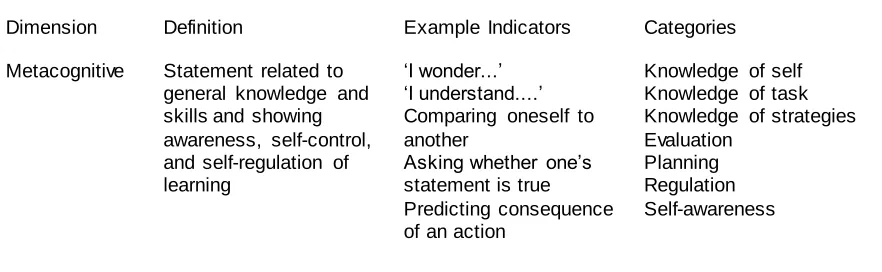
Table 1 provides the framework which has been adapted to guide the analysis of student reflections in this research due to the usefulness of the method to differentiate between the cognitive level of responses. As teachers we are concerned with ‘…the perspective of the knower and how it influences what is known and how it is known (reflexivity) (Fook, 2002 p.34)
Henri’s (1992) framework includes five dimensions of cognitive response in asynchronous discussions:
• Participative: simply the raw number of responses per individual.
• Social: those responses related to developing trust and learning community, unrelated to the
course content matter.
• Interactive: includes those responses that respond to or comment on the postings of others.
• Cognitive: these are responses which support the learning process and include elements of
understanding, reasoning, clarification, inference, judgement and strategising.
• Metacognitive: these are responses related to the knowledge of how one learns (e.g. knowledge of
[image:3.596.75.516.431.567.2]self, or the task and past successful strategies) and the skills related to effective learning (planning, regulating, evaluation and self-awareness).
Table 1 .Excerpt from (?)Henri’s Content Analysis Model
Dimension Definition Example Indicators Categories Metacognitive Statement related to
general knowledge and skills and showing awareness, self-control, and self-regulation of learning
‘I wonder...’ ‘I understand....’ Comparing oneself to another
Asking whether one’s statement is true Predicting consequence of an action
Knowledge of self Knowledge of task Knowledge of strategies Evaluation
Planning Regulation Self-awareness
The researchers are particularly interested in the metacognitive levels which represent the higher order thinking elements as it is the level of thinking that the literature supports should be evident in reflective work. Henri identified analytical models for Metacognitive knowledge and skills. This first phase paper of a longitudinal study will focus on the metacognitive skill indicators as shown in Table 2. The model allowed us to analyse results to identify the characteristics of the reflective process and the manifestations of cognitive activities and skills in learners.
Table 2. Analytical Model Metacognitive Skills
Skills Definitions Indicators
Evaluation Assessment, appraisal or verification of one’s knowledge and skills and of
the efficacy of the chosen strategy accomplishing a task
Planning Selecting, predicting and ordering an action or strategy necessary to the accomplishment of an action
Predicting the consequences of an action Organising aims by breaking them down into sub-objectives
Regulation Setting up maintenance and supervision of the overall cognitive task
Redirecting one’s efforts Recalling one’s objectives Setting up strategies
Self-awareness
Ability to identify, decipher and interpret correctly the feelings and thoughts connected with a given aspect of a task
“I’m pleased to have learned so much…” I’m discouraged at the difficulties
involved…”
Methodology
This project forms the first phase of a longitudinal project designed to evaluate the written reflections on five different assessment items in an Urban and Regional Planning and an Urban Design course taken by students at the University of Southern Queensland. Students taking this course are mainly from the Faculty of Engineering and Surveying and specifically from civil and environmental
engineering, and surveying and GIS. The de-identified qualitative data was analysed to identify themes, concepts and constructs including searching for evidence of higher order thinking. Phase Two will entail staff and student training on reflection, scaffolded reflective exercises using feedback for further reflective tasks, followed by the same evaluation strategy. Phase Three will be a
comparison of the metacognitive content in the results pre-training and post-training, supplemented by data obtained from interviewing post-training students.
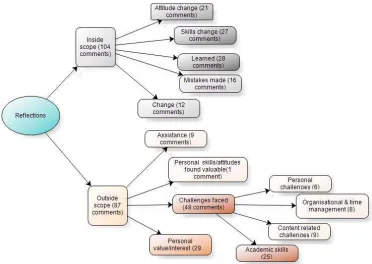
Thirty one Reflections from one course were analysed for this first phase of the research project, using simple tabulation to identify constructs, themes and concepts. The initial distinction made was between comments inside and outside the scope of the instructions , through the generation of nodes for the main and sub-categories (See Figure 1 below).
Tables were then compiled of the comments per node and those comments were categorised
according to the framework of Henri into four categories, namely Evaluation, Planning, Regulation and Self-awareness, all indicators of metacognition in Henri’s framework. The total responses/elements per Henri category was calculated to identify into which category the responses fell, both for the inside and the outside of the scope categories.
Finally, a comparison was made between the number of responses and the number of metacognitive elements as identified from the tabling process. A comparison was conducted between the numbers of responses and the number that showed metacognition and also an analysis of those that showed metacognitions inside and outside the scope of the instructions.
Results
Students focused greatly on the guidance provided in the instructions, with the majority (76 out of 104) of the comments focused on what they have learned from the ass ignment, and skills and attitude changes. Much less evidence was found of metacognitive thinking on mistakes made (16 out of 104) and even less on predictions of student behaviour adaptations in the future (12 out of 104).
academic skills (25 out of 48) with a lack of research, academic writing and referencing skills making up the bulk of the academic challenges.
Figure 1 Breakdown of comments between the categories Inside the scope and Outside the scope of the instructions. Deeper shades indicates a greater number of responses
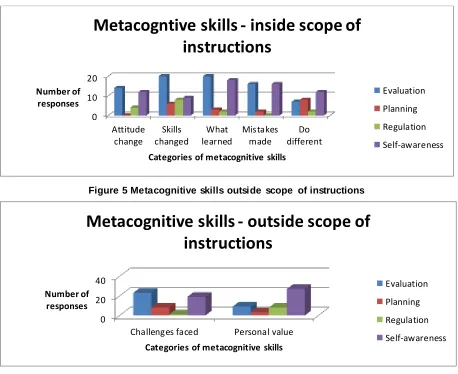
When coding the responses into Henri’s skills categories of planning, regulation, evaluation and self-awareness as shown in figures 4 and 5, of particular interest is the significantly lower number of responses in the categories of Planning and Regulation which probably could be construed as more important for the transfer of skills to new and discrete situations than Self-awareness and Evaluation.
Planning Selecting, predicting and ordering an
action or strategy necessary to the accomplishment of an action
Predicting the consequences of an action Organising aims by breaking them down into sub-objectives
Regulation Setting up maintenance and supervision
of the overall cognitive task
Redirecting one’s efforts Recalling one’s objectives Setting up strategies
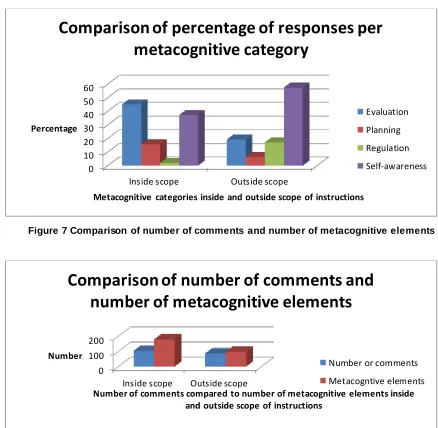
Secondly, the ratio of Evaluation/Self-awareness is almost inverted for the category Outside the scope of instructions, compared to the category Inside the scope of instructions.
Evaluation Assessment, appraisal or verification of
one’s knowledge and skills and of the efficacy of the chosen strategy
Asking whether one’s statement is true Commenting on one’s manner of accomplishing a task
Self-awareness
Ability to identify, decipher and interpret correctly the feelings and thoughts connected with a given aspect of a task
It appears as if students focused more on feelings and thoughts when reflecting on elements outside the scope of the instructions, whereas they focused more on the manner in which they accomplished tasks when dealing with the elements they were instructed to include. Some comments could be coded at more than one metacognitive category, hence the disparity between number of responses and the totals per metacognitive category.
[image:6.596.72.530.171.545.2]Figure 4 Metacognitive skills inside scope of instructions
Figure 5 Metacognitive skills outside scope of instructions
As shown in figures 6 and 7, the number of metacognitive elements in the comments were nearly double for the Inside scope category (179), than for the Outside scope (98) category. This finding ties in with the findings that students tend to reflect more on their thoughts and feelings when reflecting outside the scope of instructions and the fact that the large majority (48 out of 87) of those unsolicited responses were concerned with the challenges they faced in doing the assignment.
0 10 20
Attitude change
Skills changed
What learned
Mistakes made
Do different
Number of responses
Categories of metacognitive skills
Metacogntive skills - inside scope of
instructions
Evaluation
Planning
Regulation
Self-awareness
0 20 40
Challenges faced Personal value
Number of responses
Categories of metacognitive skills
Metacognitive skills - outside scope of
instructions
Evaluation
Planning
Regulation
Figure 6 Comparison of percentage of responses per metacognitive category
Figure 7 Comparison of number of comments and number of metacognitive elements
Discussion
Although the instructions clearly indicated that students had to reflect on mistakes and explain what they would do in a different manner, not only was the number of responses in this category low, but the number of metacognitive responses in this category was very low as well. It appeared as if most of the students had a level of self-awareness as to how effectively they had completed the
assessment, but there was no clear evidence of how that awareness was to be converted into action to ensure more effective learning in the future.
Only one of the 31 students commented on lessons learnt from previous reflections in Urban and Regional Planning assignments. Students were able to evaluate the quality of their work to a much higher level than they were able to plan for the completion of future assessment items or to put measures in place to regulate their behaviour, for example procrastination. Although the highest number of responses in the non-solicited category pertained to lacking academic skills there were no student responses on how they were going to address those shortcomings, apart from superficial comments like having to do more or better research.
“I am not used to essay writing so have agonised over the process and outcome”
“Researching different sides to an argument and applying those to the planning scheme was difficult and challenging”
0 10 20 30 40 50 60
Inside scope Outside scope
Percentage
Metacognitive categories inside and outside scope of instructions
Comparison of percentage of responses per
metacognitive category
Evaluation
Planning
Regulation
Self-awareness
0 100 200
Inside scope Outside scope
Number
Number of comments compared to number of metacognitive elements inside and outside scope of instructions
Comparison of number of comments and
number of metacognitive elements
Number or comments
[image:7.596.75.507.115.308.2]“I found completing the referencing a challenge”
The responses in the Outside the scope category showed less evidence of metacognitive thinking than the responses elicited by the instructions. It appeared that students focused their higher-order efforts on what was expected and then reported outside that scope based mainly on emot ion. Given that this is where the biggest challenges lay (academic skills) it therefore comes as no surprise that little thinking that relates to planning or regulation of future behaviour was evident in those responses. Henri defines self- awareness as an ability to identify, decipher and interpret correctly the feelings and thoughts connected with a given aspect of a task.
Some limited examples of self -regulation and evaluation were evident in both in and out of scope responses. Significantly most occurred in the out of scope responses. Henri includes asking whether one’s statement is true as an indicator of metacognitive evaluation skills.
“This bias meant that during research and the article development a continued effort was required to ensure that critical think ing was applied to all aspects and stak eholders”
From our research it can be identified that students have paid limited attention to redirecting their efforts, recalling objectives or setting up strategies (Henri, 1992). These three elements are Henri’s indicators of metacognitive regulation skills. The closest s tudent responses came to a redirection of efforts is typified by identification of the problem but no concrete strategy to rectify this in future.
“I think if I were to do this assignment again I would certainly allow myself more time to get it done. This would have allowed me to gather more sources and to explain my plan more fully.”
The other missing indicator from student responses was any recall of the objectives of the course or the assignment. There appeared to be missing any clear line of sight from the course learning objectives to this process of reflection. It may well be that context is important in an educational setting because students respond better to reflection where it is demonstrable that the reflection serves the objectives of the course. Often this is built into a project specific course and it is explicitly pointed out by examiners how the exercise will help them achieve the learning objectives for the course
Research Outcomes and Implications
The proposition put forward by this research was that students focus on the instructions provided to complete the reflective part of tasks, rather than a sound understanding of the concept of reflection as would be evidenced in reflections that go beyond the scope of instructions and that could be regarded as evidence of metacognition.
While it was anticipated that this study would reveal that students demonstrate superficial reflexivity lacking critical insight because the value of reflection for future learning has not been effectively conveyed or appreciated and the necessary reflexivity skills have not been acquired as part of course learning, our findings reveal that this is only partly the case.
Students have not demonstrated the regulatory metacognitive skill of recalling one’s objectives - that is making connections between the key learning outcomes of the course and the reflection. It may be worthy of future research to determine if explicit instruction is provided by the educator about how reflection helps achieve the learning outcomes for the course then the metacognitive skills demonstrated in the student’s reflective process improves.
As educators we may need to be more explicit in offering instructions in regard to the planning and regulation metacognitive skills to increase skill levels in selecting, predicting and ordering an action or strategy to accomplish a task and setting up maintenance and supervision of tasks. Elements of time and project management are closely related to these skills. The power of instruction to shape
REFERENCES
ANDERSON, L. W., KRATHWOHL, D. R. & BLOOM, B. S. 2005. A taxonomy for learning, teaching, and assessing, Longman.
DEWEY, J. 1933. How we think: A restatement of the relation of reflective thinking to the educational process. Lexington, MA: Heath.
ELLIOTT, A. 2007. Concepts of the Self, Polity.
FOOK, J. 2002. Social work : Critical theory and practice, Sage.
HENRI, F. 1992. Computer conferencing and content analysis. Collaborative learning through computer conferencing. Springer.
KAVANAGH, L. & O’MOORE, L. Year. Reflecting on Reflection–10 years, Engineering, and UQ. In:
19th Annual Conference of the Australasian Association for Engineering Education: To Industry and Beyond; Proceedings of the, 2008. Institution of Engineers, Australia, 92. KOLB, D. 1983. Experiential Learning: Experience as the Source of Learning and Development, New
York, Prentice Hall.
MOON, J. 2004. A Handbook of Reflective and Experiential Learning, London, RoutledgeFalmer. ROGERS, R. R. 2001. Reflection in higher education: A concept analysis. Innovative Higher
Education, 26, 37-57.
RYAN, M. & RYAN, M. 2013. Theorising a model for teaching and assessing reflective learning in higher education. Higher Education Research & Development, 32, 244-257.