This is a repository copy of Do Export Learning Processes Affect Sales Growth in Exporting Activities?.
White Rose Research Online URL for this paper: http://eprints.whiterose.ac.uk/145097/
Version: Accepted Version
Article:
Assadinia, S, Boso, N, Hultman, KGM orcid.org/0000-0003-1771-8898 et al. (1 more author) (2019) Do Export Learning Processes Affect Sales Growth in Exporting Activities? Journal of International Marketing, 27 (3). pp. 1-25. ISSN 1069-031X
https://doi.org/10.1177/1069031X19848425
© American Marketing Association 2019. This is an author produced version of a paper published in the Journal of International Marketing. Uploaded in accordance with the publisher's self-archiving policy.
[email protected] https://eprints.whiterose.ac.uk/ Reuse
Items deposited in White Rose Research Online are protected by copyright, with all rights reserved unless indicated otherwise. They may be downloaded and/or printed for private study, or other acts as permitted by national copyright laws. The publisher or other rights holders may allow further reproduction and re-use of the full text version. This is indicated by the licence information on the White Rose Research Online record for the item.
Takedown
If you consider content in White Rose Research Online to be in breach of UK law, please notify us by
1
Do Export Learning Processes Affect Sales Growth in Exporting Activities?
Abstract
Our understanding of experiential learning via export learning process, and its outcomes, is limited in the international marketing literature. Using multi-source, time-lagged data of exporting firms in the United Kingdom (U.K.) and China, this study finds that export learning process is positively associated with marketing strategy adaptation for both U.K. and Chinese exporters. Results suggest contrasting moderating effects of experiential knowledge resources (i.e., psychic dispersion, multinationality, and duration) and strategy adaptation on the relationship of export learning process and export sales growth in the two samples. In the U.K. sample, we observe a positive moderation effect of psychic dispersion, and negative moderation effects of multinationality and duration. For the China sample, we find the exact opposite pattern of moderation effects for the experiential knowledge resources. Marketing strategy adaptation plays a negative moderation role in the China sample, but has no such effect in the U.K. sample. The study has implications for theory development on, and the productive management of, processes of learning export management.
2 INTRODUCTION
Organizational learning literature suggests a firm’s ability to learn and apply new knowledge in the conduct of organizational tasks is an important driver of its strategic actions and performance (Kale and
Singh 2007). There is no scholarly consensus on the organizational learning construct (Aulakh, Kundu,
and Lahiri 2016) and, seemingly, it is multifaceted (Weerawardena et al. 2015). Indeed, one view is that
it involves the process of developing new knowledge of the external environment (e.g., customers,
competitors, and macro-environment forces) to inform strategic actions preceding performance
(Skarmeas, Lisboa, and Saridakis 2016). A second view suggests studies of learning processes and their
outcomes should emphasize knowledge furnished by the internal environment via prior operating
experiences (Edmondson et al. 2003). Exporting work (e.g., Cadogan, Kuivalainen, and Sundqvist 2009;
Gnizy et al. 2017; Souchon, Sy-Changco, and Dewsnap 2012) has concentrated on explaining how
externally focused, informational learning (i.e., know-what) drives performance in export markets. By
contrast, research on internally focused, experiential learning (i.e., know-how) linked to the skillful
execution of exporting tasks, is sparse (Tr pczy ski and Banalieva 2016). The field lacks insight into the conceptual domain, consequences, and contingencies of exporting know-how-related learning processes.
It is unfortunate that attention given to what exporters learn about the marketplace has obscured
the matter of whether firms actually know how to export. Export managers may be motivated to learn
from the marketplace as they fear their firms being outcompeted and perceive greater rewards from
learning from outsiders (cf. Menon and Pfeffer 2003). Still, knowing how to create and transfer tacit
knowledge efficiently within the exporting firm (cf. Kogut and Zander 1992) is crucial, as exporting is a
knowledge-intensive context and managers have limited time and opportunities to learn from external
information (Spyropoulou et al. 2018). Exporting know-how presents firms with a route out of difficult
economic circumstances domestically, and is a means of leveraging internal knowledge bases to exploit
3
The knowledge-based view (KBV) maintains that it is the firm’s ability to embed experiential knowledge resources in firm-level capabilities that enables the achievement of strategic goals (Kogut and
Zander 1992). Learning capabilities are the primary mechanism by which experiential knowledge is
developed and maintained, and learning about the accomplishment of tasks would allow the firm to
successfully adapt to the environment and realize new opportunities (e.g., overseas) (Morgan et al. 2003).
The current study, thus, draws on the KBV to argue that a firm’s export learning capabilities shape its adaptation strategy and sales growth in export markets. Still, no matter how advanced a firm’s capabilities might be, their function is to deploy resources. Such internal conditions are expected to affect capabilities’ economic rents (Makadok 2001). Therefore, we also posit that international experiential
resources (i.e., psychic dispersion, multinationality, and duration), alongside marketing strategy
adaptation, condition relationships of export learning process and export sales growth.
The contributions of the study are threefold. The first lies in the novelty of capturing export learning
process as an organizational capability that firms deploy systematically to excel in export operations. We
draw insights from the organizational learning and alliance literatures (e.g., Kale and Singh 2007) to
conceptualize and operationalize export learning process as a deliberate effort of exporting firms to learn,
accumulate, and deploy export managerial know-how to effectively execute export-related tasks (Morgan
et al. 2003). The importance of this exercise lies in that we currently do not have an operational definition
and measures of internal experiential learning relevant to researchers interested in understanding
processes of learning export management, and to managers interested in measuring levels of learning
within the export function of their firms. Rather, empirical exporting studies (e.g., Theodosiou and
Katsikea 2013) have focused on assessing learning processes based on external knowledge inputs.
The second contribution relates to the originality of theorizing and modeling consequences and
contingencies of export learning process. In examining marketing strategy adaptation and export sales
4
adaptation contingencies, we reveal how and when exporting firms can benefit from learning processes
(Lisboa, Skarmeas, and Lages 2013). We unveil that exporters with different profiles in terms of forms
and levels of experiential knowledge and marketing adaptation (i.e., versus standardization) (Hultman,
Katsikeas, and Robson 2011), prove differently able at using export learning process to drive sales
growth. In particular, our findings add to KBV and capabilities work (Morgan, Vorhies, and Mason 2009)
by showing that knowledge resources and learning capabilities can be complementary or substitutive.
Third, although we theorize and observe that internal contingencies shape the role of exporters’ learning capabilities, conditions in the external macro-environment may offer additional insights into
how firms benefit from such capabilities. The institutional development literature suggests conditions in
developed home markets contrast those in emerging ones, and shape how firms learn in and beyond their
home markets (Aulakh, Kundu, and Lahiri 2016; Tr pczy ski and Banalieva 2016). In anticipation of differences in external environment conditions across nations, we explore whether export learning
processes help (or hinder) exporters of the United Kingdom (U.K.) and China. Our surprising findings
(cf. Morgan et al. 2003) unveil that while the influence of export learning process on marketing strategy
adaptation is positive for both U.K. and Chinese firms, and its effect on export sales growth is generally
positive and at worst benign for U.K. firms, under certain moderation conditions the impact of learning
process on growth is negative for Chinese exporters. Prima facie, emerging economy firms lack access
to cross-border know-how sufficient to perform as successfully on the international stage as their
developed-market counterparts. We also contend that learning structures and processes that can help
mature and established exporting firms, like those in the U.K., may hold back maturing firms, such as
those in China. Drawing from the multinational organization literature (e.g., Barkema, Bell, and Pennings
1996), we discuss how export learning process provides a generic best practice that may either be a help
or hindrance, depending on the strategic contexts firms find themselves in.
5 Export Learning from a Knowledge-Based View
Marketing scholars have devoted sustained attention to understanding the export performance construct
and its drivers (Chabowski et al. 2018; Magnusson et al. 2013). Still, extant research has overlooked key
facets of organizational learning as a driver of export performance. Organizational learning has been defined as “the capacity or processes within an organization to maintain or improve performance based on experience” (Nevis, DiBella, and Gould 1995, p. 73), highlighting an earlier contention by Dodgson (1993, p. 376) that “[l]earning is a dynamic concept, and its use in theory emphasizes the continually
changing nature of organizations”. These contentions place organizational learning within the theoretical space of the KBV, which asserts that an exporting firm can derive advantages from managing its
experiential knowledge resources and becoming a learning laboratory (cf. Aulakh, Kundu, and Lahiri
2016). According to the KBV, tacit knowledge stocks—not physical assets—are the most critical resources of the firm, and heterogeneous knowledge bases across firms are the main determinants of
performance differences (Gassmann and Keupp 2007). While the broader resource-based theory suggests
resources and capabilities are likely to be heterogeneous and relatively immobile across firms
(Kraaijenbrink, Spender, and Groen 2010), the KBV elevates organizational learning as a capability that
is unique to, and variable across, firms (Cohen and Levinthal 1989).
The current study conceptualizes export learning process as an organizational learning capability
that enables exporting organizations to capture advantages in export markets. These learning processes
are internally developed within an organization and are often derived from experience (DiBella, Nevis,
and Gould 1996). Our approach extends the exporting literature that has focused on conceptualizing
learning based on inputs derived from market research (e.g., Cadogan, Kuivalainen, and Sundqvist 2009;
Lisboa, Skarmeas, and Lages 2013; Naldi and Davidsson 2014; Souchon, Sy-Changco, and Dewsnap
2012). As we show in Table 1, the emphasis has been on processes of acquiring external knowledge
6
how externally focused, informational learning affects firms’ export market strategy and performance (Lisboa, Skarmeas, and Lages 2013). The few exporting studies considering internal experiential learning
either do not directly capture the learning process underpinning how firms create and transfer experiential
knowledge within an organizational context (Morgan et al. 2003), or assess export-related outcomes of
general (not export) knowledge management skills (Villar, Alegre, and Pla-Barber 2014).
- Table 1 about here -
In defining export learning process as a capability, we capture the totality of firms’ processes to articulate, codify, share, and internalize managerial know-how to improve skills in exporting tasks. Here,
articulation refers to efforts to access and externalize individually held exporting knowledge into explicit
knowledge. Codification involves creating and using codified tools, templates, or guidelines to assist
action in future export management tasks. Sharing entails exchanging and disseminating individually
and organizationally held export management knowledge via interpersonal relations within the
organization. Finally, internalization conveys efforts to facilitate absorption of accumulated,
organization-level exporting know-how by individuals (Kale and Singh 2007). This conceptual approach is informed by Kale and Singh’s (2007) equivalent concept, alliance learning process.
Table 1 further suggests the literature has produced conflicting findings on the export performance
consequences of export learning. Certain studies have examined how processes of export learning shape
export market success within relevant boundary conditions (Theodosiou and Katsikea 2013). While a
focus on external contingencies is legitimate (cf. De Clercq and Zhou 2014), advances made by the few
studies adopting the KBV (e.g., Villar, Alegre, and Pla-Barber 2014) imply that the lack of knowledge
on how a firm’s internal knowledge activities (e.g., resources) shape the impact of export learning process on export performance, is problematic. We respond to this gap in the literature by using the KBV to
7
export sales growth outcomes of export learning process; and how export learning process drives
marketing strategy adaptation, with its sales growth outcomes being conditioned by such adaptation.
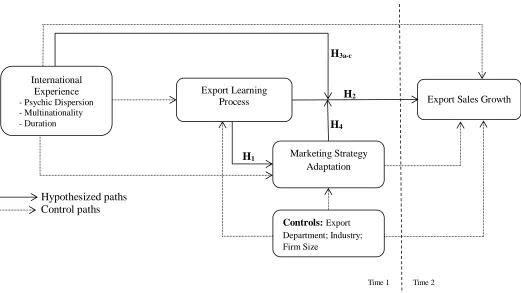
- Figure 1 about here -
As per the KBV, we make the assumption that export learning process is a capability that develops based on an exporter’s cross-border, experiential knowledge resources (Takeuchi et al. 2005; Villar,
Alegre, and Pla-Barber 2014) and control for these paths in the model. Internal, organizational learning processes are driven by the accumulation of firms’ experiences in the form of preserved behaviors, mental
maps, norms, and values (Ericsson 2006; Fiol and Lyles 1985; Ucbasaran, Westhead, and Wright 2009).
Our use of control paths, generally, allows for more focused theory development.
Although we propose a universal export learning theory applicable across national populations of
exporting firms, from a scientific point of view, we acknowledge that a contextual consideration of our
proposed model would make interpretation of the results more robust (Hambrick and Quigley 2014).
Thus, in testing theory, we explore whether export learning processes help or hinder established
international firms such as those of developed economies, in the same way as the younger generation of
firms from emerging markets (Awate, Larsen, and Mudambi 2015; Cavusgil and Knight 2015). Morgan
et al. (2003) observed no differences across developed and emerging market exporters in their testing of
the outcomes of learning-related capabilities, and remains the only export learning study to compare
these contexts. Comparisons across country samples are rare in this stream of study, generally.
Outcomes of Export Learning Process
Classical organizational learning literature argues that the ultimate purpose of learning is to inform an organization’s strategy options and growth (Burgelman, 1983; Fiol and Lyles 1985). More recent
8
export strategy and growth outcomes of the firm’s export learning process: namely, marketing strategy adaptation and export sales growth.
Marketing strategy adaptation refers to the extent to which a firm adjusts its marketing strategy to
account for variations in its export markets relative to its home market (Calantone et al. 2006). Such a
strategy involves a continuous and iterative set of decisions, ranging from virtually complete
standardization to complete adaptation of the marketing program. The expert knowledge literature argues
that deliberate, repeated practice of a task—such as continuous adaptation of strategy—enables one to fine-tune skills in executing the task (Ericsson 2006). Experts acquire knowledge in the form of
meaningful patterns about particular situations, by storing memories of their previous actions (Simon
and Chase 1973). Formulating adaptation strategies is a complex undertaking for managers, as they need
to be able to form a mental model of what adaptations are to be selected under what circumstances.
Export learning processes that articulate, codify, share, and internalize knowledge can simplify the
problem. These repositories for lessons learnt furnish export managers with anticipatory and distinctive
memory assets that develop and support routines of task planning, reasoning, and evaluation. Learning
that has been harnessed systematically from accumulated experiences of exporting offers a knowledge
base that firms can deploy to better understand the idiosyncrasies of different export markets and
resulting complexities of marketing adaptations (Evans, Mavondo, and Bridson 2008). Such a knowledge
repository helps exporters to perceive the subtleties of market mechanisms and identify opportunities to
follow and threats to avoid, resulting in export-marketing decisions that better accommodate the distinct
contingencies of each market (Westjohn and Magnusson 2017). The expert exporter’s proficiency in tailoring its offering to local market needs would improve accordingly (Hultman, Robson, and Katsikeas
2009). We thus argue that a firm’s export learning process yields an anticipatory and expert knowledge base that facilitates repeated adjustments toward marketing strategy adaptation. Hence:
9
Superior organization of export learning processes not only helps exporters determine their export
strategy adaptation options, but also offers insights into how to drive efforts to influence performance in
export markets. Here, we capture export performance as firms’ export sales growth, defined as the percentage change in export sales over time (Morgan, Kaleka, and Katsikeas 2004); which is indicative
of the health of a firm’s exporting operations. From a KBV perspective, a firm’s ability to sustain its competitive edge and grow in export markets depends on its ability to configure and deploy tacit
knowledge resources via learning capabilities (cf. Peng 2001). As an organizational capability, processes
of export learning capture the firm’s exporting experiences and competencies, which enables the firm to coordinate exporting tasks by matching these knowledge resources with opportunities to stimulate
demand growth (Ibeh and Kasem 2014; Souchon, Sy-Changco, and Dewsnap 2012).
The ability of an exporting firm to articulate and externalize exporting knowledge held by export
personnel enables it to better understand cause-and-effect links in the export market (Kale and Singh
2007). Greater articulation of exporting know-how helps firms to be more effective in using explicit
knowledge to respond to export customer needs and grow sales revenues. Similarly, deliberate efforts of
firms to document export market activities and expertise with exporting tasks may help enhance export managers’ understanding of how and why things work in certain situations. Greater codification of
exporting knowledge not only enriches internal reference sources for export personnel, but also creates
an opportunity to transfer best export practices across functional units. A firm should be more effective
in growing export sales when its export market knowledge is codified and guidelines are made accessible
to current and future export decision-makers, and other key audiences within the firm.
A firm’s ability to deploy exporting know-how relevant to growth opportunities is dependent on the diffusion, via interpersonal relations, of existing knowledge related to the execution of exporting
tasks. Still, the dissemination of knowledge across the firm is necessary but not sufficient for export
10
be internalized by individual recipients for use in their work tasks. For learning competences to help an
exporter grow sales, individuals must be able to extract know-how held by the firm. Sharing and
internalizing knowledge helps firms improve their ability to sense and exploit market opportunities (Bell,
Whitwell, and Lukas 2002). In sum, we contend that when the overall level of export learning process is
high, the exporting firm is more likely to realize sales growth opportunities overseas (Yeoh 2004):
H2: Export learning process is positively related to export sales growth.
Export Learning Process, International Experience, and Export Sales Growth
Experiential learning from repeated practice is a primary mechanism for discovering and exploiting
international opportunities (Vahlne and Johanson 2017). In essence, knowledge acquired from past
international experience helps exporting firms gain and utilize new knowledge (Chetty, Eriksson, and
Lindbergh 2006). The more a firm internationalizes its operations, the more internationally experienced
its management becomes, conferring on the firm tacit knowledge that other firms would find difficult to
access. Crucially, exporting firms internationalize in different ways and the profile of their experience is
difficult to express since cross-border experiences vary in practice. We posit that international experience
comprises three conceptually distinct components: psychic dispersion, multinationality, and duration of
exporting (Brouthers et al. 2009; Qian and Delios 2008). Psychic dispersion is captured as the number
of geographically diverse regions (i.e., global not country regions) to which a firm exports products or
services (Cadogan, Kuivalainen, and Sundqvist 2009), and multinationality stems from the number of
foreign country-markets the firm serves (Cadogan et al. 2009). While psychic dispersion exposes the
firm to broad external uncertainty across regions, which requires cognitive simplification,
multinationality is an expansion strategy based on incremental behaviors. For instance, a US exporter
serving the U.K. market might develop processes harnessing its experiences of U.K. consumers,
11
proximate European countries. Duration captures the number of years a firm has been exporting
(Brouthers et al. 2009), and enables the exporter to enhance its learning competence over time.
Resource complementarity and substitution logics within resource-based theory suggest firms
possess (knowledge) resources and capabilities that may be mutually complementary or substitutive
(Hakala 2011; Morgan, Vorhies, and Mason 2009). From a complementarity standpoint, resources must
be combined to support each other when there is a payoff relationship between them. Srivastava, Fahey,
and Christensen (2001) argued that resources should be integrated, transformed, and leveraged to produce
an overall organizational process that generates economic value for the firm. However, classical
economic theory argues that it is almost impossible for a firm to configure one resource to complement
every other resource (Lachmann 1947). It is likely to substitute for certain other resources and there is
no marginal benefit in investing in resources that interact negatively (Kaya and Seyrek 2005). The notion
of universally beneficial resources may be replaced by the principle that the efficacy of some resources
or capabilities in driving performance is dependent upon other resources or capabilities of the firm
(Noble, Sinha, and Kumar 2002). Indeed, we posit that the efficacy of export learning processes in driving
export sales growth hinges upon the international experiential knowledge resources a firm possesses.
Following resource complementarity logic, as psychic dispersion increases, the exporting firm
should be more capable of responding to export market variations in terms of customer needs and
competitive moves and growing in export markets (Cadogan, Kuivalainen, and Sundqvist 2009).
Eriksson and colleagues (2000) argued that the knowledge required to underpin a firm’s growth in foreign markets must be current and culturally specific, such that greater experiences in geographically dispersed
regions can facilitate an inflow of new knowledge resources to the firm and its development and
commercialization of viable products for different foreign markets (Patel et al. 2014). Nonetheless, it
stands to reason that the breadth of such an internal knowledge resource requires cognitive simplification
12
market opportunities for the reuse of knowledge. The firm’s efforts to use export learning process to coordinate exporting tasks and create sales growth, require experience, knowledge, and meaning
constructed from activities in psychically dispersed regions. By contrast, expert coordination efforts are
more likely to fail in the aforementioned matching process, and misfire, for low-psychic dispersion
exporters that lack broad knowledge resources to integrate. We thus argue that with greater capability to
articulate, codify, share, and internalize export market knowledge, and with greater experience in doing
business in psychically dispersed regions, a firm increases its chances of achieving export sales growth:
H3a: The impact of export learning process on export sales growth is moderated by psychic dispersion, such that as export learning process increases and the degree of psychic dispersion increases, the effect of export learning process on export sales growth becomes more positive.
We follow resource substitution logic to propose a negative moderating effect of multinationality
on the relationship between export learning process and export sales growth. High-multinationality
exporters that operate in many markets—which may fall within multilateral free-trade agreements—are likely to approach exporting tasks in a manner that emphasizes scale and experience effects via the
repeated execution of similar routines across markets. The deployment overseas of stringent knowledge
management practices concerning institutional (e.g., regulations) and business (e.g., expectations of
customers) conditions (Eriksson, Majkgård, and Sharma 2000) would seem of limited value for a firm
with greater multinationality, as institutional and business knowledge is gained incrementally across the
international portfolio. High-multinationality exporters’ reliance on a systematic export learning process could even be counterproductive when the knowledge required to succeed is understood and utilized,
automatically and repeatedly, by decision-makers across country markets. In the absence of specific
lessons and best practices that export managers need to absorb before making decisions about new
markets, export learning processes’ articulation, codification, sharing, and internalization of task execution would slow the realization of incremental growth opportunities. By contrast,
13
act more creatively in serving fewer country markets. When an exporter’s tasks involve more than the ongoing repetition of established sets of practices, it will be amassing knowledge that is fresh and diverse
(Samiee and Chirapanda 2019). Such knowledge requires coordination via export learning process to
improve the firm’s ability to productively exploit market opportunities. Thus, when multinationality is low not high, efforts to harness export managerial know-how are a worthwhile investment. Accordingly:
H3b: The impact of export learning process on export sales growth is moderated by multinationality, such that as export learning process increases and the degree of multinationality decreases, the effect of export learning process on export sales growth becomes more positive.
We likewise use resource substitution logic to posit that as the duration of exporting increases,
managerial overconfidence and structural inflexibility and inertia (Heimeriks 2009; Russo and
Schoemaker 1992) inhibit the potency of export learning process in driving export sales growth. As a
firm accumulates additional years of international experience, its managers may begin to lack the
humility to embrace all available knowledge (Cain, Moore, and Haran 2015). In addition, a greater
number of years of exporting could generate structural inflexibilities that hamper the firm’s ability to learn new skills and follow opportunities to grow (Autio, Sapienza, and Almeida 2000). Export learning
process improves export managers’ understanding of how and why things work under particular conditions, but only if they are willing and able to learn and modify behaviors accordingly. In the
presence of duration-induced barriers, learning processes would struggle to furnish the exporter with
sales growth benefits. Alternatively, a firm with limited years of export operations is more likely to
possess an organic organizational structure receptive to proactive learning, which encourages the ability
to quickly perceive and realize new export market opportunities (Banerjee, Prabhu, and Chandy 2015;
Eesley and Roberts 2012). Firms with fewer years of export operations are receptive to relying on the
sum of their managers’ creativity in accessing the export market-specific knowledge needed to grow in foreign markets (Eriksson, Majkgård, and Sharma 2000). Inexperienced firms facing liabilities of
14
managers’ personal contacts and interactions to amass and act on new know-how about foreign markets
(Patel et al. 2014). Export learning processes that articulate, codify, share, and internalize this
individually held knowledge can render it useful for driving demand growth overseas. Hence:
H3c: The impact of export learning process on export sales growth is moderated by duration, such that as export learning process increases and the duration of exporting decreases, the effect of export learning process on export sales growth becomes more positive.
Export Learning Process, Marketing Strategy Adaptation, and Export Sales Growth
Learning capabilities can drive a firm’s marketing strategy adaptation decisions, and both are expected to shape performance overseas (Katsikeas, Samiee, and Theodosiou 2006). Still, the fact that
cross-national differences in consumer needs, competitive moves, and cross-national socio-cultural and economic
conditions justify increases in marketing strategy adaptation (Zeriti et al. 2014), and increases in export
market learning are warranted in culturally heterogeneous circumstances (Ruigrok and Wagner 2003),
does not necessarily imply that higher levels of both would generate superior export sales growth.
Hultman, Katsikeas, and Robson (2011) observed that knowledgeable exporters tend to derive greater
performance benefits from marketing strategy standardization, not adaptation; exporters with limited
knowledge are more likely to favor mimetic isomorphism and adapt in line with local competitors’ marketing strategies to enhance performance (Banerjee, Prabhu, and Chandy 2015). For knowledgeable
exporters, marketing decision-making is “an evolutionary process, and the factors influencing the adaptation decision upon entry might change when the exporting firm accumulates knowledge about foreign markets” (Hultman, Katsikeas, and Robson 2011, p. 24). Effectively, exporters evolve by
harnessing knowledge to maximize performance gains offered by standardization.
We contend that firms engaging in routines to articulate and codify knowledge of how export
markets work and to share and internalize such experiential knowledge, are better able to uncover
opportunities to grow export sales if they are attempting to standardize (not adapt) marketing strategy.
15
2003). As opposed to adaptation strategies that, by nature, differ across export markets, standardization
strategies naturally overlap and, thus, competence in experiential learning can be harnessed productively
via reoccurring strategic decisions. Standardization strategies run the risk of neglecting local customers’ loyalty as they are extended to new markets (Thompson and Chmura 2015). Where exporters become
knowledgeable via an effective learning process, they can more confidently leverage internal resources
linked to the standardization approach, and achieve sales growth by exploiting communalities between
markets rather than opting for the safety net of local legitimacy (Hultman, Katsikeas, and Robson 2011).
Alternatively, pursuing strategic variations in export markets involves numerous new task experiences.
These are not always conducive to deriving performance advantages from processes that systematically
harness prior experiences and retrospective sense-making with respect to managerial know-how.
Further, export learning process drives sales growth by matching knowledge resources with
opportunities to stimulate demand. Coordinating such a process involves concerted cognitive and
behavioral efforts on the part of the exporting firm and its managers. Adaptation itself is a
resource-intensive strategic activity that is onerous to maintain (Koza, Tallman, and Attay 2011). If
internationalization increases information-processing demands on a firm’s managers (Lu and Beamish 2004), adaptation strategies that embrace country disparities magnify these demands. It stands to reason
that finite managerial resources allocated to outwardly focused adaptation decisions, cannot also and
easily be deployed to harness inwardly looking competence in coordinating exporting know-how. Thus:
H4: The impact of export learning process on export sales growth is moderated by marketing strategy adaptation, such that as export marketing strategy adaptation becomes greater, the effect of export learning process on export sales growth becomes less positive.
METHODS
Research Contexts
16
similarities also exist. Both countries’ elevation in economic terms is attributable to global trade. The
total value of U.K. exports reached US$ 444.25 Billion in 2017 (Office of Trade Statistics of the U.K.),
and China has become the world’s largest exporter of merchandized goods with total export values exceeding US$ 2.26 Trillion in 2017 (World Bank 2017). Besides empirically examining the theoretical
model across one developed market and one emerging market—both with potent exporting sectors—we used multi-industry samples in our efforts to enhance generalizability (Murray, Gao, and Kotabe 2011).
In line with previous studies focusing on active exporters’ firm-level resources and capabilities, we used the firm-level as our unit of analysis (e.g., Cadogan, Kuivalainen, and Sundqvist 2009).
Data and Samples
The U.K. study: We relied on two sources to develop the sampling frame for the study: Dun & Bradstreet and the Queen’s Award for International Trade directory. We began by drawing a random sample of
1,000 exporters and initially contacted these firms by phone to (1) evaluate their eligibility for the study,
(2) verify their contact details, (3) find key informants, (4) pre-notify informants of the study execution and objectives, and (5) uncover informants’ preferred questionnaire administration method. We
identified 658 eligible firms that suited our selection criteria. A mail packet or formal email with a
questionnaire link was sent to the informants with extensive knowledge of the firms’ export operations (e.g., chief executive officers, export sales directors, and international development managers).
Following two additional phone calls, two follow-up letters, and/or emails, we received 224 responses.
We excluded 16 responses owing to extensive missing data or to a low score for knowledge,
responsibility, or confidence in the post hoc informant quality test (see Morgan,Katsikeas, and Vorhies
2012) and five statistically outlying cases, leaving 203 valid responses. Subsequently, we obtained
three-year export sales data for 176 of the 203 firms externally from the Bureau van Dijk and ICC Plum
17
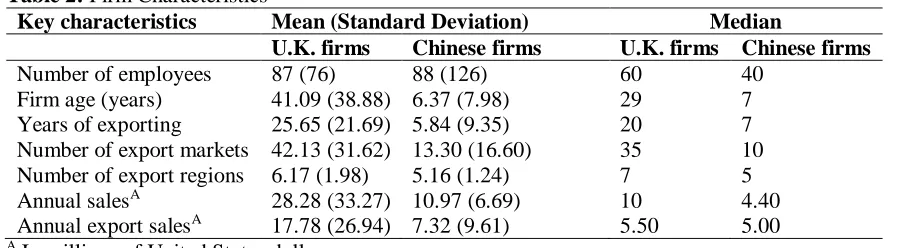
42 markets and operated in 6 global regions on average. Their average total annual sales was US$28.28
Million, out of with 62.87% was from export sales.
The China study: The sampling frame for the China study was created from a list provided by FOB Business Forum; supplemented by a second list obtained from China’s National Bureau of Statistics. In
combining these sources, a sampling frame of 2,300 Chinese firms was created. A research firm was then
hired in China to contact senior managers (e.g., chief executive officers, managing directors, and export
sales directors) in the 2,300 firms by phone to solicit their participation in the study. The initial contact
procedures and eligibility requirements were broadly consistent with those used for the U.K. sample. A
total of 589 firms declined participation and were excluded from the study. The remaining 1,711 firms
were visited by trained researchers who conducted interviews using a Mandarin version of the U.K.
questionnaire. The Mandarin version was professionally translated from English and back-translated by
a native speaker working with the research firm, helping guarantee linguistic equivalence of the
measures. We obtained 299 valid responses. Given that the survey was administered by a research agency
on our behalf, upon its completion 10% of the firms (selected at random) were contacted by phone to
verify their responses. All firms contacted confirmed their earlier responses to the questionnaire items.
Next, we obtained three-year export sales data for 198 of the 299 firms externally from the FOB Business Forum and China’s National Bureau of Statistics databases. After removing 8 cases for severe
outliers, 190 Chinese firms are used for this study—an effective response rate of 11%. As can be seen from Table 2, on average, the Chinese firms employed 88 full-time staff, had been in business for 6.37
years, and had been exporting for 5.84 years and exported to 13 countries and 5 global regions. Average
annual sales was US$10.97 Million, and 66.73% of these were attributable to export sales. The sample
profiles in terms of firm characteristics and industries represented correspond well with the overall
market profiles of exporting firms in the two countries (www.uktradeinfo.com; www.stats.gov.cn).
18 Measure Development
We developed the survey instrument from prior research following a thorough review of relevant
literature, and adapted it to the specific context via pretests and field interviews. First, an initial version
of the questionnaire was revised via in-depth discussions with five academics familiar with research on
learning processes and exporting. Second, the revised questionnaire was reviewed by an academic expert
with extensive knowledge of international marketing. Third, we conducted face-to-face interviews with
five U.K. and ten Chinese export managers. We asked the managers about their firms’ export learning activities and the outcomes of these. They also scrutinized the wording and design of the questionnaire.
International experience: We conceptualized international experience as three distinct
components: psychic dispersion, multinationality, and duration of exporting. Following Cadogan,
Kuivalainen, and Sundqvist (2009), we captured psychic dispersion by asking informants to select the “regions to which your firm currently exports” (the provided options were: Western Europe (including
all European Union (E.U.) countries); Eastern Europe (excluding all E.U. countries); Russia and Eurasia;
Africa; the Middle East; Asia; Australia and New Zealand; South and Central America; and North
America). We then summed the regions selected. Multinationality was tapped as the natural logarithm
of the “number of countries to which your firm exports” (Hultman, Katsikeas, and Robson 2011). We measured duration via the natural logarithm of the “number of years your firm has been exporting” (Hultman, Katsikeas, and Robson 2011).
Export learning process: We measured export learning process with items modified from Kale and Singh’s (2007) reflective scales. As per Kale and Singh (2007), and guided by field interviews with
export managers, learning process was treated as a second-order construct with knowledge articulation,
codification, sharing, and internalization dimensions. The rationale is that each dimension is conceptually
distinct, but also centered on the learning and accumulation of export management know-how (Kale and
19
following statements about your firm’s export learning process”. Items measuring each dimension were
captured on a seven-point Likert-type scale, where 1 = “strongly disagree” and 7 = “strongly agree”. As shown in Table 3, alpha values for each dimension in both samples exceed .76.
Marketing strategy adaption: Our reflective measure of marketing strategy adaptation was based
on those used by Aulakh, Rotate, and Teegen (2000) and Magnusson et al. (2013). Consistent with these
studies, we adopted a first-order approach—with each item tapping a different marketing program element—instead of the less parsimonious second-order approach (cf. Katsikeas, Samiee, and Theodosiou 2006). Although the measure focused on the firm’s marketing program in its export markets, guided by the prestudy interviews and in line with Aulakh and colleagues (2000), we omitted distribution.
Our interviewees suggested that channel structure can be hard to adapt given its structural rigidity and
inter-firm connectivity, and it may not act in concert with other program components (Navarro et al.
2010) and have the same nomological associations. Decisions regarding product/service, promotion, and
pricing are the means by which firms’ offerings adapt to idiosyncrasies of overseas markets (Cavusgil and Zou 1994). We used the prompting sentence, “Please indicate the degree to which the following export marketing strategy elements are standardized/ adapted in your foreign markets compared to your domestic market”. Each item was assessed on a scale anchored by 1 = “highly standardized” and 7 = “highly adapted” ( : U.K. = .86; China = .93).
Export sales growth: We used objective data to measure export sales growth in order to avoid bias
associated with self-reported performance measures (Dencker and Gruber 2015; Hult and Ketchen 2001;
Vorhies, Orr, and Bush 2011). The reasons for concentrating on export sales growth are threefold. First,
theorists (e.g., De Clercq et al. 2012; Naldi and Davidsson 2014) have argued that in view of the
long-term consequences of organizational learning process, growth is a natural measure of performance in
learning studies. Second, in addition to tapping performance, export sales growth reflects resource
20
performance in exporting research (Katsikeas, Leonidou, and Morgan 2000), export sales growth fits
with the KBV premise that economic rents are driven by knowledge resources and capabilities. Third,
Tuli and colleagues (2010, p. 37) assert that sales growth is of pragmatic importance because “managers are often evaluated on this metric [… and] viewed as a valuable metric by financial analysts as firms with higher sales growth receive higher valuations”. Our time-lagged operationalization of export sales
growth (for clarity, time 2) tapped percentage change in export sales for the three years directly following
data collection of the independent variables (time 1). Use of a three-year average helps control the impact
of any short-term, unobserved event on export sales growth. A logarithmic transformation was applied
to normalize the data. In the U.K. study, we validated the objective export sales growth measure on the
basis of its high correlation (r = .88; p < .01) with a scale-based measure of export sales performance.
Controls: To control for industry and firm heterogeneity effects on our dependent variables, export
learning process, marketing strategy adaptation, and export sales growth, we included an industry dummy
variable (services = 0, manufacturing = 1) (Boso, Cadogan, and Story 2013), and used the natural
logarithm of total number of full-time employees as an indicator of firm size (Morgan, Vorhies, and
Mason 2009). We tapped the presence of a dedicated export department using a dichotomous variable
(no = 0, yes = 1) (Katsikeas 1994), which we also linked to our dependent variables. Not only might
firms with export departments enjoy greater exporting success, but also a dedicated department would
use resources to develop capabilities and strategic practices to this end (cf. Kale and Singh 2007). Our
measures and their validation statistics are reported in Table 3.
- Table 3 about here -
ANALYSIS AND RESULTS
Bias Assessments
We assessed the threat posed by two main biases: non-response bias and common method bias. First, we
21
of annual sales and the number of full-time employees. No significant differences were found. Second,
a comparison of the 176 U.K. responses and 41 randomly selected non-participant firms, revealed no
significant differences in the means of annual sales and the number of full-time employees between the
groups. Similar results were obtained when the 190 China responses were compared to a group of 58
non-participants. Thus, non-response bias does not pose a problem in this study.
We followed recommended ex ante procedural remedies (Ketokivi and Schroeder 2004; Podsakoff
et al. 2003) to minimize the threat of method bias by using multiple data sources per observational unit.
Although the dependent variable came from a source different from the independent variables, we
conducted an ex post statistical analysis to check if there is evidence of method bias in our data. Following
the marker variable procedure (Malhotra, Kim, and Patil 2006), we used the second smallest positive
correlation between the study variables (0.02 for both samples) as a marker variable proxy and then
calculated adjusted correlations among the variables. The adjustment did not change the significance
level of any coefficient, which suggests method bias is not an issue in this study.
Measure Validation
A confirmatory factor analysis (CFA) was undertaken for the multi-item reflective constructs in the
model using maximum likelihood estimation in LISREL 8.71. A good model fit was obtained for both
samples: U.K.: 2(D.F.) = 167.89 (94); non-normed fit index (NNFI) = .99; comparative fit index (CFI) = .99; root mean square error of approximation (RMSEA) = .00; China: 2(D.F.) = 136.47 (94); NNFI = .98; CFI = .96; RMSEA = .02. Export learning process was assessed as a second-order factor, and the
weights linking export learning process to knowledge articulation, codification, sharing, and
internalization are all significant at the 1% level: knowledge articulation (U.K.: = .66; t = 7.95; China: = .89; t = 9.94); knowledge codification (U.K.: = .85; t = 9.29; China: = .81; t = 7.03); knowledge
22
Next, we undertook reliability, convergent validity, and discriminant validity evaluations for the
two samples. The scores for composite reliability and average variance extracted (AVE) for all constructs
exceed the standard benchmarks of .70 and .50, respectively, in the U.K. and China samples.
Standardized factor loadings for indicators of all constructs are significant at the 1% level. The AVEs for
each respective pair of constructs are superior to their corresponding squared correlations. Thus, we
confirm the discriminant validity of each multi-item scale used to measure components of the export
learning process construct across both samples (Fornell and Larcker 1981).
After establishing acceptable CFA model fit for each sample individually, we evaluated the
equivalence of the multi-item measures across both samples using the hierarchical tests approach
(Steenkamp and Baumgartner 1998). Accordingly, a multi-group CFA of all items was undertaken,
focusing on showing that our measures achieve configural (i.e., the measures demonstrate the same
pattern of factor loadings), metric (i.e., evidence of equal loadings), factor variance (i.e., equality of
factor variances), and error variance (i.e., equal measurement error) invariances (Steenkamp and
Baumgartner 1998). Findings revealed that the measures capturing the multi-item constructs are invariant
across the samples and, thus, appropriate for hypothesis testing purposes. The configural ( 2(D.F.) = 503.86 (201); NNFI = .90; CFI = .91; RMSEA = .09), metric ( 2(D.F.) = 408.27 (213); NNFI = .91; CFI
= .91; RMSEA = .08), and factor variance ( 2(D.F.) = 430.01 (226); NNFI = .92; CFI = .93; RMSEA = .07) invariance tests all returned acceptable fits to the data. Although the error invariance test produced
a poor fit given significant variance in the error terms across the two samples, the model did converge: 2(D.F.) = 683.26 (246); NNFI = .82; CFI = .86; RMSEA = .11. Details of the results of the measurement
model assessment are presented in Table 3.
Structural Model Estimation
Given that the multi-item perceptual measures were observed to be invariant across the two samples, we
23
to assess whether (or not) our hypothesized relationships are equivalent across the U.K. and China
samples. To this end, we first estimated a two-group structural model in which the measures of the
constructs and the structural paths between the constructs were constrained to be invariant across the two
samples. The results obtained for this model were relatively poor: 2(D.F.) = 332.98 (96); NNFI = .82;
CFI = .84; RMSEA = .10. A second two-group structural model was estimated in which the measures of
the constructs were held equal across both samples, but the parameters for the structural paths between
the constructs were allowed to vary freely. The large drop in chi-square (∆ 2 = 235.83; ∆D.F. = 56; p < .01) and observed improvement in fit heuristics (NNFI = .91; CFI = .94; RMSEA = .07) indicated that
the model that assumes equality of measures but differences in structural paths has a better fit than the
model that assumes equality of both measures and structural paths. Thus, heeding Anderson and Gerbing’s (1988) advice, structural paths for the U.K. and the China samples were analyzed separately.
We used moderated structural equation modeling (MSEM) to test moderating effect relationships
(Cortina, Chen, and Dunlap 2001). The MSEM approach helped us incorporate product terms of export
learning process and marketing strategy adaptation and with the single indicants used to measure
multinationality, psychic dispersion, and duration, in the assessment of the moderation effects. A mean
value was created for the export learning process variable from its multi-item reflective indicators.
Because product terms contain measurement error that might not be normally distributed, we followed Agustin and Singh’s (2005) advice and Ping’s (1998) two-step, single-indicant estimation procedure for
these terms. Ping’s (1998) approach is seen to produce robust estimates (Cortina et al. 2001). Hence, having orthogonized all the variables that were involved in multiplicative terms (Little, Bovaird, and
Widaman 2006), we multiplied the respective variables involved in the interactions (e.g., export learning
process multiplied by psychic dispersion). We then estimated the structural model and set the error
24
variances of the linear terms in the structural model. For the single indicant measures (such as psychic
dispersion, multinationality, and duration) we assumed a composite reliability value of .70 when
computing the error variances (Ping, 1995). We then used Ping’s (1995) equations to calculate the item loadings and error variances of the interaction terms.
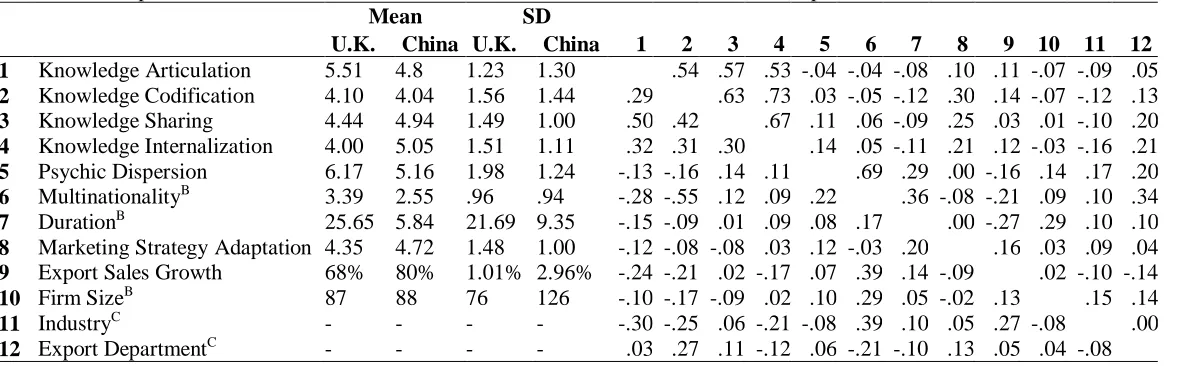
Details of the descriptive statistics and inter-construct correlations for our constructs, in the U.K.
and China samples, are reported in Table 4. Given that our Figure 1 framework has multiple outcome
variables (i.e., export learning process, marketing strategy adaptation, and export sales growth), we
estimated six nested models to account for changes in chi-square (degrees of freedom) and R2, which
facilitated a comparison across the models for the U.K. and China samples. The largest variance inflation
factors in the models—2.74 for the U.K. and 2.07 for China—fall below conventionally used thresholds (i.e. 5.00 or 10.00), and we can conclude that multicollinearity is not a problem in interpreting the results.
In Model 1, we estimated effects of control variables on export learning process. In Model 2,
control paths from psychic dispersion, multinationality, and duration to export learning process were
added to this model and estimated. Similar procedures were then followed to estimate effects of control
paths and predictor variables on marketing strategy adaptation (Model 3 and Model 4) and export sales
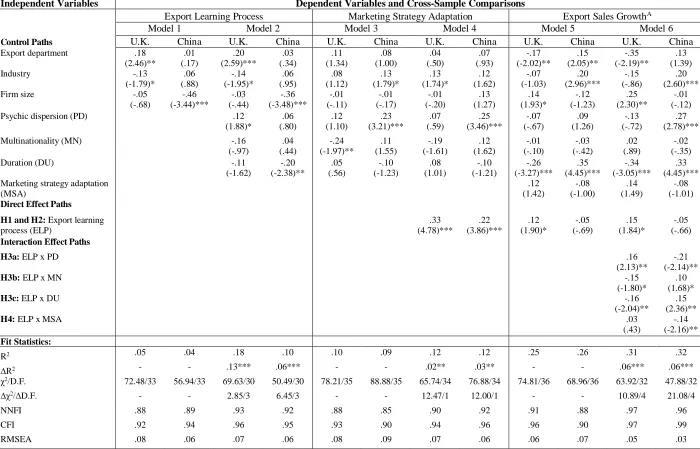
growth (Model 5 and Model 6). Overall, Model 6 returned superior fit statistics in both samples (see
Table 5). Specifically, results show good model fit for the U.K. sample: 2(D.F.) = 63.92(32); p < .05;
NNFI = .97; CFI = .97; RMSEA = .05; R2: export learning process = .18; marketing strategy adaptation
= .12; export sales growth = .31. Good model fit was also obtained for the China sample: 2(D.F.) =
47.88(32); p > .05; NNFI = .96; CFI = .99; RMSEA = .03; R2: export learning process = .10; marketing
strategy adaptation = .12; export sales growth = .32. Using Model 6 to interpret our hypotheses (it also
contains export learning process and marketing strategy adaptation outcomes), five of the six are
supported in the U.K. sample, while two hypotheses are supported in the China sample.
25
Our Model 2 findings suggest psychic dispersion is positively linked to export learning process in the UK sample ( = .12; t = 1.88; p < .10), while duration is negatively linked to export learning process in the China sample ( = -.20; t = -2.38; p < .05). With respect to the control variables, for the UK sample,
the presence of an export department drives export learning process ( = .20; t = 2.59; p < .01), whereas industry (i.e., manufacturing) attenuates export learning process ( = -14; t = -1.95; p < .10). In the China
sample, firm size is negatively related to export learning process ( = -.36; t = -3.48; p < .01).
Moreover, regarding outcomes of export learning process, we argue in H1 that export learning
process is positively linked to marketing strategy adaptation. Our Model 4 supports this assertion in both
the U.K. ( = .33; t = 4.78; p < .01) and China ( = .22; t = 3.86; p < .01) samples. Here, there are two significant control paths: industry is positively linked to adaptation in the U.K. sample ( = .13; t = 1.74; p < .10); and psychic dispersion drives adaptation in the China sample ( = .25; t = 3.46; p < .01).
The study contends that export learning process is positively related to export sales growth. We
find, in Model 6, that export learning process is positively associated with export sales growth in the
U.K. sample ( = .15; t = 1.84; p < .10), while no relationship exists in the China sample ( = .05; t = -.66; p > .10). Thus, H2 is only accepted for the U.K. We also theorize that these direct effects are
conditioned by the international experience components. Specifically, H3a argues that increases in export
learning process and higher levels of psychic dispersion are associated with increases in export sales
growth. Our findings reveal that when export learning process and psychic dispersion take on greater
values, there is a positive effect of export learning process on export sales growth for the U.K. firms ( = .16; t = 2.13; p < .05); which provides support for H3a in this sample. However, the coefficient in the
China sample for the product term of export learning process and psychic dispersion is negative ( = -.21; t = -2.14; p < .05), suggesting H3a is rejected.
We argue in H3b and H3c that increases in export learning process and greater multinationality and
26
at higher levels of multinationality, there is a corresponding decrease in the effect of export learning
process on export sales growth in the U.K. sample ( = -.15; t = -1.80; p < .10). Conversely, higher levels of multinationality are associated with a stronger effect of export learning process on export sales growth
in the China sample ( = .10; t = 1.68; p < .10). Hence, H3b is rejected in the China sample. We find that while the association between export learning process and export sales growth is attenuated when
duration of exporting takes on higher values in the U.K. sample ( = -.16; t = -2.04; p < .05), the path is accentuated when duration is larger in the China sample ( = .15; t = 2.36; p < .05). Thus, H3c is supported
in the U.K. sample but rejected in the China sample.
We propose in H4 that as marketing strategy adaptation becomes greater, the effect of export
learning process on export sales growth becomes less positive. While H4 is rejected in the U.K. sample
as the product term of export learning process and marketing strategy adaptation is not significant ( = .03; t = .43; p > .10), it is supported in the China sample as the coefficient is negative ( = -.14; t = -2.16; p < .05). As regards the Model 6 control paths, in the U.K. sample, export department and duration of
exporting are negatively linked to sales growth ( = -.35; t = -2.19; p < .05 and = -.34; t = -3.05; p < .01, respectively), while firm size is positively linked to sales growth ( = .25; t = 2.30; p < .05). For
Chinese exporters, industry is positively related to export sales growth ( = .20; t = 2.60; p < .01), as is psychic dispersion ( = .27; t = 2.78; p < .01) and duration ( = .33; t = 4.45; p < .01). The absence of
significant effects of adaptation on sales growth in both samples, upholds the view that there is no
one-size-fits-all solution to export strategy adaptation decisions (Hultman, Robson, and Katsikeas 2009).
We plotted the relationship between export learning process and export sales growth under
differing levels of the moderators, following Aiken and West’s (1991) procedures. Specifically, we estimated the effect of export learning process on export sales growth under high versus low values of
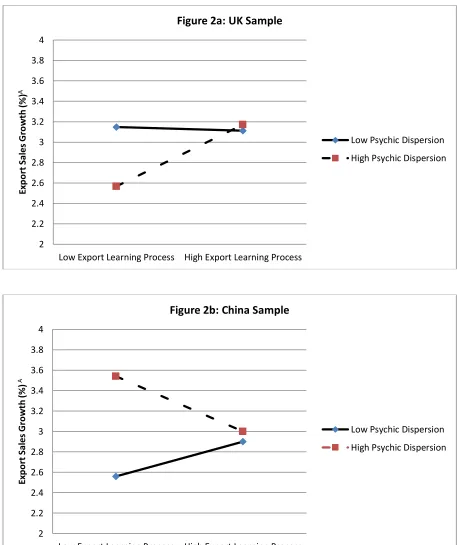
the international experience and marketing strategy adaptation moderators. In Figure 2a and Figure 2b,
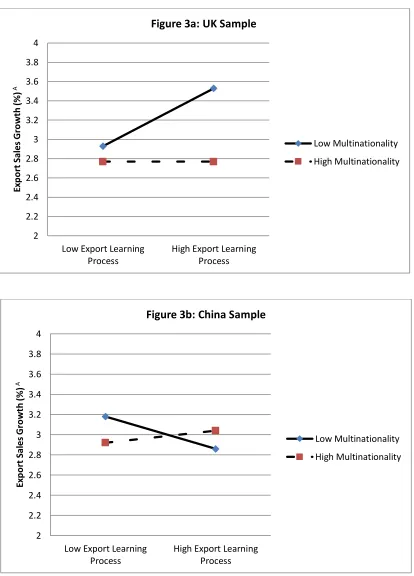
27
condition; which boosts export sales growth when paired with high export learning process in the U.K.
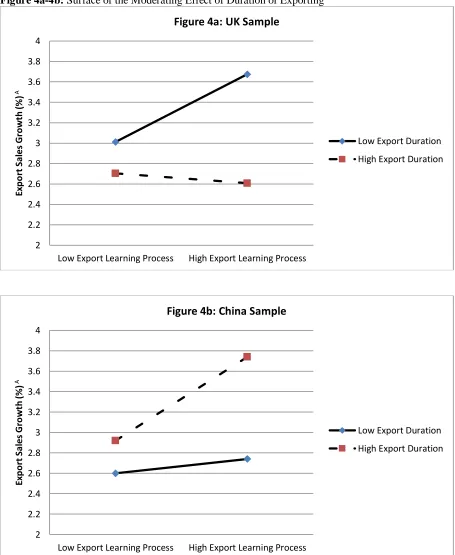
sample, and low export learning process in the China sample. Figures 3a and 3b demonstrate that
moderation effects of multinationality are facilitated mainly by low multinationality; which enhances
export sales growth when coupled with high export learning process in the U.K. sample, and low export
learning process in the China sample. Figure 4a reveals that the moderation effect of export duration in
the U.K. sample can be attributed to low duration, which boosts export sales growth when paired with
high export learning process in the U.K. sample. Figure 4b suggests the moderation effect of duration in
the China sample is driven by high duration, which boosts export sales growth when paired with high
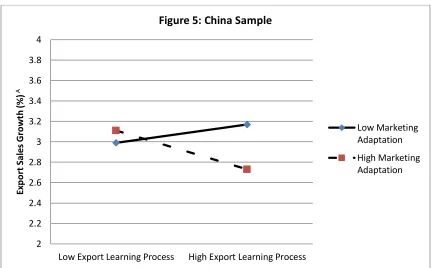
export learning process. In Figure 5, we show that the moderation effect of marketing strategy adaptation
in the China sample is driven by high adaptation, which augments export sales growth when coupled
with low export learning process. Overall, the plots imply that while the influence of export learning
process on export sales growth is either positive or benign for U.K. exporters, high levels of export
learning process are detrimental for Chinese exporters under certain conditions. Findings from additional
analyses show that our modeling is robust (see supplementary Online Appendix).
- Figures 2, 3, 4, and 5 about here -
DISCUSSION
Theoretical Contributions
The ideas discussed in the article add to two main areas of research: export learning theory and the KBV
position that exporting firms develop and benefit from experiential learning processes; and the matter of
how the strategic contexts of exporting firms in developed and emerging markets influence their learning.
Contributions to knowledge on export learning theory: While the organizational learning literature
has for a long time emphasized the theoretical distinction between know-what and know-how forms of
28
informational learning processes that harness the former (e.g., Souchon, Sy-Changco, and Dewsnap
2012; Theodosiou and Katsikea 2013). A rare exception is Morgan et al. (2003), but their empirical study
stops short of directly capturing the experiential learning process underpinning how exporters create and
transfer knowledge. As such, scholars have taken crucial steps in advancing our understanding of export
processes for acquiring and using external knowledge about the export marketplace. But the lack of
insight into how export learning processes convert internal knowledge from an organization’s experiences to develop its competences in the execution of export-related tasks, continues to inhibit
export management theory development and testing (Lages, Abrantes, and Lages 2008). Our study is the
first to conceptualize export learning process as an organizational learning capability that enables firms
to learn, accumulate, and deploy export management know-how (cf. Kale and Singh 2007). In doing so,
we apply and extend the KBV assertion that firms are capable of turning themselves into learning
laboratories to exploit existing intellectual assets (cf. Aulakh, Kundu, and Lahiri 2016). We rely on data
from U.K. and Chinese exporting firms to validate our second-order, export learning process construct
and measures of its knowledge articulation, codification, sharing, and internalization dimensions.
The study is also novel in theorizing and modeling how exporting firms can benefit from their
exporting know-how. Drawing from the KBV, we posit that an exporter’s understanding and know-how can be embedded in organizational learning capabilities that, via the more skillful accomplishment of
exporting tasks, allow it to adapt to the environment and achieve its strategic growth goals (Kogut and
Zander 1992; Morgan et al. 2003). We also adopt specific insights from the experiential knowledge
literature (e.g., Banerjee, Prabhu, and Chandy 2015) to theorize that complementarity and substitution
effects between knowledge resources and learning capabilities underpin moderating effects of
experiential knowledge components on the sales growth outcomes of export learning process (Hakala
2011). The study results confirm that different experience components play different roles in
29
2009). Here, we advance the notion that international experience is a multifaceted and complex construct
that is not best captured using broad-brush conceptualizations—the effects of which should be treated with caution (Hultman, Katsikeas, and Robson 2011). Finally, we reveal for the first time not only that
export learning process drives marketing strategy adaptation, but also that its sales growth outcomes are
conditioned by the level of adaptation. The study’s comprehensive moderation thesis helps bridge a gap in the exporting literature regarding contingencies of the export learning–firm performance relationship (De Clercq and Zhou 2014).
Contributions to knowledge on export learning in different strategic contexts: Given the paucity of
theory on whether export learning process helps or hurts exporting firms in developed and emerging
markets (cf. Adekambi et al. 2015), we developed a universal model of conditional outcomes of export
learning process. Nonetheless, our H1assertion that a firm’s export learning process facilitates repeated adjustments toward marketing strategy adaptation was the only hypothesis to receive support for both
U.K. and Chinese exporters. Surprising findings—especially for the China sample—suggest contextual considerations can add valuable precision to our a priori theorization (Hambrick and Quigley 2014; Tr pczy ski and Banalieva 2016). An important implication of the study is that the KBV may be
cross-fertilized with insights from research on multinational organizations (e.g., Zellmer-Bruhn and Gibson
2006) and, cultural and institutional differences (e.g., Barkema, Bell, and Pennings 1996).
Literature on multinational organizations suggests macro-environmental factors can shape
processes firms put in place to induce learning (Zellmer-Bruhn and Gibson 2006). Large heterogeneity across firms’ macro environments worldwide, creates learning barriers as a result of the complexities of
management systems and contradictions that emerge (Ghoshal 1987). Barkema and colleagues (1996)
suggest firms are able to overcome these barriers to learning in heterogeneous environments through
time and incremental experiences. In light of our H2 findings, that export learning process is positively
30
like those in the U.K. (see Table 2) are more capable of using cross-border learning processes to achieve
growth in foreign markets than maturing firms like those in China. Given their liability of newness
overseas and fluid internal structures, younger, emerging market firms are likely to utilize network ties,
and not formalized processes, to learn about exporting to foreign markets (Cavusgil and Knight 2015).
While Chinese firms can be ambitious in developing new external knowledge contacts in export markets,
they are reliant on long-term ties with domestic institutional contacts that have connections overseas to
address foreign-market learning barriers (Zhou, Wu, and Luo 2007). The lack of a positive main effect
of export learning process on sales growth could stem from the difficultly of transitioning from an
entrepreneurial model that leverages external know-how from contacts in China and overseas, to a model
of internalizing and formalizing know-how. That exporters may struggle to combine internal, experiential
with external, network sources of know-how contrasts theory on learning processes capable of integrating
diverse forms of know-what (Mena and Chabowski 2015), and is an intriguing avenue for future research.
In our experiential knowledge moderation hypotheses, we theorized that learning processes’ export coordination efforts are more likely to succeed in driving sales growth for: high-psychic dispersion
exporters with broad-based knowledge resources to integrate (H3a); low-multinationality exporters that
act creatively in amassing knowledge on fewer country markets (H3b); and low-duration exporters willing
and able to learn from managers’ activities and modify behaviors accordingly (H3c). While these
hypotheses were supported in the U.K. sample, we observed the exact opposite pattern of moderation
effects in the China sample. A high level of export learning process dampens Chinese exporters’ sales growth under the conditions of high psychic dispersion, low multinationality, and low export duration.
Maturing multinational enterprises may view the world as their marketplace and, as such, expand
widely to different regions. However, the business culture of Chinese firms values existing relationships
over the immediate gratification of growing by forging new ones (e.g., with importers in many new