
Territorial cohesion and structural funds programmes: urban development and territorial cooperation
93
0
0
Full text
(2) European Policies Research Centre University of Strathclyde Graham Hills Building 40 George Street Glasgow G1 1QE United Kingdom Tel: +44 (0) 141 548 3339/3321 Fax: +44 (0) 141 548 4898 E-mail: [email protected] [email protected] http://www.eprc.strath.ac.uk/eprc/default.htm http://www.eprc.strath.ac.uk/iqnet/iq-net/index.html. May 2005.
(3) Territorial Cohesion and Structural Funds Programmes: Urban Development & Territorial Cooperation. PREFACE. The research for this paper was undertaken in preparation for the fourth meeting of Phase III of the Structural Funds exchange-of-experience network, IQ-Net, which took place in Newcastle upon Tyne, UK in May 2005. The paper has been written by Laura Polverari, Nina C. Quiogue, Frederike Gross and Dr. Vit Novotny. This paper is the product of desk research and fieldwork visits among national and regional authorities in Member States (notably among partners in the IQ-Net Consortium) during spring 2005. The field research team comprised: Tobias Gross (Austria). Frederike Gross and François Josserand (Belgium, France). Helle Hjortnæs and Prof. Henrik Halkier (Denmark). Prof. Douglas Yuill (Finland). Dr Sara Davies (Germany). Laura Polverari (Italy). Carlos Mendez (Spain). Nina C. Quiogue (Sweden). Dr. Martin Ferry (United Kingdom). Dr. Vít Novotný (New Member States). The proof-reading and formatting of the final text was undertaken by Rhona Walker and Lynn Ogilvie respectively. This paper was revised following the Newcastle meeting in line with the comments of IQ-Net partners and the substance of discussions at the meeting. The research team wishes to thank all those who participated in the research, in particular all interviewees from our partner organisations, Dr. Kai Böhme from the ESPON Coordination Unit, Carlos Gorostiza from Bilbao Ria 2000 and Fotoula Glendinning, Planner at Glasgow City Council (Development and Regeneration Services). EPRC also gratefully acknowledges the financial support provided by participating programmes, which is cofinanced by technical assistance from the European Regional Development Fund. For further information about IQ-Net, and access to the full series of IQ-Net Review Papers and IQ-Net Thematic Papers, visit the IQ-Net website at: http://www.eprc.strath.ac.uk/iqnet/default.cfm .. IQ-Net Thematic Paper 16(2). i. European Policies Research Centre.
(4) Territorial Cohesion and Structural Funds Programmes: Urban Development & Territorial Cooperation. IQ-Net Thematic Paper 16(2). ii. European Policies Research Centre.
(5) Territorial Cohesion and Structural Funds Programmes: Urban Development & Territorial Cooperation. IQ-NET NEWCASTLE – 23-25 MAY 2005 TERRITORIAL COHESION AND STRUCTURAL FUNDS PROGRAMMES: URBAN DEVELOPMENT & TERRITORIAL COOPERATION. 1.. INTRODUCTION ...................................................................... 1. 2.. TERRITORIAL COHESION, URBAN DEVELOPMENT AND INTERREGIONAL COOPERATION: EU LEVEL PRIORITIES ............................................... 2 2.1 2.2 2.3. 3.. ROLE OF URBAN AREAS IN STRUCTURAL FUNDS PROGRAMMES ....................16 3.1 3.2 3.3. 4.. Toscana ............................................................................ 45 Niederösterreich .................................................................. 47 Norra ............................................................................... 49. THE URBAN CI IN PARTNER REGIONS ...............................................51 7.1 7.2. 8.. Northern Ostrobothnia (West of Finland) ...................................... 42. URBAN-RURAL PARTNERSHIP ......................................................45 6.1 6.2 6.3. 7.. Paìs Vasco .......................................................................... 31 Western Scotland ................................................................. 34 North-East England ............................................................... 37 Nordrhein-Westfalen and Sachsen-Anhalt ...................................... 40. URBAN AREAS AS ENGINES FOR GROWTH ..........................................42 5.1. 6.. Categorisation of IQ-Net partners’ programmes ............................... 16 Approaches to urban development: reactive, proactive and urban-rural partnership ........................................................................ 21 Domestic Urban Policies and alignment with the Structural Funds .......... 23 3.3.1 Aligned policies....................................................................23 3.3.2 Non-aligned policies ..............................................................26. REACTIVE APPROACHES: URBAN REGENERATION ..................................30 4.1 4.2 4.3 4.4. 5.. From economic and social to territorial cohesion ...............................2 From territorial cohesion to territorial capital and potential: a new role for urban systems ...................................................................... 4 Territorial cooperation – a new way of overcoming regional problems ..... 12. Glasgow: Clydebank Waterfront ................................................. 53 Other Urban II CI programmes in IQ-Net regions ............................... 54 7.2.1 Graz .................................................................................54 7.2.2 Dortmund...........................................................................55 7.2.3 Dessau...............................................................................55. TERRITORIAL COOPERATION EXPERIENCES ........................................57 8.1 8.2. Perceived benefits of territorial cooperation .................................. 57 Problems and difficulties ......................................................... 59. IQ-Net Thematic Paper 16(2). iii. European Policies Research Centre.
(6) Territorial Cohesion and Structural Funds Programmes: Urban Development & Territorial Cooperation. 9.. THE URBAN DIMENSION IN THE NEW MEMBER STATES .............................61 9.1 9.2. 10.. FUTURE PERSPECTIVES ............................................................72 10.1 10.2 10.3. 11.. Territorial challenges and urban areas ......................................... 61 Approaches to urban development ............................................. 63 9.2.1 Non-specific approaches to urban development .............................64 9.2.2 Semi-specific approaches to urban development............................66 9.2.3 Specific approaches to urban development ..................................67. Commission Proposals ............................................................ 72 IQ-Net partners’ views on urban development support ....................... 74 Territorial cooperation theme ................................................... 76. ISSUES FOR DISCUSSION ............................................................78 11.1 11.2 11.3 11.4. Urban centres as economic drivers ............................................. 78 More tangible territorial cooperation ........................................... 78 Policy integration and cross-fertilisation ....................................... 78 Increasingly devolved governance .............................................. 79. IQ-Net Thematic Paper 16(2). iv. European Policies Research Centre.
(7) Territorial Cohesion and Structural Funds Programmes: Urban Development & Territorial Cooperation. TERRITORIAL COHESION AND STRUCTURAL FUNDS PROGRAMMES: URBAN DEVELOPMENT & TERRITORIAL COOPERATION EXECUTIVE SUMMARY This paper discusses the territorial dimension of European Cohesion policy focusing, in particular, on the role of the Structural Funds for the support of urban areas and territorial cooperation. Starting off with a review of the evolution of relevant spatial concepts - such as those of territorial cohesion and polycentric development - in academic and policy documents, the paper turns to the analysis of current programmes and to the discussion of future challenges in integrating these goals in future Structural Funds programmes. Territorial cohesion, urban development and territorial cooperation: EU level priorities European regional and cohesion policy is a territorially discriminating policy: it operates in selected areas only. Its main aims, however, have traditionally been to support economic and social development in lagging regions or regions affected by specific challenges. In other words, whilst being discriminating territorially, European regional policy – as defined in Article 2 of the EU Treaty (former Article B), and Article 2 and 158 of the EC Treaty – is essentially a policy for economic and social development. Since at least the end of the 1990s, however, there have been trends towards a broader understanding of regional policy (at least at the European level and in some Member States), an understanding that integrates the traditional economic and social goals with specific spatial or territorial objectives. From a European perspective, this change of approach is marked by the approval in 1999 of the European Spatial Development Perspective (ESDP). Even though the actual extent of the innovation introduced by the ESDP as regards the Structural Funds programmes was limited, the thinking behind this document has left some legacy, leading to the concept of ‘territorial cohesion’. The Commission brought forward this new concept first in 2001 and then in 2004 in its Second 1 and Third 2 Reports on Economic and Social Cohesion. The Third Cohesion Report,. 1 Whilst the formulation of the Treaties refers to economic and social cohesion as being among the objectives of the Union - Article 2 EU Treaty, former Article B, and Articles 2 and 158 of EC Treaty. In reality, the Amsterdam Treaty introduced in Article 16 of the EC Treaty (ex Article 7D EC Treaty) the wording ‘territorial cohesion’, but with a circumscribed relevance, ie. only with reference to the services of economic general interest 2. The Constitution text delivered by the European Convention in July 2003 and currently awaiting ratification has added ‘territorial’ cohesion to the objectives of the Union, by adding the word territorial in Article 3 (Objectives of the Union) and by naming the whole Section 3 on cohesion ‘Economic, Social and Territorial Cohesion’, hence giving constitutional and binding status to this policy aim.. IQ-Net Thematic Paper 16(2). v. European Policies Research Centre.
(8) Territorial Cohesion and Structural Funds Programmes: Urban Development & Territorial Cooperation. in particular, includes territorial cohesion among the objectives of EU Cohesion policy 3 and dedicates two pages to the topic of ‘Territorial imbalances in the distribution of towns and cities’ 4 , emphasising the concept of urban systems as economic drivers and arguing for a more balanced distribution of such centres across the European territory. In policy terms, this implies shifting efforts from ‘reactive measures’, those tackling the improvement of the social, economic and environmental situation of cities, to more ‘proactive’ measures aiming at creating the conditions for the full exploitation of the cities’ true economic potential. The fact that urban and, more generally, regional development are increasingly being linked to the networking and cooperation between cities (and between regions) has determined a new emphasis on this aspect of regional development. In its proposals for future Cohesion policy, the Commission dedicates a third Objective to territorial cooperation. The themes of urban development and territorial cooperation are also given prominence in the draft Community Strategic Guidelines for 2007-13 Cohesion policy support (May 2005) which also include a reference to the concept of polycentric development. The role of urban areas in current Structural Funds programmes The extent of inclusion of urban measures in the mainstreamed Objective 1 and 2 programmes varies considerably across and within countries. This variation can be attributed to two main factors. The first factor is the nature of the areas covered by the programmes. Where the programme area is predominantly rural, measures for the development of urban areas in the strict sense cannot be found. A second factor is the degree of integration between Structural Funds programmes and domestic (national or regional) policies for urban development (and, more generally, the broader regional strategies and the role attributed to urban areas in these). Presenting partner programmes along a continuum, from highly urbanised areas (i.e. areas with high population density, high concentration of business activity, negligible primary sector, and good accessibility) to non-urbanised areas (i.e. sparsely populated areas with negligible business activity, high degree of primary production and very low accessibility), at one end of this spectrum can be found programmes such as Nordrhein Westfalen (NRW), Pais Vasco, North-East England and Western Scotland, all of which include large urban agglomerates and high population density. At the other end of the spectrum can be found the sparsely-populated Norra Norrland region, which has one of the lowest population densities of Europe, large parts of the territory characterised by mountainous areas with vast uninhabited forests, population settlements mainly concentrated along the coastline and an economy characterised by a high dependency on the public sector, high costs of travel and declining industrial activities. Others programmes which can be classified as ‘non-urban’ include those of Norra, Lombardia and Nordjylland. All other partner. 3. European Commission (2004) A New Partnership for Cohesion: Convergence, Competitiveness, Cooperation. Third Report on Economic and Social Cohesion, Luxembourg, Office for Official Publications of the European Communities, p. 27. 4. European Commission (2004) A new partnership for Cohesion: Convergence, Competitiveness, Cooperation. Third Report on Economic and Social Cohesion, p. 28-29.. IQ-Net Thematic Paper 16(2). vi. European Policies Research Centre.
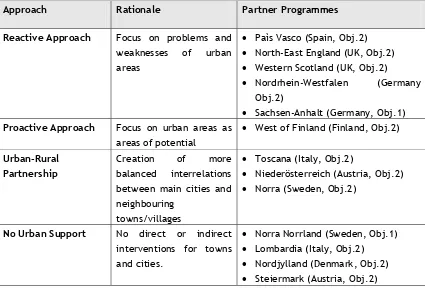
(9) Territorial Cohesion and Structural Funds Programmes: Urban Development & Territorial Cooperation. programmes can be found in between these two extremes, either closer to the ‘urban’ end of the spectrum, or nearer to the ‘non-urban’ end. Most programmes operate in diversified areas. The IQ-Net partner programmes entail different policy responses to the urban development theme. These have been categorised as ‘reactive’, ‘proactive’, ‘urban-rural’ and ‘nonurban’. Reactive approaches are found in programmes where special emphasis is placed on the problems and weaknesses of urban areas. These can be found in those programmes which include high urban conurbations (i.e. the Spanish programme of the Paìs Vasco, the two UK Programmes of North-East England and Western Scotland, and to a more limited extent, in the two German programmes for NRW and Sachsen Anhalt). In such cases, the programme intervenes directly to support urban areas with particular socio-economic problems. The programmes which implement this approach tend to include large infrastructure projects of urban renewal and regeneration, characterised by: high volume of resources; participation of local partners, also from the private sector, in the financial package; and the predominance of physical investments (such as buildings, transport infrastructure, urbanisation works etc.). These measures are often complemented by other types of interventions, such as training initiatives, employment policies, entrepreneurial support and similar. ‘A proactive approach’, which is evident particularly in the Länsi-Suomi Objective 2 programme, is more indirect. Urban areas here are not targeted in the programme per se, but are by default supported as part of a wider economic development strategy which places emphasis on growth poles and on their specialisation. The investments funded in this case are of an economic nature (business infrastructure, aids to firms and start-ups, training and R&D) and flow naturally towards the main urban centres. In this case, the emphasis is placed on the strengths rather than the weaknesses of the urban centres, which are supported as places of potential. The ‘urban-rural approach’ is followed by programmes which include interventions for urban areas of smaller scale (both the urban areas and the interventions). In such cases, the interventions implemented in the urban areas are diversified, ranging from small regeneration projects aimed at the re-launch of local businesses and trade; cultural infrastructure such as youth centres, museums, theatres etc.; social infrastructure like nurseries etc., all of which aim to improve the standard of living of citizens and the development of communities (e.g. by improving the attractiveness of the regions for tourism). The IQ-Net partner programmes that feature this approach are Toscana (Italy), Niederösterreich (Austria) and Norra (Sweden). Last, the ‘non-urban’ partner programmes (Norra Norrland in Sweden, Lombardia in Italy, Nordjylland in Denmark) are mainly focussed on strengthening population settlements and improving standards of living. It should be noted that the three approaches above (reactive, proactive and urban-rural partnership) are not mutually exclusive. Indeed, a number of programmes present a mixed approach. In some cases, the policies implemented for urban areas under the Structural Funds programmes are aligned with the broader domestic policies implemented in this IQ-Net Thematic Paper 16(2). vii. European Policies Research Centre.
(10) Territorial Cohesion and Structural Funds Programmes: Urban Development & Territorial Cooperation. field, whilst in others Structural Funds and domestic policies for urban areas are nonaligned. The paper presents some examples from both categories and detailed case studies for reactive, proactive and urban-rural approaches, drawing from: (i) the programmes of Paìs Vasco, Western Scotland, North East England, NRW and Sachsen-Anhalt; (ii) the SPD of Northern Ostrobothnia (Länsi-Suomi); and, (iii) the programmes of Toscana, Niederösterreich and Norra. It also discusses selected experiences with the Urban Community Initiative in the partners regions. Territorial Cooperation in current Structural Funds programmes The views on territorial cooperation expressed by the IQ-Net partners are rather ambivalent: on the one hand, cooperation is regarded as something positive in itself; on the other hand, cooperation projects are reported to entail significant difficulties and challenges. The paper highlights some overarching benefits of territorial cooperation and some examples of good practice amongst the IQ-Net partner regions. The main benefits associated with territorial cooperation relate to the exchange of information, “know-how” transfer and increased networking. Amongst the IQ-Net partners, cooperation has facilitated the development of new contacts and the establishment of networks which have extended beyond the timescale of the projects. Cooperation projects have also contributed to reduce the negative effects of borders, making European integration more visible, to generate additional funding for regional development and to increase the regions’ role in managing and implementing the programmes. The fact that territorial cooperation favours exchanges in sectors of excellence and at the same time the transfer of knowledge between more advanced and less-advanced regions is also seen as a way to encourage a more balanced development across Europe. However, territorial cooperation has also entailed a number of challenges for the regions involved. One of the main difficulties associated with territorial cooperation projects is the fact that the projects’ outcomes and results tend to be intangible and hardly visible. The Interreg programme is felt to be vague and complex as well as, in some cases, scarcely transparent. A further main criticism concerns the lack of proportionality in the administrative requirements of cooperation projects. The significant administrative efforts necessary to carry out such projects are resource-consuming and this is challenging especially for smaller organisations. The differences in the competencies attributed to the regional and sub-regional levels in various countries and the differing domestic administrative traditions have also contributed to make projects implementation rather complex and to delay project completion. Last, a number of partner programmes have experienced practical difficulties such as the physical distances of peripheral regions, the effectiveness of excluding private actors as project partners, communication difficulties between the participants in the cooperation project and internal difficulties related to domestic allocation of competence over the coordination of Interreg.. IQ-Net Thematic Paper 16(2). viii. European Policies Research Centre.
(11) Territorial Cohesion and Structural Funds Programmes: Urban Development & Territorial Cooperation. The urban dimension in the new Member States The paper reviews also the approaches to urban development that are being implemented in the Structural Funds programmes of the new Member States. These appear to adopt a combination of both ‘proactive’ and ‘reactive’ methods of addressing urban development. The proactive measures include improving the business environment and support for businesses and information technologies. The reactive measures include tackling poverty and deprivation, thus ensuring balanced development of cities. Overall, the ‘reactive’ approach to urban development is underplayed in the programming documents for the current period, not least due to the lack of financial resources available, but also for a general tendency to favour the goal of national growth over the reduction of intra-national inequalities. Most new Member States display a combined approach to urban development. Depending on national circumstances non-specific, semi-specific and specific approaches are brought together with an aim to form a cohesive strategy. Non-specific approaches rely on programming documents territorially covering both urban and rural areas, whereas specific approaches recognise urban development as a goal in itself which is reflected in the structure and language of programming documents. Future perspectives and partners’ views on urban development and territorial cooperation support in the 2007-13 programmes In its Third Report on Economic and Social Cohesion, the Commission places strong emphasis on the themes of urban development and territorial cooperation. Both themes are also discussed in the draft Community Strategic Guidelines for 2007-13 Cohesion policy support. For urban areas, the draft Guidelines advocate the need to support the competitiveness of neighbouring cities and ‘Functional Urban Areas’, and the “balance between the economically strongest regions and the rest of the urban structure”. 5 For territorial cooperation, the Guidelines stress the need for complementarity of cross-border and transnational cooperation with the three development priorities identified. The views about future urban support vary across Member States and regions but some emerging trends can be identified among the IQ-Net partner organisations. Concerns have been raised over the opportunity to select a priori a list of urban areas. Some suggest that flexibility is needed as regards the areas that will be supported and on the choice to include urban support in the programmes. Some IQ-Net partners highlight that it would be inappropriate to adopt a rigid definition of ‘urban areas’ – for example based on population thresholds – as this would not allow taking into account the variety of situations in Member States and regions. There are mixed views, amongst IQ-Net partners, as to whether urban areas will be assisted in future programmes. Some partners consider such inclusion to be likely, others do not envisage a strong role of the Funds in the urban development field. With reduced. 5. European Commission (2005) Ibidem.. IQ-Net Thematic Paper 16(2). ix. European Policies Research Centre.
(12) Territorial Cohesion and Structural Funds Programmes: Urban Development & Territorial Cooperation. resources, moreover, it will be difficult to strike a balance between urban and rural interests. Equally, there are no clear views yet on the likely content of the support to urban areas. This is due to the uncertainties over fundamental issues such as the level of funding available and the types of eligible activities. Overall, however, some partners have expressed an interest about the possibility of funding urban transport measures in future programmes. As regards the selection of projects eligible for support, it has been underlined that support should not be granted in consideration of the ‘urban’ localisation of the initiatives per se, but in consideration of the quality of the strategic project-design and of the nature of the projects. The need to correct the ‘perverse effects’ of Structural Funds rules is also emphasised, in particular with reference to the N+2 rule which has led to priority being given to the more ‘mature projects’ that are not necessarily the best in terms of the impacts achieved. 6 A lack of clarity of the provisions contained in the draft regulations is also stressed, as a number of expressions are not specific enough and could raise interpretation difficulties (e.g. ‘urban agglomerations’, or ‘participative, integrated strategies’). Some IQ-Net partner countries and regions stress the need to reduce the complexity of urban support measures and to take more explicitly into account the need for proportionality between resources allocated and bureaucratic demands. This is a general point, but which applies particularly to the urban measures, in consideration of the decentralisation of responsibilities to towns and cities. Last, urban support should not be equated with urban regeneration and, if urban regeneration projects will continue to be implemented under the Cohesion policy umbrella, efforts should be paid to ensure the quality and coherence of the projects with the socioeconomic goals of the programmes. The views of IQ-Net countries and regions are also diversified as regards territorial cooperation. Opinions on the mainstreaming of interregional cooperation are ambivalent. Some IQ-Net partners consider this favourably, others underline that the inclusion of interregional cooperation in the mainstreamed programmes should not be obligatory, for example in consideration of the administrative complexity of such projects. In terms of funding allocations, some IQ-Net partners suggest that the resources for territorial cooperation should not be increased (mainly because of the high administrative burdens associated with cooperation projects which are disproportionate to the results delivered). Concern is also expressed as regards the identification of new and innovative projects, suggesting the need to place more emphasis on cross-border rather than on interregional cooperation. Member States should be entitled to decide on the financial allocations, reflecting their different priorities. The general focus on competitiveness is also viewed as problematic to implement. Current cooperation programmes, suggest some IQ-Net partners, have failed to integrate successfully direct and indirect forms of support to firms. 6. ACT Consultants (2005), Ibidem, p. 85.. IQ-Net Thematic Paper 16(2). x. European Policies Research Centre.
(13) Territorial Cohesion and Structural Funds Programmes: Urban Development & Territorial Cooperation. Concerning the practical aspects of territorial cooperation projects, partner regions ask for: a clarification of the respective responsibilities of Member States and European Commission, a better definition of the role of the Managing Authorities, and the development of a solid legal basis for transnational financial management and control. A more strategic implementation is also being advocated. This should be achieved, for example, by linking cross-border and transnational cooperation projects to the mainstreamed programmes, so as to ensure more coherence and synergy between thematic projects. Moreover, current territorial cooperation experiences should be taken into account in the definition of the new rules, so as to maximise the knowledge gained and correct any area in need for improvement. Issues for discussion After having reviewed a wide range of issues about current and prospective European Cohesion policy support to urban development and territorial cooperation, the paper highlights a number of issues for discussion. EU Cohesion policy is being increasingly aligned with the objectives of the so-called Lisbon agenda (competitiveness and growth). In this context, the role played by urban centres is gaining prominence. Urban centres and systems are viewed increasingly as engines for growth and drivers of competitiveness. This implies a policy shift from reactive to proactive approaches to the support of urban areas. What are the experiences/views of IQ-Net partners on: (i) The role of urban centres as economic drivers? (ii) The role of Structural Funds in development of urban centres and systems? (iii) The instruments that should be used to support urban centres as economic drivers? (iv) The need for support to be different for the regions in the Convergence and those in the Competitiveness and Employment Objectives? The Commission and the Member States widely acknowledge the added value of territorial cooperation programmes. Yet, territorial cooperation initiatives have not delivered tangible outcomes, and it is difficult to assess their cost-effectiveness. What are the IQ-Net partners' experiences/views on: (i) The proposed strategic territorial cooperation framework? (ii) The proposed implementation framework (i.e. does this tackle the difficulties experienced during the current programming period?) (iii) The necessary steps to overcome past problems and make the outcome of cooperation initiatives more tangible in the future? The programming and implementation of the current generation of Structural Funds programmes have highlighted that it is not easy to integrate different policy perspectives in drafting and implementing the programmes and the related projects. It has been difficult, in particular, to reconcile the perspective of economic and social development with those of the planning of physical infrastructure investments. How can better synergies between the two policy spheres be achieved? What communication and cooperation instruments should be put into place to make sure that the objectives of Cohesion policy are met? How is it possible to ensure that all the different types of intervention (namely those for urban development and territorial cooperation) operate in synergy for the achievement of the objectives of Cohesion policy (e.g. as regards project selection)?. IQ-Net Thematic Paper 16(2). xi. European Policies Research Centre.
(14) Territorial Cohesion and Structural Funds Programmes: Urban Development & Territorial Cooperation. Current policy proposals emphasise the role of local authorities in Structural Funds programming and implementation. This entails a number of challenges: local authorities are not necessarily equipped in terms of human resources to face the demanding bureaucratic requirements of the Funds; their staff are not always au fait with the ‘language’ of the Structural Funds; local design and delivery cannot leave out of consideration the need for regional and supra-regional coordination. What conditions should be put into place to make sure that the local authorities can successfully meet the challenges implied by a more devolved framework? How would the respective roles of national and regional governments change? How can the regions become effective facilitators?. IQ-Net Thematic Paper 16(2). xii. European Policies Research Centre.
(15) Territorial Cohesion and Structural Funds Programmes: Urban Development & Territorial Cooperation. IQ-NET NEWCASTLE – 23-25 MAY 2005 TERRITORIAL COHESION AND STRUCTURAL FUNDS PROGRAMMES: URBAN DEVELOPMENT & TERRITORIAL COOPERATION 1.. INTRODUCTION. This paper discusses the territorial dimension of European Cohesion policy, focusing, in particular, on the role of the Structural Funds for the support of urban areas and territorial cooperation. It has been prepared through a mix of desk and field research, the latter undertaken by the IQ-Net research team in March-April 2005. Starting off with a review of the evolution of relevant spatial concepts - such as those of territorial cohesion and polycentric development - in academic and policy documents (Section 2), the paper turns to the analysis of current programmes. Section 3 presents the role of urban support in the current Structural Funds programmes. This is followed by a categorisation of partners’ approaches to urban development and by a detailed illustration of the practical policy solutions that such approaches entail (Sections 4 to 6). This is complemented by a review of selected Urban II programmes (Section 7). Section 8 discusses partners’ territorial cooperation experiences, providing an assessment of the perceived benefits and challenges. A review of the urban development theme in the programmes of the new Member States is presented in Section 9. Section 10 examines the latest debate on the role of urban and territorial cooperation in 2007-13, discussing the Commission’s proposed guidelines and the views of IQ-Net partners. To conclude, Section 11 outlines some issues for discussion at the Newcastle IQ-Net meeting.. IQ-Net Thematic Paper 16(2). 1. European Policies Research Centre.
(16) Territorial Cohesion and Structural Funds Programmes: Urban Development & Territorial Cooperation. 2.. TERRITORIAL COHESION, URBAN DEVELOPMENT AND INTERREGIONAL COOPERATION: EU LEVEL PRIORITIES. 2.1. From economic and social to territorial cohesion. European regional and cohesion policy is a territorially discriminating policy: it operates in selected areas only. Its main aims, however, have traditionally been to support economic and social development in lagging regions or regions affected by specific challenges, like the need to face the decline of specific industries, rural decline, peripherality, urban deprivation. In other words, whilst being discriminating territorially, European regional policy – as defined in Article 2 of the EU Treaty (former Article B), and Article 2 and 158 of the EC Treaty – is essentially a policy for economic and social development. Since at least the end of the 1990s, however, there have been trends towards a broader understanding of regional policy (at least at the European level and in some Member States), an understanding that integrates the traditional economic and social goals with specific spatial or territorial objectives. From a European perspective, this change of approach is marked by the approval in 1999 of the European Spatial Development Perspective (ESDP). This document, which was preceded by two other pan-European strategic documents, Europe 2000 and Europe 2000+, represents a first attempt to define a common framework for the coordination of all policies with spatial implications across and within Europe, including regional and Cohesion policy. Applying the ESDP to regional policy would have meant broadening the scope of the aims of such policy, to: •. The ‘creation of a balanced and polycentric urban system, and of a more proactive integration between urban areas and rural hinterlands […] overcoming the outdated dualism between city and countryside’. This goal, in the ESDP, was unpacked in four Policy Aims: the creation of a polycentric and balanced spatial development; the development of dynamic, attractive and competitive cities and urbanised regions; the strengthening of indigenous development and the diversification of the productive vocation of rural areas; and the improvement of urban-rural partnership.. •. The ‘realisation of integrated transport and communication networks to ensure equal access to infrastructure and knowledge from all over the European territory’, also to support the polycentric development of the EU territory. Also, this goal is subdivided into four aims, namely: the pursuit of an integrated approach to transportation and communication links; the development of conditions of accessibility able to deliver the polycentric development model outlined in the first goal; the efficient and sustainable use of the infrastructure; and the diffusion of innovation and knowledge.. •. The ‘wise management of cultural and natural resources’, that is the ‘development and conservation of the natural and the cultural heritage’, for both the preservation of regional identities and the maintenance of the natural and cultural diversity of European regions and cities. This goal too entails a sub-set of policy aims: the exploitation of the natural and cultural heritage as a development asset; the. IQ-Net Thematic Paper 16(2). 2. European Policies Research Centre.
(17) Territorial Cohesion and Structural Funds Programmes: Urban Development & Territorial Cooperation. preservation and development of the natural heritage; the management of the water resource; and, the creative management of cultural landscapes and of the cultural heritage. However, the actual extent of the innovation introduced by the ESDP, as regards the Structural Funds programmes launched after its approval (the current programmes), was limited. The ESDP had in fact been finally approved only with the status of a non-binding policy framework for EU and national policies. This meant that, as past EPRC and Nordregio research has shown 7 , the themes of the ESDP were taken into account in the current generation of Objective 1 and 2 programmes only insofar as they coincided with autonomous regional or national strategic preferences and objectives. The thinking behind the ESDP, however, has left some legacy. In particular, it led to the concept of ‘territorial cohesion’. The Commission brought forward this new concept first in 2001 and then in 2004 in its Second 8 and Third 9 Reports on Economic and Social Cohesion. Conceptually, territorial cohesion is linked to the issues of balance and harmonious development, as a counter to the concentration of human settlement and economic activities which has characterised the Union so far. The Third Cohesion Report, in particular, includes territorial cohesion among the objectives of EU Cohesion policy, referring to it mainly from a pan-European perspective 10 (p. 27). However, the concept as outlined in the Report, is rather vague 11 , leading the Dutch Presidency in their preparatory document for the Rotterdam Council of Ministers (November 2004), to call for the adoption of “a political agenda for the next 2-3 years with the aim of 7. Polverari, L. et al (2002) The Spatial and Urban Dimensions in 2000-06 Objective 1 Programmes. Overview on the Objective 1, and Rooney et al (2002) The Spatial and Urban Dimensions in the 200006 Objective 2 Programmes, Unpublished reports to the European Commission, DG Regio. 8 Whilst the formulation of the Treaties refers to economic and social cohesion as being among the objectives of the Union - Article 2 EU Treaty, former Article B, and Articles 2 and 158 of EC Treaty. In reality, the Amsterdam Treaty introduced in Article 16 of the EC Treaty (ex Article 7D EC Treaty) the wording ‘territorial cohesion’, but with a circumscribed relevance, ie. only with reference to the services of economic general interest 9. The Constitution text delivered by the European Convention in July 2003 and currently awaiting ratification has added ‘territorial’ cohesion to the objectives of the Union, by adding the word territorial in Article 3 (Objectives of the Union) and by naming the whole Section 3 on cohesion ‘Economic, Social and Territorial Cohesion’, hence giving constitutional and binding status to this policy aim. 10. European Commission (2004) A New Partnership for Cohesion: Convergence, Competitiveness, Cooperation. Third Report on Economic and Social Cohesion, Luxembourg, Office for Official Publications of the European Communities, p. 27.. 11. Indeed after the publication of the Third Cohesion Report, the Commission (DG Regio) even produced an ‘Interim Territorial Cohesion Report’ to track the progress made towards the achievement of territorial cohesion, defining it as “the balanced distribution of human activities across the Union’ which is to be intended as ‘complementary to economic and social cohesion”. In the report, the achievement of the territorial dimension of cohesion is related to three spheres: (i) overcoming the territorial imbalances of the Union, namely the imbalances between centre and periphery, those related to urban concentration in the so-called pentagon, the specific geographic handicaps of some regions (islands, mountainous areas and peripheral, sparsely populated regions); (ii) overcoming the imbalances in the distribution of competitiveness factors across the Union, particularly as regards Research and Innovation capacity (mostly concentrated in the northern half of Europe); and, (iii) achieving accessibility conditions throughout the Union, in terms of physical transportation (road, rail, airports), telecommunications and energy access.. IQ-Net Thematic Paper 16(2). 3. European Policies Research Centre.
(18) Territorial Cohesion and Structural Funds Programmes: Urban Development & Territorial Cooperation. creating a coherent approach to territorial development in EU policies” 12 and arguing for the need to “come to a general agreement on what it [Territorial Cohesion] will mean in terms of implementation”. The preparatory document concludes by advocating a: more coherent approach to the development of the EU territory. […] Territorial cohesion provides a more explicit foundation for a coherent approach to the European territory […] in practical terms it could mean the following: -. focusing regional and national territorial development policies on better exploiting regional potential and territorial capital […].. -. better positioning of regions in Europe, both by strengthening their profile and by transnational and interregional cooperation […].. -. promoting coherence of EU policies with a territorial impact, both horizontally (across sectors) and vertically (between levels of administration) […]. 13. A general agreement on an operational definition of the concept of territorial cohesion was not reached at Rotterdam, but Ministers concurred on the need to focus their work “until 2007 on territorial cohesion with the aim of supporting the Lisbon ambitions by better exploiting Europe’s diverse potentials”, placing also emphasis on structural and cohesion policy. 14 It will be therefore in the forthcoming ministerial Council, under the Luxembourg Presidency, that more light will be shed on this ambitious and yet unclear – or rather ‘unidentified’ to use Faludi’s expression - goal. 15. 2.2. From territorial cohesion to territorial capital and potential: a new role for urban systems. The emphasis placed by the Dutch Presidency on territorial capital and potential is not surprising. This is in line with the recent evolution in regional policy thinking in a number of EU countries, of which The Netherlands is perhaps the most evident example (illustrated in Box 1) . Academic research and policy documentation suggest that regional policies in the Member States are gradually moving from a redistributive to an endogenous growth approach, based on the mobilisation of local assets, in line with theories such as the ‘new economic geography’ and ‘new regionalism’ (see also Box 1). 16 According to these theories,. 12. Exploiting Europe’s territorial diversity for sustainable economic growth. Discussion paper for the EU informal ministerial meeting on territorial cohesion (2004), Rotterdam, November 29, 2004, p. 2.. 13. Ibidem, p. 12. Territorial cohesion is explained and defined in more detail at pages 10-12.. 14. The conclusions identify three areas of further work for the Ministers, namely: the contribution of integrated spatial development approaches to enable regions and cities to exploit their potentials; the impact of EU policies on national and regional spatial policies and developments; and, key territorial challenges and issues for convergence, competitiveness and cooperation in the EU, considering the proposals of the EU Constitution and the Third Cohesion Report. 15. Faludi A (2005) Territorial cohesion: an unidentified political objective. Introduction to the special issue of Town Planning Review, Volume 76, Number 1, 2005, p. 1-13.. 16. Bachtler J and Raines P (2002), A New Paradigm of Regional Policy? Reviewing Recent Trends in Europe, Paper for 23rd Meeting of the EoRPA Regional Policy Research Consortium, European Policies Research Centre, Ross Priory, 7-8 October. Bachtler J (2003) ‘The Implementation of EU Regional Policy: Experience from EU-15 Member States’, in V. Benč (Ed.) Readiness of the Candidate. IQ-Net Thematic Paper 16(2). 4. European Policies Research Centre.
(19) Territorial Cohesion and Structural Funds Programmes: Urban Development & Territorial Cooperation. embraced and promoted by the OECD, 17 it is the stock of regional ‘capital’ and ‘potential’ which is crucial for the regions’ competitive advantage. These include factors such as: geographical location, the size of the region, climate, natural resources, quality of life, economies of scale, including all the factors that can reduce ‘transaction costs’ (access to knowledge etc.) […] local and regional traditions and customs, the quality of governance, mutual trust and informal rules that enable economic actors to work together under conditions of uncertainty. Lastly there are intangible factors, the ‘something in the air’ that results from a combination of institutions, rules, practices, producers, researchers and policy-makers and that makes a certain degree of creativity and innovation possible, a condition often referred to as ‘quality of the milieu’ 18 . Placing emphasis on the ‘territorial capital’ of the region implies: shifting policy from equity alone to equity and efficiency at the same time (i.e. from redistribution to competitiveness); favouring supply-side instruments and bottom-up local economic development initiatives; achieving a stronger spatial but also thematic and sectoral targeting of resources; reducing the use of aids to businesses in favour of interventions in the ‘context for business’; and a multi-annual/longer-term strategies. 19 In territorial terms, this implies placing more emphasis on areas of potential rather than areas of need. This approach is particularly suited to the severe economic cycle of recent years, characterised by the difficulty, also for the most prosperous regions and countries, to maintain sustainable growth rates and, subsequently, by increasing pressure on public spending (and the related concentration). This approach also implies a new policy focus on urban areas which are now viewed not just as areas in need, but as areas of potential. This vision is clearly embraced by the Commission in its Third Cohesion Report. This dedicates two pages to the topic of ‘Territorial imbalances in the distribution of towns and cities’ 20 , emphasising the concept of urban systems as economic drivers (since they concentrate human capital, knowledge and infrastructure within close proximity) and arguing for a more balanced distribution of such centres across the European territory. The discussion paper for the Rotterdam ministerial meeting follows a similar path, highlighting the “challenges related to growth areas and urban systems” which are linked to the need to spread growth opportunities traditionally polarised in the main cities and core areas of the EU - across the Union. 21 In. Countries for EU Regional Policy, Slovak Foreign Policy Association Conference Almanac, 3-5 November 2003, Bratislava. 17. See for example Pezzini M (2003) Meeting Summary, Meeting of the EU Sub-Committee on Spatial and Urban Development, Brussels, 18 February 2003 or OECD (2001) Territorial Outlook 2001, Paris, 2001.. 18. Zonneveld and Waterhout in Faludi A (ed.), Town Planning Review, Special Issue, Vol. 76, Number 1, 2005, Visions on territorial cohesion, p. 19.. 19. Bachtler J and Raines P (2002) and Bachtler J (2003) Ibidem.. 20. European Commission (2004) A new partnership for Cohesion: Convergence, Competitiveness, Cooperation. Third Report on Economic and Social Cohesion, p. 28-29.. 21. Indeed the document also underlines that “recent trends show less polarised development and the growth of some urban areas at the margin or outside the pentagon”, Exploiting Europe’s territorial diversity for sustainable economic growth. Discussion paper for the EU informal ministerial meeting on territorial cohesion (2004), Rotterdam, November 29, 2004, p. 4.. IQ-Net Thematic Paper 16(2). 5. European Policies Research Centre.
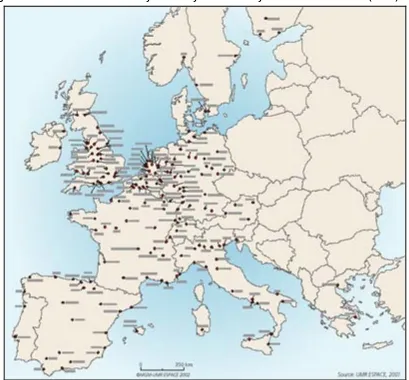
(20) Territorial Cohesion and Structural Funds Programmes: Urban Development & Territorial Cooperation. policy terms, this new conception of the role of cities implies shifting efforts from ‘reactive measures’, those tackling the improvement of the social, economic and environmental situation of cities, to more ‘proactive’ measures aiming at creating the conditions for the full exploitation of the cities’ true economic potential. This policy approach could not be more distant from the views implied in the 1998 policy document ‘Sustainable Urban Development in the European Union: A Framework for Action’. 22. 22. This document was markedly reactive and promoted four goals: (i) strengthening economic prosperity and employment in towns and cities (which in fact account for 80% of the population of the Union); (ii) promoting equal opportunities, social integration and the rehabilitation of run-down areas; (iii) improving the urban environment (management of transport, waste, energy etc.); (iv) contributing to good urban governance and increased participation of local actors and citizens. Even so, as past EPRC/Nordregio research showed, these goals are only to a limited extent reflected in the strategies of current Structural Funds programmes (see Polverari L. et al (2002) Op. Cit. and Rooney M. et al (2002) Op. Cit.). IQ-Net Thematic Paper 16(2). 6. European Policies Research Centre.
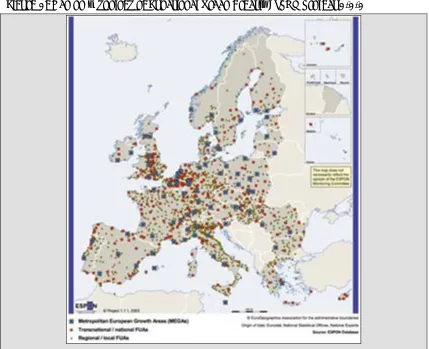
(21) Territorial Cohesion and Structural Funds Programmes: Urban Development & Territorial Cooperation. Box 1: Development nodes in the ‘new regional policy paradigm’ and theories of economic development Perhaps the most striking example of the implementation of the ‘new’ regional policy paradigm in the domestic regional policies of the Member States is found in the Dutch 2004 regional policy White Paper. 23 This sets out an economic agenda for six Dutch regions, focussing particularly on large, ‘ambitious’ projects aimed at the ‘The recovery of the growth capacity of the Dutch economy and strengthening the business locations climate’. 24. Source: Peaks in the Delta, p. 10.. The strategy of the White Paper incorporates two radical innovations: first, the refocusing of ‘regional economic policy away from the traditional problem regions in the north and towards economic priorities in all Dutch regions; and, second, a move towards a far more selective policy approach, with clear choices being made as to where, in the regions, national policy efforts should be directed’. 25. 23. Ministerie van Economishe Zaken (2004) Peaks in the Delta. Regional Economic Perspectives, The Hague, September 2004.. 24. Ibidem, p.11.. 25. Yuill D (2004) Regional Policy in the Shadow of Reform. A Comparative Overview of Recent Policy Development in the Member States and Norway’, EoRPA Paper 04/1, October 2004, p. 21-22.. IQ-Net Thematic Paper 16(2). 7. European Policies Research Centre.
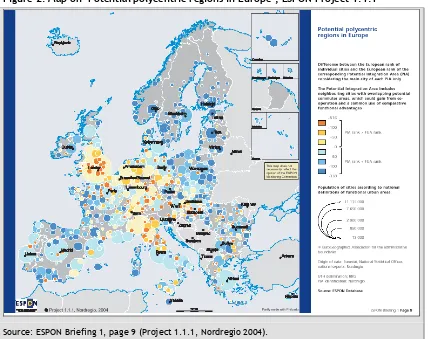
(22) Territorial Cohesion and Structural Funds Programmes: Urban Development & Territorial Cooperation. From a theoretical perspective, there have been, over time a range of models or theories which stemmed from the assumption that the geographical structure of a region can affect its economic and social situation and that this can be modified so as to improve the region’s economic and social performance. An example is the theory of growth poles. 26 Growth pole strategies emerged in the 1960s and aimed to rectify the ‘spatial deficiencies’ of regions ‘through the activation of a system of planned poles, conforming to a specific spatial configuration in terms of size, hierarchical level, frequency and location’. 27 The main assumption underlying this strategy was that concentrating on selected areas (the poles), a set of ‘propulsive industries’ would activate a process of growth in the poles that would spread and spill over to the neighbouring hinterland. This strategy was used in order to overcome different development needs. In the developed nations, it was implemented as a means to overcome the backwardness of ‘depressed areas’ within countries (i.e. low employment rates, income, human capital, infrastructure and service provision etc.). Clearly, the growth poles were generally located in, or in proximity to, urban areas. A similar theory is ‘Urban growth theory’, developed in the late 1960s. This places ‘urban systems’ or ‘city regions’ as the centres of wealth creation and accumulation. The theory argues that these systems allow for an effective exchange of knowledge between economic actors and firms, reducing search costs and increasing opportunities. 28 More recent theories, conceptually linked to the above, are cluster theories, network theories, and endogenous growth theories. The latter, in particular, seem to be often reflected in the regional strategies of current Structural Funds programmes 29 . They place strong emphasis on innovation potential, human capital and knowledge as the basis for differentials in regional performance. Consequently, these are the factors that the strategies support. Urban centres are in this context crucial to development, in that it is here that human capital and knowledge are often concentrated. A by-product of this new conception of the role of cities as engines for growth – alongside with the need for a more uniform distribution of such engines across the European territory – is the concept of polycentric development. This was mentioned in the ESDP and is being examined in the research carried out under the framework of the ESPON programme 30 . This. 26. Parr J B (1999) Growth Poles Strategies in Regional Economic Planning: A Retrospective View. Part 2. Implementation and Outcome, Urban Studies, Vol. 36, No. 8, 1247-1268, 1999. p. 1247.. 27. Parr J B (1999) Ibidem.. 28. Cambridge Econometrics, ECORYS-NEI, A study on the Factors of Regional Competitiveness. Draft final report to the European Commission Directorate-General Regional Policy. 29. Polverari L and Bachtler J (2005) The contribution of European Structural Funds to territorial cohesion, Town Planning Review, Special Issue, Vol. 76, Number 1, 2005, p. 29-42 and Polverari L and Bachtler J (2004) La dimensión territorial de la cohesión económica y social: política regional y planificación territorial en Europa in Joan Romero González and Farinós Dasí Joaquín (Eds.) ‘Ordenación del territorio y desarrollo territorial. El gobierno del territorio en Europa: tradiciones, contextos, culturas y nuevas visiones’, Ediciones Trea, S. L., Gijón, Spain.. 30. ESPON – European Spatial Planning Observatory Network – is an initiative set up under the Interreg III CI to develop a European scientific community in the field of European territorial development and improve the knowledge in this sphere. See www.espon.lu for more information. Of particular interest to this specific study are projects 1.1.1 ‘Polycentrism’, 1.1.3 ‘Enlargement And Polycentrism’, 2.2.1 ‘The Territorial Effects Of Structural Funds Programmes’ and 2.2.3 ‘Territorial Effects of Structural Funds Programmes in Urban Areas’, whose reports are all available from the programme’s website.. IQ-Net Thematic Paper 16(2). 8. European Policies Research Centre.
(23) Territorial Cohesion and Structural Funds Programmes: Urban Development & Territorial Cooperation. concept interprets the role of cities in relational terms, transcending the role of individual cities (e.g. their functional specialisation and/or their catchment/influence sphere) and advocating the possibility of creating synergies and networking between them, to strengthen the overall competitiveness standing of ‘polycentric regions’. The Interim Report on Territorial Cohesion, for example, notes that: The current European urban system is seen as monocentric, in the sense that there is only one major urbanised area with sufficient mass and economic potential to be integrated in the global economy. At the European level, the main issue is therefore to stimulate the development of regions beyond the Pentagon with the aim of making them global integration zones. A more polycentric structure, with several strong urban regions of European and global significance, can contribute to the competitiveness of Europe as well as to cohesion between different territories. 31 This ‘monocentrism’ or concentration of the main urban areas and activities in the core area of Europe is well illustrated by the map below, also taken from the Interim Report on Territorial Cohesion (Figure 1).. 31. European Commission (2004), Interim Territorial Cohesion Report, Preliminary Results of ESPON and EU Commission Studies, p.23.. IQ-Net Thematic Paper 16(2). 9. European Policies Research Centre.
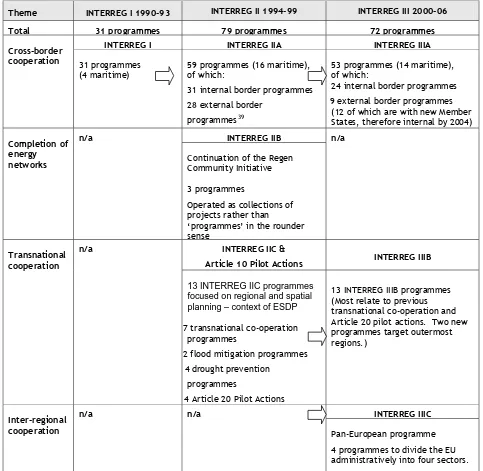
(24) Territorial Cohesion and Structural Funds Programmes: Urban Development & Territorial Cooperation. Figure 1: Map on ‘Typology of Functional Urban Areas’, ESPON Project 1.1.1. Source: European Commission (2004) Interim Territorial Cohesion Report, Preliminary Results of ESPON and EU Commission studies, p.23.. The map shows the territorial distribution across the EU of almost 1,600 ‘Functional Urban Areas’ and their relative ‘functional importance’ i.e. whether they have a regional/local, transnational/national or European/global (so called MEGAs, Metropolitan European Growth Areas) status, measured in terms of population (minimum 50,000 inhabitants), transport, tourism, industry, knowledge, decision-making (no. of headquarters of top European firms) and administration (e.g. whether the city is national, regional, provincial capital etc.).. Polycentric development, like territorial cohesion, has been interpreted in various ways. Overall, it aims to describe an ideal development path based on an interacting network of specialised urban centres (or Functional Urban Areas, FUAs) distributed evenly across the European, national and regional territories. The concept of polycentric spatial development has been described often as a ‘bridging concept’ between two not always congruent policy aims encompassed in the ESDP: ‘economic growth’ and ‘balanced development’ 32 .. 32. Nordregio et al (2003) Territorial Effects of the Structural Funds, Second Interim Report of the ESPON Project 2.2.1, p. 11.. IQ-Net Thematic Paper 16(2). 10. European Policies Research Centre.
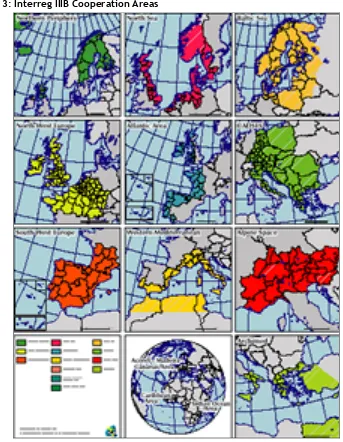
(25) Territorial Cohesion and Structural Funds Programmes: Urban Development & Territorial Cooperation. The concept applies to three levels (see also Figure 2) 33 : . European/transnational – where the goal is the stimulation of ‘global integration zones’, beyond the pentagon, able to compete in the global economy;. . national/cross-border/interregional – which implies shifting from a dominant city to a system of cities, by improving the economic performance and service provision through networks of neighbouring cities;. . regional/local – at this level, the main goal of polycentric development is to shift from one or two main regional centres to a number of small and medium centres that can provide services, e.g. through strategic alliances between towns and/or common projects.. Once again, the European Commission’s views echo positions of some Member States, notably France where a study was carried in 2003 for DATAR to analyse the ‘radiation potential’ (rayonnement) of European cities with more than 200,000 inhabitants. The study was born following the decision by the French Inter-ministerial Committee for Territorial Management (CIADT) to establish a national strategy to reinforce the metropolitan supply of France in Europe […] to strengthen the world-role of the capital, to take to the first European ranks the urban systems of Lyon, Lille and Marseille, and to sustain the other main regional metropoles, in a network with their peripheral towns to attain the radiation of the German or Italian regional capitals. 34 The elaboration of such a strategy called for a comparison of French cities with their European counterparts. DATAR commissioned this study at the University of Montpellier, based on the up-dating of a 1989 study by Roger Brunet 35 . The study led to crucial conclusions on the current and potential role of French cities that are informing the current debate on future Structural Funds support in the country, as will be seen in Section 10. 36 A similar study was recently launched in Sweden by NUTEK, the national Business Development Agency, to develop an ‘analytical background for an up-coming NUTEK. 33 European Commission (2004), Interim Territorial Cohesion Report, Preliminary Results of ESPON and EU Commission Studies, p. 9. 34. DATAR (2003) Les villes européennes: elements de comparison, Céline Rozenblat, Patricia Cicille, Paris: La Documentation Française (DATAR), 2003, p. 59, Paris 24 March 2003, p. 1 (own translation).. 35. Such radiation potential was assessed against a bundle of functions which were analysed according to their frequency and their dispersal within the 180 selected agglomerations. Based on a range of 15 indicators, seven categories of cities were identified which allowed a ranking to be established, based on the assumption that more than the effective economic power of the cities it is the specific combination of functions which accounts for the respective potential of ‘radiation’. 36. In addition to this, DATAR commissioned a study on the contribution of Objective 1 and 2 programmes to the development of the priority areas of the ‘politique de la ville’ which will also be discussed in Chapter 10.. IQ-Net Thematic Paper 16(2). 11. European Policies Research Centre.
(26) Territorial Cohesion and Structural Funds Programmes: Urban Development & Territorial Cooperation. initiative concerning regional growth in the four major urban regions in Sweden Stockholm, Göteborg, Malmö and Norrköping/Linköping’. 37 Figure 2: Map on ‘Potential polycentric regions in Europe’, ESPON Project 1.1.1. Source: ESPON Briefing 1, page 9 (Project 1.1.1, Nordregio 2004).. Based on the analysis of the identified FUAs across Europe and on the measurement of their relative positioning according to demographic mass, competitiveness factors, connectivity and knowledge base, the map demonstrates: ‘The potential synergies from cooperation between neighbouring cities measured as the difference between the ranking of the individual city and the ranking of the joint polycentric area. […] the analysis reveals opportunities and contrasts for improving the comparative position of urban areas across Europe [… not least] to play an important role in enabling areas and cities to activate their potentials and territorial capital successfully’. 38. 2.3. Territorial cooperation – a new way of overcoming regional problems. As emerges clearly from the discussion above, urban and, more generally, regional development are increasingly being linked to the networking and cooperation between cities and between regions. The proposals by the Commission for future Structural and 37. http://www.nordregio.se/. The study, which has been commissioned from Nordregio and the Norwegian Institute for Urban and Regional Research, will take place between May and December 2005.. 38. ESPON Briefing 1, page 8.. IQ-Net Thematic Paper 16(2). 12. European Policies Research Centre.
(27) Territorial Cohesion and Structural Funds Programmes: Urban Development & Territorial Cooperation. Cohesion Policy place strong emphasis on this aspect of regional development by dedicating a third objective of the Structural Funds to territorial cooperation, particularly cross-border and transnational cooperation, and by foreseeing the integration of interregional cooperation within the mainstreamed programmes of the Convergence and Competitiveness objectives. Territorial cooperation to date has been supported by the Structural Funds mainly through the Interreg Community Initiative (CI). Introduced in 1990, the CI Interreg supports projects of regional cooperation at different scales and in different fields to enhance overall territorial cohesion (see Table 1 below). Table 1: Scope and numbers of Interreg I, II and III programmes NB: Arrows indicate initiatives continued into a subsequent programming period Theme. INTERREG I 1990-93. INTERREG II 1994-99. INTERREG III 2000-06. 31 programmes. 79 programmes. 72 programmes. INTERREG I. INTERREG IIA. INTERREG IIIA. Total Cross-border cooperation. 31 programmes (4 maritime). 59 programmes (16 maritime), of which: 31 internal border programmes. 9 external border programmes (12 of which are with new Member States, therefore internal by 2004). 28 external border programmes 39 Completion of energy networks. INTERREG IIB. n/a. 53 programmes (14 maritime), of which: 24 internal border programmes. n/a. Continuation of the Regen Community Initiative 3 programmes. Transnational cooperation. n/a. Operated as collections of projects rather than ‘programmes’ in the rounder sense INTERREG IIC &. INTERREG IIIB. Article 10 Pilot Actions 13 INTERREG IIC programmes focused on regional and spatial planning – context of ESDP 7 transnational co-operation programmes. 13 INTERREG IIIB programmes (Most relate to previous transnational co-operation and Article 20 pilot actions. Two new programmes target outermost regions.). 2 flood mitigation programmes 4 drought prevention programmes 4 Article 20 Pilot Actions Inter-regional cooperation. n/a. INTERREG IIIC. n/a. Pan-European programme 4 programmes to divide the EU administratively into four sectors.. Source: Taylor, Olejniczak, Bachtler (2005) A Study of the Mid Term Evaluations of INTERREG programmes for the programming period 2000 until 2006, p. 20.. 39. Counting programmes including internal and external borders as external.. IQ-Net Thematic Paper 16(2). 13. European Policies Research Centre.
(28) Territorial Cohesion and Structural Funds Programmes: Urban Development & Territorial Cooperation. Following phases of expansion and diversification, the programme is currently in its third round, with Interreg III being implemented across the EU 25 while similar programmes cover the external borders (Phare and Tacis CBC). The initiative comprises three strands, each of them referring to a different geographical as well as thematic scope: Cross-border cooperation (strand A) is the longest operating of the three strands and supports development strategies in adjacent regions whereas transnational cooperation (strand B, see map below) covers larger groupings of European regions setting up more strategic and conceptual initiatives. Finally, interregional cooperation (strand C) was launched in 2000 to focus on the generation of policy learning through the exchange of information and experience within networks of non contiguous regions. Figure 3: Interreg IIIB Cooperation Areas. Source: http://europa.eu.int/comm/regional_policy/interreg3/images/pdf/int3b_uk_a4p.pdf. The introduction of the Interreg CI signifies the development of an international dimension to Structural Funds programming. Although EU-funded territorial cooperation can be seen as relatively small in financial terms, and the programmes and projects associated with it. IQ-Net Thematic Paper 16(2). 14. European Policies Research Centre.
(29) Territorial Cohesion and Structural Funds Programmes: Urban Development & Territorial Cooperation. are complicated to manage and administer, the importance of their overriding aim to break down cultural and physical barriers is reflected in the increasing priority given to these programmes by the Commission. This follows not only from the growing ERDF funding allocated to Interreg since 1990 40 but also from the proposed continuation of Interreg into the 2007-13 programming period, as set out in the Third Cohesion Report which, as previously noted, includes a territorial cooperation strand, with an expanded financial package, as one of three pillars of the proposed future Cohesion policy. 41 Among various other issues, the topic of urban development is currently given priority in all three Interreg strands (A: Promotion of urban development; B: Development strategies at transnational level including cooperation between towns or urban and rural areas; C: Exchange on interregional cooperation in the field of urban development) 42 . Although the theme is not explicitly mentioned in the new draft Regulations concerning territorial cooperation, urban issues are likely to remain important as the Urban Community Initiative will not be prolonged after 2006. To achieve an increased thematic focus and to avoid delimitation problems between the strands, urban development is now only being alluded to within the scope of the new interregional cooperation programmes (former strand C) where a framework programme for the exchange of experiences on urban issues (based on URBACT) is cited as an example. The essentially local nature of cross-border cooperation (former strand A) and the respective cooperation areas (e.g. entrepreneurship and SMEs, universities, environmental issues, transport access, water, waste management and energy management systems, health, culture and education) suggest that these projects are especially suitable to be implemented in an urban context. The same is true for transnational cooperation where projects are likely to build on previous experience of urban development.. 40. In the 2000-2006 programming period, INTERREG remains the largest Community Initiative, but now receives significantly more resources: It has an ERDF allocation of €4 875 billion (1999 prices), source: Taylor, Olejniczak, Bachtler (2005) A Study of the Mid Term Evaluations of INTERREG programmes for the programming period 2000 until 2006.. 41. CEC (2004) A new Partnership for Cohesion: Convergence, Competitiveness, Cooperation, (The ‘Third Cohesion Report’), Commission of the European Communities, Luxembourg. 42. In IQ-Net partner regions, two examples that can be identified are ‘Bizz 2 Bizz Cities’ (MediumSized Cities attract high value business-to-business services) led by the economic council of the province of Limburg (INTERREG IIIB) and ‘InterMETREX’ (Spatial planning in metropolitan areas) led by Glasgow and the Clyde Valley Structure Plan Joint Committee (INTERREG IIIC).. IQ-Net Thematic Paper 16(2). 15. European Policies Research Centre.
(30) Territorial Cohesion and Structural Funds Programmes: Urban Development & Territorial Cooperation. 3.. ROLE OF URBAN PROGRAMMES. AREAS. IN. STRUCTURAL. 3.1. Categorisation of IQ-Net partners’ programmes. FUNDS. Leaving aside the debate on urban development interventions in the framework of future Structural Funds programmes – which will be discussed in more detail in Section 10 – and the conceptual elaborations behind the likely increased role that the development of urban areas will play in the future programming period, looking at the current generation of programmes, it is clear that the extent of inclusion of urban measures in the mainstreamed Objective 1 and 2 programmes varies considerably across and within countries. This variation can be attributed to two main factors. The first factor is the nature of the areas covered by the programmes. Where the programme area is predominantly rural, measures for the development of urban areas in the strict sense cannot be found. A second factor is the degree of integration between Structural Funds programmes and domestic (national or regional) policies for urban development (and, more generally, the broader regional strategies and the role attributed to urban areas in these). Looking at the eligible areas of the IQ-Net partner programmes (regional programmes) and considering variables such as population (size of eligible population, population density and population growth), economic activity in the region (e.g. sectoral orientation) and accessibility (transport infrastructure, the degree of connectivity of eligible areas to subregional, regional, national, and international centres), it is possible make a rough categorisation of the IQ-Net partners’ programme areas into urban and non-urban (see Table 2). Presenting partner programmes along a continuum, from highly urbanised areas (i.e. areas with high population density, high concentration of business activity, negligible primary sector, and good accessibility) to non-urbanised areas (i.e. sparsely populated areas with negligible business activity, high degree of primary production and very low accessibility), some programmes clearly stand out as highly urbanised, while others have a marked rural nature or are even characterised by sparse population. 43 At one end of this spectrum can be found programmes such as Nordrhein Westfalen (NRW), Pais Vasco, North-East England and Western Scotland, all of which include large urban agglomerates and high population density. NRW is perhaps the most striking example of what could be defined as a highly urbanised programme area with an eligible population of over 7 million – in a Land whose total population is c.19 million – set within one of the largest metropolitan regions in the EU, the Ruhr area. At the other end of the spectrum can be found the sparsely-populated Norra Norrland region, which has one of the lowest population densities of Europe, large parts of the territory characterised by mountainous areas with vast uninhabited forests, population. 43. It has to be clarified that this is not an attempt at a thorough classification of the areas concerned. This is simply to give an overall picture of the likely inclusion of urban themes in the programmes, based on the geography and economic configuration of each partner programme area.. IQ-Net Thematic Paper 16(2). 16. European Policies Research Centre.
Figure
+7

Outline
Categorisation of IQ-Net partners’ programmes
Approaches to urban development: reactive, proactive and urban-rural
Aligned policies
Non-aligned policies
Paìs Vasco
Nordrhein-Westfalen and Sachsen-Anhalt
Territorial challenges and urban areas
Specific approaches to urban development
Commission Proposals
IQ-Net partners’ views on urban development support
Related documents