Int. J. Electrochem. Sci., 13 (2018) 9816 – 9825, doi: 10.20964/2018.10.33
International Journal of
ELECTROCHEMICAL
SCIENCE
www.electrochemsci.org
Improvement of High-Voltage Electrochemical Performance of
Surface Modified LiNi
0.6Co
0.2Mn
0.2O
2Cathode by La
2O
3Coating
Jianxiong Liu1, Xiaodong Jiang1, Yannan Zhang2,*, Peng Dong2,*, Jianguo Duan2, Yingjie Zhang2, Yunfeng Luo3, Zewei Fu3, Yuhan Yao1, Chengyi Zhu1, Xiaohua Yu1,4, Zhaolin Zhan1
1
National and Local Joint Engineering Laboratory for Lithium-ion Batteries and Materials Preparation Technology, Key Laboratory of Advanced Battery Materials of Yunnan Province, Faculty of Materials Science and Engineering, Kunming University of Science and Technology, Kunming 650093, China 2
National and Local Joint Engineering Laboratory for Lithium-ion Batteries and Materials Preparation Technology, Key Laboratory of Advanced Battery Materials of Yunnan Province, Faculty of
Metallurgical and Energy Engineering, Kunming University of Science and Technology, Kunming 650093, China
3
Yunnan Tin Group (Holding) Company Limited, Kunming 650000, China 4
National Engineering Research Center of Waste Resource Recovery, Kunming University of Science and Technology, Kunming 650093, China
*E-mail: [email protected], [email protected]
Received: 29 May 2018 / Accepted: 23 July 2018 / Published: 1 September 2018
Layered transition-metal oxides LiNi0.6Co0.2Mn0.2O2 (NCM 622) due to their poor stability when worked at high operating voltage have limited their applications in industy. In this study,
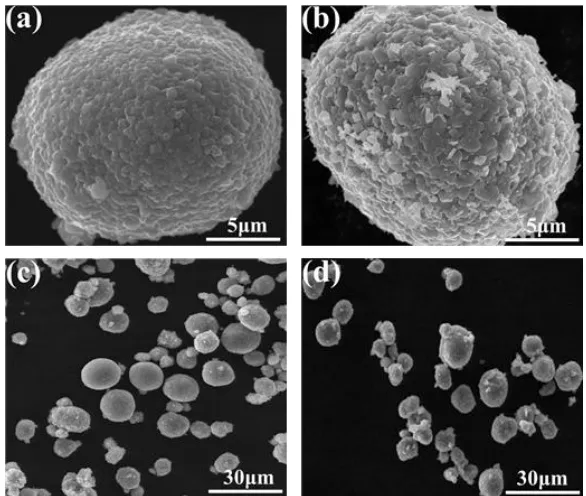
La2O3 is coated on NCM 622positive electrodes via a facile solvothermal method. The scanning electron microscopy (SEM) and EDS test results show that La2O3 nano-particles are successfully coated on the surface of NCM 622 samples. The favorable Li-ion conductivity of the La2O3-modified NCM 622 sample lead to obvious improvement in its electrochemical performances. In particular, the coated sample exhibits a capacity retention over 80% at 1 C after 100 cycles at a high cut-off voltage of 4.5 V, while that of the bare electrode is less than 60%. The alternating current impedance and cyclic voltammetry (CV) tests show that the La2O3 coating can effectively restrain the electrode polarization and reduce the Li-ion charge transfer resistance of cathode materials.
Keywords:LiNi0.6Co0.2Mn0.2O2; Cathode; Coating, High cut-off voltage
1. INTRODUCTION
long service life, and environmental friendliness [1-3]. Since the commercialization of lithium-ion batteries, LiCoO2 has been applied to the positive of lithium-ion batteries because of its high cycling stability and low irreversible capacity loss. However, the problems of large toxicity, high cost, and poor cycling performance at high cut-off voltages restrict its further applications. Recently, some researchers are actively looking for other suitable lithium-ion battery positive materials [4,5]. The layered transition-metal oxides LiNi0.6Co0.2Mn0.2O2 (NCM 622) has good thermal stability, high voltage platform, high energy density, low toxicity and low cost, which is considered to be a ideal cathode material to replace LiCoO2 [6]. However, because of adverse side reactions between the active material and the electrolyte, the NCM 622 is suffered from serious capacity fading at high cut-off voltages (above 4.3 V) or at high current conditions, and then resulting in poor cycling performance [7].
Surface coating is an effective measure to suppress side reactions between active materials and electrolytes [8-11]. Liu [12] et al. prepared Li2Si2O5-coated NCM 622 cathode material by a solution method, which improved the cycling stability of the active material at high cut-off voltage (the capacity retention of 86.4% after 150 cycles at 4.5 V). Tao [13] et al. modified NCM 622 with ZrO2 to increase the capacity retention of active material from 75.6% to 83.8% after 100 cycles. Qin [14] et al. used nano-TiO2 to coat NCM 622 by atomic layer deposition (ALD) method, which improved the cycling stability of NCM 622 (capacity retention of 85.9% after 100 cycles). To our best knowledge, La2O3 is oxides of the lanthanide series with good high temperature resistance and anti-acid corrosion abilities. In addition, La2O3 shows favorable Li-ion conduction efficiency because it is a good lithium ion conducting medium [15-17]. In this work, The La2O3-coated NCM 622 positive material (NCM 622-L) is successfully synthesized via a facile solvothermal method. Moreover, we have also explored the structure, morphology, and the electrochemical performance of NCM 622 after La2O3 coating at high cut-off voltage of 4.5 V.
2. EXPERIMENTAL
2.1. Preparation
The co-precipitation method was used to prepare spherical Ni0.6Co0.2Mn0.2(OH)2 precursor. NiSO4·6H2O, CoSO4·7H2O and MnSO4·H2O were mixed in deionized water at a molar ratio (Ni: Co: Mn = 6:2:2). The reaction temperature was kept at 60°C and pH was controlled by NH3·H2O solution to 10-11. The resulting precipitate was washed with deionized water and dried in a vacuum oven for 12 h to synthesize Ni0.6Co0.2Mn0.2(OH)2 precursor. The Li2CO3 was uniformly mixed with Ni0.6Co0.2Mn0.2(OH)2 in accordance with (n (Li): n (Ni + Co + Mn) =1.05: 1). The mixture microsphere was first heated at 500°C for 5 h, and then sintered at 900 °C for 12 h.
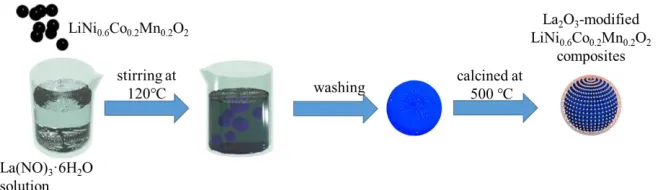
tube furnace for 6 h at 500°C to obtain a La2O3 coated NCM 622 sample (marked as NCM 622-L). The coating amount of La2O3 was 5 wt.% of the pristine NCM 622 owder. The experimental process is shown in Figure 1.
Figure 1. Coating process of LiNi0.6Co0.2Mn0.2O2 with La2O3
2.2. Characterization
The crystal structure of all the samples was characterized by a D/MAX-2200 X-ray diffractometer (XRD) using Cu Kα radiation in the 2θ range of 10-80° at a continuous scan mode with a step size of 0.02° and a scan rate of 10° min-1. The microstructure of the samples before and after coating was characterized by JSM-5600LV scanning electron microscope (SEM). Energy Dispersive Spectrometry (EDS) was used to characterize the elemental species of the samples.
2.3. Electrochemical measurements
The active material was assembled into CR2032 coin cell (Shenzhen, Ming Ruixiang Co., Ltd.) in an argon-filled glove box for further electrochemical testing. The positive material that consisted of 80 wt.% of coated active materials, 10 wt.% of conductive acetylene black and 10 wt.% of polyvinylidene fluoride (PVDF) binder were dissolved in N-methyl-2-pyrrolidone (NMP) solvent. 1 M LiPF6 dissolved in a 1:1:1 (v/v/v) ethylene carbonate (EC)/dimethyl carbonate (DMC)/ethyl methyl carbonate (EMC) was used as electrolyte. Lithium metal was used as the negative
electrode. The charge/discharge performance test was performed between 3.0 and 4.5 V (vs. Li/Li+) at different scanning rate using the CT-3008 battery test system (Shenzhen Newware Electronics, Ltd.). In addition, the tests of cyclic voltammetry (CV) and electrochemical impedance (EIS) tests were carried out using an electrochemical workstation (CHI 720B, China).
3. RESULTS AND DISCUSSION
[image:3.596.135.464.138.233.2]
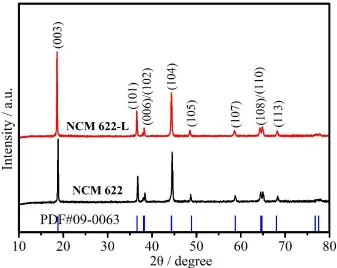
because of the small amounts of coating. Obviously, the cell parameter values of the samples before and after coating are consistent with those reported in previous literatures [19], which indicates that La2O3 coating does not have a significant effect on the crystal structure. In general, all the material exhibits a good layered structure and a low degree of cation mixing because the R (I (003)/I (104)) is more than 1.2 [20]. The peaks of (006)/ (102) and (108)/ (110) are split clearly, which illustrates that all the samples display typical lamellar features [21].
[image:4.596.129.466.188.456.2]Figure 2. The XRD patterns of (a) NCM 622 and NCM 622-L
Table 1. Refined lattice parameters of NCM 622 and NCM 622-L
Sample a / (Å) c / (Å) c / a I(003)/I(104)
The pristine 2.853 14.234 4.9932 1.435
3.0-NCM 622 2.854 14.233 4.9887 1.474
5.0-NCM 622 2.857 14.241 4.9842 1.469
[image:4.596.68.529.536.596.2]
Figure 3. The SEM images of (a) NCM 622 and NCM 622-L
[image:5.596.151.444.68.316.2]NCM 622-L is tested by energy dispersive spectrometer (EDS) to characterize the element types on the surface of NCM 622-L. As can been seen from Figure 4, the La element is distributed on the surface of the NCM 622. It can be seen from the Fig. 4(c), that the location of La are fully along with the subsrate element Ni, Co and Mn, confirming the uniformly distribution of La2O3 in NCM 622-L sample.
Figure 4. The EDS mappings of NCM 622-L
[image:5.596.106.493.461.578.2]
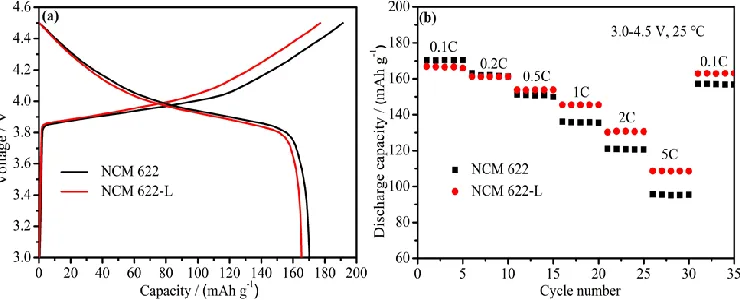
Figure 5(b) illustrates the rate performance of all the samples at 3.0-4.5 V. Noticeably, the discharge capacity of all the samples decreases with increasing rate. However, NCM 622-L displays higher capacities than NCM at all the rates tested. The capacity gap between the two samples becomes more prominent with the increase of discharge rate. The enhancement of the multiplying performance may be due to the good ionic conductivity of La2O3, which improves the diffusion capacity of Li-ions between the electrode and the electrolyte interface. [24].
Figure 5. (a) Initial charge/discharge curves of NCM 622 and NCM 622-L at 0.1C. (b) Rate performance of NCM 622 and NCM 622-L at different current density
The cycling performance of all the samples after 100 cycles at 1 C discharge rate between 3.0 and 4.5 V at 25℃ are shown in Figure 6(a). As expected, it can find the fact that the capacity retention of NCM 622-L (81.49%) is higher than that of NCM 622 (66.14%) after 100th cycles, which displays that the La2O3 coating can enhance the cycling performance of NCM 622 at the high cut-off voltage (4.5 V). In addition, the cycling performance of the two samples after 100 cycles at 1 C discharge rate between 3.0 and 4.3 V at normal cut-off voltage of 4.3 V are illustrated in Figure 6(b). The nano La2O3 coating can enhance the cycling performance of NCM 622 at normal cut-off voltage of 4.3 V. It is noted that the capacity retention of uncoated samples is 72.50%, while the NCM 622-L samples still maintained higher capacity retention (88.38%). To our best knowledge, the capacity fading of layered materials is primarily due to the side reaction between the active material and the electrolyte, and the degree of cation mixing be enhanced at high potential [25]. The surface coating could reduce the activity of active material by introducing strong La-O bonds on the surface of material, thereby reducing the surface reactivity of the active material with the electrolyte at high potential [26].
[image:6.596.114.489.190.340.2]
622-L are shown in table 2. It can be seen that the △E of the NCM 622-L is significantly reduced compared to the bare one, which indicates that the polarization of the active material is reduced after the La2O3 coating.
Figure 6. The cycling performance of NCM 622 and NCM 622-L (a) at 25 ℃ between 3.0 and 4.5 V and (b) between 3.0 and 4.3 V
[image:7.596.88.506.154.311.2]Figure 7. Cyclic voltammograms of (a) NCM 622 and (b) NCM 622-L
Table 2. The value of redox reaction gaps (△E)
Sample 1st 2nd 3rd
redox reaction gaps (△E)
NCM 622 0.218 0.175 0.166
NCM 622-L 0.196 0.136 0.115
[image:7.596.89.507.391.547.2] [image:7.596.44.554.624.670.2][image:8.596.91.507.277.429.2]
semicircle in the high frequency region and oblique line in the low frequency region. The semicircle in the high frequency region is related to the charge transfer resistance (Rct) [30]. The intercept of the semicircle with the real axis represents the electrolyte solution resistance of the working electrode (Rs) [31]. The oblique line in the low frequency region represents the Warburg impedance (Wo) describing Li+ diffusion in the bulk material [32,33]. The fitted results are shown in Table 3, the NCM 622-L sample exhibit both smaller working electrode and transfer resistance This can be explained as follows: On the one hand, La2O3 coating can inhibits side reactions between electrolyte and active material to restrain the dissolution of the metal ions and give rise to protection of the NCM 622 particle from HF attack, which favors electron transfer. On the other hand, La2O3 shows favorable Li-ion conductLi-ion efficiency because it is a good lithium Li-ion conducting medium. The results from EIS curves are consistent with the observation from rate performance from Figure 6.
Figure 8. Nyquist curves of (a) the NCM 622 and (b) NCM 622-L after 50th and 100th at 25°C
Table 3. Impedence data of NCM 622 and NCM 622-L after different number of cycles at equilibrium state
Cycling number
NCM 622 NCM 622-L
Rs/ohm Rct/ohm Rs/ohm Rct/ohm
50th 2.951 183.6 2.465 109.4
100th 3.298 295.4 2.469 188.6
4. CONCLISIONS
[image:8.596.60.528.519.580.2]
622 at high voltage. This facile coating method can also be applied to other layered transition-metal oxides to improved electrochemical performance of cathode materials.
ACKNOWLEDGEMENTS
Financial support from National Natural Science Foundation of China (No. 51764029, 51665022, and 51601081) are gratefully acknowledged.
References
1. W. Xiao, Z.Y. Nan, L. Cheng, Y.Z. Tao, Y.X. Hua, Z. Yi, Z.Z. Lin, Int. J. Electrochem. Sci., 12 (2017) 12009.
2. Z.Y. Nan, D. Peng, Y.X. Hua, X.S. Biao, S.J. Jie, Y.R. Ming, L.H. Xin, S.Z. Zhong, Y. Yao, L. Xue, Z.Y. Jie, Int. J. Electrochem. Sci., 12 (2017) 6853.
3. Z.Y. Nan, D. Peng, Z.M. Yu, S.X. Liang, Y.X. Hua, S.J. Jie, M. Qi, Li. Xue, Z.Y. Jie, J. Appl. Electrochem., 48 (2017) 1.
4. B. Ying, C.Q. Jun, Y. Qi, Z. Sen, J. Kai, Electrochim. Acta, 112 (2013) 414. 5. G. Rui, S.P. Fei, C.X. Qun, S. Ling, Electrochim. Acta, 54 (2009) 5796.
6. L.L. Wei, D. Ke, P.Z. Dong, C.Y. Bing, H.G. Rong, Chin. Chem. Lett., 25 (2014) 883.
7. H. Kaneda, Y. Koshika, T. Nakamura, H. Nagata, R. Ushio, K. Mori, Int. J. Electrochem. Sci., 12 (2017) 4640.
8. L. Wen, W. Miao, G.X. Long, Z.W. Dong, C.J. Tao, Z.H. Hui, Z.X. Xiang, J. Alloys Compd., 543 (2012) 181.
9. K.J. Zhou, R. Chong, T.G. An, Z. Xiang, L.A. Dong, W. Di, L. Hui, Z. Fei, J. Power Sources, 266 (2014) 433.
10. C. Chao, T. Tao, Q. Wen, Z. Hong, W. Ying, L. Bo, Y.Y. Bang, L.S Guo, C. Ying, J. Alloys Compd., 709 (2017) 708.
11. H.G. Rong, Z.M. Fang, W.L. Li, P.Z. Dong, D. Ke, C.Y. Bing, J. Alloys Compd., 690 (2017) 589. 12. L.S. Jie, W. Hao, H. Ling, X.M. Wu, L. Heng, Z. Yun, J. Alloys Compd., 674 (2016) 447.
13. T. Tao, C. Chao, Y.Y. Bang, L. Bo, L.S. Guo, C. Ying, Ceram. Int., 43 (2017) 15173.
14. Q.C. Can, C.J. Li, C. Jun, D.G. Le, W.T. Fu, C.Y. Bin, T.Y. Feng, L.A. Dong, C.Y. Feng, Dalton Trans., 45 (2016) 9669.
15. F.H. Qiang, L.S. Ying, Z.Z. Chang, W. Hua, S.Z. Cong, Corros. Sci., 53 (2011) 3821. 16. F.H. Qiang, X.D. Hai, L.M. Cheng, L. Qian, J. Alloys Compd., 702 (2017) 60.
17. Z. Lin, T.M. Jie, D.Y. Long, Z.Q. Ji, X.C. Gang, L.D. Min, Ceram. Int., 14 (2016) 15623. 18. Y. Peng, W.Z. Xing, L.X. Hai, X.X. Hui, W.J. Xi, W.X. Wen, G.H. Jun, Electrochim. Acta, 95
(2013) 112.
19. Z.R. Rui, L.J. Xing, H.J. Jun, Z.R. Yu, Z.J. Feng, C.H. Yu, S. Guang, J. Alloys Compd., 724 (2017) 1109.
20. Y. Kai, F.L. Zhen, G. Jia, Q.X. Hui, Electrochim. Acta, 63 (2012) 363. 21. L. Tao, L.X. Hai, W.Z. Xing, G.H. Jun, J. Power Sources, 342 (2017) 495. 22. H.G. Song, K.S. Park, Y.J. Park, Solid State Ionics, 225 (2012) 532.
23. L.X. Hui, K.L. Qin, S. Ting, L. Kun, C. Li, J. Power Sources, 267 (2014) 874.
24. H. Bin, L.X. Hai, W.Z. Xing, G.H. Jun, S. Li, W.J. Xi, J. Power Sources, 252 (2014) 200. 25. W.R. Heng, L.X. Hai, W.Z. Xing, G.H. Jun, W.J. Xi, Electrochim. Acta, 180 (2015) 815. 26. G.T. Fey, P. Muralidharan, L.C. Zhang, Y.D. Cho, Solid State Ionics, 176 (2015) 2759. 27. C.Y. Ping, Z. Yun, W. Fu, W.Z. Yi, Z. Qiang, J. Alloys Compd., 611 (2014) 135.
28. Y.Z. Guang, G.X. Dong, X. Wei, H.W. Bo, Z. Jun, H.F. Rong, W. Kai, X. Yao, Z.B. He, J. Alloys Compd., 699 (2017) 358.
30. T.K. Fey, P. Muralidharan, L.C. Zhang, Y.D. Cho, Electrochim. Acta, 51 (2006) 4850. 31. Z.S. Zhe, Z. Hong, Z. Ti, Z.Z. Hui, L.P. Yu, R.L. Quan, Corros. Sci., 67 (2013) 75. 32. C. Ho, I. Raistrick, R. Huggins, J. Electrochem. Soc., 127 (1980) 343.
33. Z.Y. Nan, Z.Y. Jie, Z.M. Yu, X.M. Li, L. Xue, Y.X. Hua, D. Peng, JOM, https://doi.org/10.1007/s11837-018-2873-5