Int. J. Electrochem. Sci., 13 (2018) 8022 – 8029, doi: 10.20964/2018.08.61
International Journal of
ELECTROCHEMICAL
SCIENCE
www.electrochemsci.org
Short Communication
Biosynthesis and Characterization of LiFePO
4/C Composite
Using Baker’s Yeast
Yue Cao1,2, Wangjun Feng1,2,*, Wenxiao Su2 1
State Key Laboratory of Advanced Processing and Recycling Nonferrous Metals, Lanzhou University of Technology, Lanzhou 730050, China
2
School of Science, Lanzhou University of Technology, Lanzhou 730050, China *
E-mail: [email protected]
Received: 21 April 2018 / Accepted: 2 June 2018 / Published: 5 July 2018
Based on the biosynthesis method, an ellipsoidal LiFePO4/C composite is successfully prepared by a simple and effective biomimetic hydrothermal method. Baker’s yeast cells not only as structural templates but also as bio-carbon sources in the process of biosynthesis. As a result, the best LiFePO4/C composite shows a very high capacity of 158.6mAh g-1 at 0.1C, which is much higher than pristine LiFePO4 material (124.7mAh g-1 at 0.1C). Also, cyclic voltammogram and electrochemical impedance spectra measurement demonstrate that the LiFePO4/C composites with Baker’s yeast cells have excellent and reversible electrochemical performance. Therefore, biosynthesis would become an effective method for making high-power lithium ion batteries.
Keywords: LiFePO4/C composite, biosynthesis, bio-carbon sources, Baker’s yeast cells, electrochemical performance
1. INTRODUCTION
yeast cells are used as not only template but also bio-carbon sources, which can prepare the composites with a certain shape and carbon layers.
In view of this, many researchers have prepared advanced mesoporous materials via biosynthesis[5–8]. Rinaldi et al[9] reviewed on the improved of lignin’s biosynthesis and structure, differences in structure and chemical bonding between native and technical lignin, and the relationship between lignin structure and catalyst performance, which showed that biosynthesis have a great effect on materials’ performance. Chang et al[10] prepared mesoporous TiO2 and mesoporous Co3(PO4)2, which had been synthesized by Baker’s yeast cells as both bio-templates and carbon source. Du et al[11] synthesized mesoporous Li3V2(PO4)3/C composites by Baker’s yeast cells, which exhibited a high discharge rate capacity (126.7 mAh/g at 0.2C) and a large Li+ diffusion coefficient. It follows that a new method can be used to synthesize composite materials.
In this work, LiFePO4/C composites are obtained by a biosynthesis method using Baker’s yeast cells as both structural template and bio-carbon source. The material structure, morphology and electrochemical properties for LiFePO4/C are investigated carefully.
2. EXPERIMENTAL SECTION
2.1 Material Preparation
The reagents employed in this work are FeSO4·7H2O, LiOH·H2O, H3PO4, C6H8O7·H2O, Glucose and Baker’s yeast cells. Firstly, quantitative instant dry yeasts (10g/L, 20g/L, and 30g/L) are cultivated in glucose solution at a suitable temperature. Then, stoichiometric amount of FeSO4·7H2O, LiOH·H2O and H3PO4 are dissolved in 50mL distilled water respectively. Then, yeast cells are dumped in the solution of FeSO4·7H2O under stirring for 0.5h. After that, the other solutions are dropped into it and stir 0.5h. The mixture is transferred into Teflon-lined stainless steel autoclaves and heat at 180℃ for 6h. After cooling to room temperature, the precursors are washed several times, then drying at 80℃ for 12h. The raw LiFePO4/C composites are acquired by annealing at 700℃ for 5h in a nitrogen atmosphere with a heating rate of 5℃/min.
2.2. Characterization
The phase identification of all samples is carried out by powder X-ray diffraction (XRD, Bruker D8, Cu Kα radiation) from 10º to 80º. The microstructure and morphology of all samples are collected by scanning electron microscope (SEM, JSM-6700F system) operated with accelerating voltage of 20 kV.
2.3. Electrochemical Analysis
active material, 10wt% acetylene black and 10wt% Polyvinylidene Fluoride (PVDF), which are added in N-methylpyrrolidone (NMP) solvent to form homogeneous slurry. The slurry is coated on an aluminum foil, and dried in a vacuum oven at 120°C for 10h. The cells are assembled in a high-purity argon filling glove box. The Land CT2001A battery test system (Wuhan, China) is used for the charge-discharge tests between 2.4V and 4.3V at room temperature. The electrochemical impedance and cyclic voltammetry measurement are tested on electrochemical workstation. Electrochemical impedance spectra measurement (EIS) is also recorded with the frequency ranging from 100kHz to 10mHz. The voltage range of the cyclic voltammogram (CV) measurements is 2.5-4.2V and the scanning rate is 0.5mV s-1.
3. RESULTS AND DISSCUSSION
Scheme 1 shows the schematic illustration of the synthesis process of LiFePO4/C precursor, which the spherical or elliptical yeast cells are used as both structural templates and biocarbon sources[12]. The cell wall of yeast cell is made up of proteins and polysaccharides, which possesses many biomacromolecules and surface charges. They can interact with metal ions or charged ionic groups, provoke the deposition of mineral, provide oriented nucleation sites, immobilize the particles, and finally establish microsphere structure[13,14]. There are hydrophilic anion groups (COOH-and OH-) on the cell wall surface and inside the yeast cell that can improve the mineralization ability of yeast cells and regulate crystal nucleation and growth[15]. When Fe2+ were mixed with purified yeast cells, the Fe2+ cations were combined with the negatively charged groups, and self-assembled to the yeast cell wall surface and cell interior, which is due to electrostatic interaction. Then, Li+ and PO3- ions were added into Fe2+/yeast solution, respectively, so LiFePO4/yeast precursor was formed. Finally, the precursor was processed by heat treatment in stainless steel autoclaves at 180℃ for 6h and annealed in a nitrogen atmosphere at 700℃ for 5h with a heating rate of 5℃/min, which LiFePO4/C particles were obtained. Comparing various materials, it finds that the performance of materials prepared by biosynthesis is better than traditional methods (Table 1.).
Table 1. Different methods of synthesis there are applied [10-12, 18]
Material Method Discharge capacity Carbon source TiO2 biosynthesis 136mAh g-1 (at 0.1C) Baker’s yeast cells[10] Li3V2(PO4)3/C biosynthesis 126.7mAh g-1 (at 0.2C) Baker’s yeast cells[11] LiFePO4/ C In-situ synthesis 155mAh g-1 (at 0.1C) Glucose[12]
LiFePO4/ C hydrothermal method 154.6mAh g-1(at 0.1C) Carbon nanotube[18]
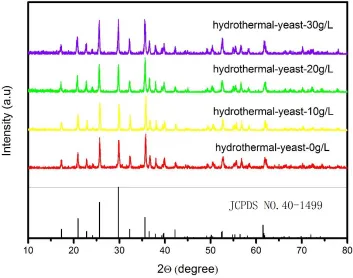
The XRD patterns of all as-prepared composites are shown in Fig.1, the diffraction patterns of the precursors are indexed as orthorhombic olivine-type structure of LiFePO4 (JCPDS NO.40-1499). It is obviously that main diffraction peaks of all the samples are assigned to the referential diffraction patterns. The peaks of LiFePO4/C composites indicate the high purity and no characteristic peaks from carbon and other elements, because the Baker’s yeast cells are transformed into amorphous carbon in the process of sintering.
Figure 1. XRD patterns of various LiFePO4 at different additional amount of yeast cells
The morphological features of all as-prepared products are characterized by SEM in Fig.2. Fig.2 (a) shows the SEM image of LiFePO4 samples which is made by hydrothermal method. It is obviously observed that the samples are mostly blocky and LiFePO4 grains are aggregated about 1-3μm in diameter. Fig.2 (b) is LiFePO4/C composites using 10g L-1
[image:4.596.124.477.307.585.2][image:5.596.106.495.138.433.2]
composites (by biosynthesis method), it shows that biosynthesis method can not only effectively change the precursors structure but also directly provide the bio-carbon which is benefit to increase the electronic conductivity for the potential active material[16,17].
Figure 2. SEM images of LiFePO4/C at different additional amount of yeast cells: (a) 0g L-1, (b) 10g L-1, (c) 20g L-1, (d) 30g L-1
[image:5.596.109.489.500.729.2]
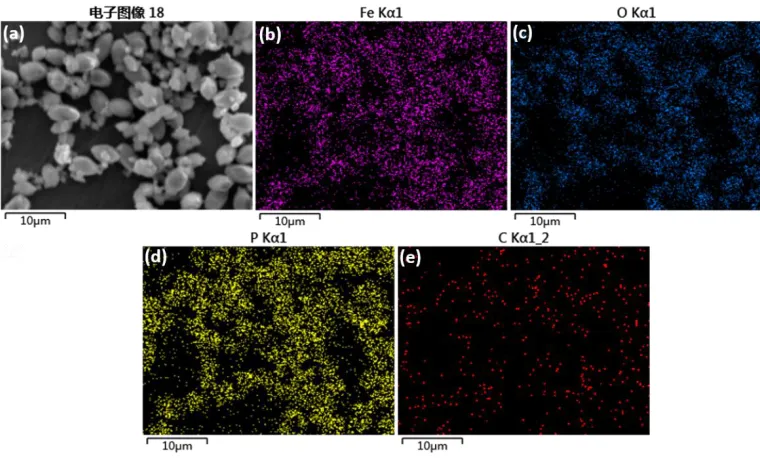
For confirming the elements in LiFePO4/C composites, the elemental distribution mappings of LiFePO4/C with 20g L-1 yeast cells are characterized in Fig.3. Fig.3 (a) shows a bright field SEM image of LiFePO4/C with 20g L-1 yeast cells, EDS analysis shows the distribution of Fe, O, P and C of LiFePO4/C sample with 20g L-1 yeast cells, respectively (Fig.3b-e). It illustrates that the mapping images of Fe, O and P are closely matched with the corresponding SEM image of LiFePO4/C composites. However, the distribution of C element is not as uniform as Fe, O and P elements, because the content of C is relatively low.
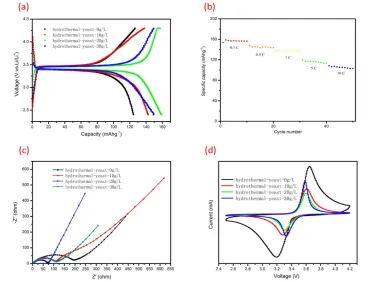
Figure 4. (a) Charge/discharge curve of various LiFePO4 /C at 0.1C. (b) Rate performance of LiFePO4 /C with 20g L-1 yeast cells at different current rates. (c) EIS curves of various LiFePO4 /C (d) CV curves of various LiFePO4 /C at a rate of 0.5mVs-1.
[image:6.596.104.493.207.489.2]
in the low frequency region. It shows that the resistance of the LiFePO4/C electrode (with yeast cells 20g L-1) is much smaller than other samples, which are accord with charge/discharge curves. All CV curves show a pair of well-defined redox peaks in Fig.4. (d), which also corresponds to all above results. In a word, the performance of LiFePO4/C composites (by biosynthesis method) are higher than the pure LiFePO4 material (by hydrothermal method), because the bio-carbon can availably increase the electronic conductivity and enhance channels for electron[20].
4. CONCLUSIONS
In this work, a biosynthesis method is used as a very alternative route to prepare cathode material for lithium ion batteries. The effect of different amount of yeast cells on the characters of LiFePO4/C composites is researched roundly. The result demonstrates that the LiFePO4/C composites with bio-carbon coating, prepared by biosynthesis method, are more suitable for lithium ion battery. Using biomimetic materials design, high power lithium ion batteries can be prepared by LiFePO4/C cathode materials. This important finding has encouraged us to investigate a new biosynthesis method to prepare some composites efficiently.
ACKNOWLEDGEMENTS
This work was financially supported by the National Natural Science Foundation of China (No.11264023).
References
1. T.M.S. Chang, Trends Biotechnol., 24 (2006) 372.
2. W.A. Hassanain, E.L. Izake, M.S. Schmidt and G.A. Ayoko, Biosens. Bioelectron., 91 (2017) 664. 3. J. Hess, M. Patra, V. Pierroz, B. Spingler, A. Jabbar, S. Ferrari, R.B. Gasser and G. Gasser,
Organometallics, 35 (2016) 3369.
4. X. Zhang, W. He, Y. Yue, R. Wang, J. Shen, S. Liu, J. Ma, M. Li and F. Xu, J. Mater. Chem., 22 (2012) 19948.
5. T. Fan, B. Sun, J. Gu, D. Zhang and L. W.M. Lau, Scr. Mater., 53 (2005) 893.
6. Y. Xia, W. Zhang, H. Huang, Y. Gan, Z. Xiao, L. Qian and X. Tao, J. Mater. Chem., 21 (2011) 6498.
7. X. Zhang, X. Zhang, W. He, C. Sun, J. Ma, J. Yuan and X. Du, Colloids Surf. B Biointerfaces, 103 (2013) 114.
8. Y. Cao, W.J. Feng and W.X. Su, Int. J. Electrochem. Sci., 12 (2017) 9084.
9. R. Rinaldi, R. Jastrzebski, M.T. Clough, J. Ralph, M. Kennema, P.C.A. Bruijnincx and B.M. Weckhuysen, Angew. Chem. Int. Ed., 55 (2016) 8164.
10. Y.C. Chang, C.Y. Lee and H.T. Chiu, ACS Appl. Mater. Interfaces, 6 (2014) 31.
11. X. Du, W. He, X. Zhang, Y. Yue, H. Liu, X. Zhang, D. Min, X. Ge and Y. Du, J. Mater. Chem., 22 (2012) 5960.
12. H. Gong, H. Xue, T. Wang, J. He, J. Power Sources, 318 (2016) 220.
14. E. Nevoigt, Microbiol. Mol. Biol. Rev., 72 (2008) 379.
15. S. Mann, D.D. Archibald, J.M. Didymus, T. Douglas, B.R. Heywood, F.C. Meldrum and N.J. Reeves, Science, 261 (1993) 1286.
16. B. Wang, A. Liu, W.A. Abdulla, D. Wang and X.S. Zhao, Nanoscale, 7 (2015) 8819. 17. P.L. Kuo, C.H. Hsu, H.T. Chiang and J.M. Hsu, J. Nanoparticle Res., 15 (2013).
18. W.J Feng, Y. Cao, X. Zhao, J.T. Gang and W.X. Su, Int. J. Electrochem. Sci., (2017) 5199. 19. C. Zhang, J. Qi, H. Zhao, H. Hou, B. Deng, S. Tao, X. Su, Z. Wang, B. Qian and W. Chu, Mater.
Lett., 201 (2017) 1.
20. R. Muruganantham, M. Sivakumar, R. Subadevi, S. Ramaprabhu and N.L. Wu, Electron. Mater. Let.,11 (2015) 841.