This is a repository copy of
Sexual selection predicts the rate and direction of colour
divergence in a large avian radiation
.
White Rose Research Online URL for this paper:
http://eprints.whiterose.ac.uk/145606/
Version: Published Version
Article:
Cooney, C.R., Varley, Z.K., Nouri, L.O. orcid.org/0000-0003-0397-8699 et al. (3 more
authors) (2019) Sexual selection predicts the rate and direction of colour divergence in a
large avian radiation. Nature Communications, 10. 1773. ISSN 2041-1723
https://doi.org/10.1038/s41467-019-09859-7
[email protected] https://eprints.whiterose.ac.uk/ Reuse
This article is distributed under the terms of the Creative Commons Attribution (CC BY) licence. This licence allows you to distribute, remix, tweak, and build upon the work, even commercially, as long as you credit the authors for the original work. More information and the full terms of the licence here:
https://creativecommons.org/licenses/
Takedown
If you consider content in White Rose Research Online to be in breach of UK law, please notify us by
Sexual selection predicts the rate and direction
of colour divergence in a large avian radiation
Christopher R. Cooney
1, Zoë K. Varley
1, Lara O. Nouri
1,2, Christopher J.A. Moody
1, Michael D. Jardine
1,3&
Gavin H. Thomas
1,4Sexual selection is proposed to be a powerful driver of phenotypic evolution in animal sys-tems. At macroevolutionary scales, sexual selection can theoretically drive both the rate and direction of phenotypic evolution, but this hypothesis remains contentious. Here, wefind that differences in the rate and direction of plumage colour evolution are predicted by a proxy for sexual selection intensity (plumage dichromatism) in a large radiation of suboscine passerine birds (Tyrannida). We show that rates of plumage evolution are correlated between the sexes, but that sexual selection has a strong positive effect on male, but not female, inter-specific divergence rates. Furthermore, we demonstrate that rapid male plumage divergence is biased towards carotenoid-based (red/yellow) colours widely assumed to represent honest sexual signals. Our results highlight the central role of sexual selection in driving avian colour divergence, and reveal the existence of convergent evolutionary responses of animal signalling traits under sexual selection.
https://doi.org/10.1038/s41467-019-09859-7 OPEN
1Department of Animal and Plant Sciences, University of Sheffield, Western Bank, Sheffield S10 2TN, UK.2School of Biological Sciences, Royal Holloway, University of London, Egham Hill, Egham TW20 0EX, UK.3Research Department of Genetics, Evolution and Environment, University College London, Gower Street, London WC1E 6BT, UK.4Bird Group, Department of Life Sciences, The Natural History Museum, Tring HP23 6AP, UK. Correspondence and requests for materials should be addressed to C.R.C. (email:c.cooney@sheffield.ac.uk)
123456789
A
central problem in evolutionary biology is to explain theprocesses shaping the evolutionary diversification of
species’phenotypic traits1–3. In particular, despite a long history of study4,5, explaining the tremendous diversity of animal sexual signalling traits has proved particularly challenging, and our understanding of the processes driving the evolution of species’ sexual signalling traits remains highly incomplete6,7. Sexual signalling traits mediate the complex relationship between
an organism and its environment in important ways8. For
instance, signalling traits such as colour, patterns, and sounds are under strong selection to facilitate effective communication
between individuals in a given environment, but such benefits
are balanced against costs such as those associated with signal
production, maintenance or display, including predation9–11.
Furthermore, animal signalling traits often play a key role in reproductive decision-making processes such as mate choice, and particularly choice for a conspecific mate4,12. Evolutionary divergence in signalling traits has consequently been recognised as a potentially powerful mechanism facilitating reproductive isolation before and/or after speciation among diverging
populations13,14. Understanding the processes driving sexual
signal divergence across lineages therefore has important impli-cations for explaining multiple facets of biodiversity, including patterns of phenotypic and species diversity among groups and across geographic regions15.
Sexual selection has long been viewed as a potent diversifying force in animal systems4,12, as preferences for novel signals can theoretically drive continuous and often rapid divergence in sexually selected traits between populations16–18. This view is supported by empirical studies showing that young, closely related species often differ primarily in terms of male courtship traits19–22, implying a role for divergent sexual selection in driving the rapid evolution of (primarily male) sexual signals during or after speciation. At a macroevolutionary scale, increased intensity of sexual selection is therefore expected to drive high rates of evolution in signalling traits. A limited number of studies have attempted to test these ideas directly using a comparative approach, but so far results linking sexual selection to elevated rates of sexual signal divergence have been mixed23,24. In addition to driving trait divergence and increases in evolu-tionary rate, sexual selection may also play a role in determining the direction of signal evolution within lineages. Ornamental traits (i.e., those under sexual selection by mate choice) such as feather colouration, signal at least three very different types of information: species identity, attractiveness, and individual
quality25. Signals of species identity and attractiveness are
expected to be arbitrary in form but differ in terms of elabo-rateness. This is because the information conveyed does not depend on the exact nature of the signal, only that they are
dis-tinctive or attractive25. Signals of quality should converge on
one or a few signal types that are more effective (or have lower
costs) than others26–28. For example, receiver sensory biases
or higher production and maintenance costs may make
carotenoid-based (yellow, red) pigments more efficient or honest
visual signals of individual quality than other types of colour producing mechanism (e.g., melanin or structural)29,30. Thus if the evolution of particular signal types is promoted or con-strained by selection for signals of quality, and perceptual, developmental or energetic differences between signal production mechanisms, then the direction of trait evolution under sexual selection should be to some extent predictable. The relative roles of selection for arbitrary (identity, attractiveness) versus adaptive (quality) signals on the rate and direction of ornament evolution remains unresolved25.
Despite these longstanding theoretical predictions, progress in resolving the role of sexual selection in signal divergence has been
slow for a number of reasons. First, although previous studies have attempted to test the impact of sexual selection on signal elaboration/divergence directly23,24,31,32, few have explicitly assessed the importance of sexual selection for explaining varia-tion in both the rate and direcvaria-tion of phenotypic evoluvaria-tion at broad phylogenetic scales, and whether these patterns differ between the sexes. Second, previous studies have generally been hampered either by small sample sizes or by a lack of high quality data on species’signalling traits, limiting the potential scope and generality of the resulting inferences. Third, such studies have also typically failed to contrast the importance of sexual selection against the role of other factors, making it difficult to assess the relative importance of sexual selection in relation to alternative mechanisms (e.g., ecological selection)15,33,34.
Here, we use a dataset of male and female plumage colouration based on calibrated UV/Vis digital images of museum specimens
and a method for summarising species-specific rates of trait
evolution across a phylogenetic tree to examine the evolutionary
dynamics of plumage colouration in the Tyrannida—a large,
morphological diverse radiation of New World suboscine
pas-serine birds comprising tyrant flycatchers, cotingas, manakins,
and their allies. Birds offer an ideal study system in which to test the role of sexual selection in signal evolution because of the general availability of phylogenetic, phenotypic and geographic data. Furthermore, the Tyrannida in particular are especially suited to our analysis because colour patterns (and underlying colour producing mechanisms) are highly variable across species, and because species in the group occupy a wide range of ecolo-gical and environmental niches, allowing investigation of the importance of alternative hypotheses for signal evolution35. Plu-mage dichromatism represents a widely used proxy for sexual selection intensity in birds36, but is likely to be an imperfect measure37,38. We therefore investigated the relationship between dichromatism values and independent measures of sexual selec-tion from prior work, using both proxies to test the predicselec-tions outlined above. Our results show that sexual selection (i) is associated with elevated rates of signal divergence between related species, (ii) impacts divergence between males more than females, and (iii) generates biases in the direction of signal evolution. We conclude that sexual selection plays a key role in explaining variation in both the rate and direction of plumage colour divergence in birds.
Results
Evolutionary rates of plumage colour divergence. We estimated
lineage-specific rates of male and female plumage colour
evolu-tion using aflexible reversible-jump model of trait evolution and
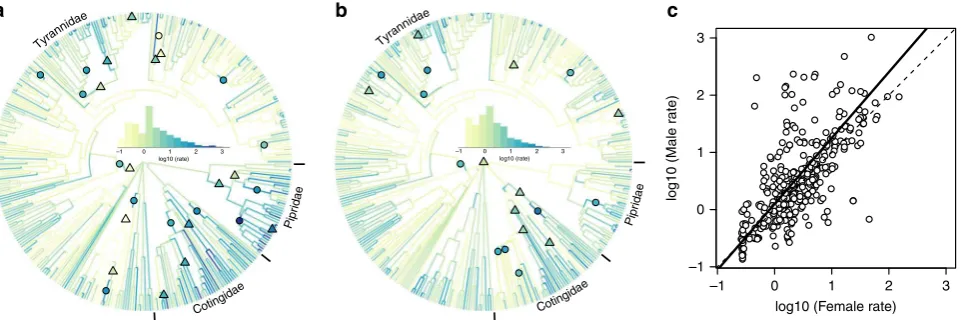
mapped these onto the Tyrannida phylogeny (Fig. 1). This
ana-lysis revealed evidence for substantial heterogeneity in rates of plumage colour evolution across the Tyrannida, with rates dif-fering by four orders of magnitude both across lineages and
between the sexes (Fig.1). In particular, we found evidence for
exceptionally high rates of male plumage colour divergence (Fig.1a) within lineages of the Pipridae (manakins; e.g.,Manacus
and Pipra) and Cotingidae (cotingas; e.g., Cotinga and Xipho-lena), as well as more isolated cases of exceptionally rapid male
divergence within the Tyrannidae (tyrant-flycatchers; e.g.,
Pyr-ocephalus rubinus). In contrast, rates of female plumage colour divergence were found to be less extreme than in males, but nonetheless still varied by three orders of magnitude across
lineages (Fig. 1b). Estimating rates of evolution for each of 10
different plumage patches (see Methods) separately revealed that patches typically associated with signalling (e.g., crown, throat, breast) have some of the fastest patch-specific rates, whereas those involved in other tasks such as locomotion (e.g., wing, tail) generally have lower rates (Supplementary Fig. 1).
Comparing species-specific trait rates (TRES) of male and
female plumage colour evolution estimated using a method summarising rate variation across the phylogeny (see Methods) revealed that rates of plumage colour evolution are correlated between the sexes, but that males typically diverge faster than
females (Fig. 1c and Supplementary Fig. 2). The phylogenetic
major axis regression line relating male and female rates was significantly greater than one, indicating that as average within-species rate increases, rates of plumage colour evolution become significantly more male biased (Fig.1c).
Multipredictor models of male and female plumage rates. To assess the source and strength of selection acting to drive diver-gence in male and female plumage colouration, we used
multi-predictor models of sex-specific plumage divergence rate (TRES
values) to test several competing hypotheses for the evolution of plumage colouration across species. Our models revealed that a proxy for sexual selection (plumage dichromatism) has a strong positive effect on rates of male but not female plumage evolution that is independent of other key variables (Fig.2, Supplementary Table 1). First, consistent with the results of our other analyses (Fig.1), our models indicate that on average plumage colouration
evolves more rapidly in males than females (Fig.2). Second, our
models showed that dichromatism is strongly associated with rapid rates of male plumage colour evolution, but that this effect
is absent in females (Fig. 2). In other words, as the degree of
dichromatism within lineages increases, rate of male plumage colour evolution tends to accelerate, whereas rates of female plumage evolution remain relatively constant (Fig.2).
Because mean plumage dichromatism is an imperfect proxy of sexual selection we re-ran our modelsfirst accounting for varying levels of (sex-specific) intraspecific colour variation (Supplemen-tary Table 2) and then using two alternative proxies for sexual selection. The latter models are based on: (i) maximum extent of colour differences across body regions (Supplementary Table 3) and, (ii) an independent proxy of sexual selection intensity based on scores of social mating system, sexual size dimorphism and paternal care (see Supplementary Methods) for a subset of our dataset (Supplementary Fig. 3, Supplementary Table 4). Impor-tantly, our results are qualitatively unchanged indicating that our
findings are robust to alternative approaches for indexing sexual
selection intensity. Furthermore, breaking results down by patch showed largely consistent effects (Supplementary Fig. 4), except that the sex-specific effect of sexual selection (dichromatism) on colour evolution was strongest in patches assumed to be used in signalling in birds, with weak or absent effects in those patches primarily used for non-signalling functions (e.g., wing, tail).
In addition to the role of sexual selection, our multipredictor models also identified other significant effects (Fig. 2, Supple-mentary Table 1). First, our models revealed a consistently
significant negative correlation with time since divergence,
implying that young species are characterised by faster evolu-tionary rates relative to older species. Second, we detected marginally positive effects of midpoint latitude and confamilial sympatry. These results are consistent with the idea of latitudinal gradients in trait divergence rates and that interspecific interac-tions may drive trait evolution, respectively. However, these
relationships were non-significant in replicate analyses using
alternative datasets (Supplementary Tables 1–4). We also found
no consistent effects of body mass and habitat (level of forest dependency) on rates of (male or female) plumage colour evolution across our analyses (Fig.2, Supplementary Tables 1–4).
Overall, our models explained ~18–27% of the variation in rates
of male and female plumage evolution across species.
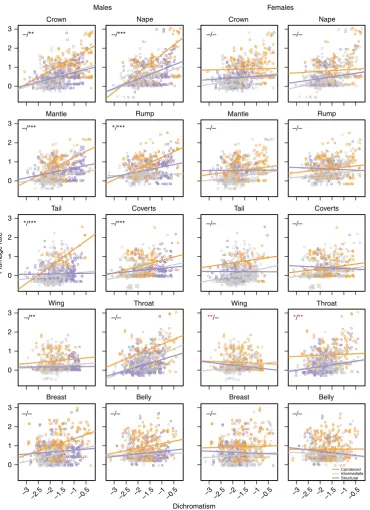
Rapid evolution towards carotenoid-based colour signals. Our analyses thus far reveal a positive association between sexual selection (as indexed by dichromatism) and accelerated (male) plumage colour divergence across Tyrannida species. To test whether this pattern was driven by the differential response(s) of particular signal types, we re-assessed this relationship afterfirst assigning each patch in our dataset to one of three non-overlapping categories broadly distinguishing colours consistent with two distinct colouration mechanisms (i.e., carotenoid-based and structural; see Supplementary Fig. 5 and Supplementary Methods). We then tested for an interaction between colouration category, and the slope of the relationship between dichromatism and (patch-specific) evolutionary rate. Our analysis revealed that, in males, the slope of the relationship between dichromatism and evolutionary rate is generally steeper among patches consistent with carotenoid colouration (i.e., red/orange/yellow), when
compared with the other two colouration categories (Fig. 3).
–1 0 1 2 3
–1 0 1 2 3
log10 (Female rate)
log10 (Male r
a
te)
–1 0 1 2 3 log10 (rate)
–1 0 1 2 3 log10 (rate)
a b c
Tyran
nidae
Coting
idae Pip
rid
ae
Tyran
nidae
Coting
idae Pip
rid
ae
Fig. 1Sex-specific rate variation in plumage colour evolution across the Tyrannida phylogeny.a,bPlots showing the Tyrannida phylogeny (n=372 spp.)
coloured by estimates of mean relative multivariate rate of plumage colour evolution based on ten body patches for males (a) and females (b). Coloured
shapes show the location of significant (posterior probability > 0.99) rate shifts affecting whole clades (triangles) and individual internal branches (circles)
(shape colour reflects rate estimate; see Methods for details). Histograms (inset) show the rate distribution for each tree.cRelationship between (log10
transformed) male and female rates of plumage colour evolution (TRESvalues) across species. Phylogenetic reduced major axis regression (solid) and
one-to-one (dashed) lines shown. Equation of the regression line:y=0.10+1.15*x (R2=0.45), which is significantly different to a one-to-one slope (T=3.69,
[image:4.595.60.541.51.211.2]In other words, as the degree of dichromatism increases, carotenoid-consistent colours evolve disproportionately rapidly compared with putative structural colours, or colours inter-mediate between these two extremes. In contrast, in females, regression slopes for the relationship between dichromatism and evolutionary rate were generally similar among signal types
(Fig. 3), with the exception of relationships across wing and
throat patches, where the slope for carotenoid-consistent patches
was significantly more negative (rather than more positive) than
that observed for the other signal types.
We then tested whether instances of recent rapid plumage
colour evolution are significantly biased towards particular
evolutionary directions in colour space (Fig. 4, Supplementary
Table 5). By comparing the average rate of evolution associated with different directions of recent plumage colour divergence to null expectations (see Methods), our analysis revealed that instances of fast plumage colour divergence in males are
significantly biased towards the evolution of red/orange/yellow
colour patches (i.e., those primarily stimulating the red cone), consistent with carotenoid-based colour producing mechanisms
(Fig. 4a). In contrast, we found that evolutionary trajectories
associated with the development of other colours were not significantly associated with fast rates. Specifically, evolutionary trajectories associated with the evolution of green colouration were characterised by rates of evolution that are no more rapid than expected by chance. Conversely, we found that evolution towards blue colours (i.e., those stimulating the blue/violet receptors) had on average lower rates than expected compared with a dataset-wide average. In females (Fig.4b), consistent with our other analyses, rates of evolution in all directions were generally lower in females than in males. Nonetheless, we found some evidence that evolutionary trajectories associated with carotenoid-consistent colour patches in females were also characterised by disproportionately rapid evolutionary rates
(Fig. 4, Supplementary Table 5). The results of these analyses
were quantitatively similar when we ran these analyses using an alternative dataset (Supplementary Table 6).
Breaking these results down into different patches (Supple-mentary Fig. 6) revealed that the significant overall effects were driven primarily by significant deviations from the null expecta-tion in only a subset of body regions typically associated with signalling and communication in birds, including the crown, nape, throat, and breast. In contrast, other body regions, in particular tail and wings, showed much weaker evidence of rate
biases associated with specific directions of colour evolution.
Patch-level analyses of females revealed broadly similar trends but with fewer incidences of significant bias in directions associated with elevated or suppressed rates (Supplementary Fig. 6).
Discussion
Our results show that within the Tyrannida (tyrant flycatchers,
cotingas, manakins and their allies), rates of plumage colouration are (i) correlated between the sexes, but typically faster for males than females (disproportionately so within fast-evolving
species), (ii) significantly associated with proxies for sexual
selection intensity (including dichromatism), with contrasting effects between the sexes, and (iii) disproportionately elevated towards carotenoid-based (i.e., red/yellow) colouration traits, particularly within body regions frequently observed to function in inter-sexual or intra-sexual displays in birds (e.g., crown, throat, breast, rump). Thesefindings support the idea that sexual selection is the key driver in determining both the rate and direction of plumage colour divergence in birds.
We found strong support for a positive association between sexual dichromatism and the rate at which male plumage col-ouration traits diverge. This result is consistent with a previous study23focused on a small yet broad sample of avian sister species pairs, but contrasts with a related clade-based analysis using different proxies for sexual selection intensity24that found both positive and negative associations between sexual selection and ornamentation. Our results indicate that this effect holds within, as well as between avian lineages, and supports the longstanding interpretation that sexual selection accelerates the evolutionary Sex (male)
a b
3 Males
Females
2
Plumage r
ate
1
0
–1
0.15 0.01
∆R
2 = 0.07
Plumage r
ate
Plumage r
ate
3 2 1 0 –1
3 2 1 0 –1 Dichromatism
Time since divergence
Confamilial sympatry Time since divergence
Body mass
Dichromatism
Forest dependency (non-forest)
Midpoint latitude
Confamilial sympatry
Time since divergence : sex
Body mass : sex
Dichromatism : sex
Forest dependency : sex
Midpoint latitude : sex
Confamilial sympatry : sex
–0.6 –0.4 –0.2 0.0
Standardised effect size (95% Cl) 0.2 0.4 0.6 pMCMC
<0.001 <0.01 <0.1
Fig. 2Predictors of rates of plumage colour evolution in the Tyrannida.aCoefficient estimates from a multipredictor BPMM predicting variation in (log10
transformed) whole-plumage TRESrates of colour evolution among Tyrannida species (n=372). Points indicate the mean standardised effect sizes for
each of the (scaled) predictor variables and lines indicate 95% credible intervals (CI). Predictors with significant (pMCMC <0.05) effects are coloured
purple (negative effect) and green (positive effect). MarginalR2value (i.e., variance explained byfixed factors) for the full model is 0.23.bScatterplots
showing the relationship between significant predictor variables and plumage rates with regression lines (and 95% CIs) plotted for males (blue) and
females (red) separately. Inset values show the change in marginalR2(ΔR2) relative to the full model when a given predictor (and its interaction with sex)
is dropped from the full model
[image:5.595.121.477.52.258.2]diversification of male plumage signals involved in courtship and species recognition4. Furthermore, we found that on average male
plumage traits diverge significantly more rapidly than female
traits and that rates of female plumage divergence are not
asso-ciated with dichromatism—results that are consistent with those
of previous studies examining sex-specific relationships between
sexual selection and plumage divergence/elaboration23,31,32. While overall differences in rate between the sexes may in part reflect greater constraints on plumage colouration in females than
males5, a pattern of increasingly rapid plumage divergence rate
associated with dichromatism in males (but not females) is more consistent with the general prediction that is due to sex differ-ences in reproductive investment, sexual selection should typi-cally be stronger on males than females4,12.
We find evidence for a strong between-sex correlation in
plumage divergence rate that becomes disproportionately more male-biased as rate increases. One explanation for this pattern is that genetic correlations cause non-adaptive changes in female –3
–2.5 3
Males Females
Crown
Mantle
Tail
Wing
Breast
Coverts
Throat
Belly Belly
Tail
Wing
Breast
Coverts
Throat
–/** –/***
–/*** */*** –/– –/–
–/– –/–
–/*** */***
–/** –/–
–/– –/– –/– –/–
**/– */**
–/– –/–
Nape
Rump Mantle Rump
Crown Nape
2
1
0
3
2
1
0
3
Plumage r
ate 2
1
0
3
2
1
0
3
2
1
0
–2
–1.5 –1–0.5 –3–2.5 –2–1.5 –1–0.5 –3–2.5 –2–1.5 –1–0.5 –3–2.5 –2–1.5 –1–0.5 Dichromatism
Carotenoid Intermediate Structural
Fig. 3Relationships between dichromatism and rate of plumage colour evolution within body regions for different colouration types. Regression lines are plotted separately for patches consistent with carotenoid-based (orange) or structural (lilac) colouration, as well as colouration intermediate between these two extremes (grey) (see Supplementary Methods). Asterisks indicate whether the slope of the carotenoid regression line (the reference category)
is significantly more positive (black) or more negative (red) compared with the slope of the (i) intermediate and (ii) structural regression lines, respectively
(i.e., carotenoid slope vs. intermediate slope, carotenoid slope vs. structural slope), based on Bayesian phylogenetic mixed-models. ***pMCMC <0.001;
[image:6.595.115.486.47.558.2]traits in response to strong divergent sexual selection acting primarily on males39,40. This is consistent with patterns observed for other traits, such as allometric increases in male-biased sexual size dimorphism in larger species that are driven by a correlation between evolutionary change in females and directional sexual selection on males, e.g., ref.41. However, genomic studies indicate that genetic correlations between males and females may not represent a major evolutionary constraint42–44. An alternative explanation therefore is that correlated rates of female plumage divergence are the result of mutual selection on signalling traits in both sexes45,46. Evidence suggests that elaborate signalling traits are maintained in females as adaptive responses to sexual and social competition47. Correlated divergence rates across the sexes may therefore be the result of females co-opting (elements of) male sexual signals for use in intra-sexual or inter-sexual or social interactions. Irrespective of the underlying mechanism, however,
finding that rates of plumage evolution are generally elevated in
males but also correlated between the sexes suggests that sexual selection plays a role in explaining the evolutionary divergence not only of male but also female plumage traits.
Our results also reveal additional predictors of rates of plumage evolution across species. First, rates of plumage evolution were associated with time since divergence for both males and females. At face value, a negative relationship between rate and time since divergence is consistent with the hypothesis that changes in plumage colouration are associated with speciation events. However, we interpret this relationship with caution as it may alternatively be explained by a methodological bias towards inferring faster rates on shorter branches if there are errors in tree
topology and/or measurement error in phenotypic data48,49.
Second, we detected a positive but weak effect of confamilial
sympatry, which is consistent with the idea that interspecific
interactions may promote rather than constrain phenotypic evolution50. However, this relationship was absent when using an alternative tree topology and subset of the data. None of the variables included in our analysis were able to explain the
sig-nificant effect of dichromatism on rates of plumage evolution
and, taken together, our multipredictor modelling results imply that sexual selection is the key driver of rates of plumage colour evolution across the Tyrannida.
These conclusions are contingent on the degree to which dichromatism represents an accurate measure of variation in sexual selection intensity across lineages. Although dichromatism has been shown to correlate with independent measures of sexual selection such as social mating system and relative testes mass31,32,51, dichromatism represents an imperfect proxy for total sexual selection intensity. This is because other mechanisms can
influence patterns of sex-differences in plumage colouration,
including natural selection for female crypsis during incubation52 or social selection on females to signal quality in the context of
male mate choice or female–female competition47. Furthermore,
if trade-offs exist between signalling modalities, then dichroma-tism may underestimate sexual selection intensity, particularly in
lineages emphasising acoustic over visual signalling traits37.
However, when we tested an independent (i.e., non-dichromatism based) index of sexual selection intensity based on social mating system, sexual size dimorphism and paternal care data for a subset of our dataset, we found qualitatively identical results.
Moreover, this alternative index was significantly positively
correlated with our dichromatism scores (Pearson’s r=0.58,
P< 0.001), suggesting that in this system at least, dichromatism provides an adequate proxy for underlying gradients in sexual selection intensity. Nonetheless, ideally we would use a more direct measure of sexual selection intensity across lineages than any of these proxies provide, for example, indices based on var-iation in male mating success (e.g., Bateman gradients; ref. 53). However, such measures are unavailable for most species, and
thus quantifiable indices such as dichromatism currently
repre-sent the most practical proxy for measuring sexual selection intensity for large numbers of species54. Yet, given these issues, we suggest that the effects with respect to dichromatism we report here are likely to be underestimates, implying that the true effect of sexual selection on rates of signal evolution may in fact be stronger than revealed here.
Our results also provide insight into the predictability of colour evolution under sexual selection. We found dispro-portionately fast rates of evolution towards areas of colour space dominated by carotenoid-based (i.e., red/yellow) colours, as well as steeper relationships between dichromatism and evolution rates for carotenoid-based patches than for other signal types
m
l
s
v
5 a b
Males Females
0
–5
PC2
–10
–15
–5
0 1
log10 (rate)
2 3
0 5
1.0 0.75 0.5 0.25 0.0
1.0 0.75 0.5 0.25 0.0
10 PC1
–5 0 5 10
Fig. 4The rate and direction of plumage colour divergence among Tyrannida species. Plots combine data from 10 plumage patches for males (a) and
females (b) of 372 Tyrannida species. Arrows indicate the direction of evolution and are coloured according to the corresponding patch-specific rate of
evolution. Radar plots (inset,aandb) show the mean evolutionary rates of divergence trajectories (black points and lines) falling within each 20osegment
of two-dimensional colour space. Grey bands indicate the 95% confidence intervals for the null distribution of mean rates based on a randomisation
process. Filled points indicate values showing significant (P< 0.05) deviations from the null distribution, with triangles and squares indicating faster and
slower average rates than expected, respectively. Scale bar (inset,a) and vector diagram showing the loadings of receptor stimulation variables onto PC
axes (inset,b) are relevant to both panels
[image:7.595.141.459.52.219.2](e.g., structural). The strength of these effects was strongest in front facing body regions (e.g., crown, throat, breast), consistent with a primary role for these body regions in close-proximity sexual or social signalling55–59. Avian carotenoid-based signals represent classic examples of sexually selected,
condition-dependent signals of individual quality29. Although there is
continuing debate regarding the precise mechanism through
which carotenoid traits become honest signals9,60, field and
behavioural studies have demonstrated the role of such traits in
determining the outcome of competitive social interactions61.
Furthermore, the genetic and biochemical basis of avian car-otenoid signal production is becoming increasing well understood62,63, and phylogenetic evidence indicates that car-otenoid pathways are deeply conserved across birds and can be readily up-regulated or down-regulated in response to relatively short-term changes in selection64. Thisflexibility contrasts with developmental and morphological constraints that potentially inhibit rapid evolution towards other types of conspicuous col-ouration (e.g., blue or iridescent structural colours)65, potentially explaining why we found that rates of evolution towards blue/ violet colouration in males were significantly lower than expected
compared with null expectations (Fig. 3). Thus, our results are
consistent with the view of carotenoid colours as key signalling traits that often evolve convergently in response to sexual selec-tion in birds66.
Overall, our results highlight the dominant role of sexual selection in driving the evolutionary divergence of avian plumage colouration, and reveal the existence of convergent evolutionary trajectories of avian signalling traits under strong sexual selection. Furthermore, our results suggest that signal divergence under sexual selection may be to some extent predictable, with rapid instances of signal divergence biased towards carotenoid-based colouration traits known to function as honest condition dependent signals of individual quality. Further work is required to assess the generality of these patterns, but given the prevalence of convergently-evolved carotenoid signals within and between avian lineages64,66, as well as in other animal lineages including
fish and reptiles67,68, our results provide insight into the evolu-tionary forces responsible for explaining patterns of diversity and convergence in visual signalling traits across the animal kingdom.
Methods
Specimen selection. We collected data on male and female plumage colouration using study skins from the avian skin collection at the Natural History Museum, Tring. We focused on species for which representatives of both sexes were available and, where possible, sampled specimens of three males and three females, selecting mature individuals in breeding plumage with no obvious signs of moult. Using this approach, we were able to sample specimens of both sexes for 372 (65%) of the taxa represented in the Jetz et al. (ref.69) phylogenies (see Supplementary Methods),
with a mean of 2.7 male and 2.4 female specimens per species.
Digital photography and image processing. Plumage colouration was measured using calibrated digital images of specimens. For full details of equipment and approach, see Supplementary Methods. Following image acquisition, all raw (.NEF) images of specimens were linearised and exported as linear TIFFfiles using DCRAW70. Each linearised image was then normalised using information from the
five grey standards included in each image to control for variation in lighting conditions, following the approach of ref.71. We then used these images to extract
colour measurements for 10 discrete plumages patches on each specimen (crown, nape, mantle, rump, dorsal tail, wing coverts, wing primaries, throat, breast, and belly). Together these patches provide a comprehensive set of measurements capturing variation in overall plumage colouration for each specimen that is comparable across species72. To do this, we used a custom IMAGEJ macro to draw
a series of polygons onto our images outlining the location of individual plumage patches on each specimen (Fig. S7). We then used the coordinate locations of these polygons to extract mean RGB values for each patch on each specimen in both the UV and visual range.
Visual modelling. To convert linearised and normalised RGB values into avian colourspace values, wefirst estimated the spectral sensitivity of our cameras using
data on the camera’s response to a range of colour patches (from commercial colour charts, coloured card, and pastels) of known surface reflectance to estimate camera sensor sensitivity functions (see Supplementary Methods). We then used established methods71to generate mapping functions to convert RGB colour values
into avian cone-catch values (Supplementary Table 7). We based our analyses on a violet-sensitive (VS) avian visual system because the available evidence indicates that Tyrannida species are unlikely to possess ultraviolet visual sensitivity73. Our
dataset therefore consisted of four colour measurements (receptor stimulation values) for 10 plumage patches for a total of 1877 specimens covering 372 species.
To demonstrate the validity of our image-based approach for measuring plumage colouration, we tested whether relative receptor stimulation values extracted from our processed digital images (see below) matched those generated by spectrophotometric measurements of patch reflectance. For a sample of specimens (i.e., species) capturing the breadth of Tyrannida colourspace (n=550
patches; see Supplementary Methods for full details), we found that receptor stimulation values derived from our image-based approach were very highly positively correlated with those based on spectrophotometric data in all four photoreceptor classes (Supplementary Fig. 8; Pearson’sr=0.92–0.96,P< 0.001 in
all cases). Thus, we conclude that our image-based approach is valid and is capable of providing estimates of patch colouration that are highly similar to those generated using spectrophotometric techniques across the full avian visible range.
We averaged patch values within species (separately for each sex) to generate species-level averages in each variable for each patch for each sex. Following previous studies, we represented chromatic variation among patches using a standard avian colourspace model in which raw cone catch values are converted to relative cone stimuli values and projected in a tetrahedron74. This tetrahedron—
in which the achromatic (luminance) dimension is removed and each vertex represents one of the four cones characterising avian colour vision (i.e.,v,s,m, andl)—is the sensory equivalent of a morphospace, where similar colours fall in close proximity in the colourspace and disparate colours are far apart74. Given that
relative cone stimuli are often correlated, following standard approaches65we
conducted a principal component (PC) analysis to represent the colourspace in fewer orthogonal variables. We used thefirst two PCs, which together accounted for 93% of the variation in the original colourspace variables (Supplementary Table 8). For full details, see Supplementary Methods.
Trait evolution. We estimated rates of plumage colour evolution using the multivariate version of the variable rates model of trait evolution75,76implemented
in the software BayesTraits V2.0.2 (http://www.evolution.rdg.ac.uk/). To provide species-level estimates of plumage evolution rate that also incorporates information on the longer-term rate of trait evolution leading to the phenotype of a given species, we developed an approach for apportioning rate-scaled branch lengths among each tip of a phylogenetic tree77. Specifically, our approach involves
calculating a weighted average of tip-to-root branch rates for each extant lineage, where, analogously to the equal splits approach77, the rate associated with each
root-ward edge is down-weighted by a factor of ½:
mi¼ PNi
j¼1wjlj PNi
j¼1wj
ð1Þ
and
wj¼
1
2j 1 ð2Þ
wheremiis the weighted average of tipi,Niis the number of edges between tipi
and the root of the tree, andljis the length of each edgej, withj=1 being the
terminal edge leading to the species andj=Nibeing the edge nearest the root.
Thus, when applied to phylogenies where branch lengths are in units of rate of trait evolution (rather than time), such as those derived from the outputs of the variable rates model, then these tip-specific weighted average values provide a species-level estimate of trait evolutionary rate that also captures the longer-term rate of trait evolution leading to the phenotype of a given species. We refer to this rate-scaled tip metric as TRES(Trait Rate equal splits) and apply the above formula to mean
rate phenograms derived from outputs of the variable rates models described above.
Statistical analyses. To assess the relationship between male and female plumage rates (TRESvalues) across species, we used phylogenetic reduced major axis
regression based on a maximum likelihood optimisation of lambda78. To assess the
effect of predictor variables on plumage TRESvariation across species, following31
we used Bayesian phylogenetic mixed models in MCMCglmm79tofit male and
colour axis calculated using a maximum likelihood approach78. We then compared
the average rate of divergence associated with differing evolutionary trajectories in colour space to null distributions of rates generated assuming no relationship between rates and direction of colour evolution. Any deviation in the mean observed rate of evolution compared with the null distribution of rates within each discrete divergence trajectory suggests that rates are disproportionately higher or lower on average than expected relative to null expectations. For full details of this approach, see Supplementary Methods.
Data availability
Data associated with this manuscript are available via Figshare:https://doi.org/10.6084/ m9.figshare.7867949.v1.
Code availability
Scripts used in this manuscript are available via Figshare:https://doi.org/10.6084/m9. figshare.7867949.v1.
Received: 9 July 2018 Accepted: 2 April 2019
References
1. Simpson, G. G.The Major Features of Evolution. (Columbia University Press, New York, 1953).
2. Simpson, G. G.Tempo and Mode in Evolution. (Columbia University Press, New York, 1944).
3. O’Meara, B. C., Cécile, A., Sanderson, M. J. & Wainwright, P. C. Testing for different rates of continuous trait evolution using likelihood.Evolution60, 922–923 (2006).
4. Darwin, C. R.The Descent of Man, and Selection in Relation to Sex. (John Murray, London, 1871).
5. Wallace, A. R.Darwinism: An Exposition of the Theory of Natural Selection With Some of Its Applications. (Macmillan & Co., London, 1889). 6. Price, T. D. Sensory drive, color, and color vision.Am. Nat.190, 157–170
(2017).
7. Mason, N. A. et al. Song evolution, speciation, and vocal learning in passerine birds.Evolution71, 786–796 (2017).
8. Cuthill, I. C. et al. The biology of color.Science357, eaan0221 (2017). 9. Weaver, R. J., Koch, R. E. & Hill, G. E. What maintains signal honesty in
animal colour displays used in mate choice?Philos. Trans. R. Soc. Lond. Ser. B 372, 20160343 (2017).
10. Zahavi, A. & Zahavi, A.The Handicap Principal: A Missing Piece of Darwin’s puzzle. (Oxford University Press, New York, 2007).
11. Johnstone, R. A.The Evolution of Animal Signals. (Blackwell Science, Oxford, 1997).
12. Andersson, M.Sexual Selection. (Princeton University Press, Princeton, 1994). 13. West-Eberhard, M. J. Sexual selection, social competition, and speciation.Q.
Rev. Biol.58, 155–183 (1983).
14. Mendelson, T. C., Martin, M. D. & Flaxman, S. M. Mutation-order divergence by sexual selection: diversification of sexual signals in similar environments as afirst step in speciation.Ecol. Lett.17, 1053–1066 (2014).
15. Wilkins, M. R., Seddon, N. & Safran, R. J. Evolutionary divergence in acoustic signals: causes and consequences.Trends Ecol. Evol.28, 156–166 (2013).
16. Lande, R. Models of speciation by sexual selection on polygenic traits.
Proc. Natl Acad. Sci. USA78, 3721–3725 (1981).
17. Iwasa, Y. & Pomiankowski, A. Continual change in mate preferences.Nature 377, 420–422 (1995).
18. Fisher, R. A.The Genetical Theory of Natural Selection. (Clarendon Press, Oxford, 1930).
19. Arnegard, M. E. et al. Sexual signal evolution outpaces ecological divergence during electricfish species radiation.Am. Nat.176, 335–356 (2010). 20. Boul, K. E., Funk, W. C., Darst, C. R., Cannatella, D. C. & Ryan, M. J. Sexual
selection drives speciation in an Amazonian frog.Proc. R. Soc. Lond. Ser. B 274, 399–406 (2007).
21. Masta, S. E. & Maddison, W. P. Sexual selection driving diversification in jumping spiders.Proc. Natl Acad. Sci. USA99, 4442–4447 (2002). 22. Mendelson, T. C. & Shaw, K. I. Rapid speciation in an arthropod.Nature433,
375–376 (2005).
23. Seddon, N. et al. Sexual selection accelerates signal evolution during speciation in birds.Proc. R. Soc. Lond. Ser. B280, 20131065 (2013).
24. Gomes, A. C. R., Sorenson, M. D. & Cardoso, G. C. Speciation is associated with changing ornamentation rather than stronger sexual selection.Evolution 70, 2823–2838 (2016).
25. Hill, G. E. Sexiness, individual condition, and species identity: the information signaled by ornaments and assessed by choosing females.Evolut. Biol.42, 251–259 (2015).
26. Schluter, D. & Price, T. Honesty, perception and population divergence in sexually selected traits.Proc. R. Soc. Lond. Ser. B253, 117–122 (1993). 27. Endler, J. A. Signals, signal conditions, and the direction of evolution.Am.
Nat.139, S125–S153 (1992).
28. Andersson, S. inAnimal Signals: Signalling and Signal Desgin in Animal Communication(eds. Y. Espmark, T. Amundsen, & G. Rosenqvist) 47–60 (Tapir Academic Press, Trondheim, 2000).
29. Weaver, R. J., Santos, E. S. A., Tucker, A. M., Wilson, A. E. & Hill, G. E. Carotenoid metabolism strengthens the link between feather coloration and individual quality.Nat. Commun.9, 73 (2018).
30. Endler, J. A. & Basolo, A. L. Sensory ecology, receiver biases and sexual selection.Trends Ecol. Evol.13, 415–420 (1998).
31. Dale, J., Dey, C. J., Delhey, K., Kempenaers, B. & Valcu, M. The effects of life history and sexual selection on male and female plumage colouration.Nature 527, 367–370 (2015).
32. Dunn, P. O., Armenta, J. K. & Whittingham, L. A. Natural and sexual selection act on different axes of variation in avian plumage color.Sci. Adv.1, e1400155 (2015).
33. Maan, M. E. & Seehausen, O. Ecology, sexual selection and speciation.Ecol. Lett.14, 591–602 (2011).
34. Scordato, E. S., Symes, L. B., Mendelson, T. C. & Safran, R. J. The role of ecology in speciation by sexual selection: a systematic empirical review.
J. Hered.105, 782–794 (2014).
35. Prum, R. Phylogenetic tests of alternative intersexual selection mechanisms: trait macroevolution in a polygynous clade (Aves: Pipridae).Am. Nat.149, 668–692 (1997).
36. Kraaijeveld, K., Kraaijeveld-Smit, F. J. L. & Maan, M. E. Sexual selection and speciation: the comparative evidence revisited.Biol. Rev. Camb. Philos. Soc.86, 367–377 (2011).
37. Cooney, C. R., MacGregor, H. E. A., Seddon, N. & Tobias, J. A. Multi-modal signal evolution in birds: re-assessing a standard proxy for sexual selection.
Proc. R. Soc. Lond. Ser. B285, 20181557 (2018).
38. Huang, H. & Rabosky, D. L. Sex-linked genomic variation and its relationship to avian plumage dichromatism and sexual selection.BMC Evol. Biol.15, 199 (2015).
39. Lande, R. Sexual dimorphism, sexual selection, and adaptation in polygenic characters.Evolution34, 292–305 (1980).
40. Rice, W. R. Sex chromosomes and the evolution of sexual dimorphism.
Evolution38, 735–742 (1984).
41. Dale, J. et al. Sexual selection explains Rensch’s rule of allometry for sexual size dimorphism.Proc. R. Soc. Lond. Ser. B274, 2971–2979 (2007). 42. Harrison, P. W. et al. Sexual selection drives evolution and rapid turnover
of male gene expression.Proc. Natl Acad. Sci. USA112, 4393–4398 (2015). 43. Dean, R. & Mank, J. E. Tissue specificity and sex-specific regulatory variation
permit the evolution of sex-biased gene expression.Am. Nat.188, E74–E84 (2016).
44. Ellegren, H. & Parsch, J. The evolution of sex-biased genes and sex-biased gene expression.Nat. Rev. Genet.8, 689–698 (2007).
45. Amundsen, T. Why are female birds ornamented?Trends Ecol. Evol.15, 149–155 (2000).
46. Kraaijeveld, K., Kraaijeveld-Smit, F. J. L. & Komdeur, J. The evolution of mutual ornamentation.Anim. Behav.74, 657–677 (2007).
47. Tobias, J. A., Montgomerie, R. & Lyon, B. E. The evolution of female ornaments and weaponry: social selection, sexual selection and ecological competition.Philos. Trans. R. Soc. Lond. Ser. B367, 2274–2293 (2012). 48. Rabosky, D. L. No substitute for real data: a cautionary note on the use of
phylogenies from birth-death polytomy resolvers for downstream comparative analyses.Evolution69, 3207–3216 (2015).
49. Cooper, N., Thomas, G. H., Venditti, C., Meade, A. & Freckleton, R. P. A cautionary note on the use of Ornstein Uhlenbeck models in
macroevolutionary studies.Biol. J. Linn. Soc.118, 64–77 (2016). 50. Pfennig, K. S. & Pfennig, D. W. Character displacement: ecological and
reproductive responses to a common evolutionary problem.Q. Rev. Biol.84, 253–276 (2009).
51. Dunn, P. O., Whittingham, L. A. & Pitcher, T. E. Mating systems, sperm competition, and the evolution of sexual dimorphism in birds.Evolution55, 161–175 (2001).
52. Badyaev, A. V. & Hill, G. E. Avian sexual dichromatism in relation to phylogeny and ecology.Annu. Rev. Ecol. Evol. Syst.34, 27–49 (2003). 53. Janicke, T., Ritchie, M. G., Morrow, E. H. & Marie-Orleach, L. Sexual selection
predicts species richness across the animal kingdom.Proc. Biol. Sci./R. Soc. 285, 20180173 (2018).
54. Cooney, C. R., Tobias, J. A., Weir, J. T., Botero, C. A. & Seddon, N. Sexual selection, speciation and constraints on geographical range overlap in birds.
Ecol. Lett.20, 863–871 (2017).
55. Andersson, S. & Amundsen, T. Ultraviolet colour vision and ornamentation in bluethroats.Proc. R. Soc. Lond. Ser. B264, 1587–1591 (1997).
56. Stein, A. C. & Uy, J. A. C. Unidirectional introgression of a sexually selected trait across an avian hybrid zone: a role for female choice?Evolution60, 1476–1485 (2006).
57. Rémy, A., Grégoire, A., Perret, P. & Doutrelant, C. Mediating male–male interactions: the role of the UV blue crest coloration in blue tits.Behav. Ecol. Sociobiol.64, 1839–1847 (2010).
58. Pryke, S. R. & Griffith, S. C. The relative role of male vs. female mate choice in maintaining assortative pairing among discrete colour morphs.J. Evol. Biol. 20, 1512–1521 (2007).
59. Keyser, A. J. & Hill, G. E. Structurally based plumage coloration is an honest signal of quality in male blue grosbeaks.Behav. Ecol.11, 202–209 (2000).
60. Koch, R. E. & Hill, G. E. Do carotenoid-based ornaments entail resource trade-offs? An evaluation of theory and data.Funct. Ecol.32, 1908–1920 (2018).
61. Hill, G. E. Plumage colouration is a sexually selected indicator of male quality.
Nature350, 337–339 (1991).
62. Mundy, N. I. et al. Red carotenoid coloration in the zebrafinch is controlled by a cytochrome P450 gene cluster.Curr. Biol.26, 1435–1440 (2016). 63. Lopes, R. J. et al. Genetic basis for red coloration in birds.Curr. Biol.26,
1427–1434 (2016).
64. Thomas, D. B. et al. Ancient origins and multiple appearances of carotenoid-pigmented feathers in birds.Proc. R. Soc. Lond. Ser. B281, 20140806 (2014).
65. Maia, R., Rubenstein, D. R. & Shawkey, M. D. Key ornamental innovations facilitate diversification in an avian radiation.Proc. Natl Acad. Sci. USA110, 10687–10692 (2013).
66. Prager, M. & Andersson, S. Convergent evolution of red carotenoid coloration in widowbirds and bishops (Euplectesspp.).Evolution64, 3609–3619 (2010). 67. Hamilton, D. G., Whiting, M. J. & Pryke, S. R. Fiery frills: carotenoid-based
coloration predicts contest success in frillneck lizards.Behav. Ecol.24, 1138–1149 (2013).
68. Sefc, K. M., Brown, A. C. & Clotfelter, E. D. Carotenoid-based coloration in cichlidfishes.Comp. Biochem Physiol. A Mol. Integr. Physiol.173, 42–51 (2014).
69. Jetz, W., Thomas, G. H., Joy, J. B., Hartmann, K. & Mooers, A. O. The global diversity of birds in space and time.Nature491, 444–448 (2012). 70. Coffin, D. DCRAW V. 9.27.https://www.cybercom.net/~dcoffin/dcraw/.
(2016).
71. Troscianko, J. & Stevens, M. Image calibration and analysis toolbox–a free software suite for objectively measuring reflectance, colour and pattern.
Methods Ecol. Evol.6, 1320–1331 (2015).
72. Maia, R., Rubenstein, D. R. & Shawkey, M. D. Selection, constraint, and the evolution of coloration in African starlings.Evolution70, 1064–1079 (2016). 73. Ödeen, A., Håstad, O. & Alström, P. Evolution of ultraviolet vision in the
largest avian radiation-the passerines.BMC Evol. Biol.11, 313 (2011). 74. Stoddard, M. C. & Prum, R. O. Evolution of avian plumage color in a tetrahedral color space: a phylogenetic analysis of New World buntings.
Am. Nat.171, 755–776 (2008).
75. Venditti, C., Meade, A. & Pagel, M. Multiple routes to mammalian diversity.
Nature479, 393–396 (2011).
76. Cooney, C. R. et al. Mega-evolutionary dynamics of the adaptive radiation of birds.Nature542, 344–347 (2017).
77. Redding, D. W. & Mooers, A. O. Incorporating evolutionary measures into conservation prioritization.Conserv. Biol.20, 1670–1678 (2006). 78. Revell, L. J. phytools: an R package for phylogenetic comparative biology
(and other things).Methods Ecol. Evol.3, 217–223 (2012).
79. Hadfield, J. D. & Nakagawa, S. General quantitative genetic methods for comparative biology: phylogenies, taxonomies and multi-trait models for continuous and categorical characters.J. Evol. Biol.23, 494–508 (2010).
Acknowledgements
We thank M. Adams, H. van Grouw, R. Prys-Jones, and A. Bond from the Bird Group at the NHM, Tring for providing access to and expertise in the collection, BirdLife International and NatureServe for access to range maps, and Joseph Brown, Angela Chira, Yichen He and Emma Hughes for helpful discussion. This work was funded by the European Research Council (grant number 615709 Project‘ToLERates’) and by a Royal Society University Research Fellowship to G.H.T. (UF120016).
Author contributions
C.R.C., G.H.T designed the research. C.R.C., Z.K.V., L.O.N., C.J.A.M. and M.D.J. collected data. C.R.C. conducted the analyses. C.R.C. and G.H.T. wrote the manuscript, with input from Z.K.V. and L.O.N.
Additional information
Supplementary Informationaccompanies this paper at https://doi.org/10.1038/s41467-019-09859-7.
Competing interests:The authors declare no competing interests.
Reprints and permissioninformation is available online athttp://npg.nature.com/ reprintsandpermissions/
Journal peer review information:Nature Communicationsthanks Geoffrey Hill and other anonymous reviewers for their contribution to the peer review of this work. Peer reviewer reports are available.
Publisher’s note:Springer Nature remains neutral with regard to jurisdictional claims in published maps and institutional affiliations.
Open Access This article is licensed under a Creative Commons Attribution 4.0 International License, which permits use, sharing, adaptation, distribution and reproduction in any medium or format, as long as you give appropriate credit to the original author(s) and the source, provide a link to the Creative Commons license, and indicate if changes were made. The images or other third party material in this article are included in the article’s Creative Commons license, unless indicated otherwise in a credit line to the material. If material is not included in the article’s Creative Commons license and your intended use is not permitted by statutory regulation or exceeds the permitted use, you will need to obtain permission directly from the copyright holder. To view a copy of this license, visithttp://creativecommons.org/ licenses/by/4.0/.