NEGOTIATION FOR ARMS CONTROL, 1 9 5 5 -6 0
by G. PETER KING
T h e s i s s u b m i tt e d f o r t h e d e g r e e o f D o c to r o f P h ilo s o p h y i n t h e A u s t r a l i a n N a t i o n a l U n i v e r s i t y ,
2b S e p te m b e r
1963.
T h is t h e s i s i s e n t i r e l y o r i g i n a l w o rk .
i
PREFACE
The chief negative aim of this thesis is to avoid
duplicating the narrative accounts of post-war negotiations already published by certain Western authors.^ Bechhoefer’s
book is the most thorough narrative account of post-war
negotiations, and also the only account which systematically
goes behind the negotiations to study policy debates in the Western camp, and especially in the United States. I have avoided this large subject almost completely in order to
focus attention on the more formal elements of the negotiating process.
I have also tried to avoid duplicating the work of
Nogee and Spanier in emphasizing the role of political warfare as a function of, or motive in, disarmament
1
See Philip Noel-Baker, The Arms Race. Atlantic Books, London, 1958; Anthony Nutting, Disarmament: An Outline of the Negotiations. Oxford University Press, London, 19^9; William R. Frye, MThe Quest for Disarmament Since World War II", in Louis Henkin (ed.), Arms Control: Issues for
the Public. Spectrum Book, New Jersey, 19^1; Bernhard G. Bechhoefer, Postwar Negotiations for Arms Control. The Brookings Institution, Washington, 1960; J.W. Spanier and J.L. Nogee, The Politics of Disarmament. Praeger, New York,
1962.
ii
2
negotiations. However, in Part Four I have given reasons
for doubting whether, as Nogee and Spanier believe,
disarmament diplomacy is effective as political warfare, and whether it is inevitably frustrated by the propaganda
motive.
Parts Two and Three, concerning proposals and
negotiation in general respectively, may be considered an attempt to analyse the practice of negotiation in the interests of establishing a theory of negotiation and
suggesting improvements in negotiating strategy and tactics from the viewpoint of effective negotiated control of the arms race. Part Four deals with the theories of other
authorities, chiefly academic and Western, which seek to explain the failure of negotiation for arms control and which suggest ways of making it succeed.
Part One is a theoretical analysis of the arms race at a high level of abstraction. It is meant to establish the validity of a method for analysing the arms race which underlies much of the argument of the theis, and also to put forward several strategic analyses employed in the discussion of proposals in Part Two.
Choice of empirical material is explained in the
Introduction to Part Two, and in Part Three, Chapter 2,
where a ’detailed1 negotiation is distinguished from other
kinds. The period 1955-60 was chosen in order to keep the
study close to contemporary problems, without it being
submerged by them. Six years of negotiation have been
found to provide an adequate selection of proposals and a
perhaps excessive quantity of verbal exchange for the
purpose of theorizing. It has also been possible to study
the vicissitudes of particular proposals over time and to
speculate about the long-term effectiveness of negotiating
pressure.
’Arms control’ and ’disarmament’ are terms used to
some extent interchangeably in this thesis. It will be
clear from the context when I wish to give one or the other
a distinct meaning - ’disarmament' having radical overtones
and ’arms control’ conservative ones. ’Arms control’ (and
’disarmament’) will be always used in the sense of
negotiated, multilateral, formal agreement for limitation
on the arms race. There are good conceptual and practical
reasons for rejecting the blanket use of the term ‘arms
iv
to cover unilateral and multilateral, formal and informal, tacit and explicit restraints on the arms race.
Here is how Thomas Schelling and Morton Halperin of
Harvard dissent from ‘classical1 usage.
...a more variegated and flexible concept of arms control is necessary - one that recognizes that the degree of formality may range from a formal treaty with detailed specifications, at one end of the scale, through executive
agreements, explicit but informal understandings, tacit understandings, to self-restraint that is
consciously contingent on each other’s behaviour.... The essence of arms control is some kind of mutual restraint* collaborative action, or
exchange of facilities between potential enemies in the interest of reducing the likelihood of war, the scope of war if it occurs, or its
consequences.3
The authors go on to propose ‘that limited war itself
is a form of arms control’. It is clear that ‘arms control’ is thus made indistinguishable from strategy and military policy except in the extreme case of annihilating general war - the only case in which 'restraint' would be
abandoned completely. Thermonuclear counterforce warfare, for example, would be ‘arms control’, according to the
Schelling/Halperin proposal, and negotiation for arms control would be indistinguishable from day-to-day military activity.
3
ACKNOWLEDGEMENTS
This thesis was written at the Australian National University while the author was a scholar in the Department
of International Relations, Institute of Advanced Studies. Mr. Arthur Burns of the Department of Political Science
was sole supervisor - an encouraging, flexible and
stimulating critic. Mrs. Margaret Hobbs and Mrs. Bonnie Press typed the preliminary drafts, and I am indebted to the latter for her swift and sure execution of the final draft. Miss Maria Budrys helped compile the bibliography
and checked many of the references. A University grant enabled me to spend nine months during 1961-2 working in Europe and the United States, and I would like to mention
the scholars, diplomats, politicians, ex-negotiators, soldiers, scientists and international officials - too numerous to name - who granted me interviews during that
vi
CHRONOLOGY OF NEGOTIATIONS
A chronology of major, detailed negotiations, 1955-60. Other rounds of negotiation which touched on arms control are mentioned in brackets. The United Nations General Assembly debated disarmament annually and the full
Disarmament Commission met occasionally during the period.4“
1955 Sub-Committee of the Disarmament Commission
February 25-May 18 (PV.s 22-*+9)
/July 18-23, Heads of Government Meeting/
August 29-October 7 (PV.s 50-68)
/October 27-November 16, Foreign Ministers Meeting/ 1956 Sub-Committee
March 19-May b (PV.s 69-86) 1957 Sub-Committee
March 18-May 16 (PV.s 87-116) May 27-September 6 (PV.s 117-157) 1958 Conference of Experts
July 1-August 21 (PV.s 1-30)
Conference on Surprise Attack
November 10-December 18 (PV.s 1-30)
+
1958-60 Conference on the Discontinuance of Nuclear Tests (PV.s 1-273)
1958 October 31-December 19
1959 January 5-March 19
April 13-May 8 June 8-August 26
October 27-December 17
1960 January 12-April 1*+
April 25-August 22
September 27-December 5 i960 Ten Nation Committee on Disarmament
March 15-April 29 (PV.s 1-32)
viii
ABBREVIATIONS USED IN CITING DOCUMENTS
United Nations Documents (Official Abbreviations)
1. General Assembly
A/ Assembly Documents
A/PV. Plenary Session, Verbatim Records
A/C.1/L. /Rev. Resolutions moved in the First Committee, /Corr. plus revisions and corrections
A/C.1/SR. First Committee, Summary Records* 2. Disarmament Commission
DC/ Official Records
DC/PV. Verbatim Records
DC/SC.1/ Sub-Committee, Official Records DC/SC.1/PV. Sub-Committee, Verbatim Records 3* Conference of Experts to Study the Methods of
Detecting Violations of a Possible Agreement on the Suspension of Nuclear Tests
EXP/NUC/ Conference Documents EXP/NUC/PV. Verbatim Records
4. Conference on the Discontinuance of Nuclear Weapon Tests GEN/DNT/
GEN/DNT/PV.
Conference Documents Verbatim Records
+
5. Geneva C o n feren c e t o S tu d y M easures Which M ight be H e lp f u l in P re v e n tin g S u r p r is e A tta c k s
GEN/SA/ C o n feren ce Documents
GEN/SA/PV. V erb atim R ecords
6. Ten N a tio n Com mittee on D isarmament
TNCD/ C o n feren ce Documents
TNCD/PV. V erbatim R ecords
Document C o l le c tio n s
1. D epartm ent o f S t a t e P u b lic a tio n s
Documents on D isarm am ent,
v o l. I Volume I Z l9^5-567? Pub. 7008 (A ugust I960)
v o l. I I Volume I I Zi 9 5 7 -9 7 , Pub. 7008 (August i 960)
i 960 Pub. 7172 (Septem ber 1961)
Geneva C o n feren c e - Geneva C o n feren ce on th e
D is c o n tin u a n c e o f N u cle ar Weapon T e s t s , H is to r y and A n a ly s is of N e g o t i a t i o n s ,
Pub. 7258 (O cto b er 196O
2. Her M a jesty * s S t a t i o n e r y O f f ic e . London, Command Documents
Cmd.s 9204 ( J u ly 195*0 > 9636 (December 1955)?
9770 (May 1958), and Cmnd. 333 (December 1957)
a r e R e p o rts on th e P ro c e e d in g s o f th e Sub-C om m ittee
o f th e Disarm am ent Com m ission, 195^-7 (" P r e s e n te d
to P a r lia m e n t by th e S e c r e t a r y of S t a t e f o r
X
Cmd.s 9648-51 (January 1956) contain the Verbatim Records of the 1955 Sub-Committee*
Cmnd. 1152 (September 1960) contains the Verbatim Records of the Ten Nation Committee on
GLOSSARY OF SPECIAL TERMS
freeze agreement not to raise armaments, forces and/or budgets above a level obtaining at some date in the past.
'weapon1 cut-off cessation of production of nuclear weapons.
'materials' cut-off cessation of production of fissionable materials for weapon purposes.
transfers transfers of past production of weapon-grade fissionable materials
to peaceful purposes.
the Two United States and Soviet Union, (the superpowers)
the Three U.S., U.S.S.R., and United Kingdom.
the Four U.S., U.S.S.R., U.K. , and France, (the great powers)
xii
TABLE OF CONTENTS
Page
Preface i
Acknowledgements v
Chronology of Negotiations vi
Abbreviations Used in Citing Documents viii
Glossary of Special Terms xi
PART ONE THE ARMS RACE : A THEORETICAL ANALYSIS 1 PART TWO THE ARMS RACE AND CONTROL PROPOSAL :
1955-60 23
Introduction
24-Chapter 1 Proposals, 1955-60 31
Chapter 2 The Nuclear Test Ban, i960 129 Chapter 3 A General Critique of Proposals 180 Appendix A Classification of Proposals 203 PART THREE THE THEORY AND PRACTICE OF
NEGOTIATING PRESSURE 210
Introduction A General Theory of Pressure
for Arms Control 211
Chapter 1 The Strategy of Negotiation 225 Chapter 2 The Grand Tactics of the
Negotiating Powers and Other 234 Preliminaries
Page
Chapter
4
Evaluation of Tactics : TheUnsolved Problem of Communication 3&5 PART FOUR THEORIES OF NEGOTIATION
38
OIntroduction 3Ö1
Chapter 1 Propaganda and Political Warfare
Theories 3^3
Chapter 2 Political, Ideological and Psychological Theories of
Disagreement
4o8
Chapter
3
"Military Determinism" *+26 Chapter 4 Other Theories : Conclusion 441Bibliography 449
Diagrams and Tables
Figure 1 12
Figure 2 22
PART ONE
THE ARMS RACE : A THEORETICAL ANALYSIS
"A slow sort of country!” said the Queen. MNow h e r e , you see, it takes all the running you can do, to keep in the same place. If you want to get somewhere else, you must run at least twice as fast as that!”
— Through the Looking Glass
The 'arms race' has not often been precisely defined
or rigorously studied by theorists, historians or
practitioners.^ There is not yet a literature of the arms
race comparable to the rest of the literature on strategy
wh i c h has become particularly rich in recent years. In this
study the arms race is defined very broadly as competition,
stemming from a conflict of interest, between two or more
states in all forms of military power. The aim is to
analyse in abstract, dynamic terms the principal features of
the military competition between the United States and the
Soviet Union in the early thermonuclear years. This
analysis leads on to a study of the cogency and implications
of arms control proposals made during 1955-60 in Part Two.
Huntington has defined the arms race as competition in
2
'the decisive form of military f o r c e 1. This approach is
not followed here, even though the thermonuclear weapon is a
far more decisive form of force than any pre-nuclear weapon.
Rather, the unity of all military activity - the fact that
1
See Samuel P. Huntington, "Arms Races: Prerequisites and Results", in Carl J. Friedrich and Seymour E. Harris (eds.), Public P o l i c y . Yearbook of the Graduate School of Public Administration, Harvard University, 1958, p. 81* ("Biblio graphical Note").
2
3
military programmes and weapons reinforce each other's deterrent or war-making capability - is stressed. This
study also departs from Huntington's approach in doubting
whether an arms race between powers with conflicting interests should be said to 'end' as long as the powers remain in conflict.^ It may become dormant: one side may temporarily accept an inferior arms ratio; but, especially in modern conditions, military innovation, which
incessantly abolishes the significance of existing
quantitative ratios, tends to continue irrespective of a nation's relative power. Powers are less likely than ever before to 'give up'; the endless frontiers of technology beckon to weak and strong alike.
Strictly speaking, 'arms’ is too narrow a term to
cover men and material, active and passive defence efforts,
warning and communication networks, etc. as well as
armaments proper; but there is no logic for excluding key components of armed strength in the analysis of military competition. Similarly, 'race' conveys well the idea of competitive increase but not very well the idea of
competitive innovation (which may be accompanied by a competitive decrease in numbers of weapons and combat
3
effectives). However, ’the arms race' is a phrase without a rival.
The arms race may be analysed in terms of the strategic programmes of the competitors. President Eisenhower’s
Budget Message of i960 laid down six programmes: ’strategic forces’; 1 air defense forces’; 'sea control forces’;
’tactical forces’; ’military assistance’; and ’stockpiling
If
and defense production expansion’. The arms race may be conceived as a series of challenges thrown out by one power to another in terms of strategic programmes rather than particular weapons, although the weapons may determine the
choice of programme rather than the programme determining choice of weapon. For instance, the atomic bomb led to the U.S. strategy of threatening massive retaliation to deter Soviet occupation of Western Europe after World War Two; but
the hydrogen bomb was fitted into the established programme of strategic retaliation, where it first supplemented and later replaced the atomic bomb.
Strategic programmes may be further analysed. The strategic forces break down into strategic counterforce and strategic countercity components in theory. (In practice the same weapons contribute to both programmes.) Air defence
5
includes defence of weapons and defence of 1 values1. Tactical capability includes: front-line troops stationed
extraterritorially; mobile, alert theatre and central
reserves; and reserves which can be mobilized after delay.
'Sea-control forces' enhance tactical capability and protect (or threaten) economic life-lines and sea-mobile
strategic forces. Military assistance tends to keep allies loyal and enhance the tactical position of the donor.
Once a programme is established there will be
continuous innovation, expansion and phase-out of weapons
and facilities in the programme. Particular types of
weapons may feature in several programmes (nuclear weapons, for example), although types will usually be developed for special roles required by the programme. A programme may become impossible to sustain for technical or economic
reasons. (This has been predicted for active defence against missiles, and for civil defence.) The results of dropping a programme illustrate well the unity of the arms race. If active defence were abandoned by one side, for example, the opponent could either reduce his planned ICBM inventory or cut back programmes for neutralising and evading anti-missile defences (e.g., stand-off rockets, radar jamming, decoys,
arms control may be regarded as moves in the arms race. In
both war and arms control, the attempt to make the opponent*
forces obsolete and inferior by outbuilding him is replaced
by the attempt to destroy and prevent his military build-up
- at the risk of one's own, in the case of war; at the cost
of o n e ’s own in arms control. In general, both in war and
arms control, innovation and expansion will continue in
some categories of strength. However, in the limiting
cases - annihilating war and general and complete
disarmament - the arms race comes to a stop. In all other
cases - local war, limited general war, selective arms
control - it continues.
Alliance may also be considered a move in the arms
race, being a political arrangement designed to achieve for
the proposer of the alliance a strategic or tactical
increase in military power. However, where disparities of
power between allies are very great (as in both the Eastern
and Western military blocs in the period 1955-60), it is no
great distortion to disregard the contribution of allies of
the superpowers to the strategic balance.
’Military power’ is not here taken to include such
7
trained reserves), spare industrial capacity and so on -which represent potential as opposed to actual military strength. Contemporary strategic doctrine rightly stresses
forces in being for both local and general war, and forces which are not quickly able to mobilize carry little power political weight in any kinds of diplomacy, including arms control. Certainly ’the arms race* has never been
conceived as a competition in war potential in its widest sense.
As conceived here, the arms race involves subjective
factors - competitiveness, hostility and conflict of interest - as well as the objective factors discussed so far. Thus we may continue to speak of an arms race even when the tempo and burden of the competition are decreasing, provided there is a continuing background of political
conflict between the nations concerned. We call the arms race latent, although armaments may be increasing, where
there is no conflict of interest between powers. Internation al society is only potentially a war of all against all
-thanks to alliance and indifference.
Formerly, arms races were a question of quantities.
one side could have placed itself one ‘technological revolution' ahead of another, that would have been
decisive; but in practice new civilian technologies arrived and developed slowly, and their military application was a haphazard, dilatory process.
Theories of the arms race are bedevilled by the
difficulty of keeping both quantitative and qualitative
changes constantly in mind. The commonest errors seem to flow from language. Words such as 'race', ‘increase' and ‘ratio' constitute a developed vocabulary for describing
quantitative aspects of an arms competition. Constant use of these words leads to neglect of qualitative
distinctions. The armaments of the parties to a pure quantitative arms race may differ greatly in quality, making a numerical comparison misleading. Or, if the parties are making innovations, the old and the new in a category like strategic bomber aircraft must not be lumped together as though every unit was qualitatively identical.
On the other hand, theorists who write as though the arms race has become entirely qualitative are guilty of absurdity. In a pure qualitative competition no
operational weapon would ever be produced - only theories,
9
What feature does make an arms race 'primarily qualitative’? This phrase has often been used without explanation to describe the superpower arms race since 19^5. If the analyst is to avoid surrendering to
impressions he should probably compare research and
development expenditures with production, maintenance and
manning expenditures for individual weapon systems and
programmes and for the military effort as a whole. He would
probably find that the postwar arms race has not been 'primarily qualitative', except in particular weapon
systems that have failed.
The level of military effort in an arms race is a function of the general level of hostility between
competitors, among other things; but also particular moves in the arms race may be traced to particular increases in tension, to crises, and diplomatic pressures. Often such moves will have little purely military logic, but will be designed to restore a battered prestige, comfort a nervous domestic audience or reassure an apprehensive alliance.
(United States I.R.B.M.s in Europe, 1958).
The economizing instinct is also important in the
dictated in part by economics; by the burden that a
strategy will involve for a given set of resources.
Economy in an arms race is not just a question of providing
rationally for a given strategy; it may also mean taking
calculated risks in neglecting expensive but necessary
items, and bluffing or relying on the psychological impact
of spectacular developments to deter an opponent (Sputnik),
In general, risk-taking and bluffing appeal to the nation
with smaller, tightly managed resources, rather than the
affluent power which finds a high and stable defence budget
an attractive alternative to sustaining high public spending
of other kinds.
In studying the response of each side to the other*s
effort, the theorist must distinguish estimates of present
strength from projections, predictions and fear of the
future strength of the opponent. Each side is busy studying
not only the deployed forces, but the planned expansion and
innovation of the other, and the likelihood of technological
surprise. Surprise may be either a question of some
development already conceived suddenly becoming feasible, or
of something unsuspected appearing. Each side will not ever
have * perfect information* about the existing capabilities of
its opponent, especially if that opponent is politically and
11
much less can a nation confronted with an exponentially-expanding technology hope to predict the strength of an opponent a decade ahead? Thus arises the tendency to
pursue every novelty at least through the research stage.
Nuclear weapons have made it necessary to distinguish quite sharply between tactical and strategic moves in the postwar arms race. The tactical and strategic arms races
have been run in considerable degree independently of each other.
Strategically, the fundamental choice is between a counterforce and a countervalue strategy. Various mixtures are possible. Active and passive defence complement both
these strategies in various ways. So-called tactical nuclear forces are an important component of the strategic balance; tactical conventional forces seem to matter less and less in the general war equation.
Participants in the tactical arms race worry chiefly about each other*s local troop strengths and ability to reinforce. However, one side may opt out of the tactical competition and extend a strategic threat (realistically or otherwise) to deter provocations at the tactical level.
(‘Massive retaliation’, the NATO ‘trip wire' concept.)
Tactically, a defensive or offensive posture may be assumed;
conventional weapons; if the latter, nuclear weapons.
The dynamics of the tactical and strategic arms races
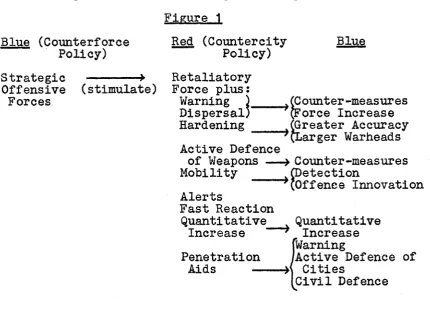
will be dealt with in turn. The diagram below (Fig. 1)
conveys the purely military dynamics of an arms race in
strategic weapons between two advanced nuclear powers. It
indicates that there is a balance to be struck between the
various elements of strategic strength, depending always on
the nation1 s assessment of the o p p o n e n t s programmes, the
state of the military a r t s , and the need to hedge against
uncertainty.
The diagram stresses challenge and response.
Figure 1
Blue (Counterforce Policy)
Red (Countercity Policy)
Blue
Strategic Offensive
Forces
--- » (stimulate)
Retaliatory Force p l u s :
Warning ) Dispersal)
Hardening
i— s
,g'
'Counter-measures Force Increase greater Accuracy .Larger Warheads Active Defence
of Weapons -- * Counter-measures Mobility
^ (Offence Innovation Alerts
Fast Reaction
[image:26.537.76.507.316.633.2]Blue is attempting to maintain a first-strike counterforce deterrent; Red sets himself to preserve a retaliatory capability. A many-faceted qualitative and quantitative arms race develops. ‘Red’ and ’Blue* are not the United States and the Soviet Union. In the real world
of 1955-60 these nations pursued a mixed
counterforce-countercity strategy with the emphasis varying from time to time.
For a power bent on being great the need for a countercity force is beyond argument. A counterforce
capability is more expensive, more difficult to obtain, and less obviously required. Nations may seek to obtain one for several reasons.
1. It may become possible to neutralize the enemy’s
deterrent - that is, render it completely obsolete. (Given modern technology, if one side stands still, this
development seems likely over any ’long run’, say ten years.) There can be a military, a political or an economic motive in building a ’splendid’ counterforce capability.
Militarily, a successful surprise attack becomes possible.
2. Any degree of counterforce capability may make the threat of massive retaliation less suicidal and hence more credible.
3- Counterforce capability is an insurance against the inadvertent failure of deterrence: it enables some damage to
be averted; it affords some prospect of ’victory1.
b.
Active and passive defence of cities and the civilianeconomy - policies which complement a counterforce
capability - discourage the exploitation of strategic
nibbling tactics by an enemy; they force him to attack in some
strength if at all; and, incidentally, they reduce the
likelihood of isolated, disastrous accident, since solitary
unauthorized attack will be averted by a good active defence.
5. A power possessing some counterforce capability in
relation to a major nuclear antagonist inevitably will enjoy almost overwhelming counterforce capability in relation to a minor nuclear antagonist. Thus Nth powers are faced with a permanent crisis of obsolescence if they attempt to join in the strategic arms race.
But, equally, a power in a nuclear arms race has incentives to be moderate, to eschew the counterforce
strategy. Not only may the attempt to obtain a counterforce capability be futile and expensive, but it may drive an
15
would have. Especially if such a force is poorly controlled
and depends on alerts and fast reaction, the situation of the counterforce power will be more dangerous in some
respects than it otherwise would have been. By being able to pre-empt to some purpose, a counterforce power whose
deterrent is rather vulnerable gives an opponent an incentive
to pre-empt if he can in a desperate situation. However, it seems unlikely that America, which pursued a counterforce strategy based on nuclear superiority in the postwar period, was ever in danger of pre-emptive attack: its nuclear
superiority was too great.
As defined here, ’moderation’ is synonymous with accepting at least temporarily the situation which Thomas
Schelling has called ’total exchange of all conceivable hostages’. The implications can be seen by studying Figure 1. A moderate power will play down or abandon
industrial dispersal, civil defence, active defence of cities, certain surveillance and detection programmes, programmes for hyper-accurate weapon delivery, programmes
for achieving tactical surprise, some phases of anti submarine warfare, etc. Moderation may be chosen out of
5
’goodness’ or because the technological situation and the enemy’s scale of effort impose it.
Having dealt with the strategic or ’central’ arms race, we are in a better position to deal with the tactical arms
race. Firstly we shall study the tactical balance as a
factor in the strategic balance. In so far as general war is a war of forces, close-in tactical atomic forces have a significant role of pinpoint bombardment to play; and the tactical forces generally might assume an offensive and
occupying, or a defensive and holding role in the wake of a thermonuclear exchange. But such an exchange could effective ly annihilate the tactical forces or destroy the power of the supporting societies to maintain them.
The tactical arms race is the net effect of a number of contributory programmes, like the strategic arms race;
however, there are more varieties of tactical than strategic warfare. The possible forms of tactical conflict range from
17
- the so-called ’mobilization base’,which might be activated in a Korea-type conflict that was not won or stalemated by forces in being - is excluded from this analysis.
At the tactical as well as the strategic level forces
in being have far greater importance than ever before. Not only would tactical nuclear war probably preclude mobiliza tion, but a fait accompli becomes a far more serious challenge
under circumstances where great concentration of forces may be needed to restore a status quo. Such concentration
invites deliberate tactical use of nuclear weapons. On the other hand, it appears that the advent of nuclear weapons, especially since they have been adapted to everything from
’city-busting’ to close-in battlefield use, has introduced greater uncertainty in the tactical as well as the strategic balance. Before tactical nuclears were made standard
equipment there was a chance that conventional tactical warfare would escalate into nuclear tactical warfare by deliberate decision (for example, this could have happened in Korea); with a wide spectrum of tactical nuclears
available, not only will some tactical conflicts be vastly more difficult to keep non-nuclear, but chance will be added
of tacticians as well as strategists.
Just as tactical strength is a factor in the strategic balance, strategic strength is a factor in the tactical
balance, as was pointed out earlier: one side may compensate for tactical inferiority by means of strategic superiority.
In reality there is no one tactical balance as there is
a strategic balance; or rather such a balance has little operational significance. The statics of the tactical competition must be based first on a theatre-by-theatre
analysis of the balance of deployed tactical forces. Of course this must be supplemented by considering: deployed forces of a mobile kind not limited to one theatre, such as carrier-based marines; strategic mobile reserves based on home territory (together with their sea and air lift); and trained, non-mobilized reserves. But even so the upshot of
such a supplementary analysis is to add the potential force which can be brought to bear in a given theatre in a given
time to the actual force present in that theatre at any time. This potential force is usually only summoned to the theatre
in case of war (Korea, for example), or acute crisis (Berlin,
1961). In local war, attrition is accompanied by an
the concentration of mobile forces, mobilization of reserve forces and activation of the war economy.
The competition in tactical forces as a whole has both a quantitative and a qualitative side, but it is on the
whole a far more old-fashioned affair than the strategic arms race. This may be true because rather than despite the fact that the decisive forms of tactical warfare under nuclear conditions - short and middle range atomic rockets - are exceedingly difficult to confine to what an enemy will consider tactical purposes. These weapons may seem too decisive to use; they may be withheld in consequence. Thus what Stalin called the ‘permanently operating factors’ of warfare may well be used decisively at the tactical level,
especially in areas where troops have not been extensively equipped with nuclear weapons, or where the withholding of nuclear weapons in tactical conflict is thought possible and
likely. Nevertheless, just as tactical strength may be
The tactical arms race is thus a mixture of old and new* Especially in offensive nuclear rockets and fighter bombers, it resembles the strategic race very closely. There is the same problem of achieving invulnerability
through good warning and mobility: this leads to a strenuous qualitative race in techniques of penetration, detection, interception, etc.; and in methods of achieving weapon compactness and improving fire-power. This race is
complicated by the need for delivery vehicles which have dual (nuclear and conventional) capability.
The tempo of innovation in the more traditional components of the tactical balance - such as infantry,
mechanized cavalry and non-atomic artillery - has risen, but is well below the tempo of strategic innovation and far less expensive. Conventional weapons such as the rifle still remain in inventory for over a decade rather than for just a few years, and new models are not hundreds of times as costly as those they replace.
21
the strategic level; but it is equally unsatisfactory. Western disarmament negotiators in the 1950s stressed the
importance of a balance of armaments rather than forces, but they found it difficult, for obvious reasons, to produce
a formula for armament reduction as compelling as fixed force levels for all powers. There are many fundamental
types of tactical armament; the man-to-weapon ratio varies greatly between various countries; and the demonstrable need
of countries for various weapons differs greatly.
The diagram below (Fig. 2) conveys the dynamics of a tactical competition between two thermonuclear powers. It takes account of the fundamentals of the U.S.-Soviet
relationship. Thus one power (Red) is almost exclusively a land power, tactically. It, or its allies, have interior lines of communication with most disputed areas; it has enormous conventional land forces, a tactical air force
devoted to the support of these forces, and naval task forces also geared to the support of land operations. This power has the tactical initiative; it has the ability to exert
pressure at a series of rapidly changing fronts by manipul ating central reserves. It maintains forces at the
flexibly and proportionately in (for it) a series of
changing, far-flung disputed areas. Hence the sea-ai’
po w e r 1s preferred strategy, if credible, would be: masivre
retaliation. This strategy ceases to be safe or effe;tivre
as the rival land power develops an atomic arsenal; i; is;
replaced or supplemented by the strategies given in tie
diagram.
Figure 2
Red (Offence) Blue (Defence)
'Massive Retaliation Local and Overall
Tactical Force Preponderance
plus (later)
Strategic Nuclear Capability
PART TWO
THE ARMS RACE AND CONTROL PROPOSAIS : 1955-60
"I wish you wouldn’t squeeze so," said the Doormouse, who was sitting next to her. "I can hardly breathe."
"I can’t help it," said Alice very meekly: "I’m growing."
"You’ve no right to grow here." said the Doormouse.
"Don’t talk nonsense," said Alice more boldly: "you know you’re growing too."
"Yes, but I grow at a reasonable pace," said the Doormouse: "not in that ridiculous fashion." And he got up very sulkily and crossed over to the other side of the court.
Alice’s Adventures in Wonderland
O «T\
In Part One I promised to examine the ‘cogency1 of
proposals for arms control in the period 1955-60. The
proposals selected for analysis in Chapters 1-2 were all put
forward by great powers (sometimes jointly with allies) for negotiation in detail. All of them were in fact the subject of negotiation in some detail; or at least the plans which
they modified were. (For example, the Soviet plan,
■1
September 20. 1957. was put forward for negotiation at the Twelfth General Assembly. Detailed negotiation on it did not occur, but its predecessor, the comprehensive partial plan of April 30, 1957? had been discussed in detail during the 1957 Sub-Committee of the Disarmament Commission. The proposal of September 20 contained changes which reflected Western criticism of the April 30 proposal.) Thus, most of
the proposals chosen for analysis were highly evolved or •mature' proposals: most of them were the end product of much pressure and compromise. The proposals of the period
1
See Chapter 1. Henceforth, the leading plans, and also
25
which have not been analysed were omitted either because
they were not submitted to detailed negotiation, or because
they very closely resembled some of the proposals analysed.
Proposals made by small powers and middle powers (except
when co-sponsored by a great p o w e r ) , and proposals made by
opposition political parties and private individuals, etc.
are entirely omitted.
Since the numerous offers of East and West which
constituted the test ban 'proposal*1 of each at the end of
1960 were first made at varying times between 1957 and i9 6 0,
the test ban has been discussed in a separate chapter. The
length of that chapter is a tribute to the length and
complexity of proposals and negotiations on the test ban, and
to the superior possibilities of analysing its military
implications.
Of each proposal considered in Chapters 1-2 I shall 2
inquire what sort of military 'world' it envisaged, studying
the details provided by the proponent, both in his text and
in the negotiating record, and also setting down unstated
2
I am indebted for this term,and for the conception behind much of what follows, to Arthur Lee Burns. See his "Prospects
for a General Theory of International Relations", World
Politics, October 19 61, p. 41. See also Thomas C. Schelling and Morton H. Halperin, Strategy and Arms C o n t r o l . The
implications of the plan. Obviously, not all the materials for the proposed analyses are available, and in any case
only sketches of the various military situations are possible in the space available. In Chapter 3 I shall comment on the vagueness, onesidedness and radicalism of most proposals.
Some uncertainty about the effect of a proposal for arms control is inevitable. Even an exhaustively detailed
agreement could not possibly control the future of the arms race in fully predictable ways; yet radical proposals are often presented for immediate adoption and indefinite continuation as though they constituted a ‘final solution* of the arms problem.
A proposal is not itself (except metaphorically) a military world; rather it is a set of rules put forward to compete with other influences in the world of the
future. Any proposal implies not just a succession of different military worlds evolving out of each other in time, but the possibility of many different worlds at any point in the time-span of the proposal, depending on developments in technology, political developments, whether participants are cheating, and many other
27
Of course no military planner could closely predict
the worlds to be expected in the absence of arms control
either; nevertheless planners resolutely rejected the
control proposals of opponents in the years under study,
and the analyses which follow attempt to make a modest
contribution to the understanding of this fact. Moreover
the proposals studied form the stock-in-trade of thinking
about the control of the arms race in the postwar period,
and are worth studying also on that account.
Some of the technical nomenclature adopted below is
defined in the Glossary of Special Terms. The method of
classifying and naming proposals is set out and justified
in the Appendix to Part Two.
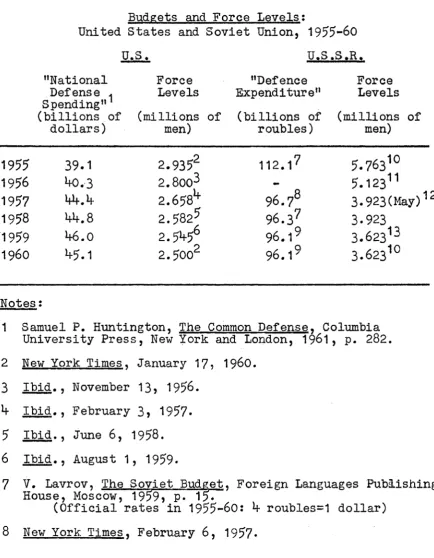
Table 1 below presents some figures on budgets and force
levels for the Soviet Union and the United States in the
period 1955-60. The figures on the Soviet defence budget
should be treated with caution, because many military items
are hidden in other parts of the Soviet budget, notably
atomic weapons. Force levels are not a reliable index of
strength either - for East or West. As Secretary of State
Dulles said in response to news of the Soviet force
reduction of 1955:
...the number of men under arms is only one index of military strength. The Soviet Union also
and equipment capable of being mobilized rapidly. And the capacity to utilize modern weapons greatly affects the value of mere numbers in the armed forces.3
28
TABLE 1
B u d g e t s and F o r c e L e v e l s :
U n i t e d S t a t e s and S o v i e t U n i o n , 1 9 5 5 - 6 0
U . S . U . S . S . R .
" N a t i o n a l D e f e n s e 1 S p e n d i n g ” ( b i l l i o n s o f
d o l l a r s )
F o r c e L e v e l s ( m i l l i o n s o f
men)
”D e f e n c e E x p e n d i t u r e ”
( b i l l i o n s o f r o u b l e s )
F o r c e L e v e l s ( m i l l i o n s o f
men)
1955 3 9 .1 2 . 9 3 5 * 1 2 3 4 5 6 112.17 8 5 -7631C 1956 4 o . 3
m 0 0 0 0 C M _
5 . 1 2 311
1957 4 4 . 4 2.658^ 9 6.7s 3 . 9 2 3 ( M a y) 12
1958 4 4 . 8 2.582-’ 9 6 . 37 3 . 9 2 3 1959 4 6 . 0 2. 5 4 5 ^ 96.19 3.62313
i960 45.1 2.5002 96.19 3 . 6 2 310
N o t e s :
1 S a m u e l P. H u n t i n g t o n , The Common D e f e n s e , C o l u m b i a U n i v e r s i t y P r e s s , New Y o r k and Lo ndo n, 1 9 6 1 , p. 282. 2 New Yo rk T i m e s . J a n u a r y 17? 1960.
3 I b i d . , November 13? 1956. 4 I b i d . , F e b r u a r y 3 , 1957«
5 I b i d . , J u n e 6, 1958.
6 I b i d . , A u g u s t 1, 1959.
7 V. L a v r o v , The S o v i e t B u d g e t . F o r e i g n L a n g u a g e s P u b l i s h i n g H o u s e , Moscow, 195^4 p." l 5 . '~
( O f f i c i a l r a t e s i n 1 9 5 5 - 6 0 : 4 r o u b l e s = 1 d o l l a r )
[image:43.537.63.498.81.640.2]9 I b i d . , O c t o b e r 2 8 , 1959.
10 R e p o r t by N . S . Khr u s h c h e v t o t h e Supre me S o v i e t o f t h e U . S , S . R . . J a n u a r y 1V, i 9 6 0 , i n S o v i e t B o o k l e t No. 6V, London, J a n u a r y 19 6 0 , p . 2 6 .
( T h i s s p e e c h r e v e a l e d S o v i e t f o r c e l e v e l s f o r t h e f i r s t t i m e i n t h e p o s t w a r p e r i o d . The i 960 r e d u c t i o n was t o be c o m p l e t e d i n two y e a r s , b u t i t was s u s p e n d e d on J u l y 8 , 19 6 1. S e e The Communist B l o c a nd t h e W e s t e r n
A l l i a n c e s . The M i l i t a r y B a l a n c e . 1 9 6 1 - 2 . The I n s t i t u t e f o r S t r a t e g i c S t u d i e s , Lo ndo n,
November 19 6 1, p . 2 . )
11 T a s s s t a t e m e n t r e g a r d i n g r e d u c t i o n o f S o v i e t f o r c e s , A u g u s t 12 , 1 9 5 5 , i n Documents on D i s a r m a m e n t , v o l . I , p . V96.
(The r e d u c t i o n - o f 6 V 0 ,0 0 0 men - was t o be c o m p l e t e d by December 15 , 1955* The 1955 f o r c e l e v e l was n o t d i s c l o s e d u n t i l i 9 6 0 . )
12 S t a t e m e n t by t h e S o v i e t G o v e r n m e n t on t h e d i s a r m a m e n t p r o b l e m , May 1V, 19 5 6 , i n Doc um ents on D i s a r m a m e n t , v o l . I , p. 6 3 8 .
(The r e d u c t i o n - o f 1 , 2 0 0 , 0 0 0 men - was t o be c o m p l e t e d by May 1, 1 9 5 7 . )
13 V. L a v r o v , op. c i t . . p. 15.
CHAPTER 1
FEBRUARY 25« 1955 ( S o v i e t p r o p o s a l f o r a f r e e z e and f o r t o t a l n u c l e a r d i s a r m a m e n t , s u b m i t t e d t o t h e S u b - C o m m i t t e e o f t h e D i s a r m a m e n t C o m m i s s i o n . )
The S o v i e t U n i o n mar ke d t i m e f r o m F e b r u a r y 25 t o March 18 i n t h e S u b - C o m m i t t e e w i t h t h i s p e r f u n c t o r y and
t r a d i t i o n a l p r o p o s a l . The f r e e z e o f b u d g e t s , arma me nt s and armed f o r c e s ( a t 1955 l e v e l s ) was t o be a p p l i e d t o ‘ a l l S t a t e s ’ 5 t h e d e s t r u c t i o n o f n u c l e a r weapons was n o t t o be a c c o m p a n i e d by a c u t - o f f o f a n y k i n d . The p r o p o s a l p r o v i d e d f o r ‘ i n t e r n a t i o n a l c o n t r o l o v e r t h e o b s e r v a n c e ’ o f t h e
m e a s u r e s , w i t h o u t d e t a i l s .
2
MARCH 8 , 1955 ( W e s t e r n p l a n f o r c o m p r e h e n s i v e and ’ c o m p l e t e ' d i s a r m a m e n t , s u b m i t t e d t o t h e S u b - C o m m i t t e e . F i r s t ,
A n g l o - F r e n c h v e r s i o n : J u n e 1 1 , 195V.3 A n g l o - F r e n c h p r o p o s a l on f o r c e l e v e l s a d d e d : March 2 9 , 1955* T im i n g o f n u c l e a r
1
D C / S C .1 / 1 2 / Re v. 1, i n Cmd. 9 6 3 6 , p. 18. ( D r a f t U.N. r e s o l u t i o n )
2
D C /S C .1 / 1 5 / Re v . 1 , i n Cmd. 9 6 3 6 , p . 2 1 .
( J o i n t d r a f t U.N. r e s o l u t i o n ) S p o n s o r e d by C a n a d a , F r a n c e , t h e U n i t e d Kingdom and t h e U n i t e d S t a t e s .
3
DC/SC. 1 /1 0 , i n Cmd. 920*f, p. 31.
H
D C / S C .1 / 2 0 , i n Cmd. 9 6 3 6 , p . 28 .
38
March 8, 1955
-disarmament modified: April 19» 1955*^ The United States withdrew its support of March o on September 6, 1955* )
March 8, 1955 was a proposal for total nuclear and
drastic conventional disarmament in three stages, to be followed by ’complete* conventional disarmament if possible. Stage One provided for ’the constitution and positioning of
the control organ*, and then a freeze of manpower and expenditure, atomic and non-atomic.
Stage Two provided for the following measures to be taken after
the control organ had reported itself able to enforce them:
(a) * One-half of the agreed reductions of conventional armaments and armed forces*. By the terms of the Anglo-French Memorandum of March 29, ’agreed reductions’ were to result in
the following force levels: 650,000 men for the United
Kingdom and France; and 1-1.5 million men for ’the three other permanent members of the Security Council*. (Since ’China’ meant different things to the various Western members of the Sub-Committee it is not clear what was involved in setting
and enforcing a force level for her.) 'Considerably lower*
DC/SC. 1/2*+, in Cmd. 9636, p. 30. (Anglo-French Memorandum)
6
Statement by Stassen. He announced that ’the United States does notr place a reservation upon all of its pre-Geneva
March 8, 1955
-levels would be reached by other states.
(b) The cut-off in the production,of nuclear weapons.
Stage Three consisted of:
(a) The third quarter of conventional reductions.
Then (b) ’A complete prohibition on the u s e ’ of mass
destruction weapons, and, ’simultaneously, the elimination of
these weapons’ . and ’the final quarter of the agreed
reductions...shall begin; and both processes shall be
completed within the time-limit laid down in the Disarmament
T r e a t y ’.^
March 8 expressed the ’hope' that after these
reductions states would further reduce their forces and
armaments to ’levels strictly necessary for the maintenance
of internal security and the fulfilment of the obligations
of signatory States under the terms of the United Nations
Cha r t e r ’.
The plan was exceedingly unwieldly. It had to be
agreed to as a whole by an indeterminately large number of
states, conceivably the entire U.N. membership and other
states as well; certainly Communist China. There was no
provision for the great powers to do some disarming on
7
35
March 8, 1955
-their own if others were not willing; there was no
suggestion that the earlier, less radical measures provided
for by the plan might be taken unconditionally. A treaty
was to be prepared by the Disarmament Commission, submitted
to the General Assembly and a World Disarmament Conference,
and would not enter into force until ’it had been ratified
by those of the signatories who would be specified in the
t r e a t y ’. Dozens of countries might have had a virtual veto
power, and at the least it would have taken years to
negotiate such a world-wide treaty, especially in view of the
failure of the Sub-Committee, the Disarmament Commission and
the General Assembly to develop a working body of ideas on
world disarmament. No region except Europe and no powers
except the Five had ever been the subject of close arms
control study in the postwar period, yet the W e s t ’s plan
implicitly set out to end many regional and local arms races.
The plan was lacking in many vital details. Although
the Western delegates on the Sub-Committee often declared that
limitation of armaments was more important than fixing force
levels, they made little effort to develop doctrine or
criteria for armament limitation.
Their effort in 1955 consisted of tabling a paper which
March 8, 1955
-The levels and types of such /permitted? armaments and equipment shall be such as to prevent undue concentration of total permitted armed forces in a manner which might threaten international peace and
security.°
No time limits were set for the individual stages of March 8 . Western delegates merely mentioned a time limit
9 of two or three years for the plan as a whole. In
subsequent years they came to oppose setting time limits for a plan as a whole and to favour time limits for
individual stages.
The plan was not fully controllable on the nuclear side. The Western delegates often declared that they would not
agree to measures which could not be controlled, and yet they firmly proposed such measures. Quite apart from the elimination of chemical and bacteriological ‘weapons of mass destruction’, for which a control method was not even suggested, March 8 provided for the elimination of nuclear weapons, which the French delegate, Moch, had admitted for years to be uncontrollable by any known inspection techniques.
ö
DC/SC.1/17, in Cmd. 9636, p. 22. 9
323-3 7
- March 8, 1955
-The plan implied a far-reaching political transformation of the world, yet it had virtually no political provisions. No analysis of the impact of near-complete disarmament on the various Cold War and other territorial disputes was offered;
and in 1955 there was no Western plan for the political structure of a militarily transformed world, apart from an extensive definition of control organ functions tabled
10
separately on April 21.
Western views on the political preconditions of disarmament were vague. Nutting said on May 12 that:
We have always held that there must be some relaxation of tension before disarmament can
begin, but we have never held and will never hold that there can be no progress towards disarmament until all the problems and issues which cause international tension have been resolved.11
How much relaxation had to occur before disarmament
could begin? No precise answer was forthcoming from the West in 1955} but it is quite certain that comprehensive and,
especially, total nuclear disarmament would have been ■un thinkable without a far-reaching detente between East and West. Had a disarmament treaty on the lines of the Western
plan been drafted in detail it would have been a dead letter.
1 0 — —
See DC/SC.1/25, April 21, 1955, in Cmd. 9636, p. 31. DC/SC.1/PV.48, in Cmd. 9650, p. 638.
A 2
MAY 10, 1955 ' ( S o v i e t p l a n f o r comprehensive and C o m p l e t e 1 dis arm am ent, s u b m i t t e d t o t h e Sub-Committee. Foreshadowed i n t h e p l a n of March 18, 1955.^3 R e a ffi rm e d i n 1956.1*0
May 10, 19?? was a two s t a g e program ( t h e f r e e z e being
p a r t of t h e f i r s t s t a g e ) w i t h t h e same f o r c e l e v e l g o a l s as
March 8 , 1955» I t a l s o p r o v i d e d f o r e l i m i n a t i o n of n u c l e a r
weapons and d e c l a r e d t h a t i t would be ‘d e s i r a b l e 1 t o red u ce
f o r c e s to ‘ l e v e l s s t r i c t l y n e c e s s a r y f o r . . . i n t e r n a l
s e c u r i t y 1 a f t e r t h e two s t a g e s p r o v i d e d f o r . These s t a g e s
were t o l a s t one y e a r e a c h .
S t a g e One (1956) p r o v id e d f o r :
(a) A f r e e z e o f f o r c e s , armaments and budget s w i t h i n
two months, and d i s c l o s u r e o f r e l e v a n t f i g u r e s w i t h i n one
month.
(b) 50 p e r c e n t of c o n v e n t i o n a l r e d u c t i o n s ( t o be
worked out i n r e l a t i o n t o l e v e l s a t December 31, 195*0.
(c) A World Conference i n t h e f i r s t h a l f of 1956 t o
d e t e r m i n e l e v e l s f o r ' o t h e r S t a t e s * .
(d) 1 As one of t h e f i r s t m e asu res* , a ban on n u c l e a r
t e s t s .
12 “
DC/SC. 1 /2 6 / R e v . 2, i n Cmd. 96 3 6 , p. 33« ( D r a f t U.N. r e s o l u t i o n )
13
DC/SC.1 / 1 9/Rev. 1, i n Cmd. 9 6 3 6 , p. 26. ( D r a f t U.N. r e s o l u t i o n )
1*f
3S
- May 10, 1955-(e) Simultaneously with (b), a ban on the use of nuclear weapons except with Security Council approval.
(f) Liquidation of agreed extraterritorial bases.
There would thus have been some reductions of forces and
armament by the Five before levels for other powers were set; but unless the World Conference had succeeded in 1956 the agreement would presumably have broken down.
The ban on tests at an early stage was not in the Soviet interest; however there were no control provisions
specifically mentioned for it.
The ban on use of nuclear weapons would have favoured the Soviet Union for the period before their elimination,
especially in Europe where Soviet conventional superiority threatened the Western Powers, and especially until most of the proposed conventional reductions had taken place.
Stage Two (1957) provided for:
(a) the ’weapon* cut-off.
(b) The final 50 per cent of conventional reductions, and agreed reductions for other states.
(c) After 75 per cent of conventional reductions had been made, a 'complete prohibition’ of mass destruction
(d) Complete liquidation of foreign bases.
Wadsworth made it clear in the Sub-Committee that the United States envisaged dismantling some of its bases during disarmament, but would keep a number adequate for its
remain-1
ing forces and alliance commitments. y On the other hand the
Soviets called for complete disengagement of the Two in
Europe and the withdrawal of the American presence in the Far
East, although not for the dissolution of either superpower’s alliance system. In a nuclearly disarmed world, with the British and French armies bottled up inside national borders
and all American forces confined to the United States, the Soviets could have dictated terms to Western Europe.
The text of May 10 began with a draft General Assembly ’Declaration’ which, after reviewing the Cold War and the existing detente over Korea and Austria, called for a withdrawal of occupying forces from Germany to promote
’national unification’, and for a settlement of ‘outstanding questions in the Far East in accordance with the principles of sovereignty and territorial integrity’. The Soviet
delegate, Malik, declared under pressure from Nutting in
T 5