Commission of the European Communities
The joint study programme
newsletter
of the Commission
W.
f(\
i' , , \ '
mm
Waiting for Erasmus
-
a drama in Gve acts
The text was prepared by the Office for Cooperation in Education on behalf of the Commission of the European Communities. © The articles and texts appearing in this
publication may be reproduced freely, in whole or in part, with due reference to their source.
Catalogue No.: CE-AB-86-003-EN-C.
Printed in Belgium.
The passage of the European Community's new Action Scheme for the Mobility of University Students, ERASMUS, past the rocks and rapids of the decision-making processes in Brussels, begins to read like a case-history in the construction of Europe -ora drama in the classical five acts.
The story so far:
Act I (Stimulus for action)
The Heads of State and Government meeting within the European Council in Milan in 1985 call for the development of a "People's Europe", including measures to boost the present inadequate level of student mobility between Community countries;
Act II (Development of the plot)
The Commission tables its proposals for the ERASMUS Programme, designed to meet this policy goal (January 1986); the Education Ministers of the 12 approve the objectives and general design of the programme and mandate the EC's Education Committee to carry out its fine tuning (June 1986). The European Parliament and the Economic and Social Committee give the proposals wholehearted backing;
Act III (The first climax)
Heads of State reiterate the importance which they attach to ERASMUS and call upon Education Ministers to reach swift agreement on its implementation (June 1986); the Education committee reaches unanimous agreement on almost all aspects of the contents of the programme and identifies certain policy issues for resolution by the Council of Education Ministers (early November 1986); the Finance Ministers of the 12 decide by majority vote on 26 November to adopt the Commission's full budget proposal (25 Million ECU) for ERASMUS in 1987.
At this point, the stage was set for the Council of Education Ministers, which met on 28 November to take - as was widely expected - a final decision on the programme - a fitting end to a year in which the universities of Europe had been celebrating the 450th. anniversary of the humanist who had given the programme its name. But, as so often happens when expectations are at their peak, events then took an unexpected turn:
Act IV (The action is delayed)
Education Ministers fail to reach agreement, and the Commission formally withdraws the ERAS-MUS proposals altogether !
The irony of the situation is apparent. The Heads of State had pressed for the programme. The Education Committee had agreed its contents. The Finance Ministers had voted its budget. But the final seal of approval was not forthcoming... Why this remarkable occurrence ?
Despite the majority vote by Finance Ministers in favour of the full ERASMUS budget for '87, observers see the main problem as being once again one of money. At the meeting of the Council of Education Ministers on 28 November, seven of the twelve Member States were in favour of the Commission's full budget proposal of 175 million ECU for the three-year first phase of the programme. Two further countries expressed a preference for a 100 million package. But France, Germany and the United Kingdom felt unable to go along with anything remotely approaching this figure.
Closely linked to the budget question is that of the Student Mobility Grants element in the ERASMUS programme. According to the Commission's proposals, this accounts for around 60% of the total expenditure envisaged, and is regarded as being at the heart of the programme. Without substantial direct support for students in the form of scholarships which will cover the extra 'mobility costs' involved in studying abroad, the Commission - backed by substantial evidence from the existing Joint Study Programmes and from indepth research on this question -feels that the ERASMUS programme would fail to meet its primary objectives. As Commissioner
Marin put it, ERASMUS without student scholarships would be like serving up cookery books to the hungry instead of a real meal. Rather than risking having to accept a Council decision on ERASMUS with a totally inadequate budget, he therefore preferred to withdraw the proposals altogether.
Act V (The denouement)
Where do we go from here ? In fact, Act V of the drama is already well under way. At the summit meeting in London to mark the end of the British presidency, the Heads of State and Government once more repeated how vital ERASMUS was for the fulfilment of the "People's Europe" concept. At their request, the Foreign Ministers discussed the matter further on 15/16 December and decided to put ERASMUS back on the agenda for urgent Council consideration. Furthermore, the Commission - on the insistence of the Heads of State - has formally reintroduced the original proposal for the programme.
Al the time of writing, it therefore seems certain that there will be a specially convened meeting of Education Ministers very early in the New Year to see the programme over the final hurdle. A happy ending to the drama is therefore hopefully in sight at last.
EC Higher Education Grants 1986/7: increased numbers,
stiffer competition, higher quality
1986/87 has proved to be yet another record year for applications for financial support from the European Community in its Higher Education Grants Scheme: 1850 applications were received - almost twice as many as in the previous year. Spanish and Portuguese institutions (as described in a separate article in this issue) have made an encouraging début.
Preparatory Visits
1986 was the fourth year in which this part of the Joint Study Programme Scheme has operated, enabling teachers in all higher education disciplines to travel to potential partner institutions in order to establish the necessary contacts for the preparation of a Joint Study Programme. 193 projects were accepted for the academic year 1986/7 - 30 % more than last year - but this in turn meant that competition was much stiffer: some 769 appli-cations were received, compared with only 372 last year.
Joint Study Programmes
Figures were also up for the Joint Study Programmes themselves: 475 applications for support were received (a third more than last year), and 270 projects (of which 90 are completely new programmes) were awarded grants (1985: 225). This brings the total number of projects sup-ported by the Commission since the inception of the prog-ramme in 1976, to 584.
This year there was a marked increase in the number of programmes planning to give students the opportunity to spend at least a term abroad, and the selection commit-tee has again been keen to give priority to programmes in which students receive full academic credit for the studies which they carry out in another Member State.
The following statistics may be of interest to those readers who wish to know the distribution of programmes receiving support, according to their subject area and the Member States in which participating institutions are located:
Subject Area Distribution of ali Joint Study Programmes Supported, 1976/7-1986/7
Political & Social Sciences, Economics, History 17% Engineering, Technology, Computer Sciences 14.8%
Languages, Literature, Linguistics 11%
Business Studies 10.8% Architecture, Urban Studies 8.3%
Natural Sciences, Mathematics 8.1%
Teacher Education 6.5%
Law 6.1% Medicine, Dentistry, Psychology 5.3%
Geography, Regional Studies 4% Fine Arts, Design . 3.7%
Agriculture 1.2% Others 3.2%
Country Participation
(Joint Study Programmes supported in 1986/7)
Belgium 41 Federal Republic of Germany 121
Denmark 16 Spain 24 France 150 Greece 20 Italy 49 Ireland 29 Luxembourg 2 Netherlands 51 Portugal 6 United Kingdom 177
Spain and Portuai: year one for their participation in the Higher
Education Cooperation Scheme
1986 was the first year in which Spanish and Por-tuguese institutions could apply for financial help for Joint Study Programmes, since Spain and Portugal are now full members of the European Community and have been since 1 January 1986. This article is an attempt at a first evaluation of the Spanish and Portuguese presence after this year's selection.
Spain
From the outset, Spain has managed to make her interest in higher education cooperation felt. In order to give a true evaluation of Spain's presence in the various programmes, we must study, on the one hand, the appli-cations sent in by Spanish institutions themselves and, on the other, the applications coordinated by other institu-tions in other member Sates, including those which have extended their already existing programmes to include Spain.
Since projects for higher education cooperation are usually long-term and exacting activities, it is hardly sur-prising that applications for Preparatory Visits for Spanish institutions came flocking to Brussels. The large number of applications for Short Study Visits are explained by the interest of Spanish university staff in getting to know as much as possible about the higher education systems of the other Member States of the European Community to which Spain now also belongs.
As far as the applications for financial help for Joint Study Programmes are concerned, the Office for Cooper-ation in EducCooper-ation received, in this first year, four which originated with a Spanish institutions: two were favoura-bly viewed by the Academic Advisory Panel.
This picture changes completely if we look at the total number of requests for grants relating to program-mes which include Spanish participation. It seems obvious that 1 January 1986 had long been awaited all over
Europe by those who already had contacts with Spain and who were now waiting to make "official" them by including a Spanish institution in their programme. Many European universities have also set up new programmes with Spanish participation.
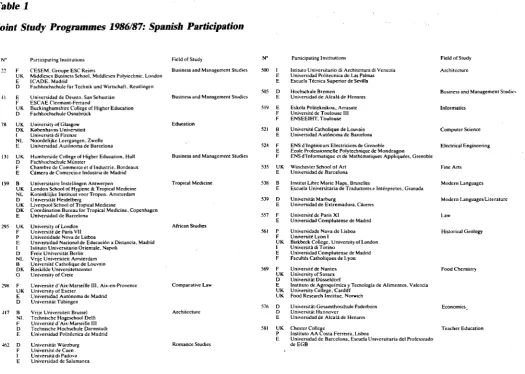
Table 1
Joint Study Programmes 1986/87: Spanish Participation
Among the 39 programmes which included Spain as a partner country, 22 were accepted (in overall terms, 475 applications were received and 270 grants awarded). The fields of study where Spain's presence is most felt are business studies and foreign languages.
Participating Institutions F C E S E M . Groupe ESC Reims
UK Middlesex Business School. Middlesex Polytechnic, London E I C A D E . Madrid
D Fachhochschule für Technik und Wirtschaft, Reutlingen E Universidad de Deusto. San Sebastián
F ESCAE ClermontFerrand
UK Buckinghamshire College of Higher Education D Fachhochschule Osnabrück
UK University of Glasgow DK Københavns Universiteit 1 Università di Firenze NL Noordelijke Leergangen, Zwolle E Universidad Autónoma de Barcelona UK Humherside College of Higher Education. Hull D Fachhochschule Münster
F Chambre de Commerce et d'Industrie, Bordeaux E Camera de Comercio e Industria de Madrid Β Universitaire Instellingen Antwerpen UK London School of Hygiene & Tropical Medicine NL Koninklijke Instituut voor Tropen. Amsterdam D Universität Heidelberg
UK Liverpool School of Tropical Medicine
DK Coordination Bureau for Tropical Medicine, Copenhagen E Universidad de Barcelona
UK University of London F Université de Paris VII Ρ Universidade Nova de Lisboa
E Universidad Nacional de Educación a Distancia, Madrid I Istituto Universitario Orientale, Napoli
D Freie Universität Berlin NL Vrije Universiteit Amsterdam Β Université Catholique de Louvain DK Roskilde Universitetscenter G University of Crete
F Université d'AixMarseille III, AixenProvence UK University of Exeter
E Universidad Autónoma de Madrid D Universität Tübingen Β Vrije Universiteit Brussel NL Technische Hogeschool Delft F Université d'AixMarseille III D Technische Hochschule Darmstadt E Universidad Politécnica de Madrid D Universität Würzburg F Universitc de Caen I Università di Padova E Universidad de Salamanca
Field of Study
Business and Management Studies
Business and Management Studies
Education
Business and Management Studies
Tropical Medicine
African Studies N° 500 503 519 521 524 535 538 539 557 561 1 l· i: D E E F F Β Γ Ι Ε F UK E Β E D E F E Ρ Participating Institutions
Istituto Universitario di Architettura di Venezia Universidad Politecnica de Las Palmas Escuela Técnica Superior de Sevilla Hochschule Bremen Universidad de Alcalá de Henares Eskola Politeknikoa, Arrásate Université de Toulouse III ENSEEIHT, Toulouse Université Catholique de Louvain Universidad Autónoma de Barcelona ENS d'ingénieurs Electriciens de Grenoble Ecole Professionnelle Polytechnique de Mondragon ENS d'Informatique et de Mathématiques Appliquées, Grenoble Winchester School of Art
Universidadde Barcelona Institut Libre Marie Haps, Bruxelles
Escuela Universitaria de Traductores e Intérpretes, Granada Universität Marburg
Universidad de Extremadura, Cáceres Université de Paris X I
Universidad Complutense de Madrid Universidade Nova de Lisboa
Field of Study Architecture
Business and Management Studii
Informatics
Computer Science
Electrical Engineering
Fine Arts
Modern Languages
Modern Languages/Literature
Law
Historical Geology
Comparative Law
Romance Studies
F Université Lyon I
UK Birkbeck College, University of London I Università di Torino
E Universidad Complutense de Madrid F Facultés Catholiques de Lyon F Université de Nantes UK University of Sussex D Universität Düsseldorf
E Instituto de Agroquímica y Tecnología de Alimentos, Valencia UK University College, Cardiff
UK Food Research Institue, Norwich D UniversitätGesamthoschule Paderborn D Universität Hannover
E Universidad de Alcalá de Henares UK Chester College
Ρ Instituto AA Costa Ferreira, Lisboa
E Universidad de Barcelona, Escuela Universitaria del Profesorado d e E G B
Food Chemistry
Teacher Education
The most frequently represented country in the 22 programmes with Spanish participation is the Federal Republic of Germany, closely followed by France and the United Kingdom.
The 22 programmes with Spanish participation are coordinated mainly by French or UK institutions (five coordinating programmes each), four programmes are
coordinated respectively by a German or Belgian institu tion, two by the Spanish institutions themselves and one each by an Italian and a Portuguese institution. There are three programmes in which both Spanish and Por tuguese institutions will be participating together. Two of these (in the fields of special education and African studies) will be coordinated by a British institution, the other (in historical geology) by an institution in Portugal.
Portugal
At first sight Portugal's first appearance on the Joint Study Programme scheme might appear much more mod est than that of Spain. However, if the comparative popu lation figures of the two countries are taken into account (Portugal around 10 million, Spain approximately 38 mill ion) it is in fact thoroughly comparable with that of its Iberian neighbour. As in the case of Spain, Portugal's presence has made itself particularly felt as regards the requests for support under the terms of the Preparatory Visit and Short Study Visit schemes. As regards Joint Study Programmes, Portuguese institutions are rep resented in nine programmes which were the subject of
funding requests to the Commission, with four of them coordinated by the Portuguese institutions themselves.
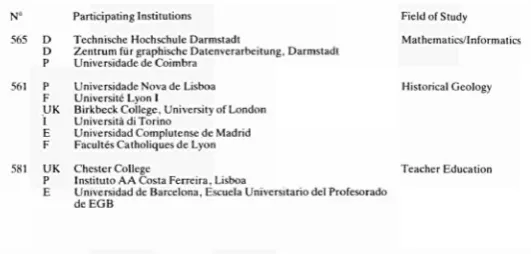
Table 2
Joint Study Programmes 1986/87: Portuguese Participation
N° Participating Institutions
295 UK University of London F Université de Paris VII Ρ Universidade Nova de Lisboa
E Universidad Nacional de Educación a Distancia, Madrid 1 Istituto Universitario Orientale, Napoli
D Freie Universität Berlin NL Vrije Universiteit Amsterdam Β Université Catholique de Louvain DK Roskilde Universitetscenter G University of Crete
401 NL Interstudie ■ Nieuwe Leraren Opleiding, Nijmegen Β Katholieke Universiteit Leuven
Ρ Universidade de Coimbra
527 Ρ Instituto Superior Técnico, Lisboa
UK Imperial College of Science and Technology, London
Field of Study
African Studies
Teacher Education
Mechanical Engineering N;
565 561
581
D 1) Ρ
Ρ F UK
]
E F
UK Ρ E
Participating Institutions
Technische Hochschule Darmstadt
Zentrum für graphische Datenverarbeitung, Darmstadt Universidade de Coimbra
Universidade Nova de Lisboa Université Lyon I
Birkbeck College, University of London Università di Torino
Universidad Complutense de Madrid Facultés Catholiques de Lyon
Chester College
Instituto AA Costa Ferreira, Lisboa
Universidad de Barcelona, Escuela Universitario del Profesorado deEGB
Field of Study
Mathematics/Informatics
Historical Geology
Teacher Education
The other European partners in the programmes with Portuguese participation are fairly evenly distributed across all the Member States of the Community (with the exception of Ireland and Luxembourg). The countries most frequently represented in the programmes with Por tuguese involvement are the United Kingdom (four prog
rammes) followed by Spain (three i.e. half the program mes with Portuguese involvement). Of the six program mes in which Portuguese insitutions will be participating, two are coordinated by British partners, two by the Por tuguese institutions concerned and one each by a German and a Dutch institution.
Table 3: Statistical Overview of Portuguese and Spanish Participation 1986/87
Applications Received
Ε Ρ Total
Joint Study Programmes 39 9 475
Preparatory Visits 74 17 769
Short Study Visits 59 25 586
Programmes Supported
Ε Ρ Total
22 6 270
19 9 193
24 11 183
COMETT set for launch in January 1987
Decisions of the Council of Ministers in July 1986 have finally cleared the way for the launch of COMETT, the Community's programme for cooperation between universities and enterprises in training in the field of technology. While the European Council of Ministers reached preliminary agreement on the programme in December 1985 (1), the implementation of the prog ramme was delayed because of failure to agree on the budget for COMETT. After lengthy negotiations, this obstacle has now been cleared, and the programme will start a threeyear operational phase on 1 January 1987. With an agreed budget of MECU 45 for 198789, COM ETT will comprise the following measures:
A. European Network
[image:5.595.292.558.90.217.2]A key criterion in the choice of UETPs for participa tion in the European network will be their capacity to respond to specific training needs at local, regional and national level in cooperation with the relevant public agencies and organizations and to carry out whit this object in mind operations such as: exchange of staff, of trainees and of training officers; training schemes in undertakings; joint development and production of train ing materials, and retraining and refresher programmes for skilled company personnel, especially those from small and medium-sized undertakings, and for training officers.
B. Transnational exchanges
Specific incentives to promote, for the benefit of all Member States, the transnational exchange of trainees, including new graduates, and university staff and the staff of undertakings through:
(i) grants for trainees, including new graduates, under going periods of training in undertakings established in other Member States;
(ii) fellowships for university staff seconded to undertak ings in other Member States;
(iii) fellowships for the staff of undertakings and business personnel seconded to universities in other Member States.
C. Joint ongoing training projects
Support for work on devising, developing and testing at European level joint projects for ongoing training initiated jointly by different undertakings in connection with the universities concerned in fields related to new technologies.
Support for ongoing training courses for the rapid dissemination in universities and undertakings of the results of research and development in the new technol ogy field.
D. Multilateral initiatives for developing multi-media training systems
Support for multilateral initiatives with regard to multi-media training systems using new information and communication technologies including television, where appropriate, with particular emphasis on the training of training officers and staff of undertakings.
/.. Additional measures implemented by the Commission. These measures shall concern:
(i) an exchange of information and experience ; (ii) the analysis and monitoring of developments in qual
ifications in regard to new technologies;
(iii) a better mutual understanding of the obstacles hin dering the development of university-enterprise cooperation in the field of advanced training whit a view to the strengthening of such cooperation. The Commission will be assisted in the implementa tion of COMETT by a COMETT Committee comprising representatives of the Member States. This Committee will have a consultative role in relation to the general guidelines for COMETT, including the criteria and proce dures for the selection of projects for support. Its first meeting is scheduled for 11/12 November 1986, after which the Commission will publish a guide to the applica tion procedures, criteria and timetable.
In order to assist the Commission in the administra tive implementation of COMETT, a COMETT Unit has been established. This unit, to be located in Brussels, will collaborate closely with the Commission in regard to: - providing information and documentation to applicants; - designing the procedures for the processing of applica
tions;
- assisting the Commission in connection with a data base on university enterprise cooperation in training; - liaising with counterpart initiatives at Member State
level.
The COMETT unit is located at Rue d'Egmont 13, 1050 Brussels (Tel.: (32) (2) 511 91 16), and will become fully operational with effect from 1 December 1986.
European royalty speaks about ERASMUS
On 24 April 1986, King Juan Carlos of SPAIN was awarded the degree of Doctor of Civil law by Oxford University. In the course of his speech of acceptance, in which the King stressed the importance of close cultural links between the Member States of the European Com munity, he made direct reference to the proposed new ERASMUS programme for the stimulation of university cooperation:
"At α time when Spain has joined, politically and legally, a European Community to which, in the fields of history and culture, we have always belonged, and when the Com munity has before it an ambitious scheme - appropriately named ERASMUS - that seeks to re-establish a tradition that existed during the epoch of that illustrious humanist, aimed at increasing the mobility and interchange of stu dents between various European Universities, I receive the Doctorate in Civil Law from the University of Oxford with pride and gratitude, as a hallowed token of the under standing between two ancient European cultures. "
In the NETHERLANDS, too, the 450th anniversary of Erasmus's death has not gone unnoticed, with a number of academic events being held to mark the occa-4
sion. In her opening speech to Parliament on 16 Sep tember, Queen Beatrice linked the name of Erasmus firmly to the need for greater European cooperation. She began her speech by saying:
"This year many countries are commemorating the 450th anniversary of Erasmus's death. As a Christian and humanist, Erasmus's call was for conciliation. It was an emphatic call, which he made as a European at a time when much was in a state of flux, and at a time during which our own nation was created. This is not just history, but also a historical perspective on the work to be accomplished today. Our government attaches great importance to the further development of European integ ration. The Single European Act must act as a stimulus for swifter decision-making, especially as applied to the
competition of the Internal Market... "
and she concluded:
JSP's in the news
Italian job crosses new frontiers
by John O'LearyMost new courses claim to break new ground. But when a polytechnic degree programme wins special approval from the Italian cabinet and inaugurates a new international video link at its launch, it must be consi-dered unique.
The course in question is a joint venture initiated by Brighton Polytechnic in partnership with Turin Polytechnic, marrying business and technology. The first 60 students will enrol this autumn, dividing their times between the two countries throughout a four-year prog-ramme.
Brighton will offer the business studies (taught in English) while Turin concentrate on technology, although including some business teaching in Italian. The students will change institution every six months, starting in Brighton to allow the British time to get their Italian up to scratch through intensive training at the polytechnic's language school.
The course needed a special decree to alter Turin Polytechnic's statutes to allow numbers to be limited by selection (Italian higher education has a principle of open access). But it has been welcomed enthusiastically by both the government and industry there. The Italian department of education put in £ 60,000 towards the launching costs and five big firms, including Unichem and Fiat, have each contributed £ 10,000.
The EEC also gave grants to pay for travel between the two polytechnics in the planning stage of the course. But in Britain red tape is proving to be a barrier. Grants regulations dictate that courses do not attract mandatory awards if the students spend more than one year out of
the country, so Brighton's recruits will have to compete for discretionary awards.
Professor Geoffrey Hall, the polytechnic director, has written to all education authorities, stressing the qual-ity of the course and asking for priorqual-ity treatment for the students. And the dean responsible for the course has written to the Prime Minister, appealing for a change in the regulations.
It is the first joint course with an Italian institution sanctioned by the Council for National Academic Awards. Students will have periods of work experience in both countries even though the sandwich mode of study is almost untried in Italy.
The video conference which launched the course on Monday was the first commercial link between London and Turin. The hour-long exchange was recorded for use in recruiting students in Britain and encouraging further industrial sponsorship in Italy, where a higher proportion of the costs will have to be met privately.
Professor Hall said Turin had been chosen as a part-ner because it is a world leader in design and engineering manufacturing. He said Brighton was looking for a Euro-pean dimension and the course was intended to produce graduates with a good knowledge of business manage-ment, who would be credible in a technological environ-ment and fluent in another language. Graduates will receive a degree from Brighton and a diploma from Turin.
(Source: The Times Higher Education Supplement; 13 June 1986)
A trilingual European diploma
at the University of Provence
At the end of two long years of negotiations an inter-national agreement has been signed which sets up a study programme and a trilingual diploma in applied foreign languages which will be common to the three signatory institutions: the University of Provence (Aix-Marseille I), the Fachhochschule of Cologne and Ealing College of Higher Education in London. This pilot project, which will begin with the new academic year 1986-87, has received the backing of the French university authorities (Directorate for Cooperation and International Rela-tions) and of the Commission of the European Com-munities (Office for Cooperation in Education), both of which have given the project a grant. This programme should, at the end of the course, give the students a European diploma, and be extended to other countries.
The three participating institutions had already had bilateral arrangements for the exchange of students. Thanks to the initiative of two members of staff, Jean-Claude Crapoulet and Yves Carbonel, directors of the English and German departments respectively of the Faculty of Letters of the University of Aix-en-Provence, these negotiations were held to extend the agreements to a trilateral convention. With the full encouragement of the President of the University, Yves Pouzard, their pro-ject has resulted in a joint study programme over four years in parallel in the three partner institutions.
This programme consists essentially in the teaching of two foreign languages, in 'civilisation' courses and their application to the fields of economy, management and
law. Each institution will provide special language courses for the foreign students. The students, whose number has been limited to twenty-five per year and per country for the time being, will spend the first and last years of their course in their home institution and the other two years in each of the other institutions.
Subject to the approval of the supervisory staff, every student who has successfully completed his/her course
will receive a diploma from an international panel accepted by the partner institutions (the subjects having been agreed upon). The staff of the institutions have also agreed to try and obtain the official recognition of the European diploma from their national authorities.
Guy Porte
(Source: Le Monde, 15 July 1986)
International inter-university cooperation:
a survey of the agreements
entered into by Italian universités
The Rui Foundation and the Institute for University Cooperation published in 1985 the results of a large-scale enquiry carried out on the international agreements entered into by the Italian universities. The analysis of the trends in 'foreign policy' among Italian universities was supplemented by a study on the most recent trends in international inter-university cooperation, especially in the European area and the developing countries. The research project was carried out with the active support of the Italian Ministries of Education and Foreign Affairs. Three recent laws (No. 38 of 1979, Decree No. 382 of 1980 and No. 705 of 1985) have meant that legislation in Italy has provided a strong boost for the development of international activities and exchanges on the part of the universities.
The first years of this decade witnessed the signing of the great majority of the 239 formal agreements which link Italian and foreign universities. The leading Italian University in this field is the 'La Sapienza' University of Rome, which is a signatory of no less than 32 formal agreements. The Universities of Padua, Trieste and Naples, the Ca' Foscari and the Architectural Institute of Venice are also very active, along with the Universities of Calabria and Perugia, and the private 'Bocconi' Uni-versity in Milan.
The principal partners of the Italian universities are those in Europe; in fact 69 per cent of the agreements have been signed with these (the leading countries are France, Poland and West Germany). In this context the volume of agreements with the universities of Eastern Europe is particularly significant (32 per cent).
Outside Europe, Italian inter-university cooperation is weighted in favour of relations with the USA. However the most promising sector of cooperation is that of prog-rammes with developing countries. The research paid detailed attention to direct agreements, to programmes financed by the Development Cooperation Fund of the Ministry of Foreign Affairs, and to programmes financed by international institutions.
The areas of study covered by Italy's formal agree-ments in cooperation are those of the 'natural and exact sciences' (39 per cent of all agreements), and the humanities (30 per cent), followed by social sciences, law, medicine and engineering. Architecture, the arts and agrarian and educational studies are at a much lower level in the agreements.
14
Alongside the directory of these agreements, the ICU/Rui study made a qualitative evaluation of Italian cooperation. From this an attempt was made to draw up a pattern for cooperation, on the basis of critical analyses of results produced in the past.
The conclusions may be summed up as follows:
international cooperation is a prime necessity for the universities;
- inter-university cooperation must have clear and measurable aims;
- inter-university cooperation must be concentrated around certain 'guiding principles' which are historically up-to-date and valid in the medium term;
- inter-university cooperation must be an intelligent and concrete expression of university autonomy;
- university cooperation must have adequate funds to attain its objectives;
- inter-university cooperation must produce communities of scholars and foster the training of researchers.
The analysis of the actual problems met with by workers in the field of cooperation made it possible for our researchers to formulate eight recommendations on: - the creation of international study courses in Italian
universities;
- international training of students and research workers; - recognition of degrees and diploma from foreign
univer-sities;
- the value of an agency at the service of inter-university cooperation;
- information;
- the role of the Minister of Education; - finances;
- the structure of the service for the right to study.
Rui Foundation and the Institute for University Cooperation: International Inter-university Cooperation: Survey of the agreements entered into by the Italian Univer-sities. Rome, 1985, 3 volumes pp. 72 + 354 + 272.
For further information refer to:
The Rui Foundation, Via Crescenzio 16 I-00193 Rome, Italy.
Oyez ! Oyez !
Transpyrenean University Cooperation
First conférence of Pyrenean Universities and Research Centres
From 26 to 27 september 1986, the presidents of a large number of universities and research centres from both sides of the Pyrenees met at Jaca (Spain) to confirm their desire to build up close cooperation among themselves. At the end of two days of extremely useful meetings, a permanent Committee of Pyrenean Universities and Centres of Research was set up. This will work from the Centre de Rencontre des Cultures Pyrénéen-nes in Andorra. The main tasks of the Committee will be to propose scientific or technological cooperation programmes which are specifically Pyrenean or which have a European interest.
Another task will be to try to connect up the Spanish and French data banks. This transpyrenean cooperation might well end up by organising Joint Study Programmes with partners from both sides of the Pyrenees.
Joint Franco-German Degree Award now in four Fields of Study
The Franco-German Institute of Technology and Business Studies has now extended its programme to include the field of civil engineering. Students in this subject, together with those in business studies, electrical engineering and mechanical engineering, receive both the "Diplom" of the Fachhochschule des Saarlandes and "Licence" from the University of Metz or Nancy (depending on the subject area concerned). An intensive language course is also an important part of the programme of the Institute, which was created in 1978 on the basis of an agreement between the French and German governments. For further information, contact:
Fachhochschule des Saarlandes Sekretariat DFHI
Goebenstr. 40 D - 6600 Saarbrüchen
Tel. (49)681-51179 or 54084, ext. 18.
European Centre for Environmental Communication
The European Centre for Environmental Communication (CECE) has started the publication of an information and liaison bulletin on audiovisual communication and environment in Europe. The bulletin, which is available in French and in English, will be published five times a year. For information about this, please contact the CECE at 55, rue de Varenne, F-75341 Paris Cedex 07.
Rui Foundation Scholarships
With the aim of furthering the growth of European Citizenship and the training of European graduates at international level, the Rui Foundation has established a fund for study scholarship to be used for periods of study by university students in a country of the European Community other than their own. The annual value of the fund is 40,000 ECUs.
It will first be put into use in the 1987/88 academic year. The scholarships are intended for university students or recent graduates of one of the twelve countries of the European Com-munity, who are of proven capacity and merit, and must have insufficient private financial means. They must be under 28 years of age, and have the intention, if Italian, of undertaking a period of study in one of the other countries of the Commun-ity; if citizens of another Community country, of undertaking a period of study in Italy.
The applications - to be presented on appropriate forms avail-able from the Foundation - must be sent to the President of the Rui Foundation, Viale XXI Aprile, 36 - I - 00162 Roma, before 10 April 1987.
Graduate Programmes open to Students
The University of York, United Kingdom, now offers four graduate programmes in its department of Economics and
Related Studies. These are M. Sc. programmes in Economics,
Health Economics, Economic and Social Policy Analysis, Pro-ject Analysis, and Finance and Investment. For further details
about these and other programmes please contact The Secretary for Graduate Admissions, Department of Economics and Related Studies, University of York, Heslington, York Y01 5DD, United Kingdom. Telephone: (0904) 59861 ext. 5602.
International Symposium on Student Exchange
The Section "Research on Exchanges" of the Society for the Study of International Problems, in cooperation with the Insti-tute for International Relations, based in Bonn, is planning a series of scientific conferences on developments and functions of student exchange in Western Europe, of student exchange between Western and Eastern Europe and finally of student exchange between European and Non-European countries. The first symposium, devoted to student exchange in Western Europe, is planned to take place in Bonn from 19-24 October 1987. The symposium will offer a platform for scholars and organizers of student exchange from Western European coun-tries to discuss the following topics:
1. Historical development and present situation of student exchange in Western Europe;
2. Political and social conditions of European student exchange;
3. Problems and difficulties of foreign students;
4. Screening the results and effects of European student exchange;
5. Consequences for European policies in this field.
Scholars from all relevant fields of research from all Western European countries who have been engaged in research in the fields listed above and who have published on those subjects are invited to attend, as are heads or staff-members in leading positions of national and European organizations in charge of planning and organizing student exchange.
Further information from:
Institute for International Relations (Institut für Internationale Begegnungen) Walramstr. 9
D - 5300 Bonn 2,
Federal Republic of Germany
The Student Handbook is available in bookstores and at the Office for Official Publications of the European Communities in Luxembourg or at EC distribution offices at the bookstore price.
£8.00 sterling £10.00 Irish BFR 630
Salg og abonnement . Verkauf und Abonnement . Πωλήσεις καί συνδρομές . Sales and subscriptions Vente et abonnements . Vendita e abbonamenti . Verkoop en abonnementen
BELGIQUE / BELGIË IRELAND ESPANA
Moniteur belge / Belgisch Staatsblad
Rue de Louvain 4042 / Leuvensestraat 4042 1000 Bruxelles / 1000 Brussel
Tél. 512 00 26
CCP/Postrekening 000200550227 Sousdépôts / Agentschappen :
Librairie européenne / Europese Boekhandel
Rue de la Loi 244 / Wetstraat 244 1040 Bruxelles / 1040 Brussel
DANMARK
Schultz Forlag
Møntergade 21 1116 København Κ Tlf: (01) 12 11 95 Girokonto 200 11 95
BR DEUTSCHLAND
Verlag Bundesanzeiger
Breite Straße Postfach 10 80 06 5000 Köln 1
Tel. (02 21) 20 290
Fernschreiber:
ANZEIGER BONN 8 882 595
GREECE
G.C. Eleftheroudakis SA
International Bookstore 4 Nikis Street Athens (126) Tel. 322 63 23 Telex 219410 ELEF
Subagent for Northern Greece:
Molho's Bookstore
The Business Bookshop 10 Tsimiski Street Thessaloniki Tel. 275 271 Telex 412885 LIMO
FRANCE
Service de vente en France des publications des Communautés européennes
Journal officiel
26, rue Desaix 75732 Paris Cedex 15 Tél. (1) 578 61 39
Government Publications Sales Office
Sun Alliance House Molesworth Street Dublin 2 Tel. 71 03 09
or by post
Stationery Office
St Martin's House Waterloo Road Dublin 4 Tel. 68 90 66
ITALIA
Licosa Spa
Via Lamarmora, 45 Casella postale 552 50 121 Firenze Tel. 57 97 51
Telex 570466 LICOSA I CCP 343 509
Subagente:
Libreria scientifica Lucio de Biasio - AEIOU Via Meravigli, 16
20 123 Milano Tel. 80 76 79
GRAND DUCHÉ DE LUXEMBOURG
Office des publications officielles des Communautés européennes 5, rue du Commerce
L2985 Luxembourg Tél. 49 00 81 49 01 91 Télex PUBOF Lu 1322 CCP 1919081
CC bancaire BIL 8109/6003/200
Messageries Paul Kraus
11, rue Christophe Plantin L2339 Luxembourg Tél. 48 21 31 Télex 2515 CCP 4924263
NEDERLAND
Staatsdrukkerij- en uitgeversbedrijf
Christoffel Plantijnstraat Postbus 20014 2500 EA 'sGravenhage Tel. (070) 78 99 11
UNITED KINGDOM
HM Stationery Office
HMSO Publications Centre 51 Nine Elms Lane London SW8 5DR Tel. 01211 3935
Subagent:
Alan Armstrong & Associates
European Bookshop London Business School Sussex Place
London NW1 4SA Tel. 01723 3902
Mundi-Prensa Libros, S.A.
Castellò 37 E28001 Madrid
Tel. (91) 276 02 53 275 46 55
Telex 49370MPLIE
PORTUGAL
Livraria Bertrand, s.a.r.l.
Rue João de Deus Venda Nova Amadora Tél. 97 45 71
Telex 12709LITRANP
SCHWEIZ / SUISSE / SVIZZERA
Librairie Payot
6, rue Grenus 1211 Genève Tél. 31 89 50 CCP 12236
UNITED STATES OF AMERICA
European Community Information Service
2100 M Street, NW Suite 707
Washington, DC 20037 Tel. (202) 862 9500
CANADA
Renouf Publishing Co., Ltd
61 Sparks Street (Mall) Ottawa
Ontario K1Ρ 5A6
Tel. Toll Free 1 (800) 267 4164 Ottawa Region (613) 238 89856
JAPAN
Kinokuniya Company Ltd 177 Shinjuku 3Chome Shiniukuku
BFR 250
& OFFICE FOR OFFICIAL PUBLICATIONS O F THE EUROPEAN COMMUNITIES L-2985 Luxemburg
Editor responsible:
Mr. Alan Smith
Printed by : /«·/> OFFSET
OFFICE FOR COOPERATION IN EDUCATION
European Institute of Education and Social Policy
51 rue de la Concorde — B-1050 Brussels — Tel.: (32) 2 512 17 34 — Telex: 21.504 fee b
Issue No. 3/86