This is a repository copy of Motivational theories applied to assess EI programs: the
EMOCARE’s Systematic Evaluation Model.
White Rose Research Online URL for this paper:
http://eprints.whiterose.ac.uk/88176/
Version: Accepted Version
Book Section:
Ribot-Horas, A and Quesada-Pallares, C (2015) Motivational theories applied to assess EI
programs: the EMOCARE’s Systematic Evaluation Model. In: Emotional Intelligence
Current Evidence from Psychophysiological, Educational and Organizational Perspectives.
Psychology Research Progress . Nova Science Pub Incorporated , 293 - 308. ISBN
1634635590
[email protected] https://eprints.whiterose.ac.uk/ Reuse
Unless indicated otherwise, fulltext items are protected by copyright with all rights reserved. The copyright exception in section 29 of the Copyright, Designs and Patents Act 1988 allows the making of a single copy solely for the purpose of non-commercial research or private study within the limits of fair dealing. The publisher or other rights-holder may allow further reproduction and re-use of this version - refer to the White Rose Research Online record for this item. Where records identify the publisher as the copyright holder, users can verify any specific terms of use on the publisher’s website.
Takedown
If you consider content in White Rose Research Online to be in breach of UK law, please notify us by
Theories of motivation applied to Emotional Intelligence programs assessment.
EMOCARE
’s
Systematic Evaluation Model
Arantxa Ribot-Horas, MA and Carla Quesada-Pallarès, PhD Universitat Autònoma de Barcelona
Barcelona / Spain
ABSTRACT
Financial resources invested in treatment programs in Hospitals are limited; programs that work with the mental illness caregivers are not an exception. To prioritize those who will be included in programs is by establishing factors criteria: cognitive level, urgency, motivation to participate, intention to change and commitment to change. This chapter explores the adequacy of the EMOCARE’s Systematic Evaluation Model as a protocol to ensure that EMOCARE improves caregivers’ well-being as part of their education in Emotional Intelligence. The methodology follows a quasi-experimental pre-post design with two groups, one of them is a quasi-control group carried out during April to May of 2014. Sample size is 15 patients from the Sant Joan de Déu Hospital (Barcelona, Spain)-, 10 of them part of the experimental group (EG) -they attended the EMOCARE program for two months-. Results are discussed along with the theoretical framework, remarking EMOCARE’s Systematic Evaluation Model is adequate to assess the efficacy and effectiveness of the program; as well as EMOCARE improves caregivers’ well-being in terms of their satisfaction with life (Diener, Emmons, Larsen, & Griffin, 1985).
INTRODUCTION
Following the psychiatric reform that took place in Spain in the 1980s, people with mental disorders (MD) were moved from psychiatric hospitals to community rehabilitation. This open-door treatment not only enhanced the rehabilitation of these patients but also created new rehabilitation agents –non-professional family caregivers. Patient relatives came to take care of their daily needs. Family caregivers experienced a remarkable change in their lives due to this new reality. Such reality requires that those nonprofessional family caregivers be provided with services, treatments and, in some cases, counseling to support their roles and function, as well as maintain their own health and sense of well-being.
Over the past three years, an emotional education training intervention for family caregivers has been developed based on Emotional Intelligence (EI) theory, among other relevant models, named EMOCARE.
Resources invested in community-based intervention in Hospitals have been limited and education programs have not been an exception. In this harsh reality, where needs are increasing and resources are less and less available, designing an effective intervention aimed at those who need it the most may be a good-enough solution at the system level. This approach poses a challenge to professionals: researchers and practitioners alike to identify working models to lead the design and application of interventions.
This chapter aims to fill the selection criteria gap through a systematic evaluation model including theories of motivation and of the individual. This systematic evaluation model would help professionals to select participants who may need such interventions the most, and may benefit from it the most.
Theoretical framework
The importance of EI in mental health
The concept of EI refers to individual differences within the perception, processing, regulation, and use of emotional information (Nelis, Quoidbach, Mikolajczak, & Hansenne, 2009). Researchers and theorists have positioned this concept in two different perspectives, which differ in conceptualization and measurement: ability EI (Mayer & Salovey, 1997) and trait EI (Petrides & Furnham, 2001).
One the one hand, ability EI (cognitive ability and emotional ability) includes four different dimensions: (1) identification of emotions, (2) effective use emotions, (3) ability to understand emotions, and (4) regulation of emotions. This model measures EI using maximum performance tests.
On the other hand, trait EI (emotional self-efficacy) is formally defined as a personality trait (Petrides, 2011). It refers to a constellation of emotional self-perceptions located at lower levels of personality hierarchies (Frederickson, Petrides, & Simmonds, 2012). This model considers trait EI as a construct that includes 15 dimensions (Petrides & Furhma, 2001): life satisfaction (happiness), optimism, self-esteem, motivation, emotional regulation (inter- and intra-personal), impulsivity, stress management, social skills, assertiveness, relationship skills, emotional expression, emotional perception, empathy, and adaptability. This model evaluates EI using self-report inventory.
construct. Petrides and Furham’s (2001) classification considers that trait EI and ability EI are not mutually exclusive concepts.
Focusing on the mental health field, emotional education may take center stage in accounting for coping strategies, resource management, interpersonal relationships and even advocacy in the service of the family-member patient (Bisquerra, 2003; Bisquerra & Pérez, 2007). Pérez-González (2008), basing his work on Bisquerra, defines social and emotional education as an educational process that is planned and developed through programs, in non-specific primary prevention, with the goal of developing EI and social and emotional skills, in the short, medium and long term, and enhancing human development in order to increase personal and social welfare.
A number of studies (Austin et al., 2005; Jaeger, 2003; Malterer, Glass, & Newman, 2008; Martins, Ramalho, & Morin, 2010; Petrides, Frederickson, & Furnham, 2004; Petrides, Pita, & Kokkinaki, 2007; Schutte, Malouff, Simunek, McKenley, & Hollander, 2002) have confirmed that EI are the resources that will be available to support the development –personal and social–, as it is empirically associated with mental health, physical health, academic performance, personal development, being capable of adapting new situations, employability, etc. These personal resources can be learned, practiced, improved, stimulated and/or enhanced through EI interventions.
Evidence of EI's role in health settings, specifically in mental health, is poor compared to other knowledge areas. Martins, Ramalho, and Morin (2010) conducted a meta-analysis in order to expand the one conducted by Schutte et al. (2002). In relation to mental health, it is noteworthy that trait EI showed a significantly greater association than the ability EI, TEIQue was the instrument that showed a stronger relationship with mental health.
Previous studies have confirmed associations between EI and emotional stress (Ciarrochi, Deane, & Anderson, 2002; Pau & Croucher, 2003), anxiety and/or depression (Fernández-Berrocal, Salovey, Vera, Extremera & Ramos, 2005; Summerfeldt, Kloosterman, Antony & Parker, 2006), with burnout and coping strategies (Montes-Berges & Augusto-Landa, 2007; Saklofse, Austin, Galloway & Davidson, 2007). However, mental health, in particular caregiver intervention, is a pending matter.
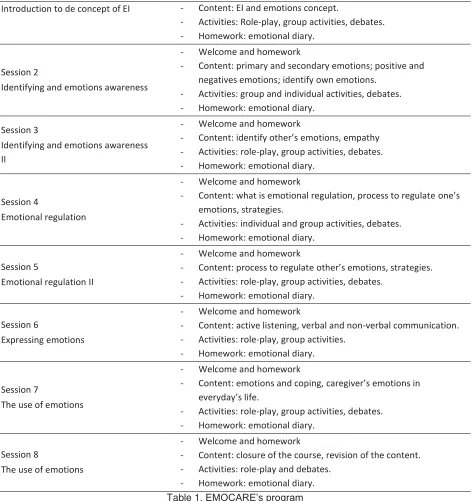
EMOCARE program aims to complement services offered to caregivers (see Table 1). It is a preventive educational intervention that offers theoretical knowledge of EI and trains participants in a set of emotional skills that will improve their life satisfaction and increase their capacity to cope with stressful situations, with focus on settings related to caregiving and its implications. Apart from EI, EMOCARE includes topics such as constructive thinking, coping skills and social skills, related to family context and mental health. EMOCARE is a program of eight weekly sessions each lasting 90 minutes, led by a pedagogue accompanied by a psychologist or a social worker. The maximum number of participants in each session is 10. EMOCARE combined the work done by Salovey and Mayer (1997), Bisquerra (2003), and evaluation was carried out following the guidelines of Pérez-Juste (2006) and Pérez-González (2008).
Sessions Content
Introduction to de concept of EI - Content: EI and emotions concept.
- Activities: Role-play, group activities, debates. - Homework: emotional diary.
Session 2
Identifying and emotions awareness
- Welcome and homework
- Content: primary and secondary emotions; positive and negatives emotions; identify own emotions.
- Activities: group and individual activities, debates. - Homework: emotional diary.
Session 3
Identifying and emotions awareness II
- Welcome and homework
- C emotions, empathy
- Activities: role-play, group activities, debates. - Homework: emotional diary.
Session 4
Emotional regulation
- Welcome and homework
- Content: what is emotional regulation, process to regulate emotions, strategies.
- Activities: individual and group activities, debates. - Homework: emotional diary.
Session 5
Emotional regulation II
- Welcome and homework
- Content: process to regulate emotions, strategies. - Activities: role-play, group activities, debates.
- Homework: emotional diary.
Session 6
Expressing emotions
- Welcome and homework
- Content: active listening, verbal and non-verbal communication. - Activities: role-play, group activities.
- Homework: emotional diary.
Session 7
The use of emotions
- Welcome and homework
- Content: emotions and coping, ife.
- Activities: role-play, group activities, debates. - Homework: emotional diary.
Session 8
The use of emotions
- Welcome and homework
- Content: closure of the course, revision of the content. - Activities: role-play and debates.
[image:5.612.71.544.71.572.2]- Homework: emotional diary. Table 1. EMOCARE’s program
EMOCARE’s target audience is caregivers of people diagnosed with MD involved (or practically involved) in PIAE program. PIAE staff members have direct contact with family and/or patients and select participants according to the following selection criteria: patients aged over 18; relationship problems reported in the family context; and relatives’ motivation to participate.
Motivation and outcomes in EI related interventions
The SJD’s selection criteria, as mentioned above, are based on family urgent care, cognitive level of family members, and motivation to participate in EMOCARE program. These criteria, however, do not help in identifying potential participants who will benefit the most from such programs in terms of behavior modification. Therefore, the SJD’s selection criteria must take into account theories of individual motivation that describe factors shaping a person’s behavior.
The Theory of Planned Behavior or TPB (Ajzen, 1985) is a well-established behavioral theory that emerges from health and preventive psychology. TPB posits that behavioral intentions are highly related to target behavior, and the extent to which intentions to behave are carried out, depends on attitudes held by individuals, subjective norms and controllability levels of target behavior. A large amount of research has been conducted to test this model's relevance in fields such as alcohol-abuse behavior (Hagger et al., 2011; Schlegel, D’Avema, Zanna, DeCourville, & Manske, 1990); smoking cessation (Bobo & Rise, 2011; Hassandra et al., 2011), condom use (Godin, Fortin, Michaud, Bradet, & Kok, 1997; Jemmott, Jemmott & Hacker, 1992), and many more health related behaviors.
Previous studies (Ajzen, 1991; Conner & Armitage, 1998; Godin & Kok, 1996) support the predictive validity of behavioral intentions, indicating that it accounts for 20% to 40% of the variance of behavior (Orbell & Sheeran, 2000; Rise, Thompson & Verplanken, 2003). Therefore, when a prospective participant in an EI program has a high intention to change, they have significantly higher chances of attaining the program's goals, compared with other who does not express such intentions. Attitude-behavior theories, such as TPB, provide understanding of the factors involved in the motivational process of behavioral change, but they are not the only ones: goal-setting theories focus on motivational processes towards achievement behaviors. Locke and Latham (1984) present Goal-Setting Theory (GST), based on the premise that human behavior derives its meaning from the goals it is aimed at; GST states that differences in performance goals held by men or women shape their performance. Locke, Latham and Erez (1988) noted that if there is no commitment to goals, then goal setting does not work. Nevertheless, studies by Latham and Locke’s (1991) show that greater personal involvement brings along greater commitment to goals. They defined commitment as follows: “the degree in which the subject ties to the goal, considers it as significant or important, is determined to achieve it, and keeps it despite setbacks and obstacles" (p. 217).
A meta-analysis by Klein, Wesson, Hollenbeck, and Alge (1999) proved that goal commitment has positive effects on subsequent behavior; thus, goal commitment is essential for any goal theory. Gibbons et al. (1998, p. 1164) proposed that “a central tenet [of the decision to commit to a particular behavior] is that because all behaviors involve premeditation or planning, [and] the only proximal antecedent of a particular action is the individual’s intention to engage in that action”. Ajzen, Czasch, and Flood (2009) linked goal commitment to intentions because “a heightened sense of commitment increases the likelihood that the behavior will be carried out" (p. 1359). Along these lines, Nenkov and Gollwitzer (2012) suggested that commitment to a goal might cause a sense of responsibility towards individual goals, reinforcing the relationship between behavioral intentions, behavioral commitment, and behavior.
a real bond with the patient and change and as a variable to be measured at the beginning of the program.
To sum up, the selection criteria to include patients’ relatives into EMOCARE program must consider: urgency, cognitive level, motivation to participate, intention to change, and commitment to change. Specifically, the purpose of the study is to create a systematic evaluation model to ensure the efficiency and effectiveness of EMOCARE program, that is, we hypothesized that EMOCARE improves caregiver’s well-being. Therefore, our hypothesis is that the application of EMOCARE does improve caregiver’s well-being.
METHOD
SampleThe participants of the study are the caregivers of people with MD involved or likely to be involved in a PIAE program. The PIAE is a comprehensive care program for mental illness’ relatives, provided in a community mental health services at SJD Hospital in Barcelona (Spain). This service annually assesses 180 people. PIAE staff members who have direct contact with family and/or MD patients conducted the recruitment of potential participants.
Selection criteria used by PIAE staff members to enroll caregivers in the program were: patients with MD aged over 18; relationship problems in the family context; need for urgent intervention; and patients who have lower cognitive levels to take the sessions. After identifying those participants who could take advantages of the program, Ribot got in touch with them in order to apply the measures conducted in t1. The experimental group was made up of those relatives who were motivated to attend EMOCARE program. The rest were asked to participate in the study as a member of the control group. Therefore, 10 caregivers who wanted to participate in EMOCARE program (experimental group), and five who did not want to participate in EMOCARE program (control group).
Measures
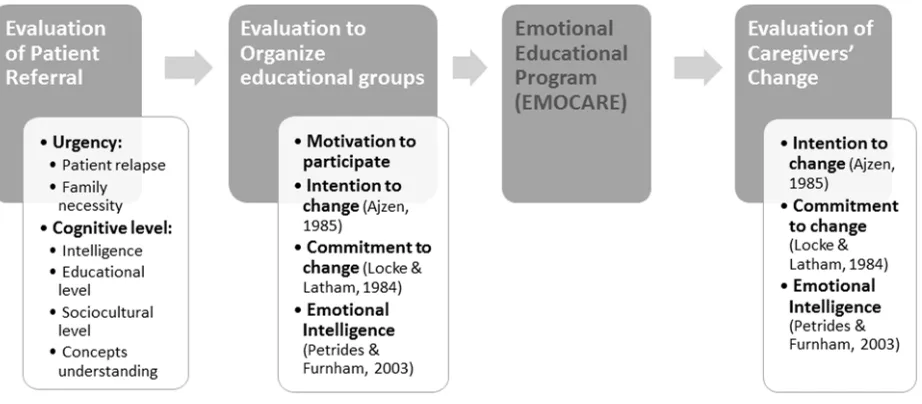
As we mentioned before, there are multiple measures to ensure that EI programs are effective and efficient. Depending on the group (control group or experimental group), these measures are applied differently. These measures are described below and presented in the Figure 1.
Socio-demographic information. Our main objective was to know the family member-patient
relation and the quality and frequency of this relationship. There are 14 questions that examine gender, age, study level, employment status, etc.
Intention to change. As mentioned earlier, Ajzen’s (1985) theory allowed us to develop the
intention to change (IC) variable, adapting the intention scale from Quesada-Pallarès’ (2014) dissertation. The scale was formed by 12-item self-report 5-point Likert scale (1: completely not agree, 5: completely agree). Internal consistency of the scale is = .97.
The IC scale was applied three times (t1, t2 and t3), always before testing motivation to participate and commitment to change in order to avoid bias. We presented the next phrase to family members “How strongly do you agree the transfer of learning acquired to your personal and family life is a goal?” and then they have to evaluate 12 items such as: “I would like to apply what I learned in the course to my life”.
Motivation to participate. In any type of intervention it is essential that the person who is going
to participate in show he/she is willing to do the program. Even if the participation is mandatory he/she cannot be forced to participate. This is extremely important when we are expecting from the patient an emotional change like the one we hope to have with EMOCARE program. Therefore, after being sure family members accomplish all selection criteria, we ask them if they want to participate in EMOCARE program [“Are you interested in participating in an emotional and education program?” Given answers (yes or not) help us to assign patient relative in the control group (not interested) or the experimental group (interested).
Burnout. We applied the Zarit Burden Inventory (Zarit, Reever & Back-Peretson, 1980),
rendered into Spanish by Martín et al. (1996). The burnout scale (BS) is a 22-item self-report scale that assesses the respondents’ subjective experience of burnout. The caregivers respond through a 5-point Likert scale within a range from 0 (never) to 4 (nearly always). The scale assesses the negative effects (mental and physical health, social activities and financial resources) on caregivers. It was applied two times (t2 and t3). After several applications, internal consistency of the scale is = .92.
Satisfaction with Life. Subjective well-being has been related to two major components: the
emotional and the cognitive component (Diener, 1984; Veenhoven, 1984). The Satisfaction with Life Scale (SWLS) (Diener, Emmons, Larsen, & Griffin, 1985) is a 5-item instrument designed to measure global life satisfaction of the respondent’s life. It was applied two times (t2 and t3) using 7-point Likert scale ranging from 1 (strongly disagree) to 7 (strongly agree). Internal consistency of the scale is = .82.
Emotional Intelligence Trait. Trait EI is defined by Petrides, Pita, and Kokkinaki (2007) as a
constellation of emotional self-perceptions, located at the lower levels of personality hierarchies.
To measure how participants perceived their emotional self-efficacy, we applied the Trait Emotional Intelligence Questionnaire-Short Form (TEIQue-SF) (Petrides & Furnham, 2006). This is a 30-item questionnaire that measures trait EI based on the TEIQue long form (Petrides & Furnham, 2003). The Spanish version validated by Pérez-González (2003) was applied two times (t2 and t3). For this short version, two items per subscales (15) were selected according to their correlations with the total subscales scores. Responses are rated on a 7-point Likert scale ranging from 1 (strongly disagree) to 7 (strongly agree). Internal consistency of the scale is = .82.
Commitment to change. Commitment to change has an important role in the execution of a
willingness to not abandon and to invest effort to change as a prior goal of its personal and family life.
Commitment to change scale was applied two times (t2 and t3); always after measuring intention to change. We presented the next phrase to family members “How strongly do you agree the transfer of learning acquired to your personal and family life is a priority?” and then they have to evaluate 4 items such as: “I am willing to work harder than I normally would to apply what I learned in the course to my life”.
Procedure
[image:9.612.78.539.270.472.2]The study followed a quasi-experiment based on pre-post design with two groups (one of them is a quasi-control group). One of the researchers repeated the measurement three times: t1 — first contact between PIAE staff members and the patients’ relatives (pre-test); t2 — first day of EI program (1st day); and t3 —the final session (post-test).
Figure 1. EMOCARE’s Systematic Evaluation Model (Ribot-Horas & Quesada-Pallarès, 2014) The four steps of EMOCARE’s evaluation process consisted of: (1) the evaluation of patient referral (from January to February 2014); (2) the evaluation to organize the educational groups (control and experimental) (March 2014); (3) the development of EMOCARE (April to May 2014); and (4) the evaluation of change in caregivers (from May to June 2014).
Data analysis
We entered the collected data to a SPSS v.17 Inc. database. First, we explored the data verifying the normality and outliers of the answers. Then, we performed reliability analyses to ensure the internal consistency of all scales. After that, we did descriptive, inferential and correlation analyses to achieve objectives and hypotheses testing. Below, we present the most relevant outcomes.
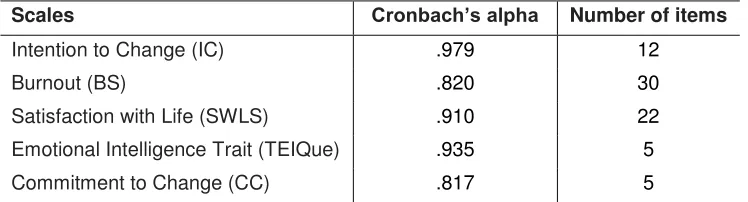
First of all, we analyzed the reliability of the measures to test its internal consistency when we applied them to this sample. According to Nunnally (1970), all measures obtained a high reliability evaluated through Cronbach’s alpha value ( >.70). Table 2 presents the information of all scales regarding to its internal consistency.
Scales Cronbach’s alpha Number of items
Intention to Change (IC) .979 12
Burnout (BS) .820 30
Satisfaction with Life (SWLS) .910 22
Emotional Intelligence Trait (TEIQue) .935 5
[image:10.612.121.495.136.237.2]Commitment to Change (CC) .817 5
Table 2. Measures’ reliability Data overview
Sample description. 60% of family members are the father or mother of the patient; however, there are also spouses (20%), sons or daughters (13%) and brothers or sisters (7%). Despite this relationship, only the 47% of family members are the main caregiver. It confirms the relationship frequency because the 33% of the relatives spend among 8 to 14 hours per week providing care. In fact, the 56% of the relatives live alone with the patient, which means that most of them may have an external caregiver.
The patients’ mean age is 41.87 years with a deviation of 15.05 years; nonetheless, the caregivers’ mean age is 57.73 years with a deviation of 12.17 years. It agrees with the relation between relatives and patients, being the parents or the elders who adopt a more involving role on the caregiving process.
Relatives who participated in the study were mostly women (60%); most of the relatives do not have a regular job (outside of their home) (60%) probably because the 47% of them have a basic educational level. Moreover, the 50% of the relatives are married and 21% of them are divorced.
In general, the patient has been diagnosed for 10.33 years with a deviation of 7.97 years; otherwise, the coexistence time of caregivers with patients is 30.30 years with a 12.75 of deviation. These results point out that the coexistence is higher than the diagnosed time, therefore, for a long time, patients and relatives did not know for sure about patients’ mental illness.
Finally, we asked them about the quality of the relationship relative-patient. In average, the quality of the relationship tend to be ordinary-mediocre because the mean is 3.27 with a deviation of 1.44, being 1 the best relationship and 6 the worst relationship.
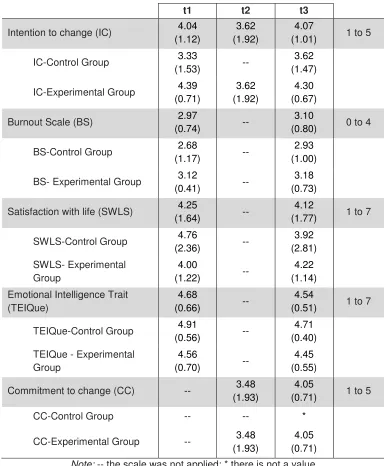
Tests results. It is also important to know how relatives rated the different tests according to the time of application. Table 3 shows these rates as a total as well as divided by the intervention group assigned.
Scales Mean (std. deviation) according to the application time
t1 t2 t3
Intention to change (IC) 4.04 (1.12)
3.62 (1.92)
4.07
(1.01) 1 to 5
IC-Control Group 3.33
(1.53) --
3.62 (1.47)
IC-Experimental Group 4.39 (0.71)
3.62 (1.92)
4.30 (0.67)
Burnout Scale (BS) 2.97
(0.74) --
3.10
(0.80) 0 to 4
BS-Control Group 2.68
(1.17) --
2.93 (1.00)
BS- Experimental Group 3.12
(0.41) --
3.18 (0.73)
Satisfaction with life (SWLS) 4.25
(1.64) --
4.12
(1.77) 1 to 7
SWLS-Control Group 4.76
(2.36) --
3.92 (2.81)
SWLS- Experimental Group
4.00
(1.22) --
4.22 (1.14)
Emotional Intelligence Trait (TEIQue)
4.68
(0.66) --
4.54
(0.51) 1 to 7
TEIQue-Control Group 4.91
(0.56) --
4.71 (0.40)
TEIQue - Experimental Group
4.56
(0.70) --
4.45 (0.55)
Commitment to change (CC) -- 3.48 (1.93)
4.05
(0.71) 1 to 5
CC-Control Group -- -- *
CC-Experimental Group -- 3.48 (1.93)
4.05 (0.71)
[image:11.612.113.502.69.535.2]Note: -- the scale was not applied; * there is not a value
Table 3. Scales’ results according to the application time as well as the group assigned
In general, we observe lower rates in t1 but the TEIQue test. Nonetheless, these data is only descriptive and, to know if it has been a significant change, we must apply inferential tests.
Means comparison. The first mean comparison is based on independent samples, it means, we must know if there is significant differences on the tests’ rates between control and experimental group.
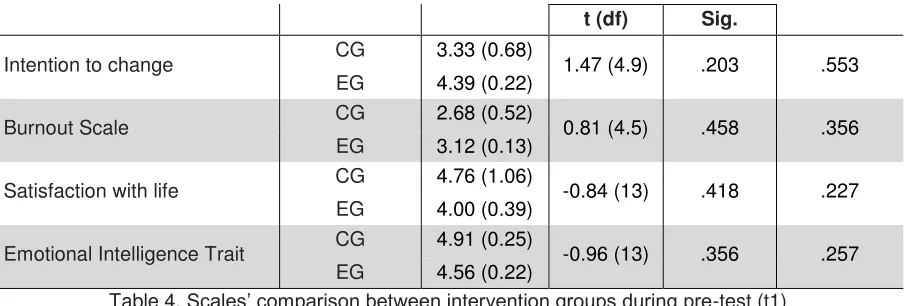
Among pre-test measures (t1), we obtained no significant differences; it means that all caregivers had the same baseline in all scales. Table 4 summarizes the results.
Scales Intervention
group
Mean (Std. Error)
t-test for Equality of Means
t (df) Sig.
Intention to change CG 3.33 (0.68) 1.47 (4.9) .203 .553 EG 4.39 (0.22)
Burnout Scale CG 2.68 (0.52) 0.81 (4.5) .458 .356 EG 3.12 (0.13)
Satisfaction with life CG 4.76 (1.06) -0.84 (13) .418 .227 EG 4.00 (0.39)
[image:12.612.82.534.70.223.2]Emotional Intelligence Trait CG 4.91 (0.25) -0.96 (13) .356 .257 EG 4.56 (0.22)
Table 4. Scales’ comparison between intervention groups during pre-test (t1)
The previous tendency is repeated in post-test measures (t3). In this case, the result is not favorable to the study because it shows that there are no significant differences between both intervention groups during the post-test, after the experimental group attended the EMOCARE program. Nonetheless, it is worth to mention that the experimental group is twice the control group, and then the data may be insufficient to compare both groups. Table 5 shows the results.
Scales Intervention group
Mean (Std. Error)
t-test for Equality of
Means Effect size (r) t (df) Sig.
Intention to change CG 3.62 (0.66) 0.99 (4.9) .230 .408 EG 4.30 (0.21)
Burnout Scale CG 2.93 (0.45) 0.56 (13) .585 .153 EG 3.18 (0.23)
Satisfaction with life CG 3.92 (1.26) 0.23 (4.7) .828 .105 EG 4.22 (0.36)
Emotional Intelligence Trait CG 4.71 (0.18) -0.91 (13) .377 .245 EG 4.45 (0.17)
Commitment to change CG 0.00 (0.00) * * *
EG 4.05 (0.22)
[image:12.612.97.520.591.719.2]Note: * it is not possible to compute it
Table 5. Scales’ comparison between intervention groups during post-test (t3)
After analyzing the differences between intervention groups, it is necessary to know if there are differences between intervention groups and time application. To do so, we performed a general lineal model test based on a repeated-measure design (see Table 6).
Scales Tests of Within-Subjects Effects Effect size (r)
F value dfmodel dfresiduals Sig.
Intention to change 2.193 1.083 14.076 .160 .367
Burnout Scale 0.634 1 13 .440 .216
Satisfaction with life 5.299 1 13 .039 .538
Commitment to change 1.493 1 13 .244 .321
Table 6. Scales’ comparison between intervention groups and application time
[image:13.612.74.540.193.450.2]The results inform that there is only one significant difference on the SWLS according to the intervention group (if they attended to the EMOCARE program) and the application time (compared between pre-test and post-test). This outcome points out that relatives from the experimental group improved significantly their satisfaction with life as a result of the EI program, compared with the control group (see Figure 2).
Figure 2. Satisfaction with life outcome analyzed thorough a general lineal model
Moreover, when we analyze the effect size of the SWLS, we identify a medium effect; then, the impact of EMOCARE program as an intervention is medium (Cohen, 1988).
5. Discussion
The need for a model that help the authors to explore the efficacy and effectiveness of EMOCARE program has been justified not only from a theoretical view (Pérez-González, 2008) but also from a practical view as a consequence of financial crisis and the negative effect of this crisis on educational programs in hospitals.
EMOCARE’s Systematic Evaluation Model (Ribot-Horas & Quesada-Pallarès, 2014) was designed to provide a framework for assessment of EI programs—formed by five different measures at three different moments. The novelty of the model lead the authors to adapt intention to change and commitment to change scales to this population, while burnout, satisfaction with life and emotional intelligence trait scales were already applied in other education programs related to mental health (Diener, Emmons, Larsen, & Griffin, 1985; Martín et al., 1996; Pérez-González, 2003). Therefore, it was necessary to verify their reliability through a new sample. The results pointed out a good internal consistency of all measures; then, the
4.76
3.92 4.00
4.22
1 2 3 4 5 6 7
Pre-test (t1) Post-test (t3)
reliability of the scales was ensured and the objective of this research -to create a systematic evaluation model to ensure the efficiency and effectiveness of EMOCARE program- was achieved.
Our second purpose, was to test the adequacy of EMOCARE. From now on we discuss the main findings previously presented.
Firstly, we observed that the baseline measure of IC, TeiQue, SWLS and BS was not significantly different between the control group and the experimental group. In fact, we notice by the descriptive results that the control group is healthier than the experimental group. However, and according to the assumption that motivation to participate is related to a higher intention to change, we see that the experimental group (formed by participants who wanted to participate in the program) had more intention to change than the control group.
Otherwise, baseline measures of the control group show interesting information. They do present lower scores in BS and higher scores in SWLS and TEIQue. As Ribot-Horas (2014) pointed out, it is understandable that people who are more satisfied with their life and perceive lower burnout, have less interest in participating in a program. However professionals have selected these people because they have encountered family relationship problems and they do not feel the need of participating.
Secondly, the intention to change is lower in the t2 compared to the t1 (although this difference is not significantly higher if we take into account the t3 measure). This result can be explained by respondents’ answers in the t1 before knowing their participation in the program. Then, after learning more about what the program was, and before the start of the program (t2), their intention to change decreases.
Moreover, the differences between intention to change and commitment to change rates (t2 and t3) suggest that, even if they have less intention to change than commitment to change in t2, EMOCARE program helped them to know what they should change and how to improve their well-being. That way they feel more capable of achieving this change, and their expectations regarding their feelings are more realistic. Therefore, and even if there are no significant differences, the experimental group has been more involved in the process of changing their own mental health.
Thirdly, although the burnout is not significantly lower (t1 compared to t3), that is, they are equally burned-out, the satisfaction with life is higher and the result shows significant increase in the experimental group It could be said that both groups, experimental and control group, are burned-out but, those who participated in EMOCARE program increased their satisfaction with life, although the burnout rate is the same. This result implies that the experimental group at t3 could identify more satisfaction in their life than in t1; then, they could describe other elements in their everyday life apart from their relatives’ mental disease.
This last result partially confirms the hypothesis of this research. Not only EMOCARE’s Systematic Evaluation Model is adequate to assess the efficacy and effectiveness of the program, but also it improves family well-being, that is, their satisfaction with life.
to compare both control and experimental group. On the other hand, the small sample size impeded complex analyses and exploration of the relationship between total scores and socio-demographic information.
Our aim is to assess EMOCARE program and the psychoeducational program conducted in the PIAE for future studies. This will provide insight into the variables studied applying the Systematic Evaluation process to others interventions.
Moreover it will be sought to increase the simple size by repeating the application of EMOCARE program; which may allow us to establish a pattern of intention to change and commitment to change as a selection criteria to guarantee EMOCARE’s efficacy and effectiveness. It would be interesting to encourage members of the control group to participate in the program in future interventions due to the need for an intervention, as they were proposed by professionals, even if members of the control group are not aware of the need.
References
Ajzen, I. (1985). From intentions to actions: A theory of planned behavior. In J. Kuhl & J. Beckmann (Eds.), Action-control: From cognition to behavior (pp. 11-39). Heidelberg: Springer.
Ajzen, I. (1991). The theory of planned behavior. Organizational Behavior and Human Decisions Processes, 50, 179-211.
Ajzen, I., Czasch, C., & Flood, M. G. (2009). From intentions to behavior: implementation intention, commitment, and conscientiousness. Journal of Applied Social Psychology, 39(6), 1356-1372.
Austin, E. J., Saklofske, D. H., & Egan, V. (2005). Personality, well-being and health correlates of trait emotional intelligence. Personality and Individual Differences, 38, 547-558.
Bauml, J., Pitschel-Walz, G, Volz, A., Engel, R.R., & Kissling, W. (2007). Psychoeducation in schizophrenia: 7-year follow-up concerning rehospitalization and days in hospital in the Munich psychosis information project study. Journal of Clinical Psychiatry, 68, 854-861.
Bisquerra Alzina, R. (2003). Educación emocional y competencias básicas para la vida. Revista de Investigación Educativa (RIE), 21(1), 7-43.
Bisquerra Alzina, R., & Pérez Escoda, N. (2007). Las competencias emocionales. Educación XX1, 10, 61-82.
Bobo Kovač, V., & Rise, J. (2011). Predicting the intention to quit smoking in a Norwegian sample. Nordic Psychology, 63(3), 68-82.
Ciarrochi, J., Deane, F. P., & Anderson, S. (2002). Emotional intelligence moderates the relationship between stress and mental health. Personality and Individual Differences, 32, 197-209.
Cohen, J. (1988). Statistical power analysis for the behavioral sciences. Hillsdale, NJ: Lawrence Erkbaum Associates.
avenues for further research. Journal of Applied Social Psychology, 28, 1429- 1464.
Diener, E. (1984). Subjective well-being. Psychological Bulletin, 95, 542-575.
Diener, E. D., Emmons, R. A., Larsen, R. J., & Griffin, S. (1985). The satisfaction with life scale. Journal of personality assessment, 49(1), 71-75.
Fernández-Berrocal, P., Salovey, P., Vera, A., Extremera, N., & Ramos, N. (2005). Cultural influences on the relation between perceived emotional intelligence and depression. International Review of Social Psychology, 18(1), 91-107.
Frederickson, N., Petrides, K. V., & Simmonds, E. (2012). Trait emotional intelligence as a predictor of socioemotional outcomes in early adolescence. Personality and Individual Differences,52, 317-322.
Gibbons, F. X., Gerrard, M., Blanton, H., & Russell, D. W. (1998). Reasoned action and social reaction: willingness and intention as independent predictors of health risk. Journal of Personality and Social Psychology, 74(5), 1164-1180.
Godin, G., & Kok, G. (1996). The theory of planned behavior: a review of its applications to health-related behaviors. American Journal of Health Promotion, 11, 87-98.
Godin, G., Fortin, C., Michaud, F., Bradet, R., & Kok, G. (1997). Use of condoms: intention and behavior of adolescents living in juvenile rehabilitation centers. Health Education Research, 12, 289–300.
Hagger, M. S., Lonsdale, A. J., Hein, V., Koka, A., Lintunen, T., Pasi, H., Lindwall, M., Rudolfsson, L., & Chatzisarantis, N. L. D. (2011). Predicting alcohol consumption and binge drinking in company employees: An application of planned behavior and self determination theories. British Journal of Health Psychology, 17(2), 379-407.
Hassandra, M., Vlachopoulos, S. P., Kosmidu, E., Hatzigeorgiadis, A., Goudas, M., & Theodorakis, Y. (2011). Predicting students’ intention to smoke by theory of planned behavior variables and parental influence across school grade levels. Psychology and Health, 26(9), 1241-1258.
Jaeger, A. J. (2003). Job competencies and the curriculum: An inquiry into emotional intelligence in graduate professional education. Research in Higher Education, 44(6), 615-639.
Jemmott, J. B., Jemmott, L. S., & Hacker, C. I. (1992). Predicting intentions to use condoms among African-American adolescents: The theory of planned behavior as a model of HIV risk-associated behavior. Ethnicity and Disease, 2, 371–380.
Klein, H. J., Wesson, M. J., Hollenbeck, J. R., & Alge, B. J. (1999). Goal commitment and the goal-setting process: conceptual clarification and empirical synthesis. Journal of Applied Psychology, 84(6), 885-896.
Latham, G. P., & Locke, E. A. (1991). Self-regulation through goal setting. Organizational Behavior and Human Decision Processes, 50, 212-247.
Locke, E. A. & Latham, G. P. (1984). Goal setting: a motivational technique that works! Englewood Cliffs, NJ: Prentice-Hall.
Locke, E. A., Latham, G. P., & Erez, M. (1988). The determinants of goal commitment. Academy of Management Review, 13, 23–39.
Magliano, L., & Fiorillo, A. (2007). Psychoeducational family interventions for schizophrenia in the last decade: From explanatory to pragmatic trials. Epidemiologia e Psychiatria Sociale, 16(1), 22-34.
Malterer, M. B., Glass, S. J., & Newman, J. P. (2008). Psychopathy and trait emotional intelligence. Personality and Individual Differences, 44(3), 735-745.
Martín, M., Salvadó, I., Nadal, S., Miji, LC., Rico, J.M., Lanz, P., & Taussig, M.I. (1996). Adaptación para nuestro medio de la escala de sobrecarga del cuidador (caregiver burden interview) de Zarit. Rev Gerontol, 6, 338-346.
Martins, A., Ramalho, N., & Morin, E. (2010). A comprehensive meta-analysis of the relationship between emotional intelligence and health. .Personality and Individual Differences, 49, 554-564.
Mayer, J. D., & Salovey, P. (1997). What is emotional intelligence? In P. Salovey & D.J. Sluyter (Ed.), Emotional development and emotional intelligence: Educational implications (pp. 3-31). New York: Basic Books.
Mikolajczak, M., Petrides, K. V., Coumans, N., & Luminet, O. (2009). The moderating effect of trait emotional intelligence on mood deterioration following laboratory-induced stress. International Journal of Clinical and Health Psychology, 9(3), 455-477.
Montes-Berges, B., & Augusto-Landa, J. (2007). Exploring the relationship between perceived emotional intelligence, coping, social support and mental health in nursing students. Journal of Psychiatric and Mental Health Nursing, 14(2), 163-171.
Nelis, D., Quoidbach, J., Mikolajczak, M., & Hansenne, M. (2009). Increasing emotional intelligence: (how) is it possible? Personality and Individual Differences, 47, 36-41.
Nenkov, G. Y., & Gollwitzer, P. M. (2012). Pre- versus postdecisional deliberation and goal commitment: The positive effects of defensives. Journal of Experimental Social Psychology, 48, 106–121.
Nunnally, J. C. (1970). Introduction to psychological measurement. NY, US: McGraw-Hill.
Orbell, S., & Sheeran, P. (2000). Motivational and Volitional Processes in Action Initiation: A Field Study of the Role of Implementation Intentions. Journal of Applied Social Psychology, 30(4), 780-797.
Pau, A. K. H., & Croucher, R. (2003). Emotional intelligence and perceived stress in dental undergraduates. Journal of Dental Education, 67, 1023-1028.
Pérez-González, J. C. (2008). A proposal for evaluating socio-emotional education programs. Electronic Journal of Reasearch in Educational Psychology, 6(2), 523-546.
Pérez-Juste, R. (2006). Evaluación de programas educativos. Madrid: Editorial La Muralla.
Petrides, K. V. (2011). Ability and trait emotional intelligence. In Chamorro-Premuzic, T., Furnham, A., & von Stumm, S. (Eds.), The blackwell-wiley handbook of individual differences (pp. 656-678). New York: Wiley.
Petrides, K. V., & Furnham, A. (2001). Trait emotional intelligence: Psychometric investigation with reference to established trait taxonomies. European Journal of Personality, 17, 39-75.
Petrides, K. V., Frederickson, N., & Furnham, A. (2004). The role of trait emotional intelligence in academic performance and deviant behaviour at school. Personality and Individual Differences, 36, 277–293.
Petrides, K. V., Pita, R., & Kokkinaki, F. (2007). The location of trait emotional intelligence in personality factor space. British Journal of Psychology, 98, 273-289.
Quesada-Pallarès, C. (2014). ¿Se puede predecir la transferencia de los aprendizajes al puesto de trabajo?: Validación del Modelo de Predicción de la Transferencia. Unpublished PhD diss., Universitat Autònoma de Barcelona.
Ribot-Horas, A. (2014). El cuidado de los cuidadores: diseño, aplicación y evaluación de un programa de educación socioemocional para familiares de personas con trastorno mental. Unpublished PhD research. UNED.
Ribot-Horas, A., & Quesada-Pallarès, C. (2014). Efficiency and effectiveness of an EI program: an evaluation proposal based on motivational theories of the patient. Poster presented at the International Conference on Motivation 2014: Passion to Learn. Helsinki: University of Helsinki (12th to 14th of June).
Rise, J., Thompson, M., & Verplanken, B. (2003). Measuring implementation intentions in the context of the theory of planned behavior. Scandinavian Journal of Psychology, 44(2), 87-95.
Saklofske, D. H., Austin, E. J., Galloway, J., & Davidson, K. (2007). Individual difference correlates of health-related behaviours: Preliminary evidence for links between emotional intelligence and coping. Personality and Individual Differences, 42, 491-502.
Salovey, P., & Sluyter, D. J. (1997). Emotional development and emotional intelligence: Educational implications. New York: Basic Books.
Schlegel, R. P., D’Avema, J. R., Zanna, M. P., DeCourville, N. H., & Manske, S. R.(1990). Problem drinking: A problem for the theory of reasoned action? Unpublished manuscript. Department of Health Studies, University of Waterloo, Waterloo, Canada.
Schutte, N. S., Malouff, J. M., Simunek, M., McKenley, J., & Hollander, S. (2002). Characteristic emotional intelligence and emotional well-being. Cognition and Emotion, 16, 769-785.
Behavioral Assessment, 28, 57-68.
Veenhoven, R. (1994). El estudio de la satisfacción con la vida. Intervención Psicosocial, 3, 87-116.