This is a repository copy of
Discriminating instance generation for automated constraint
model selection
.
White Rose Research Online URL for this paper:
http://eprints.whiterose.ac.uk/144179/
Version: Accepted Version
Proceedings Paper:
Gent, Ian P., Hussain, Bilal Syed, Jefferson, Christopher et al. (4 more authors) (2014)
Discriminating instance generation for automated constraint model selection. In: Principles
and Practice of Constraint Programming - 20th International Conference, CP 2014,
Proceedings. Springer Verlag , pp. 356-365.
https://doi.org/10.1007/978-3-319-10428-7_27
[email protected] https://eprints.whiterose.ac.uk/ Reuse
Items deposited in White Rose Research Online are protected by copyright, with all rights reserved unless indicated otherwise. They may be downloaded and/or printed for private study, or other acts as permitted by national copyright laws. The publisher or other rights holders may allow further reproduction and re-use of the full text version. This is indicated by the licence information on the White Rose Research Online record for the item.
Takedown
If you consider content in White Rose Research Online to be in breach of UK law, please notify us by
Discriminating Instance Generation for Automated
Constraint Model Selection
Ian P. Gent1
, Bilal Syed Hussain1
, Christopher Jefferson1
, Lars Kotthoff2
, Ian Miguel1
, Glenna F. Nightingale1
, and Peter Nightingale1
1 School of Computer Science, University of St Andrews, UK
{ian.gent, bh246, caj21, ijm, gfe2, pwn1}@st-andrews.ac.uk
2 INSIGHT Centre for Data Analytics, Ireland, [email protected]
Abstract One approach to automated constraint modelling is to generate, and then select from, a set of candidate models. This method is used by the automated modelling system CONJURE. To select a preferred model or set of models for a problem class from the candidates CONJUREproduces, we use a set of training instances drawn from the target class. It is important that the training instances are discriminating. If all models solve a given instance in a trivial amount of time, or if no models solve it in the time available, then the instance is not useful for model selection. This paper addresses the task of generating small sets of dis-criminating training instances automatically. The instance space is determined by the parameters of the associated problem class. We develop a number of methods of finding parameter configurations that give discriminating training instances, some of them leveraging existing parameter-tuning techniques. Our experimental results confirm the success of our approach in reducing a large set of input models to a small set that we can expect to perform well for the given problem class.
1
Introduction and Background
Numerous approaches have been taken to automating aspects of constraint model-ling, including: learning models from examples [8,4,5,17,3]; automated transformation of medium-level solver-independent constraint models [23,21,24,20]; theorem proving [7]; case-based reasoning [18]; and refinement of abstract constraint specifications [10] in languages such as ESRA [9], ESSENCE[11],F[14] or Zinc [19,16]. We focus on the refinement approach, where a user writes a constraint specification describing a problem above the level of abstraction at which modelling decisions are made. Constraint spe-cification languages support abstract decision variables with types such as set, multiset, relation and function, as well asnestedtypes, such as set of sets and multiset of rela-tions. Therefore, problems can typically be specified very concisely. However, existing constraint solvers do not support these abstract decision variables directly, so abstract constraint specifications must be refined into concrete constraint models.
We use ESSENCE[11]. An ESSENCEspecification (see Fig. 1) identifies: the para-meters of the problem class (given), whose values define an instance; the combinatorial objects to be found (find); and the constraints the objects must satisfy (such that). An objective function may also be specified (min/maximising) and identifiers de-clared (letting). Our CONJUREsystem3 [2] employs refinement rules to convert
an ESSENCEspecification into the solver-independent constraint modelling language ESSENCE′[23]. We use SAVILEROW4[22] to translate an ESSENCE′ model into input for a particular constraint solver while performing solver-specific model optimisations. By following alternative refinement paths CONJUREtypically produces a large set of models for a given ESSENCEspecification. In our previous work [1] we developed a racing process to select among these candidate models, in which a set of training instances drawn from the problem class being modelled is used to gauge relative model performance. For this process to be effective, it is important that the instances chosen arediscriminating: if all models solve a given instance in a trivial amount of time, or if no model solves it in the time available, then the instance is not useful for model selection. Our previous work assumed that such instances were given. In this paper we address the task of generating discriminating training instances automatically.
2
Racing for Automated Model Selection
Our approach to model selection follows that we reported in [1], but with an improved method of producing a set of winning models described below. It takes as input a set of instances drawn from the target problem class. Our performance measure of a model with respect to an instance is the time taken for SAVILEROW to instantiate the model and translate for input to the MINIONconstraint solver [12] plus the time taken for MIN -IONto solve the instance. We include the time taken by SAVILEROWsince it adds desir-able instance-specific optimisations, such as common subexpression elimination [13].
We conduct arace[6] for each provided instance. Given a parameterρ≥1, a model isρ-dominatedon an instance by another model if the measure for the second model is at leastρtimes faster than the first. The ‘winners’ of an instance race are the models not
ρ-dominated by any other model. So that trivial instances do not discriminate we do not consider any model that solves within 1s to be dominated. All models enter each race, but for efficiency a model is terminated as soon as it isρ−dominated by some other model. Furthermore, the order in which the models are executed is influenced by their performance in previous races: well-performing models are executed first to establish a goodρbound early. In order to guide our exploration of the instance space we assign a discriminatory quality value to an instance with respect to the results of the race run. This is the fraction of models that areρ-dominated.
A set of instances isρ-fracturedif every model isρ-dominated on at least one in-stance. In the presence of fracturing, care must be taken in defining the set of winning models over a race sequence. We do so as follows. We first find a minimum hitting set of winning models{a1, a2, a3, ...}which covers all instance races. We then define the set
Aias the set of models that woneveryrace thataiwon. The set of sets{A1, A2, A3, ...}
then gives a summary of the winning models over all fractured parts of the instance space. Note that eachAi∩Aj =∅(wherei6=j) as otherwise we could find a smal-ler hitting set. Also note that in an unfractured instance space the uniqueA1is simply
the set of models which won all races. However, for fractured spaces the set{Ai}is not uniquely defined as it depends on the hitting set found: nevertheless it gives us a representation of one particular fracturing of the instance space.
3
Methods for Generating Discriminating Instances
The instance space is defined by the parameters of a problem class. Consider the ES-SENCE specifications in Figure 1. Langford’s Problem has two independent integer parameters and hence a two-dimensional instance space. The Knapsack Problem is an example of a more complex instance space, consisting of two integers and two func-tions. The first integer,n, governs the number of items and also the domain of the two given functions, which define the weights and values of those items. Our three methods for generating discriminating instances in these spaces are described below. All run a sequence of races and combine the results following the method described in Section 2. Undirected:For each race in a sequence,undirectedsimply draws a sample from the instance space and runs a race. Section 4 describes our sampling method.
Markov:This method is loosely based on the Markov chain Monte Carlo methods used, e.g., to estimate the value of a multi-dimensional integral. We assume that criminating instances are likely to be found near (by some proximity measure) other dis-criminating instances, and non-disdis-criminating instances near other non-disdis-criminating instances. This naturally leads to a Markov chain that walks the instance space, is attracted towards known discriminating instances, and is repelled from known non-discriminating instances. Our measure of proximity per parameter type:
Integer The distance is simply the absolute difference between the two values.
Total Function Given functionsf andg we compute the distance betweenf(i)and
g(i)for eachi where both functions are defined, and aggregate using Euclidean distance. Whenf andg have different domains of definition, some mappings in
fand/orgwill be discarded. Suppose we hadgiven weights : function (total) int(1..n) --> int(1..100)(as in the Knapsack Problem) with na parameter. If the domain of definitionint(1..n)differs betweenf andg, thennmust differ and this will count towards the instance distance.
Set Given setsSandT, the distance isp
|S\T|+|T\S|, also Euclidean.
Relation Treating a relation as a set of tuples, we use the distance measure for sets.
To obtain the instance distance, we combine the distance measure for each parameter again using the Euclidean distance. This combines elegantly with the Euclidean dis-tances computed per parameter. An initial instance is sampled using the method de-scribed in Section 4. A race is run using this instance and a record taken of its discrim-inatory quality. Each subsequent instance (sampled using the same method) is accepted or rejected according to the scheme below. If an instance is accepted a race is run with that instance, otherwise another instance is generated, and so on until the required race sequence is complete. We use the following acceptance function, where xi−1 is the
previous accepted instance andx′
iis the proposed instance.
A(xi−1, x′i) =
G′(x′ i)
G(xi−1)
LANGFORD’SPROBLEM(CSPLIB24)
given k, n : int(1..)
letting seqLength be k * n
letting seqIndex be domain int(1..seqLength)
find seq : function (total, surjective) seqIndex --> int(1..n)
such that forAll i,j : seqIndex , i < j . seq(i) = seq(j) -> seq(i) = j - i - 1
THEKNAPSACKPROBLEM
given n, totalWeight : int(1..)
given weights, values : function (total) int(1..n) --> int(1..)
find picked: set(maxSize n, minSize 1) of int(1..n)
maximising (sum i in picked . values(i) )
such that (sum i in picked . weights(i) ) <= totalWeight
THEPROGRESSIVEPARTYPROBLEM(CSPLIB14)
given n_upper, n_boats, n_periods : int(1..)
letting Boat be domain int(1..n_boats)
given capacity, crew : function (total) Boat --> int(1..n_upper)
where forAll i : Boat . crew(i) <= capacity(i),
find hosts : set of Boat,
sched : set (size n_periods) of function (total) Boat --> Boat
minimising |hosts|
such that forAll p in sched . range(p) subsetEq hosts,
forAll p in sched . forAllh in hosts . p(h) = h,
forAll p in sched . forAllh in hosts .
(sum bin preImage(p,h) . crew(b))<= capacity(h),
forAll b1,b2 : Boat , b1 != b2 .
(sum pin sched . (p(b1) = p(b2))) <= 1
THEWAREHOUSE LOCATION PROBLEM. (CSPLIB34)
given n_upper, n_stores, n_warehouses : int(1..30)
letting Store be domain int(1..n_stores), WHouse be domain int(1..n_warehouses)
given capacity : function (total) WHouse --> int(1..n_upper), opencost : function (total) WHouse --> int(1..n_upper),
cost : function (total) tuple (Store, WHouse) --> int(1..n_upper)
find open :function (total) Store --> WHouse
minimising (sum r in range(open). opencost(r)) + sum s : Store . cost((s,open(s)))
such that forAll w : WHouse . |preImage(open,w)| <= capacity(w)
Figure 1.Four sample ESSENCEspecifications.
using the distance measure above.G′(x′
i)finds the set of all previous accepted instances within distance rofx′
i. If this set is non-empty,G′(x′i)returns the mean of the true quality values for the set. Otherwise,G′(x′
i) = 0.5.G(xi−1)gives the true quality of
xi−1. Finally, a pseudorandom numberais generated within[0,1], andx′iis accepted
ifA(xi−1, x′i)≥athen. Hence, the proposed instance is always accepted ifG′(x′i)is
greater thanG(xi−1).
We encode the problem class parameters intoSMAC’s input format, which uses in-teger and categorical variables. Inin-teger givens are converted to integer parameters with the range specified in the problem definition. We model structuredgivens such as functions using multipleSMACparameters. When onegivendepends on another, such as the size of the domain of the function depending onnin the Knapsack Prob-lem, we must be conservative: sufficient SMACparameters are used to accommodate the maximum size of the structured given. The extraneous parameters are ignored when racing the instances so produced. AlthoughSMAChas demonstrated that it is able to handle large parameter spaces, this conservative encoding may hinder its ability to cover the space effectively, since many of the values it is producing may be ignored. Furthermore,SMACdoes not support the complex constraints between parameters that we sometimes require (where), so we use CONJURE to validate the instances that SMACgenerates and discard those that do not satisfy the constraints.
4
Uniform Versus Non-uniform Sampling
Except forSMAC, which has its own sampling method, our generation approaches re-quire the ability to sample from the instance space associated with a problem class. Since the instance spaces of the problem classes we consider are typically infinite, our method requires some sensible bounds on the parameters involved in order to circum-scribe a finite sub-space of interest. For example in Langford’s Problem, as discussed in Section 5, we limit the two integer parameters to the ranges 2..10 and 1..50 respectively. When the parameters defining the space are independent (e.g. the pair of integer parameters to Langford’s problem), uniform sampling is straightforward: simply gener-ate a value uniformly and independently for each parameter. When the parameters are not independent, uniform sampling is more difficult. Reconsider the Knapsack Problem from Figure 1. An approach to sampling from this space is first to generatenuniformly then uniformly and independently generate a mapping for each element of the domain (1..n) of the two functionsweightsandvalues. However, this introduces bias: there are many more possible functions for large values ofnthan there are for small values of
n. Hence, if we generatenuniformly then a particular function for smallnis far more likely to be selected than a particular function for largen.
A solution to this problem is to enumerate all of the valid instances of the instance sub-space and sample uniformly from this set. This enumeration problem is naturally cast as a (simple) constraint problem. An ESSENCEspecificationE∗for the enumera-tion problem can be obtained automatically from an original ESSENCEspecificationE
simply by replacing inEthegiven(parameter) statements withfind(decision vari-able) statements and discarding the rest ofE. As a very simple example, performing this process for Langford’s Problem produces:
find k : int(2..10) find n : int(1..50)
Care must be taken that this transformation produces valid ESSENCE. For the Knapsack Problem (assuming sensible parameter limits) it produces:
find totalWeight : int (1..1000)
find weights : function (total) int(1..n) --> int(1..100) find values : function (total) int(1..n) --> int(1..100)
This is invalid because a decision variable is used to define the size of the domain of the two function variables. The solution we adopt is to leavenas a parameter, solve the problem for each value ofnand take the union of the results.
We obtain a single model forE∗automatically using CONJUREand the Compact heuristic [1] — this is sufficient because the enumeration problem is typically easy. MINIONis then used to find all solutions to the model. Ouruniformsampling method is to select uniformly from this set of solutions.
The drawback ofuniformis that it limits the size of space that we can consider. An alternative approach, which we callsolver-random, is to sample by requesting a single solution from MINION, employing a random variable and value order. This in-troduces bias for much the same reason as described above: the distribution of solutions to the model may not be uniform. However,solver-randomis much more scalable. In order to compareuniformwithsolver-randomwe performed an exper-iment on two problem classes: Warehouse Location and the Progressive Party Prob-lem (see Figure 1). So thatuniform sampling was feasible, the instance space for each problem class was restricted to around a billion instances by limiting the upper bounds of each of their parameters. For each problem class we ran three sequences of thirty races using ourMarkovandUndirectedgeneration approaches. In this ex-periment there was no substantive difference betweenMarkovandUndirected— probably because of the (lack of) discriminatory quality of the instance sampled as we discuss below. For Warehouse Location the performance of the two sampling methods is identical, reducing 128 input models to 64 non-dominated models. For the Progressive Party Problemsolver-randomactually performs better thanuniform, reducing 256 input models to 16 non-dominated models, whereasuniformproduces between 63 and 77 non-dominated models. The bias inherent tosolver-uniformappears to have been beneficial in this case, guiding the methods to discriminating instances.
These experiments provide some evidence thatsolver-randomis a reasonable approach to sampling the instance space. It is also worth noting that the restrictions on the size of the instance space that we explore (to accommodateuniform) restricts the discriminatory quality of the instances that we find — producing 64 non-dominated models for Warehouse Location is a relatively weak result.solver-randomscales easily to more challenging, hence more discriminating, instances as we will see in the following section where we usesolver-randomexclusively.
5
Experimental Results
runs, SMACrequires a total time budget. We specify the maximum time either of the other methods took to complete the race sequence.
Given the volume of experiments we use heterogeneous compute resources, while ensuring that all experiments for each problem class are run on the same resource. In all cases, a model is given 6.5GB of RAM and run on an AMD-based architecture. The Social Golfer Problem was run on a 32-core 2.1GHz machine, Warehouse Location on a 64-core 2.1GHz machine, and the remainder on 2.1GHz processors on Microsoft Azure.
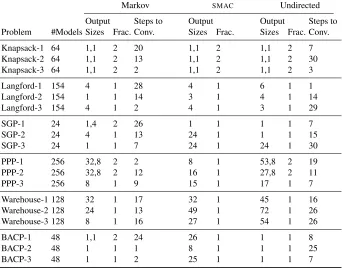
Our results are summarised in Table 1. For each problem class we record: the num-ber of models refined by CONJURE from the associated ESSENCE specification; the size of the output set(s) of models as described in Section 2; the number of discovered fractured parts of the instance space; and, forMarkovandUndirected, the number of races until convergence. This last measure indicates how many of the 30 races are necessary to achieve the final result. Detailed discussion follows.
The Knapsack ProblemThe parameter space is limited as described in Section 4. All of our methods perform well on this problem class, identifying that the instance space is fractured into two parts. The parts correspond to satisfiable versus unsatisfiable instances. For the satisfiable part, all three methods returned a single winner model (from the 64 input), which employs a 0/1 model of the problem. For the unsatisfiable part, all three methods also returned a single winning model based on an explicit rep-resentation of the set of items in the knapsack. BothMarkovandUndirectedshow some variability in how quickly they converge on this result.
Langford’s ProblemThe parameters to this problem are a pair of independent in-tegers (limited as described in Section 4). Therefore,solver-randomsampling is unbiased for this problem. None of our methods found the instance space to be frac-tured, and each was able to reduce the input set of models drastically to a small set of non-dominated models. Over the three independent runs,Markovshows a slight edge in performance returning a single model in one case, whereasUndirectedon one occasion returns six models. Both show some variability in steps to convergence.
The Social Golfer ProblemThe parameters to this problem are a triple of inde-pendent integers, hencesolver-randomsampling is again unbiased. Each parameter is limited between 1 and 100. Hence, a large fraction of this instance space is unfeas-ibly difficult so we would expect our more informed approaches to perform better in this case study. In fact,SMACstruggles with this class, in two cases finding no discrim-inating instances at all.Undirected’s performance is variable, sometimes outputting a single model, but on one occasion also finding no discriminating instances. By con-trastMarkovperforms well, reducing the 24 input models to between 1 and 4 on each run and on one occasion identifying a fracture in the instance space.
The Progressive Party ProblemThis class has the most (256) input models. Per-haps unsurprisingly, therefore, the instance space is fractured — but this is only iden-tified byMarkovandUndirected. When fracturing is detected,Markovis more consistent thanUndirectedin the size of the returned set for the first fractured part.
Markov SMAC Undirected
Output Steps to Output Output Steps to Problem #Models Sizes Frac. Conv. Sizes Frac. Sizes Frac. Conv.
Knapsack-1 64 1,1 2 20 1,1 2 1,1 2 7
Knapsack-2 64 1,1 2 13 1,1 2 1,1 2 30
Knapsack-3 64 1,1 2 2 1,1 2 1,1 2 3
Langford-1 154 4 1 28 4 1 6 1 1
Langford-2 154 1 1 14 3 1 4 1 14
Langford-3 154 4 1 2 4 1 3 1 29
SGP-1 24 1,4 2 26 1 1 1 1 7
SGP-2 24 4 1 13 24 1 1 1 15
SGP-3 24 1 1 7 24 1 24 1 30
PPP-1 256 32,8 2 2 8 1 53,8 2 19
PPP-2 256 32,8 2 12 16 1 27,8 2 11
PPP-3 256 8 1 9 15 1 17 1 7
Warehouse-1 128 32 1 17 32 1 45 1 16
Warehouse-2 128 24 1 13 49 1 72 1 26
Warehouse-3 128 8 1 16 27 1 54 1 26
BACP-1 48 1,1 2 24 26 1 1 1 8
BACP-2 48 1 1 1 8 1 1 1 25
[image:9.612.137.479.119.387.2]BACP-3 48 1 1 2 25 1 1 1 7
Table 1. Results for the six problem classes over three independent runs.
Balanced Academic Curriculum ProblemOnlyMarkovis able to detect a frac-ture in the instance space for this class, and only on one of its runs. Both Markov andUndirectedreduce the input model set drastically from 48 to a single winning model.SMACperforms much less well on this class, perhaps hampered by the neces-sary encoding compromises (see Section 3) on what is a more complex instance space defined by 7 integers, two functions and a relation.
6
Conclusions
We have developed and investigated three methods for generating discriminating in-stances for the purpose of automated constraint model selection. Our experimental evaluation shows that all of these methods are capable of reducing a large number of possible models to a much smaller set. The methods are able to detect fracturing if it occurs and successfully determine the best models for each fraction. Overall, our novel Markovapproach has the best performance on the problem classes in our experiments.
References
1. Akgun, O., Frisch, A.M., Hussain, B.S., Gent, I.P., Jefferson, C.A., Kotthoff, L., Miguel, I., Nightingale, P.: Automated symmetry breaking and model selection in Conjure. In: 19th International Conference on Principles and Practice of Constraint Programming. pp. 107– 116 (2013)
2. Akgun, O., Miguel, I., Jefferson, C., Frisch, A.M., Hnich, B.: Extensible automated con-straint modelling. In: 25th Conference on Artificial Intelligence (AAAI) (2011)
3. Beldiceanu, N., Simonis, H.: A model seeker: Extracting global constraint models from pos-itive examples. In: 18th International Conference on Principles and Practice of Constraint Programming. pp. 141–157 (2012)
4. Bessiere, C., Coletta, R., Freuder, E.C., O’Sullivan, B.: Leveraging the learning power of ex-amples in automated constraint acquisition. In: 10th International Conference on Principles and Practice of Constraint Programming. pp. 123–137 (2004)
5. Bessiere, C., Coletta, R., Koriche, F., O’Sullivan, B.: Acquiring constraint networks using a SAT-based version space algorithm. In: 21st Conference on Artificial Intelligence (AAAI). pp. 1565–1568 (2006)
6. Birattari, M., St¨utzle, T., Paquete, L., Varrentrapp, K.: A racing algorithm for configuring metaheuristics. In: The Genetic and Evolutionary Computation Conference (GECCO). vol. 2, pp. 11–18 (2002)
7. Charnley, J., Colton, S., Miguel, I.: Automatic generation of implied constraints. In: 17th European Conference on Artificial Intelligence (ECAI). pp. 73–77 (2006)
8. Coletta, R., Bessiere, C., O’Sullivan, B., Freuder, E.C., O’Connell, S., Quinqueton, J.: Semi-automatic modeling by constraint acquisition. In: 9th International Conference on Principles and Practice of Constraint Programming. pp. 812–816 (2003)
9. Flener, P., Pearson, J., ˚Agren, M.: IntroducingESRA, a relational language for modelling combinatorial problems. In: Logic Based Program Synthesis and Transformation (LOPSTR). pp. 214–232 (2003)
10. Frisch, A.M., Jefferson, C., Hernandez, B.M., Miguel, I.: The rules of constraint modelling. In: 19th International Joint Conference on Artificial Intelligence (IJCAI). pp. 109–116 (2005) 11. Frisch, A.M., Harvey, W., Jefferson, C., Mart´ınez-Hern´andez, B., Miguel, I.: Essence: A constraint language for specifying combinatorial problems. Constraints 13(3) pp. 268–306 (2008)
12. Gent, I.P., Jefferson, C., Miguel, I.: Minion: A fast scalable constraint solver. In: 17th European Conference on Artificial Intelligence (ECAI). vol. 141, pp. 98–102 (2006) 13. Gent, I.P., Miguel, I., Rendl, A.: Common subexpression elimination in automated constraint
modelling. In: Workshop on Modeling and Solving Problems with Constraints. pp. 24–30 (2008)
14. Hnich, B.: Function variables for constraint programming. AI Communications 16(2), 131– 132 (2003)
15. Hutter, F., Hoos, H.H., Leyton-Brown, K.: Sequential model-based optimization for gen-eral algorithm configuration. In: 5th Conference on Learning and Intelligent Optimization (LION). pp. 507–523 (2011)
16. Koninck, L.D., Brand, S., Stuckey, P.J.: Data independent type reduction for Zinc. In: 9th International Workshop on Constraint Modelling and Reformulation (2010)
17. Lallouet, A., Lopez, M., Martin, L., Vrain, C.: On learning constraint problems. In: 22nd IEEE International Conference on Tools with Artificial Intelligence (ICTAI). vol. 1, pp. 45– 52 (2010)
19. Marriott, K., Nethercote, N., Rafeh, R., Stuckey, P.J., de la Banda, M.G., Wallace, M.: The design of the Zinc modelling language. Constraints 13(3), 229–267 (2008)
20. Mills, P., Tsang, E., Williams, R., Ford, J., Borrett, J.: EaCL 1.5: An easy abstract con-straint optimisation programming language. Tech. rep., University of Essex, Colchester, UK (December 1999)
21. Nethercote, N., Stuckey, P.J., Becket, R., Brand, S., Duck, G.J., Tack., G.: Minizinc: Towards a standard CP modelling language. In: 13th International Conference on the Principles and Practice of Constraint Programming. pp. 529–543 (2007)
22. Nightingale, P., Akg¨un, O., Gent, I.P., Jefferson, C.A., Miguel, I.: Automatically improving constraint models in Savile Row through associative-commutative common subexpression elimination. In: 20th International Conference on Principles and Practice of Constraint Pro-gramming (September 2014)
23. Rendl, A.: Effective Compilation of Constraint Models. Ph.D. thesis, University of St An-drews (2010)