1 PhD Research Student, University of Liverpool Management School, Liverpool, United Kingdom; email: [email protected] 2 Head of Department - Marketing and Operations, University of Liverpool Management School, Liverpool, United Kingdom; email: [email protected]
Analysis Of Changes To Support Provision In Sheltered Housing
In Wales
Laura Menzies1and Paul R Drake2 University of Liverpool Management School
Abstract:The provision of support, to enable vulnerable people to maintain independent living, is one of the defining and most appealing features of sheltered housing. However, with current public spending cuts, many counties in the UK are withdrawing or reducing
services. This paper analyses the changes currently taking place in support provision in sheltered housing in Wales, one of the countries of the UK with devolved power for social housing, using data collected from interviews with housing officers in 15 counties and secondary
sources in the public domain. It was found that the delivery of support is focused on the sheltered housing warden and this was experiencing a trend of switching from a residential 24 hour service to a non-residential, 9 am - 5pm service, with call centre cover outside
of this time, and some counties adopting wardens floating between several sites. As changes in warden structures were seen as a key mechanism for reducing the cost of support, a SWOT analysis of each option was performed to see the strategies that could be applied in
each case to improve the service and mitigate any weaknesses or threats introduced. The findings of this study should be of value to sheltered housing providers seeking to reduce the cost of their support provision whilst still meeting the tenant’s needs in maintaining
independent living.
Keywords:Elderly People, Sheltered Housing, Support Services, Wales, Warden 1. INTRODUCTION
1Sheltered housing is one housing option for older people in the UK, consisting of grouped, self contained
accommodation which is fitted with an alarm system for emergencies and is specifically developed to enable older people to reside there safely with a level of estate management designed to allow for, and encourage, independence. Tenants of sheltered housing are often supported by a warden. The provision of support in sheltered housing in the UK is currently going through a transition period, with an estimated 31% of schemes moving from onsite support to offsite/floating support over the last three years (King et al, 2009). This paper analyses the current trends in support provision in Wales, one of the countries of the UK with devolved power for social housing, in order to identify issues and concerns associated with such a rapid change away from traditional support services. Traditionally, housing related support, provided by a warden in sheltered housing, was funded by a local authority’s Housing Revenue Account, which was pooled from the rents of people living in council housing in the county. Therefore, anyone who lived in a council property was contributing to the cost of support, regardless of whether they received support or not. When the British Government introduced 'Supporting People' funding in 2003, “there was a debate over whether the support provided in sheltered housing should be included under this funding regime” (Wilson, 2012). There was concern that by separating out housing and support services, sheltered housing would become
fragmented and confusing for elderly residents. Fears were justified and in trying to prove that their support service offers good value for money, many housing associations and local authorities have looked at restructuring. This is leading to a reduction in the use of traditional residential 24/7 wardens and a growth in non-residential 9-to-5 cover (a phrase commonly used to describe the conventional working day of 9am to 5pm) and floating support services.
Many local authorities and housing associations have moved to providing offsite support in order to lower the cost, and justify their service as eligible for Supporting People funding (Wilson, 2012), although little consideration has been given to the wider implications and negative impacts on the client of removing the residential warden. King et al (2009) in their report for Help the Aged found no research had been reported into the effectiveness or impacts of moving to floating support, yet 31% of providers had moved to this model. However, as discussed later the move away from residential 24/7 wardens is more of afait accomplis
rather than a choice, so that research into alternatives is required urgently.
Many tenants of sheltered housing who moved in prior to these changes chose this type of accommodation “because of the warden service and the security and low level of support this implies” (King et al, 2009). Having a residential warden makes people feel safer, as they think the warden would reach them faster than emergency services. Nocon and Pleace (1999) conducted a satisfaction survey of tenants living in sheltered housing and found that 54% of those who had 24 hour cover from an onsite warden and who received regular checks were wholly positive about the service, with a further 17% who were mostly positive. For those who did not receive these benefits, 62% made solely negative comments. Recently, a High Court judge stopped Barnet Council scrapping residential wardens, as the provision of the warden was part of elderly residents’ tenancy
agreements. Changing the warden service means changing what attracted tenants to sheltered housing in the first place which raises legal and ethical issues. Therefore, local authorities and housing associations need to be very careful before removing residential wardens. They should ensure that they consult with current tenants to help them to understand why it is necessary and how they will still be supported. Many associations have chosen not to replace residential wardens once they leave/retire, making the change more comfortable for tenants, who naturally tend to become attached to their warden.
Sheltered housing was developed as an alternative to residential care (care homes) in the 1960’s, following Townsend’s ‘The Last Refuge’, which criticised the standards of residential homes in England. It became a popular choice for older people, as many people in existing residential (institutionalised) homes did not require the higher levels of care and support provided (Nocon and Pleace, 1999). Generally, tenants of sheltered housing were supported by a warden who lived on site so that they were always available in case of an emergency. The role of the warden was to provide support, advice and guidance (Milligan, 2009:96).
Other than the warden, benefits of living in sheltered housing include security, accessibility, social benefits and maintenance of the property and garden (Heywood et al, 2002:82). Some people have moved into sheltered housing as they were on the waiting list for social housing and, due to their age, this was what was offered to them. Therefore, it may not be the type of housing that attracted them, but other factors such as location or cost.
The National Health Service and Community Care Act (1990) introduced new community care arrangements. The key principle was that no one should have to move house, i.e. home, in order to receive care and support. The emphasis on keeping people in their own homes wherever possible brought the function of sheltered housing into question post-1990. Community Care arrangements often mean that older people with care needs are able to live in their own homes, whilst others who may be healthier live in sheltered housing. People wishing to avoid residential homes, as their health deteriorates, no longer have to move into sheltered housing to get the help they need, they can be cared for in their own homes, i.e. enabled to achieve the maximum possible independence (Drake and Davies, 2007).
Despite the push towards helping people maintain
independence in their own homes, sheltered housing is still a popular option for older people, with 7% of Britain’s older population choosing it (Essential Role of Sheltered Housing, 2010; English Housing Survey, 2011). Sheltered housing providers view it as an option where people can maintain their independence, with support if they require it. Whilst care can be provided in any type of housing, support can be difficult to access by a person living in their own home, whereas in sheltered housing, wardens provide it by default. It is necessary here to distinguish between care and support. The Supporting People Programme in Wales defines housing related support as support provided to help vulnerable people develop, or maintain, the skills and confidence necessary to live independently (Welsh Government, 2013). However, this does not include care, such as personal or domestic care, but should instead complement and provide a bridge to care services. For example, support would be gently reminding the client to take a bath whereas care would be giving the client a bath. Housing related support usually involves checking in on a tenant, ensuring alarms work, signposting services, helping a tenant to claim benefits and encouraging community integration. Research has shown that older people want “help”, i.e. support, rather than “care” in order to retain their independence as it implies that they are in control (Clark et al, 1998:55). This is something that a warden service offers. Currently support is tenure-based so the Supporting People Programme pays the service charge of any sheltered housing tenant who is in receipt of housing benefit (from the state) and this goes towards paying for the warden. However,
following the Supporting People Review, from April 2014, funding will be dependent upon an assessment of individual needs, i.e. needs-based. Registered social landlords (RSLs) in Wales have been given two years to restructure their services to meet these changes. Many sheltered housing providers are assessing the demand for their warden service in the local community, so that their wardens will still be fully utilised and financed. In England, a common trend has been towards moving the wardens out of their schemes and having a mobile support team instead.
As care is provided in the home, “there needs to be a stronger awareness of the centrality of housing within community care coupled with an awareness of community care issues within housing” (Clapham, 1997). Extra Care Housing offers another housing option for older people providing onsite care 24/7 (Elderly Accommodation Counsel, 2012). One of its defining features is a more integrated approach to health, social care and housing, resulting in the smoother delivery of services. It is described as “very sheltered housing” or “housing with care”, an alternative to care homes when higher levels of care are needed. Whilst it can deliver excellent results for wellbeing, it is an expensive option and many older people do not require the levels of support and care provided. It is also typically associated with new build and complexes that are large enough to utilise and sustain the associated care and support services. Furthermore, it has been found that the high expense and new-build associated with Extra Care Housing is usually predicated on additional or special sources of government funding. Of course, with the current situation of public spending cuts expansion of capacity for this option will be prohibitively expensive.
A national survey of very sheltered housing found it had been successful, even enabling some people to move from institutional care and live more independently. However, it was found to be “more expensive than staying at home with a package of care” and that some residents neither wanted or needed to be there, doctors had unrealistic expectations of the schemes and unqualified staff were being involved with medication (Tinker, 1992). Whilst very sheltered housing has developed considerably over the last 20 years, there is still an issue with the high cost of this model to providers, social services and residents.
A tenet of this paper is that the partnership working that is integral to very sheltered housing could be applied to 'ordinary' sheltered housing too. Support could be a focal point for doing this, as providers of support have regular contact with tenants and therefore could signpost other health and social care services when needed. Wardens could act as an advocate for the older person, providing advice if they are unhappy with the services they are receiving. For this to work, wardens would need to have better
communication links with health, social services and the voluntary sector, so that they know the support options available locally and can signpost accordingly to fully exploit these.
voted for transfer and five against (Community Housing Cymru Group, 2010).
Consequently, the provision of support services within sheltered housing is in a transition period as the RSLs and the councils retaining the landlord role look to develop their housing and associated services. In particular, they are looking for more innovative and cost effective ways of providing the warden service for tenants in sheltered housing. This paper makes a contribution to this quest. It is noted that there are other drivers for transferring housing to RSLs such as encouraging a more commercial (efficient) approach to service delivery whilst allowing the tenants a greater say through the governance of these not-for-profit organisations (Pawson et al, 2009).
3. RESEARCH METHOD
This research was conducted using telephone and face-to-face interviews. The initial sample was each Welsh county’s Older Persons Officer. However, recommendations were made during interviews for gathering further information and so snowball sampling took place. During the interviews, participants were asked about the structure of their older persons support service and the responsibilities of the warden. It was found that housing officers were able to give a much clearer picture of the support strategies in place, so a housing officer from each council was contacted to arrange an interview. Local authorities that had undergone stock transfer often provided a contact for the individual currently running the warden service, so they were also interviewed wherever possible. Therefore, the summaries for each local authority were built from interviews with numerous individuals.
Fifteen of the twenty-two local authorities in Wales responded and were interviewed, giving a response rate of 68%. However, as many were suggesting moving towards a fully mobile service but none had yet fully established this service with a charging structure, Derby in England was interviewed as its service fits these criteria. Westminster in England was also interviewed as the charity ‘Essential Role of Sheltered Housing (ERoSH)’ highlight Westminster Council as providing a best practice model for community activities that integrate with health and social services. These are examples of purposive sampling.
An in depth case study was also conducted in Conwy to provide context to the responses. Conwy was chosen as the researchers had existing links with Conwy County Borough Council and Cartrefi Conwy (the RSL it had transferred its housing stock to) due to an on-going project. During the case study, RSLs, council staff, wardens and sheltered housing tenants were interviewed. The case study highlighted the complex nature of support provision in sheltered housing, with a discourse between what tenants want from support and the concerns faced by providers. SWOT analysis is used in analysing the onsite 9-to-5 and offsite warden options being introduced to replace residential 24/7 wardens.
4. ANALYSIS
Local authorities and RSLs can use various support strategies in any given sheltered housing scheme and the choice is dependent on numerous factors discussed in this analysis, along with the strengths and weaknesses of each. Although they may be named differently in each county, three common structures have been identified based on key elements of the warden’s job.
i) Residential wardenslive on site and are only responsible for their own scheme.
ii) 9-to-5 wardensare based onsite but work weekdays only and have an element of community development as part of their job role. They may also be referred to as scheme managers and some counties have added some managerial duties to this role.
iii) Floating support/mobile teamsare based offsite and so can cover a number of different schemes, supporting tenants on a needs basis. The following taxonomy of support services (Table 1) summarises the data gathered. It shows that all of the local authorities have moved, or are in the process of moving, away from residential wardens to 9-to-5 onsite wardens or floating, offsite wardens. Some are using floating wardens to cover sites with no warden whilst they develop their new support policy, whilst others are simply replacing any residential warden that leaves with a 9-to-5 warden.
The move away from residential wardens is partly driven by the European working time directive, which makes it illegal for staff to work throughout the day and then still be on call at night throughout the week (European Parliament, 2003). In 2003, residential wardens in Harrow won their case against the council due to the high number of hours they were on call on top of their working hours. The council had to pay out a significant amount in compensation, and other local authorities began taking notice of the hours their wardens were on call (Lawrence, 2008).
If wardens do not offer 24/7 cover then the provision of accommodation is no longer a cost effective option. Furthermore, it has become increasingly difficult to find people who want residential employment (Wilson, 2012); perhaps this is something from a bygone age. The Cartrefi Conwy case study and other anecdotal evidence revealed this to be a real issue. By advertising for 9-to-5 wardens Cartrefi Conwy have been able to attract candidates that treat the role as a professional job that offers them both empowerment and career progression. The type of person hired as a warden is important, as tenants are essentially locked into this relationship, so their warden greatly impacts their experience of sheltered housing. As the requirements of the warden function grow including provision of higher levels of support and a wider site management role, the professionalisation of the role is most important.
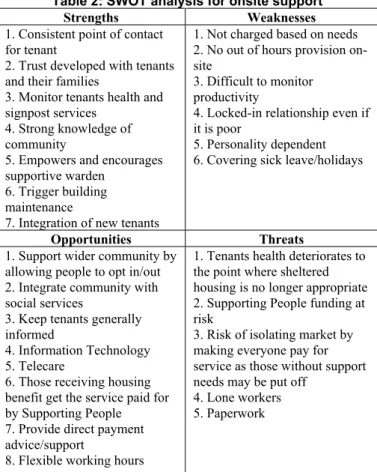
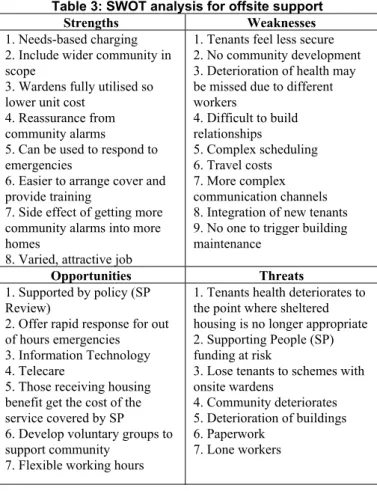
The taxonomy shows that the current trend is to move to 9-to-5 onsite or floating offsite wardens. A more detailed analysis of these structures of provision is therefore conducted below to understand them better. The discussion is based around the SWOT analysis and the points raised from this, summarised in Tables 2 and 3 for onsite and offsite support respectively. The SWOT analysis is used to illustrate how to seek the best from these models of support provision whilst mitigating their weaknesses and defending against their threats.
4.1 Onsite Support
Table 1: Taxonomy of Support Strategies
Stock Transfer Reassessing Support Structure Warden Service Developing Community Onsite Offsite
County Yes No Voted
Against Yes No CompletedRecently Residential Warden9-to-5 Floating WardensOrganise FacilitateWardens CommunityOrganiser Other
Ceredigion X X X X
Conwy X X X X
Gwynedd X X X X X
Merthyr Tydfil X X X X X
Newport X X X
Torfaen X X X X
Cardiff X X X X
Carmarthenshire X X X
Denbighshire X X X X X X
Derby X X X X
Isle of Anglesey X X X X
Pembrokeshire X X X X
Swansea X X X X X
Westminster X X X X X
Caerphilly X X X X
Vale of Glamorgan X X X X X
If they do this out of hours, the call goes through to a call centre that assesses the severity of the issue and either calls a relative of the tenant, a rapid response team or an
ambulance. 9-to-5 wardens may work across more than one site, handing over the schemes that they are not at to the call centre until they return. This improves flexibility and enables schemes to remain covered when the warden is offsite.
At night, the community alarm calls are put through to a call centre. Telecare can be fitted to a property if a tenant has a specific need and sensors trigger a response, for example, if a tenant falls. Those in favour of offsite wardens would argue that if this alarm service is appropriate for managing scheme support during the night, it is also appropriate during the day. However, this view does not account for the additional costs elsewhere that are caused by the loss of onsite wardens, for example, the cost of someone else checking the building, the cost of community development officers etc.
Table 2: SWOT analysis for onsite support
Strengths Weaknesses
1. Consistent point of contact for tenant
2. Trust developed with tenants and their families
3. Monitor tenants health and signpost services
4. Strong knowledge of community
5. Empowers and encourages supportive warden
6. Trigger building maintenance
7. Integration of new tenants
1. Not charged based on needs 2. No out of hours provision on-site
3. Difficult to monitor productivity
4. Locked-in relationship even if it is poor
5. Personality dependent 6. Covering sick leave/holidays
Opportunities Threats
1. Support wider community by allowing people to opt in/out 2. Integrate community with social services
3. Keep tenants generally informed
4. Information Technology 5. Telecare
6. Those receiving housing benefit get the service paid for by Supporting People 7. Provide direct payment advice/support
8. Flexible working hours
1. Tenants health deteriorates to the point where sheltered housing is no longer appropriate 2. Supporting People funding at risk
3. Risk of isolating market by making everyone pay for service as those without support needs may be put off
4. Lone workers 5. Paperwork
Onsite wardens provide a consistent point of contact for tenants, as with residential wardens, enabling trust to be developed. It is well known that this consistency is most important with elderly people in particular. Due to the fact that they are onsite daily, onsite wardens develop a strong knowledge of their community and their tenants, which enables them to notice any changes to a tenant’s health and signpost the appropriate local services to deal with that change. There is an opportunity to take this further by providing wardens with details of local services and
encouraging them to refer tenants for direct payments if they are unhappy with the care they are receiving. There is an opportunity to improve the signposting of other services
provided by wardens in sheltered housing, and develop this as a key feature of support. It is in a sheltered housing provider’s interests to provide information about
preventative services because if a tenant's health and ability to live independently deteriorate too much then they will have to move out of sheltered housing and into housing with care such as Extra Care Housing or a residential home. Services involving signposting rely heavily on the concept of coproduction with clients. Coproduction has been defined as “the mix of activities that both public service agents and citizens contribute to the provision of public services. The former are involved as professionals, or ‘regular producers’ while ‘citizen production’ is based on voluntary efforts by individuals and groups to enhance the quality and/or quantity of the service” (Parks et al, 1981). Whilst it is the signposter’s job to refer the client to appropriate services, it is the client’s job to follow up on referrals and generally exploit the opportunities. Onsite wardens are perfectly placed for coproduction, as they see tenants regularly and are therefore better able to follow up on any advice given, thus increasing the chances of citizen production.
The role of the warden has shifted from “good neighbour” to one that “emphasises enabling and coordinating” (Heywood et al, 2002). For example, Communities and Local
Government (2008) state that those moving into sheltered housing should expect “facilitated access to care services” and “a facilitated social and recreational activity
programme” and the role of a facilitator is to enable and coordinate. As discussed, the 9-to-5 warden is viewed as a more professional role, so these wardens are more able to deliver this than residential wardens, who the tenants still tend to view as a good neighbour.
The main threat to the onsite model is reduced state funding. Wardens providing onsite support develop support plans with their tenants to ensure that they all receive the level of support that they require. However, all tenants pay the same for this service, regardless of the level of support they receive. Supporting People guidelines are changing, so support will have to be provided on a needs basis, instead of a tenure basis (Welsh Government, 2013). This will reduce the number of people in sheltered housing that require the support service, so onsite wardens will become underutilised and uneconomical. One solution is to use floating wardens so that capacity is spread across sites ensuring much higher levels of utilisation and therefore lower costs per client. A more innovative solution, advocated here, is for the capacity freed up by some tenants not needing the warden to be used to support people in the wider community, at a cost to the individual needing the service. The case study and other secondary sources highlight that those who live in their own homes find it very difficult to access the type of support that a warden offers tenants in sheltered housing, and therefore there is a need for this type of service. This would be a hub and spoke model, with the sheltered housing scheme acting as the hub or base for the warden so that tenants still benefit from the relationship with their own onsite warden, unlike those with offsite support which employs several wardens to visit them to allow for efficient scheduling and utilisation of wardens. This hub and spoke model would also address a potential inequality. As more people are being encouraged to remain independent in their own homes, they do not have access to warden-type support services like sheltered housing tenants do. Surely this is inequitable?
With offsite support there is no immediate or overriding link to sheltered housing schemes, making it accessible to the wider community. Those in need of support can access the floating support team, regardless of the type of
accommodation they live in, thus the service supports Community Care and the more recent Personalisation Agenda which promotes both access and client control over services (HM Government, 2007). The service model is also more flexible and can be used to develop an out of hours rapid response team. Flexibility in the service also makes it easier for the provider to schedule training to upskill their staff.
Table 3: SWOT analysis for offsite support
Strengths Weaknesses
1. Needs-based charging 2. Include wider community in scope
3. Wardens fully utilised so lower unit cost
4. Reassurance from community alarms
5. Can be used to respond to emergencies
6. Easier to arrange cover and provide training
7. Side effect of getting more community alarms into more homes
8. Varied, attractive job
1. Tenants feel less secure 2. No community development 3. Deterioration of health may be missed due to different workers
4. Difficult to build relationships
5. Complex scheduling 6. Travel costs 7. More complex communication channels 8. Integration of new tenants 9. No one to trigger building maintenance
Opportunities Threats
1. Supported by policy (SP Review)
2. Offer rapid response for out of hours emergencies 3. Information Technology 4. Telecare
5. Those receiving housing benefit get the cost of the service covered by SP 6. Develop voluntary groups to support community
7. Flexible working hours
1. Tenants health deteriorates to the point where sheltered housing is no longer appropriate 2. Supporting People (SP) funding at risk
3. Lose tenants to schemes with onsite wardens
4. Community deteriorates 5. Deterioration of buildings 6. Paperwork
7. Lone workers
The major benefit of offsite support is that the service can cover a wide area, visiting tenants of sheltered housing on a needs basis only, so it fits with the government’s new Supporting People policy, i.e. needs-based funding. It is argued that technological advancements mitigate the need for high level, residential support, as tenants of sheltered housing can feel safe and secure in the knowledge that they have an emergency alarm fitted. On top of this, social services can assess them if they feel they would benefit from Telecare products to reduce their vulnerability.
Offsite support officers can be highly utilised reducing unit costs and enabling more support to be provided per pound spent. Due to the team focusing wholly on support, numerous schemes can be covered by one member of the team, reducing the number of staff required. Technology such as tablets can be used to update support plans with clients so each member of the team has up to date information. This structure is also more capable of supporting people outside of sheltered housing, and providing rapid response outside of regular working hours. The higher levels of utilisation afforded by offsite support
can free up capacity to provide rapid response to alarm calls via the call centre, not only for sheltered housing tenants but also people in the wider community. It is common to have floating support officers with no fixed schedule to respond to emergencies and cover for those who are on leave. When visiting a client, the support officer can provide the same level of support and are theoretically able to signpost other services.
However, offsite support means tighter schedules and often less frequent visits, so there is less opportunity to casually build relationships with clients. Consequently, the client may feel less comfortable sharing important personal information, such as if they are struggling with bills and need financial advice. The complex nature of scheduling for this type of service means that a tenant may be visited by numerous support officers, so deterioration in their health may not be noticed as quickly; human disasters in social care due to fragmented supply networks are well
documented. Complex scheduling is necessary to ensure that expensive travel costs and wasted time are kept to a
minimum. However, it gives tenants less control over the times they are visited. Clients may be left unsure of whom to contact to change a visit time or to ask questions. This therefore goes against the Personalisation Agenda’s emphasis on client’s choice and involvement. A floating support service improves choice for people living in their own homes, but worsens choice for those living in sheltered housing.
Another potential concern with offsite support is that the wardens’ role has traditionally included other duties as well as support. For example, they trigger building maintenance, facilitate community activities and help new tenants to settle in by answering their questions and introducing them to neighbours. Offsite support teams do not have these duties as part of their role and therefore the reduction in the cost of support provision will lead to costs elsewhere, as these functions will need to be performed by someone else. Table 1 shows that the move away from residential wardens is leading to the introduction of another person to act as the community organiser. Another option would be to see it as an opportunity to empower tenants to run their own scheme by reporting problems with the building and volunteering to set up community activities. This could reduce the
attractiveness of sheltered housing; as such coproduction might not appeal to everyone in later life. Thinking more innovatively and positively, it might provide the basis for a social enterprise to engage some elderly people as well as other people in the community.
5. CONCLUSION
There is no longer a viable case for providing residential wardens in sheltered housing, due to:
i. working-time laws;
ii. difficulties hiring for this role, especially with the professionalisation of wardens;
iii. the introduction of needs-based funding resulting in only some tenants paying towards the warden; iv. the need to provide support to people now
remaining in their own homes.
disregarded, as the relationship between the warden and tenants can still be of high value.
The suitability of offsite support is dependent on the value placed on the signposting role of the warden. Onsite wardens are undoubtedly better placed to build relationships with tenants and are therefore in a better position to
encourage them to take up other services. The current system of care and support services is fragmented and confusing, so signposting should be capitalised on as a core warden service. This requires improvements in
communication between health services, social care, housing and voluntary services, so that up to date information about the services available locally to older people can be accessed easily by the warden. Lessons can be learnt from Extra Care Housing and the model it uses to integrate with health and social services. Without explicit recognition of the importance of this area of warden support, the case for onsite warden provision is becoming weaker.
Another issue with the current system is the lack of support available to people who are striving to live independently in their own homes. Therefore, it is concluded that a hub and spoke model of support provision should be considered, with the sheltered housing scheme acting as a hub, as this model mitigates the issues of choosing to provide support either onsite of offsite. Stricter definitions of what constitutes a ‘need’ for support will undoubtedly lead to a reduction in the number of people receiving support in sheltered housing. With the spare capacity this creates, the warden should be able to support people in the surrounding community, whilst still developing those essential
relationships with people living in their scheme.
Maintaining the onsite association will save expenditure on additional people such as community development officers. Whilst offsite support is a viable option, people do not want to see numerous different people when receiving support as this would make relationship building difficult and the wardens would not develop a detailed picture and
understanding of their individual clients. This in turn would make signposting of support and care services difficult. A balance needs to be achieved between limiting the number of wardens an individual sees and providing the service in an efficient, affordable manner. However, even if this were mitigated, removing the onsite warden from sheltered housing schemes would mean taking away one of its most attractive and defining features. Would it simply become downsizing housing with physical features to support older people?
Older people are not a homogenous group and should not be treated as such. The case study highlighted that, due to local trends and the layout of sheltered housing schemes, some schemes housed very elderly people whilst others housed relatively ‘young old’, with others still housing a mix of the two. Therefore, the decision about support provision in any given scheme should be dependent on the tenants in that scheme and the level of support they require. The location of the scheme should also be looked at as floating support may not be appropriate for a rural scheme that is a long distance from the floating support team’s base location. One should assess the number of older people living in their own homes locally who wish to access support to see if a hub and spoke model would be feasible and appropriate. It is essential that a flexible approach to changing services is taken in order to keep tenants happy and to save money further down the line, as there will not be a one size fits all model.
ACKNOWLEDGEMENTS
With thanks to Cartrefi Conwy, Conwy County Borough Council, Clwyd Alyn, North Wales Housing, Wales and West Housing and all of the local authorities and RSLs who provided information for this survey.
REFERENCES
Clapham, D., (1997). Article Review: Problems and Potentials of Sheltered Housing.Ageing and Society.Volume 17, Pp. 209-214.
Clark, H., Dyer, S., Horwood, J., 1998.That bit of help.Bristol: Policy Press
Communities and Local Government, (2008).More Choice, Greater Voice: a toolkit for producing a strategy for accommodation with care for older people. London: Housing Learning and Improvement Network
Community Housing Cymru Group, (2010).Stock transfer. Accessed 29/06/2012 from http://www.chcymru.org.uk/chc_dev_final//key-issues/stock-transfer.cfm
Drake P.R. and Davies B..M.., (2007). Approaches to commissioning home care from the independent sector - a survey and taxonomy with particular reference to Wales,International Journal of Public Sector Management,Volume 20, Issue 6, Pp. 497-518.
Elderly Accommodation Counsel, (2012).Extra Care Housing. Accessed 10/08/2012 from http://www.firststopcareadvice.org.uk/jargon-extra-care-housing.aspx
English Housing Survey, 2009-10.Household Report 2009-10. Communities and Local Government. Available:
http://www.communities.gov.uk/documents/statistics/pdf/1937206.pdf Essential Role of Sheltered Housing (ERoSH), 2010.Position statement on resident wardens and their alternatives. Accessed 01/01/11 from http://www.shelteredhousing.org/library/news/1255690303 document_2_eroshpsresidentwardens.pdf
European Parliament, (2003).Directive 2003/88/EC of the European Parliament and of the Council of 4 November 2003 concerning certain aspects of the organisation of working time.Accessed 20/06/2012 from http://eurlex.europa.eu/LexUriServ/LexUriServ.do?uri=CELEX:32003L00 88:EN:NOT
Great Britain.National Health Service and Community Care Act
1990.London: The Stationery Office
Heywood, F., Oldham, C., Means, R., (2002).Housing and Home in Later Life. Buckingham: Open University Press
HM Government, 2007.Putting People First: A shared vision and commitment to the transformation of Adult Social Care. Retrieved 21/08/2010 from
http://www.dh.gov.uk/prod_consum_dh/groups/dh_digitalassets/@dh/@en/ documents/digitalasset/dh_081119.pdf
King, N., Pannell J., and Copeman, I., (2009).Nobody’s Listening. London: Help the Aged
Lawrence, N. (2008). Sheltered Housing Wardens.You and Yours. BBC Radio 4. 10.03.08. Radio
Milligan, C., (2009).There’s no place like Home: Place and Care in an Ageing Society.Surrey: Ashgate Publishing Ltd.
Nocon, A., Pleace, N., (1999). Sheltered Housing and Community Care.Social Housing Policy & Administration. Volume 33, Issue 2, Pp. 164-180
Parks, R., Baker, P. et al. (1981). ‘Consumers as Co-producers of Public Services: Some Economic and Institutional Considerations’,Policy Studies Journal, Volume 9 (Summer): 1001–1011
Pawson, H., Davidson, E., Morgan, J., Smith, R., Edwards, R., (2009).The impacts of Housing Stock Transfers in Urban Britain.Joseph Rowntree Foundation. London: New Policy Institute
Tinker, A. M., (1992). Housing for Frail Elderly People,The Society of Public Health, Volume 106, pp. 301-305
Townsend, P., (1964).The Last Refuge: A survey of Residential Homes and Institutions for the Aged in England and Wales. London: Routledge and Kegan Paul
Welsh Government, (2013).The Supporting People Programme in Wales- Factsheet.Wales: WG17888. Accessed 20/05/2013 from http://wales.gov.uk/docs/desh/publications/130501spfactsheeten.pdf