Article
Optimum Design of Steel Structures in Accordance
with AISC 2010 Specification Using Heuristic
Algorithm
Visoth Sambath Ky
a, Akhrawat Lenwari
b,*
, and Thaksin Thepchatri
cDepartment of Civil Engineering, Faculty of Engineering, Chulalongkorn University, Phayathai Rd., Pathumwan, Bangkok 10330, Thailand
E-mail: a[email protected], b[email protected] (Corresponding author), c[email protected]
Abstract. This paper proposes a heuristic algorithm (HA) for the optimum design of steel structures in accordance with all three methods specified in the ANSI/AISC 360-10 “Specification for Structural Steel Buildings”. These methods include the direct analysis method (DAM), and two alternative methods, namely, the first-order analysis method (FAM), and the effective length method (ELM). The objective of the design algorithm is to obtain the least weight for the designed steel sections. The optimum design combines the SAP2000 structural analysis program and the heuristic algorithm that is written in Microsoft Visual Basic program. The rigorous second-order analysis was performed in both DAM and ELM, while the first-order analysis was used in the FAM. Three design examples of planar steel frames are used to illustrate the application. Among the three design methods, the FAM results in lower bound solutions, while the EFM results in upper bound solutions.
Keywords: Optimization, heuristic algorithm, SAP2000, AISC 2010 specification, direct analysis method, first-order analysis method, effective length method, steel structures.
ENGINEERING JOURNAL Volume 19 Issue 4 Received 20 August 2014
Accepted 18 December 2014 Published 31 July 2015
1.
Introduction
During the last four decades, mathematicians have developed programming methods for solving optimization problems [1]. However, there is no single method that has been proven to be efficient enough for the wide range of engineering optimization problems [2]. Nowadays, there are optimization techniques that have been used for the structural design of steel structures such as genetic optimization algorithm (GA), ant colony optimization (ACO), harmony search algorithm (HS).
The heuristic search algorithm was originally defined by Polya in 1945 [3]. From the mid 1950’s to the mid 1980’s, the heuristic notion played an important role in the AI researcher’s descriptions of their works. The term Heuristic means serving to find out or discover. It refers to the experience-based techniques to solve the problems or discover the objectives. In 1959, Gelernter [4] mentioned that it is necessary to employ heuristics in the problem in order to get rid of the exhaustive search. He is one of the first to claim that heuristic works effectively by eliminating impractical options from the vast set of possibilities. In 1961, Minsky [5] employed heuristic in a vast problem space. Recently, the heuristic method has been developed and applied by researchers for various structural types such as reinforced concrete, prestressed concrete, and steel structures [e.g., 6–10].
The ANSI/AISC 360-10 “Specification for Structural Steel Buildings” [11], which hereafter is called the specification, has recently updated methods of design for stability. Previously, both the effective length method (ELM) and the first-order analysis method (FAM) were used for the design of steel frame structures for stability. Both methods are based on highly idealized assumptions which are reflected by several limitations of application. Consequently, the direct analysis method (DAM) was introduced. When the actual behavior of the structure falls outside the limitations of the above two methods, the specification requires that the DAM be used for the design for stability.
2.
Design for Stability in Accordance with AISC Specification
Figure 1 shows the three design methods specified in the specification. The design procedure for each method is described in this section. The DAM is in the main part of the specification (Chapter C: Design for stability), while the FAM and ELM are in the appendix 7 as the alternative methods.
2.1. Direct Analysis Method (DAM)
The DAM requires that the second-order analysis, either the rigorous second order or amplified first-order analysis, be performed. The notional loads are used to represent the effects of initial imperfections consisting of out-of-plumbness and out-of-straightness. This lateral load is applied as an additional load to other lateral loads at all levels. The notional lateral load applied at level i,Ni, is given by
0.002
i i
N Y (1)
where = 1 for LRFD and 1.6 for ASD and Yi = gravity load applied at level i. The coefficient 0.002 is
based on the assumption that the out-of-plumbness ratio is 1/500. An appropriate adjustment shall be made if this assumption is violated. The method uses the reduced flexural and axial stiffness to account for inelasticity. A factor of 0.80 is applied to all stiffnesses in the structure. An additional factor,b, is applied
to the flexural stiffnesses of members which contribute to the stability of the structure. The value is given by
1.0
b
for Pr /Py 0.5 (2)
4( / )[1 ( / )]
b Pr Py Pr Py
for Pr /Py 0.5 (3)
where Pr = required axial compressive strength and Py= axial yield strength (=F Ay g). However, the
stiffness reduction factor of 1.0 can be used if the notional lateral load of Ni 0.001Yi is applied to
account for inelasticity.The effective length coefficient K= 1 for every condition of columns. The mystery
2.2. Effective Length Method (ELM)
The ELM requires that the second-order analysis, either the rigorous second order or amplified first-order analysis, be performed. The method is limited by two conditions (1) the structure supports gravity loads primarily through nominally vertical columns walls or frames and (2) the ratio of maximum second-order drift to maximum first-order drift (both determined for LRFD load combinations or 1.6 times ASD load combinations) in all stories is equal to or less than 1.5. If these limitations are violated, it is required that the DAM be used. The method is suitable for structures exhibiting limited second-order effects. The method is based on the elastic or inelastic stability theory. The effective length of column that is greater than the actual unbraced length (or K > 1 from a sidesway buckling analysis). Inelasticity is neglected in the analysis
as the method uses the nominal member geometry and stiffness EI and EA for columns and beams. To account for imperfections, the notional load value of 0.002Yi must be applied at all levels in both
orthogonal directions only for gravity-only load combinations.
The most common way to determine the K factor is by using the alignment charts. However, these
charts are based on the assumptions of highly idealized conditions most of which seldom exist in the real structures. First, it is assumed that all members behave purely elastically. Second, all members are prismatic, having constant cross section, i.e. tempered sections or cellular sections are not allowed. Third, all joints are rigid. Fourth, for columns in sway frames, the rotations at the ends of the girders are assumed to be equal in magnitude and opposite in direction. Fifth, for columns in non-sway frames, the rotations at the ends of the girders are assumed to be equal in magnitude and direction. Sixth, the stiffness parameter L ( /P EI)
of all columns is equal. Seventh, joint restraint is distributed to the column above and below the joint in proportion to EI L/ of the two columns. Eighth, the buckling of all columns within the same story takes
place simultaneously. Ninth, the axial compression force in girders is negligible.
Adjustments are frequently required in situations such as for columns with differing end conditions, girders with differing end conditions, girders with significant axial load, columns inelasticity, and connection flexibility.
2.3. First-Order Analysis Method (FAM)
The FAM does not consider the second-order such as P-Δ and P-δ effects and inelasticity. The method is limited by three conditions. The first two conditions are same as those in the ELM. The third condition is that the required axial compressive strengths of all members, whose flexural stiffnesses are considered to contribute to the lateral stability of the structure, must be not greater than half of their yield strengths (Pr 0.5Py ). The required strengths are determined from the first-order analysis based on the unreduced
member stiffness. The effects of initial imperfection are included by applying the notional load as an additional lateral load to other loads at each level of the structure in all load combinations. The value of notional lateral load is given by
2.1 ( / ) 0.0042
i i i
N L Y Y (4)
where /L = the maximum ratio of the first-order story drift () to the story height (L) for all stories in
the structure due to LRFD or ASD load combination. The nonsway amplification factor, B1, specified in Appendix 8 of the specification shall be applied to the total member moments. The available strengths of members are calculated by using the effective length factor K= 1.
3.
Heuristic Optimization Algorithm
Heuristics is well-known for its simplicity and efficiency to solve large complex problems or incomplete information. It eliminates the unrealistic possibilities from a large set of possible solutions, but no guarantee of finding the optimum solution. The concept of algorithm is that the next search step is based on the educated guess or experience-based data to speed up the searching process. The algorithm works basically as the trial and error, however, with a good guess. Instead of trying all possible search options, the algorithm focuses on the paths that likely to be closer to the objective solution.
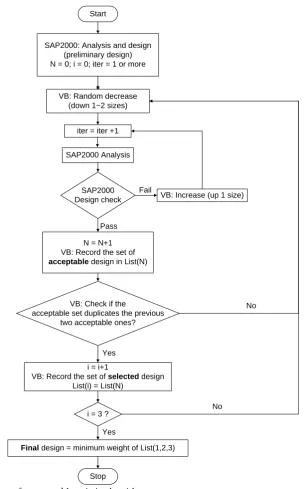
(VB) to perform the optimization using the heuristic algorithm. After the new set of sections is generated, it is exported back to SAP2000 to re-run the analysis and perform design check. Figure 1 shows the flowchart of the proposed algorithm. The preliminary cross-section sizes which pass the constraints are chosen as the initial set. Then a new set of cross-section sizes is created by randomly reducing the initial sizes one or two sizes down in terms of weight. If the new set does not pass all constraints, another new set is created by increasing the section size one size up. This process of checking and modification is repeated until steel cross-sections of the new set duplicates for three times. This set will be recorded as one of three possible final solutions. The minimum of three recorded solutions will be considered as the optimum solutions for the problem.
SAP2000: Analysis and design (preliminary design) N = 0; i = 0; iter = 1 or more
Start
VB: Random decrease (down 1~2 sizes)
SAP2000 Analysis iter = iter +1
VB: Increase (up 1 size) SAP2000
Design check Fail
No Pass
VB: Check if the
acceptable set duplicates the previous two acceptable ones?
N = N+1 VB: Record the set of
acceptable design in List(N)
i = i+1
VB: Record the set of selected design List(i) = List(N)
Yes
i = 3 ?
Yes
Final design = minimum weight of List(1,2,3)
Stop
No
Fig. 1. Flowchart of proposed heuristic algorithm.
[image:4.595.142.447.198.688.2]be Kx > 0. Each column and beam is considered as non-braced along its length. The shear and axial
deformations are considered.
4.
Design Examples of Planar Steel Frames
4.1. Two-Bay, Three-Storey Frame
Figure 2 shows a two-bay, three-storey frame subjected to a single factored load combination. This problem has previously been studied by several previous researchers [13–19]. The values of factored uniform and lateral loads are appropriate for direct application of the strength/stability provisions of the AISC–LRFD specification [19]. Displacement constraints were not imposed for the design. The elastic modulus (E) and yield stress (Fy) values were 29000 and 36 ksi, respectively. The unit weight of steel was
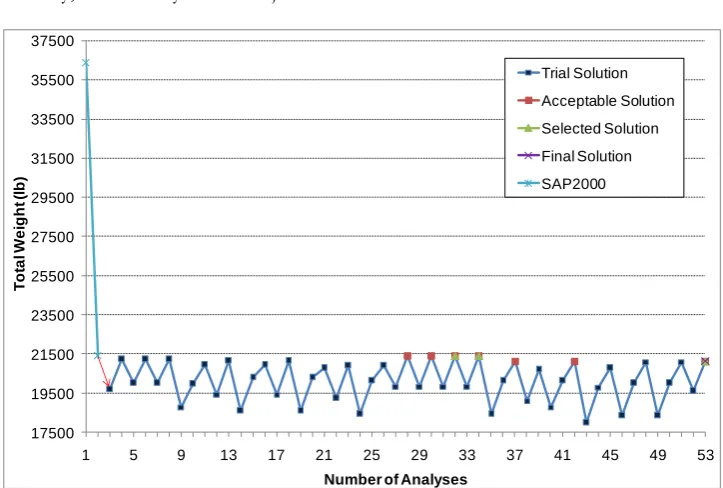
0.284 lb/cu.in. The frame members were grouped into two groups of columns, namely, inner columns and outer columns, and one group of beams. The column members were limited to W10 sections for comparison purpose. Figure 3 shows a convergence history of the heuristic algorithm for the FAM.
36 ft 36 ft
1
0
f
t
1
0
f
t
1
0
f
t
1 2 1
1 2 1
1 2 1
3 3
3 3
3 3
2.5 kips
5.0 kips
5.0 kips
2.8 kips/ft 2.8 kips/ft
2.8 kips/ft 2.8 kips/ft
2.8 kips/ft 2.8 kips/ft
Fig. 2. A two-bay, three-storey frame subjected to factored loads.
Fig. 3. A convergence history for a two-bay, three-storey frame.
17500 19500 21500 23500 25500 27500 29500 31500 33500 35500 37500
1 5 9 13 17 21 25 29 33 37 41 45 49 53
T
o
ta
l W
e
ig
h
t
(l
b
)
Number of Analyses
Trial Solution
Acceptable Solution
Selected Solution
Final Solution
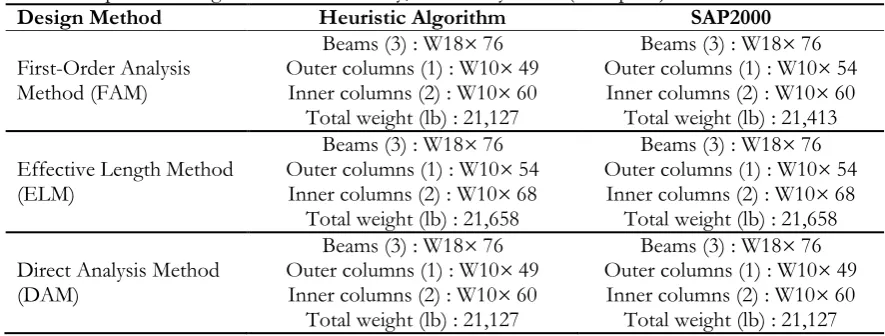
[image:5.595.147.452.291.475.2] [image:5.595.117.479.493.737.2]Table 1 shows the design optimization results using all design methods. Both FAM and DAM results are identical. The ELM results in the heaviest structure among the three methods. In comparison with the Virtual Work based Optimization for Lateral Deflections embedded in SAP2000, the proposed heuristic algorithm results in at least the same or lighter steel weights.
Table 1. Optimum design results of a two-bay, three-story frame (example 1).
Design Method Heuristic Algorithm SAP2000
First-Order Analysis Method (FAM)
Beams (3) : W1876 Outer columns (1) : W1049
Inner columns (2) : W1060 Total weight (lb) : 21,127
Beams (3) : W1876 Outer columns (1) : W1054 Inner columns (2) : W1060
Total weight (lb) : 21,413
Effective Length Method (ELM)
Beams (3) : W1876 Outer columns (1) : W1054
Inner columns (2) : W1068 Total weight (lb) : 21,658
Beams (3) : W1876 Outer columns (1) : W1054 Inner columns (2) : W1068
Total weight (lb) : 21,658
Direct Analysis Method (DAM)
Beams (3) : W1876 Outer columns (1) : W1049
Inner columns (2) : W1060 Total weight (lb) : 21,127
Beams (3) : W1876 Outer columns (1) : W1049 Inner columns (2) : W1060
Total weight (lb) : 21,127
4.2. One-Bay, Ten-Story Frame
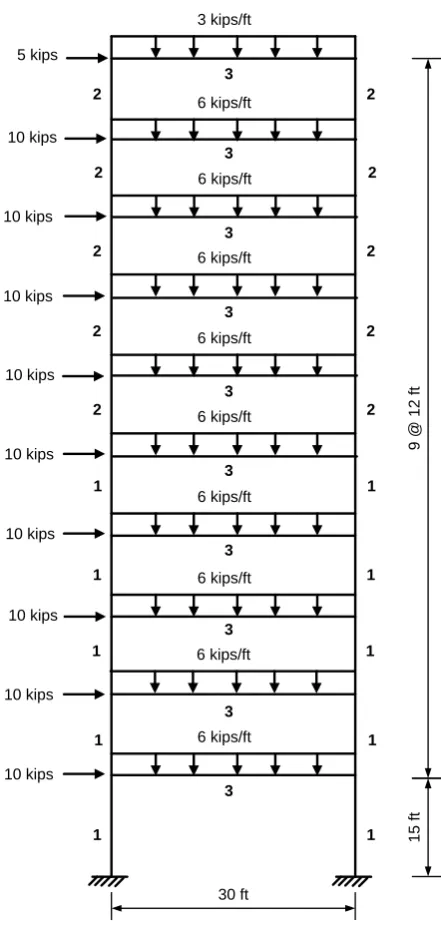
Figure 4 shows a one-bay, ten-story frame subjected to a single factored load combination. This problem has previously been studied by several previous researchers [14–21]. The elastic modulus (E) and yield
stress (Fy) values were 29000 and 36 ksi, respectively. The unit weight of steel was 0.284 lb/cu.in. The
5 kips
10 kips
10 kips
10 kips
10 kips
10 kips
10 kips
10 kips
10 kips
10 kips
30 ft
9
@
1
2
f
t
1
5
f
t
3 kips/ft
6 kips/ft
6 kips/ft
1 1
1 1
1 1
1 1
1 1
2 2
2 2
2 2
2 2
2 2 3
3
3
3
3
3
3
3
3
3
6 kips/ft
6 kips/ft
6 kips/ft
6 kips/ft
6 kips/ft 6 kips/ft
6 kips/ft
[image:7.595.185.406.76.540.2]Fig. 5. A convergence history for a one-bay, ten-storey frame.
[image:8.595.115.477.77.318.2]Table 2 shows the design optimization results using all design methods. All results are identical. In comparison with the Virtual Work based Optimization for Lateral Deflections embedded in SAP2000, the proposed heuristic algorithm results in the same or lighter structure.
Table 2. Optimum design results of a one-bay, ten-story frame (example 2).
Design Method Heuristic Algorithm SAP2000
First-Order Analysis Method (FAM)
Beams (3) : W30108 Lower columns (1) : W14233 Upper columns (2) : W14120
Total weight (lb) : 76,144
Beams (3) : W30108 Lower columns (1) : W14233 Upper columns (2) : W14120
Total weight (lb) : 76,144
Effective Length Method (ELM)
Beams (3) : W30108 Lower columns (1) : W14233 Upper columns (2) : W14120
Total weight (lb) : 76,144
Beams (3) : W30108 Lower columns (1) : W14233 Upper columns (2) : W14120
Total weight (lb) : 76,144
Direct Analysis Method (DAM)
Beams (3) : W30108 Lower columns (1) : W14233 Upper columns (2) : W14120
Total weight (lb) : 76,144
Beams (3) : W30116 Lower columns (1) : W14233 Upper columns (2) : W14120
Total weight (lb) : 78,696
4.3. Three-Bay, Twenty Four-Story Frame
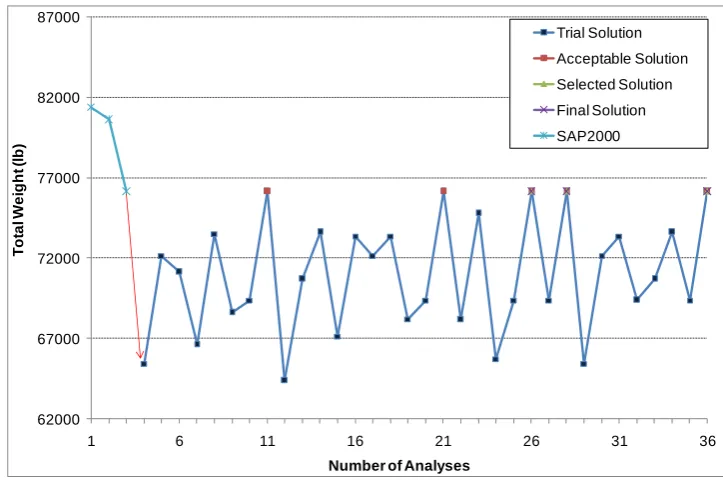
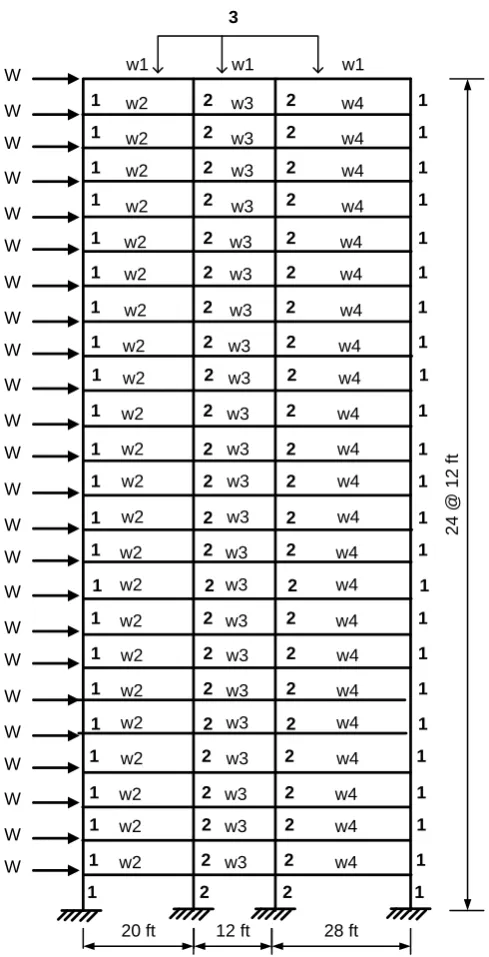
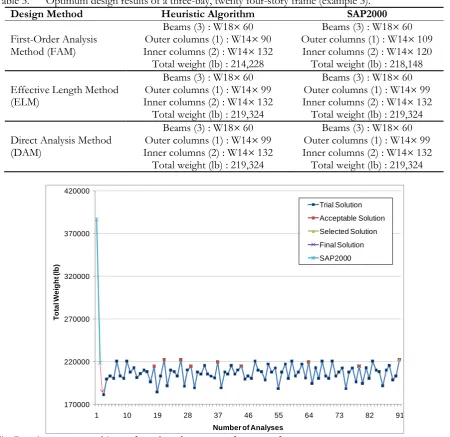
Figure 6 shows a three-bay, twenty four-story frame subjected to a single factored load combination. This problem has previously been studied by several previous researchers [15–16, 19–20, 22–23]. The elastic modulus (E) and yield stress (Fy) values were 29732 and 33.4 ksi, respectively. The unit weight of steel
was 0.284 lb/cu.in. The applied loads were W = 5,761.85 lb, w1 = 300 lb/ft, w2 = 436 lb/ft, w3 = 474 lb/ft and w4 = 408 lb/ft. The structural members were grouped into two groups of columns, namely, inner columns and outer columns, and one group of beams. The column members were limited to W14 sections. Figure 7 shows a convergence history of the heuristic algorithm for the FAM.
62000 67000 72000 77000 82000 87000
1 6 11 16 21 26 31 36
T
o
ta
l W
e
ig
h
t
(l
b
)
Number of Analyses
Trial Solution
Acceptable Solution
Selected Solution
Final Solution
[image:8.595.71.522.396.569.2]W W W W W W W W W W W W W W W W W W W W W W W W
w1 w1 w1 w2 w3 w4 w2 w3 w4 w2 w3 w4 w2 w3 w4 w2 w3 w4 w2 w3 w4 w2 w3 w4 w2 w3 w4 w2 w3 w4 w2 w3 w4 w2 w3 w4 w2 w3 w4 w2 w3 w4 w2 w3 w4 w2 w3 w4 w2 w3 w4 w2 w3 w4 w2 w3 w4 w2 w3 w4 w2 w3 w4 w2 w3 w4 w2 w3 w4 w2 w3 w4
2 4 @ 1 2 f t
20 ft 12 ft 28 ft
1 2 2 1
1 2 2 1
1 2 2 1
1 2 2 1
1 2 2 1
1 2 2 1
1 2 2 1
1 2 2 1
1 2 2 1
1 2 2 1
1 2 2 1
1 2 2 1
1 2 2 1
1 2 2 1
1 2 2 1
1 2 2 1
1 2 2 1
1 2 2 1
1 2 2 1
1 2 2 1
1 2 2 1
1 2 2 1
1 2 2 1
1 2 2 1 3
Fig. 6. A three-bay, twenty four-story frame.
[image:9.595.176.421.78.557.2]Table 3. Optimum design results of a three-bay, twenty four-story frame (example 3).
Design Method Heuristic Algorithm SAP2000
First-Order Analysis Method (FAM)
Beams (3) : W1860 Outer columns (1) : W1490 Inner columns (2) : W14132 Total weight (lb) : 214,228
Beams (3) : W1860 Outer columns (1) : W14109
Inner columns (2) : W14120 Total weight (lb) : 218,148
Effective Length Method (ELM)
Beams (3) : W1860 Outer columns (1) : W1499 Inner columns (2) : W14132 Total weight (lb) : 219,324
Beams (3) : W1860 Outer columns (1) : W1499 Inner columns (2) : W14132 Total weight (lb) : 219,324
Direct Analysis Method (DAM)
Beams (3) : W1860 Outer columns (1) : W1499 Inner columns (2) : W14132 Total weight (lb) : 219,324
[image:10.595.73.524.85.522.2]Beams (3) : W1860 Outer columns (1) : W1499 Inner columns (2) : W14132 Total weight (lb) : 219,324
Fig. 7. A convergence history for a three-bay, twenty four-story frame.
5.
Conclusions
An optimum design of steel structures in accordance with three design methods (DAM, ELF, and FAM) specified in the ANSI/AISC 360-10 “Specification for Structural Steel Buildings” is presented. The design combines the heuristic algorithm and the SAP2000 structural analysis program. Three design examples of planar steel frames are used to illustrate the application. Among the three design methods, the FAM results in lower bound solutions, while the EFM results in upper bound solutions.
Acknowledgement
The first author would like to acknowledge the Chulalongkorn University Scholarship for International Graduate Students in ASEAN Countries for providing financial supports for his study at Department of Civil Engineering, Chulalongkorn University.
References
[1] R. H. Gallagher and O. C. Zienkiewicz, Optimum Structural Design: Theory and Applications. New York: Wiley, 1973.
170000 220000 270000 320000 370000 420000
1 10 19 28 37 46 55 64 73 82 91
T
o
ta
l W
e
ig
h
t
(l
b
)
Number of Analyses
Trial Solution
Acceptable Solution
Selected Solution
Final Solution
[2] S. Rajeev and C. S. Krishnamoorthy, “‘Discrete optimization of structures using genetic algorithms,’’ J. Struct Eng, ASCE, vol. 118, no. 5, pp. 1233–1250, 1992.
[3] G. Pólya, How to Solve It: A New Aspect of Mathematical Method. Princeton University Press, 1945.
[4] H. Gelernter, “Realization of a geometry-theorem proving machine,” in Proceedings of an International Conference on Information Processing, UNESCO House, Paris, 1959, pp. 273–282.
[5] M. L. Minsky, “Steps toward artificial intelligence,” in Proceedings of the Institute of Radio Engineers, 1961, vol. 49, no. 1, pp. 8–30.
[6] C. Perea, J. Alcala, V. Yepes, F. Gonzalez-Vidosa, and A. Hospitaler, “Design of reinforced concrete bridge frames by heuristic optimization,” Adv Eng Softw, vol. 39, pp. 676–688, 2008.
[7] F. J. Martinez, F. Gonzalez-Vidosa, A. Hospitaler, and V. Yepes, “Heuristic optimization of RC bridge piers with rectangular hollow sections,” Comput Struct, vol. 88, pp. 375–386, 2010.
[8] J. V. Marti and F. Gonzalez-Vidosa, “Design of prestressed concrete precast pedestrian bridges by heuristic optimization,” Adv Eng Softw , vol. 41, pp. 916–922, 2010.
[9] M. El Semelawy, A. O. Nassef, and A. A. El Damatty, “Design of prestressed concrete flat slab using modern heuristic optimization techniques,” Expert Syst Appl, vol. 39, pp. 5758–5766, 2012.
[10] A. Lamom, T. Thepchatri, and W. Rivepiboon, “Heuristic algorithm in optimal discrete structural design,” Am J Appl Sci, vol. 5, no. 6, pp. 943–951, 2008.
[11] American Institute of Steel Construction (AISC), Specification for Structural Steel Buildings, ANSI/AISC 360-10, Chicago, 2010.
[12] American Institute of Steel Construction (AISC), Steel Construction Manual, 14th ed. Chicago, 2011. [13] S. K. Hall, G. E. Cameron, and D. E. Grierson, “Least-weight design of steel frameworks accounting
for P– Δ effects,” J. Struct Eng, ASCE, vol. 115, no. 6, pp. 1463–75, 1989.
[14] S. Pezeshk, C. V. Camp, and D. Chen, “Design of nonlinear framed structures using genetic algorithms,” J. Struct Eng, ASCE, vol. 126, no. 3, pp. 382–8, 2000.
[15] C. V. Camp, B. J. Bichon, and S. P. Stovall, “Design of steel frames using ant colony optimization,” J. Struct Eng, ASCE, vol. 131, no. 3, pp. 369–79, 2005.
[16] S. O. Degertekin, “Optimum design of steel frames using harmony search algorithm,” Struct Multi Optim, vol. 36, pp. 393–401, 2008.
[17] V. Togan, “Design of planar steel frames using teaching–learning based optimization,” Eng Struct, vol. 34, pp. 225–32, 2012.
[18] D. Safari, M. R. Maheri, and A. Maheri, “On the performance of a modified multi-demegenetic algorithm in LRFD design of steel frames,” Iran J Sci Technol, 2013.
[19] R. M. Maheri and M. M. Narimani, “An enhanced harmony search algorithm for optimum design of side sway steel frames,” Comput Struct, vol. 136, pp. 78–89, 2014.
[20] A. Kaveh and S. Talatahari, “An improved ant colony optimization for the design of planar steel frames,” Eng Struct, vol. 32, pp. 864–73, 2010.
[21] E. Dogan and M. P. Saka, “Optimum design of unbraced steel frames to LRFD–AISC using particle swarm optimization,” Adv Eng Software, vol. 46, pp. 27–34, 2012.
[22] J. H. Davison and P. F. Adams, “Stability of braced and unbraced frames,” J. Struct Div, ASCE, vol. 100, no. 2, 319–34, 1974.