This is a repository copy of TESOL initial teacher training and TESOL curriculum goals: making the connection .
White Rose Research Online URL for this paper: http://eprints.whiterose.ac.uk/4947/
Conference or Workshop Item:
Wedell, M. (Completed: 2004) TESOL initial teacher training and TESOL curriculum goals: making the connection. In: Initial Education for Teachers of English: What can be learned from the International Experience?, 26 April 2004, Pontificia Universidad Catolica de Chile, Santiago.
[email protected] https://eprints.whiterose.ac.uk/
Reuse
Unless indicated otherwise, fulltext items are protected by copyright with all rights reserved. The copyright exception in section 29 of the Copyright, Designs and Patents Act 1988 allows the making of a single copy solely for the purpose of non-commercial research or private study within the limits of fair dealing. The publisher or other rights-holder may allow further reproduction and re-use of this version - refer to the White Rose Research Online record for this item. Where records identify the publisher as the copyright holder, users can verify any specific terms of use on the publisher’s website.
Takedown
If you consider content in White Rose Research Online to be in breach of UK law, please notify us by
TESOL Initial teacher Training and TESOL Curriculum goals: Making the connection.
Paper given at the seminar on Initial Education for Teachers of English: What can be learned from the International Experience?
Pontificia Universidad Catolica de Chile. Santiago 26.04.04 Dr Martin Wedell
School of Education University of Leeds, UK [email protected]
INTRODUCTION
APEC countries represent , in TESOL terms, two very different groups. Firstly there are the English L1 countries (US, Canada, Australia, NZ) where the English proficiency of the majority can be taken for granted and where English needs to be taught only as a second language or additional language to people arriving in the countries from overseas. In the second group, the majority of APEC countries, English is a foreign language, and if a government feels it to be an important aspect of the wider curriculum, systems need to be established to provide English teaching to all pupils in all schools. These are very different TESOL environments and what is appropriate and helpful in one, is not
necessarily of relevance to the other. The paper that follows focuses on the EFL context typical of the majority of APEC members, although at times it draws from literature deriving from the English native speaker members also.
1. TESOL CURRICULA AND TESOL CLASSROOMS IN SOME APEC COUNTRIES
As a result of globalisation, however we define this term, English has become a core subject in school and university curricula in most APEC countries in common with much of the rest of the world. Nunan in a recent survey of the TESOL situation in a number of APEC countries in the Asia-Pacific region points out that
Few TESOL professionals can deny seeing the day to day results of the socio-political phenomenon of global English in the policies they encounter. Anecdotal evidence suggests that governments around the world are introducing English as a compulsory subject at younger and younger ages. […] In business, industry and government workers are increasingly expected to develop proficiency in English. These demands for English offer opportunities to the TESOL profession, but at the same time they have created many challenges for TESOL educators internationally. (Nunan 2003:591)
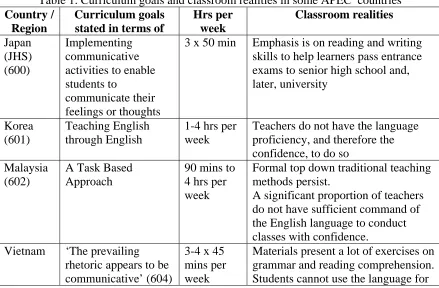
[image:3.612.86.525.428.716.2]If the demand for English is increasing, what in fact are countries hoping to achieve for learners in their state school systems and to what extent are they successfully doing so. Nunan’s article looks for answers to these questions for a range of APEC members. His findings suggest that in many (if not most countries) there is a significant gulf between statements of what outcomes the curriculum is intended to achieve and the classroom realities in which such outcomes are supposed to be achieved. The main burden of trying to reconcile the mismatch falls on classroom teachers. A summary is given in Table 1 below (unless otherwise stated page numbers refer to Nunan 2003)
Table 1. Curriculum goals and classroom realities in some APEC countries Country /
Region
Curriculum goals stated in terms of
Hrs per week
Classroom realities
Japan (JHS) (600)
Implementing communicative activities to enable students to
communicate their feelings or thoughts
3 x 50 min Emphasis is on reading and writing skills to help learners pass entrance exams to senior high school and, later, university
Korea (601)
Teaching English through English
1-4 hrs per week
Teachers do not have the language proficiency, and therefore the confidence, to do so
Malaysia (602)
A Task Based Approach
90 mins to 4 hrs per week
Formal top down traditional teaching methods persist.
A significant proportion of teachers do not have sufficient command of the English language to conduct classes with confidence.
Vietnam ‘The prevailing
rhetoric appears to be communicative’ (604)
3-4 x 45 mins per week
communicating. Taiwan
Primary and JHS(603)
Initial basic
communicative ability
1-2 hours per week
Teachers who have completed training have difficulty with English skills and teaching pedagogy
Hong Kong (599)
Communicative language teaching, task based learning and learner
centredness. (approx 90% of schools English MoI until late 1990s)
4-9 hours per week
A lack of trained teachers
Teachers’ own language proficiency inadequate.
Government and business
dissatisfaction with the proficiency of students emerging from school system
China The latest syllabuses ..
are based on the functional use of English and concepts such as CLT and learner centredness are very much in evidence (Nunan 2002:5)
2-6 x 45 mins per week
(especially beyond key schools in large developed cities)
Traditional transmission based teaching
Textbook followed very closely. Emphasis on grammar reading and writing for knowledge based exams. (Wu and Fang 2002)
From the above we can see that in the above APEC countries there is a mismatch between expected curriculum outcomes and
• Teachers’ language proficiency
• Teaching methods used
• What is tested in high stakes examinations • The content of teaching materials
Leading Nunan to conclude that in the Asia Pacific region
The single most pervasive outcome of this study is that English Language policies and practice have been implemented, often at significant cost to other aspects of the curriculum, without a clearly articulated rationale and without detailed consideration of the costs and benefits of such practices and policies on the countries in question. Furthermore there is a widely articulated belief that, in public schools at least, these policies and practices are failing. (Nunan 2003:609)
The text on the first page of the invitation to this seminar suggests that Chile shares many of these problems.
…the teaching and learning of English within the Chilean state schools system needs to be improved so that students leaving school can function in English. Grammar continues to dominate ELT in all areas: initial teacher training, curricula and consequently
schools with large class sizes and a lack of motivation to learn English exacerbate the problem.(2004:1)
At present, therefore, it seems that initial TESOL teacher education throughout much of the APEC region is not fit for the purpose of enabling teachers to help learners achieve the hoped for curriculum outcomes. It is thus one of the main hindrances to developing successful state school based TESOL provision.
Initial (language) teacher training in some other parts of the world
If we look at some snapshots of how ITT, (for TESOL and for novice teachers generally), is conceived in other parts of the world we find the following:
• Portugal
By and large the gap between theory and practice between universities and schools and the lack of a clear framework of what it means to be teach nowadays, emerge as the major weaknesses of current ITT programmes (Flores and Shiroma 2003:9)
…an academic rather than a professional logic prevails in many ITT courses in which technical rationality is prevalent, despite the widespread movement towards the teacher as researcher and reflective practitioner…student teachers are left to integrate the theory and practice of teaching in the subject area and the pedagogical components by themselves. (Flores & Shiroma 2003:10)
• France
The didactic model presented by the Universities (in France) are inadequate in the context of teacher education, relying as they do on the lecture as the main didactic approach and not at all on any teaching strategies motivated by a desire to promote learning. (Brisard and Hall 2001:193)
It seems that a belief that the proper job of teachers is to hand down academic learning irrespective of circumstances dies hard (in France), thus accounting for the fact that academic achievement and the acquisition of decontextualised educational theory are still paramount to actual teaching practice and the development of professional skills (Brisard and Hall 2001 :195)
• Hungary
(Teachers) Have a certain amount of knowledge that they have to transmit to their students and learning is determined, can be spotted when the knowledge is tested. So the job of the teacher is to tell facts to the students from primary school right the way
through to university level, and for those students then to be tested on whether they have managed to retain those facts.. (Wedell 2000:112)
• Egypt
Meeting the national imperative to learn English has been hampered by a poor supply of suitably qualified Teachers, often lacking proficiency in English themselves […] whose training makes no reference to the constraints that might conflict with the philosophy of teaching materials […] where the methodology component is quite shallow and
consequently most classroom teachers do not fully understand the principles of CLT in practice.(Gahin and Myhill 2004 : 3-11)
• Saudi Arabia
The gap between the content of teacher education programmes and the needs of the classroom widens. After graduating from University many teachers lack essential English skills, especially the ability to speak the language. (Al Hamzi 2003?: 342)
Some 10- 20 years ago policy makers in EFL countries began to introduce curricula whose expected outcomes imply more communicative, learner centred approaches to the language teaching-learning process. Their failure to recognise that different curriculum outcomes required different emphases within initial TESOL teacher education is one important factor contributing to Nunan’s conclusion (page 3 above), that national English language teaching policies are perceived as failing.
Fullan’s (2001) comment about teacher education in the North
American-UK-Australasian context ‘Society has never yet sustained an interest in teacher education reform, and until it does there is no chance of meaningful educational improvement’ ( p243), appears also to hold true for (TESOL) teacher training across much of the EFL world today.
2.WHAT CHANGES TO TESOL INITIAL TEACHER TRAINING MIGHT BE NEEDED TO MEET MORE ‘COMMUNICATIVE’ CURRICULUM AIMS?
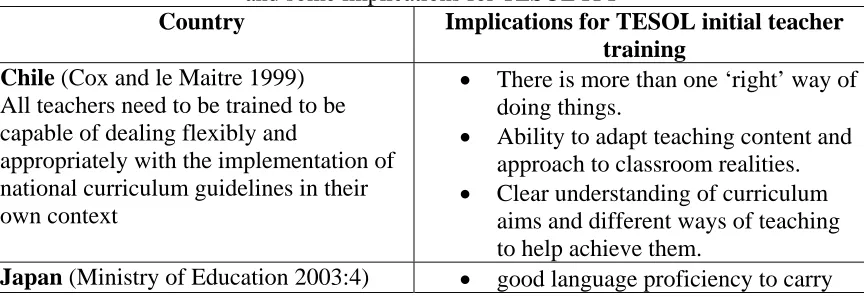
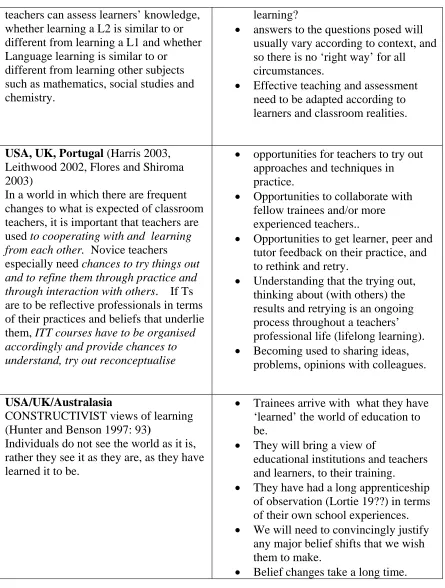
[image:6.612.90.522.568.717.2]When trying to answer this question, one needs to consider both the TESOL literature and the teacher education literature more generally. The table below thus draws on a number of sources from both, mainly from APEC countries.
Table 2. Extracts from curriculum statements and teacher education literature and some implications for TESOL ITT
Country Implications for TESOL initial teacher training
Chile (Cox and le Maitre 1999) All teachers need to be trained to be capable of dealing flexibly and
appropriately with the implementation of national curriculum guidelines in their own context
• There is more than one ‘right’ way of doing things.
• Ability to adapt teaching content and approach to classroom realities.
• Clear understanding of curriculum
aims and different ways of teaching to help achieve them.
Through the repetition of activities making use of English as a means of communication, the learning of grammar
and vocabulary should be enhanced and communicative abilities in L,S,R,W should be fostered. To carry out such
instruction effectively it is important for the teachers to establish many situations
where SS can communicate in English
and routinely conduct classes principally
in English.
out classes in English.
• Understanding of the language
system.
• Understanding of the processes
underlying the development of skills. • a range of techniques for providing
opportunities to communicate. • Knowledge of their learners and so
what they will be interested in communicating about.
• able to vary their own classroom roles
China (Berry 2003:2)
According to the new curriculum
teachers’ roles will be very different from the past. Teachers are no longer merely informants of knowledge. In addition to
empowering SS with subject knowledge
they are curriculum adaptors. Teachers should decide on the teaching content, design tasks as well as select and develop materials which they think appropriate for their SS. They are planners
scheduling the teaching content and mats.
• Personal language proficiency sufficient for all that follows
• Understanding of the language
system.
• Understanding curriculum aims, and
the view of language and learning on which they are based.
• Teaching techniques compatible with
curriculum aims
• more than one ‘right way’ of doing
things. Teaching content and
approaches need to be matched with the realities of their own context. • Understanding of their own learners • Materials evaluation and adaptation /
design Asia Pacific region (Nunan 2003:10)
If English is a necessity, steps should be taken to ensure that teachers are
adequately trained in language teaching methodologies appropriate to range of learner ages and stages, that teachers’ own language skills are significantly enhanced, that classroom realities meet curricular rhetoric and that SS have sufficient exposure to English in
instructional contexts.(Nunan 2003: 610)
• Teachers own language proficiency
adequate for the teaching-learning context that they are supposed to be responsible for.
• Understanding of language learning
and how it varies with learners’ ages. • More than one ‘right way’ need to
know about and be able to use a range of teaching approaches and
techniques appropriate to age and level of their own learners.
USA
Yates and Muchisky (2003:139)
A reflective language teacher should also ask questions such as what it means to know a language, how teachers should treat learners non-targetlike forms, how
• Teaching is a process that involves a lot of thinking and questioning and rethinking in the light of practice. • Is language teaching different from
teachers can assess learners’ knowledge, whether learning a L2 is similar to or different from learning a L1 and whether Language learning is similar to or
different from learning other subjects such as mathematics, social studies and chemistry.
learning?
• answers to the questions posed will usually vary according to context, and so there is no ‘right way’ for all circumstances.
• Effective teaching and assessment need to be adapted according to learners and classroom realities.
USA, UK, Portugal (Harris 2003, Leithwood 2002, Flores and Shiroma 2003)
In a world in which there are frequent changes to what is expected of classroom teachers, it is important that teachers are used to cooperating with and learning
from each other. Novice teachers
especially need chances to try things out
and to refine them through practice and through interaction with others. If Ts
are to be reflective professionals in terms of their practices and beliefs that underlie them, ITT courses have to be organised
accordingly and provide chances to understand, try out reconceptualise
• opportunities for teachers to try out approaches and techniques in practice.
• Opportunities to collaborate with fellow trainees and/or more experienced teachers..
• Opportunities to get learner, peer and tutor feedback on their practice, and to rethink and retry.
• Understanding that the trying out, thinking about (with others) the results and retrying is an ongoing process throughout a teachers’ professional life (lifelong learning).
• Becoming used to sharing ideas,
problems, opinions with colleagues.
USA/UK/Australasia
CONSTRUCTIVIST views of learning (Hunter and Benson 1997: 93)
Individuals do not see the world as it is, rather they see it as they are, as they have learned it to be.
• Trainees arrive with what they have ‘learned’ the world of education to be.
• They will bring a view of
educational institutions and teachers and learners, to their training.
• They have had a long apprenticeship
of observation (Lortie 19??) in terms of their own school experiences. • We will need to convincingly justify
any major belief shifts that we wish them to make.
[image:8.612.85.530.65.653.2]• Belief changes take a long time.
Table 2 suggests that TESOL ITT needs to include courses that will provide trainees with:
• Knowledge about language learning processes and how these vary according to age of learners.
• An understanding of what such knowledge implies for the approach to teaching and learning
• A range of techniques for teaching different aspects of language forms and skills required by the curriculum
• An understanding of how to evaluate learning materials and techniques for adapting them to their own context in ways that support the achievement of curriculum outcomes.
• An understanding about methods of assessment
• Adequate English language proficiency to cope with all above and below • Opportunities (to cooperate with others) to try out all of the above in more or less
realistic situations
• Opportunities to discuss the outcomes of practise with colleagues and tutors and to retry the same thing in different ways.
• Recognition of the fact that there is no ‘blueprint’ that will work in all situations with all learners
• The realisation that their ITT is just the first step in their learning about teaching process
.
3. TESOL ITT IN CONTEXT
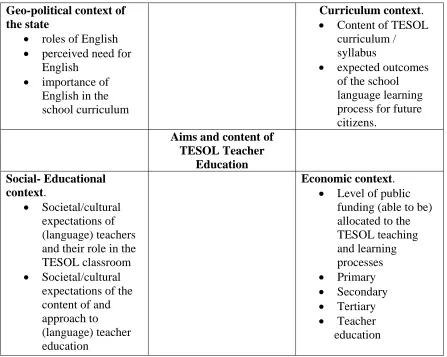
Figure 1. The macro context of TESOL initial teacher training
Geo-political context of the state
• roles of English
• perceived need for
English
• importance of
English in the school curriculum
Curriculum context.
• Content of TESOL
curriculum / syllabus
• expected outcomes
of the school language learning process for future citizens.
Aims and content of TESOL Teacher
Education Social- Educational
context.
• Societal/cultural expectations of (language) teachers and their role in the TESOL classroom • Societal/cultural
expectations of the content of and approach to (language) teacher education
Economic context.
• Level of public
funding (able to be) allocated to the TESOL teaching and learning processes
• Primary
• Secondary
• Tertiary
• Teacher education
Despite the wide variation in some or all the above factors between EFL APEC countries, it seems that in most, the principles underlying the TESOL curriculum are expressed in terms of communicative language teaching and/or task based learning and/or learner centred approaches. Similarly curriculum outcomes are expressed in terms of the development of learners’ communicative abilities.
Where do these terms come from? They have largely been imported from ideas about the nature of language and the language learning process and hence about language teaching that have been developed since the early 1970s in what Holliday (1994) calls BANA (British, Australasia, North America) English ESL and private language school language learning contexts. As mentioned in the introduction, these differ considerably from the EFL contexts that exist in the majority of APEC countries.
Given the differences resulting both from being EFL contexts and from the macro-contextual differences in Figure 1, it is unlikely that concepts commonly associated with communicative approaches, such as learner centredness, learner autonomy, teachers as
Although they are usually presented as if they were purely a set of techniques and therefore one size will fit all regardless of context, they are not value free. Instead they represent a view of the kind of people and society that countries wish to create through education. (Tabulawa 2003). If, therefore, such terms are to be used to define curriculum aims in EFL APEC countries, they need to bear in mind Holliday’s (2001) concept of ‘cultural continuity’ and need to be adapted to meet national contextual realities. There cannot thus be a single prescription for the product or the process of TESOL ITT in EFL countries. Instead it needs to be planned to meet the needs of the particular national contextual reality within which it is situated.
Macro contextual variables within APEC states are too complex to take any further in this paper. However, at the micro TESOL level within any education system, any ITT
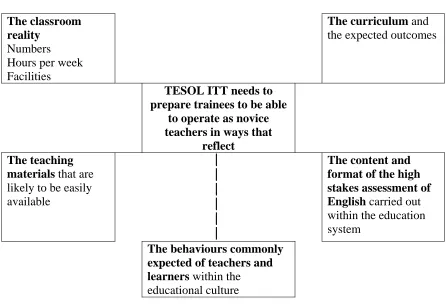
[image:11.612.83.529.307.611.2]programme needs to be planned to reflect the TESOL reality in which the trainees will be working. This is illustrated in figure 2 below.
Figure 2. The components of the micro TESOL context within any education system
The classroom reality
Numbers Hours per week Facilities
The curriculum and the expected outcomes
TESOL ITT needs to prepare trainees to be able
to operate as novice teachers in ways that
reflect The teaching
materials that are likely to be easily available
⎢ ⎢ ⎢ ⎢ ⎢ ⎢
The content and format of the high stakes assessment of English carried out within the education system
The behaviours commonly expected of teachers and learners within the educational culture
4. A POSSIBLE CORE TESOL ITT CURRICULUM
Again despite the shared ‘communicative rhetoric’, each of the above factors and the coherence between them is likely to vary between APEC countries. Any attempt I might make to suggest what an appropriate TESOL ITT curriculum might look like can
system will thus need to adapt the content and process of its ITT to meet its own realities in terms of the above, if it is to genuinely prepare novice teachers to help real learners in real classrooms to meet curriculum aims.
The idealisation that follows assumes two things
• broad coherence between the components of the TESOL system outlined in figure
2,
• a curriculum which aims to help SS develop both knowledge about the language
and the ability to use that knowledge for their own (more or less defined) purposes.
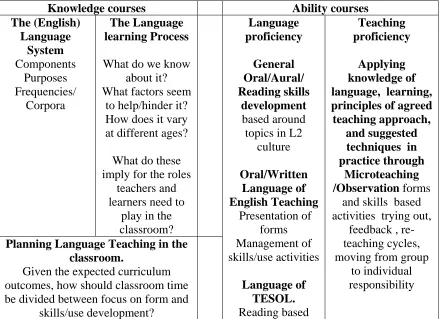
[image:12.612.89.530.294.613.2]If we bear in mind the list of bullet points on page 8 above, its content can be divided into two broad areas; ‘knowledge about’ and ‘ability to’.
Figure 3. CORE TESOL ITT CURRICULUM CONTENT
Knowledge courses Ability courses
The (English) Language System Components Purposes Frequencies/ Corpora The Language learning Process
What do we know about it? What factors seem
to help/hinder it? How does it vary at different ages?
What do these imply for the roles
teachers and learners need to
play in the classroom? Planning Language Teaching in the
classroom.
Given the expected curriculum outcomes, how should classroom time be divided between focus on form and
skills/use development? Language proficiency General Oral/Aural/ Reading skills development based around topics in L2
culture Oral/Written Language of English Teaching Presentation of forms Management of skills/use activities Language of TESOL. Reading based Teaching proficiency Applying knowledge of language, learning, principles of agreed teaching approach,
and suggested techniques in practice through
Microteaching /Observation forms
and skills based activities trying out,
feedback , re-teaching cycles, moving from group
Teaching methodology Given what we know about language and learning and what the curriculum hopes to achieve, what principles do we want to ensure in our approach to teaching, what techniques may be
helpful for teaching forms and skills/uses in motivating ways? Materials Evaluation and adaptation Bearing expected curriculum outcomes
in mind, what are strengths and weaknesses of existing materials? How can we use existing materials to
support the approach/ techniques? What principles can we use for
adapting materials/ finding supplementary materials?
Language Assessment What are the principles of any
assessment? Why do we assess?
How can we vary assessment methods according to assessment purposes?
How do the high stakes regional/national exams assess
learners?
How can we assess in ways that will encourage and not demotivate?
Applying materials evaluation and
adaptation principles, and
microteaching adapted materials
Applying principles of assessment design to particular forms and skills and trying these out.
All the above +/- embedded in school
based teaching practice.
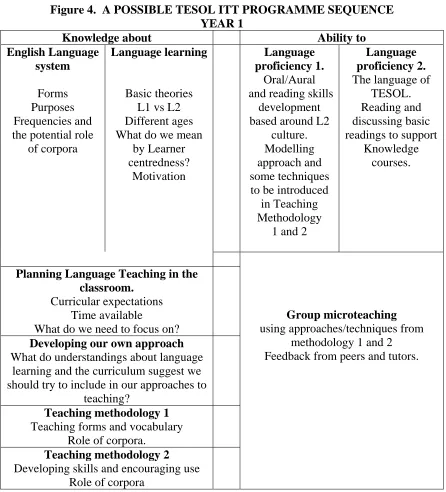
Figure 4. A POSSIBLE TESOL ITT PROGRAMME SEQUENCE YEAR 1
Knowledge about Ability to
English Language system
Forms Purposes Frequencies and the potential role
of corpora
Language learning
Basic theories L1 vs L2 Different ages What do we mean
by Learner centredness?
Motivation
Language proficiency 1.
Oral/Aural and reading skills
development based around L2
culture. Modelling approach and some techniques
to be introduced in Teaching Methodology
1 and 2
Language proficiency 2. The language of
TESOL. Reading and discussing basic readings to support
Knowledge courses.
Planning Language Teaching in the classroom.
Curricular expectations Time available
What do we need to focus on? Developing our own approach What do understandings about language
learning and the curriculum suggest we should try to include in our approaches to
teaching?
Teaching methodology 1 Teaching forms and vocabulary
Role of corpora. Teaching methodology 2 Developing skills and encouraging use
Role of corpora
Group microteaching using approaches/techniques from
YEAR 2
Knowledge about Ability to
Language Teaching materials Evaluation in the light of methodology
and curriculum aims
Principles of adaptation for different purposes
Principles of task design Authenticity of text and task Sources of supplementary materials (the
web)
Language proficiency 1 as above
Language proficiency 2 based around materials and assessment
Language proficiency 3. Language of teaching forms and
managing skills/use activities
Language assessment in the light of methodology and
curriculum aims Principles of assessment Item types for different purposes
Peer and self assessment
Microteaching cycles from the ‘book’
and from own adapted materials, using approach/techniques from methodology
1 and 2.
From group to individual. Feedback on language and methodology from peers and tutors Designing assessment instruments for
different purposes.
peer and tutor evaluation and feedback Principles of classroom observation
and practitioner research
Guided classroom observation in schools
YEAR 3 Developing ability to
(While at college/university) Language proficiency 1
Oral/Aural and reading development.
Work on Language proficiency 3 as necessary in light of issues and problems
arising
Teaching practice 1
+/- 1-2 months in school full time, 50% classroom assistant/ 50% responsibility for
one class Using language
Applying approach/techniques Using/adapting materials Designing simple assessment
Issues and problems arising Possible solutions
Microteaching cycles based round problem-possible solution
Peer and tutor feedback
Discussion/ agreement of criteria for practical teaching assessment
during/after TP 2
Discussion of focus of small scale practitioner research during TP 2
Language proficiency work as necessary to support issues arising.
Teaching practice 2 +/- full term
+/- Full time teaching of 2(+) classes
Issues and problems arising Possible solutions Microteaching as above
The above sequence tries to
• Maximise programme coherence by demonstrating to trainees how what we
teaching approach to develop principles for adapting materials and developing assessment formats.
• Provide maximum opportunities for ‘trying out’, thinking and retrying. Time-consuming, but in my opinion very worthwhile.
• Provide encouragement to cooperate and learn from each other.
• Develop trainees’ oral and written language proficiency in three critical areas, general, classroom and professional.
• Provide some cultural input via the proficiency development.
• Support the specific proficiency inputs with numerous demands to use the
language for study, microteaching, materials adaptation and discussion purposes. • Provide some training in practitioner research and an expectation that this will be
an ongoing part of their professional development.
5. Support post ITT
Novice TESOL teachers emerging from even the most ideal ITT programme will have a shock as they move into the world of full time teaching in what will usually be an unfamiliar school environment. They will frequently encounter problems resulting from lack of coherence between components of the TESOL micro environment, which may affect learners’ motivation, the ease with which particular teaching-learning techniques can be introduced, the attitudes of older colleagues/school administrators, parental expectations….
The more they can be supported for their first few years of teaching, the more likely they are to be willing and able to try to be the best teachers they can be, even in less than ideal circumstances. Establishing novice teacher support mechanisms is thus an integral part of any significant change to the TESOL ITT curriculum.
In Chile the existing teacher networks and the introduction of school based mentors with responsibilities for novice teachers show what can be done. However if these are to maximise their beneficial effects, time and space for teachers and/or mentors to meet needs to be made regularly available within existing school timetables. If they are to be taken seriously, they need to be supported by school principals and be seen as part of normal professional activity, rather than something extra to be squeezed in. (Leithwood 2002, Harris 2003, Harvey 1996,Fullan 2000) For this to be possible, they needed to be funded as part of the regular education budget.
Conclusion
To conclude, three final points which need to be borne in mind if TESOL ITT is to better prepare teachers to achieve national curriculum outcomes.
1.‘Educational policy is driven by different priorities which are dependent on the social, political, cultural and economic context within which they are embedded’. (Flores and Shiroma 2003:6). In EFL countries, English curriculum aims and the manner in which these are translated into outcomes, need to be adjusted to meet the realities of the contexts in which they are embedded. TESOL ITT then needs to be designed and carried out to help meet these realistic outcomes.
2. Such reconceptualisations of curriculum aims and outcomes and the development of TESOL ITT programmes that will support them, will require sustained work over a time span of at least five to ten years. This implies that.
Educational change needs to be seen as a state not a government issue, with the provision of economic and political support over time (Cox and Le Maitre 1999) and that
‘Governments must put educational investment beyond their own need for political survival’ (Fullan 2001:233)
3. Finally, if we are serious about wanting to see changes in the outcomes of our national English language teaching system, we have no real choice but to try to ensure that our ITT programmes prepare teachers to help learners to achieve these outcomes , since ‘Educational change depends on what teachers do and think, it is as simple and as complex as that’ (Fullan 2001:115).
References
• Al Hamzi. S. 2003. EFL teacher preparation programmes in Saudi Arabia:
Trends and Challenges. TESOL Quarterly 37/2:341-345
• Atsuko T. 2003. Regarding the establishment of an action plan to cultivate Japanese with English abilities. Tokyo Ministry of Education, Culture, Sports, Science and Technology. Japan. (www.mext.go.jp/english/topics/03072801.htm) accessed 27.01.04
• Berry R.S.Y. 2003 English language teaching and learning in mainland China: a comparison of the intentions of the English language curriculum reform and the real life teaching and learning situation in the English classroom. Hong Kong Institute of Education NAS Newsletter 4: 3-6
• Brisard.E and Hall K. 2001 Tradition and progress in ITT in France since the 1990s. Journal of Education for Teaching 27/2: 187-197
• Cox.C and Lemaitre M.J 1999 Market and State Principles of Reform in Chilean
Education: Policies and Results in G. Perry and D.Leipziger (Eds) Chile:Recent policy lessons and emerging challenges. Washington. World Bank Institute of Development Studies.
• De Wert M.H, Babinski L.M and Jones B.D.2003. Safe Passages: Providing
• Flores M.A and Shiroma E. 2003. Teacher professionalisation and
professionalism in Portugal and Brazil: what do the policy documents tell? Journal of Education for Teaching 29/1: 5-18
• Fullan M.G. 2001. The New Meaning of Educational Change (3rd Edition) .London. Cassell
• Gahin G and Myhill.D 2001 The Communicative Approach in Egypt: Exploring
the secrets of the pyramids. TEFL web journal 1/2 (www.teflweb-j.org/v1n2/Gahin_Myhill.html) accessed 19/02/04
• Harris A. 2003. Behind the classroom door: the challenge of organisational and pedagogical change. Journal of Educational change. 4 : 369-382
• Harvey. S.P 1996. Primary Science INSET in South Africa: An evaluation of
classroom support. Unpublished PhD. University of Exeter UK.
• Holliday A. 1994 Appropriate Methodology and Social context. Cambridge. CUP
• Holliday, A. 2001. Achieving Cultural Continuity in Curriculum Innovation. In Hall, D.R.,and Hewings, A. (Eds.) 2001. Innovation in English Language Teaching. Routledge, London. : 169-177
• Hunter W.J and Benson G.D 1997. Arrows in time: The misapplication of chaos
theory to Education. Journal of Curriculum Studies 29/1: 87-100
• Leithwood.K, Jantzi.D and Mascall.B 2002.A Framework for Research on large
scale reform. Jounral of Educational Change 3: 7-33
• Ministry of Education Chile and British Council 2004 Initial (Pre-Service) Education for Teachers of English: What can be learned from the International Experience? Santiago.
• Nunan.D 2003 The impact of English as a global language on educational policies and practices in the Asia-Pacific region. TESOL Quarterly 37/4:589-613 • Nunan D 2002 The impact of English as a global language: policy and planning
in greater China. Hong Kong Journal of Applied Linguistics 7/1: 1-15 • Tabulawa R 2003. International aid agencies, learner centred pedagogy and
political democratisation: a critique. Comparative Education 39/1: 7-26. • Wedell, M., 2000. Managing Change in a Turbulent Environment: The ELTSUP project in Hungary 1991-1998. Unpublished PhD thesis. Business School. University of Glamorgan
• Wu.X.D and Fang.L 2002 Teaching communicative English in China: a case
study of the gap between teachers views and practice. Asian Journal of ELT 12: 143-162
• Yates.R and Muchisky.D 2003. On reconceptualising teacher education TESOL