Theses Thesis/Dissertation Collections
3-1-2013
An Efficient interaction framework for mobile web
services
Abdullah Almuaibid
Follow this and additional works at:http://scholarworks.rit.edu/theses
This Thesis is brought to you for free and open access by the Thesis/Dissertation Collections at RIT Scholar Works. It has been accepted for inclusion in Theses by an authorized administrator of RIT Scholar Works. For more information, please [email protected].
Recommended Citation
Mobile Web Services
by
Abdullah Abdullatif Almuaibid
A Thesis Submitted
in
Partial Fulfillment of the
Requirements for the Degree of
Master of Science
in
Computer Science
Supervised by
Xumin Liu, Ph.D.
Department of Computer Science
B. Thomas Golisano College of Computing and Information Sciences
Rochester Institute of Technology
Rochester, New York
The thesis “An Efficient Interaction Framework for Mobile Web Services” by
Abdullah Abdullatif Almuaibid has been examined and approved by the following Exami-nation Committee:
Xumin Liu, Ph.D. Assistant Professor Thesis Committee Chair
Rajendra K Raj, Ph.D. Professor
Dedication
Acknowledgments
This journey that I took in pursuing my studies was a blessing, and I am grateful for having the opportunity to do so. I am thankful for all the encouragement and help I
Abstract
An Efficient Interaction Framework for
Mobile Web Services
Abdullah Abdullatif Almuaibid
Supervising Professor: Xumin Liu, Ph.D.
Having the latest technological devices is becoming more of a necessity these days rather than a luxury as it was only a decade ago. Among these advancements, the smart phone has grown in popularity significantly. This is due to a variety of reasons but it would have to be said that the access to mobile internet service it provides is a strong motivator for acquiring one. As might be expected the increased number of smart phone users requesting information from the internet has resulted in times when theaverage access time(the time a user must wait to download his/her requested service) is quite high. In research the use
Contents
Dedication. . . iii
Acknowledgments . . . iv
Abstract . . . v
1 Introduction. . . 1
2 Related Work . . . 6
3 Hypothesis . . . 9
4 Different Allocation Approaches . . . 15
5 Problem Statement . . . 17
5.1 Single channel average access time . . . 17
5.2 Multichannel average access time . . . 17
5.3 Methodology . . . 18
6 Framework Design . . . 20
6.1 Brute Force . . . 21
6.2 Greedy . . . 24
6.3 Dynamic Programming . . . 27
7 Results Analysis. . . 29
7.1 Configuration . . . 29
8 Conclusions . . . 34
8.1 Future Work . . . 35
List of Figures
1.1 Web service reference model. . . 2
1.2 Life cycle of a mobile web service. . . 3
3.1 Mobile web service reference model . . . 10
3.2 Registry channel . . . 11
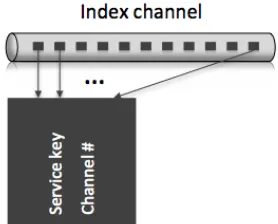
3.3 Index channel . . . 12
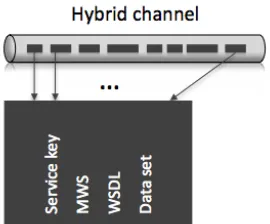
3.4 Hybrid channel . . . 13
6.1 Architecture of the skewed broadcast channels . . . 21
7.1 Comparison of the number of calculations performed in Greedy vs. Dy-namic Programming. . . 31
7.2 A fixed number of mobile web services (200) with a variable number of available broadcast channels. . . 32
Chapter 1
Introduction
A smart mobile device has become something many people “can’t live without” [5]. This is not surprising as it affords them the ability to be connected to the entire world and in general is like having an omniscient personal assistant thanks to its capability of accessing the internet. The demand for web access by mobile device users has expanded exponentially in recent years. With the continued investments being made by wireless carriers in advanced telecommunication technologies such as WiFi, WiMaX, UWB, 3G/UMTS, and 4G LTE,
there has been an increase in the availability of bandwidth for use by these mobile devices. Additionally, broadcast is considered an effective approach for delivering information to mobile users. It facilitates the distribution of mobile web services (MWSs) among mobile devices and the wireless network. Due to its scalability, the number of users does not affect the response time for retrieving the information. Also advantageous is the fact that broadcast does not consume significant amounts of power on the client side [7, 9, 11, 12].
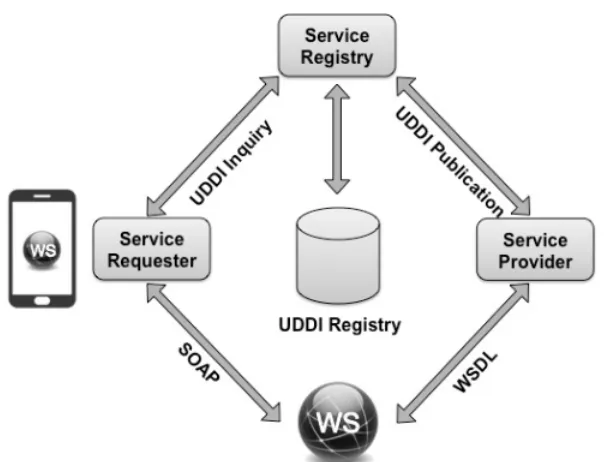
Language (WSDL) is the second core component; it allows the service requester’s device to know how to deal with (invoke) services from the service provider without knowing the ex-act specifications of each other’s programs. Finally, the Universal Description, Discovery and Integration (UDDI) is the third component; its function is to carry the WSDL for the web service provider in order to share and advertise its services to all the service requesters who may be interested. Figure 1.1 represents the life cycle of a web service (Web service reference model).
Figure 1.1: Web service reference model.
In general a broadcast mobile web services’ infrastructure [10] consists of three parts:
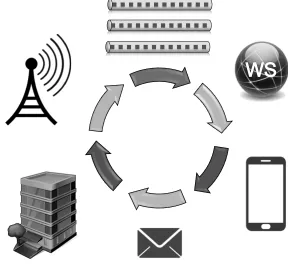
the web service providers are able to disseminate information about their web service of-ferings to mobile device users. In turn, their potential customers can access those same cell phone networks and request any mobile web service (ideally) through the wireless carrier’s cell phone network’s broadcast channels. Figure 1.2 represents the life cycle of a mobile web service.
Figure 1.2: Life cycle of a mobile web service.
provider. Wireless carriers are in charge ofDefining and Providing Service Provider Inter-faces. Once established, the web service providers can publish and manage their services through this interface. Additionally, the wireless carriers are responsible forProviding the Mobile Web Services’ Registry. It is similar to a database in that it maintains all available mobile web services and each of their corresponding registry data. Finally, wireless carriers are tasked withOrganizing and Broadcasting Services and Data. Their goal is to arrange the broadcast channels so that all necessary data pertaining to their mobile users’ requested services is readily available.
The final element in the mobile web services’ infrastructure is the mobile users. In order for them to be able to use mobile web services they must have the capability of being Wireless Receivers. That is to say, at least one wireless receiver must be present in the mobile device for the purpose of interacting with the wireless carrier’s network of broadcast channels. Finally, the mobile devices need to have the functionality of Service Invokers. By this we mean, they must be able to interpret the registry, request their desired service, access the service and return some output if needed.
Chapter 2
Related Work
With a firm understanding of the mechanics of web services, further (more specific) re-search on mobile web services provided us with novel approaches and valuable “food for thought”. One such example is the concept of accessing web services via cell phone broad-cast networks [7, 9]. Another paper describes different broadbroad-cast channel structures which were invented to share any data through a cell phone broadcast network [9]. Yet another research introduces the concept ofskewing the datato accommodate the fluctuations in the number of requests for different types of data [7, 9, 11].
Not surprisingly, a substantial number of researchers have included the use of broad-cast channels in their mobile web services solutions due to the advantages of scalability, energy efficiency and unlimited user capacity that they bring to the table [9, 7, 11, 1] The challenge becomes the allocation of the data among the broadcast channels so that the aver-age access time(AAT) is consistent (regardless of the “popularity” of the data requested). One approach is to allocate bandwidth to the transmission of less frequently requested data while leaving broadcast to handle the more popular data as was suggested in [2] and [12]. A different concept is to send out the most popular information requests at increased intervals on the broadcast channel, thereby skewing the data allocation [11].
with their simplified GREEDY approximation algorithm. In their experiments, they com-pared the performance of their algorithm (GREEDY) to FLAT, Bin-Packing (BP), VFK and Dynamic Programming (DP) on data items of the same size. Their goal was optimization balanced with practicality thus taking into consideration the limitations of the on-line and mobile environments. As they had hoped, the GREEDY algorithm produced near-optimal performance within its less complex (when compared to previously used algorithms) oper-ational mode [11].
Tackling more complicated wireless transactions, Yanget al. [9] sought to apply ef-ficiencies to accessing composite mobile services (a service which depends on other ser-vices to work) which are defined by Business Process Execution Language (BPEL) graphs. They discovered that theclosest-first-accessalgorithm had advantages over the depth-first-access and breadth-first-accessalgorithms no matter the type of composite service (i.e.,
sequential, parallel or hybrid). Due to the intricacies of these operations, the team sought to breakdown the access method into three processes: service request flow, receiver flow, and service execution flow. Their proposed broadcast channel configuration was made up of seven channels with each having its own designated purpose. More specifically, they were each assigned a certain type of content, such as M-services, wireless data, service descriptions, composite services, or service registry information.
Additional efficiencies for the above configuration were sought by the team through “selective tuning” which would allow the mobile devices to rest (doze) and only activate when its required content became available. This was accomplished by developing their “index channel method” which consisted of a M-service index channel and a data index channel. Both channels provided service or data location information (“arrival time”) in index format to the mobile device which allowed it to doze while waiting and thus reduced its tuning time (and energy consumption).
Another of the earlier broadcast-based solutions was one proposed by Zheng et al.
auxiliary index with data” as an energy-saving mechanism (i.e., reducing tuning time) in an effort to achieve results similar to those in [9]. Other challenges which they sought to overcome included the random access storage-based nature of K-NN search indexes and the need to “packetize” information for transmission to the client.
In the research above (and historically speaking) those designing and delivering mo-bile web services have had to contend with the limitations (i.e.,battery life, bandwidth and storage) which are inherent in most mobile devices. Contrary to this thinking, Chou and Li [4] designed a mobile distributed computing platform (based on Android technology) which facilitates distributed services computing on mobile devices utilizing real-time and over IP communication capabilities. Their Web Service Initiation Protocol (WIP) enables mobile devices to act like/appear as web service providers. Along the same lines, Aijaz
et al. [3] set out to prove that mobile devices could host asynchronous mobile web services (Mob-WS). Their scenario had web service requestors and web service providers both be-ing mobile devices. They established Peer-to-Peer communication between the parties by leveraging Bluetooth technologyR.
Chapter 3
Hypothesis
As discussed previously, past researchers have chosen to utilize cell phone wireless carriers’ broadcast networks to deliver mobile web services to their subscribers. This proved to be an advantageous and efficient approach in many scenarios [9, 7, 12, 8]. One of the main benefits for pursuing this strategy is that broadcast is not affected by the number of mobile users who receive data via this portal. However, the mobile users do have to wait for their specific mobile web service to arrive in the broadcast channel in order to be able to access it. Other researchers came up with a design which skews the data distribution in the cell phone networks’ broadcast channels [11]. The theory underlying our paper is that a new interaction framework could be achieved by having a unique architecture for the broadcast channels and dynamically skewing the mobile web services into their specified channel(s) (while still taking into consideration their popularity). As a result, the desired configuration is a more efficient channel design and allocation system for delivering mobile web services to the many of mobile users who desire them.
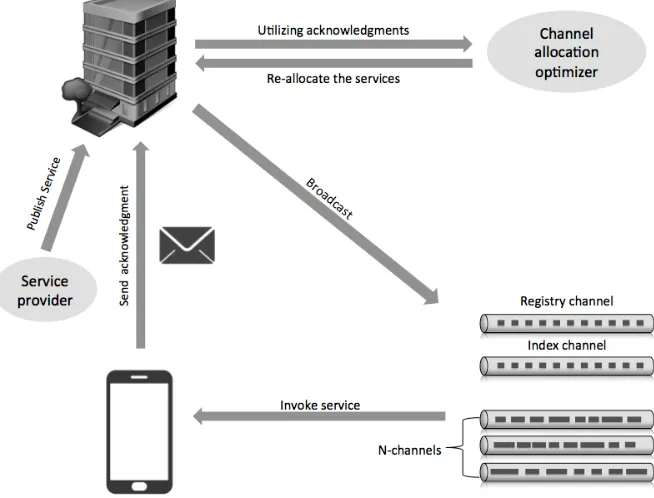
This proposed architecture (see Figure 3.1) consists of two main components. One is the mobile application, which among other things, facilitates the user’s ability to explore the available mobile web services. Additionally, it allows the mobile user to communi-cate automatically with the wireless carrier’s broadcast server. This line of communication is necessary because, as we know, the broadcast channels themselves can only communi-cate in one direction. Therefore once the mobile user downloads his/her desired mobile
acknowledgement is transmitted as anonymous data as knowing which mobile user is lo-cated where and what mobile web server he/she is using/requesting could be considered
[image:19.612.142.469.210.459.2]an invasion of privacy.) These acknowledgements are being tabulated for the purpose of determining the popularity and frequency of each web site’s usage. The data will be used in the calculations which determine the broadcast channel scheduling.
Figure 3.1: Mobile web service reference model
The other main architectural component is thebroadcast channel configuration. It con-sists of three core channels: a Registry channel, an Index channel and a Hybrid channel.
The following are descriptions of each type of main channel:
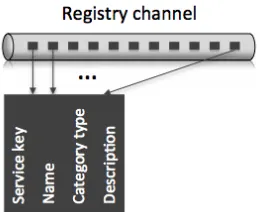
(e.g., from the wireless carrier’s UDDI), each which contains basic, individual mo-bile web service information: name, category type (e.g., weather, sports, dining,
[image:20.612.246.376.291.397.2]etc.), and a short description. Additionally, at the beginning of each registry record is found the mobile web service’s “service key” which is a unique number assigned to it for identification purposes. (This service key will be utilized by the mobile device in subsequent searches in order to eventually obtain its selected mobile web service.) The comparatively small size of these registry records makes storing them on a mo-bile device reasonable and necessitates only one broadcast channel being designated for their transmission.
Figure 3.2: Registry channel
time than multiple index channel configurations (e.g.,service index and data set index in [9].
Figure 3.3: Index channel
3. Hybrid channel: The “hybrid” channel (Figure 3.4) is so named because it transmits each mobile web service with its associated service key, WSDL and corresponding data. Similar to the index channel, each record begins with the service key identifying number. The “combined” construction of the hybrid channel also reduces the tuning time and average access time from what is needed when separate channels are used for the broadcast of the various mobile web services’ components (as in [9, 7]). To elaborate, the mobile device tunes to the hybrid channel number which was listed in the index channel directly following the service key for its selected mobile web service. Since the hybrid channel is broadcasting in the pattern of: service key(a), mobile web service(a), WSDL(a), data set(a), service key(b) ... the mobile device can “doze” during most of the transmission and only activate when a new service key arrives in the channel. (As you can see, this reduces the tuning time needed to find the mobile web service.) If it does not correspond to the service key number that the device is looking for, it will doze again until the next service key appears in the hybrid channel. When the matching service key number is broadcasted, the mobile device will download the related mobile web service, WSDL and corresponding data and be able to invoke the service.
Figure 3.4: Hybrid channel
factors/thresholds:
(a) Period of time” (t)e.g.,3 hours and;
(b) Pre-defined number of requests/user acknowledgments, (r)e.g.,1000
These two attributes determine the most highly demanded mobile services and assign them to the hybrid broadcast channels based on that, with the result being that the most popular will be in less crowded channels. It’s important to note that the mobile web ser-vice re-allocation process (among the hybrid channels) will also result in the index channel records being changed as some of the mobile web services maybe being broadcast in dif-ferent hybrid channel locations. When the user has successfully reached his/her desired
mobile web service and downloaded it, the mobile application will send an anonymous acknowledgement to the broadcast server, which will add it to the total number of ac-knowledgements already received for that particular mobile web service.
Generally speaking, the example that follows will illustrate how this solution will func-tion. Hypothetically, we have six randomly-sized mobile web services (ws1, ws2,... , ws6);
each of them will have a counter assigned to it (associated with the “maximum number of requests” threshold). If a user downloads one of the mobile web services, the mobile ap-plication will send an anonymous acknowledgment to the broadcast server and its counter will increase by one (i.e.,total number of requests for that mobile web service).
other threshold (which is “period of time”) has been met. In this case, the algorithm will reassign the mobile services to broadcast channels due to the fact that the “period of time” was exceeded. In the second scenario, the threshold for “maximum number of requests” has been met before the “period of time” expired and therefore the algorithm will reorganize the mobile services to different channels based on the quantity of requests (i.e.,number of user acknowledgments received). The two thresholds ensure that the allocation of mobile web services is based on real-time(i.e.,up-to-date) users’ requests.
Chapter 4
Different Allocation Approaches
During the course of this research, we have been testing different types of allocation methodologies to determine the “cheapest” (i.e., least expensive to execute for all parties involved) allocation approach which still served our purposes (i.e.,shorter average access time & utilizing fewer mobile device and wireless carrier resources). The three different allocation approaches that we used were:
1. Formulating all possible combinations and sequences (i.e.,Brute Force),
2. Sorting the mobile web services and allocating them heuristically (i.e.,Greedy) and finally
3. Using Dynamic Programming to allocate them
Chapter 5
Problem Statement
5.1 Single channel average access time
In a single channel, one or more mobile web services could be there. Therefor, we noted the MWS asCmwheremis the number of mobile web services in the channel and it is of a range16m6Cm. Liis the length of a mobile web service and its associated data (how many buckets it occupied on the channel). AndWi is the weight for a certain mobile web service (as determined by the number ofacknowledgmentsgenerated by mobile users who accessed that particular service %75 and the size of it %25). The total length of the channel is denoted asT. To determine theaverage access timefor a mobile web service in a single
hybrid channel configuration, we used the equation below (5.1).
Cm X
i=1
✓
2Li+T 1
2 ⇥Wi
◆
(5.1)
Taking into account that mobile web services are cyclically broadcasted into the chan-nel, this equation (5.1) calculates the average access time by adding together the “best case scenario” of accessing a mobile web service and the “worst case scenario” of accessing the same mobile web service and then calculating the average.
5.2 Multichannel average access time
In this scenario, there areK hybrid channels, each noted as Chi with a range of1 6 i 6
channels noted as Cm where mis of a range 1 6 m 6 Cm. Li is the length of a mobile web service and its associated data whileWiis the weight for a certain mobile web service. In order to determine theaverage access timeof a mobile web service in a multiple hybrid broadcast channel arrangement, we used this equation (5.2).
K X
i=1
PCm j=1Lj
2 1 +Lj
!
Wi !
(5.2)
5.3 Methodology
In general our two-component architecture (i.e.,mobile application and broadcast channel configuration) plays an important role in reducing the average access timeexperienced by the user (i.e., before his/her desired mobile services can be accessed). Delving into the
details, you will find a broadcast channel allocation process which is based on real-time requests (popularity) of mobile web services which are accounted for by the accumulation of user ‘acknowledgements’. To this continuously updating scheduling procedure, the ad-dition of a time threshold has been incorporated. This feature permits the distribution of mobile web services to be based on/limited to a specific timeframe. When the specified
time has elapsed:
1. the ‘counters’ are re-set,
2. the current popularity can then become “visible” again and
3. the allocation is updated.
The ‘period of time’ threshold prevents the possibility that a mobile web service will be given priority based on out-of-date accessing data.
Chapter 6
Framework Design
In order to examine and test the results of our proposed framework, we useaverage access timefor measuring the retrieval time of specific mobile web services from the broadcast net-work channels. We proposed the use of a skewed broadcast channel architecture, however in contrast to [11], mobile web services data are utilized instead of their generic, uniform-sized data. Each of our mobile web services has associated data and a request counter (to tabulate users’ acknowledgments) in order to more closely mimic a ‘real world’ scenario. The result is that each mobile web service is a different size and thus requires a variable number of “buckets” in order to transport it inside the broadcast channel.
Figure 6.1: Architecture of the skewed broadcast channels
The Brute Force algorithm, Greedy algorithm, and Dynamic Programming algorithm allo-cation is described below:
6.1 Brute Force
The Brute Force algorithm-based allocation scheme proved to be the most expensive al-ternative among the three (i.e., Greedy, Dynamic and Brute Force). In the first example below you will see that this allocation methodology is inconvenient and time consuming as it produces an inordinate number of allocation combinations even when dealing with a small number of mobile web services. Example 1 configuration:
• 3 hybrid broadcast channels
• 5 mobile web services (designated “a”, “b”, “c”, “d” & “e”)
Based on the assumption that none of the broadcast channels will be left empty (i.e.,a min-imum of one mobile web service in each channel), only two basic distribution formulas are possible: 3/1/1 and 1/2/2. Allocation 3/1/1 produces the following possible
combina-tions (see Table 6.1) Total: 10 combinations
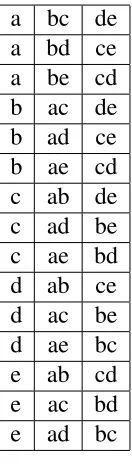
Allocation1/2/2 produces the following possible combinations (see Table 6.2)
Table 6.1: All possible combinations for 3/1/1
abc d e abd c e abe c d acd b e ace b d ade b c bcd a e bce a d bde a c cde a b
Table 6.2: All possible combinations for 1/2/2
[image:31.612.276.342.437.669.2]As you can see this relatively small-sized example has produced a grand total of 25 mobile web services allocation permutations which, according to our process, will each have to be tested to determine which is the most efficient mobile web services distribution.
In the second example (see below) we increase the number of available mobile web services to six (i.e., “f”) to see what effect this may have on the number of possible allocation combinations. The number of available hybrid broadcast channels remains at three. The six mobile web services now generate three possible basic distribution formulas: 4/1/1,
3/2/1 and 2/2/2.
A 4/1/1 allocation is represented in the formula below:
6 4 ⇥ 2 1 ⇥ 1 1
2 = 15 (6.1)
Total: 15 combinations
A 3/2/1 allocation is represented in the formula below:
✓ 6 3 ◆ ⇥ ✓ 3 2 ◆ ⇥ ✓ 1 1 ◆
= 60 (6.2)
Total: 60 combinations
And a 2/2/2 allocation is represented by the formula below:
6 2 ⇥ 4 2 ⇥ 2 2
3 = 30 (6.3)
Total: 30 combinations
With this second example, we can see that changing just one of the factors slightly (i.e.,
6.2 Greedy
Our second testing scenario involved the use of a Greedy algorithm. As our starting point we began with the Greedy algorithm presented in [11]. Since our data was significantly dif-ferent than theirs, we modified their formula to take that into account. Among the changes we made was the establishment of a weighting criteria which was utilized when all of the available mobile web services are first sorted. Rather than just rank them strictly by the number of user acknowledgements received (“popularity”) we also took into account the amount of space that each mobile web services would take up in the broadcast channel (“length”). For our purposes, we weighted popularity ratings as 75% and size of mobile web services as 25% in our ordering process and the cost model. As you can see from the steps below, the Greedy algorithm determines the possible combinations of mobile web services and theaverage access timeassociated with retrieving each. After an analysis of the results is made, the re-allocation of the mobile web services into the available broadcast channels will be made based on the configuration which gives the lowest AAT. Follows is an example representation of the Greedy algorithm. Below the example is the pseudocode for the same algorithm.
After sorting six MWSs based on weight, the allocation or the configurations of Greedy for three channels will be as shown below:
MWS3 MWS5 MWS1 MWS4 MWS6 MWS2 Greedy will start from the first MWSe.g.,
MWS3 MWS5 MWS1 MWS4 MWS6 MWS2
and consider it as the best splitting point. This process will go through all the possible splitting pointse.g.,
MWS3 MWS5 MWS1 MWS4 MWS6 MWS2
MWS3 MWS5 MWS1 MWS4 MWS6 MWS2
MWS3 MWS5 MWS1 MWS4 MWS6 MWS2
Based on the lowest AAT provided from the multi-channel equation, one of the configura-tions will be chosen.
If this configuration is chosen:
MWS3 MWS5 MWS1 MWS4 MWS6 MWS2
The second step is to do the same for both sides and decide which configuration will provide the lower AAT.
MWS3 MWS5 MWS1
MWS4 MWS6 MWS2 Verses
MWS3 MWS5
MWS1 MWS4 MWS6 MWS2
Algorithm 1Greedy
1: Parameters:
2: listOfMWS: an ArrayList of input objects 3: numberOfChannels: number of channels
4: numberOfCurrentChannels: initial as 0
5: Sorts all available mobile web services (MWS) (found inArrayList listOfMWS) based
on weight.
6: whilenumberOfCurrentChannels<numberOfChannelsdo
7: forfirst index of the service in the channeltoindex of last service in the channel do 8: calculate and check which index is the best splitting point using SAAT
9: Break the initial list up into two channels based on the provided splitting point 10: The first split will yield two channels. Those channels will now become keys to
the hash map, which will point to the new channels they will form
11: calculate AAT for the current sub-channels to identify which has the lowest AAT
using MAAT
12: end for
13: choose the splitting that yields the lowest AAT 14: numberOfCurrentChannels += 1
15: ifnumberOfChannels == numberOfCurrentChannelsthen
16: Exit
6.3 Dynamic Programming
For our third testing approach, we chose Dynamic Programming as they did in [11]. Similar to our procedure with the Greedy algorithm test, we began with the DP algorithm from Yee
et al. [11]. With this as our base, we made adjustments to it due to the random (variably-sized) nature of our data and its composition (actual MWS data vs. generic data). The same test data that was run through the Greedy algorithm was then processed through the updated DP algorithm. The result was that DP’s allocation configuration produced the optimal solution. This is not surprising if you consider the nature of Dynamic Programming. Below, you will find DP algorithm equation 6.4. Following that is an example of the steps that Dynamic Programming goes through in its search for the best outcome (in this case lowest AAT possible for all available MWSs).
After sorting six MWSs based on weight, the allocation or configurations of DP for three channels will be as follows:
MWS3 MWS5 MWS1MWS4MWS6MWS2
MWS3 MWS5MWS1 MWS4MWS6MWS2
MWS3 MWS5MWS1MWS4 MWS6MWS2
MWS3 MWS5MWS1MWS4MWS6 MWS2
MWS3MWS5 MWS1 MWS4MWS6MWS2
MWS3MWS5 MWS1MWS4 MWS6MWS2
MWS3MWS5 MWS1MWS4MWS6 MWS2
MWS3MWS5MWS1 MWS4 MWS6MWS2
MWS3MWS5MWS1 MWS4MWS6 MWS2
MWS3MWS5MWS1MWS4 MWS6 MWS2
dpOptSoli,K =LAAT(AATim+dpOptSolm+1,K 1) (6.4)
K = number of the hybrid channels
LAAT = lowest AAT
m= total number of MWSs-1
i= start index of MWSs in a channel (1im) j = end index of MWSs in a channel (i < j m)
In the Figure 1.2, we can see the mobile web services cycle as it is proposed here:
Starting on the left we have the wireless carrier (A) utilizing its broadcast network (B) to disseminate the mobile web services it has to offer. Similar to pipelines, there are multiple broadcast channels (C) in the network which transmit mobile web services at different intervals. Mobile devices (E) entering the broadcast networks geographic area are apprised of the web services which are available in this region.
By clicking on a choice, the mobile user will then download his/her desired web service
(D) to the mobile device (E). In this solution, the mobile device sends anacknowledgement
Chapter 7
Results Analysis
For the purposes of this experiment, a Java-based simulator was devised which mimics the real world by generating random-sized mobile web services and their associated data. Ad-ditionally, it represents the functionality of the proposed framework by, among other things, checking the two thresholds (i.e.,Period of time and Pre-defined number of requests/user
acknowledgments) to reallocate the channels more efficiently.
7.1 Configuration
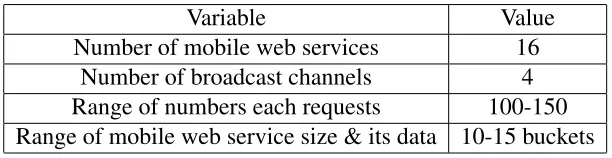
[image:38.612.157.463.560.639.2]The characteristics of the simulated data we utilized for testing purposes are shown in Table 7.1. We ran the same generated data through both the Greedy and Dynamic Pro-gramming (DP) allocation approaches in order to make a more fair comparison. The con-figurations were small in this example to more easily display the result as a tree. However we will provide charts showing the utilization of more complex configurations.
Table 7.1: Configuration Variables
Variable Value
Number of mobile web services 16 Number of broadcast channels 4 Range of numbers each requests 100-150 Range of mobile web service size & its data 10-15 buckets
the threshold for “maximum number of requests” was set at 200 and the size of a mobile web service was given a range of between 3 & 6 buckets. After creating sixteen mobile web services, each was assigned a random number of requests (user acknowledgements). Therefore, based on their relative weight (75% on popularity and 25% on size) the algo-rithm allocates the mobile web services among the four broadcast channels. In the first step, the sixteen MWSs are divided into two groups with one MWS (“highest weighted”) going into channel #1 and the remaining fifteen MWSs being put into channel #2. In subse-quent steps the algorithm will continue to “skim off” the “weightiest” MWSs and put them in channels by themselves (see channel #2 has two of them and channel #3 has six). At the end of the allocation cycle, the MWSs with the lowest weights (seven MWSs in this case) are put in the last channel (#4).
1. 16 MWSs
3 MWS 13 MWSs
4 MWSs 9 MWSs
4 MWS 5 MWSs
Table 7.2: Results comparison
Allocating method Average access time
Greedy method 207.16
Dynamic Programming method 159.56
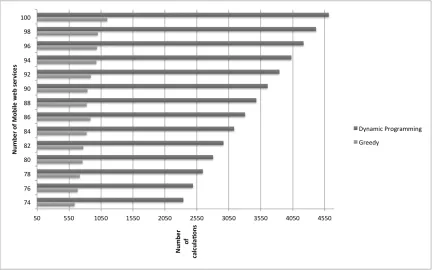
As you can see in figure 7.3 the DP algorithm does come up with lower AAT. However when you look at Figure 7.1 it becomes quite apparent that these the lower AAT figures came only as a result of significantly more calculations having been performed during the process. This same phenomenon occurred when we made the number of MWSs fixed (200) and the number of broadcast channels variable (see figure 7.2).
[image:40.612.94.526.317.587.2]Chapter 8
Conclusions
8.1 Future Work
Bibliography
[1] 3GPP2. Cdma2000 high rate broadcast-multicast packet data air interface specifica-tio. ”http://www.3gpp2.org/public_html/specs/C.S0054-0_v1. 0_021704.pdf", 2004. [Online; accessed 18-December-2011].
[2] Swarup Acharya, Rafael Alonso, Michael Franklin, and Stanley Zdonik. Broadcast disks: data management for asymmetric communication environments. In Proceed-ings of the 1995 ACM SIGMOD international conference on Management of data, SIGMOD ’95, pages 199–210, New York, NY, USA, 1995. ACM.
[3] Fahad Aijaz, Seyed Mohammad Adeli, and Bernhard Walke. Middleware for commu-nication and deployment of time independent mobile web services. InProceedings of the 2008 IEEE International Conference on Web Services, pages 797–800, Washing-ton, DC, USA, 2008. IEEE Computer Society.
[4] Wu Chou and Li Li. Wipdroid - a two-way web services and real-time communication enabled mobile computing platform for distributed services computing. In Proceed-ings of the 2008 IEEE International Conference on Services Computing - Volume 2, pages 205–212, Washington, DC, USA, 2008. IEEE Computer Society.
[5] Telegraph Media Group Limited. Rise in nomophobia: fear of being without a phone.
”http://www.telegraph.co.uk/technology/news/9084075/
Rise-in-nomophobia-fear-of-being-without-a-phone.html",
2012. [Online; accessed 20-April-2012].
[6] W3C. The world wide web consortium - web services. ”http://www.w3.org/ TR/ws-gloss/", 2009. [Online; accessed 20-December-2011].
[8] Xu Yang and Athman Bouguettaya. Efficient access to wireless web services. In
Proceedings of the 7th International Conference on Mobile Data Management, MDM ’06, pages 30–, Washington, DC, USA, 2006. IEEE Computer Society.
[9] Xu Yang, Athman Bouguettaya, and Xumin Liu. Efficient access to composite m-services. InProceedings of the 2009 IEEE International Conference on Web Services, ICWS ’09, pages 381–388, Washington, DC, USA, 2009. IEEE Computer Society.
[10] Xu Yang, Athman Bouguettaya, and Xumin Liu. Semantic-based access to composite mobile services. Int. J. Web Service Res., 8(3):70–100, 2011.
[11] Wai Gen Yee, S.B. Navathe, E. Omiecinski, and C. Jermaine. Efficient data alloca-tion over multiple channels at broadcast servers. Computers, IEEE Transactions on, 51(10):1231 – 1236, October 2002.
[12] Wai Gen Yee, Shamkant B. Navathe, Edward Omiecinski, and Chris Jermaine. Bridg-ing the gap between response time and energy-efficiency in broadcast schedule de-sign. In Proceedings of the 8th International Conference on Extending Database Technology: Advances in Database Technology, EDBT ’02, pages 572–589, London, UK, 2002. Springer-Verlag.