White Rose Research Online URL for this paper:
http://eprints.whiterose.ac.uk/940/
Article:
Chatzis, V., Bors, A.G. orcid.org/0000-0001-7838-0021 and Pitas, I. (1999) Multimodal
decision-level fusion for person authentication. IEEE Transactions on Systems, Man and
Cybernetics, Part A: Systems and Humans. pp. 674-680. ISSN 1083-4427
https://doi.org/10.1109/3468.798073
[email protected]
https://eprints.whiterose.ac.uk/
Reuse
Items deposited in White Rose Research Online are protected by copyright, with all rights reserved unless
indicated otherwise. They may be downloaded and/or printed for private study, or other acts as permitted by
national copyright laws. The publisher or other rights holders may allow further reproduction and re-use of
the full text version. This is indicated by the licence information on the White Rose Research Online record
for the item.
Takedown
If you consider content in White Rose Research Online to be in breach of UK law, please notify us by
of the four problems with a perfect classification record for all bit strings of finite lengths.
Induction is seen here as the process of deriving a stable metric space to separate the training groups. A stable metric space is one containing well-separated, compact clusters. From the perspec-tives of clustering and statistical discriminant analysis, the proposed theory provides the most meaningful and methodological cluster-ing/separation criterion because it goes beyond the limitations of the Euclidean space to the metric space, and beyond the limitations of the fixed space to a dynamic selection from an infinite family of spaces. The proposed model is based upon a modified version of the model in [8]. The modifications are deceptively subtle but the consequences are profound because now an elegant, computational (discrete), analytical (continuous) and systematic method is being offered for the difficult unsupervised pattern learning problem.
REFERENCES
[1] R. O. Duda and P. E. Hart, Pattern Classification and Scene Analysis. New York: Wiley, 1973.
[2] L. Goldfarb, “A unified approach to pattern recognition,” Pattern
Recognit., vol. 17, pp. 572–582, 1984.
[3] , “A cognitive theory without inductive learning,” Behav. Brain
Sci., vol. 15, pp. 446–447, 1992.
[4] L. Goldfarb, J. Abela, V. C. Bhavsar, and V. N. Kamat, “Can a vector space based learning model discover inductive class generalization in a symbolic environment?,” Pattern Recognit. Lett., vol. 16, pp. 719–726, 1995.
[5] L. Goldfarb and T. Y. T. Chan, “An application of a new approach to pictorial pattern recognition,” in Proc. 4th IASTED Int. Symp. Robotics
Automation, 1984, pp. 70–73.
[6] A. K. C. Wong, H. C. Shen, and P. W. Wong, “Search-effective multi-class texture multi-classification,” Int. J. Pattern Recognit. Artif. Intell., vol. 4, no. 4, pp. 527–552, 1990.
[7] V. Clarson and J. J. Liang, “Mathematical classification of evoked potential waveforms,” IEEE Trans. Syst., Man, Cybern., vol. 19, no. 1, pp. 68–73, 1989.
[8] L. Goldfarb, “An evolving model for pattern learning,” Pattern
Recog-nit., vol. 23, no. 6, pp. 595–616, 1990.
[9] T. Y. T. Chan, “Unifying metric approach to chromosome classifica-tion,” in Proc. World Multiconf. Systemics, Cybernetics, Informatics, Int. Inst. Informatics and Systemics, 1997, vol. 3, pp. 296–303.
[10] T. Y. T. Chan, “A fast metric approach to feature subset selection,” in
Proc. Workshop Computational Intelligence 24th Euromicro Conf., IEEE
Computer Society, 1998, vol. 2, pp. 733–736.
[11] V. C. Bhavsar, T. Y. T. Chan, and L. Goldfarb, “Some parallel algorithms and VLSI implementations for a new approach to pattern recognition,” Contr. Comput., vol. 14, pp. 88–93, 1986.
[12] L. Goldfarb, “What is distance and why do we need the metric model for pattern learning?,” Pattern Recognit., vol. 25, pp. 431–438, 1992. [13] L. Goldfarb and T. Y. T. Chan, “On a new unified approach to pattern
recognition,” in Proc. 7th Int. Conf. Pattern Recognition, 1984, pp. 705–708.
[14] T. Y. T. Chan and L. Goldfarb, “Primitive pattern learning,” Pattern
Recognit., vol. 25, no. 8, pp. 883–889, 1992.
Multimodal Decision-Level Fusion for Person Authentication
Vassilios Chatzis, Adrian G. Bor¸s, and Ioannis Pitas
Abstract—In this paper, the use of clustering algorithms for decision-level data fusion is proposed. Person authentication results coming from several modalities (e.g., still image, speech), are combined by using fuzzy
kkk-means (FKM) and fuzzy vector quantization (FVQ) algorithms, and
median radial basis function (MRBF) network. The quality measure of the modalities data is used for fuzzification. Two modifications of the FKM and FVQ algorithms, based on a novel fuzzy vector distance definition, are proposed to handle the fuzzy data and utilize the quality measure. Simulations show that fuzzy clustering algorithms have better performance compared to the classical clustering algorithms and other known fusion algorithms. MRBF has better performance especially when two modalities are combined. Moreover, the use of the quality via the proposed modified algorithms increases the performance of the fusion system.
Index Terms—Data fusion, fuzzy clustering, fuzzy logic, median RBF, person authentication.
I. INTRODUCTION
The acquisition, processing, and combination of information pro-vided by different knowledge sources is usually referred as
multi-sensor data fusion. Several methods have been proposed for data
fusion using neural networks, clustering algorithms, pattern recog-nition techniques, syntactic models, fuzzy logic, etc., and they are generally categorized to centralized, autonomous, or hybrid fusion. Decision-level fusion involves fusion of sensor information that is preliminary determinated by the sensors. Examples of decision-level fusion methods include weighted decision methods, classical inference, Bayesian inference, and Dempster–Shafer method [1].
Clustering methods refer to a wide variety of methods that attempt to subdivide a data set into subsets (clusters). Fuzzy clustering algorithms consider each cluster as a fuzzy set, while a membership function measures the possibility that each training vector belongs to this set. The fuzzyk-means (FKM) algorithm also known as fuzzy ISODATA proposed by Dunn [2] and extended by Bezdek [3], and the
fuzzy vector quantization (FVQ) algorithm proposed by Karayiannis
[4] will be used for decision-level fusion. The fuzzy clustering algorithms will be used to combine results coming from various single modality person authentication algorithms (e.g., from speech, video, still images). The methods provide results accompanied with a degree of quality. The quality measure will be used to fuzzify the data. Two modifications of the FKM and FVQ algorithms, based on a novel fuzzy vector distance definition and named fuzzy data K-means (FDKM) and fuzzy data vector quantization (FDVQ), will be proposed to handle the fuzzy data and utilize the quality measure.
Radial basis function (RBF) network is a two-layer feed-forward neural network in which various clusters are grouped together in order to describe classes [5]. RBF network has very good functional modeling capabilities. The algorithm employed for training the RBF network is based on robust statistics and is called median RBF (MRBF) [6].
Manuscript received December 21, 1997; revised December 25, 1998 and June 2, 1999. This work was supported in part by the Multimodal Verification for Teleservices and Security Applications (M2VTS) ACTS project.
The authors are with the Department of Informatics, Aristotle University of Thessaloniki, GR-54006 Thessaloniki, Greece (e-mail: [email protected]).
The paper has the following structure. In Section II the problem is described. First, the person authentication problem is described and the methods used are presented in brief. Then, the person authentication fusion system is described and the way that the clustering algorithms are applied as fusion managers is explained. In Section III the clustering methods FKM, FVQ, and MRBF are briefly presented and the proposed FDKM and FDVQ modifications are described. Experimental results are presented in Section IV and conclusions are drawn in Section V.
II. PROBLEM DESCRIPTION A. The Person Authentication Problem
The person authentication problem can be considered as a special case of the person identification problem. An identification system compares biometric or other features of a person with the features of persons that belong to a client database. The identity of the client whose feature set is closer to the candidate feature set is assigned to the candidate. Such a system does not deal with the imposture problem. In an authentication system the candidate (client or impostor) claims an identity and his feature set is compared only to the feature set of the claimed client identity. Thus, an authentication system is much faster than an identification system and moreover deals with the imposture problem.
The problem of person authentication is a detection problem. Such a problem can be analyzed by means of a binary hypothesis test [7]. The first hypothesisH1accepts a certain candidate claim for a client identity and the second hypothesisH0 rejects this claim. A hypothesis test can be seen as a partition of the sample space of the observations into disjoint subsets. These subsets are separated by a set of decision functions.
In this study, five different unimodal methods for person authen-tication are used, based on grey-level and shape information of a persons face and voice features. These methods were developed within ACTS M2VTS project. The first face recognition technique used was “morphological dynamic link architecture” (MDLA) [8], [9], that employs both grey-level and shape information. Two more methods for person authentication which employ shape and grey level information coming from the profile of a person are used: the “profile shape matching” (PSM) that uses the shape of the profile and the “grey level matching” (GLM) that uses its grey-level values [10], [11]. The fourth method employed was based on the use of Gabor filters responses to create a feature vector and implement the dynamic link architecture (GDLA) [12], [13]. Finally a speech authentication algorithm based on hidden Markov models (MSP) was used [14]. All of the above mentioned methods were applied on the M2VTS database which consists of four shots of 37 persons’ video data that include speech and image sequences of rotated heads [15]. Experiments were performed by considering repeatedly each person as an impostor and the remaining 36 persons as clients for every shot, thus resulting in 5328 authentication and 5328 imposture tests.
Let M be the number of authentication algorithms (to be called modalities). Each authentication algorithm uses a different source of information provided in the database (e.g., profile views, frontal views, or speech) and provide authentication results rj and their qualityqj normalized in the range[0; 1]
frj; qjg: rj2 [0; 1]; qj2 [0; 1]; j = 1; 2; 1 1 1 ; M:
(1) The valuesrj near zero show that the candidate is totally different
TABLE I
FALSEREJECTION(FR)ANDFALSEACCEPTANCE(FA) RATES, WHENMDLA, GDLA, PSM, GLM,ANDMSP
METHODSAREAPPLIED FORPERSONAUTHENTICATION
from the client and values near one stress that the candidate and the client are similar. The individual performances of the five modalities tested on M2VTS database are presented in Table I. The result quality is a measure of its reliability. For example, when an authentication method uses frontal views to authenticate persons, special characteristics existing on a persons face could produce reliable decisions regarding both imposture and authentication tests. On the contrary, a common face without special characteristics would probably cause less reliable decisions. Qualities near zero mean that the result is unreliable, and the values near one that the result can be considered reliable. The qualities can easily be transformed to provide measures of fuzziness, through the rough qualitative relation “fuzziness = 1 0 quality.”
In the following, when both authentication and quality results are taken into account, the results coming from all the modalities (methods) for each authentication test will be considered as a fuzzy vector u defined by the pair of the authentication and the quality results
uj= frj; qjg j = 1; 2; 1 1 1 ; M: (2) The person authentication system structure is shown in Fig. 1.
B. Clustering Algorithms Used for Decision-Level Fusion
A person authentication fusion system has to decide whether a person is a client (decisionH1) or an impostor (decisionH0) based on the results uj, j = 1; 2; 1 1 1 ; M of the individual modalities. In this paper, we consider person authentication fusion as a pattern recognition problem. The multidimensional dataujprovided by each modality, is proposed to be grouped through classification algorithms in two classes, one close to0 (where the authentication test fails) and one close to 1 (where the test succeeds).
The data to be fused by the fusion system of Fig. 1 consist of authentication and quality results uj provided by the various unimodal algorithms. A fusion system has to decide which of the two hypotheses is the most likely, using a decision functionf. If the decision function value is one, then theH1hypothesis is chosen and if it is zero thenH0 is chosen
f(uj) = 1; H0; H01adopted-person accepted
Fig. 1. Person authentication system using a parallel fusion algorithm.
The fusion system is evaluated by using the false acceptance rate (FAr), the false rejection rate (FRr), and the receiver operating char-acteristic (ROC) curve. False acceptances happen when an imposture is accepted as a client. False rejections happen when a client is rejected by the system. FAr is the rate of the false acceptances over the total number of imposture tests and FRr is the rate of the false rejections over the total number of authentication tests. By changing the fusion system parameters several pairs of FAr and FRr can be found, which correspond to different operating points of the fusion system. Accordingly, a plot of FRr versus FAr defines the ROC curve. Several competing classification techniques will be used to define the decision functionf and handle the fusion problem. One of them is the classicalk-means, one is based on robust training (MRBF), two are fuzzy pattern recognition techniques (FKM, FVQ), and two are novel fuzzy pattern recognition algorithms for fuzzy data (FDKM, FDVQ).
III. DESCRIPTION OF THEDECISION-LEVELFUSIONALGORITHMS A. The OR and AND Logical Operators
The OR and AND logical operators can be considered as the simplest fusion technique. Let us consider a thresholdt, t 2 [0; 1]. The modalities provide results of authentication tests in the range
[0; 1]. If the result is less than t means the authentication test fails
and the candidate is not accepted as a client. If it is greater thant that the test succeeds and the candidate is accepted as a client. Then, the fusion is performed by using the OR and AND operators as follows.
OR: A candidate is accepted as a client if at least one modality produces result greater than the corresponding threshold.
AND: A candidate is accepted as a client if all the modalities produce results greater than the corresponding thresholds.
B. k-Means Algorithm
The well known classicalk-means algorithm [16] classifies each training vector to a certain cluster in order to minimize a distance measure. The algorithm is derived from the constrained minimization of the following objective function:
J = k j=1
M
i=1
kxi0 yjk2 (4)
wherexi are the training vectors and yj are the codebook vectors, referred also as the cluster centers. The performance of the algorithm strongly depends on the initialization of the codebook vectors and on the presence of outliers. Once the codebook is designed, any data is classified into a cluster based on a classical distance criterion.
C. Fuzzyk-Means Algorithm
The FKM algorithm [2] classifies each vector to all clusters with different values of membership between 0 and 1. This membership value indicates the association of a vector to each of thek clusters. Notice that the FKM algorithm does not classify fuzzy data, but crisp data into fuzzy clusters.
The algorithm is derived from the constrained minimization of the following objective function:
Jm= k j=1
M
i=1
uj(xi)mkxi0 yjk2 1 < m < 1 (5)
wherexi are the training vectors,yj are the codebook vectors, and
uj(x) are the membership functions of the clusters. This
minimiza-tion, under the constraints that uj(xi) 2 [0; 1], 8 i; j, that 0 <
M
i=1 uj(xi) < M and that kj=1uj(xi) = 1, 8 i = 1; 2; 1 1 1 ; M
results in a membership function of the form
uj(xi) = k 1
l=1
kxi0 yjk2 kxi0 ylk2
1=(m01): (6)
The fuzziness of the clustering procedure is controlled by the parameterm, which is always greater than one. When m tends to one, the clustering tends to the one provided by the crisp procedure. When a vectorxi is an outlier, which means that it is far from all cluster centers, their membership functions (6) take very small values and that vector does not practically modify the cluster centers. Thus, the fuzzy clustering algorithms are not seriously affected by the presence of outliers.
D. Fuzzy Vector Quantization Algorithm
(a) (b)
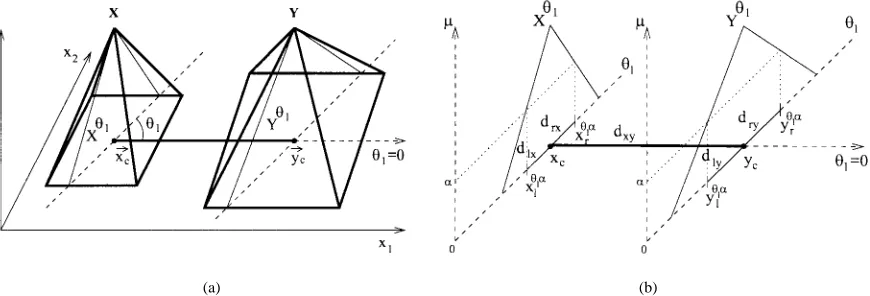
Fig. 2. (a) Two 1-D fuzzy numbers X ; Y , coming from 2-D fuzzy vectorsX; Y when the direction = (1) is determined and (b) the upper
xr ; yr , and lowerxl ; yl limits of two-cuts X; Y, the centers of the fuzzy vectorsxc; yc, and the distance between them.
Such a membership function can be of the form
uj(xi) = 1 0 kxdmax(xi)i0 yjk2 (7)
where is a positive integer. The existence of overlapping hyper-spheres guarantees the participation of all the training vectors in the formation of the codebook. Thus, the effect of the initial codebook selection on the quality of clustering is eliminated. The hyperspheres are shrunk during the training procedure. Thus, it is not necessary to define the fuzziness level. Finally, each of the training vectors is assigned to one cluster. Notice that, similarly to the fuzzyk-means algorithm, the fuzzy vector quantization algorithm does not classify fuzzy data.
E. Fuzzy Clustering of Fuzzy Data
The fuzzyk-means and fuzzy vector quantization algorithms are applied on crisp data. A crisp codebook vector is designed through a soft decision process, where each vector is assigned to all clusters with a degree of membership. In the following, we shall propose two modifications of the fuzzy k-means and fuzzy vector quantization algorithms, the FDKM and the FDVQ, that will provide us a way to handle fuzziness and classify fuzzy data, based on a fuzzy vector distance measure. During the training procedure, these methods take into account not only the presence of outliers, but also the reliability of the result.
The outputs of the modalitiesujwill be considered in the following as fuzzy vectors consisted of the authentication resultsrj and the quality resultsqj. A fuzzy vector is defined as an extension of the notion of a fuzzy number ton dimensions [17]. A fuzzy vector X can be symbolized as
X = 1 x
l ; xr (8)
wherexl andxr are the lower and upper points that limit the -cuts of the corresponding 1-DXfuzzy numbers defined on a certain direction. An example of two two-dimensional (2-D) fuzzy vectors
X; Y , and the corresponding one-dimensional (1-D) fuzzy numbers X andY defined on the direction1are shown in Fig. 2(a) and
(b). The union of all 1-D fuzzy numbers for all then 0 1 angles
= (1; 2; 1 1 1 ; n01), which is symbolized by , reconstructs the n-dimensional fuzzy vector. Then, a distance norm Dn[X; Y]
between fuzzy vectorsX, Y is defined as [17]
Dn[X; Y] =2(n 0 1)1 =0 1 1 1
=0 1
=0 1 kx
l ; yl k + kxr ; yr k d dn011 1 1 d1
(9) wherek:; :k denotes a distance norm between classical vectors. When the Euclidean norm is chosen, the Euclidean fuzzy distance is defined. When the fuzzy vectors are described by using -cuts, for a given
and a vector of angles = (1; 2; 1 1 1 ; n01), two points x l
and xr are defined, which are the lower and the upper limits of the corresponding-cut. The proposed Euclidean fuzzy distance is the normalized integral of all the distances d2e(xl ; yl ) between the lower limits, and the distancesd2e(xr ; yr ) between the upper limits, for every 2 [0; 1], and i2 [0; ), i = 1; 2; 1 1 1 ; n 0 1.
Let us symbolize asdlx the Euclidean distance between the lower limitxl of the-cut and the center xcof a fuzzy vectorX, as drx the Euclidean distance between the upper limit, xr of the -cut and the center xc, and asdxy the distance between the centers of two fuzzy vectors X; Y.
It is easy to prove that the distance between two lower limits of two fuzzy vectors-cuts is equal to
d2
e(xl ; yl )
= (dlx 0 dly)2+ 2(dlx 0 dly)dxy n01
i=1
cos(i) + d2xy (10)
wherei, i = 1; 2; 1 1 1 ; n 0 1 are known angles i 2 [0; ). The distance between two upper limits of two fuzzy vectors -cuts is equal to
d2
e(xr ; yr )
= d rx0 dry
2 0 2(d
rx0 dry)dxy n01
i=1
cos(i) + d2xy: (11)
By using (9)–(11), the Euclidean fuzzy distance between two fuzzy vectors X; Y is given by
De [X; Y] = d2
TABLE II
[image:6.612.98.502.476.558.2]FRANDFA RATES,BYUSING THERESULTS FROMMDLA, GDLA, PSM, GLM,AND MSP MODALITIESCOMBINED BYTWO, PROVIDED BYUSINGKM, FKM, FDKM, FVQ, FDVQ,ANDMRBF
TABLE III
FRANDFA RATES,BYUSING THERESULTS FROMMDLA, GDLA, PSM, GLM,AND MSP MODALITIES
COMBINED BYTHREE, PROVIDED BYUSINGKM, FKM, FDKM, FVQ, FDVQ,AND MRBF
TABLE IV
FRANDFA RATES,BYUSING THERESULTS FROMMDLA, GDLA, PSM, GLM,AND MSP MODALITIESCOMBINED BYFOUR, PROVIDED BYUSINGKM, FKM, FDKM, FVQ, FDVQ,ANDMRBF
where
d2 f
= 2(n 0 1)1 =01 1 1
=0 1
=0
1 (d
lx 0 dly)2+ (drx0 dry)2+ 2dxy n01
i=1
1 cos(i)(dlx0 dly 0 drx+ dry) d dn01 1 1 1 d1:
(13) The above equation shows that the Euclidean fuzzy distance is the classical Euclidean distance between the centers of two fuzzy vectorsX; Y, modified by a factor that depends on the fuzziness
that every fuzzy vector holds. The Euclidean fuzzy distance can be considered as a generalized Euclidean distance since (13) equals to 0 when the vectors are crisp (dlx = dly = drx= dry = 0, 8 i; ). The Euclidean fuzzy distance is also equal to the classical Euclidean distance of the fuzzy vectors centers when the fuzziness of the fuzzy vectorX is equal to the fuzziness of the fuzzy vector Y for every angle and -cut (dlx = dly, drx = dry, 8 i; ). Generally, the Euclidean fuzzy distance can be equal to, greater or less than the classical distance of the fuzzy vectors centers, depending on their membership functions.
Fig. 3. FR and FA rates, using OR, AND, KM, FKM, FDKM, FVQ, FDVQ, and MRBF methods for fusing the results of GLM and MSP methods.
by substituting the classical Euclidean distancekxi0 yjk2with the Euclidean fuzzy distance calculated by (12) and (13). The need for crisp decisions at the end of the training procedures, forces us to chose crisp codebook vectors. Thus, the centers of the fuzzy vectors should be used for all arithmetic operations.
F. Median Radial Basis Function Network
An RBF network is a two-layer neural network used for classifi-cation or functional approximation purposes [7]. The inputs of the RBF network consist of the results provided by various modalities employed. Each hidden unit implements a Gaussian function which models a cluster
j(x) = exp 0(x 0 yj)TS01
j (x 0 yj) (14)
where x is the entry vector, yj is the mean vector, Sj is the covariance matrix, andj = 1; 1 1 1 ; L, where L is the total number of hidden units. Each hidden unit models the location and the spread of a cluster.
The output unit consists of a weighted sum of hidden unit outputs which are fed into a sigmoidal function
(x) = 1
1 + exp 0 L
j=1 jj(x)
(15)
wherej are the output weights associated with the hidden units. The output consists of a decision function (x) 2 (0; 1).
A very common approach for estimating the parameters of an RBF network consists of an adaptive implementation of thek-means clustering algorithm [16]. For the covariance matrix estimation, a 2-D extension of this algorithm is employed. In [6] a robust statistics algorithm (MRBF) was proposed for estimating parameters of RBF networks. It was proved that this algorithm provides better parameter estimates when the clusters are overlapping or in the presence of outliers [6]. MRBF assigns an incoming data vector to a cluster which has the smallest Euclidean distance
kxi0 yj =minL
k=1 xi0 ykk: (16)
After assigning a set of vectors to the same cluster, we calculate the center of the cluster using the marginal median algorithm
[image:7.612.327.553.61.243.2]yj= Medfxj; 0; xj; 1; 1 1 1 ; xj; ng (17)
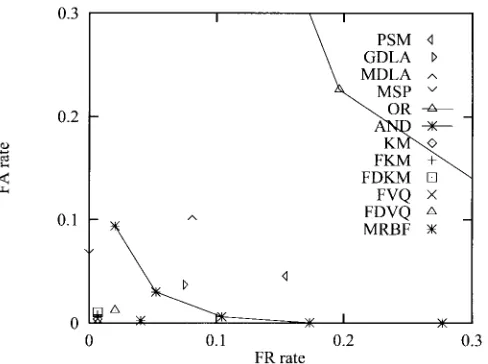
Fig. 4. The FR and FA rates, using OR, AND, KM, FKM, FDKM, FVQ, FDVQ, and MRBF methods for fusing the results of PSM, MDLA, and MSP methods.
where xj; i fori = 0; 1 1 1 ; n are the data samples assigned to the hidden unit j. In order to limit the computational complexity we consider only a limited set of data samples and the formula (17) is calculated from a running window. For the dispersion estimation we employ the median of the absolute deviations from the median algorithm
Sj=Medfjxj; 00 yjj; 1 1 1 ; jxj; n0:6745 0 yjjg (18) where the covariance matrix Sj is considered diagonal. The output weights are calculated from the back-propagation algorithm
j= n
i=0
[F (xi) 0 (xi)] (xi)[1 0 (xi)]j(xi) (19) where F (xi) is the decision function associated with each data sample in the training set.
MRBF networks use the second order statistics. Furthermore, the radial functions modeling the clusters are not influenced by the presence of outliers in the MRBF training algorithm, due to the use of the median operators. Therefore MRBF networks are expected to have good performance.
IV. EXPERIMENTAL RESULTS
The algorithms that are described in Section III are used to fuse results coming from the five different modalities that were developed for person authentication in the framework of M2VTS project. The fusion methods are applied by using the results coming from the five modalities, in groups of two, three, and four. The results are presented in Tables II–IV, respectively.
Fig. 5. The FR and FA rates, using OR, AND, KM, FKM, FDKM, FVQ, FDVQ, and MRBF methods for fusing the results of PSM, GDLA, MDLA, and MSP methods.
When the results of three modalities were combined, the best fusion was succeeded by using the results coming from MDLA, PSM, and MSP algorithms, fused by FDKM algorithm. A 0% false rejection rate and 0.39% false acceptance rate was obtained. The best result is also shown in Fig. 4 together with the results from the OR and AND fusion techniques. The FKM algorithm provides better performance in all cases in comparison to the classical KM. The use of the quality improves again the performance when the results are not good enough, and preserves the performance when the results are good.
When the results of four modalities were combined, the best fusion was succeeded by using the results coming from MDLA, GDLA, PSM, and MSP algorithms, fused by classical KM algorithm. A 0.68% false rejection rate and 0.39% false acceptance rate was obtained. The results from the fusion of the four modalities are also shown in Fig. 5. The FKM algorithm improves the performance in cases of poor results. The use of the quality seems to be improper in such cases where there is a lot of information coming from the data itself.
V. CONCLUSION
The use of fuzzy clustering algorithms for decision-level data fusion in a person authentication system was proposed. Results coming from five person authentication algorithms were combined by using fuzzyk-means and fuzzy vector quantization. The quality measure that is also provided with the results was used to fuzzify the data. Two modifications of the FKM and FVQ algorithms, based on a novel fuzzy vector distance definition were proposed to utilize the quality of the results. Simulation results showed that fuzzy clustering algorithms have better performance compared with classicalk-mean and other known fusion algorithms. It was also shown that the use of median radial basis function network provides a reliable technique for data fusion. Moreover, the proposed fuzzy clustering algorithms for fuzzy data which utilize the quality of the results, provide improved fusion performance.
REFERENCES
[1] D. L. Hall and J. Llinas, “An introduction to multisensor data fusion,”
Proc. IEEE, vol. 85, pp. 6–23, Jan. 1997.
[2] J. C. Dunn, “A fuzzy relative of the ISODATA process and its use in detecting compact well-separated clusters,” J. Cybern., vol. 3, pp. 32–57, Mar. 1973.
[3] J. C. Bezdek, Pattern Recognition with Fuzzy Objective Function
Algo-rithms. New York: Plenum, 1981.
[4] N. B. Karayiannis, “Fuzzy vector quantization algorithms and their application in image compression,” IEEE Trans. Image Processing, vol. 4, pp. 1193–1201, Sept. 1995.
[5] S. Haykin, Neural Networks: A Comprehensive Foundation. Engle-wood Cliffs, NJ: Prentice-Hall, 1994.
[6] A. G. Bor¸s and I. Pitas, “Median radial basis function neural network,”
IEEE Trans. Neural Networks, vol. 7, pp. 1351–1364, June 1996.
[7] S. A. Kassam, Signal Detection in Non-Gaussian Noise. Berlin, Ger-many: Springer-Verlag, 1988.
[8] C. Kotropoulos, A. Tefas, and I. Pitas, “Frontal face authentication using variants of dynamic link matching based on mathematical morphology,” in IEEE Int. Conf. Image Processing (ICIP’98), Oct. 1998, pp. 122–126. [9] C. Kotropoulos, I. Pitas, S. Fischer, and B. Duc, “Face authentication using morphological dynamic link architecture,” in Proc. 1st Int. Conf.
Audio- and Video-Based Biometric Person Authentication AVBPA’97,
Mar. 1997, pp. 169–176.
[10] S. Pigeon and L. Vandendorpe, “Profile authentication using a chamfer matching algorithm,” in Proc. 1st Int. Conf. Audio- and Video-Based
Biometric Person Authentication (AVBPA’97), Mar. 1997, pp. 185–192.
[11] , “Bimodal human profile authentication,” Signal Process., to be published.
[12] S. Fischer, B. Duc, and J. Bigun, “Face recognition with Gabor phase and dynamic link matching for multi-modal identification,” Signal Process. Lab., Swiss Federal Inst. Technol., Tech. Rep. LTS 96.04, 1996. [13] M. Lades, J. C. Vorbruggen, J. Buhmann, J. Lange, C. v.d. Malsburg, R. P. Wurtz, and W. Konen, “Distortion invariant object recognition in the dynamic link architecture,” IEEE Trans. Comput., vol. 42, pp. 300–311, Mar. 1993.
[14] P. Jourlin, J. Luettin, D. Genoud, and H. Wassner, “Acoustic-labial speaker verification,” in Proc. 1st Int. Conf. Audio- and Video-Based
Biometric Person Authentication AVBPA’97, Mar. 1997.
[15] S. Pigeon and L. Vandendorpe, “The M2VTS multimodal face database,”
Lecture Notes in Computer Science: Audio- and Video-Based Biometric Person Authentication, J. Bigun, G. Chollet, and G. Borgefors, Eds.
Berlin, Germany: Springer-Verlag, 1997, vol. 1206, pp. 403–409. [16] R. J. Schalkof, Pattern Recognition: Statistical, Structural, and Neural
Approaches. New York: Wiley, 1992.
[17] V. Chatzis and I. Pitas, “Fuzzy vector median definition based on a fuzzy vector distance,” in Proc. IEEE Workshop Nonlinear Signal Image