Friedrich L. Bauer
Decrypted Secrets
Methods and Maxims
of Cryptology
Fourth, Revised and Extended Edition
With 191 Figures, 29 Tables,
and 16 Color Plates
Professor Emeritus of Mathematics and Computer Science Munich Institute of Technology
Department of Computer Science Boltzmannstr. 3
85748 Garching, Germany
ACM Computing Classification (1998): E.3, D.4.6, K.6.5, E.4 Mathematics Subject Classification (1991): 94A60, 68P25
Library of Congress Control Number: 2006933429
ISBN-10 3-540-24502-2 Springer Berlin Heidelberg New York ISBN-13 978-3-540-24502-5 Springer Berlin Heidelberg New York ISBN 3-540-42674-4 3rd ed. Springer Berlin Heidelberg New York
This work is subject to copyright. All rights are reserved, whether the whole or part of the material is concerned, specifically the rights of translation, reprinting, reuse of illustrations, recitation, broad-casting, reproduction on microfilm or in any other way, and storage in data banks. Duplication of this publication or parts thereof is permitted only under the provisions of the German Copyright Law of September 9, 1965, in its current version, and permission for use must always be obtained from Springer. Violations are liable for prosecution under the German Copyright Law.
Springer is a part of Springer Science+Business Media springer.com
© Springer-Verlag Berlin Heidelberg 1997, 2000, 2002, 2007
The use of general descriptive names, registered names, trademarks, etc. in this publication does not imply, even in the absence of a specific statement, that such names are exempt from the relevant protective laws and regulations and therefore free for general use.
Cover Design: Design & Concept E. Smejkal, Heidelberg Color Photos: Reinhard Krause, Deutsches Museum München Typesetting: By the author in TEX
Preface
Towards the end of the 1960s, under the influence of the rapid development of microelectronics, electromechanical cryptological machines began to be replaced by electronic data encryption devices using large-scale integrated circuits. This promised more secure encryption at lower prices. Then, in 1976, Diffie and Hellman opened up the new cryptological field of public-key systems. Cryptography, hitherto cloaked in obscurity, was emerging into the public domain. Additionally, ENIGMA revelations awoke the public interest.
Computer science was a flourishing new field, too, and computer scientists became interested in several aspects of cryptology. But many of them were not well enough informed about the centuries-long history of cryptology and the high level it had attained. I saw some people starting to reinvent the wheel, and others who had an incredibly naive belief in safe encryption, and I became worried about the commercial and scientific development of professional cryptology among computer scientists and about the unstable situation with respect to official security services.
This prompted me to offer lectures on this subject at the Munich Institute of Technology. The first series of lectures in the winter term 1977/78, backed by the comprehensive and reliable bookThe Codebreakers(1967) by David Kahn, was held under the code name ‘Special Problems of Information Theory’ and therefore attracted neither too many students nor too many suspicious people from outside the university.
Next time, in the summer term of 1981, my lectures on the subject were announced under the open title ‘Cryptology’. This was seemingly the first publicly announced lecture series under this title at a German, if not indeed a Continental European, university.
The series of lectures was repeated a few times, and in 1986/87 lecture notes were printed which finally developed into Part I of this book. Active interest on the side of the students led to a seminar on cryptanalytic methods in the summer term of 1988, from which Part II of the present book originated.
The 1993 first edition (in German) of my bookKryptologie, although written mainly for computer science students, found lively interest also outside the field. It was reviewed favorably by some leading science journalists, and the publisher followed the study book edition with a 1995 hardcover edition under the titleEntzifferte Geheimnisse [Decrypted Secrets], which gave me the opportunity to round out some subjects. Reviews in American journals recommended also an English version, which led in 1997 to the present book.
consider this my greatest advantage, since I am not bound by any pledge of secrecy. On the other hand, keeping eyes and ears open and reading between the lines, I learned a lot from conversations (where my scientific metier was a good starting point), although I never know exactly whether I am allowed to know what I happen to know.
Luigi Sacco (1883–1970) It all started in 1951, when I told my former professor
of formal logic at Munich University, Wilhelm Brit-zelmayr, of my invention of an error-correcting code for teletype lines1. This caused him to make a wrong association, and he gave me a copy of Sacco’s book, which had just appeared2. I was lucky, for it was the best book I could have encountered at that time— although I didn’t know that then. I devoured the book. Noticing this, my dear friend and colleague Paul August Mann, who was aware of my acquain-tance with Shannon’s redundancy-decreasing encod-ing, gave me a copy of the now-famous paper by
Claude Shannon calledCommunication Theory of Secrecy Systems3 (which in those days as a Bell Systems Technical Report was almost unavailable in Germany). I was fascinated by this background to Shannon’s information theory, which I was already familiar with. This imprinted my interest in cryptology as a subfield of coding theory and formal languages theory, fields that held my academic interest for many years to come.
Strange accidents—or maybe sharper observation—then brought me into contact with more and more people once close to cryptology, starting with Willi Jensen (Flensburg) in 1955, Karl Stein (Munich) in 1955, Hans Rohr-bach, my colleague at Mainz University, in 1959, as well as Helmut Grunsky, Gisbert Hasenj¨ager, and Ernst Witt. In 1957, I became acquainted with Erich H¨uttenhain (Bad Godesberg), but our discussions on the suitability of certain computers for cryptological work were in the circumstances limited by certain restrictions. Among the American and British colleagues in nu-merical analysis and computer science I had closer contact with, some had been involved with cryptology in the Second World War; but no one spoke about that, particularly not before 1974, the year when Winterbotham’s book The Ultra Secretappeared. In 1976, I heard B. Randall and I. J. Good reveal some details about the Colossi in a symposium in Los Alamos. As a science-oriented civilian member of the cryptology academia, my interest in cryp-tology was then and still is centered on computerized cryptanalysis. Other aspects of signals intelligence (‘SIGINT’), for example, traffic analysis and di-rection finding, are beyond the scope of this book; the same holds for physical devices that screen electromechanical radiation emitted by cipher machines.
1 DBP No. 892767, application date January 21, 1951.
Preface VII
Cryptology is a discipline with an international touch and a particular ter-minology. It may therefore be helpful sometimes to give in this book some explanations of terms that originated in a language other than English.
The first part of this book presents cryptographic methods. The second part covers cryptanalysis, above all the facts that are important for judging cryp-tographic methods and for saving the user from unexpected pitfalls. This follows from Kerckhoffs’ maxim: Only a cryptanalyst can judge the secu-rity of a cryptosystem. A theoretical course on cryptographic methods alone seems to me to be bloodless. But a course on cryptanalysis is problematic: Either it is not conclusive enough, in which case it is useless, or it is conclu-sive, but touches a sensitive area. There is little clearance in between. I have tried to cover at least all the essential facts that are in the open literature or can be deduced from it. No censorship took place.
Certain difficulties are caused by the fact that governmental restrictions dur-ing and after World War II, such as the ‘need to know’ rule and other gim-micks, misled even people who had been close to the centers of cryptanalysis. Examples include the concept of Banburismus and the concept of a ‘cilli’.
The word Banburismus—the name was coined in Britain—was mentioned in 1985 by Deavours and Kruh in their book, but the method was only vaguely described. Likewise, the description Kahn gave in 1991 in his book is rather incomplete. On the other hand, in Kozaczuk’s book of 1979 (English edi-tion of 1984), Rejewski gave a descripedi-tion of R´o˙zycki’s ‘clock method’, which turned out to be the same—but most of the readers could not know of this connection. Then, in 1993, while giving a few more details on the method, Good (in ‘Codebreakers’) confirmed that “Banburism was an elaboration of ... the clock method ... [of] ... R´o˙zycki”. He also wrote that this elabora-tion was ‘invented at least mainly by Turing’, and referred to a sequential Bayesian process as the “method of scoring”. For lack of declassified concrete examples, the exposition in Sect. 19.4.2 of the present book, based on the re-cently published postwar notes of Alexander and of Mahon and articles by Erskine and by Noskwith in the recent bookAction This Day, cannot yet be a fully satisfactory one. And as to cillies, even Gordon Welchman admitted that he had misinterpreted the origin of the word, thinking of ‘silly’. Other publications gave other speculations, see Sect. 19.7, fn. 29. Ralph Erskine, in Action This Day, based on the recently declassified ‘Cryptanalytic Report on the Yellow Machine’, 71-4 (NACP HCC Box 1009, Nr. 3175), gives the following summary of the method:
‘Discovered by Dilly Knox in late January 1940, cillies reduced enormously the work involved in using the Zygalski sheets, and after 1 May, when the Zygalski sheets became useless, they became a vital part of breaking Enigma by hand during most of 1940. They were still valuable in 1943.
message key of the preceding part could be calculated within fine limits. The second error was the use of non-random message keys—stereotyped keyboard touches and 3-letter-acronyms. In combination, and in conjunction with the different turnover points of rotorsItoV, they allowed one to determine which rotors could, and which could not, be in any given position in the machine.’
Although Banburismus and cillies were highly important in the war, it is hard to understand why Derek Taunt in 1993 was prevented by the British censor from telling the true story about cillies. Possibly, the same happened to Jack Good about Banburismus.
***
My intellectual delight in cryptology found an application in the collection ‘Informatik’ of the Deutsches Museum in Munich which I built up in 1984 –1988, where there is a section on cryptological devices and machines. My thanks go to the Deutsches Museum for providing color plates of some of the pieces on exhibit there.
And thanks go to my former students and co-workers in Munich, Manfred Broy, Herbert Ehler, and Anton Gerold for continuing support over the years, moreover to Hugh Casement for linguistic titbits, and to my late brother-in-law Alston S. Householder for enlightenment on my English. Karl Stein and Otto Leiberich gave me details on the ENIGMA story, and I had fruitful discussions and exchanges of letters with Ralph Erskine, Heinz Ulbricht, Tony Sale, Frode Weierud, Kjell-Ove Widman, Otto J. Horak, Gilbert Bloch, Arne Frans´en, and Fritz-Rudolf G¨untsch. Great help was given to me by Kirk H. Kirchhofer from Crypto AG, Zug (Switzerland). Hildegard Bauer-Vogg supplied translations of difficult Latin texts, Martin Bauer, Ulrich Bauer and Bernhard Bauer made calculations and drawings. Thanks go to all of them.
The English version was greatly improved by J. Andrew Ross, with whom working was a pleasure. In particular, my sincere thanks go to David Kahn who encouraged me (“The book is an excellent one and deserves the widest circulation”) and made quite a number of proposals for improvements of the text. For the present edition, additional material that has been made public recently has been included, among others on Bletchley Park, the British at-tack on Tunny, Colossus and Max Newman’s pioneering work. Moreover, my particular thanks go to Ralph Erskine who indefatigably provided me with a lot of additional information and checked some of the dates and wordings. In this respect, my thanks also go to Jack Copeland, Heinz Ulbricht, and Augusto Buonafalce. Finally, I have to thank once more Hans W¨ossner for a well functioning cooperation of long standing, and the new copy editor Ronan Nugent for very careful work. The publisher is to be thanked for the fine presentation of the book. And I shall be grateful to readers who are kind enough to let me know of errors and omissions.
Contents
Part I: Cryptography—The People . . . . 1
1 Introductory Synopsis . . . .9
1.1 Cryptography and Steganography. . . .9
1.2 Semagrams. . . . 10
1.3 Open Code: Masking. . . . 13
1.4 Cues. . . . 17
1.5 Open Code: Veiling by Nulls. . . . 19
1.6 Open Code: Veiling by Grilles. . . . 23
1.7 Classification of Cryptographic Methods. . . . 24
2 Aims and Methods of Cryptography. . . . 26
2.1 The Nature of Cryptography. . . . 26
2.2 Encryption. . . . 32
2.3 Cryptosystems. . . . 34
2.4 Polyphony. . . . 36
2.5 Character Sets. . . . 39
2.6 Keys. . . . 41
3 Encryption Steps: Simple Substitution. . . . 44
3.1 Case V(1)−−−W (Unipartite Simple Substitutions) . . . . 44
3.2 Special Case V ≺−−−−V (Permutations). . . . 46
3.3 CaseV(1)−−−Wm (Multipartite Simple Substitutions). . . . 53
3.4 The General Case V(1)−−−W(m), Straddling . . . . 55
4 Encryption Steps: Polygraphic Substitution and Coding . 58 4.1 Case V2 −−−W(m) (Digraphic Substitutions) . . . . 58
4.2 Special Cases of Playfair and Delastelle: Tomographic Methods. . . . 64
4.3 Case V3 −−−W(m) (Trigraphic Substitutions) . . . . 68
4.4 The General Case V(n)−−−W(m) : Codes . . . . 68
5 Encryption Steps: Linear Substitution. . . .80
5.1 Self-reciprocal Linear Substitutions. . . . 82
5.2 Homogeneous Linear Substitutions. . . . 82
5.3 Binary Linear Substitutions. . . . 86
5.4 General Linear Substitutions. . . . 86
5.6 Decimated Alphabets. . . . 90
5.7 Linear Substitutions with Decimal and Binary Numbers . . . . 91
6 Encryption Steps: Transposition . . . . 93
6.1 Simplest Methods. . . . 93
6.2 Columnar Transpositions. . . . 98
6.3 Anagrams. . . . 102
7 Polyalphabetic Encryption: Families of Alphabets. . . .106
7.1 Iterated Substitutions. . . .106
7.2 Cyclically Shifted and Rotated Alphabets. . . .107
7.3 Rotor Crypto Machines. . . .110
7.4 Shifted Standard Alphabets: Vigen`ere and Beaufort . . . .127
7.5 Unrelated Alphabets. . . .131
8 Polyalphabetic Encryption: Keys . . . .139
8.1 Early Methods with Periodic Keys . . . .139
8.2 ‘Double Key’ . . . .141
8.3 Vernam Encryption. . . .142
8.4 Quasi-nonperiodic Keys. . . .144
8.5 Machines that Generate Their Own Key Sequences. . . .145
8.6 Off-Line Forming of Key Sequences. . . .156
8.7 Nonperiodic Keys. . . .158
8.8 Individual, One-Time Keys. . . .161
8.9 Key Negotiation and Key Management. . . .165
9 Composition of Classes of Methods . . . .169
9.1 Group Property. . . .169
9.2 Superencryption. . . .171
9.3 Similarity of Encryption Methods. . . .173
9.4 Shannon’s ‘Pastry Dough Mixing’. . . .174
9.5 Confusion and Diffusion by Arithmetical Operations. . . .180
9.6 DES and IDEAR . . . .184
10 Open Encryption Key Systems . . . .193
10.1 Symmetric and Asymmetric Encryption Methods. . . .194
10.2 One-Way Functions. . . .196
10.3 RSA Method. . . .203
10.4 Cryptanalytic Attack upon RSA. . . .205
10.5 Secrecy Versus Authentication. . . .208
10.6 Security of Public Key Systems. . . .210
11 Encryption Security. . . .211
11.1 Cryptographic Faults. . . .211
11.2 Maxims of Cryptology. . . .220
11.3 Shannon’s Yardsticks. . . .225
Contents XI
Part II: Cryptanalysis—The Machinery . . . .233
12 Exhausting Combinatorial Complexity . . . .237
12.1 Monoalphabetic Simple Encryptions. . . .238
12.2 Monoalphabetic Polygraphic Encryptions. . . .239
12.3 Polyalphabetic Encryptions. . . .241
12.4 General Remarks on Combinatorial Complexity. . . .244
12.5 Cryptanalysis by Exhaustion. . . .244
12.6 Unicity Distance . . . .246
12.7 Practical Execution of Exhaustion. . . .248
12.8 Mechanizing the Exhaustion. . . .251
13 Anatomy of Language: Patterns . . . .252
13.1 Invariance of Repetition Patterns. . . .252
13.2 Exclusion of Encryption Methods. . . .254
13.3 Pattern Finding. . . .255
13.4 Finding of Polygraphic Patterns. . . .259
13.5 The Method of the Probable Word. . . .259
13.6 Automatic Exhaustion of the Instantiations of a Pattern. . . .264
13.7 Pangrams. . . .266
14 Polyalphabetic Case: Probable Words . . . .268
14.1 Non-Coincidence Exhaustion of Probable Word Position . . . .268
14.2 Binary Non-Coincidence Exhaustion . . . .271
14.3 The De Viaris Attack. . . .272
14.4 Zig-Zag Exhaustion of Probable Word Position. . . .280
14.5 The Method of Isomorphs. . . .281
14.6 A clever brute force method: EINSing. . . .287
14.7 Covert Plaintext-Cryptotext Compromise. . . .288
15 Anatomy of Language: Frequencies . . . .290
15.1 Exclusion of Encryption Methods. . . .290
15.2 Invariance of Partitions. . . .291
15.3 Intuitive Method: Frequency Profile. . . .293
15.4 Frequency Ordering. . . .294
15.5 Cliques and Matching of Partitions. . . .297
15.6 Optimal Matching . . . .303
15.7 Frequency of Multigrams. . . .305
15.8 The Combined Method of Frequency Matching. . . .310
15.9 Frequency Matching for Polygraphic Substitutions. . . .316
15.10 Free-Style Methods. . . .317
15.11 Unicity Distance Revisited. . . .318
16 Kappa and Chi . . . . 320
16.1 Definition and Invariance of Kappa. . . . 320
16.2 Definition and Invariance of Chi. . . . 323
16.3 The Kappa-Chi Theorem. . . . 325
16.4 The Kappa-Phi Theorem. . . . 326
17 Periodicity Examination . . . . 330
17.1 The Kappa Test of Friedman. . . . 331
17.2 Kappa Test for Multigrams. . . . 332
17.3 Cryptanalysis by Machines: Searching for a period. . . . 333
17.4 Kasiski Examination. . . . 339
17.5 Building a Depth and Phi Test of Kullback. . . . 345
17.6 Estimating the Period Length. . . . 348
18 Alignment of Accompanying Alphabets . . . . 350
18.1 Matching the Profile. . . . 350
18.2 Aligning Against Known Alphabet. . . . 354
18.3 Chi Test: Mutual Alignment of Accompanying Alphabets. . . . 358
18.4 Reconstruction of the Primary Alphabet. . . . 363
18.5 Kerckhoffs’ Symmetry of Position. . . . 365
18.6 Stripping off Superencryption: Difference Method. . . . 370
18.7 Decryption of Code. . . . 373
18.8 Reconstruction of the Password. . . . 373
19 Compromises . . . . 375
19.1 Kerckhoffs’ Superimposition. . . . 375
19.2 Superimposition for Encryptions with a Key Group. . . . 377
19.3 COLOSSUS. . . . 401
19.4 Adjustment ‘in depth’ of Messages. . . . 412
19.5 Cryptotext-Cryptotext Compromises. . . . 419
19.6 Cryptotext-Cryptotext Compromise: ENIGMA Indicator Doubling 431 19.7 Plaintext-Cryptotext Compromise: Feedback Cycle. . . . 448
20 Linear Basis Analysis . . . . 459
20.1 Reduction of Linear Polygraphic Substitutions. . . . 459
20.2 Reconstruction of the Key. . . . 460
20.3 Reconstruction of a Linear Shift Register. . . . 461
21 Anagramming . . . . 464
21.1 Transposition. . . . 464
21.2 Double Columnar Transposition . . . . 467
21.3 Multiple Anagramming. . . . 467
22 Concluding Remarks . . . . 470
22.1 Success in Breaking. . . . 471
22.2 Mode of Operation of the Unauthorized Decryptor. . . . 476
22.3 Illusory Security. . . . 482
22.4 Importance of Cryptology. . . . 484
Appendix: Axiomatic Information Theory . . . . 487
Bibliography. . . . 497
Index . . . . 501
List of Color Plates
4Plate A The disk of Phaistos
Plate B Brass cipher disks
Plate C The ‘Cryptograph’ of Wheatstone
Plate D The US Army cylinder device M-94
Plate E The US strip device M-138-T4
Plate F The cipher machine of Kryha
Plate G The Hagelin ‘Cryptographer’ C-36
Plate H The US Army M-209, Hagelin licensed
Plate I The cipher machine ENIGMA with four rotors
Plate K Rotors of the ENIGMA
Plate L The British rotor machine TYPEX
Plate M Uhrbox of the GermanWehrmacht
Plate N Cipher teletype machine Lorenz SZ 42
Plate O Russian one-time pad
Plate P Modern crypto board
Plate Q CRAY Supercomputers
Part I: Cryptography
ars ipsi secreta magistro
[An art secret even for the master ]
Jean Robert du Carlet, 1644
For it is better for a scribe to be thought ignorant than to pay the penalty for the detection of plans.
Giambattista Della Porta, 1563
Giambattista Della Porta (1535–1615) Reciprocal cipher alphabet by
People
W. F. Friedman M. Rejewski A. M. Turing A. Beurling
(1891–1969) (1905–1980) (1912–1954) (1905–1986)
Only a few decades ago one could say that cryptology, the study of secret writing and its unauthorized decryption, was a field that flourished in conceal-ment—flourished, for it always nurtured its professional representatives well. Cryptology is a true science: it has to do with knowledge (Latinscientia), learning and lore.
By its very nature cryptology not only concerns secretiveness, but remains shrouded in secrecy itself—occasionally even in obscurity. It is almost a secret science. The available classic literature is scant and hard to track down: under all-powerful state authorities, the professional cryptologists in diplomatic and military services were obliged to adopt a mantle of anonymity or at least accept censorship of their publications. As a result, the freely available literature never fully reflected the state of the art—we can assume that things have not much changed in that respect.
Nations vary in their reticence: whereas the United States of America released quite generous information on the situation in the Second World War, the Soviet Union cloaked itself in silence. That was not surprising; but Britain has also pursued a policy of secretiveness which sometimes appears excessive—as in the COLOSSUS story. At least one can say that the state of cryptology in Germany was openly reported after the collapse of the Reich in 1945.1
Cryptology as a science is several thousand years old. Its development has gone hand in hand with that of mathematics, at least as far as the persons are concerned—names such as Fran¸cois Vi`ete (1540–1603) and John Wallis (1616–1703) occur. From the viewpoint of modern mathematics, it shows traits of statistics (William F. Friedman, 1920), combinatory algebra (Lester S. Hill, 1929), and stochastics (Claude E. Shannon, 1941).
1 Hans Rohrbach (1948),Mathematische und maschinelle Methoden beim Chiffrieren und
The People 3
Mathematicians as cryptologists. Traditionally, mainly linguists were doing cryptanalysis. The Second World War finally brought mathemati-cians to the fore: for example, Hans Rohrbach (1903–1993) in Germany and Alan Mathison Turing (1912–1954) in the UK; A. Adrian Albert (1905–1972) and Marshall Hall (1910–1990) were engaged in the field in the United States; also J. Barkley Rosser, Willard Van Orman Quine, Andrew M. Gleason, and the applied mathematicians Vannevar Bush (1890–1974) and Warren Weaver (1894–1978). And there was Arne Beurling (1905–1986) in Sweden, Marian Rejewski (1905–1980) in Poland, Hugo Hadwiger (1908–1981) in Switzer-land; moreover Wolfgang Franz in Germany, Maurits de Vries in the Nether-lands, Ernst S. Selmer (b. 1920) in Norway, Erkki Sten Pale (b. 1906) in Fin-land, Paul Glur in SwitzerFin-land, and Shiro Takagi in Japan.
One could mention a few more present-day mathematicians who have been en-gaged in official cryptology for a time. Some would prefer to remain incognito.
The mathematical disciplines that play an important part in the current state of cryptology include number theory, group theory, combinatory logic, com-plexity theory, ergodic theory, and information theory. The field of cryptology can already be practically seen as a subdivision of applied mathematics and computer science. Conversely, for the computer scientist cryptology is gain-ing increasgain-ing practical importance in connection with access to operatgain-ing systems, data bases and computer networks, including data transmission.
Screen. Quite generally, it is understandable if intelligence services do not reveal even the names of their leading cryptologists. Admiral Sir Hugh P. F. Sinclair, who became in 1923 chief of the British Secret Intelligence Service (M.I.6), had the nickname ‘Quex’. Semi-officially, Sinclair and his successor General Sir Stewart Graham Menzies (1890–1968), were traditionally known only as ‘C’. Under them were a number of ‘Passport Control Officers’ at the embassies as well as the cryptanalytic unit at Bletchley Park, Buckingham-shire. And the name of Ernst C. Fetterlein (dec. 1944), who was till the Octo-ber Revolution head of a Russian cryptanalytic bureau (covername ‘Popov’) and served the Government Code and Cypher School of the British Foreign Office from June 1918, was mentioned in the open cryptological literature only incidentally in 1985 by Christopher Andrew and in 1986 by Nigel West.2
Professional cryptology is far too much at risk from the efforts of foreign secret services. It is important to leave a potential opponent just as much in the dark about one’s own choice of methods (‘encryption philosophy’) as about one’s ability (‘cryptanalytic philosophy’) to solve a message that one is not meant to understand. If one does succeed in such unauthorized decryption—as the British did with ENIGMA-enciphered messages from 1940 till 1945—then it is important to keep the fact a secret from one’s opponents and not reveal it by one’s reactions. As a result of British shrewdness, the relevant German
thorities, although from time to time suspicious, remained convinced until the approaching end of the war (and some very stubborn persons even in 1970) that the ciphers produced by their ENIGMA machines were unbreakable.
The caution the Allies applied went so far that they even risked disinforma-tion of their own people: Capt. Laurance F. Safford, US Navy, Office of Naval Communications, Cryptography Section, wrote in an internal report of March 18, 1942, a year after the return of Capt. Abraham Sinkov and Lt. Leo Rosen from an informative visit in February 1941 to Bletchley Park:“Our prospects of ever [!] breaking the German ‘Enigma’ cipher machine are rather poor.” This did not reflect his knowledge. But in addressing the US Navy leadership, he wanted to keep the secret of Bletchley Park struggling hard with the German Navy 4-rotor ENIGMA introduced a few weeks before (in February 1942), the breakthrough coming only in December 1942.
In times of war,mat´eriel and even human life must often be sacrificed in order to avoid greater losses elsewhere. In 1974, Group Captain Winterbotham said Churchill let Coventry be bombed because he feared defending it would reveal that the British were reading German ENIGMA-enciphered messages. This story, however, was totally false: As the targets were indicated by changing code words, this would not in fact have been possible. But, the British were initially very upset when, in mid-1943, the Americans began systematically to destroy all the tanker U-boats, whose positions they had learnt as a result of cracking the 4-rotor ENIGMA used by the German submarine command. The British were justifiably concerned that the Germans would suspect what had happened and would greatly modify their ENIGMA system again. In fact they did not, instead ascribing the losses (incorrectly) to treachery. How legitimate the worries had been became clear when the Allies found out that for May 1, 1945, a change in the ENIGMA keying procedures was planned that would have made all existing cryptanalytic approaches useless. This change “could probably have been implemented much earlier” if it had been deemed worthwhile (Ralph Erskine).
This masterpiece of security work officially comprised “intelligence resulting from the solution of high-grade codes and ciphers”. It was named by the Bri-tish “special intelligence” for short, and codenamed ULTRA, which also refer-red to its security classification. The Americans similarly called MAGIC the information obtained from breaking the Japanese cipher machines they dub-bed PURPLE . Both ULTRA and MAGIC remained hidden from Axis spies.
The People 5
S. Friedman n´ee Smith (1892–1980), wife of the famous William Frederick Friedman (1891–1969)3 and herself a professional cryptologist, performed considerable service in this line. She did not always have an easy time in court: counsel for the defence expounded the theory that anything could be read into a secret message, and that her cryptanalysis was nothing more than “an opinion”. The Swedish cryptologist Yves Gyld´en (1895–1963), a grand-son of the astronomer Hugo Gyld´en, assisted the police in catching smugglers in 1934. Only a few criminological cryptologists are known, for example the Viennese Dr. Siegfried T¨urkel in the 1920s and the New Yorker Abraham P. Chess in the early 1950s. Lately, international crime using cryptographic methods has again begun to require the attention of cryptanalysts.
Amateurs. Side by side with state cryptology in diplomatic and military ser-vices have stood the amateurs, especially since the 19th century. We should mention some serious poets, novelists and fiction writers with nothing more than a fancy for cryptography: Stefan George, Robert Musil, and Vladimir Nabokov, and more recently Hans Magnus Enzensberger. But that is not all. From the revelation of historic events by retired
professionals such as ´Etienne Bazeries4, to the after-dinner amusements practised by Wheat-stone5 and Babbage6, and including journalis-tic cryptanalyjournalis-tic examples ranging from Edgar Allan Poe to the present-dayCryptoquipin the Los Angeles Times, accompanied by excursions into the occult, visiting Martians, and terror-ism, cryptology shows a rich tapestry, inter-woven with tales from one of the oldest of all branches of cryptology, the exchange of mes-sages between lovers. The letter-writer’s guides that appeared around 1750 soon offered crypto-graphic help, likeDe geheime brieven-schryver, angetoond met verscheydene voorbeelden by a
certain G. v. K. , Amsterdam, 1780, andDem Magiske skrivekunstner, Copen-hagen,1796. A century later, we find in GermanSicherster Schutz des Brief-geheimnisses, by Emil Katz, 1901, andAmor als geheimer Bote. Geheimspra-che f¨ur Liebende zu Ansichts-Postkarten, presumably by Karl Peters, 1904.
Mixed with sensational details from the First and Second World Wars, an ex-citing picture of cryptology in a compact, consolidated form first reached a
3 Friedman, probably the most important American cryptologist of modern times, intro-duced in 1920 theIndex of Coincidence, the sharpest tool of modern cryptanalysis. 4 Etienne Bazeries (1846–1931), probably the most versatile French cryptologist of modern´
times, author of the bookLes chiffres secrets d´evoil´es(1901).
5 Sir Charles Wheatstone (1802–1875), English physicist, professor at King’s College, London, best known for Wheatstone’s bridge (not invented by him).
broad public in 1967 in David Kahn’s masterpiece of journalism and historical scienceThe Codebreakers. In the late 1970s there followed several substantial additions from the point of view of the British, whose wartime files were at last (more or less) off the secret list;among the earliest wereThe Secret War by Brian Johnson, and laterThe Hut Six Storyby Gordon Welchman. Cryp-tology’s many personalities make its history a particularly pleasurable field.
Lewis Carroll. A quite remarkable role as an amateur was played by Charles Lutwidge Dodgson (1832–1898),nom de plume Lewis Carroll, the author of Alice in Wonderland, Through the Looking-Glass, and The Hunting of the Snark. He liked to amuse his friends and readers with puzzles, games, codes,
and ciphers. Among the latter, he reinvented the Vigen`ere cipher with his 1858 Key-Vowel Cipher (restricted to 5 alphabets, see Sect. 7.4.1) and his 1868 Alphabet Cipher, moreover the Beaufort cipher (see Sect. 7.4.3) with his 1868Telegraph Cipher. His 1858 Matrix Cipherwas the first, and very elegant, version of a Variant Beaufort cipher (see Sect. 7.4.3). Like Charles Babbage (1791–1871) and Francis Beaufort (1774–1857), Lewis Carroll was an amateur who did not earn his money from cryptanalysis.
Commerce. Commercial interest in cryptology after the invention of the telegraph concentrated on the production of code books, and around the turn of the century on the design and construction of mechanical and elec-tromechanical ciphering machines. Electronic computers were later used to break cryptograms, following initial (successful) attempts during the Second World War. A programmable calculator is perfectly adequate as a ciphering machine. But it was not until the mid-1970s that widespread commercial interest in encrypting private communications became evident (“Cryptology goes public,” Kahn,1979); the options opened up by integrated circuits coin-cided with the requirements of computer transmission and storage. Further contributing to the growth of cryptology were privacy laws and fears of wire-tapping, hacking and industrial espionage. The increased need for informa-tion security has given cryptology a hitherto unneeded importance. Private commercial applications of cryptology suddenly came to the fore, and led to some unorthodox keying arrangements, in particular asymmetric public keys, invented in 1970 by James H. Ellis and first proposed publicly in 1976 by Whitfield Diffie and Martin Hellman. More generally, the lack of adequate copyright protection for computer programs has encouraged the use of en-cryption methods for software intended for commercial use.
The People 7
Assistant Attorney General, Office of Legal Counsel, Department of Justice, wrote to Dr. Frank Press, science advisor to the President: “The crypto-graphic research and development of scientists and mathematicians in the private sector is known as ‘public cryptography’. As you know, the serious concern expressed by the academic community over government controls of public cryptography led the Senate Select Committee on Intelligence to con-duct a recently concluded study of certain aspects of the field.” These aspects centered around the question of whether restraints based on the International Traffic in Arms Regulation (ITAR) “on dissemination of cryptographic in-formation developed independent of government supervision or support by scientists and mathematicians in the private sector” are unconstitutional un-der the First Amendment, which guarantees freedom of speech and of the press. It was noted: “Cryptography is a highly specialized field with an au-dience limited to a fairly select group of scientists and mathematicians ... a temporary delay in communicating the results of or ideas about cryptographic research therefore would probably not deprive the subsequent publication of its full impact.”
Cryptological information is both vital and vulnerable to an almost unique degree. Once cryptological information is disclosed, the government’s in-terest in protecting national security is damaged and may not be repaired. Thus, as Harmon wrote in 1978, “a licensing scheme requiring prepublication submission of cryptographic information” might overcome a presumption of unconstitutionality. Such a scheme would impose “a prepublication review requirement for cryptographic information, if it provided necessary procedu-ral safeguards and precisely drawn guidelines”,whereas “a prior restraint on disclosure of cryptographic ideas and information developed by scientists and mathematicians in the private sector is unconstitutional.”
Furthermore, in the 1980s, the Department of Justice warned that export controls on cryptography presented “sensitive constitutional issues”.
Let us face the facts: cryptosystems are not only considered weapons by the US government—and also by other governments—theyareweapons, weapons for defense and weapons for attack. The Second World War has taught us this lesson.
In other words, cryptology invites dangerous machinations even more than atomic energy. At least the crypto weapon does not kill directly—but it may cover up crimes.
The responsibility of the government and the scientists in view of the nim-bleness of cryptological activities is reflected in the Computer Security Act of the US Congress of 1987 (Public Law 100-235). It established a Com-puter System Security and Privacy Advisory Board (CSSPAB), composed of members of the federal government and the computer industry. While a la-tent conflict did exist, its outbreak seemed to have been avoided in the USA till 1993 due to voluntary restraint on the part of cryptologists (exercised by the Public Cryptography Study Group).
In 1993, however, acrypto war broke out between the government and civil rights groups, who felt provoked by the announcement in April 1993—which came also as a surprise to the CSSPAB—and the publication in February 1994 of an Escrowed Encryption Standard (EES), a Federal Information Pro-cessing Standards publication (FIPS 185). The standard makes mandatory an escrow system for privately used keys. While this persistent conflict is not scientific, but rather political, it still could endanger the freedom of science.
Things look better in liberal, democratic Europe; prospects are lower that authorities would be successful everywhere in restraining scientific cryptolo-gy. In the European Union, discussions started in 1994 under the keyword “Euro-Encryption”, and these may also lead in the end to a regulation of the inescapable conflict of interests between state authorities and scientists. France dropped in 1999 its escrow system. In the former Soviet Union, the problem was of course easily settled within the framework of the system, but in today’s Russia, in China, and in Israel strong national supervision continues.
1
Introductory Synopsis
En cryptographie, aucune r`egle n’est absolue.
[In cryptography, no rule is absolute.] ´
Etienne Bazeries(1901)
1.1
Cryptography and Steganography
We must distinguish between cryptography (Greek kryptos, hidden) and steganography (Greeksteganos, covered). The termcryptographia, to mean secrecy in writing, was used in 1641 by John Wilkins, a founder with John Wallis of the Royal Society in London; the word ‘cryptography’ was coined in 1658 by Thomas Browne, a famous English physician and writer. It is the aim of cryptography to render a message incomprehensible to an un-authorized reader: ars occulte scribendi. One speaks ofovert secret writing: overt in the sense of being obviously recognizable as secret writing.
The term steganographia was also used in this sense by Caspar Schott, a pupil of Athanasius Kircher, in the title of his book Schola steganographia, published in Nuremberg in 1665; however, it had already been used by Trithemius in his first (and amply obscure) work Steganographia, which he began writing in 1499, to mean ‘hidden writing’. Its methods have the goal of concealing the veryexistenceof a message (however that may be composed)— communicating without incurring suspicion (Francis Bacon, 1623: ars sine secreti latentis suspicione scribendi). By analogy, we can call this covert secret writing or indeed ‘steganography’.
Cryptographic methods are suitable for keeping a private diary or notebook— from Samuel Pepys (1633–1703) to Alfred C. Kinsey (1894–1956)—or pre-venting a messenger understanding the dispatch he bears; steganographic methods are more suitable for smuggling a message out of a prison—from Sir John Trevanion (Fig. 13), imprisoned in the English Civil War, to the French bank robber Pastoure, whose conviction was described by Andr´e Langie, and Klaus Croissant, the lawyer and Stasi collaborator who defended the Baader-Meinhof terrorist gang. The imprisoned Christian Klar used a book cipher.
Among the modern methods it is worth mentioning high-speed telegraphy, the spurt transmission of stored Morse code sequences at 20 characters per second, and frequency subband permutation (‘scrambling’) in the case of tele-phony, today widely used commercially. In the Second World War, the For-schungsstelle (research post) of theDeutsche Reichspost (headed byPostrat Dipl.-Ing. Kurt E. Vetterlein) listened in from March 1942 to supposedly se-cure radio telephone conversations between Franklin D. Roosevelt and Win-ston Churchill, including one on July 29, 1943, immediately before the cease-fire with Italy, and reported them via Schellenberg’s Reichssicherheitshaup-tamt, Amt VI to Himmler.
Written secret messages were revolutionized by microphotography; a micro-dot the size of a speck of dirt can hold an entire quarto page—an extraor-dinary development from the macrodot of Histiæus1, who shaved his slave’s head, wrote a message on his scalp; then waited for the hair to grow again. Microdots were invented in the 1920s by Emanuel Goldberg. The Russian spy Rudolf Abel produced his microdots from spectroscopic film which he was able to buy without attracting attention. Another Soviet spy, Gordon Arnold Lonsdale, hid his microdots in the gutters of bound copies of magazines. The microdots used by the Germans in the Second World War were of just the right size to be used as a full stop (period) in a typewritten document.
1.2
Semagrams
Linguistic steganography recognizes two methods: a secret message is either made to appear innocent in an open code, or it is expressed in the form of visible (though often minute) graphical details in a script or drawing, in a semagram. This latter category is especially popular with amateurs, but leaves much to be desired, since the details are too obvious to a trained and wary eye. The young Francis Bacon (1561–1626) invented the use of two type-faces to convey a secret message (Fig. 1), described in the Latin translation
De dignitate et augmentis scientiarum (1623) of his 1605 book Proficience and Advancement. It has never acquired any great practical importance (but see Sect. 3.3.3 for the binary code he introduced on this occasion).
Fig. 1. Francis Bacon: Visible concealment of a binary code (‘biliteral cipher’) by means of different types of script. Note the different forms of /e/ in the wordManere The same steganographic principle appears to have been known in Paris at the same time, and was mentioned by Vigen`ere in 1586. Despite its clumsiness it
1.2 Semagrams 11
Fig. 2. Semagram in a 1976 textbook on combinatory logic (the passage deals with the famous K¨onigsberg bridges problem). The lowered letters give the message “nieder mit dem sowjetimperialismus” [down with Soviet imperialism]
has lasted well: the most recent uses known to me are A. van Wijngaarden’s alleged usage of roman (.) and italic (.) full stops in the ALGOL 68 report.
A second steganographic principle consists of marking selected characters in a book or newspaper; for example, by dots or by dashes. It is much more con-spicuous than the above-mentioned method—unless an invisible ink is used— but simpler to implement. A variant (in a book on combinatory logic) uses an almost imperceptible lowering of the letters concerned (Fig. 2) .
Fig. 4. Secret message solved by Sherlock Holmes (AM HERE ABE SLANEY), fromThe Adventure of the Dancing Menby Arthur Conan Doyle
All these are examples of semagrams (visibly concealed secret writing). And there are many more. In antiquity Æneas used theastragal, in which a cord threaded through holes symbolized letters. A box of dominoes can conceal a message (by the positions of the spots), as can a consignment of pocket watches (by the positions of the hands). Sherlock Holmes’ dancing men (Fig. 4) bear a message just as much as hidden Morse code (Fig. 5): “com-pliments of CPSA MA to our chief Col. Harold R. Shaw on his visit to San Antonio May 11th 1945” (Shaw had been head of the Technical Operations Division of the US government’s censorship division since 1943).
Fig. 5. Semagram. The message is in Morse code, formed by the short and long stalks of grass to the left of the bridge, along the river bank and on the garden wall
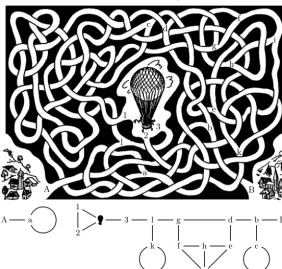
A maze is a good example of a clear picture hidden in a wealth of incidental detail: the tortuous paths of Fig. 6 reduce to a graph which can be taken in at a glance. Autostereograms which require the viewer to stare or to squint in order to see a three-dimensional picture (Fig. 7) are also eminently suitable for concealing images, at least for a while.
1.3 Open Code: Masking 13
Where will the balloon land, A or B?
1 3 2
A B
a
b c d
e f
g
h
i
k l
a A
1
2
l
k
g d
e f h
i
b
c B 3
Fig. 6. Maze and its associated graph
• •
307948125630794812563079481256307948125630794812563079481256307948125630794812 618407329561840732956184032956187403295618403295671840329561840329756184032975 901653287490165328749015326874915032687415093268417509326417850936421785093642 803514967280351496728051349678051234967058123467059812347065981347026598134702 659187230465918723046518972306514897230516489730521648970532164970853216497085 482307195648230719564238071956423807196452380719645238019764523801976452380197 462087513946208751394206875139420687519432068751943206851794320685179432068517 935478016293547801629543701629854370169825370164982537064192537086419253708641 625493817062549381706549382176540938216540973816524097316524809316752480931675 406135879240613587924613508792613450872613945082617394582610739482651073948265 386209754138620975413620897541320689751324068975321406875392140685379214068537 613284750961328475096128347509628134750629813475620981345672098135647209813564 259861304725986130472586193047586219304586721934580672194583067294518306729451 045136792804513679280453671920458367192058346792015834679015283679401528367940 062851479306285147930628547930162854793016854792301685479231685407923168540792 403926587140392658714039265871403926587140392658714039265871403926587140392658
Bernhard Bauer
Fig. 7. Autostereogram
1.3
Open Code: Masking
[image:27.441.80.362.77.345.2]holding a cigarette or scratching one’s head indicates the suit or value of the cards held. A hand on the chest with the thumb extended means “I’m going to take this game. Anybody want to partner me?” The right hand, palm down, on the table means “Yes”, a clenched fist, “No, I’m working single, and I discovered this guy first, so scram!” The French conjurer Robert Houdin (1805–1871) is said to have used a similar system around 1845, with I, M, S, V standing forcoeur,carreau,tr`efle,pique: il fait chaud oril y a du monde
means “I have hearts”, as it starts with /I/. Things were no more subtle in English whist clubs in Victorian days; “Have you seen old Jones in the past fortnight?” would mean hearts, as it starts with /H/. The British team was suspected of exchanging signals at the world bridge championships in Buenos Aires in 1965—nothing could be proved, of course.
Sometimes, a covert message can be transmitted masked in an innocent way by using circumstances known only to the sender and the recipient. This may happen in daily life. A famous example was reported by Katia Mann: In March 1933, she phoned from Arosa in Switzerland her daughter Erika in Munich and said: “Ich weiß nicht, es muß doch jetzt bei uns gest¨obert werden, es ist doch jetzt die Zeit” [I don’t know, it is the time for spring-cleaning]. But Erika replied “Nein, nein, außerdem ist das Wetter so abscheulich. Bleibt ruhig noch ein bissel dort, ihr vers¨aumt ja nichts” [No, no, anyway, the weather is so atrocious. Stay a little while, you are not missing anything here]. After this conversation, it became clear to Katia and Thomas Mann that they could not return to Germany without risk.
Fig. 8. Tramps’ secret marks (GermanZinken), warning of a policeman’s house and an aggressive householder (Central Europe, around 1930)
Secret marks have been in use for centuries, from the itinerant scholars of the Middle Ages to the present-day vagrants, tramps, hoboes and loafers. Figure 8 shows a couple of secret marks, such as could still be seen in a provincial town of Central Europe in the 1930s; Fig. 9 shows a few used in the midwestern United States in the first half of the 20th century. Tiny secret marks are also used in engravings for stamps or currency notes as a distinguishing mark for a particular engraver or printer.
good for a handout bad dog police not hostile town is hostile
not generous stay away police hostile plainclothes detectives here Fig. 9. Hoboes’ secret marks for ‘police not hostile’ and other messages
1.3 Open Code: Masking 15
Languages specific to an occupation or social class, collectively known as jar-gon, above all the kinds used by beggars, vagabonds, and other rascals, vari-ously calledargot(France, USA),cant(UK),thieves’ Latin(UK),rotwelsch
(Germany), fourbesque (Italy), alemania (Spain), or cal˜ao (Portugal), and which serve to shield (and keep intact) a social group, often make use of masking. Masked secret writing is therefore calledjargon code.
The oldest papal code in the 14th century usedEgyptiansfor the Ghibellines, and Sons of Israel for the Guelphs. One French code in the 17th century used jargon exclusively: Jardinfor Rome,La Roze for the Pope,Le Prunier
for Cardinal de Retz,La Fenestre for the King’s brother,L’ ´Ecurie (meaning either stable or gentry) for Germany,Le Roussinfor the Duke of Bavaria, and so on. A simple masking of names was used in a Bonapartist plot in 1831.
The languages of the criminal underworld are of particular steganographic interest. French argot offers many examples, some of which have become normal colloquial usage: rossignol(nightingale) for skeleton key, known since 1406;mouche (fly) for informer (‘nark’ in British slang), since 1389. Alliter-ative repetition is common: rebecca for rebellion,limace (slug) forlime(file), which in turn is fourbesque for shirt; marquise for marque (mole or scar), which in turn is alemania for a girl; fris´e (curly) for Fritz (a popular name for a German). Not quite so harmless are metaphors: chˆateau for hospital,
mitraille (bullet) for small change, or the picturesque but pejorative mar-mite (cooking pot) for a pimp’s girlfriend, and sac `a charbon (coal sack) for a priest. Sarcastic metaphors such as mouthpiece for a lawyer are not confined to the underworld.
Some jargon is truly international: ‘hole’–trou–Lochfor prison; ‘snow’ –neige
–Schnee or ‘sugar’–sucre for cocaine; ‘hot’–heiß for recently stolen goods; ‘clean out’ –nettoyer–abstauben for rob; ‘rock’ –galette –Kohle for money. All kinds of puns and plays on words find their place here. The British ‘Twenty Committee’ in the Second World War, which specialized in double agents, took its name from the Roman number XX for ‘double cross’.
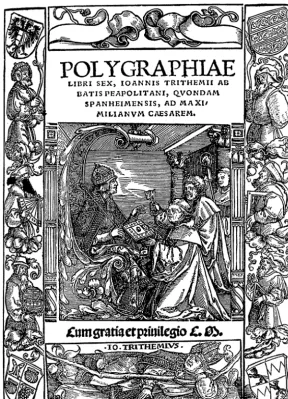
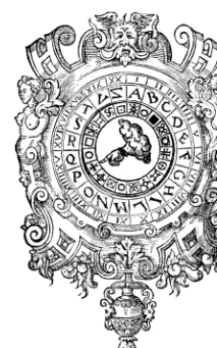
Well-masked secret codes for more or lessuniversaluse are hard to devise and even harder to use properly—the practised censor quickly spots the stilted language. The abbot Johannes Trithemius (1462–1516), in hisPolygraphiæ Libri, six books printed in 1508–1518 (Fig. 10), presented a collection of Latin words as codes for individual letters (Fig. 11), theAve Maria cipher. “Head”, for example, could be masked as “ARBITER MAGNUS DEUS PIISSIMUS”. In fact, there were 384 such alphabets in the first book, to be used successive-ly—a remarkable case of an early polyalphabetic encryption (Sect. 2.3.3).
Fig. 10. Title page (woodcut) of the first printed book on cryptography (1508)
Allegorical language is of little help here. In Louis XV’s diplomatic service, Chevalier Douglas was sent on a secret mission to Russia in 1755 with an allegorical arsenal from the fur trade, withle renard noir ´etait cher for “the influence of the English party is increasing”, le loup-cervier avait son prix
for “the Austrian party (under Bestuchev) retains its dominant influence”. Bestuchev himself, who was friendly to Prussia, was le loup-cervier, while
une peau de petit-gris meant 3000 mercenaries in the pay of the British.
[image:30.441.74.363.62.462.2]1.4 Cues 17
Fig. 11.
The first entries of
Trithemius’Ave Mariacipher
Major-General Kirke—ordered cigars in batches of thousands from Plymouth one day, Portsmouth the next; then Gravesend and so on—1000 coronas stood for one battleship. Their inadequate system brought their lives to a premature end on July 30, 1915. Luck was on the side of Velvalee Dickinson, a Japanophile woman in New York City, who kept up a lively correspondence on broken dolls in 1944. Things came to light when a letter to an address in Portland, Oregon was returned, and the sender’s name turned out to be false. The lady really did sell exquisite dolls from a shop in Madison Avenue. Tech-nical Operations Division, the agency for detecting especially hard to find hid-den messages, and the FBI managed to produce evihid-dence for the prosecution, but she got away with ten years in prison and a $ 10 000 fine. In the Audrey Hepburn movie of 1961Breakfast at Tiffany’s, Miss Holly Golightly spent a night behind bars because she helped a gangster conduct his cocaine dealer-ship from his prison cell by means of “weather reports”—it did occur to her, she admitted, that “snow in New Orleans” sounded somewhat improbable.
1.4
Cues
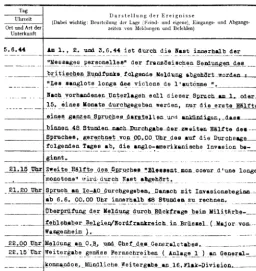
The most important special case of masking, i.e., of a jargon-code message, concerns the use of a cue (French mot convenu), a prearranged phrase or verse to mean a particular message. The importance of the message is linked to the time of transmission; the message serves as an alarm or acknowledge-ment. Large numbers of messages were broadcast by the BBC to the French
Fig. 12. Extract from a log kept by the 15th Army’s radio reconnaissance section (Lt. Col. Helmuth Meyer, Sgt. Walter Reichling).
Here,autommeis to be readautomne,longeuris to be readlangueur
explained to this day the alarm did not reach the 7th Army, on whose part of the coast the invasion took place within 48 hours, on June 6, 1944.
The Japanese used a similar system in 1941. For example, HIGASHI NO KAZE AME (east wind, rain), inserted into the weather report in the over-seas news and repeated twice, was used to announce “war with the USA”. The US Navy intercepted a diplomatic radio message to that effect on Novem-ber 19, 1941 and succeeded in solving it by the 28th. As tension mounted, numerous reconnaissance stations in the USA were monitoring Japanese ra-dio traffic for the cue. It came on December 7th—hours after the attack on Pearl Harbor—in the form NISHI NO KAZE HARE (west wind, clear), indicating the commencement of hostilities with Britain, which came as very little surprise by then. Perhaps the whole thing was a Japanese double cross.
Technically, masked secret writing shows a certain kinship with enciphered secret writing (Sect. 2.2), particularly with the use of substitutions (Chap. 3) and codes (Sect. 4.4).
1.5 Open Code: Veiling by Nulls 19
somehow embedded in the open, harmless-looking message by adding nulls. In order to be able to reconstruct the real message, the place where it is concealed must be arranged beforehand (concealment cipher). There are two obvious possibilities for using garbage-in-between (Salomaa): by specifying rules (null cipher, open-letter cipher) or by using a grille (French for ‘grat-ing’).
1.5
Open Code: Veiling by Nulls
Rules for veiled messages are very often of the type “thenth character after a particular character”, e.g., the next letter after a space (“family code”, popular among soldiers in the Second World War, to the great displeasure of the censors); better would be the third letter after a space, or the third letter after a punctuation mark. Such secret messages are called acrostics. A practised censor usually recognizes immediately from the stilted language that something is amiss, and his sharp eye will certainly detect what ˘
PRESIDENT’S ˘EMBARGO ˘RULING ˘SHOULD ˘HAVE ˘IMMEDIATE ˘
NOTICE. ˘GRAVE ˘SITUATION ˘AFFECTING ˘INTERNATIONAL ˘LAW. ˘
STATEMENT ˘FORESHADOWS ˘RUIN ˘OF ˘MANY ˘NEUTRALS. ˘YELLOW ˘
JOURNALS ˘UNIFYING ˘NATIONAL ˘EXCITEMENT ˘IMMENSELY means—a message intercepted in the First World War.
If necessary, it can help to write out the words one below the other: ↓
I N S P E C T D E T A I L S F O R
T R I G L E T H A C K N O W L E D G E T H E
B O N D S F R O M F E W E L L
The disguise falls away; the plain text “jumps out of the page”.
Sir John Trevanion, who fought on the Royalist side against Oliver Cromwell (1599–1658) in the English Civil War, saved himself from execution by using his imagination. In a letter from his friend R. T. he discovered the message “panel at east end of chapel slides”—and found his way out of captivity (Fig. 13).
Worthie Sir John: — Ho˘pe, th˘at is ye beste comfort of ye afflicted, ca˘nnot much, I f˘ear me, he˘lp you now. Th˘at I would saye to you, is ˘this only: if ˘
ever I may be able to requite that I do owe you, st˘and not upon asking me. ’Ti˘s not much that I can do: bu˘t what I can do, be˘e ye verie sure I wille. I k˘nowe that, if ˘dethe comes, if ˘ordinary men fear it, it ˘frights not you, ac˘counting it for a high honour, to ˘have such a rewarde of your loyalty. Pr˘ay yet that you may be spared this soe bitter, cu˘p. I f˘ear not that you will grudge any sufferings; on˘ly if bie submission you can turn them away, ’ti˘s the part of a wise man. Te˘ll me, an ˘if you can, to ˘do for you anythinge that you wolde have done. Th˘e general goes back on Wednesday. Re˘stinge your servant to command. — R. T.
Fig. 13. Message to Sir John Trevanion:panel at east end of chapel slides (third letter after punctuation mark)
Acrostics have also been used to conceal slogans. The nationalistic Austrian mathematician Roland Weitzenb¨ock, in the preface to his book Invarianten-theorie(Groningen 1928), wrote “nieder mit den Franzosen” as an acrostic.
The technique of acrostics even found its way into belletristic literature. In the classical acrostic, it was the initial letters, syllables, or words of succes-sive lines, verses, sections, or chapters which counted. Words or sentences (Fig. 14) were enciphered in this way, also author’s names, and even the addressee of invectives: ‘The worst airline’, ‘Such a bloody experience never again’. Acrostics also served as an insurance against omissions and insertions: an early example of the present-day parity checks or error-detecting codes.
In a similar way, the chronogram conceals a (Roman) numeral in an inscrip-tion; usually it is a date; for example, the year when the plaque was erected: In the baroque church of the former Cistercian monastery F¨urstenfeld near Munich, in 1766 a statue of the Wittelsbachian founderLudwig der Strenge
(1229–1294) was placed, below which there is a tablet with the chronogram LVDoVICVs seVerVs DVX baVarVs aC paLatInVs,
hIC In sanCta paCe qVIesCIt .
(Ludwig the Severe, Duke of Bavaria and Count Palatine, rests here in holy peace.)
If the chronogram consists of a verse, then the technical term is a chrono-stichon—or chronodistichon for a couplet.
Composers have concealed messages in their compositions, either in the notes of a musical theme (a famous example2is B A C H), or indirectly by means of a numerical alphabet: if thei-th note of the scale occursktimes, then thek-th letter of the alphabet is to be entered in thei-th position. Johann Sebastian Bach was fond of this cipher; in the theme of the organ chorale ‘Vor deinen Thron’, written in 1750 in the key of G major, g occurs twice (B), a once (A), b three times (C), and c eight times (H).
Nulls are also used in many jargons: simply appending a syllable (parasitic suffixing) is the simplest and oldest system. In French, for example,
1.5 Open Code: Veiling by Nulls 21
floutiereforflou, argot for ‘go away!’; girolle for gis, argot for ‘yes’;
mezis forme; icicaille forici
and there are hundreds of similar forms. Cartouche (18th century) has
vousi
¯e¯¯rg¯e¯trouva¯¯i¯l¯le bono¯¯rg¯u¯e¯ce gigotm¯¯ou¯¯ch¯¯e where the nulls are underlined.
Fast writing method
He must have had a special trick, said Robert K. Merton, for he wrote such an amazing quantity of material that his friends were simply astonished at his prodigious output of long manuscripts, the contents of which were remarkable and fascinating, from the first simple lines, over fluently written pages where word after word flowed relentlessly onward, where ideas tumbled in a riot of colorful and creative imagery, to ends that stopped abruptly, each script more curiously charming than its predecessors, each line more whimsically apposite, yet unexpected, than the lines on which it built, ever onward, striving toward a resolution in a wonderland of playful verbosity. Fuller could write page after page so fluently as to excite the envy of any writers less gifted and creative than he. At last, one day, he revealed his secret, then died a few days later. He collected a group of acolytes and filled their glasses, then wrote some words on a sheet of paper, in flowing script. He invited his friends to puzzle a while over the words and departed. One companion took a pen and told the rest to watch. Fuller returned to find the page filled with words of no less charm than those that graced his own writings. Thus the secret was revealed, and Fuller got drunk. He died, yet still a space remains in the library for his collected works.
Ludger Fischer / J. Andrew Ross
Fig. 14. Self-describing acrostic
Tut Latin, a language of schoolchildren, inserts TUT between all the sylla-bles. Such school jargons seem to be very old; as early as 1670 there are reports from Metz (Lorraine) of a ‘stuttering’ system, where, for example,
undreque foudreque stood forun fou.
The Javanais language is also in this class:
ja
¯¯ve forje; la¯¯vebla¯¯vanc forle blanc; na¯¯von fornon; cha
¯¯vaussa¯¯vura¯¯ve forchaussure.
Other systems use dummy syllables with duplicated vowels, such as B talk in German:
GAB
¯A¯RTEB¯E¯NLAUB¯A¯U¯BEB¯E¯ for gartenlaube(bower) or Cadogan in French:
CAD
¯G¯A¯DOD¯G¯O¯GAD¯G¯A¯N for cadogan.
Fig. 15.
Poem in theBilanguage by Joachim Ringelnatz
Simple reversing of the letters, called back slang, occurs in cant:OCCABOTfor ‘tobacco’, KOOL for ‘look’, YOB for ‘boy’, SLOP for ‘police’. Permutation of the syllables is found in the FrenchVerlan (froml’envers): NIBERQUEfor
bernique (“nothing doing”, said to be related tobernicles, tiny shells); LON-TOUforToulon, LIBRECAforcalibre (in the sense of a firearm);DREAUPER for perdreau (partridge, to mean a policeman); RIPOU for pourri (rotten); BEURforrebeu (Arab). More recent are F ´ECAforcaf´e,T ´ECIforcit´e. More complicated systems involve shuffling the letters, i.e., a transposition (Sect. 6.1). Criminal circles were the origin of the Largonji language:
leud´efordeux [francs]; linv´eforvingt[sous]; laranqu´eforquarante[sous]; with the phonetic variants
linspr´e forprince (Vidocq, 1837); lorcef´eeforLa Force, a Paris prison; and of the Largonjem language:
lonbemfor bon (1821); loucherbem for boucher; olrapemfor op´era(1883).
The name Largonji is itself formed in this way from ‘jargon’.
A variant with suppression of the initial consonant is the Largondu language:
lavedu for cave; loquedu for toque; ligodu for gigo(t). Similar formation rules lie behind the following:
locromuche for maquerau (pimp) ; leaubiche for beau;
nebdutacfor tabac (1866); licelargu for cigare (1915).
These systems also have parallels in East Asia (Hano¨ı, Ha¨ıphong). Pig Latin, another school language, puts AY at the end of a cyclically permu-ted word: third becomesIRDTHAY. Cockneys have a rhyming slang with nulls: TWIST AND TWIRLforgirl,JAR OF JAMfortram,BOWL OF CHALKfortalk, FLEAS AND ANTSforpants, APPLES AND PEARS forstairs,BULL AND COW forrow, CAIN AND ABEL for table, FRANCE AND SPAIN for rain, TROUBLE AND STRIFE forwife, PLATES OF MEAT forfeet, LOAF OF BREADfor head. The actual rhyming word is usually omitted—the initiated can supply it from memory. Some of these expressions have entered the language (lexical-ization): few people are aware of the origin of “use your loaf” or “mind your plates”.
1.6 Open Code: Veiling by Grilles 23
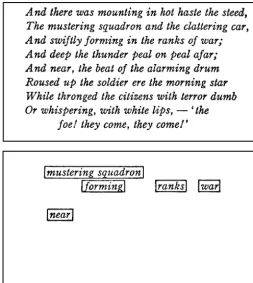
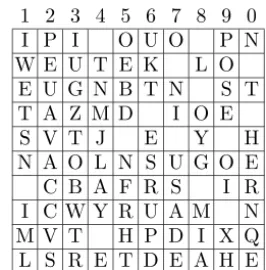
Fig. 16. Lord Byron’s hypothetical message
1.6
Open Code: Veiling by Grilles
The method of the grille, which goes back to Geronimo Cardano (in De Subtilitate, 1550, is simple to understand, but suffers from the disadvantage that both sides must possess and retain the grille—in the case of a soldier in the field or a prisoner, not something that can be taken for granted. It is also awfully hard to compose a letter using it. If Lord Byron (1788–1824)— admittedly no ordinary soldier—had used the method, his talents would have come in extremely handy for composing a poem such as that in Fig. 16. He would presumably also have been able to lay it out so attractively that the plain text fitted the windows of the grille without calling attention.
[image:37.441.91.344.63.345.2]Veiled secret writing is a concealment cipher. In professional use, it is usually considered as enciphered secret writing (Sect. 2.2), it shows a certain kinship particularly in the use of nulls (Sect. 2.3.1) and of transposition (Sect. 6.1.4).
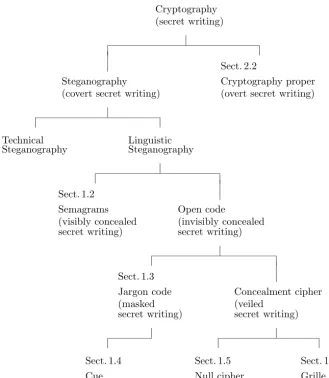
Cryptography (secret writing)
|
| |
|
| Sect. 2.2
Steganography Cryptography proper
(covert secret writing) (overt secret writing)
|
| |
Technical Linguistic
Steganography Steganography
|
| ||
Sect. 1.2 |
Semagrams Open code
(visibly concealed (invisibly concealed secret writing) secret writing)
|
| ||
Sect. 1.3 |
Jargon code Concealment cipher
(masked (veiled
secret writing) secret writing)
| |
| | |
Sect. 1.4 Sect. 1.5 Sect. 1.6
Cue Null cipher Grille
Fig. 17. Classification of steganographic and cryptographic methods
1.7
Classification of Cryptographic Methods
Figure 17 shows a diagrammatic summary of the classification of methods of steganography and cryptography proper as given in this and the next chapter.
[image:38.441.57.386.115.493.2]