The World Wide Military
Command and Control System
Evolution and Effectiveness
DAVID E. PEARSON
Air University Press Maxwell Air Force Base, Alabama
June 2000
Library of Congress Cataloging-in-Publication Data Pearson, David E. (David Eric),
1953-The world wide military command and control system: evolution and effectivenss / David E. Pearson.
p.cm.
Includes bibliographical references and index. ISBN 1-58566-078-7
1. Worldwide Military Command and Control System-History. I. Title.
UB212.P432000 355.3'3041 '0973-dc21
Disclaimer
99-462377
Chapter
1
2
3
4
5
6
Contents
DISCLAIMER
DEDICATION
ABOUT THE AUTHOR .
PREFACE . . .
INTRODUCTION Notes . . . .
PART I
Conceptualization
Centralizing the Defense Establishment Notes . . . .
Defense Communications Agency and System Notes . . . .
National Military Command System . Notes . . .
WWMCCS Is Born . . . . Notes . . . .
Three WWMCCS Failures Notes . . .
PART II
Formalization
WWMCCS Automatic Data Processing Upgrade . Notes . . . .
Page
ii
iii
be
xi
xiii
XX
3 17
19 31
33 49
51
69
71
91
95
Chapter Page
7 Centralizing Communications Management 117
Notes 134
8 The WWMCCS Council and the Modem
WWMCCS Structure . 137
Notes 159
9 The WWMCCS Architect and Architecture 163
Notes 182
10 WWMCCS Intercomptiter Network 185
Notes 196
11 The Carter Administration and the Evolutionary
Approach 199
Notes 215
12 Crises and Criticisms 219
Notes 239
13 Failures at NORAD 241
Notes 255
PART III
Implementation
14 Strategic Modernization . 259
Notes 271
15 The C3I Triad: Programs . 281
Notes 298
16 WWMCCS Information System 301
Notes 312
17 Defense Centralization 315
Notes 329
18 Defense Communications and the End
of the Cold War 331
Chapter 19 Figure 1 2 3 4 5 6 7 8 9 10 11
Organization, Technology, and Ideology in Command and Control
Notes . .
EPILOGUE.
INDEX . . .
mustrations
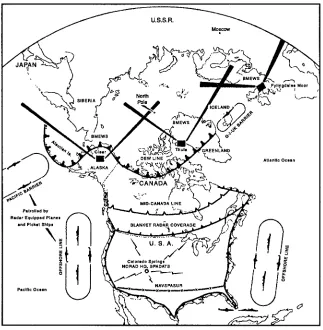
The Early Array of Sensors and Sentinels Forwarding Information to NORAD
Headquarters . . . .
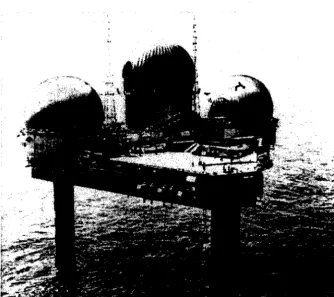
Cold War Vigilance: Texas Tower Offshore Radar Platform. . . . .
SAC's Underground Command Post.
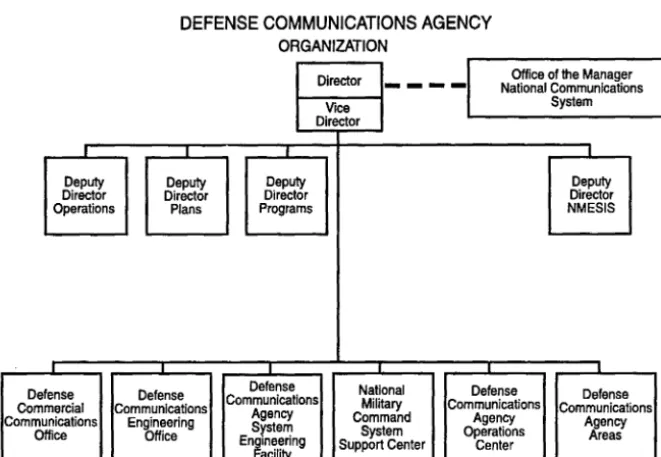
Defense Communications Agency
AUTOSEVOCOM Switches
NMCS Personnel in Action .
USS Northampton, National Emergency Command Post Afloat . . . .
Artist's Conception of the National Military Command System . . . .
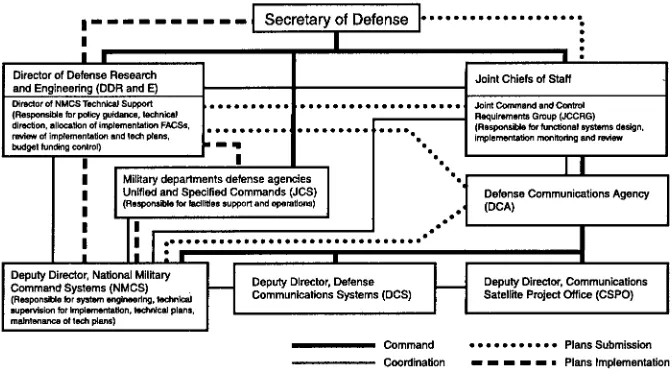
Responsibilities for Implementing the National Military Command System .
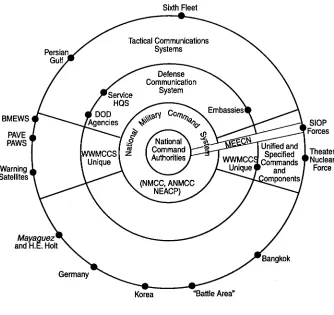
Conceptualizing a Command and Control System . . . .
The National Communications System, Encompassing All Federal Assets . . .
Page 343 358 363 377 108 109 110 110
III
III
112 112 113 113 114Chapter Page
13 Conception ofWWMCCS System Architecture,
Given Revised DODD 5100.30 . . 273
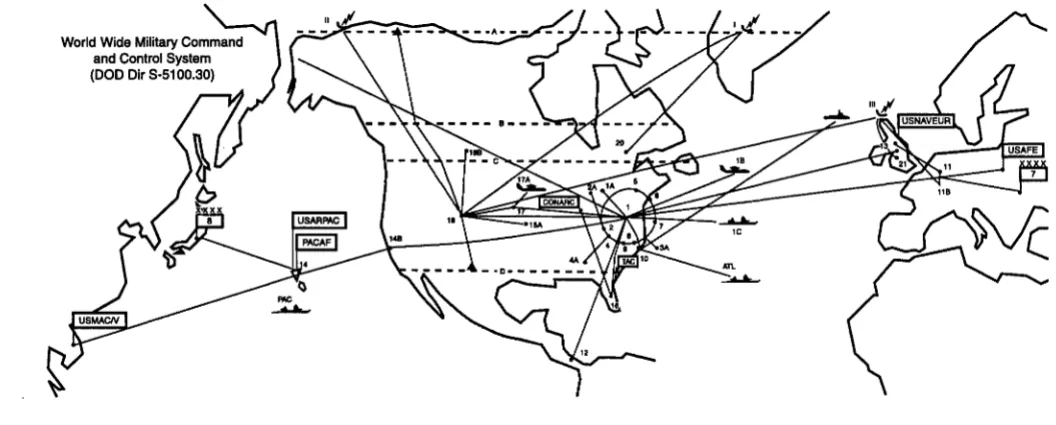
14 WWMCCS System Relationships 274
15 The Elements ofWWMCCS
...
27516 PWIN Initial Three-Node Configuration 276
17 WIN Configuration in the Early 1980s . 277
18 New Organizational Structure for Defense
Communications Agency
. . .
27819 NORAD's Missile Warning System. . . 279
20 Communications System Segment Connections 279
About the Author
David E. Pearson, an Anny veteran, graduated magna cum
laude from the University of Massachusetts at Amherst, received his PhD from Yale University, and was a Fellow in
Preface
Let me begin by saying what this book is not. It is not the same as the books previously written on command and control by Paul Bracken, Bruce Blair, C. Kenneth Allard, or others. The World Wide Military Command and Control System (WWMCCS) is constituted of four general types of elements: sensors, com-mand posts, computers, and communications networks. Whereas previous books dealt mainly with the fIrst two types, this book is concerned far more strongly with the second two. Nor has any previous writer dealt with WWMCCS comprehen-sively. Allard, for instance, devotes only about two pages to WWMCCS, Blair refers to it on but three occasions, and Bracken does not mention it at all. Here, addressing what the system is and how it got that way are central concerns, and attention is paid to a number of key system factors and elements that re-ceived almost no attention in these earlier works.
This book is also not another study of cold war deterrence, nor is it an examination of the (hypothesized) interactivity be-tween the American and Soviet command and control systems under conditions of crisis or war.
Perhaps the best single way to summarize it is to view the book as a bureaucratic or organizational history. What I do is to take three distinct historical themes-organization, technol-ogy, and ideology-and examine how each contributed to the development of WWMCCS and its ability (and frequent inabil-ity) to satisfy the demands of national leadership. Whereas earlier works were primarily descriptive, cataloguing the com-mand and control assets then in place or under development. I offer more analysis by focusing on the issue of how and why WWMCCS developed the way it did. While at first glance less provocative, this approach is potentially more useful for de-fense decision makers dealing with complex human and tech-nological systems in the post-cold-war era. It also makes for a better story and, I trust, a more interesting read.
potentially so expansive, that a full treatment is impossible within the compass of a single volume. Indeed, a full treatment of even a single WWMCCS asset or subsystem-the Defense Satellite Communications System, Extremely Low Frequency Communications, the National Military Command System, to name but a few-could itself constitute a substantial work. In its broadest conceptualization, WWMCCS is the world, and my approach has been to deal with the head of the octopus rather than its myriad tentacles.
Introduction
In the late 1970s, in response to a lengthy series of failures and snafus in various components of the Defense Depart-ment's World Wide Military Command and Control System (WWMCCS; pronounced "wimex"), a remarkable and rather unlikely team of consultants was assembled at the Pentagon. Their job was to try to figure out how to make the vast, multi-billion dollar metasystem of sensors, command centers, and communications links work better. The group included 30 an-thropologists and sociologists, mathematicians, control theo-rists and systems theotheo-rists, and representatives from a variety of other scholarly disciplines-"academics with a philosophical bent," as one writer described them. In a series of meetings with a similarly sized group of defense experts, the academics
\
considered ways to deal with WWMCCS's many problems. All sorts of recommendations were offered up, but, according to one of the consultants, conspicuously lacking was any "critical examination of the dominant paradigm which condones the expenditure of vast resources without even a semblance of a conceptual rationale for the effort."l
The Pentagon's concern with command and control effective-ness was soon complemented by the concerns of defense ana-1ysts outside the government. By the early 1980s, these analysts were pointing out how such traditional measures of effectiveness as number of warheads, throw weights, damage expectancy, and surviving equivalent megatonnage tended to selectively focus at-tention on only a few critical aspects of the strategic balance. They pointed out that while the defense literature contained an abundance of missile duels, it offered far fewer "serious inquiries into the organizational, human, and technical requirements for minimal, essential command and control."2 They noted that while the centrality of command and control in the implementa-tion of US strategiC policy was everywhere impliCit, plans seldom reflected key vulnerabilities and real-world system limitations.
Numerous efforts were made throughout the remainder of the 1980s to identify the key concepts in this area to evolve unambiguous measures of effectiveness for WWMCCS. The re-sult was an increasingly elaborate lexicon for articulating what is meant by command and control effectiveness-elaborate, but still far from adequate. Many of the terms that came to be incorpo-rated into this burgeoning conceptual list, such as standardiza-tion or end-to-end security, were superficial and far from self-explanatory, and the requirement for them by no means self-evident.3 The diversity and complexity of the concepts was
great, and thus revealing. Rather than serving as an indicator of greater understanding, the proliferation of tenebrous terminol-ogy could be interpreted as something quite different, perhaps as nothing so much as a signal indicator of incomprehensibility and unmanageable complexity. 4
Amidst the confusion there were naturally some areas of con-sensus. Among the generally agreed-upon criteria of effective-ness that eventually emerged within the defense community, it was held that command and control systems should be
and assets, led to major problems when the services were called upon to work together in joint operations.5 Next, the
systems should be responsive, able to provide rapid, direct connections and real-time relays whenever necessary with adequate capacity. The systems must be flexible, able to meet changing requirements in a dynamic environment. This in turn suggests that they should be survivable in case of attack, to be accomplished by emphasizing reconstitution of assets, redundancy, and design of command nodes and communica-tions links. That is, effective systems should permit an assess-ment of friendly and adversary residual capabilities in a post-attack environment, and allow for variable response options. Indeed, the Reagan administration's strategic modernization program of the early 1980s specifically highlighted the require-ment that command and control systems be as survivable as the weapons they supported.6 Given that conflicts might
per-sist for some time, effective systems should also be endurable, degrading gradually rather than experiencing catastrophic fail-ure under conditions of stress and damage. They must be reliable, able to perform acceptably with imperfect information and under severe time constraints. Finally, they must be able to provide secure linkages between users under a wide range of conditions. 7
It all sounded fine, but as soon as these concepts were considered in the context of WWMCCS, their meanings be-came problematical and contextual. Take, for example, the apparently unambiguous criterion of survivability. Since re-sources are not infinite, it might well be appropriate for some WWMCCS elements to be designed to function only in peace-time. Others might need to deal with minor emergencies, while others might have to function through major conventional war. Still others might have to function during a tactical nuclear war or throughout and even subsequent to a strategic nuclear exchange. Which systems should be made more or less surviv-able? How should this best be accomplished? Precisely who should make these determinations? The answers that were offered often depended upon nothing so much as who was asked the question.
appli-cable measures of effectiveness. But in the real world in which WWMCCS programs were conceived and developed-one of
multiple users. competing organizational subunits. goal dis-sensus. budgetary constraints. and a context of rapid techno-logical change-consensus was difficult to achieve. Absent agreement on specific definitions. the meaning of such con-cepts as survivability. reliability. or any of the others became possible only on a fairly general rhetorical level; that is. they became official goals. necessarily lacking specific human or technological referents to what the system was supposed to accomplish.8 Who. after all, could possibly disagree with the
general proposition of having more SUrvivable. reliable. or flex-ible systems for the command and control of America's mili-tary forces? But in practice. such measures were frequently little more than sophisticated sloganeering of a politically ex-pedient sort. In the end. these terms offered little gUidance for determining whether the World Wide Military Command and Control System was an effective system. under what condi-tions. and from whose point of view.
Problems with properly conceptualizing effectiveness were hardly unique to WWMCCS. Among organizational analysts. interest in effectiveness had been persistent; it had also been persistently frustrated by a similar conceptual ambiguity.9 Since the 1960s numerous highly divergent models of effec-tiveness had been advanced. Almost as qUickly as they ap-peared. they were subjected to pointed criticism by writers who viewed their assumptions as either dubious or of limited applicability. It was pointed out in the mid-1960s that most of what had been written on the topic was highly judgmental, filled with advice that "seems sagaciOUS but is tautological and contradictory."10 But despite the doubts. the theoretical impor-tance of the concept ensured an ongOing effort to promulgate an acceptable operational definition. And not without reason; after all. effectiveness represents the ultimate dependent vari-able in any organizational analysis.l1
of the 1970s, efforts to come to grips with the concept had reached an apparent intellectual impasse. It was recognized that the many shortcomings of effectiveness research were at-tributable to the fact that the concept being addressed was ambiguous in the extreme. Two analysts lamented in summing up the state of the literature, "There are no definitive theories. There is no agreement on a definition for organizational effec-tiveness; the number of definitions varies with the number of authors who have been preoccupied with the concept."13
Three principal themes, or, perhaps better said, historical streams of action appear to have governed the development of WWMCCS. They are summarized by such terms as technology, organization, and ideology. Technological changes throughout the cold war dramatically altered the nature of warfare, and technological push would be a defining process in the develop-ment of defense systems, including WWMCCS. These changes in turn necessitated changes in organization, in particular the movement toward a more centralized defense management structure-something actively resisted by a number of power-ful defense constituencies, most notably the military services. To allay doubts and overcome resistance, considerable author-ity for WWMCCS's development was ceded to the services, who proceeded to define system requirements in ways genial to their interests-a sort of technological "user pull."17 Thus, from the outset WWMCCS has been a "subunit-dominated organi-zation," emphasizing the services' needs and requirements over those of other elements, over the interests of the system as a whole, and, not infrequently, over the national interest.
A sense of WWMCCS's subunit-dominated character, of its fundamental ambiguity and fractiousness, was captured well by a former deputy director for defense research and engineer-ing who, in the mid -1960s, pointed out: "We are talkengineer-ing about a picture which is constantly changing in different ways-in the functions performed, the people performing, and the equipment being used."18 It was apparent at the end of that decade in the remarks of a House Military Operations Sub-committee staff administrator who exclaimed to the director of one WWMCCS subunit, "You have so many systems here, no wonder you need a systems engineering analysis setup."19 It
when it was pointed out that things were so nebulous that no one could be found who had a thorough general under-standing of the program. The difficulties with defining what is meant by WWMCCS are perhaps best summed up in the re-peated references to it throughout the years as a "loosely knit federation," "more of a federation of systems than a single system," a "federation of subsystems," and various similar characterizations.
This condition of rampant organizational suboptimization was validated and ultimately institutionalized by the "evolu-tionary approach," an increasingly pervasive ideology within defense circles asserting that command and control system development is best conducted incrementally, by system subunits; and the reason it gained such wide currency prob-ably lies more in its bureaucratiC utility than in its ability to create an optimal system for command and control. Those interested in maintaining a decentralized defense status quo embraced the approach because it maintains that the deci-sion-making process is situationally contingent and unknow-able in advance. Centralized decision makers thus cannot ade-quately specify the sorts of information they require, with whom they might need to communicate, or precisely what type of system best suits their needs. In light of this ignorance at the center, the logical course of action is to devolve authority toward the periphery, thus providing greater flexibility for sys-tem development to lower-level syssys-tem subunits. Thus the services, fully cognizant of the defensewide trend toward greater centralization and acutely sensitive to the loss of autonomy and authority it portended, perceived in the evolu-tionary approach a way to maintain some (though surely not all) of their earlier autonomy and authority. Unable to stop the juggernaut of defense centralization, they saw in the
evolution-ary approach a way to make the most out of a bad situation. Branch offices of the secretary of defense they would not be, and, by embracing it, they were able in substantial measure to co-opt the development of WWMCCS in ways they considered advantageous.
might be expected to vigorously oppose any centralizing initia-tive. Whatever the other merits or liabilities of this approach, it appears to have held a certain Machiavellian appeal to the proponents of greater centralization (at least initially) because, as with the services, it was perceived as a way to advance their interests. But as things turned out, it also represented the classic deal with the devil, for the price paid by the centralizers turned out to be disproportionately high. Adopting the evolu-tionary approach certainly helped to diminish service resis-tance; but the price ultimately paid was nothing less than the very soul of the centralized WWMCCS concept.
The historical lack of any organizational center of gravity for WWMCCS and the serious lack of coordination between its constituent elements resulted in a multiplicity of problems and occasionally major failures when the system was called upon to function in coordinated, joint-service fashion. Focusing on process rather than on result, emphasizing what the sociolo-gist Max Weber called formal rather than substantive rational-ity, WWMCCS's subunit-dominated structure and the evolu-tionary approach that validated it thus set the stage for an ongoing series of falls. Those who enjoy ironies may find this one especially deliCious: the same conditions that cleared the way for the establishment of WWMCCS and that permitted its subsequent growth simultaneously guaranteed that it would not be able to function effectively. In structural terms, we might conclude that the World Wide Military Command and Control System was born to fail. The remainder of this work documents how this interplay of organization, technology, and ideology shaped the development of WWMCCS during the cold war's three fmal tense decades.
Notes
1. William J. Broad, "Philosophers at the Pentagon," Science 210 (24 October 1980): 409, 412.
2. Garry D. Brewer and Paul Bracken, "Some Missing Pieces of the C31
Puzzle," unpublished manuscript, Yale University, 1983.
3. Van C. Doubleday, "WWMCCS in Transition: An Air Force View," Signal 30 (August 1976): 71.
5. "Standardization: The Key to Increasing the Effectiveness of Tactical C&C," Armed Forces Management, July 1967,44.
6. House, Committee on Armed Services, Strategic Force Modernization Program, 97th Cong., 1st sess., 1981 (Washington, D.C.: Government
Printing Office [hereafter cited as GPO], October/November 1981), 211. 7. General Accounting Office, The World Wide Military Command and Control System-Major Changes Needed in its Automated Data Processing Management and Direction, Report to the Congress, LCD-80-22 (Washington, D.C.: GPO, 14 December 1979), 15-19.
8. Charles Perrow, "The Analysis of Goals in Complex Organizations,"
American Sociological Review 26, no. 4 (December 1961): 855.
9. Richard M. Steers, "Problems in Measurement of Organizational Effectiveness," Administrative SCience Quarterly, 1975, 20.
10. Daniel Katz and Robert L. Kahn, The Social Psychology of Organizations (New York: Wiley, John, and Sons, Inc., 1966), 149.
11. Richard H. Hall, "Effectiveness Theory and Organizational Effectiveness," Journal of Applied Behavioral Science 16 (1980): 536.
12. Jeffrey Pfeffer and Gerald R. Salancik, The External Control of Organizations: A Resource Dependence Perspective (New York: Harper & Row, 1978),8.
13. Paul S. Goodman and Johannes M. Pennnings, "Perspectives and Issues: An Introduction," in New Perspectives on Organizational Effectiveness, ed. Paul S. Goodman and Johannes M. Pennings (San Francisco: Jossey-Bass, 1977), 1-12.
14. Kim S. Cameron, "Effectiveness as Paradox: Consensus and Conflict in Conceptions of Organizational Effectiveness," Management Science 32,
no. 5 (May 1986): 539-40.
15. Renee R. Anspach, "Everyday Methods for Assessing Organizational Effectiveness," Social Problems 38, no. 1 (February 1991): 2.
16. Hall, 245.
17. Blue Ribbon Commission on Defense Management, A Quest for Excellence: Final Report to the President (Washington, D.C.: GPO, 1986),45.
18. "Dr. Fubini Stresses DDR&E's Desire for System Compatibility,"
DATA (February 1965): 9.
19. House, Committee on Government Operations, Military Commun-ications-1968, 90th Congo 2d sess. (Washington, D.C.: GPO, 1968),6.
20. "Defense Communications Agency-The Future: Analog to Digital,"
Armed Forces Management, October 1968,154.
21. House, Armed Services Investigating Subcommittee, Committee on Armed Services, Review of Department of Defense Worldwide Communications, Phase I, 92d Cong., 1st sess. (Washington, D.C.: GPO, May
PART I
Chapter 1
Centralizing the Defense Establishment
During the course of World War II, the development of mili-tary communications tended in a specific direction-toward systems that were common user. The phrase denotes general-purpose systems-those that serve the needs of a host of users at a number of geographic locations and can send message traffic of all types and precedences. The reasons for the war-time growth of this type of system are not difficult to appreci-ate. The global scale and rapid pace of the conflict necessitated large-scale coordination within the armed forces as well as between our forces and those of our Allies. Good communica-tions naturally were vital to this coordination, and common-user systems, with their associated networks of tape relay cen-ters and tributary stations, promised precisely the sort of flexibility that the exigencies of global war required.l
Con-versely, communications systems that were "dedicated" to a single use or user were frequently viewed as inherently limited and inflexible.
While common-user systems had their advantages, they were not universally lauded, and the reasons were equally easy to understand. Many users, notably the military services, were unhappy with them precisely because they were designed to serve the communications needs of others and were thus not fully under one's own control. In other words, common-user systems necessitated accommodation, and this was Viewed as undeSirable. ConSider that within a common-user system the message's precedence level determines how rapidly it will be processed. Precedence level makes eminent sense in the abstract, but in a world characterized by bureaucratic pa-rochialism, problems predictably arose. The messages of some users, especially those transmitting large volumes of lower precedence traffic, suffered substantial delays at times of heightened communications activity. Such delays being ad-judged intolerable, there ensued an inflation of messages'
THE WORLD WIDE MILITARY COMMAND AND CONTROL SYSTEM
time-sensitive messages requiring immediate transmission were slowed down because large quantities of precedence-in-flated traffic were choking the system.
Following the conclusion of World War II and the emergence of the United States as the preeminent global power, the mili-tary services assumed worldwide responsibilities commensu-rate with the nation's new role. Requiring worldwide commu-nications capabilities, yet viewing the wartime regime of common-user systems as inherently inimical to their interests, the services began to develop sets of dedicated communica-tions networks to meet their own unique, mission-specific re-qUirements.2 Before long a whole new communications
doc-trine began to crystallize around the distinction between dedicated and common-user communications systems and technologies. 3
Despite the apparent decentralizing tendency, the need to create a centralized command structure was also recognized early in the postwar period, at the time the National Security Act of 1947 formally reorganized the defense establishment. The act constituted the Air Force as a separate military depart-ment. The secretary of war was replaced by a secretary of defense, who sought to exercise general direction, authority, and control over the three military departments and to serve as the principal assistant to the president in national security matters.4 The Joint Chiefs of Staff (JCS), established earlier as the supreme military body for directing the Allied war effort, was provided a statutory basis and deSignated the principal military advisor to the secretary of defense and the president. These new organizations, offices, and departments reflected the war's lel?sons and insights, preeminently that the advent of revolutionary new weapons had rendered earlier concepts of separate ground, sea, and air warfare obsolete and that future conflicts would involve joint rather than separate operation of forces.5
CENTRALIZING THE DEFENSE ESTABLISHMENT
constituencies within the defense establishment were pre-served. The reason for compromise was simple and thoroughly pragmatic: without such concessions, the powerful groups, notably the services, would not support the act. Thus, the National Security Act was less a revolutionary mandate for change than it was a synthesis of the old and the new-a "compromise between the friends and foes of centralization," as one observer phrased it.6
The compromise, such as it was, was hardly symmetrical. During the lengthy debates preceding the reorganization, tra-ditionalists frequently held sway over those promoting greater Unification, and hence centralization, in defense decision mak-ing. While the act gave the secretary of defense formal author-ity over the defense establishment, the latitude for action was circumscribed by a provision giving the service secretaries the authority to separately administer their respective depart-ments. This provision included, perhaps more importantly, authority over budgetary matters, an arrangement that in practice would decentralize not only day-to-day operational authority to the military departments but practically all true authority as well. The result was that the secretary of defense and his small staff were soon held hostage to the three mili-tary services, with their separate secretaries and extensive staffs, which retained the status of individual executive de-partments. The JCS, lacking a formal chairman and unable to reallocate basic service combat roles and missions-a preroga-tive of the strongly service-partisan Congress-was powerless as well, able to do little more than attempt to adjudicate in-terservice conflictS.7 Nonetheless, this decentralized national military establishment, described later by President Dwight D. Eisenhower as "little more than a weak confederation of sover-eign military units,"8 represented a tentative first step toward greater centralized control of the military.
TIlE WORLD WIDE MILITARY COMMAND AND CONTROL SYSTEM
cabinet-rank officials, to subordinate military departments represented in the cabinet and National Security Council by the secretary of defense alone. The amendments authorized the appointment of a JCS chairman, senior in rank to all other officers, to replace the existing post of chief of staff to the commander in chief. The size of the Joint Staff was more than doubled.9 It appeared that the forces of centralization were well
on the way to achieving ascendancy.
The amendments also introduced into law a series of well-intentioned legal checks and balances against possible abuses of military power that effectively blocked any genuine efforts at unification, and hence centralization of control. The secretary of defense was prohibited from exercising his budgetary power
if it interfered with the missions of the military departments. The chairman of the JCS, rhetorically cast as the nation's highest ranking officer, was denied a vote in debates. He could not make decisions in the name of the other chiefs even when the decisions were supported by the secretary, and he lacked even the ability to adjudicate disputes among his separately interested colleagues. JO In addition, the law limited the size of
the Joint Staff, granted the services the right to make appoint-ments thereto, and placed limits on officers' tenures once there. Collectively, these measures limited the continuity and influence of the Joint Chiefs of Staff organization; they had the effect of putting the JCS at a considerable disadvantage vis-a-vis the individual military departments. Despite the changes, then, relationships continued to be bound securely to the ear-lier system of negotiation. II
CENTRALIZING THE DEFENSE ESTABLISHMENT
and to which they would shortly return. Proposals articulated by the service chiefs tended to come primarily from their own staffs rather than from members of the Joint Staff, with un-derstandable emphasis on service needs and favored posi-tions. Additionally, the fact that the JCS had to make do with officers "who remain in the Pentagon barely long enough to find the cafeteria," and for whom repeat tours of duty were rare, meant that the ability of the joint-service organization to develop the patterns of practices and understandings that constitute organizational memory was severely impeded.12 In
the absence of such memory, team formation was difficult, and it was hard to bring newcomers up to speed regarding the complex issues with which the JCS had to deal. In addition, just when personnel had finally received sufficient exposure to begin to understand, articulate, and advance joint-service con-cerns, they were rotated out of Joint Staff assignments. Per-haps most important, budgetary control remained with the military departments. This meant that these departments pur-sued their own political and lobbying agendas with respect to the Congress, from whom they won budgetary approval, and, more generally, with the American public. The resulting struc-ture inevitably was rife with fractiousness, competition, and rivalries that impeded joint-service planning and operations. 13
The National Security Act and its amendments, later charac-terized by President Eisenhower as "prescribing controversy by law," brought about no genuine unification of forces and did little to advance the cause of greater centralization in defense deCision making. 14
THE WORLD WIDE MILITARY COMMAND AND CONTROL SYSfEM
pulse code modulation-along with advances in automatic message switching, storage, and retrieval-offered great prom-ise not only for automating the existing communications net-works then being developed by the services but also for im-proving the linkages between them. Many of these advances were conjured into being by new and increasingly sophisti-cated weapons systems whose use required ever-more-rapid access to accurate weather data, air traffic control informa-tion, logistics, and other types of support information. 15
While there is little doubt that the services were thinking globally (at least in their own terms) as they developed their communications systems, the doctrine of dedicated communi-cations they embraced worked to constrain a truly global ca-pability. Since the services were the ones responsible for devel-oping new communications technologies, the not-so-surprising result was a series of systems that were emphati-cally service speCific. (The Army, for example, operated a large number of dedicated, special purpose, point-to-point commu-nications systems, each with its own terminals and manual cryptographic equipment.) Most of these were incompatible with the others, meaning that however good they might be individu-ally, in the aggregate they constituted no coherent system at all. While it was clearly necessary to do something about this communications "straight jacket," efforts to modernize and automate things were resisted, sometimes quite fiercely, by those with a stake in the status quO.16 If you change the
sys-tem, after all, the comfortable bureaucratic world would rap-idly devolve toward chaos; careers would be disrupted; author-ity would slip away. Despite the ever-mounting need, the joint-service philosophy necessary for a comprehensive "sys-tems" approach had yet to take hold. The systems that were developed during the 1950s tended to be vertical, dedicated systems going straight to the top and unable to connect users across different organizational structures. They were ever jus-tified as necessary for the services' unique functions. 17
CENTRALIZING THE DEFENSE ESTABLISHMENT
need for a large nuclear force, and SAC bombers loaded with high-yield nuclear weapons met this need. Second, there was also a need for a sensor system capable of providing early warning of attacks against the United States. A whole array of new warning systems was put into place during these years. These systems included SAGE and such components as the distant early warning line (DEWLINE) of radars, the Ballistic Missile Early Warning System, the undersea Sound Surveil-lance System, and others. Third and last, all of this hardware called for a centralized command and control structure that would permit the orders of the National Command Authorities (NCA) to be received without a hitch. 18 But under the terms of
massive retaliation, the pressures for coordinating efforts were not overwhelming. The services pursued their own preferred ways of contributing to the nation's defense, and there was little reason to fault their separate and generally uncoordi-nated development of technologies. As a result, an entire gen-eration of complete weapons and the command and control systems appropriate to them were developed during this era, systems which were in almost all important respects entirely independent of one another.19 In other words, the nature of
military doctrine, and by extension the organizations responsible for implementing it, had profound implications for the types of technologies that were conceived and developed during this era.
THE WORLD WIDE MILITARY COMMAND AND CONTROL SYSTEM
new generation of weapons more appropriate to the threat that was seen to be emerging. The majority of these technologies would emphasize centralized command and control of US forces to a degree unknown previously, necessitating in turn more sophisticated systems that would permit that control to take place.20
Eisenhower's belief that the military departments were the primary obstacle to more effective, centralized defense man-agement was the driving force behind his administration-long effort to reform the Department of Defense. (Shortly after tak-ing office, he moved to centralize decision-maktak-ing authority by enlarging the Joint Staff, augmenting the JCS chairman's in-fluence by giving him the power to control appointments to the Joint Staff, and substantially expanding the Office of the Sec-retary of Defense.)21 His major effort at reform came toward the end of his administration, in April 1958, when he forwarded to Congress a far-reaching proposal described as essential if
America were to meet its two "overriding tasks" of ensuring US security through military strength and of working toward a genuine world peace.22 The proposal began by noting how vious efforts to centralize defense functions had produced pre-dictions of disaster and prompted vigorous opposition. Ac-knowledging that the deSire to protect traditional concepts and prerogatives was sincere and well meaning, Eisenhower then quickly pointed out that it had undercut a fully effective de-fense. He then issued a resounding call for change: "We must cling no longer to statutory barriers that weaken executive action and civilian authority. We must free ourselves of emo-tional attachments to service systems of an era that is no more. "23
CENTRALIZING THE DEFENSE ESTABLISHMENf
chief (CINC). Seven such commands were to be established within the DOD, to which all military forces would be as-signed. They would be under the auspices of the JCS and independent of the military departments. Their missions would be oriented toward a particular geographic area-the Atlantic, for example, or the Pacific, or Europe. The age of separate ground, sea, and air warfare was gone forever, Eisenhower argued, and what was required was a new conceptual outlook-a whole new philosophy-that took into account the growing emphasis on nuclear weapons and other complex technolo-gies, the fact that these were based at a relatively few fixed sites, and the overarching emphasis on a more static (read
strategic) version of warfare this implied. Given rapidly im-proving communications technologies, the time had come, he said, to unify the military services so that during periods of crisis they could function cohesively, as a unified command, responsive to centralized direction. Activities and responsibili-ties unique to the individual services would, of course, con-tinue, he said, but these would be of secondary rather than primary concern, "the branches, not the central trunk of the national security tree."24 It was an ordering of authority and priorities that most emphatically did not fall under the current defense organization. It was a resounding call for centralization.
The second proposal involved further enhancing the author-ity of the secretary of defense, enabling the secretary to func-tion as a fully effective agent of the commander in chief. This clarification of the secretary's role, as the president described it, involved creating a number of several new positions within the DOD and repealing all statutes giving responsibility for military operations to anyone other than the secretary. It
THE WORLD WIDE MILITARY COMMAND AND CONTROL SYSTEM
budgetary expenditures both among and within the military departments. While the secretary already had the authority to place restrictions on the use of funds by the military depart-ments' this amounted in practice to little more than a limited veto power over decisions already made by the services, who actually determined how the funds were to be spent. The president argued that implementing these changes would go far toward unshackling the secretary from legal restrictions derived from the earlier, nonnuclear era.25
Opposition to the president's bill was vigorous and immedi-ate. Key members of the Congress asserted that it would de-stroy the identity of America's armed forces, constitute a com-plete surrender by Congress of its power over the purse, and concentrate far greater power in the hands of a single individ-ual (the secretary of defense) than was prudent. Carl Vinson of Georgia, the powerful chairman of the House Armed Services Committee, was perhaps the most vituperative. As he sketched out the gloomy scenario of Eisenhower'S plan, Vinson noticed that it would turn the traditionally proud and autonomous military departments into little more than supply and service organizations for the new unified and specified commands and make them mere "branch offices" of the secretary of defense. The service secretaries, relieved of responsibility for military operations, would become mere figureheads who would be by-passed in important decision making. Vinson ominously warned of the likely emergence of a centralized, top-heavy defense de-partment decision-making structure in which various assis-tant secretaries and deputy assisassis-tant secretaries would make unilateral deciSions and impose them upon the military de-partments without adequate consultation within the military chain of command. Far from a coherent management structure, he warned, Eisenhower's proposals portended a netherworld of blurred decision making where responsibility was diffuse and lines of accountability were weak. He hinted darkly that one or more ofthe services might even be abolished altogether.26
CENTRALIZING THE DEFENSE ESTABLISHMENT
be exercised through the secretaries of the military depart-ments. Another change would limit the authority of the secre-tary of defense to transfer, merge, or abolish important service functions if a member of the Joint Chiefs of Staff objected. Finally, language was introduced to make explicit the right of the individual services to go to Congress on their own initiative to make recommendations or to register complaints. The revised bill, approved unanimously by the 37 members of the House Armed Services Committee, was sent to the White House for review, where the president promptly denounced it as a "bad concept, bad practice, bad influence with the Pentagon. "27
Such vitriolic language, coupled with an unyielding insistence that the offending changes be expunged from the bill, quickly put the president on a collision course with the Democratic-controlled Congress. The Defense Reorganization Act of 1958 had become wholly partisan, an open political test, and the stage was set for a showdown in the House of Representatives.
"In the years that I have served in this body," Carl Vinson intoned before a packed House chamber on 12 June, "I have witnessed many changes in the affairs of our government. But I never thought that the day would come when the duly elected representatives of the people would be asked to appropriate $40 billion to one man and grant him the sole power of deter-mining its expenditure. I never thought that the repre-sentatives of the people would be asked to maintain four mili-tary services and then surrender to a single man, not elected by the people, the integrity and the justification for the exist-ence of such military services . . . . But that day has come and that is the issue which squarely faces this body today." Vinson opened debate by posing to his colleagues a stark, dichoto-mous chOice: "By your vote you will either wash your hands of your responsibility and abjectly surrender; or you will inSist that you have not only the right but the responsibility and duty to have a voice in the defense of this Nation. "28
THE WORLD WIDE MILITARY COMMAND AND CONTROL SYSTEM
to cut their losses by suggesting the amendments made no real difference anyway; they were merely refinements in lan-guage and of no particular consequence. Republicans then quickly threw their support behind the bill, which passed overwhelmingly in both the House and the Senate. Eisenhower signed the bill on 4 August 1958, passing into law a measure he described as "good, but not good enough."29
As with earlier attempts at reform, the 1958 defense reor-ganization bill represented an uneasy compromise between the forces of centralization and decentralization. The expanded role of the secretary of defense and the Joint Chiefs of Staff, coupled with the enactment into law of the unified and speci-fied command structure, established, almost by definition, a requirement for a command and control system capable of meeting the needs of centralized decision makers in Washing-ton. In most important respects, however, the military depart-ments remained independent entities with considerable bu-reaucratic power. Planning and force structure remained predicated on unilateral service views of priorities and on how a future war might be fought. Views on training, equipping, and supporting forces logically followed, not infrequently at the expense of joint missions and overall combat capability. Each service retained separate responsibility for its own budget and continued to compete vigorously to increase its share of total defense dollars.30 Under such conditions, any effort to create a command and control system truly responsive to cen-tralized control appeared almost certain to be resisted by the services or subordinated to their unique, mission-specific needs. 31
CENTRALIZING THE DEFENSE ESTABLISHMENT
were carried out unilaterally by the services, the result was that in many parts of the world there was a duplication of function in the form of a number of separate, essentially iden-tical facilities. Some of these were located literally right next door to one another, where one station could as easily have served all. Such unnecessary redundancy was rightly viewed as a driving force behind escalating costs.
A related area of concern was the lack of interoperability between the services' separate communications systems. Be-cause of their independent evolution, the equipment and pro-cedures employed by the services differed, often considerably so. The result was incompatibilities in such key areas as the modulation systems, frequencies, and message formats em-ployed. 32 Essentially a communications Tower of Babel, the overall "system" produced by this multiplicity of lower level systems appeared to critics to represent considerably less than the sum of its individual parts. There was also a problem of reliability, especially during crises or other conditions of sys-tem perturbation and stress. Although much of the time the dedicated circuits of the services' various communications systems were underutilized, they had a tendency to become overloaded during peak usage, when they were unable to han-dle the increased volume of message traffic. Should something interrupt, damage, or destroy a circuit in a dedicated point-to-point system, there was little possibility for alternative routing of messages; communications between the two points would simply be terminated. Such a network of inflexible, load-sensitive circuits obviously offered little hope for maintaining communi-cations connectivity during major system outages or during periods of degradation that would surely accompany general nuclear war.33 This separate approach also meant that leasing services from commercial carriers was undertaken in a frag-mented manner, disallowing the cost efficie;ncies of scale that otherwise could be realized. For those taking a broader, defensewide view, things appeared not far short of an organ-izational disaster.
THE WORLD WIDE MILITARY COMMAND AND CONTROL SYSTEM
developed within the DOD. Not surprisingly, the group's vision of the future was technical in orientation, calling for a new computer-based, fully automated command and control sys-tem that could serve a large number of users under a wide range of conditions.34 But with the organizational as well as
technological shortcomings of the extant system increasingly apparent, and with a growing level of dissatisfaction with the existing state of affairs both inside and outside of the Penta-gon, the need for some form of system consolidation under centralized managerial control also appeared manifest.
Efforts to create precisely such a structure would begin in earnest during the coming decade. Yet, even as the movement toward command and control centralization got under way, it was clear that it faced major challenges. One of these con-cerned the fact that there was no precedent, no available model on which the centralizing effort could be based.35 As
such, efforts necessarily would have to proceed in ad hoc fash-ion, an approach that would invariably result in poor decisions and errors. Another challenge lay in the fact that centraliza-tion implied a loss of authority for some affected subunits and groups, with corresponding restrictions on their ability to carry out their missions as they saw fit. With resources and thus mission effectiveness at stake, centralization could rea-sonably be expected to be a source of consternation, tensions, and resistance.
As the decade of the 1960s dawned, the dynamic tension between the forces of centralization and decentralization remained unresolved. Despite an ever-increasing technical capability for rapid global communications, the services-comfortable with their traditional miSSions, conservative and resistant to change-tended still toward ways of doing business that had proven efficacious in the past. In other words, it was still very much a question whether the best way to proceed was to take a top-down approach, proceed from the bottom up, or to seek some prudent combination of the twO.36 It would fall to
CENTRALIZING THE DEFENSE ESTABLISHMENT
Notes
1. Geoffrey Cheadle, "Computerized Combat Communications: 'Message Handling Will Never Be the Same,''' Anned Forces Joumal 108 (19 October 1970): 20.
2. Solis Horwitz, "National Communications for the Nuclear Age," Signal
18 (July 1964): 35. 3. Cheadle, 20.
4. S. Rearden, History of the Office of the Secretary of Defense: The
Fonnative Years, 1947-50, vol. 1 (Washington, D.C.: Historical Office, Office of the Secretary of Defense, 1984),24.
5. Dracos Burke, "SAC: The 'Specified' Command," Air Force JAG Law Review 10, no. 1 (January-February 1968): 4.
6. Vincent Davis, "Organization and Management," in American Defense Annual 1987-1988, ed. Joseph Kruzel. (Lexington, Mass.: Lexington Books, 1987), 179.
7. Allan R. Millett and Peter Maslowski, For The Common Defense: A Military History of the United States of America (New York: Free Press, 1984). 480.
8. "Text of President Eisenhower's Message on Reorganization of Defense Department," New York Times, 4 April 1958, 6.
9. Rearden, 54.
10. House, Department of Defense Reorganization Act of 1958, 85th
Cong., 2d sess., 1958, H.R. 1765 (Washington, D.C.: Government Printing Office [hereinafter cited as GPO], 22 May 1958),27-28.
11. Millett and Maslowski, 480.
12. John M. Collins, U.S. Defense Planning: A Critique (Boulder, Colo.: Westview Press, 1982), 58-59.
13. Ibid., 59-60.
14. "Text of President Eisenhower's Message," 6.
15. Albert Mark, "AUTOVON: Inception to Implementation," Signal 20
(March 1966): 10.
16. Richard J. Meyer, "Army Support of the AUTOVONjAUTODIN System," Signal 19 (December 1964): 7.
17. George Weiss, "Restraining the Data Monster: The Next Step in C3,"
Anned Forces Joumal108 (5 July 1971): 29.
18. Paul Bracken, The Command and Control of Nuclear Forces (New Haven: Yale University Press, 1983), 184.
19. "Electronics in Military Decision Making," INTERAVIA 19 (June 1964): 850.
20. J. P. McConnell, "Command and Control," Sperryscope 17, no. 2 (third quarter 1965): 1.
21. Millett and Maslowski, 522.
22. Jack Raymond, "Eisenhower Asks Drastic Revision of Defense Set-Up," New York Times, 4 April 1958, 1.
THE WORLD WIDE MILITARY COMMAND AND CONTROL SYSTEM
25. Ibid.
26. House, Congressional Record, 85th Cong., 2d sess., vol. 104, pt. 8, 12
June 1958, H. R. 1765, 10891.
27. Russell Baker, "President Scores Congress Version of Pentagon Plan," New York Times, 29 May 1958, 1-8.
28. Congressional Record, 10894.
29. Russell Baker, "House Approves Bill on Pentagon; President Loses,"
New York Times, 13 June 1958, 1.
30. Alain C. Enthoven and K. Wayne Smith, How Much Is Enough? Shaping the Defense Program 1961-1969 (New York: Harper & Row, 1971), 10-11.
31. Lawrence E. Adams, "The Evolving Role of C3 in Crisis Management."
Signal 30 (August 1976): 60.
32. House Committee on Armed Services, Armed Services Investigating
Subcommittee, Review of Department of Defense Worldwide
Communications, Phase 1, 92d Cong., 1st sess. (Washington, D.C.: GPO, 10 May 1971), 18.
33. Albert Mark, "AUTOVON: Inception to Implementation," Signal,
March 1966, 10.
34. I. B. Holley Jr., "Command, Control and Technology," Defense Analysis 4, no. 3 (1988): 276.
35. Brooke Nihart, "The Ungarbled Future: DCA," Armed Forces Journal
107 (9 May 1970): 20.
Chapter 2
Defense Communications Agency
and System
On 12 May 1960 Defense Secretary Thomas S. Gates put defense communications under centralized management control. He issued Department of Defense Directive (DODD) 4600.2, which directed that all long-distance, point-to-point, govern-ment-owned and -leased defense communications services be merged into a single, common-user Defense Communications System (DCS).l In DODD 5105.19, issued simultaneously, Gates created a new agency-the Defense Communications Agency (DCA)-to manage the new system, in the process turn-ing down an Army bid to become the Defense Department's single manager for communications. As the directive described it, DCA's purpose was to ensure that the new system would be "so planned, engineered, established, improved, and operated as to effectively, effiCiently and economically meet the long-haul, point-to-point telecommunications requirements" of the Department of Defense.2
Gates's authority to establish the new DCA and the DCS derived from the National Security Act of 1947, as amended under the 1958 defense reorganization. As Gates and his boss in the White House saw it, consolidating relevant communica-tions facilities, personnel, and technologies into a single world-wide complex under centralized management would go far toward eliminating duplicate facilities, reducing manpower re-qUirements, and realizing significant reductions in cost through economics of scale. In this spirit of hope the DCA and DCS were conceived, intended as centralizing forces that would couple more tightly the disparate and often contradic-tory communications elements and efforts of the military de-partments-creating in the process a more effective system for the command and control of American military forces around the globe. Given the vastness and complexity of the DOD, the ambitiousness of this arrangement can scarcely be overstated.
THE WORLD WIDE MILITARY COMMAND AND CONTROL SYSTEM
release of his two directives indicated that DCA would assume its functions on a phased-in schedule over the following 10 months, a highly abbreviated period for setting up a fully elabo-rated defensewide communications system. Not by coincidence, this arrangement allowed just sufficient time to have the sys-tem in place before a new administration arrived in Washington the following January. Promoting this sort of dispatch within the Pentagon bureaucracy would require serious bureaucratic clout. Directive 5105.19 provided this clout by specifying that the DCA director would be a military officer of flag or general rank directly responsible to the secretary of defense by way of the Joint Chiefs of Staff.3 Keeping the bureaucratic feet to the fire, the implementation schedule set forth in the directive called for the appointment of the first DCA director to take place within a month, a requirement that was met when RADM William D. Irvin was named to the post on 7 June 1960.
Irvin had his work cut out for him. According to the imple-mentation timetable, he was to submit an organizational staff-ing plan to the secretary within a month. Workstaff-ing closely with members of J-6 of the Joint Staff (communications-electron-ics), Irvin met this target date, and his plan called for a head-quarters organization consisting of some two hundred military and civilian personnel. Of these, military staffers would out-number their civilian counterparts by a ratio of three to one, a proportion, according to Irvin, deliberately contrived to ensure that military perspectives would predominate within the new organization. Gates approved the staffing plan on 21 July, and the new agency was given office space in the Naval Services Center in Arlington, Virginia, the site of the old Radio Ar-lington. Irvin dryly remarked that this facility had not been "platinum plated" in anticipation of his arrival. 4
DEFENSE COMMUNICATIONS AGENCY
circuitS. At that time they represented a total plant investment of $2 billion. DCA assigned responsibility for these elements to the appropriate military service or defense agency. Secretary Gates approved the DCA plan in early 1961, just before the arrival of the new Kennedy administration. According to the implementation schedule, the Defense Communications Sys-tem would be set up by 7 March. With the organizational wheels turning, that target date was met. In addition, on 6 March 1961, the Defense National Communications Control Center became operational, initiating limited DCA control over the newly identified assets of the DCS.5 The era of defense
common-user communications systems had begun.
In the Defense Communications Agency and the system it managed, the compromise between the forces of tradition and change represented by the 1958 reorganization bill found its uneasy expression. The creation of the DCA was a milestone in the effort to centralize authority within the Office of the Secre-tary of Defense (OSD). Consider that DCA's charter gave the agency's director operational direction over the DCS, which was defined as the responsibility for assigning tasks to the system's operating elements, establishing a set of standards, practices, methods, and procedures for the performance and operation of those tasks, and conducting ongOing analyses of system performance. The director would exercise this author-ity not through a specific military service, but through the JCS under the authority of the secretary. This meant that, for the first time, the chiefs were given day-to-day operations respon-sibility, a major departure from the earlier notion that they should serve solely as a planning and consultative body.
THE WORLD WIDE MILITARY COMMAND AND CONTROL SYSTEM
Robert S. McNamara remarked how DCA's goal in developing the DCS had been to achieve a network that makes use of all available circuitry for meeting the priority needs of users. To create such a capability, he said, required the consolidation of existing manually switched communications resources, while moving toward their replacement by a high-speed, automat-ically switched network. "Only by expeditious pursuit of this goal will it be possible to satisfy the nation's requirements for capacity, reliability, security and survi"l:ability of communica-tions at a cost we can afford," he concluded.6
On the surface McNamara's statement appeared to be a strikingly broad mandate for centralization and change, and yet from the very outset, it was clear that Gates's directives were not intended to establish a new communications network separate from those of the services, but rather to provide for the more effective coordination of existing service assets under the overall direction of the DCA. Consequently, a number of caveats were built into DCA's organizational authority that would severely circumscribe its ability to exercise control over the system it had been created to manage. Consider, as the military services promptly did, that the "operational direction" and "managerial control" specified in DCA's charter actually constituted a general coordinating role in the development of the Defense Communications System. Unfortunately for the centralizers' ambitious communications designs, such a coor-dinating function was conspicuously lacking in the bureau-cratic muscle necessary for the new agency to enact its agenda and enforce its will over the opposition of other major actors. The services, jealously guarding their independent
communi-cations assets as fundamental to the performance of their military missions, saw the new agency and Unified system as inimical to those missions/ They voiced their serious reserva-tions, and, in various ways were able to erect bureaucratic impediments to limit Gates's mandate.
DEFENSE COMMUNICATIONS AGENCY
found it necessary to exclude a number of key communica-tions elements from his unification order. Excluded for this reason were post, base, and local area communication sys-tems. Also excluded were tactical communications systems op-erated by field commanders, including the Navy's fleet broad-casts and ship-to-shore circuits, Air Force ground-to-air and air-to-air communications, and certain types of Army tactical communications.8 Thus DCA's "operational direction" and
"management control" did not preclude the services from plan-ning for, even operating, their own individual communications systems. By design, then, the Defense Communications Sys-tem was not intended to include all DOD communications assets. But it was by the services' design, not DCA's.
Another impediment involved existing organizational struc-tures within the services relating to communications that were almost completely unaffected by the arrival of the new Defense Communications System and Defense Communications Agency. Since the services continued to exercise complete con-trol over those communications assets that had not been spe-cifically designated as part of the DCS, their communications branches, developed to meet their specific mission require-ments, remained essentially intact.9 Thus, when DCA was
es-tablished, no service communications divisions or functions were disbanded. The reason for this apparent organizational lunacy was again bureaucratic pragmatism, an effort by Gates to minimize the services' resistance to the establishment of the new system and agency. Unfortunately, this arrangement also contributed greatly to a condition of perpetual tension between DCA and the communications branches of the services, with the services almost always holding the superior position.
DCA's authority was additionally circumscribed by a provi-sion in its charter explicitly stating that the secretaries of the military departments would remain responSible for the facili-ties and resources that related to or supported the Defense Communications System.1O DCA's "direction" of operating
THE WORLD WIDE MILITARY COMMAND AND CONTROL SYSTEM
were responsible for the operational activities necessary to provide communications.
The services also were responsible for engineering, procur-ing, and other activities necessary for expanding and improv-ing the DCS, with DCA merely to provide supervision, coordi-nation, and review. 11 Not only were no personnel eliminated
under these arrangements, but the services soon found it nec-essary to expand, establishing entirely new organizational en-tities to coordinate their functions with DCA. Accordingly, each military department promptly organized a separate com-munications command in the continental United States, with field elements located in each commander in chiefs geographi-cal area of responsibility-the Atlantic, Pacific, European, and so on. Headed by a flag or general officer, each communica-tions command reported through the chief of the service to the secretary of the department. DCA's "operational direction" was thus severely limited. Not officially a part of the chain of com-mand, it had little true authority over the personnel and facili-ties that made up the system. 12
Perhaps the most important way in which DCA was limited was in its ability to make and enforce budgetary decisions. As in other areas, it was the services that furnished the funds to secure personnel and procure equipment. In fact, the services retained such complete financial control that it was possible for funds programmed for the Defense Communications Sys-tem to be reprogrammed unilaterally by one of the military services without approval from DCA. 13