Real-time Interactive Video Streaming over Lossy
Networks: High Performance Low Delay Error Resilient
Algorithms
Thesis submitted in accordance with the requirements of the University of Liverpool for the degree of Doctor in Philosophy
by
Jimin Xiao
Department of Electrical Engineering and Electronics
School of Electrical Engineering and Electronics and Computer Science University of Liverpool
Abstract
According to Cisco’s latest forecast, two-thirds of the world’s mobile data traffic and 62
percent of the consumer Internet traffic will be video data by the end of 2016. However,
the wireless networks and Internet are unreliable, where the video traffic may undergo
packet loss and delay. Thus robust video streaming over unreliable networks, i.e.,
Internet, wireless networks, is of great importance in facing this challenge. Specifically,
for the real-time interactive video streaming applications, such as video conference and
video telephony, the allowed end-to-end delay is limited, which makes the robust video
streaming an even more difficult task. In this thesis, we are going to investigate robust
video streaming for real-time interactive applications, where the tolerated end-to-end
delay is limited.
Intra macroblock refreshment is an effective tool to stop error propagations in the
prediction loop of video decoder, whereas redundant coding is a commonly used method
to prevent error from happening for video transmission over lossy networks. In this
the-sis two schemes that jointly use intra macroblock refreshment and redundant coding
are proposed. In these schemes, in addition to intra coding, we proposed to add two
redundant coding methods to enhance the transmission robustness of the coded
bit-streams. The selection of error resilient coding tools, i.e., intra coding and/or redundant
coding, and the parameters for redundant coding are determined using the end-to-end
rate-distortion optimization.
Another category of methods to provide error resilient capacity is using forward
error correction (FEC) codes. FEC is widely studied to protect streamed video over
unreliable networks, with Reed-Solomon (RS) erasure codes as its commonly used
im-plementation method. As a block-based error correcting code, on the one hand,
enlarg-ing the block size can enhance the performance of the RS codes; on the other hand,
large block size leads to long delay which is not tolerable for real-time video
following P/B-frames) based FEC schemes are proposed to improve the performance of
Reed-Solomon codes for real-time interactive video applications. The first one, named
DSGF (Dynamic sub-GOP FEC Coding), is designed for the ideal case, where no
transmission network delay is taken into consideration. The second one, named
RVS-LE (Real-time Video Streaming scheme exploiting the Late- and Early-arrival packets),
is more practical, where the video transmission network delay is considered, and the
late- and early-arrival packets are fully exploited. Of the two approaches, the sub-GOP,
which contains more than one video frame, is dynamically tuned and used as the RS
coding block to get the optimal performance.
For the proposed DSGF approach, although the overall error resilient performance
is higher than the conventional FEC schemes, that protect the streamed video frame by
frame, its video quality fluctuates within the Sub-GOP. To mitigate this problem, in this
thesis, another real-time video streaming scheme using randomized expanding
Reed-Solomon code is proposed. In this scheme, the Reed-Reed-Solomon coding block includes not
only the video packets of the current frame, but also all the video packets of previous
frames in the current group of pictures (GOP). At the decoding side, the parity-check
equations of the current frame are jointly solved with all the parity-check equations of
the previous frames. Since video packets of the following frames are not encompassed
in the RS coding block, no delay will be caused for waiting for the video or parity
packets of the following frames both at encoding and decoding sides.
The main contribution of this thesis is investigating the trade-off between the video
transmission delay caused by FEC encoding/decoding dependency, the FEC
error-resilient performance, and the computational complexity. By leveraging the methods
proposed in this thesis, proper error-resilient tools and system parameters could be
selected based on the video sequence characteristics, the application requirements, and
the available channel bandwidth and computational resources. For example, for the
applications that can tolerate relatively long delay, sub-GOP based approach is a
suit-able solution. For the applications where the end-to-end delay is stringent and the
computational resource is sufficient (e.g. CPU is fast), it could be a wise choice to use
Contents
Abstract i
Contents v
List of Tables vi
List of Figures xii
List of Abbreviations xii
Acknowledgement xiv
1 Introduction to Error Resilient Video Streaming 1
1.1 Motivation . . . 1
1.2 Overview of H.264/AVC Video Standard . . . 2
1.2.1 Encoder and Decoder Structure in H.264/AVC . . . 3
1.2.2 Inter Prediction . . . 4
1.2.3 Intra Prediction . . . 6
1.2.4 Error Resilient Tools in H.264/AVC . . . 7
1.3 Real-time Video Streaming over Lossy Networks . . . 8
1.3.1 End-to-End Distortion Driven Intra Coding and Motion Prediction 9 1.3.2 Multiple Description Coding and Redundant Coding . . . 10
1.3.3 Feedback-based Real-time Video Streaming . . . 12
1.3.4 Forward Error Correction Based Unequal Loss Protection . . . . 13
1.4 Overview of The Thesis . . . 14
2 Joint Redundant Motion Vector and Intra Macroblock Refreshment
for Video Transmission 18
2.1 Introduction . . . 18
2.2 Preliminary and ROPE Approach . . . 20
2.3 Proposed JRVIR Approach . . . 22
2.3.1 JRVIR Rate-distortion Optimization . . . 23
2.3.2 JRVIR End-to-end Distortion Evaluation . . . 24
2.3.3 JRVIR Rate Evaluation . . . 24
2.3.4 Lagrange Multiplier Selection . . . 25
2.3.5 Pseudo Code of JRVIR Algorithm . . . 25
2.4 Experimental Results . . . 26
2.5 Conclusions . . . 30
3 Redundant Video Coding with End-to-end Rate-distortion Optimized at Macroblock Level 35 3.1 Proposed HRMIR Approach . . . 36
3.1.1 HRMIR Rate-distortion Optimization . . . 37
3.1.2 HRMIR End-to-end Distortion and Rate . . . 38
3.1.3 Lagrange Multiplier Selection . . . 40
3.1.4 Computational Complexity Reduction . . . 40
3.2 Experimental Results . . . 41
3.3 Conclusions . . . 44
4 Dynamic Sub-GOP Forward Error Correction Code for Real-time Video Applications 52 4.1 Systematic Reed-Solomon Erasure Code . . . 54
4.1.1 Bernoulli i.i.d. Packet Loss Model . . . 54
4.1.2 Burst Packet Loss Model . . . 55
4.2 Real-Time FEC Video Transmission Approaches . . . 55
4.2.1 Frame-Level Evenly FEC . . . 56
4.2.2 Dynamic sub-GOP FEC Coding . . . 57
4.2.3 Optimal sub-GOP Size and RS Packet Allocation . . . 59
4.2.4 Greedy Algorithm for Fast RS Parity Packet Allocation . . . 62
4.3 Experimental Results . . . 64
4.4 Conclusions . . . 68
5 A Real-time Error Resilient Video Streaming Scheme Exploiting the Late- and Early-arrival Packets 79 5.1 Proposed Video Streaming Approach . . . 80
5.1.1 RVS-LE Approach: A Case Study . . . 81
5.1.2 Optimal sub-GOP and RS Parity Packet Allocation . . . 84
5.1.3 Implementation of sub-GOP and Parity Packet Allocation . . . . 88
5.1.4 Implementation of Reference Buffer Updating . . . 89
5.1.5 A Benchmark: Frame-Level Evenly FEC . . . 90
5.2 Experimental Results . . . 91
5.3 Conclusions . . . 98
6 Real-Time Video Streaming Using Randomized Expanding Reed-Solomon Code 104 6.1 Reed-Solomon Code Property for RE-RS . . . 106
6.2 Randomized Expanding Reed-Solomon Scheme . . . 107
6.2.1 sub-GOP Based FEC Scheme . . . 109
6.2.2 Proposed RE-RS scheme . . . 110
6.2.3 Detailed Procedure of RE-RS Scheme . . . 111
6.2.4 Performance of Randomly Reordering . . . 114
6.2.5 Why Evenly Allocating Parity Packets? . . . 117
6.2.6 Sliding Window RS code: A Simplified Solution . . . 121
6.3 Experimental Results . . . 121
6.4 Conclusions . . . 130
7 Conclusion 133 7.1 Contributions . . . 133
7.2 Future Work . . . 134
A List of publications 136
Bibliography 146
List of Tables
2.1 Video quality (dB) of JRVIR, RMV and ROPE for different bitrate
(kbps) and packet loss rates; for ROPE the percentage of intra
mac-roblock is provided in brackets, whereas for JRVIR the first number in
brackets is the percentage of intra macroblock, the second is the
percent-age of macroblock with redundant motion vector. . . 28
2.2 The time duration of encoding 30 frames for various video sequences and
bitrates for JRVIR and JM software, average packet loss rate 10% is used. 29
3.1 Percentage of Intra macroblocks for HRMIR and Optimal Intra, QP is
28, first 50 frames are used, PLR is set to 3%, 5%, 10% and 20%. . . 44
4.1 The remaining packet loss rate after RS code correction with µ = 0.2,
where RS coding block size is K = 5,10,15,20,30, network packet loss
rate isp= 5%,10%,15%. . . 57
5.1 Average delay and the rate of unreceived packets on time using different
maximum end-to-end delay, for packet loss and delay patterns file 3,10
and 20 in Q15-I-16r. . . 91
5.2 The effect ofS on the optimization process . . . 93
5.3 The ratio of slice number that need re-decoding and updating to the
total slice number; packet loss and delay pattern is file f10, parity packet
List of Figures
1.1 A typical video communication system for unreliable networks. . . 1
1.2 H.264/AVC encoder structure. . . 3
1.3 H.264/AVC decoder structure. . . 3
1.4 Macroblock partition methods: 16×16, 16×8, 8×16, 8×8. . . 5
1.5 Sub-macroblock partition methods: 8×8, 8×4, 4×8, 4×4. . . 5
1.6 9 intra prediction modes for 4×4 luminance block. . . 6
1.7 4 intra prediction modes for 16×16 luminance block. . . 6
1.8 A typical MDC structure. Receiving one description could lead to low reconstructed quality; receiving both descriptions could lead to better quality. . . 10
2.1 Three types of macroblocks in one frame; for the macroblocks with re-dundant motion vector, the rere-dundant motion vectors are stored in the redundant picture. . . 23
2.2 Frame by frame comparison with bitrate 1 Mbps; average packet loss rate 10%; (a)CIF Forman, (b) CIF Silent. . . 31
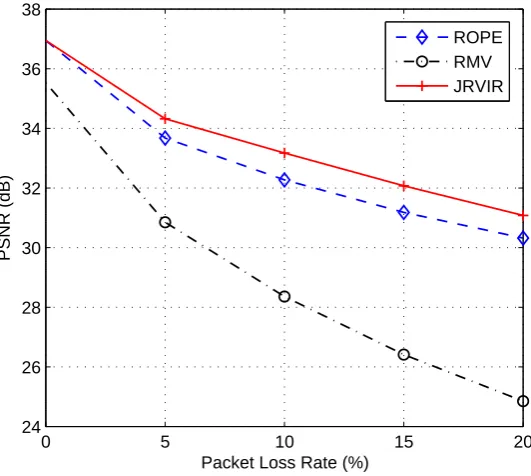
2.3 Average PSNR comparison under different packet loss rates; CIF Fore-man sequence is used; target bitrate is 1 Mbps; (a) GOP length 150, (b) GOP length 15. . . 32
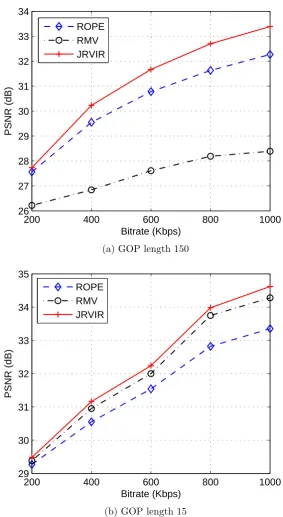
2.4 Average PSNR comparison under different bitrate; packet loss rate is 10%; CIF Foreman sequence is used; (a) GOP length 150, (b) GOP length 15. . . 33
3.1 Four types of macroblocks in one frame: 1 stands for inter macroblock,
2 stands for intra macroblock, 3 stands for inter macroblock with
redun-dant version and 4 stands for intra macroblock with redunredun-dant version;
the redundant version macroblocks are encapsulated in the redundant
picture. . . 37
3.2 Macroblock level QP value of redundant coding for one frame in the
Foreman CIF sequence; positive number for inter macroblock and
nega-tive number for intra macroblock; we use 60 and hatching to denote inter
macroblock without redundant version,−60 and hatching to denote intra macroblock without redundant version. . . 38
3.3 Average PSNR versus bit rate for the Foreman sequence; QPstep of
HRMIR is set to 1, 5, 10; PLR is set to 10%, and GOP length is 30. . . 41
3.4 Frame by frame average PSNR comparison for HRMIR, Optimal Intra
and RS-MDC; average PLR is 10%, full-pixel accuracy motion
estima-tion; (a) Forman CIF 30 fps, 2.12 Mbps, (b) Bus CIF 30 fps, 2.88 Mbps. 46
3.5 Frame by frame average PSNR comparison for HRMIR, Optimal Intra
and RS-MDC, average PLR is 10%, 1/4-pixel accuracy motion
estima-tion; (a) Foreman CIF 30 fps, 1.48 Mbps, (b) Bus CIF 30fps, 1.92 Mbps. 47
3.6 Average PSNR versus bit rate for HRMIR, Optimal Intra and RS-MDC;
PLR is 10%; GOP length N = 15 and 30; (a) CIF Foreman sequence,
(b) CIF Bus sequence. . . 48
3.7 Average PSNR versus bit rate for HRMIR, Optimal Intra and RS-MDC;
PLR is 5% and 10%; GOP length N = 30; (a) CIF Foreman sequence,
(b) CIF Bus sequence. . . 49
3.8 Performance comparison for HRMIR, Optimal Intra and RS-MDC when
there is PLR mismatch between encoding stage and practical network
situation; Foreman sequence; GOP length is 30; the estimated PLR is
10%, while the actual PLR is varied from 0 to 20%; bitrate is 1.48 Mbps. 50
3.9 Percentage of Intra macroblock for HRMIR and Optimal Intra with PLR
5% and 10%; Foreman Sequence; QP is 28. . . 50
3.10 Performance comparison for HRMIR, Optimal Intra and RS-MDC when
the packet loss is burst; PLR is 10%; burst length is two; Bus sequence
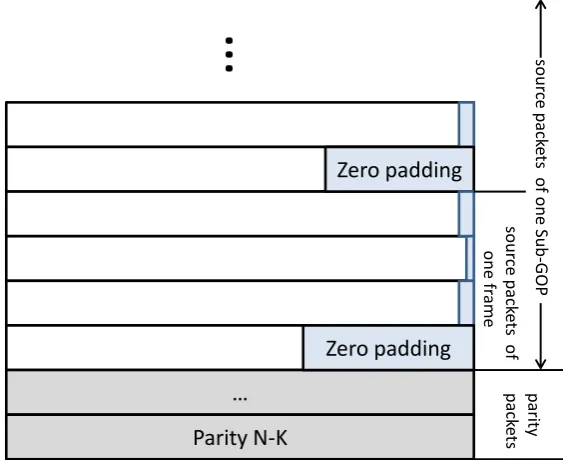
4.1 Packet padding method for the RS coding; H.264 fixed slice length
method is used; the slice length is nearly same except for the last one. . 56
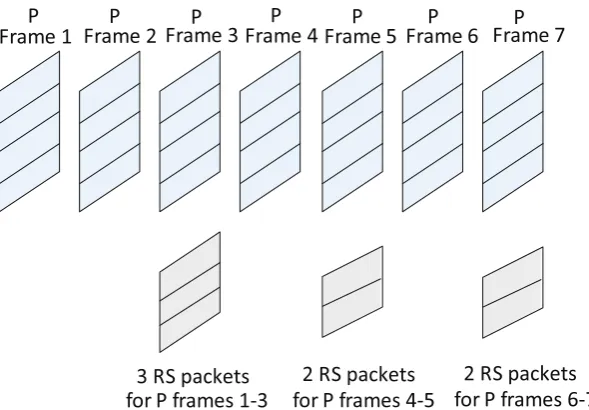
4.2 One example of RS parity packets allocation for the dynamic sub-GOP
FEC coding approach. . . 58
4.3 RS allocation example with the greedy algorithm; packet loss rate p =
5%; one GOP has 30 P-frames; RS parity packet rate µ = 20%; each
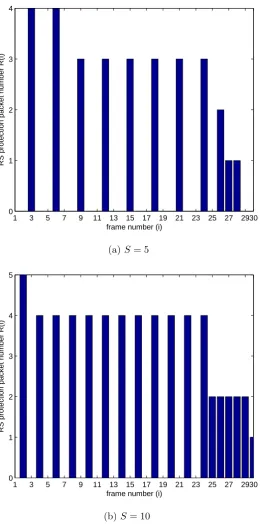
frame includes S slices; (a) S = 5, (b)S = 10. . . 70
4.4 Average PSNR versus bitrate for fixedα value (α = 1) and adaptiveα
for the DSGF approach; CIF Foreman sequence is used; GOP length is
30; packet loss rate is 5%, parity packet rate is 20%. . . 71
4.5 Average PSNR versus bitrate for various parity packet rateµ; CIF
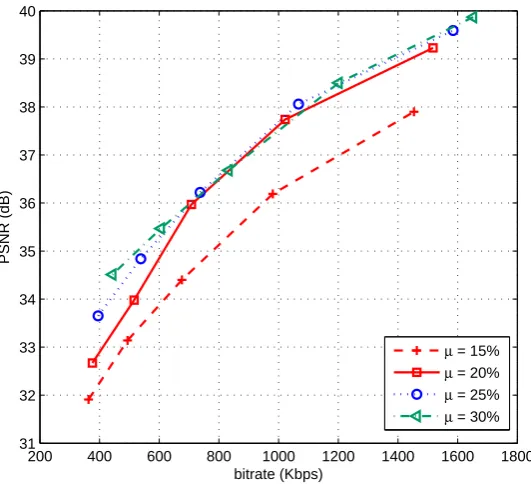
Fore-man sequence is used; packet loss rate is 5%; RS parity packet rate µ
includes 15%, 20%, 25% and 30%. . . 71
4.6 Average PSNR versus bitrate curves; the network packet loss rate is 5%
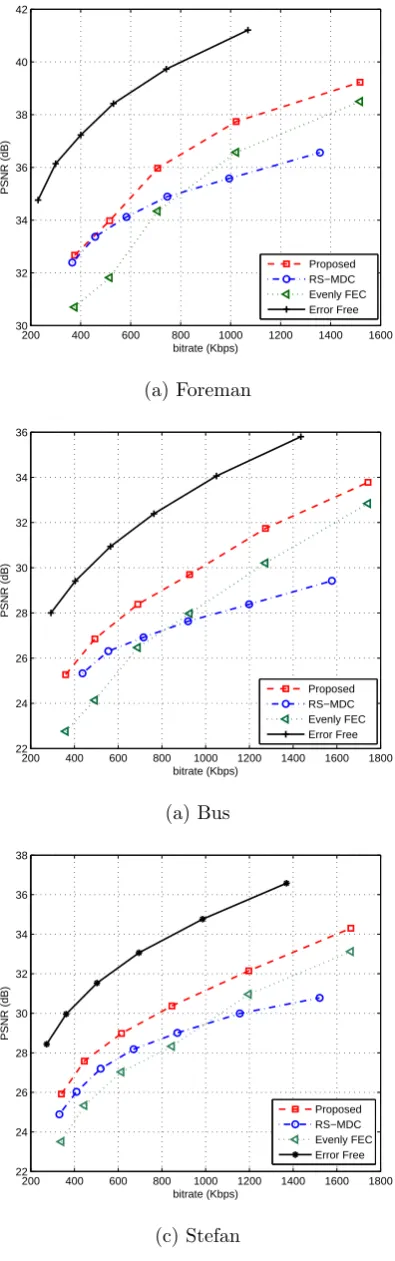
and the parity packet rateµ is 20%. . . 72
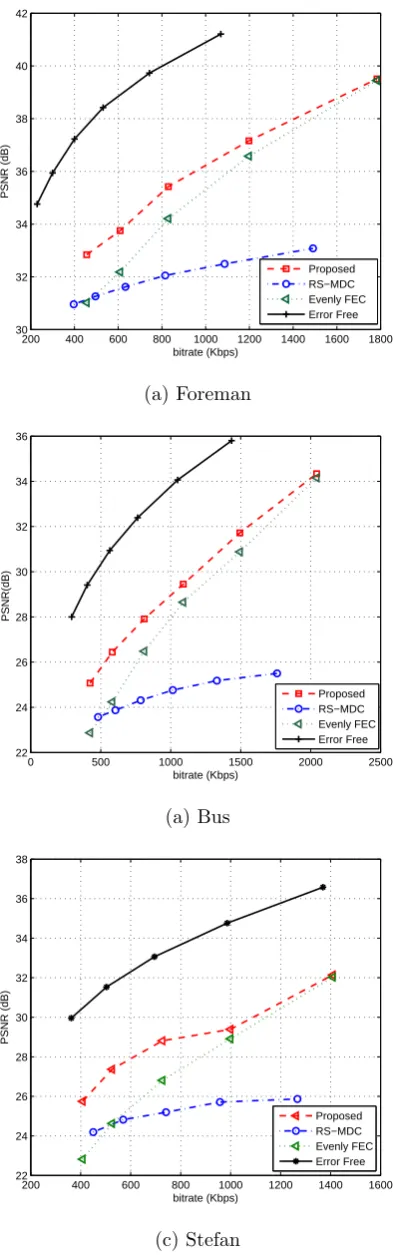
4.7 Average PSNR versus bitrate curves; the network packet loss rate is 10%
and the parity packet rateµ is 40%. . . 73
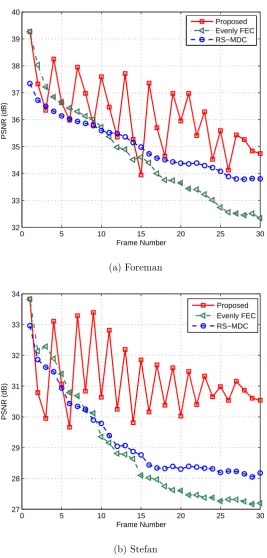
4.8 Video quality versus frame number in one GOP with length 30; Packet
loss rate is 5%, parity packet rateµ is 20%; (a) CIF Foreman sequence;
QP = 26; bitrate for the proposed approach and the Evenly FEC
ap-proach is 707.9 Kbps, for RS-MDC is 746.5 Kbps; (b) CIF Stefan
se-quence; QP = 32; bitrate for the proposed approach and the Evenly
FEC approach is 845.4 Kbps; for RS-MDC is 870.5 Kbps. . . 74
4.9 Two consecutive frame in one decoded sequence after random packet
loss (p=5%), (a) 10th frame,with PSNR 38.27 dB; (b) 11th frame,with
PSNR 35.20 dB; (c) zoom in the most damaged area in Frame 11. . . . 75
4.10 Video quality versus different packet loss rate; CIF Foreman sequence is
used; QP is 26; GOP length 30; the redundancy of the three approaches
isµ= 36.5%. . . 76
4.11 Average PSNR versus bitrate curves; the network packet loss follows the
pattern in file 10 of Q15-I-16r;µis 40%; (a) Foreman sequence,(b) Stefan
4.12 Average PSNR versus bitrate curves for the Foreman sequence; the
packet loss rate is 10%; average burst length is two;µis 60%. . . 78
5.1 Examples of sub-GOP and RS parity packets allocation and packet
trans-mission delay for the proposed approach; the I-frame (with index 0) is
not shown in the figure; t1, t2, t3, t4, t5 are the display deadline for
frame 1, frame 2, frame 3, frame 4 and frame 5, respectively;t1′,t2′,t3′,
t4′, t5′ are the sending time for frame 1, frame 2, frame 3, frame 4 and
frame 5, respectively. . . 82
5.2 The effects the parameterα, Foreman CIF sequence, maximum delay is
300ms. . . 93
5.3 Average PSNR versus bitrate for various parity packet rates µ
(redun-dancy), CIF Foreman sequence is used, packet loss and delay pattern file
is f10. . . 94
5.4 Average PSNR versus bitrate for improper parity packet ratesµ= 25%
and µ = 50%, CIF Foreman sequence is used, packet loss and delay
pattern file is f10. . . 95
5.5 Effects of sub-GOP size, Foreman CIF sequence, QP = 28 (608.64 kbps),
packet loss and delay pattern file is f10. . . 96
5.6 Average PSNR versus bitrate for RVS-LE, Hybrid-MDC and RS-MDC;
Bernoulli 10% packet loss rate without delay; CIF Foreman sequence,
GOP length 30. . . 96
5.7 Average PSNR versus bitrate for different approaches, the packet loss
and delay pattern is file f20; (a) Foreman, (b) Coastguard, (c) Stefan. . 100
5.8 Average PSNR versus bitrate for different approaches, the packet loss
and delay pattern is file f10; (a) Foreman, (b) Coastguard, (c) Stefan. . 101
5.9 Average PSNR versus bitrate for different approaches, the packet loss
and delay pattern is file f3; (a) Foreman, (b) Coastguard, (c) Stefan. . . 102
5.10 Effects of the allowed maximum delay; CIF Foreman sequence, the packet
loss and delay pattern is file f10, parity packet rate is 40%. . . 103
6.1 Examples of different FEC schemes, where each frame has 4 video packets
and redundant packet rateµ= 0.5. (a) Evenly FEC; (b) sub-GOP based
6.2 The value ofP(C′(i, j)) for different i,j; (a) each frame has 5 slices and
1 parity packet, packet loss model is i.i.d., with packet loss rate 10%; (b)
each frame has 10 slices and 2 parity packet, packet loss model is i.i.d.,
with packet loss rate 5%. . . 116
6.3 D¯totalversus variance ofR(i); number of P-frames in one GOP isL= 29,
other parameters including (a){S, µ, p}={10,0.2,0.05}, (b){S, µ, p}=
{5,0.4,0.1}, (c){S, µ, p}={10,0.4,0.1} , (d){S, µ, p}={10,0.4,0.15}. 120 6.4 Average PSNR versus bitrate for various redundant packet rate µ; CIF
Foreman sequence is used; i.i.d. average packet loss rate is 10%; RS
redundant packet rate µincludes {0.3,0.4,0.5,0.6}. . . 123 6.5 Average PSNR versus bitrate curves; i.i.d. average packet loss rate is
5% and the redundant packet rate µ= 0.2; (a) Foreman sequence, (b)
Bus sequence, (c) Stefan sequence, (d) Mobile sequence. . . 124
6.6 Average PSNR versus bitrate curves; i.i.d. average packet loss rate is
10% and the redundant packet rateµ= 0.4; (a) Foreman sequence, (b)
Bus sequence, (c) Stefan sequence, (d) Mobile sequence. . . 125
6.7 Performance comparison between the proposed RE-RS scheme and two
ULP schemes [1, 2] ; CIF Paris sequence; i.i.d. 10% average packet loss
rate. . . 126
6.8 Frame by Frame video quality in one GOP; i.i.d. average packet loss
rate is 5%; RS redundant packet rate µ = 0.2; (a) Foreman Sequence,
QP = 26, (b) Stefan Sequence, QP = 32. . . 128
6.9 The average number of unrecovered packets among frames [1, i] by the
time of decoing frame i; i.i.d. average packet loss rate is 5%, RS
redun-dant packet rate µ= 0.2; Foreman Sequence; QP = 26. . . 129
6.10 Average PSNR versus bitrate curves for the Foreman sequence; average
packet loss rate is 10%, including i.i.d. packet loss model and Gilbert
burst packet loss model; for burst loss the average burst length is two. . 130
6.11 Average PSNR versus bitrate curves for expanding window and sliding
window schemes; sliding window size 4, 5 and 6; Foreman sequence; (a)
10% i.i.d. average packet loss rate, the redundant packet rate µ = 0.4;
(b) 10% burst packet loss, average burst length is 2, the redundant packet
List of Abbreviations
ARQ Automatic Repeat-reQuest
CABAC Context-Adaptive Binary Arithmetic Coding
CDF Cumulative Distribution Function
CIF Common Intermediate Format
CPU Central Processing Unit
FEC Forward Error Correction
FMO Flexible Macroblock Ordering
fps frame per second
GF Galois Field
GOP Group of Pictures
HRMIR Hybrid Redundant Macroblock and Intra-macroblock Refreshment
i.i.d. Independent Identically Distributed
JRVIR Joint Redundant motion Vector and Intra-macroblock Refreshment
LT Luby Transform
MB Macroblock
MDC Multiple Description Coding
ME Motion Estimation
MSE Mean Squared Error
MTU Maximum Transmission Unit
PLR Packet Loss Rate
PSNR Peak Signal-to-Noise Ratio
RDO Rate-Distortion Optimization
RE-RS Randomized Expanding Reed-Solomon
RMV Redundant Motion Vector
ROPE Recursive Optimal Per-pixel Estimate
RPS Reference Picture Selection
RS Reed-Solomon Code
RS-MDC Redundant Slice Multiple Description Coding
RTCP Real Time Control Protocol
RTP Real Time Protocol
RTT Round-Trip Time
RVS-LE Real-time Video Streaming scheme exploiting the Late- and Early-arrival packets
SVC Scalable Video Coding
VCL Video Coding Layer
Acknowledgement
Foremost, I would like to express my sincere gratitude to my primary PhD supervisor
professor Tammam TILLO for his continuous support of my PhD study and research,
for his patience, guidance, encouragement, kindness, and immense knowledge. His
guidance helped me in all the time of my research and writing of this thesis. I could
not have imagined having a better supervisor for my PhD study. Besides my primary
supervisor, I would like to thank my co-supervisors, professor Jeremy S Smith and Dr.
Waleed Al-Nuaimy.
My sincere thanks also go to professor Weisi LIN, in Nanyang Technological
Uni-versity, Singapore, for offering me the research assistant position in his research group
and leading me working on diverse exciting research fields.
I thank our research partners in Beijing Jiaotong University, including professor Yao
ZHAO, Dr. Chunyu LIN, and Chao YAO. I also thank my fellow PhD students in the
department, Chun ZHAO, Shi CHENG, Jie REN, for starting this journey together.
Last but not least, I would like to thank my family, my wife Qing, her understanding
and love during the past few years. Her support and encouragement was in the end
Chapter 1
Introduction to Error Resilient
Video Streaming
1.1
Motivation
A video communication system typically includes five stages, as shown in Fig.1.1. The
video is firstly compressed by the video encoder so as to reduce the bit rate, and
then the bit stream is segmented into fixed or variable length packets. If the deployed
communication network is unreliable, transmitting the hybrid-coded video over such
unreliable environments would make it suffer from error propagations and this leads
to the well-known drifting phenomenon [3, 4]. Therefore, the video packets usually
undergo a channel coding stage, where typically the Forward Error Correction (FEC)
protection packets are used to protect them. At the receiver side, the received packets
are FEC decoded to help recovering the lost source packets. After that, the source
packets are video decoded, and displayed. For these still unrecovered source packets,
error concealment is widely used to “guesss” the lost regions.
For the real-time interactive video streaming applications, i.e., video conference
and video telephony, the tolerated end-to-end delay is limited, typically, the acceptable
delay is between 150 ms and 400 ms according to ITU-T G.114 [5]. This stringent delay
constraint poses challenges to the video communication systems, since the total delay
Video source encoding
Packetizating and channel coding
Communication networking
system
Depacketizating and channel
decoding
Video decoding
Original video Reconstructed video
caused in each stage cannot be more than this limitation. In this thesis, we are going
to design error resilient video communication systems with stringent end-to-end delay
for real-time interactive video applications. To fulfill this objective, the research work
will be carried out from both source coding and channel coding aspects. Firstly, we
are going to investigate error resilient techniques that are implemented in the standard
video compression stage. For example, adding more intra coding regions can efficiently
stop error propagations; exploiting the redundant slice [6, 8] concept in the H.264/AVC
[9, 10] video compression standard can prevent error happening due to network packet
losses. It is worth pointing out that, these source coding error resilient techniques are
independent of the channel coding stage. Secondly, we are going to study the Forward
Error Correction techniques for real-time interactive video streaming, where the error
correction performance and the caused delay will be jointly taken into consideration.
1.2
Overview of H.264/AVC Video Standard
H.264/MPEG-4 Part 10 or AVC (Advanced Video Coding) [9, 10] is a standard for
video coding/compression, and it is currently one of the most widely used formats for
compression, and distribution of high definition video. The final drafting work on the
first version of the standard was completed in May 2003 [9]. As the previous video
coding standards (e.g., H.263 [11] and MPEG-2 [12]), H.264/AVC is a block-oriented
motion-compensation-based video coding standard. This standard was developed by
the ITU-T Video Coding Experts Group (VCEG) together with the ISO/IEC Moving
Picture Experts Group (MPEG), this partnership is known as the Joint Video Team
(JVT). The ITU-T H.264 standard and the ISO/IEC MPEG-4 AVC standard (formally,
ISO/IEC 14496-10 C MPEG-4 Part 10, Advanced Video Coding) are jointly maintained
so that they have identical technical content.
The main goals of the H.264/AVC standardization effort have been enhancing
com-pression performance and provision of a “network-friendly” video representation
ad-dressing “conversational” (video telephony and conference) and “nonconversational”
(storage, broadcast) applications. In terms of compression performance, H.264/AVC
provides gains of up to 50% over a wide range of bit rates and video resolutions
com-pared to previous standards [13]. In terms of “network-friendly” video representation,
the concept of network abstraction layer (NAL) is designed in order to provide network
Fn
(current frame) Transform Quantization
Entropy coding F’n-1 (reference) Fn (reconstructed) motion estimation motion compensation Intra prediction Deblocking filter Inverse Transform Inverse Quantization + - + + Inter Intra PRED
Figure 1.2: H.264/AVC encoder structure.
Entropy decoding F’n-1 (reference) Fn (reconstructed) motion compensation Intra prediction Deblocking filter Inverse Transform Inverse Quantization + + Inter
Intra PRED
Figure 1.3: H.264/AVC decoder structure.
layer (VCL) for a broad variety of systems.
1.2.1 Encoder and Decoder Structure in H.264/AVC
Inherited from the earlier coding standards, H.264/AVC defines the syntax of an
en-coded video stream rather than explicitly defining a Codec; however the decoding
methods of the bit stream is defined in the standard. Typically, the diagrams of the
compliment video encoder and decoder are as depicted as in Figure.1.2 and Figure.1.3,
respectively.
Similar to the previous video coding standards, the basic functional units of H.264/AVC
include motion prediction, motion estimation, intra prediction, transform,
quantiza-tion, and entropy coding. To enhance the overall compression performance, the details
of these common units are modified in H.264/AVC. The main features of the design
block-size motion compensation with small block block-sizes; quarter-sample-accurate motion
com-pensation; multiple reference picture motion comcom-pensation; generalized B frame
con-cepts; in-the-loop deblocking filtering; advanced entropy coding, i.e., CABAC
(context-adaptive binary arithmetic coding) and CAVL (context-(context-adaptive variable-length
cod-ing).
The H.264/AVC encoder (Fig.1.2) includes two dataflow paths, aforward path and
areconstruction path. An input frame or fieldFnis processed in units of a macroblock
(16×16 pixels). Each macroblock is encoded using either Intra prediction mode or Inter prediction mode. For each block (4×4 pixels) in the macroblock, a prediction PRED is formed based on the reconstructed picture samples. In Intra mode, PRED
is generated from samples in the current slice that have previously encoded, decoded
and reconstructed; for the Inter mode, PRED is formed from the motion compensation
region(s) of one or two reference picture(s) selected from the set of list 0 and/or list 1
reference pictures. Then the difference between the prediction signal PRED and the
current block is regarded as residual signal, which will be transformed, quantized and
finally entropy encoded to form the video bitstream.
Inversely, at the video decoder side, the compressed video bitstream will be entropy
decoded, inverse transformed, and inverse quantized. Together with the reconstructed
prediction signal, the decoded frame will be generated.
1.2.2 Inter Prediction
In the Inter prediction, a macroblock is predicted from one or more previously encoded
video frames or fields with block-based motion compensation. Different from the earlier
standards, H.264/AVC supports various block sizes (from 16×16 to 4×4) and quarter-pixel accuracy motion vector for the luminance component. In this thesis we focus on
the Inter prediction tools available in the Baseline profile.
The luminance component of each 16×16 macroblock can be split in 4 ways for the motion compensation. As depicted in the Fig.1.4, it is either one 16×16 block, two 16×8 blocks, two 8×16 blocks or four 8×8 blocks. If there is 8×8 block chosen within one macroblock, this 8×8 block can be further partitioned in 4 ways (depicted in the Fig.1.5), which are one 8×8 block, two 8×4 blocks, two 4×8 blocks or four 4×4 blocks. Partitioning macroblocks into motion compensated sub-blocks of varying size
16
16
16 x16
0 16
8
8 x16
0 1
8 16
8
16 x8 0
1 8
8
8 x8 0
8
1
2 3
8 8
Figure 1.4: Macroblock partition methods: 16×16, 16×8, 8×16, 8×8.
8
8
8 x 8
0 8
4
4 x 8
0 1
4 8
4
8 x 4 0
1 4
4
4 x 4 0
4
1
2 3
4 4
Figure 1.5: Sub-macroblock partition methods: 8×8, 8×4, 4×8, 4×4.
motion vector, so the finer the macroblock is partitioned, and more motion vectors will
be needed, and therefore more bitrate will be dedicated for the motion information.
Nevertheless, with the finer macroblock partitioning methods, the energy of the residual
is lower, and less bitrate is required to represent the residual. So it is a trade-off process
to select the proper macroblock partitioning methods. Typically, for the image region
with complex texture/detail, finer partitioning methods are preferred, whereas for the
homologous region, coarse partitioning methods are enough. The choice of partition
M
I J K L
A B C D E F G H
0 (Vertical)
M I J K L
A B C D E F G H 1 (horizontal)
M
I
J
K
L
A B C D E F G H
1 (DC)
mean of A, B, C, D I, J, K, L
M
I
J
K
L
A B C D E F G H
3 (diagonal down-left)
M
I
J
K
L
A B C D E F G H
4 (diagonal down-right)
M I J K L
A B C D E F G H
5 (vertical-right) M I J K L
A B C D E F G H 6 (horizontal-down) M I J K L
A B C D E F G H 7 (vertical-left) M I J K L
A B C D E F G H
8 (horizontal-up)
Figure 1.6: 9 intra prediction modes for 4×4 luminance block.
1.2.3 Intra Prediction
In Intra prediction, the prediction block PRED is generated based on the previously
encoded and reconstructed neighboring blocks and is subtracted from the current block
before encoding. For the luminance component, the predicted block PRED block is
form for each 4×4 or 16×16 block. There are a total of 9 possible prediction modes for the intra 4×4 luminance block, which are shown in Fig.1.6. and 4 modes for a 16×16 luminance block, as described in Fig.1.7.
0 vertical
H
V ………
1(horizontal) H V … … …
2 ( DC )
H
V mean( H+V )
3(plane)
H
V
1.2.4 Error Resilient Tools in H.264/AVC
Beside the high efficiency compression performance, a number of design aspects to
en-able error resiliency are considered in the H.264/AVC standard, including the following
highlighted features [10]:
1. Parameter set structure: The parameter set design provides robust and efficient
representation of header information. As the loss of some key bits of
informa-tion (such as sequence/picture header informainforma-tion) could have a severe negative
impact on the decoding process when using prior standards, this key
informa-tion was separated for handling in a more flexible and specialized manner in the
H.264/AVC design.
2. NAL unit syntax structure: Each syntax structure in H.264/AVC is placed into
a logical data packet named NAL unit. Instead of forcing a specific bitstream
interface to the system as in prior video coding standards, the NAL unit syntax
structure allows greater customization of the method of carrying the video content
in a manner appropriate for each specific network.
3. Flexible slicing method and FMO: Unlike the prior standards, slice sizes in H.264/AVC
are highly flexible. Each slice can contain a user-specified length, in terms of bytes
or number of macroblocks. Moreover, a new functionality to partition the picture
slice groups has been developed, with each slice becoming an
independently-decodable subset of a slice group. When used effectively, flexible macroblock
ordering (FMO) can significantly enhance robustness to data losses by managing
the spatial relationship between the regions that are coded in each slice.
4. Redundant slices/pictures: In order to enhance robustness to the video slice loss,
the H.264/AVC design contains a new feature to allow the encoder to send
redun-dant version information for regions of pictures, enabling a (typically somewhat
lower quality) representation of regions of pictures for which the primary
repre-sentation has been lost during network transmission. However, the standard does
only specify the encapsulation method, but it does not specify how to generate the
redundant slices/pictures. In [6], a new approach is proposed to mathematically
primary and redundant slices are interleaved into two equally important multiple
descriptions for transmission.
5. Data Partitioning: Since some coded information (e.g., motion vectors and other
prediction information) is more important or more valuable than other
informa-tion for the purposes of representing the video content, H.264/AVC allows the
syntax of each slice to be separated into up to three different partitions for
trans-mission, depending on the categorization of syntax elements.
The data partition A contains the most important slice date, the header
in-formation such as macroblock (MB) types, quantization parameters, and motion
vectors. With the loss of data in data partitionA, data of the other two partitions
becomes useless. Data partition B contains intra coded block patterns (CBPs)
and transform coefficients of I-blocks. Because the intra frames and intra-MBs
are used as references, the loss of this part will severely impair the video quality
of successive frames due to error propagations. Data partition C contains Inter
CBPs and coefficients of P-blocks. Compared to the data partitionA andB, the
data contained in data partitionC is less important. However, it is the biggest
partition of a coded slice as a large number of frames are coded as P-frames.
6. SP/SI synchronization/switching pictures: The H.264/AVC design includes new
picture types, SP/SI pictures, that allow exact synchronization of the decoding
process of some decoders with an ongoing video stream produced by other
de-coders without penalizing all dede-coders with the loss of efficiency resulting from
sending an I picture. This can enable switching a decoder between
representa-tions of the video content that used different data rates, recovery from data losses
or errors, as well as enabling trick modes such as fast-forward, fast-reverse, etc.
1.3
Real-time Video Streaming over Lossy Networks
In this section, the existing real-time error resilient techniques will be categorized and
1.3.1 End-to-End Distortion Driven Intra Coding and Motion Pre-diction
One commonly used method to combat network packet losses is to use Intra coding.
The intra-macroblock refreshment approach is standard compatible, and it is an useful
tool to combat network packet losses. It can be employed to weaken the inter-picture
dependency due to inter prediction, and eventually, cut-off the error propagations. The
early intra-macroblock refreshment algorithms are based on randomly inserting Intra
macroblocks [14] or periodically inserting Intra contiguous macroblocks [15]. However,
in both [14] and [15] the Intra refresh frequency is determined in a heuristic way, and
it is costly to code an entire picture by intra-coding. So the trade-off between code
efficiency and error resiliency need to be balanced. Zhang et al. first treated this
problem as the optimization of coding mode selection for each macroblock in [16], and
proposed the well-known Recursive Optimal Per-pixel Estimate (ROPE) approach to
determine intra-macroblock. In [16] the expected end-to-end distortion for each pixel
is calculated in a recursive way, and in the mode selection step, the expected
end-to-end distortion is used in the rate-distortion optimization process. In [17], another
flexible intra macroblock update algorithm was investigated to optimize the expected
rate-distortion performance. In this approach, the end-to-end distortion is calculated
by emulating the real channel behaviors, and therefore, the computation complexity
is tremendous. Among the methods to get the expected end-to-end distortion, [16] is
a pixel-based approach, another block-based approach [18] generates and recursively
updates a block-level distortion map for each frame. Recent advances in Recursive
Optimal Per-pixel Estimate (ROPE) further expanded its capability to accommodate
sub-pixel prediction [19] and burst packet loss [20].
The above mentioned methods exploit network lossy-aware end-to-end distortion
to optimally select the Intra coding mode for each macroblock. To further enhance
the error resiliency performance of the encoded video streaming, in [21, 22], end-to-end
distortion is applied in the motion estimation and motion prediction stage, which is
so-called loss-aware motion estimation and loss-aware motion prediction. With this
extension, the error-resilience performance is improved further. In recent work [23],
SSIM [24] is used to evaluate the end-to-end distortion instead of using conventional
Figure 1.8: A typical MDC structure. Receiving one description could lead to low reconstructed quality; receiving both descriptions could lead to better quality.
1.3.2 Multiple Description Coding and Redundant Coding
Multiple Description Coding (MDC) is an effective tool to combat packet losses in
unreliable and non-prioritized networks, particularly for real-time video communication
applications where the acceptable end-to-end delay is limited and retransmission is
unacceptable. In the paradigm of MDC, two or more equally importancedescriptionsof
the video sequence are generated. Each description can be decoded independently with
lower but acceptable quality. The decoding quality is improved when more descriptions
are received. A typical structure of MDC is shown in Fig.1.8. If one description is
received, the side decoder reconstructs the signal with distortion D1 or D2. If both
descriptions are received, the central decoder reconstructs the signal with distortion
D0, andD0 <min(D1, D2). It is not possible to simultaneously minimize bothD0 and
D1+D2 when the total rate is limited.
One of the most popular solutions to the MDC problem is Multiple Description
based on Scalar Quantization (MDSQ) [25]. In this work, two descriptions are
gener-ated by quantizing the transform coefficients using two quantization levels. If both of
the descriptions are received, the reconstructed quality is equivalent to using a finer
quantizer, whereas if only one description is received, the reconstructed quality is
equiv-alent to using a coarse quantizer. This work is later applied to video coding in [26].
However, the main drawback of MDSQ is that it yields descriptions that are not
stan-dard compliant. In [27], MDC scheme with correlating transform has been proposed,
with this method cannot be decoded with standard tools.
To generate descriptions that are compatible with video standards (e.g. H.264/AVC
[10]), MDC is introduced in the pre/post-processing stages [29]. The basic idea is
to split the video source into two sub-videos, which are encoded independently. At
the decoder side, in case of two description reception, the decoded descriptions are
post-processed to recover the full quality video. On the other hand, if a description
gets lost, the received one can reconstruct the video at a coarse quality. In order
to introduce a controlled redundancy among the descriptions, so as to achieve the
desired tradeoff between the two quality levels, the data must be properly processed
prior to splitting. Over-sampling of the original image has been proposed in [30],
and generalized to video sequences in [31]. In these papers, zero padding in the 2-D
discrete cosine transform (DCT) domain is addressed. Similarly, in [32] an algorithm
is proposed for the generation of an arbitrary number of descriptions, based on zero
padding in the DCT domain followed by multiple description generation by means of a
polyphase downsampler. All the above MDC methods downsample the video sequences
in spatial domain; however, it is often preferable to downsample temporally rather than
to perform spatial downsampling [33, 34].
Another method to generate standard compatible Multiple Descriptions is to use the
redundant slices/pictures concept, which has been defined in the Baseline and Extended
Profiles of H.264/AVC [10] standard. In [35], the authors proposed one method to select
the frames that need redundant pictures, whereas other frames do not require redundant
version. The main flaw of these approaches is that the redundancy is introduced at
slice/frame level, meaning that all MBs belonging to the same slice/frame will be
regarded as equally important. This degrades the performance of these approaches,
especially for non-stationarity video content. In fact, MBs have different characteristics,
which is the reason for having different coding modes for different MBs in H.264/AVC.
Consequently, it would be better to tune the inserted redundancy at MB level. Armed
with this theory, in [36], the authors proposed to allocate the redundancy at macroblock
level. The problem of this approach is that it needs to analyze one GOP of frames
for redundancy allocation, which means one GOP of delay will be caused, making it
not suitable for the real-time interactive video streaming applications. To tackle this
problem, a new macroblock level redundancy allocation scheme is proposed in [37],
coding, are selected based on the end-to-end distortion using the ROPE approach [16].
It should be noted that, [37] is done by the thesis author, which is part of this thesis.
1.3.3 Feedback-based Real-time Video Streaming
Retransmission of lost information triggered by feedback from the receiver side is
re-garded as the most efficient error resiliency approaches for traditional data
commu-nication applications. The advantage of feedback-based retransmission is its inherent
adaptiveness to various loss rates. Retransmissions are only triggered if the information
is actually lost. The overhead encountered is therefore a direct function of loss rate
and the sender does not need to receive or estimate information about the expected
channel condition. However, for the real-time interactive video communication
appli-cations, the packet retransmission is limited because of the stringent one-way latency
requirement, which is usually 150-400 ms.
Nevertheless, the feedback information can still be exploited to improve the error
resiliency performance in real-time interactive applications. In [38], it assumes that
received video data can be decoded faster than real-time, so the later arrival packets
(with delay larger than allowed) are exploited to generate error-free reference frames.
Later, in [39] an elegant retransmission-based approach for end-to-end error
recov-ery called RESCU (Recovrecov-ery from Error Spread using Continuous Updates) has been
proposed. The main idea of RESCU is to change the frame dependencies in a video
sequence such that a retransmission of lost information can be used for error recovery
with the help of Accelerated Retroactive Decoding (ARD) [38], despite the low delay
requirements of real-time video communication. In RESCU, ARD is used to generate
error-free reference frames from retransmitted packets. Another proposal that uses
feedback information to stop error propagation is NEWPRED (New Preidction) [40].
Here, feedback about lost packets or correctly received packets is used to restrict the
prediction from those image areas that have been successfully decoded. The
Refer-ence Picture Selection (RPS) concept introduced in H.263 Annex U and adopted in
H.264/AVC supports a standard-compatible implementation of NEWPRED. Based on
RESCU [39] and NEWPRED [40], a proxy-based reference picture selection scheme for
error resilient conversational video in mobile networks has been proposed in [41]. The
problem of the scheme in [41] is that its motion prediction is inefficient, where in the
the frameN(N >1) frames before the current frame.
1.3.4 Forward Error Correction Based Unequal Loss Protection
Layered coding splits the information related to an image or video into different
sub-streams or layers, which are hierarchically organized. A base layer guarantees the
base-quality version of the content; the higher layer, built upon the base layer, allows
to improve the base-quality. This hierarchical organization makes a higher layer useless
in case that any lower layer is lost [42], making this solution suitable for prioritized
networks. On the other hand, if layered data, e.g., JPEG2000 [43] and SVC [44], have
to be transmitted on non prioritized networks, Unequal Loss Protection (ULP) tools
[45–50] could be employed, where different FEC codes are assigned to different quality
layers. Typically, the more protection is provided for the base layer, and less protection
for the higher layer.
ULP methods have been proposed not only for hierarchical date, but also for the
non-hierarchical date, such as H.264/AVC. Different importance of video frames exists
in a group-of-pictures (GOP) level. Due to temporal dependency, the decoding of the
current frame strongly depends on its preceding frames in the GOP. The earlier an
error occurs in a GOP, the more frames will be corrupted. In [51], unequal amounts of
protection are assigned to different frames, accounting for their position in the Group
of Pictures (GOP). The distortion is analytically evaluated using a suitable model
of the drift [52]. The unequal importance of video data can also be found at the
resynchronization packet level if error resilience techniques are used. In [53, 54], the
concept of data partitioning in H.264/AVC is exploited for the unequal loss protections
systems. In [55], the allocation of the ULP is based on both the frame positions
in the GOP and the data partitioning type. In [1], the error resilience features of
H.264/AVC (FMO) are exploited together with Reed-Solomon codes to enhance the
protection of the video stream. An iterative procedure is proposed for the classification
of MBs into slice groups and the identification of the optimal channel rate allocation. In
[56], starting from a pre-encoded H.264/AVC stream, i.e., non-progressive video data,
1.4
Overview of The Thesis
1.4.1 Contribution and Organization of This Thesis
In this thesis, we are targeting real-time interactive video communication systems for
the unreliable networks, i.e, wireless network and Internet. Thus how do design
low-delay error resilient techniques, while maintaining good packet loss recovery
perfor-mance is our objective. The main contributions of the thesis are:
• Joint redundant motion vector and intra macroblock refreshment
We propose a scheme for error-resilient transmission of videos which jointly uses
intra-macroblock refreshment and redundant motion vector. The selection of
using Intra refreshment or redundant motion vector is determined by the
rate-distortion optimization procedure. The end-to-end distortion is used for the
rate-distortion optimization, which can be easily calculated with the ROPE [16]
method. Experimental results show that the proposed method outperforms both
the Intra Refreshment approach and Redundant Motion Vector approach
signifi-cantly, when the two approaches are deployed separately. This work was published
in [57], and presented in Chapter 2.
• Redundant video coding with end-to-end rate-distortion optimized at
macroblock level
In Chapter 2, redundant motion vector and intra macroblock are jointly used. In
this part, in addition to Intra coding, we propose to add two marcoblock
cod-ing modes to enhance the transmission robustness of the coded bitstream, which
are inter coding with redundant macroblock and intra coding with redundant
macroblock. The selection of coding modes and the parameters for coding the
redundant version of the macroblock are determined by the rate-distortion
opti-mization. The end-to-end distortion is employed in the optimization procedure,
which considers the source coding and channel conditions. Extensive
experimen-tal results show that the proposed approach outperforms other error resilient
approaches, for some video sequences, the average PSNR can be up to 4 dB
higher than that of the optimal Intra refreshment approach. This work could be
regarded as extension work of Chapter 2. This work was published in [37], and
• Dynamic Sub-GOP Forward Error Correction Code for Real-time Video Applications
In the previous chapters, redundant coding is implemented by duplicating
infor-mation with the same or lower fidelity. In the following chapters, the methods
described are based onerror correction code, where the inserted redundant
infor-mation is used to recover the lost inforinfor-mation. Reed-Solomon erasure codes are
commonly studied as a method to protect the video streams when transmitted
over unreliable networks. As a block-based error correcting code, on one hand,
enlarging the block size can enhance the performance of the Reed-Solomon codes;
on the other hand, large block size leads to long delay which is not tolerable
for real-time video applications. In this thesis a novel Dynamic Sub-GOP FEC
(DSGF) approach is proposed to improve the performance of Reed-Solomon codes
for video applications. With the proposed approach, the sub-GOP, which
con-tains more than one video frame, is dynamically tuned and used as the RS coding
block, yet no delay is introduced. For a fixed number of extra introduced packets,
for protection, the length of the sub-GOP and the redundancy devoted to each
sub-GOP becomes a constrained optimization problem. To solve this problem, a
fast greedy algorithm is proposed. Experimental results show that the proposed
approach outperforms other real-time error resilient video coding technologies.
This work was published in [58], and presented in Chapter 4.
• A Real-time Error Resilient Video Streaming Scheme Exploiting the
Late- and Early-arrival Packets
In the Chapter 4, the sub-GOP concept is proposed and optimized for the ideal
case, where no transmission network delay is taken into consideration. In this
chapter, the sub-GOP method is designed for the practical applications. For
real-time video streaming systems, the video packets arriving after the display
deadline of their frames are considered aslate-arrival packets, and typically they
are discarded. This will affect the current frame and the following ones due to
error propagations. For this reason, in this thesis, we propose an approach to
exploit thelate-arrival and out-of-order packets, which includes two mechanisms.
The first mechanism will use these packets to update the reference frames to make
error propagations. The second mechanism will use these packets to increase the
chance of successfully decoding the Reed-Solomon (RS) code. In the proposed
approach, a sub-GOP based systematic RS code is used and optimized to exploit
these packets, where the size of each sub-GOP and the parity packet number for
each sub-GOP are optimally tuned, taking into consideration the maximum
end-to-end delay, the network conditions, and other system parameters, so as to make
the best use of the late-arrival packets and to exploit the out-of-order packets.
Finally, the experimental results show the advantage of the proposed approach
over other approaches. This work was published in [59], and presented in Chapter
5.
• Real-Time Video Streaming Using Randomized Expanding Reed-Solomon
Code
For the proposed DSGF approach in Chapter 4, although the overall error
re-silient performance is higher than the conventional FEC schemes, that protect
the streamed video frame by frame, its video quality fluctuates within the
Sub-GOP. To mitigate this problem, another interactive video streaming scheme using
randomized expanding Reed-Solomon code is proposed. For the FEC schemes,
typically enlarging the FEC coding block size can improve the error correction
performance. For video streaming applications, this could be implemented by
grouping more than one video frame into one FEC coding block. However, in
this case, it leads to decoding delay, which is not tolerable for real-time video
streaming applications. In this thesis, to solve this dilemma, a real-time video
streaming scheme using randomized expanding Reed-Solomon code is proposed.
In this scheme, the Reed-Solomon coding block includes not only the video
pack-ets of the current frame, but could also include all the video packpack-ets of previous
frames in the current GOP. At the decoder side, the parity-check equations of the
current frame are jointly solved with all the parity-check equations of the previous
frames. Since video packets of the following frames are not encompassed in the
coding block, no delay will be caused for waiting for the video or parity packets
of the following frames both at encoding and decoding sides. Experimental
re-sults show that the proposed scheme outperforms other real-time error resilient
Chapter 2
Joint Redundant Motion Vector
and Intra Macroblock
Refreshment for Video
Transmission
2.1
Introduction
Due to the unreliable underlying networks, the development of error-resilient video
cod-ing techniques is a crucial requirement for video communications over lossy networks.
Among all the error-resilient video coding techniques, two categories of robust coding
approaches are promising and suitable for the real-time interactive video
communica-tion systems. One category is based on intra-macroblock refreshment, and another one
is redundant coding. The intra-macroblock refreshment approach is standard
compat-ible, and it is an useful tool to combat network packet losses. It can be employed to
weaken the inter-picture dependency due to inter prediction, and eventually, cut-off
the error propagations. The early intra-macroblock refreshment algorithms are based
on randomly inserting Intra macroblocks [14] or periodically inserting contiguous Intra
macroblocks [15]. However, in both [14] and [15] the Intra refresh frequency is
deter-mined in a heuristic way, and it is costly to code an entire picture by intra-coding. So
the trade-off between coding efficiency and error resiliency need to be balanced. Zhang
et al. first treated this problem as the optimization of coding mode selection for each
macroblock in [16], and proposed the well-known Recursive Optimal Per-pixel Estimate
(ROPE) approach to determine intra-macroblock. In [16] the expected end-to-end
dis-tortion for each pixel is calculated in an recursive way, then in the mode selection step,
In [17], another flexible intra macroblock update algorithm was investigated to optimize
the expected rate-distortion performance. In this approach, the end-to-end distortion
is calculated by emulating the real channel behaviors; therefore, the computation
com-plexity is tremendous. Among the methods to get the expected end-to-end distortion,
[16] is pixel-based; another block-based approach [18] generates and recursively updates
a block-level distortion map for each frame.
Redundant coding is another effective tool for robust video communications over
lossy networks. In [35], an optimal algorithm is presented to determined whether one
picture needs redundant version. In [6], redundant slices are optimally allocated based
on the slice position in the GOP; and the primary and redundant slices are then
inter-leaved to generate two equal important descriptions of the same data using the MDC
paradigm. In [34], the two descriptions are generated by splitting the video pictures
into two threads; and then redundant pictures are periodically inserted into the two
threads. In both [35] and [34] redundant coding are optimized in frame level; namely all
the macroblocks in one frame are encoded with the same redundant coding parameters.
For [6], redundant information is allocated in slice level. In all the three approaches,
redundant bitrate is allocated to both motion vectors and residual information. In [61]
a new approach with only redundant motion vectors is proposed. As the redundant
bitrate for motion vector is low, this approach improves the bandwidth utilization with
limited primary picture quality degradation. In [62] a significant motion vector
protec-tion (SMVP) scheme for error-resilient transmission of videos is proposed. This scheme
shows how to determine the significant motion vectors (SMVs) and how much rate
should be dedicated to SMVs. The idea behind this scheme is to give more protection
to significant motion vectors.
Intra-macroblock refreshment can stop errors in the previous frames, while
redun-dant coding is a way of preventing and minimizing propagated errors in the future
frames. Motivated by the two approaches, in this section, we propose an innovative
approach that jointly uses intra-macroblock refreshment and redundant motion vector.
For each macroblock, intra coding or redundant motion vector is chosen based on the
rate-distortion optimization procedure. The loss-aware end-to-end expected distortion
is used for this RD optimization (RDO), and the end-to-end distortion is calculated
with the ROPE [16] method.
presented as a preliminary, as it is the method we adopted to calculate the end-to-end
distortion, In Section 2.3, the proposed Joint Redundant motion Vector and
Intra-macroblock Refreshment (JRVIR) approach is introduced. In Section 2.4, extensive
experimental results are given, which validate our approach. Finally, some conclusions
are drawn in Section 2.5.
2.2
Preliminary and ROPE Approach
In an ideal error-free environment, the rate-distortion optimized intra/inter mode
de-cision is an efficient tool to determine the macroblock mode based on the cost function
defined in [63]. The cost function of all the macroblocks is defined as
JM B =DM B+λmode·RM B (2.1)
where λmode is the Lagrange multiplier, DM B and RM B are the encoding distortion
and the bitrate in different encoding modes, respectively. This optimization mode is
tailored for error-free environments, and no packet loss is considered here.
However, when the compressed videos are transmitted over error-prone networks,
traditional schemes cannot adaptively insert intra refresh macroblocks to efficiently stop
the channel error propagations. The ROPE approach uses the end-to-end distortion
in the RD optimization, which takes into account the channel packet losses. With the
ROPE approach, intra macroblocks are optimally used to stop error propagations, and
it is defined as follows:
Let fi
n denotes the original value of pixel i in frame n, and let ˆfni and ˜fni denote
its encoder and decoder reconstruction, respectively. Because of possible packet loss
in the channel, ˜fi
n can be modeled at the encoder side as a random variable. In the
ROPE approach, the DM B is redefined as the overall expected decoder distortion in
one macroblock.
DM B = ∑
i∈M B
din (2.2)
din=E{(fni −f˜ni)2}
ROPE provides a recursive algorithm to accurately calculate the two moments for each
pixel in a frame.
Let us assume that packet loss events are independent for simplicity, and the
aver-age Packet Loss Rate (PLR)pis available at the encoder side. To make it more general,
there is no limitation on the slice shape and size. So, the motion vectors from
neigh-boring macroblocks are not always available in the error concealment stage. Therefore,
the decoder may not be able to use motion vector from neighboring macroblocks for
concealment. Therefore, we assume the decoder copies reconstructed pixels from the
previous frame for concealment. The motion prediction at the encoder only employs
the previous reconstructed frame. The recursive formulas of ROPE are as follows.
• Pixel in the Intra macroblock
E{f˜ni}= (1−p) ˆfni +pE{f˜ni−1} (2.4)
E{( ˜fni)2}= (1−p)( ˆfni)2+pE{( ˜fni−1)2} (2.5)
• Pixel in the Inter macroblock
E{f˜ni}=(1−p)(ˆein+E{f˜ni+mv−1 })
+pE{f˜ni−1} (2.6)
E{( ˜fni)2}=(1−p)((ˆeni)2+ 2ˆeinE{f˜ni+mv−1 }
+E{( ˜fni+mv−1 )2})
+pE{( ˜fni−1)2} (2.7)
where inter coded pixel i is predicted from pixel i+mv in the previous frame. The
prediction residualein is quantized to ˆein.
It is important to notice that in order to make it simple, we apply ROPE in its
simple setting, where the motion estimation is evaluated at pixel level accuracy, and
we use constrained intra prediction, so there are no error propagations in the intra
prediction. Recent advances in ROPE further expand its capability to accommodate
sub-pixel prediction [19], bursty packet loss [20]. But they are not incorporated here so
as to avoid diluting the focus. In the ROPE approach, the end-to-end distortion is only
used in the mode selection stage. However, recently, in [21, 22] end-to-end distortion
loss-aware motion estimation and loss-aware motion prediction. With this extension,
the error-resilience capability of ROPE is improved further. The loss-aware motion
estimation and loss-aware motion prediction are not used in our approach, because we
extend ROPE in a different direction. In fact, the gain can be accumulated if both the
loss-aware motion estimation and loss-aware motion prediction are applied.
2.3
Proposed JRVIR Approach
As both the redundant motion vector and intra macroblock refreshment are powerful
tools for error resilient video communications, in the proposed Joint Redundant motion
Vector and Intra macroblock Refreshment (JRVIR) approach, they are jointly applied
to further protect the video stream. With the JRVIR approach, all the macroblocks
of one frame are divided into three types, namely intra macroblock, inter macroblock
(including skip) without redundant motion vector and inter macroblock (including skip)
with redundant motion vector. The redundant motion vectors are encapsulated in
the redundant picture. Let us take macroblocks in Fig.2.1 as an example. Let us
suppose the last macroblock in the first row is a macroblock with redundant motion
vector, accordingly, it is stored in the redundant picture. On the contrary, for intra
refresh macroblock and inter macroblock without redundant motion vector, there will
be no redundant information to be sent in the redundant picture. Therefore, for inter
macroblock with redundant motion vector, if the macroblock in the primary picture
is lost due to packet losses, the redundant extra motion vector can be used to recover
the macroblock. It is important to note that, in the proposed JRVIR approach, as
not all the macroblocks need to have redundant motion vector, a new flag is applied
in each macroblock to indicate whether there is redundant motion vector. For these
macroblocks with redundant motion vector, there will be no transformed coefficients to
be encapsulated in the redundant macroblcoks. Therefore, the proposed JRVIR would
not be standard compatible, and some small modifications are required for both the
encoder and decoder.
In general, Intra coding is more expensive, in terms of rate requirement, with
re-spect to redundant motion vector. Therefore, for the macroblocks with smooth texture
and/or macroblocks with slow and translational movements, providing redundant
mo-tion vector would lead to better resource utilizamo-tion, i.e., bitrate, with respect to the