RESEARCH ARTICLE
Impact of serotype and sequence
type on the preferential aerosolization
of
Streptococcus suis
Léa Gauthier‑Levesque
1,2, Laetitia Bonifait
1,2, Nathalie Turgeon
1, Marc Veillette
1, Phillipa Perrott
1,
Daniel Grenier
2,3and Caroline Duchaine
1,2,4*Abstract
Background: Streptococcus suis is a swine pathogen that causes pneumonia, septicemia and meningitis. It is also an important zoonotic agent responsible of several outbreaks in China. S. suis strains are classified into 35 serotypes based on the composition of their polysaccharide capsule. S. suis serotype 2 causes the majority of severe infections in pigs and in human, and can be further subdivided into sequence types (STs) based on multilocus sequence typ‑ ing. The ST1 is associated with highly virulent strains. In North America, the strains most commonly isolated belong to ST25 and ST28, which are respectively moderately and weakly virulent in a mouse model. The presence of S. suis bioaerosols in the air of swine confinement buildings has been previously demonstrated. The aim of this study was to better understand the aerosolization behaviour of S. suis by investigating the preferential aerosolization of vari‑ ous strains of S. suis, belonging to different serotypes or STs, using in‑house developed environmental chamber and bubble‑burst nebulizer. qPCR technology was used to analyze the ratio of S. suis strains.
Results: The results suggest that the highly virulent serotype 2 ST1 strains are preferentially aerosolized and that the S. suis preferential aerosolization is a strain‑dependent process.
Conclusion: These observations will need to be confirmed using a larger number of strains. This study is a proof of concept and increases our knowledge on the potential aerosol transmission of S. suis.
Keywords: Preferential aerosolization, Streptococcus suis, Serotype 2, Sequence type, Airborne
© 2016 The Author(s). This article is distributed under the terms of the Creative Commons Attribution 4.0 International License (http://creativecommons.org/licenses/by/4.0/), which permits unrestricted use, distribution, and reproduction in any medium, provided you give appropriate credit to the original author(s) and the source, provide a link to the Creative Commons license, and indicate if changes were made. The Creative Commons Public Domain Dedication waiver (http://creativecommons.org/ publicdomain/zero/1.0/) applies to the data made available in this article, unless otherwise stated.
Background
Streptococcus suis is a swine pathogen that causes important economic losses in the swine industry world-wide. Swine are natural hosts of S. suis, which can be isolated from their tonsils and nasal cavities, as well as genital and digestive tracts [1, 2]. S. suis causes a wide range of illness in swine such as meningitis, septicemia, pneumonia, endocarditis and arthritis. It is also known as an important zoonotic agent for individuals in close contact with pigs or pork by-products [3]. Two serotype 2 human infection outbreaks occurred in China with
more than 200 cases declared and 50 deaths reported [4]. However, in North America and Europe, human
S. suis infections are still considered sporadic. Seven human deaths related to S. suis infections have been described in Canada and the United States since 1991 [5–11].
Streptococcus suis strains are classified into 35 different serotypes on the basis of the antigenicity of their capsu-lar polysaccharide [12–15]. Amongst these serotypes, serotype 2 is the most commonly isolated from diseased animals [1, 3, 12, 16, 17]. Multilocus sequence typing (MLST) allowed separating the serotype 2 strains into 16 sequence types (STs) based on genetic variations. The ST1 is associated with invasive and highly virulent strains [18–20]. In North America, strains belonging to ST25 and ST28 are most often recovered in infected pigs [21].
Open Access
*Correspondence: [email protected]
1 Centre de Recherche de l’Institut Universitaire de Cardiologie et de
Pneumologie de Québec (CRIUCPQ), 2725 Chemin Sainte‑Foy, Quebec City, QC, Canada
They are respectively strains with moderate and weak vir-ulence in a mouse model [21].
Healthy carrier pigs could act as an infectious reser-voir for pathogenic strains of S. suis. Many modes of transmission have been proposed for the transfer of S. suis between swine within the herd. The most accepted relates to a transmission of S. suis by a ‘‘nose-to-nose’’ contact between uninfected and infected pigs, especially when animals show clinical signs of infection [1, 22]. In 2001, Berthelot-Hérault et al. [22, 23] first emphasized the transmission of S. suis virulent serotype 2 strains through aerosols from infected swine to pathogen-free swine. Then, Dekker et al. [24] further supported these observations and showed that a clinical serotype 9 strain could be transmitted through aerosols. Very recently, Bonifait et al. [25] demonstrated the presence of S. suis, more particularly serotype 2, in bioaerosols of swine confinement buildings (SCBs), with and without recent documented infection cases. All the above studies sup-port the potential of air transmission of this swine and zoonotic pathogen.
The notion of preferential aerosolization was intro-duced by Parker et al. [26] when they showed that Myco-bacterium intracellulare was more concentrated than
Mycobacterium scrofulaceum in air samples produced by an equally mixed solution using smooth bubble-burst nebulizer. Moletta et al. [27] have also highlighted this concept of preferential aerosolization of some microor-ganisms in anaerobic microbial communities and con-sequently suggested that aerosolization appears to be a non-randomly phenomenon and that some bacteria are more prone to be transferred to the air.
The aim of this study was to investigate the aerosoliza-tion behaviour of S. suis in a controlled environment. In this regard, the possibility of a preferential aerosolization of different isolates of S. suis has been studied in terms of serotype (serotype 2, serotype 5) and of ST (ST1, ST25, ST28) in order to determine whether the virulence of the strains may be related to their aerosolization.
Methods
Serotype and sequence type (ST)
The serotype 2 S. suis S735 was aerosolized with either strain of serotype 5 (Amy12C, 4B) included in this study, in order to compare the preferential aerosolization of
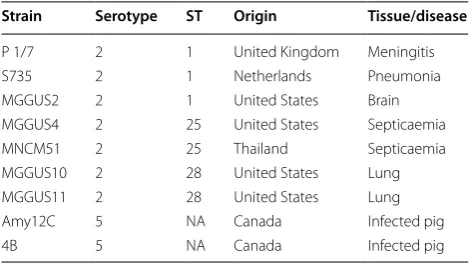
S. suis serotype 2. The choice of serotype 5 strains was based on the fact they present differences in morphologi-cal characteristics. Indeed, S. suis serotype 5 appears to possess a capsule thinner than that of S. suis serotype 2 [28]. Seven strains belonging to either ST1, ST25 or ST28 was tested (Table 1) [21]. Each strain was nebulized sepa-rately with S. suis Amy12C (serotype 5) used as an inter-nal reference strain. Strains of S. suis used in this study
are listed in Table 1. Bacteria were grown in Todd Hewitt Broth (THB) (Difco Laboratories, Becton, Dickinson and Company, Sparks, MD, USA.) at 37 °C.
Cell surface hydrophobicity test
Cell surface hydrophobicity was determined by measuring the adsorption of S. suis cells to n-hexadecane as described previously [29]. Assays were performed in triplicate.
Experimental chamber
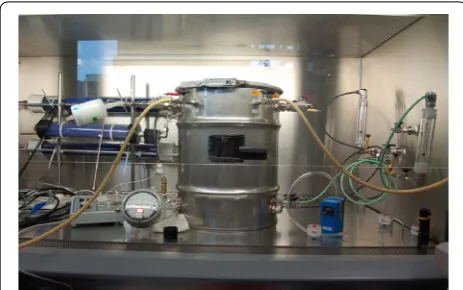
The chamber used in this study was designed, built and characterized by Perrott et al. (Manuscript in prepara-tion). This chamber consists in a stainless steel drum of 45.2 L, was 470 mm in height by 350 mm in diameter and was airtight by a lid (Fig. 1). Ports were created to allow nebulization or air sampling.
Preparation of nebulizing solutions
For each comparative analysis, two strains of S. suis were grown separately in 300 mL of THB overnight, and har-vested by centrifugation (10 min at 7000×g). Cells were washed twice with 1X Phosphate Buffered Saline (PBS, Lonza, Bâle, Switzerland) and suspended in PBS at an optical density 660 nm = 1.5 (about 4 × 10⁸ bacteria/mL)
using a GeneQuant pro spectrometer (model 80-2114-98, GE Healthcare Biosciences, Buckinghamshire, Eng-land). Nebulizing solutions of 150 mL were prepared and contained both strains of S. suis.
Preferential aerosolization assay
For the preferential aerosolization assays, two different S. suis strains were mixed in the nebulizing solution. Ratios in the nebulizing solution and in the air were compared to evaluate if one of the two strains was enriched in the bioaerosols compared with the original bacterial suspen-sion. Aerosolization assays of tested strains were per-formed in duplicate.
Table 1 Serotype, sequence type (ST), origin and diseases of S. suis strains used in this study
Strain Serotype ST Origin Tissue/disease
P 1/7 2 1 United Kingdom Meningitis S735 2 1 Netherlands Pneumonia MGGUS2 2 1 United States Brain MGGUS4 2 25 United States Septicaemia MNCM51 2 25 Thailand Septicaemia MGGUS10 2 28 United States Lung MGGUS11 2 28 United States Lung Amy12C 5 NA Canada Infected pig
[image:2.595.304.540.112.244.2]Nebulization
The nebulizer used in this study has been described by Perrot et al. (Manuscript in preparation). Briefly, this nebulizer was designed to mimic the bubbling process and minimize the stress associated with the aerosoli-zation of bacteria. Using commercial nebulizer, as jet nebulizer, a high-speed airstream hits the liquid bacteria suspension and creates cell wall damages [30–32]. The bubbling nebulizer was located inside the experimental chamber. It was made with a 250 mL of polypropylene container to allow sterilization by an autoclave (Fig. 2). At the bottom of the container, a hole was made to fix a stainless steel tube that allows air to pass. At the end of the tube, the air passes through a cotton fabric that makes bubbles and creates bioaerosols.
Aerosolization
Aerosolization was performed with a nebulization set at 4 L/min and an addition of dilution air at 6 L/min. Prior
to bacterial aerosolization, PBS was aerosolized for con-ditioning the chamber; this was followed by a purge of the chamber prior to the baseline air sampling. Bacte-ria were first nebulized during 20 min to fill the cham-ber with aerosols and then, the air of the chamcham-ber was sampled. Between each duplicate, the nebulizer and the nebulizing solution were changed. The temperature and relative humidity were monitored using the Omega RH-USB probe (Omega Engineering, Inc., Stamford, CT). Introducing dry air into the chamber controlled the tem-perature and humidity. The humidity was also controlled using silica beads.
Air sampling
Aerosols and baselines were sampled using SKC 37 mm cassettes (SKC Inc., Eighty-Four, PA, USA) loaded with a 0.8 μm polycarbonate filter (SKC Inc., Eighty-Four, PA, U.S.A.). The cassettes were connected to a Gilian AirCon2 High Volume Air Sampler (Gilian Instrument Corp., W. Caldwell, NJ, USA.) set at 10 L/min, for 30 min. Aerosol samples were taken during the nebulization. Fil-ter samples were eluted in 5 mL of PBS using Genie-2 vortex (Scientific industries, Bohemia, NY, USA.) for 15 min. A blank was prepared for each experiment (cas-settes not plugged to a pump).
DNA extraction
Aliquots of air samples and nebulizing solution (1.5 mL) were centrifuged for 10 min at 14,000×g and the pellets were stored at −20 °C until use. DNA extraction was per-formed with MOBio PowerLyser® UltraClean® Microbial DNA kit (Carlsbad, CA, USA.) following the manufactur-er’s instructions using homogenization with Mixer Mill MM301 (Retsch, Düsseldorf, Germany) at 20 movements per min during 10 min. DNA was eluted with 50 μL of elution buffer supplied with the kit. Samples were kept at
−20 °C.
Quantitative PCR
Quantitative PCR (qPCR) analyses were performed with the Bio-Rad CFX 96 Touch™ Real-time PCR Detection System (Bio-Rab Laboratories, Mississauga, ON, Can-ada). Primers and probes were purchased from Integrated DNA Technologies (Coralville, IA, USA.) and are listed in Table 2. Results were analyzed using the CFX Manager™ Software version 3.1 (Bio-Rad Laboratories). Quantifi-cation of S. suis serotype 2 was performed according to Nga et al. [33]. Primers target the cps2J gene that is part of the serotype 2 capsular polysaccharide operon [34]. As standard curve, a 10-fold dilution of S. suis S735 genomic DNA was used. Quantification of S. suis serotype 5 was made as previously described by Wang et al. [35]. Prim-ers target the cps5I gene that is part of the serotype 5
Fig. 1 Experimental chamber used for the preferential aerosolization process
[image:3.595.57.289.88.233.2] [image:3.595.57.289.527.698.2]capsular polysaccharide operon coding for a glycosyl-transferase [35]. As standard curve, a 10-fold dilution of
S. suis 4B genomic DNA was used.
Results
Temperature and relative humidity
The temperature and the relative humidity inside the chamber during the preferential aerosolization assays were respectively 22.9 °C and 63.5 %.
[image:4.595.56.545.100.195.2]Cell surface hydrophobicity
Table 3 reports the relative cell surface hydrophobicity for strains of S. suis used in this study. All S. suis sero-type 2 strains showed a low cell surface hydrophobicity (≤11 %) compared to the high hydrophobicity observed for the serotype 5 strains (≥87 %).
Preferential aerosolization assay
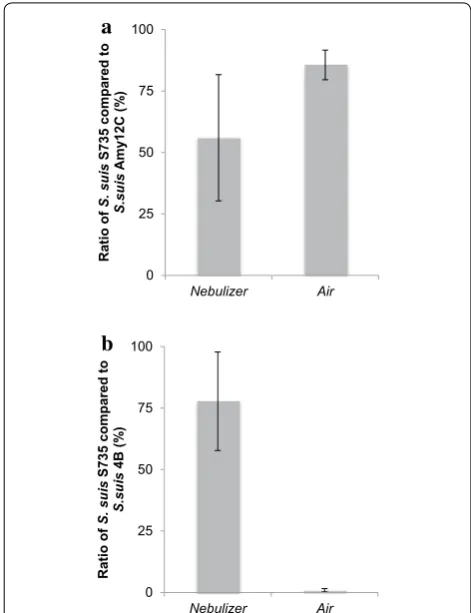
The ratios of the tested strains of S. suis in the nebuliz-ing solution and the bioaerosols are reported in Fig. 3. A ratio of 100 % means that the tested strain represents the entire sample. The serotype 2 strain S. suis S735 was aerosolised along with either S. suis Amy12C or S. suis
4B, two serotype 5 isolates. Figure 3a shows that S. suis
S735 is preferentially recovered in bioaerosols when aerosolized concomitantly with S. suis Amy12C. How-ever, although the ratio in the air is higher than that in the nebulizing solution, these differences are not statisti-cally significant (p < 0.05). Regarding S. suis 4B, an oppo-site result was obtained. Indeed, the serotype 5 strain was the one almost exclusively detected in the bioaerosols (Fig. 3B).
Strains belonging to different STs were aerosolized separately with S. suis Amy12C (serotype 5) used as Table 2 Primers and probe used in this study
NA Not applicable
Primer/probe Target Sequence Amplicon length (pb) Reference
CpS2Jf cps2J 5′‑GGTTACTTGCTACTTTTGATGGAAATT‑3′ 88 Nga et al. [33] CpS2Jr cps2J 5′‑CGCACCTCTTTTATCTCTTCCAA‑3′ 88 Nga et al. [33] CpS2Jp cps2J 5′‑FAM‑TCAAGAATCTGAGCTGCAAAAG
TGTCAAATTGA‑TAMRA‑3′ 88 Nga et al. [33]
[image:4.595.303.539.359.666.2]CpS5If cps5I 5′‑TTTTCGTTGTATTTTCCAAA‑3′ 262 Wang et al. [35] CpS5Ir cps5I 5′‑TCCAAACATTATCCCCTATT‑3′ 262 Wang et al. [35]
Table 3 Relative cell surface hydrophobicity of S. suis
strains used in this study
NA Not applicable
a Two out of three values were negative
b The three values were negative
Serotype ST Strains of S. suis Hydrophobicity (%)
2 1 P1/7 11 ± 5
S735 6 ± 7
MGGUS2 1a
25 MGGUS4 5 ± 2 MNCM51 5 ± 1 28 MGGUS10 >0b
MGGUS11 5 ± 2
5 NA Amy12C 88 ± 7
4B 87 ± 10
a
b
0 25 50 75 100
Nebulizer Air
Ratio of
S. suis
S735 compared
to
S.suis
Am
y1
2C (%
)
0 25 50 75 100
Nebulizer Air
Ratio of
S. suis
S735 compared
to
S.suis
4B (%
)
Fig. 3 Comparative analysis of strains belonging to different sero‑ types. a Ratio of S. suis S735 (serotype 2) in the nebulizing solution and in the air compared to S. suis Amy12C (serotype 5) and b ratio
of S. suis S735 (serotype 2) in the nebulizing solution and in the air
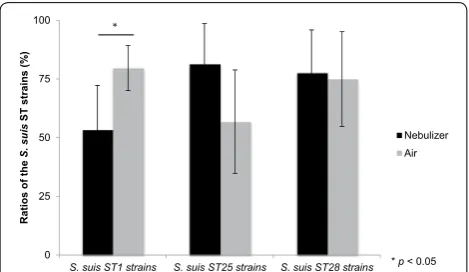
[image:4.595.56.295.561.697.2]an internal reference strain. The ST1 virulent strains selected were isolated from pigs meningitis/septicemia cases [21]. ST25 and ST28 strains were isolated from pigs septicemia and pneumonia cases, respectively [21]. Figure 4 compares the aerosolization of the S. suis ST1 (3 strains), ST25 (2 strains) and ST28 (2 strains) when pooling data obtained for the different strains. For S. suis
ST1, the ratio in the nebulizing solution was 53 %, while the ratio in the air was 80 % which is statistically differ-ent (p = 0.0059). The ratio in the nebulizing solution for
S. suis ST25 was 81 % and its ratio in the air was 57 %. Lastly, ratios in the nebulizing solution and in the air for the S. suis ST28 were respectively 78 and 75 %. There are no statistical differences for the S. suis ST25 and ST28.
Discussion
The presence of S. suis in the air of SCBs and the potential risks of transmission of this pathogen through bioaero-sols have been previously studied [22, 24, 25]. However a better understanding of the aerosolization process of
S. suis is essential and was the topic of this study. More specifically, we proposed the hypothesis of a preferential aerosolization of S. suis in function of serotype and ST.
Given that S. suis serotype 2 is the serotype most com-monly isolated from diseased animals, it can be suggested that this serotype is preferentially aerosolized compared to the others. When comparing the preferential aero-solization behaviours of S. suis S735 (serotype 2) with S. suis Amy12C or S. suis 4B (serotype 5), it appears that aerosolization is more likely to be strain-dependent than serotype-dependent, although additional strains belong-ing to different serotypes should be tested. Both strains of S. suis serotype 5 possessed characteristics (thin cap-sule and high hydrophobicity) that differentiate them from serotype 2 strains [28]. Consequently, these two
properties appear not to have significant impact on the preferential aerosolization of S. suis.
Preferential aerosolization occurs when the ratio of bacteria is higher in the air compared to the original source. In this regard, S. suis ST1 strains tested in this study, but not S. suis ST25 and ST28 strains, appear to be statistically preferentially aerosolized. Differences at the gene and protein levels may at least in part, explain the aerosolization behaviours of the various ST [36]. Tringe et al. [36] showed that fimbrial adhesin genes are up-regulated in air. It has been shown that S. suis possesses pili that have a putative role as adhesins [16]. The ST1 strains express the Sfp1 pilus but not the Sgp1 (Sfp1+/ Sgp1−) [21]. It can be suggested that virulence factors could be involved in the preferential aerosolization pro-cess. Suilysin and extracellular factor are two virulence factors expressed by ST1 strains and not by ST25 and ST28 strains [21, 37]. Ye et al. demonstrated that the ST1 strains evolved from the ST25 strains and that they acquired 132 genomic islands, including 5 pathogenic-ity islands and 4 ST1 specific genes [19]. One or several genes acquired by ST1 isolates could favour bacterial aerosolization. Very recently, Atanassov et al. [38] identi-fied nine proteins that differentiate ST1, ST25 and ST28 from other STs; including two that were overexpressed by ST1. These two proteins have not been purified for iden-tification. Again, these proteins overexpressed by ST1 could promote the aerosolization of these strains. The proteins and genes specific or overexpressed by the ST1 strains could modify the water/air interface cell affinity or change the cell density. These factors could contribute to the preferential aerosolization process. The construction of mutants deficient in specific factors may allow evaluat-ing the above hypotheses.
Strains less present in the air could be carried within the larger droplets which sediment. The preferentially aerosolized strains could be included in the smaller drop-lets that remained longer in the air and included in the air samples. It could explain the difference between air ratio of the different strains.
A better understanding of the aerosolization process of
S. suis is essential to reduce the economic losses for the swine industry and to increase the swine’s health. Fur-thermore, aerosolization studies are of particular interest because S. suis is an important zoonotic agent especially in the Asian countries where the proximity between swine and farmers is more important.
Conclusion
This study is a proof of concept and provides new evi-dence on the potential risks associated with the trans-mission of S. suis serotype 2 through bioaerosols. It also suggests a preferential aerosolization of S. suis serotype 2 0
25 50 75 100
S. suis ST1 strains S. suis ST25 strains S. suis ST28 strains
Ratios of the
S. suis
ST strains (%
)
Nebulizer Air
* p< 0.05
[image:5.595.57.292.541.677.2]ST1 strains and that preferential aerosolization of S. suis
is likely a strain-dependent process, although more stains should be studied. This study emphases the importance to develop an exposure prevention strategy to protect the swine and the swine producers against S. suis infections.
Authors’ contributions
LGL performed the preferential aerosolization assays and drafted the manuscript. LB and MV participated in the design of the study and qPCR protocols. NT and PP designed and built the experimental chamber and the bubble‑burst nebulizer. DG critically revised the manuscript and supervised the culture protocols for S. suis. CD conceived, coordinated and participated in the design of the study and contributed to the manuscript writing. All authors read and approved the final manuscript.
Author details
1 Centre de Recherche de l’Institut Universitaire de Cardiologie et de Pneu‑
mologie de Québec (CRIUCPQ), 2725 Chemin Sainte‑Foy, Quebec City, QC, Canada. 2 Centre de Recherche en Infectiologie Porcine et Avicole (CRIPA),
Fonds de Recherche Nature et Technologies du Québec (FRQNT), Saint‑Hya‑ cinthe, QC, Canada. 3 Groupe de Recherche en Écologie Buccale (GREB),
Faculté de Médecine Dentaire, Université Laval, Quebec City, QC, Canada.
4 Département de Biochimie, Microbiologie et Bio‑informatique, Faculté des
Sciences et de Génie, Université Laval, Quebec City, QC, Canada.
Acknowledgements
The authors are thankful to Marcelo Gottschalk (Faculté de médecine vété‑ rinaire, Université de Montréal) who provided the S. suis strains used in this study. We also thank Serge Simard for his expertise in statistical analysis.
Availability of data and material
All supporting data are included in the manuscript.
Competing interest
The authors declare that they have no competing interests.
Consent for publication
Not applicable.
Ethics approval and consent to participate
The authors declare that no human or animal data was used in this study.
Funding
This project was funded through a Natural Sciences and Engineering Research Council of Canada Discovery Grant. CD is a Fonds de la Recherche en Santé du Québec (FRQ‑S) Senior Scholar and a member of the Réseau en Santé Res‑ piratoire du FRQ‑S. LGL received conference travel Grants from the Centre de recherche en infectiologie porcine et avicole (CRIPA) and from the Respiratory Health Network of the Fonds de recherche du Québec‑Santé.
Received: 16 December 2015 Accepted: 2 May 2016
References
1. Higgins R, Gottschalk M. Streptococcal Diseases. In: Barbara E. Straw JJZ, Sylvie D’Allaire, David J. Taylor editors. Diseases of Swine. 9th edn. Ames, Iowa: Blackwell Publishing; 2006: 769–83.
2. Lowe BA, Marsh TL, Isaacs‑Cosgrove N, Kirkwood RN, Kiupel M, Mulks MH. Microbial communities in the tonsils of healthy pigs. Vet Microbiol. 2011;147(3–4):346–57.
3. Lun ZR, Wang QP, Chen XG, Li AX, Zhu XQ. Streptococcus suis: an emerging zoonotic pathogen. Lancet Infect Dis. 2007;7(3):201–9.
4. Yu H, Jing H, Chen Z, Zheng H, Zhu X, Wang H, Wang S, Liu L, Zu R, Luo L, et al. Human Streptococcus suis outbreak, Sichuan, China. Emerg Infect Dis. 2006;12(6):914–20.
5. Trottier S, Higgins R, Brochu G, Gottschalk M. A case of human endo‑ carditis due to Streptococcus suis in North America. Rev Infect Dis. 1991;13(6):1251–2.
6. Michaud S, Duperval R, Higgins R. Streptococcus suis meningitis: first case reported in Quebec. Can J Infect Dis. 1996;7(5):329–31.
7. Willenburg KS, Sentochnik DE, Zadoks RN. Human Streptococcus suis meningitis in the United States. N Engl J Med. 2006;354(12):1325. 8. Lee GT, Chiu CY, Haller BL, Denn PM, Hall CS, Gerberding JL. Streptococcus
suis meningitis, United States. Emerg Infect Dis. 2008;14(1):183–5. 9. Fittipaldi N, Collis T, Prothero B, Gottschalk M. Streptococcus suis meningi‑
tis, Hawaii. Emerg Infect Dis. 2009;15(12):2067–9.
10. Haleis A, Alfa M, Gottschalk M, Bernard K, Ronald A, Manickam K. Meningi‑ tis caused by Streptococcus suis serotype 14, North America. Emerg Infect Dis. 2009;15(2):350–2.
11. Fowler HN, Brown P, Rovira A, Shade B, Klammer K, Smith K, Scheftel J. Streptococcus suis meningitis in swine worker, Minnesota, USA. Emerg Infect Dis. 2013;19(2):330–1.
12. Feng Y, Zhang H, Wu Z, Wang S, Cao M, Hu D, Wang C. Streptococcus suis infection: an emerging/reemerging challenge of bacterial infectious diseases? Virulence. 2014;5(4):477–97.
13. Gottschalk M, Higgins R, Jacques M, Beaudoin M, Henrichsen J. Isolation and characterization of Streptococcus suis capsular types 9–22. J Vet Diagn Invest. 1991;3(1):60–5.
14. Gottschalk M, Higgins R, Jacques M, Beaudoin M, Henrichsen J. Charac‑ terization of six new capsular types (23 through 28) of Streptococcus suis. J Clin Microbiol. 1991;29(11):2590–4.
15. Gottschalk M, Higgins R, Jacques M, Mittal KR, Henrichsen J. Descrip‑ tion of 14 new capsular types of Streptococcus suis. J Clin Microbiol. 1989;27(12):2633–6.
16. Fittipaldi N, Segura M, Grenier D, Gottschalk M. Virulence factors involved in the pathogenesis of the infection caused by the swine pathogen and zoonotic agent Streptococcus suis. Future Microbiol. 2012;7(2):259–79. 17. Gottschalk M, Segura M, Xu J. Streptococcus suis infections in humans: the
Chinese experience and the situation in North America. Anim Health Res Rev. 2007;8(1):29–45.
18. King SJ, Leigh JA, Heath PJ, Luque I, Tarradas C, Dowson CG, Whatmore AM. Development of a multilocus sequence typing scheme for the pig pathogen Streptococcus suis: identification of virulent clones and poten‑ tial capsular serotype exchange. J Clin Microbiol. 2002;40(10):3671–80. 19. Ye C, Zheng H, Zhang J, Jing H, Wang L, Xiong Y, Wang W, Zhou Z, Sun Q, Luo X, et al. Clinical, experimental, and genomic differences between intermediately pathogenic, highly pathogenic, and epidemic Streptococ-cus suis. J Infect Dis. 2009;199(1):97–107.
20. Ye C, Zhu X, Jing H, Du H, Segura M, Zheng H, Kan B, Wang L, Bai X, Zhou Y, et al. Streptococcus suis sequence type 7 outbreak, Sichuan, China. Emerg Infect Dis. 2006;12(8):1203–8.
21. Fittipaldi N, Xu J, Lacouture S, Tharavichitkul P, Osaki M, Sekizaki T, Takamatsu D, Gottschalk M. Lineage and virulence of Streptococ-cus suis serotype 2 isolates from North America. Emerg Infect Dis. 2011;17(12):2239–44.
22. Berthelot‑Herault F, Gottschalk M, Labbe A, Cariolet R, Kobisch M. Experi‑ mental airborne transmission of Streptococcus suis capsular type 2 in pigs. Vet Microbiol. 2001;82(1):69–80.
23. Berthelot‑Herault F, Cariolet R, Labbe A, Gottschalk M, Cardinal JY, Kobisch M. Experimental infection of specific pathogen free piglets with French strains of Streptococcus suis capsular type 2. Can J Vet Res. 2001;65(3):196–200.
24. Dekker N, Bouma A, Daemen I, Klinkenberg D, van Leengoed L, Wagenaar JA, Stegeman A. Effect of spatial separation of pigs on spread of Strepto-coccus suis serotype 9. PLoS One. 2013;8(4):e61339.
25. Bonifait L, Veillette M, Letourneau V, Grenier D, Duchaine C. Detection of Streptococcus suis in bioaerosols of swine confinement buildings. Appl Environ Microbiol. 2014;80(11):3296–304.
26. Parker BC, Ford MA, Gruft H, Falkinham JO III. Epidemiology of Infec‑ tion by nontuberculous mycobacteria, IV. Preferential aerosolization of Mycobacterium intracellulare from natural waters. Am Rev Respir Dis. 1983;128:652–6.
• We accept pre-submission inquiries
• Our selector tool helps you to find the most relevant journal
• We provide round the clock customer support
• Convenient online submission
• Thorough peer review
• Inclusion in PubMed and all major indexing services
• Maximum visibility for your research
Submit your manuscript at www.biomedcentral.com/submit
Submit your next manuscript to BioMed Central
and we will help you at every step:
28. Gomez E, Kennedy CC, Gottschalk M, Cunningham SA, Patel R, Virk A. Streptococcus suis‑related prosthetic joint infection and streptococcal toxic shock‑like syndrome in a pig farmer in the United States. J Clin Microbiol. 2014;52(6):2254–8.
29. Bonifait L, Gottschalk M, Grenier D. Cell surface characteristics of nontype‑ able isolates of Streptococcus suis. FEMS Microbiol Lett. 2010;311(2):160–6. 30. Zhen H, Han T, Fennell DE, Mainelis G. Release of free DNA by membrane‑ impaired bacterial aerosols due to aerosolization and air sampling. Appl Environ Microbiol. 2013;79(24):7780–9.
31. Thomas RJ, Webber D, Hopkins R, Frost A, Laws T, Jayasekera PN, Atkins T. The cell membrane as a major site of damage during aerosolization of Escherichia coli. Appl Environ Microbiol. 2011;77(3):920–5.
32. Reponen T, Willeke K, Ulevicius V, Grinshpun SA, Donnelly J. Tech‑ niques for Dispersion of Microorganisms into Air. Aerosol Sci Tech. 1997;27(3):405–21.
33. Nga TV, Nghia HD, le Tu TP, Diep TS, Mai NT, Chau TT, Sinh DX, Phu NH, Nga TT, Chau NV, et al. Real‑time PCR for detection of Streptococcus suis serotype 2 in cerebrospinal fluid of human patients with meningitis. Diagn Microbiol Infect Dis. 2011;70(4):461–7.
34. Smith HE, de Vries R, van’t Slot R, Smits MA. The cps locus of Streptococ-cus suis serotype 2: genetic determinant for the synthesis of sialic acid. Microb Pathog. 2000;29(2):127–34.
35. Wang K, Sun X, Lu C. Development of rapid serotype‑specific PCR assays for eight serotypes of Streptococcus suis. J Clin Microbiol. 2012;50(10):3329–34.
36. Tringe SG, Zhang T, Liu X, Yu Y, Lee WH, Yap J, Yao F, Suan ST, Ing SK, Haynes M, et al. The airborne metagenome in an indoor urban environ‑ ment. PLoS One. 2008;3(4):e1862.
37. Takeuchi D, Akeda Y, Nakayama T, Kerdsin A, Sano Y, Kanda T, Hamada S, Dejsirilert S, Oishi K. The contribution of suilysin to the pathogenesis of Streptococcus suis meningitis. J Infect Dis. 2014;209(10):1509–19. 38. Atanassov C, Bonifait L, Perivier M, Gottschalk M, Grenier D. Candidate