Rochester Institute of Technology
RIT Scholar Works
Theses
Thesis/Dissertation Collections
8-2-1968
The Individual Piece
Edward Jajosky
Follow this and additional works at:
http://scholarworks.rit.edu/theses
This Thesis is brought to you for free and open access by the Thesis/Dissertation Collections at RIT Scholar Works. It has been accepted for inclusion in Theses by an authorized administrator of RIT Scholar Works. For more information, please [email protected].
Recommended Citation
THE INDIVIDUAL PIECE
EDWARD JAJOBKY
Candidate for the Master
f Fine Arts in the College
of Fine and Applied Arts of
the Rochester Institute f
Technology
Daniel Valenza : Advisor
DEDICATION
I dedicate this paper to
Cathy
Richer for herhelp
and inspiration.Unique
By
Winnie Burke The idea and thedesign- -a throne of walnut massive base and plush red *
seat--for royalty?- -An
idea made real
regal...
A table with one
leg
the impossible made possible a table tailed with
a base curl...
curious
Uniqueness
is success.
A sun-yellow chair of enfolding foam
poly-
formed,
multi-formed
alive
with
limbs
that love...
Uniqueness is success
[image:4.566.76.409.88.633.2]TABLE OF CONTESTS
PAGE
I. INDEX OF ILLUSTRATIVE MATERIAL . . v
II. INTRODUCTION vii
III. EXPOSITION 1
IV. CONCLUSION 18
V. BIBLIOGRAPHY 19
INDEX OF ILLUSTRATIVE MATERIAL
ILLUSTRATION NUMBER
Walnut chair 1
Oak
dining
table 2Walnut end table sketch . . X. .. 3
Oak end table 4
Oak cantilevered chair
'
5
Laminated oak chair ... 6
Serving
shelf 7Teak lounge chair 8
Mahogany
coffee table 9Walnut with glass table 10
Walnut chair 11
Walnut stool 11a
Foam yellow chair . 12
Walnut writing table ... 13
Walnut writing table ... 14
Walnut
toy
chest . . . .15Walnut
typing
table 16Oak and rosewood table 17
Tellow chair 19
Oak table 20
Oak stool 21
Walnut chair . 22
End table with drawer 23
Walnut pedestal ... 24
Drafting
table ... 25 Laminated oak chair ... 26Candlestick holder 27
Oak end table 28
Mahogany
stool ... 29Cherry
end table .30Cartoon ...31
Oak chair 32
INTRODUCTION
This thesis consists of several individual
pieces, each designed with a special purpose. The reason for making the various pieces was to
illustrate the many important aspects of the
individual piece: its creation, different purposes,
and goals. To the artist craftsman, the individual
piece is important because;* it is a final product
which accomplishes his goals. Each piece becomes an expression of a designer's work and represents his
thinking,
experience with materials, competencyof skills, and development of design concepts.
The individual piece is important because
with each one there is something added to the field
of furniture design. The contribution may be in terms
of a new usage of material, construction, technical
detail,
or new kind of form. The piece may representan entirely new system of design which in the future
will
develop
into more sophisticated furniture designs.By
examining the individual piece, we canstimulate our own
thinking
and evaluate our own work.By
establishing goals we can then proceed in a morespecific direction. The designer must discover a
philosophy which will enable him to grow with the
needs of the future. Then he must
develop
theskills and ideas needed to answer the new demands.
The pieces presented in this paper have been
chosen with the philosophy that design is dependent
upon
time,
place, and circumstance: eachhaving
itsown purposes.
In
designing,
it is important that oneconsiders what he is
trying
to achieve and then worksearnestly to fulfill those goals. This paper concerns
itself with some of the important goals and purposes
of the designer. The designer must be flexible and
must be able to adapt to the changing demands of
society. The thesis includes works done to achieve
these goals. Some were designed to gain personal
growth and experience with construction and technical
procedures, while others were made specifically for
the exploitation of form and material.
They
were madeto exemplify what I have tried to learn and accomplish.
They
alsodisplay
my sensitivity for form and mydevelopment of craftsman skills. When some form or
idea indicates promise, I
try
todevelop
it aslong
asit proves constructive. I have tried to be openminded
in my work and therefore extremely free in
determining
in what direction I will work next.
The individual piece is the culmination of
the designer's efforts to achieve new furniture
design. There exists a special quality about the
individual piece which is not found in the cliche
or mass production item. The spirit that prevails
consists of the ideas and the personality of the
designer. It has the final touch of.the craftsman
that expresses his artistic control of material and
form. Each piece is a culmination of the individual
designer's ideas and thoughts.
Paying
attention tothe finest
details,
its design is carefullyformulated and skillfully worked into the final
product. Each new piece made represents a new step
in the designer's development and skill.
Vitality
is the designer's major goal increating a new piece. He achieves this through new
forms,
materials, and technical devices.Creating
different shapes and using materials in novel ways
adds zest and life to the individual pieces.
By
incorporating
advances intechnology,
the designerestablishes vitality in his new works. Novel form is
one of the most obvious means of achieving this
- 2
-field.
Font is dependent upon both the technical andmaterial limitations. The pieces shown throughout
this paper are an attempt to create new form and
vitality.
Developing
new systems of technique and form leads to the creation of different technical andvisual designs. Systems become the underlying
structures and formulas for the artist. Systems come about as a result of technological advances and new materials.
Creating
a system involvesexperimenting with materials,
forms,
and the technical aspects of const ruction.A single individual piece may incorporate
a new system under which other systems may be developed. The ideas developed here may be
expanded into innumerable designs and evolve into
an entire line of furniture. Each new work becomes a
testing
ground for new ideas and concepts. An unsuccessful work exposes faults in the system andmay suggest necessary alterations. The individual piece presents the opportunity of
developing
newideas and systems which might be applicable to
creating many designs. The large walnut chair is
J* .V
"*
*<*_!
Sfc~
W
IP
- 3
-system of form and construction. See illustrations
10 and 22.
The individual piece is an exciting challenge
to the designer because it includes
many variables
and requirements that must be solved. The success
of each item depends on the knowledge and experience
of the designer. Throughout the construction of the
piece, the designer must continuously
cope with aesthetic
and technical
decisions.
He has to
evaluate each
design in terms
of the purposes
and the final
effects he wishes
to obtain. Each of
the pieces
illustrated were
formulated with specific goals
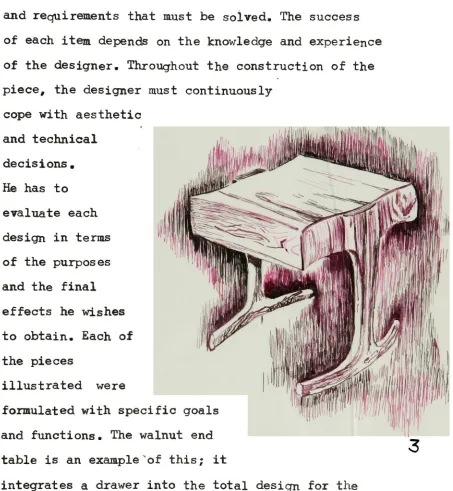
and functions. The walnut end
table is an example^of
this;
itintegrates a drawer into the total design for the
[image:15.566.66.519.176.667.2]- 4
-Hhe designer's goal is to achieve good design
by
creating unique pieces which are well constructed and
visually pleasing. Each piece must be designed
appropriately to meet a specific purpose and to achieve
a
hamony
within itself. The designer wishes to createa unity of
form,
material, and construction. The piecesexemplifying these qualities include the oak end
table,
the walnut chair, and the writing desk. See illustrations
4,
1,
and 13.Well designed fon* is relative to time and
circumstances. What may have been good design
philosophy
during
the 1920's may not meet theneeds of today.
Likewise,
the designs oftoday
maynot satisfy the demands of the future.
Therefore,
design must continually change and evolve.
However,
there are concepts and ideas which only change in
degree. These include appropriateness of material
and simplicity of form. The contemporary trend
tends to place more emphasis on form and total
effects so that the object becomes a satisfying
entity unto itself. Examples of this would
include the oak
dining table,
drafting
table,
- 5
-The individual piece is important because
it places more value on result as a complete unit
and evaluation as a single entity. Each piece
establishes a character and
identity
of its ownand becomes a personality and an important addition
to the surroundings. It may be so well designed that
it be regarded as a piece of sculpture and considered
a work of art.
Being
aesthetically pleasing, it oftenbecomes the focal point of a room. The craftsman
often gains recognition
by
exhibiting his work inart museums. To be accepted, the work must be
recognized as an artistic contribution
by
a jury.Many
of the pieces illustrated in this paper havebeen exhibited in museums,
including
illustrations4,
5,
9, 13, 15, 16,
17, 23,
and 29. The mahoganystool and the oak end table have received awards in
museum exhibitions. See illustrations 4 and 29.
The individual piece becomes the answer to
the problem of
having
something made for aparticular purpose when the item cannot be supplied
through the commercial market. Custom design is an
important aspect of craftsman made furniture and is
desirable for many reasons. First of all, it fulfills
- 6
-situation.
Secondly,
it can be designed aesthetically to fit in with the established atmosphere. In thiscase, the piece not only has to be well designed but
it Also has to take into consideration the
limitations of the environment. A careful study
of the surrounding styles and setting must be
made in order to
fully
integrate the new design.An understanding of the customer's needs and taste
must be taken into consideration. The custom
design has the advantage of
being
able to fit inwith the personality of the customer and satisfy
his particular needs. The custom serving shelf
with slate inserts is an example of satisfying
a need for extensive serving area and integration
into the contemporary atmosphere. See above illustration. An example of different tastes
- 7
-rugged, and strong furniture as compared to a
more
feminine, light,
and delicate style.Examples of my work exhibiting a masculine
style include illustrations
1, 9, 22,
and 29.Those of a more feminine appeal include
illustrations
4,
6,
12, 16,
and 21.Entire environments can be created
by
the use of individual pieces. Each piece,
having
a quality of conveying a specialfeeling
and spirit, makes it possible tocreate a unique atmosphere. With careful
selection of works, all kinds of moods can
be established and worked into a total
environment. A particular mood could be
established
by having
all aspects of theroom,
including
itsfurnishings,
contributeto the desired total effect. Other aspects
involved would include floor coverings, wall
treatment,
and accessories. Pieces exhibitingsimilar qualities would be selected according
to a design theme. A
feeling
of elegance wouldbe created
by
the presence of the walnut chair,- 8
-the
following
items could also be used: the walnutstool, the walnut end
table,
and the walnutpedestal. See illustrations
10, 11a,
and 24.Individual
pieces can be used
as a system of
furnishing an entire
house or apartment.
A system of this
nature would
exhibit a personal
touch. The pieces
would be selected
and purchased on
the basis of specific
needs of the family.
This would allow one to add pieces as
they
areneeded and still be consistent with the rest of the
decor. A more colorful atmosphere would be created
with each item adding more interest to the room. The
unifying characteristic would be in relating the
pieces through their basic philosophy of good
contemporary design. This philosophy includes using
materials
honestly,
using clean-cutlines,
and using- 9
-in that
they
may be placed throughout the home.Furnishing
with this concept makesit,
easier to add on to the present collection because thepieces are independent and do not rely on a
particular style or period. This concept has many
advantages over the traditional method of
buying
furniture of a particular period.
By*
selecting
individual pieces, one can
buy
just those itemswhich are necessary for one's own needs. This
system makes it more convenient and more adaptable
for further expansion. Individual pieces throughout this paper, with some selection, could be used
appropriately in
furnishing
a contemporary home.The individual
piece is designed to
meet the needs of today's
living. Today's fur
nishings should
complement the changing
and mobile life we
live. The design
philosophy to meet our
fast
tempo,
everything-is-possible life demands
- 10
-sometimes disposable. Our present furnishings are
still in a
transitory
stage but seem to be movingin a progressive direction to meet our ever-increasing
needs. Experiments with all kinds of materials,
processes, methods, and forms exemplify the work
being
done.Designers are
looking
foranything that
will add
comfort and
practicality
to our lives.
Examples of
my work which
illustrate
the use of new
processes and
materials include the laminated plywood chair and the
yellow foam plastic chair illustrated above.
If the individual piece is appropriate to
mass production methods and
techniques,
it oftenbecomes a prototype for industry. This can happen
^H_______________H___
14-"'
r/M.-v,-,^'-:'
X - X
-XXM
j*_; ^r?ys_ "^-^
.
- 11
-20 to mass production
processes. An
example of this
is the yellow
chair I
initially
designed as a
hand crafted
object. Its final
outcome reveals the
possibilities of its
production on an
industrial basis. The
initial piece would have to be first designed and
made
by
the craftsman and used as a model in theplanning stages for mass production.
Many
differentdesigns can be made from the technique used in the
yellow chair. The form of the chair was first
conceived and then it was carved from large foam
blocks. It was shaped and sanded into an integrated
whole. Strength and
durability
were addedby
coatingthe foam with fiberglass and many layers of resin.
Coloring
was added to the resin before it waspainted on the chair. The design was chosen to
- 12
-forms.
This prototype could be used in making a moldfor manufacturing on a mass production basis.
Creating
theindividual piece involves
a synthesis of
form,
function,
andmaterial. It
encompasses the
integration of
appropriate
construction
and technical
solutions. The
designer thinks in
terms of establishing
unity and harmony.
Many
times the designer willput much of his personality into the final design.
He does this through a personal interpretation of
design and
by
exhibiting a spirit which he feelsa form should have. Each piece becomes a personal
statement of the individual designer's philosophy.
In
designing
the piece the craftsman goesthrough stages of experimenting with
form,
selecting- 13
-methods and processes to be
used. The success
of the designer depends on his ability to
evaluate and come up with the best solution
to each problem. He has to refer to his
past
experience and rely on his creative imagination
for novel solutions. This creative spirit of
the designer makes his works unpre'dictable and
exciting in the end result. An attitude of
"anything
goes"seems to be the trend of today's
thought.
This creates great variety andinteresting
products. Some piecesillustrating
this idea were exhibited at the Museum of Con
temporary
Crafts in an exhibition entitled"Fantasy
Furniture." Examples of my own workspossessing this spirit of adventure include the
foam plastic chair, the oak end
table,
and thewalnut
typing
table. See illustrations19,
4,
and 16.
Conceiving
the ideas for new pieces canbe approached in various ways. It may start with
a new design form and may be developed further
by
adapting suitable materials and processes. The oak
- 14
-fashion.
Refer to illustrations 17 and 1. New ideascan be stimulated
by
the nature of a particularmaterial and selection of an appropriate form to
accentuate the character and
beauty
of the material.This method was used in creating the sculptured
cherry table. After the form was carved, it seemed
appropriate to place a transparent surface above
the object to allow one to see its entire form. See
illustration 30.
The process of creation can be initiated
by
deciding
on theuse of a certain
process such as
lamination. An
example of this
process is the
laminated oak
chair. I used
this technique
so that I could
take advantage
of the added
strength and ability of the laminating plywood to
make
- 15
-allow them to flex for an added
cushion effect.
Using
another approach, the form can beconceived
first,
then appropriatematerials and
methods might be selected for the construction.
Examples of work
following
this method includethe oak stool, pedestal, and end table. See
illustrations
18, 24,
and 23. This procedureis most often followed
by
the craftsman interestedin achieving new form.
On the other
hand,
the method of constructioncan be conceived first. An example of this "form
following
process"would be the yellow chair. See
illustration 19.
By
carving into a foamblock,
Iwas able to create and
destroy
images with a blowof an axe. When I had the effect I wanted I stopped
carving, smoothed down the
form,
and examined itto make sure everything contributed to the total
unity.
Another approach might be to start with a
feeling
or abstract idealeaving
the mind open forinterpretation. Some ideas using this method include
elegance, growth, motion,
transparency,
andfloatation. These ideas can be used to establish
- 16
-Many
.of my pieces have been inspiredby
a specialfeeling.
See illustrations1, 4,
5,
9, 16,
and 19.By
exhibiting in many museums and in furnitureshows, I have talked with a great many people on what
they
like to see in furniture. Some of the commentsheard include such things as "I like things which are
wild and show real imagination." Some people showed a
great deal of concern for the unique ideas and pieces
revealing creative solutions. "I want something that is
hand crafted and has the personal touch of the craftsman,"
and "I use them in place of paintings and
sculptures,"
are some responses. Some people like to have them
because
they
are veryinteresting
and have a greatdeal of spirit.
However,
there are many who are skepticalof new things. The drawings on the
following
page revealsa situation that I well remember. The persons involved
did not know that I was
listening
and spoke rather
-17-. . . b*lV
Hari
/
iS T- 18
-CONCLUSION
The craftsman
strives to create something
entirely new and
different,
which has novelty,
variety, and zest. An object that has
character
and can stand alone is
complete in
itself,
having
new
form,
newusage of
materials,
and new techniquesof construction.
Such an object is well designed and
fits its
function
appropriately. It isplanned with
Vast sources of knowledge and is
executed with
great skill,
being
nurtured with love and a
strong desire to achieve
harmony
and grace.The individual piece becomes the masterpiece
of the craftsman. It is a work of art developed
through a
problem-solving and technical process.
It is a
totally
unique solution to a problem; itis the product of a
long
process ofdecision-making
and controlled evaluation. Each piece is but a mere
segment of a
long
evolution of an idea.The individual piece serves many functions.
It can be used as an art object, a system of
furnishing,
a prototype forindustry,
a customdesign,
and atesting
ground for new concepts.With many areas to work
in,
the designer finds- 19
-BIBLIOGRAPHY
1. Bal
linger,
Louise Bowen. Design Sources andResources.
New York: ReinholdPublishing
Corp.,
1965.2.
Bevlin,
MarjorieElliot.
Design throughDiscovery.
New York:Holt,
Rineharfi,
Winston,
1963.3.
Dewey,
John. Art as Experience.New York:Capricorn
BooEs,
1958.4.
Hayward,
Helena(ed. ).
World Furniture.New York: McGraw Hill Book Co., 1965.
5.
Kepes,
Gyorgy. Vision and Value- Series I.The Nature~and Art of Motion. New York:
George
Braziller,
lM5.6.
Kupka,
Karl. Dawn of Art. New York:Viking
Press,
IF577.
Langer,
Susanne K. Feeling and Form. New York:Charles Scribner's
Sons,
1953.8.
Moholy-Nagy,
L. The New Vision an Abstract ofan Artist,
lew York:
WitteiTBorn andCo.,
T4^
9.
Nelson,
George. "Problems ofDesign,
Notes onthe New Subscape " Interiors, Vol.
CX,
No. 4 (Nov. 1950) pp. 140-143.
10.
Newman,
Erich. The Archetypal World ofHenry
Moore. New
York:
Pantheon Books, 1959.11.
Pye,
David. The Nature of Design. New York:Hew YorkTT?einhold
Pub. Co.,
1964.12.
Santayana,
George. The Sense of Beauty. NewYork: Collier
BooEs,
1961.13. Struppeck, Jules. The Creation of Sculpture.