0022-538X/94/$04.00+0
Copyright © 1994, American Society forMicrobiology
Enhanced
Competitiveness
of Tomato
Bushy Stunt Virus
Defective
Interfering
RNAs
by Segment
Duplication
or
Nucleotide Insertion
K. ANDREWWHITEANDT. JACKMORRIS*
School ofBiologicalSciences, University of Nebraska-Lincoln, Lincoln, Nebraska 68588-0118 Received 22 April 1994/Accepted 9 June 1994
We have analyzed atypical tomato bushy stunt virus defective interfering (DI) RNA species which accumulated during apassage series in protoplasts. We present a rationale for the orderofappearanceof these moleculesand show, using competition assays, that either segment duplication or single nucleotide insertion canenhanceDIRNAcompetitiveness. Possible mechanismsfor theintroductionof the modificationsobserved intheseDI RNAs are discussed.
Tombusviruses are small icosahedral plant viruses which contain single-stranded positive-sense RNA genomes with lengths of approximately 4.8 kb. Defective interfering (DI) RNAs (22), containing various small noncontiguous portions of the viral genome, have beenfound associated with several members of thisgroup(1, 6, 8, 10). These molecules range in size from approximately 0.4 to 0.8 kb and contain four highly conserved regions (I to IV) which include segments derived from the 5' terminus (I), an internal region (II), and the 3' terminus (III and IV) of the viral genome. Regions I, II, and IV are all essential for tomato bushy stunt tombusvirus (TBSV) DI RNA accumulation, whereas molecules in which region III is deleted are still biologically active (3). The essential regions likely contain cis-acting elements important for RNAreplication.
Wehave shownpreviously that the formation of tombusvirus DI RNAslikely involves replicase-mediated RNA recombina-tion events, in which segments of the genomearedeleted ina stepwisemanner(24).It wasobserved that the accumulation of aparticularDI RNAspeciesinprotoplasts correlated with its competitive ability and that the major factorinfluencing
com-petitivenesswasreplication efficiency. Itwasproposed, there-fore, that replication efficiency was likely a major factor influencing the evolution of these molecules (24). In the presentstudy, we investigate DI RNAgeneration and evolu-tion by analyzing addievolu-tional structural features of TBSV DI RNAswhich influence their competitiveness.
DI-73 evolves tobothlarger and smaller forms during serial passageinprotoplasts.Previously,wehavestudied the evolu-tion of TBSV DI RNAs by coinoculating in vitro-generated transcripts of various DI RNAs species with helper genome transcripts and subjectingthe viral RNAs toserial passage in protoplasts (24). In these passage series, transcripts of the genomeofcucumber necrosis tombusvirus(CNV [19],which shows 64% nucleotide identity to TBSV [7]) were used to differentiate between input TBSV DI RNAs and DI RNAs thatmight be generatedde novo fromthe helper. Previously, DI-73 (Fig. 1) transcripts were coinoculated with CNV genomic transcripts into cucumber protoplasts and subjected to 10 serial passages by using a portion ofthe isolated total nucleic acid as inocula(24). Total nucleic acid prepared from
*Corresponding author. Mailing address: School of Biological
Sciences,348ManterHall, Universityof Nebraska-Lincoln, Lincoln, NE 68588-0118.Phone: (402) 472-6676. Fax: (402) 472-2083.
each passage24hpostinoculationwasexamined by polyacryl-amidegelelectrophoresis under denaturing conditions. Infive of six passage seriesanalyzed,smallerDIRNAs withstructures
similarto that of DI-72(containingsmall deletions in their 3' region; Fig. 1) eventually dominated (24). These DI-72-like moleculeswere shown to be derived fromthe input DI-73. In one passage series, however, a larger DI RNA, DI-Rl (con-tainingadirectduplication ofa130-nucleotide [nt] segment of region II; Fig. 1), began to accumulate and became the dominantDI RNAspecies in the middle of the passage series (24).Asshown inFig.2, DI-Rlaccumulated toeasily detect-ablelevels in passage6butwas nolonger detectableby passage 9.The dominantDI RNA atpassage 10, designatedDI-B103 (Fig. 2), exhibited similar electrophoretic mobility to that of DI-72.
Duplication of asegmentinregionIIcan increase DI RNA competitiveness. The observedtimingofappearance of theDI RNAsinthe passage series shown inFig.2suggestedthat the larger DI-Rl molecules were more competitive than their intermediate-sized DI-73 precursors and that the DI-72-sized molecules (i.e., DI-B103), which ultimately dominated,were more competitive than the
DI-Ri
molecules. Competition assays were performed in cucumber protoplasts, using CNV genomic RNA transcripts (CNV-K2/M5 [19]) as the helper. Coinoculations of the helper with equimolar amounts of transcripts frompreviouslyconstructed cDNA clones ofDI-Rl and DI-73 (24) resulted in theabundant
accumulation of progeny of each of these DI RNAs (Fig. 3A, lanes 3 and 4, respectively). No DI RNAs weredetected in mock and helper only inoculations (Fig. 3A, lanes 1 and 2, respectively) or in inoculations containing only the DI RNAs (data notshown), indicating that theDIRNAsobservedinhelper coinoculations were not residual inocula. In coinoculations of helper with equimolaramountsofbothDI-Rl andDI-73, DI-RI accumu-latedtolevels similartothose with singleDI-Ri
inoculations (Fig. 3A, cf. lanes 6 and 3); however, the accumulation of DI-73 was greatly reduced compared with the accumulation when itwasinoculatedsingly with the helper (Fig. 3A, cf. lanes 6and4).This result showed thatDI-Rl was morecompetitive than DI-73. As previously observed (24), DI-72 was morecompetitivethan DI-73 in coinoculations(Fig.3A,lane8),but interestingly, DI-Rl was also more competitive than DI-72
(Fig. 3A, lane7).Theseresultswere reproducible in indepen-dent experiments, and the resultswere essentially identical to those observed when transcripts of the TBSV genomewere 6092
on November 9, 2019 by guest
http://jvi.asm.org/
TBSV
(TBSV-100)
DI-73
I
H4-l:3 98
5. 4
/14 14\3
Dl-733
DI-RI \ & \
4398 447
A
DiR5L\
D1-73-01
72-B CN,.;-K 2Nl5 T+ri,v-I..
r ~ Ilr
c
M c OE i7
- --tr
. 2 3 4 _ 6 _
,4647
DlI-72
168
DI-72 DI-B1 03
IJ1285
1523 Rsa I (1436)..ACUUGGGUA..
..ACUULUGGGUA..
1390
uu
..GGGU AUUC..
..GGGU UC..
III IV
4479 4649
FIG. 1. Schematic representation of the genomic RNA of TBSV andof various TBSV DI RNAs. The organization of the coding regions inthe 4.8-kb genomic RNA of TBSV is shown at the top, with the approximate molecular weight values (in thousands) of the encoded proteins (7). Regions from which the TBSV DI RNAswerederivedare shown below as shaded boxes with the deleted intervening regions
depicted as lines. The four regions which are conserved, to some
degree, in all characterized, naturally occurring TBSV DI RNAsare
indicated byromannumerals. Region III/IVrepresentsacontiguous TBSV3' terminus which includes thesegmentbetween regions III and IV. Coordinates given correspond to those of the genomic RNA of TBSV(7) andrepresentjunction sites, orinternal regions, in the DI RNAs. An expanded version of region IIis shown below DI-73, and
region IIof DI-RI (containing a duplicated 130-nt segment) is also
shown.Regions I and III/IV in DI-RI areidenticaltothose inDI-73. The differences insequence between DI-72 and DI-B103 are shown below DI-72. DI-B103 containsanextrauracil residue inregionIIat
position 1393 and has 2 fewernt atthejunction of regions III and IV. The position ofaRsaI site in both DI-73 and DI-B103 isindicated. DI-73 and DI-72areidenticalexceptthat DI-72 containsa167-ntdeletionnearits3' terminus. The data (see the text)suggestthat the order ofcompetitiveness of these DI RNAs is DI-B103>DI-RI >DI-72>DI-73.
usedasthe helper (datanotshown). These data establish that DI-RI(containingasegmentduplication) ismorecompetitive
than either of the previously characterized smaller DI RNAs (DI-73 and DI-72).
PASSAGE#
l. I I .
D:-73
;~
_ .s
FIG. 2. Transition of DI-73 to both larger (DI-RI) and smaller (DI-B103) forms during 10 serial passagesin cucumber protoplasts. Theprotoplastswereinitially inoculated with CNV-K2/M5 (2 ,ug) and DI-73(0.0034 ,ug). Passageswerecarriedoutby inoculatinganewset ofprotoplasts withanaliquot (one-fourth) of the total nucleic acid isolated from the previous infection. Aliquots of total nucleic acid isolated 24 h postinoculation from the initial infection (lane 0) and from 10 serialpassages (lanes 1 to 10, respectively)wereseparated ina4.5% polyacrylamide gel containing 8Murea,andthegelwasstained with ethidium bromide. The positions of DI-73, DI-RI, and DI-B103inthegelareindicated.
FIG. 3. Accumulation of various DI RNA progeny in cucumber protoplast infections with either CNV-K2/M5orTBSV-100transcripts
as helper. Approximately 3 x 10⁵ protoplastswere inoculated with helper and various equimolaramounts of DI RNAtranscripts. Total nucleic acidwasisolated 24 hpostinoculation, aliquotswereseparated in 4.5% polyacrylamidegelscontaining 8 M urea, andthe gelswere
stained with ethidium bromide. The viral RNAs present in the inoculumareindicated above the lanes. (A) Lanes: 1,mockinfection; 2to8,CNV-K2/M5 (2
jig)
withorwithout DI RNA transcripts, DI-Rl (0.39 p.g), DI-73 (0.34 p.g), and DI-72 (0.27jig),
as indicated. The positions ofDI-RI, DI-72, and DI-73 in the gel are indicated. (B) Lanes: 1, mock infection; 2 to 9, 2 ,ug of either CNV-K2/M5 orTBSV-100 alone or with DI RNA transcript DI-Rl (0.39 ,ug) or
DI-B103(0.27 ,ug)orboth,asindicated above the lanes. The positions ofDI-RI andDI-B103 in the gelare indicated.
Directsegment duplication has been reported in DI RNAs of variousRNAviruses(9, 12, 23); however, the significance of suchduplications hasnot been determined. We have demon-stratedthataduplicatedsegmentinregionIIisabletoconfer enhancedcompetitiveness and that the fitness of the molecule is consistent with its observed order of appearance in the passage series (i.e., DI-RI replaced DI-73). Duplication of segments in other naturally occurring TBSV DI RNAs in wholeplantshavebeen reported(3, 8), and,similartoDI-Rl, they may also be more competitive than their counterparts which donot contain theduplications.
The role ofregion II in DI RNA accumulation is unclear, butit hasbeen shown to be essential forthebiological activity of TBSV DI RNAs, since deletion of the entire region, orof certain portions of it, render the molecules nonviable (3). In turnip crinkle virusDIRNAs, itwasshown thatreplacement of deleted segments in nonviable DI RNAs with nonviral se-quencesof similarlength resultedinrestoredviability (13).We have found thattranscripts generated fromamodified pDI-72 construct,in which region II wasinverted, donot accumulate to detectable levels (26), suggesting that this region is not simplyaspacerelement. Ifcis-actingelementsdo resideinthe region duplicated in DI-RI, this may increase the odds of trans-acting factors interacting with DI-Rl and may help to explainthe enhancedcompetitiveabilityof this molecule. Itis unclear, however, whether suchanelement would function in the plus or minus strand. We cannot, however, preclude the possibility that the duplication may be acting as a spacer element which is optimally positioning other cis-acting ele-ments.
A single nucleotide insertion in region II can increase DI RNAcompetitiveness. Theobservation that DI-Rl was more competitive than DI-72suggestedthat DI-B103,the molecule which ultimately dominated in the passage and which was
predicted to be DI-72-like, must somehow be structurally
different from DI-72. We used reverse transcription-PCR to
amplify cDNAs to DI-B103, using the protocol described
on November 9, 2019 by guest
http://jvi.asm.org/
[image:2.612.60.294.71.251.2] [image:2.612.329.545.74.187.2] [image:2.612.111.243.537.624.2]A
I--CNV-K2"M5
-EL
o-X X
OFD x a + i
0 C CT01 1<" a:c
1 2 :3 4 5 fw 7
DI-R
1-Dl-72XPU
B
DI-Rl
DI-72iB103
DIB103I072
I- CJNV-K2lMD-I
5 cb ED + +
0 ,
I 1
FIG. 4. Accumulationof DI RNAprogenyincucumberprotoplast
infectionswith CNV-K2/M5transcripts ashelper. Approximately 3 x
105 protoplasts were inoculated with helper and various equimolar
amountsofDI RNA transcripts. Totalnucleic acid wasisolated 24 h
postinoculation, aliquotswereseparated ina4.5% polyacrylamidegel
containing8 Murea,and the gelswerestainedwith ethidiumbromide. The viralRNAspresentin the inoculum areindicated abovethe lanes.
(A) Lanes: 1, mock infection; 2 to 7 CNV-K2/M5 (2 p.g) with or
withoutDI RNAtranscripts,DI-RI (0.39,ug),DI-72XP(0.27,ug),and DI-72XPU (0.27 pLg). The positions of DI-Rl, DI-72XP, and DI-72XPU in the gel are indicated.(B) Lanes: 1,mock infection; 2to7, CNV-K2/M5 (2,ug) with orwithout the DI RNAtranscripts, DI-Rl
(0.39 pLg), DI-72/B103 (0.27 ,ug), and DI-B103/72 (0.27
jig).
The positions of DI-RI, DI-72/B103, and DI-B103/72are indicated.previously(24), and theamplified molecules were clonedand
sequenced. The DI-B103 molecules differed from DI-72 at
only three nucleotide positions; an additional U residue was
present atposition 1393and 2nt(A and U)weredeletedatthe junction of regions III and IV (Fig. 1). Transcripts of DI-B103
weresynthesized in vitro and used in competitionexperiments
with DI-Rl (Fig. 3B). When coinoculated individually with
CNV-K2/M5 helper,progenyof each DI RNA accumulatedto
similar levels (Fig. 3B,lanes 3 and 4). When bothDI-Rl and
DI-B103werecoinoculatedwith CNV-K2/M5 helper,DI-B103
progeny accumulated to levels higher than those of DI-Rl
progeny (Fig. 3B, lane5). DI-B103was alsomorecompetitive
thanDI-Rlwhen TBSV helper(TBSV-100)wasused(Fig. 3B,
lane 9). This suggestedthatone of the three singlenucleotide
modifications in DI-B103, not present in DI-72, must be responsible forthe observed enhanced competitiveness.
Totestwhether theextraUresidue in regionII could,on its
own, cause enhanced competitiveness, region II of the
DI-B103 clone was amplified with primers which introduced
restriction sitesXbaI and PstIl at the 5' and 3' ends,
respec-tively, of the PCR product. The DI-B103 region II was then
used to replace the comparable region in DI-72XP (a DI-72
derivative containingXbaI andPstl sites introduced between
regions I and II and regions II and III, respectively). The
resulting construct, DI-72XPU, was identical to DI-72XP,
except that the former contained an extra U residue at
coordinate 1393(as confirmed by sequencing). Both DI-72XP and DI-72XPU accumulated to similar levels when singly coinoculated with CNV-K2/M5 helper (Fig. 4A, lanes 4 and 5), but in competition experiments with DI-Rl, only DI-72XPU
was abletocompete more effectively than DI-Rl (Fig. 4A, cf.
lanes 6 and 7). Results essentially identical to these were observed when TBSV-100 was used as helper (data not shown). These data indicated that the additional Uresiduein region II could, on its own, confer enhanced competitive ability.
To determine whether the 2-nt deletion at the junction between regions III and IV in DI-B103 was also able to
independently enhance competitive ability, a chimeric mole-cule of DI-72 andDI-B103wasconstructedby usingaRsaIsite presentinthe 3'portion of regionII(coordinate1436)(Fig.1). DI-72/B103 contained the DI-72 sequence 5' to the RsaI site and the DI-B103 sequence 3' to the RsaI site and thus contained the2-ntdeletion betweenregionsIII and IVbutnot the Uresidue insertion in region II. DI-72/B103wasunableto effectively compete against DI-Rl in coinfections (Fig. 4B, lane 6), indicating that the 2-nucleotide deletion, on itsown, could not confer enhanced competitiveness. The reciprocal chimera, DI-B103/72, containing only the extra U residue in region II,was more competitive than DI-Rl(Fig. 4B, lane 7), confirming earlier results with DI-72XP (Fig. 4A). Both the
DI-72/B103 and DI-B103/72 constructs were sequenced com-pletely to confirm that they contained only the predicted modifications, and all of these results were reproducible in independent experiments. Takentogether, these dataindicate that a single nucleotide insertion of a U residue at position 1393 is ableto enhance TBSVDI RNA competitiveness.
It is interesting to note that region II in CNV DI RNAs contains the additional U residue at the corresponding posi-tion (6, 18), as does the CNVgenome (20). The additional U residue in regionIIofDI-B103 therefore makes itmoresimilar tothe region IIof CNV DI RNAs. If this region doesrepresent a cis-acting element, making it more CNV-like might enhance its ability to interact with CNV-encoded trans-acting factors. This is relevant in lightof the fact that CNV was thehelperin the passage series in which DI-B103was formed. Our compe-tition assays indicated, however, that both DI-B103 and DI-72XPU (both of which contain the extra U residue) showed approximately the same level of competitiveness over DI-Rl, with either TBSV or CNV as the helper. This suggeststhat the higher level of competitiveness of DI RNAs containing the extra Uresidue isnothelper specific.
Aprevious studyofsequences essential for TBSVDI RNA accumulation indicated that a portion ofregion II containing the extra U residue can be deleted without eliminating the biological activity of the DI RNA (3). Our results show that although this region may be dispensable for accumulation, it can have a marked effect on DI RNA competitiveness. This result illustrates that nonessential regions of DI RNAs may play important auxiliaryroles in DI RNAfitness.Furthermore, the observation that both of the modifications which enhanced competitiveness mappedto regionII suggests that this region can play a significant role in DI RNA fitness and evolution.
Previously, we have shown that the smaller DI-72 is more competitive than the larger DI-73 (24). Wesuggested thatsize alone was not entirely responsible for the higher level of competitiveness observed for smaller DI-72 and that the 3' deletion in DI-72 may make it more proficient at recruiting and/or utilizing trans-acting replication factors. Our present results indicate that larger DI RNAs(e.g., DI-Ri) canbemore competitive than smaller ones (e.g., DI-73 and DI-72), thus confirming our earlier proposal that sizealonedoes not dictate competitiveness.
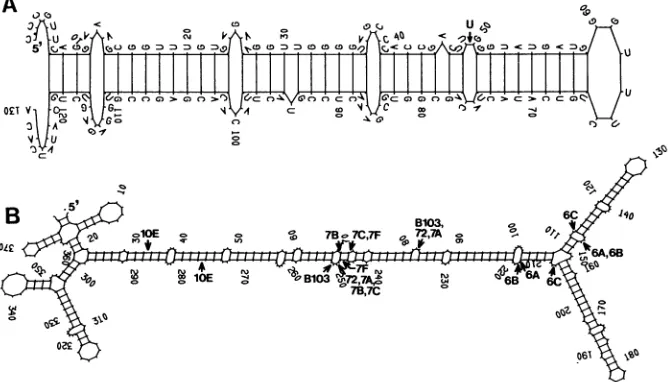
Possible mechanisms for the formation of Rl and DI-B103. Previously, we proposed a replicase-mediated copy choice-type mechanism (11, 17) to explain the formation of tombusvirus DI RNAs (24), and a similar mechanism maybe responsible for the generation of the direct duplication in DI-RI. The most stable computer-generated structure (4) of the 130-nt segment which was duplicated inDI-Rlisshownin Fig. 5A. The sequence is predictedtoform ahairpin structure (Fig. 5A), the majority ofwhich is alsopresent whenthe entire DI-73 molecule is folded (data notshown). The formationofa hairpin such as that shown in Fig. 5A could potentially assist
on November 9, 2019 by guest
http://jvi.asm.org/
[image:3.612.83.273.71.191.2]A
O£T
B
OL£ I
061
Il
FIG. 5. Computerpredicted secondary structures for 130-nt segment which was duplicated in DI-Rl (A) and regionIII/IVof DI-73(B). The structures weregenerated by usingthe program FOLD(4),and the calculated freeenergieswere-37.8 and -98.4(AandB,respectively).Position 1inpanel Acorresponds to coordinate 1344 of the TBSV genome (7), and position 1 in panel B corresponds to coordinate 4398. In panel A, the positionof theextraUresidue identified in DI-B103 is indicated. InpanelB, thejunctionsites observed betweenregionsIIIand IVinDI-B103 (B103) andpreviouslycharacterized TBSV DI RNAs (72, 6A to 6C, 7A to 7C and 7F, and 10E [24]) are indicated by arrows.
thereplicase (during negative-strand synthesis) in transferring to a3' positiononthetemplate aftercopying the segment (i.e., by placing the sites of dissociation and reinitiation in close proximity). Evidence suggests that intramolecular recombina-tion (24) and recombination during negative-strand synthesis (25) canoccur intombusvirus infections.
Twoseparate eventswerelikely involved in the formation of DI-B103: deletion ofa169-nt segmentbetweenregionsIIIand IV and insertion of a U residue in region II. We reported previously the possible involvement of guide sequences in directing sites of recombination and also the potential for base-paired heteroduplex structures to form between same-sense sequences at the upstream and downstream junction sites(24).Inthecomputer-predictedstructureofregion III/IV, thejunctionsites of the deletion betweenregionsIIIandIVin DI-B103 map closeto eachother, as do previously identified junctionsofregion III and IVof other DI-72-like molecules (Fig. SB). The close proximity of the junction sites on the predicted structuresuggeststhatan intramolecular secondary structuremay beinvolved in thegeneration of the deletions by (i) providinganobstacle for thereplicase which may promote itsstalling and dissociation and (ii) positioning the dissociation andreinitiation sites close to each other. A similarproposal has beenmadefor the formation ofDI RNAs of broad bean mottle virus (21), and an analogous mechanism has been shown to function in intermolecular nonhomologous RNA recombination in brome mosaic virus(16).A structuresimilar to that in Fig. SB could also theoretically form between two
regions III/IV, suggesting that intermolecular recombination events similar tothose described for brome mosaic virus (16) may also bepossible. Intermolecular recombination has previ-ously been demonstrated in tombusvirus infections of both protoplasts and whole plants (25). Secondary structures have also beenimplicated in the formationofDI RNAsin corona-viruses (15) and flock house nodavirus (14). For TBSV DI RNA formation, both secondary structure in thetemplate(s) and guide sequence(s) in the nascent strands may function either together or independently to direct the deletion of sequences.
The introduction of the Uresidue into region IIofDI-B103 may have also been the result of a recombination event involvingDIRNAs.Recombinant tombusvirus RNAs in which nontemplated U and A residues were identified at junctions have been described previously (24, 25). Alternatively, we cannotpreclude the possibility that polymerase error(5) may be responsible for the addition of the U residue. The presence of other U residuesat the site of the addition suggests thata replicase stuttering-type mechanism (2) may have been re-sponsible forthe addition.
We thank Peter Nagy, Laurie Baggio, and Fred Robinson for criticallyreadingthe manuscript. We thank D. Rochon forproviding CNV-K2/M5 and Fred Robinson forproviding pDI-72XP.Some DNA sequencing was performed by the Center of Biotechnology DNA SequencingFacility (UniversityofNebraska-Lincoln).
This research was supported by a grant from the Department of Energy(DE-FG03-88ER13908).K.A.W. wassupported bya postdoc-toralfellowship from the Natural Science andEngineeringResearch Council of Canada.
REFERENCES
1. Burgyan, J., F. Grieco, andM.Russo. 1989.Adefectiveinterfering RNA molecule in cymbidium ringspot virus infections. J. Gen. Virol. 70:235-239.
2. Carpenter, C. D., P. J. Cascone, and A. E. Simon. 1991. Mutations in a satellite RNA ofturnip crinkle virus result in addition of poly(U) invivo.Virology 183:595-601.
3. Chang, Y.C.,M. Borja,H. B. Scholthof,A.0.Jackson,andT.J. Morris.Unpublished data.
4. Devereux,J.,P.Haeberli, and0.Smithies.1984. Acomprehensive
setofsequence analysis programs for the VAX. Nucleic Acids Res.12:387-395.
5. Drake,J. W. 1993. Rates of spontaneous mutation among RNA viruses. Proc. Natl. Acad. Sci. USA 90:4171-4175.
6. Finnen, R. L., andD. A. Rochon.1993.Sequence andstructureof defective interfering RNAs associated with cucumber necrosis virusinfections. J. Gen. Virol. 74:1715-1720.
7. Hearne,P.Q.,D. A.Knorr,B.I.Hillman,and T.J.Morris. 1990. Thecomplete genomestructureandsynthesisofinfectiousRNA
from clones oftomatobushystuntvirus.Virology 177:141-151. 8. Hillman, B. I., J. C. Carrington, and T. J. Morris. 1987. A
on November 9, 2019 by guest
http://jvi.asm.org/
[image:4.612.135.470.79.270.2]defective interfering RNAthatcontains a mosaic ofaplant virus genome. Cell 51:427-433.
9. Jalanko, A., and H. Soderlund. 1985. The repeated regions of semliki forest virus defective-interfering RNA interferes with the encapsidation process of the standard virus. Virology 141:257-266. 10. Knorr, D. A., R. H.Mullin, P. Q. Hearne, and T. J. Morris. 1991. De novo generation ofdefective interfering RNAs of tomato bushy stunt virus by highmultiplicity passage. Virology 181:193-202. 11. Lazzarini, R. A., J. D. Keene, and M. Schubert. 1981. The origins
of defective interfering particles of the negative-strand RNA
viruses. Cell 26:145-154.
12. Li, X.H., L. A. Heaton, T. J. Morris, and A. E. Simon. 1989. Turnip crinkle virus defectiveinterfering RNAs intensify viral symptoms andaregenerated de novo. Proc. Natl. Acad. Sci. USA 86:9173-9177.
13. Li, X. H., and A. E. Simon. 1991. In vivo accumulation of a turnip crinkle virus defective interfering RNA is affected byalterations in size and sequence. J. Virol. 65:4582-4590.
14. Li, Y., and L. A. Ball.1993. Nonhomologous RNA recombination during negative-strand synthesis of flock house virus RNA. J. Virol. 67:3854-3860.
15. Makino, S., C.-K. Shies, L. H. Soe, S. C. Baker, and M. M. C. Lai. 1988.Primary structure and translation of a defective interfering
RNAof murine coronavirus. Virology 166:550-560.
16. Nagy, P. D., and J. J. Bujarski. 1993. Targeting the site of RNA-RNA recombination in brome mosaic virus with antisense sequences. Proc.Natl. Acad. Sci. USA 90:6390-6394.
17. Perrault, J. 1981. Origin and replication of defective interfering particles. Curr. Top. Microbiol. Immunol. 93:151-207.
18. Rochon, D. M. 1991. Rapid de novo generation of defective interfering RNA bycucumber necrosis virusmutantsthat do not
expressthe 20-kDa nonstructural protein. Proc. Natl. Acad. Sci. USA 88:11153-11157.
19. Rochon, D. M.,andJ. C.Johnston. 1991. Infectious transcripts from cloned cucumber necrosis virus cDNA: evidence for a
bifunctional subgenomic promoter. Virology 181:656-665. 20. Rochon, D. M., and J. H. Tremaine. 1989. Complete nucleotide
sequenceof the cucumber necrosis virus genome. Virology 169:
251-259.
21. Romero, J., Q. Huang, J. Pogany, and J. J. Bujarski. 1993.
Characterization ofadefectiveinterfering RNA components that increase symptom severity of broad bean mottle virus infections. Virology 194:576-584.
22. Roux, L.,A. E.Simon,andJ. J.Holland. 1991.Effects of defective interfering viruseson virusreplication andpathogenesis in vitro and in vivo. Adv. VirusRes.40:181-211.
23. White, K.A., J. B. Bancroft, and G.A. Mackie. 1991. Defective RNAs of clover yellow mosaic virus encode nonstructural/coat protein fusion products. Virology 183:479-486.
24. White, K. A., and T. J. Morris. 1994. Nonhomologous RNA
recombination in tombusviruses: generation and evolution of defective interferingRNAsbystepwise deletions. J. Virol. 68:14-24.
25. White, K. A., and T. J. Morris. 1994. Recombination between
defective tombusvirus RNAs generates functional hybrid
ge-nomes.Proc. Natl. Acad.Sci. USA 91:3642-3646. 26. White,K.A., andT.J. Morris. Unpublisheddata.