Building Ontology Repositories for E-Commerce Systems
JIANMING YONG
1,2, YUN YANG
1and JUN YAN
11
CICEC - Centre for Internet Computing and E-Commerce
School of information technology
Swinburne University of Technology
PO Box 218, Hawthorn, Melbourne, VIC 3122
AUSTRALIA
2
Department of information Systems
Faculty of Business
University of Southern Queensland
Toowoomba QLD 4350
AUSTRALIA
http://www.it.swin.edu.au/staff/yyang/
Abstract: - This paper describes a new method to integrate and implement e-commerce systems in distributed computing environments, especially the Internet. In this paper, we propose a core part of ontology repositories for e-commerce systems, illustrate the organisational topology of the repositories, and demonstrate how to use XML standards to build the repositories. After all these repositories are distributed on the Internet, the ubiquitous integration platform can be formed so that all the e-commerce systems can interact each other seamlessly.
Key-Words:- E-commerce systems, ontology repositories, system integration, e-commerce networking infrastructure, interoperability, XML
1 Introduction
The Internet has become a very important infrastructure to facilitate e-commerce. Most of business activities can be done through the Internet. Online banking, selling, and purchasing etc. have become an essential part of producers and consumers. Different vendors have different systems, including different platforms and different data formats. How to integrate these heterogenous systems together to conduct e-commerce has become one of the main concerns.
There are many researches being conducted about the ontology. What is the definition of ontology and why is it important to e-commerce? Hendler [3] defines ontology as a set of knowledge terms, including the vocabulary, the semantic interconnections and some simple rules of interference and logic for some particular topic. O’Leary [4] says that the ontology and common language are the same. From their descriptions or definitions, when a term is used in somewhere, most of others in addition to
authors themselves can understand what the word really means, in terms of both syntax and semantics. This is exactly what e-commerce needs to have. A whole aggregation of ontology actually forms a flexible information exchange platform. Furthermore, Fensel [1,2] says ontology provides support in integration of heterogeneous and distributed information sources across various networks.
This paper is organised as follows. Section 2 introduces our e-commerce networking infrastructure. Section 3 is the core of this paper, illustrating how to build ontology repositories and how the repositories cooperate with other e-commerce components etc. Section 4 concludes our work.
2 Networking Infrastructure
telecommunications, e-commerce is upgraded into new life phases. At the initial stage of e-commerce, enterprises tried to use limited telecommunication capacity to conduct their business, such as using telephone to monitor their business activities and fax to order goods in order to accelerate their business transactions. Although all sorts of standards were made to facilitate e-commerce, people were not satisfied with their efforts. EDI [5] was a quite important application in the e-commerce history. A lot of large organisations and companies have adopted EDI in their routine business activities for many years. But for those SMEs (Small and Medium size Enterprises), they could not afford to use EDI because of either the cost or technical complexity. The real e-commerce revolution comes from data communications, especially the Internet. Since the early 1990s, the
Internet has been led to commercialisation. Year by year the commercial traffic grows exponentially over the Internet. Although the current networking market is facing sluggish movement or even deep negative mood, the Internet has definitely become the vital infrastructure of future economy. E-commerce will deploy widely with the Internet support. All the enterprises, including large, medium and small sizes, can become players in this situation. The Internet has become the essential part of enterprises, which want to implement their e-commerce strategies.
How do enterprises interact with the infrastructure (Internet) and build their e-commerce systems? Physically any e-commerce system consists of three parts: internal network, access network and the Internet as depicted in Figure 1.
Internal network
An internal network is normally an Intranet, including PCs, all sorts of servers, LANs (Local Area Networks), etc. Sometimes an internal network can be just one or only several computers. Sometimes, for a large enterprise, an internal network is much more complex that may include thousands of computers, many different LANs and BNs (Backbone Networks). Its function can be related to all business activities and be in charge of the internal information flow and resource management. However, for e-commerce, it is a product provider, for example, using a Web server to publish its product catalogues and service information. With help of an access network described below, outside customers can reach its products according to its own security policy.
Access network
An access network is a bridge between an internal network and the Internet. Normally it supplies connection services. It negotiates with an internal network to decide how an enterprise connects to the Internet and what resources can be visible to the
their own access network. However, for most of SMEs, they do not directly operate their access networks. They often buy services from ISPs or other agents, who operate access networks. Thus, access networks become the Internet gateways for many SMEs.
outside users. For some large enterprises, they operate
ternet
Internet was initially built, it has been over
development of the technology of next gen
to effectively integrate these heterogenous applications In
Since the
three decades. No one knows exactly how big the Internet is now. What we can say is that the Internet has an exponentially growth, especially from the early 1990s and we also know it has become an infrastructure of modern economy and the carrier of e-commerce.
With the
[image:2.612.66.511.298.381.2]eration Internet, IPv6 (http://www.ipv6.org/), the Internet penetrates into all aspects of the modern society, especially profit-oriented enterprises. Through all sorts of agents, who work at a range of access networks, the Internet becomes more reachable to SMEs, though large enterprises still are big players in the market. After the Internet becomes a very important infrastructure, the biggest challenge is how Fig. 1. E-commerce networking infrastructure
Internal
and systems. In order to solve this problem, we address the ontology and its repositories for seamless information exchange.
3 Ontology for E-commerce Systems
s is ous
hy do different platforms need ontology
In the platform layer, ontology facilitates the ana
repositories
.1 Building ontology repositories
rkets etc., we
in the business processes. That means ontology
hy do different platforms need ontology
In the platform layer, ontology facilitates the ana
repositories
.1 Building ontology repositories
rkets etc., we
in the business processes. That means ontology For e-commerce, one of the most important thing
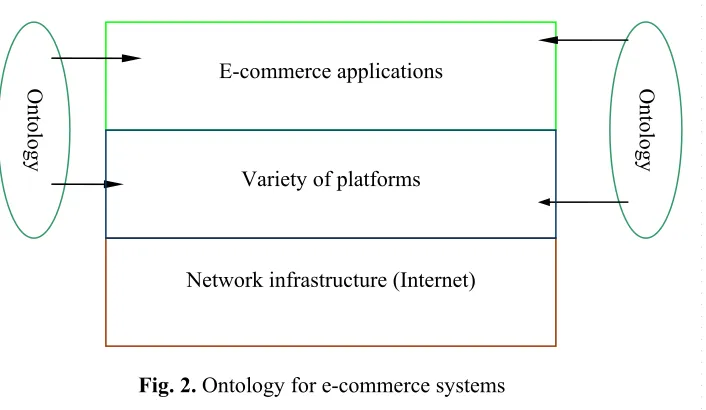
interoperability, for different platforms and vari applications. All sorts of relevant participants should understand each other. Otherwise, no e-commerce transactions can be processed properly. How can ontology facilitates e-commerce, Figure 2 shows the relationships among infrastructure, ontology and e-commerce applications.
facilitates e-commerce, Figure 2 shows the relationships among infrastructure, ontology and e-commerce applications.
W
W
support? Although TCP/IP offers Internet
transparency, different vendors still use different
hardware and software to host their tools. When
we use these tools to develop any systems and
supporting tools, there is an information exchange
issue. Thus, ontology can be used to facilitate the
interoperability in any different platforms. For
example, in the stage of design and planning, we
may use UML,
www.omg.org/technology/documents/formal/uml.
htm, to describe data/action flows. Actually we
treat UML as a kind of ontology language.
support? Although TCP/IP offers Internet
transparency, different vendors still use different
hardware and software to host their tools. When
we use these tools to develop any systems and
supporting tools, there is an information exchange
issue. Thus, ontology can be used to facilitate the
interoperability in any different platforms. For
example, in the stage of design and planning, we
may use UML,
www.omg.org/technology/documents/formal/uml.
htm, to describe data/action flows. Actually we
treat UML as a kind of ontology language.
tforms
E-commerce applications O
n
O
[image:3.612.136.489.277.482.2]n
Fig. 2. Ontology for e-commerce systems
lysis, design, implementation and maintenance of tool systems. In the e-commerce application layer, there are various ontology repositories to facilitate the business transactions. In this section, we will discuss some details about:
• how to build
lysis, design, implementation and maintenance of tool systems. In the e-commerce application layer, there are various ontology repositories to facilitate the business transactions. In this section, we will discuss some details about:
• how to build
• how repositories work
• how repositories work
33
When we deal with factories, superma When we deal with factories, superma
know that warehouses are necessary to these industrial activities. From the e-commerce perspective, an ontology repository has a similar function as a real warehouse in enterprise supply chain management. Nevertheless, the most important function of repositories is to facilitate interactive communications
repositories become the platform of interoperability. Based on this most important characteristic, what kinds of repositories e-commerce systems should have? The Internet e-commerce trade cycle for a typical B2C (business to customer) scenario was presented in searchÂnegotiateÂorderÂdeliverÂinvoiceÂpayment Âafter saleÂnew search (a new cycle starts) [5]. In each stage, what kinds of repository are needed? For example, if you want to find cars, it will not show you trucks or others. In order to solve this consistency problem, we can build respective repositories for each stage or we can build an overall repository to satisfy the needs of all stages. Also different industries may have quite different requirements. Thus the common repository should be built using respective industrial standards. When vendors want to implement e-know that warehouses are necessary to these industrial
activities. From the e-commerce perspective, an ontology repository has a similar function as a real warehouse in enterprise supply chain management. Nevertheless, the most important function of repositories is to facilitate interactive communications
repositories become the platform of interoperability. Based on this most important characteristic, what kinds of repositories e-commerce systems should have? The Internet e-commerce trade cycle for a typical B2C (business to customer) scenario was presented in searchÂnegotiateÂorderÂdeliverÂinvoiceÂpayment Âafter saleÂnew search (a new cycle starts) [5]. In each stage, what kinds of repository are needed? For example, if you want to find cars, it will not show you trucks or others. In order to solve this consistency problem, we can build respective repositories for each stage or we can build an overall repository to satisfy the needs of all stages. Also different industries may have quite different requirements. Thus the common repository should be built using respective industrial standards. When vendors want to implement e-Network infrastructure (Internet)
Variety of pla
to
lo
gy
to
lo
commerce systems, they have to establish a certain reflection to the common repository. The following paragraph is about how to build a common repository for the car industry using XML schema (http://www.w3.org/XML/Schema).
We use the tree topology for building repositories of which the root repository must hold most common stan
r e-commerce systems. The quality of r
le a modular electronic bus
to pro
.2 How repositories work
formed, the repository dards for the specific industry. As for the car
industry, the root repository must have all the common characteristics for the whole car industry. Thus from the Internet e-commerce trade cycle, we will need search, negotiate, order, deliver, payment and aftersale schemas. In addition to these seven schemas, there are two common schemas for the product catalogue and process transaction. We use a tool, XML spy (http://www.xmlspy.com), to generate schemas for these repositories.
Actually the ontology repository has become the transition centre fo
epository framework will affect all e-commerce systems dramatically. Thus we should build the repository using ubiquitous standards. In the following, we will introduce two very important e-commerce standards, ebXML and Biztalk.
ebXML (http://www.ebxml.org) is a set of specifications that together enab
iness framework. The vision of ebXML is to enable a global electronic marketplace where enterprises of any size and in any geographical location can meet and conduct business with each other through the exchange of XML-based messages. ebXML is a joint initiative of the United Nations (UN/CEFACT) and OASIS (Organisation for the Advancement of Structured Information Standards) developed with global participation for global usage. It has eleven project teams: requirements, business process methodology, technical architecture, core components, transport/routing and packaging, registry and repository, quality review, proof of concept, trading partners, marketing awareness, and technical architecture security. Each project team has its own set of deliverables and schedules. Since the establishment of the ebXML organisation in November 1999, its project teams have carried out a great deal of work towards their final specifications. Some of specifications have been approved. Some are still ongoing, however most specifications are under review. In the near future, after all specifications are finished and approved, ebXML will contribute significantly to the future global electronic
marketplace. ebXML can formulate the ontology repository for any business process and transaction.
The goal of BizTalk (http://www.biztalk.org) is vide resources for learning about and using XML for Enterprise Application Integration (EAI) and B2B (business to business) document exchange, both within the enterprise and over the Internet. On BizTalk.org you can learn how to use XML messages to integrate software applications and build new solutions. The design emphasis is to use XML to integrate your existing data models, solutions, and application infrastructure, and adapt them for electronic commerce. You can also learn about the BizTalk Framework, a set of guidelines for implementing an XML schema and a set of XML tags used in messages sent between applications. Microsoft, other software companies, and industry standards groups can use the BizTalk Framework to create XML schemas in a consistent manner. The goal of the BizTalk Framework is to accelerate the rapid adoption of XML. BizTalk Framework schemas, which are business documents and messages expressed in XML, can be registered and stored on the BizTalk.org Web site. Any individual or organisation can download the framework and use it to create and submit an XML schema to the Web site. As long as the schema passes a verification test, it is considered a valid BizTalk Framework schema. Individuals and organisations can freely use XML schemas from the BizTalk Web site within their applications, for as long as the schema is published for public use. Biztalk has become very important enterprise standards. It already built many XML schemas for different sectors. Many system developers have directly used Biztalk’s schemas as their ontology repository.
3
After all needed schemas are
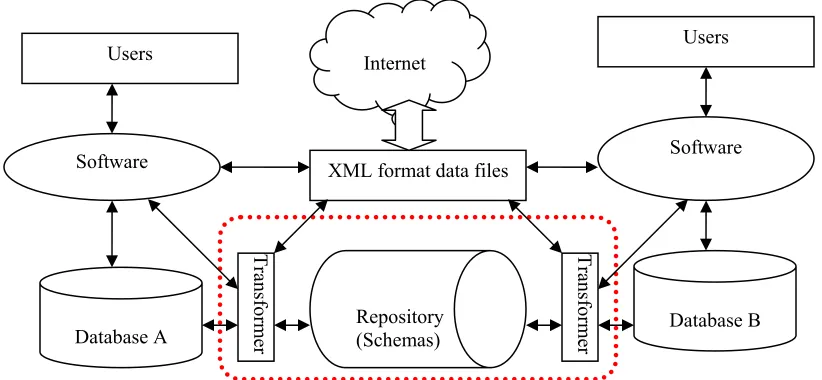
addition, all the legacy systems can still run in their traditional way. If they need to communicate with external systems, they will contact the core part to
input or output what they need. The core part will transfer the XML format data to the requested database format and vice versa.
[image:5.612.106.517.131.321.2]
The major function of transformers in Figure 3 is for translate their original data format into XML-for Fig. 3. Relationships between repositories and databases
e B epository
Software Users
XML format data files
e A Software
Users Internet
T
ra
T
ra
data integration. When an XML-format request comes from the outside, the transformer picks up this request, analyses this request against relevant schemas, contacts the database to get requested data. After that, the transformer uses these data against relevant schemas to form an XML-format response and returns to the request side via the Internet or other telecommunications infrastructure.
4 Conclusion
ave illustrated our new approach for
mat
eferences:
l, Trends and Controversies Ontologies
[2] antic Web
[3] Semantic Web Agents and the
[4] nowledge-Based Systems
[5] , Technologies
In this paper, we h
building ontology repositories for e-commerce systems on the Internet. Through well-built ontology repositories, all related e-commerce systems could be connected seamlessly. These repositories use XML-based standards to construct their frameworks. All the frameworks are formulated by XML schemas and all these ontology repositories are distributed around the Internet or other telecommunications infrastructures. At the same time all the legacy systems can still keep their original process procedure. If these legacy systems want to communication with outside systems, they can contact relevant ontology repositories and
data. With the help of these powerful ontology repositories, all e-commerce systems, whether old or new, would run more effectively. Therefore a global e-market can be established after those ontology repositories are built.
R
[1] D. Fense
and Electronic Commerce. IEEE Intelligent Systems, Vol. 16, No. 1, 2001, pp8-14.
D. Fensel, F. Harmelen, et al., The Sem
OIL: An Ontology Infrastructure for the Semantic Web. IEEE Intelligent Systems, Vol.16, No.2, 2001, pp38-45.
J. Hendler, The
Semantic Web. IEEE Intelligent Systems, Vol.16, No.2, 2001, pp30-37.
D. E. O'Leary, K
Different Firms, Different Ontologies, and No One Best Ontology. IEEE Intelligent Systems, Vol.15, No.5, 2000, pp72-78.
D. Whiteley, E-commerce - Strategy and Applications, McGraw-Hill, 2000.
Databas R
(Schemas) Databas
ns
fo
rm
er
ns
fo
rm