Australasian (ACIS)
ACIS 2004 Proceedings
Association for Information Systems Year 2004
Interpretative Insights into Interpersonal
Trust and Effectiveness of Virtual
Communities of Open Source Software
(OSS) Developers
Michael Lane∗ Glen van der Vyver†
Prajwal Basnet‡ Srecko Howard∗∗
∗University of Southern Queensland †University of Southern Queensland ‡Sunshine Coast University ∗∗University of Southern Queensland
Interpretative Insights into Interpersonal Trust and Effectiveness of Virtual
Communities of Open Source Software (OSS) Developers
Michael S. Lane Glen Litton Van der Vyver
Prajwal Basnet Srecko Howard
University of Southern Queensland Sunshine Coast University
Information Systems Department
Faculty of Business, University of Southern Queensland Toowoomba, Queensland, Australia
Email: [email protected]
Email: [email protected]
Email: [email protected]
Sunshine Coast University Caloundra, Queensland, Australia
Email: [email protected]
Abstract
This paper reports on the qualitative aspect of a study which investigated the importance of interpersonal trust (cognitive trust, affective trust) in virtual communities of developers involved in open source projects at the SourceForge.net web portal. The qualitative responses to an online survey from developers involved in open source projects at SourceForge.net provided rich contextual insights into open source software development. The interpretative analysis of these qualitative data provided a number of interesting findings that show interpersonal trust (cognitive, affective) is important to the effectiveness of virtual communities of core developers involved in open source projects. The findings also show that trust is dynamic and built over time, that there are different levels of trust within an open source project and cognitive and affective trust operate interdependently.
Keywords:
Open Source Software, Virtual Communities, Affective Trust, Cognitive Trust, SourceForge.net
INTRODUCTION
Open source software has gained considerable attention in the popular press and is starting to gain acceptance in the business environment as a viable alternative to proprietary software (Bonaccorsi, 2003; Garzarelli, 2002). Organisations have started to question the worth of many proprietary software packages which have locked them into ongoing expensive upgrades (Varghese 2004; Zymaris 2004). Industry and researchers alike are interested in understanding the dynamics of virtual communities of developers who are able to produce high quality, cost effective software which is distributed free via the Internet. Some previous studies on virtual communities of developers involved in free/open source projects have identified the importance of trust in these projects. This study is particularly interested in determining what role interpersonal trust plays in the virtual communities of developers involved in open source projects and the level of importance of the cognitive and affective aspects of this trust.
This paper is structured as follows. First, we look at virtual communities of developers as communities of practice which are involved in open source projects. Next, we discuss the interpersonal aspects of affective and cognitive trust. Then, the importance of interpersonal trust in the virtual communities of developers involved in open source projects is established in previous empirical studies on open source development. The general research questions investigated in this part of a larger study are outlined and the research method deployed is described and justified. The key findings are presented and discussed. Finally the major conclusions and implications of the study are presented.
VIRTUAL COMMUNITIES INVOLVED IN OPEN SOURCE SOFTWARE (OSS)
(Osterloh, Rota & Kuster 2002; Ridings, Gefen & Arinze 2002). Second, they consist of members who are knowledgeable about the tasks which are undertaken in the virtual community (such as software development) (Osterloh, Rota & Kuster 2002b). Third, matching tasks to talent is easier in voluntary virtual communities of practice because members have the freedom to judge which tasks are best suited to their talents and aptitudes (Benkler 2002). Fourth, the members of voluntary virtual communities of practice are intrinsically motivated by the fact that they can work voluntarily without the pressures of meeting specific requirements or deadlines (Osterloh, Rota & Kuster 2002b). It has also been found that the absence of deadlines and time pressures in Free/OSS development leads to increased creativity and enjoyment (Amabile, Hadley & Kramer 2002; Lakhani & Wolf 2003).
It is important to distinguish a virtual community from the cyber-place, or virtual settlement in which it operates (Jones & George 1998). The location of a virtual community is important because it establishes the ‘virtual’ place where people can meet (Ridings, Gefen & Arinze 2002). There are four criteria that the location of a virtual community (a cyber-place) must meet to be defined as the virtual settlement for that community. First, it should be a cyber-place where individuals can interact. Second, more than one communicator (individual) should be present at the cyber-place to allow for some level of interaction. Third, it should be a place where a significant portion of the communications between the members of the virtual community occurs. Finally, there should a minimum sustained level of membership to the cyber-place (Jones 1997).
In this study, it is argued that SourceForge.net, an OSS development portal, is a virtual settlement because it meets these four criteria. First some degree of interactivity between project members is required to ensure the sustained growth of OSS projects hosted at SourceForge.net. Second, many of the OSS projects hosted at SourceForge.net consist of more than one active member. Third, at SourceForge.net each OSS project is provided with a cyber-place (a website) where interactions between members can occur through discussion forums. Furthermore, project members and the wider user community of the OSS project can also view project tasks, post information about bugs, download patches and updates, access the source code repository (CVS) and download file releases (source code and binary executables) for the OSS project from the project website (SourgeForge Net 2003). Finally, to become involved with OSS projects hosted at SourceForge.net, an individual needs to become a member of both SourceForge.net, and the individual OSS projects which they are interested in.
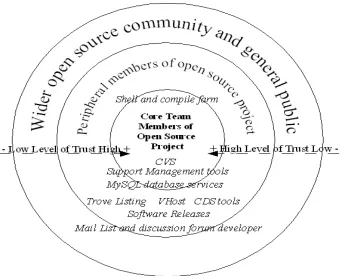
SourceForge.net provides a comprehensive range of development tools for OSS development including:
• SourceForge Collaborative Development System (CDS) web tools
• Project Web Server
• Tracker: Tools for Managing Support
• Mailing lists and discussion forums
• Software releases
• Shell services and compile farm
• MySQL Database Services
• Project CVS Services
• VHost Services
• Trove Listing
Figure 1 Sphere of Trust and Access to Open Source development tools in Open Source Projects: (developed for this research)
INTERPERSONAL TRUST IN OSS DEVELOPMENT
Interpersonal trust is the focus of this study. Interpersonal trust is predominant form of trust in OSS development for four distinct reasons (Stewart & Tony 2002):
1. Virtual communities for OSS projects are collaborative networks, where members interact for extended periods of time.
2. There are no strict deadlines or schedules which limit the development of interpersonal relationships. 3. Members of a virtual community involved in an OSS project depend on each other for many aspects of
software development such as development design, documentation, planning, graphics, to produce the source code and testing. Members also need to write code which is compatible with the work of others, and the existing source code (Stewart & Gosain 2001).
4. Members of a virtual community for an OSS project put themselves in a position of vulnerability with respect to other members in order to complete a transaction. For instance, a programmer may spend a considerable amount of time and effort writing source code. When this code is submitted, there is always the risk that another member (or even the project manager) may claim the work of the programmer as their own.
In this study, we focus on two dimensions of interpersonal trust, cognitive and affective. The complexity of cognitive and affective trust requires further elaboration.
DEFINITION OF AFFECTIVE TRUST AND COGNITIVE TRUST
Cognitive trust is related to knowledge. We touched on the uncertainty / certainty dimension of trust before to which knowledge is closely related. When we have absolute knowledge of all the dimensions of a particular situation, there is no need for trust. When we have limited knowledge of a particular situation, there is often a pressing need to trust people. Trust is highly relevant to conditions of risk and uncertainty, the normal condition of so many corporations today. McAllister (1995) views trust as a leap of faith and argues that trust cannot exist if there is not at least some degree of knowledge.
Affective trust is directly related to human emotion and indirectly to affiliation and those psychological processes which might be called intuitive. McAllister (1995) argues that this type of trust is related to the emotional investments people make in relationships, the intrinsic value of the relationship and a feelings of genuine concern for other members of the group. This type of trust is based on feeling rather than rational thought and many of the processes involved are subconscious.
Affective trust in the context of this study is defined as: trust consisting of the emotional bonds between two parties who express genuine care and concern for each other’s welfare (McAllister, 1995; Staples & Ratnasingham, 1998).
Stewart and Gossain (2002) have empirically examined interpersonal (affective,cognitive) trust (discussed below) in the context of virtual communities for OSS projects. They found that both cognitive trust and affective trust had a positive influence on the effectiveness of OSS development groups. Specifically, cognitive trust increased process effectiveness or the process of carrying out tasks while affective trust increased engagement between members of a virtual community. This in turn resulted in increased outcome effectiveness. A recent study by Basnet (2004) confirmed the importance of cognitive trust and affective trust in virtual communities of software developers involved in OSS projects. Therefore, we consider that interpersonal trust is an important factor impacting on the effectiveness of virtual communities of developers in open source projects.
RESEARCH QUESTIONS AND RESEARCH METHOD EMPLOYED
The general research questions investigated in the qualitative aspect of this study are:
• Does interpersonal trust (cognitive, affective) play an important role in the virtual communities of open source developers working in open source projects?
• If so, how and why is interpersonal trust (cognitive, affective) important in virtual communities of open source developers?
• If interpersonal trust is important, how do affective trust and cognitive trust impact on the effectiveness of virtual communities of open source developers?
A qualitative method allowed the researchers to explore the research questions in an interpretative manner in line with the research objectives (Miles & Huberman, 1994; Yin, 1994). Content analysis was considered an appropriate qualitative method to analyse and interpret the data collected from a set of open ended questions. These open-ended questions asked the target respondents in an online survey to express their opinions on the role of cognitive and affective trust in virtual communities of developers in OSS projects. The target respondents were core members of OSS projects which are maintained on SourceForge.net (http://sourceforge.net). This is the largest open source software development portal in the world, hosting over 80,000 open source projects with over 800,000 registered members. One hundred and fifty open source developers provided specific responses to the open ended questions in the survey. Using an interpretative approach allowed us to gain valuable insights into the role of interpersonal trust and effective open source development. The data was analysed using the software package NVivo which facilitates the management of the analysis process for qualitative data. NVivo allows researchers to code large volumes of qualitative text for recurring themes and patterns in a rigorous, verifiable manner. The data is then gradually reduced and abstracted by the researcher(s) into more generalisable theory and frameworks (Miles & Huberman 1994; Richards, 1999; Carroll & Swatman 2002; Gibbs, 2002).
DISCUSSION OF DATA ANALYSIS FINDINGS
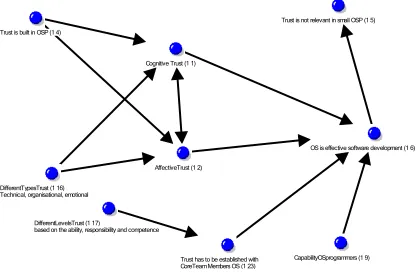
Cognitive Trust (1 1)
AffectiveTrust (1 2) Trust is built in OSP (1 4)
Trust is not relevant in small OSP (1 5)
OS is effective software development (1 6)
CapabilityOSprogrammers (1 9) DifferentTypesTrust (1 16)
Technical, organisational, emotional
DifferentLevelsTrust (1 17)
based on the ability, responsibility and competence
Trust has to be established with CoreTeam Members OS (1 23)
Figure 2 Conceptual model of the influence of cognitive and affective trust on effectiveness of virtual communities of developers involved in open source projects (developed for this research)
[image:6.595.72.488.76.349.2]The data analysis of the qualitative responses of the survey respondents confirms many of the themes identified by Stewart & Gosain (2002) in relation to the ideology of OSS development. Table 1 shows the extent to which each of themes occurred in the document containing the qualitative comments of the survey respondents in percentage terms of number of characters. These themes were used to develop the conceptual model of interpersonal trust and effective virtual communities of developers involved in OSS projects, presented in Figure 2.
Table 1 Most commonly occurring themes (Number of characters coded for each theme in percentage terms) identified in the survey respondents comments in relation to trust in virtual communities of developers involved in open source projects (Source: developed for this research)
Trust themes Cognitive Trust Affective Trust Trust is built in OSP
Trust is not relevant in small OSP
OS is effective software development Capability of Open Source programmers Different Types of Trust Different of Levels of Trust Number of characters coded for each theme in percentage terms
33.7% 20.4% 18.5% 10.3% 9.1% 4.2% 2.3% 1.5%
The shaded cells in Table 1 highlight the relative importance of interpersonal trust (cognitive, affective) in OSS virtual communities and that trust needs to be built over time. The findings in relation to the key themes identified in the qualitative responses of the survey respondents are now discussed.
Role of Interpersonal Trust (Cognitive) in OSS virtual communities
The analysis of the qualitative responses show that cognitive trust appears to play a very significant role in virtual communities involved in OSS projects. Cognitive trust is built through a rational process, based on evidence of ability, responsibility and competence of a member of the OSS project. In an OSS project, everything the member does is ‘out there’, subject to scrutiny and criticism of the other members of the virtual communities of OSS developers. The virtual community as whole is able to assess the competence and trustworthiness of members based upon their output. The following comments by the survey respondents show the importance of cognitive trust in virtual communities of OSS developers.
contribute and swear they will stay with us forever (>1 new developer per week), and almost none of them stay, either due to difficulty of the task, r/l commitments or whatever. I simply don't trust anyone or mistrust anyone till I have seen their work and seen them stick with the project for a number of weeks or months (P65:66)”
“The focal point is the project managers - if developers are allowed into the closed circle of those who have access to CVS commit without regard for their quality or capability, the trust relationships break down (P113)”
“Once a potential project participant has proved his/her interest by submitting relevant code changes and expressing an interest to write more code, this is normally enough for them to gain the trust of existing project members. Once trusted a participant is typically given commit rights to the source repository, and can thus freely change the code base.(P185:186)”
Project management tools such as CVS reduce the impact of a new member on an open source project when faulty code is committed to the source code repository.
“When I add a member to my project, I know he has the potential to break things, but on the other side, he can only break small things (project is backuped, CVS keeps track of sources, website database is backed up) there is nothing that can't be undone (P110)”
Role of affective trust in OSS virtual communities.
While affective trust did not appear to be rated by the survey respondents as important as cognitive trust, its impact on virtual communities involved in OSS projects should by no means be discounted. It was evident from the comments of the survey respondents that synchronous and asynchronous Internet communication such as online chat, instant messaging and email play an important role in developing affective trust by facilitating engagement between the OSS virtual community members.
“I've always been able to trust and work with other OSS programmers in developing and supporting such software; I've often been amazed at the lengths people have gone to assist myself and others using such software (case in point the debian IRC channel) (P31)”
“I find that live "chat"-style communication is essential for maintaining a cohesive development group. There are group members I know both personally, and only online. While I have a basic level of trust for all of them, much of that is garnered from time spent in discussion via IRC chat room, instant messaging, and via email. This extensive communication is essential to maintaining a sense of trust and rapport. One can for sure more trust the open-source community than any commercial company. We are doing this for other reasons to produce the best possible software: - to fix all bugs, - to have fun, + many more, and not only for one reason -> Money (P35:43)”
Relationship between interpersonal trust and size of OSS project (number of core developers)
It was apparent from analysing numerous comments by the survey respondents that interpersonal trust is much relevant in open source projects which have a significant number of contributors and/or core team members. A number of respondents emphasised that the OSS project they were involved was driven by a single individual and obviously in such a situation, trust was not a major issue:
“This is a one-man project, so many of these trust questions are not relevant. In fact, all the OSS projects I have started up on my own have one developer (P22):”;
I have to answer neutral on this, since I am currently the only person working on this project (P153).”.
Moreover, there were a large number of respondents who felt trust was very important to the success of open source projects and that a lack of trust was often caused by inappropriate behaviour such as the practice of forking projects. Forking is frowned on practice of taking existing development code from a project and creating another version from the base code. This has happened in a number of OSS projects and will continue to happen because of the very nature of open source development. The problem is compounded because the forker may take a number of key developers from the original project and therefore the whole project may suffer as a consequence as well. This is an interesting phenomenon in OSS projects and usually occurs because of a clash of personalities, differences in ideology or because the perceived ability of the OSS project leader may be questioned. Clearly, as the size of the virtual community involved in a particular OSS project grows, the issue of trust becomes more important until it becomes crucial element contributing to the effectiveness of the virtual community and the success of the OSS project:
“I am also developing proprietary software in a Source Forge like model where none of the developers have actually met each other. At first, I was hesitant to integrate my module with their code, but after a month or two of working with developers, you generally get a sense of how good they are and trust their code.(P45)”
“I think trust is important in a free software development. But I really don't think that virtual communities can make it more difficult to trust people. Usually, you can trust people, and you know everyone has the same hobby than yours (programming and they want to help people) and there is no reason not to trust them.(P76).”
Interpersonal trust is built over time in the virtual community involved in an OSS project
The analysis of the qualitative responses of the survey participants show that interpersonal trust in new virtual community members of OSS projects was built over time. An important path to achieving the trust of the existing members in a virtual community involved in an OSS project is the demonstration of professionalism through dedication to the project. When members reach certain, community specific, levels of perceived trustworthiness and competency, they are given access to the concurrent version control system (CVS) and the ability to commit code to the project. OSS development is based on meritocracy where recognition and status is based on the relative merit, ability and professionalism of individual software developers. This has to be demonstrated to other members of the OSS project over time to earn their trust both cognitively and emotionally. Hence, cognitive and affective aspects of interpersonal trust are built over time as evidenced by the following comments by survey respondents.
“Free software is a meritocracy, and a person achieves through his/her merits and commitment, and level of activity (P11); “Free Software is generally a trusting community. However, it is generally accepted that a new guy is not trusted. This means that a new guy can't just write an email to the developer's list and get write access to the project's cvs. A new guy has to build trust with the project by submitting patches, useful criticism, help, and testing, and so forth. Before someone can have write access to CVS, they generally have to demonstrate programming skills, an ability to take criticism and use it constructively, work with a team, and show that they are willing to work to resolve problems (P11);”.
“Trust is built in certain primary ways, even though there is not physical contact between people, there can still be a reasonable connection. All projects I have worked on revolve heavily around their corresponding IRC channel, so we communicate regularly in real time. This connected the small number of people involved in each project in real time and made it much easier to form real relationships. It's not like e-mail (P12);
Other member encompasses a whole range. There are some I trust to make the right changes there are others who need hand-holding and probably should not be granted commit-access. Again, in this respect the open software community is very similar to the functioning of the scientific community in general. (P33:34)”.
The comments (above) by an OSS developer that emphasises contact by IRC (online chat programs) builds interpersonal trust more effectively then e-mail. These are interesting comments that warrant further investigation in future research into virtual work structures in organisations. Could the immediate interaction of IRC (and instant messaging) create stronger emotional bonds and speed up the trust between members? How much of the immediate communication ability of tools such IRC is involved in building trust in OSS projects? It would appear that groups using the IRC build faster cohesion and trust if IRC was used predominantly as opposed to only using e-mail or a discussion board for communication.
OSS developers have been labelled as zealots because of their support of the ideology driving open source software (Bezroukov 2003; Petreley 2004) and their fierce opposition to proprietary software. We found that the OSS developers that responded to the qualitative survey questions value their communities and the culture within which they operate. There was a degree of contempt for traditional, structured methods and the imposition of authority by conventional software development practices as evidenced by the following comment by a survey respondent.
Here's the deal with FOSS projects (or ours, at least :-): everyone working on the project is there because they *want* to be. No one's getting paid a dime (in fact, many of us have put varying amounts of money into the project for this reason or that to help it along). It's not about getting things done because some jerk upstairs says it has to be done by next Tuesday. It's about doing the best job we can for a project we all truly believe in. Because of this, I've found the developers on our project to be some of the nicest, easy-going, and trustworthy people I've ever worked with. (P50);
Open source developers are free and open, they come and go, what makes it difficult planning stages of the project relying on your developers. Therefore, the tactic is to use the developers at the time they are present and don't postpone too much with them, unless, of course, you've spent years working with them. Open source is all about trust and an open-source project must develop the following three relationships of trust in order to be successful: a) trust among the developers involved in an open source project, b) trust between the developers and the users of an open source project, and c) trust in open source from the user community (P207:212);”
Interpersonal trust in OSS virtual communities facilitates effectiveness of OSS projects.
The findings from the qualitative responses of the survey respondents show that the virtual communities of OSS developers believe that open source development is an effective way of developing software because of the network effect and that interpersonal trust is an importance element in such collaborative endeavours. The following comments by survey respondents emphasise these key findings that interpersonal trust in virtual communities of developers in OSS projects leads to effective development.
“I came to the current developers of the project with just a very rough Idea of what I wanted it to do. Within a week we had settled on what the final project should look like and had begun the detail phase of planning. Now a few months later we have several source files and I am amazed at what the program can do already, and it isn't even close to being fully functional. The project I am referring to is APWL it is a new programming language that while it doesn't do anything "useful" yet the basic parts of the language are almost complete. I was over joyed when it was first able to add one value to another. I can't wait until it can create GUI's.(P152)”
“I trust the team of developers that I work with and I am glad to be able to work with them. If I had not created the project on www.sourceforge.net my program would probably never been realized. Working with a team of developers instead of working on it by myself has proven to be a fast method of creating good quality software (P:152)”.
“Free-Open Source Software is going to decide the future software Industry. I trust a lot in this (P:286:287)”.
CONCLUSIONS AND IMPLICATIONS
We found significant evidence in our analyses of the qualitative responses of the survey respondents that supports the importance of cognitive and affective trust in virtual communities of developers involved OSS projects. Our findings show that trust is a dynamic complex concept which is built over time in OSS projects resulting in different levels of trust based on individual ability, responsibility and competence of individual OSS developers. The findings also show that cognitive trust is more important than affective trust but that affective trust is also evident and reflects the ideology of the OSS development movement. We also believe that our qualitative findings show that interpersonal trust is an important factor influencing effectiveness of OSS projects given the network effect and the free, open and collaborative nature of virtual communities of developers involved in OSS projects. Our findings also show that interpersonal trust is more important in larger OSS projects which involve more than one or two OSS developers.
Our findings provide support for previous work in this area but also show that the operation of trust within the context of virtual communities such as OSS communities has an evolving dynamic which is not well understood. In particular, the mechanisms by which trust is established and perpetuated in virtual communities are not typical of those mechanisms studied in a large amount of previous work on trust.
We argue that an understanding of virtual communities and their dynamics will play an important role in organisational behaviour theory in the future as virtual organisations are becoming an increasingly viable organisation form. These virtual community practices and theories are likely to have a high level of impact upon the way we think about IS development. We have developed a preliminary model which proposes that the level of trust a virtual community has in a member determines the level of access the member has to group resources, group influence and the workings of the inner clan who control the destiny of the group. The level of cognitive and affective trust in an individual increases over time. Interpersonal trust is built an individual by demonstrating appropriate ability, benevolence and integrity to core developers and through socially engaging with the members of virtual community in a OSS project. An ‘interpersonal trust in virtual communities model’ has emerged from our qualitative work here. We plan to test and extend the model in order to deepen understanding of how interpersonal trust works in virtual communities in a number of different contexts.
REFERENCES
Basnet, P 2004, 'The Influence of Trust and Control on the Effectiveness of Virtual Communities for Free/Open Source Software Projects', Honours thesis, University of Southern Queensland.
Bezroukov, N 1999, 'A Second Look at the Cathedral and the Bazaar', First Monday, vol. 4, no. 12, p. 29. Benkler, Y 2002, 'Coase’s Penguin, or, Linux and the Nature of theFirm.” ,' Yale Law Journal, vol. 112, no. 3
pp. 1-79.
---- 1999, 'Open Source Software Development as a Special Type of Academic Research (Critique of Vulgar Raymondism)', First Monday, vol. 4, no. 10, p. 23.
Bonaccorsi, A & Rossi, C 2003, Why Open Source Software Can Succeed, Sant'Anna School of Advanced Studies, Italy, Pisa, Italy.
Carroll, JM & Swatman, PA 2000, 'Structured case: A methodological framework for building theory in information systems research', European Journal of Information Systems, vol. 9, no. 4, pp. 235-42. Garzarelli, G 2002, Open Source Software and the Economics of Organization, Università degli Studi di Roma,
‘La Sapienza’, Rome, Italy.
Gibbs, GR 2002, Qualitative Data Analysis: Explorations with NVivo, Open University Press, Buckingham - Philadelphia.
Holtgrewe, U 2004, 'Articulating the Speed(s) of the Internet: The Case of Open Source/Free Software', Time Society, vol. 13, no. 1, pp. 129-46.
Jones, G & George, J 1998, 'The experience and evolution of trust: implications for cooperation and teamwork', Academy of Management Review, vol. 23, no. 3, pp. 531-46.
Lakhani, K & Wolf, RG 2003, Why Hackers Do What They Do: Understanding Motivation Effort in Free/Open Source Software Projects (working paper), MIT Sloan School of Management and The Boston Consulting Group.
McAllister, DJ 1995, 'Affect and Cognition-Based Trust as Foundations for Interpersonal Cooperation in Organizations.' Academy of Management Journal, vol. 38, no. 1 pp. 24-59.
Miles, MB & Huberman, AM 1994, Qualitative Data Analysis: An expanded source book, Sage, Thousand Oaks.
Osterloh, M, Rota, S & Kuster, B 2002, Trust and Commerce in Open Source -- a Contradiction?, The University of Zurich, Zurich.
---- 2002, Open Source Software Production: Climbing on the Shoulders of Giants, The University of Zurich.
Petreley, N 2004, Source code doesn't kill competition in the software industry, people kill competition, InfoWorld, viewed 12th July 2004,
<http://archive.infoworld.com/articles/op/xml/00/05/01/000501oppetreley.xml>.
Richards, L (ed.) 1999, Using QSR NVivo for Qualitative Analysis, Investigating the Social World, Pine Forge Press, Thousand Oaks.
Ridings, CM, Gefen, D & Arinze, B 2002, 'Some Antecedents and Effects of Trust in Virtual Communities', Journal of Strategic Information Systems, vol. 11, pp. 271-95.
SourceForge.Net 2004, Source Forge Open Source Development Portal, SourceForge.Net, viewed 12th March 2004, <http://www.sourceforge.net>.
Staples, S & Ratnasingham, P 1998, 'Trust: The Panacea of Virtual Management?' paper presented to International Conference on Information Systems, Helsinki, December.
Stewart, KJ & Gosain, S 2001, 'An Exploratory Study of Ideology and Trust in Open Source Development Groups', paper presented to Twenty-Second International Conference on Information Systems, New Orleans, Louisiana, U.S.A, December 16th - 19th.
---- 2002, Impacts of Social Coordination Mechanisms on Effectiveness in Open Source Development Groups (Working Paper), University of Maryland.
Varghese, S 2004, ACS set to call for open source take-up, Sydney Morning Herald, viewed 15th July 2004, <http://smh.com.au/articles/2004/04/29/1083103604961.html>.
Yin, RK 1994, Case Study Research - Design and Methods, Sage, Thousand Oaks, California. Zymaris, C 2004, What the open source industry stands for, TechRepublic, viewed 12th July 2004,
<http://techrepublic.com.com/5102-22-5369495.html>.
COPYRIGHT