'My
Barrier Reef': exploring the Bowen
community's attachment to the Great
Barrier Reef
~--- "
-Susan Mclntyre-Tamwoy
This paper provides a preliminary outline of a case study in the exploration of social attachment to the Great Barrier Reef The case study was designed to inform a broader study on consultation processes and heritage management in relation to the Great Barrier Reef Marine Park while at the same time furthering the research agenda of the CRC Reef's cultural heritage task.
The paper presents the preliminary outcomes of
a
workshop held at Bowen to explore the cultural attachment of people to landscapes or places within the Bowen coastal landscape and seascape" The outcomes of the Bowen case study are used to draw preliminary conclusions about how well these values are identified and protected in the current management processes. In addition the implications for current and future management of the Great Barrier Reef WHA and Marine Park are outlined.This project has been carried out with the support of the Cooperative Research Centre for the Great Barrier Reef World Heritage Area (incorporated as CRC Reef Research Centre Ltd and abbreviated as CRC Reef in this report). CRC Reef is a knowledge-based partnership of coral reef managers, researchers and industry. CRC Reef provides research solutions to protect, conserve and restore the world's coral reefs by ensuring industries and management are sustainable and that ecosystem quality is maintained. The CRC Reef Research Centre was established and is supported under the Australian Government's Co-operative Research Centre Program (IN\I\IW.reef.crc.org.au).
The case study outlined in this paper provides preliminary insights into the exploration of the social attachment to the Great Barrier Reef. The 'My Barrier Reef' project was designed to inform a broader study on the cultural heritage values of the Great Barrier Reef.
In 2000 James Cook University (Greer et al.) undertook a preliminary overview of cultural heritage values and issues relevant to the Great Barrier Reef World Heritage Area. The report noted the emerging importance of social value in assessing, identifying and managing cultural heritage and the shift within cultural heritage management and assessment towards the adoption of cultural landscape approaches (see also Mclntyre-Tamwoy 2000; Ashmore and Knapp 1999; Harrison 2002).
Greer et at. (2000:84) emphasised social value and its importance to the management of the Great Barrier Reef Marine Park and World Heritage Area:
There is growing shift from 'expert- based' assessments to one in which the community has an expanded role in the identification of heritage places and the explanation of their meanings ... The challenge for heritage managers of the future will be to successfully identify and manage the cultural heritage values of a broad range of groups that include indigenous Australians, settlers, migr.ants and others.
They also emphasised the benefits of a cultural landscape approach to the management of values and places. This means managing them within a landscape context rather than as isolated sites:
[These approachesj ... are aimed at delineating the way in which the landscape is culturally constructed ... such approaches are primarily engaged in defining the connections between people and places, have broad application and can be employed as an aid to under-standing all the cultural heritage values (Greer et al 2000: i).
The outcomes of their work can be summarised as follows:
• Current understandings of cultural heritage within GBRMPA are limited.
• Cultural heritage research undertaken by or for the agency is largely 'issues- based'.
• There is a need for long term research which serves management planning needs.
• Current processes designed for natural heritage
assessment are inadequate in relation to cultural heritage assessments including impact assessment.
The Great Barrier Reet Marine Park Authority (GBRMPA) and CRC Reef responded positively to the challenges posed in the report with eRe Reef allocating financial resources to the first major cultural heritage task in their research agenda.
Within the CRC task there are a number of cultural heritage projects running concurrently which together explore the full range of cultural heritage values of the Great Barrier Reef. 'Project C1: Consultation Processes, Heritage Management and Permitting Procedures Part 1', involves reviewing current consultation and heritage management practices and developing and recommending new approaches to these where appropriate. As part of this project it was decided to test some methods of consultation with the community which were not 'issues driven'. In other words we did not want to consult over a specific management issue such as proposed changes to rezoning, but rather start more broadly and find out what sorts of places people were attached to. In turn this should lead us to a discussion of what places are worth conserving to protect the values of the local community. In this way it was intended that not only would the efficacy ot non-issues-based workshops as a consultation method be tested but that we would also explore social attachment to the reef in a regional coastal community.
20
''0
i
... J'
.ft.·'··· .. ···
) "
J / ... .
.. ~.-...
}
... ' .. .t
..
•
a
• J
.,
[image:2.597.53.563.33.409.2]•
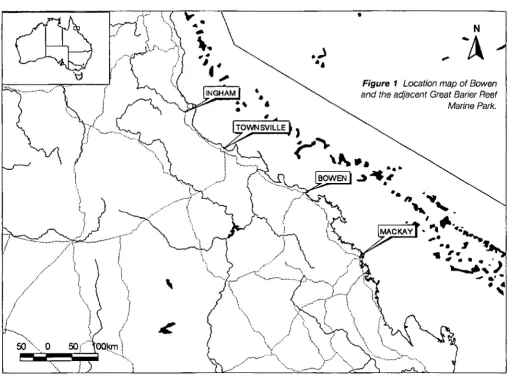
Figure 1 Location map of Bowen
and the adjacent Great Barier Reef Marine Park.
-\~---
-
-:~~f:;
\ ... \
/')'\"1 /
'\
... .'
//,,/
\" \ ....
)i...
'!
.
.)
'.1./
,
('
·r· ... .
50 ··· ... 0
! /'
50(":: 'OOkm\
····• ... 1
...
...
.-
'. ,....
... ,.\" \.... r
\'"
\ ..•.•. :... _ . I.., ". ",
... \, ... , ... j .... / ... \ ... .
.
.. ,,~... .... ~Case study: 'My Barrier
Reeft:
social attachment in Bowen.
Bowen was selected as the place to conduct this case study because it has essentially retained the character of a coastal country regional centre with a mixed economy. Horticulture, commerce, mining and tourism all contribute to the economy of Bowen. While tourism is an important and growing part of the local economy it has not yet reached the stage where the township and its residents have sacrificed local identity for the sake of the glamour resort model. Throughout its history the sea, sea transport and the resources of the sea have been important to the welfare and livelihood of the local settler community as well as the local AbOriginal community.
Bowen is a Queensland township with a long history of European settlement. In fact the township of Bowen was the first official town declared along the Reef Coast (Bowen &
Bowen 2002: 112). Captain Cook first named Cape Gloucester (which was actually an Island) on the Bowen coastline in 1770. Edgecumbe Bay itself was described and the harbour named 'Port Denison' by Capt. Henry Daniel Sinclair in 1859. He selected it as a suitable port to service the emerging settlements in North Queensland. Therefore two years later he led a party by sea and met up on April 12 1861 with an overland party led by George Elphinstone Dalrymple and together they established the town of Bowen.
Bowen has throughout most of its history relied on the sea to both receive supplies and export produce. Even in WWII the town provided an essential contribution to the war effort that was uniquely focused on the sea and the excellent port. Bowen was the base for the Catalina fiying boats and from here contributed to the Battle of the Coral Sea.
historic environment IIOlume 17 number 3 2004
The Great Barrier Reef is very close to the coastline in Bowen. Bowen and Bundaberg have a reputation as the only places where the reef is accessible to onshore divers. This means that the pleasures of snorkelling and diving are available to a broad range of locals and tourists without the necessity of relying on expensive charters and tours.
Recreational fishing is also important in Bowen and as well as the usual fishing charters, fishing from the rocky coastline and around creek mouths is very popular. The Bowen Family Fishing Classic is one of the largest family fishing competitions in Australia. Once again this adds to the opportunities for a relatively low-cost 'do-it-yourself' holiday.
Even the tourists in Bowen are almost loca1. Bowen tourism is dominated by 'grey nomads' (travellers of more than.50 years of age). some of whom have been returning to Bowen for holidays for two or more decades. Many of these people have formed strong connections within the community and are welcomed as seasonal regulars in the Bowen clubs. There is a history also of seasonal workers 'pickers', in the local horticultural industry
Methodology
Community consultation was undertaken from 20 May to 8 June 2003. The consultation process included:
• Meeting between CRG Task leader and primary researcher and the Mayor of Bowen.
• 'People and Water': an exhibition of historic photographs of Bowen, intended to stimulate interest in the project; • Community workshops aimed at a broad cross-section of
•
relating to places that individuals and groups are attached to; Targeted interviews with identified clubs and groups or individuals within the community.
Drs Greer and Mclntyre-Tamwoy met with the Mayor of the Bowen Shire Council, Mr Michael Brunker in April 2003, to outline the proposal and seek his views in relation to it. Mr Brunker was extremely positive and thought that a significant sector of his community could and would engage with the proposed focus of 'social attachments' to the Great Barrier Reef.
Based in part on the discussion with the mayor, a photographic exhibition was set up in the Bowen Shire Library. The 'My Barrier Reef' community consultation workshop was undertaken at the Barrier Reef TAFE, Bowen Campus. An
advertisement for the workshop was placed in the local newspaper, 'The Bowen Independent' and the paper ran a small article on the exhibition.
'My Barrier Reef' Workshop
1 Do you hava a I ... ourllo IIshing .pot thai is your .poelal place?? I, there a place that you go to meditate and contemplate Iii.', problems?
Historical Society. The exhibition ran in the Bowen Library from 20 May to 8 June 2003, along with brief background text introducing the project. The exhibition was undertaken with the full support of the Bowen Shire Council Library Service Manager. Copies of the Data Collection sheets that were used in the community consultation workshops were available for people to complete and send to the researchers independently.
'My Barrier Reef community
consultation workshop
There were two workshop sessions (morning and evening) held on Tuesday 3 June 2003. This was aimed at maximizing opportunities for attendance. The focus of the workshops was to determine the social attachment of the local community, however, while this term is familiar to cultural heritage specialists it is not necessarily welJ understood by the broader community. To accommodate this, people were asked about their knowledge and experiences in relation to 'special places'. A flyer advertising the workshop outlined some of the ways in which a place might be considered 'special'. The workshops were not aimed at collecting 'confidential' or
? Partlaps you halle a name for a special place along the coast where you IIrst 1.11 In
10118, proposed marriage, celebrated special occasions or go for picnics.
sensitive information; nevertheless it was recognized that some people would feel more comfortable completing the forms in their own time and provision was made for this. Towards the end of the' session, a
? When you approach Bowen from the Bea or air are there coastal landmarks that toll
you that you have almosl arrivad?
? When you were a child did you play gamu that Involved the .aa, reaf or coastllna
Bnd are these games associated with sp8ctal places In your memories?
? Do you know of the location. 01 shipwrocks, jaHI •• or other historic featums along
the reaf or coast?
? I. tha Greal Barrier Reof Important to you?
If you haw answered YES to any of thtISCI questions we would like 10 invite you to help US
build up II picture of how your local community at Bowen interacts with coastal places and Ihereef.
D.te~ Tu.e.y, 3 June 2Q03.
WorkshOJ> Vtnuo: 80 ... A""noUwu. 01 TArE _ n CamlJOjo, QuM.,. Road, _n.
Wor1\ .. .,op time: Thr. worbholP _au tM othrwd at 2 d~1 u.m.. '10 tNt ~ c.n aUellMli .t tM
_ 11>.0'_
ou,lII , ... " 1 0 am .... nd .;aln at ... 6,30 pm.DuretJon: A,ppraJl,Imataf)' 1.5- 3-hou".
Ughf ~"N MNed:~
,".f'"
fa- MU.Ia.IIMtd.IfgIIC ...~ Md fUM ,...",. • .uuIm.
LJt!Ir tftIIoN Il'IfonMtion pIN . . -contKt~
Dr Susan Mcintyre-Tamwoy on 0425215012 0<" Jane Harrington on (07) 4781 6979
..
P1e.M oonw Ind vlsh aur elltdbUian of Bowen hhltoric:al ~otograph .. on display In thl
[image:3.595.53.310.301.648.2]Bowen Shire Ub,.'Y.
Figure 2 'People and Water' exhibition poster.
facilitated group discussion to highlight any local themes that emerged during the workshop was undertaken, PartiCipants were advised that a brief written report summarizing the outcomes of the workshop would be provided to all partiCipants who provide contact details.
Other components
A number of targeted interviews were undertaken with identified clubs, community groups, and individuals. A brief Feedback report was prepared providing a broad outline of the information collected. This was provided to all participants who provided contact details. In this report, individuals were not linked to specific places or outcomes.
Places identified through
the project
WOrkShOp participants were asked to identify places along the reef or coastline that were special to them and/or their families. It was stressed that the places did not have to be important to anyone else although they were asked if the place was known by other names. The range of places identified
'People and Water' exhibition
The exhibition incorporated fifteen historic photographs that illustrated the connections between people and land and seascapes at Bowen. The photographs were selected from the James Cook University North Queensland Historic Photographs Collection, and specifically from the Collection made available to the University Collection by the Bowen
included places that were described by participants variously as being of:
• aesthetic or scenic value (such as Rose Bay)
historic value (such as the Sailing Club Building which was the site of the former RAAF 101 Catalina flying boat squadron • general community value, including recreational and historic (sllch as Front Beach where most of the community
22
festivities had traditionally occurred throughout the history of Bowen)
• places of isolation and respite from modern society
(eg Elliot River Huts; meatworks huts etc) • fishing places
• uniquely personal places such as the beach where one couple proposed, the bay where one person triumphed over a personal challenge and learned to snorkel
• natural features eg a large banyan tree at Queens Beach; Mother Beddock (a natural stone formation and local landmark), Stone Island.
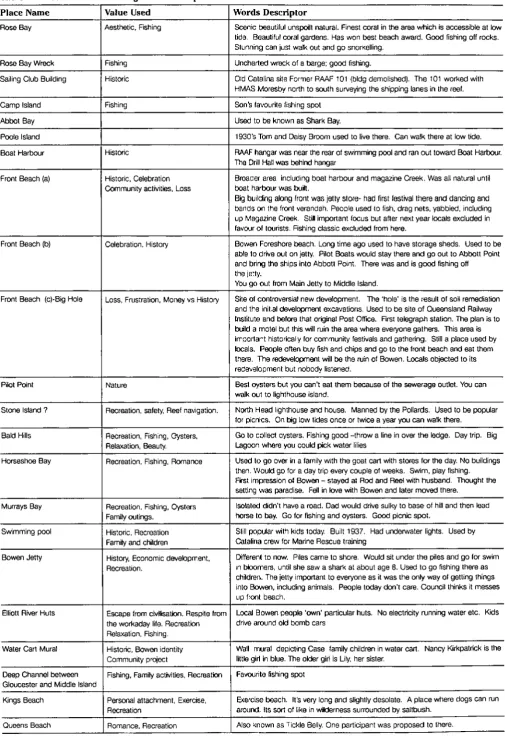
[image:4.595.315.562.84.163.2] [image:4.595.56.303.328.513.2]While the focus was on places along the reef, participants did not limit themselves to places beyond the waterline. The coastline and littoral zones, including creeks and river mouths as well as the seaward end of the township itself featured heavily in the responses. Minimal information was recorded during the workshops. The basic information included: place name, any other names that the place might be known by locally, 'values' or words used by participants to describe why the place was special, and a brief description of the place and memories or activities associated with it. A total of 40 places was listed; details are given in Table1.
Figure 3 'Mother Beddick {sic] Near Bowen Queensland'.
7879, wood engraving published by David Syme and Co. (Image courtesy of La Trobe Pictures Collection, State Library of Victoria).
What does this long list of places tell us about the Bowen community and their sense of themselves? Clearly people value the history of the township. They are conscious that their town is under mounting development pressure and pressure from tourism and they see this as a potential threat to their history and historic places. Many of the places identified pOint to a relaxed family-focused lifestyle. The 'family friendly' resorts and holiday venues were mentioned as clear favourites over those perceived to be more impersonal, brash andlor focused on external tourists.
Importantly, the 'recent past' featured as a strong commonality in the justification provided by participants for places nominated i.e. events and the places where these events played out, from their childhood, their children's childhood and their romances. This deeply personal connection with history is consistent with a population that has been born and raised in the town and is likely to contrast sharply with other towns where tourism and lor gentrification and economic growth has led to an influx of new residents and displacement of the old ones.
historic en,,;ronmenl volume 17 number 3 2004
Figure 4 'Mother Beddock as seen fran Ragstaff Hill:
The prominent feature can be seen in the distant headland beyond the expanse of Kings Beach. (S. Mclnryra-Tamwoy).
Emerging issues of strategic importance to
the management of protected areas
Four main issues of strategic importance to the management of protected areas emerge from this project. They are not specific to seascapes in general nor to the Great Barrier Reef but are equally relevant to all protected areas managers and agencies. These four issues are:
• Local identity vs globalisation of heritage. This is especially important in managing landscapes and places with high tourist profiles and which may be of iconographic value such as World Heritage Areas.
• Understanding and debating the fundamental philosophies underpinning natural and cultural heritage conservation and management with a view to developing examples of truly integrated natural and cultural management of protected areas.
• Methodologies for researching cultural landscapes and local social attachments.
• Understanding how community values change through time
and the nature of the relationship between such changes and the globalisation of heritage values and protected area management agencies policies and practice.
These issues are expanded below as they are important to heritage management generally but most particularly to the protected area management system.
Local identity versus globalisation
The vexed issue of local identity versus globalisation of heritage is especially important in managing landscapes and places with high tourist profiles and of iconographic value such as World Heritage Areas. Protected area management agencies
by th~ir very nature tend to manage for what they see as higher
the past several decades. Increasingly natural heritage scientists, specialists and managers are realising that many other places and species of value need to be managed by protocols and protective measures which extend beyond the protected area management system.
Therefore there is a real sense of protected areas being managed for the 'common good' of all species (particularly non-human species). As non-human species cannot speak for themselves the best people to determine the management strategies are the scientists who 'know' the species. In such a scenario local Input, such as community programs and the identification of local values, is only useful where it supports the top-down effective management of the natural system (see debate in Lunney, Dickman and Burgin 2002). The local is seen as counter-productive, perhaps even a hostile threat to the protected area where it directly opposes or subverts the management system (Underwood and Chapman 2002; Dickman 2002). There is little recognition of the way in which these landscapes may inform or define the identity of local communities.
With the advent of World Heritage Areas another layer is added. The management regime of WHAs is targeted at managing those criteria significant in terms of the universal or world values, for which the area was nominated and dedicated (Droste, Platcher and Rossler 1995). This is specifically used by managers as a defence against conSidering other values which are sometimes interpreted as 'lesser values.' This somewhat unfortunate consequence of the world heritage nominations is now being recognised with some dismay by heritage practitioners. Recently a conference on this issue was hosted by the Netherlands National Commission for UNESCO World Heritage. The conference theme was 'Unking Universal and Local Values:. Managing a Sustainable Future for World Heritage'. Amongst the many recommendations which focused on the recognition of the rights of local communities was a call to
'emphasize that universal and local values are part of a continuum, not a hierarchy, and should not be separated. Indeed it is not viable to identify or manage universal values without acknowledging and maintaining value of places to the local peoples' www.unesco.nVmain 8(iii).
While this sounds a simple recommendation it involves a significant mind shift not just amongst managers and natural heritage specialists but amongst the bulk of the cultural heritage managers (at least in Australia) who have been accustomed to working with tiered systems of legislative protection and provide little evidence that they understand the difference between the system and the philosophy of heritage management. This is not to say that the system has not been critiqued within the Australian heritage community. Aspects of the system have been critiqued, such as the limitations of the paradigm of Cultural Resource Management (Greer 1995:27) and its privileging of scientific over other values; and significance assessment, especially in relation to Indigenous heritage (Byrne et al. 2001; MClntyre-Tamwoy 2000). Despite this, legislation and administrative processes maintain the tiered approach.
Understanding and debating
fundamental philosophies
The fundamental philosophies that underpin natural and cultural heritage conservation and management are often taken
for granted by practitioners. However meaningful debate between practitioners, researchers and regulators needs to focus on these with a view to developing examples of truly integrated natural and cultural management of protected areas.
Management strategies designed by scientists are often over-ruled or modified by political imperatives and sometimes these relate to particularly vocal or economically influential local stakeholder groups (such as in the case of GBRMPA where commercial fisherman, the tourism operators and Aboriginal groups assert 'resource harvesting' rights). These groups are rarely accepted by the specialists as having equal knowledge of the species and habitats and so while they may be tolerated as a rather unpalatable reality they are viewed as something to be managed and their impact mitigated against.
The issue of 'indigenous local communities' is treated slightly differently to those of non-indigenous people. While in Australia I would maintain that there is little evidence that natural SCientists and protected area managers pay more than lip service to the belief that Aboriginal people retain information of value in the management and understanding of natural species, there is a pOlitical correctness that has resulted in a reduction in direct attack on the rights of indigenous communities to have a say in the management of natural areas.
In fact the bulk of literature which does support local community involvement in the management of such areas relates primarity to 'traditional' or 'indigenous' communities and there is an obvious confiation of the terms traditional, local and indigenous as if they are all in all cases the same thing (see for example Gibbs 1999; Innes 1996, 1997; Knowles 1997).
For those interested in influencing or changing the fundamental way in which protected areas are managed it is important to understand the philosophical basis of the system. In addition there are some practical and very human tendencies within management agencies which need to be understood. One example is the issue of boundaries and landscapes. The very act of gazetting a park creates a bounded landscape both in legal management terms as well as in conceptual tenms, as those operating in the system will see 'the park' whether marine or terrestrial, as having a continuous edge. The perimeter encompasses the 'estate'; beyond which extends the great, uncontrollable unknown, with forces that threaten the very health and survivability of the natural system within. For local communities however this boundary may be largely invisible and irrelevant.
For example, the Great Barrier Reef Marine Park has an eastern boundary out at sea beyond the outer reef system, a western boundary at the low tide mark as well as northern and southern boundaries beyond the Bowen region. To the residents of Bowen however, the eastern boundary is largely irrelevant as many of them would never or rarely venture so far out. It is to all extents and purposes beyond their cultural landscape. The northern and southern boundaries of the park are also irrelevant as the northern and southern boundaries of their cultural landscape are defined not by the extent of the reef system but by their life experiences, journey time from home and resources and activities. The park's western boundary however is in the middle of their cultural landscape and is the focus of many of the interactions between the park managers and the community. It would seem important then for managers to understand the extent and nature of the local communities' cultural landscape, however until now there has been no research into this. This cultural landscape and the way it overlaps with the park has
24
been an invisible phenomenon that has generated what sometimes appears as inexplicable conflict.
More debate is required between natural heritage managers and specialists and cultural heritage managers and specialists that explores and challenges the underlying philosophies of eco-feminism (see for exampte Merchant 2000:209-212; Warren 1996; Lahar 1996: 1-18; Warren 1996:ix-xxvi) and deep ecology (Sessions 1996: 137 -154; Devall and Sessions 1985; Belshaw 2001 :279-281) on the natural heritage side and the rhetoric of cultural fabric conservation on the side of cultural heritage managers. There is a mid-ground that is largely unexplored as practitioners on both sides argue from within their phitosophical com for! zones.
An example of this can currently be seen in literature on community-based projects. While both cultural and natural heritage specialists are advocating community-based approaches these come from entirely different angles and the terms effectively mean different things. In the natural heritage management literature community-based approaches are not always favoured (see tor example Burgin 2002; Underwood and Chapman 2002). Where they are promoted, in nature conservation and natural heritage management they are based on the premise that you need to engage with the community to get their support for environmental initiatives. The initiatives and the knowledge base remains essentially in the hands of the scientists while the community alternatively provides necessary but limited additional human resources and labour and/or is educated and inducted into the dominant science-driven
knowledge system and paradigm (ag Dickman 2002: Saunders
2002;Wilson 2002), While this is very similar to the way in which 'community' is integrated into historic management in the EIA context (see for example almost any large salvage excavation in Sydney or Melbourne where 'volunteers' are used as labour), it is very different to the definition of community based-archaeology that is emerging trom a growing published literature on the subject (see for example Greer, Harrison and Mclntyre-Tamwoy 2002).
Methodologies for researching cultural
landscapes and local social attachments.
It is important to develop, present and critique methodologies for researching cultural landscapes and local attachments. To date there has been little produced by the heritage industry in the way of critical approaches to the development of methodologies for such research (although see Hamson 2002).
In part this goes to the heart of the shortcomings of our
Environmental Impact Assessment (EIA) -based heritage industry. A fee for service system is not really conducive to generating and promoting
en
tical review of methodologies and practice. The emphasis is on doing projects rather than analysing the outcomes and the processes involved in doing projects. However, this is precisely what is needed to effectreal change in the integration of social and local community values into heritage management.
With the recent emergence of heritage management as a research area within the academy there has been some research which has targeted these sorts of questions within recent years. For instance within the CRG task at James Cook University there are currently two doctoral researchers working on related issues: Celmara Pocock (in prep.) is looking at Changes in visitor experiences of the GBR through time from early navigation, through the major scientific expeditions up to
histone environment YOILm& 17 ournl:le< 3 2Q()o1
modern tourism. Her study was established to explore the concept of aesthetic and social significance and its application to understanding the significance of the reef. In doing this she has looked more specifically at aesthetics as a SUb-component of social value (see also Pocock 2002). This is critically evaluated and she suggests that sensuousness and the ways in which bodily knowledge contributes to knowledge of places is a more useful way of using this category of significance.
Jane Harrington (in prep.) is using ethnographic approaches to understand the values of local communities living in or adjacent to WHAs and whether these values are reflected in the management of these places. In particular she is looking at how the listing of these areas impacts on local identity and the strategies local communities adopt to live with world heritage management consequences.
Finally, more research is needed aimed at understanding how community values change through time and what is the nature of the relationship between such changes and globalisation 01
heritage values and protected area management agencies, policies and practice. There is a growing body of information in environmental philosophy and ethics and in anthropology (see for example Friedman 1992:331-366), which discusses the consequences, challenges and opportunities of globalisation. However specific studies that look at changes in community values through time have as yet been largely over1ooked. Furthermore the impact on local communities of protected area management polices and practice have not been undertaken except where these have been used to demonstrate the socio-economic benefits of eco- and cultural tourism emerging from the existence of the protected area.
Such research would involve exploration of the relationship between the power of the Protected Area Management system and the adaptability of the local community. What effect do the community and the adaptive process have on the evolution of the landscape and its management? Is the resultant outcome a shared landscape or do they essentially remain forever separate and contested? Zukin (1992:224) - although talking specifically about post modern urban landscapes - maintains that:
This asymmetry of power shapes the dual meaning of landscape ... Iandscape refers to both the special imprint of dominant institutions on the natural topography and social terrain, and the entire ensemble of the built, managed, or otherwise rearranged environment. While in the first sense the landscape of the Powerful clearly opposes the imprint of the Powerless - that is, the cultural construction we choose to call the yernacular - landscape in the second sense combines these antithetical impulses in a single, broadly coherent view.
Conclusion
The preliminary outcomes of the Bowen case study emphasise that emotional attachment to places in the land and seascape are based on a combination of highly personalised experiences and a distilled understanding on the part of individual members of the community of 'community history'. As thiS 'history' may be invisible to outsiders the range of places is not the same as that which might result from an independent heritage assessment by a heritage specialist adopting standard survey and assessment techniques,
see Context Pty Ltd 1998) there is a conflation in community assessments of 'historic value' and personal attachment. Participants in such exercises will inevitably have a shared understanding of a select number of places that are widely considered within the community to be 'important' to the history of the community. Such places will often be mentioned even by those who have never visited them or taken more than a passing interest in them and even though all physical traces may have been removed. These places are clearly important. not necessarily as archaeological or architectural sites, although this may be of interest, but as landscape anchors or geo-reference points for a shared historic landscape.
Many of the other places nominated for reasons other than their perceived historic value are valued for intensely personal experiences and/or responses to the natural landscape. Interestingly while the experiences may be exclusive or in each instance shared amongst only a couple or family group, many of these places may be nominated by more than one person using similar language to express similar exclusive experiences. For instance Queens Beach, nominated by one participant for a very personal experience is also widely accepted as a beach for romance. What makes one beach a known spot for romance over other beaches in the area? Is it a combination of sunsets, sand, sea and accessibility that varies in some as yet unmeasured way from the other beaches?
In addition to places where the attachment is born of very personal experiences, it is significant that many other places are nominated for group events or celebrations. At Bowen such places focus on the coastline. For example, at Front Beach the Victory Day celebrations, Foundation Day celebrations and the annual fishing competition are held; at the Bowen Jetty the dredge Platypus celebration was held while it was working in the area and it is a well frequented fishing spot; the mouth of the Don river and more particularly the bridge over Don river is the place where townsfolk gather to watch the flood waters
come down the river; Light House/Pilot Point is a focal paint for group outings which can only occur at certain times of the year when it is possible to walk over to the Lighthouse during major low tide episodes.
Although further work is needed to confirm the results, preliminary work at Bowen suggests that the places of greatest significance to the community associated with the Great Barrier Reef are concentrated along the coast line and only rarely extend beyond the visual limits of a person standing on the shore. Examples of such anomalies may include favourite fishing spots not reported in this exercise on the far side (non visible sides) of islands such as the coral bay on 'the other side of Stone Island'.
Of importance to Great Barrier Reef managers however are the areas along the coast that are favourite camping and recreation points of the local community, including the focus on the use of some of the estuaries and the strong sense of ownership and autonomy associated with places such as the Elliott River huts.
While the sample of participants and respondents in this case study was too small to assume that the fist of places and the nature of attachment to them is a conclusive list. the results of the case study provide a strong starting point to understanding and exploring community attachment in this area.
Acknowledgements
[image:7.595.36.544.517.699.2]The project discussed in this project is sponsored by the CRC Reef. Dr Shelley Greer of James Cook University is the task leader who endorsed and oversaw this project. She and David Roe of JCU are the task leaders for the Cultural Heritage Values of the Great Barrier Reef World Heritage Area, CRG Reef Task. Jane Harrington, currently a PhD student at JCU, assisted with the organization of the Bowen Workshops and put together the project display advertising the workshop at the Bowen Library. Her assistance is gratefully acknowledged.
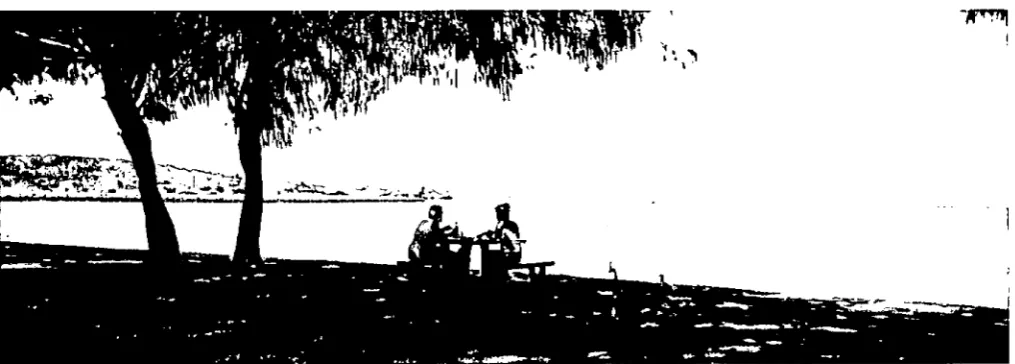
Figure 5 Front Beach is
a
focal point for the Bowen community. emphasising the community's historic identnyasa
seaport andits continuing connection to the sea. (S. Mcintyre- Tamwoy).
26
References
Astlmore, W. and Knapp, SA eds Archaeologies of Landscape: Contemporary Perspectives, Oxford: Blackwell 1999.
Belshaw. C. Environmental Philosophy: Reason, Nature and Human Concern, Acumen Publishing Ltd UK 2001.
Bowen, J. and Bowen, M. The Greal Barn"er Reef.' History, Science,
Hen"tage, Cambridge: Cambridge University Press 2002.
Burgin, S. 'Tragic consequences for conservation of mis·defining the term ·community·', pp. t·5 in Lunney et 131. 2002
Context Pty Ltd 'Community Heritage Values Identification and Assessment Project for the Upper and Lower North East Regions Vol 1 Workshop Overview Report', report undertaken for the NSW/CRAJRFA Steering CommiltOO (project number NA 29 EH) 1998.
Coupe, L. ed. The Green Reader: From Romanticism co Ecocriticsim, London and New York: Routledge 2000.
Devall, B. and Sessions, G. Deep Ecology: Living as if Nature Mattered, Salt Lake City: Peregrine Smith 1985.
Dickman, C. 'Community ve!"SUS resea!Ch~based conservation: What are the paradigms?', pp. 38-46 in Droste. B., H. Platcher and M. Rossler eds
Cultural Landscapes of Universal Value: Components of a Global Strategy,
New York: Gustav Fischer Verlag 1 995.
Edmunds, J. and Turner, S. Generations. Culture and Society,
Buckingham, Philadelphia: Open University Press 2002.
Friedman, J. 'Narcissim, roots and postmodernity: the constitution of selfhood in the global crisis', in Lash and Friedman 1992.
Gibbs, M. 'Indigenous people's rights and resource management: New Zealand in an international conte)(t', paper presented to the conference on The PaCific Aim Community in the 21st century: The Next Generation. Wellington and AUCkland, 26-31 AliQust 1999.
Greer, S., J. Harrington, M. Gibbs, M. Fuary, J. Innes and O. Roe 'Draft Report on Cultural Heritage Values in the Great 8arrier Reef Marine Park &
World Heritage Area', unpublished report to the GBRMPA 2000, Greer, S., A. HarriSon and S. Mclntyre-Tamwoy 'Community -based archaeology in Australia', Wood Archaeology 34,2; 2002: 265-287. Harrington, J_ in prep. '8eing Here: A comparative study of cultural heritage issues in three world heritage places: the Great Barrier Reef WHA, Australia; Ayutlhaya, Thailand and Avebury, the United Kingdom' PhD Thesis, Departmenl of Anthropology, Archaeology and Sociology, James Cook University, Townsville.
Harrison, A. 'Pastoral heritage and the NPWS estate: a cuttural heritage discussion paper', HursMle: NSW National Parks and Wildlife Service 2002. Houlgate, S. ed. Hegel and the Philosophy of Nature, Albany: State
University of New York Press 1998.
Innes, J.R. 'Developing the linkages: Indigenous involvement in the management of the Great Barrier Reef World Heritage Area', Reef Research 1996.
nistoric environment volume '7 nunber 3 2004
Innes, J.A. 'Achieving co-operative management: a discussion paper', internal GBAMPA Policy Options Paper 1997.
Jackson, J. B. Oiscoven"ng the Vernacular Landscape, New Haven,
Connecticut: Yale University Press 1984.
Knowles, J. 'Traditional practices in the Tasmanian World Heritage Area: a study of five communities and their attachment to the area', a report for the steering committee of the Traditional Practices in the World Heritage Area Project 1997.
Lash, S. and Friedman, J. eds Modernity and Identity, Oxford and
Cambridge USA: Blackwell 1992
lahar, S. 1996 'Ecofeminisl Theory and Grassroots Politics', pp 1-18 in Warren, K (ed) 1996.
Lunney, D. C. Dickman and S. Burgin eds A CIaSll of Paradigms:
Community and Research- based Conservation, Royal Zoological Society
of New South Wales 2002.
Mclntyre-Tamwoy S. in prep. 'Social value. the cultural component in natural resource management', submitted to the Australasian Journal of Environmental Management.
Marsh, H., P. Gibson, C. Roberts and R. Williams 'Providing research support for co-management of natural resources in a manner acceptable to Indigenous Australians', paper presented at the International Symposium: Society and Resource Management: Applications of Social Science to Resource Management in the Asia Pacific Region, University of Queensland July 7-10 1999.
Merchant, C. [1992I'Ecofeminism', reprinted as pp. 209-213 in Benton,
L.M and Short, J.R eds Environmental Discourse and Practice: A Reader,
Oxford and Cambridge, Mass.: Blackwell 2000.
Pocock, C. 'Sense matters: aesthetic values 01 the Great Barrier Reef',
International Jovmal of Heritage Studies 8.4; 2002: 365-381.
Pocock C. in prep. 'Romancing the Reel: History, heritage and the hyper-real'. PhD thesis, Department of Anthropology, Archaeology and Sociology, James Cook University, Townsville.
Sessions, A. 'Deep Ecology versus Ecoteminism: Healthy differences or incompatible philosophies?', pp 137 -154 in Warren 1996.
Underwood, A.J. and M.G. Chapman 'Conservation of coastal organisms depends on scientific realism, not community monitoring', pp. 20-35 in Lunney et aL 2002.
Wachenfeld, D.R., J.K Oliver and J.1. Morrisey eds State of Che Great Barrier Reef World Heritage Area 1998, Townsville: GBRMPA. 1998. Warren, K. ed. ECOlogical Feminist Philosophies. Bloomington and
Indianapolis: Indiana University Press 1 996.
Wilson, P. 'Community-based research: science conducted as if people really matter', pp 74-85 in Lunney et al. 2002.
Table I: Places Identified during the workshop
Place Name Value Used Words Descriptor
Rose Bay Aesthetic, Fishing Scenic beautilul unspoilt natural. Finest coral in the area which is accessible at low
tide. Beautilul coral gardens. Has won best beach award. Good fishing off rocks. Stunning can just walk out and go snorkelling.
Rose Bay Wreck Fishing Uncharted wreck of a barge; good fishing.
Sailing Club Building Historic Old Catalina site Former RAAF 101 (bldg demolished). The 101 worked with
HMAS Moresby north to south surveying the shipping lanes in the reef.
Camp Island Fishing Son's lavourite fishing spot
Abbot Bay Used to be known as Shark Bay.
Poole Island 1930's Tom and Daisy Broom used to live there. Can walk there at low tide.
Boat Harbour Historic RAAF hangar was near the rear 01 swimming pool and ran out toward Boat Harbour.
The Drill Hall was behind hangar
Front Beach (a) Historic, Celebration Broader area including boat harbour and magazine Creek. Was all natural until
Community activities, Loss boat harbour was built.
Big building along front was jetty store- had first festival there and dancing and bands on the Iront verandah. People used to fish, drag nets, yabbied, including up Magazine Creek. Still important focus but after next year locals excluded in favour of tourists. Rshing classic excluded from here.
Front Beach (b) Celebration, History Bowen Foreshore beach. Long time ago used to have storage sheds. Used to be
able to drive out on jetty. Pilot Boats would stay there and go out to Abbott Point and bring the ships into Abbott Point. There was and is good fishing off the jetty.
You go out from Main Jetty to Middle Island.
Front Beach (c)-Big Hole Loss, Frustration, Money vs History Site of controversial new development. The 'hole' is the result of soil remediation and the initial development excavations. Used to be site of Queensland Railway Institute and before that original Post Office. Rrst telegraph station. The plan is to build a motel but this will ruin the area where everyone gathers, This area is important historically for community festivals and gathering. Still a place used by locals. People often buy lish and chips and go to the front beach and eat (hem there. The redevelopment will be the ruin ot Bowen. Locals objected to its redevelopment but nobody listened.
Pilot Point Nature Best oysters but you can't eat them because of the sewerage outlet. You can
walk out to lighthouse island.
Stone Island 7 Recreation, safety, Reef navigation. North Head lighthouse and house. Manned by the Pollards. Used to be popular
for picnics. On big low tides once or twice a year you can walk there.
BaJd Hills Recreation, Fishing, Oysters, Go to collect oysters. Fishing good -throw a line in over the ledge. Day trip. Big
Relaxation, Beauty. Lagoon where you could pick water lilies
Horseshoe Bay Recreation. Fishing, Romance Used to go over in a family with the goat cart with stores for the day. No buildings
then. Would go for a day trip every couple of weeks. Swim, play fishing. First impression of Bowen - stayed at Rod and Reel with husband. Thought the setting was paradise. Fell in love with Bowen and later moved there.
Murrays Bay Recreation, Fishing, Oysters Isolated didn't have a road. Dad would drive sulky to base of hill and then lead
Family outings. horse to bay. Go for fishing and oysters. Good picnic spot.
Swimming pool Historic, Recreation Still popular with kids today. Built 1937. Had underwater lights. Used by
Family and children Catalina crew for Marine Rescue training
Bowen Jetty History, Economic development, Different to now. Piles came to shore. Would sit under the piles and go for swim
Recreation. in bloomers, until she saw a shark at about age S. Used to go fishing there as
children. The jetty important to everyone as it was the only way 01 getting things into Bowen, including animals. People today don't care. Council thinks it messes up front beach.
Elliott River Huts Escape from civilisation. Respite from Local Bowen people 'own' particular huts. No electricity running water etc. Kids
the workaday life. Recreation drive around old bomb cars
Relaxation, Fishing.
Water Cart Mural Historic, Bowen identity Wall mural depicting Case family children in water cart. Nancy Kirkpatrick is the
Community project little girl in blue. The older girl is Lily, her sister.
Deep Channel between Rshing, Family actMties, Recreation Favourite fishing spot
Gloucester and Middle Island
Kings Beach Personal attachment, Exercise, Exercise beach. It's very long and slightly desolate. A place where dogs can run
Recreation around. Its sort of like in wilderness surrounded by saltbush.
Queens Beach Romance, Recreation Also known as Tickle Selly. One participant was proposed to there.
[image:9.595.37.543.50.789.2]Meatworks Creek Huts, Respite from the workaday life. There is still a big building there. You need a key from the owner to get in. Hut Recreation, Fishing, owners are given keys. Crocodiles used to accumulate there because of the Alternative lifestyle, Historic meatworks
Long Island Family Resort Good family"style resort. Recommended by locals to locals
South Mole Island Family Resort Access from Airlie Beach which is about 45 min from Bowen. Used to be a good family resort. The sort of place you would take your family when they came to visit.
Stone Island Aesthetic, Beautiful reef Pretty barren. It is very close to Bowen. Able to boat over. Nice coral bay on the other side of island. Remembered for a terrible Mothers Day experience ... the resort was terribly primitive
Dingo Beach Family recreation and holidays. Also called Hideaway Bay. Beautiful white sand. Better than Airlie Beach, whiCh ·Respite from the workaday life. has large mudflats. A lot of farmers from Bowen have houses at Dingo Beach.
There used to be lot of huts but now people are gradually buying them up as holiday houses.
Mouth of the Don River Aesthetic, Community activity Mouth is at Queens Beach. The Don is the fastest-flowing river when it flows. The Recreation river still runs under the surface. The water is pum ped out from below ground for
irrigation. The bed is usually dry like now but when the water comes down it comes down as a wall of water and people go out to the bridge to watch it.
Light Housel Pilot Point Historic, Community activity One or two tides per year are really low and you can walk right over. Used to be
off Bowen Recreation able to walk out on a sand bar and collect cowries but not allowed to any more,
It used to be a big event to go out on the low tide. Masses of people used to walk over but if you are too slow you're stuck on the island. Sometimes people got caught wading back up to their waiSt.
Flagstaff Fishing Sharp rocks. It's a terrible place to stand. One person told how as a young
married couple she and her husband used to carry the baby stroller and all straight down the steep goat track over the hill. Used to prop the stroller amongst the rocks and go fishing. You can't go there anymore because the track is closed off.
Curlewis 1 & 2 South of Elliot River. Separated from the rest of the mainland area by extensive
salt pans. Huts- gas stove, tank water, one big room and lots of beds not far from beach. Some parts get cut off at high tide and you have to stay until it goes out again. You can get away from it ali here and do all the things you don't get time to do at home. Further up the Elliott it's more mens/boys huts.
Mother Beddock Aesthetic, Natural, spiritual Spiritual place. Slriking Landscape feature. Connected with anecdotes about Mother Beddock - and her prominent nose, although no historical information on such a person has been identified. Early spelling appears to have been 'Beddick'.
Big Banyan at Queens Beach Meeting place, aesthetic Magnificent old tree. Site of local weekend markets.
Queens Bay Family recreation South end of Queens Beach
Muliers Lagoon Historic, Aboriginal Also Known as Swifty'S Swamp
Faith Hope and Charity Reel Fishing Great fishing fully protected by reef, calm.
Mackerel Patch Rshing Always a good catch.
Aboriginal wet season camp HistOric, Aboriginal Hill Opposite Coles. One intormant remembers that Aboriginal families who lived around the lagoon and coast moved to this area during the wet
28