ABOUT A CONSTRUCTIVIST APPROACH FOR STIMULATING
STUDENTS’ THINKING TO PRODUCE CONJECTURES AND
THEIR PROVING IN ACTIVE LEARNING OF GEOMETRY
Oleksiy YevdokimovKharkov State Pedagogical University/University of Southern Queensland Ukraine/Australia
The paper describes processes that might lead secondary school students to produce conjectures in a plane geometry. It highlights relationship between conjecturing and proving. The author attempts to construct a teaching-learning environment proposing activities of observation and exploration of key concepts in geometry favouring the production of conjectures and providing motivation for the successive phase of validation, through refutations and proofs. Supporting didactic materials are built up in a way to introduce production of conjectures as a meaningful activity to students.
Background and theoretical framework
Conjecturing and proving activities have traditionally been given significant attention throughout the Grades in the schools. In the most of the countries current mathematics education standards contain a special section on reasoning and proof, investigations, conjectures, evaluation of arguments and the use of various methods of proofs (e.g. NCTM Standards, 2000; MIUR, 2004; UMES, 2003). Therefore, different questions concerning argumentation and proof are constantly in the focus of researchers and mathematics educators’ interest.
During the last years a considerable amount of research, concerning the processes of conjectures production and construction of proofs was connected with interactive learning environment and different software (Harel and Papert, 1990; Davis, 1991), in particular, dynamic geometry software (Arzarello et al, 1998; Furinghetti and Paola, 2003; Mariotti, 2000). Neither considering a technology aspect within the theme of argumentation and proof in full nor restricting the use of technology in that direction, we would like to put into consideration a constructivist didactical approach, which, on the one hand, can be successfully used in stimulation students’ active research interest while learning mathematics, in particular, geometry, on the other hand, provides possibility for investigation students’ abilities in their development to produce conjectures.
Within the long-term research project on active learning of mathematics in a constructivist framework for secondary school students the author gave a course on plane geometry for 45 students (8th Grade, 14-15 years old) during the year. All students didn’t take any courses before, which were aimed on formation of skills to produce conjectures specially. Teaching programme of the course consisted of 16 theoretical modules with support of the didactical materials for each of them.
geometry in a constructivist framework. These materials were built up in a way to introduce conjectures production as a meaningful activity to students.
Our theoretical position is grounded in the theory of active learning processes in mathematics (Hiebert, 1992; Wang, Haertel and Walberg, 1993). We took into account that current learning perspectives incorporate three important assumptions (Anthony, 1996):
• learning is a process of knowledge construction, not of knowledge recording or absorption;
• learning is knowledge-dependent; people use current knowledge to construct new knowledge;
• the learner is aware of the processes of cognition and can control and regulate them.
From a constructivist perspective it is easier for a student, under appropriate arrangement of teaching, to act as an architect, to reveal the truth and construct new knowledge, than to learn ready-made knowledge without understanding its origin, meaning and interrelations (Davis, 1991). In other words, “learning is a process of construction in which the students themselves have to be the primary actors” (von Glasersfeld, 1995). Thus, the view of the learner has changed from that of a passive recipient of knowledge to that of an active constructor of knowledge.
We would like to consider conjecturing process from the didactical point of view, i.e. to show how it can be constructed similarly to the process of mathematical research and how this kind of teaching contributes to the development of students’ mathematical thinking. de Villiers (1996) and Hanna (2000) noted that in actual mathematical research mathematicians have to first convince themselves that a mathematical statement is true and then move to a formal proof. At the same time conjecturing with verification, exploration and explanation constitute the necessary elements that precede formal proof (“conceptual territory before proof”, Edwards, 1997). Yevdokimov (2003) proposed to consider an Active Fund of Knowledge of a Student (AFKS) in the given area of mathematics. As AFKS we called student’s understanding of definitions and properties for some mathematical objects of that domain and skills to use that knowledge. The key question in the context of conjecturing and proving was the following: where, when and for what of mathematical objects a student would apply a certain mathematical property for proving and whether it would be necessary to apply that property generally in that case.
increase AFKS properly, stimulating students for active mental work with using all separate parts of AFKS simultaneously.
We would like to emphasize a dual correspondence between separate parts of
AFKS (personal attribute) and “conceptual territory before proof” (impersonal attribute). More precisely, parts of AFKS act in “conceptual territory before proof” and vice versa, Edwards’ term contributes to increasing every part of AFKS, which acts in it again and so on (Scheme 1).
separate part of AFKS
Conceptual
Territory
Before
Proof separate part of AFKS
Scheme 1.
Thus, on the first stage of the research within the every module the main task for developing and increasing the separate parts of AFKS, was the following:
“Find out as many properties of a certain mathematical object as you can”.
On the second stage of the research within the every module we proposed for students the following task:
“Find out properties of something using your previous findings for certain mathematical objects”.
Now we need to clarify what it means: to find out or reveal a property. On the one hand, any property gives relationship between conjecturing and proving, since for obtaining a property we have to produce conjecture and then prove it. On the other hand, any property gives a clear structure from premise to result (Scheme 2). And such form of any property is a final product of students’ findings for the task.
Premise ⇒ Result
Scheme 2.
Premise ⇒ ?
? ⇒ Result
? ⇒ ?
Scheme 3.
However, a mathematical conjecture does appear from nowhere, without links to its “historical-mathematical neighbourhood” (Yevdokimov, 2004). Conjecture is a result of applying AFKS to different mathematical objects within “conceptual territory before proof” taking into account possible generalisation, systematisation and analogue. Like Brown and Walter (1990) we propose to consider "situation", an issue, which is a localised area of inquiry activities with features that can be taken as given or challenged and modified.
Turning to the forms, it is necessary to note that for finding any property students have to move through its forms of Scheme 3 for obtaining that property in the form of Scheme 2. Moreover, the first two forms of Scheme 3 refer to the first stage of the research and the last form refers to the second stage. Of course, it doesn’t relate to all properties, which were known for students before. Here, we speak of the development of conjecturing process in the student’s mind only.
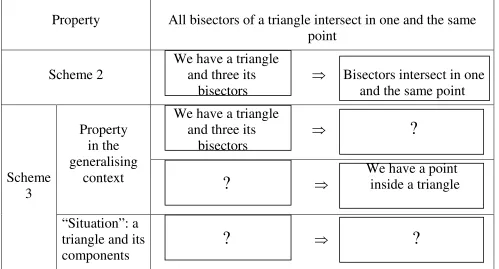
For illustration the schemes above we would like to demonstrate one well-known property of bisectors of a triangle in all forms (property B1 from Appendix). It
is shown in the following table.
Property All bisectors of a triangle intersect in one and the same point
Scheme 2
We have a triangle and three its ⇒ Bisectors intersect in one
bisectors and the same point
We have a triangle
and three its ⇒ ? bisectors
Property in the generalising
context We have a point ? ⇒ inside a triangle
Scheme
3
“Situation”: a triangle and its components
[image:4.595.50.549.460.729.2]
? ⇒ ?
Description of students’ activities and data collection
Taking to attention the scope of the paper we would like to describe and characterise students’ conjecturing and proving activities for a part of the module concerning a triangle and some of its properties and present a sample of the didactical material for this part (Appendix is omitted in the paper).
We proposed three tasks in succession for students’ work on their own. Sufficient period of time was given for every task. Our first task was the following:
Task 1.
“Find out as many properties of a bisector of a triangle as you can”.
We would like to note that some bisector’s properties were connected with height and median of a triangle. Therefore, in the first part students had been asked to explore the similar tasks for height and median too:
Task 2.
“Find out as many properties of a height of a triangle as you can”.
Task 3.
“Find out as many properties of a median of a triangle as you can”.
As we mentioned above such tasks were aimed on developing and increasing separate parts of AFKS (AFKSbisector,, AFKSheight,, AFKSmedian correspondingly).
It is necessary to note that some properties were known for students before, therefore, at first, we asked students to point out all known properties. After that, students could begin their inquiry work to produce conjectures and prove them. At the same time students had been asked to prove every property without any dependence whether it was indicated as known before or proposed as a conjecture. If a student proposed at least 5 conjectures independently, at least 3 of them with proofs, and was not able to produce other conjectures, then he/she had access to didactical material with extended list of properties for bisector, height and median. After that students had been asked to prove those properties, which were unrevealed or unproved for them before. At these stages help of a teacher was an acceptable, but not necessary condition for students. Instead of teacher’s help students could take advantage of extended didactical material (it is omitted in the paper), which contained not only properties themselves, but short remarks and instructions for proving every property. After getting acquaintance with proofs students took for consideration the next task.
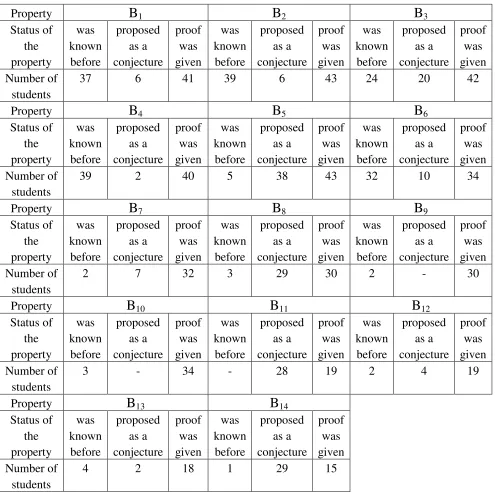
This procedure was repeated in succession three times for every task. Results became better every time, it witnessed that most of the students increased their AFKS and developed their abilities to produce conjecture. Full data collection of students’ progress in increasing their AFKSbisector in the first stage of the research is given in
Table 2. The same tables were formed for AFKSheight, and AFKSmedian
Property B1 B2 B3 Status of the property was known before proposed as a conjecture proof was given was known before proposed as a conjecture proof was given was known before proposed as a conjecture proof was given Number of students
37 6 41 39 6 43 24 20 42
Property B4 B5 B6
Status of the property was known before proposed as a conjecture proof was given was known before proposed as a conjecture proof was given was known before proposed as a conjecture proof was given Number of students
39 2 40 5 38 43 32 10 34
Property B7 B8 B9
Status of the property was known before proposed as a conjecture proof was given was known before proposed as a conjecture proof was given was known before proposed as a conjecture proof was given Number of students
2 7 32 3 29 30 2 - 30
Property B10 B11 B12
Status of the property was known before proposed as a conjecture proof was given was known before proposed as a conjecture proof was given was known before proposed as a conjecture proof was given Number of students
3 - 34 - 28 19 2 4 19
Property B13 B14
Status of the property was known before proposed as a conjecture proof was given was known before proposed as a conjecture proof was given Number of students
[image:6.595.52.547.67.560.2]4 2 18 1 29 15
Table 2.
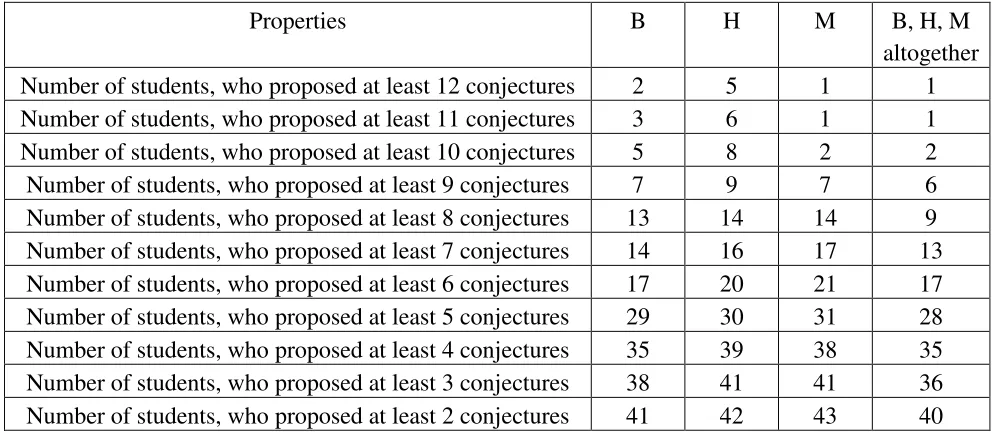
Summary data collection of students’ progress in increasing of their AFKSbisector, AFKSheight, and AFKSmedian in the first stage of the research is given in
Table 3.
Properties B H M B, H, M altogether Number of students, who proposed at least 12 conjectures 2 5 1 1 Number of students, who proposed at least 11 conjectures 3 6 1 1 Number of students, who proposed at least 10 conjectures 5 8 2 2 Number of students, who proposed at least 9 conjectures 7 9 7 6 Number of students, who proposed at least 8 conjectures 13 14 14 9 Number of students, who proposed at least 7 conjectures 14 16 17 13 Number of students, who proposed at least 6 conjectures 17 20 21 17 Number of students, who proposed at least 5 conjectures 29 30 31 28 Number of students, who proposed at least 4 conjectures 35 39 38 35 Number of students, who proposed at least 3 conjectures 38 41 41 36 Number of students, who proposed at least 2 conjectures 41 42 43 40
Table 3.
On the second stage we proposed the following task for students’ work on their own:
“Find out properties of something using your previous findings and exercises for bisector, height and median”.
As we mentioned above such task was aimed on developing and increasing of AFKS properly, using AFKSbisector,, AFKSheight, and AFKSmedian simultaneously.
Shortly, we would like to attract attention for students’ strategy to produce conjectures, which was prepared in our teaching-learning environment and used by students on their own with full understanding and not by chance.
On the base of B2 21 students proposed to construct different geometrical
objects in a triangle. Thus, in that way 15 students came to the concept of symmedian of a triangle. After having a geometrical object, where content of their AFKS could apply to, 14 students produced a conjecture of existing a point of intersection for three symmedians of a triangle. As a result Lemoine point of a triangle was revealed. Property B1 significantly contributed for students’ inquiry work in that direction. At
the same time property B4 led to the students’ conjecturing work (5 students did it
successfully) for finding the following property:
“Symmedians of a triangle divide the opposite sides of it into the parts, which are proportional to the squares of the corresponding adjoining sides of this triangle”.
It is important to note that other properties of Lemoine point were conjectured and proved by students in the similar way in our teaching-learning environment. Final remarks
out by students right away as known for them before. At last, directions of their further work are not indicated for students, but most of them are able to imagine how possible properties would look like.
Our results, although local, support hypothesis that most of the students can be successfully involved in the conjecturing and proving activities in different levels, if learning has active and constructive nature. In this work we have shown effectiveness of a constructivist approach to organise students’ thinking leading to production of conjectures. We found out that a specific learning-teaching environment can significantly contribute to students’ progress in learning geometry.
References
Anthony, G. (1996). Active learning in a constructivist framework. Educational Studies in Mathematics, 31, 349-369.
Arzarello, F., Gallino, G., Micheletti, C., Olivero, F., Paola, D. & Robutti, O. (1998). Dragging in Cabri and modalities of transition from conjectures to proofs in geometry. In: A.Olivier & K.Newstead (Eds) Proceedings of PME22, Stellenbosch, South Africa, Vol.2, 32-39.
Brown, S. I. and Walter, M. I. (1990). Problem Posing. Lawrence Erlbaum: Hillsdale NJ.
Davis, R. (1991). Constructivist views on the teaching and learning of mathematics.
Journal for Research in Mathematics Education, Monograph 4, National Council of Teachers of Mathematics.
de Villiers, M. (1996). Some adventures in Euclidean geometry. Durban: University of Durban-Westville.
Edwards, L. (1997). Exploring the territory before proof: Students’ generalizations in a computer microworld for transformation geometry. International Journal of Computers for Mathematical Learning, 2, 187-215.
Furinghetti, F. and Paola, D. (2003). To produce conjectures and to prove them within a dynamic geometry environment: a case study. In N.A.Pateman, B.J.Dougherty and J.T.Zilliox (Eds) Proceedings of the 2003 Joint Meeting of PME and PMENA, USA, Vol.2, 397-404.
Hanna, G. (2000). Proof, explanation and exploration: An overview. Educational Studies in Mathematics, 44 (1), 5-23.
Harel, I. and Papert, S. (1990). Software Design as a Learning Environment.
Interactive Learning Environments, 1(1), 1-33.
Hiebert, J. (1992). Reflection and communication: Cognitive considerations in school mathematics reform. International Journal of Educational Research, 17, 439-456.
Italian Ministry of Education. (2004). New mathematical standards for the school from 5 through 18 years. MIUR.
Mariotti, M. A. (2000). Introduction to proof: the mediation of a dynamic software environment. Educational Studies in Mathematics, 44 (1), 25-53.
Ukrainian Ministry of Education and Science. (2003). Programmes for schools. Mathematics. Kiev, UMES.
Wang, M. C., Haertel, G. D. and Walberg, H. J. (1993). Toward a knowledge base for school learning. Review of Educational Research, 63, 249-294.
Yevdokimov, O. (2003). Intuitive proofs as a tool for development of student’s creative abilities while solving and proving, In N.A.Pateman, B.J.Dougherty and J.T.Zilliox (Eds) Proceedings of the 2003 Joint Meeting of PME and PMENA,
USA, Vol.1, 264.
Yevdokimov, O. (2004). Using materials from the history of mathematics in