University of Southern Queensland
The dynamics, implications and effects of
knowledge creation in professional learning
communities: Three case studies
.
A Dissertation submitted by
Marian Lewis
Cert.Ed., B.Ed., M.Ed (Ed. Admin.)
ABSTRACT
Australia faces many challenges in a globalised and rapidly changing world. Schools are increasingly being given responsibility for ensuring the future economic, social and political wellbeing of the nation and its successful transition into the knowledge age. Teachers have the responsibility of educating their students for an as yet unknown future. To meet these complex professional challenges, teachers need to become creators rather than consumers of knowledge. Through engaging in knowledge creation work teachers can re-image their work, reconceptualising the meaning of teacher professionalism.
The study explores understandings of knowledge creation that emerge from the experiences of three Queensland schools engaged in IDEAS, a process of whole-school renewal which focuses on the work of teachers. In each case, through collaborative effort, the teachers created new knowledge. How this happened, what was achieved, the dynamics of the relationship between individual and group learning, and the subsequent impact on practice varied from case to case. The nature of the knowledge created was strongly influenced by contextual factors such as the dominant organisational paradigm, socio-emotional climate, cognitive processes, leadership and organisational coherence.
CERTIFICATION PAGE
CERTIFICATION OF DISSERTATION
I certify that the ideas, experimental work, results, analyses and conclusions reported in this dissertation are entirely my own effort, except where otherwise acknowledged. I also certify that the work is original and has not been previously submitted for any other award, except where otherwise acknowledged.
______________________________ _______________
Signature of Candidate Date
ENDORSEMENT
______________________________ _______________
Signature of Supervisor Date
______________________________ _______________
ACKNOWLEDGEMENTS
Firstly, I would like to acknowledge my gratitude to Professor Frank Crowther. As my supervisor, he has encouraged, guided and certainly challenged me throughout this research, allowing me the space (and the time) to develop my own project, but providing invaluable comment at critical junctures.
I would like to sincerely thank my associate supervisor, Dr Dorothy Andrews, for her help and encouragement over the last four years. Her unwavering calmness and kindness, even in the midst of uncertainties, gave me the confidence to hold on to the belief that I could actually complete this project. I am truly grateful for her friendship and guidance.
It has been a great privilege working with you both and to see not only the growing success of IDEAS but its power to transform schools through the work of teachers.
Thank you to the five schools who welcomed me, an unknown researcher, making this project possible. Thank you for letting me observe and participate in your experiences with IDEAS. I am truly grateful to all the teachers who shared their stories and their perceptions with me – who willingly gave their time for interviews. I treasure the memory of many conversations – and will not forget the openness and honesty of these exchanges.
I would like to acknowledge receipt of an Australian Postgraduate Award, supplemented by the University of Southern Queensland. The scholarship allowed me to work for three years on this research as a full-time student. Thank you, too, to Ruth Hilton, Manager of the USQ Office of Research and Higher Degrees, for her ongoing support (and just a little pressure!)
Thanks must also go to my friend Lucy Jarzabkowski for her encouragement, good humour and support from afar. Her proof reading skills are also greatly appreciated.
Lastly, and most importantly – my greatest thanks go to my husband, Peter. He has constantly encouraged me in this project despite the impact of so much ‘study’ on our life together. His belief in my ability to do this has never flagged, and I am deeply grateful for his unwavering support.
TABLE OF CONTENTS
TITLE PAGE i
ABSTRACT ii
CERTIFICATION PAGE iii
ACKNOWLEDGEMENTS iv
TABLE OF CONTENTS 1
CHAPTER 1: AN INTRODUCTION TO THE STUDY 7
1.1 OVERVIEW 7
1.2 THE FOCUS OF THE INQUIRY 8
1.3 THE CONTEXT OF THE INQUIRY 10
1.4 THE CONTEXT FOR SCHOOLS 11
1.4.1 GLOBALISATION AND CHANGE 12
1.4.2 THE IMPACT OF GLOBALISATION AND CHANGE ON AUSTRALIA 13
1.4.3 THE CHALLENGE FOR AUSTRALIAN SCHOOLS 14
1.4.4 SCHOOLS:PROVIDING THE FOUNDATIONS FOR AUSTRALIAN PROGRESS 15
1.4.5 RECONCEPTUALISING TEACHER PROFESSIONALISM 16
1.5 IDEAS:APROCESS OF WHOLE-SCHOOL RENEWAL 17
1.5.1 THE RESEARCH-BASED FRAMEWORK 21
1.5.2 THE IDEAS PROCESS 21
1.5.3 PARALLEL LEADERSHIP 24
1.5.4 THE PRINCIPLES OF IDEAS 25
1.5.5 IDEAS AS A CHANGE PROCESS 25
1.6 LOCATING THE RESEARCHER IN THE INQUIRY 26
1.7 SUMMARY OF THE CHAPTERS 27
CHAPTER 2: A REVIEW OF THE LITERATURE 30
2.1 OVERVIEW 30
2.2 THE CHANGING SOCIETY IS CHANGING THE WORK OF TEACHERS 31
2.2.1 SCHOOL SYSTEM RESTRUCTURING 31
2.3 PROFESSIONAL LEARNING COMMUNITY 34
2.4 THE NATURE OF KNOWLEDGE 36
2.4.1 KNOWLEDGE PRODUCTION 37
2.4.2 SCIENTIFIC KNOWLEDGE AND SOCIAL SCIENCE 37
2.4.3 CHALLENGES TO POSITIVISM 38
2.4.4 THE NATURE OF UNDERSTANDING 40
2.4.5 TWO MODES OF KNOWLEDGE 42
2.5 KNOWLEDGE CREATION 43
2.5.1 ADEFINITION 43
2.5.2 TWO PERSPECTIVES ON KNOWLEDGE 44
2.5.3 KNOWLEDGE:VARIOUSLY DESCRIBED 45
2.5.4 EXPLICIT KNOWLEDGE AND TACIT KNOWLEDGE 46
2.5.5 GROUP TACIT KNOWLEDGE 47
2.5.6 INFORMATION AND KNOWLEDGE CONSTRUCTION 48
2.6 KNOWLEDGE CREATION MODEL:NONAKA AND TAKEUCHI 49
2.6.1 THE KNOWLEDGE CREATION SPIRAL 49
2.6.2 THE FOUR STAGES OF KNOWLEDGE CREATION 50
2.6.3 MOVING BETWEEN STAGES IN THE KNOWLEDGE CREATION PROCESS 51
2.6.4 SPREADING NEW KNOWLEDGE ACROSS THE ORGANISATION 52
2.7 TEACHERS’PRACTICAL THEORY 54
2.8 INDIVIDUAL AND ORGANISATIONAL LEARNING 56
2.8.1 COGNITION:INDIVIDUAL AND SOCIAL 57
2.8.2 SITUATED COGNITION 58
2.8.3 COGNITION AS SOCIAL PROCESS 59
2.8.4 ORGANISATIONAL CULTURE 61
2.8.5 CULTURE AS A COGNITIVE PROCESS 62
2.8.6 COLLECTIVE MIND IN ORGANIZATIONS 65
2.8.7 COGNITION AS DISTRIBUTED 66
2.8.8 DISTRIBUTED COGNITION IN SCHOOLS 68
2.8.9 CULTURE AND SOCIALISATION 69
2.9FACTORS INFLUENCING KNOWLEDGE CREATION PROCESSES 70
2.9.1 KNOWLEDGE CREATION NEEDS ‘QUALITY’TACIT KNOWLEDGE 70
2.9.2 LANGUAGE AND COMMUNICATION 72
2.9.3 KNOWLEDGE CREATION REQUIRES GOOD RELATIONSHIPS 75
2.9.4 KNOWLEDGE CREATION NEEDS ‘SPACE’ 77
2.9.5 MANAGEMENT FOR KNOWLEDGE CREATION 78
2.9.6 THE FRAGILITY OF THE KNOWLEDGE CREATION PROCESS 79
2.9.7 ORGANISATIONAL CULTURE 83
2.9.8 BARRIERS TO ORGANISATIONAL LEARNING 84
2.10 EMOTION IN ORGANISATIONS 85
2.10.1 EFFICACY 86
2.10.2 COLLECTIVE EFFICACY 87
2.10.4 TEACHER STRESS AND BURNOUT 90
2.10.5 EFFICACY,STRESS,BURNOUT AND CHANGE 92
2.11 CONCLUSION 93
CHAPTER 3: METHODOLOGY 96
3.1 THE RESEARCH ORIENTATION OF THE INQUIRY 96
3.2 THE RESEARCH PROBLEM 97
3.3 THE RESEARCH STRATEGY:CASE STUDY 98
3.4 METHOD OF DATA COLLECTION 102
3.4.1 INTERVIEWS 103
3.4.2 PHASES OF DATA COLLECTION 104
3.5 DATA COLLECTION IN THE CASE STUDY SCHOOLS 106
3.5.1 HOLY CROSS LUTHERAN PRIMARY SCHOOL 106
3.5.2 WILLOWBANK STATE HIGH SCHOOL 107
3.5.3 RAINBOW TERRACE STATE SCHOOL 108
3.6 WORKING WITH THE DATA 110
3.6.1 TRANSCRIPTION 110
3.6.2 ANALYSIS OF THE DATA 111
3.7 GENERALISATION 113
3.8 THE RESEARCHER IN THE TEXT 115
3.9 CRITERIA FOR JUDGING ADEQUACY 117
3.10 CONCLUSION 120
CHAPTER 4: THE STORIES OF THE SCHOOLS 122
4.1 OVERVIEW 122
4.2 HOLY CROSS PRIMARY SCHOOL 122
4.2.1 BACKGROUND:SETTING THE SCENE 122
4.2.2 INTOTHEFUTURE 123
4.2.3THEMES FROM TEACHERS'STORIES 129
4.2.4 INTO THE FUTURECHANGES 132
4.2.5 MOVING FORWARD IN TIME 134
4.2.6 LOOKING TO THE FUTURE 138
4.2.7 LUTHERANISM IN THE STORY OF THE SCHOOL 138
4.3 RAINBOW TERRACE STATE SCHOOL 142
4.3.1 BACKGROUND:AGLIMPSE INTO THE PAST 142
4.3.2 APERSPECTIVE ON THE PRESENT 143
4.3.3 THE PRINCIPAL:QUALITIES AND APPROACH 146
4.3.4 THE RAINBOW TERRACE TOTAL SYSTEMS MODEL 147
4.3.5 THE MOVE INTO IDEAS 148
4.3.6 IDEAS AT RAINBOW TERRACE 149
4.3.7 CARRYING THROUGH TO 2001 156
4.3.8 FINAL OBSERVATIONS 159
4.4 WILLOWBANK STATE HIGH SCHOOL 159
4.4.1 BACKGROUND:SETTING THE SCENE 159
4.4.2 IDEAS AT WILLOWBANK:AN UNCERTAIN START 160
4.4.3 THE IDEASGROUP BEGINS ITS WORK 162
4.4.4 SPREADING THE WORD 168
4.4.5 FINAL OBSERVATIONS 175
4.5 CONCLUSION 176
CHAPTER 5: KNOWLEDGE CREATION: EMERGING
UNDERSTANDINGS 177
5.1 KNOWLEDGE CREATION AND THE LIFE WORLD OF THE SCHOOL 177
5.2 NEW KNOWLEDGE AND ITS CONTEXTUALISED MEANING 177
5.2.1HOLY CROSS LUTHERAN PRIMARY SCHOOL 177
5.2.2 RAINBOW TERRACE STATE SCHOOL 180
5.2.3 WILLOWBANK STATE HIGH SCHOOL 182
5.3 KNOWLEDGE CREATION AND LEARNING AT HOLY CROSS 184
5.3.1 THE CHANGING IMAGE OF THE SCHOOL 185
5.3.2 THE KNOWLEDGE SITUATION:NEW KNOWLEDGE NEEDED 185
5.3.3 INTO THE FUTURE:NEW SPACE FOR ACTION 186
5.3.4 THE DOCUMENTARY ARTEFACTS 187
5.3.5 TRACKING PROGRESS OVER TIME 190
5.3.6 EMERGING UNDERSTANDING:MY PERSPECTIVE 196
5.4KNOWLEDGE CREATION AND LEARNING AT RAINBOW TERRACE 201
5.4.1 THE KNOWLEDGE CREATION STORY: INITIAL TELLING 201
5.4.2 THE KNOWLEDGE CREATION STORY:AMORE TELLING ANALYSIS 205
5.4.3 KNOWLEDGE CREATION IN THE IDEASSCHOOL MANAGEMENT TEAM 209
5.4.4 EMERGING UNDERSTANDING:MY PERSPECTIVE 211
5.5 KNOWLEDGE CREATION AND LEARNING AT WILLOWBANK 214
5.5.1THE IDEASGROUP 215
5.5.2 SPREADING THE LEARNING:THE RIPPLE EFFECT 219
5.5.3 OTHER DYNAMICS: LESS OBVIOUS FACTORS 222
5.5.4 THE PERCEPTION OF CHANGE 228
5.6 CONCLUSION 233
CHAPTER 6: CONCLUSIONS 235
6.1 OVERVIEW 235
6.2 THE RESEARCH QUESTIONS 236
6.2.1 THROUGH WHAT PROCESSES CAN PROFESSIONAL LEARNING COMMUNITIES BE
SAID TO ‘CREATE’ NEW KNOWLEDGE? 236
6.2.2 WHAT KINDS OF INDIVIDUAL AND ORGANISATIONAL LEARNING SUPPORT THE
WHOLE-SCHOOL RENEWAL EFFORT? 252
6.2.3 WHAT ARE THE FACTORS THAT ENCOURAGE AND CONSTRAIN THE CREATION OF
KNOWLEDGE AND ITS TRANSLATION INTO ACTION? 254
6.3 LOCATING THE INQUIRY WITHIN AND BEYOND THE LITERATURE 259
6.4 THE IMPORTANCE OF THIS RESEARCH 263
6.5 RECOMMENDATIONS FOR FUTURE RESEARCH 265
6.6 FINAL REFLECTIONS 268
LIST OF REFERENCES 292
List of Appendices
Appendix 1: Sample of IDEAS Diagnostic Inventory Survey for Teachers……. 270 Appendix 2: Data Collection: Familiarisation Phase – Interview Topics ……….274 Appendix 3: Data Collection: Deepening the Inquiry Phase - Interview Topics..275 Appendix 4: Focus Group Discussion - Willowbank State High School (Dec.1999) ………..…… 276 Appendix 5: Focus Group Discussion – Holy Cross Primary School (Nov. 2000) ……….….... 277 Appendix 6: Focus Group Discussion – Rainbow Terrace State School (Nov. 2000) ……… 278 Appendix 7: Holy Cross Primary School – Schoolwide Pedagogy (Nov. 1999) ..279 Appendix 8: Rainbow Terrace State Schoolwide Pedagogy (Semester 1 2001)…281 Appendix 9: Rainbow Terrace State Schoolwide Pedagogy (Nov. 2001)…..…283 Appendix 10: Willowbank State High School IDEAS Trial Report Back to Staff
Summary (May 2000) ………287
Appendix 11: Willowbank State High School IDEAS Trial Report Back to Staff
Summary (Nov2000) ……….………...288
Appendix 12: Willowbank State High School Vision and Schoolwide Pedagogy
(Nov 2000) ……….290
List of Exhibits
Exhibit 1: Holy Cross Primary School – Vision Statement (November 1999)...125
Exhibit 2: Holy Cross Primary School - Schoolwide Pedagogy (November 1999)126 Exhibit 3: Holy Cross Primary School – Teachers’ Pedagogical Plan (Feb. 2000) ...128
Exhibit 4: Holy Cross Primary School - Management Plan (abbreviated) (July 2000) ...135
Exhibit 5: Rainbow Terrace State School Total Systems Model (May 2000)...145
Exhibit 6: Rainbow Terrace: Shared Beliefs about Human Behaviour (Nov. 1999) ...152
Exhibit 7: Rainbow Terrace State School : Beliefs about Teaching and Learning (extract) ...154
Exhibit 8: Rainbow Terrace State School Vision Statement (August 2001) ...156
Exhibit 9: Rainbow Terrace State School: The Twelve Pedagogical Principles ....158
Exhibit 10: Willowbank State High School Draft Vision (November 1998) ...162
Exhibit 11: Willowbank State High School: Vision and Schoolwide Pedagogy (April 1999)...163
List of Figures Figure 1: The Research-based Framework for Enhancing Outcomes in Schools...19
Figure 2: The IDEAS Implementation Process...22
Figure 3: School-based Leadership and Enhanced School Innovation...24
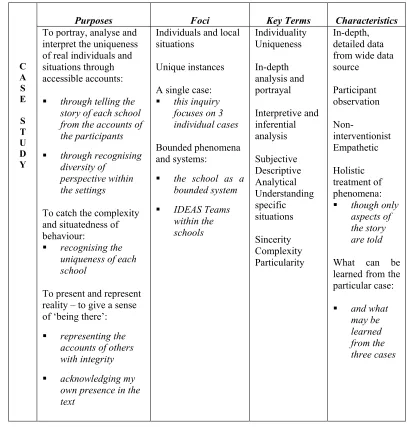
List of Tables Table 1: Elements of Case Study Style (with explanatory notes relating to this study) ...100
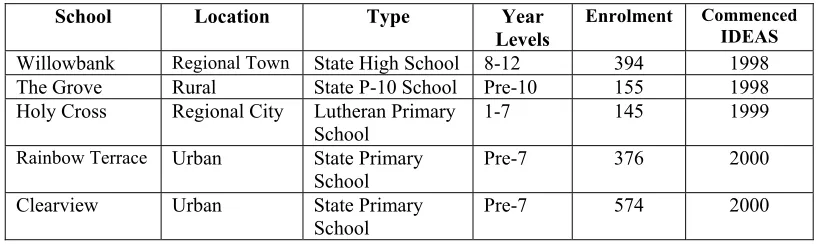
Table 2: The Five Case Study Schools ...101
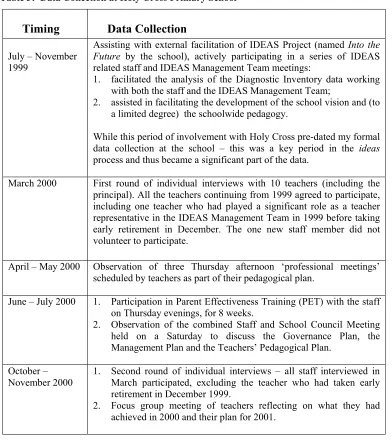
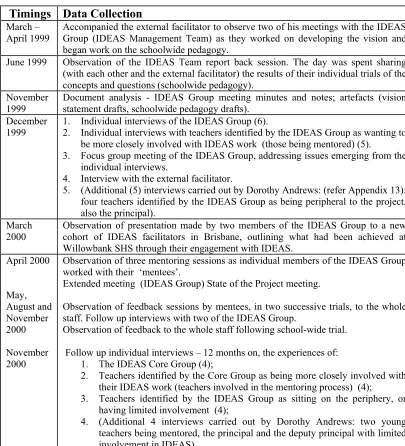
Table 3: Data Collection at Holy Cross Primary School ...107
Table 4: Data Collection at Willowbank State High School ...108
Table 5: Data Collection at Rainbow Terrace State School...109
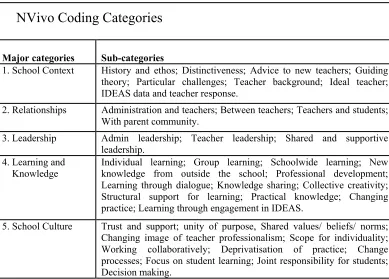
Table 6: NVivo Coding Categories Devised for Data Analysis ...112
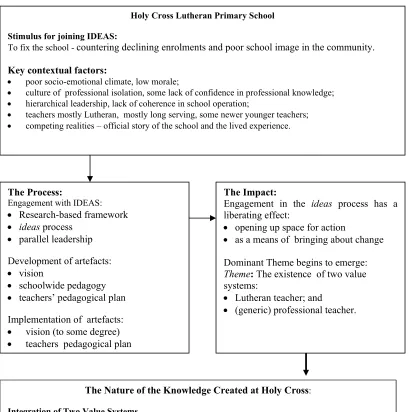
Table 7: The Nature of the New Knowledge Created at Holy Cross Primary School ...179
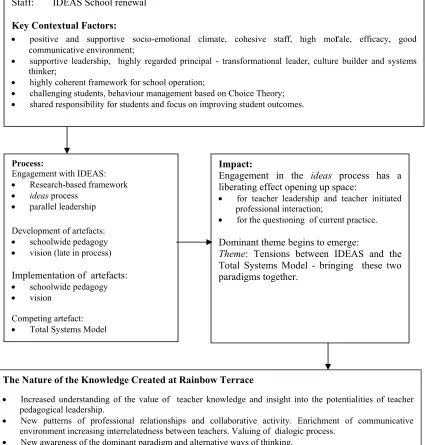
Table 8: The Nature of the New Knowledge Created at Rainbow Terrace State School...181
Table 9: The Nature of the New Knowledge Created at Willowbank State High School...183
Table 10: A Summary of the Processes Used in Knowledge Creation...236
Table 11: The Processes of Knowledge Creation within the ideas Process ...247
TABLE OF CONTENTS
TITLE PAGE i
ABSTRACT ii
CERTIFICATION PAGE iii
ACKNOWLEDGEMENTS iv
TABLE OF CONTENTS 1
CHAPTER 1: AN INTRODUCTION TO THE STUDY 7
1.1 OVERVIEW 7
1.2 THE FOCUS OF THE INQUIRY 8
1.3 THE CONTEXT OF THE INQUIRY 10
1.4 THE CONTEXT FOR SCHOOLS 11
1.4.1 GLOBALISATION AND CHANGE 12
1.4.2 THE IMPACT OF GLOBALISATION AND CHANGE ON AUSTRALIA 13
1.4.3 THE CHALLENGE FOR AUSTRALIAN SCHOOLS 14
1.4.4 SCHOOLS:PROVIDING THE FOUNDATIONS FOR AUSTRALIAN PROGRESS 15
1.4.5 RECONCEPTUALISING TEACHER PROFESSIONALISM 16
1.5 IDEAS:APROCESS OF WHOLE-SCHOOL RENEWAL 17
1.5.1 THE RESEARCH-BASED FRAMEWORK 21
1.5.2 THE IDEAS PROCESS 21
1.5.3 PARALLEL LEADERSHIP 24
1.5.4 THE PRINCIPLES OF IDEAS 25
1.5.5 IDEAS AS A CHANGE PROCESS 25
1.6 LOCATING THE RESEARCHER IN THE INQUIRY 26
1.7 SUMMARY OF THE CHAPTERS 27
CHAPTER 2: A REVIEW OF THE LITERATURE 30
2.1 OVERVIEW 30
2.2 THE CHANGING SOCIETY IS CHANGING THE WORK OF TEACHERS 31
2.2.1 SCHOOL SYSTEM RESTRUCTURING 31
2.3 PROFESSIONAL LEARNING COMMUNITY 34
2.4 THE NATURE OF KNOWLEDGE 36
2.4.1 KNOWLEDGE PRODUCTION 37
2.4.2 SCIENTIFIC KNOWLEDGE AND SOCIAL SCIENCE 37
2.4.3 CHALLENGES TO POSITIVISM 38
2.4.4 THE NATURE OF UNDERSTANDING 40
2.4.5 TWO MODES OF KNOWLEDGE 42
2.5 KNOWLEDGE CREATION 43
2.5.1 ADEFINITION 43
2.5.2 TWO PERSPECTIVES ON KNOWLEDGE 44
2.5.3 KNOWLEDGE:VARIOUSLY DESCRIBED 45
2.5.4 EXPLICIT KNOWLEDGE AND TACIT KNOWLEDGE 46
2.5.5 GROUP TACIT KNOWLEDGE 47
2.5.6 INFORMATION AND KNOWLEDGE CONSTRUCTION 48
2.6 KNOWLEDGE CREATION MODEL:NONAKA AND TAKEUCHI 49
2.6.1 THE KNOWLEDGE CREATION SPIRAL 49
2.6.2 THE FOUR STAGES OF KNOWLEDGE CREATION 50
2.6.3 MOVING BETWEEN STAGES IN THE KNOWLEDGE CREATION PROCESS 51
2.6.4 SPREADING NEW KNOWLEDGE ACROSS THE ORGANISATION 52
2.7 TEACHERS’PRACTICAL THEORY 54
2.8 INDIVIDUAL AND ORGANISATIONAL LEARNING 56
2.8.1 COGNITION:INDIVIDUAL AND SOCIAL 57
2.8.2 SITUATED COGNITION 58
2.8.3 COGNITION AS SOCIAL PROCESS 59
2.8.4 ORGANISATIONAL CULTURE 61
2.8.5 CULTURE AS A COGNITIVE PROCESS 62
2.8.6 COLLECTIVE MIND IN ORGANIZATIONS 65
2.8.7 COGNITION AS DISTRIBUTED 66
2.8.8 DISTRIBUTED COGNITION IN SCHOOLS 68
2.8.9 CULTURE AND SOCIALISATION 69
2.9FACTORS INFLUENCING KNOWLEDGE CREATION PROCESSES 70
2.9.1 KNOWLEDGE CREATION NEEDS ‘QUALITY’TACIT KNOWLEDGE 70
2.9.2 LANGUAGE AND COMMUNICATION 72
2.9.3 KNOWLEDGE CREATION REQUIRES GOOD RELATIONSHIPS 75
2.9.4 KNOWLEDGE CREATION NEEDS ‘SPACE’ 77
2.9.5 MANAGEMENT FOR KNOWLEDGE CREATION 78
2.9.6 THE FRAGILITY OF THE KNOWLEDGE CREATION PROCESS 79
2.9.7 ORGANISATIONAL CULTURE 83
2.9.8 BARRIERS TO ORGANISATIONAL LEARNING 84
2.10 EMOTION IN ORGANISATIONS 85
2.10.1 EFFICACY 86
2.10.2 COLLECTIVE EFFICACY 87
2.10.4 TEACHER STRESS AND BURNOUT 90
2.10.5 EFFICACY,STRESS,BURNOUT AND CHANGE 92
2.11 CONCLUSION 93
CHAPTER 3: METHODOLOGY 96
3.1 THE RESEARCH ORIENTATION OF THE INQUIRY 96
3.2 THE RESEARCH PROBLEM 97
3.3 THE RESEARCH STRATEGY:CASE STUDY 98
3.4 METHOD OF DATA COLLECTION 102
3.4.1 INTERVIEWS 103
3.4.2 PHASES OF DATA COLLECTION 104
3.5 DATA COLLECTION IN THE CASE STUDY SCHOOLS 106
3.5.1 HOLY CROSS LUTHERAN PRIMARY SCHOOL 106
3.5.2 WILLOWBANK STATE HIGH SCHOOL 107
3.5.3 RAINBOW TERRACE STATE SCHOOL 108
3.6 WORKING WITH THE DATA 110
3.6.1 TRANSCRIPTION 110
3.6.2 ANALYSIS OF THE DATA 111
3.7 GENERALISATION 113
3.8 THE RESEARCHER IN THE TEXT 115
3.9 CRITERIA FOR JUDGING ADEQUACY 117
3.10 CONCLUSION 120
CHAPTER 4: THE STORIES OF THE SCHOOLS 122
4.1 OVERVIEW 122
4.2 HOLY CROSS PRIMARY SCHOOL 122
4.2.1 BACKGROUND:SETTING THE SCENE 122
4.2.2 INTOTHEFUTURE 123
4.2.3THEMES FROM TEACHERS'STORIES 129
4.2.4 INTO THE FUTURECHANGES 132
4.2.5 MOVING FORWARD IN TIME 134
4.2.6 LOOKING TO THE FUTURE 138
4.2.7 LUTHERANISM IN THE STORY OF THE SCHOOL 138
4.3 RAINBOW TERRACE STATE SCHOOL 142
4.3.1 BACKGROUND:AGLIMPSE INTO THE PAST 142
4.3.2 APERSPECTIVE ON THE PRESENT 143
4.3.3 THE PRINCIPAL:QUALITIES AND APPROACH 146
4.3.4 THE RAINBOW TERRACE TOTAL SYSTEMS MODEL 147
4.3.5 THE MOVE INTO IDEAS 148
4.3.6 IDEAS AT RAINBOW TERRACE 149
4.3.7 CARRYING THROUGH TO 2001 156
4.3.8 FINAL OBSERVATIONS 159
4.4 WILLOWBANK STATE HIGH SCHOOL 159
4.4.1 BACKGROUND:SETTING THE SCENE 159
4.4.2 IDEAS AT WILLOWBANK:AN UNCERTAIN START 160
4.4.3 THE IDEASGROUP BEGINS ITS WORK 162
4.4.4 SPREADING THE WORD 168
4.4.5 FINAL OBSERVATIONS 175
4.5 CONCLUSION 176
CHAPTER 5: KNOWLEDGE CREATION: EMERGING
UNDERSTANDINGS 177
5.1 KNOWLEDGE CREATION AND THE LIFE WORLD OF THE SCHOOL 177
5.2 NEW KNOWLEDGE AND ITS CONTEXTUALISED MEANING 177
5.2.1HOLY CROSS LUTHERAN PRIMARY SCHOOL 177
5.2.2 RAINBOW TERRACE STATE SCHOOL 180
5.2.3 WILLOWBANK STATE HIGH SCHOOL 182
5.3 KNOWLEDGE CREATION AND LEARNING AT HOLY CROSS 184
5.3.1 THE CHANGING IMAGE OF THE SCHOOL 185
5.3.2 THE KNOWLEDGE SITUATION:NEW KNOWLEDGE NEEDED 185
5.3.3 INTO THE FUTURE:NEW SPACE FOR ACTION 186
5.3.4 THE DOCUMENTARY ARTEFACTS 187
5.3.5 TRACKING PROGRESS OVER TIME 190
5.3.6 EMERGING UNDERSTANDING:MY PERSPECTIVE 196
5.4KNOWLEDGE CREATION AND LEARNING AT RAINBOW TERRACE 201
5.4.1 THE KNOWLEDGE CREATION STORY: INITIAL TELLING 201
5.4.2 THE KNOWLEDGE CREATION STORY:AMORE TELLING ANALYSIS 205
5.4.3 KNOWLEDGE CREATION IN THE IDEASSCHOOL MANAGEMENT TEAM 209
5.4.4 EMERGING UNDERSTANDING:MY PERSPECTIVE 211
5.5 KNOWLEDGE CREATION AND LEARNING AT WILLOWBANK 214
5.5.1THE IDEASGROUP 215
5.5.2 SPREADING THE LEARNING:THE RIPPLE EFFECT 219
5.5.3 OTHER DYNAMICS: LESS OBVIOUS FACTORS 222
5.5.4 THE PERCEPTION OF CHANGE 228
5.6 CONCLUSION 233
CHAPTER 6: CONCLUSIONS 235
6.1 OVERVIEW 235
6.2 THE RESEARCH QUESTIONS 236
6.2.1 THROUGH WHAT PROCESSES CAN PROFESSIONAL LEARNING COMMUNITIES BE
SAID TO ‘CREATE’ NEW KNOWLEDGE? 236
6.2.2 WHAT KINDS OF INDIVIDUAL AND ORGANISATIONAL LEARNING SUPPORT THE
WHOLE-SCHOOL RENEWAL EFFORT? 252
6.2.3 WHAT ARE THE FACTORS THAT ENCOURAGE AND CONSTRAIN THE CREATION OF
KNOWLEDGE AND ITS TRANSLATION INTO ACTION? 254
6.3 LOCATING THE INQUIRY WITHIN AND BEYOND THE LITERATURE 259
6.4 THE IMPORTANCE OF THIS RESEARCH 263
6.5 RECOMMENDATIONS FOR FUTURE RESEARCH 265
6.6 FINAL REFLECTIONS 268
LIST OF REFERENCES 292
List of Appendices
Appendix 1: Sample of IDEAS Diagnostic Inventory Survey for Teachers……. 270 Appendix 2: Data Collection: Familiarisation Phase – Interview Topics ……….274 Appendix 3: Data Collection: Deepening the Inquiry Phase - Interview Topics..275 Appendix 4: Focus Group Discussion - Willowbank State High School (Dec.1999) ………..…… 276 Appendix 5: Focus Group Discussion – Holy Cross Primary School (Nov. 2000) ……….….... 277 Appendix 6: Focus Group Discussion – Rainbow Terrace State School (Nov. 2000) ……… 278 Appendix 7: Holy Cross Primary School – Schoolwide Pedagogy (Nov. 1999) ..279 Appendix 8: Rainbow Terrace State Schoolwide Pedagogy (Semester 1 2001)…281 Appendix 9: Rainbow Terrace State Schoolwide Pedagogy (Nov. 2001)…..…283 Appendix 10: Willowbank State High School IDEAS Trial Report Back to Staff
Summary (May 2000) ………287
Appendix 11: Willowbank State High School IDEAS Trial Report Back to Staff
Summary (Nov2000) ……….………...288
Appendix 12: Willowbank State High School Vision and Schoolwide Pedagogy
(Nov 2000) ……….290
List of Exhibits
Exhibit 1: Holy Cross Primary School – Vision Statement (November 1999)...125
Exhibit 2: Holy Cross Primary School - Schoolwide Pedagogy (November 1999)126 Exhibit 3: Holy Cross Primary School – Teachers’ Pedagogical Plan (Feb. 2000) ...128
Exhibit 4: Holy Cross Primary School - Management Plan (abbreviated) (July 2000) ...135
Exhibit 5: Rainbow Terrace State School Total Systems Model (May 2000)...145
Exhibit 6: Rainbow Terrace: Shared Beliefs about Human Behaviour (Nov. 1999) ...152
Exhibit 7: Rainbow Terrace State School : Beliefs about Teaching and Learning (extract) ...154
Exhibit 8: Rainbow Terrace State School Vision Statement (August 2001) ...156
Exhibit 9: Rainbow Terrace State School: The Twelve Pedagogical Principles ....158
Exhibit 10: Willowbank State High School Draft Vision (November 1998) ...162
Exhibit 11: Willowbank State High School: Vision and Schoolwide Pedagogy (April 1999)...163
List of Figures Figure 1: The Research-based Framework for Enhancing Outcomes in Schools...19
Figure 2: The IDEAS Implementation Process...22
Figure 3: School-based Leadership and Enhanced School Innovation...24
List of Tables Table 1: Elements of Case Study Style (with explanatory notes relating to this study) ...100
Table 2: The Five Case Study Schools ...101
Table 3: Data Collection at Holy Cross Primary School ...107
Table 4: Data Collection at Willowbank State High School ...108
Table 5: Data Collection at Rainbow Terrace State School...109
Table 6: NVivo Coding Categories Devised for Data Analysis ...112
Table 7: The Nature of the New Knowledge Created at Holy Cross Primary School ...179
Table 8: The Nature of the New Knowledge Created at Rainbow Terrace State School...181
Table 9: The Nature of the New Knowledge Created at Willowbank State High School...183
Table 10: A Summary of the Processes Used in Knowledge Creation...236
Table 11: The Processes of Knowledge Creation within the ideas Process ...247
CHAPTER 1: An Introduction to the Study
We are in the midst of a revolution from which a new order is emerging. The solutions of the past decades will not suffice in the new knowledge age (ISR, 2000, unpaginated).
Education of the highest quality is the foundation for all our futures. It is education which empowers us to rise to the challenges of social, cultural, economic and technological change that we confront daily (Kemp, 2001, p.3).
1.1 Overview
Australian schools are facing complex challenges in times of rapid change. Change, arising from globalisation and Australia’s responses to globalising forces, is having a profound economic, social and political impact on the country. Schools are being given a central role in ensuring the future prosperity and stability of Australia – they are also charged with the task of dealing with many of the problems arising from the transition from the industrial age to the knowledge age. Schools have a huge task, catering for the diverse needs of their current student cohorts and preparing them for success in a future that cannot be predicted.
Against this background, the study inquires into the dynamics, implications and effects of professional knowledge generation in three schools. It is premised on the belief that the creation of contextualised professional knowledge is fundamental to teachers reimaging their profession to meet challenges posed by rapid change. The study rests on the assumption that the creation and use of contextualised knowledge enables teachers to be flexible and responsive to the demands of educating their students for the future. It tracks and explores the knowledge creation process in specific settings as teachers work together with common purpose to build their capacity to enhance school outcomes.
the school culture, socio-emotional climate, relationships of power, the available resources and infrastructural arrangements. Within their particular settings, solutions to problems may be presented to schools in the form of systemic policies and directives. Teachers can also draw on public professional knowledge to help them meet complex challenges. However, while decontextualised professional knowledge may be helpful, there are no ‘one-size-fits-all’ solutions in conditions of diversity and change. Through working and learning collaboratively, within the professional community of the school, teachers may create and utilise knowledge relevant to their particular context. In doing so, they are reimaging their work and redefining their professionalism.
This inquiry explores the creation and utilisation of contextualised professional knowledge within the context of a whole-school renewal project called Innovative Designs for Enhancing Achievements in Schools (IDEAS)1. While originating outside the school, IDEAS is driven from within, primarily through the work of teachers. It is a process that teachers can use collectively to generate new contextualised knowledge, building capability to achieve their shared aspirations and improve school outcomes.
1.2 The Focus of the Inquiry
Seeking to illuminate knowledge generation and utilisation processes in three case study schools, the inquiry looks at the type of organisational learning that is occurring, who is involved, and how it is geared towards improving student achievement. Its ultimate concern is how teachers’ collective learning generates knowledge that changes both teacher classroom practice and ways of working.
This study is grounded in the reality of difficulties faced by teachers as they struggle to reconcile the complex demands of the post-industrial and post-modern world from within institutions that are essentially modernist (Hargreaves, 1994; Usher & Edwards, 1994). The inquiry seeks to observe groups of teachers as they strive to work as ‘collaborative individuals’ “…emancipated by discontinuity,
1 A school renewal project developed by the University of Southern Queensland in partnership with
empowered by knowledge, and driven by values” (Limerick, Cunnington & Crowther, 1998), and to give voice to their experiences.
The objectives are to discover:
1. how the knowledge created within a professional learning community is informed by both tacit and explicit prior knowledge;
2. the dynamics of the relationship between individual teacher knowledge and the shared knowledge generated by the group;
3. how the knowledge created by the group may be linked to changing teacher practice;
4. how the learning of the professional community is maintained by the professional group;
5. the contextual factors that support or hinder the knowledge creation processes;
6. factors influencing the dissemination of new knowledge across the school to teachers not involved in creating it.
Drawing these objectives together, the following question provides the focus for the research and encapsulates the research problem:
Focus Question:
What understandings of ‘knowledge creation’ emerge from
the experiences of professional learning communities
engaged in a process of whole-school renewal?
associated cluster of concepts - those of individual and organisational learning, of shared and distributed cognition and of organisational culture as a cognitive process. Other concepts relate to the environment for knowledge creation – the professional learning community, socio-emotional conditions in organisations and sense of individual and organisational efficacy.
Research Questions
The conceptual framework and focus question were used to generate the following questions that guided the research in each of the case study schools:
Research Question 1: Through what processes can professional learning communities be said to ‘create’ new knowledge?
Research Question 2: What kinds of individual and organisational learning support the whole-school renewal effort?
Research Question 3: What are the factors that encourage and constrain the creation of knowledge and its translation into action?
1.3 The Context of the Inquiry
Seeking to explore the generation and use of professional knowledge in a range of school contexts, this inquiry is an account and analysis of the engagement in IDEAS of three Queensland schools: a state high school in a rural centre; a Lutheran primary school in a regional city; and an urban state primary school on the fringes of the State capital. The schools are diverse but commonality is provided by their engagement in IDEAS. Difference is respected because although each of the schools is engaged in a common process, the way that this is enacted varies from school to school, depending on the particular context. The inquiry also respects diversity within schools by recognising the coexistence of multiple perspectives.
what constitutes excellent teaching and learning in their particular context. This entails the collaborative engagement of teachers in knowledge creation activity.
A considerable amount of research-based knowledge is embedded in IDEAS. This professional knowledge, while originating outside the school, provides a platform for school renewal that teachers can utilise as they engage in the ideas
process. Working with IDEAS, teachers share their knowledge, engaging in professional conversations and developing systems of shared understanding. In this way professional knowledge from outside the school is used in conjunction with the knowledge generated through the sharing of individuals’ practical knowledge within the school – creating new contextualised professional knowledge grounded in both.
Before describing IDEAS in more detail, it is important to explore what is behind the assertion that Australian schools are facing complex challenges in times of rapid change. The brevity of this assertion belies the enormity of the change, the speed at which it is occurring and the complexity of the challenges created for schools.
1.4 The Context for Schools
There is taking place now a shift in the way our world is organised and the way in which we see reality; therefore, there has to be a parallel paradigm shift in schools in order that they do not become asynchronous with the society that they intend to serve (Bowring-Carr & West-Burnham, 1997, p.38).
global markets. To meet the challenges of such complex times requires a reconceptualisation of teacher professionalism. As knowledge creators, teachers may re-image their role and change the nature of their work.
1.4.1 Globalisation and Change
To say the world is rapidly changing is axiomatic. Change, now at discontinuous levels, fuelled by globalisation and the technologies which support it, is affecting countries worldwide. Calling it “one of humanity’s most ambitious efforts” Wishard describes globalisation as “the long-term effort to integrate the global dimensions of life into each nation's economics, politics, and culture” (1999, p.60). Development within nations increasingly takes place as part of a global process.
This change may be described as revolutionary. In eighteenth century Europe, a process of industrialisation began, transforming social and economic relationships. Now, as a result of advances in information and communication technologies, in global transportation networks and the progressive opening up of markets (Worthington, 2001; Charles, 1999) the industrial age is being superseded by the knowledge age (Drucker, 1994), and a global knowledge-based economy is emerging:
The new economy will be as different from what preceded it, as was the industrial era from feudalism, and it is already beginning to have a comparable impact on social relationships and institutions (Sheehan, 1999).
Indeed, the scale and speed of the current transformation from the industrial age to the knowledge age makes the transition more dramatic (Capra, 1982). It requires new ways of understanding the world, moving away from the industrial paradigm and seeing the world from a knowledge perspective (Sveiby, 1999). In the new economy, the basis for competition has moved from cost to knowledge generation and utilisation (Dellit, 2000; Kiely, 1999) and associated intangibles such as human and relationship capital (Batterham, 2000).
Economies are experiencing deep structural change, across all sectors, with significant social implications (McKeon, 2000; Sheehan, 1999). The nature of organisations is changing and the knowledge worker has come to the fore (Drucker, 1994, 2001; Georgopoulos, 2000).
1.4.2 The Impact of Globalisation and Change on Australia
The emergence of the global economy has tremendous implications for Australia as the national economy is increasingly buffeted by world economic forces. It is affected by the decisions of transnational corporations (Suter, 2001) and by “…the trillion or so dollars which flows through global markets every day” (Westfield, 1999, p34). The impact of economic downturn in other places, for example, Asia and, more recently, America, it also keenly felt (Gottleibsen, 2001).
As Australia’s competitive advantage has traditionally arisen from mineral resources and agricultural produce, its transition into the new economy is not an easy process. It is becoming clear, however, that the creation, distribution and utilisation of knowledge is an increasingly important factor underlying the country’s economic growth (ISR, 2000). According to the Government’s Chief Scientist, it is Australia’s science capability and its capacity to innovate that will form the basis of wealth creation and job growth:
Innovation is…the only way forward…the key to competitiveness, employment growth and social well-being. The cycle of innovation must be fed by new ideas and basic knowledge (Batterham, 2000, p.5).
Farewell to the ‘fair-go’ society – as society fragments…the new Australia is breaking up into extremes of advantage and disadvantage …The increasingly visible polarisation occurring within our cities is growing between rural and urban Australia as well (Australian, 19 April 1999, p.10).
Contemporary Australian society seems overwhelmed by social problems. At a time of apparent economic prosperity, widespread ambivalence about the benefits of economic change is reflected in community concerns about negative social consequences (Australian, 5 May 1999, p.13).
The potential erosion of culture, the growing division between groups within society, the reduced influence of national politics, and the changing nature of the workforce are of profound significance for Australian society. These factors pose huge challenges for Australian schools, currently poised in the transition between two eras, influenced by both (Middleton & Hill, 1996). It is becoming clear, however, that schools will have a central role in shaping Australia’s future.
1.4.3 The Challenge for Australian Schools
The transition from the industrial age to the knowledge age challenges Australian schools on a number of fronts. The increasing pluralism and fragmentation of society is creating great diversity which is reflected in student populations. Disadvantage and other problems arising from social and economic change have an impact on the lives of many young people. Schools are expected to provide programs to counteract this, increasingly providing pastoral care and an emphasis on positive relationships (Middleton & Hill, 1996) to meet the social and welfare needs as well as the academic needs of students.
Individuals who do not succeed in school now have little chance of finding employment (Middleton & Hill, 1996; National Commission on Teaching and America's Future, 1996).
1.4.4 Schools: Providing the Foundations for Australian Progress
Education is increasingly seen as the fundamental building block of both economic and social progress (Johnson, 2001). There is a growing expectation that what students learn at school, and the attitudes they develop towards learning, will continue to have a significant influence on their lives, helping them to shape their futures. This is illustrated in the explicit economic and social imperatives outlined in the philosophy of the Queensland State Education 2010 Project, described as “a pragmatic response to a globalised, post-industrial society” (Queensland State Education, 2000, p.9).
The corollary of the knowledge economy is a learning society, founded on lifelong learning. Lifelong learning is seen as one of the keys to the twenty-first century, a way of meeting the challenges imposed by a rapidly changing world (Delors, 1996), of attacking emerging economic and social problems (BHERT, 2001; National Commission on Teaching and America's Future, 1996) and of people retaining mastery of their own destinies. The role of schools is to establish a love of learning in their students, disposing them to continue learning throughout their lives (BHERT, 2001; Moran, 2000). In a knowledge based economy, lifelong learning is important because employers are demanding high skill levels of workers. Also, with technological change and shifting market conditions these skills need to be constantly updated (Batterham, 2000; Johnson, 1998). Schools are also perceived to have a key role in creating a cohesive society (Dellit, 2000). Socially, lifelong learning is seen as a means of breaking the nexus between advantage and disadvantage. It is also a way of ensuring democratic engagement and personal fulfilment (BHERT, 2001).
previous Federal Minister for Education (Kemp, 1999), talked of the importance of students developing generic, transferable skills along with entrepreneurial, innovative and adaptive behaviour. He stressed the new pressures on schools and students:
…to develop strong foundational skills, critical thinking, innovation, lifelong learning and technological and scientific literacy as the basis of our future productivity as a knowledge-based economy (Kemp, 2001, p.3).
Others talk variously of the importance of teamwork, creativity and flexibility; initiative, risk taking and perseverance; framing, analysing and solving problems; communicating ideas and information; planning and organising activities; and using a high level of technical know-how (National Education Assembly, 2001; Carneiro, 2000; MCEETYA, 1999; National Commission on Teaching and America's Future, 1996). Clearly, schools are seen as having a central role to play in creating human capital of the kind required by the knowledge economy. However, as indicated, meeting the challenges of the future goes beyond the preparation of students for employment. Social cohesion is also at stake (Manley, 1996). Social capital is important, as is education for democracy which Goodlad (2000) sees as the desirable agenda for schools. To counter the increasing fragmentation of society, schools can foster understanding between diverse experiences and multiple points of view, going beyond education for democracy, into what Darling-Hammond (1997) describes as ‘education as democracy’.
1.4.5 Reconceptualising Teacher Professionalism
Emerging from the above description is a conceptualisation of teachers’ work as central to the future economic, social and political wellbeing of the nation. Effective teachers are increasingly being seen as making a difference, and having a significant impact on students’ learning and life chances (Crowther, 2001; Kemp, 2001; Long & Cass, 2001; Darling-Hammond, 2000; DETYA, 2000; Sanders, 1999; National Commission on Teaching and America's Future, 1996; Shulman, 1983; King & Newmann, 2000). Darling-Hammond asserts that:
These arguments lend support to the prediction that schools will become the key institution of the knowledge society and teaching its key profession (Drucker, 1994).
While limited in its scope, this inquiry indicates that the creation and implementation of contextualised professional knowledge represents a movement towards that potentiality. Drawing on Drucker (1999), it is suggested that IDEAS casts teachers in the role of efficacious professionals - knowledge workers within their profession - working collaboratively to develop their specialised knowledge, continuously learning and continuously innovating. The success of schools will depend on the contextualised creation, diffusion and use of knowledge, and the way this knowledge is managed and further developed over time.
According to Crowther:
IDEAS is distinguished by its very optimistic view of the immediate future for the teaching profession…It was founded on a confidence that teaching is potentially the most vital of professionals in a knowledge society (Crowther, 2001, p.1).
The experience of the IDEAS Project is yielding some tentative evidence:
…that a new era for the teaching profession is possible and in fact is discernible, albeit hazily at this juncture (Andrews, Crowther & Lewis, 2001).
This study explores how, through their engagement in IDEAS, three schools may be making tentative steps at redefining themselves in response to change through teacher-generated professional knowledge. These schools are challenging the commonly held perception that teachers are consumers not creators of knowledge (Huberman, 1983). Each of the case study schools is using IDEAS as a vehicle for whole-school renewal. This provides the opportunity for knowledge creation processes to be explored in each setting, and a basis for subsequent cross-case comparisons.
1.5 IDEAS: A Process of Whole-school Renewal
that enhanced student outcomes. Five schools were involved in the pilot trial, commencing in 1998. By 2003, the project has advanced considerably, its continuing conceptual development informed by, and informing, the experiences of close to one hundred and fifty participating Queensland schools.
IDEAS has three essential components:
the Research-based Framework for Enhancing School Outcomes (Figure 1) and associated concept of alignment;
the ideas process (initiating, discovering, envisioning, actioning, sustaining) - a five phase school-based implementation strategy (Figure 2);
parallel leadership (Figure 3).
Underpinning each of these components is the concept of professional community and shared responsibility for school development and revitalisation (Crowther et al., 2001; King & Newmann, 2000; Marks & Louis, 1999; Louis & Marks, 1998; Hord, 1997). Within IDEAS is the implicit requirement for an organisation to “re-image” itself (Morgan, 1997). The new image that emerges through engagement with IDEAS relates to administrator leaders taking a strategic leadership role while teachers take a pedagogical leadership role (Crowther et al., 2001), developing a professional community of collaborative individuals (Limerick, Cunnington & Crowther, 1998). This community is underpinned by the concepts of collaboration, deprivatisation of practice, shared norms, reflective dialogue, and collective teacher focus on student learning (Louis & Marks, 1998; Kruse, Louis & Bryk, 1994).
A description of the more specific research underpinning each of the components of IDEAS follows.
The Research-based Framework
(1998, cited in Hill & Jane, 2001). Finally, Kaplan and Norton’s (1996) notion of ‘Balanced Scorecard’ provided some clarification of the concept of alignment of key management and pedagogical processes. The alignment concept (Crowther et al., 2001), which derives primarily from the concept of ‘school capacity’ (King & Newmann, 2000), asserts that schools that have generated both depth and integration across the five core elements in the RBF (detailed below) have been
found to produce an enhanced sense of identity and greater capacity too pursue high expectations for student achievement (Crowther et al., 2001).
The ideas Process
Crowther et al. (2001) indicate that four major sources were used in the conceptualisation of the ideas process. These are: metastrategy (Limerick, Cunnington & Crowther, 1998), appreciative inquiry (Cooperrider & Whitney, 1996), action learning (Zuber-Skerritt, 1990; Kolb, 1984; Argyris & Schon, 1974) and organisational capacity building (King & Newmann, 2000; Newmann, King & Youngs, 2000b). The ideas process is underpinned by the concepts of professional learning community (Hord, 1997; Louis, Marks & Kruse, 1996; Kruse, Louis & Bryk, 1994) and shared responsibility for school renewal (Crowther, Hann & McMaster, 2001). Recognition is also given to the importance of teacher professional learning being contextualised, collaborative and ongoing – under the control of teachers but with external support (King & Newmann, 2001; King & Newmann, 2000; Newmann, King & Youngs, 2000a; Youngs & King, 2000). In summary, the ideas process is conceptualised around building organisational capacity (Crowther et al., 2002; Newmann, King & Youngs, 2000b; Scribner et al., 1999).
Parallel Leadership
The conceptualisation of parallel leadership derives from the work of Crowther and his associates (Andrews & Crowther, 2002; Crowther, Hann & McMaster, 2001; Crowther et al., 2000). Andrews and Crowther (2002) describe how the conceptualisation of teacher leadership and parallel leadership embedded within IDEAS arose from a five year research process which evolved in four distinct phases.
Three concepts – teacher leadership, teacher-principal relationships and the role of the principal in nurturing teacher-leaders…provided the focus of the inquiry during different research phases (Andrews & Crowther, 2002, p.153).
The following section provides a more detailed description of each of the major components of IDEAS. It draws on the documentation prepared by the IDEAS Core Team to assist school-based facilitators (Crowther et al., 2001; Crowther, 1999) and from Andrews and Lewis (2001).
1.5.1 The Research-based Framework
The Research-based Framework (RBF) provides a way of thinking about a school as an integrated entity. It presents an image of a successful school, an image that may be achieved by working towards the alignment of the key components: Strategic Foundations, Cohesive Community, Schoolwide Pedagogy, Infrastructural Design, and Professional Supports.
Alignment of the components of the RBF is achieved largely through the work of teachers taking on a pedagogical leadership role in the school. Through engagement in the ideas process, teachers envision a desired future for their school, what they particularly aspire to achieve. Teachers also develop agreement on what constitutes teaching excellence in their school. These pedagogical principles, which align with the vision, are known as the schoolwide pedagogy. The pedagogical leadership role taken on by the teachers is complimented by the strategic leadership role of the principal, in a relationship of parallel leadership. An important aspect of this administrator leadership role is facilitating the increasing alignment between different components of the RBF.
1.5.2 The ideas Process
The ideas process has five phases: initiating, discovering, envisioning, actioning and sustaining (Figure 2). It engages teachers in collaborative learning:
…to enhance the school’s approach to teaching and learning and to heighten the integration of teaching and learning with the school’s vision, values and infrastructures (Crowther et al., 2001, p.29).
Figure 2: The IDEAS Implementation Process Source: LRI IDEAS Team, February 2001
The five phases of IDEAS are linked in a conceptual sequence, however the movement through the process is not necessarily linear. The sequence may vary depending on the particular school circumstances. A brief description of the stages follows.
Initiating: An IDEAS School Management Team is established. This team, generally consisting of classroom teachers, works with the school’s facilitator (generally also from within the school) to manage IDEAS. Sometimes the principal is part of this team, often not. In the initiating phase, the facilitator and Management Team spend time raising the teachers’ level of awareness about IDEAS.
learning which provides the basis for exploring the desired image of the school, and for considering pedagogical principles arising from successful practice.
Envisioning: This phase is concerned with both vision and schoolwide pedagogy. The vision is developed though teachers identifying what the school aspires to be and imagining the collective ideal. It involves making explicit the essence of what the school wants to become. The values that give meaning to the ideal are explored and successful practices that reflect the vision are identified and discussed. A set of pedagogical principles is developed and gradually refined into a schoolwide pedagogy which provides a distinct pedagogical identity enhancing the culture of the school and guiding the work of teachers.
Actioning: A mutualistic approach is taken in this planning and implementation phase. The teachers, under the guidance of the IDEAS Management Team, develop a pedagogical plan concerned with the trialing, implementation and refinement of the schoolwide pedagogy, as well as its evaluation and development over time. A management plan is developed by the administration to support and reflect the pedagogical plan, providing appropriate resourcing, keeping track of progress towards alignment, and raising community awareness of the vision and schoolwide pedagogy. Where appropriate, a governance plan is formulated by the school council (or equivalent body) to endorse and support the school vision and pedagogical plan. All the plans are consistent with the school vision, appropriate with the mandate of the group and aligned with each other.
1.5.3 Parallel Leadership
IDEAS centres on the work of teachers. In the process of developing a distinctive school culture through the schoolwide pedagogy and vision, teacher leaders work in parallel with administrator leaders. Teachers develop their pedagogic leadership role while administrator leaders take on a strategic leadership role.
Parallelism, as used within IDEAS, has three distinct characteristics: mutualism, shared purpose and allowance for individual expression. These are incorporated into the following definition:
Parallel leadership engages teacher-leaders and administrator-leaders in collaborative action, while at the same time encouraging the fulfilment of their individual capabilities, aspirations and responsibilities. It leads to strengthened alignment between the school’s vision and the school’s teaching and learning practices. It facilitates the development of professional learning community, culture building and schoolwide approaches to teaching and learning. It makes possible the enhancement of school identity, teachers’ professional esteem, community support and students’ achievements (Crowther, Hann and McMaster 2001 cited in Crowther 2001, p.52).
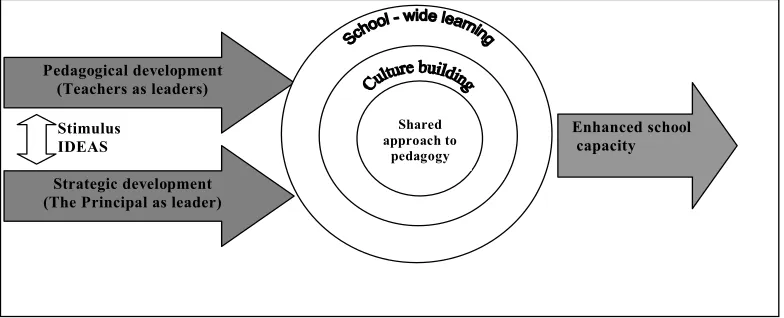
School-based leadership is an important factor in enhancing capacity to improve student outcomes (Crowther, Hann & McMaster, 2001; Crowther et al., 2001). The pedagogical leadership of teachers works in parallel with the strategic leadership of administrators. Through their engagement in the ideas process, teachers learn together in their professional community, developing an agreed schoolwide pedagogy and transposing this into practice (Figure 3). This strengthens the identity of the school, gives cohesion to the culture and enhances capacity to improve student outcomes.
Strategic development (The Principal as leader) Pedagogical development (Teachers as leaders)
Enhanced school capacity Stimulus
IDEAS
Shared approach to
pedagogy
[image:34.595.132.524.578.737.2]Figure 3: School-based Leadership and Enhanced School Innovation
1.5.4 The Principles of IDEAS
IDEAS is based on five specific principles (Crowther, 2001, pp.3-4):
1. Teachers are the key: Central to IDEAS is the creation of a schoolwide pedagogy - a shared approach to teaching, learning and assessment. While administrators have an important role to play, it is the teachers who drive this process.
2. Professional learning is key to professional revitalisation: IDEAS enables successful classroom practices and the school’s vision to be brought into alignment. This engages the professional learning community in the highest level of exploration and dialogue – placing professional learning at the centre of school renewal, and teachers as the heart of the process.
3. No blame: Blame is not attributed to individuals. Instead, IDEAS requires processes that will redress perceived deficits. These may be identified through successful practices.
4. Success breeds success: IDEAS is based on the premise that a professional community can achieve a great deal when positives are emphasised rather than deficits.
5. Alignment of school processes is a collective school responsibility: It is a collective responsibility for individual schools to create a distinctive identity through aligning school vision, community cohesion, infrastructure, classroom practices and professional development.
External facilitation support is also available to IDEAS schools. Members of the IDEAS Core Team (university based) and more recently, members of the IDEAS Support Team (experienced IDEAS facilitators) are available to visit schools at key junctures in the process.
1.5.5 IDEAS as a Change Process
for this research because its model of school operation, captured in the Research-based Framework, centres on the work of teachers. The ideas process facilitates contextualised knowledge work as teachers are engaged in developing and implementing a shared vision and schoolwide pedagogy. While other school renewal processes may have provided a basis for this research, IDEAS has proved particularly fertile ground for study of collegially-based knowledge creation processes.
1.6 Locating the Researcher in the Inquiry
My work as a doctoral researcher has been extremely complicated by my location in a number of enabling but also potentially conflicting research contexts. A brief explanation of this complexity follows.
This research grew out of the IDEAS Project which I have had the privilege to be involved with since 1999. As a member of the USQ IDEAS Core Team, I have been ideally placed to observe the growth and development of the project. Membership of the IDEAS Team assisted my research in a number of ways. The significant goodwill between schools and the Director of the USQ Leadership Research Institute was of great advantage to me as a newcomer to Queensland. My participation in regular IDEAS Team meetings, school visits, facilitator training days and the preparation of the IDEAS Facilitation Folder (Crowther et al., 2001) has also provided an invaluable background to my research. IDEAS Team membership did not create any real tensions for me as a researcher, though it did give my presence in the schools an extra dimension. In general, I was able to move from one role to another where this was required, but stayed in the role of student researcher where possible as my primary purpose in those schools was data collection and observation. My particular role and participation varied from school to school. This is explored in more detail in Chapter 3.
As indicated previously, IDEAS was developed by the USQ Leadership Research Institute in partnership with Education Queensland. Complementing the IDEAS Project has been an ARC-SPIRT2 Grant project directed by Professor Crowther
2 ARC stands for Australian Research Council and SPIRT for Strategic Partnerships with Industry
and Dr Andrews in conjunction with Professor Peter Cuttance (University of Melbourne) and Professor Ronel Erwee (USQ). This research team is working with industry partner, Education Queensland, to inquire into the impact of whole-school reform processes on whole-school outcomes. The ARC-SPIRT Grant project (2001-2003) trials a conceptual framework (see Figure 3) developed in the 1998-1999 ‘Innovation and Best Practices Project’ (IBPP), in a number of Queensland State Schools. As a process of whole-school reform, IDEAS is being used at the vehicle for this inquiry. The IBP Project, led by Professor Cuttance, was carried out by researchers from a consortium of Australian universities (Sydney, USQ, Melbourne and Edith Cowen).
My involvement in research in which my supervisors have a vested research interest raises the question of whether my integrity as an independent researcher may be compromised. This has partially been guarded against by the sensitivity of those involved, and the care taken by my supervisors to avoid this potential conflict of interests. In addition, I have maintained separation from the ARC-SPIRT Grant research project. Finally, I have gone to major lengths to validate my own data. The existence of the ARC-SPIRT Grant project has the potential, over time, to contribute to the validation, or otherwise, of the outcomes of this research. However, this inquiry also stands alone, its validity resting on the features outlined in Chapter 3.
1.7 Summary of the Chapters
The thesis has been structured into six chapters.
Chapter 2 provides a review of the literature that has informed this study. It briefly considers how the changing nature of society impacts on the work of teachers and outlines what is understood by professional learning community before going on to consider in some detail the nature of knowledge and of knowledge creation. Some consideration is also given to aspects of teacher knowledge. Discussion of individual and organisational learning follows. Consideration is given to different forms and processes of cognition: individual and social, situated and distributed, and relating to culture and cultural processes. This leads into discussion of the factors both enhancing and constraining knowledge creation. Particular note is made of the impact of efficacy and emotion in organisations on these processes. Finally, to conclude the chapter, brief mention is made of orientations to school renewal and the particular orientation of IDEAS.
Chapter 3 describes the research orientation of this inquiry and identifies the focus of the research. Each of the case study schools is described and an explanation provided of how the sample was selected. Information is given on the collection of the data, its transcription, and analysis. A rationale is provided for treating each school as an individual case up until the final stage of analysis, when some tentative generalisation is formulated. A brief account of my presence in the research and in the text is offered. Consideration is given to how the inquiry meets the criteria for adequacy and ethical clearance considerations are noted.
Chapter 5 draws on the contextualised stories of each of the schools to look more specifically at the knowledge creation processes. The chapter begins with consideration of the nature of the knowledge created in each school. This is followed by a detailed exploration and analysis of how knowledge creation may be understood in each of the schools and my own emerging interpretation of the knowledge creation processes at work in each of the three cases.
CHAPTER 2: A Review of the Literature
2.1 Overview
The review of the literature is structured into a series of sections. Initially, consideration is given to how changes in society are bringing greater complexity to the work of teachers. Attention then turns to the systemic response of restructuring and the impact of restructuring on student outcomes. The existence of different types of teacher collaborative activity is noted, leading into more specific consideration of the notion of professional learning community.
A section concerning the nature of knowledge follows. This is intended to provide the foundation for more detailed consideration of knowledge creation. Taking an historical perspective, understandings of the nature of knowledge are explored, leading into an examination of the social construction of knowledge and of meaning.
The three sections which then follow constitute the core of this review of the literature. Structured to broadly correspond with the research questions they explore:
the processes of knowledge creation;
individual and organisational learning;
factors influencing the knowledge creation process.
To locate the study more specifically within a school context, a section drawing out relevant aspects of teacher knowledge has been included. This is linked to, and follows, the section exploring the processes of knowledge creation. To complete this literature review, a further section dealing with emotions in organisations has been added in recognition of the highly affective nature of teacher engagement in knowledge creation. To conclude the chapter, the importance of whole-school renewal is re-emphasised and the particular orientation of IDEAS as a school renewal process is noted.
2.2 The Changing Society is Changing the Work of
Teachers
The literature clearly supports the assertion that the changing nature of society is challenging schools and has significant implications for the work of teachers (Fullan, 1991, 1999; Hargreaves & Fullan, 1998; Smyth, 1998; Levin & Riffel, 1997; Hargreaves, 1994; 1997). Darling-Hammond indicates the enormity of the task faced by teachers when she says:
Public schools are being asked to educate the most pluralistic group of students in history for more challenging learning than ever before. Teachers and other school leaders are expected to learn to teach in much more sophisticated ways that reach students who approach learning from diverse vantage points while restructuring schools designed many decades ago for a much different mission in a much simpler time (Darling-Hammond cited in Hargreaves & Fullan, 1998, p.iv).
While Darling-Hammond was talking of an American context, the statement may equally be applied to Australian schools. The ability to meet such challenges implies a fundamental change in the work of teachers, the way they relate to each other and learn together. This is no easy matter. The changing environment is making the role of the teacher more complex and demanding – it is redefining what it means to be a successful teacher. Also, in Australia, teachers’ work has underdone a process of redefinition in the context of school system restructuring, itself a response to changing conditions. It is clear that the case study schools in this inquiry, all located in Queensland, are facing challenges arising from a rapidly changing environment. For public schools, this is evidenced by the 2010 document (Queensland State Education, 1999) which explores how schools are to meet the challenge of moving from the industrial age into the information age.
2.2.1 School System Restructuring
varied from state to state, and within states as governments changed, the general emphasis in Australian public school systems has been on reducing the central bureaucracy and, within broad system policy parameters, allowing more decision-making at the local school level (Sharpe, 1996). Hargreaves (1994) notes that while many meanings are attached to restructuring, the principle of collaboration is common to almost all of them. Although Hargreaves is writing in an American context, in broad terms, the same may be said of restructuring within Australia (Sharpe, 1996).
community. The important point here is that there is a significant difference between teachers choosing to collaborate in order to achieve shared goals and being required to do so (Little & McLaughlin, 1993). In the redefinition of teachers’ work, therefore, it is important to consider the type of collaboration, its origin and motivating force.
This is significant when considering teacher engagement with IDEAS. Unlike many system-wide initiatives, the decision to participate is taken at a school level. Control of the ideas process rests largely with classroom teachers. The particular path through the process is determined by the circumstances of the school and the timeline is determined by the IDEAS Management Team. Teacher collaboration within IDEAS is not imposed from outside the school and, being firmly grounded in pedagogy, is tied to practice not administrative concerns. IDEAS motivates educationally-driven collaboration because it builds on successful classroom practice and engages teachers in professional conversations about their work (Crowther et al., 2001). It involves ways of working consistent with the types of collaboration that characterise professional learning communities. This is discussed in more detail below.
2.2.2 The Effect of Restructuring on Student Outcomes
renewal processes that forms the focus of this study. Restructuring of itself does not open the way for such organisational learning, though it does have implications for the work of teachers. Depending on the prevailing conditions in the school, restructuring may open up avenues of teacher collaboration which were not possible under the more traditional bureaucratic arrangements. It opens up the possibility of knowledge creation within the professional community of the school.
Before considering the nature of knowledge and knowledge creation processes in more detail, it is appropriate to consider what is meant by professional learning community. School system restructuring and reorientation created the potential for teachers to become more involved in decision making and operate on a more collaborative, collegial basis (Mayer et al., 1997). The increasing involvement of teachers in broader school issues represents a different focus for teachers, one beyond the classroom – within the professional community of the school.
2.3 Professional Learning Community
For all this to occur teachers need to have time, access to each other, good communication structures and a degree of autonomy (McLaughlin, 1997; Kruse, Louis & Bryk, 1994). The literature suggests, however, that putting structural factors into place is not enough in itself – the school has to have the social and human factors that support them (Bryk, Camburn & Louis, 1996; Kruse, Louis & Bryk, 1994). Hargreaves (1994) stresses the importance of social climate if collaboration is to be sustained. Huberman (1993) adds that the absence of a positive and supportive social climate can lead to the breakdown of collaborative effort or foster the type of collaboration which has little bearing on what the teacher does in the classroom. The presence of characteristics such as trust, respect and openness to improvement are thus key characteristics of professional learning communities. Change is therefore more likely to occur in schools where the structures are in place for the learning community to operate and there is a positive social climate for teachers to share their professional knowledge.
Craig (1995b) describes the importance of knowledge communities where experiences may be shared in an atmosphere of trust and new knowledge generated as a result of the linkage between individual and communal ways of knowing. Such knowledge is enriched by the range of perspectives being shared. This is very different to the teacher-in-classrooms scenario where teachers may have little opportunity to talk about students, school and teaching and where, “…everyone in the organization is likely to be operating under a different set of assumptions, precepts and images” (Pellicer &