University of Southern Queensland
Faculty of Engineering and Surveying
DEVELOPING PHYSICAL MODEL FOR BEARING
CAPACITY AND FLOW NET APPLICATIONS
A dissertation submitted by
Manop Jiankulprasert
in fulfillment of the requirements of
Course ENG4111 and ENG 4112 Research Project
towards the degree of
Bachelor of Engineering (Civil)
Abstract
Bearing capacity and flow nets are geotechnical problems that civil engineers will encounter in practice. Small scaled physical models can be used to improve understanding of physical behavior for these two particular problems.
The ultimate load which a foundation can support may be calculated using bearing capacity theory. An experimental study procedure of soil ultimate bearing capacity was developed based on a previous research project student. One dimension consolidation was introduced in order to reduce the moisture content of the clay sample after mixed. Fine sand and coarse sand were also used in this study.
University of Southern Queensland
Faculty of Engineering and Surveying
ENG4111 & ENG4112 Research Project
Limitations of Use
The Council of the University of Southern Queensland, its Faculty of Engineering and Surveying, and the staff of the University of Southern Queensland, do not accept any responsibility for the truth, accuracy or completeness of material contained within or associated with this dissertation.
Persons using all or any part of this material do so at their own risk, and not at the risk of the Council of the University of Southern Queensland, its Faculty of Engineering and Surveying or the staff of the University of Southern Queensland.
This dissertation reports an educational exercise and has no purpose or validity beyond this exercise. The sole purpose of the course pair entitled "Research Project" is to contributed to the overall education within the student's chosen degree program. This document, the associated hardware, software, drawings, and other material set out in the associated appendices should not be used for any other purpose: if they are so used, it is entirely at the risk of the user.
Prof G Baker
Dean
Certification
I certify that the ideas, designs and experimental work, results, analyses and conclusions set out in this dissertation are entirely my own effort, except where otherwise indicated and acknowledged.
I further certify that the work is original and has not been previously submitted for assessment in any other course or institution, except where specifically stated.
Manop Jiankulprasert
Student Number: D10321702
Acknowledgement
I would like to take this opportunity to thank my supervisor for his proficient help and guidance throughout this research project.
I would like to sincerely appreciate the help in technical support from Mr. Glen Bartkowski in construct the models and Mr. Mohan Trada in model testing.
My appreciation extends to all of my family members, Mr. Tagarajan Perumal, Mr. Samy, Mr. Ngoo Wai Fei for the support and encouragement during the progress of this project.
University of Southern Queensland.
Year 2006
Sincerely,
Table of Content
Abstract i
Acknowledgement iv
Table of content v
List of Figures viii
List of Tables xii
Chapter 1: Introduction
1
1.1 Introduction 2
1.1.1 Principal types of soils 2
1.1.2 Permeability of soils 5
1.1.3 Stress and strain in soils 7
1.2 Project Aim and Scope 9
Chapter 2: Part A – Bearing Capacity
112.1 Introduction 12
2.2 Mohr's Rupture Diagram and Coulomb's Equation 14 2.3 Types of Failure in Soil at Ultimate Load 18
2.4 Bearing Capacity Equations 23
2.4.1 The Terzaghi bearing capacity equation 26 2.4.2 Meyerhof's bearing capacity equation 29 2.4.3 Hansen's bearing capacity equation 31 2.4.4 Vesic's bearing capacity equation 35
2.4.5 Which equations to use 35
2.5 Analysis of the Physical Models 36
2.5.1 Preparation 36
2.5.2 Construction 38
2.5.3 Testing of the models 43
2.6 Kaolin Clay 48 2.6.1 Properties of the Kaolin clay 48 2.6.2 Preparation of the Kaolin clay 48
2.7 Comparison of Results 56
Chapter 3: Part B – Flow Net
593.1 Introduction 60
3.2 Seepage 64
3.2.1 Flow net 65
3.2.2 Construction of flow net 67
3.2.3 Calculation of pore water pressure using flow net 74 3.2.4 Mechanics of piping due to heave 76 3.3 Analysis of the Physical Model 79
3.3.1 Preparation 79
3.3.2 Construction 80
3.3.3 Results and discussions 83
3.4 Comparison of Results 88
Chapter 4: Open Day Demonstration
90
4.1 Introduction 91
4.2 Procedure 98
4.2.1 Bearing capacity models 98
4.2.2 Cofferdam model 101
Chapter
5:
Project
Conclusions
105
5.1 Project Achievements 106
5.2 Conclusions 107
5.3 Recommendations for Further Study 107
Appendices 117
Appendix A: Project Specification 118
List of Figures
PAGE Figure 1.1: Clay structures (a) dispersed, (b) flocculated, (c) bookhouse, 3
(d) turbostratic, (e) example of a natural clay. (Craig, 1992)
Figure 1.2: Particle size ranges. (Terzaghi & Peck, 1967)) 4
Figure 1.3: Coefficient of permeability. (Terzaghi & Peck, 1967) 5
Figure 1.4: Schematic for permeability determination. (a) Constant-head 7 permeameter; (b) falling-head permeameter; t = time for head
to change from h1 to h2. (Bowles, 1996)
Figure 1.5: Diagram illustrating principal features of triaxial-test apparatus. 8
(Terzaghi, 1948)
Figure 2.1: Common types of foundations. (Das, 1979) 12
Figure 2.2: Diagram illustrating Mohr's circle of stress and rupture diagrams. 15 (a) Principal stresses and inclined plane on which normal and
shearing stresses p and t act. (b) Circle of stress.
(c) Rupture line from series of failure circles. (d) Relation between angles α and φ. (Terzaghi, 1948)
Figure 2.3: General shear failure in soil. (Das, 2000) 18
Figure 2.4: Local shear failure in soil. (Das, 2000) 19
Figure 2.5: Punching shear failure in soil. (Das, 2000) 20
Figure 2.6: Nature of failure in soil with relative density of sand (Dr) 21 and Df /R. (Das, 2000)
Figure 2.7: Definition of conditions for developing the ultimate bearing 24 capacity equation. (David, 1998)
Figure 2.8: Bearing capacity approximation on a φ = 0 soil. (Bowles, 1996) 25
Figure 2.9: Simplified bearing capacity for a φ - c soil. (Bowles, 1996) 26
Figure 2.10: (a) Shallow foundation with rough base defined. Terzaghi and 27 Hansen equations of Table 2.X neglect shear along cd;
Figure 2.12: Front view of the two layers sand model. 37
Figure 2.13: Front view of the sand on clay model. 37
Figure 2.14: Finished one layer sand model. 39
Figure 2.15: Finished two layers sand model. 39
Figure 2.16: Completed tank, Perspex front cover, screen, and top cover. 41
Figure 2.17: Soil reinforcement of sand on clay model. 41
Figure 2.18: Scaled footing 42
Figure 2.19: Finished sand on clay model. 42
Figure 2.20: The compression machine. 43
Figure 2.21: Failure mechanism of one layer sand model. 45
Figure 2.22: Plot of load vs. deformation of one layer sand model. 45
Figure 2.23: Failure mechanism of two layers sand model. 46
Figure 2.24: Plot of load vs. deformation of two layers sand model. 46
Figure 2.25: Failure mechanism of sand on clay model. 47
Figure 2.26: Plot of load vs. deformation of sand on clay model. 47
Figure 2.27: Mold for casting the concrete block. 50
Figure 2.28: Pure concrete into the mold. 50
Figure 2.29: Flatten and keep in a safe place for one week. 51
Figure 2.30: Concrete block ready to use. 51
Figure 2.31: Applied the first concrete block. 52
Figure 2.32: Water dropping from the bottom drainage holes. 52
Figure 2.33: Applied the second concrete block. 53
Figure 2.34: Settlement after applied the second concrete block. 53
Figure 2.35: Diagram of clay model settlement. 55
Figure 3.1: Principal types of Cofferdam. (Lee, 1961) 62
Figure 3.2: Seepage by Underflow. (Lee, 1961) 64
Figure 3.3: Flow net. (Liu & Evett, 1998) 66
Figure 3.4: Geometry for example flow net construction: excavation for 68 cooling water outfall pipe. (Powrie, 1997)
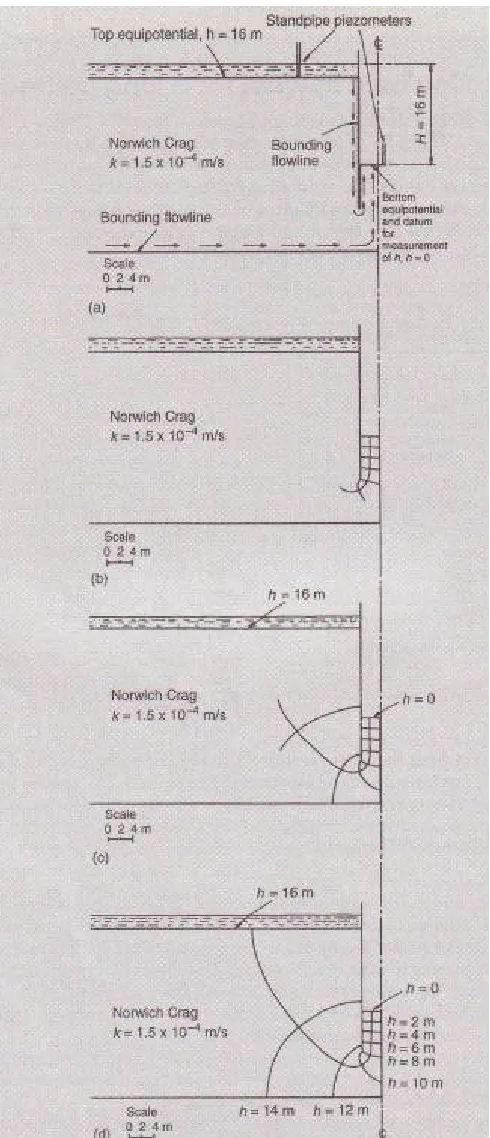
Figure 3.5: Construction of flow net for cooling water outfall pipe excavation: 70 (a) identify the sink, the source and the bounding flow lines;
Figure 3.6: Flow channel and equipotential drops. (Liu & Evett, 1998) 72
Figure 3.7: Calculating pore water pressure form flow net. 75 (a) Determining the total head hA; (b) relationship between
total head and pore water pressure. (Powrie, 1997)
Figure 3.8: Use of flow net to determine factor of safety of row of sheet piles 78 in sand with respect to piping. (a) Flow net. (b) Forces acting on sand within zone of potential heave. (Terzaghi, 1922)
Figure 3.9: Methods of improving seepage conditions. (a) Cofferdam. 79 (b) Concrete or masonry dam. (Whitlow, 1996)
Figure 3.10: Expect flow lines. 80
Figure 3.11: Front view drawing of the physical model. 81
Figure 3.12: Physical model under construction. 82
Figure 3.13: Testing the tank for leakage after construction. 83
Figure 3.14: Fill up the water and saturated the sand sample. 83
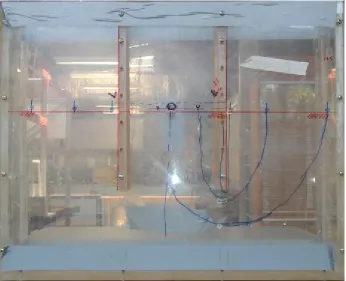
Figure 3.15: Finished cofferdam model. 84
Figure 3.16: Dewatering the cofferdam. 85
Figure 3.17: Injecting the dye. 86
Figure 3.18: Shortest flow path. 86
Figure 3.19: Flow lines. 87
Figure 3.20: Heave and boiling. 88
Figure 3.21: Collapse. 88
Figure 4.1: Poster for the bearing capacity model. 92
Figure 4.2: Bearing capacity background and applications. 93
Figure 4.3: Failure mode and derivation of equations. 94
Figure 4.4: Poster for the cofferdam model. 95
Figure 4.5: Cofferdam background and applications. 96
Figure 4.6: Seepage and flow net. 96
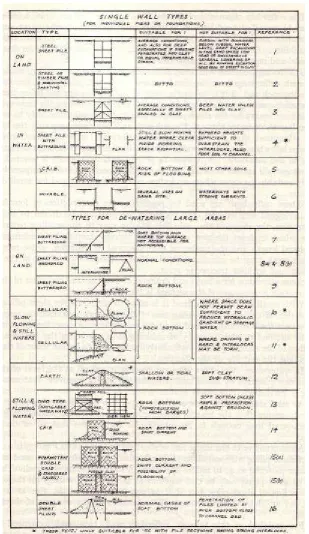
Figure 4.7: Types of cofferdam. 97
Figure 4.8: Covered physical model. 98
Figure 4.9: Participants listening to the background information. 99
[image:11.595.104.526.51.789.2]Figure 4.13: Participants listening to the concepts and application. 102
Figure 4.14: Drawing for sketching the flow lines. 102
Figure 4.15: Participants checking the results. 103
List of Tables
PAGE Table 2.1: Bearing capacity equations by the several authors indicated. 28
(Bowles, 1996)
Table 2.2: Bearing capacity factors for the Terzaghi equations. 29 (Bowles, 1996)
Table 2.3: Shape, depth, and inclination factors for Meyerhof bearing 30 capacity equation of Table 2.1. (Bowles, 1996)
Table 2.4: Bearing capacity factors for Meyerhof, Hansen, and Vesic 30 bearing capacity equations. (Bowles, 1996)
Table 2.5a: Shape and depth factors for use in either the Hansen (1970) 33 or Vesic (1973, 1975) bearing capacity equations of Table 2.1. Use s'c, d'c when φ = 0 only for Hansen equations. Subscripts
H, V for Hansen, Vesic, respectively. (Bowles, 1996)
Table 2.5b: Table of inclination, ground, and base factors for the Hansen 33 (1970) equations. See Table 2.5c for equivalent Vesic
equations. (Bowles, 1996)
Chapter 1
1.1 Introduction
1.1.1 Principal Types of Soils
In foundation and earthwork engineering, more than in any other field of civil engineering, success depends on practical experience. The design of ordinary soil-supporting or soil-supported structures is necessarily based on simple empirical rules, but these rules can be used safely only by the engineer who has a background of experience. The properties of the soils on which the distinctions based are known as
index properties, and the tests required determining the index properties are
classification tests. (Terzaghi, 1948)
Soils may be classified according to the sizes of the particles of which they are composed, by their physical properties, or by their behavior when the moisture content varies. The following list of soil types are commonly used by experienced foremen and practical engineers for field classification.
Gravel is rounded or semi-round particles of rock that will pass a 3-in. and be retained on a 2.0-mm. No. 10 sieve. Sizes larger than 10 in. are usually called boulders.
Sand is disintegrated rock whose particles very in size from the lower limit of gravel 2.0 mm down to 0.074 mm (No. 200 sieve). It may be classified as coarse or fine sand, depending on the sizes of the grains. Sand is a granular noncohesive material.
Clay is a cohesive material whose particles are less than 0.005 mm. The cohesion between the particles gives a clay high strength when air-dried. Clay can be subject to considerable changes in volume with variations in moisture content. They will exhibit plasticity within a range of "water contents."
Organic matter is a partly decomposed vegetable matter. It has a spongy, unstable structure that will continue to decompose and is chemically reactive. If present in soil that is used for construction purposes, organic matter should be removed and replaced with a more suitable soil.
Figure 1.1: Clay structures (a) dispersed, (b) flocculated, (c) bookhouse, (d) turbostratic, (e) example of a natural clay. (Craig, 1992)
In the field classification of soils includes a rather great variety of different materials. Furthermore, the choice of terms relating to stiffness and density depends to a considerable extent on the person who examines the soil. Because of these facts, the field classification of soils is usually uncertain and inaccurate. More specific information can be obtained only by physical tests that furnish numerical values representative of the properties of the soil.
The size of the particles that constitute soils may vary from that of boulders to that of large molecules.
Grains larger than approximately 0.06 mm can be inspected with the naked eye or by means of a hand lens. They constitute the very coarse and coarse fractions of the soils.
Grains ranging in size from about 0.06 mm to 2µ (1µ = 1 micron = 0.001 mm) can be examined only under the microscope. They represent the fine fraction.
Grains smaller than 2µ constitute the very fine fraction. Grains having a size between 2µ and about 0.1µ can be differentiated under the microscope, but their shape cannot be determined by means of an electron microscope. Their molecular structure can be investigated by means of X-ray analysis.
1.1.2 Permeability of Soils
A material is said to be permeable if it contains continuous voids. Since such voids are contained in all soils including the stiffest clays, and in practically all nonmetallic construction materials including sound granite and neat cement, all these materials are permeable. Furthermore, the flow of water through all of them obeys approximately the same laws. Hence the difference between the flow of water through clean sand and through sound granite is merely one degree. (Terzaghi, 1948)
The permeability of soils has a decisive effect on the cost and the difficulty of many construction operations, such as the excavation of open cuts in water-bearing sand, or on the rate at which a soft clay stratum consolidates under the influence of the weight of a superimposed fill. Even the permeability of dense concrete or rock may have important practical implications, because water exerts a pressure on the porous material through which it percolates. This pressure, which is known as seepage pressure, can be very high.
The erroneous but widespread conception that stiff clay and dense concrete are impermeable is due to the fact that the entire quantity of water that percolates through such materials toward an exposed surface is likely to evaporate, even in a very humid atmosphere. As a consequence, the surface appears to be dry. However, since the mechanical effects of seepage are entirely independent of the rate of percolation, the absence of visible discharge does not indicate the absence of seepage pressures.
Flow of soil water for non turbulent conditions has been expressed by Darcy's as
v = ki (1.1)
where i = hydraulic gradient h/L
k = coefficient of permeability, length/time
Figure 1.3 lists typical order-of-magnitude (exponent of 10) for various soils. The quantity of flow q through a cross section A is
q = kiA (1.2)
Figure 1.4: Schematic for permeability determination. (a) Constant-head permeameter; (b) falling-head permeameter; t = time for head to change from h1 to h2. (Bowles, 1996)
1.1.3 Stress and Strain in Soils
The relations between stress and strain in soils determine the settlements of soil-supported foundations. They also determine the change in earth pressure due to small movements of retaining walls or other earth supports. (Terzaghi, 1948)
Furthermore, the experimental determination of these values for soils is much more difficult. The investigations are usually carried out by means of triaxial compression tests. In a triaxial test, a cylindrical specimen of soil is subjected to an equal all-round pressure, known as the cell pressure, in addition to an axial pressure that may be varied independently of the cell pressure.
The essential features of the triaxial apparatus are shown diagrammatically in Fig. 1.5. The cylindrical surface of the sample is covered by a rubber membrane sealed to a pedestal at the bottom and to a cap at the top. The assemblage in contained in a chamber into which water may admit under any desired pressure; this pressure acts laterally on the cylindrical surface of the sample through the rubber membrane and vertically through the top cap. The additional axial load is applied by means of a piston passing through the top of the chamber.
Figure 1.5: Diagram illustrating principal features of triaxial-test apparatus. (Terzaghi, 1948)
conducted in two steps: the application of the cell pressure, followed by the additional axial load.
1.2 Project Aim and Scope
The aim of my project is to design and construct small scaled physical models that will illustrate the overall behavior of ultimate bearing capacity of shallow foundations and flow net under a cofferdam.
This will involve designing and building the physical models using simply available materials. Five models will be used for testing of ultimate bearing capacity of shallow foundations, and one model will be used for demonstration of flow net application.
Thus, this project will be in two parts, and the scopes for each part are outlined below.
Bearing Capacity
• To design and construct small scaled physical models to study the ultimate bearing capacity of shallow foundations.
• To compare the experimental results with the theoretical results.
• To demonstrate the models at the USQ Open Day for the geotechnical demonstration area.
Flow Nets
• To design and construct small scaled physical models to study the flow net under a cofferdam
• To compare the experimental results with the theoretical results.
Chapter 2
2.1 Introduction
The lowest part of a structure is generally called a foundation and its function is to transfer the load of the structure to the soil on which it is resting. Proper design requires that the load transferred should not overstress the soil. Overstressing of soil might result in excessive settlement or shear failure of soil, which would damage the structure. Thus, for geotechnical and structural engineers engaged in foundation design, it is important to evaluate the safe bearing capacity of soils. (Das, 1979)
Depending on the structure and the soil, various types of foundations are used. The most common types of foundations are shown in Fig. 2.1. A spread footing is simply an enlargement of a load-bearing wall or column, which spreads the load of the structure over a large area of the soil. Sometimes the size of the spread footings will be too large for the low load-bearing capacity of soil. Then it becomes more economical to construct the entire structure over a concrete pad, which is called a mat foundation.
Pile and caisson foundations are used for heavier structures in which the depth required for supporting the load is large.
Piles are structural members made of timber, concrete, or steel that transmits the load of the superstructure into the lower layers of the soil. Depending on the way in which piles transmit the load into the subsoil, they are divided into two categories: (1) friction pile and (2) end-bearing pile. In the case of friction pile, the superstructure load is resisted by the frictional force generated along the surface of the pile. In end-bearing pile, the load carried by the pile is transmitted at its point to a firm stratum.
In a caisson foundation, a shaft is drilled into the subsoil and filled with concrete. During the shaft drilling a metal casing may be used; it may be left in place or may be withdrawn during the pouring of concrete. The basic functions of a pile and caisson are practically the same, but the diameter of a caisson shaft is much larger than that of a pile.
For safe performance the load carried by a foundation must be such that (1) the settlement of soil caused by the load is within the tolerable limit and (2) shear failure of soil supporting the foundation does not occur.
Spread footings and mat foundations are generally classified as shallow; pile and caisson foundations are deep foundations.
2.2 Mohr's Rupture Diagram and Coulomb's Equation
Soils, like most solid materials, fail either in tension or in shear. Tensile stresses may cause the opening of cracks that, under some circumstances of practical importance, are undesirable or detrimental. In the majority of engineering problems, however, only the resistance to failure by shear requires consideration. (Peck, 1967)
Shear failure starts at a point in a mass of soil when, on some surface passing through the point, a critical combination of shearing and a normal stress is reached. Various types of equipment have been developed to determine and investigate these critical combinations. At present the most widely used is the triaxial apparatus described in Chapter 1. Because only principal stresses can be applied to the boundaries of the specimen in this equipment, the state of stress on any other than principal planes must be determined indirectly.
According to the principles of mechanics, the normal stress and shearing stress on a plane inclined at angle α to the plane of the major principal stress and perpendicular to the plane of the intermediate principal stress (Fig. 2.2a) are determined by the following equations α 2 cos ) ( 2 1 ) ( 2 1 3 1 3
1 p p p
p
p = + + − (2.1)
α 2 sin ) ( 2 1 3 1 p p
t = − (2.2)
The corresponding components of stress are represented by points on the dash circles plotted on the same axes in Fig. 2.2b. Since, in the usual triaxial test, the major principal stress acts in a vertical direction and the cell pressure represents both the intermediate and minor principal stresses which are equal, we are generally concerned only with the outer circle associated with the major and minor principal stresses p1 and p3. This is known as the circle of stress.
Figure 2.2: Diagram illustrating Mohr's circle of stress and rupture diagrams.
Every point such as D, on the circle of stress represents the normal stress and shearing stress on a particular plane inclined at an angle α to the direction of the plane of the major principal stress. From the geometry of the figure it can be shown that the central angle A O' D is equal to 2α.
If the principal stresses p1 and p3 correspond to a state of failure in the specimen then at least one point on the circle of stress must represent a combination of normal and shearing stresses that led to failure on some plane through the specimen. Moreover, if the coordinates of that point were known, the inclination of the plane upon which failure took place could be determined from knowledge of the angle α.
If a series of tests is performed and the circle of stress corresponding to failure is plotted for each of the tests, at least one point on each circle must represent the normal and shearing stresses associated with failure. As the number of tests increased indefinitely, and if the material is homogeneous and isotropic, it is apparent that the envelop of the failure circle (Fig. 2.2c) represents the locus of points associate with failure of the specimens. The envelop is known as the rupture line for the given material under the specific conditions of the series of tests.
From the geometry of Fig. 2.2d it may be seen that for any failure circle
φ α =90°+
2
(2.3)
Therefore the angle between the plane on which failure occurs and the plane of the major principal stress is
2
45 φ
In general, the rupture for a series of tests on a soil under a given set of conditions is curved. However, it may often be approximated by a straight line with the equation
φ
tan p c
s = + (2.5)
This expression is known as Coulomb's equation. In this equation symbol t, representing shearing stress is replaced by s, known as the shearing resistance or shearing strength, because points on the rupture line refer specifically to states of stress associated with failure.
The triaxial test gives great flexibility with respect to possible stress changes, and pore water drainage conditions, in taking the test specimen to failure. With respect to drainage conditions, one of the following three procedures is usually adopted. (Parry, 1995)
1. Unconsolidated undrained test (UU): the specimen is taken to failure with no drainage permitted.
2. Consolidated undrained test (CU): the drainage valve is initially opened to allow the pore pressure to dissipate to zero, and then closed so that the specimen is taken to failure without permitting any further drainage. It is common to apply a 'back pressure', that is a positive pore pressure, to the specimen initially, balanced by an equal increment in cell pressure to avoid changing the effective stress. This is to ensure that any air in the soil voids or in the ducts connecting to the pore pressure measuring device is driven into solution in the water. It also decreases the possibility of cavitation, that is water vapour forming, or air coming out of solution in the water, if large negative charges in pore pressure take place during a test.
2.3 Types of Failure in Soil at Ultimate Load
To understand the concept of ultimate soil-bearing capacity and the mode of shear failure in soil, let us consider a long rectangular model footing of width B located at the depth Df below the ground surface and supported by a dense sand layer (or stiff clayey soil) as shown in Fig. 2.3. If this foundation is subjected to a load Q which is gradually increased, the load per unit area, q = Q/A (A = area of the foundation), will increase and the foundation will undergo increased settlement. When q becomes equal to qu at foundation settlement S = Su, the soil supporting the foundation undergoes sudden shear failure. The failure surface in the soil is shown in Fig. 2.3a, and the q versus S plot is shown in Fig2.3b. This type of failure is called general shear failure, and qu is the
If the foundation shown in Fig. 2.3a is supported by a medium dense sand or clayey soil of medium consistency (Fig. 2.4a), the plot of q versus S will be as shown in Fig. 2.4b. Note that the magnitude of q increased with settlement up to q = q'u, which is usually referred to as the first failure load. At this time, the developed failure surface in the soil will be like that shown by the solid lines in Fig 2.4a.
Figure 2.4: Local shear failure in soil. (Das, 2000)
If the load on the foundation is further increased, the load-settlement curve becomes steeper and erratic with the gradual outward and upward progress of the failure surface in the soil (shown by the broken line in Fig. 2.4b) under the foundation. When q
Figure 2.5a shows the same foundation located on a loose sand or soft clayey soil. For this case, the load-settlement curve will be like that shown in Fig. 2.5b. A peak value if load per unit area, q, is never observed. The ultimate bearing capacity, qu, is defined as the point where ∆S/∆q becomes the largest and almost constant thereafter. This type of failure in soil is called punching shear failure. In this case, the failure surface never extends up to the ground surface.
Figure 2.5: Punching shear failure in soil. (Das, 2000)
Figure 2.6: Nature of failure in soil with relative density of sand (Dr) and Df /R. (Das, 2000)
This was clearly explained by Vesic (1973) who conducted extensive laboratory model tests in sand. The summary of Vesic's findings is shown in a slightly different form in Fig. 2.6. In this figure, Dris the relative density of sand, and the hydraulic radius, R, of the foundation is defined as
P A R =
(2.6)
where A = area of the foundation = B × L
) (
2 B L
L B R
+ ×
= (2.7)
For a square foundation, B = L.
So,
4 B R =
(2.8)
2.4 Bearing
Capacity
Equations
Over the past one hundred years, a number of investigators have undertaken studies relating to foundation bearing capacity, typically applying the classical theories of elasticity and plasticity to soil behavior to develop equations appropriate for foundation design. (Terzaghi, 1948)
The original theoretical concepts for analyzing conditions considered applicable to foundation performance using the theory of plasticity are credited to Prandtl (1920) and Reissner (1924). Prandtl studied the effect of a long, narrow metal tool bearing against the surface of a smooth metal mass that possessed cohesion and internal friction but no weight. The results of Prandtl's work were extended by Reissner to include the condition where the bearing area is located below the surface of the resisting material and a surcharge weight acts on a plane that is level with the bearing area. (Bowls, 1996)
Terzaghi (1943) applied the developments of Prandtl and Reissner to soil foundation problem, extending the theory to consider rough foundation surfaces bearing on materials that posses weight.
Figure 2.7: Definition of conditions for developing the ultimate bearing capacity equation. (David, 1998)
The theory assumes that the soil material in zones I, II, and III possesses the stress-strain characteristics of a rigid plastic body (viz., the material shows an infinite initial modulus of elasticity extending to the point of shear failure, followed by a zero modulus; see Fig. 2.7b). Applied to the soil mass providing support for the foundation, the theory assumes that no deformations occur prior to the point of shear failure but that plastic flow occurs at constant stress after shearing failure. It is also assumed that the plastic deformations are small and the geometric shapes of the failure zones remain essentially constant.
internal friction φ is zero degrees) to a curve intermediate between a logarithmic spiral and a circle (when φ is greater than zero degrees).
Terzaghi developed a general bearing capacity equation for strip footings that combined the effects of soil cohesion and internal friction, foundation size, soil weight, and surcharge effects in order to simplify the calculations necessary for foundation design. His equation utilized the concept of dimensionless bearing capacity factors whose values are a function of the shear possessed by the supporting soils.
Modifications to early concepts have emerged from such studies, but the general form of the Terzaghi bearing capacity equation has been retained because of its practicality. There is currently no method of obtaining the ultimate bearing capacity of a foundation other than as an estimate. Vesic (1973) tabulated 15 theoretical solutions since 1940 and omitted at least one of the more popular methods in current use. There have been several additional proposals since that time.
2.4.1 The Terzaghi Bearing Capacity Equation
One of the early sets of bearing capacity equations was proposed by Terzaghi (1943) as shown in Table 2.1. Terzaghi's equations were produced from a slightly modified bearing capacity theory developed by Prandtl from using the theory of plasticity to analyze the punching of a rigid base into a softer soil material.
Figure 2.10: (a) Shallow foundation with rough base defined. Terzaghi and Hansen equations of Table 2.1 neglect shear along cd; (b) general footing-soil interaction for bearing capacity equations for strip footing; left side for Terzaghi (1943), Hansen (1970), and right side Meyerhof (1951). (Bowles, 1996)
The basic equation was for the case in which a unit width from a long strip produced a plane strain case, all shape factors si = 1.00, but the Ni factors were computed differently. Terzaghi used α = φ in Fig. 2.9 and 2.10 whereas most other theories use the α = 45 + φ/2 shown. We see in Table 2.1 that Terzaghi only used shape factors with the cohesion (sc) and based (sγ) terms. The Terzaghi bearing capacity equation is developed, as
γ
γ
BN
N
q
cN
by summing vertical forces on the wedge bac of Fig. 2.10.
Table 2.1: Bearing capacity equations by the several authors indicated. (Bowles, 1996)
Terzaghi (1943). See Table 2.2 for typical values and for Kpγ values.
γ γ
γ
BN
s
N
q
s
cN
q
ult=
c c+
q+
0
.
5
For: strip round square sc = 1.0 1.3 1.3
sγ = 1.0 0.6 0.8
) 2 45 ( cos2 2 φ + = a a Nq φ φ π 2)tan 75 . 0 ( −
=
e
a
φ
cot
)
1
(
−
=
q cN
N
⎟⎟ ⎠ ⎞ ⎜⎜ ⎝ ⎛ − = 1 cos 2 tan 2 φ φ γ γ p K NMeyerhof (1963). See Table 2.3 for shape, depth, and inclination factors. Vertical load:
q
ult=
cN
cs
cd
c+
q
N
qs
qd
q+
0
.
5
γ
B
′
N
γs
γd
γ Inclined load:q
ult=
cN
cd
ci
c+
q
N
qd
qi
q+
0
.
5
γ
B
′
N
γd
γi
γ⎟ ⎠ ⎞ ⎜ ⎝ ⎛ + = 2 45 tan2
tanφ
φ
π e Nq
(
−
1
)
cot
φ
=
qc
N
N
(
)
(
φ
)
γ
=
N
q−
1
tan
1
.
4
N
Hansen (1970). See Table 2.4 for shape, depth, and other factors.
General:
q
ult=
cN
cs
cd
ci
cg
cb
c+
q
N
qs
qd
qi
qg
qb
q+
0
.
5
γ
B
′
N
γs
γd
γi
γg
γb
γ when φ =0use
q
ult=
5
.
14
s
u(
1
+
s
c′
+
d
′
c−
i
c′
−
b
′
c−
g
c′
)
+
q
=
q
N
same as Meyerhof above=
c
N
same as Meyerhof above(
)
φ
γ
=
1
.
5
N
q−
1
tan
N
Vesic (1973, 1975). See Table 2.4 for shape, depth, and other factors. Use Hansen's equations above.
=
q
N
same as Meyerhof above=
(
)
φ
γ=
2
N
q+
1
tan
N
The difference in N factors results from the assumption of the log spiral arc ad and exit wedge cde of Fig. 2.10. This makes a very substantial difference in how Pp is computed, which in turn gives the different Ni values. The shear slip lines shown on Fig. 2.10 qualitatively illustrate stress trajectories in the plastic zone beneath the footing as the ultimate bearing pressure is developed.
Terzaghi's bearing capacity equations were intended for "shallow" foundations where D ≤ B so that the shear resistance along cd of Fig. 2.10a could be neglected. Table 2.1 lists the Terzaghi equation and the method for computing the several Ni factors and the two shape factors si. Table 2.2 is shown a short table of N factors.
Table 2.2: Bearing capacity factors for the Terzaghi equations. (Bowles, 1996)
2.4.2 Meyerhof's Bearing Capacity Equation
These additions produce equations of the general form shown in Table 2.1, with select
Table 2.3: Shape, depth, and inclination factors for Meyerhof bearing capacity equation of Table 2.1. (Bowles, 1996)
Meyerhof obtained his N factors by making trials of the zone abd' with arc ad' of Fig. 2.10b, which include an approximation for shear along line cd of Fig. 2.10a. The shape, depth, and inclination factors in Table 2.3 are from Meyerhof (1963) abd are somewhat different from his 1951 values. The shape factors do not greatly differ from those given by Terzaghi except for addition of sq. Observing that the shear effect along line cd of Fig. 2.10a was still being somewhat ignored, Meyerhof proposed depth factors di.
He also proposed using the inclination factors of Table 2.3 to reduced the bearing capacity when the load resultant was inclined from the vertical by the angle θ. When the
iγ factor is used, it should be self-evident that it does not apply when φ = 0°, since base slip would occur with this term, even if there is base cohesion for the ic term. Also, the ii factors all = 1.0 if the angle θ = 0.
Up to a depth of D ≈ B in Fig. 2.10a, the Meyerhof qult is not greatly different from the Terzaghi value. The difference becomes more pronounced at larger D/B ratios.
2.4.3 Hansen's Bearing Capacity Equation
Hansen (1970) proposed the general bearing capacity case and N factor equations shown in Table 2.1. This equation is readily seen to be a further extension of the earlier Meyerhof (1951) work. Hansen's shape, depth, and other factors making up the general bearing capacity equation are given in Table 2.5. These represent revision and extensions in which the footing is tilted from the horizontal bi and for the possibility of a slope β of the ground supporting the footing to give ground factors gi. Table 2.4 gives selected N values for the Hansen equations together with computation aids for the more difficult shape and depth factor terms.
The Hansen equation implicitly allows any D/B and thus can be used for both shallow and deep foundations. Inspection of the
q
N
q term suggests a great increase in qult with great depth. To place modest limits on this, Hansen used(
1 sin)
1 tan 2 1 4 . 0 1 2 ≤ ⎪ ⎪ ⎭ ⎪⎪ ⎬ ⎫ − + = + = B D B D d B D d q c φ φ(
1 sin)
tan 1 tan 2 1 tan 4 . 0 1 1 2 1 > ⎪ ⎪ ⎭ ⎪⎪ ⎬ ⎫ − + = + = − − B D B D d B D d q c φ φTheses expressions give a discontinuity at D/B = 1; however, note the use of ≤ and >. For φ = 0 (giving d'c) we have
D/B = 0 1 1.5 2 5 10 20 100
d'c = 0 0.40 0.42 0.44 0.55 0.59 0.61 0.62
Table 2.5a: Shape and depth factors for use in either the Hansen (1970) or Vesic (1973, 1975) bearing capacity equations of Table 2.1. Use s'c, d'c when φ = 0 only for Hansen equations. Subscripts H, V for Hansen, Vesic, respectively. (Bowles, 1996)
2.4.4 Vesic's Bearing Capacity Equations
The Vesic (1973, 1975) procedure is essentially the same as the method of Hansen (1961) with select changes. The Nc and Nq terms are those of Hansen but Nγ is slightly different (see Table 2.4). There are also differences in the ii, bi, and gi terms as in Table 2.5c. The Vesic equation is somewhat easier to use than Hansen's because Hansen uses the i terms in computing shape factors si whereas Versic does not.
2.4.5 Which Equations to Use
There are few full scaled footing tests reported in the past. The reason is that they are very expensive to do and the cost is difficult to justify except as pure research or for a precise determination for an important project, usually on the basis of settlement control. Few clients are willing to underwrite the costs of a full scaled footing load test when the bearing capacity can be obtained, often using empirical Standard Penetration Test (SPT) or Cone Penetration Test (CPT) data directly.
The Terzaghi equations, being the first proposed, have been very widely used. Because of their greater ease of use (does not need to compute all the extra shape, depth, and other factors). They are only suitable for a concentrically loaded footing on horizontal ground. They are not applicable for footings carrying a horizontal shear and/or a moment or for tilted bases.
Use Best for
Terzaghi Very cohesive soils where D/B ≤ 1 or for a quick estimate of qult to compare with other methods. Do not use for footings with moments and/or horizontal forces or tilted bases and/or sloping ground.
Hansen, Meyerhof, Vesic Any situation that applies, depending on user preference or familiarity with a particular method.
Hansen, Vesic Where base is tilted; when footing is on a slope or when
2.5 Analysis of the Physical Models
In this part of the paper three physical models will be used to illustrate the ultimate bearing capacity of shallow foundations on one layer sand, two layers sand, and sand on clay. The models will be constructed and tested to represent the failure patterns of different soil types.
2.5.1 Preparation
Initially, the design documents were prepared for this physical model. The drawings were achieved using AutoCAD 2005. The front view of the sand model is shown in Fig. 2.11 and 2.12. The front view of the sand on clay model is shown in Fig. 2.13. The complete drawing of the model is in Appendix X.
Figure 2.12: Front view of the two layers sand model.
2.5.2 Construction
The materials required to construct the physical models are
• Clear Perspex
• Coated Form Plywood • Kaolin Clay
• Fine Sand and Coarse Sand • Small Scaled Footings
The construction involved cutting the Clear Perspex and Coated Form Plywood into the required sizes. The models are then assembled using silicone adhesive and screws. The front cover will be Clear Perspex to allow viewing of the shear failure pattern.
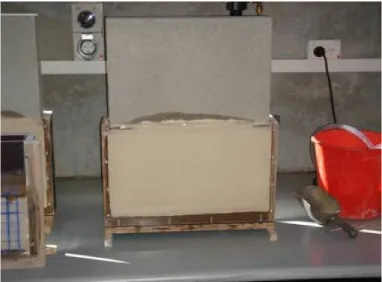
Fine sand was selected to use in one layer sand case. The sand was placed into the tank in layers (50 mm) and compacted well (20 blows each layer). The front cover was then removed and the grid lines were sprayed on top of the grid plate. Then the front cover was fitted and the model was ready for testing.
Figure 2.14: Finished one layer sand model.
In preparing the clay model, the model is required to have bottom drainage for reducing the moisture contents. The preparation of the Kaolin clay and its properties will be discussed in detail in Section 2.6.
Steps for preparing the clay model:
1. Place a screen at the bottom of the tank. (to cover the bottom drainage holes and to keep the sand in place)
2. Fill the dry sand on top of the screen for 20 mm. (to drain water from mixed Kaolin clay)
3. Fill the fresh mixed Kaolin clay in layer and compact well.
4. The model will then undergoes the one-dimensional consolidation process until the moisture content reach 40-45%.
5. Remove the front cover and used a red marker to draw a grid line.
6. Put the front cover back and place the footing to the desire location.
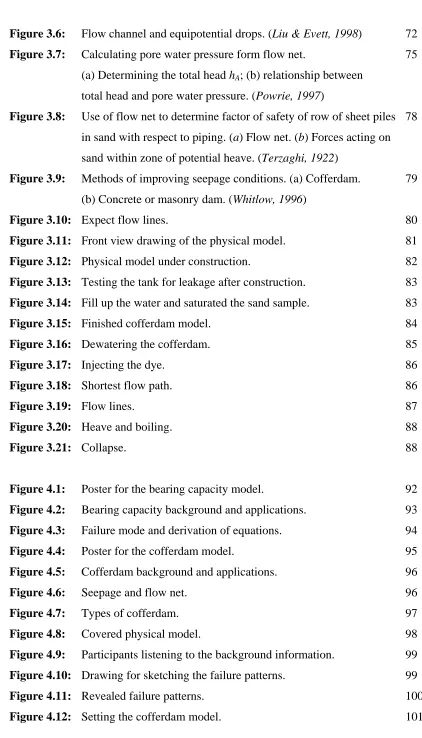
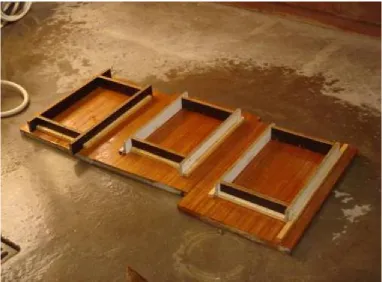
Figure 2.16: Completed tank, Perspex front cover, screen, and top cover.
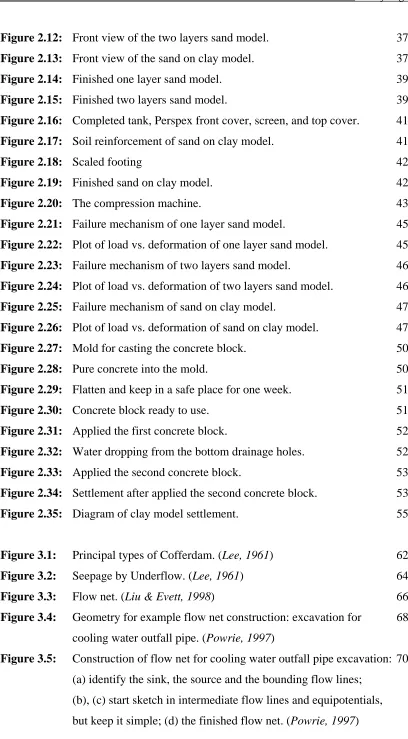
Figure 2.18: Scaled footing
2.5.3 Testing of the Models
The physical models are tested using a simple compression machine similar to the machine used in concrete testing. Results obtained from this machine can be used to develop a load versus deformation curve.
2.5.4 Results and Discussions
The compression machine was started and accelerated at 1 mm per minute until the failure. After failure was occurred, the machine was stopped and taken out of the machine. The model was then placed in a safe place to avoid any disturbance from altering the failure mechanisms. The results for the load and deformation were recorded.
Figure 2.21 and 2.22 shows the failure mechanisms and load versus deformation curve for one layer sand model. The failure mechanism of this model can be compare with the local shear failure mechanism shown in Section 2.2. During the test, the load rate was adjusted to fasten the process.
Figure 2.23 and 2.24 shows the failure mechanisms and load versus deformation curve for two layers sand model. The failure mechanism of this model cannot be compared to any of the failure mechanisms shown in the text book because of the second layer contains too many air voids due to the compaction. When the load applied, the air voids between sand particles was remove but cannot create the particle interlocking (no friction angle, φ ). Therefore, there is no shear failure plane developed for this model.
Figure 2.21: Failure mechanism of one layer sand model.
Load vs. Deformation
0 200 400 600 800 1000 1200 1400
0 50 100 150 200 250 300 350
Deformation, mm
Lo
ad
, N
Max. load = 1208 N
Figure 2.23: Failure after tested of two layers sand model.
Load vs. Deformation
0 200 400 600 800 1000 1200 1400
0 50 100 150 200 250 300 350 400 450
Deformation, mm
L
o
ad
, N
Figure 2.25: Failure mechanism of sand on clay model.
Load vs. Deformation
0 50 100 150 200 250 300 350 400 450 500
0 50 100 150 200 250
Deformation, mm L o ad , N
Max. Load = 448 N
Load = 325 N
2.6 Kaolin
Clay
2.6.1 Properties of the Kaolin Clay
The properties of Kaolin clay were defined by previous year students.
Unit Weight: γd = 12 kPa γw = 20 kPa
Specific Weight: Gs = 2.67
Atterberg Limits: Liquid limit = 43% Plastic limit = 22% Plasticity index = 21%
Cohesion Strength: Moisture content = 41% Cohesive strength = 12 kPa
2.6.2 Preparation of Kaolin Clay
Steps for preparing the Kaolin clay:
1. Mix Kaolin clay powder with water to achieve approximately 120% moisture contents.
2. Place mixed Kaolin clay into the prepared tank in layer and compact well using a rod to remove any air voids.
3. Fill the tank until full, flatten the top surface, and clean any unwanted clay.
4. Incrementally, one-dimensionally consolidated by placing a concrete block on top of the tank.
5. Record the initial settlement.
6. Double the weight every week and record the settlement.
7. Remove the concrete block until the moisture content reached 45-50%. The moisture content can be calculated from the change in volume of the tank. Figure 2.33 shows the diagram of clay model settlement.
8. Take off the front cover and draw the grid line.
Figure 2.33: Applied the second concrete block.
[image:70.595.136.518.445.727.2]The example of moisture content calculation is as follow:
Mixture of the two tanks, Kaolin clay = 18 kg
Water = 22 kg
Moisture content =
s w M M = 18 22
= 122%
Initial volume of clay = 0.258 × 0.070 × 0.450 = 0.008127 m3
Volume of clay after one week = 0.228 × 0.070 × 0.450 = 0.007182 m3
Density of Kaolin clay, ρ = 2300 kg/m3
Mass of clay when wet = ρ× Volume = 2300 × 0.008127 = 18 kg
Mass of clay after one week = 2300 × 0.007182 = 16.5 kg
After one week,
∴ Moisture content of one tank =
s week one after w M M , =
(
)
9 9 5 . 16 −= 83%
After two weeks,
Volume of clay = 0.203 × 0.070 × 0.450 = 0.006394 m3
Mass of clay = 2300 × 0.006394 = 14.7 kg
∴ Moisture content =
s weeks two after w M M , =
(
)
9 9 7 . 14 −After three weeks,
Volume of clay = 0.190 × 0.070 × 0.450 = 0.005985 m3
Mass of clay = 2300 × 0.005985 = 13.7 kg
∴ Moisture content =
s weeks three after w
M M ,
=
(
)
99 7 .
13 −
[image:72.595.137.558.208.543.2]= 53%
2.7 Comparison
of
Results
Numerical Method
The ultimate bearing capacity, qult of the model can be calculated using:
A P
qult = max (2.10)
where, Pmax = Maximum load, kN A = Area under footing, m2
All the footings used in model testing are identical. So
A = 0.050 × 0.070 = 0.0035 m2
One layer sand model
The maximum load of the one layer sand model is 1208 N.
The ultimate bearing capacity for this model is
kPa qult 345
Terzaghi's Method
The footing and soil parameters:
B = 0.05 m L = 0.07 m γ = 19.62 kN/m3 c = 0 φ = 40°
Pmax = 1.208 kN (model) qult = 345 kPa (model)
Since c = 0 and no surcharge load, any factors with subscript c and q do not need computing. Use 1.0 for sγ factor. The equation reduced to
γ
γ
B
N
q
ult=
0
.
5
When φ = 40°, the factor Nγ is 100.4 from Table 2.2.
The ultimate bearing capacity from Terzaghi equation is
kPa
q
ult=
0
.
5
×
19
.
62
×
0
.
05
×
100
.
4
=
49
.
25
The result is too far out because of the scale effects. Generally, models on sand do not produce reliable test results compared to full-scale prototypes. The model reaction involves only a statistically small quantity of soil grains compare with that involved with the full-scale elements. (Bowls, 1996)
For example, sand requires confinement to develop resistance. The confined zone beneath a 50 × 70 mm model is almost nil when compared with the confined zone beneath a small 1 × 2 m footing.
Chapter 3
3.1 Introduction
A cofferdam is a temporary structure to exclude water and to enable the construction in the dry of foundations, bridge piers, and the like, or a sheet-pile enclosure on land, on waterlogged earth, for the same purpose. The cofferdam method enables the permanent construction to be carried out in the open air, the alternatives being caissons, monoliths, or cylinders, the last possible conjunction with piles.
The essential difference between sheet pile walls and cofferdams is the drainage of the backfill with the former, to avoid the greater penetration and anchorage otherwise necessary. Cofferdams, on the other hand, invariably hold back the maximum hydrostatic head possible and consequently need greater support. Where open caissons can be used, these are often more economical for foundations of small plan area, but sometimes the advantage of the cofferdam method over caissons is the avoidance of compressed-air work. (Lee, 1961)
There are many types of cofferdam which have been evolved, from the primitive earth dam to the modern interlocking steel pile cofferdam. The principle is simple; the space to be occupied by the foundation is enclosed and the excess water is pumped out. Until steel sheet piling became available, the cofferdam was limited to very low heads and to positions where no sudden rise in water level was likely to occur. However, steel sheet piling can be driven to 18 m or more, although care still has to be taken to select suitable sites in order to avoid troubles due to leakage or underflow causing flooding.
Water will enter the cofferdam in two ways: (Lee, 1961)
1. By leakage through the sheet piling.
Practically all types of steel sheeting provide a reasonably watertight wall by reason of a practically continuous contact line in the interlocks of the piles when the wall defected by the lateral loading. Percolation through the interlocks is reduced by causing fine materials say, a mixture of ashes and sawdust, to pass into the leak from the water side, or alternatively the interlocks may be greased before driving so that fine material carried by seepage may lodge and seal the gap.
More serious leaks may be reduced by a tarpaulin secured over the area concerned while the repair is effected, and stiffened so that it is not forced through any gap.
2. By under flow (Fig. 3.2).
To prevent excessive underflow necessitates penetration sufficient, taking into account the permeability of the soil, to prevent the water coming in faster than it can conveniently be pumped.
Where sheet piles have to be driven hard to obtain sufficient penetration to prevent excessive underflow, the ends of the sheet piles may become buckled and the interlock may be so damaged that the succeeding sheet will be forced out, with the result of considerable inflow of water being revealed when interior is being dewatered.
3.2 Seepage
It may be quite apparent that if one were pure water on a sandy or gravelly surface, the water would disappear into the ground. It may be equally apparent that one may not be successful in constructing an efficient dam from a sandy or gravelly soil; the water would seep out through the dam quite easily. On the other hand, the water flow through a fine-grain soil, such as silt or clay, would take place with more difficulty. In short, the quantity of flow, other conditions being equal (e.g. hydrostatic heads, stratum thickness, time, etc.), would be much greater in the granular soil than in the silty or clayey soil. The process of water flow through soil is commonly referred to as seepage.
Problems associated with the seepage phenomenon are likely to fall into one of the three groups dealing with:
1. Flow into pits or out of reservoirs.
2. Seepage pressures and related effects which they may have on the stability slopes, cuts, foundations, etc.
3. Drainage from fine grain soils subjected to load increase.
3.2.1 Flow Net
When water flow through well-defined aquifers over long distances, the flow rate can be computed by using Darcy's law (Eq. (1.2)) if the individual terms in the equation can be evaluated. In case where the path of flow is irregular or if the water entering and leaving the permeable soil is over a short distance, flow boundary conditions may not be so well defined; an analytic solutions, such as the use of Eq. (1.2), become difficult. In such cases, flow may be evaluated by using flow nets. (Liu & Evett, 1998)
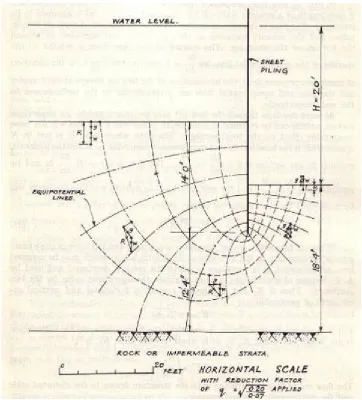
Figure 3.3 illustrated a flow net. In the figure, water seeps through the permeable stratum beneath the wall from the upstream side (left) to the downstream side (right). The solid lines below the wall are known as flow lines. Each flow line represents the path along which given water particle travels in moving from the upstream side through the permeable stratum to the downstream side. The dashed lines in Fig. 3.3 represent
equipotential lines. They connect points on different flow lines having equal total energy heads. A collection of flow lines intersecting equipotential lines, as shown in Fig. 3.3, constitutes a flow net; and as demonstrated subsequently, it is a useful tool in evaluating seepage through permeable soil.
Flow net can be of several types, depending on the configuration and the number of zones of soil or rock through which seepage is taking place. a primary subdivision can be made that depends on the following conditions:
1. Flow is confined within known saturation boundaries and the phreatic line is therefore known.
2. Flow is unconfined and the upper level of saturation (the phreatic line) is not
known.
A second subdivision can be made that depends on whether (a) the cross section can be drawn as one zone or unit of a single permeability or (b) the cross section contains two or more zones or units of different permeabilities. That latter is described as a composite section.
These criteria give four possible combinations of flow conditions:
1a. Confined flow in single permeability sections.
1b. Confined flow in composite sections (those having two or more permeability abilities).
2a. Unconfined flow in single permeability sections.
2b. Unconfined flow in composite sections.
3.2.2 Construction of Flow Net
If all the boundaries to the flow regime are known at the outset, the flow net is described as confined. The construction of a confined flow net is illustrated below. (Powrie, 1997)
Figure 3.4 shows cross section through a long excavation in Norwich Crag, a fine sand mean permeability k = 1.5 × 10⁻⁴ m/s. The sides of the excavation are supported by steel sheet piles, a structure known as a cofferdam. the purpose of the excavation is to enable the construction of a cooling water outfall pipe for a coastal power station. The excavation is therefore to be made across a beach, so that the ground surface outside the sheet pile cofferdam must be assumed to be flooded with seawater to a depth of 2 m at high tide.
Newcomers to flow net sketching are often nervous about making a start, in case they make a mistake. It is at this stage that you must bear in mind that flow net sketching is an iterative process: it is only by making mistake, which are then corrected, that a satisfactory solution is approached. The flow net should be constructed methodically, and the following procedure should enable the newcomers to make a reasonable start. Remember also that the person who never made a mistake, never made anything: do not be afraid to try.
1. Is the problem geometry symmetrical about the centerline? If so - as in this case - it is only necessary to sketch one half of the flow net. Remember, however, that if only half the flow net is sketched, the number of flow tubes must be multiplied by two in order to calculated the flow rate per metre length.
2. Identify where the water is going to - the sink. Sketch in the bottom equipotential (i.e. the one with the smallest value of total head h) - in this case, the excavation floor, which we shall assume remains just covered in a shallow depth of water. Make this (or some other convenient point) the datum level from which the total head or potential is measured (Fig. 3.5a).
3. Identify where the water is coming from - the source. Sketch in the top equipotential (i.e. the one with the greatest value of the total head h) - in this case, the flooded beach on either side of the excavation (Fig. 3.5a: only the left-hand side is shown in the diagram).
4. Identify the bounding flow lines. In this case, one flow line runs from the beach down the back of each of the sheet pile walls, round the bottom of the wall and into the excavation. The underlying London Clay has a permeability of perhaps 10-11 m/s, and in comparison with the Norwich Crag, is effectively impermeable. Bounding flow lines therefore follow the interface between the Norwich Crag and the London Clay, coming in from the left (and right) and turning through 90° to follow the centreline up to the floor of the excavation (Fig. 3.5a: only the left-hand side is shown).
5. Starting with zones where the flow pattern is reasonably well-defined (in this case between the sheet pile walls of the cofferdam), begin to sketch in equipotentials and flow lines within the boundaries you have now defined (Fig. 3.5b and 3.5c). Keep it simple: in this case, one intermediate flow line is sufficient, at least for a start. You can always go back and subdivide large slow elements by sketching in further flow lines and equipotentials as a check, but if you start off by being too ambitious, you will get into a hopeless mess.
6. If some flow lines and equipotentials do not cross at right angles, or if some flow elements are not 'square', rub out the offending lines and redraw them so that the significant errors are gradually eliminated. The flow net does not have to be perfect. You will soon reach a stage where further improvements make very little practical difference.
Figure 3.6: Flow channel and equipotential drops. (Liu & Evett, 1998)
Once a suitable flow net has been prepared as described above, seepage flow can be determined by modifying Darcy's law, as follows.
q = kiA
Consider one square in a flow net - for example, the one labeled "G" in Fig. 3.6. Let ∆q and ∆h denote the flow rate and drop in head (energy), respectively, for this square. Since each square is x units wide and y units long and has a unit width perpendicular to the figure, term i in the Darcy's law is given by ∆h/x and term A is equal to y. Hence,
y x
h k q = ∆
∆ (3.1)
However, since the figure is square, y/x is unity and
h k q = ∆
If Nd represents the number of equipotential increments (space between equipotential lines), then ∆h equals h/Nd and
d N h k q = ∆ (3.3)
If Nf denotes the number of flow paths (space between flow lines), then ∆q equals q/Nf (where q is the total flow rate per unit width) and
d f N h k N q = (3.4) or d f N N h k
q = (3.5)
From Figure 3.4, the required flow rate is given by
d f N N h k q =
with k = 1.4 × 10⁻⁴ m/s H = 16 m
Nf = 2, × 2 for symmetry = 4 Nd = 8
∴ q 1.2 10 m /spermeterlength 8 4 16 10 4 .
1 3 3
In the foregoing discussion of flow net, it was assumed that soil was isotropic - that is, equal soil permeability in all directions. In actuality, natural soils are not isotropic, but often soil permeabilities in vertical and horizontal directions are similar enough that the assumption of isotropic soil is acceptable for finding flow without appreciable error. In stratified soil deposits, however, where horizontal permeability is much greater than vertical permeability, the flow net must be modified and Eq. (3.