EFFECTIVENESS OF STRUCTURED TEACHING PROGRAMME
ON KNOWLEDGE AND EXPRESSED PRACTICE REGARDING
SANITARY NAPKIN AMONG SCHOOL GIRLS THOSE WHO
ATTAINED MENARCHE AT A SELECTED SCHOOL IN
KANCHEEPURAM DISTRICT
By
Mrs. SARITHA .M
A DISSERTATION SUBMITTED TO
THE TAMIL NADU DR.M.G.R MEDICAL UNIVERSITY, CHENNAI
IN PARTIAL FULFILMENT OF THE REQUIREMENTS FOR THE
DEGREE OF MASTER OF SCIENCE IN NURSING
EFFECTIVENESS OF STRUCTURED TEACHING PROGRAMME
ON KNOWLEDGE AND EXPRESSED PRACTICE REGARDING
SANITARY NAPKIN AMONG SCHOOL GIRLS THOSE WHO
ATTAINED MENARCHE AT A SELECTED SCHOOL IN
KANCHEEPURAM DISTRICT
CERTIFIED THAT THIS THE BONAFIDE WORK OF Mrs. SARITHA .M
Karpaga Vinayaga College of Nursing Madurantakam Taluk
Kancheepuram District – 603 308
SEAL
Signature
Dr.(Mrs). T.KOMALAVALLI M.Sc(N)., Ph.D(N)., LLB., Principal and Professor
Karpaga Vinayaga College of Nursing Madurantakam Taluk
Kancheepuram District – 603 308
A DISSERTATION SUBMITTED TO
THE TAMIL NADU DR.M.G.R MEDICAL UNIVERSITY, CHENNAI
IN PARTIAL FULFILMENT OF THE REQUIREMENTS FOR THE
DEGREE OF MASTER OF SCIENCE IN NURSING
EFFECTIVENESS OF STRUCTURED TEACHING PROGRAMME
ON KNOWLEDGE AND EXPRESSED PRACTICE REGARDING
SANITARY NAPKIN AMONG SCHOOL GIRLS THOSE WHO
ATTAINED MENARCHE AT A SELECTED SCHOOL IN
KANCHEEPURAM DISTRICT
APPROVED BY THE DISSERTATION COMMITTEE ON:………
Dr. ANNAMALAI REGUPATHY., MS (Ortho) Managing Director
Karpaga Vinayaga Institute of Medical Sciences and Research Centre
Madurantakam Taluk
Kancheepuram District – 603 308
Research Guide:
Dr.(Mrs). T.KOMALAVALLI, M.Sc(N)., Ph.D(N)., LLB., Principal and Professor
Karpaga Vinayaga College of Nursing Madurantakam Taluk
Kancheepuram District – 603 308 Mrs. K.INDUMATHI M.Sc (N)
Department of Community Health Nursing Karpaga Vinayaga College of Nursing Madurantakam Taluk
Kancheepuram District – 603 308
A DISSERTATION SUBMITTED TO
THE TAMIL NADU DR.M.G.R MEDICAL UNIVERSITY, CHENNAI
IN PARTIAL FULFILMENT OF THE REQUIREMENTS FOR THE
DEGREE OF MASTER OF SCIENCE IN NURSING
CERTIFICATE
This is to certify that “A study to assess the effectiveness of structured teaching programme on knowledge and expressed practice regarding sanitary napkin among school girls those who attained menarche at a selected school, in Kancheepuram District” is a bonafide work done by Mrs. SARITHA .M, M.Sc(N) II Year, Karpaga Vinayaga College of Nursing, Kancheepuram District, in partial fulfillment of The Tamil Nadu Dr.M.G.R. Medical University rules and regulations towards the award of the degree of Master of Science in Nursing,
Branch-IV, Community Health Nursing , under my guidance and supervision during
the academic year 2014-2016.
Date: Signature of the Principal
DECLARATION
I hereby declare that the dissertation entitled “A study to assess the effectiveness of structured teaching programme on knowledge and expressed practice regarding Sanitary Napkin among school girls those who attained menarche at a selected school, in Kancheepuram District” is submitted to
The Tamilnadu Dr.M.G.R. University, Chennai, in partial fulfillment of the Master of Science in Nursing under the guidance and supervision of
Dr. (Mrs). T.Komalavalli, M.Sc(N)., Ph.D(N)., LLB., Principal and Head of the Department of Research at Karpaga Vinayaga College of Nursing in Kancheepuram
District and has not formed the basis for the award of any degree or diploma,
associateship, fellowship titles in this or any other universities.
Date : Signature of the Candidate
EFFECTIVENESS OF STRUCTURED TEACHING PROGRAMME
ON KNOWLEDGE AND EXPRESSED PRACTICE REGARDING
SANITARY NAPKIN AMONG SCHOOL GIRLS THOSE WHO
ATTAINED MENARCHE AT A SELECTED SCHOOL IN
KANCHEEPURAM DISTRICT
By
Mrs. SARITHA .M
A DISSERTATION SUBMITTED TO
THE TAMIL NADU DR.M.G.R MEDICAL UNIVERSITY, CHENNAI
IN PARTIAL FULFILMENT OF THE REQUIREMENTS FOR THE
DEGREE OF MASTER OF SCIENCE IN NURSING
OCTOBER - 2016
ACKNOWLEDGEMENT
At the very outset I give thanks and praise to God Almighty for his abundant blessings, health, support, wisdom, courage and confidence throughout the
dissertation.
I wish to express my deep sense of gratitude and thanks to our Managing
Director Dr. ANNAMALAI REGUPATHY.,MS(Ortho), Karpaga Vinayaga Institute of Medical Sciences and Research Centre, Madurantakam Taluk, in
Kancheepuram District.
I wish to express my sense of gratitude and heartful thanks to our Principal,
Dr. (Mrs). T.KOMALAVALLI, M.Sc(N)., Ph.D(N)., LLB., and HOD of Child Health Nursing, Karpaga Vinayaga college of Nursing for helping me to uplift my professional career, her patience, valuable guidance, support and direction to carry
out this dissertation.
I express my sincere and heartful thanks to Dr.(Ms). S.PUNITHA JOSEPHINE, M.Sc (N)., MBA., Ph.D (N)., Vice Principal for her guidance, constant motivation and support to culminate this study.
With deep sense of gratitude, I express my whole hearted thanks to
Mrs. D. KALAIMANI, M.Sc(N)., M.Phil., Professor, Department of Child Health Nursing for her guidance, motivation, support and suggestion throughout this study.
I extend my sincere thanks to Mrs. K. INDUMATHI, M.Sc(N)., Assistant Professor, Mrs. R. PRABA DEVI, M.Sc(N) Lecturer, Department of Community Health Nursing for their guidance, motivation, support and suggestions to carry out
I extend my sincere thanks to Mr. K.LAKSHIMIPATHY M.Sc(N).,
Assistant Professor, Department of child Health Nursing for his guidance, and
suggestions to carry out this study successfully.
I owe my sincere thanks to all the FACULTY members of Karpaga Vinayaga College of Nursing for extending their cooperation and support during the study.
I extend my gratitude to Mr.ASHOK BHOORASAMY, M.Sc., M.Phil.,
Professor Biostatistics, for his constructive efforts and guidance in Statistical analysis.
I extend my sincere thanks to Ms.RADHIKA, M.L.S., Librarian, Karpaga Vinayaga College of Nursing for her help in getting the reference material.
I extend my thanks to librarians of THE TAMILNADU Dr.M.G.R. MEDICAL UNIVERSITY, GUINDY, CHENNAI for their help in getting the reference material for my study.
I extend my sincere thanks to the HEAD MASTER, Govt. girls higher secondary School at Acharapakkam, for grant me permission to conduct the study.
I am extremely grateful to all the PARTICIPANTS for their active involvement, trust, co-operation and support which they have extended to complete this study.
Words are inadequate to express the affection and inspiration shown by MY MOTHER, BROTHERS, AND SON for their continuous encouragement and constant support throughout the study.
SYNOPSIS
A study to assess the effectiveness of structured teaching programme on knowledge and expressed practice regarding Sanitary Napkin among school girls those who attained menarche at a selected school in Kancheepuram District.
The objectives were, to assess the knowledge and expressed practice
regarding sanitary napkin among school girls those who attained menarche, to
evaluate the effectiveness of structured teaching programme on knowledge and
expressed practice regarding sanitary napkin among school girls those who attained
menarche and to associate the selected demographic variables and health related
variables with the level of knowledge and expressed practice regarding sanitary
napkin among school girls those who attained menarche.
A quantitative research approach of pre experimental with one group pre and
post-test design was chosen for this study. By using purposive sampling technique a
total of 50 samples were included for the study. The structured teaching programme
was given by researcher. Pre and post test was conducted by structure questionnaire.
Data were recorded and coded. The data analysis was done by using descriptive and
inferential statistics. The result revealed that there was a statistically significant
difference between pre and post-test knowledge and expressed practice scores
regarding sanitary napkin among school girls at level P<0.001. This study implied
that creating awareness regarding sanitary napkin will prevent the occurrence of
reproductive tract infection among school girls and promote their health.
TABLE OF CONTENTS
CHAPTER
NO.
TITLE
PAGE
NO
I
INTRODUCTION
1-10Background of the study 1
Need for the study 3
Statement of the problem 7
Objectives of the study 8
Operational definitions 8
Hypotheses 8
Delimitations 10
Projected outcomes 10
II
REVIEW OF LITERATURE
11-23Literature related to knowledge and expressed practice
regarding sanitary napkin among school girls 11
Literature related to education interventions among
school girls regarding sanitary napkin 14
Conceptual framework 21
III
METHODOLOGY
24-35Research approach 24
Research design 24
Variables 26
CHAPTER
NO.
TITLE
PAGE
NO
Population 26
Sample 27
Sampling technique 27
Sample size 27
Criteria for sample selection 28
Selection and development of the study instrument 28
Content Validity 32
Reliability 32
Pilot study 32
Data collection procedure 33
Plan for data analysis 35
IV
DATA ANALYSIS AND
INTERPRETATION
36-61V
DISCUSSION
62-65VI
SUMMARY, RECOMMENDATIONS
AND IMPLICATIONS
66-72VII
REFERENCES
73-76LIST OF TABLES
TABLE.
NO
TITLE
PAGE
NO.
1. Research design 24
2. Plan for data analysis 35
3. Distribution of demographic variables among school girls 37
4. Distribution of health related variables among school girls 45
5. Distribution of level of knowledge regarding sanitary
napkin among school girls in pre and post test 52
6. Distribution of level of expressed practice regarding
sanitary napkin among school girls in pre and post test 54
7. Comparison of pre and post-test knowledge score regarding
sanitary napkin among school girls 56
8. Comparison of pre and post-test expressed practice score
regarding sanitary napkin among school girls 57
9. Association of demographic variables with level of
knowledge regarding sanitary napkin among school girls 58
10. Association of health related variables with level of
knowledge regarding sanitary napkin among school girls 59
11. Association of demographic variables with level of expressed practice regarding sanitary napkin among school girls
60
12. Association of health related variables with level of expressed practice regarding sanitary napkin among school girls
LIST OF FIGURES
FIGURE
NO. TITLE PAGE NO.
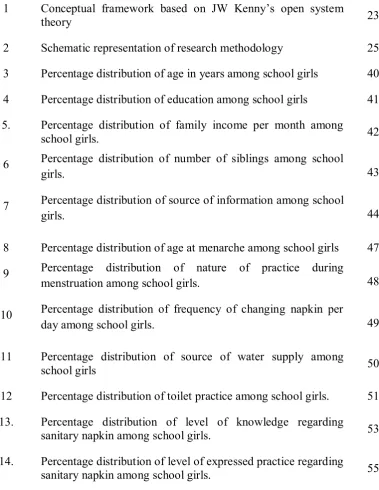
1 Conceptual framework based on JW Kenny’s open system
theory 23
2 Schematic representation of research methodology 25
3 Percentage distribution of age in years among school girls 40
4 Percentage distribution of education among school girls 41
5. Percentage distribution of family income per month among
school girls. 42
6 Percentage distribution of number of siblings among school
girls. 43
7 Percentage distribution of source of information among school
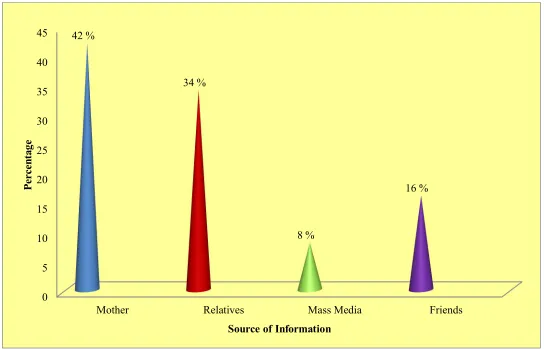
girls. 44
8 Percentage distribution of age at menarche among school girls 47
9 Percentage distribution of nature of practice during
menstruation among school girls. 48
10 Percentage distribution of frequency of changing napkin per
day among school girls. 49
11 Percentage distribution of source of water supply among
school girls 50
12 Percentage distribution of toilet practice among school girls. 51
13. Percentage distribution of level of knowledge regarding
sanitary napkin among school girls. 53
14. Percentage distribution of level of expressed practice regarding
sanitary napkin among school girls. 55
LIST OF APPENDICES
S. NO. TITLE PAGE
NO
A Letter seeking Permission for conducting the study i
B Letter permitting to conduct the study ii
C Letter seeking experts opinion for the content validity the tool iii
C1 Acceptance of tool validation iv
D Research participant consent form – English v
D1 Research participant consent form – Tamil vi
E Certificate for English editing vii
E1 Certificate for Tamil editing viii
F List of experts for content validity ix
G Structured tool x-xliii
PART-I - Section-A and B x-xii
English Demographic and health related variables ix-xi
PART-II - English Multiple choice questions xiii-xv
PART III - English - checklist xvi
PART-IV - English-lesson plan xvii-xxvi
PART-I - Section-A and B
Tamil Demographic and health related variables xxvii-xxix PART-II Tamil Multiple choice questions xxx-xxxii
PART III - Tamil - checklist xxxiii
PART-IV - Tamil lesson plan xxxiv-xliii
H Coding sheet xliv-xlix
CHAPTER-1
INTRODUCTIONPrevention is simple, cost effective and better than cure.
BACKGROUND OF THE STUDY
School life is the first experience of living outside the home which mould the
school children to prepare themselves to lead a life, according to their growth and
development and changing needs of the society. School is the best forum for the
students to acquire knowledge, skill and attitude in various aspects of their life style
pattern. The health of the child is the basement for healthy nation. In the school life
the concept of prevention and health promotion are inevitable to bring the child with
a good health. The personal hygiene is the fundamental step for the children to learn
in order to prevent diseases and promote health.
Each child undergo many changes when the growth and development takes
place over a period of time. These development changes are common among both
girls and boys; one of such physiological changes among girl is attaining menarche.
It marks beginning of a multitude of physical, physiological and psychological
changes in the lives of the adolescent girls. Generally menarche indicates the girls
maturity and the readiness for marriage and sexual activity.
According to the report by UNICEF (2016) there are 243 million adolescence comprising 20% of total population in India, which clearly shows that
India has got more young people. It includes 10% of school girls aged between 12 to
themselves in hygienic way during the time of menstruation which adversely affects
their health. .
When the girl attains menarche, menstrual hygiene is the real challenge for them to
practice. The good menstrual hygiene prevents reproductive tract infection among
girls which ultimately promote the reproductive health. The current trend of antenatal
care starts from puberty. This concept was emphasized by Kumari (2014) who conducted a study among girls regarding menstrual hygiene revealed that only few
girls were using sanitary napkin and many did not practice the same. Menstrual
hygiene involves the personal hygiene measures to be adopted by women and
adolescent girls, it includes the use of clean material to absorb or collect menstrual
blood and these materials can be changed in privacy as often as necessary for the
duration of menstruation. Menstrual hygiene management also includes, using soap
and water for washing the body as required and having access to facilities to dispose
of used menstrual management material. To highlight the menstrual hygiene
awareness among girls 28th May is observed as menstrual hygiene day, which aims to break taboos and raise awareness about the importance of good menstrual hygiene
management for women and adolescent girls worldwide.
Thus menstrual hygienic practices are greatly emphasized among school girls
in order to promote the reproductive health, which also improves the girls self-image
and promote their attitude towards good reproductive health. It also avoids the
embarrassment of staining their cloth and promote their self-respect among their
friends. Good menstrual hygiene enhances their confidence and promote the regular
school attendance and prevent environmental pollution.
The school girls are always receptive to learn new phenomenon and practice
the same with favorable attitude when the menstrual hygiene is being taught by
behavioral change towards the practice of menstrual hygiene. Hence the school
setting is a ideal place for the school health nurse to create awareness regarding
menstrual hygiene among school girls.
Many gynecologists believe that sanitary napkin can act as a precautionary
measure to prevent reproductive tract infection. The sanitary napkin is one of the
appropriate measures to be practiced by school girls during the time of menstruation.
This is substantiated by the finding of Jimmy Wales (2013) et.al., which highlighted that sanitary napkins prevent reproductive tract infection and reduce the risk of
cervical cancer. The Role of community health nurse in school health is important. It
comprises imparting knowledge to the school girls about the importance of sanitary
napkin and promote the menstrual hygiene practices. When the school girl is
educated she propagates the information to her family members, friends and to the
society. She also influences her friends to practice good menstrual hygienic
measures. It promotes the dignity of the girls and women in the society. Thus the
community health nurse play an major role to empower the school girls with
adequate knowledge on sanitary napkin during menstruation, which enhances
self-esteem and academic performance. Therefore it helps them to develop themselves
comprehensively and that promote their quality of life.
NEED FOR THE STUDY
Menstrual hygiene is important to be practiced by the school girls to promote
their health and prevent illness. Inadequate menstrual hygiene management is
connected with the use of cloth, ashes and husk sand during menstruation, thereby it
causes severe reproductive health problem.
hygiene. The poor menstrual hygienic practices also leads to several problem among
school girls which include dropped out from the school, inability to continue the
education and reduction of self-esteem. It occurs because the school girls don’t
practice menstrual hygiene and don’t have accessibility for sanitary napkin. The
biggest barrier to adopt the quality of sanitary napkin in India are lack of
affordability and accessibility as reported by Inderjeet Singh (2013) there are about 70% of school girls and their the family cannot affords sanitary napkin. It is further
supported by the report of Times of India (2014) which unveiled that 50% of the school girls who dropped out the school in secondary classes are due to lack of
sanitary napkin, coupled with lack of separate toilet facilities and water resources
within the school campus. Thus the lack of knowledge on menstrual hygiene practice
and sanitary napkin are the major cause for absenteeism among school girls.
The significant problems among school girls which are greatly ignored in
schools, in developing countries are lack of facilities for disposal of menstrual waste.
There are about only 46% of school girls have accessibility to water, sanitation at
school. According to Global Statistics By WHO (2015) often school toilets for girls don’t have bins for menstrual waste collection with the result that the napkin
may be spread all around the school compound area, these pollutes the environment
and also causes embarrassment for the school girls. Many studies have reported that
the girls, who were unable to afford sanitary napkin they miss school in order to
avoid the embarrassment of staining the clothes.
Many studies, across India have reported poor menstrual hygienic practice
among school girls in that majority of them are at risk for reproductive tract
infections. A study conducted at Lucknow by Aravind Kumar (2013) among 28 lakhs adolescent girls revealed that approximately 19 lakhs school girls quit
infections. Another study conducted by Dr.M.Tripurasundari (2014) reported that reproductive tract infection occurs among girls due to unhygienic menstrual
practices. A study which was conducted in India by Arumugam et.al., (2014)
revealed that as many as 42% of women who participated in the study did not know
about sanitary napkin and from where in the anatomy menstruation originated and
most of them were scared and worried on menstruation. Worldwide many school
girls don’t have accessibility to toilet facilities, privacy and menstrual hygienic
management issues are greatly ignored by professionals in the health and education
sector too.
Another major factor that is to be considered among school girls is early
menarche, which is the growing trend across Globe especially in urban areas. Since
many school girls attain menarche between 12 to 14 years they don’t have adequate
knowledge about the onset of menstruation, physical and physiologically
development. In addition to their early puberty may cause emotional pressure among
school girls which may reduce their academic performance. The study which
conducted by Esreal Ayele et.al. (2015) revealed that the yearly menarche is a major cause for poor menstrual hygienic practices. A study conducted by Dr.Neelam Singh, Rierdan (2013) have reported that school students don’t have adequate knowledge and practice on menstrual hygiene. Further Rierdan (2013) concluded that only 40.6% of girls have knowledge regarding menstruation and among them
only 12.9% of school girls practice the same. Thus these findings paved the way for
the investigator to impart knowledge regarding sanitary napkin during menstruation,
thereby to enhance the practice of menstrual hygiene.
It is evident from the above information that many school girls aged between
12 to 14 years don’t have awareness regarding sanitary napkin as an menstrual
important for community health nurse to impart knowledge about sanitary napkin
during menstruation and help them to adhere to their menstrual hygienic practices.
Menstrual practices are still clouded by taboos and socio culture restrictions
result in adolescent girls remaining ignorant of the scientific facts and hygiene health
practices, which sometimes result into adverse health outcomes. Hygiene practice is
neglected by girls especially in the rural areas, due to lack availability and inability to
afford sanitary napkins. Rural school girls are still treated as untouchables during
menstruation, resulting in health problems and growing absenteeism’s in schools.
Schools girls refrain from going to toilets because there is no lock, no water supply,
and no disposal facility. They also seem to avoid going to toilets during menstruation
as most schools do not have separate toilets for girls. Thus the researcher felt the
need to educate the rural school girls regarding sanitary napkin during menstruation
and teach them to practice the same by promoting favourable attitudes towards
menstrual hygienic practice.
The role of community health nurse is important to inculcate the concept of
use of sanitary napkin during menstruation among school girls because it prevents,
fungal infection, reproductive tract infection and urinary tract infection which might
leads to cervical cancer, according to the report by the Cervical Cancer Free Coalition (May 2013) in order to increase the menstrual hygienic practice among women. The Indian government proposed a new scheme towards menstrual hygienic
practice to rural adolescent girls. The main goal of these schemes was awareness,
availability and quality of napkin, regular supply, privacy, water supply, proper
disposal of napkin, reproduce health education and family support.
Under the scheme a pack of 6 sanitary napkins is provided under the
NRHM’s brand ‘Freedays’. These napkins are sold to the adolescents girls at Rs. 6
(ASHA). On sale of each pack, the ASHA gets an incentive of Rs. 1 per pack besides
a free pack of sanitary napkins per month. In order to promote personal hygiene
among young rural girls, the Govt. of Tamil Nadu launched distribution of free
sanitary napkins to girls in the age group of 10 to 19 in all the villages.
The Honourable Chief Minister of Tamil Nadu J. Jayalalithaa had launched
the scheme of distribution of free sanitary napkins to young girls as well as lactating
mothers and women prisoners across the state at an annual outlay of Rs.44.21 crore.
As per the scheme three bags containing six napkins each would be given to young
rural girls once in two months. The bags will be given to the students through their
teachers and to the lactating mothers (seven bags each containing six napkins)
through nurses in the primary health centres.
On the basis of the above information it is concluded that the knowledge of
school girls on menstrual hygiene is inadequate and the adolescent girls are still
ignorant of the scientific fact on menstrual hygiene health practices, which may
cause adverse health outcomes. These underlines the role of the community health
nurse and also emphasize the need to assess the knowledge and expressed practice
regarding sanitary napkin which is used during menstruation by the school girls who
attained menarche. This has motivated the investigator to conduct a study on
effectiveness of structured teaching programme on knowledge and expressed practice
regarding sanitary napkin among school girls those who attained menarche at a
selected school in Kancheepuram District.
STATEMENT OF THE PROBLEM
A study to assess the effectiveness of structured teaching programme on
knowledge and expressed practice regarding sanitary napkin among school girls
OBJECTIVES OF THE STUDY
1. To assess the level of knowledge and expressed practice regarding
sanitary napkin among school girls those who attained menarche.
2. To evaluate the effectiveness of structured teaching programme on
knowledge and expressed practice regarding sanitary napkin among
school girls those who attained menarche.
3. To associate the selected demographic variables and health related
variables with the level of knowledge and expressed practice regarding
sanitary napkin among school girls those who attained menarche.
HYPOTHESES
H1 – There is a significant difference between pre and post-test level of knowledge
regarding sanitary napkin among school girls those who attained menarche
and subjected to structured teaching programme.
H2– There is a significant difference between pre and post-test level of expressed
practice regarding sanitary napkin among school girls those who attained
menarche and subjected to structured teaching programme.
OPERATIONAL DEFINITIONS
EFFECTIVENESS
It refers to the extent to which the structured teaching programme regarding
sanitary napkin yield the desired outcome in improving the level of knowledge and
expressed practice among school girls those who attained menarche as evidenced by
STRUCTURED TEACHING PROGRAMME
It refers to the systematically designed educational programme implemented
by the researcher by using lecture cum demonstration method regarding sanitary
napkin to the school girls those who attained menarche.
KNOWLEDGE
It refers to the level of understanding of school girls regarding sanitary
napkin as measured by using multiple choice questions in pre and post –test.
EXPRESSED PRACTICE
It refers to the verbalization of practice regarding steps followed in the use of
sanitary napkin by the school girls those who attained menarche as measured
precisely by checklist in pre and post-test.
SANITARY NAPKIN
It refers to the sanitary pad in an absorbent item worm by a school girl to
absorb menstrual blood.
SCHOOL GIRLS
It refers to the school girls those who attained menarche, aged between 12
and 14 years and studying in VIII (or) IX standard in Govt. Girls Higher secondary
school at Acharapakkam in Kancheepuram district.
MENARCHE
It refers to the first occurrence of menstruation usually between the ages of 10
and 15 years among school girls and continues as monthly discharge of blood
DELIMITATION OF THE STUDY
The study was delimited to
· The school girls those who were aged between 12 and 14 years at a selected school.
· The school girls those who were studying VIII (or) IX standard at a selected school.
· The period of six weeks.
· The sample size of 50
PROJECTED OUTCOME
By this study, the effectiveness of structured teaching programme can be
evaluated. The structured teaching programme will have an impact on the
knowledge and expressed practice of the school girls regarding sanitary napkin. The
school girls who are in the age group between 12-14 years and studying VIII (or) IX
standard will understand the definition, importance and general steps of sanitary
napkin which will help them to maintain good sanitary napkin practice, reduce the
CHAPTER - II
REVIEW OF LITERATURE
This chapter deals with the literature related to the menstrual hygiene and the
effectiveness of structured teaching programme regarding sanitary napkin among
school girls. The literature was collected extensively and organized under the
following headings.
1. Literature related to the menstrual hygiene among school girls.
2. Literature related to effectiveness of structured teaching programme on knowledge and practice regarding sanitary napkins among school girls.
1. Literature related to the menstrual hygiene among school girls
El-gilany AH et.al (2016) conducted a study on menstrual hygiene among school girls in Mansoura, Egypt. This study surveyed among 664 school girls aged
14-18 years in Mansoura, Egypt, asked about type of sanitary protection used,
frequency of changing pads means of disposal and bathing during menstruation.
Girls were selected by cluster sampling technique in public secondary schools in
urban and rural areas. Data were collected through an anonymous, self-administered,
open – ended questionnaire during class time. The significant predictors of use of
sanitary pads were availability of mass media at home high and middle social class
and urban residence. The study results concluded that uses of sanitary pads were
Omidvar ( 2015) conducted a cross sectional study to assess the factors influencing hygienic practices during menses among school girls in Udupi district.
The study evaluated the knowledge, attitude and practice (KAP) of menstrual
practice among rural school girls. The study results showed that out of 60 school
girls between the age group of 10-14 years in that two thirds of school girls were
using improper use of sanitary napkins, it implies that school girls need to the
equipped with accurate, relevant and recent knowledge favourable attitude to have
safe practice regarding menstrual hygiene.
Grag R, et.al., (2014) conducted a study on issue and challenges regarding subsidized sanitary napkins for rural school girls. In India menstruation is
surrounded by myths, and misconceptions with a long list of “do’s” and “don’ts” for
women. Poor menstrual hygiene is one of the major reasons for the high prevalence
of RTIs in the country and contributes significantly to female morbidity. The
government of India proposed a new scheme towards menstrual hygiene by a
provision of subsidized sanitary napkins to rural school girls. But there are various
other issues like awareness, availability and quality of napkins regular supply,
privacy and water supply, disposal of napkins, reproductive health education and
family support which needs simultaneous attraction for promotion of menstrual
hygiene.
Begam (2015) conducted a descriptive study to assess the factors influencing hygienic practices during menstruation, among school girls in Mansoura (Egypt).
The study carried out of 664 school girls aged 14-18 years. The study results
revealed that mass media were the main source of information about menstrual
hygiene followed by mothers, but a large majority of school girls accepted that they
Khyrunnisa (2015) conducted a community based cross sectional study among 251 school girls in the Gazipur village in East Delhi, to help identify and
overcome barriers to proper hygiene practice through door to door survey, the age
menarche was 13-16 years, only 41.1% girls had knowledge about menstrual hygiene
practice, rest of the girls had inadequate knowledge regarding menstrual practice.
The study concluded that education about menstrual hygiene is vital aspect in
improving the health.
Annal Angeline (2013) conducted a cross –sectional study among 251 adolescent girls in the Gazipur village in east Delhi through door to door survey. A
study is performed by a cluster randomized method. The study results showed that
the mean age of menarche was 13.6 years. 29% subjects said that they had prior
knowledge regarding menstruation mothers 41% were the most common source of
information, while 92% of girls said they were restricted from worshipping 70%
restricted from household activities 74.8% of the girls used sanitary pads. The study
findings stressed the need to improve the menstrual hygiene and sanitary napkin
practices.
Aparajita (2013) conducted cross sectional study on menstrual hygiene in rural Thiruvanthapuram, Kerala. The majority 60.8% death with menstruation in
unhygienic way and a significant association was seen between menstrual hygiene
maintenance and education symptoms suggestive of reproductive tract infection. The
study results reported that 36.1% of the subjects had stain problems related to
sanitary protections, 45.8% of the women hygienic management of menstruation.
There was a statistically significant reproductive tract infection and skin problems
Dhungal (2012) conducted the randomized controlled study about menstruation among school girls in Cydney, Australia. The objective of the study
was to investigate effectiveness of a hygiene promotion intervention based on
awareness in increasing menstrual practice among school girls. The sample size was
82 school girls. The study results showed that a high proportion 80% of them
considered menstruation to the inconvenient and embarrassed. Many had
misconceptions, and myths regarding menstrual hygiene.
Drakshyani Devi (2012) conducted a prospective study on menstruation in school girls in Singur. The sample size were 12 school girls were randomly recruited
into the study The study findings revealed that 10% girls received advice regarding
menstrual hygiene from different source, some of their practices were unhygienic so
that the girls should be educated about the significance of menstruation absorbent
and its proper disposal of sanitary napkin.
2. Literature related to effectiveness of structured teaching programme on knowledge and practice of sanitary napkins among school girls
Shabmem (2016) conducted a integrated qualitative and quantitative study to assess the knowledge of menstrual hygiene among school girls in south –eastern
Nigeria. The study carried out for 1205 school girls regarding menstruation. The
study results revealed that major source of information about menarche or
menstruation war friends or relatives which was about 72% mean age of menarche
was 14 years and very few girls (0.4%) used sanitary napkin.
Danker (2015) did a study to assess the knowledge and practice of menstrual practice among school girls aged between 10 to 15 years in Nigeria this is a school
based cross sectional descriptive study conducted from September 2014 to February
study findings showed that 50% of the girls had lack of knowledge about the origin
of menstrual blood and 50% of the participants reported that they did not take bath
during menstruation. The study results concluded that most of the girls were unaware
of hygienic practice and misconceptions about menstruation.
Lynette (2014) conducted a cross sectional study about knowledge on menstruation among school girls in Jordanian. The sample of the study was 40 of
aged between 13-17 years and also suggested that schools and teachers should be
reinforced through and well planned health educators for girls and their mothers to
improve menstrual hygiene and napkin practice. The study results found that there
was a adequate knowledge toward menstruation and menstrual practices.
Lee (2015) carried out descriptive cross – sectional study about menstrual practice, the prevalence of proper menstrual practice and related factors among sixth
grade of elementary students in Guntur, Karnataka district. A self-administered
questionnaire was administered to 274 students at seven schools randomly selected
by proportion to size from five villages. Data was analyzed using descriptive
statistics. The study results concluded that they had adequate knowledge about
menstruation, most of them used sanitary pad as absorbent during their last menses
changed menstrual dressing about 1-5 times per day and three quarter increased the
frequency of bathing.
Carol Dashiff (2014) conducted a descriptive study to find out the knowledge on menstrual hygiene among school girls in urban Karachi, Pakistan. A
total sample of 263 girls through randomized technique The study results proved
that first informant regarding menstruation out of 37.5% girls, 86.25% girls believed
it was a physiological process, 48.75% girls know the use of sanitary pad during
menstruation. The study concluded and suggested that menstrual practice promotion
to improve child well – being and societal productivity.
Soeffer et.al. (2014) conducted a descriptive qualitative study on menstrual health among school Girls, at Eijaur. The sample size was 150 school girls. Through
random sampling menstrual practice was assessed. The study revealed that in
addition to medical problems, the blind girls had difficulties in maintaining personal
hygiene, especially during menstrual period 100% blind girls were following poor
hygienic practices during menstruation and 15% were using sanitary pads.
Moswed (2013) conducted a qualitative and quantitative study on Indigenous practices of Saudi girls during their menstrual period. A substantial proportion of
sample 65% avoided bathing during menstruation perineal care 57.5% restrained
from changing pad upto 8 hours which showed very poor menstrual hygiene. This
study results suggested that nurses and health care provider should use all available
opportunity to educate young girls about menstruation.
Paula (2013) conducted a descriptive study to evaluate the knowledge on menstrual hygiene among school girls in Honking, China. The overall objectives of
this study was to carry out a baseline survey on menstrual practice among school
girls. Sample size was three schools. The methods use were cluster randomized trial
of a hygiene promotion. The study results showed that the school girls properly
maintained menstrual hygiene, 94% of them use the pads during the period but only
11.3% disposed of them.
Adhikari P.et.al., (2015) conducted a study to evaluate the knowledge and practice on different aspects of menstrual hygiene. One hundred and fifty school
girls of age 13-15 years from 3 school of Shivanagar and Patihami Village
percentages of them use the pads during the period. The study results revealed that
overall knowledge and practice about the use of sanitary napkins were increased
among school girls.
Lawn M, et.al., (2015) conducted a study on knowledge and practice of adolescent school girls in Kano, Nigeria, around menstruation and menstrual
hygiene. Data was collected quantitatively and mean age of the students was
14.4+/-1.2 years; the majority was in their mid-adolescence. The study results suggested
that the students attained menarche at 12.9+/- 0.8 years. Most of them used sanitary
pads as absorbent during their last Menes; changed menstrual dressings about 1-5
times per day’ and three-quarter increased the frequency of bathing.
Deshmukh P.R et.al., (2014) conducted a study on the effect of community based health education intervention on awareness and behavior change of rural
adolescent girls regarding their management of menstrual hygiene at primary health
Centre in 23 villages in the warthog district of Maharashtra state. Study subjects
were unmarried rural adolescent’s girl (12-19 years).The study target audience using
a triangulated research design of quantitative (survey) and qualitative (Focus group
discussion) method. After 3 years, significantly more ad descent girls (55%) were
aware of menstruation before its initiation compared with baseline (35%) the practice
of using readymade pads increased significantly from 57 to 85% the study results
showed that adolescent girls perceived a positive change in their behavior and level
of awareness.
Rao R.S.P et.al., (2014) conducted a study on effectiveness of reproductive health education among school girls in Karnataka.” The objective is to determine the
effectiveness of an educational intervention program on knowledge of reproductive
health among adolescent girls chi square test was used to test the effect of the
14.4 to 68% p<0.0001) The study results suggested that an educational intervention
programme can bring about a desirable change in knowledge among school girls
regarding reproductive health.
Subhash B, Thakre et. al., (2013) conducted a experimental study do assess the knowledge and the practices of menstrual hygiene among 387 rural elementary
school girls, in Denmark. The present study was undertaken among school girls
selected by simple random sampling. The study results showed that 36-95% of the
girls were aware of menstruation. A majority of them had knowledge about the use
of sanitary pads. The mean age of menarche of study subjects was 12.85+ 0.867
years, sanitary pads were used by 49.35% of the selected girls. The study results
concluded that menstrual hygiene indices have shown a significant difference in the
rural and urban girls.
Nair M.K. et. al., (2013) conducted a experimental study on menstrual hygiene practices in school girls in Thiruvananthapuram, the aim of the study was to
evaluate and intervention to reduce student absenteeism through increase menstrual
practice. The experimental school included 341 pupils aged between 10 to 15 years.
the method used were cluster randomized trial of a hygiene promotion among school
girls the study revealed that 72.4% school girls used sanitary protection during
menstruation. Menstrual hygiene was adequate in the majority of girls, menstruation
are common in school girls and have significant consequence on future health.
Rose J.G.(2013) conducted a study on Attitude toward and experience with menstruation in the USA and India, Sixty seven women students who were attending
a university in southern India and 61 women students who were attending a liberal
Girls college in new England Volunteered to participate in this study. The study
results showed that Indian women scored significantly higher than American women
A.J.Singh (2013) conducted a qualitative and quantitative study on reproductive health of Indian women in two primary health Centre areas of rural
North India. A study sample comprised of 669 women. Data consisted of menstrual
hygiene and knowledge about sanitary practice. The results of the study stated that
approximately 72% of women used sanitary napkin during menstruation. Women
were classified as having adequate knowledge of proper menstrual practice. The
study revealed that the women in primary health Centre exhibited sustained
improvement in hygienic knowledge and decreased risk of RTI and UTI infection.
Abioye E.A.(2013) conducted a study to assess the menstrual knowledge and practices among 352 secondary school girls in liora at Nigeria. The study sample
was selected by random sampling method, among these 187 (53.1%) had attained
menarche. Tools used measured the knowledge and hygienic practices during
menstruation. Data were collected by using structured interview schedule method.
The study results showed that in both the group 10% of sample were ignorant about
knowledge on menstruation, 84% were not psychologically prepared for first menses.
and half of the girls menstruated regularly 66.3% used sanitary pad as menstrual
absorbent.
Shazly et.al.,(2013) conducted a study to assess the knowledge on menstruation and menstruation and menstrual hygiene practices among nursing
students affiliated to university of Alexandria The study sample size include all
secondary school nursing students enrolled in main university, Hospital, Structured
interview, Questionnaire were based on age of menarche length of menstrual cycle
and duration of menstrual flow, menstrual practice such as change of sanitary pad per
day, bathing , washing hands after handling sanitary pad. The study results showed
George (2012) conducted a study on planned reaching programme to identify the learning needs among 49 pre-adolescent girls about menstrual hygiene. A
structural knowledge questionnaire based on female reproductive system, menstrual
cycle and menstrual practice during menstruation. Data were collected by
self-administered questionnaire method. Planned teaching programme based on menstrual
hygienic practices in four areas were conducted for 30 minute scoring done for both
pre-test and post-test. The study findings showed that the mean post test score was
higher than the mean pretest score. The planned teaching programme was found to
be effective.
Rajashree R. Kamble (2012) conducted a study to evaluate school – based hygiene and water treatment programs to increase student knowledge, improve
hygiene and decreased as absenteeism. Baseline information was collected from
students in 42 schools in Kenya. The study findings showed that 61.66% of the girls
had an average knowledge regarding menstruation on menstrual hygiene and 87.66%
of the girls followed correct practices. The students in this school program improve
CONCEPTUAL FRAME WORK
Conceptual framework is a set of global ideas about the concepts in relation
to a specific discipline. A conceptual framework in the network of interrelated
concepts that provide a structure for organizing and describing the phenomenon of
interests. A concept is a thought idea or mental image framed in the mind, in
response to learning something new. A frame work is a basic structure supporting
anything. It guides an investigator to know what data needs to be collected and gives
the right direction to the research process.
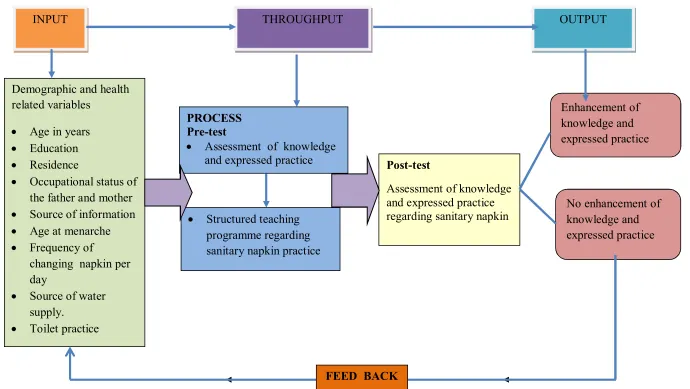
The present study aim the effectiveness of structure teaching programme for
school girls regarding sanitary napkin. The Framework of the present study is based
on J.W.Kenny’ Open System model, 1990.
A system consists of a set of interacting components within a boundary that
filters the type and rate of exchange with the environment. All living system is open
in that there is a continuous exchange of matter, energy and information. In open
system, there are varying degrees of interaction with the environment, from which
the system receives input and gives output in the form of matter, energy and
information.
According to system theory, for survival all systems must receive certain
amount of matter, energy and information from environment. The system regulates
the types and amount of input received through the process of selection. To maintain
the system equilibrium or homeostasis, the system uses input through self-regulation.
Through system matter, energy and information are continuously maintains itself and
environment to guide its operation. Feedback may be positive, negative or neutral. In
Input
Based on J.W. Kenny’s open system model, input can be a matter, energy and
information that enter into the system from the environment through its boundaries.
In this study input consist of demographic data of the school girls such as age in
years, religion, type of family, residence, educational status of father and source of
information. The health related variables such as age at menarche, frequency of
changing napkin per day and perception of pain during menstruation and assessment
of the existing knowledge and practice of School girls.
Throughput (Process)
Through put is the operation phase or manipulation and activity phase. It is
the process that allows the input to be changed so that it is useful to the system. In
this study throughput is the construction of planned teaching programme and
administration of teaching programme based on the learning needs.
Output
Output is any information that leaves the system and enters the environment
through system boundaries. It refers to the ultimate results, which are expected
following health education programme. In this study output refers to the knowledge
and practice gained by the school girls on sanitary napkin. It also depicts whether the
knowledge and practice of school girls on sanitary napkin is varying with
demographic variables and health related variables. After processing the input, the
system returns to the output environment, in the form of change in behavior. These
may be adequate, moderately adequate and inadequate knowledge.
Feedback
Feedback is the result of throughput, it allows the system to monitor its
interval function, it is the process whereby the output of the system is rectified as
Fig. 1. Conceptual framework based on JW Kenny’s open system model (1990)
INPUT THROUGHPUT OUTPUT
Demographic and health related variables
· Age in years
· Education
· Residence
· Occupational status of the father and mother
· Source of information
· Age at menarche
· Frequency of
changing napkin per day
· Source of water supply.
· Toilet practice
PROCESS Pre-test
· Assessment of knowledge
and expressed practice Post-test
Assessment of knowledge and expressed practice regarding sanitary napkin
Enhancement of knowledge and expressed practice
No enhancement of knowledge and expressed practice
· Structured teaching programme regarding sanitary napkin practice
CHAPTER - III
METHODOLOGYThis chapter deals with a brief description of research approach, research
design settings, population, sample criteria, sampling technique, description of the
tool, pilot study, data collection procedure, plan for data analysis.
RESEARCH APPROACH
A quantitative research approach was used for this study.
RESEARCH DESIGN
[image:38.595.118.513.483.550.2]A pre experimental one group pre and post-test design was chosen.
Table-1
SCHEMATIC REPRESENTATION OF RESEARCH DESIGN
Group Pre-test Intervention Post-test
Study group O1 x O2
Keys
O1- Pre-test on knowledge and expressed practice regarding sanitary napkin.
X- Intervention- structured teaching programme regarding sanitary napkin among school girls.
.
Fig-2 Schematic Representation of Research Methodology
Research Approach – Quantitative
Research Design – Pre experimental with one group Pre and Post Test
Target population-school girls
Accessible Population
School girls those who attained menarche aged between 12&14 years and studying in VIII(or) IX standard in Govt.Girls higher secondary
school at Acharapakkam in Kancheepuram District
Sampling Technique Purposive sampling Technique
Sample Size
50 school girls who fulfilled the inclusive criteria
Data Collection – Pre Test
1. Demographic and health related variables 2. Structured questionnaire on assessment of
knowledge
3. Assessment of expressed practice
Intervention –Structured Teaching program regarding sanitary napkin
Posttest 1.Structured questionnaire on assessment of knowledge
2. Assessment of expressed practice
Analysis and Interpretation of data by using descriptive and inferential statistics
VARIABLES
INDEPENDENT VARIABLES
In this study independent variable was structured teaching programme
regarding sanitary napkin.
DEPENDENT VARIABLES
In this study dependent variables were knowledge and expressed practice regarding sanitary napkins among VIII (or) IX standard school girls those who
attained menarche and aged between 12 and14 years.
SETTING OF THE STUDY
The study was conducted among school girls those who attained menarche aged between 12 and14 years and studying in VIII (or) IX standard in Govt. girls
higher secondary school at Acharapakkam in Kancheepuram district. The school was
located at semi urban area in Kancheepuram District. The school comprised of
classes starting from VI to XII standard. Total strength of the student in the school
was 900 that included 110 students in VIII and IX Standard. A total of 50 school
girls were selected for the study by adapting purposive sampling technique.
The working hour is from 9.30 am to 4.30 pm with a lunch break of 45min
from 12.45pm to 1.30pm. The school remain closed on all Saturdays and Sundays
and all government holidays.
POPULATION
TARGET POPULATION
ACCESSIBLE POPULATION
It refers to school girls those who attained menarche, aged between 12 and 14 years and studying in VIII (or) IX standard at Govt. girls higher secondary school
at Acharapakkam in Kancheepuram District.
SAMPLE
In this study the sample comprised of school girls those who fulfilled the inclusive criteria at Govt. girls higher secondary school at Acharapakkam in
Kancheepuram District.
SAMPLING TECHNIQUE
A purposive sampling technique was adopted.
SAMPLE SIZE
A sample of 50 school girls who were studying VIII (or) IX standard and
aged between 12 and 14 years at Govt. girls higher secondary school at
Acharapakkam in Kancheepuram district and who fulfilled the inclusion criteria were
chosen for this study.
Method of sample selection
The school girls who met the inclusion criteria were selected for this study. Girls those who were aged between 12 and 14years were selected by using purposive
S.no Standard Population Sample
Girls Girls
1 VIII standard 52 23
2 IX standard 58 27
Total 50
CRITERIA FOR SAMPLE SELECTION Inclusion Criteria.
• School girls those who were aged between 12 and 14 years, attained menarche
and studying in VIII (or) IX standard at Govt. girls higher secondary school at
Acharapakkam in Kancheepuram District
• School girls those who were able to speak, read and write Tamil and English.
Exclusion Criteria
• School girls those who were not willing to participate in this study.
• School girls those who were on leave.
SELECTION AND DEVELOPMENT OF THE STUDY INSTRUMENT
The researcher constructed the tool based on the literature review and opinion from experts, which consisted of
Part-I: Section-A Demographic variables
Section-B: Health related variables.
Part-II: Section-A Structured questionnaire to assess the knowledge regarding
Part-III: Checklist to assess the expressed practice regarding sanitary napkin.
Part-IV: Structured teaching programme regarding sanitary napkin.
DESCRIPTION OF THE TOOL
The tool for this study consisted of three parts.
PART-I
SECTION-A DEMOGRAPHIC VARIABLES
The demographic variables consisted of 12 items which included age in years, education, religion, type of family, residence, educational status of father,
educational status of mother, occupational status of father, occupational status of
mother, family income per month, number of sibling and source of information.
SECTION-B HEALTH RELATED VARIABLES
It consisted of seven items which included age at menarche, nature of practice during menstruation, frequency of changing napkin per day, perception of pain
during menstruation, source of water supply, methods of disposal and toilet practice.
PART-II STRUCTURED QUESTIONNAIRE TO ASSESS THE KNOWLEDGE REGARDING SANITARY NAPKIN
SECTION-A
It consisted of 4 sub divisions
i. Two structured multiple choice questions in anatomy and physiology of
female reproductive system.
iii. Four structured multiple choice questions on Impact of unhygienic
menstrual practice.
iv. Ten structured multiple choice questions regarding sanitary napkin.
A total of 20 multiple choice questions were used to assess the level of
knowledge regarding sanitary napkin among school girls in pre and post-test. The
questions were constructed relevant to definition, importance, general steps and
consequences of poor sanitary practices during menstruation.
PART III – CHECKLIST TO ASSESS THE EXPRESSED PRACTICE REGARDING SANITARY NAPKIN
The ten items were included in the check list based on expressed practice
regarding sanitary napkin during menstruation
PART IV- STRUCTURED TEACHING PROGRAMME REGARDING SANITARY NAPKIN
It consisted of structured teaching programme regarding sanitary napkin which included definition, importance, general steps in using sanitary napkin and
consequences of poor sanitary practice. The lecture cum demonstration methods was
adopted and visual aids like roller board, chart, banner and pamphlet were used.
SCORE INTERPRETATION PART-I
PART-II SECTION-A
It consisted of 20 self-administered multiple choice questions regarding Anatomy and physiology of female reproductive system, menstruation, Impact on
unhygienic menstrual practice and importance of sanitary napkin. The correct and
wrong answer was given one and zero respectively. The maximum total score was
twenty.
The total score were computed and categorized as follows.
Score Level of knowledge in percentage Category
< 10 Inadequate Knowledge <50%
11-15 Moderately adequate knowledge 51-75%
16-20 Adequate knowledge >76 -100%
PART- III
It consisted of check list which contains ten items and it has a minimum score of ‘10’ and maximum of ‘20’. A score were interpreted as follows;
Score Level of practice in percentage Category
< 10 <50% Poor practice
11-15 51-75% Good practice
CONTENT VALIDITY
The content validity of the tool was established by experts which comprised
of nursing and medical experts. The experts were requested to give their opinion and
suggestion regarding the relevance of the tool for further modification to improve the
clarity and content of the items and modification was done accordingly. The tool was
finalized and translated in Tamil by the investigator.
RELIABILITY OF THE TOOL
The reliability of structured multiple choice questions, assessment of expressed practice were elicited by using test retest method. The “r” value was
computed by Karls person’s correlation coefficient formula and it was found to be
0.95, which indicated that the tool was highly reliable.
PILOT STUDY
A pilot study is a study which is carried out at the end of the planning phase of
research in order to explore the feasibility of the study. A pilot study was conducted
from 02.11.2015 to 10.11.2015 at Govt. Girls School, Vaiyavoor at Kancheepuram
District Administrative approval was obtained from the headmaster of the school to
conduct the pilot study. The purpose of pilot study was to:
A total of 5 school girls were selected for the study by using purposive
sampling technique on 2nd November 2015 pre-test was conducted by using structured knowledge questionnaire and checklist to assess the expressed practice
regarding sanitary napkin. On the third day structured teaching programme was
implemented to the school girls who were included for the study. Post-test was
conducted on 10thNovember 2015 after seven days of the administration of the
DATA COLLECTION PROCEDURE
The data collection procedure included the following steps
1. Collection of demographic variables and health related variables by
self-administered questionnaire.
2. Conduct of pre-test by self-administered multiple choice questions and
checklist to assess the knowledge and expressed practice, respectively.
3. Administration of structured teaching programme.
4. Conduct of post-test by self-administered multiple choice questions and
checklist to assess the knowledge and expressed practice, respectively.
The written permission was obtained from the authority of Govt. girls higher
secondary school at Acharapakkam in Kancheepuram District. The data collection
was done for the main study from 18.01. 2016 to 27.01.2016.The participants for
main study were selected by Purposive sampling technique among school girls those
who attained menarche in the Govt. girls higher secondary school at Acharapakkam
in Kancheepuram District. Totally 50 school girls were selected who fulfilled the
inclusive criteria. They were divided into two batches and one batch consists of 23
girls and another batch consists of 27 girls. Before giving the intervention the
investigator conducted pre-test in the exam hall as per the data collection schedule
and intervention was given on 2nd day from pre-test. Two batches were given structured teaching programme regarding sanitary napkin on same day. From the day
of intervention the investigator took eight days on an average to conduct post-test
which was done by using same tool to assess the level of knowledge and expressed
practice regarding sanitary napkin among school girls those who attained menarche.
DATA COLLECTION SCHEDULE
Standard Batch Pre-test on knowledge and expressed
practice
Intervention Post-test on knowledge and expressed practice
Date Time Date Time Date Time
VIII Standard
I
Batch
23
18.01.2016 10.00 am to 1.00pm
19.01.2016 10.00 am
to 11.00am
27.01.2016 10.00 am
to 11.00am
IX Standard
II
Batch
27
18.01.2016 10.00 am to 1.00pm
19.01.2016 2.00 pm to 3.00 pm
27.01.2016 11am to 12pm
TABLE-2
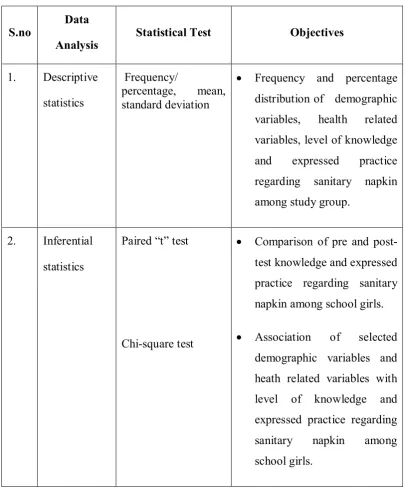
PLAN FOR DATA ANALYSIS
The data analysis was done by using descriptive and inferential statistics. The plan for data analysis were as follows:
S.no Data
Analysis Statistical Test Objectives
1. Descriptive
statistics
Frequency/
percentage, mean, standard deviation
· Frequency and percentage distribution of demographic variables, health related variables, level of knowledge and expressed practice regarding sanitary napkin among study group.
2. Inferential
statistics
Paired “t” test
Chi-square test
· Comparison of pre and post-test knowledge and expressed practice regarding sanitary napkin among school girls.
CHAPTER - IV
DATA ANALYSIS AND INTERPRETATION
This chapter deals with the statistical analysis of the data which enables the
researcher to summarize, organize, evaluate, interpret and communicate the
numerical information.
The descriptive and inferential statistics were used to analyze the data to
evaluate the effectiveness of structured teaching programme on knowledge and
practice regarding sanitary napkin among school girls. As per the objectives of this
study the tables were organized.
SECTION-A
Distribution of demographic variables and health related variables among
school girls.
SECTION-B
Distribution of level of knowledge and expressed practice regarding sanitary
napkins among school girls in pre and post -test.
SECTION-C
Comparison of pre and post-test knowledge and expressed practice scores
regarding sanitary napkin among school girls.
SECTION- D
Association of demographic variables and health related variables with level
SECTION – A
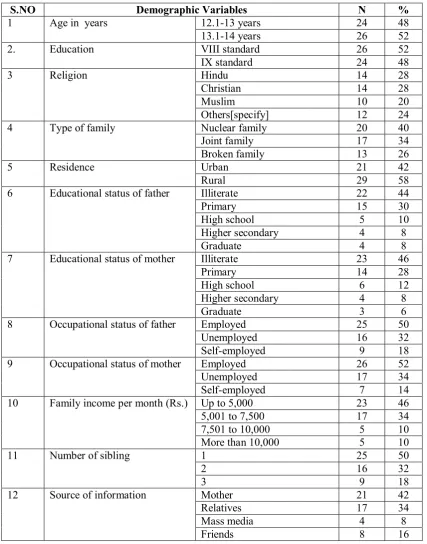
TABLE – 3
Distribution of demographic variables among school girls
N=50
S.NO Demographic Variables N %
1 Age in years 12.1-13 years 24 48 13.1-14 years 26 52 2. Education VIII standard 26 52 IX standard 24 48
3 Religion Hindu 14 28
Christian 14 28 Muslim 10 20 Others[specify] 12 24 4 Type of family Nuclear family 20 40 Joint family 17 34 Broken family 13 26 5 Residence Urban 21 42
Rural 29 58
6 Educational status of father Illiterate 22 44 Primary 15 30 High school 5 10 Higher secondary 4 8 Graduate 4 8 7 Educational status of mother Illiterate 23 46
Primary 14 28 High school 6 12 Higher secondary 4 8 Graduate 3 6 8 Occupational status of father Employed 25 50
Unemployed 16 32 Self-employed 9 18 9 Occupational status of mother Employed 26 52 Unemployed 17 34 Self-employed 7 14 10 Family income per month (Rs.) Up to 5,000 23 46 5,001 to 7,500 17 34 7,501 to 10,000 5 10 More than 10,000 5 10 11 Number of sibling 1 25 50
2 16 32
3 9 18
The table depicts the distribution of demographic variables among school girls.
It reveals that among 50 school girls, 24(48%) were in age group of 12.1-13
and 26(52%) of them were in the age group of 13.1-1