This is a repository copy of Exploring the Motivations for Building New Digital Musical Instruments.
White Rose Research Online URL for this paper: http://eprints.whiterose.ac.uk/135263/
Version: Accepted Version
Article:
Emerson, Gina and Egermann, Hauke Wolfgang orcid.org/0000-0001-7014-7989 (2018) Exploring the Motivations for Building New Digital Musical Instruments. Musicae scientiae. ISSN 1029-8649
https://doi.org/10.1177/1029864918802983
[email protected] https://eprints.whiterose.ac.uk/
Reuse
Items deposited in White Rose Research Online are protected by copyright, with all rights reserved unless indicated otherwise. They may be downloaded and/or printed for private study, or other acts as permitted by national copyright laws. The publisher or other rights holders may allow further reproduction and re-use of the full text version. This is indicated by the licence information on the White Rose Research Online record for the item.
Takedown
If you consider content in White Rose Research Online to be in breach of UK law, please notify us by
MANUSCRIPT ACCEPTED FOR PUBLICATION IN MUSICAE SCIENTIAE
Exploring the Motivations for Building New Digital Musical Instruments
Gina Emerson1 and Hauke Egermann2
1Institute for Cultural Innovation Research, Hamburg University of Music and Drama, Germany
2York Music Psychology Group, Department of Music, University of York, United Kingdom
Abstract
Over the past four decades, the number, diversity and complexity of digital musical
instruments (DMIs) has increased rapidly. There are very few constraints on DMI design as such systems can be easily reconfigured, offering near limitless flexibility for music-making.
Given that new acoustic musical instruments have in many cases been created in response to the limitations of available technologies, what motivates the development of new DMIs? We conducted an interview study with ten designers of new DMIs, in order to explore 1) the
motivations electronic musicians may have for wanting to build their own instruments; and 2) the extent to which these motivations relate to the context in which the artist works and
performs (academic vs. club settings). We found that four categories of motivation were mentioned most often: M1: wanting to bring greater embodiment to the activity of
performing and producing electronic music; M2: wanting to improve audience experiences
of DMI performances; M3: wanting to develop new sounds, and M4: wanting to build responsive systems for improvisation. There were also some detectable trends in motivation according to the context in which the artists work and perform. Our results offer the first
systematically gathered insights into the motivations for new DMI design. It appears that the challenges of controlling digital sound synthesis drive the development of new DMIs, rather
than the shortcomings of any one particular design or existing technology.
Keywords
Exploring the Motivations for Building New Digital Musical Instruments
Over the past four decades, the number, diversity and complexity of digital musical
instruments (DMIs) has increased rapidly. Defined here as devices for controlling digital sound synthesis (after Wessel, Wright & Schott, 2002), DMIs generate sound via a multi-step process that begins with some form of input from a human performer. This is typically
an action or gesture (the latter is the standard term in DMI literature, e.g. Jensenius, 2014) that is executed on or with the instrument’s control element (Fig. 1). The controller can take
a diverse range of forms. Existing trends include the replication or augmentation of acoustic instrument interfaces (e.g. Gurevich & von Muehlen, 2001; Impett, 1994; Machover, 1992; Schiesser & Schacher, 2012) and the development of ‘wearable’ controllers that are directly
attached to the body (e.g. Nakra, 2000; Waisvisz, 1985; see Miranda & Wanderley, 2006 for further examples). Input gestures are linked to their respective output parameters (i.e. particular sounds) via the mapping, the term that is used to describe the configuration of the
relationship between the control and sound generation parts of the instrument (Hunt & Kirk, 2000; Hunt & Wanderley, 2002). The actual audio output is usually pre-coded in an audio
programming environment on a laptop computer (e.g. Max/MSP, Csound, Pure Data, SuperCollider) and is triggered by the gestural input into the controller in the manner dictated by the mapping (Figure 1). - place Figure 1 about here - In contrast to most traditional
acoustic instruments,1 this form of sound production involves a separation of sound control and sound generation elements. This means that 1) DMIs do not have to be sources of sound
in themselves, they can have any timbre or produce any sound regardless of the form or material of the control element; 2) no significant physical effort is required to create audio output from the instrument; and 3) DMIs can have any number of different input-output
reconfiguration grants DMI designers and performers a very high degree of flexibility for music-making.
Organologists have identified a range of possible motivations for the creation of new musical instruments, including economic, social and political factors alongside creative and
artistic motivations (Bijsterveld & Peters, 2010; Libin, 2000). However, by and large, the limitations of particular technologies have historically inspired the development of new instruments or modifications to existing ones. Examples include limitations in pitch or
dynamic range (e.g. the restricted dynamic range of the harpsichord encouraging the development of the modern pianoforte, Bijsterveld & Schulp, 2004), limitations in the ease of use from the performer’s perspective or in terms of manufacturing which was, for
instance, partly responsible for the success of the upright piano over square models (Libin, 2000, p. 199). Given that there are few limitations on DMI design, what motivates the
development of new DMIs in artistic settings?2 Despite the prevalence of such devices in both academic music departments and in dance music/club settings, there is little to no systematic research on this topic. We investigated the possible motivations for producing
new DMIs via an interview study with ten artists active in the field of DMI design.
The existing scholarship in this area is largely restricted to published accounts by
instrument designers detailing the decisions involved in the design process of a particular DMI. This body of self-reflective ‘artistic research’ (cf. Borgdorff, 2010 for more on this term) along with the small number of theoretical works on DMI development (e.g. Kim,
2012; Miranda & Wanderley, 2006; Théberge, 1997) provides some background information from which it is possible to infer three potential motivations for the development of new
DMIs.
The first of these possible motivations is that of improving physical control over digital sound synthesis or aiming for a more embodied experience when performing
build in a more intuitive means of physically controlling sound parameters, expressing dissatisfaction with ‘laptop-based’ setups (e.g. Bennett, Ward, O’Modhrain & Rebelo, 2007;
Graham & Bridges, 2015; Magnusson and Mendieta, 2007; van Troyer, 2014). Morreale, McPherson & Wanderley (2018)’s survey of DMI performers identified several artists that
choose to perform with instruments that gave them a more satisfying sense of control. The idea of increasing the level of ‘embodiment’ or of striving for a more ‘embodied’ approach
to music-making frequently occurs in this context (Kim, 2012; Leman, 2008). It commonly
refers to a desired transfer of physical energy into a sound-producing device, usually achieved by incorporating more nuanced, continuous forms of control. This is, for example, the central point of Miranda and Wanderley’s monograph (2006) on DMIs, which provides
a summary of the trends in new interface design that go beyond the more established discrete control paradigms of the keyboard setup and the buttons, knobs and sliders on
industry-produced MIDI controllers.
A second possible motivation may be to place an emphasis on the audience’s
experience of a performance and design new DMIs that make the live performance of
electronic music enjoyable and interesting to watch. A number of studies point to the difficulties in comprehension audiences face at DMI performances (Barbosa, Calegario,
Teichrieb, Ramalho & McGlynn, 2012; Berthaut, Coyle, Moore & Limerick, 2015;Bown, Bell & Parkinson, 2014; Emerson & Egermann, 2017; Emerson & Egermann 2018; Gurevich & Fyans, 2011; Marquez-Borbon, Gurevich, Fyans & Stapleton, 2011) and proposals have
been made for systems that provide more information on the workings of the instrument during performance. Berthaut, Marshall, Subramanian and Hachet (2013) designed a display
system that can be placed under a tabletop DMI and illustrates the ongoing sound generation process via 3D visualisations. There are also several live coding performers who include projections of their screen display in their setup, allowing spectators to see how changes in
actively consider the audience’s perspective in the design process (Croft, 2007; O’Modhrain,
2011), which could inspire and motivate the creation of new DMIs that engage audiences
more directly.
A third and final potential motivation that arises from existing literature is that of
wanting to produce new sounds or timbres with which to make music. This wish to work with new timbres drove the development of some modern acoustic instruments (e.g. the hang, invented in 2000, Rohner & Schärer, 2007). It was furthermore the principal
motivation of many of the early pioneers of noise and electronic music, such as Luigi Russolo and Edgar Varèse. Russolo, in his Futurist music manifesto, The Art of Noises declared that it was necessary to “substitute for the limited variety of timbres that the
orchestra possesses today the infinite variety of timbres in noises, reproduced with appropriate mechanisms” (1914/1986, p. 28). Varèse went as far to envisage that, via the
introduction of new electronic instruments, timbre as a parameter of sound would take on a foreground role in the composition process and no longer be “incidental, anecdotal, sensual or picturesque” but rather “an agent of delineation like the different colours on a map
separating different areas” (Varèse & Wen-chung, 1966, p.12). The desire to generate new timbres may well drive DMI development, but since such instruments largely have no finite
sense of timbre, this is perhaps less likely to be the case. Rather, developing new means of controlling and manipulating timbre could be a more likely motivation.
Aims and Study Design
Responding to the lack of empirical research specifically on this topic, we aim to investigate
and artistic practice in music (Barrett, 2006; Bijsterveld & Schulp, 2004; Blom, Bennett & Wright, 2011; Kennedy, 1999).
As the existing literature on DMI design does offer some potential motivations for new instrument design, we chose a deductive approach to category construction (Elo & Kyngäs,
2008; Hsieh & Shannon, 2005: 1281; Mayring, 2000; Schilling, 2006). This method involves the testing of categories that arise out of existing research, whilst also allowing for the emergence and inclusion of new categories during analysis. We therefore approached our
interview study with three proposed categories of motivation:
M1: Wanting a more embodied experience when performing and producing electronic music
M2: Wanting to make the activity of performing electronic music more interesting to
audiences.
M3: Wanting to develop new sounds or timbres.
A second research question following on from this primary investigation considered the extent to which these motivations might relate to the context in which the artist works and
typically performs in. This secondary aim was realised in a purely explorative manner.
Method
Participants
We conducted semi-structured interviews with ten artists (all male), who are prominent
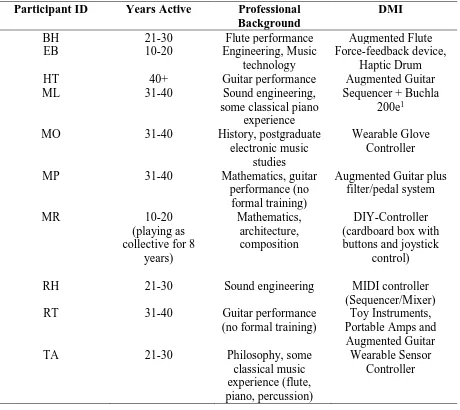
performers in the field of experimental electronic music and build their own DMIs (see Table 1). The ten participants, except for RH, all had an existing connection to the 3DMIN research project (e.g. had given a visiting lecture as part of the project event series or had an
order to ensure a broad, varied sample for the interview study, and from both academic and club music contexts to explore the relationship between context and motivation. Table 1
provides basic information on the interviewees and their new instruments. MR is a collective of three individuals who design instruments and perform together. As they make creative
decisions jointly, we treat them here as one artist.
-place Table 1 about here-
Data Collection and Analysis
The interviews were structured into six blocks of questions (see Appendix for Interview Protocol): 1) background information (e.g. education, present day activities, basic motivations); 2) questions about the development of the instrument(s) (artistic
intentions/vision, production costs, open source components); 3) questions about the technical specifications of the instrument and its sound production; 4) questions about the procedure of a typical concert; 5) questions about how the interviewee’s setup/performance style might differ from that of other artists; and 6) questions about the performer’s use of
their body and physical energy in relation to their instrument (e.g. importance of haptic
feedback from the instrument, awareness of any embodied music production/cognition theories). As far as possible, the interview structure was kept the same for each interview. The interviewees were encouraged to answer the questions freely with as little follow-up
from the interviewer as possible. The interviews took place at various locations in Berlin, were conducted in either English or German3 and were recorded with a Zoom H-1 audio
recorder. They ranged from 37 to 100 minutes in length and all took place in within a timespan of 11 months.
We conducted a deductive content analysis of the transcribed interviews. The three
Atlas.ti (Version 1.0.48). The transcripts were then read through multiple times and quotations relating to the proposed themes were annotated accordingly. The first author
repeated this initial coding three times so as to ensure that any new codes that emerged during the analysis could be applied to all interviews. The second author then reviewed the coded
transcripts and agreements on interpretation were reached between the two authors. The first author found 51 motivations and four categories. The second author agreed with these 51 codings and then found a further 10 possible motivation quotations on review. After an
extensive discussion, we agreed on 57 quotations across four categories. There remained one uncategorisable quotation from TA (see discussion on Page 16).
While Atlas.ti was primarily used as a tool for organising and annotating during the coding process, we also used the software to produce a summative analysis of the coded quotations (Hsieh & Shannon, 2005). This involved calculating totals of quotations for each
category in order to assess the relative importance of the categories (reported in Table 2 below).
Results
Motivation Categories: ‘Humanising’ Computer Music (M1 and M2) vs. Using Technology
for Artistic Exploration (M3 and M4)
In total, the interviewees mentioned their motivations for building DMIs on 57 occasions. Almost all of these 57 quotations could be sorted into the three proposed
motivation categories, thus confirming our expectations regarding possible motivations. Out of these three categories, the motivation of wanting a more embodied experience when
performing and producing electronic music (M1) was the most frequently cited. While our interview protocol (see Appendix) did feature a more direct question on embodiment (in Block 6), all interviewees except HT had already mentioned being motivated by the desire
Over the course of the analysis, a fourth category emerged: the motivation of using technology (in most cases, machine learning algorithms) to create instruments or systems
that introduce elements of uncertainty into a musical performance and can therefore act as responsive partners in improvisation (M4). This intention may seem contradictory as it
involves a loss of performer control but it is relatively common, especially among DMI artists who perform improvised music (e.g. Lewis 2000; Linson, Lewis, Dobbyn & Laney, 2015). Another related approach is simply to incorporate randomisation features, such as a SuperCollider patch for randomising the instrument’s mapping design (e.g., de Campo,
2014).
-place Table 2 about here-
On the basis of this initial analysis, we decided to group the four categories under two larger
themes or intentions. The two most frequently mentioned motivation categories, M1 and M2, can be viewed as originating from the more general intention of increasing human involvement, presence and physicality in the production of electronic music. Quotations for
these two categories frequently identified an explicit problem that the artists felt motivated to rectify through instrument development, either the lack of expressivity or enjoyability
when playing existing (typically laptop-based) systems from the performer’s perspective (M1) or the lack of emotional connection between computer music performers and their audiences (M2):
Quotations from M1 (Greater Embodiment in Performance):
So I like to have coherence between what I am hearing and what I am doing with my body. So that's important for me. To be able to do these big gestures that follow the
music and having this strong controller I can be harsh with. (MR)
Another reason is that if you're sitting, most of your body is not involved in the actual gesture of making the sound. So an instrument is a device that requires an interface to the human body. You have to do some kind of physical action on the instrument that
can make sound [...] because if you press a button that says 'start' or 'loop' or something it's a machine, it's not an instrument. (RT)
For me, it’s really that I have to like the instruments I’m playing with. It’s not enough
for them to allow me to do what I want because of their technical specifications, I need
to build a personal relationship to them. It has to be enjoyable for me to play with [...]. (RH)
[...] you know my performance is very, very physical compared to other electronic musicians. [...] But I have this intensity of physicality and I think not so many electronic
musicians are working in this field. I'd like to see such kinds of performance. (TA)
Quotations from M2 (Improving Audience Experience):
My main influence when building the instrument was the irritation that I had from attending electronic music concerts with live performers. I found that the lack of nuance
in the control paradigms was literally in the way of the music. I found the relationship between input controllers and sound to be banal. (BH)
what's going on. Because otherwise if you're just seeing someone perform something and you can't understand at all how they're controlling the sound, how do you know they
didn't just hit play on the CD player and then they're just pretending to perform? You can't tell the difference. (EB)
What degree of connectedness can you achieve if you're sitting at a table and either turning knobs or clicking on a laptop? [...] So the reason that I prefer portable
instruments is because I can play standing. I can just stand in front of the people. And I think the sense of being together and sharing the space between the musician and the
audience is much more... is like.. it's closer.. (RT)
But what I see in the majority of cases is this typical situation of sitting, very often with
a computer and I believe that there's a general feeling of insufficiency. Something is lacking, something is not fully satisfying. And I think both the audience and the artist feel that. (RT)
The sense of motivation encompassed in categories M1 and M2 appears to be driven by the
will to solve the larger problems that arise out of the use of digital technologies in music production. In contrast, quotations from the categories M3 and M4 mention the motivation of using technological means to achieve the artistic aims of developing new sounds or
building a system to improvise with:
Quotations from M3 (Developing New Sounds):
If you think back to how computer music began, people with musical ideas had access to computers for the first time and wanted to discover what kind of new sounds can they
interactions we can have using a force feedback device that were not possible before. (EB)
But when it comes to my thinking, I am totally interested if there is a sonically interesting
timbre, sound, and then I am all there. So I think whatever I am doing [...] it will have some sonically interesting outlook. (HT)
Quotations from M4 (Building Responsive Systems for Improvisation):
I am the kind of improviser who needs to be surprised, who needs to be like on the edge
of the seat, see what's happening, that could be the sound in the room, how does the room react to what you are playing, if I play with other people, other people bring the surprises to me. But I figured when I do solo performances, the best is if the computer surprises
me. (HT)
And so one thing that I have experimented with is simply randomly changing the
processing every single time you play a note, it's just always something different. And that's kind of fun, it's very destabilising and very interesting to do. (MP)
I'm always searching for the borderline between the aspects I can control and I cannot control. I think in that point [my instruments are] totally different from any kind of
traditional instrument. (TA)
We identified two larger trends in motivations for instrument building that are each comprised of two smaller categories. Naturally, these smaller categories were not always so easy to separate during analysis; a number of single comments could be interpreted as
combined motivation of wanting greater embodiment in performance and of wanting to improve audience experience, in which the instrument mediates between them and their
spectators:
No, [the instrument] is a mediator also. Because we want people to know that they are made of cardboard and that we can destroy it. Sometimes on stage I destroy my instrument at the end of the performance and that's of course a way to excite people. (MR)
Once at the end I threw the instrument away into the audience and they were fighting to
see who would get it. So, of course you can not get more in touch with the audience with an instrument than give it to them. (MR)
Here, the same feature of the instrument that allows for greater portability and physicality, namely that it is made of cardboard (see MR quotation above), enables the artist to provoke the audience through its temporary nature. Category M1 in itself furthermore covers a wide
range of interpretations of what exactly increasing embodiment in DMI performance means. While some interviewees mentioned specific methods of increasing haptic feedback from
the instrument (e.g. EB and ML) or modelling the playing technique on that of an acoustic instrument (e.g. MP), for RH, part of this more embodied experience involved having a more nuanced control over the instrument and needing practise on it in order to master this
finer-grained control:
This criterion is also applicable here, that [the instrument] is not designed to be universally usable and that it offers a very personal, very specific range of possibilities. And within these possibilities, it offers both very fine-grained but also radical modes of interaction in
practise, I can improve it through skill [...], I have to learn, I can learn it, and when I’ve
learnt it, I become better. (RH)
Aside from the 57 motivation quotations categorised as above, there remained one
quotation from TA which defied clear categorisation:
And if I played a [conventional] instrument, I noticed people compared me to other
instrumentalists. So if I played the piano, there are so many pianists. So people tend to compare and basically talk about technique. And I think that is a very boring thing. Of
course my approach was already different, but I felt I couldn't avoid such kind of competition if I played a conventional instrument. And then I thought: I'll build my instrument. (TA)
This seems to hint at a possible fifth category, a social motivation of not wanting to be compared with other instrumentalists and seeking to avoid competition through developing one’s own instrument. Designing and performing with DMIs can represent a way of creating
new performance and concert setups, ones that are free of the baggage that comes with
traditional instruments (cf. collaborative instruments such as the reacTable, Kaltenbrunner, Jorda, Geiger & Alonso, 2006; or experiments in outdoor music-making, Greie-Ripatti & Bovermann, 2017; see also Magnusson and Mendieta, 2007, p. 97 for a discussion on the
issue of performance traditions and instrument development). However, as no other participants mentioned a similar motivation and TA did not elaborate on this, we did not see
grounds for developing it into a category.
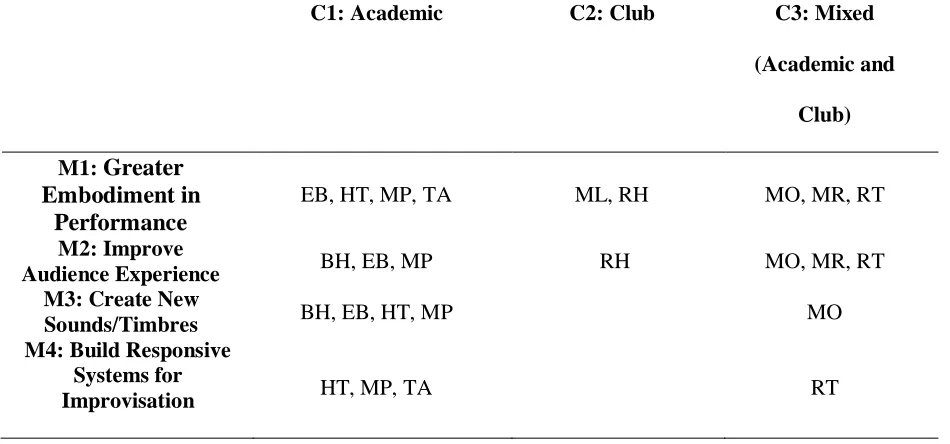
In a subsequent analysis, we explored the relationship between the motivation to develop a new DMI and the context in which the artist works and performs. The interviewees were
sorted into three context categories (C1: Academic, C2: Club, C3: Mixed (Academic and Club) based on how they described their present activities and the settings they perform their
music in. EB, MP, BH, and HT all hold positions at universities and teach classes in electronic music and instrument design. TA does not hold a formal position but gives lectures in academic settings. MO, MR and RT all referred to playing in a mixture of settings,
including electronic dance music venues and university-based workshops and conferences. ML and RH perform only in club contexts.
- place Table 3 about here –
As can be seen in Table 3, there appears to be a strong relationship between the participants’ performance contexts and their motivation to build DMIs. Those artists working in the club scene have a much narrower range of motivations than those situated in the academic
context; their interests are more focused around achieving greater embodiment in performance (M1) and improving audience experience (M2). RH, for example, develops
setups which allow him to perform from directly within the crowd of audience members:
For me, the result is that I bring myself into the position of the audience. Literally, physically. I play in the middle of the audience and then I don’t need any monitors or any
form of translation between myself and what the audience hears, I know entirely, that what I’m hearing is what the others are hearing. (RH)
It is logical that a club performer would focus on establishing a relationship with the
exclusively, places a similar emphasis on wanting to improve the audience’s experience,
citing the visible presence of the performer as an important element in this:
It's an interesting question, because I've always believed that live music is something to
be heard but also seen and I always had this strong conviction that if you're on a stage you have to be seen. That's the reason why you are there because people want to see you doing your stuff in front of them, that's the reason for the live situation. (RT)
Out of the artists in the context categories C2 and C3, it is only ML who is not motivated at
all by the intention of creating a particular experience for the audience. In fact, he places little importance on the visual aspects of his performances and appears to be uninterested in the audience’s perspective and their level of understanding:
With my setup, you don’t really see anything at all. [...] And somehow, the visual aspect
is just not very important to me, to be honest. The sounded result has to be right. (ML)
How important is it for you that people understand what you’re doing?
I can’t really say that that’s very important to me. And I think, well, I have the impression
sometimes that most people do not actually understand. But that’s not very important to
me. I know what I’m doing. (ML)
It is unclear why the two exclusively club-based artists, RH and ML, were not motivated by
the desire to develop new sounds. It is possible that club musicians simply seek to set a particular atmosphere or just to entertain through their output, rather than push at musical frontiers, but this is not a satisfactory conclusion. Certainly, as freelance club artists, they
to be motivated by M4. This is perhaps because a different type of improvisation is favoured in club settings, one that does not require such active feedback from the system.
The broader range of motivations in the academic setting (C1) can most likely be attributed to the higher level of self-reflection that is common in this context. DMI artists
who are active in academic research are often familiar with the literature surrounding electronic music practice and are also sometimes engaged directly in artistic research, a practice that promotes a reflective, documented approach to creative work (Blom, Bennett
& Wright, 2011). It was generally the case that their answers to the interview questions were more detailed. For example, EB, who holds an academic position, made references to
literature on DMI design when talking about whether to define his DMI as an ‘instrument’ or a ‘controller’:
So the Firefader is a controller.
So the Firefader is a controller actually, I mean in a rigorous sense. You asked me to mention three instruments, so I mentioned it. But it's true, it's not really specific until
you're using a specific sound synthesizer and a specific mapping also. I think if you look into the book written by Wanderley and Miranda, you'll probably find a similar definition.
(EB)
It is also notable that M4, the motivation of building responsive systems for
improvisation, is found almost exclusively in the academic setting. This is perhaps because DMI artists in academic contexts are more likely to be involved in pushing the technological
advancement of this branch of music technology. Most DMI systems that involve artificial intelligence of some kind have been developed in academic contexts, probably due to the more reliable funding structures in place in this context (see Blackwell & Young, 2004;
merits of losing control and being surprised by the DMI system, voicing frustrations with setups that centre around fixed, discrete elements (e.g. the keyboard setup):
And that's a privilege of electronic music, because it can be really built in, how the
instrument is designed to have this degree of randomness [...] I find it very exciting to work with instruments that are responsive in the very split second to any performing decision, but then what they give you is something that is approximate to your intention.
So you want to make a sound and you know the sound is going to be, going to have this characteristic and it does, but it's not quite what you imagined. (RT)
While motivations for DMI production are in many instances very individual, it does appear possible to classify the motivations artists have according to the context they work in.
Discussion
The participants in our study reported being most motivated in their production of
new DMIs by the desire for a more embodied experience when performing and producing electronic music (M1). Just under half of all the references to motivation mentioned this and
only one participant, BH, did not report this at all. This aim, along with the second most frequently cited category, M2 (improving audience experience), suggests that developers of new DMIs are motivated by the need to turn digital musical technologies into musical
instruments and to produce performative tools that function successfully within individual and social musical contexts. Their work is driven primarily by the broader need to humanise
music-making with new DMIs (75% of quotations) and only secondarily by more individual artistic and musical goals (25% of quotations). The prominence of this theme in our interview data mirrors the prevalence of discussions on embodiment and expressivity in the
technologies for music-making; there is still an over-focus on the means of musical production, rather than the ends.
M3, being motivated by the search for new timbres, only accounted for 14% of quotations about motivation.The creation of specific new sounds may have become less
important in electronic musical instrument design since the advent of digital sound synthesis, as it essentially provides the means for the production of any imaginable timbre (Jordá, 2004). Magnusson (2010) speaks of a ‘creative paralysis’ in the face of the limitless
possibilities presented by current audio programming environments, a development the early pioneers of electronic music referenced above probably did not foresee. While a sense of ‘paralysis’ around sound design was not expressed by any of our participants, it may be the
case that the need to search for new sounds has been satiated by the timbral freedom digital sound synthesis offers, and thus M3 was not more frequently mentioned in our study.
While our expectations about the possible motivations for new DMI design were confirmed (M1, M2 and M3 were able to explain most of the data), an unexpected category, M4, emerged during analysis. The motivation to build responsive systems for improvisation
that can surprise and challenge the performer certainly contrasts the motivations behind the development of most existing acoustic, electronic and digital instruments, for which the
optimisation of performer control and the reduction of randomness or uncontrollability has been the focus. Using machine learning methods to introduce the ‘right amount’ of randomness and develop systems that can be partners in musical improvisation marks a step
in a very interesting direction for the future of music-making.
There were some detectable trends in motivation according to the context in which
the artists work and perform. Those working in the club (C2) and mixed contexts (C3) were more interested in humanising computer music production, whereas the artists from the academic setting displayed a broader set of motivations, more often encompassing the
end up working in but it is more likely the case that this choice of context comes about through a range of different factors, including academic background, available opportunities
at the individual’s time of study and even socioeconomic factors. Once someone becomes associated with a particular context, it is also possible that their motivations to produce new
DMIs change to adapt with the surrounding environment. Those working in the academic context, for example, may well be required through teaching and research commitments to become familiar with the theoretical literature on DMIs or to focus on developing specific
branches of music technology (e.g. computational creativity), which could in turn alter their motivations and how they reflect on them.
Our investigation lays the groundwork for the development of future hypotheses regarding possible DMI design motivations and how these come to be formed. In order to test the broad trends we have found here, our study would benefit from being replicated with
a larger sample size and with more musicians exclusively active in the club scene. There is also a number of related questions that could be addressed in a follow-up study. A comparative interview study with designers of acoustic instruments would allow for the
confirmation or rejection of some of the differences between these two worlds of musical instrument design that we propose here. It would also be illuminating to include perspectives
from DMI designers working in industry, who could potentially have a different set of motivations from those working in club and academic contexts.
Our results offer the first systematically gathered insights into the motivations for
new digital musical instrument design. It appears that it is the limitations or challenges of controlling digital sound synthesis itself that drive the development of new DMIs, rather
than the shortcomings of any one particular instrument design. It is also evident that DMI production involves a complex array of concepts and issues, including control,
embodiment, expressivity, virtuosity and musicality. These terms are each interpreted
References
Arfib, D., Couturier, J. M., & Kessous, L. (2005). Expressiveness and digital musical instrument design. Journal of New Music Research, 34(1), 125-136.
Barbosa, J., Calegario, F., Teichrieb, V., Ramalho, G., & McGlynn, P. (2012). Considering audiences’ view towards an evaluation methodology for digital musical instruments. NIME 2012: Proceedings of the 12th International Conference on New Interfaces for Musical Expression (pp. 403–408). Retrieved from
http://www.nime.org/proceedings/2012/nime2012_174.pdf
Barrett, M. (2006). ‘Creative collaboration’: an ‘eminence’study of teaching and learning in music composition. Psychology of Music, 34(2), 195-218.
Bennett, P., Ward, N., O'Modhrain, S., & Rebelo, P. (2007). DAMPER: A platform for effortful interface development. NIME 2007: Proceedings of the 7th International Conference on New Interfaces for Musical Expression (pp. 273-276). Retrieved from http://www.nime.org/proceedings/2007/nime2007_273.pdf
Berthaut, F., Coyle, D., Moore, J. W., & Limerick, H. (2015). Liveness Through the lens of agency and causality. NIME 2015: Proceedings of Conference on New Interfaces for Musical Expression. (pp. 382–386). Retrieved from
http://www.nime.org/proceedings/2015/nime2015_272.pdf
Berthaut, F. Marshall M., Subramanian S., & Hachet M. (2013). Rouages: Revealing the mechanisms of digital musical instruments to the audience. NIME 2013: Proceedings of the International Conference on New Interfaces for Musical Expression (pp. 165– 169). Retrieved from http://nime.org/proceedings/2013/nime2013_51.pdf
Bijsterveld, K., & Schulp, M. (2004). Breaking into a world of perfection: Innovation in today’s classical musical instruments. Social Studies of Science, 34(5), 649-674.
Bijsterveld, K., & Peters, P. F. (2010). Composing claims on musical instrument
development: A science and technology studies’ contribution. Interdisciplinary Science Reviews, 35(2), 106–122.
Blackwell, T., & Young, M. (2004). Self-organised music. Organised Sound, 9(2), 123-136.
Blom, D., Bennett, D., & Wright, D. (2011). How artists working in academia view artistic practice as research: Implications for tertiary music education. International Journal of Music Education, 29(4), 359-373.
Borgdorff, H. (2010). The production of knowledge in artistic research. In M. Biggs & H. Karlsson (Eds.), The Routledge companion to research in the arts (pp. 44-63). Abingdon, UK: Routledge.
Borgo, D. (2005). Sync or swarm: Improvising music in a complex age. New York: Continuum.
Interfaces for Musical Expression (pp. 13–18). Retrieved from http://www.nime.org/proceedings/2014/nime2014_538.pdf
Brown, A. R., & Sorensen, A. C., (2007). aa-cell in practice: An approach to musical live coding. Proceedings of the 2007 International Computer Music Conference (pp. 292–299). Retrieved from http://eprints.qut.edu.au/39768/1/c39768.pdf
Brown, A. R., & Sorensen, A. C. (2009). Interacting with generative music through live coding. Contemporary Music Review, 28(1), 17–29.
Croft, J. (2007). Theses on liveness. Organised Sound, 12(1), 59.
De Campo, A. (2014). Lose control, gain influence: Concepts for metacontrol. Proceedings of the 2014 International Computer Music Conference (pp. 217–222). Retrieved from http://smc.afim-asso.org/smc-icmc-2014/images/proceedings/PS2-B01-Losecontrolgaininfluence.pdf
Elo, S., & Kyngäs, H. (2008). The qualitative content analysis process. Journal of Advanced Nursing, 62(1), 107-115.
Emerson, G., & Egermann, H. (2017). Mapping, causality and the perception of
instrumentality: Theoretical and empirical approaches to the audience’s experience of digital musical instruments. In T. Bovermann, A. de Campo, H. Egermann, S-I. Hardjowirogo, & S. Weinzierl (Eds.), Musical instruments in the 21st Century (pp. 363-370). Singapore: Springer.
Emerson, G., & Egermann, H. (2018). Gesture-sound causality from the audience’s perspective: Investigating the influence of mapping perceptibility on the aesthetic perception of new digital musical instruments. Psychology of Aesthetics, Creativity, and the Arts, 12(1), 96-109.
Graham, R., & Bridges, B. (2015). Managing musical complexity with embodied metaphors. NIME 2015: Proceedings of the 15th International Conference on New Interfaces for Musical Expression (pp. 103-6). Retrieved from
http://www.nime.org/proceedings/2015/nime2015_303.pdf
Greie-Ripatti, A., & Bovermann, T. (2017). Instrumentality in sonic wild{er}ness. In T. Bovermann, A. de Campo, H. Egermann, S-I. Hardjowirogo, & S. Weinzierl (Eds.), Musical instruments in the 21st Century (pp. 243-262). Singapore: Springer.
Gurevich, M., & Fyans, A.C. (2011). Digital musical interactions: Performer–system relationships and their perception by spectators. Organised Sound. 16(2), 166-75.
Gurevich, M., & von Muehlen, S. (2001). The accordiatron: A MIDI controller for interactive music. NIME 2001: Proceedings of the 1st International Conference on New Interfaces for Musical Expression (pp. 1-3). Retrieved from
http://www.nime.org/proceedings/2001/nime2001_027.pdf
Hunt, A., & Kirk, R. (2000). Mapping strategies for musical performance. In Wanderley, M. & Battier, M. (Eds.) Trends in gestural control of music (pp. 231-258). Paris: IRCAM.
Hunt, A., & Wanderley, M. (2002). Mapping performer parameters to synthesis engines. Organised Sound, 7(2), 97–108.
Impett, J. (1994). A meta-trumpet(-er). Proceedings of the 1994 International Computer Music Conference (pp. 147-150). Retrieved from
http://quod.lib.umich.edu/cgi/p/pod/dod-idx/meta-trumpeter.pdf?c=icmc;idno=bbp2372.1994.037
Ingham, R. (1998). The Cambridge companion to the saxophone. Cambridge, UK: Cambridge University Press.
Jensenius, A.R. (2014). To gesture or not? An analysis of terminology in NIME proceedings 2001-2013. NIME 2014: Proceedings of the 14th International
Conference on New Interfaces for Musical Expression (pp. 217–220). Retrieved from http://www.nime.org/proceedings/2014/nime2014_351.pdf
Jessop, E., Torpey, P. A., & Bloomberg, B. (2011). Music and technology in Death and the Powers. NIME 2011: Proceedings of the 2011 Conference on New Interfaces for Musical Expression (pp. 349–354). Retrieved from
http://www.nime.org/proceedings/2011/nime2011_349.pdf.
Jordà, S. (2004). Instruments and players: Some thoughts on digital lutherie. Journal of New Music Research, 33(3), 321-341.
Kaltenbrunner, M., Jorda, S., Geiger, G., & Alonso, M. (2006). The reactable: A collaborative musical instrument. Paper presented at the15th IEEE International Workshops on Enabling Technologies: Infrastructure for Collaborative Enterprises. doi:10.1109/WETICE.2006.68
Kennedy, M. (1999). Where does the music come from? A comparison case-study of the compositional processes of a high school and a collegiate composer. British Journal of Music Education, 16(2), 157-177.
Kim, J. H. (2012). Embodiment in interaktiven Musik- und Medienperformances – unter besonderer Berücksichtigung medientheoretischer und kognitionswissenschaftlicher Perspektiven [Embodiment in interactive music and multimedia performances – perspectives from media theory and cognitive science]. Osnabrück, Germany: epOs.
Leman, M. (2008). Embodied music cognition and mediation technology. Cambridge, London: MIT Press.
Lewis, G. E. (2000). Too many notes: Computers, complexity and culture in Voyager. Leonardo Music Journal, 10, 33-39.
Libin, L. (2000). Progress, adaptation, and the evolution of musical instruments. Journal of the American Musical Instrument Society, 26, 187. Retrieved from
Linson, A., Dobbyn, C., & Laney, R. (2012). Improvisation without representation: artificial intelligence and music. Proceedings of the Music, Mind, and Invention Workshop: Creativity at the Intersection of Music and Computation. Retrieved from http://www.tcnj.edu/~mmi/papers/Paper12.pdf
Linson, A., Dobbyn, C., Lewis, G. E., & Laney, R. (2015). A subsumption agent for collaborative free improvisation. Computer Music Journal, 39(4), 96-115.
Machover, T. (1992). Hyperinstruments: A progress report. Cambridge, MA: MIT Media Lab.
Magnusson, T., & Mendieta, E. H. (2007). The acoustic, the digital and the body: A survey on musical instruments. NIME 2007: Proceedings of the 7th International Conference on New Interfaces for Musical Expression (pp. 94-99). Retrieved from
http://www.nime.org/proceedings/2007/nime2007_094.pdf
Magnusson, T. (2010). Designing constraints: Composing and performing with digital musical systems. Computer Music Journal, 34(4), 62-73.
Marley, W., & Ward, N. (2015). Tightly coupled agents in live performance metacreations. ACM SIGCHI 2015: Proceedings of the ACM SIGCHI Conference on Creativity and Cognition (pp. 299-302). doi: 10.1145/2757226.2757255
Marquez-Borbon, A., Gurevich, M., Fyans, A., & Stapleton, P. (2011). Designing digital musical interactions in experimental contexts. Contexts, 373–376. Retrieved from http://www.nime.org/proceedings/2011/nime2011_373.pdf
Mayring, P. (2000). Qualitative content analysis. Forum: Qualitative social research, 1(2).
Retrieved from http://217.160.35.246/fqs-texte/2-00/2-00mayring-e.pdf
McLean, A., Griffiths, D., & Collins, N. (2010). Visualisation of live code. Electronic Workshops in Computing: Electronic Visualisation and the Arts (pp. 26–30). Retrieved from https://dl.acm.org/citation.cfm?id=2227185.
Miranda, E. R., & Wanderley M.M. (2006). New digital musical instruments: Control and interaction beyond the keyboard (Computer music and digital audio series, Vol. 21). Middleton, WI: AR Editions.
Nakra, T. M. (2000). Inside the conductor’s jacket: Analysis, interpretation and musical synthesis of expressive gesture (Doctoral dissertation, Massachusetts Institute of Technology, MIT Media Lab). Retrieved from
http://vismod.media.mit.edu/pub/tech-reports/TR-518/.
O’Modhrain, S. (2011). A framework for the evaluation of digital musical instruments. Computer Music Journal, 35(1), 28–42.
Rohner, F., & Schärer, S. (2007). History, development and tuning of the Hang. ISMA 2007: Proceedings of the International Symposium on Musical Acoustics. Retrieved from http://www.hangblog.org/panart/Paper-Hang-2007.pdf
Schiesser, S., & Schacher, J. C. (2012). SABRe : The augmented bass clarinet. NIME 2012: Proceedings of the 12th International Conference on New Interfaces for Musical Expression (pp. 109–112). Retrieved from
http://www.nime.org/proceedings/2012/nime2012_193.pdf
Schilling, J. (2006). On the pragmatics of qualitative assessment: Designing the process for content analysis. European Journal of Psychological Assessment, 22(1), 28.
Théberge, P. (1997). Any sound you can imagine: Making music/consuming technology.
Middletown, CT: Wesleyan University Press.
van Troyer, A. (2014). Composing embodied sonic play experiences: Towards acoustic feedback ecology. NIME 2014: Proceedings of the 14th International Conference on New Interfaces for Musical Expression (pp. 118-121). Retrieved from
http://www.nime.org/proceedings/2014/nime2014_444.pdf
Varèse, E., & Wen-chung, C. (1966): The liberation of sound. Perspectives of New Music, 5(1), 11-19.
Waisvisz, M. (1985) The hands: A set of remote MIDI-controllers. Proceedings of the 1985 International Computer Music Conference (pp. 86–89). Retrieved from
http://quod.lib.umich.edu/i/icmc/bbp2372.1985.049/1
Wanderley, M. M., & Orio, N. (2002). Musical expression: Borrowing tools. Computer Music Journal, 26(3), 62–76.
Acknowledgements
Tables
Table 1. List of Participants, their Professional Backgrounds and their DMIs
Participant ID Years Active Professional Background
DMI
BH 21-30 Flute performance Augmented Flute
EB 10-20 Engineering, Music
technology
Force-feedback device, Haptic Drum
HT 40+ Guitar performance Augmented Guitar
ML 31-40 Sound engineering,
some classical piano experience
Sequencer + Buchla 200e1
MO 31-40 History, postgraduate
electronic music studies
Wearable Glove Controller
MP 31-40 Mathematics, guitar
performance (no formal training)
Augmented Guitar plus filter/pedal system
MR 10-20
(playing as collective for 8
years)
Mathematics, architecture, composition
DIY-Controller (cardboard box with buttons and joystick
control)
RH 21-30 Sound engineering MIDI controller
(Sequencer/Mixer)
RT 31-40 Guitar performance
(no formal training)
Toy Instruments, Portable Amps and
Augmented Guitar
TA 21-30 Philosophy, some
classical music experience (flute, piano, percussion)
Table 2. Number of Quotations per Motivation Category for Each Interviewee (Summative Content Analysis)
‘Humanising’ Computer Music Production
(75% of Quotations)
Using Technology to Realise an Artistic Aim
(25% of Quotations) Participant ID M1: Greater Embodiment in Performance M2: Improving Audience Experience M3: Developing New Sounds M4: Building Responsive Systems for Improvisation
BH 2 1
EB 4 3 2
HT 1 3 2
ML 3
MO 1 1 1
MP 3 1 1 1
MR 6 3
RH 7 1
RT 1 4 1
TA 2 2
Total Quotations Concerning Motivation:
57
Table 3. Motivation Categories cross-classified by Interviewee Work/Performance Context C1: Academic C2: Club C3: Mixed
(Academic and
Club)
M1: Greater Embodiment in
Performance
EB, HT, MP, TA ML, RH MO, MR, RT
M2: Improve
Audience Experience BH, EB, MP RH MO, MR, RT
M3: Create New
Sounds/Timbres BH, EB, HT, MP MO
M4: Build Responsive Systems for
Figure
Figure 1. The process of sound generation with a Digital Musical Instrument. Controller/
Interface
Sound Synthesis Element (Laptop Computer) Input
Gesture from Human Performer
Mapping
Appendix: Interview Protocol
1) Please tell us about your background and your interests in music and technology.
Points for follow-up questions: • personal information
• technical or artistic education • present day activities
• motivation
2) Please tell us about the development of your instrument(s).
Points for follow-up questions: • idea/vision
• links to theory • costs/amount of time • open source aspects?
• completed or continuous development?
3) How do your instrument(s) work?
Points for follow-up questions: • sound production/synthesis
• direct access to musical parameters • mapping
• spatialisation
4) Please give us a report about the procedure of your last concert. (no specific points for follow-up questions)
5) You probably often have the opportunity to watch other artists perform and to observe their interactions with their instruments. What do they do during their performances? Points for follow-up questions:
• contrasts to your performances?
• extroverted or introverted performance style? • is the performance understandable/readable? • overall audiovisual experience
6) How do you use your body during a performance/when interacting with your instrument(s)?
Points for follow-up questions: • gestural control
• does the instrument give resistance or feedback?
Notes
1 See De Souza (2017, pp. 38-45) for examples of separate sound control and sound
generation elements in acoustic instruments.
2 DMIs have also been developed for use in pedagogical and therapeutic contexts, our focus
here is however only on DMIs used for artistic creation.
3 RH and ML were interviewed in German. The quotations presented here were translated