by
Garth Pilkinton
R thesis submitted to
The Rust Pali an National University for the degree of
Doctor of Philosophy
This dissertation represents my own original work, fill authorities and sources that have been consulted are acknowledged in the references.
flCKNOULEDGEnEHTS
Looking back on a project that has been as long in the gestation period as this one^ it is not easy to put into context the encouragement and assistance that has been received along the u>ay. But many haue helped., sometimes merely by acknowledging the existence of another human being, plugging away doing the Saturday shift in the Coombs Building at the flNU.
I would like to thank John Higley, who encouraged me to apply for entry to the fiHU as a post-graduate scholar, and Stanley Benn and other faculty members, who, acting on their conviction that maturity should not be considered a barrier to good scholarship, supported my application. I would like to acknowledge the
friendship and support of the late Charles Rowley, who shared more than a telephone with me, and the enjoyment of the occasional
'happy hour' presided over by Don Anderson and sometimes shared with Kath Blakers, Marijke van Ommeren, Hichele Robertson, and others. Dorothy Broom, Brian Graetz, John Braithwaite, Don Rawson and Hina MistiI is gave me their ear on occasions and to them i am a I so gratefuI.
fruition luithout his backing and I wish to publicly acknowledge my debt to hitn. He read my draft chapters ujith care, encouraging me to deuelop my insights and mrite with a degree of professionalism that might otherwise haue been missing.
Co-superuisorj Terence Halliday, challenged me to think about a wide range of sociological issues while at the same time assisting me to focus the study within a sociology of organisations framework. I am grateful to Terry for the time he spent debating with me the meaning of the limited data to which originally I had access. Uhen the drought broke and turned into a
flood, the investment Terry had made by suggesting ways of systematising the data, became inualuable. Terry continued to provide editorial comment and aduice after mouing to Chicago.
fl number of others haue read and commented on my work. I owe a special debt to Helen Pilkinton and Jack Hoadley for their constant encouragement, and particularly for their insistence that
I clarify concepts and ideas that somehow had failed to appear on the written page. Richard Curtain read a number of chapters, encouraging me to address the 'big' issues of importance to the
labour movement. Rosalie Pilkinton cast a professional eye over my use of agency theory in Chapter Eight, while Nicola and Ruth Pilkinton used their sharp eyes to good effect, spotting a number of typographical errors in several chapters.
only for their professional assistance, but also because they haue established such a supportiue atmosphere in the RBL (they also breiju yery good coffee). Rs this study has drawn to a close, Penny Pemberton and Coleen Pritchard haue read each chapter with a minimum of delay before dispatching it to the flCTU where Ann Uilson has responded uiith equal promptness.
This case study marks an important stage in the collective response of an Rustralian family to the redundancy of the male breadu.1 inner after 30 years active and interesting mork in a field entirely different from sociology. This dissertation ujould not have been written had it not been for the assumption of new and challenging roles by Helen, Stuart, Sheryi, Nicola, Ruth and Jane Pilkinton, as well as by the former breadwinner. I belieue that together we haue shown that euen redundancy can create opportunities for new and positive experiences.
RBSTRflCT
While the RCTU often occupies centre stage in Australian industrial J political and economic life, the flCTU's inodus operandi and the roles it performs are not uuell understood. The RCTU is an intermediary organisation: RCTU officers and other executive members mediate between the flCTU's affiliated unions and state branches., on the one hand, and significant outside actors like the Government, the Conciliation and Arbitration Commission, employers and international organisations, such as the ILO, on the- other.
Using a role oriented-model developed during the case study, relationships between the ACTU executive and the organisations named above are examined. This case study shows that the authority of trade union confederat ions like the ACTU is contingent on the exchange of concessions by the executive and its officers when they mediate between 'inside' and 'outside' organisations.
When a confederation's executive has no further concessions to exchange between the parties, the mediation process breaks down. Mediation ceased in 1976 when the Government refused to give ground to the ACTU executive over the Government's tlEDIBRHK policy. The national Zl-hour I1EDIBRNK strike was called by the RCTU executive primarily to restore its authority over affiliated unions that had already taken strike action and were determined to take further strike action with or without RCTU support.
TABLE OF COHTEHTS
Chapter One Chapter Two
PART ONE: CASE STUDV ORIENTATION Theoret i caI Foundat i ons
The Simp I i fied Model
Chapter Three The Complete flodel And The flethodology
Chapter Four Chapter Five Chapter Six
PART THREE: COLLECT IUE GOODS Chapter Seven Collegial Authority
Chapter Eight Delegated Authority
PART FOUR: RECOGNITION AND INTEGRATION Chapter Nine External Authority
Chapter Ten Executive Authority
27 51 PART TUO: ORGANISATIONAL mPERATIUES
Conferred Authority 77 Elected, Competent and Personal Authority 117
Conceded Authority 162
210 2^6
287 330
DETAILED TRBLE OF CONTENTS
flcknowledgements
Abstract
I I I
VI
Abbreuiat ions X I u
List of Figures xu I
List of Tables x v i i i
PART ONE; CASE STUDV ORIENTATION
CHRPTER 1 THEORETICRL FOUNDRTIONS
1.1 Introduct ion
1.1.1 The RCTU's Authority: R Limited Literature
1.2 STRUCTURES AND ROLES
5
7
1.2.1 Classifying The RCTU Rnd Similar Organisations 7
1.2.2 Rn Intermediary Role 11 1.2.3 Influence, Poiuer Rnd Ruthority H
1.2.4 Legitimacy Rnd Authority 18
1.3 SUfinARV 21
1 . 3 . 1 T h e L e g i t i m a t i o n O f T h e R C T U ' s A u t h o r i t y Notes
21
2^!
CHRPTER 2
2.1
2 . 2
THE SlflPLIFIED MODEL
Introduct ion
SOURCES OF R CONFEDERRTI OH'S AUTHOR I TV
27
27
29
2.2.1 The Simplified Node I Explained
2.2.2 Conferred Authority Through Consent 2.2.3 External Ruthority
CHAPTER 3
CHAPTER 1
2 . 2 . ^ The r i e d i a t i o n P r o c e s s 38
2 . 2 . 5 r i e d l a t i o n , Independence And flccountabi i i t y 40
2 . 2 . 6 E x e c u t i v e A u t h o r i t y 44
2 . 3 sunnARv 47
2 . 3 . 1 fl P r e l i m i n a r y Assessment Of The tlodel 47
Notes 48
THE COMPLETE MODEL AND THE METHODOLOGV 51
3.1 1ntroduct1 on 51
3 . 2 ADDITIONAL SOURCES OF AUTHOR 1 TV 55
3 . 2 . 1 E l e c t e d , Competent Rnd P e r s o n a l A u t h o r i t y 55
3 . 2 . 2 Conceded A u t h o r i t y 61
3 . 2 . 3 C o l l e g i a l A u t h o r i t y 64
3 . 2 . 4 D e l e g a t e d A u t h o r i t y 66
3 . 2 . 5 The Complete Model 66
3 . 3 THE RESEARCH PROGRAMME 70
3 . 3 . 1 Data S o u r c e s Rnd Methodology 70
3 . 1 SUMMARV 73
3 . 4 . 1 The U t i 1 i t y Of The Model 73
Notes 75
PRRT TWO: ORGAN 1SRTlONRL IMPERRTIUES
CONFERRED AUTHOR 1 TV 77
4.1 1ntroduct ion 77
4 . 2 CONFERRED AUTHOR 1 TV AND CONTROL 80
4 . 2 . 1 The F i u e TLCs 80
4.3.1 Conferred Authority find Control Of The flCTU 94 4.3.2 Federal Union Funding Of The flCTU 102 4.3.3 The flCTU's Conferred Authority Since 1953 104
4 . 4 SUriflflRV 1 0 7
4.4.1 A States' House And A People's House 107 /
Notes 109 CHAPTER 5 ELECTED, COHPETENT AND PERSONAL AUTHOR I TV 117
5.1 Introduction 117 5.2 THE flCTU EXECUTIUE STRUCTURE 121
5.2.1 Structural Changes Since 1927 121 5.2.2 The 'Congressional' Electoral College 125
5.2.3 The 'Industry Group' Electoral Colleges 127
5.3 COflPETENT AND PERSONAL AUTHORITY 132 5.3.1 A Profi le Of 94 RCTU Execut iye neiribers 132
5.3.2 Attitudes, Practices And Ski I is 135 5.3.3 Preparation For Leadership 141 5.3.4 Education Is An Appreciating Asset 143
5.4 ELECTED AUTHORITV 146 5.4.1 Political Party Linkages 146
5.5 SUnnARV 152 5.5.1 The Imperatives Of Elected Authority 152
CHRPTER 6
6.1
6.2
6.2.1
6 . 2 . 2
6.3 6.3.1 6.3.2 6.4 CONCEDED RUTHORITV Intpoduct ion
flCTU POLICV FORtlfiTION
fin Ouervieuj Of Three flCTU Congresses Union Demands find Executiue Responses
nOBILISflTION
The RCTU find Equal Pay - Leading From Rboue national Strikes - Responding To Affiliates
SUnHRRV
6.4.1 The Exchange Of Concessions For Ruthority
Notes 162 162 165 165 173 179 179 189 199 199 201
PART THREE: COLLECTlUE GOODS
CHRPTER 7 7.1 7.2 7.2.1 7.2.2 7.2.3 7.2.4 7.3 COLLEGIRL RUTHORITV Introduct ion
THE RCTU'S COLLEGIRL RUTHORITV
The flCTU's Constitut ion find Human Resources The Control Of Industrial Disputes
Collect ive Bargaining
Affiliated Unions Rnd Collegial Decisions
sunnflRV
7.3.1 Collegial Decisions find Collective Goods
CHAPTER 8
8.1
8 . 2
DELEGRTED AUTHOR I TV
Introduct ion
STRUCTURAL CHANGES IN UNION ORGANISATION
8.2.1 fie I bourne's Agency Services
8.3 THE ACTU'S ARDITRRTION RGENCV ROLE
8.3.1 'Express' And 'Usual' Authority
8.3.2 State Subsidies And Hultiplier Effects
8. 1 . SUnilARV
8.1.1 The State And Collectiue Goods
Notes
PART FOUR: RECOGNITION AND INTEGRATION
CHAPTER 9 EXTERNAL AUTHOR I TV
9.1 Introduction
9.2 CONTESTS FOR RECOGNITION
9.2.1 Government Influence On The ACTU's Formation 9.2.2 The ALP - In And Out Of Government
9.2.3 Cooperation And Conflict Uith The Coalition 9.2.4 International Conflict
9.2.5 Causally Textured Enuironments
9.3
sunnARV
9.3.1 Towards National Unity
CHRPTER 10 EXECUTIUE AUTHOR I TV 330
10.1 Introduction 330 10.2 NRTIOHflL INTEGRRTION 331
10.2.1 The Principles Of Labour ism 331 10.2.2 riussolini's Ghost find The RLP-flCTU Accord 335
10.2.3 riediation In flatrix Organisations 310
Notes 315
fl6BREUIRTI0HS n* RCTU flBL REU flFL flFL-CIO flLflC RLP RI1IEU flflUU RNRC flNU flPUU RRU RTF RWU BUlU CRGEO CCFIJ CPR D6B DLP FCU FIR Fnuu FPLP FRG GFTU HCCPSO ICFTU ILO ITUC LO
end-note documents primary source
Australian Council of Trade Unions Rrchiues of Business and Labour Rmalgamated Engineering Union Rmerican Federation of Labor
flmerican Federation of Labor and Congress of Industrial Organisat ions
Rustralian Labor Advisory Committee Rustralian Labor Party
Australasian tleat Industry Employees' Union Amalgamated Metal IJorkers' Union
Rustralian National Railway Commission Australian National University
Rustralian Postal Uorkers' Union Australian Railways Union
Australian Teachers' Federation Australian l-lorkers' Union
Building Uorkers' Industrial Union
Council of Australian Gouernment Employee Organisations Commonujealth Council of Federated Unions
Communist Party of Australia German Federation of Trade Unions Democratic Labor Party
Federated Clerks' Union
Federated Ironuiorkers' Association
Federated 11 iseeIIaneous Uorkers' Union of Australia Federal Parliamentary Labor Party
Federal Republic of Germany
General Federation of Trade Unions
High Council of Commonwealth Public Service Organisations International Confederation of Free Trade Unions
RBBREUIRTIONS (Cent) f1LH riember of the Leglslatiue flssembly niflC Hinistny of Labour- Hdvisony Council f1LC Member of the Legislative Council HTC Haritime Transport Council
riTHC rie I bourne Trades Hall Council
riTF Hetal Trades Federation
HfllJIJ Hort h Rustra I i an IJorkers' Lin i on HCC national Ciuic Council
HIE Hat i onaI Industrial Execut i ue HUT HationaI Union of Teachers OBU One Big Union
F'OEU Post 0 f f i ce Eng i neer i ng Un i on TLC Trades and Labor Council
TUC Trades Union Congress TUU Transport Uorkers' Union
UBEF Uehicle Builders Employees' Federation HFTU l-lorid Federation of Trade Unions
List Of F i g u r e s
HLimber- Title Pcige
1.1 R e l a t i o n s B e t m e e n Influence, PoiiieP; A u t h o r i t y find 21 Leg i t i macy
1.2 The L e g i t i m a t i o n Of The flCTU By O r g a n i s a t i o n s In 22 Both Its Internal find E x t e r n a l E n u i r o n m e n t s
2.1 fl S i m p l i f i e d Model Of S o u r c e s Of A u t h o r i t y In A 30 Trade Union C o n f e d e r a t i o n
2.2 T e n s i o n s Inherent In The E x e c u t i u e ' s H e d i a t i o n 42 Role
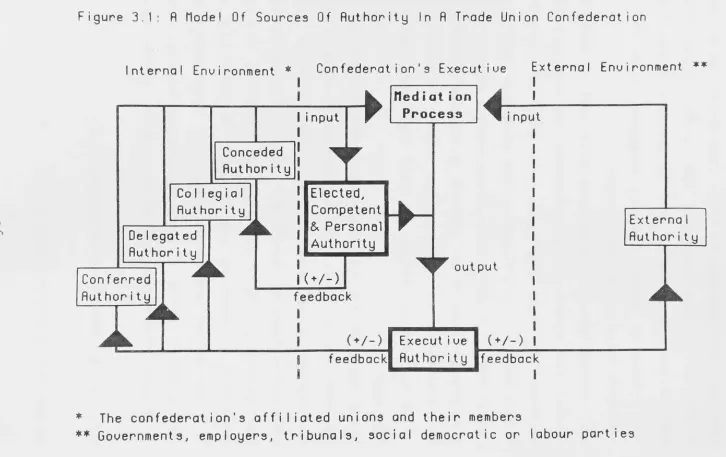
3.1 fl riodel Of Sources Of A u t h o r i t y in A Trade U n i o n 5 1 Confederat ion
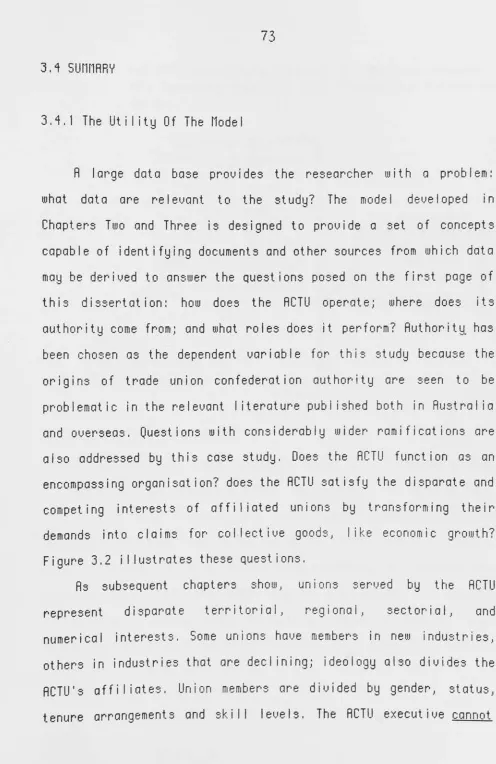
3 . 2 The ACTU Executive's C a p a c i t y To T r a n s f o r m 74 D i s p a r a t e And Competing Interests Into D e m a n d s
For C o l l e c t i u e Goods
4.1 A g g r e g a t e Annual A f f i l i a t i o n Fees Paid To The !U3 flCTU And The del b o u r n e T L C , 1927-195?
4.2 The Inclusiueness Of The A C T U , 1953-1983 106
5.1 The E l e c t o r a l C o l l e g e s F o r m e d By ACTU C o n g r e s s 123 Delegates And The Six State B r a n c h e s IJhich
.Jointly Elect The 26-f1ember RCTU E x e c u t i u e ( 1 9 8 3 )
5.2 Educational A t t a i n m e n t And A u e r a g e Age At Uhich 145 Executiue H e m b e r s Here E l e c t e d To T h e i r First
Union Position And To The ACTU E x e c u t i v e
5,1 ACTU-Government And A C T U - U n i o n R e l a t i o n s D u r i n g 192 Anti-Gnuernment Protest S t r i k e s , 1969
List Of Figures (Contd)
Number Title Page
7.2 Proportions Of Aggregate Invitations To Attend 231 fleet ings Convened By The ACTU For The fletalj
Building^ Transport And 'Other' Industry Groups In 1917, 1957, 1967 And 1977
8.1 Total Union Contributions To Support The ACTU's 273 Arbitration Agency Service Adjusted To 1969
List Of Tables
Number Title Page
4.1 The Ruthority Conferred By Affiliated Unions On The 81 Fiue TLCs Uhich Became flCTU State Branches In 1927
4.2 The Nexus Betmeen The Authority C o n f e r r e d On The Fine 89 TLCs In 1927 And (1) Their Electoral C o n s t i t u e n c i e s
And (2) Their Executiue Structures
4.3 Conferred Ruthority find flffi M a t e d Union Control Of 92 The Fiije TLCs
4.4 Conferred Ruthority find Union Control Of The RCTU, 96 1927-1957
4.5 The Inclusiveness Of The RCTU (Affiliated Nembership/ 105 Total Unionists In Australia x 100) 1953-1983
5.1 Changes To The ACTU Executive Structure, 1927-1983 121
5.2 ACTU Executiue Members Elected By Each Electoral 124 College, Their Term Of Office And Employment By
The ACTU
5.3 The RCTU 'Congressional' Electoral College, 1953-1983 125
5.4 The ACTU 'Industry Group' Electoral Colleges, 1957 128
5.5 The ACTU 'Industry Group' Electoral Colleges, 1983 130
5.6 The Educational Attainment Of ACTU Executiue llembers 133 And Their Vear Of Election To The Executiue
5.7 The Auerage Age Nhen RCTU Executiue flembers Here 135 Elected To Their First Full-Time Union Position
And Their Educational Attainment
List Of Tables (Contd)
Number Title Page
5.9 Linkages Between flCTU Executive ilembers find The ALP 147
5.10 Index Of flCTU-flLP Linkages For The Flue Executive 150 Offices
6.1 Basic Parameters Of 1951, 1965 and 1979 Congress 167 Documents Supplied To Delegates
6.2 The Incorporation Of Unions Into The Policy Formation 169 Process fit The 1951, 1965 find 1979 Congresses
6.3 Executiue Rnd lion-Execut iue Oral Interuent ions Rt The 171 1951, 1965 find 1979 Congresses
6.4 The Proportion Of Agenda Items In 16 Policy Categories 174 Submitted To flCTU Congresses During The Three Decades
1951-1959, 1961-1969 find 1971-1979
6.5 fl Rank Order Comparison Of Agenda Item And Congress 177 Decision Frequencies In 16 Policy Categories, 1951-79
6.6 flCTU Female (find Junior) Affiliated Hembers fls A 182 Proportion Of Females Employed In Fi^e Industries
In 1955 find 1973
7.1 Heatings Convened By The fiCTU find Inijitations To 215 Attend Extended To Affiliated find Non-fiffiIiated
Unions, 1947 To 1977
7.2 fleet ings Conuened By The fiCTU In 1947, 1957, 1967 216 And 1977 To Consider tlajor Industrial Issues
7.3 Aggregate Inuitations To Attend Meetings Conuened 230 By The ACTU For Each Industry Group Of Rffiliated
List Of Tables (Contd)
Number Title Page 7.4 flffiIiated Unions Categorised By The Frequency Of 234
Inuitations Received To Attend Meetings Conuened By The flCTU In 1947, 1957, 1967 find 1977
7.5 Union Size find Its Correlation Uith The Frequency 236 Of Inuitations To Rttend Meetings Conuened By The
flCTU In 1947, 1957, 1967 find 1977
8.1 State find Federal Unions That Contributed To The 252 CCFU-t1THC 44-Hour-Ueek Costs
8.2 Rrbitration Court Sitting Days in The Six State 254 Capitals, Darwin find 'Other Locations', in 1907,
1917 find 1917
8.3 Cumulatiye Totals Of Federally Registered Unions, By 256 State In Which Registered, fit Five-Vearly Intervals,
1909-1929
0.4 flCTU Cases, Contributions Paid By Unions To meet Legal 269 Costs find Reimbursement Periods, 1945-1969
8.5 Contributions (In Dollars) To Pay Legal Costs find 272 Research Bureau Cost For Each biennium, 1945-1969
8.6 The Number Of Males On Rverage Earnings Uho Could 275 Haue Been Employed By Union Contributions To The
THEORETICAL FOUNDATIONS
1.1 Introduction
The flCTU, through it? role in the Commonwealth Conciliation and Arbitration Commission^ has a marked influence on Australia's economic and political life. Since 1945, the ACTU has luon regular uiage increases for most of the uiorkforce^ a significant reduction
in ujorking hours and equal pay for women toorkers. floreouerj in February 1983, the month before the Hauike Labor Gouernment, uias first elected, the ACTU became a signatory to the Prices and Incomes Accord, noiu a cornerstone of the Gouernment's economic policy and of considerable electoral importance. In partnership ujith the ACTU, the Gouernment aims to control inflation, reduce unemployment, restructure industry, and stimulate economic growth.' For these reasons alone, the ACTU deserues attention, but of more importance here, uihat sort of organisation is the ACTU? Hou) does it operate? IJhat are the sources of its authority? Uhat roles does it perform?
the flCTU President betmeen and 1969, and other flCTLI executive members, played key roles in promoting and administering Rustralia's post-war immigr>ation programme.
Between 51 and 60 per cent of the workforce haue been enrolled as union members since the second world war (55 per cent
in 1983), while practically all major unions are affiliated to the flCTU.'^* fls a result, the flCTU is now a highly inclusive organisation and has more authority to speak for the Australian workforce as a whole than any other organisation. I will argue in this dissertation that, as the fiCTU's roles expand, so its authority to represent the workforce as a whole will further increase. Greater centralisation of authority in the hands of the RCTU, moreover, will be accompanied by a decrease in the autonomy and authority of individual unions. But what exactly is meant by authority?
a lieutenant. Ueber's concept of authority as a command relationship is most easily understood in the context of an explicit hierarchical structure. Hany examples, other than the one aboue, could easily haue been used.
Authority in the flCTU is not related to positions arranged in a clearly defined hierarchy. In 19^7, for example, trade union leaders were members of the flCTU executiue. Of these 1'f persons, only one, the flCTU Secretary, occupied a full-time position funded by the flCTU. Though the other 13 executiue members mere all full-time union officials, they were not employed by the RCTU. Vet in 1917, the RCTU apparently had the authority to represent unions and their members in the historic case heard by the Rrbitration Court uihich resulted in standard working hours for employees throughout Australia being reduced from to 10 hours per uueek.^
RIbert Honk, who was elected as the flCTU's first full-time Secretary in 1913, might, metaphorically, haue led an army of unionists during the 10-Hour-Ueek case. But, as the RCTU's only
full-time officer, it would be more accurate to describe RIbert rionk as a general without an army. Rt best, an ill-defined hierarchy connected the RCTU Secretary with the other 13 members of the executiue, and there was no hierarchy at all which joined the RCTU Secretary to officers of affiliated unions or with the multitude of union members represented by the flCTU in the 10-Hour-Ueek case.
non-The sum of £9,006 (the equiualent of about $200,000 in ujas contributed by union members, through their unions, to meet the
RCTU's legal and other costs in this historic case.^ Furthermore, the flCTU ujas encouraged by the ILO's policy on shorter hours and it also gained support from the Chi f ley Gouernment. The flCTU asl^ed Prime llinister Chi f ley to legislate for shorter hours using an ILO Conuention as justification, but Chifley belieued that the Gouernment lacked the constitutional power to do this. Instead, he suggested that the Gouernment intervene when the flCTU's case came before the Rrbitration Court
Seueral questions arise from this brief account of the RCTU's role in the 'fO-Hour-Ueek case. Did the flCTU 'command' unions and their members to contribute the equiualent of $200,000 to meet the cost of the 40-Hour-l-Jeek case? If the RCTU did not 'command' unions and their members, did it somehouii influence them to pay? If so, hooi did it exercise its influence? Is there some sort of obscure power differential between the RCTU and its affiliated unions which explains these euents? Rnother interesting question is, why did the Gouernment decide to intervene in the 10-Hour-Ueek case?
tell us about the genesis of authority in other types of o r g a n i s a t i o n s ? These and related q u e s t i o n s are c o n f r o n t e d by this case study of the sources of the fiCTLl's authority.
1.1.1 The fiCTU's Authority: fl Limited Literature
Despite the significant part played by the RCTU in A u s t r a l i a ' s e c o n o m i c and political life, little a t t e n t i o n has been a d d r e s s e d to the sort of questions that haue been posed aboue. Hagan published The History of the R.C.T.U. in 1981 but H a g a n does not treat the ACTU's authority as a central issue. Euans (1968)^ a former member of the RCTU executiue, has published an account of the roles performed by the RCTU and the functions of its executive but Euans does not specifically address the q u e s t i o n of the ACTU's authority either. Hoiueverj as uoeil as p u b l i s h i n g reports of ACTU congress proceedings since 1961, flartin has p u b l i s h e d tuio pioneering articles on the authority of the RCTU (1958 and 1962), stimulating my own interest and that of others.s
centre, as Hart in calls the flCTU, mi I I haue little chance of pressing its claims on outsiders unless unions are prepared to surrender autonomy by submitting to its demands.
Hart in, as the following quotation shows, does not equate internal authority with any sort of hierarchy. Internal authority
... is essentially a product of compromise and expediency. It has little to do with constitutional prouisions and formal sanctions, and depends for its substance and maintenance on such variable factors (to mention the most obuious) as personal relationships between fl.C.T.U. officers and union
leaders ... (1962: 186).
riartin goes on to say that the exercise of internal authority is a delicate matter and "... its stability cannot be taken for granted" (1962: 186). External authority, he argues, depends on the organisation being accorded recognition by significant outside actors, particularly by gouernments.^
flartin's concepts prouide part of the foundation for the analysis of authority in this dissertation, i haue deueloped a model of authority in which internal authority is differentiated
Here^ I classify the flCTU as a trade union confederation in which authority flows from the periphery towards the centre rather than down from the top. Generally speaking, all trade union confederations - organisations such as the British TUC, the Swedish LO, the West German DGB, and the RFLCIO in the U.S. -perform roles that are comparable: they mediate between their
internal and external enuironments. On the basis of my flCTU case study, I will argue the thesis that a trade union confederation's authority is principally derived from the roles performed by the confederation's executive.
1.2 STRUCTURES RND ROLES
1.2.1 Classifying The RCTU Rnd Similar Organisations
In the early 1920s, unsuccessful attempts were made to form an Rustralian One Big Union (OBU). The OBU was meant to replace a!I existing unions and its members working in the same or similar
Each of the flCTU's constituents is itself an organisation ujith its oijun rules, constitution and members. Unions become constituents of the RCTLI by affiliating to it and by paying the appropriate affiliation fees. In 1983, 157 unions representing about tmo and a half million members were affiliated to the RCTU.^o* Host of these unions are federal organisations: they haue branches in two or more states or territories and a number haue branches in all states and territories, Individual unionists are not members of the flCTU but are affiliated to it, through their unions. In this dissertation, they will be referred to as the RCTU's affiliated union members.
The only trade union organisations in Australia structurally similar to the flCTU are the Trades and Labor Councils (TLCs),ii Trade unions affiliate to the TLCs, as they do to the RCTU, but the TLCs are state rather than federal organisations. State branches of federal unions, and unions which exist only within a single state, are affiliated to TLCs located in Fie I bourne, Sydney, Brisbane, Adelaide, Hobart and Perth and in a number of prouincial centres, such as Bendigo in Uictoria and Newcastle in New South Hales. Each of the six TLCs located in the state capitals is now a branch of the RCTU. Howeuer, a state branch was not formed in Uestern Rustralia until 1919.^2 jhe fiue state branches, located in the eastern states, were crucially important in the RCTU's early years (see Chapter Four).
Uhereas the TLCs represent unions at the state level, the RCTU represents unions at the national and at the international
to the flCTUs. The uiord similar is used aduisedly: no similar organisation in any other country except Neui Zealand represents unions in a luage-fixing system controlled by the state since only New Zealand and Australia haue adopted arbitration systems, The British counterpart to the flCTU, the TUC, and the RFL-CIO in the U.S. do not participate in a state-controlled, luage-fixing system, and neither does the Uest German DGB or the Siuedish LO. Notwithstanding this rather important difference, the RCTU and its counterparts named aboue are structurally similar organisations and each performs national and international representational roles on behalf of its affiliated unions and their members.
coalition of individual unions and in Romance countries it is usually an individual u n i o n "
Crouch (1982), Hartmann and Lau (1980), Heady (1970) and Uindmuller (1975) call organisations like the flCTU, trade union confederations. Trade union confederation is an appropriate term because the constituents of these organisations are trade unions. Confederations perform representational roles and centralise at least some of the functions otherwise fulfilled by indiuidual trade u n i o n s O f most importance in this context, authority is distributed in similar mays in all trade union confederations.
Confederations are founded on three basic principles. First, the "... center is not sovereign - it holds its authority at pleasure from the constituent ('peripheral") units of the confederation" (King, 1962: 133). That is, constituent units confer authority on the central executive of the confederation and authority flouis inwards toward the centre, not downwards from the top as it does in many organisations. Second, in confederations the autonomy of constituent units or parts is safeguarded. The "... center can exercise only as much authority as the constituent parts are willing to relinquish" (Uindmuller, 1975: 92). Third, a confederation's constituents are not individuals; they are other organisations and the central executive of the confederation has no direct control over individuals (llahlke and Dragnich,
The form of gouernment adopted and the distribution of authority between affiliated unions and the central executive undoubtedly uaries betiween confederations. These uariations^ however, are not so substantial as to inualidate this c l a s s i f i c a t i o n T h r o u g h o u t this dissertation^ 'confederation' will be used to describe a class of organisations of which the RCTLI, the TUC, the RFL-CIO, the Uest German DGB and the Swedish LO are fiue trade union examples.
1.2.2 fln Intermediary Role
Trade union confederations mediate between their affiliated unions and significant external organisations, like gouernments and employer organisations. Thus, trade union confederations are intermediary organisations (Hartmann and Lau, 1980: 366). fls flartin puts it, the role of the TUC is
essentially that of an intermediary, l-lhen it presents claims to gouernment, it is as it were, facing two ways simultaneously. It is not only claiming gouernment recognition of its right to be heard; it is also asserting in relation to its constituents, the authority to speak on their behalf (1980: 1-5).
affiliated unions. But mho OP uihat does flartin identify as the TUC?
In a footnote to the quoted passage, flartin explains what he means by the TUC:
... the term 'TUC here refers to the organisation's leadership enclosed in its executiue organ (originally knoum as the Parliamentary Committee, latterly as the General Council), mith its associated full-time administrative staff and committees draujn exclusiuely or predominately from its own membership (1980: 5).
Follouiing flartin, I shall use 'fiCTU' to refer to the RCTU's executiue or to its full-time officers mhere they speak, as they often do, in the name of the flCTU.
If a confederation's executiue has a separate organisational identity, and that is flartin's position, questions arise about the relationship between the executive and the confederation's affiliated unions. I argue that its affiliated unions are a significant part, but only a part, of a confederation's organisational enuironment. The environment is the surroundings or the context mithin which an organisation operates (Dill, 1971; 82) or, putting it in other words, the enuironment includes euerything outside a particular organisation that it must contend with (Hall, 1977: 22). Rn organisation's enuironment includes other organisations, the state of the economy, social and political conditions and territorial and geographical imperatiues.
internal enuironment are its affiliated unions and their members. Hoiueuer, the expectations of affiliated unions towards the confederation may not be the same as those of union members. Confederation officers are
very much aujare of the dualistic nature of the internal environment. They are under pressure to satisfy the expectations of the constituent trade unions as well as the rank and file and they are anxious to secure the loyalty of both (Hartmann and Lau 1980: 371).
For historical reasons, the internal environment of particular confederations may include additional organisations, and this is the case luith the flCTU.
The flCTLI's internal environment is very much a product of the Rustralian federal system. It consists of the following overlapping organisations and their memberships: federal unions, some state unions which are not branches of federal unions but are affiliated directly to the flCTU, the six state branches (the metropolitan TLCs), a number of provincial TLCs such as those in Newcastle, Uollongong and Bendigo, and union members many of whom are affiliated, through their unions, to both the state branches and to the RCTU direct
(RLP) and the Federal Par Iiamentany Labor Party (FPLP), state and federal arbitration systems (particularly the federal system), the
ILO, the ICFTU and trade union confederations in a good many other countries.
fi confederation's external environment, furthermore, includes trade unions mhich are not affiliated to the confederation and luhich sometimes are regarded as organisat ional riualsJ"^ For example, the Rustralian Workers' Union (flUU) did not affiliate to the RCTU until 1967. Rs the fiUU was Rustralia's biggest union, its non-affiliation was of considerable importance to the RCTU. For much of the 40-year period 1927-1967, leaders of the RUU and the RCTU were publicly opposed, although, as shown in Chapter Eight, they privately cooperated to some extent. Until 1967 the RUU was a significant part of the RCTU's external environment.
Like other confederations, the RCTU derives its authority principally by mediating between its internal and external environments. The derivation and maintenance of the RCTU's authority, therefore, is of central concern throughout this dissertation. In the remainder of this chapter, authority and related concepts, like influence, power and legitimacy, are discussed.
1.2.3 Influence, Power Rnd Authority
confined to the eueryday use of the terms: it is also reflected in scholarly discourse. By different scholars
power is regarded as a form of influence, or influence as a form of pomer, or they are treated as entirely distinct phenomena ... Authority is a subtype of poujer, or power and authority are distinct and opposite (Wrong, 1979: 65).
I shall adopt what Peabody (1961: 5) calls a "... genus and differentia approach ..." defining pocuer as a special case of
influence and, in turn, I shall define authority as a special case of power,
Before defining it, a number of points can be made about the nature of influence. It follows from the aboue that influence is the most inclusive concept of the three. In addition, influence can be exercised both intentionally and unintentionally (Gamson, 1968: 69 and Urong, 1979: 1). Influence, furthermore, does not necessitate the use of sanctions such as threats (negatiue sanctions) or promises (positive sanctions). Ueather forecasts, for example, influence aviation, farm activities, sporting events and so on, yet the meteorological office does not offer sanctions to users of its forecasts. It simply issues, or communicates them to users and undoubtedly these forecasts influence behaviour.
Influence is defined as any transaction or event which changes behaviour or policy. On the other hand, influence is also exercised when existing behaviour or policy is reinforced (Hoisti,
197-^: 156).
1973: 1 H 6 and Urong, 1979: 1-5). Recording to Ueben, power is exercised in most, if not all, social relations. It can be exercised "... in the market, on the lecture platform, at a dinner party, in sports or scientific discussions, in erotic or charitable relationships" (Bendix, 1969: 290). Ueber defines power as "... the probability that one actor within a social relationship will be in a position to carry out his own will despite resistance ..." (Giddens, 1971: 17).
One reading of Ueber's definition of power implies that the exercise of power necessarily inuolues conflict: the resistance of others has to be overcome. But Giddens (1971: 17) argues that this is a misreading of Ueber's phrase "euen against the resistance of others ...". fln actor may carry out his or her own will or exercise power, despite resistance and olso in the absence of resistance. The exercise of power may be indirect, it may be subtle, and it may be exercised with low visibility. For example, trade union leaders exercise power when they deflect attention away from issues to the point that they are no longer diuisiue or harmful to their organisational interests (Giddens, 1971: 18).
represented the flCTU, its affiliated unions (and some unaffiliated ones including the RIJU), and their members in the Arbitration Court.
Authority may be defined as a command relationship but, as discussed earlier, there is a good deal more to authority than merely this one aspect. According to IJeber, authority is a special case of power: it is "... the power to command and the duty to obey" (IJeber, 195'f: 324). It is not difficult to see how power differentials between superiors and subordinates create the capacity for superiors to command subordinates. The second part of Ueber's definition., howeuer, provides more difficulty. How do power differentials create a duty to obey?
Ueber provides a clear example of the conuersion of one type of power relationship into authority. The power of the market, argues Ueber, is "... based upon influence derived exclusively
from the possession of goods or marketable skills ..." (IQS't:
1.2.^ Legitimacy Rnd Authority
Legitimacy is a pigotal concept in Ueber's theory of authority as indeed it is in all theories of social order. Euery authority system, IJeber wrote, "... attempts to establish and to cultiuate the belief in its legitimacy" (1917, 298), Ueber appears to equate legitimacy with perceptions of the morality, of the rightness, of the propriety or of the justice of directives issued by authorities (Eckstein, 1973: 1152). But legitimacy,
fundamentally, does not appear to be a moral issue. In the case of the bank's authority over its client, for example, morality seems not to be at issue. The bank merely made a business decision to protect its investment in the corporation by taking control. Rather than morality, Rbell (1979: H 3 ) suggests that Ueber ujas more interested in the need for compliance in organisations.''^
Blau (1970: 156) poses a question uihich Ueber either avoids or answers inadequately. Blau asks: hoiu are other forms of power transformed into legitimate authority? How, for example, do conquerers legitimise their rule when they become kingsT^o In bureaucracies the legitimation process is also complex. Terms of employment, whether expressed in legally binding contracts or not,
legitimate formal superior-subordinate relations. Generally, superiors receive greater rewards than subordinates and as a result they are expected to exercise more legal authority.21 Superiors can sometimes resort to coercive measures to ensure subordinate compliance but the scope of legal authority, even if
Legal authority does not ensure uiillingness to work, nor does it encourage initiative or harmonious industrial relations. If senior officers, managers, supervisors and leading hands are to contribute to achieving organisational goals, they must rely more on their influence over subordinates than on formal legal authority. How is the superior's influence converted or transformed into legitimate authority over subordinates? Does the superior simply rely on the subordinate's belief in the correctness of instructions or orders? Blau thinks not, for persuasive reasons. Legitimacy, according to Blau, depends on subordinate reaction to influential superiors.
influence and pouier are transformed into legitimate authority by particular sorts of managerial practices and by the collective reponse of subordinates, Hanagers extend their influence and power by supplying information controlled by superiors, by representing subordinate interests to higher authority and by neglecting to enforce unpopular rules. In short, influence and power are extended by supplying subordinates with scarce resources,
including the superior's good will. This creates a reservoir of joint social obligations amongst subordinates who have an interest
in maintaining good relationships with their superiors. Thus, subordinates, rather than superiors, establish group norms, enforcing compliance on potential deviants. Blau argues, the "... prevalence of such a normative orientation among subordinates
subordinates rather than the instruments of pomer or influence wielded by the superior himself ..." (1970: 155).2 2 Legitimate authority therefore entails uoluntary compliance by the collectiuity of subordinates who comply with group norms. Something like obligatory compliance^ howeuer, is exacted from
indiuidual subordinates uiho respond to what Blau calls "... compelling social pressures" (1970; 158). Blau uses a striking metaphor to illustrate the obligatory nature of indiuidual responses to group norms luhich legitimate authority. The response of indiuidualSj Blau argues, is about as "... uoluntary as our custom of wearing clothes" (1970: 158).
Legitimate authority can be distinguished from the use of power backed by coercion, such as the coerciue power exercised by James Hoffa ouer the Teamsters' Union in the USfl, fl superior who resorts to coercion concedes that legitimate authority is failing, or worse, that it has already failed (Carter, 1979; ^^9). This is not to say that authority should neuer be supplemented with coerciue power or that coerciue power is necessarily illegitimate.
It is to say that legitimate authority entails a set of role expectations that do not include the use of coercion. Coerciue power is an alternatiue, but incompatible, form of social control called into play when legitimate authority is under threat or has
1.3 SUnnRRY
1.3.1 The Legitimation Of The fiCTU's fiuthonity
Relations between influence, power, authority and legitimacy are shown in Figure 1.1. influence is more inclusive than power which in turn is more inclusive than authority; all authority is power and all power is influence. But not all influence is power, and not all power is authority. Authority is the smallest domain and it is distinguished from both power and influence by an added dimension: legitimacy. In bureaucracies, as I have argued above,
Figure 1.1: Relations Between Influence, Power, Authority and Legit imacy
Influence Power
L eQ/f /^tjcu
Authority
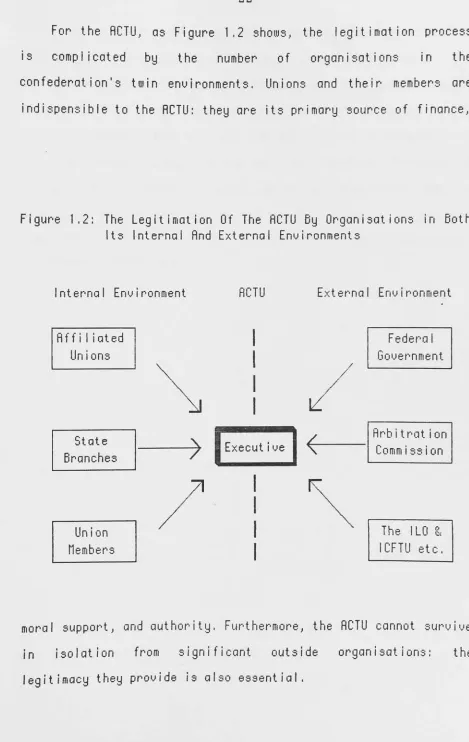
FOP the flCTU, as Figure 1.2 shows, the legitimation process is complicated by the number of organisations in the confederation's tin in enuironments. Unions and their members are
[image:43.567.59.528.59.801.2]indispensible to the RCTU: they are its primary source of finance,
Figure 1.2; The Legitimation Of The fiCTU By Organisations in Both Its internal find External Environments
Internal Enuironment fiCTU External Environment
Execut i ue
/
f
-FederaI Government
flrb i trat i on Comm i ss i on
The ILO 8< ICFTU etc.
^ These aims are spelled out in the STRTEflENT OF ACCORD BV THE flUSTRRLIflH LRBGR PRRTV AND THE AUSTRRLIRN COUNCIL OF TRRDE UNIONS
(ACTU Not long I Directoru and Union Officials' nanual. 1983-8'^). ^ A set of guidelines for handling interstate disputes u>as
developed by a conference convened by the flCTU in July 1928 following the Marine Cooks' strike (Hagan, 1981: 89-90).
^ This spelling (labour) will be used except mhen referring to the Labor Party or Trades and Labor Counci Is.
See Table 1.1: riembership of Rustralian Trade Unions 1691-1983, Submission To The Connnittee Of Reuiem Into Rustralian
Industrial Relations Law And Sustems, Department of Eniployment and Industrial Relations^ Hay 1984.
5 The Arbitration Court ceased to function following the High Court's 1956 decision in the Boilermakers' case. An Industrial Court was then established to exercise judicial powers while arbitral powers were uested in the Commonwealth Conciliation and Arbitration Commission. The ACTU's role in the Boi Iermakers' case
is discussed i n Chapter Eight.
^ Documentary sources for these costs are provided in Chapter Eight. Conversion to 1978 values was made using retail price index numbers for 1978 (1,313) and for 1946 (190) found in the Vear Book Rustralia (1980: 131). Conversion from 1978 to 1984 values was then made using figures for 1984 (132) and 1978 (83) from the Vear Book Australia (1985: 105).
ABL/RCTU letter To Secretaries Of Rfflliated Unions from Secretary flonk, dated February 12, 1946, N21/42.
8 For Martin's reports of RCTU congress proceedings, see The Journal Of Industrial Relations and Labour History.
9 In a response to Martin's two articles (1958 and 1962), Dabscheck criticises Martin for not appreciating "... the significance of a compulsory arbitration system for the 'nature' and operation of Australian trade unions" (1977: 389). As already
indicated, I believe the ACTU's role in the arbitration system has contributed significantly to its authority and this is illustrated in Chapter Eight. Here I am concerned with establishing a conceptual framework and discussing Dabscheck's article would not contribute to that end.
10 mnil. National Directory and Union Officials' Manuol .
1983-8 4 .
The fiLP in Perth, the IJestenn Australian capital, became a branch of the flCTU in 19-^9 (Pilklnton, 1963; 280), fl Perth TLC was
formed in 1962 and it then became the flCTU's state branch (flBL/flCTU, Minutes Of flCTU Executive Meeting, Julq 3, 1962, H21/278).
^^ Romance countries e.g. France, Italy and Spain are those whose languages are derived from Latin,
The TUC, for example, has traditionally represented British trade unions in negotiations uuith the British Gouernment (Martin,
1980).
^^ Classification allows comparisons to be made and contrasts to be dramn between organisations which are similar and, on the other hand, between organisations which are ostensibly quite different. fl study of The National Collegiate Rthletic Association (NCAA) in the U.S., for example, has provided useful
insights for this case study because the NCAA is classified as a loose confederation of universities which was transformed "... into the dominant control agent over intercollegiate athletics during the period from 1906, when it was organized, to 1952, when member schools granted it regulatory power" (Stern, 1979: 2*12). Classification is therefore of some importance: it facilitates moving from the general to the particular case and then from the particular back to the general case.
Provincial councils in each state have access to the flCTU through their state branches. Five provincial councils, three of which are in New South Hales, have direct access, These five are the Barrier Industrial Council (Broken Hill), the Newcastle TLC, the South Coast TLC (UooIongong), the ACT TLC (Canberra) and the Northern Territory TLC (Darwin).
One or two union federations with a restricted constituency, such as the Metal Trades Federation (MTF) and the Maritime Transport Council (MTC), are also in this category. The MTF is discussed in Chapter Seven.
18 The AUU's significance can be judged by its affiliated membership of 156,657 in 1967 compared with the two next biggest affiliates. The Federated Clerks' Union (FCU) and the flmalgamated Engineering Union (AEU) paid fees on 58,727 and 56,150 members respectively: they were about one third as big as the fllJU (ACTU Executive Report, September 1967).
by t h o s e who exercise poiuer "... and p a r t i c u l a r l y by those subject to it ..." (flbell, 1979: 113).
Ueber^ of course, identified three ideal typical luays in luhich poiDer d i f f e r e n t i a l s hai^e been legitimated throughout h i s t o r y . These are; [1] traditional authority w h i c h is legitimated by "... an e s t a b l i s h e d belief in the sanctity of immeinorial t r a d i t i o n s and the legitimacy of the status of those exercising a u t h o r i t y under them" (1947: 301); [2] c h a r i s m a t i c authority which
is legitimated by "... deuotion to the exceptional sanctity, h e r o i s m or exemplary character of an indiuidual person, and of noriTiatiue patterns of order reuealed or o r d a i n e d by him" (1947: 301) and [3] rational legal authority which is legitimated by a "... belief in the 'legality' of patterns of n o r m a t i v e rules and the right of those e l e u a t e d to authority under such rules to issue c o m m a n d s ..." (1947: 300).
21 See preuious note for Ueber's definition of rational legal author i ty,
C o e r c i o n undoubtedly produces conformity in a u t h o r i t a r i a n s o c i e t i e s such as the Souiet Union but could Souiet leaders rule ijuithout the support of the populace? Probably not. Blau's p o s i t i o n would probably be upheld, although not as strongly, euen
CHAPTER TUO
THE SiriPLIFIED HODEL
2.1 Introduction
fl trade union confederation is legitimated by external organisat ions, particularly gouernments., as uuell as by unions and their members. Claus Offe (1981) in a contribution to the debate on neo-corporatism, makes a similar point. Offe argues that any organisation that is accorded positiue political status, through its recognition by gouernments "... has resources to spend that do not floui from the luiMingness of members to contribute to a common objectiue ...". fls a result, Offe argues, the behauiour of such an organisation is only partly determined by its members because "...
it has commitments to honor that are the price for political subsidy and hence are irreducible to the membership leuel ..." (1981: 137).
Confederations or unions that gain recognition from external organisations, especially from gouernments, enjoy a number of aduantages. In the case of a French agricultural union, these
extent of the authority conferred on the confederation by affiliated unions and their members.
in this chapter, I deuelop a simplified model of sources of authority in trade unions confederations based on systems analysis. Within the systems framework, organisations are uieujed as social formations which transform inputs of material, energy or
information into outputs of some kind (Kast and Rosenziueig, 1970: 119: Euan, 1976: 1 3 5 - H 7 ) . For example, a systems analysis of Australia's federal Conciliation and Rrbitration Commission would probably identify submissions to the Commission from unions, employers or gouernments as system inputs, deliberations of conciliators and arbitrators as transformation processes and the Commission's decisions as system outputs. In my model, inputs basically consisting of union support and external legitimacy are transformed through mediation processes into authority that is exercised by the confederation's executiue,
Until about 1960, closed systems models, which assumed that organisations were isolated from their enuironments, tended to dominate the literature on organisational theory (Starling, 1975:
Gouerninent, the state of the economy, OP the status of female luorkers compared with their male counterparts.
In the period since about I960, the analysis of organisations as open systems has tended to displace closed systems analysis
(Scott, 1981: 407). Open systems analysis recognises that organisations and their environments are interdependent and that mutual dependencies are created and maintained by the tujo-ujay exchange of resources across permeable organisational boundaries. Interdependency is such that, on the one hand, environmental factors can influence and change organisational processes and structures and, on the other hand, organisations can manipulate their environments (Scott, 1981: 407-10: Starling, 1975: 166). Trade union confederations exemplify each of these attributes: they are open organisational systems.
2.2 SOURCES OF R CONFEDERRTIOH'S RUTHORITV
[image:50.567.67.534.55.796.2]2.2.1 The Simplified flodel Explained
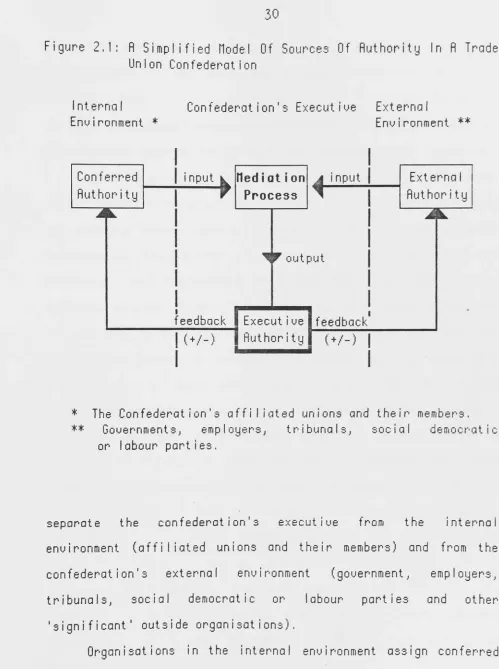
Figure 2,1 is a simplified model of an open organisationaI system in oihich the degree of interdependence between the confederation's twin environments and the executive is very high
Figure 2.1: fl Simplified node I Of Sources Of Ruthority In R Trade Union Confederation
Internal Confederation's Executiue External Environment * Environment **
* The Confederation's affiliated unions and their members,
GooernmentSj employers^ tribunals^ social democratic or Iabour part i es.
separate the confederation'3 executive from the internal environment (affiliated unions and their members) and from the confederation's external environment (government, employers, tribunals, social democratic or labour parties and other
'significant' outside organisations).
executiue authonity, the system output. Through feedback, organisations in both enuironinents sense "variations in output
(Starling, 1975: 171). in turn, the reaction of organisations in the tmin enuironuients determines the leuel of future transfers of conferred and external authority to the confederation's executive.
The configuration of Figure 2.1 is consistent ujith the thesis that a confederation's executiue derives its authority principally by mediating between the confederation's internal and external enuironments. The central location of the executive, moreover, emphasises its intermediary role and the importance of the mediation process. It should be noted that the figure is laid out horizontally rather than vertically; this emphasises the non-hierarchical nature of interactions between the executive and organisations in both environments. ^ Furthermore, the figure conveys the impression of a dynamic, open, organisational system.
2.2.2 Conferred Authority Through Consent
Trade unions confer authority on a confederation by affiliating to it. Rs a union's decision to affiliate entails the transfer of resources, it is a conscious and deliberate act. Equally important, as this decision commits the union as a whole,
it must be made in accordance with the union's constitution and rules, Affiliation requires the consent of the union's gouerning body or council and may also require the approual of the union's members whether obtained by a plebiscite or by decisions taken at representatiue meetings. In conformity with these principles, conferred authority is defined as a formal warrant of authority
issued by a trade union which has decided to affiliate to a confederat ion.
fiffiMated unions agree to abide by the confederation's constitution, rules and conuentions of behauiour. Confederation gouernment is based on majority decisions, binding both the executive and affiliates. Other affiliated unions demand respect
for their rights, for example in job-control and recruitment. IJhen they affiliate, unions know that the confederation's executive will control some of their octiuities and that the executive will claim the right to represent their interests to outside organisations. These last conditions are important because they mean that unions give up some of their autonomy by affiliating to a confederat ion.
confederation supplies its affiliates and their members tuith
ualued collectiue goods or "... goods u)hich cannot feasibly be
withheld from others in that group" (Olson, 1965: 11). National
luage increases, for example, are collectiue goods supplied to all
union members as a result of the RCTU's aduocacy in the
Arbitration Commissi on.2 On the other hand, affiliated unions haue
control ouer resources which the confederation cannot acquire
except from them, To meet its ouun organisational needs, a
confederation exchanges resources with trade unions. In return,
unions affiliate under conditions specified in confederation rules
or in agreements made with its executiue.
Union membership is a resource that has considerable
intangible value, fl union's membership, when aggregated with that
of other unions, is an indicator of the legitimacy bestowed on a
confederation by its affiliates.^ Rt its annual Conuention held in
Brisbane in January 1967, the RIJU announced the end of its '^0-year
stand-off. Conuention delegates decided unanimously that the big
union would affiliate to the flCTU, The Courier flai I of 26 January,
proclaimed that it was, the "IJedding of the (union) century". The
RUU's 'dowry' included its large membership. The 1967 RCTU
Executiue Report shows that the RUU affiliated on the basis of
more than 150,000 members and that since 1965, the RCTU's
aggregate affiliated union membership had increased by 10 per
cent, due to the RUU's affiliation.'^
Unions will sometimes affiliate to a confederation in the
hope of influencing gouernment policy. In Britain, for example,
TUC for a long time, sporadically debating the issue from the
1390's to the mid 19603 (Coates, 1972: 100-111). The HUT feared
that TUC affiliation would align the union with the Labour Party,
that it mould destroy the professional status of teachers, and
that it would lead to the resignation of members,^ But by the late
1960s, the TUC "... had become the only channel through which
teachers ... might exert influence on the formation of national
economic policy" (Coates, 1972: 101), Faced with the reality of
the TUC's monopoly on trade union access to gouernment, the HUT
cast aside its objections and affiliated in Hay, 1970.®
Rs a condition of their affiliation, unions also pay fee-s; to
the confederation. From the confederation's standpoint,
affiliation fees are an important tangible resource as they are
likely to constitute a substantial proportion of total income, in
1982, for example, the RCTU's affiliation fees of $1,851,390
represented 92 per cent of its income for the year."* Prior to
paying its annual fees, each union must decide to continue its
affiliation. Thus, the continued payment of fees is a renewal of
consent to affiliate and, of great importance, the continued
payment of fees is a renewal of the warrant of authority conferred
2.2.3 Externa! Authority
Rs noted in Chapter One, Hart in (1962: 175) defines external
authority as the "... abi I ity to impose claims on outsiders ,..".
The ujord 'impose', with its connotations of force and compulsion,
seems rather too strong to describe the relationship betujeen a
confederation and an 'outside' organisation, particularly a
gouernment. Confederations gain concessions from gouernment,
seldom 'imposing' claims on them, fl confederation's primary role
is to mediate betiueen 'outside' and 'inside' organisations,
negotiating the exchange of mutual concessions, External autharity
is contingent on 'outside' organisations recognising the
confederation's capacity to mediate between them and 'inside'
organ i sat i ons.
Through international agreements, confederations become
sources of external authority for their counterparts in other
countries. In the flCTU agreed to an ICFTU proposal that
uisits to the Federal Republic of Germany (FRG) by trade union
delegations from Rustralia should be restricted to those arranged
by the DGB.®* In 1973, flCTU Secretary Souter wrote to George
fleany, President of the RFL-CIO, uouching for the Federal
Secretary of the RUU, about to embark on a study tour of the union
movement in the United States,^* Rs this letter indicates, if an
Rustralian union wishes to gain access to affiliates of the
RFL-C I O , it must first recognise the HFL-RFL-CIO's authority,^^
Governments and other outside organisations act in their own
is because confederations haue the capacity to decrease the
socio-political uncertainty (Hickson et. al., 1971: 219) faced by
outside organisations in their dealings mith trade unions and
their members. Rs one strategy to counter this source of
enuironmentaI uncertainty, at times a serious problem, external
organisations actively 'sponsor' confederations (Hartmann and Lau,
1960: 370). In exchange, confederations expand their coordinating
and centralising roles and affiliated unions, millingly or not,
are increasingly forced to rely on them in order to gain access to
external organisations.^^
fis soon as it was formed in 1927, the flCTU gained
recognition from the Gouernment ouer a matter of great importance
to the neiu confederation. Rs a signatory to the Treaty of
Uersailles signed in 1919, the Rustralian Gouernment has aluuays
been required to select employer and morker delegates to attend
ILO conferences. Recording to the ILO, the selection process is to
be done in consultation mith the 'most representative'
organisations of employers and trade unionists respect i ue I y. fji
its first meeting in August 1927, the RCTU executiue decided on
procedures to elect potential ILO delegates, the final selection
to be made by the G o u e r n m e n t . B y coordinating these elections,
the RCTU expected to be accorded 'most representative' status by
the Government and, moreover, to have its authority similarly
recognised by the international community, especially by trade
unions in other countries (see Chapter Nine).^'^
R devolution of authority occurred in 1930, to use Keeler's
the final selection of the single ILO delegate mas formally transferred to the RCTU. Rs noted aboue, the ILO merely requires the Gouernment to consult iiuith 'the most representative" organisation of workers over this matter. Betuieen 1927 and 1930, the Gouernment itself selected a single delegate from a panel of names submitted each year by the RCTU. The RCTU, hoiueuer, persistently informed the Government of its strongly held belief that it luas the best judge "... as to the person or persons most suitable to be .... (the uiorkers') representative or representatives . . .". In 1930, the RCTU was invited by the Government, for the first time, to independently select, the workers' delegate who would represent Australia at the ILO.''^'*
Such is the importance of recognition that the contest for it may absorb more of a confederation's energy than it expends on representing its constituents (Kwavnick, 1970: 58).^" The loss of such a contest, moreover, may have serious consequences. In Britain, the General Federation of Trade Unions (GFTU), formed in
1899, represented the international interests of British trade unions prior to the 1 9 H - 1 9 1 8 war, the TUC displaying little
interest in doing so at that time. Rt the end of the war, the Government invited the much more inclusive TUC to advise it on the
labour clauses of the Uersaille Peace Treaty (Prochaska, 1962: 151). Subsequently, it was the TUC which was accorded 'most representative' status, so gaining the right to nominate ILO delegates. The withholding of government recognition from the GFTU
2 . 2 . 1 The flediat ion Process
fled i at ion is a bargaining process facilitated by
intermediaries lufiose presence is required more often than not at
the bargaining table, flediators bring disputing parties together
so that the parties themseiues can reach agreement. Essentially^
mediators haue only one task; "... to work towards an agreement
that both sides are likely to accept ..." (Johnston, ]962:
Mediators may urge the parties to make concessions, to make offers
and counter-offers; mediators are entitled to bring pressure to
bear so that the parties do reach an agreement. But mediators are
not entitled to make autards or to impose judgements; they are
conciliators rather than arbitrators (Johnston, 1962;
The role of the mediator is based on the expectation that
relations between the parties can be stabilised in the short-term,
if not in the long-term, fl basic conflict of interest, such as a
conflict between unions and employers, will probably not be
permanently resolued by mediation. Nonetheless, parties that are
in conflict often seek mediation because it avoids the imposition
of a solution by an outside arbitrator. Uhen mediation takes
place, the final solution is an agreement between the parties
themselues, and the parties retain their autonomy and freedom to
bargain again in the future (Ross, 1968: 507).
In addition to taking a neutral position, mediators must haue
special knowledge of the euents in question and the issues at
stake. This allows mediators to transcend emotional barriers
study of public sector mediation in loum, by Karim and Pegnetter
(1983: 109), shoms that when mediators are regarded as experts,
the parties "... ujill focus on the disputed issues and each other
more objectiuely But, neutrality and knoiuledge are not
sufficient: mediators also need prestige or the uirtues that
create personal authority (Braun, ig'f'l: 55).
Each of the attributes identified aboue is discussed by a
South Austral ian Judge, fir. Justice Uells, mho describes the
authority of the mediator as folloujs. R mediator traditionally
has no enforceable authority, and the ujeight of his counsels
is dependent upon his personal qualities, the position he
occupies in the realm of affairs in which he intervenes, and
his professional skill and knoujiedge, He uses his best
endeauourSj by recommendations, aduice and suggestions, to
compose the differences of the parties in dispute or at
uariance, but he is neuer looked upon as hauing an authority
to make orders that are binding in I am J ®
fir. Justice Uells remarks are apposite as he ujas discussing the
mediation role performed by the President and other officers of
the Industrial Court of South Australia.
Because of their personal qualities and their position,
mediators are able to inuoke moral imperatiues in an attempt to
bring the parties together. To quote llr, Justice Hells again, a
mediator
... may declare, ujith respect to any particular question that
arises, who, in his opinion, is in the right, and uuho is in
parties to arriue at a solution acceptable to all concerned. But he (the mediator) seeks neither to threaten nor to punish the contumaciousJ^*
R declaration of luho is 'right' may be made by the President of the flCTU or by another flCTU mediator.^o yhen such a pronouncement
is made, the parties to mediation find it difficult to ignore.
2.2.5 Mediation, Independence find Rccountabi lity
B confederation's executive has to be sufficiently independent to mediate between its affiliated unions and external o r g a n i s a t i o n s O n the other hand, the executiue is also accountable, through feedback mechanisms, to organisations in both
its internal and external environments. Independence from another person or organisation means freedom from influence, control, or even support. Accountability refers to a reciprocal sort of relationship entailing the requirement to report, to justify or to explain to the other party both the reasons for actions taken and their consequences. But independence and accountability are not mutually exclusive, fl government agency or commission, for example, may have a substantial degree of independence and yet still be accountable to Parliament tuhich allocates funds to it (Hosher, 1979; 233-23'^).
easy to define: it addresses questions like 'did the end-user get the desired result from the p r o g r a m m e ' P r o c e s s accountability
"... refers to the general procedures and methods of operation by which a delegated assignment is carried out" (Smith, 1971:29). R confederation's affiliates demand that the executiue giues priority to programmes which they haue helped formulate, On the other hand, external organisations, particularly gouernments, are concerned as much with the processes utilised by the executiue in
implementing the confederation's programmes as they are with the programmes themselves.
The government expects a confederation's executiue to .take account of current economic, social, and political constraints and, aboue all, to act 'responsibly' when it mediates between a government and affiliated unions. This means that the executiue is expected to place limits on affiliated unions, particularly on their use of the strike weapon. The expectations of gouernment sometimes cannot be met because the executiue is also accountable to its affiliates who sometimes will not only use the strike weapon, but will demand that the executiue supports its use. Tensions inherent in the executiue's mediation role are
iIlustrated by Figure 2.2.