This is a repository copy of
Implications of the selection of a particular modal
decomposition technique for the analysis of shallow flows.
.
White Rose Research Online URL for this paper:
http://eprints.whiterose.ac.uk/138800/
Version: Published Version
Article:
Higham, J.E., Brevis, W. and Keylock, C.J. orcid.org/0000-0002-9517-9896 (2018)
Implications of the selection of a particular modal decomposition technique for the analysis
of shallow flows. Journal of Hydraulic Research, 56 (6). pp. 796-805. ISSN 0022-1686
https://doi.org/10.1080/00221686.2017.1419990
[email protected] https://eprints.whiterose.ac.uk/ Reuse
This article is distributed under the terms of the Creative Commons Attribution-NonCommercial-NoDerivs (CC BY-NC-ND) licence. This licence only allows you to download this work and share it with others as long as you credit the authors, but you can’t change the article in any way or use it commercially. More
information and the full terms of the licence here: https://creativecommons.org/licenses/
Takedown
If you consider content in White Rose Research Online to be in breach of UK law, please notify us by
Full Terms & Conditions of access and use can be found at
https://www.tandfonline.com/action/journalInformation?journalCode=tjhr20
Journal of Hydraulic Research
ISSN: 0022-1686 (Print) 1814-2079 (Online) Journal homepage: https://www.tandfonline.com/loi/tjhr20
Implications of the selection of a particular modal
decomposition technique for the analysis of
shallow flows
J.E. Higham, W. Brevis & C.J. Keylock
To cite this article: J.E. Higham, W. Brevis & C.J. Keylock (2018) Implications of the selection of a particular modal decomposition technique for the analysis of shallow flows, Journal of Hydraulic Research, 56:6, 796-805, DOI: 10.1080/00221686.2017.1419990
To link to this article: https://doi.org/10.1080/00221686.2017.1419990
© 2018 The Author(s). Published by Informa UK Limited, trading as Taylor & Francis Group
Published online: 26 Mar 2018.
Submit your article to this journal
Article views: 837
View Crossmark data
https://doi.org/10.1080/00221686.2017.1419990
© 2018 The Author(s). Published by Informa UK Limited, trading as Taylor & Francis Group This is an Open Access article distributed under the terms of the Creative Commons Attribution-NonCommercial-NoDerivatives License (http://creativecommons.org/Licenses/ by-nc-nd/4.0/), which permits non-commercial re-use, distribution, and reproduction in any medium, provided the original work is properly cited, and is not altered, transformed, or built upon in any way.
Research paper
Implications of the selection of a particular modal decomposition technique for the
analysis of shallow flows
J.E. HIGHAM, Post-Doctoral Researcher, National Energy Technology Laboratories, Department of Energy, Morgantown, WV, USA
Email: [email protected], [email protected] (author for correspondence)
W. BREVIS (IAHR Member), Department of Mining Engineering and Department of Hydraulics and Environmental Engineering, Pontifical Catholic University of Chile, Santiago, Chile
Email: [email protected]
C.J. KEYLOCK, Prize Senior Lecturer, Department of Civil & Structural Engineering, Sheffield Fluid Mechanics Group, University of Sheffield, Sheffield, UK
Email: [email protected]
ABSTRACT
This work deals with the capabilities of two synoptic modal decomposition techniques for the identification of the spatial patterns and temporal dynamics of coherent structures in shallow flows. Using two different experimental datasets it is shown that due to the linear behaviour of large-scale, quasi-two-dimensional flow structures, there are almost no differences in the identification of dominant modes between the results obtained from a traditional proper orthogonal decomposition and the more recently developed dynamic mode decomposition. However, it is also shown that nonlinear dynamics can arise in the transition of these structures to a quasi-two-dimensional behaviour, which can result in the proper orthogonal decomposition identifying structures composed of multi-frequencies, a sign of a convoluted dynamics. Thus dynamic mode decomposition is recommended instead for the analysis of such phenomena. In addition, this paper introduces a simple ranking methodology for the use of the dynamic mode decomposition technique in shallow flows, which is based on the results of the proper orthogonal decomposition.
Keywords: Coherent structures; dynamic mode decomposition (DMD); particle image velocimetry (PIV); proper orthogonal decomposition (POD); quasi-two-dimensional coherent structures (Q2DCS); shallow flows
1 Introduction
The main effect caused by the forcing of a topographical obstruction in a turbulent shallow flow is the generation of highly energetic coherent structures (Jirka, 2001). Due to the constraints imposed by the water depth on the vertical vor-tex stretching process, these coherent structures grow side-wise, developing mainly horizontal dynamics. This means that their structure is almost two-dimensional everywhere on depth, except near the bottom where the boundary layer governs the flow characteristics, i.e. they behave as quasi-two-dimensional coherent structures (Q2DCS) (Jirka & Uijttewaal, 2004). Besides the Reynolds number, Q2DCS are mainly characterized by the shallowness numberS=CfD/H, whereCf is the
fric-tion coefficient,Da characteristics length scale andHthe water
depth (Chen & Jirka,1997; Uijttewaal, 2014; Constantinescu et al.,2009). Due to the high energy of Q2DCS, their dynamics can be crucial to understand important process such as momen-tum and mass exchange, and the dynamic loads exerted by a flow over hydraulics infrastructure. It is because of this that the description of their spatial characteristics and temporal dynam-ics is paramount in the context of environmental process and hydraulic engineering.
There are several techniques that can be used to generate syn-optic data to investigate the behaviour of topographically forced shallow flows. These can include data gathered from field or laboratory image-based velocimetry measurements (Weitbrecht et al.,2002; Uijttewaal & Jirka, 2003), or those generated by numerical eddy resolving techniques (Hinterberger et al.,2007; Rodi,2017). It is in the context of these large datasets where the
Received 22 March 2017; accepted 15 November 2017/Open for discussion until 5 July 2019.
ISSN 0022-1686 print/ISSN 1814-2079 online http://www.tandfonline.com
selection of tools for the identification of statistically meaning-ful coherent structure can play an important role.
From a general perspective, modal decomposition techniques can be used to determine regions of dynamical and spatial sig-nificance (Lumley et al.,1996) from large datasets. A popular modal decomposition technique is proper orthogonal decom-position (POD) (Aubry, 1991; Berkooz et al., 1993). This technique is used to find a set of spatially orthogonal modes which are ordered by their contribution to the total variance, i.e. turbulent kinetic energy in the case of velocity time series, or enstrophy in case of vorticity fields. Previous research has shown the POD to be an effective method in describing com-plex processes in open channel flows (Roussinova et al.,2010; Fox & Belcher,2011; Higham & Brevis,2018) and in the con-text of shallow flows (Brevis & García-Villalba,2011; Peltier et al.,2014).
An alternative to POD, the dynamic mode decomposition (DMD) (Schmid et al., 2009) has been introduced relatively recently. The main difference with POD is that the method searches for temporally orthogonal modes. DMD has been suc-cessfully applied to a number of experimental cases, but its application has been mainly limited to a range of problems in fluid mechanics (Schmid et al., 2009; Muld et al., 2012; Tu et al.,2013). Even though both techniques have offered insights into complex systems and processes, it is necessary to under-stand some of their limitations to avoid any misinterpretation of the physical insights they offer.
POD is a linear statistical method and as a consequence assumes that modes can be superimposed for the reconstruc-tion of the signal. This means that complex nonlinear cases can cause the low-order POD modes to be convolved with mul-tiple, high variance, contributing mechanisms. As the DMD algorithm extracts spatial modes which are temporally orthogo-nal, the structures described in the modes relate only to discrete frequencies, thus are unlikely to describe multiple mechanisms. However, the extracted modes cannot be related directly to a physical quantity such a enstrophy or kinetic energy, making it difficult to pinpoint the meaning of the modes in terms of the types of physics that are often used to inform process insight or numerical modelling. A number of previous works have aimed to solve this problem usingoptimization techniques (Jovanovi´c et al., 2014), or modal reductions (Chen et al., 2012; Wynn et al.,2013). In this work a simple alternative to these meth-ods is presented, with a particular application to the use of the DMD technique for the analysis of Q2DCS in shallow dynam-ics. Based on the mainly linear, or weakly nonlinear, behaviour of large Q2DCS in shallow flows for low values of the shal-lowness number(S≤0.6)(Ghidaoui et al.,2006), POD should
offer a good performance for the identification of coherent struc-tures. However for larger S or in the region of transition of
these structures to a quasi two-dimensional behaviour, the flow patterns can be affected by three-dimensional structures, thus producing a departure from a linear behaviour. Even though POD cannot capture the full nature of the modes under these
conditions, it can be expected that due to the still dominant two-dimensionality of the flow, the results will contain enough information on the dominant dynamics. As explained later in detail, this information can be found in the temporal coefficients resulting from a POD, which, after a Fourier spectral analysis, can guide the search for corresponding modes using the DMD technique. Thus, the aim of this paper is to not only to demon-strate the potential utility of DMD in hydraulics research, but also to show how it can be complemented, and the interpre-tation of its results enhanced, through the use of information from POD. Overviews of these two techniques are provided in the next two sections, with further detail available in the liter-ature. Results where DMD and POD largely return the same behaviours are then presented, before considering a case in greater detail where more complex flow dynamics requires the use of the two techniques in parallel.
2 Proper orthogonal decomposition
POD was independently derived by a number of individ-uals, and consequently takes a variety of names in differ-ent fields such as Karhunen–Loève decomposition, singular value decomposition (SVD) and principal components anal-ysis (PCA) (Kosambi, 1943; Loève, 1945; Karhunen, 1946; Pougachev,1953; Obukbov,1954). A set oft=1, 2,. . .,T tem-porally ordered velocity/vorticity fields,V(x,y;t), is considered, each of which is of sizeX ×Y. The method requires the con-struction of anN×TmatrixWfromTcolumnsw(t)of length N=XY, each one corresponding to a column-vector version of a transformed snapshotV(x,y;t). A POD can be obtained by:
W≡SC∗ (1)
where S is a matrix of size Ω×Ω (Ω are the number of modes of the decomposition and (·)∗ represents a conjugate transpose matrix operation).l=diag(S)2/(N−1)is the vector containing the contribution to the total variance of eachΩ. The elements inlare ordered in descending rank order, i.e. (l
1≥ l2≥ · · ·lΩ≥0). In practical terms the matrixof sizeN×Ω contains the spatial structure of each of the modes and the matrix
Cof sizeΩ×Ωcontains the coefficients representing the time evolution of the modes.
From Eq. (1) and as shown by Brevis and García-Villalba (2011), each Ci relates to the temporal evolution of
eachi, wherei=1· · ·T. As outlined above, each POD mode
is spatially orthogonal and may contain multiple intertwined mechanisms; therefore a Fourier spectrum of each Ci should be able to highlight the peak frequencies relating to these intertwined periodicities.
3 Dynamic mode decomposition
algorithm suggested by Ruhe (1984). The DMD algorithm approximates the temporal dynamics by fitting a high-degree polynomial to a Krylov sequence of flow fields (Mezi´c,2005; Schmid et al., 2009). For complex flow systems containing interactions of turbulent structures and mechanisms, the DMD algorithm can be used to extract spatial modes with single ‘pure’ frequencies. There are a number of methods to compute a DMD, and that implemented in the present study is the popular SVD-based algorithm, which is used to reduce the susceptibility to experimental noise, through an initial projection on to a orthog-onal basis (Schmid, 2010). The algorithm is outlined below, although the reader is directed to Schmid (2010), Jovanovi´c et al. (2014) and Tu et al. (2013) for the full mathematical description. The DMD algorithm begins with a similar transfor-mation as POD, with the difference that two matrices are formed that are each one column smaller than the full dataset; the idea is to use the former as a means to predict the data the latter:
WA= {w1,w2,. . .,wτ}, and WB= {w2,w3,. . .,wT} (2)
where τ =(T−1), and the super-scripts A and B denote the two W matrices of size N×τ. A SVD ofWA is computed,
such that:
WA≡ ˜S˜C˜∗ (3)
where ˜, S˜ and C˜ are the POD modes, the singular values and the temporal coefficients ofWArespectively, and where ∼
relates to the SVD quantities in the DMD algorithm. The matrix
F, of size(τ×τ ), is created by:
G= ˜WBC˜S˜−1 (4)
and its complex eigenvalues,µi, and eigenvectors,zi, are
com-puted wherei=1· · ·τ. At this point the method of Jovanovi´c et al. (2014) is used, as this creates a set of amplitudes for each spatial mode. Following Jovanovi´c et al. (2014) a Vandermonde matrix is created from the complex eigenvalues:
Qi,j =µ(ij−1) (5)
wherei=1· · ·τ andj =1· · ·τ, and the spatial modes are cre-ated by=WAZ, whereZis the set of complex eigenvectors
previously computed. Furthermore, a set of amplitudes,Dα, are created and the original input,WA, can be expressed as:
WA≡DαQ (6)
where Dα is of size τ×τ. Similar to a POD , the spatial are modes of sizeN×τ relating to the spatial structure,α= diag(Dα)relates to their amplitude , but not their variance, andQcontains the coefficients representing the time evolution of the modes. In practical terms, the angle between the real and
imaginary part of,zi, can be used to describe the frequency,f,
relating to eachand can be expressed by:
Fi=2πarg{zi} (7)
From Eq. (7), it is clear that each of the modes obtained by DMD relates to a unique peak frequency. If the Fourier spec-trum of the POD coefficients is used to identify the frequency of dominant but intertwined structures, these frequencies can be used to identify their spatial structure from the DMD results. There is a main restriction for this methodology. The technique can be applied only for the identification of low order modes in shallow flows or in cases where a flow structure clearly governs the dynamics. In these flows, peak frequencies are expected to be clearly identified from the Fourier spectrum of the tempo-ral POD coefficients. These conditions do not hold, for instance, in three-dimensional turbulent flows, where the contribution of low order modes can be of a similar magnitude to the contribu-tion of higher order ones. Thus, any frequency extracted from the Fourier spectrum might be misleading due to the lack of capabilities of POD, being spatially orthogonal, to separate non-linear interactions of structures with similar contributions to the variance of the signal. It is because of this that the link between POD and DMD introduced here, is only presented in the context of shallow flows. Furthermore, a recent contribution by Taira et al. (2017) also shows that DMD is not suitable for complex highly anisotropic flows, therefore the use of DMD for shallow quasi-two dimensional flows seems most logical.
4 Flow visualizations of a shallow cylinder wake
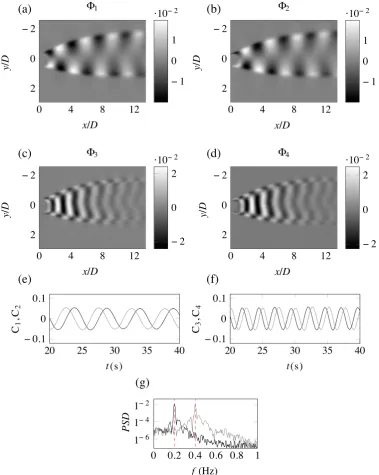
A first experimental dataset was selected to showcase hydro-dynamic conditions where the DMD does not improve the identification of Q2DCS in the low order modes, obtained by POD. The dataset was obtained from the experimental work of Brevis and García-Villalba (2011), in which the POD of a flow visualization was used to identify dominant frequencies in the wake of a cylinder in a shallow flow. All experimental details can be found in the work of Brevis & García-Villalba (2011). Figure1shows the results obtained from the POD analysis. In this case the spatial modes1&2 are paired, indicating a peri-odic shedding behaviour with a different phase in these two modes. Figure 1a only shows1 as reference. The modes in Fig. 1a and b reveal the advection of patches of dye trans-ported by vortical structures. Modes3&4(Fig.1c and d), are also paired but show a different structure. According to Bre-vis and García-Villalba (2011) these modes correspond to the spanwise alternated motion of the vortex behind the cylinder. Figure1e and f show the evolution of the temporal coefficients is clearly sinusoidal; consequently a peak atf = {0.2, 0.4 Hz}
t t
[image:6.595.106.486.83.559.2]f
Figure 1 POD results of flow visualizations of a shallow cylinder wake. (a–d) The spatial modes1−4. (e, f) The temporal coefficientsC1andC3 in black andC2andC4in grey. (g) Fourier power spectrum of the temporal coefficientsC1(black) andC3(grey). The red dashed lines highlight the frequencies extracted using the DMD
In additionS=0.06, thus it is expected to see a highly linear
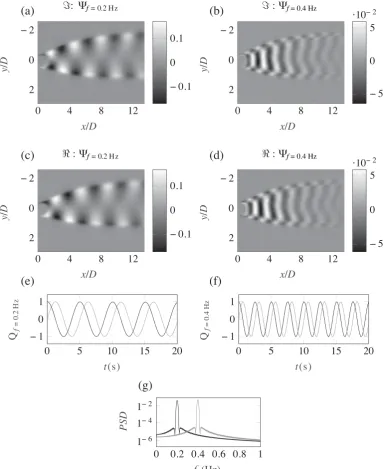
dynamic of the dominant modes. This can be seen in Fig.2a– d where the results of the DMD analysis are given; the spatial structure of the modes is very similar to that obtained by the POD. However, different to the POD analysis, in the DMD spa-tial modes the advection of the patches of the transported dye can be seen between the real and imaginary components of the spatial modes. As shown in Fig. 2e and f in both cases the coefficients show a sinusoidal shape, although noticeably there is a sharper peak in the Fourier spectra in Fig.2g, highlighting the better localization of the DMD method.
5 Shallow flow obstructed by a groyne
t t
[image:7.595.108.492.83.553.2]f
Figure 2 DMD results of flow visualizations of a shallow cylinder wake. (a–d) The real and imaginary components of the spatial modesf=0.2 Hz andf=0.4 Hzrespectively. (e, f) The real and imaginary temporal coefficients relating toQf=0.2 HzandQf=0.4 Hzwhere the black line is the real component and the grey line is the imaginary component. (g) The Fourier power spectra of the temporal coefficients shown in (e) and (f).Qf=0.2 Hz (black) andQf=0.4 Hz(grey)
The structures populating the shear layer in the near field are expected to be generated by both vortex shedding from the tip of the obstacle and by the strong velocity gradient pro-duced between the main channel and the secondary gyre inter-face. From a general observation of the derived vorticity fields sequence, it is expected that the vortices associated with the velocity gradient are of a larger size as the mechanism of gen-eration seems to be more energetic than vortex shedding. Even thoughS≤0.6, the region analysed here is the near field, where
vortices are not expected to behave as a Q2DCS, but are in a transitional stage, still governed by quasi two-dimensional features, but also influenced by three-dimensional ones.
The dataset in the present study is a subset of the data presented in (Higham, Brevis, Keylock, & Safarzadeh, 2017). The experiments were carried out in a tilting shallow flume of 18 m×1.82 m located at the Institute for Hydromechanics, Karlsruhe Institute of Technology, Germany. A single rectan-gular obstacle of length D=0.25 m and cross section 0.05×
0.05 m was placed perpendicular to the main flow direction, at the side-wall of the flume, and at 12 m downstream from the channel entrance. The flow rateQwas set to 0.0135 m3s−1, and the flume slope was inclined to 0.001 m m−1resulting in a water depthH=0.04 m (see Fig.3). The Reynolds number was,R=
Figure 3 Illustration of the experimental set-up of the single groyne. Measurement section highlighted in white. (Not to scale.)
water density and kinematic viscosity respectively. These condi-tions gave a low Froude number,F=U0/√gh=0.29, whereg
is the acceleration of gravity, which ensured minimal surface disturbances (Uijttewaal, 2005). The friction factor was esti-mated to be 0.03, thusS=0.18. The dynamic of the Q2CS was
quantified by means of large scale particle image velocimetry (LSPIV) measurement. The PIV system consisted of a camera with a 1200×1200 pixel CCD-sensor and 12 bit resolution. The flow was seeded with floating 2.5 mm particles using a pneu-matic particle dispenser. It has been previously shown that the use of these tracer particles is effective in capturing the large scale turbulent motions (Weitbrecht et al.,2002). The camera was mounted directly above the water surface at a height of
1.5 m and was set to capture an area of 0.5×0.45 m downstream of the obstacle. A total of 700 snapshots were recorded with an acquisition frequency of 7.5 Hz. The image sequence was analysed using the PIV lab (Thielicke & Stamhuis,2014), using multi-pass and image deformation techniques (Scarano,2002), and the raw PIV results were filtered using the PODDEM algorithm (Higham, Brevis, & Keylock,2016).
Both the POD and DMD calculations were undertaken on all 700 snapshots. The POD was calculated over the snapshots of the fluctuating velocity field, while the DMD was performed over the instantaneous velocity snapshots. The reasoning behind this is related to the stability of the DMD solution, as discussed by Tu et al. (2013) and Chen et al. (2012).
t t
f
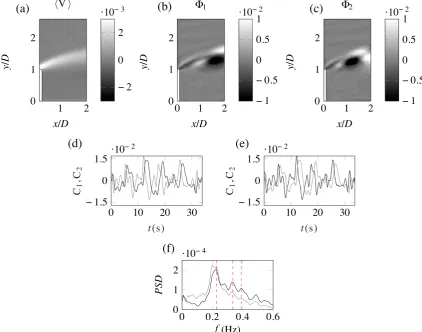
Figure 4 POD results of the near vorticity field of the shear layer generated by a lateral groyne in a shallow flow (groyne highlighted in white). (a) The time averaged vorticity fieldV. (b, c) The POD spatial modes,1and2. (d, e) The POD temporal coefficients ofC1andC2respectively, where the grey line denotes the mode which forms the conjugate pair. (f) The Fourier power spectra of the temporal coefficients shown in (d) and (e).
[image:8.595.82.505.396.728.2]In Fig. 4b and c the first two POD modes, 1&2, of the vorticity field are presented. These top two spatial modes have similar energy, contributing to ∼35% of the total vari-ance. As shown by Rempfer and Fasel (1994) and Brevis and García-Villalba (2011), two modes of similar energy can show analogous, but shifted, spatial and temporal features. In this particular case, these shifted features appear to be related, as expected, to the advection of vortices resulting from a Kelvin– Helmholtz instability.
In Fig. 4d and e the temporal coefficients, C1&2, of the first two modes are presented. The evolution of the coefficients appears to correspond to the presence of multiple dynamical
processes. This is further revealed by the Fourier spectrum of
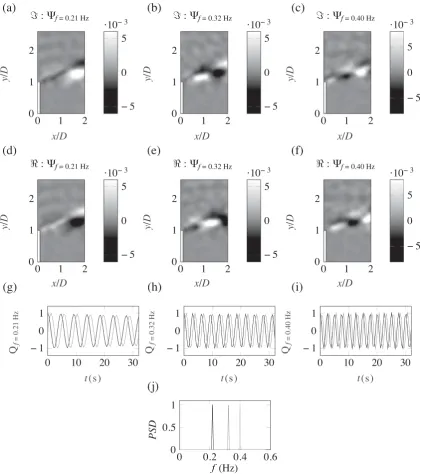
C1&2(see Fig.4f), which shows the presence of a broad band of frequencies but with clear peaks, at different energy levels, and frequencies off = {0.21, 0.32, 0.39 Hz}. After performing the DMD analysis on the data, the modes associated to these peak frequencies were identified. The imaginary components of the DMD spatial modes are shown in Fig. 5a–c and the real components in Fig.5d–f. The temporal coefficients relating to these modes are presented in Fig. 5g–i where the black lines are the real components and the grey lines are the imaginary components. Figure5j highlights how sharply the identified fre-quencies are expressed in the DMD modes. In Fig.5a and d in
x/D x/D x/D
x/D x/D x/D
y
/D
y
/D
y
/D
y
/
D
y
/
D
y
/
D
f = 0.21 Hz
f
= 0.21 Hz f = 0.32 Hz f = 0.40 Hz
f = 0.32 Hz f = 0.40 Hz
f = 0.21 Hz f = 0.32 Hz f = 0.40 Hz
t t t
[image:9.595.90.513.255.730.2]f
both the real and the imaginary components the spatial DMD modes,f=0.21 Hz, resemble the structures seen in the two first POD modes; however, the DMD spatial modes highlight that this single frequency is related to a flapping motion of the shear layer, a feature also highlighted by Talstra (2011) for a similar geometry. In Fig.5b and ef=0.32 Hzreveals the presence of an advecting motion along the shear layer; this advection is high-lighted between the real and the imaginary components of the DMD spatial modes. Finally, in Fig.5c and f the third mode f=0.39 Hzshows structures of smaller size, but with about twice the frequency of the first mode, which are shed from the tip of the obstacle. For a full physical insight into these mecha-nisms, the reader is directed to Higham et al. (2017), where a more in-depth analysis of a larger domain is undertaken. This example highlights the advantages of the presented approach of combining the DMD algorithm with a POD based search criterion; because turbulent shear layer formulation and eddy shedding are typically complex and nonlinear, a mixing of fre-quencies is clear in the POD temporal coefficients. Using DMD, one can seek these frequencies and discern the flow processes that drive this dynamic behaviour; determining structures which are temporally orthogonal but also spatially important.
6 Conclusions
In the present study methodology has been introduced for enhancing understanding of fluvial and hydraulic processes in shallow flows using two modal decomposition methods. The physical basis for the approach derives from the fact that the POD undertakes a decomposition that is proportional to the variance in the data and, consequently, is related to energy or enstrophy in the measurements. However, for complex flows, POD mixes together multiple frequencies. The Fourier spec-trum of a POD mode provides the information to search through the DMD to find the relevant frequencies. The spatial DMD modes corresponding to these frequencies can then be used to elucidate the relevant mechanisms. The application of the method is discussed in terms of flows where the low order modes which make a very large contribution to the total vari-ance. The results of the test cases agree with the expected performance of the decomposition methods. POD shows great potential to explain the dynamics of Q2DCS, as their behaviour is spatially important, i.e. spatially orthogonal in the far field. However, it is shown that in the near field, where vortices are in transition towards a Q2DCS behaviour, POD has the potential to convolve the dynamics of different flow structures. How-ever, their spatial structure can be extracted from the signal if their associated frequencies are identified and then extracted from the DMD results. In summary, the use of the POD as a search criteria for the DMD allows the determination of spa-tial modes which are both spaspa-tially important and temporally orthogonal. The search criteria proposed here is not expected to be valid for three-dimensional flows because of the linear
nature of the additive separation. However, for shallow flows, it improves existing methods for extracting physically significant turbulence behaviour from experimental or numerical datasets based on modal decompositions. (For the readers information, an implementation of the POD-DMD method is available on the MathWorks repository.)
Acknowledgments
A. Safarzadeh (University of Mohaghegh Ardabili) is thanked for providing the groynes dataset.
Funding
The first author was supported by a PhD studentship from the UK 10.13039/501100000270 Natural Environment Research Council [NE/L501682/1]. The second author was supported by Engineering and Physical Sciences Research Council [EP-L026457-1]. The third author was supported by Royal Academy of Engineering/Leverhulme Trust Senior Research Fellowship [LTSRF1516-12-89].
Notation
Cf = Friction coefficient (–) F = Froude number (–) R = Reynolds number (–) S = Shallowness number (–)
C = matrix of POD temporal coefficients (–)
Dα = matrix of DMD amplitudes (–)
Q = matrix of DMD temporal coefficients (–)
V(x,y;t) = matrix of velocity / vorticity fields (m s−1) / (s−1)
W = matrix of column transformed velocity fields (m s−1)
= matrix of POD spatial modes (–) = matrix of DMD spatial modes (–) f = frequency (Hz)
F = vector of DMD Frequencies (Hz) z = complex eigenvectors (–) α = DMD amplitudes (–) µ = complex eigenvalues (–) Ω = number of POD modes (–) D = characteristic length scale (m) g = gravity acceleration (m s−2) H = depth of water (m)
PSD = power spectral density (–)
t = time (s)
References
Aubry, N. (1991). On the hidden beauty of the proper orthog-onal decomposition. Theoretical and Computational Fluid Dynamics,2(5-6), 339–352.
Berkooz, G., Holmes, P., & Lumley, J. L. (1993). The proper orthogonal decomposition in the analysis of turbulent flows. Annual Review of Fluid Mechanics,25(1), 539–575.
Brevis, W., & García-Villalba, M. (2011). Shallow-flow visual-ization analysis by proper orthogonal decomposition.Journal of Hydraulic Research,49(5), 586–594.
Chen, D., & Jirka, G. H. (1997). Absolute and convective insta-bilities of plane turbulent wakes in a shallow water layer. Journal of Fluid Mechanics,338, 157–172.
Chen, K. K., Tu, J. H., & Rowley, C. W. (2012). Vari-ants of dynamic mode decomposition: Boundary condition, Koopman, and Fourier analyses. Journal of Nonlinear Sci-ence,22(6), 887–915.
Constantinescu, G., Sukhodolov, A., & McCoy, A. (2009). Mass exchange in a shallow channel flow with a series of groynes: LES study and comparison with laboratory and field experiments.Environmental fluid mechanics,9(6), 587–615.
Fox, J. F., & Belcher, B. J. (2011). Comparison of macrotur-bulence measured using decomposition of PIV, ADV and LSPIV data.Journal of Hydraulic Research,49(1), 122–126. Ghidaoui, M. S., Kolyshkin, A. A., Liang, J. H., Chan, F. C., Li, Q., & Xu, K. (2006). Linear and nonlinear analysis of shallow wakes.Journal of Fluid Mechanics,548, 309–340.
Higham, J., & Brevis, W. (2018). Modification of the modal characteristics of a square cylinder wake obstructed by a multi-scale array of obstacles. Experimental Thermal and Fluid Science,90, 212–219.
Higham, J. E., Brevis, W., & Keylock, C. J. (2016). A rapid non-iterative proper orthogonal decomposition based outlier detection and correction for PIV data.Measurement Science and Technology,27(12), 125303.
Higham, J. E., Brevis, W., Keylock, C. J., & Safarzadeh, A. (2017). Using modal decompositions to explain the sudden expansion of the mixing layer in the wake of a groyne in a shallow flow.Advances in Water Resources,107, 451–459. Hinterberger, C., Fröhlich, J., & Rodi, W. (2007).
Three-dimensional and depth-averaged large-eddy simulations of some shallow water flows.Journal of Hydraulic Engineering, 133(8), 857–872.
Jirka, G. H. (2001). Large scale flow structures and mixing processes in shallow flows.Journal of Hydraulic Research, 39(6), 567–573.
Jirka, G. H., & Uijttewaal, W. S. (2004). Shallow flows: A definition. In G. H Jirka & W. S. Uijttewaal (Eds.),Shallow flows(pp. 3–11). London: Taylor and Francis Group. Jovanovi´c, M. R., Schmid, P. J., & Nichols, J. W. (2014).
Sparsity-promoting dynamic mode decomposition.Physics of Fluids,26(2), 024103.
Karhunen, K. (1946). Zur spektral theorie stochastischer prozesse.Annales Academiæ Scientiarum Fennicæ,A1, 34. Kosambi, D. (1943). Statistics in function space. Journal of
Indian Mathematical Society,7, 76–88.
Loève, M. (1945). Functions aleatoire de second ordre. Comptes Rendus de l’Académie des Sciences, 220.
Lumley, J., Holmes, P., & Berkooz, G. (1996). Turbulence, coherent structures, dynamical systems and symmetry. Cam-bridge: Cambridge University Press.
Mezi´c, I. (2005). Spectral properties of dynamical systems, model reduction and decompositions.Nonlinear Dynamics, 41(1-3), 309–325.
Muld, T. W., Efraimsson, G., & Henningson, D. S. (2012). Flow structures around a high-speed train extracted using proper orthogonal decomposition and dynamic mode decomposition. Computers & Fluids,57, 87–97.
Obukbov, A. M. (1954). Statistical description of continu-ous fields.Trudy Geofizicheskogo Instituta, Akademiya Nauk SSSR,24, 3–42.
Peltier, Y., Erpicum, S., Archambeau, P., Pirotton, M., & Dewals, B. (2014). Meandering jets in shallow rectangu-lar reservoirs: POD analysis and identification of coherent structures.Experiments in Fluids,55(6), 1740.
Pougachev, V. S. (1953).General theory of the correlations of random functions. Izvestiya Akademii Nauk SSSR. Seriya Matematicheskaya. Bulletin de l’Académie des Sciences de l’URSS.
Rempfer, D., & Fasel, H. F. (1994). Evolution of three-dimensional coherent structures in a flat-plate boundary layer. Journal of Fluid Mechanics,260, 351–375.
Rodi, W. (2017). Turbulence modeling and simulation in hydraulics: A historical review.Journal of Hydraulic Engi-neering,143, 03117001.
Roussinova, V., Shinneeb, A.-M., & Balachandar, R. (2010). Investigation of fluid structures in a smooth open-channel flow using proper orthogonal decomposition. Journal of Hydraulic Engineering,136(3), 143–154.
Ruhe, A. (1984). Rational Krylov sequence methods for eigen-value computation.Linear Algebra and its Applications,58, 391–405.
Scarano, F. (2002). Iterative image deformation methods in PIV. Measurement Science and Technology,13(1), R1–R19. Schmid, P. J. (2010). Dynamic mode decomposition of
numeri-cal and experimental data.Journal of Fluid Mechanics,656, 5–28.
Schmid, P. J., Meyer, K. E., & Pust, O. (2009). Dynamic mode decomposition and proper orthogonal decomposition of flow in a lid-driven cylindrical cavity. In 8th international sym-posium on particle image velocimetry-PIV09(number 3, pp. 1–4), Monash University.
Talstra, H. (2011).Large-scale turbulence structures in shallow separating flows. TU Delft, Delft University of Technology. Thielicke, W., & Stamhuis, E. J. (2014). PIVlab – towards
user-friendly, affordable and accurate digital particle image velocimetry in MATLAB. Journal of Open Research Soft-ware,2(1), e30.doi:10.5334/jors.bl
Tu, J. H., Rowley, C. W., Luchtenburg, D. M., Brunton, S. L., & Kutz, J. N. (2013).On dynamic mode decomposition: Theory and applications. arXiv preprint arXiv:1312.0041.
Uijttewaal, W. S. J. (2005). Effects of groyne layout on the flow in groyne fields: Laboratory experiments. Journal of Hydraulic Engineering,131(9), 782–791.
Uijttewaal, W. S. J. (2014). Hydrodynamics of shallow flows: Application to rivers.Journal of Hydraulic Research,52(2), 157–172.
Uijttewaal, W. S. J., & Jirka, G. H. (2003). Grid turbulence in shallow flows. Journal of Fluid Mechanics, 489, 325– 344.
Weitbrecht, V., Kühn, G., & Jirka, G. H. (2002). Large scale PIV-measurements at the surface of shallow water flows. Flow Measurement and Instrumentation,13(5), 237–245. Wynn, A., Pearson, D. S., Ganapathisubramani, B., & Goulart,