RIT Scholar Works
Theses
Thesis/Dissertation Collections
2-8-2017
Optimal L(h, k) labelings of Cartesian products of
complete graphs and paths
Krishna Vittal Ammanabrolu
Follow this and additional works at:
http://scholarworks.rit.edu/theses
This Thesis is brought to you for free and open access by the Thesis/Dissertation Collections at RIT Scholar Works. It has been accepted for inclusion in Theses by an authorized administrator of RIT Scholar Works. For more information, please [email protected].
Recommended Citation
Cartesian products of complete
graphs and paths
by
KRISHNA VITTAL AMMANABROLU
A Thesis Submitted in Partial Fulfillment of the Requirements
for the Degree of Master of Science in Applied Mathematics
School of Mathematical Sciences, College of Science
Rochester Institute of Technology
Rochester, NY
Name: Dr. Bonnie C. Jacob
School: Science and Mathematics, NTID
Thesis Co-Advisor
Date
Name: Dr. Jobby Jacob
School: Mathematical Sciences
Thesis Co-Advisor
Date
Name: Dr. Baasansuren Jadamba
School: Mathematical Sciences
Committee Member
Date
Name: Dr. Hossein Shahmohamad
School: Mathematical Sciences
Committee Member
Date
Dr. Matthew J. Hoffman
School: Mathematical Sciences
Director of Graduate Programs
Abstract
In an L(h,k)labeling of a graph G we assign non-negative integers to the vertices of the graph such that the labels of the vertices that are at a distance of one have a difference of at least h and the labels of the
vertices which are at a distance of two have a difference of at least k. The aim in general is to minimize the
C
ontents
1 Introduction and definitions 1
1.1 Overview . . . 1
1.2 Definitions . . . 3
2 Background onL(h,k)labeling of various graphs 8 2.1 Introduction . . . 8
2.2 NP completeness of the problem . . . 8
2.3 Upper and lower bounds . . . 8
2.4 Known results . . . 9
3 L(h,k)labeling ofKnPm 12 3.1 h≥2k. . . 12
3.2 2k>h≥k . . . 15
3.3 h<k≤ bn2ch . . . 16
3.4 bn2ch<k≤(n−1)h . . . 24
4 Lower bounds for other graphs 49
5 Future work 50
6 Conclusion 50
1.
I
ntroduction and definitions
TheL(h,k)problem has its origins in the frequency assignment problem. It is typically a problem
of optimization. Let us say that there are some radio transmitters for which we need to assign
fre-quencies with an aim of minimizing the highest frequency used. The requirements originate from
the fact that frequencies of transmitters which are close by can possibly interfere with each other.
Therefore the prime objective of this frequency assignment problem was to eliminate interference.
During the 1960’s the demand for usable spectrum increased exponentially. Simultaneously the
growth of the usable spectrum decreased. This led to development of a number of new models
for frequency assignment with an objective of minimizing the frequencies used and eliminating
interferences, if any. One such model wasL(h,k)labeling [20].
There are two types of objective functions in frequency assignment problems. One is called the
minimum span problem (where span is the difference between highest frequency and lowest
frequency) [15]. The other is called the minimum order problem (where order is the number of
distinct frequencies used). Minimizing the order does not always minimize the highest frequency
used. While we can find the order using a computational method in polynomial time, it is not
always possible to find the minimum span in polynomial time. In both types of problems we have
frequency-distance constraints. That is, transmitters that are close by should not have interfering
frequencies [13].
Metzger [18] first established the fact that the frequency assignment problem can be solved using
graph theory. He developed two coloring procedures for the problem and talked about two
techniques to solve the problem. One technique is called the frequency exhaustive technique
and the other is called the uniform assignment technique. Thus a model was created which
considerably increased the spectrum savings.
Hale [13] also pointed out the connection between the frequency assignment problem and graph
theory and used well-known graph theory algorithms to solve the frequency assignment problem.
Later, a formal definition using graph theory terminologies was developed to analyze the frequency
assignment problem.
1.1
Overview
In Section 2, we give a brief introduction toL(h,k)coloring and discuss the NP completeness of
the problem. We also provide some known results pertaining toL(h,k)labeling.
Section 3 contains main results of this thesis. Section 3.1 starts with the basic lemma required for
our results. We divide the problem into different cases depending on the values ofhandk. As we
increase the value ofkkeepinghas constant the problem becomes more and more tedious owing
to fact that we need to analyze more layers of a complete graph.
Section 4 contains lower bounds for the span of other graphs. In Section 5 and 6 we discuss future
1.2
Definitions
A graphGis a set of vertices (nodes)Vconnected by edges (links)E. ThusG= (V,E). The vertex
set is denoted byV(G)and the edge set is denoted by E(G). An edgeeis a link between two
vertices. Two vertices are said to beadjacentif they have an edge connecting them. Thedegree
of a vertex is the number of edges that are incident to the vertex and is denoted by deg(v). The
maximum degree of a graphG, denoted by∆(G), is the maximum across the vertices of Gof
the degrees of those vertices. Alea f of a graph is a vertex with degree one. Leaves may not
always be present in a graph. A graphHis called asubgraphof a graphGifV(H)⊆V(G)and
E(H)⊆E(G). LetG= (V,E)be any graph, and letS⊆Vbe any subset of vertices ofG, then the
induced subgraph G[S]is the graph whose vertex set isSand whose edge set consists of all of the
edges inEthat have both endpoints inS. Thedistancebetween two verticesuandv(represented
byd(u,v)) is the number of edges in the shortest path connecting them.
Acomplete graphonnvertices is a graph in which every pair of distinct vertices is adjacent. The
complete graph onnvertices is denoted byKn. A graph isconnectedif there is a path between
every pair of vertices. A path is a connected graph in which there are two leaves and all other
vertices have degree two. A path onnvertices is denoted byPn. To define theCartesian product,
consider two graphsGandH. Suppose the vertices of graphGarev1,v2, . . . ,vn and that ofHare
u1,u2, . . . ,um. The vertex set of the Cartesian product of the graphGandHis the set of vertices
VG×VH. The vertexw1= (ui,vj)is adjacent tow2= (uk,vl)if eitheruiandukare same andvjis
adjacent tovl, orvj andvl are same anduiis adjacent touk. The Cartesian product ofGandH
is defined byGH. Consider the Cartesian product ofKn andPm. By the above definition, the
Cartesian product containsmlayers ofKn. Each vertexviis adjacent to its corresponding image
in the next layer. Throughout this paper we use the following representation. Byvi,j we mean
a vertex in the Cartesian product wherejrepresents the layer to which the vertex belongs andi
represents the position of the vertex in that layer. For example, consider Figure 1 which isK5P2.
We have two layers ofK5. As we can see in Figure 1 any vertex in the first layer will be namedvi,1
and any vertex in the second layer will be namedvi,2. Now the graphK5P2will have an edge
between vertexv1,1in the first layer and the vertexv1,2in the second layer. Similarly there will be
an edge between the vertexv2,1in the first layer and vertexv2,2in the second layer. In general for
v1,1 v1,2
v2,1 v2,2
v3,1 v4,1 v3,2 v4,2
[image:9.612.173.441.99.334.2]v5,1 v5,2
Figure 1:K5P2
v1,1 v1,2
v2,1 v2,2
v3,1 v4,1 v3,2 v4,2
v1,3
v2,3
v3,3 v4,3
Figure 2:K4P3
K4P3is given in Figure 2. Note that the vertexv1,1is at a distance of two from the vertexv1,3.
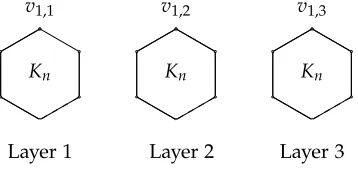
Throughout the thesis for Cartesian product ofKnPmwe draw layers side by side and do not
show the edges between adjacent layers. Also we do not show all the edges in Kn to avoid
congestion. For example the graphKnP3is represented as shown in Figure 3.
v1,1
Layer 1
Kn
v1,2
Kn
Layer 2
v1,3
Layer 3
[image:9.612.218.397.469.559.2]Kn
Figure 3:KnP3
Given two non negative integershandk, anL(h,k)labelingof a graphG= (V,E)is a map from
V to a set of labels such that adjacent vertices receive labels at leasth apart, while vertices at
distance two receive labels at leastkapart. TheL(h,k)span of a labeling is difference between the highest label and the lowest label. In this thesis, we use 0 as the smallest label and hence the span
0 4 15
19
30 34
[image:10.612.223.391.93.148.2]45 49
Figure 4:L(4, 15)labeling ofC8
An example of anL(4, 15)labeling is shown in Figure 4. The highest label is 49. Hence the span of
this labeling is 49. TheL(h,k)span of a graph, denoted by,λh,k(G)is minimum span of allL(h,k)
labelings for a graph. When no confusion will result, we refer toλh,k(G)simply asλ(G). Figure 5
shows theL(h,k)span forC8. So we haveλ4,15(C8) =19.
0 4 15
19
0 4
15 19
Figure 5:L(4, 15)labeling ofC8
We introduce a new term calledtransition. A transition is defined for two adjacent layers ofKnPm.
Let f be anL(h,k)labeling ofKnP2. Arrange the vertices in increasing order of their labels. Let
the order bev1,v2, . . . ,v2n−1,v2n. That is f(v1)< f(v2)< f(v3)<. . .< f(v2n−1)< f(v2n). The
vertex vi can belong to either the first layer or the second. We say we have a transition if the
vertexvibelongs to one layer and the vertexvi+1to the other layer. Depending on the number of
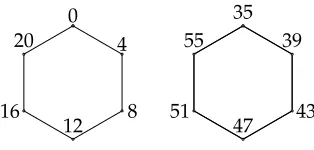
transitions it has anL(h,k)labeling can be either a one-transition or a two-transition or in general ann-transition labeling. To illustrate the concept, consider anL(4, 15)labeling ofK6P2as shown
in Figure 6.
0 4
8 12 16
20
35 39
43 47 51
55
Figure 6:L(4, 15)labeling forK6P2
[image:10.612.227.384.548.623.2]transition. The transition occurs since label 20 is in the first layer and the next highest label 35 is
in the second layer.
Now consider Figure 7 which shows a two-transitionL(4, 15)labeling ofK6P2.
0 58
54 50 46
42
4 15
19 23 27
[image:11.612.228.386.154.222.2]31
Figure 7:L(4, 15)labeling forK6P2
When we arrange the vertices in increasing order of their labels, we have 0 in the first layer, then
we have 4 in the second layer. Therefore we have one transition there. After label 31 which belongs
to the second layer we have label 42 in the first layer. Therefore we have another transition. Hence
this labeling has two transitions.
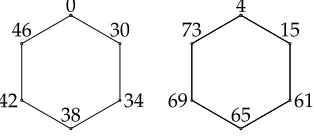
Figure 8 shows a three- transitionL(4, 15)labeling ofK6P2:
0 30
34 38 42
46
4 15
61 65 69
[image:11.612.228.385.386.454.2]73
Figure 8:L(4, 15)labeling forK6P2
In this labeling we have 0 in the first layer and 4 in the second layer which is the first transition.
After the label 15 which is in second layer the next highest label 30 in first layer. Hence we have
the second transition. The label 46 is in first layer and 61 is in second layer which is the third
transition.
Let f be anL(h,k)labeling ofKnP2. Let f(v1)< f(v2)< f(v3)<. . .< f(v2n−1)< f(v2n). Let
us say we have a transition at some vertexvi. Without loss of generality assumeviis in first layer
andvi+1is in second layer. Suppose thatvi−1(if it exists) is in first layer and thatvi+2(if it exists)
is in second layer. Then it is called anisolated transition.
Suppose we have a set of verticesvi,vi+1,vi+2such thatviis in first layer,vi+1is in second layer
andvi+2is in first layer. Suppose thatvi−1(if it exists) is in first layer and thatvi+2(if it exists) is
In general if we havenconsecutive transitions starting atvi1 then we say we havecombined n
transition system.
Observation 1. Consider an L(h,k)labeling of a graph Kn. Since the smallest label in a layer cannot be
less than zero and also we have n vertices which are adjacent to each other, the highest label in the layer is at
2.
B
ackground on
L
(
h
,
k
)
labeling of various graphs
2.1
Introduction
TheL(h,k)problem was first introduced by Griggs and Yeh [12]. The problem arises in multihop
radio networks for frequency assignment. Initially the problem was studied for only special case
where h = 2 and k = 1. Later on the L(h,k) labeling was formally defined and was used to
model many other problems. L(h,k)labelings are used in packet radio networks to avoid hidden
collisions. They are also used in optical cluster based networks [19].
There are many results pertaining toL(h,k)span of different graphs. The upper and lower bounds
were established in special cases where(h,k) = (1, 0),(2, 1)for any generalized graph. It was
proved thatλ0,1(G)≤∆2−∆, where∆is the maximum degree for any graphG[14].
In the case ofL(2, 1)labeling of a graph we have the lower bound,λ2,1(G)≥∆+1 [10]. Griggs
and Yeh gave an upper bound, which isλ2,1≤∆2+2∆[12]. It is conjectured thatλ2,1(G)≤∆2
[12]. This still remains an open problem. For a complete list of results aboutL(h,k)labeling and
its history, see [3].
2.2
NP completeness of the problem
The L(h,k)labeling problem in general is NP hard and becomes computationally intractable. It
is conjectured that the problem of finding if the L(h,k)span is less than some numberris NP
complete. Bertossi and Bonuccelli showed thatL(0, 1)labeling can be used to solve the problem
of avoiding hidden collisions in packet radio networks [2]. They also proved that the decision
version of L(0, 1)is NP complete. McCormick proved that the decision version ofL(1, 1)labeling
for minimum span is equivalent to decision version ofL(2, 1)labeling for minimum order [17].
Griggs and Yeh proved that the decision version of theL(2, 1)labeling problem is NP complete [12].
2.3
Upper and lower bounds
For any positive integersh andkwe haveλh,k(G)≥h+ (∆+1)k, where∆is maximum vertex
degree [4].
when∆≥3 [10]. Also it was observed that limh→∞λλh+h,11,1(G(G)) =1 [4].
2.4
Known results
Theorem 2.1. [16]λ0,1(Pn) =1.
In Figure 9 an optimalL(0, 1)labeling ofP6is shown.
0 0 1 1 0 0
Figure 9:OptimalL(0, 1)labeling ofP6
Theorem 2.2. [1]λ1,1(P2) =1andλ1,1(Pn) =2for n>2.
Figure 10 shows an optimalL(h,k)labeling.
0 1 2 0 1 2 0
Figure 10:OptimalL(1, 1)labeling ofP7
Theorem 2.3. [11]For any h and k we have.
λh,k(Pn) =
0, for n=1
h, for n=2
h+k, for3≤n≤4
h+2k, for n≥5and h≥2k
2h, for n≥5and h<2k
Theorem 2.4. [7]In case of a cycle we have:
λ0,1(Cn) =
1, if n≡0 (mod 4)
2, otherwise
0 0 1 1 0 0 1 1 0 0 1 1
Figure 11: L(0, 1)labeling ofC12
0 0 1 1
0 0 1 1 2 2
Figure 12: L(0, 1)labeling ofC10
Theorem 2.5. [7]For any h and k we have .
λh,k(Cn) =
2h if n
=odd,n≥3and h≤2k or
if n≡0 (mod 3)and h≥2k
h+2k if n≡0
(mod 4)and h≥2k or
if n6≡0 (mod 3),n6=5and h≤2k
2h, if n≡2 (mod 4)and h≤3k
h+3k, if n≡2 (mod 4)and h≥3k
2h, if n≥5and h≤2k
4k, if n=5
Theorem 2.6. [8, 9]Consider the graph G≡KnKm. When2≤m<n, we have the following result.
λh,k(G) =
(m−1)h+ (n−1)k, for hk >n
(mn−1)k, for hk ≥n
(n−1)h+ (2n−1)k, for hk >(n−1)
(n2−1)h, for hk <(n−1)
In 2003, Erwin et al. gave the L(h,k) labeling for the Cartesian product of complete graphs
[6].
Theorem 2.7. [6]Consider the graph G= n
∏
i=1
When n>3and all the ti’s are relatively prime when2≤t1<t2<t3<. . .<tn we have,
λh,k(G) =
(tntn−1−1)k, for hk ≤tn−1
(tn−1)h+ (tn−1−1)k, for hk >tn−1
In 2009, Huang et al [5], gave a potential labeling for the graphG=
n
∏
i=1
Kni, where there is no
restriction onni which provides an upper bound, where the notation
n
∏
i=1
Gni represents Cartesian
product of the graphs.
Theorem 2.8. [2]Bertossi et al. proved that L(0, 1)labeling for binary trees requires only 3 colors.
Theorem 2.9. [2]λ1,1(B) =∆, where B is a binary tree
ATreeis an undirected graph in which any two vertices are connected by exactly one path.
Theorem 2.10. [12](∆+1)≤λ2,1(T)≤(∆+2), where T is a tree.
Later on, Chang and Kuo gave a polynomial time algorithm based on dynamic programming to
3.
L
(
h
,
k
)
labeling of
K
nP
mWe start by proving the following lemma.
Lemma 3.1. Let H be an induced subgraph of G. Thenλ(h,k)(H)≤λ(h,k)(G).
Proof. Let f be an optimalL(h,k)labeling ofG. Consider two verticesu andv such thatu,v ∈ V(H). IfdH(u,v) =1 thendG(u,v) =1. Therefore we have|f(u)− f(v)| ≥h. IfdH(u,v) =2,
thendG(u,v) =2 (since His an induced subgraph ofG). Therefore|f(u)−f(v)| ≥k. Therefore
f restricted toHis anL(h,k)labeling forH. Hence we haveλh,k(H)≤λh,k(G).
Remark 1. The proof does not work ifHis not an induced subgraph ofG. For example consider
the graphsK4and its subgraphC4.
0 2
4 6
Figure 13: L(2, 6)labeling ofK4
0 2
6 8
Figure 14: L(2, 6)labeling ofC4
From Figures 13 and 14, we haveλ2,6(K4)<λ2,6(C4).
Remark 2. If h≥k, and if H is a subgraph of G, thenλh,k(H)≤λh,k(G).
3.1
h
≥
2
k
Theorem 3.1. λh,k(KnPm) = (n−1)h+k, when h≥2k.
Proof. Consider the graphHwhich isKnP2. Let f be an optimalL(h,k)labeling of Hwith the
highest label less than or equal to(n−1)h+k−1. Without loss of generality let the highest label be f(vx,1). Any vertexvj,2in the second layer will be either at a distance of one or two fromvx,1.
Consider the vertexvx,2in the second layer which is at a distance of one fromvx,1, therefore:
f(vx,2) ≤ (n−1)h+k−1−h = (n−2)h+k−1
Consider any vertexvj,2in the second layer which is at a distance of two fromvx,1, then
f(vj,2) ≤ (n−1)h+k−1−k = (n−1)h−1
< (n−1)h
which is a contradiction to Observation 1.
Hence we haveλ(H)≥ (n−1)h+k. Since the graph His an induced subgraph of the graph
KnPm, we have,λ(KnPm) ≥ (n−1)h+k. Also we have a labeling which uses(n−1)h+k
labels. The labeling is as follows.
In thejthlayer, when jis odd, any vertexvi,jwill have label(i−1− j
−1
2 )h (modnh)for 0≤i≤
n−1.
In the jth layer, when j is even, any vertex vi,j will have label (i+1− 2j)h+k (mod nh) for
0≤i≤n−1 respectively.
Now we give the proof that this anL(h,k)labeling
Case 1. In thejthlayer, when jis odd, we have f(vi,j) = (i−1−j−21)h (mod nh).
If we take two vertices in the same layer then
|f(vi1,j)−f(vi2,j)| = |(i1−1−
j−1
2 )h−(i2−1− j−1
2 )h (mod nh)| = |(i1−i2)h|
≥ h
If we take a vertex from(j+1)st layer then|f(vi1,j)− f(vi2,j+1)| = |(i1−1−
j−1
2 )h−(i2+1− j+1
2 )h−k (mod nh)|. Ifi1=i2, then
|f(vi1,j)−f(vi2,j+1)| = | −h+k (mod nh)|
> h
Ifi16=i2then
|f(vi1,j)−f(vi2,j+1)| = |(i1−i2−1)h−k (mod nh)| ≥ |k (mod nh)|
If we take a vertex from(j+2)ndlayer onlyv
i,j+2will be at a distance of two. So
|f(vi,j)− f(vi,j+2)| = |(i1−1− j−21)h−(i1−1−j+21)h (mod nh)|
Case 2. In the jthlayer, when j is even, we have f(vi,j) = (i+1−2j)h+k (mod nh).
If we take two vertices in the same layer then
|f(vi1,j)−f(vi2,j)| = |(i1+1−
j
2)h+k−(i2+1−2j)h−k (mod nh)| = |(i1−i2)h|
≥ h
If we take a vertex from(j+1)thlayer then|f(vi1,j)−f(vi2,j+1)|=|(i1+1−
j
2)h+k−(i2−1−2j)h (mod nh)|. If i1=i2, then
|f(vi1,j)− f(vi2,j+1)| = |2h+k (modnh)|
> h
If i16=i2then
|f(vi1,j)−f(vi2,j+1)| = |(i1−i2+2)h+k| (modnh) ≥ k(sincek<h)
If we take a vertex from(j+2)ndlayer only vi,j+2will be at a distance of two. So
|f(vi,j)−f(vi,j+2)| = |(i+1−2j)h+k−(i+1− j+2
2 )h−k (modnh)| = | −h (modnh)|
= (n−1)h
> k.
We show anL(5, 2)labeling forK6P4in Figure 15.
0 5 10 15 20 25 7 12 17 22 27 2 25 0 5 10 15 20 2 7 12 17 22 27
Figure 15:L(5, 2)labeling ofK6P4
Remark 3. The labeling does not work whenh<2k. For example ifh=5 andk=3 when we
label the graph K6P2 using the above mentioned labeling as shown in Figure 16, we have a
conflict since the vertex which has label 8 is at a distance of two from the vertex which has label
0 5 10 15 20 25 8 13 18 23 28 2
Figure 16: Labeling in Theorem 3.1 fails forL(5, 3)
3.2
2
k
>
h
≥
k
Theorem 3.2. If2k≥h≥k, thenλ(KnPm) = (2n−1)k.
Proof. Consider the graph Hwhich isKnP2. Let f be an optimalL(h,k)labeling of H. In the
graphHeach vertex is either at a distance of one or two from every other vertex. Sinceh>k, we
have the highest label required is at least(2n−1)k. Thereforeλ(H)≥(2n−1)k.
SinceHis an induced subgraph ofKnPmwe haveλ(KnPm)≥(2n−1)k.
Also we have anL(h,k)labeling of the graphHwith(2n−1)kas the highest label. We use the
labeling which was explained in the proof of Theorem 3.1 withh=2k.
We showL(6, 4)labeling ofK6P4in Figure 17.
[image:20.612.223.386.91.160.2]0 8 16 24 32 40 12 20 28 36 44 4 40 0 8 16 24 32 4 12 20 28 36 44
Figure 17: L(6, 4)labeling forK6P4
Remark 4. Using a brute force program we checked that although the labeling works whenh<k
it is no longer an optimal L(h,k) labeling. Consider two L(4, 8)labelings of the graph K6P4
0 16 32 48 64 80 24 40 56 72 88 8 80 0 16 32 48 64 8 24 40 56 72 88
Figure 18: L(4, 8)labeling forK6P4using the above mentioned labeling
0 4 8 12 16 20 28 32 36 40 44 48 20 0 4 8 12 16 48 28 32 36 40 44
Figure 19: L(4, 8)labeling forK6P4found using the brute force program
From Figures 18 and 19 we can say that labeling fails whenh<k
3.3
h
<
k
≤ b
n2c
h
Theorem 3.3. If h<k≤ nh
2 and m,n≥3, thenλ(KnPm) =2(n−1)h+k.
Proof. Consider the graph H=KnP3. Let f be an optimal L(h,k)labeling of H. Assume that
the highest label is less than or equal to 2(n−1)h+k−1. Now consider the first two layers.
There are 2nvertices. Let us arrange the vertices in the increasing order of their labeling. That
is f(v1)< f(v2)< f(v3)<. . .< f(vn−1)< f(vn)<. . .< f(v2n−1)< f(v2n). The vertex vi can
either belong to the first layer or the second. Letxibe the difference between f(vi)and f(vi+1).
Since each vertex is either at a distance of one or two from any other vertex we havexi ≥h.
Claim:x1+x2+x3+. . .+x2n−1≤2(n−1)h+k−1.
Proof of the claim: We know thatx1= f(v2)−f(v1),x2= f(v3)−f(v2). Similarly,xl= f(vl+1)−
f(vl), for any l such that 1≤ l ≤ 2n−1 So when we add all xi’s we have their sum equal to
f(v2n)− f(v1). We know that f(v1) ≥ 0 and f(v2n) ≤ 2(n−1)h+k−1. Hence we have
x1+x2+x3+. . .+x2n−1≤2(n−1)h+k−1.
Claim:xi≤k−1, for 1≤i≤2n−1
Proof of the claim: Assume for somej, we havexj≥k. We still have(2n−2)otherxi’s and each
[image:21.612.142.473.212.281.2]we have
x1+x2+x3+. . .+xj−1+xj+xj+1+. . .+x2n−1 ≥ (2n−2)h+k = 2(n−1)h+k
> 2(n−1)h+k−1
which is a contradiction. Thereforeh≤xi≤k−1.
Now consider the first and second layers, there has to be at least one transition between the layers.
Let us assume that there is a transition at vertexvi. That is the vertexviwill belong to one layer
andvi+1will belong to the layer adjacent to it. There are two cases that we need to consider. We
first prove a claim
Claim: Ifh<k≤ nh2 andn>3, then we haveλ(KnP2)≥(2n−3)h+k
Proof of the claim: If we have a combined 2-transition between the layers then we come across
set of vertices vl, vl+1, vl+2 such that vl and vl+2 belong to one layer and v0l+1 belongs to
an other layer. Without loss of generality assume that the vertices vl andvl+2 are in second
layer and vl+1 is in first layer. Now the vertex vl+1 cannot be adjacent to both vl and vl+2,
hence eitherd(vl,vl+1) = 2 ord(vl+2,vl+1) = 2. Therefore either xl ≥ kor xl+1 ≥ k, which
is a contradiction to the above mentioned claim. So only isolated transitions exist. Consider
an isolated transition at some vertex vj. Assume that the vertex vj is in second layer and
vj+1 is in first layer. We know that either vj−1 or vj+2 exist. So either xj−1+xj ≥ k (since
d(vj−1,vj+1) =2) or xj+xj+1 ≥ k(sinced(vj,vj+2) =2). Also we know that xi ≥ h for anyi,
thereforex1+x2+x3+. . .+xj+xj+1+xj+2+. . .+x2n−2+x2n−1≥(2n−3)h+k
Case 1. Let us assume that in the second layer we come across a vertexvi+1such that f(vi+1) =y
and in the first layer we have the vertexvisuch that f(vi) =y−xi.
Sincexi ≤k−1, the distance between both the vertices should be one. That isd(vi,vi+1) =1. The
vertices are shown in Figure 20.
vi
Layer 1
vi+1
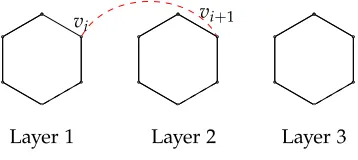
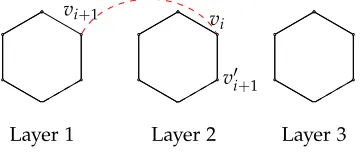
[image:22.612.217.396.578.658.2]Now consider the second and third layers. We again have 2nvertices with the same restrictions.
When we arrange the vertices in the increasing order of their labels and take the differences we
have an another set ofx01,x02,x03. . .x20n−1. The vertexvi+1is in the second layer. So now consider
the vertex which comes before the vertexvi+1after arranging the vertices in the increasing order.
Let that vertex bev0i. Therefore we have f(v0i) =y−x0l.
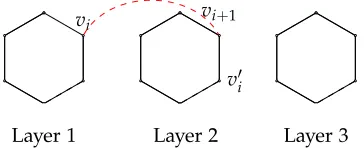
If the vertexv0i is in the second layer, then we haved(vi,v0i) =2 as shown in Figure 21.
vi
Layer 1
vi+1
v0i
[image:23.612.216.398.227.305.2]Layer 2 Layer 3
Figure 21: KnP3
If we calculate the difference between their labels we have|f(vi)−f(v0i)|=|xi−x0l|<(k−1)<k.
If the vertexv0i is in the third layer and if d(vi+1,vi0) = 2 as shown in Figure 22,then we have
|f(vi+1)−f(v0i)|=|x0i| ≤(k−1)<k, a contradiction.
vi
Layer 1
vi+1
Layer 2
v0i
Layer 3
Figure 22: KnP3
Ifd(vi+1,v0i) =1 as shown in Figure 23, then We haved(vi,v0i) =2. Therefore|f(vi)− f(v0i)| ≥k,
[image:23.612.211.402.441.519.2]vi
Layer 1
vi+1
Layer 2
v0i
[image:24.612.213.395.96.177.2]Layer 3
Figure 23: KnP3
Now ifvi+1is the vertex with lowest label in second and third layers, since f(vi)< f(vi+1), we
have f(vi+1)≥h. By the above claim we can say that the difference between highest and lowest
labels in the second and third layers should be greater than or equal to(2n−3)h+k. Now ifv02n
is the vertex with highest label in second and third layers then f(v02n)≥(2n−3)h+k+ f(vi+1).
Therefore f(v20n)≥(2n−2)h+k.
Case 2. Now we assume that we come across a vertexviin the second layer and the vertexvi+1is
in the first layer with f(vi) =yand f(vi+1) =y+xi .
Sincexi≤k−1, we haved(vi,vi+1) =1 as shown in Figure 24.
vi+1
Layer 1
vi
Layer 2 Layer 3
Figure 24: KnP3
Now consider the second and third layers. We again have 2n vertices with same restrictions.
When we arrange the vertices in increasing order of their labels and take their differences we have
x01,x02,x30, . . . ,x20n−1. Consider the vertexv0i+1which comes immediately after the vertexvi when
arranged in the increasing order. The vertex will have the labely+x0i.
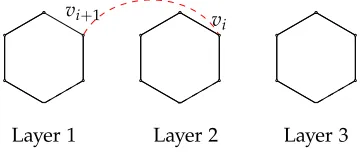
If the vertexv0i+1is in the second layer as shown in Figure 25, thend(vi+1,v0i+1) =2, but if we
[image:24.612.216.396.419.498.2]vi+1
Layer 1
vi
v0i+1
[image:25.612.217.397.97.176.2]Layer 2 Layer 3
Figure 25: KnP3
If the vertexv0i+1is in the third layer and ifd(vi,v0i+1) =2 as shown in Figure 26, then we have
|f(v0i+1)−f(vi)|=|x0i| ≤(k−1)<k.
vi+1
Layer 1
vi
Layer 2
v0i+1
[image:25.612.206.408.292.370.2]Layer 3
Figure 26: KnP3
Ifd(v0i+1,vi) =1, as shown in Figure 27, then we haved(vi+1,v0i+1) =2, which again gives us
|f(vi+1)−f(v0i)|=|xi−x0i| ≤(k−1)<k.
vi
Layer 1
vi+1
Layer 2
v0i
Layer 3
Figure 27: KnP3
If vi is vertex with highest label in second and third layers then v0i+1 does not exist. Sincevi
[image:25.612.213.395.516.598.2](2n−3)h+k+h
f(vi+1) ≥ (2n−3)h+k+h = (2n−2)h+k
= 2(n−1)h+k
Hence f cannot be anL(h,k)labeling of the graph.
Therefore,λ(KnP3)≥2(n−1)h+k. Since His an induced subgraph ofKnPmform≥3 we
haveλ(KnPm)≥2(n−1)h+k. We now describe the labeling with highest label as 2(n−1)h+k.
The labeling.
For thejthlayer:
whenj≡1 (mod 4), for any vertexvi,j, we have f(vi,j)≡(i−1)h (mod nh), for 1≤i≤n.
whenj≡2 (mod 4), for any vertexvi,j, we have f(vi,j)≡(i−1)h (mod nh) + (n−1)h+k, for
1≤i≤n.
whenj≡3 (mod 4), for any vertexvi,j, we have f(vi,j)≡(bn2c+i−1)h (modnh), for 1≤i≤n.
whenj≡0 (mod 4), for any vertexvi,j, we have f(vi,j)≡(bn2c+i−1)h (mod nh) + (n−1)h+k,
for 1≤i≤n.
Now we give the proof of labeling.
Case 1. Injthlayer when j≡1 (mod 4)we have f(vi,j)≡(i−1)h (mod nh).
If we take two vertices in the same layer then
|f(vi1,j)−f(vi2,j)| = |(i1−1)h−(i2−1)h (mod nh)|
= |(i1−i2)h|
≥ h
If we take a vertex from(j+1)thlayer then|f(vi1,j)−f(vi2,j+1)|=|(i1−1)h−(i2−1)h (mod nh)−
(n−1)h+k|. Ifi1=i2, then
|f(vi1,j)− f(vi2,j+1)| = |0 (modnh) + (n−1)h+k|
> h
Ifi16=i2then
If we take a vertex from(j+2)thlayer onlyvi,j+2will be at a distance of two. So
|f(vi,j)−f(vi,j+2)| = |(i−1)h−(bn2c+i−1))h (mod nh)|
= | − bn
2ch (mod nh)| = bn
2ch
≥ k(sincek≤ bn
2ch).
Case 2. Injthlayer when j≡2 (mod 4)we have f(vi,j)≡(i−1)h (mod nh) + (n−1)h+k.
If we take two vertices in the same layer then
|f(vi1,j)− f(vi2,j)| = |(i1−1)h−(i2−1)h (mod nh) + (n−1)h+k−((n−1)h+k)|
= |(i1−i2)h|
≥ h
If we take a vertex from(j+1)th layer then |f(vi1,j)−f(vi2,j+1) = (i1−1)h−(b
n
2c+i2−1)h (mod nh) + (n−1)h+k|. Ifi1=i2, then
|f(vi1,j)−f(vi2,j+1)| = | − b
n
2ch (mod nh) + (n−1)h+k| = bn
2ch+ (n−1)h+k
> h.
Ifi16=i2then
|f(vi1,j)− f(vi2,j+1)| = (−b
n
2c+i1−i2)h (modnh) + ((n−1)h+k)|
≥ k(since(i1−i2)h (mod nh)− bn2c ≤((n−1)h)
If we take a vertex from(j+2)thlayer onlyvi,j+2will be at a distance of two. So
|f(vi,j)−f(vi,j+2)| = |(i−1− bn2c −i+1))h (mod nh) + (n−1)h+k|
= | − bn
2ch (mod nh) + (n−1)h+k| = bn
2ch+ (n−1)h+k
≥ k.
Case 3. Injthlayer when j≡3 (mod 4)we have f(vi,j)≡(bn2c+i−1)h (modnh).
If we take two vertices in the same layer then
|f(vi1,j)−f(vi2,j)| = |(b
n
2c+i1−1)h−(b n
2c+i2−1)h (mod nh)| = |(i1−i2)h|
≥ h
If we take a vertex from(j+1)thlayer then|f(v
i1,j)− f(vi2,j+1)|=|(b
n
2c+i1−1)h−(bn2c+i2−
1)h (modnh)−(n−1)h+k|. Ifi1=i2, then
|f(vi1,j)− f(vi2,j+1)| = |0 (modnh)−(n−1)h+k|
Ifi16=i2then
|f(vi1,j)− f(vi2,j+1)| = |(i1−i2)h (modnh)−((n−1)h+k)| ≥ k
If we take a vertex from(j+2)thlayer onlyvi,j+2will be at a distance of two. So
|f(vi,j)− f(vi,j+2)| = |(bn2c+i−1−i+1)h (mod nh)|
= |bn
2ch (mod nh)| = |bn2ch|
≥ k(sincek≤ bn2ch).
Case 4. Injthlayer when j≡0 (mod 4)we have f(vi,j)≡(bn2c+i−1)h (modnh)+(n-1)h+k.
If we take two vertices in the same layer then
|f(vi1,j)−f(vi2,j)| = |(b
n
2c+i1−1)h−(bn2c+i2−1)h (modnh) + (n−1)h+k−((n−1)h+k)| = |(i1−i2)h|
≥ h
If we take a vertex from(j+1)thlayer then|f(vi1,j)−f(vi2,j+1)|=|(b
n
2c+i1−1)h−(bn2c+ (i2−
1)h (modnh) + (n−1)h+k|. Ifi1=i2, then
|f(vi1,j)−f(vi2,j+1)| = |(b
n
2c+i−1−i+1) (mod nh) + (n−1)h+k|
> h
Ifi16=i2then
|f(vi1,j)− f(vi2,j+1)| = |(i1−i2)h (modnh) + ((n−1)h+k)| ≥ k
If we take a vertex from(j+2)thlayer onlyvi,j+2will be at a distance of two. So
|f(vi,j)− f(vi,j+2)| = |(bn2c+i−1−i+1)h (mod nh)|
= |bn
2ch (mod nh)| = bn
2ch
≥ k(sincek≤ bn
2ch).
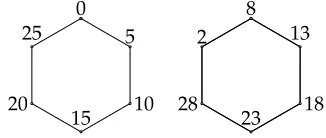
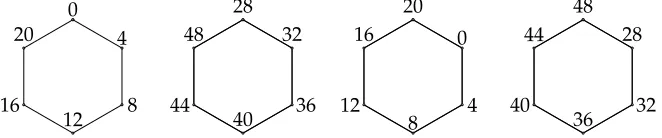
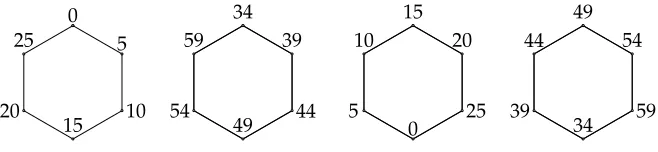
0 5 10 15 20 25 34 39 44 49 54 59 15 20 25 0 5 10 49 54 59 34 39 44
Figure 28: L(5, 9)labeling forK6P4
Remark 5. The labeling does not work whenk>bn
2ch. Using a brute force algorithm we checked
that to get a general expression for the optimalL(h,k)labeling, we need to analyze five layers of
the complete graph.
3.4
b
n2c
h
<
k
≤
(
n
−
1
)
h
Lemma 3.4. Let f be an optimal L(h,k)labeling of the graph KnP2with nh2 <k≤(n−1)h, where n
is an even number greater than4and the vertex with zero label is in the first layer. If the highest label in the
first layer is less than(n2−1)h+k then every vertex in the second layer must have label greater than or equal to(n−2)h+k.
Proof. Consider the graphKnP2and arrange the vertices of the first layer in the increasing order
of their labeling. That is, f(v1,1)< f(v2,1)< f(v3,1)< . . .< f(vi,1)< f(vi+1,1)< . . .< f(vn,1).
Now let us suppose we can use some value between f(vi,1)and f(vi+1,1)to label some vertexvj,2
in the second layer, so we have f(vi,1)< f(vj,2)< f(vi+1,1), wherevi,1is theith highest labeled
vertex in the first layer. Now if vj,2 is adjacent tovi,1 then f(vj,2) ≥ f(vi,1) +h, andvj,2is at a
distance of two fromvi+1,1. So
f(vi+1,1) ≥ f(vj,2) +k
≥ f(vi,1) +h+k
Similarly ifvj,2is adjacent tovi+1,1 then f(vj,2) ≤ f(vi+1,1)−h and the vertex vj,2 will be at a
distance of two fromvi,1, therefore
f(vi,1) ≤ f(vj,2)−k
≤ f(vi+1,1)−h−k.
Ifvj,2 is not adjacent to eithervi,1or vi+1,1 then f(vj,2)≥ f(vi,1) +kand f(vi+1,1)≥ f(vj,2) +k.
Thus f(vi+1,1)≥ f(vi,1) +k+k.
(i−1)h. Therefore f(vi+1,1)≥(i−1)h+h+k.
We still haven−(i+1)vertices in the first layer with labels greater than f(vi+1,1). Therefore
f(vn,1)≥ih+k+ (n−i−1−1)h= (n−2)h+k>(n2−1)h+kforn>2. But the highest label
in the first layer is less than(n2−1)h+k. Therefore we cannot use any value between 0 and f(vn,1)
for any vertex in the second layer.
Now, we know that f(vn,1≥(n−1)h. Let the lowest labeled vertex in the second layer bev1,2. If
v1,2is at a distance of two fromvn,1then f(v1,2)≥(n−1)h+k. Ifv1,2is adjacent tovn,1, then it
will be at a distance of two from thevn−1,1. Therefore
f(v1,2) ≥ f(vn−1,1) +k
≥ (n−2)h+k.
Lemma 3.5. Let f be an optimal L(h,k)labeling of KnP3, where nh2 ≤k≤(n−1)h and n is an even
number greater than4. If the highest label used in the first layer is less than(n2−1)h+k then we have highest label in third layer greater than or equal to(n2)h+k and second highest label greater than or equal to(n2−1)h+k.
Proof. Let us arrange the vertices of the first layer in increasing order of their labeling, so
f(v1,1) < f(v2,1) < f(v3,1) < . . . < f(vn−1,1) < f(vn,1). Consider the vertex vn
2+1,1, we know
that f(vn
2+1,1) ≥ (
n
2)h. If f(vn2,1) ≥ k, then we will have f(vn,1) ≥ k+ (
n
2 −1)h, which is a
contradiction. Therefore f(vn
2+1,1)<k. In the third layer let the vertex which is at a distance of
two fromvn
2+1,1 bevn2+1,3. We know that|f(vn2+1,3)−f(vn2+1,1)| ≥k. Since f(vn2+1,1)< k, we
have f(vn
2+1,3)≥ f(vn2+1,1) +k. Therefore f(vn2+1,3)≥(
n 2)h+k.
Similarly f(vn
2,1)≥(
n
2−1)h, so f(vn2,3)≥ f(vn2,1) +k≥(n2−1)h+k.
Lemma 3.6. Let f be an L(h,k)labeling of KnP3, where nh2 ≤ k ≤ (n−1)h, n is an even number
greater than4and there is only one transition between any two adjacent layers. If the lowest label in the
first layer is less than the lowest label in the second layer which is less than the lowest label in the third
layer, then we have highest label under f is greater than or equal to(n−2)h+3k.
v1,1
vi,1
vn,1
Layer 1
v1,2
vj,2
vn,2
Layer 2
v1,3
vn,3
[image:31.612.209.404.93.187.2]Layer 3
Figure 29: KnP3
Letv1,1,v1,2,v1,3be the vertices with the lowest label in the first layer, second layer and the third
layer respectively. By assumption we know that f(v1,1)< f(v1,2). Now suppose there are vertices
vi,1andvj,2such that f(vi,1)> f(vj,2). Then will have at least two transitions between layers one
and two, since we have f(v1,1)< f(v2,1)< f(vj,2)< f(vi,1)violating our assumption. Therefore
no vertex in the first layer has label greater than f(v1,2). Similarly no vertex in the second layer
has a label greater thanv1,3.
Let vn,1 be the vertex with highest label in the first layer. Then we have f(vn,1) ≥ (n−1)h.
There are at least n−1 vertices in the second layer that are at a distance of two from vn,1.
Therefore if vy,2 is the vertex with the highest label in the second layer, we have f(vy,2) ≥
(n−1)h+k+ (n−2)h. There are n−1 vertices in the third layer that are at a distance of
two from vy,2. Therefore if vn,3 is the vertex with the highest label in the third layer, we have
f(vn,3)≥(n−1)h+k+ (n−2)h+k+ (n−2)h≥3k+ (n−2)h.
Lemma 3.7. Let f be an L(h,k)labeling of KnP2, where nh2 <k≤(n−1)h, where n is an even number
greater than4and there are two transition between the layers. Assume that the vertex with the smallest
label is in the second layer and let that vertex be v1,2. Let v1,1be the vertex with the smallest label in the
first layer. Let vn,1be the vertex with highest label in the first layer. Suppose there are x vertices in the
second layer that are at a distance of two from v1,1and that have label lower than f(v1,1)and there are y
vertices in the second layer that are at a distance of two from vn,1and that have label higher than f(vn,1).
Then we have x+y≥n−2.
Proof. Since we have only two transitions between the layers any vertex in the second layer will
have label either less than f(v1,1)or greater than f(vn,1). Letv1,2 be the vertex in the second layer
adjacent tov1,1and letvn,2be the vertex in the second layer adjacent tovn,1. If f(v1,2)< f(v1,1)
and f(vn,2) > f(vn,1), then we have x+y = n−2. In any other case we have x+y > n−2.
Lemma 3.8. Let f be an L(h,k)labeling of KnP2, where nh2 < k ≤ (n−1)h, n is an even number
greater than4and there are two transition between the layers. Then the highest label is greater than or equal
to2k+ (n−2)h+ (n−3)h.
Proof. Consider Figure 30.
v1,1
vn,1
Layer 1
v1,2
vn,2
Layer 2
Figure 30: KnP3
Let us assume that the vertex with the smallest label is in the second layer and let that vertex
bev1,2. Letv1,1 be the vertex with the smallest label in the first layer. Letvn,1be the vertex with
highest label in the first layer.
Let there bex vertices in the second layer that are at a distance of two fromv1,1and have label
lower than f(v1,1).
Let there beyvertices in the second layer that are at a distance of two fromvn,1and have label
higher than f(vn,1). From Lemma 3.7 we know thatx+y≥n+2
Let us first assume that x ≥ 1 and y ≥ 1. We have f(v1,1) ≥ (x−1)h+k. It follows that
f(vn,1)≥(x−1)h+k+ (n−1)h.
Letvn,2be the vertex with highest label in the second layer. Now since there areyvertices in the
second layer that are at a distance of two fromvn,1and have labels greater than f(vn,1), we have
f(vn,2) ≥ (x−1)h+k+ (n−1)h+k+ (y−1)h = k+ (n−1)h+k+ (x+y−1)h ≥ 2k+ (n−1)h+ (n−3)h
Now when x is zero we have y ≥ n−2. Since the vertex with smallest label v1,2, is in the
second layer, We have(n−1)vertices that are at a distance of two fromv1,2. Therefore f(vn,1)≥ (n−2)h+k. Therefore
When y is zero, we have x ≥ n−2 and f(v1,1) ≥ (x−1)h+k. Hence we have f(vn,1) ≥ (x−1)h+k+ (n−1)h. Sincey=0, we haved(vn,1,vn,2) =1. Letvn−1,1be the vertex with second
highest label in the first layer. We have f(vn−1,1)≥(x−1)h+k+ (n−2)h. Also we know that
d(vn−1,1,vn,2) =2. Hence we have
f(vn,2) ≥ (x−1)h+k+ (n−2)h+k
≥ 2k+ (n−2)h+ (n−3)h.
Lemma 3.9. Let f be an L(h,k)labeling of KnP2where nh2 <k≤(n−1)h and n is an even number
greater than4. Let us arrange all2n vertices in increasing order of their label. So f(v1) < f(v2) <
f(v3)<. . .< f(vn−1)< f(vn)< . . .< f(v2n−1)< f(v2n). Let xi = f(vi+1)−f(vi). If there exist
xj and xl such that xj≥k and xl ≥k then have f(v2n)≥3k+ (n−2)h.
Proof. We have 2n−1xi’s. Since we know that any two vertices will be either at a distance of one
or at a distance of two, we havexi≥hfor eachi. So we have
x1+x2+x3+. . .+xj+. . .+xl+. . .+x2n−1 ≥ (2n−3)h+2k
≥ 3k+ (n−2)h(sincek≤(n−1)h)
Lemma 3.10. Let f be an L(h,k)labeling of KnP2where nh2 <k≤(n−1)h and n is an even number
greater than4. Let us arrange all2n vertices in increasing order of their label. So f(v1) < f(v2) <
f(v3)<. . .< f(vn−1)< f(vn)< . . .< f(v2n−1)< f(v2n). Let xi = f(vi+1)−f(vi). If there exist
xj, xl, xmsuch that xj+xj+1≥k, xl+xl+1≥k and xm+xm+1≥k, then f(v2n)≥3k+ (n−2)h.
Proof. We have 2n−1xi’s. Since we know that any two vertices are either at a distance of one
or two, we havexi ≥ hfor eachi. So we havex1+x2+x3+. . .+xj+. . .+xl+. . .+x2n−1 ≥
3k+ (2n−7)h≥3k+ (n−5)h+ (n−2)h≥3k+ (n−2)hforn≥5.
Lemma 3.11. Let f be an L(h,k)labeling of KnP2where nh2 <k≤(n−1)h and n is an even number
greater than4. Let us arrange all 2n vertices in increasing order of their labels. So f(v1) < f(v2) <
f(v3)<. . .< f(vn−1)< f(vn)< . . .< f(v2n−1)< f(v2n). Let xi = f(vi+1)−f(vi). If there exist
Proof. We have 2n−1xi’s and since we know that any two vertices are either at a distance of one
or two, we havexi≥hfor eachi. So we have
x1+x2+x3+. . .+xj+. . .+xl+. . .+x2n−1 ≥ 3k+ (2n−6)h
≥ 3k+ (n−4)h+ (n−2)h ≥ 3k+ (n−2)h
Lemma 3.12. Let f be an L(h,k)labeling of KnP2where nh2 <k≤(n−1)h and n is an even number
greater than4. Let us arrange all 2n vertices in increasing order of their labels. So f(v1) < f(v2) <
f(v3)<. . .< f(vn−1)< f(vn)< . . .< f(v2n−1)< f(v2n). Let xi = f(vi+1)− f(vi). If we have a
combined two transition under f , then there exists an xjsuch that xj≥k.
Proof. Since we have a combined two transition there exists a set of verticesvi,vi+1,vi+2such that
viis in first layer (since we just have two layers we can start with any layer),vi+1is in second layer
andvi+2is in first layer. Now the vertexvi+1can either be adjacent toviorvi+2but not both. So
eitherd(vi,vi+1) =2 ord(vi+2,vi+1) =2. Therefore eitherxi ≥korxi+1≥k.
Lemma 3.13. Let f be an L(h,k)labeling of KnP2where nh2 <k≤(n−1)h and n is an even number
greater than4. Let us arrange all the2n vertices in the increasing order of their label. So f(v1)< f(v2)<
f(v3)<. . .< f(vn−1)< f(vn)< . . .< f(v2n−1)< f(v2n). Let xi = f(vi+1)− f(vi). If we have a
combined three transition under f then there exist xjand xmsuch that xj ≥k and xm+xm+1≥k.
Proof. Since we have a combined three transition there exist a set of vertices vi,vi+1,vi+2,vi+3
such thatviis in first layer (since we just have two layers we can start with any layer),vi+1is in
second layer,vi+2is in first layer andvi+3is in second layer. The vertexvi+1can either be adjacent
toviorvi+2but not both. Hence eitherd(vi,vi+1) =2 ord(vi+2,vi+1) =2. Therefore eitherxi ≥k
orxi+1≥k.
Ifxi ≥k, then consider the system of verticesvi+1,vi+2,vi+3we have a combined two transition.
By Lemma 3.12 there exists anxjsuch thatxj ≥k. Hencexj+xj+1≥k
Whenxi+1≥k, ifvi−1exists it will be in first layer since we just have combined three transition
therefore we will haved(vi−1,vi+1) = 2 hencexi−1+xi ≥ k. Ifvi+4 exists it will be in second
layer since we just have combined three transition therefore we will haved(vi+4,vi+2) =2. Hence
xi+2+xi+3≥k. Sincen≥6 eithervi−1orvi+4should exist.
in increasing order of their labeling, that is f(v1) < f(v2) < f(v3) < . . . < f(vn−1) < f(vn), then
f(vi+1−f(vi)<k−(n2−1)h
Proof. Consider some vertexvisuch that|f(vi+1)−f(vi)| ≥k−(n2−1)h. We know that f(vi)≥ (i−1)h. So f(vi+1)≥(i−1)h+k−(n2−1)h. Therefore f(vn)≥(i−1)h+k−(n2−1)h+ (n−
i−1)h≥(n2−1)h+kwhich is a contradiction.
Lemma 3.15. Let f be an L(h,k)labeling of KnP3, where nh2 ≤k ≤(n−1)h, n is an even number
greater than4, and zero is in first layer. If the difference between highest and lowest labels in both first
and third layers is less than(n2−1)h+k then in third layer lowest label is greater than or equal to k and highest label is greater than or equal to(n−1)h+k.
Proof. Let us arrange the vertices of the first layer in increasing order of their labeling, that is,
f(v1,1) < f(v2,1) < f(v3,1) < . . . < f(vn−1,1) < f(vn,1). Assume that there exists a vertex vi,1
such that f(vi,3) ≥ f(vi,1) +k(we will surely have a vertex like this since zero is in first layer)
and f(vi+1,3) ≤ f(vi+1,1)−k, where d(vi,1,vi,3) = 2 and d(vi+1,1,vi+1,3) = 2. Now |f(vi,3)−
f(vi+1,3)| ≥ |2k−(f(vi+1,1)−f(vi,1))|. From Lemma 3.14, we know that(f(vi+1,1)−f(vi,1))≤
k−(n2−1)h. Hence we have|f(vi,3)−f(vi+1,3)| ≥2k−(k−(n2−1)h≥(n2−1)h+k, which is a
contradiction. Therefore for every vertexvi,1in the first layer we have f(vi,3)≥ f(vi,1) +k. Since
f(v1,1)≥0, we have f(v1,3)≥kand since f(vn,1)≥(n−1)h, f(vn,3)≥(n−1)h+k.
Lemma 3.16. If nh2 <k≤(n−1)h and n is even, thenλ(KnP2)≥(n−1)h+ (n−2) +k.
Proof. Let f be an optimal L(h,k) labeling ofKnP2. Now let us arrange all the 2n vertices of
the graph in increasing order of their labels, that is, f(v1) < f(v2)< f(v3) <. . .< f(v2n−2)<
f(v2n−1)< f(v2n). Letxi = f(vi+1)−f(vi). There should be at least one transition in the graph
so there existsxl such thatxl+xl+1≥k. Hence
x1+x2+x3+. . .+xj+. . .+xl+. . .+x2n−1 ≥ k+ (2n−3)h
≥ (n−1)h+ (n−2)h+k
Lemma 3.17. Let f be an L(h,k)labeling of KnP3, where nh2 ≤ k ≤ (n−1)h and n is even. If the
Proof. Assume that zero is in first layer and since the difference between highest and lowest label
in the first layer is less than(n2−1)h+k, by Lemma 3.4 lowest label in second layer is greater than
or equal to(n−2)h+kand by Lemma 3.15 the lowest label in the third layer is greater than or
equal tok. So every vertex in the second and third layers has label greater thankand by Lemma
3.16 we know that the difference between highest and lowest labels in second and third layers
should be greater than(n−1)h+k+ (n−2)h. Therefore the highest label for the graph is greater than or equal to(n−1)h+k+ (n−2)h+k≥(n−2)h+3k(sincek≤(n−1)h).
If zero is in second layer, we can only have either one transition or two transitions between first
and second layers(since we cannot use any label betweenvi,1andvi+1,1for the second layer by
Lemma 3.4). If there is only one transition between first and second layers we have highest label
in first layer greater than or equal to(n−1)h+k+ (n−2)h. Therefore by Lemma 3.15 highest
label in the third layer greater than or equal to(n−1)h+k+ (n−2)h+k≥(n−2)h+3k(since
k≤(n−1)h).
If there are two transitions between first and second layers, by Lemma 3.8 we have the highest
label in first layer greater than or equal to(n−2)h+kand highest label in second layer is greater
than or equal to 2k+ (n−2)h+ (n−3)h. If there is only one transition between second and
third layers and since zero is in second layer the highest label in third layer is greater than or
equal to 2k+ (n−1)h+ (n−3)h+k+ (n−2)h>3k+ (n−2)h. Now if there are two transitions between second and third layers we have the highest label in second layer greater than or equal to
2k+ (n−1)h+k+ (n−3)h+ (n−2)h≥3k+ (n−2)h.
Lemma 3.18. Let f be an L(h,k)labeling of KnP2where nh2 <k≤(n−1)h and n is an even number
greater than4. If there are more than three transitions under f , then we have highest label greater than or
equal to3k+ (n−2)h.
Proof. Let us arrange the 2n vertices in increasing order of their labels. So we have f(v1) <
f(v2) < f(v3) < . . . < f(vn−1) < f(vn) < . . . < f(v2n−1) < f(v2n). Let xi = f(vi)− f(vi+1).
Therefore we have 2n−1xi’s. The different possible ways in which we can have four transitions
are:
• Four isolated transitions.
• Two combined two transitions.
• One combined three transition and one isolated transition.
• One combined four transition.
Case 1. Four isolated transitions:
Let us say we have four isolated transitions at following verticesvi,vj,vl,vm. Therefore we will
havexi+xi+1≥k,xj+xj+1≥k,xl+xl+1≥k,xm+xm+1≥k. Hence by lemma 3.10 the highest
label is greater than or equal to 3k+ (n−2)h.
Case 2. Two combined two transitions.
In a combined two transition we have anxj such thatxj ≥k. Since we have two combined two
transitions, we havexj ≥kandxl ≥k. Hence by lemma 3.9 we have the highest label greater than
3k+ (n−2)h.
Case 3. One combined two transition and two isolated transitions.
In a combined two transition system we have anxjsuch thatxj≥k. In two isolated transitions we
havexl andxmsuch thatxl+xl+1≥kandxm+xm+1≥k. Hence by lemma 3.11 we have highest
label greater than 3k+ (n−2)h.
Case 4. One combined three transition and one isolated transition.
In a combined three transition system we havexl andxm such thatxl ≥ kandxm+xm+1 ≥k
and in an isolated transition we havexn such thatxn+xn+1≥k. Hence by lemma 3.11 we have
highest label greater than 3k+ (n−2)h.
Case 5. One combined four transition.
Since we have four transitions we have a set of verticesvi,vi+1,vi+2,vi+3such thatvi,vi+2,vi+4
are in first layer.vi+1andvi+3are in second layer. Now eitherd(vi,vi+1) =2 ord(vi+1,vi+2) =2.
Similarly eitherd(vi+2,vi+3) =2 ord(vi+4,vi+4) =2. So we have at least have two xi such that
xi≥k. Therefore by Lemma 3.9 we have highest label greater than 3k+ (n−2)h.
Hence by the above five cases we can say that highest label will be greater than or equal to
3k+ (n−2)h. Also if we have more than four transitions then the highest label will be greater
Lemma 3.19. Let f be an L(h,k)labeling of KnP3where nh2 <k≤(n−1)h and n is even. If there are
three transitions under f , then the highest label is greater than or equal to3k+ (n−2)h.
Proof. Let us arrange the 2n vertices in increasing order of their labels. So we have f(v1) <
f(v2) < f(v3) < . . . < f(vn−1) < f(vn) < . . . < f(v2n−1) < f(v2n). Let xi = f(vi)− f(vi+1).
Therefore we have 2n−1xi’s. The different possible ways in which we can have the transitions
are:
• Three isolated transitions.
• One combined three transition.
• One combined two transition and one isolated transitions.
Case 1. Three isolated transitions:
Let us say we have isolated transitions at verticesvi, vj, vl. Therefore we have xi+xi+1 ≥ k,
xj+xj+1≥k,xl+xl+1≥k. Hence by Lemma 3.10 we have highest label greater than or equal to
3k+ (n−2)h.
Case 2. One combined three transition:
In a combined three transition we have a set of verticesvi,vi+1,vi+2,vi+3such thatvi is in first
layer,vi+1is in second layer,vi+2is in first layer,vi+3is in second layer.
Ifd(vi+1,vi+2) =1 thend(vi,vi+1) =2 andd(vi+2,vi+3) =2. Thereforexi≥ kandxi+2≥k, so
by Lemma 3.9 we highest label greater than or equal to 3k+ (n−2)h.
Ifd(vi+1,vi+2) =2 then we can have a scenario such thatd(vi,vi+1) =1 andd(vi+2,vi+3) =1.
Therefore xi+1≥ k. The vertexvi−1should be in first layer(since we just have combined three
transition system), alsod(vi−1,vi+2) =2, thereforexi+xi+1 ≥k. The vertexvi+4 should be in
second layer(since we just have combined three transition system), alsod(vi+2,vi+4) =2, therefore
xi+2+xi+3≥k. Ifvi−1does not exist we will have an isolated transition aftervi+3because each
layer has at least 6 vertices, similarly ifvi+4 does not exist we will have an isolated transition
beforevi. So we will havexj+xj+1≥kfor somej. Hence by Lemma 3.11 we have highest label
greater than or equal to 3k+ (n−2)h.
Case 3. One combined two transition and one isolated transition.
In a combined two transition system we have a set of verticesvi,vi+1andvi+2such thatvi is in
If both exist, then we have a set ofxjand xl such thatxj≥kandxl+xl+1≥k. Also we have an
isolated transition therefore we havexmsuch thatxm+xm+1≥k. Hence by Lemma 3.11 we have
the highest label greater than or equal to 3k+ (n−2)h.
Ifvi−1 does not exits andd(vi+1,vi+2) = 2. Then we just havexi+1 ≥k. Since we also have an
isolated transition there exists anxmsuch thatxm+xm+1≥k. This corresponds to the following
special case:
The vertex v1 is in second layer. v2 is in first layer andv3 is in second layer, then vn+1 is in
second layer and from vn+2 to v2n all the vertices are in first layer. The d(v2,v3) = 2. Since
f(v2)≥ h, we have f(v3)≥ h+k. So f(vn+1)≥h+k+ (n−2)h, f(vn+2) ≥(n−2)h+2kand
f(v2n ≥(n−2)h+2k+ (n−2)h.
Since the third layer is adjacent to second layer. The vertex which is at a distance of two fromvn+2
will have label(n−2)h+2k+k≥3k+ (n−2)h.
Hence we have the highest label greater than or equal to 3k+ (n−2)h.
Lemma 3.20. Let f be an L(h,k)labeling of KnP4, Wherenh2 <k≤(n−1)h and n is even.If f has two
transitions between two adjacent layers then there exists at least one vertex v such that f(v)≥(n−2)h+3k
Proof. Let us consider the two adjacent layers that have two transitions. Figure31 shows the layers
that have two transitions between them.
v1,1
vn,1
Layer 1
v1,2
vn,2
[image:39.612.242.370.468.557.2]Layer 2
Figure 31: KnP3
Without loss of generality assume that the vertex with the lowest label is in the second layer.
Now arrange the vertices of first layer in the increasing order of their labels. Let the order be
f(v1,1)< f(v2,1)< f(v3,1)<. . .< f(vn−1,1)< f(vn,1). Let there bexvertices in the second layer
vertices in the second layer that have their label greater than f(vn,1)and which are at a distance of
two fromvn,1.
Case 1. Whenx ≥1 andy≥1.
We have f(v1,1)≥(x−1)h+k. We divide the problem into different sub cases depending on the
difference between highest and lowest label in the first layer.
In the first sub-case assume that the difference between the highest and lowest label in the first layer
is greater than or equal to(n2−1)h+k. Therefore we have f(vn,1)≥(x−1)h+k+ (n2−1)h+k.
We assumed that there areyvertices in the second layer which have labels greater than f(vn,1)
and which are at a distance of two fromvn,1. If f(vn,2)is the vertex with the highest label in the
second layer then f(vn,2)≥ f(vn,1) +k+ (y−1)h≥(x−1)h+k+ (n2−1)h+k+k+ (y−1)h=
3k+ (x+y+n2 −3)h. But we know that x+y ≥n−2 (from Lemma 3.7). Therefore we have
f(vn,2)≥3k+ (n−2)h+ (2n −3)h≥3k+ (n−2)hforn≥6.
In the second sub-case assume that the difference between the highest and lowest label in the first
layer is less than(n2−1)h+k. Therefore by Lemma 3.8 we have f(vn,2)≥2k+ (n−2)h+ (n−3)h.
Suppose there is a layer adjacent to the layer 2 as shown in Figure 32.
v1,1
vi,1
vn,1
Layer 1
v1,2
vj,2
vn,2
Layer 2
v1,3
vn,3
[image:40.612.208.406.408.499.2]Layer 3
Figure 32: KnP3
We know that there are two transitions between layers 1 and 2 and layer 3 is adjacent to layer 2.
From Lemma 3.17, if the difference between highest label in third layer is less than(n2−1)h+k
then the highest label is greater than or equal to 3k+ (n−2)h. Hence the between the highest
label and lowest label in third layer should be greater than or equal to(n2−1)h+k. If there are two transitions between the second and third layers we have highest label greater than or equal to
3k+ (n−2)h, by the previous sub-case.
greater than or equal to 2k+ (n−2)h+ (n−3)h+ (n−2)h >3k+ (n−2)h because there are
n−1 vertices in the third layer that are at a distance of two fromvn,2.
Suppose the vertex with the lowest label is in the third layer. We know that the highest label in the
third layer is greater than or equal to(n2−1)h+k. Therefore we have f(v1,2)≥(n2)h+k, if it is at
a distance of one fromvn,3. Now f(vn,2)≥2k+ (n−2)h+ (n−3)h+ ((n2)h+k)>3k+ (n−2)h
Now if only layer one is adjacent to layer two as shown in Figure 33.
v1,4
vn,4
Layer 4
v1,3
vn,3
Layer 3
v1,1
vn,1
Layer 1
v1,2
vn,1
[image:41.612.175.440.225.298.2]Layer 3
Figure 33: KnP4
If there are two transitions between Layer 3 and Layer 1 and if the vertex with smallest label is in
layer 3, then we consider system of layers 1, 3 and 4. If layers 1 and 3 have two transitions with
smallest labeled vertex in layer 3, since layer 4 is adjacent to layer three, then by previous sub-case
of this lemma we have highest label greater than or equal to 3k+ (n−2)h.
If there are two transitions between layer and layer 1 and if the vertex with smallest label is in
layer 1, then we consider system of layers 3, 1 and 2. If layers 1 and 3 have two transitions with
smallest labeled vertex in layer 1 and layer 2 is adjacent to layer 1, then by previous part of this
lemma we have highest label greater than or equal to 3k+ (n−2)h.
Now assume that there is only one transition between layer 3 and layer 1 and the vertex with
the smallest label is in layer 3. Therefore we will have f(v1,1)≥ (n−2)h+k. Hence we have
f(vn−1,1)≥ (n−2)h+k+ (n−2)h and f(vn,1) ≥ (n−2)h+k(n−1)h. Hence the vertex with
highest label in second layer will have label(n−2)h+k(n−1)h+k+ (y−1)h≥3k+ (n−2)h
(sincek≤(n−1)h).
Now assume that the vertex having smallest label is in layer 1 and let that vertex bev1,1. We know
that f(v1,1)≥(x−1)h+k. Therefore f(vn,1)≥(x−1)h+k+ (n−1)h. There are(n−1)vertices
in the third layer that are at a distance of two and whose labels are greater than f(vn,1). Therefore
we have highest label in the layer greater than or equal to(x−1)h+k+ (n−1)h+k+ (n−2)h=
Case 2. whenx=0.
Consider the first and the second layers. There are two transitions between them. Ifv2,1is the
lowest labeled vertex, then we haved(v2,1,v1,1) =1, sincex=0.
Sincev2,1 is at a distance of two fromv1,2we have f(v2,1)≥k. Therefore f(vn,1)≥k+ (n−2)h.
If vn,2 is the vertex with highest label in the second layer then we have f(vn,2) ≥ k+ (n−
2)h+k+ (y−1)h and also we know that y ≥ n−2 from Lemma 3.7. Therefore we have
f(vn,2)≥k+ (n−2)h+k+ (n−3)h.
Suppose there is a layer adjacent to the second layer as shown in Figure 34.
v1,1
vn,1
Layer 1
v1,2
vn,2
Layer 2
v1,3
vn,3
[image:42.612.208.405.259.353.2]Layer 3
Figure 34: KnP3
We know that there are two transitions between layers 1, 2 and layer 3 is adjacent to layer two.
From Lemma 3.17, if the difference between highest label and lowest label in third layer is less than
(n2−1)h+kwe have our highest label greater than or equal to 3k+ (n−2)h. Hence we should
have difference between the highest label in third layer greater than or equal to(n2−1)h+k. If
there are two transitions between the second and third layers we have highest label greater than or
equal to 3k+ (n−2)h, by the previous sub-case.
If there is a single transition between the second and third layers and if the vertex with the lowest
label is in the second layer, then f(vn,2)≥ 2k+ (n−2)h+ (n−3)h. We have the highest label
greater than or equal to 2k+ (n−2)h+ (n−3)h+ (n−2)h >3k+ (n−2)h because there are
n−1 vertices in the third layer that are at a distance of two fromvn,2.
Suppose the vertex with the lowest label is in the third layer. We know that the highest label in the
third layer is greater than or equal to(n2−1)h+k. Therefore we have f(v1,2)≥(n2)h+k, if it is at
a distance of one fromvn,3. Now f(vn,2)≥2k+ (n−2)h+ (n−3)h+ ((n2)h+k)>3k+ (n−2)h.
v1,4
vn,4
Layer 4
v1,3
vn,3
Layer 3
v1,1
vn,1
Layer 1
v1,2
vn,1
[image:43.612.174.438.93.203.2]Layer 3
Figure 35: KnP4
If there are two transitions between layer 3 and layer 1 and if the vertex with smallest label in
Layer 3, consider system of layers 1, 3, 4 . If layers 1 and 3 have two transitions with smallest
labeled vertex in layer 3 and and layer 4 is adjacent to layer 3, then by previous sub-case of this
lemma we have highest label greater than or equal to 3k+ (n−2)h.
If there are two transitions between layer three and layer one and if the vertex with smallest label
is in layer 1, then consider system of layers 3, 1 and 2. If layers 1 and 3 have two transitions with
smallest labeled vertex in layer 1 and layer two is adjacent to layer 1, then by previous part of this
lemma we have highest label greater than or equal to 3k+ (n−2)h.
Now assume that there is only one transition between layer 3 and layer 1 and the vertex with
the smallest label is in layer 3. Therefore we will have f(v1,1)≥ (n−2)h+k. Hence we have
f(vn−1,1)≥ (n−2)h+k+ (n−2)h and f(vn,1) ≥ (n−2)h+k(n−1)h. Hence the vertex with
highest label in second layer will have label(n−2)h+k(n−1)h+k+ (y−1)h≥3k+ (n−2)h
(sincek≤(n−1)h).
Now assume that the vertex having smallest label is in layer 1 and let that vertex bev1,1. We know
that f(v1,1)≥(x−1)h+k. Therefore f(vn,1)≥(x−1)h+k+ (n−1)h. There are(n−1)vertices
in the third layer that are at a distance of two and whose labels are greater than f(vn,1). Therefore
we have highest label in the layer greater than or equal to(x−1)h+k+ (n−1)h+k+ (n−2)h=
2k+ (n−2)h+ (n−1)h+ (x−1)h≥3k+ (n−2)hforx≥1 (sincek≤(n−1)h).
Case 3. Wheny=0. Consider the first and the second layers. There are two transitions between these two layers. If v1,1 is the lowest labeled vertex in the first layer f(v1,1) ≥ (x−1)h+k,
f(vn−1,1)≥(x−1)h+k+ (n−2)hand f(vn−1,1)≥(x−1)h+k+ (n−1)h. Therefore f(vn,2)≥
(x−1)h+k+ (n−2)h+k. This is same as result obtained in previous sub-case of this Lemma.
Corollary 3.21. Let f be an L(h,k)labeling of KnPmwith following conditions:
• There two or more than two transitions in some adjacent layers.
• n is even, n≥6and m≥5.
• nh
2 <k≤(n−1)h.
Thenλ(KnPm)≥(n−2)h+3k.
Proof. By Lemma’s 3.18, 3.19, 3.20 we can say that if there are two or more than two transitions
then the highest label is greater than or equal to 3k+ (n−2)h.
Theorem 3.22. Let f be an L(h,k)labeling of KnPmwith following conditions:
• n is even and n≥6, m≥5.
• Zero is in the first layer.
• nh
2 <k≤(n−1)h.
• The difference between the highest label and lowest label in first layer is less than(n2−1)h+k.
thenλ(KnPm)≥(n−2)h+3k.
Proof. From Corollary 3.4, if there are two are more transitions then the highest label is greater
than or equal to 3k+ (n−2)h. Let us consider the case when there is only one transition between
any two adjacent layers. Consider three layers ofKn as shown in Figure 36.
v1,1
vi,1
vn,1
Layer 1
v1,2
vj,2
vn,2
Layer 2
v1,3
vn,3
[image:44.612.208.402.497.590.2]Layer 3
Figure 36: KnP3
Letv1,ibe vertex with lowest label in theithlayer. If f(v1,1)< f(v1,2)< f(v1,3). Then by Lemma
f(v1,1)< f(v1,2)and f(v1,3)< f(v1,2)
or f(v1,1)> f(v1,2)and f(v1,3)> f(v1,2).
Since zero is in first layer the only possible configuration for the five layers is as follows.
f(v1,1)< f(v1,2), f(v1,3)< f(v1,2), f(v1,3)< f(v1,4), f(v1,5)< f(v1,4).
So f(vn,1)< f(vn,2), f(vn,3)< f(vn,2), f(vn,3)< f(vn,4)and f(vn,5)< f(vn,4).
The highest label in the first layer is less than (n2 −1)h+k. By Lemma 3.17 the difference
between the highest and lowest label cannot be less than (n2−1)h+k. Also by Lemma 3.2,
f(vn−1,3)≥(n2−1)h+kand f(vn,3)≥(n2)h+k.
Hence in second and fourth layers every vertex should have label greater than or equal to
(n2−1)h+k+kand by Lemma 3.17 we know that in at least one layer we have the difference
between highest and lowest label greater than or equal to(n2−1)h+k. Let the vertex with highest label bevn,4. So f(vn,4)≥(n2−1)h+k+k+ (n2−1)h=3k+ (n−2)h.
Theorem 3.23. Let f be an L(h,k)labeling of KnPmwith following conditions:
• n is even and n≥6, m≥5.
• Zero is in the first layer.
• nh2 <k≤(n−1)h.
• The difference between the highest label and lowest label in first layer is greater than or equal to
(n2−1)h+k.
thenλ(KnPm)≥(n−2)h+3k for n>3.
Proof. From Corollary 3.4, if there are two are more transitions then the highest label is greater
than or equal to 3k+ (n−2)h. Let us consider the case when there is only one transition between
any two adjacent layers. Consider three layers ofKn as shown