Case studies of
behaviour
management
practices in schools
rated Outstanding
Research report
March 2017
2
Contents
Executive Summary 3
Introduction and Overview 5
Method 5
Limitations 6
Sample Characteristics 6
Ten key themes 8
Issue 1: Policies and Practice 9
Issue 2: Structures 17
Issue 3: General Behaviour Management Practices and Approaches 22
Issue 4: Positive Praise and Rewards 30
Issue 5: Managing Disruptive Behaviour and Sanctions 36
Issue 6: Special Educational Needs and Disabilities (SEND) 45
Issue 7: Data 52
Issue 8: Parents and Other Agencies 58
Issue 9: Culture and Ethos 64
Issue 10: Consistency 73
3
Executive Summary
1. In 2016, the Department for Education (DfE) asked Tom Bennett to conduct a review of behaviour management practices in schools. The Bennett review drew on a range of evidence sources including observations in schools, headteacher and expert panels and desk research. In the summer term of 2016, DfE
commissioned ASK Research to undertake qualitative research into behaviour management practices in schools as part of the evidence base for the Bennett review. The aim was to provide case study illustrations of behaviour management practices used in schools categorised as outstanding by Ofsted in the period 2014-2015 having improved from their previous Ofsted rating. The assumption being that these schools had taken steps to improve their behaviour management. 2. This report provides a summary of the findings from ASK Research’s qualitative
research in schools as well as case study illustrations of practice.
Method
3. This was a small scale, time limited piece of research. The research involved telephone consultations with headteachers or nominated members of the senior leadership team (SLT) from 20 schools across England. Although not
representative, the sample of schools included a mix by phase of education, region, size and type of school, and the level of improvement they had made in their behaviour rating from Ofsted.
Findings
4. There were 10 key underpinning themes emerging across all interviews. These were about the overall approach to behaviour management, not specific strategies (i.e. not all ‘outstanding’ schools were using the same strategies in the same way). 5. Senior leaders interviewed were all clear that any strategies employed had to be
chosen and tweaked to fit the school, teachers and local population. Practices also needed to be reviewed, refined and updated over time.
6. What was common across schools was the overarching approach to behaviour management: balancing positive reinforcement and modelling of good behaviours for learning with clearly communicated approaches for dealing with poorer
behaviour.
4 8. The 10 key themes were:
i. Policies and Practice; ii. Structures;
iii. General Behaviour Practice; iv. Rewards and Praise;
v. Sanctions; vi. SEND; vii. Data;
viii. Parents and Other Agencies; ix. Culture and Ethos;
x. Consistency.
5
Introduction and Overview
This report presents the key findings from a small-scale piece of qualitative research to provide case study illustrations of behaviour management practices in schools
categorised as outstanding by Ofsted for Behaviour and Safety in 2014-15. The
Department for Education (DfE) commissioned ASK Research to undertake the research in 2016.
This report presents a summary of the ten key elements of practice emerging across the schools visited together with case study illustrations to document examples of practice from the schools consulted.
Method
The aim of the qualitative research was to understand what leaders of schools who had made improvements in their school behaviour had done to achieve those improvements – particularly in terms of:
• their whole school approach to behaviour management; • strategies in dealing with poor behaviour;
• changes in their approach (since their previous Ofsted inspection when they had a lower Behaviour and Safety rating);
• their perception of the most effective elements of their action on behaviour issues. A sample of 222 schools was drawn from the DfE’s Edubase. The criteria for selection was that schools were rated ‘outstanding’ by Ofsted for ‘Behaviour and Safety’ in
inspections between Aug 2014 – Aug 2015, having improved their ‘Behaviour and Safety’ rating since their previous inspection.
All 222 schools were informed of the research by the DfE and invited to respond, by opting in to being interviewed. Schools either put themselves forward to take part or were recruited via the research team.
A final sample of 20 schools were interviewed from across England. Although not
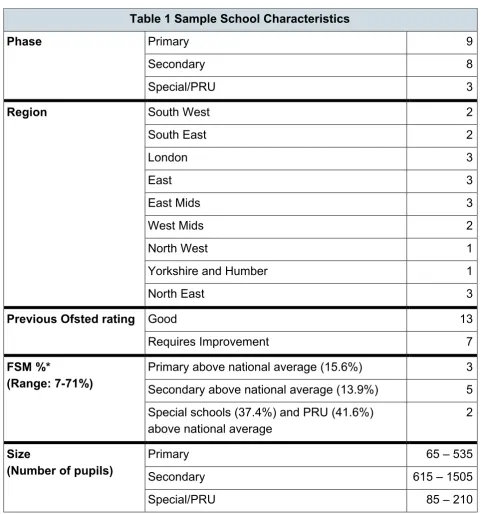
representative, the sample of schools included a mix by phase of education, region, size and type of school, and the level of improvement they had made in their behaviour rating from Ofsted (see Table 1).
6
• what had been introduced or changed that was considered to have led to an improvement in behaviour;
• which elements were considered to have been the most important;
• strategies and practices that didn’t work or were considered less effective; • leadership role;
• recommendations to other schools seeking to improve behaviour.
The fieldwork was undertaken in a short timescale with the majority of interviews conducted over a 2-week period in July 2016.
All interviews were written up and coded using a Framework technique. The key issues emerging were explored along with details of how common approaches and techniques were being implemented.
Limitations
The small-scale nature of this research and non-probability sampling strategies employed limits the extent to which generalisations can be made. The research team were asked by DfE to interview schools rated by Ofsted as outstanding. It is acknowledged that Ofsted grading is only one measure of success and other factors (such as cohort changes) may also lead to improvements in behaviour.
As the focus of this research is only on schools rated as outstanding, it is not clear if lower rated schools would report using the same approaches or strategies.
By interviewing senior leaders, the research team collected the ‘top down’ view of behaviour management. The results may have been different had individual classroom teachers been interviewed.
It should also be borne in mind that this research is one strand of a range of sources of evidence that are being used together to inform the wider Bennett review of behaviour. The evidence from this qualitative research with schools is therefore one small piece of the jigsaw.
Sample Characteristics
7
Table 1 Sample School Characteristics
Phase Primary 9
Secondary 8
Special/PRU 3
Region South West 2
South East 2
London 3
East 3
East Mids 3
West Mids 2
North West 1
Yorkshire and Humber 1
North East 3
Previous Ofsted rating Good 13
Requires Improvement 7
FSM %*
(Range: 7-71%) Primary above national average (15.6%) Secondary above national average (13.9%) 3 5 Special schools (37.4%) and PRU (41.6%)
above national average
2
Size
(Number of pupils) Primary Secondary 615 – 1505 65 – 535
Special/PRU 85 – 210
8
Ten key themes
In this section, the ten key underpinning themes that emerged across the interviews conducted are presented. This includes:
• an overview of the key features identified;
• an extended summary of the practices and strategies used by the schools interviewed. This acts as a means to exemplify the features identified with practical approaches being used in schools;
9
Issue 1: Policies and Practice
The research identified that all schools had clear policies written on behaviour
expectations with detail of procedures to ensure this, or respond to poor behaviour. Many of these policies separated out the responsibilities of SLT, staff, pupils and parents. The key features were that policies:
• were clearly articulated and simple to implement, understand and follow;
• often collaboratively developed and delivered across the school to foster buy-in; • had clear red lines that were well understood and consistently applied;
• supported early identification of issues and intervention;
• focussed on achievement and codes of conduct and not solely rules for behaviour.
Clear, simple policy
Schools had a clear behaviour policy (included on the school website) that detailed the school ethos, why good behaviour was important, and details of the rewards and sanctions used. These made it very clear what the steps in the process would be, and who would be involved at each point.
Example: Primary school
One primary school’s policy states:
AIMS:
We continually strive to achieve our Vision Statement, “We Care, We Share, We Learn and Achieve” by aiming:
• To provide a positive, safe and happy learning environment in which everyone is inspired and empowered to achieve the highest standard of which they are capable in all aspects of their life.
• To recognise, accommodate and support the needs of all individuals.
• To help everyone to make appropriate choices through praise, encouragement and by leading through example.
• To treat everyone with respect, encourage self-respect, listen to and value everybody’s opinions, contributions and ideas.
• To provide a broad, balanced, stimulating curriculum in which all progress is recognised, developed and celebrated.
10
• To ensure that effective leadership and management enables us to continually improve all aspects of our school through systematic, rigorous self-evaluation.
• To make school fun for everybody.
Through a positive approach towards behaviour management, we aim to create a calm learning environment in which pupils can:
• learn and teachers can teach;
• operate with increasing independence;
• develop a sense of responsibility for their own behaviour and a greater sense of consideration for others;
• grow in confidence and self-esteem; • feel safe and supported;
• develop a wide range of knowledge and skills.
This document aims to set out the expectations of pupil behaviour and to give an explanation of the agreed methods to be used by the staff in order to achieve this standard of acceptable behaviour. The purpose of this document is to give a clear
explanation to parents and new staff of our expectations and agreed methods. [Followed by details of rewards and sanctions processes].
Red lines, consistently applied, with flexibility only where there are
clear mitigating circumstances
There were definite ‘red lines’ for acceptable behaviour, which if crossed resulted in sanctions (including immediate severe sanctions for the most disruptive behaviours). These were made clear to staff, parents and pupils and often spelt out in policies.
Schools had a strong culture of communication and application of any rules or red lines in order to ensure compliance.
In addition to securing compliance, schools also worked hard to understand the reasons for non-compliance. This may have been achieved, for example, as part of restorative practices, through monitoring of data or identification of SEND to determine whether there were any mitigating circumstances or factors that would explain the behaviour. This meant that isolated incidents could be dealt with in a more individualised way.
Example: Secondary school
11 Example: Primary school
All children have their behaviour monitored by using the class zone board. Pupils all start at the same point every day (or every week for older pupils). Children move up or down the zones based on their behaviour and performance. Negative behaviour instantly moves you down on the board. For one particular pupil with Special Educational Needs and Disabilities (SEND) the system is further tailored so he has 3 car stickers on the board to give him 3 chances before his behaviour is reprimanded. It’s made clear to other children why his behaviour is treated slightly differently. There is a ‘line’ before going into the red zone (where sanctions occur) that triggers the issuing of a final warning.
Early ID and intervention
Rather than repeatedly sanctioning poor behaviour, many of the schools interviewed were identifying potential issues early and intervening to help prevent them from escalating. Intervention strategies included: home support for poor attenders; anger management sessions for pupils who show aggression; and groups addressing uniform (and make up) issues. Schools were also using a range of teaching and learning
interventions for those whose behavioural issues may be due to other barriers to learning.
Example: Secondary school
“It’s so much more beneficial to intervene earlier. It reduces workload, exclusions are down, 40 less than in the previous year. And we have the chance to uncover issues at home which could trigger safeguarding procedures”.
Collaborative approach
Pupils, teachers, non-teachers and parents input into developing the school behaviour policy and/or class approach.
Example: Primary schools
“Monday assembly is focused on the learning behaviour for that week. On Friday we celebrate success in that area with two students rewarded from each class. This keeps it all high profile and reinforces the positive language and approach to success”.
At the start of a year each class establishes a set of class rules and targets. These are developed into visual systems for managing behaviour (e.g. a target board, a treasure chest for collecting jewels, sun and cloud board).
Example: Secondary school
12
needs of its students. The school set up a new Student Engagement Department. Young people and families were involved in its development through co-designing a package of provision for academic, emotional and social empowerment.
“We developed an on-site student engagement department. This involved adopting an asset-based approach working with students, families, the community and professionals to shape the provision”.
In another school, the head reviewed the behaviour management policy alongside pupils and staff. All were involved in the development of a new policy in order to foster buy-in and ownership of any new approach adopted.
Focus on achievement and engendering responsibility, not simply
rules for behaviour
Schools spoke of using positive language and constantly reinforcing the school’s ethos for success and achievement, as opposed to repeating ‘good behaviour’ mantras. This was reflected in many of their school mottos and codes of conduct.
Example: Primary school
“Our school motto, all around the school says ‘A good learner…’. One of our maxims is to value school. If someone were found scribbling on the desk we would pick them up on not valuing school. We respect differences, so any verbal abuse or bullying would be brought back to that. Our policy is therefore a list of ‘dos’ rather than ‘do nots’”.
Example: Primary school
“We do not insist on silence. Silence does not mean getting on with work, actually
13
ISSUE 1: CASE STUDY ILLUSTRATION
Using a Community Asset-Based Approach to Reduce Exclusion and
Improve Achievement
Context
The school is a larger than average-sized all-through school. When the school was last inspected by Ofsted in 2014 it was judged to be outstanding overall. This was an
improvement from a ‘good’ rating in the previous inspection. One-third of pupils are White British with the largest proportions being from minority ethnic groups of Black African and Black Caribbean heritage. The proportion speaking English as an additional language is above average. The proportion for free school meals is well above average. The
proportion of pupils with a statement of special educational needs is also above average1.
Strategies for managing behaviour
The school’s policies and processes to set high standards of behaviour are documented in the Behaviour for Learning Policy and include a range of activities:
• seven key character strengths; • code of conduct;
• documented approach to dealing with unacceptable behaviour (including examples of what constitutes unacceptable behaviour);
• sanctions for unacceptable behaviour (including examples of possible sanctions); • commitment to learning - where students are given a grade on their commitment
to learning (graded from A-D). The school has also developed a checklist of what behaviours are required to achieve an A grade. Grades are logged on the School Information Management System (SIMs);
• rewards system;
• net points recorded on SIMs and tallied each term for every student;
• yellow card system which contributes towards the overall House points tally of the student (‘Achievement’ card = plus 1 point and a ‘Concern’ card = minus 1 point); • attendance and punctuality logs are recorded on SIMs for each lesson (number of
minutes late);
• documented staged approach for dealing with low-level behaviour in class;
14 • on-call system;
• referral centre; • exclusion policy.
Student Engagement Department (SED)
The school’s Student Engagement Department (SED) was established approximately three years ago. It was formed from a merger of several existing behaviour provisions (Mentoring Team, Attendance and Punctuality, Resource base and Referral centre). The department was set up in recognition of a need to prevent young people from permanent or self-exclusion. There was also concern that young people were becoming over reliant on existing services and were becoming ‘passive recipients to specialist intervention2’. In establishing the SED, the aim was to determine which of the prevailing approaches used in school were more and less effective, rationalise existing provision and shift the
engagement of young people and families from a position of passive to active participation.
A 3-year initial plan for change was developed:
• Year 1 - focussed on setting the vision, documenting the outcomes to be achieved and determining which practices and services were of value and which were not; • Year 2 - focussed on co-production - co-production involves the development of a
relationship between service provider and service user that draws on the
knowledge, ability and resources of both to develop solutions to issues that are considered to be successful, sustainable and cost-effective, changing the balance of power from the professional towards the service user3
. In year 2, a set of
principles values and expertise were co-produced in line with the shared vision and outcomes expected;
• Year 3 - concentrated on action - deploying the co-designed processes to achieve the stated outcomes desired.
What sorts of activities and provision does the SED deliver?
The SED is integrated into the school. Referrals are made to the SED where a core team of staff allocate students to appropriate provision. There are 3 groups of activity within the SED:
2 School’s own report
3 Supporting best practice in community development. Community Resilience and Co-production . Getting
to grips with the language: A briefing paper . Scottish Community Development Centre. Available at:
15
• Group A - comprises 3 blocks of activity, training and interventions designed to address the social, emotional and physical well-being of students. Block 1 is integrated provision within school and includes: in-house alternative provision (aimed at preventing referrals to the local PRU); mentoring, social work and counselling team; support for students and families around attendance and punctuality; an internal exclusion area with a restorative focus; and external alterative provision. Block 2 is about staff training and development. Staff
members from the SED provide regular training and support to teachers through the school to ensure quality first teaching. Training and development for school staff has focussed on strategies for behaviour management, motivating students and restorative practice. Block 3 provides pastoral support and promotes good practice. This is achieved through the allocation of a member of staff from the SED team to each year group.
• Group B - is about community engagement - working with students, families, the community and professionals to shape the SED by co-designing and co-producing interventions and activities. This is achieved through peer-to-peer support, and collaboration and co-production with teachers. Evaluation is an integral part of activity and students and families have been actively involved in evaluating and reviewing provision.
• Group C - is about working in partnership with internal staff as well as external organisations and agencies to improve the quality of the SED. This includes: developing a portfolio of local services to which the SED can signpost and refer families; establishing the SED as a centre of training e.g. for student social workers; half-termly meetings to evaluate practice and performance; and
involvement with strategic partners such as the Clinical Commissioning Groups, Health and Well-Being board to share good practice and shape community services.
Some examples
“What’s strong as opposed to what’s wrong”. - The central tenet of the school’s SED approach is to identify ‘the assets’, in other words, the positive skills and attributes within each student and to use the attributes identified as a hook to involve, or re-shape the student’s engagement with the school. This has included for example, training and
supporting a young person to set-up and coach a football team at the primary school site. The aim is to focus on ‘what’s strong’ (assets) about the individual, as opposed to ‘what’s wrong’ (deficits).
16
students are timetabled across SED activities and help to co-design and deliver engagement programmes.
Ensuring sustainability- by working in partnership with other agencies and through on-going training and reflection, the school is able to ensure that the provision it offers can be sustained as it does not require increasing external funding.
Emerging impact
The school regularly monitors and evaluates the SED. This includes identifying impact. Figures provided by the school suggest that the introduction of the SED has had a notable impact in terms of:
• achievement - in 2014-2015 35% of students in the SED achieved 5 or more A* to Cs including English and Maths compared to 0% of students in the local PRU/ Alterative Provision (AP) and the national average of 1% of students in PRUs/AP in the same year;
• contributing to a reduction in the number of fixed term exclusions which stood at 510 in 2006-2007 before the SED and is now at 17 (figures for 2015-2016 after the SED);
• contributing to a reduction in permanent exclusions. There were 4 permanent exclusions in the year 2012-2013 before the SED was established. In the 3 years that the SED has been running (2013-2016) there has only been 1 permanent exclusion4.
Issues and considerations
In setting up similar provision, the school has identified a number of issues that need to be taken into account:
• time and resources for implementation;
• skill-sets of staff - staff in the SED are largely from a youth work, alternative provision, counselling background. Staff in the referral centre are very experienced teachers;
• time that pupils are taken out of lessons - the school tries to limit the intervention time so that the young people and base they may attend remain fully integrated within the school. This means a student may receive 50 minutes of mentor time but is then expected to be back spending the next 50 minutes in their subject lesson;
• taking risks and encouraging staff buy-in - work needs to be done and feedback provided on the effects of using an asset-based approach in order for some staff not to see it as a means of rewarding pupils (e.g. by giving them responsibility) for bad behaviour in class.
17
Issue 2: Structures
The research showed that several schools had introduced structural changes to better manage behaviour. These included:
• having a pastoral team – with clear accountability for behaviour;
• allocating SLT responsibility for behaviour management (more common in secondary schools). This involved for example:
o adding a new level into the school structure such as incorporating non-teaching staff into the SLT;
o having a senior member of SLT take responsibility for behaviour
management, policies, implementation, staff support and disciplining pupils; • the involvement of governors;
• changing the structure of the school day (e.g. breaktimes/lunchtimes, factoring in time for extra-curricular activity).
Pastoral team
Schools spoke of the need for specific staff to have non-teaching time to allow them to take the lead on monitoring and supporting behaviour, to focus on relationship
development and building rapport with students, and to oversee or enact early
intervention. Many had brought in a layer of staff at senior level who had ‘pastoral’ roles and less (or no) allocated teaching time. In larger schools, to ensure these staff had capacity to build relationships with students, the pupil population was split into smaller groups, each assigned a pastoral lead.
Example: Secondary school
“We split the school into smaller colleges, each with a pastoral lead. This was so there was more belonging of students, as well as a greater ability for senior staff to connect with individual pupils”.
Example: Primary school
Pastoral leads were introduced with an explicit responsibility for every child’s
18
SLT responsibility
SLT took a clear lead role in behaviour management, often with an assistant head taking overall responsibility. It was expected that the SLT would:
• model expectations (to staff and pupils);
• give a clear and consistent message (through words and deeds);
• give total backing to staff decisions (including justifying actions to parents); • allow staff ownership / flexibility of class management within school guidance; • choose staff to fit approach (in interviewing and preliminary meetings);
• invest in training.
Example: Secondary school
SLT are given time and responsibility for being present at the school gates at the start and end of school and during lunchtime. They are also expected to regularly walk the corridors so that they are setting the tone for pupils both in and out of school.
Example: Secondary school
In another school there are no middle leaders. There is a much larger SLT. Each
member of the SLT has responsibility for a core aspect such as behaviour, teaching and learning.
Teaching and Non-Teaching Staff
Several schools had changed staffing structures, often as a means to foster stronger relationships between staff and pupils.
Example: Secondary school
In one secondary school a decision had been made to deploy non-teaching staff as heads of year. These staff were often learning mentors or pastoral staff. It was felt that by virtue of having a different relationship with the children, these staff could help unpick the issues that may be affecting the pupil’s behaviour or learning for example.
Example: Secondary school
Noting break and lunchtimes as a flashpoint for negative behaviour, the Head chose to allocate directed time for teachers to supervise at break and playtimes. Not only did this lead to a reduction in behaviour incidents but also fostered a different relationship between teachers and students as students were afforded opportunities to engage with staff in a different way than they would in lessons.
19
All non-teaching staff were included in behaviour management training and school
discussions. This ensured that they too were aware of the behaviour policy and applied it in a consistent way. Lunchtime supervisors were made responsible for monitoring
behaviour and reporting it to the afternoon teaching staff.
Governors
There was a split between governors taking an active role in advising on and monitoring behaviour management and those leaving it more in the hands of SLT, supporting them to try new approaches and take risks.
Example: Primary and Secondary schools
One school spoke of governors willing to take a risk with their Ofsted rating if issues were addressed/allowing approaches to be tried, even if there was not an immediate impact, or not everything tried was successful. Some schools did have governors who wanted to see behaviour management strategies and were involved in developing and monitoring policies. Other schools said the governors showed little or no interest in specific
behaviour approaches taken (unless there were large or entrenched issues).
Changing the school day structure
Several schools interviewed had re-structured the school day. Example: Secondary schools
In one school, time had been released during the last period on one day of the week for non-curricular activities. The activities would start in school time but also extend beyond the school day. This approach helped to keep children in school and prompt them to take up activities in school that helped them to engage with school in different ways.
Some schools carefully monitored take-up of extra-curricular activities to ensure that there was something available for all students.
Example: Primary school
20
ISSUE 2 CASE STUDY ILLUSTRATIONS
Structural Changes Introduced to Manage Behaviour
A significant number of schools interviewed had implemented structural changes
designed to better manage behaviour. Structural changes included those that were: staff-based (i.e. that changed the hierarchy, chain of command, management systems, job structure in schools); and those that altered the arrangement of the school day.
Example 1
Secondary school - a larger than average sized secondary. The proportion of disadvantaged students is average. The majority of students are of White British heritage. An above average proportion of students have English as an additional language.
The school implemented ‘major change’ in its curriculum offer. The school has adopted a personalised approach to learning and students opt for subjects that they want to do. Students can follow the English Baccalaureate (EBacc) and there is also a range of vocational subjects on offer.
Structural changes implemented by the school have included:
• changing the school day - this included shortening the school lunch break and formally timetabling the last lesson of the school day for extra-curricular activities on one day of the week;
• staffing - this has included using teachers to supervise lunch and break times as part of their directed time. Teachers are given a choice to supervise every break or one lunchtime a week. Currently, heads of year are practising teachers within the school but the school is considering changing this to non-teaching staff. Example 2
Secondary school - a larger than average sized secondary. The proportion of ethnic minorities is much higher than the national average. The proportion of pupils with SEND is lower than the national average.
The school took a number of steps to improve its behaviour management practice from good to outstanding. This included implementing the following structural changes:
21
• the instigation of a behaviour, personal development and well-being team - this comprises a team of 4 staff including the deputy head with responsibility for behaviour. The team includes highly experienced teachers as well as staff with a background and expertise in youth work, safeguarding and as a learning mentor. The behaviour team operate an on-call system and team members carry radios to aid communication.
The main advantages of operating using this refined staff structure are:
• responsiveness - all staff have ‘absolute flexibility during the day’ to respond and deal with any incidences of behaviour. Although the staff have timetabled
activities, they have the flexibility to come out of lessons as and when required; • consistency - all behaviour incidents (consequence points graded from a C1 for minor infringements of behaviour to C4) are filtered through one person in the team. This ensures that responses for managing behaviour are consistently and routinely applied;
• shifting responsibility for managing low-level behaviour to class teachers (who deal with C1 incidents) with more serious or repeated issues of behaviour being tackled by a small and responsive team. This has included working with teachers to ensure that the little things are consistently focussed on and enforced e.g. uniform, punctuality and being prepared for lessons (teachers and students). High standards of behaviour and punctuality are insisted upon. This, alongside quality first level teaching, is considered central to ensuring high standards of behaviour across the school. Over a number of years by applying a consistent approach to managing behaviour and insisting on high standards, the school has developed a culture where students are not simply obedient but take responsibility for their own actions and choices. This is evidenced both in school feedback and Ofsted inspection reports.
Example 3
Secondary school - a larger than average sized secondary college. The majority of students are from an Indian-heritage background and most students speak English as an additional language.
The staffing structure was changed so that non-teaching staff are employed as assistant heads of year. The fact that these staff are not teachers is considered significant in changing the way the staff interact with students. Assistant heads of year selected, were largely operating as learning mentors in the school or came with a background of working within a PRU. Their role is to support achievement and to have a significant focus on attendance and behaviour. Their role includes producing reports that feed into regular pastoral meetings.
22
Issue 3: General Behaviour Management Practices and
Approaches
There was a wide range of different general practices for behaviour management. All of these had been introduced as a way of keeping behaviour in classrooms positive,
preventing escalation of issues and maintaining structures within which the school could operate most beneficially for all. These approaches were mainly based on experience or received wisdom (including from initial training) about what helps with managing
behaviour. These included:
• school or classroom rules;
• school motto or ethos statement; • pupils given positions of responsibility;
• classroom seating allocations/learning environment; • curriculum;
• personal, social, health and economic education (PSHE)/tutor time;
• teachers being prepared and having well-planned and differentiated lessons; • students put on task immediately;
• use/reinforce clearly articulated whole-school behaviour policy; • uniform.
School or classroom rules
Example: Primary schools
Many primary schools were using some form of zone or target boards in their behaviour management strategies. These involve behaviour and effort being rewarded or
sanctioned during lessons by moving pupils to a different position on a chart. This could involve: ‘going over the rainbow’ (for very positive behaviour) or ‘sitting on a dark cloud’ (for worsening behaviour); or being ‘in the raincloud’ (for the most serious behaviours). In another example, children are moved up or down a number scale, etc. Once children reach a certain ‘score’ level (positive or negative), they receive a reward (star or certificate) or sanction (moved out of classroom, sent to the head).
Example: Secondary schools
23
School motto, code of conduct, set of values or ethos statement
Schools generally had a school motto, code of conduct, approach or ethos statement that was well-known, documented and visible across the school.
Example: Special school: Approach
• Respect for the individual.
• We attempt empathy.
• Challenging behaviour is normal.
• All behaviour is communicative.
Example: Secondary school
• We aspire by:
o Putting in excellent effort
o Taking on new challenges
o Being self-reflective
• We enjoy our time at school by:
o Showing respect
o Being a community
o Being safe
• We achieve our best at school:
o With good attendance
o By being punctual
o By being our best
Pupils given positions of responsibility
Schools had strategies in place to foster pupil responsibility for their own behaviour and learning. This was created, in part, by giving pupils positions of responsibility.
Example: Primary school
KS2 pupils apply for and are interviewed to hold certain ‘jobs’ within school. This includes classroom tidier, playground monitors, leading activities for children with behaviour
issues, for example.
Example: Secondary school
24
Classroom seating allocations/learning environment
Schools talked of creating (more) effective learning environments. This ranged from simple strategies for managing disruptive behaviour such as moving children to a different desk or classroom - to whole school approaches such as getting rid of rows/groups of tables and chairs to create more open, thematically-based learning environments such as African huts, spaceships etc.
Example: Primary school
The dining room was made more comfortable and ‘homely’ by using smaller tables, tablecloths and having teaching staff sitting with pupils and serving them lunch. Small areas of the school were also made more ‘cosy’ for pastoral sessions and small group interventions, to help build up relationships of trust.
Example: Secondary school
“We moved into a new build and it made all the difference. It’s light and airy and fresh feeling. There are no nooks and crannies where anyone can hide, so it’s easy for staff to see everything happening around the school. Students have greater respect for the property than in our last place and that encourages them to have pride in the school, their work and themselves”.
Curriculum
Schools of all types and across all phases of education highlighted the importance of a flexible, engaging and creative curriculum that was adaptive, creative and flexible so it could meet the needs of a range of learners.
Example: Primary school
One school decided to take another look at its curriculum offer and challenged staff to make all of their teaching and learning engaging for all pupils. Staff are encouraged to regularly change the format, tempo and content of lessons. They foster delivery that allows pupils to be the experts and offer a range of ways for pupils to engage with topics (such as making something, designing a poster, or writing a story).
PSHE/Tutor time
25 Example: PRU
They start each day with tutor time, to get pupils to sit, get calm, and discuss what’s ahead for the day. This allows tutors to regularly reinforce the expectation of
achievement and pick up on any potential issues, while offering pastoral support for pupils (many of whom have chaotic home-lives with different behavioural norms). This fosters teacher-pupil trust and encourages them to want to do well.
Teachers prepared
Example: Secondary school
Teachers having well-planned and differentiated lessons was considered an effective way to offer less scope for behavioural problems, keep students energised and on task.
Students put on task
Example: Special school
The details of the first activity pupils are to engage with is on the board ready for students to consider as soon as they enter the classroom. Students are expected to be sat at their desks and ‘ready to learn’. Students therefore know what the lesson is going to be about and are more focussed.
Reinforce behaviour policy
Example: Primary school
“I only have to say to pupils ‘the 3 S’s’ and they all know what it means (it’s the school’s motto which refers to positive behaviours). If the lesson is starting to get a bit noisy I’ll ask if we all know what the 3 S’s mean and who is displaying them”.
Uniform
Example: PRU
“We introduced a uniform policy which everyone said would not be adhered to. But it gave our students a sense of pride and belonging. We made it simple and affordable, but with a zero tolerance approach to not turning up in it”.
Example: Secondary school
26
ISSUE 3 CASE STUDY ILLUSTRATIONS
General Behaviour Management
Including Examples of Managing Low-Level Disruption
There was a wide range of different general practices for low-level behaviour
management in evidence. Most schools were clear that high quality first level teaching and effective classroom management along with an engaging and flexible curriculum were important components of good behaviour.
In many of the schools we spoke with:
• schools had employed multiple strategies to secure high quality first level teaching. This included employing techniques such as: modelling effective practice to staff; practice observations and learning walks; peer-to-peer review; and use of video evidence to discuss and review features of effective practice;
• the curriculum had often been reviewed and changed as part of a wide range of strategies for school improvement. This included: using a growth mind-set; a wide-ranging curriculum offer in secondary school; and examples of project-based and creative curriculum environments being used in primary schools;
• staff were supported to adopt and be responsible for positive strategies for managing behaviour in their own classrooms.
Strategies for Classroom Management and Dealing with Low-Level Behaviour
These included:
• using “the 5Ps (passion, participation, praise, pace, purpose)” within all teaching; • acknowledging the children when they arrive for class - for example by saying
‘hello’ and asking how they are;
• effectively planned and prepared lessons with clear objectives set. Often children were given a task written on the board for them to commence as soon as they came into class;
• establishing routines (such as ‘come in quietly, books and pens out ready for learning’);
• changing the classroom learning environment - in one primary school this involved more use of open plan teaching in cross year groups. More immersive learning environments were created, for example by removing the school desks and chairs to make room for an “African hut’ or “spaceship’ to learn in;
• use of voice ‘don’t shout and keep calm’ and ‘the look’;
27
• ignoring low-level disruption until a time that it can be better addressed without taking up learning time from other students. In other cases, schools adopted a zero tolerance policy to any form of disruption to learning. This was achieved through a well-documented logging system of consequence points that were recorded on the school management system/SIMs;
• points or rewards systems (for positive or negative behaviour or both), which lead to rewards or sanctions.
Example 1
Primary school - smaller than average size, most pupils are White British, around one-quarter FSM, high levels of pupil mobility.
For low-level disruption - the teacher is expected to intervene or divert attention if possible by:
• moving in - continuing with lesson delivery but whilst standing close to the child being disruptive;
• providing eye contact, giving ‘the look’;
• praising a child who is near the disruptive child; • mentioning the child’s name mid-flow;
• the teaching assistant may move closer and maybe touches the child quietly as a signal for them to move to the time out area.
Classroom sanctions will be applied, such as:
• a move down the class behaviour/reward chart; • a child told that a warning will be serious; • a child sent to see the headteacher. Example 2
Primary school - larger than average size, around 50% White British background and the remaining proportion from a wide range of ethnic heritage. Above average levels of English as an additional language, lower than average levels of FSM.
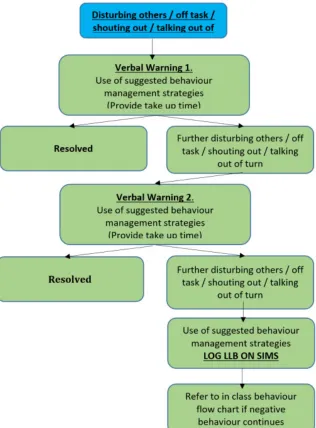
For low-level disruption, children are given two opportunities to improve their behaviour: • Warning (warning one);
• Final warning (warning two). After that:
28
• if still disruptive the child will be moved to a partner class and given lunchtime pay-back.
Example 3
Secondary school - larger than average in size, majority of pupils from Indian heritage background, most have English as an additional language, above average FSM.
30
Issue 4: Positive Praise and Rewards
Schools were clear that creating a positive approach to behaviour management was at the centre of their approach. Many spoke of ensuring that positive practice, praise and rewards should be used to encourage good behaviour much more than fear of sanctions or threat of response if behaviour was not good.
This was achieved through three key strategies:
• praise - starting everyday “as a new day” or “with the positive” and praising the good behaviours and achievements rather than focussing on the negative;
• role models (virtual and actual) - several schools had varying systems for creating role models in school;
• reward systems - all schools had documented rewards systems and strategies for celebrating achievement. These also focussed on praise. It was clear that it wasn’t just the value of the reward system that was important. It was also the consistency with which it is applied.
It also emerged as important that the rewards offered were tailored to the school and its students. This was to ensure that any rewards offered were something that students wished to receive or achieve. Schools also spoke of the need to refresh and renew
systems to keep up momentum and ensure that rewards kept their status or kudos. (“The school shop rewards just didn’t do it for students any more”).
Praise
Staff spoke about not judging students by their previous behaviour, so as to allow them to improve. Each day starts afresh, so the slate is wiped clean on behavioural issues that had previously occurred. Often schools spoke of the importance of praising pupils who had displayed negative behaviours in the past – the sense of receiving praise being stronger than the response to poor behaviour. Approaches to praising children included:
• verbal praise and encouragement;
• communication with parents about good behaviour; • celebration/achievement assemblies;
• identifying pupil assets rather than deficits. Example: Primary school
31 Example: Special school
A special school had weekly assemblies where pupils received awards across the subject areas. Over the course of a week, teachers could also nominate a pupil for the prestigious pupil of the week award. The pupil was given a ‘trophy’ to take home and show to their parents. The trophy would be returned at the end of the week and the students given a mini version to take home and keep.
Role Models
Schools adopted different ways of fostering role models within the school. This included: • head boy and head girl and vice roles;
• allocating roles such as playground buddies etc.;
• highlighting the behaviour of pupils behaving well in class; • creating a character to act as the school role model.
Example: Primary school
All pupils have a job, which they apply and are interviewed for – door monitor, cleaner, play leaders. Play leaders are most highly valued with most students aspiring to get this job. Year 4 pupils provide structured activities at lunch (normally for those requiring interventions). This builds positive self-esteem and pride in their role in school and models good behaviours and success to younger children.
Example: Primary schools
One primary school had created a school role model character called TIM (an acronym for “Today I am Mastering”). TIM was visible across the school, in the form of a mascot, school badges etc. Pupils in the school tried to emulate TIM and his positive behaviour.
Rewards
32
Simplicity and consistency of application were considered as important as the strategy employed.
Examples of rewards included:
• individual rewards (e.g. certificates, stickers); • group rewards;
• tokens e.g. house points, marbles in a jar;
• prizes and financial incentives (from the school shop, or high street);
• privileges (table tennis at lunchtime, or an end of term trip to a theme park). Example: Infant school
In one infant school, children collected jewels. These went into a class pot for a whole class award as well. Children with SEND may also be given their own jewel pot with targeted personalised strategies to gain jewels. These would also be put into the school class pot.
Example: Secondary school
Teachers can award students Vivos that students can save and then spend on the rewards they want from an online catalogue. Vivois a rewards system that can be purchased from a private company.
Example: Secondary school
ISSUE 4 CASE STUDY ILLUSTRATIONS
Rewards and Sanctions
Most of the schools relied on some form of structured reward and sanction system. Rewards
Rewards included:
• praise – both verbal and written feedback; • warm encouragement;
• sharing work;
• mentioning in group activities and/or assemblies.
However, in nearly all cases a system also existed to reflect these rewards. The ‘value’ of these rewards varied, as did the length of time over which they were accrued, and the extent to which they could be ‘lost’ as well as ‘gained’. These differences were
particularly evident between primary and secondary settings. In primary schools:
Children were monitored on a ‘zone board’ or ‘thinking tree’ or ‘class chart’, or similar systems. These all allowed pupils to be rewarded for their behaviour, work or effort by being moved further ‘up’ the scale. Achieving a certain level over a certain timeframe (e.g. above the green line all day or at level 5 all week) could result in a more tangible reward. This might be a certificate at the end of the week or a treat (either physical or experiential). The reward maybe either received at school or at home – such as play time in the park.
In secondary schools:
Reward systems were more formalised and, in many cases, were individually calculated. Some schools had jointly accrued systems such as across classes, or school ‘houses’. How points were awarded and what for was explicit but at the discretion of staff. These points had to be earned over longer periods of time than in primary schools and the ultimate goals had higher values. Some pupils had student point accounts that could be exchanged for items at any time, whilst others only ‘paid out’ at termly or half-termly intervals.
Some schools had a ‘shop’ at which points could be exchanged – with PlayStations and bicycles as higher value rewards but also stationery and luxury items of lower value available.
34
also result in a treat. These were often day trips or leisure activities.
A PRU offered outside learning sessions to those who built up points over a half term. Top winners are read out in assembly or get to use the gym equipment at lunchtimes. Trips to theme parks were often seen as good incentives for pupils to work towards. Sanctions
However, for these systems to be effective and rigorous, there was also a need for a clear sanctioning process when behaviour norms were not met. These processes appeared fairly consistent across all schools.
Initially, negative behaviour was dealt with by: • disapproving looks or reactions;
• verbal correction, reprimand or warning; • moving seating position.
Teachers were felt to be equipped with certain techniques, words or actions to prevent low-level disruption continuing or worsening. These techniques had been picked up from training, through experience, or were provided to staff on their lanyards.
In primary schools, pupils could be moved ‘down’ the scale. If they fell ‘under the red line’ or ended the session at ‘Level 1’, there were further consequences. Pupils could be kept in during break times, or kept away from their friends.
Similarly, secondary-aged pupils could lose points or accrue negative points which could count against them over the longer term.
Severe or persistent behaviour violations could be dealt with by removal from the class (either to outside the classroom or another space). If this did not resolve the problem, their issue could be escalated up to a more senior member of staff, who could suggest greater sanctions. Parents were informed and/or involved at various stages of this process.
There were very few examples of primary schools using after school detentions, but some did keep children back during breaks and maybe hold them back after school to discuss their behaviour (possibly also with their parents).
Internal segregation and exclusions were used by both school phases, although only for the most severe disruptions and with the proviso that a strategy would follow this to address behaviour or underlying issues.
35
reward/sanction history identified that they had specific issues. This might be an
intervention designed to address behaviour explicitly, for example, the child may be put on anger management or relaxation interventions. Other interventions focussed on achievement, for example, the child may be given a different teaching and learning format or greater staff time.
Fixed term exclusions were considered as a last resort. Schools also identified that having a pupil with specific issues was cause to reflect on school practice and ask how changes could be brought in to better support the student. Again, some schools found that small group interventions helped, that giving rewards for smaller steps of
achievement could help, or, that outside, or alternative provision, was the answer to improving behaviour and achievement.
Emerging impact
Bringing in rewards for consistent attendance led to a boost in one secondary school’s attendance figures.
Issues and considerations
• Not all staff feel comfortable either rewarding or sanctioning pupils; • There needs to be consistency in how the system is applied;
• The ‘rewards’ need regular refreshing so that they continue to act as suitable motivation;
• Increases in or peaks of sanctioning may identify issues beyond individual pupils – such as something not working in their environment, or teacher development needs, for example;
36
Issue 5: Managing Disruptive Behaviour and Sanctions
Schools commented that there had to be clear, documented processes for dealing with disruptive behaviour. These had to be known to all members of the school and parents. Teaching staff had to feel confident to implement them and pupils and parents had to be sure that these processes would be followed fairly and with the express intention to keep all of the school working together for achievement.
Strategies employed included:
• effective classroom practice (see earlier on general strategies) in the general practices;
• practices for dealing with low-level behaviour;
• sanctions;
• de-escalation strategies;
• restorative practices;
• targeted interventions;
• strategies for dealing with challenging behaviour;
• exclusion.
Three key features for managing disruptive behaviour emerged as important:
• simplicity;
• consistency;
• professional judgement.
Practices for managing low-level behaviour issues
Several schools had a ‘no shouting’ policy reinforced with commonly repeated phrases such as “listen to how I’m talking”. Likewise, many schools spoke about the importance of building up a good relationship with pupils so that a) they didn’t want to disappoint the staff or b) the staff knew how to prevent issues arising for students. “I only have to give most students a look for a split second and they know they’re stepping close to the mark and I know they don’t want to step over it and disappoint me”.
Schools articulated a range of strategies for dealing with low-level behaviour. These generally had several stages, with the pupils fully aware that they were progressing through the stages:
• ignoring disruptive behaviour - at least until the rest of the class was on task and dealing with it then;
• body language - “the look”, continuing the lesson but standing close to the pupil; • verbal warning;
37 • move out of the classroom;
• loss of break time; • detention;
• internal exclusion; • removal of privileges; • warning or strike system; • sent to head or SLT/pastoral.
Sanctions (and rectifying behaviour)
Primary schools tended to support the approach adopted with visual symbols or systems. Secondary schools fostered whole school documented systems based on a graded approach, a ‘3-strikes and you’re out’ type approach, or a points-based system. Example: Infant school - thinking tree
In one infant school all children started the day on the sun icon. They could be moved to the sun/cloud icon if they exhibited poor behaviour. If this persisted they would move to the cloud icon or back into the sunshine for displaying more positive behaviours. More challenging behaviour would result in the child being moved outside of the classroom to sit by the thinking tree.
Example: Secondary school - internal exclusion
• “On call system” - sent to isolation room;
• Punitive;
• Students sit in booths and do their work;
• Graded approach to “exclusion”;
• Internal exclusion from 8.30am to 4.30pm. Don’t go out at all for breaks;
• 3.30pm to 4.30pm move out of isolation room (now in their own time as school has finished) and move into the inclusion room where work takes place on how pupil can do things better. Reflection time;
• Key approach - “try all the time to give students time for reflection. We use a restorative approach”.
This is only used “for pretty serious incidents”.
De-escalation
Several schools had written and rehearsed procedures to help their staff to deescalate behaviour issues.
38 • consistent support from team leader/SLT;
• not being afraid to apply and use a sanction if warranted; • not being afraid to exclude - sometimes it is needed. Example: Primary school
The school teacher uses the following strategies to keep calm when a child is exhibiting poor behaviour:
• count to 10;
• walk away;
• leave the room;
• speak to another child;
• speak to another adult.
Example: Special school
The school employ a range of strategies to try de-escalate things:
• keep calm;
• don’t allow incidents of challenging behaviour to affect you personally. A child’s behaviour is not about you… it is about them trying to communicate something;
• do not confront;
• don’t threaten consequences;
• be aware of your body language, facial expressions;
• be aware of the language used;
• do not get into a power struggle;
• it is difficult but sit it out;
• don’t talk about a child’s behaviour in front of them;
• give children respect and dignity;
• “We will say you can’t go and join your friends until you have done x”.
Restorative Practices
39 Example: Infant school
Based on formal training staff had received on restorative practice, they had set out a script which staff used following an incident of poor or unacceptable behaviour.
Responding to challenging behaviour - the individual is asked the following questions…
• What happened?
• What were you thinking about at the time?
• What have your thoughts been since? • Who has been affected by what you did? • In what way have they been affected?
• What do you think needs to happen next?
Responding to those harmed - those harmed are asked…
• What happened?
• What were your thoughts at the time?
• What have your thoughts been since?
• How has this affected you and others?
• What has been the hardest thing for you?
• What do you think needs to happen next?
Example: Primary school
Children get escalated through the sanctions system: move seat, move out of class, move to the head’s room, but once they are dealt with they then have to work back through the same system (moved back to outside head, moved back to outside class, moved to different seat in class, moved back to seat). This teaches them a commitment to addressing their behaviour, and tends to stop them earlier in the process. It also shows other pupils that there is no quick fix – that poor behaviour has consequences.
Targeted Interventions
Schools provided examples of targeted interventions they had used to support pupils. These included:
• report card; • sticker chart;
• individual behaviour plan; • one page profile;
40 Example: Special school
The school develops Individual Support Plans for each student that set out proactive strategies that can be used to help the individual manage their behaviour on a routine basis. The plan also includes reactive strategies - to be used when behaviour is more challenging to help keep the person and those around them free from harm.
Example: Special school
A special school had implemented the use of one page profiles. One page profiles capture important information about the person on one sheet of paper. The profile may summarise what the child likes, what their ‘triggers are’ and how best to support them when they are anxious for example.
Example: Secondary school
A secondary school has an inclusion centre within the school. Students may be referred to the centre for a behaviour management programme. The centre is staffed and
managed by the school - and uses programmes they have developed themselves.
Example: Primary school
Behaviour charts are developed with focused targets (based around behavioural issues). Targets are set in collaboration with pupils and parents, and are deliberately achievable (e.g. be kind to others). They encourage achievement and success which improves whole behaviour. Rewards can also be carried out at home (to build the home-school link and parents sharing in their child’s success).
More challenging behaviour
There was a split in how schools managed more challenging behaviour. Some schools, particularly small (primary) schools and special schools tended to focus on identifying the triggers of disruptive behaviour. Once these were identified the schools could put in place support to tackle those and to support the child or family.
Larger secondary schools were more likely to use punitive approaches as a frontline response e.g. loss of privileges, isolation/internal exclusion, fixed term exclusions, managed moves and fixed term exclusions, as well as then looking to target support to tackle the underlying issues for ongoing issues.
Example: PRU
41
• promoting the least intrusive positive handling strategy and a continuum of gradual
and graded techniques, with an emphasis and preference for the use of verbal, non-verbal de-escalation strategies being used and exhausted before positive handling strategies are utilised;
• enabling services to develop acceptable and authorised responses to disruptive,
disturbing, angry and aggressive behaviours in a manner that maintains positive relationships and provides safety for all;
• reducing the amount of serious incidents involving physical controls in all settings
and to emphasise the importance of exhausting behaviour management strategies in the first instance;
• increasing the awareness of staff concerning the importance of recording and
reporting, monitoring and evaluating, all incidents involving positive handling;
• providing a process of repair and reflection for both staff and children.
Example: Secondary school
There is an ‘on-call system’ in all classrooms and a speed dial on mobile phones. The school allocates a member of the SLT to man the on call phone every hour of the school day. There is a clear process for responding, including moving all other pupils out of the environment.
A new approach was brought in to manage a ‘boy heavy, disruptive cohort’ (so the process was aimed at dealing with incidents of bullying and physical harm).
There are clearly set out stages and everyone is very aware of these:
1. Issue a Behaviour Notification Plan to parents and have a meeting to discuss the issue. No outside time for 1 week and move onto behaviour chart
2. Further meeting. No outside time for 1 week, onto behaviour charts and reporting for 4 weeks (bring in additional staff to support child)
3. Final warning – not addressing behaviour will result in exclusion (never reached this stage).
Exclusion comes as ‘no surprise to anyone’ as they have all been kept informed
throughout the process, but it is given on the basis of evidence that the maximum effort has been made to prevent this.
Attendance
This was seen as a key factor to address when trying to improve the whole school approach to behaviour, but was less of an issue for schools whose behaviour management strategies were starting to bear fruit. Schools’ approaches included:
• Rewards for attendance – such as certificates or reward assemblies;
42
family support worker, truancy officers) or punitive (e.g. parents fined and/or taken to court);
• Using data to identify issues and changing school structures to address these. Example: Secondary school
Data showed a spike in attendance issues around Whitsun and November-December. The school put a 3-week qualification period, from which overall attendance and behaviour rewards were calculated, over these times. Attendance is now consistent across the entire school year.
Exclusion
43
ISSUE 5 CASE STUDY ILLUSTRATIONS
Internal Exclusion Examples of Schools’ Approaches
Our evidence from schools rated as outstanding overall and for behaviour, suggests that there is no one simple approach nor a set of strategies that should be applied. Local context is an important consideration in the way techniques are interpreted, refined and implemented within a school. Whilst all schools we spoke to operated some form of internal exclusion, what that consisted of, and the model of delivery operated, varied across schools.
Internal exclusion is an internal process within the school that is used when the objective is to remove the pupil from class, not from the school site, for disciplinary reasons.
Example 1
Secondary school - larger than average sized. The proportion of ethnic minorities is much higher than the national average. The proportion of pupils with SEND is lower than the national average. A very small proportion of students attend alterative provision. The school operates an ‘on-call system’ that provides support to all staff from a behaviour team of four individuals who can be called upon when difficulties arise. Support from the on-