DOI 10.1140/epjc/s10052-017-4780-2 Regular Article - Experimental Physics
Performance of algorithms that reconstruct missing transverse
momentum in
√
s
=
8 TeV proton–proton collisions in the ATLAS
detector
ATLAS Collaboration CERN, 1211 Geneva 23, Switzerland
Received: 30 September 2016 / Accepted: 21 March 2017
© CERN for the benefit of the ATLAS collaboration 2017. This article is an open access publication
Abstract The reconstruction and calibration algorithms used to calculate missing transverse momentum (ETmiss) with the ATLAS detector exploit energy deposits in the calorime-ter and tracks reconstructed in the inner detector as well as the muon spectrometer. Various strategies are used to sup-press effects arising from additional proton–proton interac-tions, called pileup, concurrent with the hard-scatter pro-cesses. Tracking information is used to distinguish contribu-tions from the pileup interaccontribu-tions using their vertex separa-tion along the beam axis. The performance of theETmiss recon-struction algorithms, especially with respect to the amount of pileup, is evaluated using data collected in proton–proton collisions at a centre-of-mass energy of 8 TeV during 2012, and results are shown for a data sample corresponding to an integrated luminosity of 20.3 fb−1. The simulation and modelling ofETmissin events containing aZ boson decaying to two charged leptons (electrons or muons) or aW boson decaying to a charged lepton and a neutrino are compared to data. The acceptance for different event topologies, with and without high transverse momentum neutrinos, is shown for a range of threshold criteria for ETmiss, and estimates of the systematic uncertainties in the ETmissmeasurements are presented.
Contents
1 Introduction . . . . 2 ATLAS detector . . . . 3 Data samples and event selection . . . . 3.1 Track and vertex selection. . . . 3.2 Event selection for Z→ . . . . 3.3 Event selection forW →ν . . . . 3.4 Monte Carlo simulation samples . . . . 4 Reconstruction and calibration of theETmiss . . . . 4.1 Reconstruction of theETmiss . . . .
e-mail:[email protected]
4.1.1 Reconstruction and calibration of theETmiss
hard terms. . . . 4.1.2 Reconstruction and calibration of theETmisssoft
term . . . . 4.1.3 Jet pT threshold and JVF selection . . . .
4.2 TrackETmiss . . . . 5 Comparison of ETmiss distributions in data and MC
simulation . . . .
5.1 Modelling of Z→ events . . . .
5.2 Modelling ofW →ν events . . . .
6 Performance of theEmissT in data and MC simulation. 6.1 Resolution ofETmiss . . . .
6.1.1 Resolution of the ETmiss as a function of the number of reconstructed vertices . . . . 6.1.2 Resolution of theETmiss as a function ofET
6.2 TheETmissresponse . . . . 6.2.1 MeasuringETmiss recoil versuspTZ . . . . . 6.2.2 Measuring ETmiss response in simulated
W →ν events . . . . 6.3 TheETmissangular resolution . . . .
6.4 Transverse mass inW →ν events . . . .
6.5 Proxy forETmisssignificance . . . . 6.6 Tails ofETmiss distributions . . . . 6.7 Correlation of fakeETmiss between algorithms . . 7 Jet-pT threshold and vertex association selection. . .
8 Systematic uncertainties of the soft term . . . . 8.1 Methodology for CST. . . .
8.1.1 Evaluation of balance between the soft term and the hard term . . . . 8.1.2 Cross-check method for the CST
system-atic uncertainties . . . . 8.2 Methodology for TST and TrackETmiss . . . . 8.2.1 Propagation of systematic uncertainties . . 8.2.2 Closure of systematic uncertainties. . . . . 8.2.3 Systematic uncertainties from tracks inside
Appendix . . . . A. Calculation of EJAF . . . . References. . . .
1 Introduction
The Large Hadron Collider (LHC) provided proton–proton (pp) collisions at a centre-of-mass energy of 8 TeV during 2012. Momentum conservation transverse to the beam axis1 implies that the transverse momenta of all particles in the final state should sum to zero. Any imbalance may indicate the presence of undetectable particles such as neutrinos or new, stable particles escaping detection.
The missing transverse momentum (ETmiss) is recon-structed as the negative vector sum of the transverse momenta (pT) of all detected particles, and its magnitude is represented by the symbol EmissT . The measurement of EmissT strongly depends on the energy scale and resolution of the recon-structed “physics objects”. The physics objects considered in the ETmiss calculation are electrons, photons, muons,τ -leptons, and jets. Momentum contributions not attributed to any of the physics objects mentioned above are reconstructed as theETmiss“soft term”. Several algorithms for reconstruct-ing theETmisssoft term utilizing a combination of calorimeter signals and tracks in the inner detector are considered.
The ETmiss reconstruction algorithms and calibrations developed by ATLAS for 7 TeV data from 2010 are sum-marized in Ref. [1]. The 2011 and 2012 datasets are more affected by contributions from additional pp collisions, referred to as “pileup”, concurrent with the hard-scatter pro-cess. Various techniques have been developed to suppress such contributions. This paper describes the pileup depen-dence, calibration, and resolution of theETmissreconstructed with different algorithms and pileup-mitigation techniques.
The performance of EmissT reconstruction algorithms, or “ETmiss performance”, refers to the use of derived quanti-ties like the mean, width, or tail of theEmissT distribution to study pileup dependence and calibration. The ETmiss recon-structed with different algorithms is studied in both data and Monte Carlo (MC) simulation, and the level of agreement between the two is compared using datasets in which events with a leptonically decayingWorZboson dominate. TheW boson sample provides events with intrinsicEmissT from non-interacting particles (e.g. neutrinos). Contributions to the ETmissdue to mismeasurement are referred to as fakeEmissT .
1ATLAS uses a right-handed coordinate system with its origin at the
nominal interaction point (IP) in the centre of the detector and thez-axis along the beam pipe. Thex-axis points from the IP to the centre of the LHC ring, and they-axis points upward. Cylindrical coordinates(r, φ) are used in the transverse plane,φbeing the azimuthal angle around the beam pipe. The pseudorapidity is defined in terms of the polar angleθ asη= −ln tan(θ/2).
Sources of fake ETmiss may include pT mismeasurement, miscalibration, and particles going through un-instrumented regions of the detector. In MC simulations, the ETmissfrom each algorithm is compared to the true ETmiss (ETmiss,True), which is defined as the magnitude of the vector sum of pTof stable2weakly interacting particles from the hard-scatter col-lision. Then the selection efficiency after a ETmiss-threshold requirement is studied in simulated events with high-pT neu-trinos (such as top-quark pair production and vector-boson fusionH →ττ) or possible new weakly interacting particles that escape detection (such as the lightest supersymmetric particles).
This paper is organized as follows. Section2gives a brief introduction to the ATLAS detector. Section3describes the data and MC simulation used as well as the event selections applied. Section4 outlines how the ETmiss is reconstructed and calibrated while Sect.5presents the level of agreement between data and MC simulation inW andZboson produc-tion events. Performance studies of theETmissalgorithms on data and MC simulation are shown for samples with different event topologies in Sect.6. The choice of jet selection crite-ria used in the ETmissreconstruction is discussed in Sect.7. Finally, the systematic uncertainty in the absolute scale and resolution of the Emiss
T is discussed in Sect. 8. To provide a reference, Table1 summarizes the different ETmiss terms discussed in this paper.
2 ATLAS detector
The ATLAS detector [2] is a multi-purpose particle physics apparatus with a forward-backward symmetric cylindrical geometry and nearly 4π coverage in solid angle. For track-ing, the inner detector (ID) covers the pseudorapidity range of|η|<2.5, and consists of a silicon-based pixel detector, a semiconductor tracker (SCT) based on microstrip technol-ogy, and, for|η|<2.0, a transition radiation tracker (TRT). The ID is surrounded by a thin superconducting solenoid pro-viding a 2 T magnetic field, which allows the measurement of the momenta of charged particles. A high-granularity elec-tromagnetic sampling calorimeter based on lead and liquid argon (LAr) technology covers the region of |η| < 3.2. A hadronic calorimeter based on steel absorbers and plastic-scintillator tiles provides coverage for hadrons, jets, andτ -leptons in the range of|η| <1.7. LAr technology using a copper absorber is also used for the hadronic calorimeters in the end-cap region of 1.5<|η|<3.2 and for electromag-netic and hadronic measurements with copper and tungsten absorbing materials in the forward region of 3.1<|η|<4.9. The muon spectrometer (MS) surrounds the calorimeters. It
2 ATLAS defines stable particles as those having a mean lifetime>
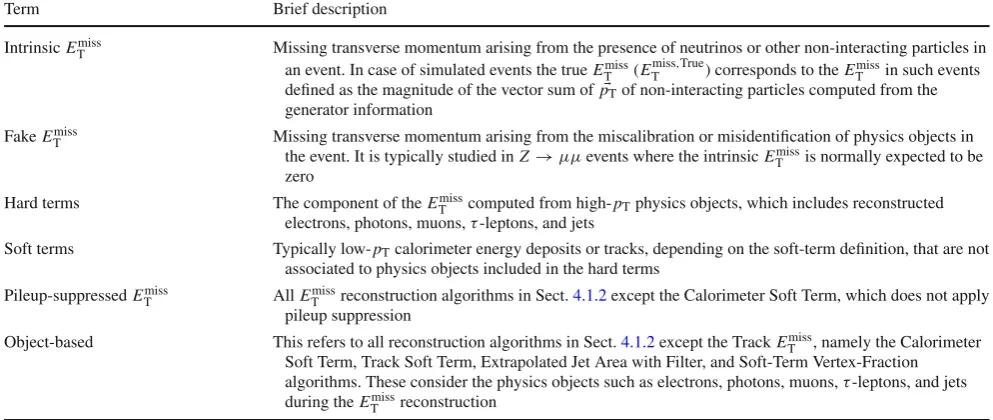
Table 1 Summary of definitions forEmiss
T terms used in this paper
Term Brief description
IntrinsicETmiss Missing transverse momentum arising from the presence of neutrinos or other non-interacting particles in an event. In case of simulated events the trueEmiss
T (E
miss,True
T ) corresponds to theEmissT in such events
defined as the magnitude of the vector sum ofpTof non-interacting particles computed from the
generator information FakeEmiss
T Missing transverse momentum arising from the miscalibration or misidentification of physics objects in
the event. It is typically studied inZ→μμevents where the intrinsicEmiss
T is normally expected to be
zero
Hard terms The component of theEmiss
T computed from high-pTphysics objects, which includes reconstructed
electrons, photons, muons,τ-leptons, and jets
Soft terms Typically low-pTcalorimeter energy deposits or tracks, depending on the soft-term definition, that are not
associated to physics objects included in the hard terms
Pileup-suppressedETmiss AllETmissreconstruction algorithms in Sect.4.1.2except the Calorimeter Soft Term, which does not apply pileup suppression
Object-based This refers to all reconstruction algorithms in Sect.4.1.2except the TrackEmissT , namely the Calorimeter Soft Term, Track Soft Term, Extrapolated Jet Area with Filter, and Soft-Term Vertex-Fraction algorithms. These consider the physics objects such as electrons, photons, muons,τ-leptons, and jets during theEmiss
T reconstruction
consists of three air-core superconducting toroid magnet sys-tems, precision tracking chambers to provide accurate muon tracking out to|η| =2.7, and additional detectors for trig-gering in the region of|η|<2.4. A precision measurement of the track coordinates is provided by layers of drift tubes at three radial positions within|η|<2.0. For 2.0<|η|<2.7, cathode-strip chambers with high granularity are instead used in the innermost plane. The muon trigger system consists of resistive-plate chambers in the barrel (|η|<1.05) and thin-gap chambers in the end-cap regions (1.05<|η|<2.4).
3 Data samples and event selection
ATLAS recordedppcollisions at a centre-of-mass energy of 8 TeV with a bunch crossing interval (bunch spacing) of 50 ns in 2012. The resulting integrated luminosity is 20.3 fb−1[3]. Multiple inelastic pp interactions occurred in each bunch crossing, and the mean number of inelastic collisions per bunch crossing (μ) over the full dataset is 21 [4], excep-tionally reaching as high as about 70.
Data are analysed only if they satisfy the standard ATLAS data-quality assessment criteria [5]. Jet-cleaning cuts [5] are applied to minimize the impact of instrumental noise and out-of-time energy deposits in the calorimeter from cosmic rays or beam-induced backgrounds. This ensures that the residual sources ofETmissmismeasurement due to those instrumental effects are suppressed.
3.1 Track and vertex selection
The ATLAS detector measures the momenta of charged parti-cles using the ID [6]. Hits from charged particles are recorded
and are used to reconstruct tracks; these are used to recon-struct vertices [7,8].
Each vertex must have at least two tracks with pT > 0.4 GeV; for the primary hard-scatter vertex (PV), the requirement on the number of tracks is raised to three. The PV in each event is selected as the vertex with the largest value of (pT)2, where the scalar sum is taken over all the tracks matched to the vertex. The following track selection criteria3 [7] are used throughout this paper, including the vertex reconstruction:
• pT>0.5 GeV (0.4 GeV for vertex reconstruction and the calorimeter soft term),
• |η|<2.5,
• Number of hits in the pixel detector≥1,
• Number of hits in the SCT≥6.
These tracks are then matched to the PV by applying the following selections:
• |d0|<1.5 mm, • |z0sin(θ)|<1.5 mm.
The transverse (longitudinal) impact parameter d0 (z0)is the transverse (longitudinal) distance of the track from the PV and is computed at the point of closest approach to the PV in the plane transverse to the beam axis. The require-ments on the number of hits ensures that the track has an
3 The track reconstruction for electrons and for muons does not strictly
accurate pT measurement. The|η|requirement keeps only the tracks within the ID acceptance, and the requirement of pT>0.4 GeV ensures that the track reaches the outer layers of the ID. Tracks with lowpThave large curvature and are more susceptible to multiple scattering.
The average spread along the beamline direction forpp collisions in ATLAS during 2012 data taking is around 50 mm, and the typical track z0 resolution for those with |η| < 0.2 and 0.5 < pT < 0.6 GeV is 0.34 mm. The typical trackd0resolution is around 0.19 mm for the sameη andpTranges, and both thez0andd0resolutions improve with higher trackpT.
Pileup effects come from two sources: in-time and out-of-time. In-time pileup is the result of multipleppinteractions in the same LHC bunch crossing. It is possible to distinguish the in-time pileup interactions by using their vertex posi-tions, which are spread along the beam axis. Atμ =21, the efficiency to reconstruct and select the correct vertex for Z→μμsimulated events is around 93.5% and rises to more than 98% when requiring two generated muons withpT>10 GeV inside the ID acceptance [10]. When vertices are sepa-rated along the beam axis by a distance smaller than the posi-tion resoluposi-tion, they can be reconstructed as a single vertex. Each track in the reconstructed vertex is assigned a weight based upon its compatibility with the fitted vertex, which depends on theχ2of the fit. The fraction of Z→μμ recon-structed vertices with more than 50% of the sum of track weights coming from pileup interactions is around 3% at
μ =21 [7,10]. Out-of-time pileup comes from pp colli-sions in earlier and later bunch crossings, which leave signals in the calorimeters that can take up to 450 ns for the charge collection time. This is longer than the 50 ns between subse-quent collisions and occurs because the integration time of the calorimeters is significantly larger than the time between the bunch crossings. By contrast the charge collection time of the silicon tracker is less than 25 ns.
3.2 Event selection for Z→
The “standard candle” for evaluation of the ETmiss perfor-mance is Z → events ( =eor μ). They are produced without neutrinos, apart from a very small number originat-ing from heavy-flavour decays in jets produced in association with theZ boson. The intrinsicETmissis therefore expected to be close to zero, and the EmissT distributions are used to evaluate the modelling of the effects that give rise to fake ETmiss.
Candidate Z → events are required to pass an elec-tron or muon trigger [11,12]. The lowestpTthreshold for the unprescaled single-electron (single-muon) trigger ispT>25 (24) GeV, and both triggers apply a track-based isolation as well as quality selection criteria for the particle
identifica-tion. Triggers with higher pT thresholds, without the isola-tion requirements, are used to improve acceptance at high pT. These triggers require pT>60 (36) GeV for electrons (muons). Events are accepted if they pass any of the above trigger criteria. Each event must contain at least one primary vertex with azdisplacement from the nominalppinteraction point of less than 200 mm and with at least three associated tracks.
The offline selection of Z → μμ events requires the presence of exactly two identified muons [13]. An identi-fied muon is reconstructed in the MS and is matched to a track in the ID. The combined ID+MS track must have pT > 25 GeV and |η| < 2.5. The z displacement of the muon track from the primary vertex is required to be less than 10 mm. An isolation criterion is applied to the muon track, where the scalar sum of the pT of additional tracks within a cone of sizeR=(η)2+(φ)2=0.2 around the muon is required to be less than 10% of the muon pT. In addition, the two leptons are required to have oppo-site charge, and the reconstructed dilepton invariant mass, m, is required to be consistent with the Z boson mass: 66<m<116 GeV.
TheEmissT modelling and performance results obtained in Z→ μμandZ →eeevents are very similar. For the sake of brevity, only the Z → μμdistributions are shown in all sections except for Sect.6.6.
3.3 Event selection forW →ν
Leptonically decaying W bosons (W → ν) provide an important event topology with intrinsic ETmiss; the ETmiss distribution for such events is presented in Sect. 5.2. Sim-ilar to Z → events, a sample dominated by leptoni-cally decayingW bosons is used to study theEmissT scale in Sect.6.2.2, the resolution of theETmissdirection in Sect.6.3, and the impact on a reconstructed kinematic observable in Sect.6.4.
The ETmissdistributions forW boson events in Sect.5.2 use the electron final state. These electrons are selected with
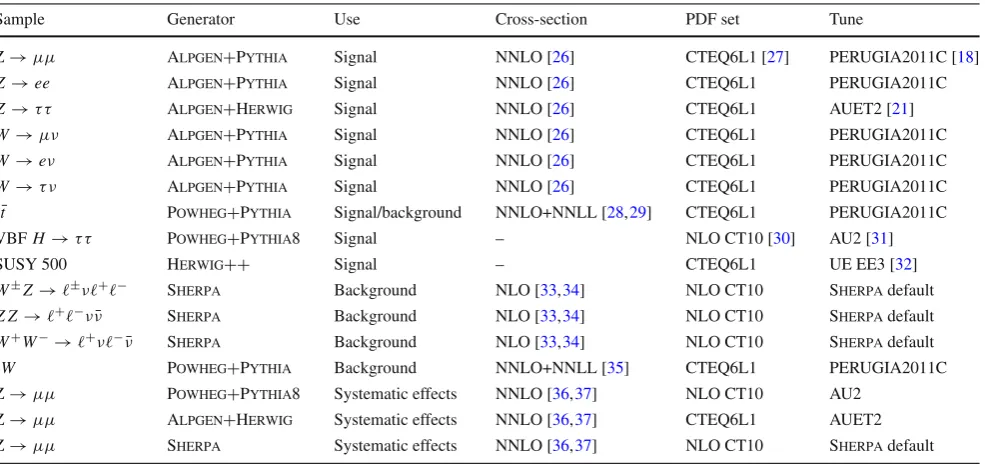
Table 2 Generators, cross-section normalizations, PDF sets, and MC tunes used in this analysis
Sample Generator Use Cross-section PDF set Tune
Z→μμ Alpgen+Pythia Signal NNLO [26] CTEQ6L1 [27] PERUGIA2011C [18]
Z→ee Alpgen+Pythia Signal NNLO [26] CTEQ6L1 PERUGIA2011C
Z→ττ Alpgen+Herwig Signal NNLO [26] CTEQ6L1 AUET2 [21]
W→μν Alpgen+Pythia Signal NNLO [26] CTEQ6L1 PERUGIA2011C
W→eν Alpgen+Pythia Signal NNLO [26] CTEQ6L1 PERUGIA2011C
W→τν Alpgen+Pythia Signal NNLO [26] CTEQ6L1 PERUGIA2011C
tt¯ Powheg+Pythia Signal/background NNLO+NNLL [28,29] CTEQ6L1 PERUGIA2011C
VBFH→ττ Powheg+Pythia8 Signal – NLO CT10 [30] AU2 [31]
SUSY 500 Herwig++ Signal – CTEQ6L1 UE EE3 [32]
W±Z→±ν+− Sherpa Background NLO [33,34] NLO CT10 Sherpadefault
Z Z →+−νν¯ Sherpa Background NLO [33,34] NLO CT10 Sherpadefault
W+W−→+ν−ν¯ Sherpa Background NLO [33,34] NLO CT10 Sherpadefault
t W Powheg+Pythia Background NNLO+NNLL [35] CTEQ6L1 PERUGIA2011C
Z→μμ Powheg+Pythia8 Systematic effects NNLO [36,37] NLO CT10 AU2
Z→μμ Alpgen+Herwig Systematic effects NNLO [36,37] CTEQ6L1 AUET2
Z→μμ Sherpa Systematic effects NNLO [36,37] NLO CT10 Sherpadefault
electron tracks are then matched to the PV by applying the following selections:
• |d0|<5.0 mm, • |z0sin(θ)|<0.5 mm.
TheW boson selection is based on the single-lepton trig-gers and the same lepton selection criteria as those used in the Z→ selection. Events are rejected if they contain more than one reconstructed lepton. Selections on theETmissand transverse mass (mT) are applied to reduce the multi-jet back-ground with one jet misidentified as an isolated lepton. The transverse mass is calculated from the lepton and theETmiss,
mT=
2pTEmissT (1−cosφ), (1)
wherepTis the transverse momentum of the lepton andφis the azimuthal angle between the lepton andEmissT directions. Both themTandETmissare required to be greater than 50 GeV. These selections can bias the event topology and its phase space, so they are only used when comparing simulation to data in Sect.5.2, as they substantially improve the purity of W bosons in data events.
TheETmissmodelling and performance results obtained in W →eνandW →μνevents are very similar. For the sake of brevity, only one of the two is considered in following two sections:ETmissdistributions inW →eνevents are presented in Sect.5.2and the performance studies show W → μν events in Sect.6. When studying the EmissT tails, both final states are considered in Sect.6.6, because theη-coverage
and reconstruction performance between muons and elec-trons differ.
3.4 Monte Carlo simulation samples
Table2summarizes the MC simulation samples used in this paper. The Z→andW →νsamples are generated with
Alpgen[16] interfaced withPythia[17] (denoted by Alp-gen+Pythia) to model the parton shower and hadronization,
and underlying event using the PERUGIA2011C set [18] of tunable parameters. One exception is the Z → ττ sample with leptonically decayingτ-leptons, which is generated with
Alpgen interfaced with Herwig[19] with the underlying
event modelled usingJimmy[20] and the AUET2 tunes [21].
Alpgenis a multi-leg generator that provides tree-level
cal-culations for diagrams with up to five additional partons. The matrix-element MC calculations are matched to a model of the parton shower, underlying event and hadronization. The main processes that are backgrounds to Z → and W → ν are events with one or more top quarks (tt¯and single-top-quark processes) and diboson production (W W, W Z, Z Z). The tt¯ and t W processes are generated with
Powheg[22] interfaced withPythia[17] for hadronization
and parton showering, and PERUGIA2011C for the underly-ing event modellunderly-ing. All the diboson processes are generated withSherpa[23].Powhegis a leading-order generator with corrections at next-to-leading order inαS, whereasSherpa is a multi-leg generator at tree level.
with at least one leptonically decayingW boson are consid-ered in Sect.6.6. The single top quark (t W) production is considered with at least one leptonically decayingWboson. Both thett¯andt Wprocesses contribute to theWandZboson distributions shown in Sect.5as well as Z boson distribu-tions in Sects.4,6, and8that compare data and simulation. A supersymmetric (SUSY) model comprising pair-produced 500 GeV gluinos each decaying to att¯pair and a neutralino is simulated with Herwig++[24]. Finally, to study events with forward jets, the vector-boson fusion (VBF) produc-tion ofH→ττ, generated withPowheg+Pythia8[25], is considered. Bothτ-leptons are forced to decay leptonically in this sample.
To estimate the systematic uncertainties in the data/MC ratio arising from the modelling of the soft hadronic recoil, ETmiss distributions simulated with different MC generators, parton shower and underlying event models are compared. The estimation of systematic uncertainties is performed using a comparison of data and MC sim-ulation, as shown in Sect. 8.2. The following combina-tions of generators and parton shower models are consid-ered: Sherpa, Alpgen+Herwig, Alpgen+Pythia, and
Powheg+Pythia8. The corresponding underlying event
tunes are mentioned in Table2. Parton distribution functions are taken fromCT10[30] forPowhegandSherpasamples andCTEQ6L1[38] forAlpgensamples.
Generated events are propagated through a Geant4 sim-ulation [39,40] of the ATLAS detector. Pileup collisions are generated with Pythia8for all samples, and are overlaid on top of simulated hard-scatter events before event reconstruc-tion. Each simulation sample is weighted by its correspond-ing cross-section and normalized to the integrated luminosity of the data.
4 Reconstruction and calibration of theETmiss
Several algorithms have been developed to reconstruct the ETmissin ATLAS. They differ in the information used to recon-struct thepTof the particles, using either energy deposits in the calorimeters, tracks reconstructed in the ID, or both. This section describes these various reconstruction algorithms, and the remaining sections discuss the agreement between data and MC simulation as well as performance studies.
4.1 Reconstruction of theETmiss
TheETmissreconstruction uses calibrated physics objects to estimate the amount of missing transverse momentum in the detector. TheETmissis calculated using the components along thexandyaxes:
Exmiss(y) =Emissx(y),e+Exmiss(y),γ +Exmiss(y),τ
+Emissx(y),jets+Exmiss(y),μ+Emissx(y),soft, (2)
where each term is calculated as the negative vectorial sum of transverse momenta of energy deposits and/or tracks. To avoid double counting, energy deposits in the calorimeters and tracks are matched to reconstructed physics objects in the following order: electrons (e), photons (γ), the visible parts of hadronically decayingτ-leptons (τhad-vis; labelled asτ), jets and muons (μ). Each type of physics object is represented by a separate term in Eq. (2). The signals not associated with physics objects form the “soft term”, whereas those associated with the physics objects are collectively referred to as the “hard term”.
The magnitude and azimuthal angle4(φmiss) ofETmissare calculated as:
ETmiss=
(Emiss
x )2+(Emissy )2, φmiss=arctan(Emiss
y /Emissx ).
(3)
The total transverse energy in the detector, labelled asET, quantifies the total event activity and is an important observ-able for understanding the resolution of theETmiss, especially with increasing pileup contributions. It is defined as:
ET=
pTe +pTγ+pTτ+pTjets
+pμT+psoftT , (4)
which is the scalar sum of the transverse momenta of recon-structed physics objects and soft-term signals that contribute to theETmissreconstruction. The physics objects included in
psoftT depend on theEmissT definition, so both calorimeter objects and track-based objects may be included in the sum, despite differences in pTresolution.
4.1.1 Reconstruction and calibration of the ETmisshard terms
The hard term of the EmissT , which is computed from the reconstructed electrons, photons, muons,τ-leptons, and jets, is described in more detail in this section.
Electrons are reconstructed from clusters in the electro-magnetic (EM) calorimeter which are associated with an ID track [14]. Electron identification is restricted to the range of
|η|<2.47, excluding the transition region between the barrel and end-cap EM calorimeters, 1.37<|η|<1.52. They are calibrated at the EM scale5with the default electron
calibra-4 The arctan function returns values from[−π,+π]and uses the sign
of both coordinates to determine the quadrant.
5 The EM scale is the basic signal scale for the ATLAS
tion, and those satisfying the “medium” selection criteria [14] withpT>10 GeV are included in theETmissreconstruction. The photon reconstruction is also seeded from clusters of energy deposited in the EM calorimeter and is designed to separate electrons from photons. Photons are calibrated at the EM scale and are required to satisfy the “tight” photon selection criteria with pT>10 GeV [14].
Muon candidates are identified by matching an ID track with an MS track or segment [13]. MS tracks are used for 2.5<|η|<2.7 to extend theηcoverage. Muons are required to satisfy pT >5 GeV to be included in the ETmiss recon-struction. The contribution of muon energy deposited in the calorimeter is taken into account using either parameterized estimates or direct measurements, to avoid double counting a small fraction of their momenta.
Jets are reconstructed from three-dimensional topolog-ical clusters (topoclusters) [41] of energy deposits in the calorimeter using the anti-kt algorithm [42] with a distance parameterR=0.4. The topological clustering algorithm sup-presses noise by forming contiguous clusters of calorime-ter cells with significant energy deposits. The local clus-ter weighting (LCW) [43,44] calibration is used to account for different calorimeter responses to electrons, photons and hadrons. Each cluster is classified as coming from an EM or hadronic shower, using information from its shape and energy density, and calibrated accordingly. The jets are reconstructed from calibrated topoclusters and then corrected for in-time and out-of-time pileup as well as the position of the PV [4]. Finally, the jet energy scale (JES) corrects for jet-level effects by restoring, on average, the energy of reconstructed jets to that of the MC generator-level jets. The complete procedure is referred to as the LCW+JES scheme [43,44]. Without chang-ing the average calibration, additional corrections are made based upon the internal properties of the jet (global sequen-tial calibration) to reduce the flavour dependence and energy leakage effects [44]. Only jets with calibratedpTgreater than 20 GeV are used to calculate the jet termExmiss(y),jetsin Eq. (2), and the optimization of the 20 GeV threshold is discussed in Sect.7.
To suppress contributions from jets originating from pileup interactions, a requirement on the jet vertex-fraction (JVF) [4] may be applied to selected jet candidates. Tracks matched to jets are extrapolated back to the beamline to ascer-tain whether they originate from the hard scatter or from a pileup collision. The JVF is then computed as the ratio shown below:
JVF=
track,PV,jet
pT/
track,jet
pT. (5)
This is the ratio of the scalar sum of transverse momentum of all tracks matched to the jet and the primary vertex to the pT sum of all tracks matched to the jet, where the sum is performed over all tracks withpT>0.5 GeV and|η|<2.5
and the matching is performed using the “ghost-association” procedure [45,46].
The JVF distribution is peaked toward 1 for hard-scatter jets and toward 0 for pileup jets. No JVF selection require-ment is applied to jets that have no associated tracks. Require-ments on the JVF are made in the STVF, EJAF, and TST ETmissalgorithms as described in Table3and Sect.4.1.3.
Hadronically decayingτ-leptons are seeded by calorime-ter jets with|η|<2.5 and pT >10 GeV. As described for jets, the LCW calibration is applied, corrections are made to subtract the energy due to pileup interactions, and the energy of the hadronically decaying τ candidates is calibrated at theτ-lepton energy scale (TES) [47]. The TES is indepen-dent of the JES and is determined using an MC-based proce-dure. Hadronically decayingτ-leptons passing the “medium” requirements [47] and havingpT>20 GeV after TES cor-rections are considered for theEmissT reconstruction.
4.1.2 Reconstruction and calibration of the ETmisssoft term
The soft term is a necessary but challenging ingredient of the EmissT reconstruction. It comprises all the detector sig-nals not matched to the physics objects defined above and can contain contributions from the hard scatter as well as the underlying event and pileup interactions. Several algorithms designed to reconstruct and calibrate the soft term have been developed, as well as methods to suppress the pileup contri-butions. A summary of theEmissT and soft-term reconstruction algorithms is given in Table3.
Four soft-term reconstruction algorithms are considered in this paper. Below the first two are defined, and then some motivation is given for the remaining two prior to their defi-nition.
• Calorimeter Soft Term (CST)
Table 3 Summary ofEmiss
T and soft-term reconstruction algorithms used in this paper
Term Brief description Section list
CSTETmiss The Calorimeter Soft Term (CST)ETmisstakes its soft term from energy deposits in the calorimeter which are not matched to high-pTphysics objects. Although noise
suppression is applied to reduce fake signals, no additional pileup suppression techniques are used
Section4.1.2(definition) Section5.1(Z→μμmodelling) Section5.2(W→eνmodelling) Section6(perf. studies) TSTETmiss The Track Soft Term (TST)EmissT algorithm uses a soft term that is calculated using
tracks within the inner detector that are not associated with high-pTphysics objects. The JVF selection requirement is applied to jets
Section4.1.2(definition) Section5.1(Z→μμmodelling) Section5.2(W→eνmodelling) Section6(perf. studies) EJAFEmiss
T The Extrapolated Jet Area with FilterEmissT algorithm applies pileup subtraction to
the CST based on the idea of jet-area corrections. The JVF selection requirement is applied to jets
Section4.1.2(definition) Section5.1(Z→μμmodelling) Section6(perf. studies) STVFEmiss
T The Soft-Term Vertex-Fraction (STVF)EmissT algorithm suppresses pileup effects in
the CST by scaling the soft term by a multiplicative factor calculated based on the fraction of scalar-summed trackpTnot associated with high-pTphysics objects
that can be matched to the primary vertex. The JVF selection requirement is applied to jets
Section4.1.2(definition) Section5.1(Z→μμmodelling) Section6(perf. studies)
TrackETmiss The TrackETmissis reconstructed entirely from tracks to avoid pileup contamination that affects the other algorithms
Section4.2(definition)
Section5.1(Z→μμmodelling) Section6(perf. studies)
with pT > 0.4 GeV that are not matched to a
high-pT physics objects are used instead of the calorimeter
pTmeasurement, if theirpTresolution is better than the expected calorimeterpTresolution. The calorimeter res-olution is estimated as 0.4· √pTGeV, in which thepTis the transverse momentum of the reconstructed track. Geometrical matching between tracks and topoclusters (or high-pTphysics objects) is performed using theR significance defined asR/σR, whereσRis theR resolution, parameterized as a function of the track pT. A track is considered to be associated to a topocluster in the soft term when its minimumR/σRis less than 4. To veto tracks matched to high-pTphysics objects, tracks are required to haveR/σR>8. TheETmisscalculated using the CST algorithm is documented in previous pub-lications such as Ref. [1] and is the standard algorithm in most ATLAS 8 TeV analyses.
• Track Soft Term (TST)
The TST is reconstructed purely from tracks that pass the selections outlined in Sect.3.1and are not associated with the high-pT physics objects defined in Sect.4.1.1. The detector coverage of the TST is the ID tracking vol-ume (|η|<2.5), and no calorimeter topoclusters inside or beyond this region are included. This algorithm allows excellent vertex matching for the soft term, which almost completely removes the in-time pileup dependence, but misses contributions from soft neutral particles. The track-based reconstruction also entirely removes the out-of-time pileup contributions that affect the CST.
To avoid double counting the pTof particles, the tracks matched to the high-pT physics objects need to be removed from the soft term. All of the following classes of tracks are excluded from the soft term:
– tracks within a cone of sizeR=0.05 around elec-trons and photons
– tracks within a cone of sizeR=0.2 aroundτhad-vis
– ID tracks associated with identified muons
– tracks matched to jets using the ghost-association technique described in Sect.4.1.1
– isolated tracks with pT ≥ 120 GeV (≥200 GeV for |η|<1.5) having transverse momentum uncertainties larger than 40% or having no associated calorime-ter energy deposit with pT larger than 65% of the trackpT. ThepTthresholds are chosen to ensure that muons not in the coverage of the MS are still included in the soft term. This is a cleaning cut to remove mis-measured tracks.
The TST algorithm is very stable with respect to pileup but does not include neutral particles. Two other pileup-suppressing algorithms were developed, which consider con-tributions from neutral particles. One uses anη-dependent event-by-event estimator for the transverse momentum den-sity from pileup, using calorimeter information, while the other applies an event-by-event global correction based on the amount of charged-particlepTfrom the hard-scatter ver-tex, relative to all otherppcollisions. The definitions of these two soft-term algorithms are described in the following:
• Extrapolated Jet Area with Filter (EJAF)
The jet-area method for the pileup subtraction uses a soft term based on the idea of jet-area corrections [45]. This technique uses direct event-by-event measurements of the energy flow throughout the entire ATLAS detector to estimate thepTdensity of pileup energy deposits and was
developed from the strategy applied to jets as described in Ref. [4].
The topoclusters belonging to the soft term are used for jet finding with the kt algorithm [48,49] with dis-tance parameterR=0.6 and jetpT>0. The catchment areas [45,46] for these reconstructed jets are labelled Ajet; this provides a measure of the jet’s susceptibility to contamination from pileup. Jets withpT<20 GeV are referred to as soft-term jets, and the pT-density of each soft-term jetiis then measured by computing:
ρjet,i = pjetT,i
Ajet,i.
(6)
In a given event, the medianpT-densityρevtmedfor all soft-termktjets in the event (Njets) found within a given range −ηmax< ηjet< ηmaxcan be calculated as
ρmed
evt =median{ρjet,i} fori=1. . .Njetsin|ηjet|< ηmax.
(7)
This medianpT-densityρevtmedgives a good estimate of the in-time pileup activity in each detector region. If deter-mined with ηmax =2, it is found to also be an appro-priate indicator of out-of-time pileup contributions [45]. A lower value forρevtmedis computed by using jets with |ηjet|larger than 2, which is mostly due to the particular
geometry of the ATLAS calorimeters and their cluster reconstruction algorithms.6
In order to extrapolate ρevtmed into the forward regions of the detector, the average topocluster pT in slices of
η,NPV, andμ is converted to an average pTdensity ρ(η,NPV, μ) for the soft term. As described for the
ρmed
evt ,ρ(η,NPV, μ)is found to be uniform in the cen-tral region of the detector with|η|< ηplateau=1.8. The transverse momentum density profile is then computed as
Pρ(η,NPV,μ)= ρ(η,
NPV, μ) ρcentral(NPV, μ)
(8)
whereρcentral(NPV, μ) is the averageρ(η,NPV, μ) for|η|< ηplateau. ThePρ(η,NPV,μ)is therefore 1, by definition, for|η|< ηplateauand decreases for larger|η|. A functional form ofPρ(η,NPV,μ)is used to param-eterize its dependence onη,NPV, andμand is defined as
Pfctρ(η,NPV,μ)=
1 (|η| < ηplateau)
(1−Gbase(ηplateau))·Gcore(|η| −ηplateau)+Gbase(η)
|η| ≥ ηplateau
(9)
where the central region|η|< ηplateau=1.8 is plateaued at 1, and then a pair of Gaussian functionsGcore(|η| −
ηplateau)andGbase(η)are added for the fit in the forward regions of the calorimeter. The value ofGcore(0) = 1 so that Eq. (9) is continuous atη = ηplateau. Two exam-ple fits are shown in Fig. 1 for NPV = 3 and 8 with μ =7.5–9.5 interactions per bunch crossing. For both distributions the value is defined to be unity in the cen-tral region (|η|< ηplateau), and the sum of two Gaussian functions provides a good description of the change in the amount of in-time pileup beyondηplateau. The base-line Gaussian functionGbase(η)has a larger width and is used to describe the larger amount of in-time pileup in the forward region as seen in Fig.1. Fitting with Eq. (9) provides a parameterized function for in-time and out-of-time pileup which is valid for the whole 2012 dataset. The soft term for the EJAFETmissalgorithm is calcu-lated as
Emissx(y),soft= − Nfilter-jet
i=0
pjetx(y,corr),i , (10)
which sums the transverse momenta, labelledpjetx(y,corr),i , of the corrected soft-term jets matched to the primary ver-tex. The number of these filtered jets, which are selected
6 The forward ATLAS calorimeters are less granular than those in the
η
4
− −2 0 2 4
) 〉μ〈 , PV ,N η ( ρ P 2 − 10 1 − 10 1 ATLAS Data 2012
s=8TeV Minimum Bias,
< 9.5 〉 μ 〈 = 3, 7.5 <
PV N ) 〉 μ 〈 , PV ,N η ( fct ρ Fit of P
) 〉 μ 〈 , PV (N base
Fit of G
(a) η
4
− −2 0 2 4
2 − 10 1 − 10 1 ATLAS Data 2012
s=8TeV Minimum Bias, (b) ) 〉μ〈 , PV ,N η ( ρ P < 9.5 〉 μ 〈 = 8, 7.5 <
PV N ) 〉 μ 〈 , PV ,N η ( fct ρ Fit of P
) 〉 μ 〈 , PV (N base
Fit of G
Fig. 1 The average transverse momentum density shape Pρ(η,NPV,μ)for jets in data is compared to the model in Eq. (9)
withμ = 7.5–9.5 and with a three reconstructed vertices and b
eight reconstructed vertices. The increase of jet activity in the forward
regions coming from more in-time pileup with NPV=8 inbcan be
seen by the flatter shape of the Gaussian fit of the forward activity Gbase(NPV,μ)(blue dashed line)
after the pileup correction based on their JVF andpT, is labelledNfilter-jet. More details of the jet selection and the application of the pileup correction to the jets are given in Appendix A.
• Soft-Term Vertex-Fraction (STVF)
The algorithm, called the soft-term vertex-fraction, uti-lizes an event-level parameter computed from the ID track information, which can be reliably matched to the hard-scatter collision, to suppress pileup effects in the CST. This correction is applied as a multiplicative fac-tor (αSTVF) to the CST, event by event, and the resulting STVF-corrected CST is simply referred to as STVF. The
αSTVFis calculated as
αSTVF=
tracks,PV
pT
tracks
pT, (11)
which is the scalar sum ofpTof tracks matched to the PV divided by the total scalar sum of track pTin the event, including pileup. The sums are taken over the tracks that do not match high-pTphysics objects belonging to the hard term. The meanαSTVF value is shown versus the number of reconstructed vertices (NPV) in Fig.2. Data and simulation (including Z, diboson,tt¯, andt W sam-ples) are shown with only statistical uncertainties and agree within 4–7% across the full range of NPV in the 8 TeV dataset. The differences mostly arise from the mod-elling of the amount of the underlying event and pTZ. The 0-jet and inclusive samples have similar values of
αSTVF, with that for the inclusive sample being around 2% larger.
0 5 10 15 20 25 30
〉 STVF α〈 1 − 10 1 Inclusive 0-jet ATLAS -1
= 8 TeV, 20.3 fb s
μμ → Data 2012, Z
) PV Number of Reconstructed Vertices (N
0 5 10 15 20 25 30
Data / MC
0.951
1.05
Fig. 2 The meanαSTVFweight is shown versus the number of
recon-structed vertices (NPV) for 0-jet and inclusive events in Z→μμdata.
Theinsetat thebottomof the figure shows the ratio of the data to the MC predictions with only the statistical uncertainties on the data and MC simulation. The bin boundary always includes the lower edge and not the upper edge
4.1.3 Jet pTthreshold and JVF selection
The TST, STVF, and EJAF ETmiss algorithms complement the pileup reduction in the soft term with additional require-ments on the jets entering theEmissT hard term, which are also aimed at reducing pileup dependence. These ETmiss recon-struction algorithms apply a requirement of JVF>0.25 to jets with pT<50 GeV and|η|<2.4 in order to suppress those originating from pileup interactions. The maximum
parti-cles from jets below the pT threshold are considered in the soft terms for the STVF, TST, and EJAF (see Sect.4.1.2for details).
The same JVF requirements are not applied to the CST ETmissbecause its soft term includes the soft recoil from all interactions, so removing jets not associated with the hard-scatter interaction could create an imbalance. The procedure for choosing the jet pT and JVF criteria is summarized in Sect.7.
Throughout most of this paper the number of jets is com-puted without a JVF requirement so that theETmissalgorithms are compared on the same subset of events. However, the JVF>0.25 requirement is applied in jet counting when 1-jet and≥2-jet samples are studied using the TST ETmiss recon-struction, which includes Figs.8and22. The JVF removes pileup jets that obscure trends in samples with different jet multiplicities.
4.2 TrackETmiss
Extending the philosophy of the TST definition to the full event, the ETmiss is reconstructed from tracks alone, reduc-ing the pileup contamination that afflicts the other object-based algorithms. While a purely track-object-basedEmissT , desig-nated Track ETmiss, has almost no pileup dependence, it is insensitive to neutral particles, which do not form tracks in the ID. This can degrade the ETmiss calibration, espe-cially in event topologies with numerous or highly ener-getic jets. Theη coverage of the Track EmissT is also lim-ited to the ID acceptance of |η| < 2.5, which is substan-tially smaller than the calorimeter coverage, which extends to
|η| =4.9.
TrackETmissis calculated by taking the negative vectorial sum ofpTof tracks satisfying the same quality criteria as the TST tracks. Similar to the TST, tracks with poor momentum resolution or without corresponding calorimeter deposits are removed. Because of Bremsstrahlung within the ID, the elec-tronpTis determined more precisely by the calorimeter than by the ID. Therefore, the TrackETmissalgorithm uses the elec-tronpTmeasurement in the calorimeter and removes tracks overlapping its shower. Calorimeter deposits from photons are not added because they cannot be reliably associated to particularppinteractions. For muons, the ID trackpTis used and not the fits combining the ID and MSpT. For events with-out any reconstructed jets, the Track and TSTEmissT would have similar values, but differences could still originate from muon track measurements as well as reconstructed photons or calorimeter deposits fromτhad-vis, which are only included in the TST.
The soft term for the TrackETmissis defined to be identical to the TST by excluding tracks associated with the high-pT physics objects used in Eq. (2).
5 Comparison of EmissT distributions in data and MC simulation
In this section, basic EmissT distributions before and after pileup suppression in Z→andW →νdata events are compared to the distributions from the MC signal plus rel-evant background samples. All distributions in this section include the dominant systematic uncertainties on the high-pT objects, the ETmiss,soft (described in Sect.8) and pileup modelling [7]. The systematics listed above are the largest systematic uncertainties in theETmissfor ZandW samples.
5.1 Modelling of Z→events
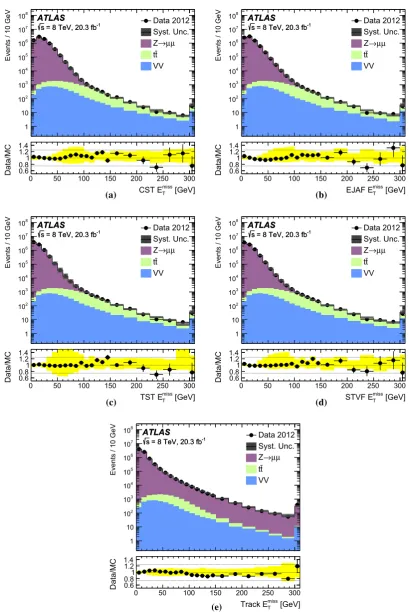
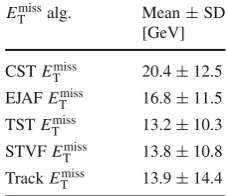
The CST, EJAF, TST, STVF, and Track ETmissdistributions for Z → μμdata and simulation are shown in Fig.3. The Z boson signal region, which is defined in Sect. 3.2, has better than 99% signal purity. The MC simulation agrees with data for allETmissreconstruction algorithms within the assigned systematic uncertainties. The mean and the stan-dard deviation of the ETmiss distribution is shown for all of the ETmiss algorithms in Z → μμ inclusive simulation in Table 4. The CST ETmiss has the highest mean ETmiss and thus the broadest EmissT distribution. All of the ETmiss algo-rithms with pileup suppression have narrowerETmiss distribu-tions as shown by their smaller meanEmissT values. However, those algorithms also have non-Gaussian tails in the Exmiss andEmissy distributions, which contribute to the region with
ETmiss50 GeV. The TrackETmisshas the largest tail because it does not include contributions from the neutral particles, and this results in it having the largest standard deviation.
The tails of the ETmiss distributions in Fig. 3 for Z → μμ data are observed to be compatible with the sum of expected signal and background contributions, namelytt¯and the summed diboson (V V) processes includingW W,W Z, andZ Z, which all have high-pTneutrinos in their final states. Instrumental effects can show up in the tails of theETmiss, but such effects are small.
TheETmissφdistribution is not shown in this paper but is very uniform, having less than 4 parts in a thousand differ-ence from positive and negativeφ. Thus theφ-asymmetry is greatly reduced from that observed in Ref. [1].
Events / 10 GeV 1 10 2 10 3 10 4 10 5 10 6 10 7 10 8 10 Data 2012 Syst. Unc. μ μ → Z t t VV ATLAS -1 = 8 TeV, 20.3 fb s
ATLAS
-1 = 8 TeV, 20.3 fb s
[GeV] miss T CST E 0 50 100 150 200 250 300
Data/MC 0.6
0.81 1.2 1.4
(a)
Events / 10 GeV
1 10 2 10 3 10 4 10 5 10 6 10 7 10 8 10 Data 2012 Syst. Unc. t t VV ATLAS -1 = 8 TeV, 20.3 fb s
ATLAS
-1 = 8 TeV, 20.3 fb s
[GeV] miss T EJAF E 0 50 100 150 200 250 300
Data/MC 0.6
0.81 1.2 1.4
(b)
Events / 10 GeV
1 10 2 10 3 10 4 10 5 10 6 10 7 10 8
10 Data 2012
Syst. Unc. t t VV ATLAS -1 = 8 TeV, 20.3 fb s
ATLAS
-1 = 8 TeV, 20.3 fb s
[GeV] miss T TST E 0 50 100 150 200 250 300
Data/MC 0.60.8 1 1.2 1.4
(c)
Events / 10 GeV
1 10 2 10 3 10 4 10 5 10 6 10 7 10 8
10 Data 2012
Syst. Unc. t t VV ATLAS -1 = 8 TeV, 20.3 fb s
ATLAS
-1 = 8 TeV, 20.3 fb s
[GeV] miss T STVF E 0 50 100 150 200 250 300
Data/MC 0.60.8 1 1.2 1.4
(d)
Events / 10 GeV
1 10 2 10 3 10 4 10 5 10 6 10 7 10 8
10 Data 2012
Syst. Unc. t t VV ATLAS -1 = 8 TeV, 20.3 fb s
ATLAS
-1 = 8 TeV, 20.3 fb s
[GeV] miss T Track E 0 50 100 150 200 250 300
Data/MC 0.60.8 1 1.2 1.4 (e) μ μ → Z μ μ →
Z Z→μμ
μ μ → Z
Fig. 3 Distributions of theETmisswith theaCST,bEJAF,cTST,d
STVF, andeTrackEmiss
T are shown in data and MC simulation events
satisfying the Z→μμselection. Thelower panel of the figuresshows
[image:12.595.92.502.47.660.2]Table 4 The mean and standard deviation of the
Emiss
T distributions in
Z→μμinclusive simulation
Emiss
T alg. Mean±SD
[GeV] CSTEmiss
T 20.4±12.5
EJAFEmiss
T 16.8±11.5
TSTEmiss
T 13.2±10.3
STVFEmiss
T 13.8±10.8
TrackEmiss
T 13.9±14.4
causes the larger systematic uncertainty for the TST and STVFETmiss. The TrackEmissT does not have the same increase in systematic uncertainties because it does not make use of reconstructed jets. Above 120 GeV, most events have a large
intrinsicEmissT , and the systematic uncertainties on theETmiss, especially the soft term, are smaller.
Figure 4 shows the soft-term distributions. The pileup-suppressedEmissT algorithms generally have a smaller mean soft term as well as a sharper peak near zero compared to the CST. Among the EmissT algorithms, the soft term from the EJAF algorithm shows the smallest change relative to the CST. The TST has a sharp peak near zero similar to the STVF but with a longer tail, which mostly comes from individual tracks. These tracks are possibly mismeasured and further studies are planned. The simulation under-predicts the TST relative to the observed data between 60–85 GeV, and the dif-ferences exceed the assigned systematic uncertainties. This
[GeV]
miss T
CST E
0 50 100 150 200 250 300
Data/MC 0.60.8 1 1.2
1.4 h_tot_MET_xType0
Events / 4 GeV
1 10 2 10 3 10 4 10 5 10 6 10 7 10 8
10 Data 2012
Syst. Unc. μ μ → Z t t VV ATLAS -1 = 8 TeV, 20.3 fb s
ATLAS
-1 = 8 TeV, 20.3 fb s
[GeV]
miss,soft T
CST E
0 20 40 60 80 100 120 140 160
Data/MC 0 0.5 1 1.5 2
Events / 4 GeV
1 10 2 10 3 10 4 10 5 10 6 10 7 10 8
10 Data 2012
Syst. Unc. μ μ → Z t t VV ATLAS -1 = 8 TeV, 20.3 fb s
ATLAS
-1 = 8 TeV, 20.3 fb s
[GeV]
miss,soft T
EJAF E
0 20 40 60 80 100 120 140 160
Data/MC 0 0.5 1 1.5 2 [GeV] miss T TST E
0 50 100 150 200 250 300
Data/MC 0.60.8 1 1.2 1.4
h_tot_MET_TST_xType0
Events / 4 GeV
1 10 2 10 3 10 4 10 5 10 6 10 7 10 8
10 Data 2012
Syst. Unc. μ μ → Z t t VV ATLAS -1 = 8 TeV, 20.3 fb s
ATLAS
-1 = 8 TeV, 20.3 fb s
[GeV]
miss,soft T
TST E
0 20 40 60 80 100 120 140 160
Data/MC 0 0.51 1.5 2
Events / 4 GeV
1 10 2 10 3 10 4 10 5 10 6 10 7 10 8
10 Data 2012
Syst. Unc. μ μ → Z t t VV ATLAS -1 = 8 TeV, 20.3 fb s
ATLAS
-1 = 8 TeV, 20.3 fb s
[GeV]
miss,soft T
STVF E
0 20 40 60 80 100 120 140 160
Data/MC 0 0.51 1.5 2 (a) (b) (c) (d)
Fig. 4 Distributions of the soft term for theaCST,bEJAF,cTST, anddSTVF are shown in data and MC simulation events satisfying the Z→μμselection. Thelower panelof the figures show the ratio
[image:13.595.83.290.238.675.2] [image:13.595.83.511.241.671.2]miss T
CST E
0 50 100 150 200 250 300
0.6 0.8 1.2 1.4 h_tot_MET_xType0 [GeV] miss,soft T CST E
0 20 40 60 80 100 120 140 160 h_term_MET_xType3
Events / 10 GeV
1 10 2 10 3 10 4 10 5 10 6 10 7 10 8 10 Data 2012 Syst. Unc. μ μ → Z t t VV ATLAS -1 = 8 TeV, 20.3 fb s
(CST) [GeV]
T
E
Σ
0 200 400 600 800 1000 1200 1400 1600 1800
Data/MC 0 0.5 1 1.5 2 miss T TST E
0 50 100 150 200 250 300
0.6 0.8 1.2 1.4 h_tot_MET_TST_xType0 [GeV] miss,soft T TST E
0 20 40 60 80 100 120 140 160 h_term_MET_TST_xType3
Events / 10 GeV
1 10 2 10 3 10 4 10 5 10 6 10 7 10 8 10 Data 2012 Syst. Unc. μ μ → Z t t VV ATLAS -1 = 8 TeV, 20.3 fb s
(TST) [GeV]
T
E
Σ
0 200 400 600 800 1000 1200 1400 1600 1800
Data/MC 0 0.5 1 1.5 2 (a) (b)
Fig. 5 Distributions ofaET(CST) andbET(TST) are shown in
data and MC simulation events satisfying the Z→μμselection. The lower panelof the figures show the ratio of data to MC simulation, and
thebandscorrespond to the combined systematic and MC statistical uncertainties. The far right bin includes the integral of all events with
ETabove 2000 GeV
region corresponds to the transition from the narrow core to the tail coming from high-pTtracks. The differences between data and simulation could be due to mismodelling of the rate of mismeasured tracks, for which no systematic uncertainty is applied. The mismeasured-track cleaning, as discussed in Sect.4.1.2, reduces the TST tail starting at 120 GeV, and this region is modelled within the assigned uncertainties. The mismeasured-track cleaning for tracks below 120 GeV and entering the TST is not optimal, and future studies aim to improve this.
The ETmiss resolution is expected to be proportional to
√
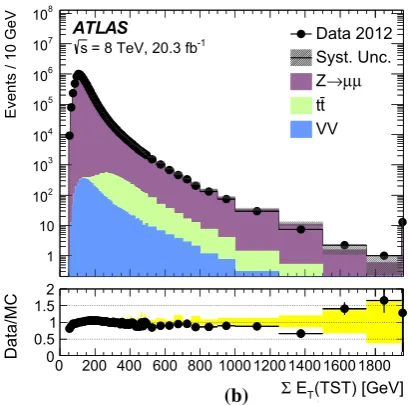
ETwhen both quantities are measured with the calorime-ter alone [1]. While this proportionality does not hold for tracks, it is nevertheless interesting to understand the mod-elling ofETand the dependence ofETmissresolution on it. Figure5shows theETdistribution for Z →μμdata and MC simulation both for the TST and the CST algorithms. The
ET is typically larger for the CST algorithm than for the TST because the former includes energy deposits from pileup as well as neutral particles and forward contributions beyond the ID volume. The reduction of pileup contributions in the soft and jet terms leads to theET(TST) having a sharper peak at around 100 GeV followed by a large tail, due to high-pTmuons and large
pjetsT . The data and simulation agree within the uncertainties for theET(CST) andET(TST) distributions.
5.2 Modelling ofW →νevents
In this section, the selection requirements for themT and
ETmiss distributions are defined using the same ETmiss
algo-rithm as that labelling the distribution (e.g. selection criteria are applied to the CST ETmissfor distributions showing the CST ETmiss). The intrinsic ETmissinW → ν events allows a comparison of the EmissT scale between data and tion. The level of agreement between data and MC simula-tion for the ETmissreconstruction algorithms is studied using W →eνevents with the selection defined in Sect.3.3.
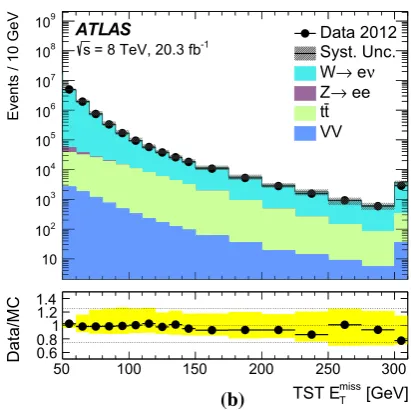
The CST and TSTETmissdistributions inW →eνevents are shown in Fig.6. TheW → τν contributions are com-bined withW → eνevents in the figure. The data and MC simulation agree within the assigned systematic uncertain-ties for both the CST and TST ETmissalgorithms. The other ETmissalgorithms show similar levels of agreement between data and MC simulation.
6 Performance of the EmissT in data and MC simulation
6.1 Resolution ofETmiss
[image:14.595.305.510.55.258.2]Events / 10 GeV
10 2 10
3 10
4 10
5 10
6 10
7 10
8 10
9 10
Data 2012 Syst. Unc.
ν
e
→
W ee
→
Z t t VV ATLAS
-1 = 8 TeV, 20.3 fb s
[GeV]
miss T
CST E
50 100 150 200 250 300
Data/MC 0.60.8 1 1.2 1.4
Events / 10 GeV
10 2 10
3 10
4 10
5 10
6 10
7 10
8 10
9 10
Data 2012 Syst. Unc.
ν
e
→
W ee
→
Z t t VV ATLAS
-1 = 8 TeV, 20.3 fb s
[GeV]
miss T
TST E
50 100 150 200 250 300
Data/MC 0.60.8 1 1.2 1.4
(a) (b)
Fig. 6 Distributions of theaCST andbTSTEmissT as measured in a data sample ofW →eνevents. Thelower panelof the figures show the ratio of data to MC simulation, and thebandscorrespond to the
combined systematic and MC statistical uncertainties. The far right bin includes the integral of all events withETmissabove 300 GeV
The previous ATLASEmissT performance paper [1] studied the resolution defined by the width of Gaussian fits in a nar-row range of±2RMS around the mean and used a separate study to investigate the tails. Therefore, the results of this paper are not directly comparable to those of the previous study. The resolutions presented in this paper are expected to be larger than the width of the Gaussian fitted in this manner because the RMS takes into account the tails.
In this section, the resolution for theETmissis presented for Z → μμ events using both data and MC simulation. Unless it is a simulation-only figure (labelled with “Simula-tion” under the ATLAS label), the MC distribution includes the signal sample (e.g. Z→μμ) as well as diboson,tt¯, and t W samples.
6.1.1 Resolution of the ETmissas a function of the number of reconstructed vertices
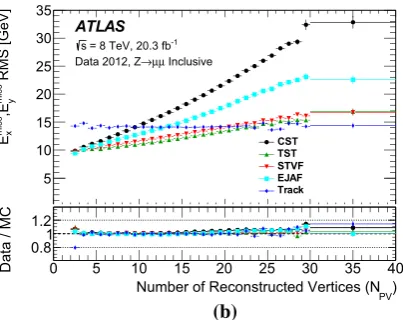
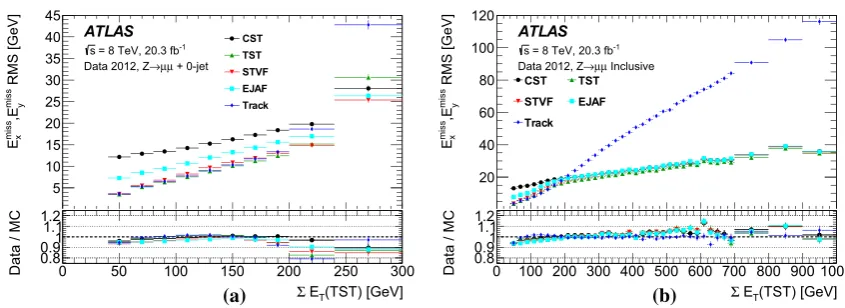
The stability of theETmissperformance as a function of the amount of pileup is estimated by studying theETmiss reso-lution as a function of the number of reconstructed vertices (NPV) for Z→μμevents as shown in Fig.7. The bin edge is always including the lower edge and not the upper. For example, the events withNPVin the inclusive range 30–39 are combined because of small sample size. In addition, very few events were collected belowNPVof 2 during 2012 data taking. Events in which there are no reconstructed jets with pT>20 GeV are referred to collectively as the 0-jet sample. Distributions are shown here for both the 0-jet and inclusive samples. For both samples, the data and MC simulation agree within 2% up to aroundNPV=15 but the deviation grows
to around 5–10% for NPV>25, which might be attributed to the decreasing sample size. All of the EmissT distributions show a similar level of agreement between data and simula-tion across the full range ofNPV.
For the 0-jet sample in Fig.7a, the STVF, TST, and Track ETmissresolutions all have a small slope with respect toNPV, which implies stability of the resolution against pileup. In addition, their resolutions agree within 1 GeV throughout the NPVrange. In the 0-jet sample, the TST and TrackETmissare both primarily reconstructed from tracks; however, small dif-ferences arise mostly from accounting for photons in the TST ETmiss reconstruction algorithm. The CST ETmissis directly affected by the pileup as its reconstruction does not apply any pileup suppression techniques. Therefore, the CSTETmisshas the largest dependence on NPV, with a resolution ranging from 7 GeV at NPV =2 to around 23 GeV at NPV =25. The ETmissresolution of the EJAF distribution, while better than that of the CSTETmiss, is not as good as that of the other pileup-suppressing algorithms.
For the inclusive sample in Fig. 7b, the Track ETmiss is the most stable with respect to pileup with almost no depen-dence on NPV. ForNPV>20, the TrackETmisshas the best resolution showing that pileup creates a larger degradation in the resolution of the otherETmissdistributions than exclud-ing neutral particles, as the TrackETmissalgorithm does. The EJAFEmissT algorithm does not reduce the pileup dependence as much as the TST and STVFETmissalgorithms, and the CST ETmissagain has the largest dependence onNPV.
[image:15.595.305.511.51.256.2] [image:15.595.83.287.52.257.2]