Amy Finch
Ben Dobson
Elaine Fischer
Alasdair Riggs
#reformeducation
Amy Finch Ben Dobson Elaine Fischer Alasdair Riggs
September 2016
Reform
Reform is an independent, non-party think tank whose mission is to set out a better way to deliver public services and economic prosperity. Our aim is to produce research of outstanding quality on the core issues of the economy, health, education, welfare, and criminal justice, and on the right balance between government and the individual. We are determinedly independent and strictly non-party in our approach.
Acknowledgements
We are extremely grateful to the 66 academy chain chief executives and executive principals that took part in this survey, and for early support from The Schools, Students and Teachers Network (SSAT). We would also like to thank Mike Crowhurst, Anna Grotberg, Will Millard, Dr Olmo Silva and officials from the Infrastructure and Funding Directorate at the Department for Education (DfE) for their input into the survey questions and design, and to Ian Comfort, Jon Coles and Professor Toby Salt for piloting the survey. We would like to give special thanks to Hugh Greenway, Anna Grotberg, Tom Middlehurst, Charlotte Pickles, Dr Olmo Silva and officials from the Infrastructure and Funding
Directorate at the DfE for their helpful comments on drafts of this paper. Thanks also to Dr Tim Coulson, Dame Maureen Brennan, Samantha Beecham, Ian Comfort, Debbie Godfrey-Phaure, David Moran and Professor Toby Salt for their time taking part in unstructured interviews for the paper.
Executive summary
4
Glossary of terms
7
1
Academies and chains
9
1.1 An ‘all academy’ vision
10
1.2 Academy chains: making the most of school autonomy
11
1.3 Chain whispers
14
1.4 Chains as the new ‘middle tier’?
16
2
Academy chain survey
17
2.1 Chain efficiency
18
2.2 Leadership and governance
24
2.3 Barriers to inclusive expansion
28
2.4 Chain accountability
32
2.5 Survey summary
37
3
Academy chains unlocked
39
3.1 A stronger academy chain
40
3.2 A beefed-up commissioning body
42
3.3 Open competition
47
3.4 Inclusive chain growth
50
3.5 Conclusion
55
Annex A: The survey sample
56
Annex B: The survey results
60
Annex C: List of interviewees
80
Executive summary
Since first introduced under Labour, academy schools have been the main way that governments have sought to raise the standard of schools. Their popularity with
policymakers means that two fifths of state-educated children in England now attend an academy. While there are different forms of academies, all have greater responsibility over the curriculum, staffing and finances than other state-funded schools.
Yet the evidence that academies have improved school education is not clear cut. Labour’s academies have almost certainly led to sustainable improvements in pupil outcomes. However, the Coalition Government’s academies have had variable impact, with some lowering, some sustaining and others improving education in those schools, depending on the starting point of the school. Taken in its entirety, the evidence suggests that the recent academies are not having the transformative impact on education that was expected by government.
The Conservative Government has changed its approach to academies. It now expects all new academies to join or establish an academy chain – groups of two or more academies run by the same sponsor – believing that chains will help unleash the potential of
academies to spread educational excellence across the country. Yet, as with individual academies, the evidence on academy chains shows variable impact on pupil attainment. There is a dearth of information explaining why, as no research has established a full enough picture of what academy chains do.
To address this research gap, Reform has undertaken the first survey of academy chains. The respondents were chief executives from 66 academy chains responsible for a total of around 700 academies. The results show a varied picture of chain operations, with some highly centralised and others devolving more responsibility to schools. It also shows that most chains want to expand, regardless of their current size. However, their key priority is to reduce disparities in pupil attainment across their chain, suggesting that chains want a role in spreading excellence. While many are interested in running low-performing schools, the school’s finances and geographical location remain a barrier.
Drawing on these results, along with unstructured interviews with chain chief executives, the report highlights four problems with current policy. First, academy chains are not routinely granted enough financial autonomy over their academies. Second, the process of matching schools to chains is not transparent or independent, and is therefore open to conflict. Third, this opacity is hindering competition between chains. Fourth, chains are not effectively incentivised to run schools that are in need of support.
Reform recommends a new approach to the funding, commissioning, oversight and accountability arrangements for academy schools to help them reach their potential. It recommends that funding for academies be allocated to the chain for them to dispense as they see fit, alongside more robust accountability measures. Commissioning decisions should be taken by an independent body, based on transparent criteria, and with all chains able to put themselves forward to run schools. There should be more stringent, and more generous, grants for chains that decide to run schools that have previously failed, find themselves in financial difficulties, or are otherwise undesirable to run.
Reform’s recommendations are aimed at helping the Government achieve its ambition of improving education for all. Without a rejuvenation of this flagship government
Summary of recommendations
1. All revenue funding for academies should be delegated to academy chains before being distributed by the chain to its academies. The academy chain should take responsibility for funding its academies and agreeing how much each academy should receive. The delegation of academy budgets to chains should be irrespective of the chain’s size or performance. The Department for Education’s (DfE) funding allocation to the academy chain must be based on a national funding formula (NFF) for pupils to ensure each chain’s settlement is fair. As the implementation of the NFF has been delayed until 2018-19, the delegation of academy funding to chains should start immediately to allow chains to more easily address inconsistent funding across academies in different local authorities.
2. The DfE should amend the Academies Financial Handbook to remove the requirement on trusts to have an appeals mechanism in place for headteachers that wish to dispute how the chain distributes its funding.
3. There should be one, independent body responsible for commissioning academies. This would require merging the financial accountability functions of the Education Funding Agency (EFA) with the oversight on standards of the Schools Commissioning Group (SCG). The responsibility for funding academies should not rest with the independent commissioner, but remain with an executive agency of the DfE. If all schools become academies, the Government should consider merging the new commissioning body with the schools wing of Ofsted, so that there is one independent regulator of all schools.
4. The DfE should evaluate the capacity of the new independent commissioning body. It should undertake a skills audit and consider external recruitment, such as from existing headteacher boards, to address skills gaps.
5. The independent commissioning body should develop, agree and manage the Secretary of State’s contracts with academy sponsors. Sponsor bids and the
management of sponsor contracts (‘funding agreements’) should be jointly assessed on evidence of financial propriety and educational standards in the chain. Every funding agreement should include an expectation of the chain’s educational performance, in addition to financial performance. This element of the sponsor agreement could relate to the DfE’s MAT performance tables. However, there should be scope for the
commissioner to develop bespoke funding agreements to encourage sponsors to take on schools that have both poor finances and pupil outcomes.
6. Ofsted and the independent commissioning body should consult with academy chain leaders to identify the characteristics of an ‘inadequate’ academy chain. In the long-term, these characteristics should be based on pupil outcomes, such as the aggregate MAT performance measures developed by the DfE. Until performance measures are sufficient to judge all academy chains, a framework for recognising poor practice should be used to inform a judgement.
take over a school. The expressions of interest, similar to a short bid, will be submitted online and set out how the sponsor will improve standards in the school, including supporting evidence. These expressions should be assessed by the independent commissioning body on the basis of the needs of the pupils in the school and the capacity of the sponsor. The capacity of the sponsor should be determined by its current performance and a growth readiness check.
9. Academy chains should continue to be able to seek approval from Regional School Commissioners to voluntarily release some or all of their schools. The schools in question must not be deemed ‘inadequate’ or ‘coasting’, and the chain should be required to find a sponsor willing to take the school(s) on. The school swap should not require permission from the headteacher or local governing body of the school in question. There should be a three-year protection on a school before it can be swapped again.
10. The Government should abandon its proposal to introduce parental petitions in favour of requiring all chains to have a clear method for engaging with their pupils’ parents.
11. All infrastructure funding for academy chains should be pooled to create a struggling school premium. The school commissioning body should identify schools that are attached to this premium, either due to poor educational performance, their small size, geographical remoteness or poor financial circumstances. The premium should follow the school, and any sponsor winning a bid to take over the school should be paid the premium, and no more.
12. The commissioning body should consult the sector to identify a percentage of the struggling school premium that can be recouped by government if the trust fails to deliver to its sponsor agreement.
13. All academy chains should be expected to invest their own reserves in their infrastructure, in addition to public capital funding through the struggling school premium. If a trust is required or seeks permission to release some or all of its academies, it should absorb any deficits and keep any reserves.
14. The DfE should amend the Governors’ Handbook to allow maintained schools and academies to pay local governors.
15. Ofsted should review its framework on inspecting governance in academies. It should focus inspection on identifying strong internal accountability at every level within a trust. While it should be made explicit that parent governors are not required, Ofsted should continue to expect a clear mechanism for engaging parents in every individual academy.
16. The Government should continue to seek private funding for its Academy
Glossary of key terms
Academy chain A formal partnership between two or more academies. The partnership can be in the form of a multi-academy trust, umbrella trust or collaborative partnership.
Academy A state-funded school that receives funding directly from central government rather than a local authority
(including free schools, studio schools and university technology colleges). It is not statutorily required to follow the National Curriculum, follow national terms and conditions for staff, or involve the local authority in running the school.
> Sponsored academy A previously maintained school that was identified as
‘inadequate’ by Ofsted and required to become an academy as part of the Government’s intervention strategy.
> Converter academy A previously maintained school that voluntarily applied to
become an academy and is usually judged as either ‘good’ or ‘outstanding’ by Ofsted.
Academy trust / trust A registered charity and company whose members must appoint trustees to uphold the academy’s contract with the Secretary of State for Education.
Articles of association A contract between the Secretary of State for Education and the academy trust setting out the internal
management, decision-making and running of the academy trust.
Board member / member A person with ultimate responsibility for the trust, including the ability to appoint trustees and sign the articles of association. They cannot be employees of the trust, and there must be at least three members to form a multi-academy trust.
Chief executive / chief
executive officer The executive leader of an academy chain, appointed by the directors. They are part of the executive team and may also be a trustee.
Education funding agency
(EFA) The executive agency of the Department for Education whose statutory responsibility it is to allocate current and capital funding to all academies, and all maintained schools through local authorities.
Executive team The people appointed by the trustees to run the academy trust, including the Chief Executive, Finance Director or Executive Principal.
majority of their current funding. The funding is allocated through the EFA, and it does not include capital funding or the Pupil Premium Grant.
Governing body The group of individuals that are legally responsible for a maintained school. In an academy trust, the trustees can delegate governance functions to a (local) governing body, but it is not required to do so.
Maintained school Schools that are funded through the local authority, including voluntary-aided (such as faith schools), community, voluntary-controlled and foundation schools.
Multi-academy trust (MAT) An academy trust with responsibility for running three or more academies (three academies is the DfE’s normal working definition). Some trusts are counted as MATs in official figures even if they run just one academy, if the MAT has plans to grow.
Regional school
commissioner (RSC) A person that manages the work of the School Commissioners Group in a specific region (see below).
Rebrokerage The process of finding a new sponsor for an academy whose funding agreement has been terminated due to an ‘inadequate’ judgement from Ofsted. This is carried out by the National or Regional School Commissioner.
Schools commissioners
group (SCG) A group of civil servants in the Department for Education responsible for developing high-quality academy sponsors, tackling underperformance in maintained schools and academies through academy conversion and rebrokerage, and establishing new school provision through free schools.
Sponsor An organisation or person that has received approval from the DfE to support an underperforming academy trust. They could be an existing academy trust, a university, a business, an independent school, a diocesan body or a charity.
Trustee / director The individuals appointed by the academy trust’s members with responsibility for the trust’s strategy, financial stewardship and overall performance. They must comply with their statutory duties as both company directors and charitable trustees.
1.1 An ‘all academy’ vision
10
1.2 Academy chains: making the most of school autonomy
11
1.3 Chain whispers
14
1.3.1 Geographical reach
14
1.3.2 Commercial skills
14
1.3.3 Accountability
15
1.3.4 Economies of scale and financial autonomy
15
The Government has set out an endgame for the academies programme. Since
publishing its white paper earlier this year, it has reaffirmed its “continued determination to see all schools to become academies in the next 6 years”.1 Retracting its previous
proposal to mandate all schools to convert or have plans in place to convert by 2022, the Government’s current policy is to seek new legal powers to direct all schools to become academies in areas where the local authority “can no longer viably support its remaining schools” or when it “fails to meet a minimum performance threshold across its schools”.2 This marks a substantially different policy approach towards school autonomy than that of both the Coalition Government and any predecessor government since the Education Reform Act 1988. Grant-maintained schools and City Technology Colleges, introduced and developed by the 1987 and 1990 Conservative Governments, were the first forms of independently-run, state-funded schools in England and their boards had greater control over governance, funding and the curriculum.3 This specialist school movement was expanded upon by the 1997 Labour Government’s City Academy programme with one substantial difference: city academies acted as a challenge to existing poor school provision.4 Only those schools judged as ‘inadequate’ by Ofsted were taken over by a sponsor (usually a charity, business or philanthropists), with additional capital funding invested by both the sponsor and government.5
The Academies Act 2010 pioneereda new approach. In addition to using school autonomy as a lever to challenge poor performance, the Coalition Government hoped autonomy would allow already good schools to get even better. The Act allowed any school judged by Ofsted as ‘outstanding’ or ‘good with outstanding features’ to apply for academy conversion,6 making the attainment of those Ofsted ratings an attractive goal. However, just how attractive academisation would become was not fully understood.7 From 2010 the number of academies grew exponentially: the 200 existing academies established under eight years of Labour reached over 1,000 academies in just one year of Coalition.8
Today around 65 per cent of state-funded secondary and 18 per cent of state-funded primary schools are academies.9 That equates to roughly 66 per cent of state school pupils aged 11 to 16 years and 20 per cent of pupils aged 5 to 11 years currently being taught in academies.10 This new environment means the Government is embarking on a radically different set of policies from both the Labour and Coalition Governments. While many consider the explicit push to convert all schools to academies as endorsement of the academy model, removing the choice to convert is, by extension, removing some of the incentives to become an outstanding school. If this implication is understood, then the Conservative Government’s policy of coerced academisation suggests it has lost belief in the power of school autonomy as a carrot for ‘good’ and ‘outstanding’ schools to improve. This is premature. No published research has yet examined the impact of the Coalition’s converter academies while also robustly comparing like-for-like schools (those that later go on to become academies). The National Foundation for Educational Research has compared the performance of converter academies with maintained schools that have
1 Department for Education, ‘Next Steps to Spread Educational Excellence Everywhere Announced’, Press release, (2016).
2 Ibid.
3 City Technology Colleges specialised in vocational qualifications and many of the early academies specialised in the Arts.
4 The specialist school movement also grew through the creation of new, local-authority maintained Technology Colleges, whereas all but three of the original City Technology Colleges established has now converted to academy status.
5 House of Commons, Academies under the Labour Government (London: The Stationery Office, 2016). 6 This requirement was later relaxed to allow any ‘good’ school to apply for conversion.
7 BBC Radio 4, ‘A Subversive History of School Reform, Analysis’, 24 July 2016.
8 Department for Education, Schools, Pupils and Their Characteristics: January 2016, 2016. 9 Ibid.
was one-third higher in academies than similar maintained schools, with disadvantaged pupils making on average one-third of a GCSE grade more progress from KS2 to KS4 in academies.12 Results for primary converter academies were not statistically significant. Recent research by the London School of Economics and the Education Policy Institute (EPI) does, however, support the stick hypothesis for post-2010 sponsored academies. It shows there is a leap in KS4 attainment13 in the year prior to becoming an academy which is not sustained in the years after conversion and falls to zero improvement after three years.14 This suggests it could be the imminent threat of conversion that causes schools to focus on KS4 pupils and temporarily boost results. However, the researchers state it is difficult to discern how much of the fall in results is due to the sponsored academies getting worse or comparative maintained schools getting better.
The research on Labour’s pre-2010 sponsored academies is more substantial and positive. Research shows that for these schools there were marginal improvements in KS4 results in the four years prior to becoming an academy and then much greater, sustained improvements each year for at least three years after conversion.15 However, evidence suggests that over time sponsored secondary academies attract a higher attaining intake,16 coexistent with a lower attaining intake in neighbouring maintained schools.17 Other research has found no difference in pupil attainment in primary sponsored academies, but one GCSE grade improvement for pupils eligible for free school meals in secondary schools.18
In How to run a country: Education, Reform made the case that all schools should be afforded the freedoms of academies,19 as international evidence suggests that school autonomy, supplemented with strong public accountability, are common features of high performing school systems.20 Nonetheless, any change in the system must look carefully at the school’s motivation for academisation. While both the original city academies and current sponsored academies had a strong financial incentive to convert,21 the idea behind the programmes was to challenge existing poor provision of schools. However, it is not clear that ‘coerced academisation’ retains either the carrot or stick hypothesis of school improvement.
Nevertheless, there must be recognition that the current school system is stuck between two different models with different commissioning and oversight arrangements. Given the scale of academisation, it is unlikely that the trend towards full academisation in England can be reversed. It is policymakers’ job to get the most out of the new system. One emerging phenomenon in which there is much hope is the academy chain. The sections below explore how academy chains could, in theory, support school autonomy and improve pupil results, particularly for the disadvantaged.
11 In this research, ‘similar schools’ refer to the proportion of pupils achieving 5+ A*-C GCSEs, the proportion achieving National Curriculum level 4 in English and maths, proportion of pupils on Free School Meals, number of pupils in the school and the school’s most recent Ofsted rating.
12 National Foundation for Educational Research, Analysis of Academy School Performance in 2015 (London: NFER, 2016).
13 The researchers control for pupil characteristics and pupil mobility.
14 Andrew Eyles et al., The Impact of Post-2010 Sponsored Academies (London: LSE in partnership with EPI, 2016). 15 Andrew Eyles et al., The Impact of the Academies Programme: Research Findings from the Education Policy Institute
and the London School of Economics (London: LSE in partnership with EPI, 2016).
16 Measured by KS2 primary results.
17 Eyles et al., The Impact of Post-2010 Sponsored Academies.
18 National Foundation for Educational Research, Analysis of Academy School Performance in 2015. 19 Amy Finch and James Zuccollo, How to Run a Country: Education (Reform, 2015).
20 Sean Coughlan, ‘Academies ‘Promising Trend’ Says OECD’, BBC News, 3 May 2016.
As the number of academies has grown, so too has the number of academy chains. Academy chains are groups of academies that together hold one contract (funding agreement) with central government through the Education Funding Agency (EFA). Academy chains are not-for-profit organisations (legally defined as both a company and charity) with trustees legally responsible for delivering the contract, and a chief executive or executive principal held to account by the trustees.22 Articles of association, agreed with the EFA, set out the internal management and decision-making power within the academy chain.
The Department for Education (DfE) usually adopts the term multi-academy trust (MAT) to refer to an academy trust that runs three or more academies. The authors prefer to maintain the term academy chain for two reasons. Firstly, the DfE has given some standalone academies MAT status, as these MATs have aspirations for future growth.23 Secondly, some academy chains are made up of more than one MAT, despite having the same academy sponsor. For example, AET is an academy chain with one MAT
(Academies Enterprise Trust) and a subsidiary trust (London Academies Enterprise Trust). The authors use the term academy chain herein to refer to all MATs with two or more academies, MATs with the same sponsor, umbrella trusts and collaborative partnerships – where individual academies have separate funding agreements with the DfE. In reality, the overwhelming majority of academy chains referred to in this report will be MATs. We retain the term MAT to refer to the survey questions and responses, and to any literature that adopts this term.
[image:14.595.161.553.510.751.2]Despite the growth in academy chains, just under half of all academies are standalone schools, and the majority of chains have only two to five schools (see Figure 1). The largest chain has 69 academies which is much smaller than the average size of schools previously managed by a local authority (roughly 160 schools) or some of the international private schools (Doga has just under 100).24
Figure 1: Rise of academies by size of academy trust
0
2002 2005 2008 2011 2014 2016
159 470 612
1,823
2,357
0 1,000 2,000 3,000 4,000 5,000 6,000
31+ academies
11 to 30 academies
6 to 10 academies
2 to 5 academies
Standalone academies
Number of open academies
Source: Reform calculations; Department for Education, Open academies and academy
projects in development, 2016.
arrangement for stronger schools to support the improvement of weaker schools”.25 The recent white paper, Educational Excellence Everywhere, set out an expectation that “[m]ost schools will form or join MATs, given the benefits they offer”.26 Schools converting to academy status will be expected to join a chain, and will only be allowed to operate as standalone academies in “exceptional circumstances”.27
This marks a fundamental structural change to education in England, with academy chains set to replace the role of the local authority (LA) in directly running schools. It is therefore reasonable to ask firstly whether the function of an academy chain and LAs are comparable and, if they are, whether one is better placed to drive school improvement than the other.
The Government considers there to be four key advantages to academy chains over local authorities. According to its white paper, Educational Excellence Everywhere, academy chains:
> Prevent geographical monopolieswith different MATs operating in a given
area, increasing diversity of provision and giving parents more choice and competition. If performing well, MATs can scale their success nationwide, taking effective models from one part of the country to the toughest areas in a way that no high-performing local authority ever could
> Provide opportunities to bring together educational expertise with business
and financial skills in innovative and efficient organisations that can deliver better outcomes from the resources available
> Offer a clear,single point of accountability where the leader of the MAT has
the powers and funding to bolster standards in the schools for which he or she is responsible, and is completely accountable for the results
> Direct funding for the whole group of schools where it can do most good,
commissioning support and services from a variety of providers, or developing the services themselves if they think they can perform better28
There is no clear evidence on whether the academy chain model of school improvement outlined above is more effective than the LA model. Some consider the comparison to be fundamentally flawed, as LAs and academy chains take different roles in the management of their academies. 29 Nevertheless, the EPI has attempted to compare the two, and finds that academy chain performance is just as variable as the aggregate performance of schools run by local authorities.30
That academy chain performance is variable is the main conclusion of the research on chain effectiveness. The DfE has found an even split of academy chains above and below overall average improvement in KS2 value-added three years after takeover, and slightly more chains below than above31 for KS4 value-added.32 The EPI research (which used the DfE’s methodology but also calculated performance for LAs) similarly found an even spread across chains and LAs in the top and bottom quintile for performance and improvement. For two years running, the Sutton Trust has found that there are about as
25 Department for Education, Educational Excellence Everywhere, 2016, 5. 26 Ibid., 58.
27 Ibid.
28 Ibid., 59.; emphasis added.
29 See Department for Education, Statistical Working Paper: Measuring the Performance of Schools within Academy
Chains and Local Authorities, 2015; Merryn Hutchings, Becky Francis, and Philip Kirby, Chain Effects 2016: The Impact of Academy Chains on Low-Income Students (London: The Sutton Trust, 2016).
30 Jon Andrews, School Performance in Multi-Academy Trusts and Local Authorities - 2015 (Education Policy Institute, 2016).
31 However, this is not necessarily an accurate reflection of the trust’s impact at KS4 as it represents a disproportionate amount of historically underperforming schools. This is not the case at KS2.
32 Department for Education, Statistical Working Paper: Multi-Academy Trust Performance Measures: England, 2014 to
prior) as those that have seen a widening of the attainment gap.33
Research published by Reform has highlighted the potential of academy chains.34 In
Education in chains, Grotberg and Robbargued that academy chains could provide clearer, more capable governance at a lower overall cost. This could be achieved through more expert management, skilled governors recruited into full-time, salaried positions,
opportunities for professional development and mechanisms for driving economies of scale through central procurement of goods and services across all academies.35 However, it is not yet clear whether academy chains are able to capitalise these opportunities.
The next stage for policy research is to understand why variation between academy chain performance exists, and examine what behavioural aspects are associated with high performance. This means understanding more about what academy chains do. For a fair assessment to be made, academy chains must be given time to develop. However, a greater understanding of how chains are currently operating will help cast light on whether they are on track to reach their potential.
1.3 Chain whispers
To date, there has been no rigorous analysis of how academy chains operate. Anecdotal evidence and case studies have informed the majority view, and while there have been several recent attempts to monitor the performance of academy chains, there is not enough evidence to draw conclusions about successful characteristics. Nevertheless, there have been numerous attempts to monitor the development of academy chains, identify good practice from case studies and share views on what works.36 The Education Select Committee has also established an inquiry to investigate what makes a successful MAT.37 While the evidence base is weak, the brief overview below offers a starting point for assessing the Government’s four claims, and provides context on commonly held assumptions about academy chains.
1.3.1 Geographical reach
The education white paper states that the absence of arbitrary geographical limits on growth means “MATs can scale their success…in a way that no high-performing local authority ever could”.38 The logical implication of this position is that geographical flexibility makes academy chains a more effective arrangement for addressing regional
performance disparities than local authorities.
As academy chains grow across LA boundaries, one important consideration is how geographically condensed or dispersed chains should be. The Chief Inspector of Ofsted, Sir Michael Wilshaw, has presented both wide geographical dispersion of academies within chains and lack of leadership capacity as “a considerable challenge”.39 In oral evidence to the Education Select Committee, the National Schools Commissioner, Sir David Carter, commented that some chains “set up in the very early days…were
geographically too widespread” and that he “remain(s) a real fan and believer that a closer geographical mix is the best one”.40
33 Merryn Hutchins, Becky Francis, and Philip Kirby, Chain Effects 2015: The Impact of Academy Chains on Low-Income
Students (London: The Sutton Trust, 2015); Hutchings, Francis, and Kirby, Chain Effects 2016: The Impact of Academy Chains on Low-Income Students.
34 Anna Grotberg and Matthew Robb, Education in Chains (Reform, 2015), 10 35 Ibid., 23.
36 See, for example, Department for Education, Characteristics of Successful Multi-Academy Trusts, 2015. 37 Education Select Committee, ‘Multi-Academy Trusts Inquiry’, Webpage, 2016.
38 Department for Education, Educational Excellence Everywhere, 15.
The DfE expects that, as academy chains expand, individual academies will benefit from streamlined and more highly skilled executive boards, particularly in sponsored chains.41 This, they suggest, will have the dual benefit of allowing more effective professional management of the schools in the trust and allowing school-level governors to focus on the more direct needs of pupils, as opposed to school administration.42
There is wide agreement that commercially skilled trustees and board members are a feature of high-performing academy chains, underlining both the potential chains have to attract high-skilled people and their ability to deliver better outcomes. When identifying characteristics of successful chains, the DfE emphasise the importance of commercially skilled roles by suggesting a succession plan for “key posts” within the chain, including the Chief Executive Officer (CEO) and Finance Director.43 A pamphlet by the Association of School and College Leaders, the National Governors Association and Browne Jacobson echo the importance of commercial skills on the academy chain executive board, particularly as the chain expands.44 Research into US Charter Schools also recommends the executive board taking a more strategic role and devolving operational responsibility for schools.45
1.3.3 Accountability
Proponents of academy chains believe they offer a simpler accountability structure than schools maintained by the LA. In maintained schools, central government, the council and the school leadership play a significant role in determining school performance: central government exercises control over curricula; local authorities set and monitor a local financial framework; school leadership delivers the prescribed curricula and manages their delegated budget.46 By contrast, the school leadership in an academy chain is ultimately responsible to the trustees. The chain leadership has a high degree of autonomy and is itself responsible for monitoring and evaluating the performance of its individual
academies.47
Concerns remain however about holding chains to national standards in terms of school performance and financial accounting. For example, in evidence submitted to the Education Select Committee, academics from the Alliance Manchester Business School questioned the ability of the EFA to effectively oversee financial management on a chain level, and suggested financial data be published by individual academies to improve accountability.48 The Sutton Trust, teachers and the national leaders of governance have also questioned whether the chain model – by virtue of its large scale – actually erodes accountability on a local level.49
1.3.4 Economies of scale and financial autonomy
The Government’s white paper argues that “[h]igh quality sponsors can… delivering (sic) economies of scale and strong financial sustainability”.50 The implication is that chains deliver these savings by centralising functions, such as procurement and staff terms and conditions, in return for a ‘top-slice’ charged to the school. The chain leadership can also
41 Department for Education, Educational Excellence Everywhere, 50; Department for Education, Accountability and
Governance: Research Priorities and Questions, 2014, 10.
42 Department for Education, Educational Excellence Everywhere, 50.
43 Department for Education, Characteristics of Successful Multi-Academy Trusts, 8.
44 Association of School and College Leaders, National Governors’ Association, and Browne Jacobson, ‘Leading and Governing Groups of Schools’, 2015, 26.
45 Charter Board Partners, Governance Best Practices (Washington DC, 2014).
46 Department for Education, Making “Prescribed Alterations” to Maintained Schools, 2016.
47 National College for Teaching and Leadership, Governance in Multi-Academy Trusts; Department for Education,
Educational Excellence Everywhere.
48 House of Commons Education Select Committee, Multi Academy Trust Inquiry: Written Evidence Submitted by
Professor Pam Stapleton and Dr Anne Stafford, 2016.
49 House of Commons Education Select Committee, Multi-Academy Trust Inquiry: Written Evidence Submitted by the
Sutton Trust, 2016.
regional differences in need, procuring goods and services for all schools centrally and developing their own services where appropriate.51
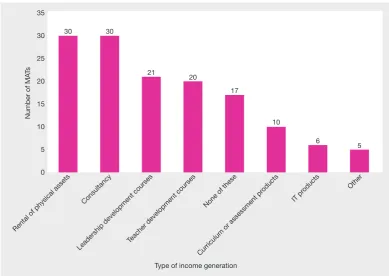
There is a clear appetite to exercise such financial autonomy amongst academies: in a survey of converter academies conducted by Reform and The Schools, Students and Teachers Network (SSAT) in 2014, greater financial autonomy was the most cited reason for conversion.52 Case studies run by the DfE also suggest that high-performing academy chains have sought to maximise back office efficiencies across their chains by central procurement of services such as catering, utilities, human resources and printing services,53 and have developed revenue generation schemes such as IT systems and teacher training packages. For example, some have developed performance
management and pupil data management systems in-house and are now selling them to software providers. Others sell teacher training packages externally to outside schools and chains, which helps recoup the costs of the programme development.54 Some outstanding academies within chains will lead a Teaching School Alliance, attracting additional public funds to run school-led initial teacher training, continuing professional development and other research and leadership development programmes.55
1.4 Chains as the new ‘middle tier’?
As more schools become academies, it is expected that academy chains will become the main vehicle for delivering school improvement. Relatedly, it is likely that chains will take on much more of the LA’s role as the ‘middle tier’ for schools, becoming the main operational body between central government and schools. While the white paper sets out a clear, four-point rationale for why academy chains might be more transformative than local authorities, it is crucial that there is a greater understanding about how academy chains operate and the effect these decisions have on pupil performance. To address this gap in policy research, Reform undertook a survey of academy chain chief executives. The objective was to understand the different operational decisions chains make and evaluate whether these differences are associated with the size, age or geographical distribution of the chain. While the results presented here do not compare academy operations with performance, the research aims to open up the ‘black box’ of academy chains and provide information that could, in future, be used to assess academy chain effectiveness.
It is hoped the results presented here, and the subsequent analysis, will be a useful resource to researchers, policymakers, and the school system alike. Chapter 2 presents the survey results for four areas: inclusive growth, governance and leadership skills, accountability and efficiency. Chapter 3 presents some solutions to the problems identified in the academy chain survey.
51 Department for Education, Educational Excellence Everywhere.
52 Amy Finch et al., Plan A+ 2014: The Unfinished Revolution (Reform, 2014), 3.
53 Department for Education, What Does a High Performing Academy Sponsor Look Like?, 2014. 54 Kreston Reeves, Academies Benchmark Report 2015, 2015.
2.1 Chain efficiency
18
2.1.1 Level of centralisation
19
2.1.2 Size
20
2.1.3 Geographical dispersion
22
2.2 Leadership and governance
24
2.2.1 With freedom comes responsibility
24
2.2.2 The hindrances of volunteerism
25
2.2.3 Mixed messages
27
2.3 Barriers to inclusive expansion
28
2.3.1 Size, type and location
29
2.3.2 Financial problems
31
2.3.3 School performance
32
2.4 Chain accountability
32
2.4.1 The reach of the Schools Commissioners Group
33
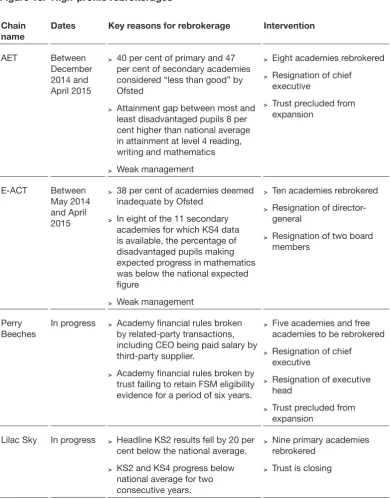
2.4.2 Reasons for rebrokerage
34
2.4.3 Criteria for takeover and expanding sponsors
37
executives. For a full list of survey responses, see Annex B. The survey was conducted online between May and August 2016. Reform received a total of 66 usable survey responses from executive leaders56 of chains with two or more academies. This
represents a sample of approximately 9 per cent of all academy chains with two or more academies, and 15 per cent with three or more.
The chains that responded to the survey were broadly comparable to the total population of academy chains with two or more academies. The mix of primary and secondary academies, the proportion of pupils on free school meals (FSM) and pupils with English as an additional language (EAL) are similar in the survey compared to all academy chains. There is, however, a skew in the survey towards chains with more academies and more pupils, more sponsored academies, and greater geographical dispersion between academies in the chain. The authors have attempted to mitigate these difference in the analysis. More details on the representativeness of the sample are outlined in Annex A. Initial results from the survey were presented at a small, private roundtable held at Reform in early August 2016. The roundtable was attended by chain chief executives that had taken part in the survey, senior officials from the DfE, academics and representatives from sector organisations. The discussion was held under The Chatham House Rule, but the authors have made clear when the below analysis has been informed by the discussion. Following the roundtable, the authors held unstructured interviews with six chain chief executives and one senior official at the DfE. The names of those interviewed are listed in Annex C. Chapter 2 presents the findings of the survey as well as the main arguments made at the roundtable.
2.1 Chain efficiency
As academy chains build larger pupil rolls, it is reasonable to expect that, at some point, they will achieve economies of scale. This means that their size would allow them to operate more efficiently than smaller chains and standalone academies due to greater centralisation, increased purchasing power, and operational effectiveness. For example, procuring goods and services for all academies in the trust centrally might allow them to ‘bulk buy’, lowering their unit cost. Centralising curriculum development or, equally, allowing high-performing individual academies to pilot curriculum designs, might help improve pupil performance across the chain.
While an overwhelming majority of respondents in Reform’s survey believe economies of scale in academy chains are possible, there has been no rigorous analysis of the size at which chains need to be to deliver this. Indeed, one roundtable attendee expressed scepticism about the extent to which significant efficiencies can be achieved by central procurement in academy trusts, as savings can be offset by extra costs associated with growth.
However, some roundtable attendees indicated that efficiencies can be achieved through better staff deployment in larger chains. For example, where a smaller chain may have middle managers that solely oversee one school, a larger trust may deploy them as regional managers across several academies, utilising spare capacity and sharing best practice. Larger chains with a bigger pool of staff may also be better placed to use existing permanent staff flexibly to cover sickness or parental leave, instead of using costly temporary or supply staff. As a national employer, larger academy chains might be able to attract and retain more highly skilled, productive employees, because of the progression opportunities they may offer.
Most academy chain sponsors provide their academies with additional services funded by top-slicing57 each school’s revenue, known as its general annual grant (GAG). The top-slice funds the chain’s operational costs, such as central staff salaries and any services delivered centrally by the chain. For example, in exchange for a 4 per cent top-slice for all academies in the chain, the academy chain trust may hire executive directors, develop staff terms and conditions and manage procurement.
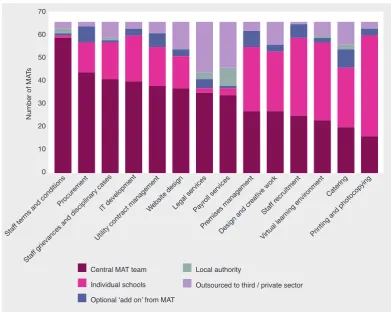
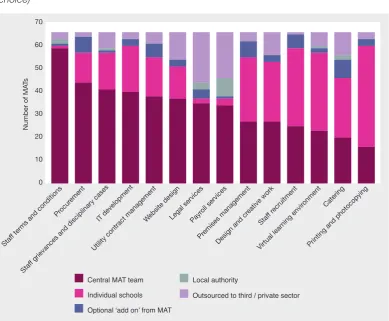
Chains vary in the level of control they have over individual school operations (see Figure 2). The most centralised service is the development of staff terms and conditions, closely followed by procurement and dealing with staff grievances. The least centralised services, i.e. those that are, in most cases, delivered by individual academies, are services
[image:21.595.174.566.375.687.2]delivered on site, such as printing and photocopying and catering. It is somewhat surprising, however, that the virtual learning environment (VLE) is, in many chains, delivered by individual academies. These chains are either small in size (number of academies and pupil roll) or run by dioceses.
Figure 2: Operational autonomy within academy chains
Q10. Consider the following operational functions for individual academies. Who carries out these functions? (Answers are multiple choice)
Number of MA
Ts
0 10 20 30 40 50 60 70
Outsourced to third / private sector Local authority
Optional ‘add on’ from MAT Individual schools Central MAT team
Printing and photocopying Catering
Virtual lear ning envir
onment
Staff recruitment
Design and cr eative work
Premises management Payroll services Legal services Website design
Utility contract management IT development
Staff grievances and disciplinary cases Procur
ement
Staff terms and conditions
It is reasonable to ask whether those chains that deliver more services centrally charge their academies a higher top-slice. However, there is no apparent relationship between the number of services delivered by the central team and the size of the top-slice. On average, academy chains charge 4.5 per cent for primary and 4 per cent for secondary schools (see Figure 3). However, a small number of chains reported charging no top-slice (6 chains; 9 per cent). Contrary to what might be expected, these chains are not run by
however, small chains with respect to school numbers (between two and four academies).
Figure 3: The range of academy chain top-slicing amounts
Q11. (a)-(b) Consider your primary/secondary schools. On average, what percentage of revenue does the central MAT team hold back or top-slice from the General Annual Grant of these schools?
Top-slice as a per
centage of GAG
0 1 2 3 4 5 6 7 8 9 10
Primary schools Secondary schools
Excluding 0% top-slice Including 0% top-slice
Primary schools Secondary schools
The level of financial control the central team has may impact the number of functions delivered centrally. It is reasonable to hypothesise that academy chains with more financial autonomy are better placed to invest in central operations, and ultimately better able to drive efficiencies across the chain. For example, a chain that varies the top-slice across different academies may, in the short term, be able to give more support to a school in need and reduce support to a school that is doing well.
However, the majority of survey respondents (52 chains; 80 per cent) indicated that they do not vary their top-slice across different academies,58 suggesting that this flexibility is currently under-utilised. The most popular reason for varying the top-slice among the remaining 14 academy chains was the support required by the school, with the majority charging more for academies that are struggling. One chain reported charging 0.5 per cent less as a fee for a PFI school; another reported charging less for those academies that joined the trust first.
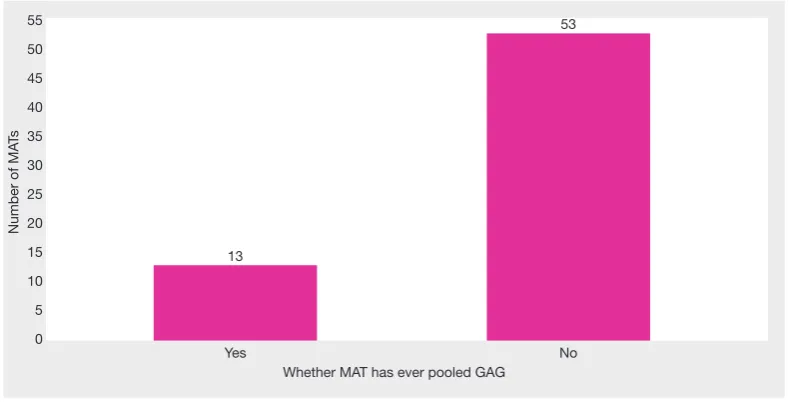
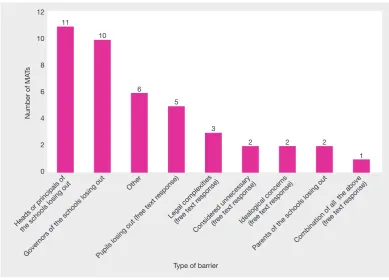
Another way to more flexibly direct funding and resources across the academy chain is by pooling all of the academies’ GAG funding. GAG pooling requires agreement from the EFA and means that chains can distribute their funding to academies in the way they see fit. The survey responses indicate this practice is not commonplace: 53 (80 per cent) said they do not pool GAG funding. However, of those who said they do not, 17 (30 per cent) indicated that they would like to. The most common reasons cited for not yet pooling GAG funding were resistance from the headteachers and governors of the academies losing out.
2.1.2 Size
As organisations become bigger, their purchasing power increases. As academy chains grow, so too should their ability to benefit from economies of scale and lower overall operating costs. It is difficult, however, to accurately assess the extent to which chains are currently achieving economies of scale. This is in part because school and academy
funding formula.
Instead, we can examine how much the central team in a chain delivers (as a proxy for a reduced unit cost) relative to its size. The survey results suggest that, contrary to what may be thought, larger academy chains deliver slightly fewer services than smaller chains when outliers are removed (see Figure 4).59 This is a somewhat surprising finding. In research for this report, academy chain chief executives have explained that the chain leadership can take different approaches to their academies, often offering more support to individual academies that are struggling (such as sponsored academies) than
academies that come from a position of strength.
Figure 4: The number of functions delivered centrally by size of academy chain
Number of functions deliver
ed centrally
Number of pupils in MAT
0 1,000 2,000 3,000 4,000 5,000 6,000 7,000 8,000 9,000 10,000 0
2 4 6 8 10 12 14 16
Note: Chains with pupil sizes larger than 10,000 have been excluded from this graph as they are statistical outliers.
At present the majority of academy chains are relatively small: over 80 per cent of chains have between two and five academies, and over 90 per cent have 4,000 pupils or fewer.60 This is significantly smaller than the average LA, which has 110 primary schools and 29,673 primary pupils, and 22 secondary schools and 20,952 secondary pupils.61 One respondent said of economies of scale in the survey: “This is a myth. You can’t replace 150 LAs with 1,500 MATs and claim economies of scale.” This suggests that chains have not yet reached a size where they are able to benefit from the level of purchasing power available to local authorities, and thus that expansion should be encouraged if greater economies of scale are to be achieved.
Moreover, the survey results indicate that the majority of chain chief executives do not think they have grown large enough to begin reducing average costs across the chain. Most respondents suggested that in order to start benefitting from economies of scale, an academy chain must have between eight and 20 academies and between 2,500 and 7,500 pupils, with a mean response of 12 academies and around 5,000 pupils. This is more than double the number of pupils (2,068) and nearly three-times larger than the number of academies (5) in the average academy chain.
59 This is not statistically significant.
60 Reform calculations; Department for Education, Open Academies and Academy Projects in Development, 2016.
Reported factor incr
ease in number of pupils r
equir
ed
for economies of scale
Current number of pupils in MAT
0 2,000 4,000 6,000 8,000 10,000 12,000 14,000 16,000 -1
0 1 2 3 4 5 6 7 8 9
Statistical outliers Trendline with outliers Trendline without outliers
Larger academy chains estimated that they needed to grow by a smaller amount to achieve economies of scale, and some indicated that they were already large enough. This suggests that academy chains do lower their operating costs as they expand, but highlights that the majority currently feel insufficiently developed to do so.
2.1.3 Geographical dispersion
Q23. How often do you offer the following forms of staff movement between schools in your MAT?
Number of MA
Ts 0 5 10 15 20 25 30 35 Never Rarely Sometimes Frequently
Staff cover (for sickness or paternity/maternity leave) Employees work in
multiple schools Permanent moves
Secondment
Type of staff movement 17 32 12 5 12 33 13 8 18 34 11 3 4 33 16 13
The relationship between closer geographical dispersion and more flexible staff deployment is also supported by our survey findings. As shown in Figure 7, the most geographically concentrated quartile of survey respondents are the most likely to flexibly utilise staff across different schools within the chain, whereas the least geographically concentrated quartile are the least likely to make use of such flexible working.
Figure 7: Relationship between geographical dispersion and staff deployment practices
Number of MA
Ts
Employees work in multiple schools Staff cover
(for sickness or paternity/maternity leave) 0 5 10 15 20 25 30 35
Fourth quartile (least dispersed) Third quartile (less dispersed) Second quartile (more dispersed)
First quartile (most dispersed)
Never Rarely Sometimes Frequently Never Rarely Sometimes Frequently
geographically, measured by the average distance between each academy and the centre point of the trust.
Figure 8: Relationship between pupil numbers and geographical dispersion (all trusts)
Number of pupils in MA
T
Dispersion (km)
0 5 10 15 20 25
0 500 1,000 1,500 2,000 2,500 3,000 3,500 4,000 4,500 5,000
Note: Dispersion was assessed by calculating the average distance between each academy in the chain and the centre-point between all academies in the chain.
The larger trusts in the sample less commonly reported deploying staff across multiple academies and to cover for sick or parental leave. This suggests that the greater geographical spread associated with larger trusts can act as a barrier to flexible staff deployment. This underlines the importance geographical dispersion plays in optimising trust development, so large chains are able to benefit from the efficiencies flexible staff deployment can deliver.
2.2 Leadership and governance
2.2.1 With freedom comes responsibility
Conversion to academy status results in the acquisition of a number of additional responsibilities. Legal responsibility for the school moves from the LA (or other relevant body) to the academy trust. The trust becomes the employer, gaining responsibility for pensions, payroll, purchasing compliance, legal and financial liabilities, admissions and much more. It needs to ensure that agreements are made on all previous contracts and liabilities held by other parties, such as the LA.62 During the conversion process, the trust will seek legal guidance to establish the initial arrangements, but the legal responsibility the trust holds once set up is still significantly greater than a maintained school.63 The acquisition of these responsibilities is reflected in the skills that the survey respondents valued most at different levels of governance. At the trustee level, which holds the greatest level of accountability after the Member, the most highly-prized set of skills was financial, accounting or legal experience (see Figure 9).
62 Department for Education, Treatment of Surplus and Deficit Balances When Maintained Schools Become Academies, 2015.
19. (a)-(c) Consider your [MAT trustees. executive board, school governing bodies]. Please tick by the three skills or attributes you consider most important for the effective functioning of that team. Please only tick three.
Number of MA
Ts
Governance level 0
10 20 30 40 50 60
Financial, accounting or legal experience Academic background
Data handling Leadership experience
Governance expertise
Commercial or business expertise Knowledge of the education sector Teaching experience
Parents
School governing bodies Executive board
MAT Trustees 3
8 36
46
39 35
5 12
53
1 21
35
26
12 44
13 12 41
30
5 33
27 38
16 27
8 24
2.2.2 The hindrances of volunteerism
Given the increasing complexity of the role of governors through both academisation and chain expansion, the need to recruit skilled governors is overwhelmingly apparent.64 There has been wide-spread lamentation across the sector of the inconsistency of governance in both maintained schools and academies. However, this does not necessarily equate to a lack of skills. It has been suggested that it is unrealistic to expect unpaid volunteers to devote the amount of time required to effectively fulfil these extensive governance
responsibilities.65 Our survey did not find a high level of dissatisfaction with the skills of the trustees, executive board or school governors but one respondent noted that the issue was about having the time to support and challenge, rather than the skills.
19. (d) How satisfied are you with the current skills mix of your Trustees, Executive Board and school governors? Please explain your answer.
Number of MA
Ts
Satisfied Very satisfied
Level of satisfaction
Dissatisfied 0
5 10 15 20 25 30
26
23
7
A survey of governors by the National Governors’ Association (NGA) and Times Educational Supplement (TES) in 2015 found that 51 per cent of respondents were employed and 14 per cent were self-employed. Of those who were employed, 40 per cent did not receive their statutory additional leave allowance for governance duties.66 Maintaining the role of governance as a voluntary one may be limiting what we can expect of governors, as Gerard Kelly, former editor of the TES, has said.67 The DfE does not currently provide for the payment of trustees in their model articles of association and trusts would need authorisation from the charity commission to do this. In maintained schools there is no provision to pay governors except in some cases of intervention.68 However, there are paid roles at a trust level, such as the chief executive and accounting officers.
One implication of professionalising academy chain governance in this way is the phasing out of parent volunteers. Respondents to the survey considered the most valuable skills for the trustees and executive board to be financial accounting or legal experience, leadership experience and commercial or business expertise. Parents were among the least highly rated at these levels of governance. Indeed, the DfE has announced plans to remove the current requirement to have parent trustees.69
Figure 9 above shows that parental representation is more popular at local governing level than the trust-wide level. While the governing bodies may be merged or governors removed when an academy chain takes over a school, no respondents were specifically removing parent governors (see Figure 11). In our roundtable discussions, chief
executives voiced the importance of parental engagement. Although it was recognised that representation as governors is not necessarily the best way to achieve this, the levels of political risk in not including parents on the governing body are high.
66 Ellie Howarth, ‘The 2015 NGA/TES Survey of Governors and Trustees’, Governing Matters, October 2015. 67 Gerard Kelly, ‘It’s Essential That Governors Are Paid for Their Work’, Schools Week, 26 October 2015. 68 Department for Education, Governance Handbook.
within a MAT
Q20. When taking over a school or academy what approach do you usually take to their governing body?
Number of MA
Ts
Approach to governing body 0 5 10 15 20 25 30 Other (fr ee text) Remove par ent gover nors
Remove the gover ning
body completely Remove a significant
number of gover nors
Merge their gover ning body
with other gover ning bodies within the MA
T
Recruit additional gover nors
from outside the MA T
Keep the existing gover ning body 25 14 0 5 6 6 12
Some academy chains, such as Oasis Community Learning and E-ACT have established boards of local representatives, such as parents, staff and the wider community, who communicate their thoughts with the board but are not given governance responsibility.70 With the demand for such highly skilled governance, recruitment is a serious issue. The NGA and TES survey found that half of all respondents agreed it is difficult to recruit governors/trustees.71 In its recent white paper, the DfE sets out its expectation that the expansion of academy chains will lessen the quantity of governors needed, as high-quality governing boards take over more and more academies.72
2.2.3 Mixed messages
As academy chains expand and require more complex models of governance and delegation, there is an increased risk of duplication or confusion between the role of the chief executive and local governance.73 Members of local governing bodies may be unclear on their role when the school academises and governance responsibility moves to the members and trustees of the trust, especially if they are still being referred to as governors. There have been cases of academy chains experiencing resistance to change from local governing bodies, which the chain is under no obligation to devolve any power to.74 The Chief Executive of the NGA says that the NGA frequently receives queries from members of local governing bodies of academies in chains that have misunderstood that decision-making power lies with the trust or that believed academisation was not going to substantially change their role.75
70 Oasis Community Learning, Scheme of Delegation (OASIS, 2016); E-ACT, E-ACT’s New Governance Structure: An
Overview (One E-ACT, 2016).
71 Howarth, ‘The 2015 NGA/TES Survey of Governors and Trustees’. 72 Department for Education, Educational Excellence Everywhere. 73 Department for Education, Governance Handbook.
74 Richard Vaughan, ‘How Cutting up Credit Cards Saved a Scandal-Hit Chain’, Times Educational Supplement, 29 July 2016.
75 Emma Knights, ‘When It Comes to Local Governance, We Want to Have Our Cake and Eat It... but Perhaps We Can’, The
having local governing bodies and regional directors, but said that teachers were resistant to getting rid of local governing bodies. There was general agreement that when there are less than five academies in a chain, the most efficient structure is to have one governing body. Above this size, the governance structure becomes more complex and therefore a clear scheme of delegation is important.
Current Ofsted guidance is that inspectors should seek to meet with those responsible for the governance of the trust. The recent Ofsted handbook acknowledges that in some cases there “may be a local governing body that is wholly advisory, with no formal governance responsibilities”, and that inspectors must ensure their meetings are with those “directly responsible for governance”.76 However, it does not say that chains should be judged unfavourably if they have decided not to have this level of governance.77 Yet evidence from our roundtable suggests that experience on the ground is a different matter: chief executives felt that Ofsted did not understand how governance in an academy chain should work.
2.3 Barriers to inclusive expansion
In order to ensure national coverage of high-quality sponsors, the white paper sets out plans to encourage “sponsors to grow” by “increasing their incentives and minimising barriers”.78 The Government is right to tackle barriers to chain capacity. The support high-quality chains can offer new academies is likely to help them better utilise the autonomy associated with becoming an academy. As discussed, larger academy chains are also likely to be able to drive efficiencies by increasing their purchasing power. The Government’s drive to encourage academy chains to expand is partly explained by their ability to expand into multiple regions across the country, allowing “proven
educational models to be scaled” and “the system’s best leaders to run more than one school”.79 Results from the survey reveal a strong desire amongst chain chief executives for their chain to grow. In the short term (next two years) an overwhelming majority of chain CEOs (92 per cent; 61 chains) said they wanted to expand by taking on more academies. Only four chains surveyed (6 per cent) wanted to have the same number of academies in two years’ time, and no chains wanted any fewer.
Expansion plans are ambitious: all but four want to expand by at least 50 per cent, and more than half want to over double in size (with some – even those of a comparatively large size already – planning for a four-fold expansion). Those chains already with 15 or more academies are slightly less ambitious, but are still, on average, planning to double in size.
2021-22
Expected factor incr
ease in number of academies by 2021-22
Current number of academies in MAT
Trendline with outliers Trendline without outliers Statistical outliers
0 10 20 30 40 50 60
-1 0 1 2 3 4 5 6
However, the survey results show that academy chains do not always look to expand when encouraged to do so: over one-third of respondents indicated that they have at some point refused to take on a new school when asked formally to do so by someone external from the chain, such as a Regional School Commissioner (RSC). This suggests that, at present, there are a number of barriers to chains developing in the way the Government intends.
2.3.1 Size, type and location
Q18. (a) Have you ever declined to take on a new school when formally asked by someone external to the MAT, such as a Regional Schools Commissioner? 18. (b) If yes, what were the reasons? Tick all that apply
Number of MA
Ts
Reason cited 0
2 4 6 8 10
The school was too small The school in question wascarrying a curr
ent deficit
It would r equir
e structural change in the MA
T Other
The leadership of the school was weak The school's ethos / vision did notmeet the MA
T's ethos / vision The geographical location
of the school
12
3 5
5 6
6 6
10
In the roundtable for this paper, chain chief executives and sector experts explained how geographical location can act as an expansion barrier, and also commonly described a reticence to take on primary and smaller schools – both of which attract lower levels of pupil funding. The reasons are described below.
Taking on schools that are a significant distance away from the other academies in the chain may require a costly management restructure of an academy chain. If, for example, a chain has clusters of academies with regional managers, taking on a school that falls outside of any of its existing catchments may require investment in new management. By contrast, responsibility for a new school that is nearby to others in the chain could be absorbed by existing management. Concerns have also been raised within the sector about the effect a wide geographical spread of academies within a chain has on school-to-school collaboration,80 which may exacerbate reluctance to take on rural schools. The respondents who indicated that geography has been a barrier to expansion have on average nearly 10,000 pupils, whereas those who did not cite geography as a reason for not taking on a school have only around 4,500.
Leaders of academy chains are also less willing to take on smaller schools. This is because they are typically more expensive to run.81 Though smaller schools will generally have lower overhead costs than larger schools, there are nevertheless base costs associated with running a school of any size. As the funding a school receives from government is determined by the number of pupils, such costs represent a proportionally
80 House of Commons Education Select Committee, Multi-Academy Trust Inquiry: Written Evidence Submitted by the
National Governors’ Association, 2016.
The relative costliness of smaller schools helps to explain why primary schools are seen as less attractive expansion projects, as primary schools have, on average, nearly four times fewer pupils than secondary schools.82 The average amount of funding per pupil is also lower for primary than for secondary school pupils (by an average of 27 per cent in the academic year 2014–15), compounding the relative expense of primary schools.
2.3.2 Financial problems
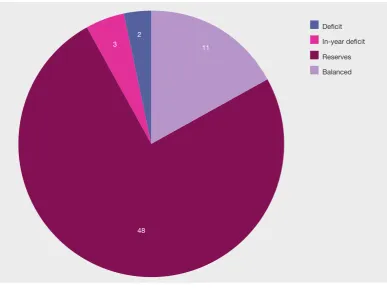
The survey also shows that chain leaders commonly prioritise financial stability. Nearly two-thirds of respondents indicated that they ranked getting more academies out of a deficit as “quite” or “very” important when asked to consider their short-term priorities. The chains surveyed