DESIGN AND DEVELOPMENT OF SOLAR TOASTER
MOHD HAFIZ BIN MUSTAFA
DESIGN AND DEVELOPMENT OF SOLAR TOASTER
MOHD HAFIZ BIN MUSTAFA
This report is submitted
in fulfillment of the requirement for the degree of Bachelor of Mechanical Engineering (Design and Innovation)
Faculty of Mechanical Engineering
UNIVERSITI TEKNIKAL MALAYSIA MELAKA
ii
DECLARATION
I declare that this project report entitled “Design and development of solar toaster” is the result of my own work except as cited in the references
iii APPROVAL
I hereby declare that I have read this project report and in my opinion this report is sufficient in terms of scope and quality for the award of the degree of Bachelor of Mechanical Engineering (Design & Innovation).
iv
DEDICATION
v ABSTRACT
. The project is about developing a solar toaster model by using a solar energy as a main energy source instead of electrical energy. This is because the solar energy is renewable free source of energy that sustainable. The objective of this study is to design, perform structural and heat analysis and also fabrication on solar toaster. There are a few disadvantages of the solar cooking from the previous studies. Sometimes solar cooking is unconsistent because the sun is too low and the angles of the collector is not right (Deziel, 2017). In accomplishing this study, the literature review was done and there are some method that has been conducted that includes internet research, concept design, concept selection, detail design, CAE analysis and ANSYS analysis. In the initial stage, all the information are gathered as guidance to complete the project. The project continues by design study on the component that will be used in this structure which is solar toaster. After that on the methodology, ideas for conceptual design are developed that fullfil the engineering design specification. In order to select the final design of the solar toaster, pugh concept selection was used. For design analysis, there are several approaches have been made to minimize the factor of safety of the design. Finite element approach is used in the study by using FEA software using CATIA to study the stress concentration on the structure frame for static load condition. From this analysis the maximum Von Mises obtain is 2.12 ×10⁶ 𝑁
𝑀2 while the factor of safety obtain is 44.81. Then heat or
vi ABSTRAK
Projek ini adalah kira-kira membangunkan model pembakar roti solar dengan menggunakan tenaga solar sebagai sumber tenaga utama dan bukannya tenaga elektrik. Ini kerana tenaga solar boleh diperbaharui sumber bebas tenaga yang mampan. Objektif kajian ini adalah untuk mereka bentuk, melaksanakan analisis struktur dan analisis haba dan juga fabrikasi pembakar solar. Terdapat beberapa kelemahan memasak solar dari kajian sebelumnya. Kadang-kadang memasak solar adalah tidak konsisten kerana matahari adalah terlalu rendah dan sudut pengumpul tidak betul (Deziel, 2017). Dalam mencapai kajian ini, kajian literatur yang telah dilaksanakan dan terdapat beberapa kaedah yang telah dijalankan termasuk penyelidikan internet, reka bentuk konsep, pemilihan konsep, reka bentuk terperinci, analisis CAE dan analisis ANSYS. Di peringkat awal, semua maklumat atau penyelidikan yang telah dilakukan mengenai topik ini dikumpulkan sebagai petunjuk bagi perkara yang teras. Maklumat ini kemudian perlu berkaitan dengan objektif projek. Dari ini, penyelidikan itu berterusan oleh kajian reka bentuk pada komponen yang akan digunakan dalam struktur ini yang merupakan pembakar roti solar. Selepas itu pada metodologi, idea-idea untuk reka bentuk konsep yang dibangunkan atas pembakar solar untuk memenuhi spesifikasi reka bentuk kejuruteraan. Dalam usaha untuk memilih reka bentuk akhir pembakar solar, pemilihan konsep Pugh digunakan. Untuk analisis reka bentuk, terdapat beberapa pendekatan telah dibuat untuk dikurangkan faktor keselamatan. bahan yang dipilih dan keselamatan reka bentuk adalah kriteria yang diperlukan untuk mencari faktor keselamatan yang terbaik. pendekatan unsur terhingga digunakan dalam kajian ini dengan menggunakan perisian FEA iaitu analisis perisian CATIA akan dilakukan untuk mendapatkan kepekatan tekanan pada rangka struktur bagi keadaan beban
statik. Daripada analisis ini maksimum Von Mises mendapatkan 2.12 × 10⁶ 𝑁
𝑀2
manakala faktor keselamatan mendapatkan adalah 44,81. Kemudian haba atau analisis terma dengan menggunakan perisian ANSYS dijalankan untuk menganalisis aliran haba pada pembakar solar. Daripada analisis ini aliran haba maksimum telah direkodkan di kawasan pembakar yang membuktikan secara teori reka bentuk pembakar solar akan kerja-kerja. Seterusnya, fabrikasi prototaip pembakar solar sedang berlaku untuk membuktikan uji kaji sama ada pembakar solar berfungsi atau tidak. Tempoh proses fabrikasi adalah kira-kira tiga minggu. Dapat disimpulkan bahawa model pembakar roti solar baru dapat menyelesaikan masalah memasak solar yang lepas kerana peningkatan baru kepada reka bentuk dan mekanisme
vii
ACKNOWLEDGEMENT
I would like to express my deepest appreciation to my supervisor Dr. Shafizal Bin Mat for giving me this opportunity to do final year project with him. He never hesitated to give me advice and guidance whenever I confronted problems. I am thankful for his patience and advice while leading me in this project.
viii
TABLE OF CONTENTS
DECLARATION ... ii
APPROVAL ... iii
DEDICATION ... iv
ABSTRACT ... v
ACKNOWLEDGEMENT ... vii
LIST OF FIGURES ... x
LIST OF TABLES ... xiii
LIST OF ABBREVIATIONS ... xiv
LIST OF EQUATION ... xvi
CHAPTER 1 ... 1
INTRODUCTION ... 1
1.1 Background of study ... 1
1.2 Problem Statement ... 2
1.3 Objective ... 2
1.4 Scope of Project ... 2
1.5 General Methodology ... 3
1.6 Outline of Dissertation ... 3
CHAPTER 2 ... 5
LITERATURE REVIEW ... 5
2.1 Introduction ... 5
2.2 Toaster ... 7
2.4 The Equator... 15
2.5 Solar Energy ... 17
2.6 Summary of Chapter 2 ... 24
CHAPTER 3 ... 25
METHODOLOGY ... 25
3.1 Introduction ... 25
3.2 Problem Definition ... 27
ix
3.4 Concept Design and Selection ... 28
3.5 Detail design and analysis ... 29
3.6 Finite Element Analysis (FEA)... 30
3.7 Thermal analysis ... 31
3.8 Factor of Safety ... 33
3.9 Summary of Chapter 3 ... 33
CHAPTER 4 ... 34
DESIGN PROCESS ... 34
4.1 Concept design ... 34
4.2 Fabrication ... 39
4.3 Summary of Chapter 4 ... 44
CHAPTER 5 ... 45
RESULTS ... 45
5.1 Prototype Experiment ... 45
5.2 Structural Analysis ... 47
5.3 Heat Analysis ... 50
5.4 Mechanism on the Design... 54
5.5 Summary of Chapter 5 ... 60
CHAPTER 6 ... 61
CONCLUSION AND RECOMMENDATION ... 61
6.1 Conclusion ... 61
6.2 Recommendation ... 62
REFERENCES ... 64
x
LIST OF FIGURES
FIGURE TITLE PAGE
2.1 Toaster 1920-1940 7
2.2 Toaster 2000 8
2.3 Toaster Nowadays 8
2.4 Patent of Toaster 10
2.5 Patent of Toaster 11
2.6 Patent of Toaster 12
2.7 2.8 2.9 2.10
Patent of Toaster Patent of Toaster
The position of equator line Sea temperature
13 14 15 16
2.11 Photovoltaic System 18
2.12 Photovoltaic Schematic Diagram 19
2.13 Domestic Water Heating 20
2.14 Photovoltaic Solar 21
2.15 Solar Thermal Energy Plant 22
xi
3.1 Flowchart 26
3.2 Pugh Concept 29
3.3 FEA Result 31
3.4 Thermal Analysis 32
4.1 First Concept Design 34
4.2 Second Concept Design 35
4.3 Third Concept Design 36
4.4 Fourth Concept Design 37
4.5 Final Design 39
4.6 Solar Toaster Prototype 44
5.1 Prototype under Sunlight 45
5.2 Prototype been tested 46
5.3 Bread been toasted 46
5.4 Translational Displacement 47
5.5 Stress Principal 48
5.6 Deformation 48
5.7 Von Misses 49
5.8 Average Daylight 51
5.9 Average Temperature 51
5.10 Monthly Sun Hours 52
5.11 Heat and thermal analysis 53
xii
5.14 Design of chain 54
5.15 Design of motor 55
5.16 Battery 56
5.17 Design of Switch 57
xiii
LIST OF TABLES
TABLE TITLE PAGE
4.1 Pugh Concept Selection 38
4.2 Material Used 40
4.3 Equipment and tools 41
5.1 Material Properties 49
xiv
LIST OF ABBREVIATIONS
xv
LIST OF SYMBOL
oC = Degree Celsius
xvi
LIST OF EQUATION
Equation Title Page
3.1 Factor of Safety 33
1
CHAPTER 1
INTRODUCTION
1.1 Background of study
Nowadays as we are living in a technology world and approaching 2020, It is better if we stop depend on electrical energy from home supply and start use alternative energy such as Biomass Energy, Wind Energy, Solar Energy, Geothermal Energy and Hydroelectric Energy. For this case, Solar Energy is used as a main electric source for this project as it is limitless beside its only required maintenance cost which is believed quite cheap.
Solar Energy resources are massive and widespread, it can be harnessed anywhere around the world but yet this massive and larges resources are not fully explored by us. Human beings are too dependent on non-renewable sources which are proven not sustainable such as nature gas, oil and coal. This type of resources produces a variety of pollutants which affect the people’s health and damage the environment.
2 1.2 Problem Statement
Solar cooking is not efficient enough compared to electrical cooking because sometimes solar cooking is unconsistent because the sun is too low and the angles of the collector is not right (Deziel, 2017). Sometimes the meat or fish is partially cooked which expose you to harmful bacteria and parasites (Zamostny, 2011). User takes longer time to use solar cooking compared to electrical cooking (Deziel, 2017). The design of the solar oven is too big to be commercialized (Olmert, 2007). Hence, continuous development on the design and the mechanism of the solar toaster is needed to close the loopholes of system.
1.3 Objective
The objectives of this project are as follows:
1. To design toaster that use solar energy as energy source. 2. To perform structural and heat analysis on the solar toaster. 3. To fabricate the prototype of solar toaster.
1.4 Scope of Project
The scopes of this project are:
1. Study the literature review of solar energy. 2. Design the solar toaster.
3. Analysis on the solar toaster.
3 1.5 General Methodology
Generally, there are three methods involved in this project which is design, analysis and fabrication. In the design process, four concept designs were drawn before the best design is selected. The four concept designs is different from each other as it have different advantages and disadvantages. A best design will be selected for the final design process. Structural and thermal analysis will be done on the solar toaster by using Computer Aided Engineering and ANSYS software. The purpose of thermal analysis is to collect information and data about solar energy in Malaysia. The prototype needed to be fabricated to prove experimentally that the project is successful. The fabrication process has two part which is toaster part and solar part. One of the main problem and restriction is to attach and combine both part of the prototype.
1.6 Outline of Dissertation
Chapter 1
explains the project background, problem statement, objectives of the study, scope of the study, general methodology and outline of dissertation of the study.
Chapter 2
describes the literature review that covers on background, design and the characteristic of the solar toaster. It also show the pattern of the toaster, photovoltaic system, solar thermal system and also solar energy system.
Chapter 3
4 Chapter 4
discusses the design and fabrication process. The design process covers about the concept design and the method to select final design. Meanwhile, the fabrication process discusses about the fabrication of the solar toaster prototype that covers the material and equipment use.
Chapter 5
discusses the result of the project, prototype fabrication and focus on explaining analysis such as on stress analysis, structure analysis, heat analysis and the mechanism design. It explains detail each component of the mechanism of the design.
Chapter 6
5
CHAPTER 2
LITERATURE REVIEW
2.1 Introduction
Solar toaster is a toaster that used an energy from solar to toast a bread. This method has been implemented since 1995 to use solar energy as its energy source (Lorraine Anderson, 2006). This is the new innovation towards green technology implementation. The history of toaster back in 1909 when General Electric built first home electric toaster but the concept or idea of a toaster that using thermal insulation method to cook food start in 29000 BC when people in Central Europe used a ancient oven to cook mammoth (Olmert, 2007). However, the first recorded oven in history was created in France in 1490, this oven is made from brick and tile. (Frances, 1960)
Nowadays an oven or toaster can be found nearly in every house as people using it as one of the important cooking tool (Miller, 2013). Solar energy can be defined as an energy from the sunlight or heat from the sun which been converted into thermal or electrical energy (Goswami, 2013). Sun is the main power source which supply energy to the universe. In fact, the earth receives nearly 174 000 terrawats power of incoming solar radiation at the atmosphere which make it the largest energy source with the highest potential and space to be explore (Gavin, 2007).
6
use on a multipurpose such as been use to regulate the temperature of their dwelling (Lomas, 1999).
In 400 BC, the famous Greek philisopher Socrates emphasizing the advantages of constructing the houses with overhang and south facing window (Gale, 2006). This is to enhance the usage of the sun so that the temperature of the house decrease during the summer and increase during the winter (MacEachern, 2016).
In a 212 BC, the greek scientist Archimedes used the reflective properties of bronze shields to set fire on a Roman Empire ships by focusing the sunlight (Mongillo, 2011). In 1839, Alexandre Edmond Becquerel a french scientist discovered a photovoltaic effect while experimenting the electrolytic cell which generated electricity from a sunlight (Zamostny, 2011). This finding finally bring into development of a solar energy year by year until the creation of a solar panel as can be found today.
In 1954 David Chapin, Calvin Fuller and Gerald Pearson invented the device which converted sunlight into electrical power. They later improve the conversion rate efficiency from 4% to 11% (Maehlum, 2013).
7 2.2 Toaster
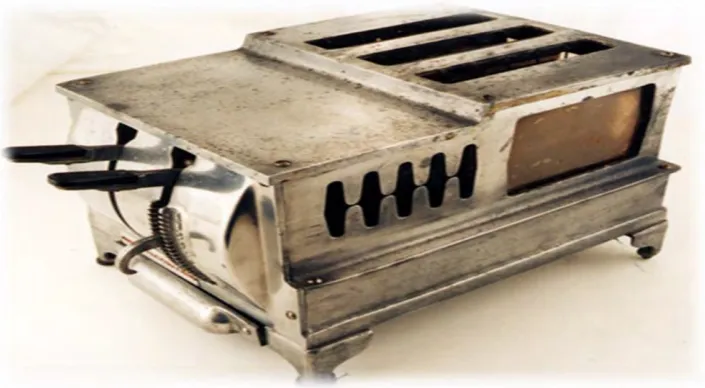
[image:24.595.160.513.344.538.2]Basically toaster used thermal insulation method in making a toast by exposing a bread with a radiant heat (Woodford, 2016). There are many type of a toaster nowadays, one of the famous toaster been used is “Pop up toaster” which had been invested in 1919 by Charles Strite. Nowadays after undergoes series of development “Pop up toaster” can works in three minutes by inserting the bread at the slots of the toaster and press the power cord. At the end as the bread is toasted the power cord will move upwards, thus stop the toasting process (Ament, 2007).
Figure 2.1: Toaster been used during 1920-1940