Rochester Institute of Technology
RIT Scholar Works
Theses Thesis/Dissertation Collections
2-13-2015
The Law of the Protection of Personal Data: A
Qualitative and Quantitative Analysis
Endrine Rafuna
Follow this and additional works at:http://scholarworks.rit.edu/theses
This Senior Project is brought to you for free and open access by the Thesis/Dissertation Collections at RIT Scholar Works. It has been accepted for inclusion in Theses by an authorized administrator of RIT Scholar Works. For more information, please [email protected]. Recommended Citation
Student: Endrine Rafuna
Supervisor: Brian Bowen
Adviser: Hasan Tahiri
Title: The Law on the Protection of Personal Data – A Qualitative and Quantitative Analysis
Date of Submission: February 2015
Keywords:
1) Personal Data
2) Privacy
3) Law on the Protection of Personal Data
4) National Agency for Personal Data Protection
5) Kosovo
6) Albania
1
2
The Law on the Protection of Personal Data – A Qualitative and
Quantitative Analysis
Honors Society Project
Presented to
The Academic Faculty
By
Endrine Rafuna
In Partial Fulfillment
of the Requirements for Membership in the
3
Acknowledgments
This study has been a great and challenging experience. I have learned a lot in an area that I had
not previously thought I would be interested in, but it turned out that I found it both interesting
and educative.
There were many challenges along the way and the main one was time. Time is what seems to be
lacking in everyone’s life, but for a student who is juggling classes, a part time job,
extracurricular activities, and a capstone project, it is especially valuable. I am thankful that I
proved myself to be a good time-manager and that I had the opportunity to finish the semester
and this project successfully, despite the final result of this course.
However, I would not have been able to complete this project without the help of other people.
At the end of the day, being on your own only gets you so far, and it is the other people in our
lives, the ones who offer their help, and the ones whose help you seek that make life easier and
better.
I would first and foremost like to thank my family for being supporting and encouraging in my
four years at AUK. They are the people who have sacrificed a lot so that I could be here,
completing this project as I have successfully completed the last three years. They have pushed
me to my limits and encouraged me to do my best even when I thought I couldn’t. I would like to
thank my friends and colleagues at AUK, with whom I consulted inside and outside classes, who
provided insight and advice on how to go about doing the study.
I would also like to thank Dr. Brian Bowen, for being a helpful guide throughout this course and
laying down the foundations of the studies that we all have done. He has provided us with the
tools and the advice to go through these projects and be able to finish them. I would also like to
thank Prof. Lorraina Pinnell with whom I consulted in the beginning for my proposal, but due to
busy schedules I could not further continue consulting with her. I would like to thank, Prof.
Vjosa Osmani who expressed her willingness to assist me in the legal interpretations, even if she
had a very busy schedule. However, I would express my deepest gratitude to Mr. Hasan Tahiri,
who consulted with me every step of the way, who was patient and willing to sacrifice his time
to guide me through any problems that I ran into.
4
Contents
Acknowledgments... 3
Executive Summary ... 5
Introduction ... 5
Problem Statement ... 6
Goals ... 6
Work Plan ... 7
Chapter 1 – A General Introduction to the Protection of Personal Data ... 7
Definitions... 8
Importance of Personal Data ... 10
History... 11
Chapter 2 – A Specific Background in the Law on the Protection of Personal Data in Kosovo .. 15
Contents of the Law ... 15
The Problems with the Law ... 17
Chapter 3 – Conducting the Investigation – Steps, strengths, and shortcomings ... 19
The Research Execution ... 20
Qualitative Research ... 20
Quantitative Research ... 21
The quality of the investigation ... 22
Strengths of the investigation... 22
Flaws of the investigation ... 22
Chapter 4 – The Results of the Study ... 23
Qualitative Results ... 23
Quantitative Results ... 26
Chapter 5/6 – Analysis and Discussion of Results ... 33
Qualitative Analysis Discussion ... 33
Quantitative Analysis Discussion ... 38
Conclusion and Recommendations ... 40
References: ... 42
5
Executive Summary
This study’s main topic is Kosovo’s Law on the Protection of Personal Data. It aims to
prove that the Law is incomplete and needs to add more articles regarding the protection of
digitalized computer data, and that the enforcing institution of this Law, so the National Agency
for Personal Data Protection has not been able to inform the citizens of Kosovo about it.
The study has tried to prove this by doing a comparative analysis of Kosovo and
Albania’s Law on the Protection of Personal Data to find out the differences and see if there are
any places that Kosovo can improve. It has also done a survey of a sample from the city of
Prishtina to find out how informed they are about this Law.
The results of the qualitative research, so the comparative analysis, were inconclusive
because they favored Kosovo. In this case Kosovo’s law is better than Albania’s; however,
Kosovo still needs to improve its law by adding the articles that guarantee the citizens the
protection of their digitalized computer data. The results of the quantitative research prove that
the citizens of Prishtina are not well informed about the Law on the Protection of Personal Data
or the institution responsible for implementing it.
This study has several recommendations starting from more in depth studies on the issue,
more comparisons of Kosovo’s law with other countries, a larger sample size and a more
comprehensive quantitative study, and a lot more engagement from the National Agency for
Personal Data Protection to improve and promote the Law on the Protection of Personal Data.
Introduction
In a world of increasing digitalization, where information is easily obtained and shared,
and individuals are constantly concerned about protecting their own data and making sure that
their privacy is not breached. Because of these concerns, policy makers try to understand the data
that needs protection and formulate policies that serve best to shield individuals from possible
privacy invasions. This project will try to study the main framework that protects the privacy of
Kosovar citizens by conducting a comparative study and a survey.
The main legal framework that serves as a protector of privacy in Kosovo is the Law on
6 the institution responsible for implementing and enforcing it is the National Agency for Personal
Data Protection.
Problem Statement
When the law was approved in 2010, it was more or less copied from the European
Union legal framework; however, with some major differences concerning the protection of
personal data in terms of electronic communication. This means that even though Kosovo’s law
specifies what personal data is, it does not necessarily protect against the breach of privacy that
can come from computer technology. This is the first problem with the law.
The second problem stems from the citizens’ ignorance regarding this law. The National
Agency for Personal Data Protection is an independent institution which is also responsible for
informing citizens of the rights that this law gives them, and they have not been doing a good
job.
This study aims to show that Kosovo’s law is lacking the proper articles on the protection
of privacy from computer technology and that the citizens of Kosovo are not well informed on
this law. Based on this, there are two hypotheses:
Hypothesis 1: The Law on the Protection of Personal Data is not comprehensive enough to
protect its citizens from all forms of privacy breaching
Hypothesis 2: The citizens of Prishtina are not well informed on this Law
This research project will try to prove the two hypotheses by comparing Kosovo’s Law
on the Protection of Personal Data with the same law in Albania to see whether Kosovo’s law
needs improvements and to qualitatively asses it.
Moreover, a survey will also be done with a random sample of the population of Prishtina
to find out whether they are informed enough about this law. The reason why the survey will
only be done for Prishtina is that the project is short in duration and does not allow for such in
depth studies.
Goals
7 - To find out the extent to which the general population of Kosovo is informed about their
rights when it comes to privacy protection
- To come to a conclusion on how Kosovo can improve the law by making a comparative
study
Work Plan
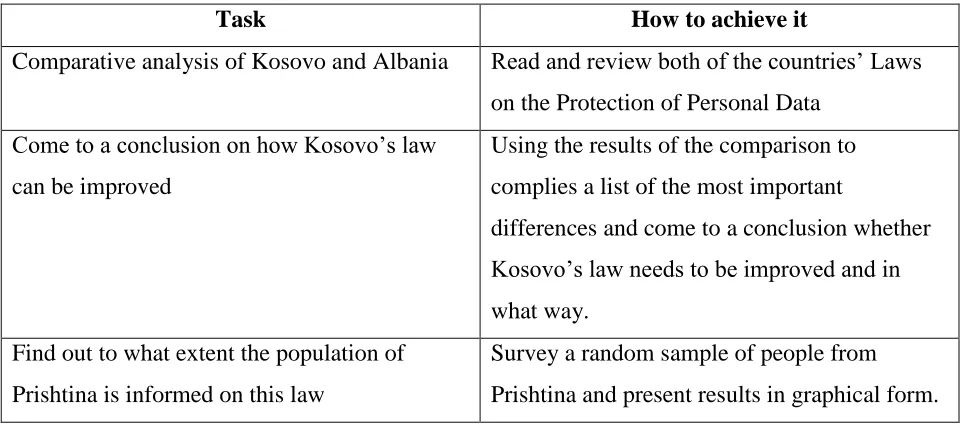
To better achieve the goals of this project, a work plan was compiled. The work plan
[image:9.612.66.552.268.482.2]constitutes of these tasks:
Table 1: Work Plan
Task How to achieve it
Comparative analysis of Kosovo and Albania Read and review both of the countries’ Laws
on the Protection of Personal Data
Come to a conclusion on how Kosovo’s law
can be improved
Using the results of the comparison to
complies a list of the most important
differences and come to a conclusion whether
Kosovo’s law needs to be improved and in
what way.
Find out to what extent the population of
Prishtina is informed on this law
Survey a random sample of people from
Prishtina and present results in graphical form.
In the following chapters, the background of the problem will be presented, then the
methodology, the results, the discussion, and the final conclusions and recommendations.
Chapter 1 – A General Introduction to the Protection of Personal Data
The first chapter will provide a general background on the issues of privacy and the
protection of personal data from a worldwide perspective. In the following pages of the chapter
8
Definitions
The concept of privacy has been present for a long time and its definition constantly
evolves with the invention of new computer technology. One of the earliest definitions given by
Warren and Brandeis (1890) where they cite Judge Cooley is the right “to be let alone”. Their paper “The Right to Privacy” explores the changes in the dynamics of life from the time when
people only needed to be protected from physical beatings, and freedom only meant to not be
restrained, to a time when people also need to be protected from the spreading of their personal
information (Warren and Brandeis, 1890). They state that with a rise in the complexity of life,
people have more need to be alone with their own thoughts, and the publishing of their private
information causes them emotional and mental distress, greater than the pain of physical injury
(Warren and Brandeis, 1890).
Prosser (1960) in his paper “Privacy” explains that the American common law has
defined four actions which violate privacy. These four actions are:
1. Intrusion upon the plaintiff's seclusion or solitude, or into his private affairs
2. Public disclosure of embarrassing private facts about the plaintiff
3. Publicity which places the plaintiff in a false light in the public eye
4. Appropriation, for the defendant's advantage, of the plaintiff's name or likeness
The most difficult to explain would be the first one. McFarland (2012) has commented
that in this first category “Intrusion” would mean the unwanted physical presence of someone,
excessive phone calls and unauthorized observation such as filming someone in their own home.
The other categories are more concerned with information, whether it is true or false. Another
narrower definition of privacy would be “informational privacy” which Moor (1989) has
explained as “the right to control of access to personal information”, which basically protects
digitalized information.
To summarize all of these definitions, privacy could be defined as the right to protect
who you are, what you do, what you think, and what you believe. All in all, privacy means the
protection of your personal data.
However, personal data could be interpreted in a variety of ways. At first impression,
9 The Council of Europe in the 1981 Convention for the Protection of Individuals with
regard to Automatic Processing of Personal Data defines it in Article 2a as:
“any information relating to an identified or identifiable natural person (‘data subject’);
an identifiable person is one who can be identified, directly or indirectly, in particular by
reference to an identification number or to one or more factors specific to his physical,
physiological, mental, economic, cultural or social identity” (Convention for the
Protection of Individuals with regard to Automatic Processing of Personal Data, 1981).
This definition is supplemented by Recital 26 of the Directive, which says:
“Whereas the principles of protection must apply to any information concerning an
identified or identifiable person; whereas, to determine whether a person is identifiable,
account should be taken of all the means likely reasonably to be used either by the
controller or by any other person to identify the said person; whereas the principles of
protection shall not apply to data rendered anonymous in such a way that the data subject
is no longer identifiable ...” (Directive 95/46/EC, 1995).
These definitions could be better understood if an example is provided. For example, if
someone is conducting a random survey, and after collecting the data, if they can identify any of
the people in their sample by their survey responses, then that is considered a violation to the
respondent’s personal data. However, this definition is quite broad, but categories of data that are
personal are:
a) The race or ethnic origin of the person
b) Religious beliefs and similar other beliefs
c) Their political opinions
d) The person’s sexuality
e) Their mental and physical health or any condition relating to them
f) Any information relating to their legal status and whether they have previously
committed a crime
g) Their economic status (salary, wealth, and any other income)
10 A breach of privacy or a misuse of personal data would be if someone dispersed this
information without the consent of the person. An example would be if a professor told the
whole class what another student’s GPA is without this students’ consent or an employer telling
his other employees what the salary of someone else is. As can be seen a misuse of personal data
can more often be done by people who are in official positions. People’s gossip of what
someone’s GPA or salary is can be a breach of privacy, but one can hardly take legal measures
towards this. However, when this happens in the workplace, in school and so on, legal measures
can be taken.
Importance of Personal Data
In an age where many markets operate on personal data, its importance cannot be stressed
enough. Many companies put high monetary values on personal data and have invested in
advanced software that assists them in collecting and storing it (Schwartz, 2004). Through
personal data, companies can dive into the preferences of their consumers, using it to customize
and advertise their products. Websites use the information on our computers, be it our search
history or the information we willingly enter into them, to tailor our web experience with ads of
products that we would potentially be interested in. Moreover, companies not only use personal
data to develop their internal marketing strategies, but also sell it to third parties for high
monetary benefits (Samuelson, 2000).
There are different points of view as to whether people should be given more privacy
when it comes to their personal data or not, especially online. Proponents of more privacy give
the argument that the companies that benefit from this personal data are only taking the benefits,
while the losses are borne by the person whose personal data has been used or sold without them
having any knowledge of it, so they cannot take any legal measures to correct the wrong done to
them (Samuelson, 2000). This argument therefore states that the companies internalize the gains,
while externalizing the losses, which is seen as an unfair market failure. A proposed solution to
this market failure is making personal data into intellectual property and allowing individuals to
sell it, so as to gain some of the benefits that their personal data provides (Samuelson, 2000).
This is seen as a far better measure than the legal restrictions that countries set when it comes to
personal data, especially the very restrictive laws and documents of Europe, which will be
11 Opposing the people who want more privacy, the groups against it argue that having
access to information or data, whether it is personal or not, creates a more equal environment in
which not only the powerful have that sort of information, but it is available to everyone. They
consider the laws and the attempts to stop companies from collecting and publishing personal
information as censorship and as a barrier to having more efficient markets.
Having presented an argument from both points of view, no conclusion can be made
whether one is right and the other is wrong. There is a grey area, and that is finding a balance
between having too much and too little information about someone.
History
Since the project will be based on comparing the Law on the Protection of Personal Data
of Kosovo with Albania, both countries in Europe, the history of the legal documents will focus
on Europe only.
The governing body of European countries that sets the legal frameworks is the European
Union, which has a variety of documents that define the rights and limits to the access of
personal data. The member countries of the EU have to follow the rules that these documents set
for them, and apply them to their own legislation. The concern for privacy and the disclosure of
personal data began in the 1960s and since then countries of the world have implemented
legislation and policy in order to give their citizens privacy when it comes to their personal
information (Evans, 1981). The first country in Europe to implement a law on the protection of
personal data was Sweden. In 1973, Sweden passed the Data Protection Act which made opening
up “personal data registers” illegal (Evans, 1981). They also created the Data Protection Board,
which would make sure that the abovementioned Act was respected. Other countries followed
the example of Sweden and in 1978, Germany, France, Denmark, Norway, and Austria, and in
1979 Luxemburg, all had some sort of legislation that protected their citizens’ privacy (Evans,
1981).
On a continental basis, the European Council was the first to discuss the issue of privacy
12 The Charter of Fundamental Rights of the European Union of 2010 together with the
Convention for the Protection of Human Rights and Fundamental Freedoms of 1950, cite the
right for the protection of personal data in Article 8. This Article says:
“1. Everyone has the right to the protection of personal data concerning him or her.
2. Such data must be processed fairly for specified purposes and on the basis of the
consent of the person concerned or some other legitimate basis laid down by law.
Everyone has the right of access to data which has been collected concerning him or her,
and the right to have it rectified.
3. Compliance with these rules shall be subject to control by an independent authority.”
(European Commission, 2010)
This article basically says that every single individual has personal data that belongs only
to them, and if they disclose this information to some person or institution, they have the right to
take it back and regain access to it. However, in the debate of the European Assembly in 1968,
Article 8 was seen as incomplete because it only applied to the public sector and most data banks
that collected personal data of individuals were private. This led to the passing of
Recommendation 73/22 in 1973, which restricted private firms from obtaining personal
information from individuals without their permission.
Recommendation 73/22 was seen as the first step towards a complete set of rules for the
protection of personal data, but it needed to be more advanced. Therefore, in 1981 the
Convention for the Protection of Individuals with regard to Automatic Processing of Personal
Data was passed and its main rules were:
a) the quality of personal data which should be processed lawfully, stored to be used
for legitimate purposes, to be relevant, accurate, and not excessive;
b) the security of the data which should be protected against loss or destruction, be it
accidental or not, and for no country to give more measures of protection than
13 c) the data flow in between countries, which states that if another country requires
personal data from another, they should submit a request and use the provided
information only for the purposes needed and for no other illegitimate use.
d) the creation of a committee with a representative person of each country to
enforce this convention (The Convention for the Protection of Individuals, 1981)
Moreover, the protection of personal data is so important to the European Union that it is
also mentioned in the different treaties that are done between member countries. One of the most
important treaties is The Treaty on European Union or the Maastricht Treaty, in which Article 16
says:
“Everyone has the right to the protection of personal data concerning them.
The European Parliament and the Council, acting in accordance with the ordinary
legislative procedure, shall lay down the rules relating to the protection of individuals
with regard to the processing of personal data by Union institutions, bodies, offices and
agencies, and by the Member States when carrying out activities which fall within the
scope of Union law, and the rules relating to the free movement of such data. Compliance
with these rules shall be subject to the control of independent authorities” (Treaty on
European Union, 1993)
Concluding the documents with which the European Union regulates the collection,
usage, and disclosure of personal data, the infographic below summarizes the above mentioned
events (Figure 1.1).
In conclusion to the chapter, the definitions of both privacy and personal data have been
provided and the arguments of both pro and against more privacy have been presented because
personal data in our contemporary age is of great importance and monetary value. Moreover, a
brief historical evolution of documents drafted by the governing body of Europe, the European
15
Chapter 2 – A Specific Background in the Law on the Protection of
Personal Data in Kosovo
Kosovo is still a fairly new independent country in Europe. With its independence
declared only 6 years ago, it has a long way to go to get developed and be accomplished
economically and politically. Besides the difficult economic times and the current political crisis
that Kosovo has found itself in, the justice system is also highly underdeveloped. Kosovo’s laws
are considered to be quite good; however, their implementation and enforcement has proven to
be quite difficult due to corruption. Because the Justice System and the Assembly of Kosovo
have had to do a lot of work in creating a functional court system and other laws, the Law on the
Protection of Personal Data is rather new and has lagged behind on updates.
Contents of the Law
The Law on the Protection of Personal Data, hereby referred to as “the Law”, is a 44 page
document that has been approved by the Assembly 5 years ago, on April 29th, 2010. It was
signed by the former President of the Assembly of Kosovo, Jakup Krasniqi. It contains 8
chapters and 96 articles, which serve as a guideline to protect the privacy and personal
information of the citizens of Kosovo (The Law on the Protection of Personal Data, 2010).
Chapter 1 is on General Provisions. It contains the purpose of the law, different
definitions, the principles of processing the personal data (hereby referred to as “data”), and the
scope of the law. The purpose of the law is to determine the responsibilities, principles, and
rights when it comes to the protection of personal data, and also creating an institution which
will monitor and enforce it. The next few paragraphs will contain several important definitions
and a brief summary of each chapter of the law.
Personal data is defined as:
“any information relating to an identified or identifiable natural person (data subject); an
identifiable person is one who can be identified, directly or indirectly, in particular by
reference to an identification number or to one or more factors specific to his or her
physical, physiological, mental, economic, cultural or social identity” (The Law on the
16 What can be seen from this definition is that it is the same definition that the European
Union uses in its Convention, therefore, it can be said that Kosovo has tried to adapt to the EU
document and their requirements for a well-written law. In fact, Kosovo has not only adapted to
the law, but it has more or less copied it leaving aside some articles.
The phrase “Processing of personal data” means any operation performed on the personal
data, whether it is collecting, organizing, storing, recording or retrieving it. “Automated data
processing” means processing personal data using technology. Any person who has the power to determine the purpose and the means of processing personal data is called a “Data controller”, while the person who actually processes the data is called a “Data processor”. And finally, any person who discloses their data is a “Data recipient” (The Law on the Protection of Personal
Data, 2010).
Chapter 2 is called “Legitimacy of Data Processing” and it mainly elaborates on the
circumstances when personal and sensitive data can be processed; how to go about the collection
of personal data for scientific reasons such as for example surveys; the security of the data
processing; and the filing and registering of the data (The Law on the Protection of Personal
Data, 2010).
Chapter 3 is “The Rights of the Data Subject” and it explains the rights of and the
processes to retrieve, modify, correct, supplement or even delete the data, and any exemptions or
restrictions. This can only be done by the person whose data is stored in the files (The Law on
the Protection of Personal Data, 2010).
Chapter 4 is “The Institutional Protection of Personal Data” which talks about the
institution legally responsible for implementing and enforcing the law, which is the National
Agency for Personal Data Protection, hereby referred to as the Agency; its structure, tasks and
the overall processes it has to complete (The Law on the Protection of Personal Data, 2010). Its
mission is counseling public and private institutions, accepting and solving complaints,
inspections and controls, informing the public, and promoting and supporting the basic right to
17 Chapter 5 is the “Transfer of Personal Data” which gives the rules on how to go about
transferring personal data outside of Kosovo and the general procedures needed to complete that
process (The Law on the Protection of Personal Data, 2010).
Chapter 6 elaborates on the “Rights and Supervision” which is concerned about the
enforcement of the law. It gives the directions on how the employees of the Agency should go
about doing inspections on institutions and businesses to see whether they are respecting and
following the law. It mostly deals with recording, video surveillance and the general rules for
institutions, businesses and public/private owners who set them up (The Law on the Protection of
Personal Data, 2010).
Chapter 7 deals with “Penal Provisions” which means the fines and legal consequences of
individuals, businesses and institutions who fail to act in accordance with this law. Finally,
Chapter 8 deals with the conclusions of the law (The Law on the Protection of Personal Data,
2010)
The Problems with the Law
Having briefly summarized the content of the law, its quality can be briefly discussed.
The written law has some good points; however, it lacks in others. Particularly, it lacks in the
areas of protecting digitalized data, or computer stored data. As we are all aware, computer
technology is constantly advancing and the ways in which someone can access someone else’s
personal data through their computer are also moving forward. However, the law does not have
references to digitalized data and any legal consequences to anyone who accesses digital
personal data without permission.
Moreover, the Agency is also heavily criticized when it comes to the quality of the law
and also to the way they enforce it. The Agency is supposed to be an independent institution,
which amongst others, means that it is not politically influenced. However, activist organizations
who try to get the government to be more transparent have been blocked by the Agency, which
always uses the Law on the Protection of Personal Data to refuse access to documents which
according to public opinion should be public. A case where this has happened, is when in 2012,
the Balkan Investigative Reporting Network (BIRN), which is non-governmental organization, in
18 International Law and Policy Group (PILPG) filed a request for government expenses when the
Prime Minister and the Vice Prime Minister are travelling, to be made public (A.G, personal
communication, 2014). The Kosovar Ombudsperson, Sami Kurteshi, cooperated with these
organizations and also consulted with the National Agency for the Protection of Personal Data so
they could decide whether accessing these government expenses was in violation of the Law on
the Protection of Personal Data (Opinion on Receipts, 2012). The Agency decided that because
the expenses contained restaurant receipts which could indicate the health and religious beliefs of
high officials, they are therefore said to be personal data and cannot be accessed without their
consent (Opinion on Receipts, 2012). The public and the organizations that lobbied for more
transparency saw the act of the Agency as politically influenced, and as a failure of the Agency
to be an independent institution (A.G, personal communication, 2014)
In an interview with Mr. A.G, legal specialist in Public International Law and Policy
Group (PILPG), he stated that the quality of the law is in accordance with EU standards;
however, the challenge is “for Kosovo institutions to find the balance between the public’s right
to access government documents and the right to privacy and protection of personal data” and for
the Agency to be objective and not politically influenced (A.G, personal communication, 2014).
On the enforcement of this law, Mr. A.G thinks that when it comes to the protection of public
person’s personal data, the law is implemented quite well; however, there are problems when it comes to official person’s data. He thinks that often the Law on the Protection of Personal Data
is misused to declare data that is supposed to be public by the constitution, as private (A.G,
personal communication, 2014).
Another case which has been a source of public discussion was on the topic of phone
companies and carriers that take their client’s personal information when they purchase a SIM
card (phone number) and then disclose this information to companies so they can do marketing.
In 2012, the Agency released documents where they ordered the phone companies to destroy any
copies that they have of the personal information of their clients after verification (Documents of
Decisions, 2012). This was a great decision; however, the Agency failed to follow up on its
decision and the phenomena of phone companies misusing personal information continues.
Criticism is also directed at the Agency when it comes to the extent the public is
19 has been done to give the public at least a general idea on the law that protects their personal
information. In their annual reports, the Agency reports to have printed brochures, organized
conferences, and workshops (Annual Report, 2011); however, the general population still has no
knowledge that it is illegal for their landlord to put cameras in the building without the consent
of 70% of the people living there, or that receiving unwanted and unconsented text messages
from retail shops that advertise their products is against the law (The Law on the Protection of
Personal Data, 2010).
By not properly informing people on their rights, the Agency is failing to accomplish
another part of its mission, which is to inform people and promote the rule of the law they are
appointed to enforce. According to Mr. A.G, citizens of Kosovo are not informed enough about
the Law on the Protection of Personal Data, and the Agency needs to heavily promote it through
TV ads and public debates. He also mentions that not only is the general public not aware of the
law, but officials are not informed enough too. He states that they are misinformed and claim that
information is private, when in fact it is public by law (A.G, personal communication, 2014).
In conclusion, Kosovo’s Law on the Protection of Personal Data is quite well written;
however, problems come up on the fact that it has not been updated to include digital means of
breaching privacy; that the Agency is not doing a good job in remaining impartial to political
influences and is not enforcing the law well. In the following chapters, the results of the
comparison of laws from Kosovo and Albania will be presented together with the survey results
on how informed the population of Prishtina is on the law.
Chapter 3 – Conducting the Investigation – Steps, strengths, and
shortcomings
In the years since it was declared independent, Kosovo has worked on improving its legal
framework, the laws that it has, and their enforcement. At the moment, Kosovo has 220
approved laws (Assembly of Kosovo, 2014) and this project deals with the law that protects
privacy. This law, approved in 2010 is called The Law on the Protection of Personal Data. The
institution responsible for enforcing it is the National Agency for Personal Data Protection, in
20 It was initially hypothesized that the law was poorly written, but after consulting with
technical advisers, it was found out that the law is well written. However, there are three
problems with it. The first problem is that it is lacking in the section of the protection of
digitalized information, meaning that more work needs to be done to ensure that people’s
computer data is protected. The second problem is its enforcement by the National Agency,
where according to various legal experts there is bias towards government officials. The third
problem is the lack of information that the general Kosovar population has on this law.
Taking into account the short time span to complete the project, it is focused on
documenting and trying to come up with solutions for only two of the problems, mainly with the
first and third one. For the first problem, it was decided to conduct a comparative research
method, so comparing Kosovo’s law with another country. For better comparisons and
approximations on the economic development, it was decided to compare Kosovo with Albania.
As for the third problem, it was decided to conduct a survey with a random sample from the
population of Prishtina and find out how informed they are on their rights.
In this chapter, the methods by which the research was conducted will be explained.
Moreover, details on the quality of the investigation will be provided together with its strengths
and shortcomings, and any issues that came forth during the investigation. The next chapter will
also provide the results of the investigation.
The Research Execution
In order to have a thorough investigation on the project, it was divided into two parts. The
first part was the qualitative research, and the second was the quantitative research. The
qualitative research deals with the comparative analysis of the laws of the two countries, while
the quantitative research was done through the survey. In the next few paragraphs, details of the
steps taken for the research will be presented.
Qualitative Research
The qualitative research required detailed and thorough reading of the two laws of each
country, so Kosovo and Albania. To have a much better sense of their differences, the laws were
21 The comparisons were divided into sections, each section concerning the different parts
of the laws, such as definitions, transferring of personal data and so on.
Moreover, to strengthen the understanding of this law, besides consulting with the
technical advisers, an expert roundtable organized by the Justice and the People Campaign on the
transparency of the law was attended, where Ruzhdi Jashari, the main supervisor of the National
Agency for Personal Data Protection participated. His speech was helpful in getting a more
specific understanding of what the Agency does and how citizens can direct their complaints to
it.
Quantitative Research
The quantitative research was done through a survey of 150 people from Prishtina. The
survey was designed in Albanian in cooperation with one of the technical advisers, and contained
8 questions. It was stratified with gender, age, education, and employment. After getting this
basic information, it asked about whether the person was aware that the Law on the Protection of
Personal Data existed, whether they knew that the National Agency existed, and if they had ever
gotten any informative brochures from the Agency, informing them on the law. For the purpose
of the project, the survey was also translated in English, and for the full preview of what it
looked like and the questions it had, please refer to Appendix 1.
The survey was conducted in a time period of 8 weeks, so from week 6 of the semester,
up to week 13. During this period, random people in the streets of Prishtina were stopped and
asked to fill out the survey. The main part where people were selected was the Mother Theresa
Square because of the influx of people and their diversity (people of different genders, ages,
education backgrounds walk through there). The main days that the surveys were conducted
were the weekends, usually Saturdays.
Besides the physical surveys that were done, some online surveys were conducted too.
The survey was posted in various social media sites and random people answered. I received 46
online responses, out of the total 150.
After both research methods were completed, summaries of both the qualitative and the
22
The quality of the investigation
Research projects will never be perfect. Even if they are big budget, long-time projects,
they will always have flaws and shortcomings, whether it is a failure to prove hypothesis, sample
problems, or others. As with all the other projects, mine too has its strengths and flaws, which
will be listed and discussed in the next paragraphs.
Strengths of the investigation
Taking into account the research and the adviser’s opinion, this is the first study that
concerns the Law on the Protection of Personal Data. Because of that, this might set a precedent
for other deeper studies, especially the quantitative surveys, which can measure the level of
awareness of the population of not only Prishtina, but the whole of Kosovo, and come up with
more solutions. On the qualitative analysis, the study is also a way of discovering whether
Kosovo’s law has advantages or disadvantages with other regional countries.
Flaws of the investigation
The project has some flaws too. One of the most obvious is the time span of the project,
with which all the other problems are connected. If the project time period were to be longer,
there would have been more time to go through the laws more thoroughly, and even include
more countries, such as the USA. There would have also been more time to conduct more
surveys, which would make the sample larger, hence more representative than it is now. With
only 150 surveys, and with the population of Prishtina being 207,477 people (Kosovo Agency of
Statistics, 2014), the sample is smaller than what it would have been if more surveys were
conducted with more time.
In addition, the online survey might have introduced some bias into the survey results
because a specific demographic of people answered it, mostly young people who have social
media accounts.
Moreover, the only time that the surveys could be conducted was during the weekends,
Saturdays more exactly. This leaves space to contemplate whether survey results would have
maybe been different if it were conducted in another day of the week or continuously during
23 The survey might be deemed as being short, with only 8 questions; however, it was better
to make it short and understandable in order to avoid the problem of people not wanting to
answer it because of its length.
Nevertheless, the study is qualitative enough for its short time span and the fact that the
project author was attending classes and working at the same time.
In conclusion, this chapter contained the basic methodology of the study for both the
quantitative and qualitative analysis. The steps of the study were described, as well as its quality,
including its strengths and flaws.
Chapter 4 – The Results of the Study
After describing the methodology in the last chapter, this chapter will show the results of
the overall study. Because the investigation was done in two parts, the chapter will also be
divided into two parts, the qualitative and the quantitative results.
Qualitative Results
The qualitative results are comprised of the comparative analysis between Kosovo and
Albania’s laws on the protection of personal data. Albania’s Law on the Protection of Personal
Data was approved in 2008 by the Assembly of Albania. It has 16 pages, with 10 chapters and 45
Articles, and was signed by Albanian Deputy Fatos Beja. The following list will have the main
differences between Albania’s Law and Kosovo’s Law.
1. Length – Kosovo’s Law is noticeably longer than Albania’s, with 44 and 16 pages
respectively. So Kosovo’s Law is double in length.
2. Responsible institutions – Kosovo has an established independent institution called the
National Agency for Personal Data Protection that is in charge of monitoring and
enforcing the rule of the Law on the Protection of Personal Data, while Albania does not
have a responsible institution. The Albanian Assembly elects the Commissioner who is a
person responsible for the enforcement and lawful application of the Law on the
Protection of Personal Data, but does not belong to a specific institution with this duty.
Kosovo has a Chief National Supervisor and four other National Supervisors that make
24 3. Kosovo’s definition of terms are more specific, as they are directly taken from the EU’s
law on the protection of personal data, while Albania has tailored their definitions to their
own needs, therefore they are simpler. An example is both countries’ definitions of
personal data.
a. Kosovo’s definition: Personal data - any information relating to an identified or
identifiable natural person (data subject); an identifiable person is one who can be
identified, directly or indirectly, in particular by reference to an identification
number or to one or more factors specific to his or her physical, physiological,
mental, economic, cultural or social identity;
b. Albania’s definition: “Personal Data” shall mean any information relating to an
identified or identifiable natural person. Elements used to identify a person
directly or indirectly are identity numbers or other factors specific to his physical,
psychological, economic, social and cultural identity etc.
4. In their definitions, Albania does not mention biometric characteristics as being
considered personal data, while Kosovo does. That is important in terms of properly
defining what is included in personal data and what is not.
5. In the scope of the laws, Kosovo specifically cites that the law holds for both public and
private bodies, while Albania does not define the scope of its law.
6. Albania’s Article 5d states “Protection of personal data is based on keeping data in a
form that allows the identification of data subjects for no longer than it is necessary for
the purpose for which they were collected or further processed”. Kosovo does not have
this article which would assist in solving the problems with telecom companies which
keep their customer’s personal data and can wrongfully use it. After the misuses were
documented (telecom companies distributed personal data for advertising purposes), the
National Agency for Personal Data Protection had to release a regulation which
prohibited them from doing this.
7. When it comes to the transfer of personal data, Kosovo has a list of countries and
international organizations which have been evaluated and deemed as fit to receive
transfer of personal data whenever it is seen as necessary, without further procedures.
25 receive the data. Albania does not have this list, therefore any foreign entity that requests
personal data from Albania has to undergo the same procedures to be approved.
8. Both laws allow the disclosure of personal data for scientific or research purposes, but
Kosovo specifically cites that the data is to be destroyed immediately after being
processed and that the National Agency has to be informed of how and when the
destruction of the data was done, while Albania only requires anonymity and does not say
what the person has to do with the data after their research project is completed.
9. If a person requests their own personal data and any details related to its processing,
based on the Kosovo law, the responsible person from the National Agency for Personal
Data Protection has to respond by approving or denying the request within 15 days, while
in Albania this is to be done in 30 days. This difference is due to the fact that Kosovo has
an institution responsible only for this Law, while Albania doesn’t, therefore processing
times are longer.
10.Kosovo’s law has specific articles that set the rules for institutions who want to use
personal data on direct marketing; for institutions or people who want to put up video
surveillance to monitor business premises and apartment buildings; rules for the usage of
biometric characteristics, and rules for recording entrances or exits of premises. Albania
lacks all of these articles that set these rules on paper.
11.Albania’s law only includes fines and penalties for administrative offences, so only for
when the people who are working for the Commissioner violate any of the laws. Kosovo
on the other hand has a wide range of penal provisions which cite the punishments in
fines (Euros) for general violations of the law, violations of contractual processing,
violations of the security of the data, violations for the usage of personal data for direct
marketing, violations for video surveillance in public and private institutions and areas
(business premises, work areas, apartment buildings), and violations on the usage of
biometric characteristics in both the public and private sector.
Based on these differences, a conclusion can be made that Kosovo’s Law on the Protection of Personal Data is better written and more specific than Albania’s Law on the Protection of
26
Quantitative Results
The quantitative study was done through the survey. In the following pages, the visual
representation of each survey question and answer will be done, as well as explanations.
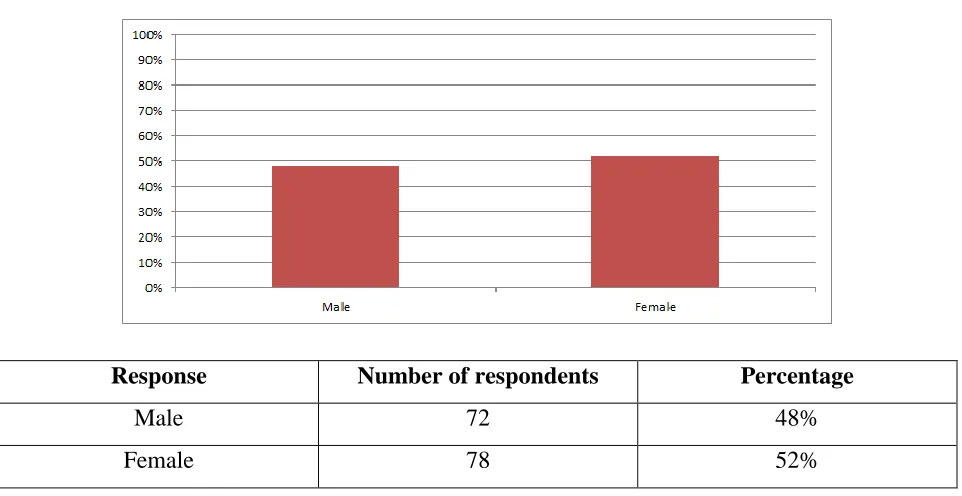
The first question of the survey was asking about the respondent’s gender. This is what
[image:28.612.67.548.218.466.2]150 people answered.
Figure 4.1 – Survey Question 1: What is your gender?
Response Number of respondents Percentage
Male 72 48%
Female 78 52%
Out of the 150 people, 78 respondents were female and 72 were male, making the
percentages 52% and 48% respectively. There is a gender balance with a slight female majority,
but the answers were random and were not sought out.
27
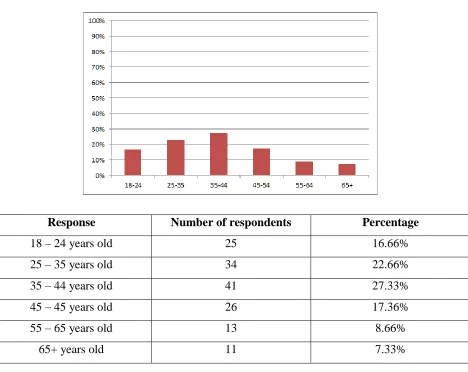
Figure 4.2 – Survey Question 2: What is your age?
Response Number of respondents Percentage
18 – 24 years old 25 16.66%
25 – 35 years old 34 22.66%
35 – 44 years old 41 27.33%
45 – 45 years old 26 17.36%
55 – 65 years old 13 8.66%
65+ years old 11 7.33%
The survey results for this question were fairly balanced. There is a higher number of 25
to 44 year olds, which is expected because the majority of our population is of that age. The
distribution looks quite normal too, therefore, it is safe to say that the sample was not too biased.
28
Figure 4.3 – Survey Question 3: What is the highest level of education you have?
The responses were quite expected. There is a small number of people with only
elementary school as their highest education, which is probably the people who are aged 65+. A
considerable number have only high school as their highest education and a much larger number
are students. This can be because of the location where the surveys were done was close to the
University of Prishtina and the area is quite frequented by students as well as people who work,
which can explain the next answers, so the higher education responses. There are 32 people with
Bachelor’s Degrees, 15 with a Master’s Degree and 3 with a PhD. This is quite normal because
as it was said above, the location might have been such that people with higher education would
be there for work or other activities. Moreover, the Mother Theresa Square has some more
expensive bars and restaurants which can be frequented by people with a higher income, and
these are the people who have higher education, therefore the responses are justified.
29
Figure 4.4 – Survey Question 4: Are you employed?
Response Number of respondents Percentage
Yes 94 62.67%
No 56 37.33%
Out of the 150 people that responded to the survey, 94 are employed and 56 aren’t. The
responses seem normal as a degree of unemployment is to be expected in Kosovo, and especially
amongst the university students and the retirees.
The fifth question asks whether the respondent is aware that the Law on the Protection of
Personal Data exists.
[image:31.612.169.444.541.712.2]30
Response Number of respondents Percentage
Yes 83 55.34%
No 67 44.66%
The responses to this question were surprising as the guess would have been that more
people are not aware of the law rather than the fact that they are. So from the 150 people in the
sample, 83 were aware that the law existed, and 67 were not. Considering the percentages, the
awareness is quite even.
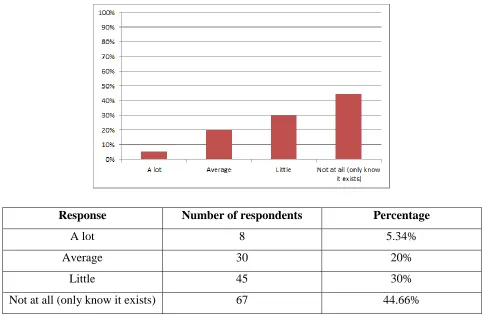
The sixth question asked that if the person had said that they are aware of the Law on the
[image:32.612.64.546.337.653.2]Protection of Personal Data, to what extent they were informed on this law.
Figure 4.6 – Survey Question 6: If yes, how much are you informed about the law?
Response Number of respondents Percentage
A lot 8 5.34%
Average 30 20%
Little 45 30%
Not at all (only know it exists) 67 44.66%
This question was difficult to define and was left entirely up to the respondent, so it may
31 the respondent was an expert on this law, therefore those who chose that option were either law
students, or legal employees of some sort. From the responses, only 8 people chose this answer.
An average knowledge of this law meant that the respondent had read the law, understood the
underlying premises and concepts, knew what the National Agency was, and was generally more
informed. Little knowledge of the law meant that the respondent knew the law existed and had
some basic knowledge on it. The last response, which is “Not at all”, means that the respondent
either had no idea that the law existed, or only has ever heard its name mentioned, but does not
know what the law is about. The responses show that people generally do not even have a very
basic knowledge on the law.
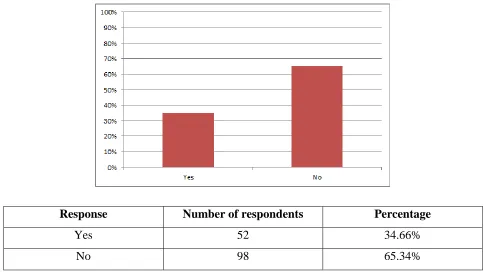
Question seven asked if the respondents had ever heard of the National Agency for
[image:33.612.63.547.366.645.2]Personal Data Protection.
Figure 4.7 – Survey Question 7: Have you ever heard of the National Agency for Personal Data
Protection?
Response Number of respondents Percentage
Yes 52 34.66%
No 98 65.34%
The responses for this question were more negative than positive. 98 people out of the
32 people were probably the ones who had little to no knowledge of the Law on the Protection of
Personal Data.
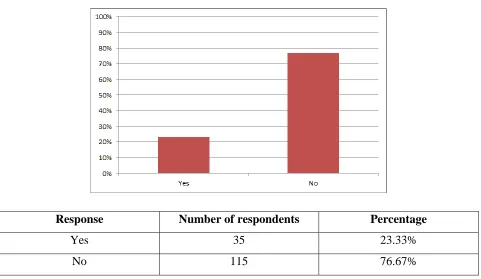
The eighth and last question asks whether the respondent has ever received any
[image:34.612.67.548.216.495.2]informative material about the Law on the Protection of Personal Data.
Figure 4.8 – Survey Question 8: Have you ever received any informative material about the Law on the
Protection of Personal Data?
Response Number of respondents Percentage
Yes 35 23.33%
No 115 76.67%
This question received the most negative responses. Out of the 150 people in the sample,
only 35 had ever received any informative material about the Law on the Protection of Personal
Data. The rest had never seen any promotional or informational brochures, pamphlets, posters,
and so on. This was not surprising and completely expected.
Based on the survey responses, it is safe to say that there is a fair amount of people who
are informed about the law, but the majority is not, therefore, the Agency needs to do a better job
33 In conclusion, the chapter summarized the results of the research. The research was
divided into its qualitative and quantitative data. The qualitative research focused on the
comparative analysis between Kosovo and Albania’s Laws on the Protection of Personal Data,
and included the main differences between them. It was concluded that Kosovo’s law is better
than Albania’s. The quantitative analysis focused on the survey results that were done throughout
the semester on the extent that citizens of Prishtina are informed about the Law on the Protection
of Personal Data. The results showed that many people were aware that the law existed, but a
very small number had any knowledge on what it was about and very few received any
informative material on it.
Chapter 5/6 – Analysis and Discussion of Results
The results that were presented above cannot stand alone without some interpretation,
analysis, and some discussion. Graphs and numbers alone can tell a story, but it won’t be
complete without some words to direct the reader to where they should be looking. Because of
this, the next pages will contain an analysis and a discussion of the results. Following the
structure of Chapter 4, this chapter will also be divided into the qualitative and the quantitative
analysis.
Qualitative Analysis Discussion
The qualitative analysis was concerned with the comparative analysis of the Laws on the
Protection of Personal Data for both Kosovo and Albania. The results were very clear and
indicated that Kosovo’s law was a lot more thorough and well written, whereas Albania’s was
too short and not well defined.
Initially, the first hypothesis for this study was:
Hypothesis: The Law on the Protection of Personal Data is not comprehensive enough to protect
its citizens from all forms of privacy breaching.
The study tried to prove this through the comparative analysis, but the law of Albania
34 Albania’s Article 5d states “Protection of personal data is based on keeping data in a
form that allows the identification of data subjects for no longer than it is necessary for
the purpose for which they were collected or further processed”
Kosovo does not have this article which explicitly states that data should not be held for
longer than necessary. This was what initially may have caused the problems with the telecom
companies keeping personal data longer and distributing them to retailers for marketing
purposes. However, flaws are also present in that article because one can argue about the
definition of “longer than necessary” in a court of law. Therefore, even if Kosovo had this
article, it would not make a huge difference in how companies exploit personal data.
In the other points, Kosovo is the one that is ahead in the quality of this law. The law is
longer, more comprehensive, and better defined. This is probably as a result of the fact that it
was based on the EU law, albeit not completely.
Taking this into account, it could be said that the study failed to show that Kosovo’s law
is not qualitative and comprehensive enough, and that it does not protect its citizens from all
forms of privacy invasions. The second goal of the study was “to come to a conclusion on how
Kosovo can improve the law by making a comparative study”, and even though the comparative
study has not shown any results that the law needs improvement, the issue of unprotected
digitalized data still stands.
The protection of digitalized personal data is not only a problem in Kosovo, but it is a
worldwide issue, which sparks much controversy. This is especially for European countries,
because the EU legislature is trying to pass a Regulation which makes it possible for individuals
to ask from search engines and other websites to remove or hide their personal data. This also
gives individuals the right to sue the companies which refuse to remove or hide the personal
data, and the court will review the case (Factsheet on the “Right to be Forgotten” ruling, 2014).
This Regulation is expected to pass in the first quarter of 2015, and it is directly related to
a right that humans have in the digitalized world, which is “The Right to be Forgotten” and “The Right to Erasure”. Both of these rights are better explained by a factsheet that the European
Commission published, to better inform people on what their rights are in the new technological
35 Figure 5.1 – Factsheet on the “Right to be Forgotten” and the “Right to Erasure”
36 What that means is that any person has the right to ask from a search engine or an internet
service that they no longer use their services or have no intention of using them in the future, to
remove their personal data (Factsheet on the “Right to be Forgotten” ruling, 2014). An example
can be given by telling a short story.
Once upon time there was a 12 year old child. This child registered for an online service
and made public quite a lot of personal data about themselves, such as their real name, age, race,
religion, address and so on. Let’s skip ahead to the future. This child is now 22 years old, and
considered an adult. Whenever he or she searches for his/her name on a search engine such as
Google, that internet service that they registered for 10 years ago pops up. The 22 year old does
not like this as he/she is now more aware of how this data can be used by others. Therefore, they
write an email to the online service or to Google themselves, asking them to remove or at least
hide the personal data. If the online service or the search engine agree to remove the data, then
everything is fine. If however, the online service or the search engine does not agree to do this,
the 22 year old adult can take the case to court. The court reserves the right to make decisions for
each case individually, and the rules do not universally apply for each case. However, what
Figure 5.1 says is that if a very long time has passed, and if the data subject (in this case the 22
year old) wants their data removed, then the controller (in this case the online service or the
search engine) has to remove them from their own websites, and from any other third parties
which are currently using the data.
Besides this, the EU also updates their laws continuously to protect people from
unwanted text messages, spam in their email (marketing related content sent to your email
address without your consent), and especially cookies (hidden information which is transferred
to the website you are using and to advertising companies that can use them to send you different
ads and take your personal information). That is why, when you sometimes visit a new website,
it will ask you whether you want to turn on your cookies or not, because by law they are required
37 Figure 5.2 – A web site asking whether you would like to accept/share the cookies
Source: Google
If you allow cookies from the site, the site can have your personal data, such as what you
search in their website, and it can sell it to third parties so they can send you ads.
Therefore, despite the fact that the comparative study did not yield any results and
Hypothesis 1 cannot be proven only by that, if we take into account that Kosovo has tried to
adapt a similar law to the EU, then it is proven that Kosovo needs to improve its law. If Kosovo
wants to be included in the EU, they need to pass regulations or extensions to the already
existing law to give people more internet security when it comes to protecting their personal
data. So, no matter that the initial study did not prove the hypothesis, it is still proven that
Kosovo’s law needs improvements in the area of protecting digitalized data based on the
regulations that the EU has or is going to pass.
Nevertheless, having checked the website of the National Agency for Personal Data
Protection in Kosovo, they seem to have gotten the message that they are falling behind on the
protection of digitalized data. Their draft strategy for 2014 – 2017 states that the Law needs to be
more complete and that the EU has recommended that the Law has to be more harmonized with
the European Union Law and Regulations (Strategy for 2014-2017, 2013).
Moreover, they recently completed a campaign to inform high school students on
disclosing personal data in the internet. The results of the campaign and their focus groups have
not yet been published, but it is a step towards progress (National Agency for Personal Data
Protection Ends the Year of 2014).
In addition, the Agency has also very recently published a survey on their website which
38 survey is not stated in the beginning; however, one can assume that they are trying to get more
information on how people use their personal data online, so that they can pass regulations to
protect them or start campaigns to make them more aware.
Quantitative Analysis Discussion
The quantitative research was concerned with finding out the extent that the population is
informed about the Law on the Protection of Personal Data. This was done through surveying
150 people of Prishtina. The survey consisted of 8 questions and only people of Prishtina were
surveyed because of the short time span of the project.
The goal for this was “to find out the extent to which the general population of Kosovo is
informed about their rights when it comes to privacy protection”. Initially it was hypothesized
that:
Hypothesis: The citizens of Prishtina are not well informed on this Law.
The results were quite satisfactory. The stratification characteristics such as gender, age,
employment, and education were normal and not something that would spark concern. As has
been discussed in the methodology, there are flaws in the sample; however, overall, the results
are not such as to be alarming in any way (it would have been bad if everyone turned out to be
employed, or if everyone was male for example).
The questions that were the core of the quantitative analysis were the last four, so the one
that asked if the respondent was aware that the Law on the Protection of Personal Data existed;
how much they knew about it; if they were aware that the National Agency for Personal Data
Protection existed; and if they had ever received any informative material about the Law.
The answers to the question that asked respondents whether they were aware of the Law
on the Protection of Personal Data were quite surprising. A lower awareness rate was expected,
so it was not expected that 55.34% of the people who were surveyed would be aware that this
law existed. It does not however prove that the initial hypothesis is wrong, but it is a good sign
and points out that the National Agency for Personal Data Protection has managed to at least
39 The answers to the question of how much the people knew about this law were
completely unsurprising. Only 5.34% knew a lot about the law, while 44.66% only knew that it
existed and nothing more. This is the part on which improvements need to be made. The citizens
of Prishtina and Kosovo need to know more about the rights that the law gives them. They need
to be aware how to protect their personal information and how not to let authorities or even
phone companies exploit their data. If people were more informed, this phenomenon would not
be very widespread, we would not be receiving ads in our phones for products we have no
interest about.
Of course in order to be informed more about the law, citizens also need to be more
aware of the institution responsible about the law, and when the question of whether they had
ever heard about the National Agency for Personal Data Protection was asked, only 34.66%
answered positively. This means, that not only does the Agency need to promote the law it
monitors and enforces, it also needs to promote itself because citizens also have to be aware of
the institution that they can go to in case they have complaints.
The last question that the study was mostly concerned about asked the respondents
whether they had ever received any informational material about the Law on the Protection of
Personal Data. As predicted, most of them had not. In fact, only 23.33% of the respondents had
ever received anything that informed them about the Law on the Protection of Personal Data.
The National Agency claims to be doing awareness campaigns; however, their last brochure is
dated back to January 2013, which means that they have not distributed any material in the
streets of Kosovo for the last two years. The only way that people could have been informed
about them is through the television, when news channels mentioned the National Agency of the
Law on the Protection of Personal Data, although this is simply an assumption and cannot be
backed up by data.
If one goes through the website of the National Agency on the Protection of Personal
Data, in their publications, they will find what is supposed to be their Strategy for 2014 to 2017.
This strategy contains plans on what the institution’s objectives are for the next years to come.
One of their challenges is achieving a satisfactory level of information on the Law from the
citizens of Kosovo, but they immediately state that their budget does not allow for big campaigns