Workload Challenge:
KS5 Data
Research report
March 2018
Mary King – Hatcham College
with support from:Kafilat Agboola – Hatcham College
Contents
Table of figures 3
Research topic 4
Review Group Recommendations 4
Approaches to reducing workload 5
Research Projects 11
Approach 1: Needs analysis, problem identification and baseline data collection 11
Approach 2: Identifying how useful tasks are to different stakeholders 13
Approach 3: Policy and process review 15
Approach 4: Training and development 17
Approach 5: The use of IT solutions to improve data management systems 19
School Culture 20
School Policy 21
Ongoing Review 21
Apply Lessons and Approaches Elsewhere 21
Conclusion 23
Appendix A 24
Process map: assessment data 24
Table of figures
Figure 1: Enquiry process 8
Figure 2: Please state your level of agreement with the following statements about the
data you receive from your school’ 14
Figure 3: ‘Which school channels for receiving information do you currently use?’ 14
Research topic
The Hatcham College Workload Challenge project is focused on data management for post-16 students, through exploring the existing beliefs and expectations of different stakeholders (students, parents, teachers and school leaders) around the collection, sharing and analysis of data to support student learning. In doing so, Hatcham College are investigating inefficiencies in the creation, input, analysis, sharing and communication of student assessment and progress data; evaluating the current workload demands linked to these activities; and exploring how workload can be reduced and better
redeployed, whilst meeting the needs of all stakeholders, and maintaining and improving student outcomes.
Review Group Recommendations
The following recommendations from the workload review of data use were used to inform this project.
Principles for everybody involved in using data
• “Collect data that are purposeful, valid and reliable.”
• “Use the principles in [the workload review] to decide what to collect and how to
collect it.”
• Our approach: We have been looking at the whole process of data collection
across KS5 to identify areas which generate most workload for teachers and leaders. We are trying to embed the process of reviewing workload impacts into every level of decision making around data management.
Principles for LAs, MATs and School Leaders using data
• “Conduct a regular audit of in-school data management procedures to ensure they remain robust, valid and effective, and manageable for staff.”
• “Review assessment which leads to data generation and consider a range of approaches (including standardised tasks/test items).”
• Our approach: We have been working with KS5 leads to audit their data collection processes and ensure they are as meaningful and as efficient as possible. We have also been looking at ways we can communicate this data more effectively to students and parents.
• “Make data accessible to all stakeholders in an appropriate form.”
• Our approach: We are trialling the use of an online essay hand-in platform,
hope to introduce an app which will allow students and parents to monitor their attendance data in an accessible format.
Principles for teachers using data
• “If you do not understand why data is being collected, ask. Suggest alternative sources of data or processes if you think better ones exist.”
• Our approach: Another aspect of the project has been to empower teachers to
be critical of the data collection systems they are involved in and look for areas where improvements can be made.
Approaches to reducing workload
What approaches were taken to reduce workload?
In this project we looked to reduce workload through 5 main approaches:
1. Needs analysis, problem identification and baseline data collection
2. Identifying how useful tasks are to different stakeholders
3. Policy and process review
4. Training and development
5. The use of IT solutions to improve data management systems
What evidence formed the basis for developing each approach?
The evidence used for the initial needs analysis and identification of key issues • Interviews with teachers and data/administrative staff at Hatcham College about
their involvement in and workload relating to data management
• An online survey of KS5 pupils about the school information channels which were
most useful to them
• A review of Hatcham College data management policies in conjunction with the
workload review recommendations
The evidence used while developing the new approaches
• Interviews were conducted with several members of the Hatcham Leadership Team (HLT) in order to map the individual steps in the data collection process.
• Once the process for the collection and use of both Assessment Data and Quality
This flagged up the process of setting up specific “interventions” for students in response to each SIMS data collection as the main area of workload for middle-leaders.
The evidence used to assess impact following development
• This work is ongoing. We have collected data on time logging using a workload assessment tool around the January SIMS data entry point. We are going to repeat this in March and do a final summary survey of both staff and students. This will enable us to assess the impact of the introduction of Turnitin in some departments on both staff workload and student engagement.
• The trial of Turnitin will continue until the end of the academic year and the impact on staff workload will be a key factor in our decision on whether to adopt it across the whole sixth form for the 2018-19 academic year.
• Work around improving the processes associated with the collection and use of assessment data will be ongoing with discussions around student tracking and intervention continued regularly at Key Stage 5 leadership meetings.
How did you expect each approach to make a difference?
Needs analysis, problem identification and baseline data collection
It was crucial to start our work by talking to staff involved in the data management process at different levels, in order to ensure that the project was useful and practical.
Identifying how useful tasks are to different stakeholders
Although our primary focus has been on teachers’ experience of their workload, in order to identify the most useful tasks it was important also to get feedback from students, themselves crucial stakeholders in the data management process. This helped us get a sense of where there was room for improvement in our communication with students.
Policy and process review
When we began the project there was no diagram or policy that set out the various stages of data collection and usage. While most staff had an understanding of their individual tasks, they did not always have a sense of the overall picture with regards to how their data would be used. Addressing this should help to give staff more sense of the whole system and of their role in it, which in turn could empower them to suggest
improvements or to identify areas of weakness or inefficiency.
Training and development
whole school improvement; the HLT are keen to ensure that all departments have a robust and consistent approach to tracking individual student data. Therefore, a workshop in which staff were invited to develop a sense of the purpose and uses of student tracking, and to reach a consensus on useful data to collect and useful formats, was devised.
It is crucial that policies or expectations around student tracking are devised with input from middle-leaders rather than being imposed from above; this helps to meet the
Workload Review Group recommendation that processes are “robust, valid and effective, and manageable for staff.”
The initial interviews also identified that lack of expertise with Excel was an issue for some members of the KS5 team; the workshop provided staff with the opportunity to choose an Excel “buddy” who could assist them with setting up and formatting their tracking documents.
The use of IT solutions to improve data management systems (ongoing area of development)
The school is aware that there are technological solutions available to help schools to manage workload and improve processes. We are investigating solutions in two main areas:
Trialling an online platform for students to hand in essays (Turnitin). We hope that this will improve student engagement with assessment data as they will be able to view their grades in an online markbook; additionally it should reduce staff workload around marking through the use of saved comment banks and targets.
Monitoring attendance data and more specifically communicating with students/parents about it was identified as an area in which workload could be reduced through an IT solution. The school would like to adopt an app that will link with the school database to allow parents to monitor their students’ attendance in real time. In turn, this will
considerably reduce the workload for form tutors and streamline that of heads of year.
Investigating approach effectiveness and impact on workload
reduction
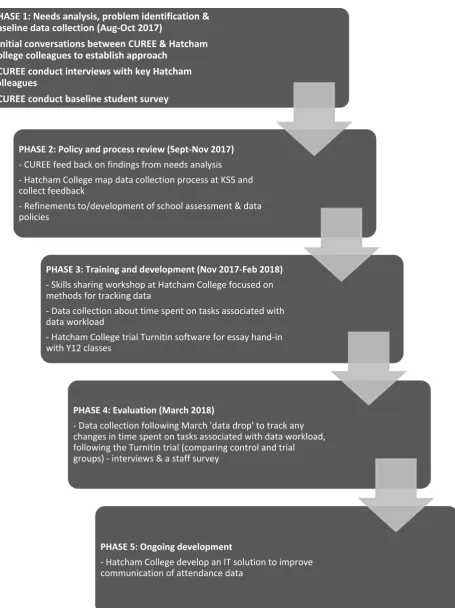
Figure 1: Enquiry process
Data collection
During this process, we carried out the following data collection activities. PHASE 1: Needs analysis, problem identification &
baseline data collection (Aug-Oct 2017)
- Initial conversations between CUREE & Hatcham College colleagues to establish approach
- CUREE conduct interviews with key Hatcham colleagues
- CUREE conduct baseline student survey
PHASE 2: Policy and process review (Sept-Nov 2017)
- CUREE feed back on findings from needs analysis - Hatcham College map data collection process at KS5 and collect feedback
- Refinements to/development of school assessment & data policies
PHASE 3: Training and development (Nov 2017-Feb 2018)
- Skills sharing workshop at Hatcham College focused on methods for tracking data
- Data collection about time spent on tasks associated with data workload
- Hatcham College trial Turnitin software for essay hand-in with Y12 classes
PHASE 4: Evaluation (March 2018)
- Data collection following March 'data drop' to track any changes in time spent on tasks associated with data workload, following the Turnitin trial (comparing control and trial groups) - interviews & a staff survey
PHASE 5: Ongoing development
• CUREE conducted baseline interviews with key members of staff (including Heads of Year, form tutors, data managers and administration personnel) to explore the current issues and culture around data workload management
• CUREE conducted a baseline survey with students in KS5 to capture the data students received, how they accessed it and what forms of data were most useful to them
• Following the mapping of data collection processes, Hatcham College held informal conversations with colleagues to collect feedback about which steps represented the biggest proportion of workload and any steps which they felt had not been addressed
• During the January ‘data drop’, KS5 staff at Hatcham College were asked to track the amount of time they spend on different data management tasks. As part of the
ongoing development of workload management, staff will also be asked to track their time during the March ‘data drop’, following the Turnitin trial, to compare trial and control groups and assess the impact
• Following the Turnitin trial, CUREE will additionally be conducting a final staff survey, supplemented with staff interviews, to explore the impact of the different approaches on their data workload
Impact
The intended impacts of the project were as follows:
• Primary impacts -
• At least a 20% reduction in the time (hours and days) associated with the recording, input, analysis, and reporting of data linked to assessment
• Increased satisfaction rating by stakeholders
• A reduction to the time lag between data entry and communication to stakeholders
• Existing beliefs and practices will be challenged across several stakeholder groups
• Shared understanding of and alignment with the schools’ response to the
recommendations and principles identified by the Workload Review Group • The adoption by departments, schools and a group of schools of lean data
management and reporting process stripped of all duplicated steps and wasted inputs
• Improved understanding of the actions that will make a difference to student learning and increased teacher and leader capacity to do this due to time savings
• Secondary impacts:
• Teachers empowered by joint practice development and peer networks to become more resilient, research aware and willing to review and improve practice in other areas
• Longer-term impacts:
Research Projects
As described above, this research and development project consisted of 5 main approaches to reducing workload. The emphasis on these on identifying and fixing
issues, switching to more effective alternatives and reviewing impact and practice varied. For each approach we detail:
• The aims and approach being developed or tested
• The research methods used to design, develop and/or evaluate each approach • Results and data analysis
• A discussion of the data and approach limitations and opportunities for further research and development
Each approach aimed to build on an ongoing developmental and enquiry process, building on the data and findings than the previous stage (rather than the individual testing of separate initiatives). In doing so, our intention was to build a coherent and rounded picture of school practice and the impact of interventions
Approach 1: Needs analysis, problem identification and
baseline data collection
Aims and Approach
The first stage in our ongoing developmental and enquiry process was to capture the current practice in the school, in order to identify the problems and concerns relating to data management and workload which staff were experiencing. Once the needs had been identified, we could then begin the process of analysing the possible solutions or areas colleagues would like to develop.
Methods
In September 2017, CUREE conducted 20-30 minute interviews with nine members of staff at Hatcham College whose professional role involved them in data management in some capacity. This included one assistant principal, five subject leaders, two form tutors and three data managers/members of administrative personnel1. In interviews, staff were
asked to explain how their role involved them in data management in relation to
assessment and attendance data; the processes they used in, for example, tracking and reporting data; what this represented in terms of their workload; and, where problems were identified, their thoughts about potential solutions or areas for development.
Results
From the staff interviews, we were able to identify a number of common problems relating to the workload related with data management, including:
• Technical ability: A common difficulty reported by staff was a lack of confidence, familiarity and efficiency with the programmes used to process attainment data. There was a tendency among colleagues to track assessment data using Microsoft Excel, and then transfer this to SIMS where the data is centrally stored; however, some staff did not feel they were confident in using these programmes, and had difficulty extracting data from one programme to input into another.
• Data usage: There were a number of issues raised around data usage. Firstly, many staff discussed how time-consuming it was for them to make use of the data they were collecting and conduct further analysis – for example, follow up with underperforming students. Secondly, staff felt there was a need to place greater emphasis on data which would be directly useful to students. Finally, several colleagues reported how non-routine or ‘ad hoc’ data management tasks, created substantial workload demands.
• Communication with parents: The main issue raised by staff in relation to attendance data was the workload necessited by communicating with parents if a student’s attendance dropped below optimal levels (the school system requires form tutors to phone parents to inform them of this, with monitoring and
interventions from Heads of Years). Some suggested that enabling thus to become an automatic process (e.g. through an email or text message being sent to parents) might be a more efficient approach.
• Written reports: Many colleagues raised the issue of written reports being a very time-consuming means of distributing data to parents, and were kee to discuss whether data management solutions could be used to feed into a more streamlined or automated report. One colleague suggested an additional parents’ evening as a quicker and less data-intensiver approach to communicating with parents.
Discussion
From the interviews, it was clear that the staff themselves had considered a number of potential solutions to common problems associated with workload and data
management. These included:
• the need for staff to receive training in data management; and
• the need for a member of staff with expertise in data handling to support the design of assessment spreadsheets, and to develop a standardised approach to tracking tools
Although the resource pool these findings were drawn from (i.e. the nine members of staff interviewed) was comparatively small, it was felt that the spread of roles covered, including both teaching and administrative staff, provided a valuable insight into the issues relating to workload and data management at all stages of the process.
Approach 2: Identifying how useful tasks are to different
stakeholders
Aims and Approach
Following on from the baseline data collection for staff, we felt that the next stage in our needs analysis was to capture the experiences of other key stakeholders – namely, the students. In particular, we felt there was a need to focus on how students were currently accessing information about their attendance and attainment, and which channels were most useful to them, in order to explore potential areas for reducing teacher workload.
Methods
At the beginning of the academic year (2017-18), CUREE carried out a survey of KS5 students at Hatcham College. 72 students participated, 16 from Year 12 and 56 from Year 13. Of these, 43% of responding students had been attending the school since Year 7, and 53% had joined in KS5. The survey questions focused on how students were commonly accessing their data, and which sources of information they found the most useful.
Results
The key findings from the survey were as follows:
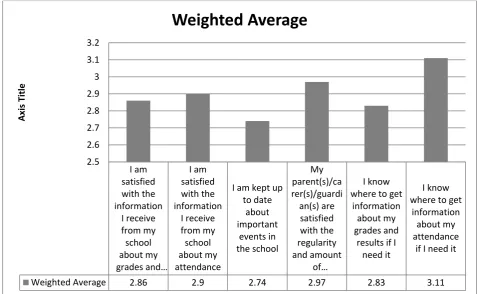
• One third of students agreed that they and their parents were satisfied with the
information they received from the school about their grades and attendance.
• 35% of students sid that they knew where to get information about their grades if
Figure 2: Please state your level of agreement with the following statements about the data you receive from your school’
• When asked which school channels for receiving information they currently used, the daily tutors time and school assemblies received the highest number of responses (48 and 41 students respectively). However, only 4 students reported using their pastoral wallets, and 9 letters home relating to individual subjects.
Figure 3: ‘Which school channels for receiving information do you currently use?’
I am satisfied with the information I receive from my school about my grades and… I am satisfied with the information I receive from my school about my attendance
I am kept up to date about important events in the school My parent(s)/ca rer(s)/guardi an(s) are satisfied with the regularity and amount of… I know where to get
information about my grades and
results if I need it
I know where to get
information about my attendance
if I need it
Weighted Average 2.86 2.9 2.74 2.97 2.83 3.11
2.5 2.6 2.7 2.8 2.9 3 3.1 3.2 Ax is Titl e
Weighted Average
Weekly school newsletter (via email) Daily tutortime Pastoralwallets
Direct contact with teachers/d epartments /careers staff (via… Letters home for individual subjects
Assembly (pleaseOther specify):
Responses 40.85% 67.61% 5.63% 40.85% 12.68% 57.75% 0.00%
[image:14.595.54.530.457.724.2]• When asked which school information channels they found the most useful, their
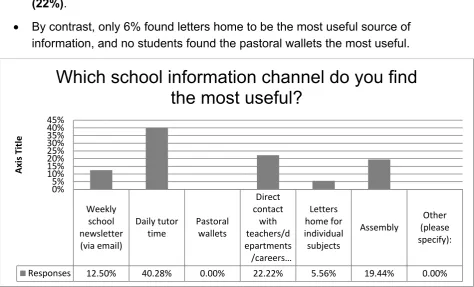
daily tutor time again ranked top of the list (with 40% saying they found this the most useful), followed by direct contact with teachers and other staff via email (22%).
• By contrast, only 6% found letters home to be the most useful source of
[image:15.595.57.532.111.398.2]information, and no students found the pastoral wallets the most useful.
Figure 4: ‘Which school information channel do you find the most useful?’
Discussion
Whilst one third of students were satisfied with the information they received from the school about their grades and results, equally, just over a third reported being unsatisfied with this information (with the remaining responses neither agreeing nor disagreeing with the statement). Similar responses were reported for their attendance data. In addition, 40% said that they did not know where to get information about their grades if they needed it. This correlates with the interview responses from teachers, that there is a need to sharpen the processes through which data is not only communicated – between members of staff as well as to students and parents. We aim to address these findings as part of the ongoing development in Approach 5.
Approach 3: Policy and process review
Aims and Approach
The first step was to get a sense of the overall way that data is collected and used at key stage 5. The aims of this were to make the process more transparent, and to empower stakeholders by giving them a sense of their part in the wider school process. One of the aims of this project has always been to develop tools that can be applied lower down the
Weekly school newsletter (via email)
Daily tutor
time Pastoralwallets
Direct contact with teachers/d epartments /careers… Letters home for individual subjects
Assembly (pleaseOther specify):
Responses 12.50% 40.28% 0.00% 22.22% 5.56% 19.44% 0.00%
0% 5% 10% 15% 20% 25% 30% 35% 40% 45% Ax is Titl e
school at key stages 3 and 4; these process maps will be able to be adapted with little effort for the other key stages.
Methods
A descriptive approach was taken to identify each of the stages of data management at key stage 5. Carl Wadey, Head of Sixth Form, was interviewed about the overall process and its aims and objectives, and Kafilat Agboola and Nathan Gardner (previous and current Directors of Sixth Form) were asked for their input.
As my research progressed it became clear that there were two parallel processes involved: the use of assessment data and of quality of teaching data (ie the observations of teachers made by their Line Managers and/or Heads of Departments). I decided to present these in two distinct process maps as the processes do not share any stages in common.
The programme Microsoft Visio was used to present the data visually as a flowchart, showing the stages of the processes, decisions, actions and parties involved at each stage.
Results
Once I had created working documents (these process maps will remain working
documents as the school continually improves/refines its policies around data collection and student intervention) I was able to ask for feedback on the stages of the processes from my colleagues. At the Workload Challenge workshop a group of middle leaders with responsibilities in the sixth form (both Heads of Department and Key Stage 5 leads) were given copies of the process maps and asked to comment on:
• “pinch points” – times of year when workload around these processes is particularly high
• Specific stages which generate the highest workload • Areas of inefficiency/improvement
Discussion
Staff complained that too often they are demanded to document what intervention they have delivered without being given the time to decide on the best, most meaningful interventions to have real impact. Forecast grades entered on SIMS give a limited picture and Key Stage Leads need to find out why students are underachieving, which specific skills they are lacking, and so on. Additionally, ensuring that students attended
intervention sessions (often run before/after school or at lunchtime) generated another sizeable administrative workload.
It was also clear that there is a lot of excellent work going on in different departments but that staff do not always/often get the chance to share expertise. The History department is making effective use of the Virtual Learning Environment (VLE) Moodle to set tareget students to take factual tests to improve their knowledge. The Maths department is trialling the use of a website, Kerboodle, which enables students to explore topics as recommended by their teacher and get instant feedback; this has the potential to
significantly reduce workload around intervention. It is clear that the whole Key Stage 5 team would benefit from regular opportunities to share ideas around efficient, effective work in this very time-consuming area.
The current working process map documents can be found in Appendix A.
Approach 4: Training and development
Aims and Approach
Following the findings from the initial interviews, it was clear that some workload stresses mentioned by Key Stage Leads could be eased/reduced through improvement in the student tracking data collected by each department. An effective tracking document, saved in a shared area so it can be accessed by multiple people, could reduce or
hopefully eliminate ad hoc requests for data from HoDs, senior leaders or tutors; it could reduce stress around SIMS data entry – all the information needed to judge a student’s forecast grade is collected; and it could reduce workload for Key Stage Leads in
responding to student/parent enquiries, because the decisions made around forecast grades would be transparent. Therefore, tracking was selected as an area for further staff development.
Methods
A workshop was devised with the aim of helping Key Stage Leads to reach a consensus on what the requirements should be around student tracking and how to ensure it
impacted positively on their workload, in order to feedback these ideas to the Heads of Sixth Form. Questions included:
• Which pieces of work should be entered on trackers in your subject? (mock exams, essays, homework, coursework…?) “staff felt there was a need to place greater emphasis on data which would be directly useful to students.”
• Who should have access to trackers?
This workshop was conducted on Federation Day (a training day organised for the staff of all 3 Federation secondary schools) as 3 concurrent group discussions; teachers were grouped into subject groups with representatives from each of the 3 schools present. Staff were asked to discuss their own departmental approach to tracking and to share good practice with a view to setting expectations for the Hatcham Sixth Form (to then be shared across the other schools through the process of alignment). Feedback was then taken from all 3 groups in turn with ideas recorded by Mary.
Results
It is important to recognise that in reality this workshop acted as an initial discussion generating further questions rather than conclusive decisions around tracking policy. It was very difficult for staff across different departments to agree on answers to the questions. Some departments advocated collecting very specific data (ie students’ performance on different question types so that students underachieving on each
question skill could be identified) whereas other subjects collect only key pieces of work.
Discussion
The discussion raised the issue of whether it is important/necessary to have a unified approach to tracking across the different subjects at all, when the assessments they are handling are so different. Ultimately all departments are required to reduce their student assessment to a single forecast grade for each student for SIMS,so perhaps it is more important that the data collection system respects departments’ autonomy in the way they devise their tracking documents.
However, another aspect to this is that at present some Key Stage Leads do not have the skills necessary in the use of Excel to set up their trackers to do things like automatically calculate overall grades or percentages, and this was significantly increasing their
workload. Some members of our discussion suggested that trackers could be created and formatted by the Heads of Sixth Form or the administrative team in order to reduce the workload of middle leaders. However, this would clearly require a shared sense of what data a tracker would be collecting.
Approach 5: The use of IT solutions to improve data
management systems
Aims and Approach
An aspect of the initial findings which clearly indicated that improvement was needed was that only one third of students agreed that they and their parents were satisfied with the information they received from the school about their grades, results and attendance. One suggestion for a way to improve this while hopefully also impacting positively on staff workload was to adopt an online platform for students to hand in essays; this would enable students to view all their grades from each subject in an online markbook, while also allowing teachers to mark online using saved comment banks to reduce workload around marking. The website Turnitin provides this and also allows students to check their work for spelling/grammar errors. We are hopeful that Turnitin’s online markbook will also be able to replace or complement the departmental tracking document and reduce staff workload in that area as well. We decided to trial the use of Turnitiin among 100 of our year 12 students, with the Workload Challenge Project working in tandem with the Sixth Form’s focus on improving quality of writing.
The other key area in which a technological solution has the potential to improve our school’s efficiency and reduce staff workload is that of attendance data. The school is researching different companies who can provide an app that can link to the school’s SIMS database to enable parents to check “live” attendance data.
Methods
Prior to choosing Turnitin as our online platform several options were investigated, including the MintClass program which plugs into the school’s SIMS database to enable staff to work more closely with that data. This seemed a useful program but we could not identify areas where it had the potential to significantly reduce workload.
Following an online tutorial on Turnitin, we decided that it had the potential to improve our practice and to have a positive impact on workload in the Sixth Form. The program was purchased for a trial group of 100 year 12 students. Staff from five essay-based
departments (English, Sociology, Psychology, Government & Politics and Economics) will be asked to adopt it with one year 12 class per department. The teachers involved will be given training in order to act as Turnitin “champions” in the school if we decide to adopt it across the whole of year 12 for the 2018-19 academic year.
All Key Stage Leads in the Sixth Form Team were asked to assess the workload
associated with a data drop, but more importantly can be repeated at the next data entry point in March to enable us to assess the impact of Turnitin on staff workload.
Students will also be surveyed in March to see whether the use of Turnitin has a positive impact on their satisfaction with the school’s communication of their assessment data.
Results
Results in this area are ongoing and will be assessed at the end of March 2018. The Turnitin trial will be evaluated again in July 2018 in order to decide whether it should be rolled out across the whole of the new year 12 intake for the 2018-19 academic year.
The attendance data app will be introduced in September 2018. We will monitor the impact on staff workload and parent/student satisfaction.
Discussion
Turnitin may bring additional benefits of reducing workload related to marking; while this project has focused specifically on staff workload around the data management
process,marking, assessment and data management are closely linked. Improving efficiency in one area has the potential to positively impact other areas. School Culture and Ongoing Development and Review
What cultural barriers may exist to prevent take up of new initiatives to reduce workload? What specific issues may reduce the effectiveness of the approaches you have
developed?
What steps could be taken to reduce these cultural barriers?
School Culture
Hatcham College is a high-attaining, Ofsted-rated Outstanding secondary Academy with a large and successful sixth form. It prides itself on employing a highly-qualified and skilled teaching workforce. However, as in many other UK secondary schools, there is a sense at Hatcham College that staff are working at the limit of their capacity and do not have time to take on any more changes to their working patterns. Sadly, this attitude can hamper the ability of the organisation to make positive changes as staff do not have the space to reflect on ways to work more efficiently. Hatcham staff also have to contend with a split-site school in which the majority of teachers do not have specific classrooms but teach across a range of different rooms on two sites. As a result, it can be very hard to work efficiently.
The school has been through a time of great change in recent years: in 2005 it became a Federation, expanding to include (at present) two other secondary schools and 4
Additionally, during the year in which this project was completed, the Federation has initiated a process of alignment across the 3 secondary schools, asking each department to align their curricula and assessments to ensure complete consistency of planning. This has generated its own workload and, in turn, has influenced staff’s response to the
workload challenge.
A continuing focus is to ensure that the process of alignment is undertaken with the recommendations of the workload review group in mind, and that processes are streamlined as they are adopted across the federation.
School Policy
In recent years there have been some important innovations in managing workload at the whole school level:
• SIMS data entry points reduced from 6 to 4 per year (to 3 for KS3 for non-core
subjects).
• Long reports at KS5 reduced from 2 to 1 in total for the 2 years of sixth-form – at
the end of year 12.
Both of these changes have significantly reduced workload connected to data
management and demonstrate the willingness of the leadership to make changes to manage workload and improve data management practice.
Ongoing Review
• Data around workload has been collected for the current SIMS data drop and this will be followed up with another data collection at the SIMS data drop in March. This will enable us to assess the impacts of our interventions including the introduction of Turnitin.
• In addition, we will also be carrying out a final staff survey (complemented, where
necessary, with further staff interviews) to capture perspectives about the impact of the initiative on workload and data management.
Apply Lessons and Approaches Elsewhere
• We would like to expand the project across the 3 Federation secondary schools
Conclusion
Discuss the relative merits of each of the approaches you developed. How effective were they, what do they cost to implement and what resources are needed, including staff time.
What recommendations would you make to other schools hoping to reduce staff workload in this area?
Recommendations:
• Middle leaders should be actively encouraged to delegate administrative tasks to a designated contact in the administrative team.
• Schools which require student data to be tracked at departmental level before it is entered into a central database should involve their teams in discussions about what data is most useful to collect, when, and the extent to which those tracking documents need to be unified across departments; don’t assume that one tracker will meet the needs of departments with very different assessment models.
• Schools should not assume that all middle-leaders have the necessary skills with
programs like Excel and should offer training in data management to all staff when they accept middle-leadership posts.
• Schools should ensure that adequate time is allocated to skills-sharing and
discussion around student tracking and intervention following data entry. Too often “intervention” is demanded of middle-leaders/Heads of Department without much chance to reflect on how to make it meaningful and maximise the impact on student attainment. Teachers would benefit from regular opportunities to share ideas around efficient, effective work in this very time-consuming area.Effective online resources should be shared around relevant departments to ensure that as much intervention work as possible is automated.
Appendix A
© Crown copyright 2018
This publication (not including logos) is licensed under the terms of the Open
Government Licence v3.0 except where otherwise stated. Where we have identified any third party copyright information you will need to obtain permission from the copyright holders concerned.
To view this licence:
visit www.nationalarchives.gov.uk/doc/open-government-licence/version/3
email [email protected]
write to Information Policy Team, The National Archives, Kew, London, TW9 4DU About this publication: