A comparative
case study
of
Programming language Expansion Ratios
A thesis presented in partial fulfilment of
the requirements for the
degree of Master of Technology in Computing Technology
at
Massey University
Lim, Ping
Hwee
Abstract
An effective size estimation tool must allow an estimate to be obtained early enough to
be useful. Some difficulties have been observed in using the traditional lines of code
(LOC) measure in software sizing, much of which is due to the need for more detailed
design information to be available before an accurate estimate can be achieved. This
does not allow the result to be obtained early in the software development process.
Moreover, the inherent language-dependency of LOC tends to restrict its use. An
alternative measure using Function Point Analysis, developed by Albrecht, has been
found to be an effective tool for sizing purposes and allows early sizing. However, the
function point measure does not have a sufficient historical base of information for it to
be used successfully in all cases with existing models of the software development
process. Because lines of code already have a sense of "universality" as the de facto
basic measure of software size, it can serve as a useful extension to function points.
Language Expansion Ratios are seen as the key in providing such an extension by
bridging the gap between function point and lines of code. Several sizing models have
made use of expansion ratios in an effort to provide an equivalent size in lines of code in
anticipation of its use in productivity studies and related cost models. However, its use
has been associated with ranges of variability. The purpose of this thesis is to study
Language Expansion Ratios, and the factors affecting them, for several languages
based on a standard case study.
This thesis surv~ys the prevailing issues of software size measurement and describes ,i .
I
the role and importance of language expansion ratios. It presents the standard case
study used and the methodology for the empirical study. The experimental results of
measurements of the actual system are analysed and these form the basis for
appropriate conclusions on the validity and applicability of the expansion ratios
This research si,ows that the use of Language Expansion Ratios is valid but it is i
considered inadequate when applied in its present form. This was found to be due to the
weighting factors associated with the appropriate function value obtained for the
Acknowledgments
I wish to extend my gratitude to Professor Graham Tate for consenting to be my
supervisor for this thesis. His direction has been very important to this work. I am
also grateful for his careful review and comments of the entire content of this thesis.
His guidance and encouragement are very much appreciated.
I
A special thanks to Miss June Verner for her constant help and support during the
course of this research. In particular, I wish to express my deep appreciation for her
help in making the documentation facilities available to me.
Finally, I would like to express my gratitude to Miss Lili Ton for her help during the
preparation of this thesis. Her efforts and patience in some of the typescripts and
TABLE OF CONTENTS
Page List of Figures ... v iii
List of Tables ... xi
CHAPTER 1 INTRODUCTION ... i
CHAPTER 2 SURVEY OF BACKGROUND INFORMATION ... 5
2. i Review of Software Metrics ... 6
2. i. i Size Metrics ... 7
2. i . i . i Line Count ... 8
2.i.i.2 TokenCount. ... i i 2.i.i.3 Function Count ... i 5 a. Function Point Analysis (FPA) ... i 5 b. MARK II Function Points ... 1 7 2. i . 2 Structure Metric ... 2 O 2. i .2. i Logic Structure ... 2 i 2.i.2.2 Data Structure ... 23
2. i .3 Composite Metrics ... 2 4 2. 2 Review of Software Sizing Models ... 2 5 2. 3 Need for Improved Sizing Mechanism ... 2 9 2. 4 Role of Language Expansion Ratios ... 3 i CHAPTER 3 OVERVIEW OF CASE STUDY
···35
3. i Research Objective ... 3 5
3.2 Case Study Specification - OveNiew ... 3 7 3. 3 Language Implementation ... 4 O
3 .3. i Advanced Revelation ... 4 i a. Tools That Build Tools ... 4 i
b. Paint ... 4 2 c. Popup ... 4 2 d. Menus ... 4 2 e. R/Basic ... 4 2
Page f. Editor ... 4 3 g. Macros ... 4 3 h. The Command Level (TCL) ... 4 3 i. Operating System ... 4 3 3.3.2 lnformix 4GL ... 4 4 a. A Database Language ... 4 4 b. A Programming Language ... 4 4 c. Screen-Building Utility ... 4 5 d. Menu-Building Utility ... .4 5 e. Report Writer ... 4 5 3.3.3 Micro Focus Level II Cobol. ... .4 6 a. Level II Cobol Compiler ... 4 6 b. Animator ... 4 7 c. Forms-2 ... 4 7 d. Fileshare ... 4 7
CHAPTER 4
METHODOLOGY FOR EMPIR!C/l-.LSTUDY ··· ... m . . n
4. 1 Detailed Design and Implementation ... .4 8 4. 2 Size and CosVEffort Estimation ... 5 6 4. 3 Data Collection ... 5 9 4. 4 Software Measurement. ... 5 9 4. 5 Analysis of Data ... 6 1
CHAPTER 5
EXPERIMENTAL RES UL TS AND OBSERVATION ... 6 3 5.1 Regression Analysis of Empirical Data ... 6 4 5. 1 . 1 System ... 6 6 5.1.2 ModuleTypes ... 76 5.1.3 lnpuVUpdate Transactions ... 7 6 5.1.4 Reports ... 79 5.1 .5 Forms ... 8 O 5.1.6 External lnquiries ... 8 2 5. 1 . 7 Comparative Expansion Ratios ... 8 3 5. 2 System size and Effort - estimates vs actuals ... 8 8 5. 3 Comparison of Productivity Measures ... 9 1
Page CHAPTER 6
SUMMARY AND CONCLUSIONS ... 9 5
List of References ... 1 0 1
Appendices
Appendix
Appendix
Appendix
Appendix A
B
C
D
···1 05
···1 06
···140
···169
···1 80
Figure 1
2.2
3.1 .1
4.1 .1
4.1 .2
4.1 .3
4.1 .4
4.1 .5
4.1 .6
4.1 .7
4.4.1
5.1 .1
5.1 .2
5.1
.35.1
.45.1 .5
5.1
.6
5.1 .7
5.1 .8
6 .1 6.2 8.1 8.1.1 8.1.2 8.1.3 8.1.4 8.1.5 8.1.6 81 .7 8.2 8.2.1 8.2.2 8.2.3List of Figures
Page
Control flow graph, G, with complexity, V(G)
=
5 ... 2 2 Multi-language sizing mechanism ... 3 3Overview of Research ... 3 6
Inventory Control and Purchasing System (DFD0) ... 4 9
Modified State Transition Diagram - User-interface
for Inventory Control and Purchasing System ... 5
o
User-interface for System Start-up Menu ... 5 1
User-interface for Handling New Types of Stock Menu ... 5 1
User-interface for Monitoring Stock level Menu ... 5 3
User-interface for Purchase Order Processing and follow-up Menu ... 5 3
Incremental Development ... 5 8
Steps in the statistical analysis of data ... 6 2
Plot of lnformix (LOC) vs AREV (LOC) - System 1 ... 6 8
Plot of Cobol (LOC) vs AREV (LOC) - System 2 ... 6 9
Plot of Cobol (LOC) vs I nformix (LOC) - System 1 ... 6 9
Residuals plot for Inform ix vs AREV - System 1 ... 7
o
Residuals plot for Cobol vs AREV - System 1 ... 7 0
Plot of Intermix (LOC) vs AREV (LOC) - System 2 ... 7 3
Plot of Cobol (LOC) vs AREV (LOC) - System 2 ... 7 3
Plot of Cobol (LOC) vs Inform ix (LOC) - System 2 ... 7 4
Results of software size estimates ... 9 7
Results of Language Expansion Ratios for
Micro Focus Level II Cobol. ... 9 9
System Start-up (DFD1) ... 1 41
Process P1 ... 1 4 2
Process P2 ... 1 4 3
Process P3 ... 1 4 4
Process P4 ... 1 4 5
Process PS ... 1 4 6
Process P6 ... 1 4 7
Process P7 ... 1 4 8
New Types of Stock (DFD1) ... 149
Process PS ... 1 5 0
Process P9 ... 1 5 1
Process P10 ... 1 5 2
Figure B.2.4 B.3 B.3.1 B.4 B.4.1 B.4.2 B.5 B.5.1 B.5.2 B.6 B.6.1 B.6.2 B.7 B.7.1 B.8 B.9 D.1 D.2 D.3 D.4 D.5 D.6 D.7 D.8 D.9 D.1 0 D.11 D.12 D.13
Page
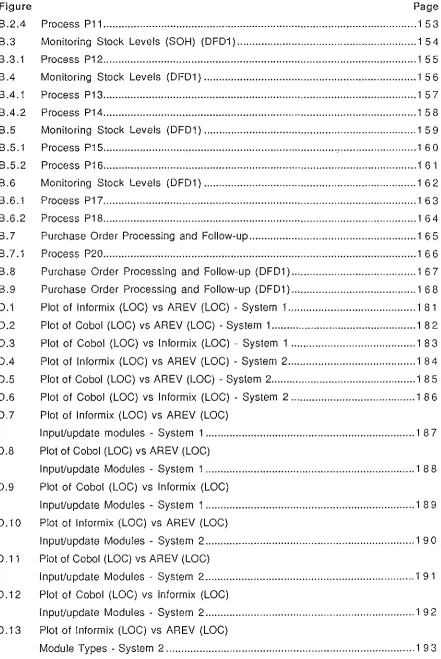
Process P11 ... 1 5 3 Monitoring Stock Levels (SOH) (DFD1) ... 1 5 4 Process P1 2 ... 1 5 5
Monitoring Stock Levels (DFD1) ... 1 5 6
Process P13 ... 1 5 7 Process P14 ... 1 5 8 Monitoring Stock Levels (DFD1) ... 1 5 9
Process Pi 5 ... ···.··· ... 1 6
o
Process P1 6 ... 1 6 1 Monitoring Stock Levels (DFD1) ... 1 6 2 Process P17 ... 1 6 3 Process Pi 8 ... 1 6 4 Purchase Order Processing and Follow-up ... 1 6 5 Process P20 ... 1 6 6
Purchase Order Processing and Follow-up (DFD1) ... 1 6 7 Purchase Order Processing and Follow-up (DFD1) ... 1 6 8 Plot of lnformix (LOC) vs AREV (LOC) - System 1 ... 1 81 Plot of Cobol (LOC) vs AREV (LOC) - System 1 ... 1 8 2 Plot of Cobol (LOC) vs Inform ix (LOC) - System 1 ... 1 8 3 Plot of lnformix (LOC) vs AREV (LOC) - System 2 ... 1 8 4 Plot of Cobol (LOC) vs AREV (LOC) - System 2 ... 1 8 5
Plot of Cobol (LOC) vs Inform ix (LOC) - System 2 ... 1 8 6
Plot of lnformix (LOC) vs AREV (LOC)
Input/update modules - System 1 ... 1 8 7 Plot of Cobol (LOC) vs AREV (LOC)
Input/update Modules - System 1 ... 1 8 8 Plot of Cobol (LOC) vs lnformix (LOC)
Input/update Modules - System 1 ... 1 8 9
Plot of lnformix (LOC) vs AREV (LOC)
Input/update Modules - System 2 ... 1 9 O Plot of Cobol (LOC) vs AREV (LOC)
Input/update Modules - System 2 ... 1 91
Plot of Cobol (LOC) vs lnformix (LOC)
Input/update Modules - System 2 ... 1 9 2 Plot of lnformix (LOC) vs AREV (LOC)
Module Types - System 2 ... 1 9 3
Figure Page D.14 Plot of Cobol (LOG) vs AREV (LOG)
Module Types - System 2 ... 1 9 4 D.15 Plot of Cobol (LOG) vs lnformix (LOG)
Module Types - System 2 ... 1 9 5 D.16 Plot of lnformix (LOG) vs AREV (LOG)
Reports Modules - System 2 ... 1 9 6 D.17 Plot of Cobol (LOG) vs AREV (LOG)
Reports Modules - System 2 ... 1 9 7 D.18 Plot of Cobol (LOG) vs lnformix (LOG)
Reports Modules - System 2 ... 1 9 8 D.19 Plot of lnformix (LOG) vs AREV (LOG)
Forms Modules - System 2 ... 1 9 9 D.20 Plot of Cobol (LOG} vs AREV (LOG)
Forms Modules - System 2 ... 2
o o
D.21 Plot of Cobol (LOG) vs lnformix (LOG)Forms Modules - System 2 ... 2 O 1 D.22 Plot of lnformix (LOG) vs AREV (LOG)
Menus - System 2 ... 2
o
2 D.23 Plot of Cobol (LOG) vs AREV (LOG)Menus - System 2 ... 2 O 3 D.24 Plot of Cobol (LOG) vs lnformix (LOG)
Menus - System 2 ... 2 O 4
List of Tables
Table Page
5. 1 .1 Results of Statistical Analysis for System 2 ... 6 7 5. 1 . 2 Results of Statistical Analysis for System 1 ... 6 8 5. 1 .3 Input/Update Programs with File-to-File Operations ... 7 8 5. 1 .4 Summary of Language Expansion Ratios
based on Albrecht's Function Points ... 8 6 5.1 .5 Summary of Language Expansion Ratio
based on Symond's Mark II Approach ... 8 7 5. 2. 1 Estimated and Actual Effort in person-months ... 8 9 5 .3. 1 Summary of Development Efforts in person-hours ... 9 1 5 .3 .2 Milestone Time-log in person-hours ... 9 3 C.1 List of Programs ... , 70 C.2 Results of Function Point Analysis ... 1 7 1 C.3 Line count for System 1 ... 1 7 3 C.4 Line count for System 2 ... 1 7 4 C.5 Line count for Input/update module - System 1 ... i 7 5 C.6 Line count for Input/update - System 2 ... 1 7 6 C.7 Line count by Module Type Categories ... 1 7 7 C.8 Line count for Reports Module ... i 7 7 C.9 Line count for Menus Module ... 1 7 8 C.1 O Line count for Inquiry Module ... 1 7 8 C.11 Line count for Forms Module ... 1 7 9 D .1 Regression Analysis of plot in Fig. D.1 ... 1 8 1 D.2 Regression Analysis of plot in Fig. D.2 ... 1 8 2 D.3 Regression Analysis of plot in Fig. D.3 ... 1 8 3 D.4 Regression Analysis of plot in Fig. D.4 ... 1 8 4 D.5 Regression Analysis of plot in Fig. D.5 ... 1 8 5 D.6 Regression Analysis of plot in Fig. D.6 ... 1 8 6 D.7 Regression Analysis of plot in Fig. D.7 ... 187 D.8 Regression Analysis of plot in Fig. D.8 ... 1 8 8
D.9 Regression Analysis of plot in Fig. D.9 ... 1 8 9 D .1 O Regression Analysis of plot in Fig. D.10 ... 1 9 O
D.11 Regression Analysis of plot in Fig. D.11 ... 1 91 D.12 Regression Analysis of plot in Fig. D.12 ... 192 D. 13 Regression Analysis of plot in Fig. D.13 ... 1 9 3
Table D.14 D.15 D.16 D.17 D.18 D.19 D.20 D.21 D.22 D.23 D.24
Page Regression Analysis of plot in Fig. D.14 ... 1 9 4 Regression Analysis of plot in Fig. D.15 ... 195 Regression Analysis of plot in Fig. D.16 ... 1 9 6 Regression Analysis of plot in Fig. D.17 ... 1 9 7 Regression Analysis of plot in Fig. D.18 ... 1 9 8 Regression Analysis of plot in Fig. D.19 ... 1 9 9 Regression Analysis of plot in Fig. D.20 ... 2 O O Regression Analysis of plot in Fig. D.21 ... 2 O 1 Regression Analysis of plot in Fig. D.22 ... 2
o
2 Regression Analysis of plot in Fig. D.23 ... 2 O 3 Regression Analysis of plot in Fig. D.24 ... 2 O 4CHAPTER 1
INTRODUCTION
The impact of the Software Crisis emanates from the realization of the importance
which computerization has on society and industries. An overwhelming demand for
software escalated to such an extent that traditional software development techniques
could not cope. The problem related to the difficulty of establishing techniques for
handling the growing size and level of complexity of software systems whose
development schedules could not be accurately predicted.
The cost of software grows disproportionately with the other associated costs of
computer systems and this upward trend is an issue of concern [DACS87,JONE86j. in
the search for a solution to the software crisis, the field of Software Engineering was
created in a deliberate attempt to use a combination of techniques, methods, and tools
for producing economical software that is reliable and works efficiently.
An important aspect of Software Engineering has been the focus on software size
estimation as a prerequisite for resource planning and scheduling in the software
development process. The unpredictable nature of the software development process
has prompted intense research in finding a way of making programs measurable and,
hence, more predictable. Source lines of code (LOG) have been widely used for
research studies involving size estimation. The count of the number of lines of code is
said to be related to the size of the effort required in the development process. Several
studies have been pursued to verify this.
The study by Walston and Felix [WALS77] discusses research into a method of
estimating programming productivity by measuring the rate of production of lines of
code by project and relating them to factors which might influence its behaviour.
Measurement data were collected from 60 projects in one organization and were
maintained in a measurement database. Based on these data, productivity analysis of
effort and product size shows a nearly first-power (or linear) relationship. In
another study carried out in the Software Engineering Laboratory at the University of
Maryland, Basili et al [BASl8i] examined the relationships among the various basic
software development variables, such as size, effort, project duration etc. The
analysis reveals a high probability of a relationship between total effort and delivered
lines of source code. The relationship is nearly linear with a coefficient of
determination of 0.93 at the 0.001 level of significance. This high correlation
indicates a possibility of using source lines of code to predict the total effort required
in a development project. This result was found to be consistent with the study by
Walston and Felix [WALS77].
The validity of using source lines of code as a predictor of programming effort is also
based on the assumption that it includes a measure of functional complexity. Although
studies by [WALS77] and [BASl8i] indicate a linear relationship between source lines
of code and effort, Basili et al [BAS18i] also stated that the assumption which relates
the functional complexity to program size is subjective. The argument is that size may
increase at an even greater rate as complexity increases. This follows the notion
suggested by Brooks [BR0075] that man and month are not necessarily interchangeable
as the result of increasing one may not directly cause the other to decrease. However,
it can be acknowledged that the link between lines of code and effort prediction is a valid
one, though more factors relating to complexity will have to be considered. Already,
several cost models have used lines of code as the input parameter for cost and schedule
estimates. Of the better known costs models are the COCOMO and SLIM models
[BOEH84].
The biggest difficulty in using today's Software Cost models has been the problem of
providing sound sizing estimates. Several methods of size measurement have been
developed to depart from the usual lines of code measure for size estimation in an
attempt to search for a better way to estimate software size early enough for it to
remain useful. One such method that remains popular is the measure for function
value developed by Albrecht called Function Point Analysis. Function Point Analysis
has been quite successful and is adopted in several commercial software sizing models.
However, most of these models also provide an equivalent size in lines of code in
anticipation of its use in productivity studies as well as with existing cost models. The
use of an expansion ratio to convert from function points to lines of code has been
recognized to contain ranges of variability due to the fact that it is obtained from
different sources or based on different datasets. However, the expansion ratio remains
useful in standardizing the basic unit of measure for quantifying software. The purpose
of this thesis is to study Language Expansion Ratios, and the factors affecting
them, for several languages based on a standard case study.
Chapter 2 provides a summary of the background information relating to the issues of
software sizing. A review of software metrics and the problems associated with them
are presented followed by a discussion of the subjectivity of sizing in existing size
estimation models. It emphasizes the need for an improved size estimation method
which can be applied to the wider range of programming languages and examines the
role of language expansion ratios in providing such an extension to existing sizing
methods.
Chapter 3 presents the research objective for this thesis and a brief outline of the
system analysis and design specification of the case study used. The languages used in
this study are presented with specific emphasis on their main development features.
Chapter 4 provides an outline of the methodology adopted for this empirical study. It
describes the system development tasks involved in the implementation phase as well
as the software development strategy used. The implementation phase includes detailed
design and code implementation. Other implementation-related activities such as size
and cost/effort estimation, data collection, software measurement and statistical
analysis methods are also included as an overall base appropriate for the empirical
study.
Chapter 5 presents the experimental results of the case study. It describes the detailed
analysis of experimental data and discusses related observations associated with the
results of the analysis.
Chapter 6 provides a summary and appropriate conclusions based on the empirical
study conducted in chapter 5.