*Qt?,
I
'
European Communities
4!7'
ol
EUROPEAN
PARLIAMENT
Wbrking
Documents
t982-
1983
4 0ctober 1982
0R: DE
r,a.2
nglish Edition
Report
Drawn up on behaLtTf
Research on t\r,/onnon and Prospect{
Rapporteur: trtr R LINK0HR
DOCUMENT T.-6541E2
the Committee on Energy and Research poticy
:
probIemsBy letter of 15 October 1980 the Committee on Energy and Research requested authorization to draw up a report on the Common Research Policy: problems and prospects.
' At its meeting of 30 October 1980 the enlarged Bureau ar.lthorized the committee to draw up a reporL on this matter.
The committee appointed Mr LINKOIIR rapporteur 25 November 1980.
On 18 September 1980 a motion for a resolution on the setting up of
a special secretariat to sponsor Community energy research in Denmark was
tabled by t'lrs GROES and others Pursuant to RuIe 25 of .the then Rules of Procedure (Doc. l-405/80). On 19 September 1980 the European Parliantent
rcferred this moti,on for a resolution t<: the Committee on Energy and
Research.
on 19 February 1981 the committee appointed Mr MORELAND rapporteur.
It considered the draft report at its meeting of 28 October 1981 and decided, on a proposal by the rappotteur, to continue its consideration
of the motion for a resolution within the framework of its own-initiative report on the Common Research Policy: problems and prospects. Mr IT1ORELAND
was relieved of his duties as rapporteur.
0n u, Harch 1982 l4rs THEOBALD-PAoLI tabLed a motion for a resotution pursuant
toRute6ToftheRuLesofProcedureonsettingupaEuropeanFederationof
Inst'i tutes of ExperimentaL Biol'ogy (Doc. 1-13t8il. 0n 11 March 1982 the European parLiament referred to the motion for a resotution to the committee on Energy
and Research.
0n 26 March 1982 the comm'ittee decided to consider the motion for a resotut'ion
within the frameuork of its oun-.initiative report on the common Research PoLicyl
probtems and
Prospects-At .its meetings of 3 Decembdr 1981, 30 April. 1982 and 24 June 1982, the
committee considered the draft report and on ?4 September 198? adopted the motion
for a resoLution and exptanatory statement by 2L votes to 1'
rhe f oL[oying took part 'in the vote: Mrs Hatz , chai rmanl ltlr setignan '
vlce-cha.irman; lrlr Linkohr, rapporteur; Mr Adam, Mr Bonaccini (deputizing for Mr Ippotito), itr Gat,vez, (deputiz'ing for Mr Pintat )' I{r Fuchs ' l{r Ghergo
(deputizing for Mr Sassano)r Mr Herman (deputizing for ilr saIzer), l'lr tilarkopouLos, ilr"-tr(o-re[and'
Flr lilutler-H€Fnlohhr Mr Normanton, Mr Pedini ' ilr Ptt€rsen' Mrs Pruvot (deputizing
for Mr Gatl,and), Itlr Protopapadakisr l4r purvit' Mr Rinsche' Sir Peter qannech
lulr Verranesi and Mrs Viehof f (deput'i zing for ilrs Liz'in) '
on
CONTENTS
A. MOTION FOR A RESOLUTION
Priorities of a future European Research policy Tasks of the .Ioint Research Centre
Responsibilities of the European parliament Requests to the Commission
Requests to the Council and the Member States
Forwarding instrirctions
EXPLANATORY STATEIIIENT
I. fntroduction - The
II. Basic parameters:
Page
I
5 7I
I
9 9 B. III. rv. v. vr. VII. 10 10 13 14 14 15 I5 I5 17 I8 I8 18 19 19 20 22 24 ,28 31 3L 32 34 .15 36 37tripl,e ehallenge
Ivlember States' spending and their
approach to Comnunity research
Table I
Table Ii
Table III Tab1e IV
Table V
Tab1e VI
Table VII Tab1e VIII
Table IX Table X Table XI
Research policy as a means of changing economic structures
LegaL bases for a Common Research policy Justification for Community research
Necessary adiustments to European research policy The connectioh between employment, short-term economic policy and research ...:....
VIII.The role of the research IX. The Joint Research Centre
x' coordination, European cooperation and new comnrunity research
XI. Relations between the Community in the field of rescareh polic| worker
and Third ylorld countries
XII. Conclusion
XIII.Summary of recomrnendations
6!NEIES
I List. of European Research Organizations
II Hotion for a nesolution Doc. 1-406/g0
III tlotion for a reso[ution Doc. 1-13lEz
(non-Community) AlTUEX
-{r
42 43A.
The Comm.ittee on Energy and Research hereby
fotLoring motion for a resolution, together uith
submits to the European parl.iament the
exptanatory statement:
u9uq!_!q8_8_8E98rUiIAN_
on the Common Research pol.icy: probLems anrt prospects
Ib e- Eurspe e!_eer!l.eIc!!,
A' having regard to the motion for a resotution by Mrs GRoES and others (Doc. 1-406/g0),
ts ' having regard to the mot ion for a resotution
by lirs THEoBALD-PA0II $oc. 7-13tg),
c' having regard to the. study by the Economic and sociat committee of the goal.s
and p.iorities of a common research and devetopment poticy (cEs
1033/g1)
D' bel'ieving that the abiLities of the comnunity's scientists and engineers shou[d be
harnessed more effectiver.y for the aqquisition of neu technor.ogjes
E' having regard to the report of the committee on Energy and Research (Doc.1-654 EiJ,
1. Notes that community research expenditure accounts for onLy about 1.5X of al.I pubtic
research expend.iture in the European Community;
Notes further that onLy 1.82 of the community budget is devoted to research expenditure; considers that the sharp increase in real terms in the cost
considerabIe budgetary probtems for the Hember States and,
the Community too; 2.
5.
of research creates -.
to a tesser extent, for 4' Recognizes the industrial' and technol.ogicaL chatl.enge by the
usA and Jappn as endangering
the competitiveness of the European community; is convinced that this
danger can onLy be
overcome by a considerabLy increased and more efficient
commitment lrithin Europe in terms of research and technotogy and draus attention to'the greater proportion of gross
domestic product spent on research in these tuo countries which is substantiatLy
higher than that spent .in Member States of the Community.
5- Notes that technol'ogicet dependence makes the European community open to bLackmaiL and
exposes its trade and industrial. pol.icy to outside infLuences, as recenLy happened as
a result of the US technoLogical. embargo;
6' urges therefore that the European community shouLd have an independent research
and
industriat strategy;
Regards research ooLicy as an important potentiaI means of
adapting to the transformation
of society brought about by technotogicat change;
concludes therefore that the time is now ripe for a fundamentaI restructur.ing of
research poticy in Europe;
er.grt!tcs-e1_e_1-u!gre_Eurqpssn_r9ssetsh_pe!lsy
9' Thenefore considers a fundamentaL reatlocation of nationat and European programnes
to be necessary in order to make better use of scarce resources; 7.
8.
10. Advocates extensive reductions in the research bureaucracy by transferring srnaLt-scate
programmes mak'ing high administrat.ive dernands to the toyer levets. t{here snaLL-scate
programmes are shoun to have a cataLytic effect they shouLd be continued subject to carefuL controt;
11. Expects as great a reduction as possibte, uh'itst being objectiveLy justified, in the
infLated advisory services of the Commission and the CounciI and reguests the
Commission to submit to the European Partiament uithin one year proposats for
simpt ification of the advisory services;
12- Urges that large-scate research be put on a European footing since this riLt permit
the consoLidation of research and financing potentiat and ensure in an efficient
manner that the resutts of research are disseninated yidety uith f.inancing being
borne jointLy by atI the ttlember States;
13. Expects and supports an extension of researcfr-poticy activities of the European
Community beyond the fieLd of apptied research to that of basic research in sub.iects
directty connected uith the Communjtyts objectives and requirementsl
14. Considers the foLloring fundamentat aspects of agricuIturat research uhich has
hitherto been underdevetoped in comparison yith the Comrnunityrs powers in the
agricutturaL sector, as an important and tegaLl.y viabLe means of intensifying
appL ied research:
- further improvements in the quaIity of foodstuffs,
- neduction of the environmentaI impact by further deveLopments
pIant protection,
- reduction of energy consumption in agriculture by such means
devetopment of biol.ogicaI nitrogen fixation techn'iques,
research into and prevention of animaI diseases,
recognition of the rote of nutr.itiona[ science, also as a subject taught in
universit'ies, in the protection of consumers,
study of the soit, with special attention to barren regions,
genetic studies in retation to agricuIture. .
15. RecaILs that agricuLturaL research may greatty hetp to:
- reduce the dependence of Europe by decreasing its deficits in certain sectors (such as pnote'ins, oiLs, tobacco, mutton and [amb, nood and so forth);
- reduce surp[uses by enabting them to be processed;
- revitatize insufficient[y devetoped regions in which projects are cLear[y of necessity a priority (such as the Mediterranean regions and IreLand);
16. Considers it essentia[, if European industry is to survive'in competition rith
industries in the rest of the wor[d, for a devetopment and research poLicy to be
an integraI part of the Community's economic and industriat poLicy.
17. Recognizes microetectronics and informatics, maritime exptoration, space and
aeronautics, transport, biotechnotogy and energy as especiatLy dynamic areas of research of fundamentaI importance for technoLogicaI devetopment in European
industry; hopes therefore that piLot projects yitl. be set up, around rrhich to
coordinate, as far as possibte, nat.ionaL researchl
18. Requests a purposefuI assessnent of the appticabitity to everyday Life of the
resuIts of miLitary researchl
19. Considers that even jn the short term promising opportunities for cooperation in
European industry are to be found at the pre-competitive stage; and believes that, particutar[y at that stage, it is usefuI to encourage the estabtishment
in integrated
as recycLing and the
of the Community undertakings referred to in ArticLe 45 of the EAEC Treaty;
20' Expects that this cooperation and the activities of the European pubLic research
organization tliLt lead to the estabLishment of a European tscientifjc arear and better integration of national' programmes, if possibl-e, towards Community objectives;
21' CatLs, to the same end, folincreased mobitity of researchers through Largc-eceLe
further education and study programnes and incentives; in this connectjon care must
be taken not to negLect the probl.em of sociaI security;
2?. Catts on researchers to make active use of the opportunitjes yhich atready exist rithin
European exchange programmes;
Stresses the need for coordination of private and pubLic research objectives u.ith
priority being given to the choice of poticy at European Levet;
?3.
?4. Consider"s that vhen new research objectives are being estabLished and steps taken to
imptement them, researchers must perform an advisory function;
?5' Regards questions of nuctear, biotogicaL and chemical. safety, tihich by their very nature
assume a trans-frontier dimension, as manifestl.y constitutirp an area yhere research shouLd
be organized at European tevet; IesIs-e!-!hc_J.eu!_Bescereh_!e!ue_
26' Urges that the next mu[ti-annuaI programme for the Joint Research Centre (JRC) shouLd be
used to make is specificat[y quatified as a research centre for safety in high-risk
industriaL activities in the nucIear, chemicat and bioLog.icaI sectors;
27. Recommends that the most import research sectors shouLd be identified and determined
and that the funds of the centnes which are most advanced in those sectors shoul.d be
increased as a resuLt;
28' catts for financing of the high ftux reactor at petten to be secured beyond 1gE4i 29' t'letcomes the progress made by the JRC in the production of hydrogen using a
thermo-chemicaI circuit and insists that a Iarger demonstration pLant be constructed at
ISpRA
as soon as possibte;
30' cal'[s for the continuous provision of unrefined infornation on the progress of work
on
the Super Sara project so as to assess the effectiveness of the Commission.s work and
reserves the right to take'its findings into account in the annuaI budgetary procedure;
31' Recogn'izes coordination and ampl.ification of nationaI research as a further activity
of
the JRc, rhich shoul'd set up'l"r."r"n,"tions at nationaL research establ.ishments for
that purpose;
32' Recommends the exchange of personnet betneen nationaL research establ.ishments and the
Joint Research Centre;
33' considers it essentiaL to organize this research as a technotogicaI advisory service that uiLt atso address itsel.f to the need to overcome the cutturaL difficuLties of technotogy transfers, and lJil.t heLp with the timel.y preparation of Lome III, having
regard to the European Communityis speciaL responsibiLity to the ACp-States;
34' Insists that research in the interests of the Third worLd shoutd be conducted on the
spot, provided this is pract'icaL having regard to the nature of the programmes and, if
appropriate, in addition by coordination and ['iaison between nationaL universities
and research centres;
35. Adv6cates rith immediate effect the highest poss'ibLe organizationaL autonony for the
JRC, rhich should not onty have a coordinating rote in speciatized fietds, but be
competitive vith other research institutions and be given such internationaI Liaison
authority as may be necessary;
36. Expects the Comnission to submit the next nutti-annuaI research programne bcfore the end of 19E2 so as to teave sufficient tine for consuttationl
EecpensiU.li!ics-e!-!!s-Eutepee!-Eer!reuen!
37. Undertakes, shou[d the next mu[tiannuaI research programne be submitted tdte, to take
the initiative itsetf before the end of 1982;
38. CatIs for the joint monitoring of European research activities by its Budgetary Control
Committee and Committee on Energy and Research to be stepped up, and stresses the vitat importance of this function, espec'iat[y in areas of high-cost research, such as JET;
39. Advocates regutar contacts t,,ith the staff of European research estabLishdents; 40. Expects its del.egations - in particutar those to the USA, Japan, Canada, India and
Latin America - to appoint rapporteurs on research matters rho ritL hotd regutar
exchanges uith the reIevant speciaIist committee;
Eesces!r-!e-!h9-gelors!i.e!-41. Catts on the Comnission to supptement its previous efforts by bringout out an overa[[ report, to be updated at regular interva[s, on the research poLicy of the major
industriat xortd groupings (USA, USSR, Japan, EEC), so as to improve the basis of assessment and the potentiaI for correction and anticipation in evatuatjng its orn
research poticy;
42. Requests the Comnission to L'imit administrative expenditure on rcscarch and
dcvetopment projects to thc amount strictty necessary;
43. CaIts on the Comnission to inctude'investigation of the sociaI impact of technotogy
in the industriatized countries as one of the research object'ives of the Community;
44. Requests, for this purpose, and to str€ngthen thc potentia[ scientific connunity, an
'improvement in the dial.ogue between scientists, and betreen science and the lay
pubt'ic, and reconnends a cheap edition of a rEuropean research handbookr as an
important contribution to this end;
4j. calls on the commission to adjust community research, having
regard to horizontal policy areas (regional policy, sma1l and
medium-sized undertakings, Third world), in order to herp eliminate
existing divergencies (and prevent large-scale industry from
dcriving any unfair aclvarnLagc);
46. Rejects the creation of new Community research centres, but iS in
favour of cooperation agreements between the Conurission and existing national research establishments. These should include the identifi-cation of key areas in specific fields of research to facilitate the.
division of work. Account should be taken of experience and specific
geographical factors;
l,l. Expects the Commission to take stcps to involve itsctf in the
shaping of c:rtcrnal scientific relaLions ol- the Member Statcs,
and to coordinate and guide them;
4p. Insists on a Treaty amendment that will break with the existing ad-hoc basis and anchor research policy firmly in the EEC,Treaty with clear allocation of responsibilities;
49. EXpects in this connection that the role of the European Parliament as an institution of political decision-making and control will
be clearly defined so as to remove Community research from an
area where Parliament has no effective influence and to endow it with the necessary legitimation;
50. Calls on the Commissi<>n to submit the relcvant proposals for the
amendment of the Treaties, pursuant to Article 236 of ttre EEC
Treaty, Article 2Q4 of the EURATOM Treaty and Article 96 of the
ECSC Treaty;
Requests to the Council and the llember States
51. Calls on the Council, as part of the joint budgetary aut.hority, to
approve the re-allocation of budgetary appropriations within the
Community budget in favour of researchl
5?. CaLLs on the Member States to increase their research efforts to at Least 2.51 ot their gross domestic product;
53. Catts on ltlember States to ensure that scientific experts, users of research and
industriaL representatives are more directty invotved than nationaL civiL servants in representing the Communityrs interest in research matters;
54. Be[ieves that each President of the CounciL of Research Ministers shouLd visit the sites of the Joint Research Centre dur.ing his period of office;
55. Believes that the CounciI of Research ttlin'isters shou[d meet more frequentLy and
spend more time devetoping Community research poticy and the coordination of
Member Statesr policies instead of devoting its agenda to ad hoc research
programmes.
56. Ca[[s on the Member States to coordinate their research more ctoseLy and to poot
selected projects at EiJropean leveI so as to save money and improve the efficiency of researchl
leruerding-r!9!rus!Lets
57. Instructs its President to foruard this resolutjon to the Commission and Councit,
and to the partiaments and governments of the l{ember States.
B
EXPLANATORY STATEMENT
The Comrnon Research Policy - problems and ProsPects I. Introductj.on - Thc triplc challenge
I. European research policy faces three major challenges in thc early 80's.
- the dramatic rise in the cost of research exacerbatee the budgetary
problems in the national states and the Conmunita. Economies wj-ll
have to be made by redistributing national and European re$Ponsib-ilities for research. This report recommends that the najor research projects, both in basic and applied r€search' should be Iargely transferred to the EuroPean level
- Europe rnrrct develop ways of dealing with the industrial Cha,llenge
Ifgf_-q-hg._gE4__a-r1d_J_agqq._ Research must play a part in this. the
Japanese and Americans are ahead not so much in terms of basic
and applied research as in their ability to channel research
findings into the industrial process as part of an integrated industrial strategy. Since research has become a tool for modernizing our
economy,in many areas, we sannot allow research to be conducted at the European level in some areas while production and. nar'keting
in general remain nationally organized. Hence the proposal that a European industrial strategy should evolve from a European
innovation policy. EuroPe must take advantage of the siae of
its markets. A European industrial strategy would not.neceaearily
exclude cooperation with the USA and Japan
- Research policy must not be regarded as a mere business tool. Research findings need to be viewed in their social, eqoilomic
and structural context. we often lose sight of the fact that we are experiencing a period of exciting discoveries in the hisuory
of science which point to new approaches in thinking. Recognition
of the finite nature of natural resources and scientific insights have shown that mankind cannot manipulate nature at will. Man is part of nature. This gives rise to a new view not only of
physics but also of the behaviour of social systems. Europe is
on the threshold of a secular cultural upheaval. It is not
enough to respond to this chaLlenge by, say, posing the question 'nuclear energy: yes or no?t'i an adequate response can only be achieved within given economic Iimitations. The European Community must bear its full share of responsibility her6.
These three challenges mean that Europeiln research policy muet be prepared to adopt a fundamentally new approach. eithough thie
approach will be based on what has gone before sone adjustnontg
will be necessary.
t
\
t
\
2' The following considerations and c\nclusions relate to the iesearch
policy of the communiry and its Member sfates. The subject of this study is the future division of labour between tnational and Community research.
Particular attention is given to the severe financial constraints which now apply.
3. The report is confined to pubric research expenditure. The
rapporteur is however awarle that private firms too are playing a consi&rable part in research and development projects. The firms are mainly intcrested in marke'.-linked developi,rents. But the large companies are increasingly also conducting basic research and thus have a major influence on the
progress of scientific discoveries. consequently, a separate study might
usefully consider and evaluate that portion of European research which is conducteo by private bodies.
4' The basic research conducted by the large companies mainJ.y takes place
in the fields of information science, electronicsr ch€mistry and energy. The multinational oil companies play a special role and are in the process of using their huge profits to transform themserves step by step from.
vertically organized oil groups to horizontally integrated energy companies. This increases their influence over international events. Because of
their international activities, the multinational companies are also gaining
a growing influence over technoligcal developments in the less industrialized countries.
5' rf the European Parliament is to concern itself with European research policy, it is important to, stress and investigate particularly those aspects
which falI within or shourd fall within the communityls sphere of
responsi-bility. This report is no substitut,e for any of the detailed studies of
European research policy nor is this its aim. rnstead it seeks to provide
a sober analysis as the basis for practical proposals on the future form of Comrnunity research policies.
6. Research policy moves within a given socio-politicar framework ,
and public debate on it ranges bet,\,{een two extremes:
- either the state simply establishes the basic parameters and subsequently encourages research by means of tax incentives - or research policy is seen as an instrument of structural policy
and controlled by direct financial transfers.
At the European revel this controversy virtualry disappears as the
Community is unable to provide tax incentj-ves. European research policy is therefore conducted with direct financial encouragement by the
community. such control is however only possibre on an ad hoc basls. As a result the allocation of research resources is generally not subject
to intra- community conpetition, despite t!,e use of tendering procedures. perhaps the commission's ability to control this
process ha.s heen orrr.r:est-i.rnat-ed. Particularlv in the case of
indirect promotion of pxogrammes, a major degree of decentralization to
national or regional public authorities would generally be preferable.
1 . Research represents man's intellectual confrontation with his own
flature, and that of the outside world. This relatiohship between man
and nature has left a very deep mark on European cultural hlstory. It
crops up again in the debates on the ecological movement and the movement
away from linear progress. Although this debate is not new, it is
currently dominaLing publie discussj.rln prr<.rbably nrore Lhan evcr in tlrc past.
No European research policy which does not simply take the technocratic view but seeks to contribute to culturaL history, (which, of course, it always does in one way or anothel), can evade this issue. Nor can the
debate be reduced to a matter of technology assessment.
8. Seience has lasting effects on culture, the economy, society and
education. And conversely the general direction, scale and assessment of scientific activity-are determined by our own systems of values and financial capacity. The more we become aware of this reciprocal
rel.ation-ship, the more clearly defined is the desire to promote orderly intefaction between science and society. Vle need scientific discoveries to understand the totality of our existence, but at the same time we do not wish to be shackled by scientific constraints. Scientific activity should therefore be based on an exchange between, the general public and those engaged in
scienLific activity in the more restricted sense. It shorld be tramryareryrt and cpen to
inquiry and critici$r ad scientists thsnsclves shanld havc npre say in thc shap.lng of
research policry.
9. [Ve are not only facing new technological challengesr but are also experiencing a profound cultural crisis. Concepts and values upon whieh our society has been based for centuries have been brought into question,
or made obsoJete by r<'ality. The natrrral sciences have played a major part in this process, but without being able to offer new values and
patterns of behaviour. Nor, of course is this the task of scienc€r o1,
least in its strictest sense, but we nonetheless have an ob)-igation to
reflect on the crisis in our culture. Enropean research and scientifie policy must therefore incLude the totality of our existence in its con-siderations. ?ar more importance should be attached to the social sciences
an<i humanities than in the past. In the long term, Community research will also have to enbrace this field.
]0 ' F:ur.rran eulture, in oarticular thx: seientific and tectmolocdcal clvi.ljzati.on of EuroPe, has had a lasting influc.nce on tho cultures; of other contincnts;.
It was frorn Europe that the exact. sciences, and in their wake the techno-logical societ,y based on a division of labour, started their triumpha] progress round the world. To a certain extent this was also true of the
philosophy of the tuorld which went with them. Concepts such as the nation,
pE 74,.527/$n.
I
t
-L2-dernocracy .rrrtl sor:i,rl isrrr vr,()rc al)s()rlrctl lry ot, ltr.r ctrltrrrori dnd givon (.on(.rote
form. But we are now finding that the non-European nations are having tremendous difficulties in applying these concepts to their circumstances
and integrat,in.g them into their traditional systems of values.
Counter-movements have energed resulting in aggression and incomprehenslon. fslamic fun<iamentallsm is only one, albeit perhaps the most obviou3,
form of resistance to European culture. At the same time we Europeans too are searching for a new identity. But we can onry find a role in the
wol lrl itt irrtr:r,tct iorr .rrr<l srrl icl,rrit'y wif lr of hor <'rrlttrres. Srrrely lho
European Conrirunity is the ideal institution to assist in this search for
our cultural role in the world, to pose the questions and supply the answers. The Comnrunity should not simply become an instrument for
indus".rial self-assertion but should seize the initiative in tackling the
grr',rtost r'hal len,1o I o civil izni ion in orrr history. Perhaps preople in Europe'are so unenthusiastic about the Community precisely because it has failed to act in the sphere of cultural policy. Angrished qqestions are being
asked about the ethical integration of technology and no answers are being
given.
11. In every country of the Coi'iununity i,herr.e is a growing desire to
cqFprehend'technology, in terms of human nature. Profound fears have been generated by the opportunities presented by discoveries in nuclear physics,
rnilitary technology, information technotogy and genetic engineering. we
are all confronted by more than a philosophical problemi we have become
aware of the boundaries of our pl.anet, and have observed that not only
our intellectual rife but also our very existence, our food and health
depend on how we cope with technology.
It is no longer enough to recognize all the potential uses of technology; we need to refledt on the function, relative importance and impact of technology. Here too the Community has obligations which it cannot escape. VJe need an ongoing, structured dialogue on the
tecltnological civilizaLicrtr. 'l'lris alsr:.rpplicri to tr.uhrrology trurrt;fc.r
to the Third World. In the context of development policy we need
infornation on the socio-cultural impact of various development strategies.
If. Basic parameters: yember,itates' sp nd their approach to Commu n-i_ty- f
" sqe
!-c.t,-12. In 1979, in the Community o[ Nine, public rescarch expcnditure
totalled 161700 million EUAI, at currerft prlces, and in 1980 l9r400
million EUA. The annual average growth rate in real terms between 1970
and 1979 was just 0.5t. west cermany, the Nethertands and rreland had a higher rate of growth and in France, rtaty and the united Kingdom it was lower.
I sauti"tics
supplied by cRoNos' Community research amounted in 1980 to 284 m EUA; in other words the
Cor,rmunity'share of total public research expenditure (EgR 9) rras only *nt f.5t._In some areas of research, however, it was far higher, which simply refleats
the concentration of, community resources on a few areas of research.
13. A furtlrer pn&Iern is lop utilization of appropriaticrs by corpariscr $ith tie levels of alleati*rnb in tlE blrdqet for Ccgururity reseiueh:
original budget altocation TMllt'i-r
i:"i;tm;.:::*;*it*i
"'
,l::Lcarried
rapsedrhis
yearL97 4
L97 5
L97 6
1977
19 78
L97 9
r980
84 m EUA
96 rrr EUA
135 m EUA
183 m EUA
194 m EUA
196 m EUA
277 m EUA
14 m EUA
2.2 m EUA
3
mEUA1.5 m EUA
33mEUA t8 nEUA !
70 m EUA 7 N&UA
100 m
EUA
25
rr EUA76mEUA
16 nEUA
I110 m EUA 0.5 m EUA
14. the breakdown of.public research appropriations in the lrlember States by individual sectors is shown in the following table:
rotar expenditure by EUR 9
H*"*#according
ro objecrivesin t
Chapter I
e70
1975
1979
I 9EOI Study and utilization of
natural environmenl 1.6 1.8 2.3 2.3
2 Organization of human
environment 2.7 3.1 3.5 3.4.
3 Protection and improvement
Of hrrrnan heal th ?..() 4. j 5.7 5.5
4 Production, distribution and
rational use of energy 10.3 9.3 10.7 l0.g
5 Agricultural productivity
and technology 3.I 3.6 3.7 3.s
6 Industrial productivity
and iechnology I1.3 10.6 8.5 9.6
7 Proh'l ems of soe i a I
coexistence I.9 3. O 3. O Z.g
8 Space research and
exploitation 4.3 4.3 4.1 4.0
l0 GeneraL pionrot,ion <;f ;esearch 36.2 37 .S 33.9 32.3\
Total expendit.ure for
non-milrtar.y_^?_3_! 74.L 77.5 75.1 ?9.5
9 Defence 25.9 22.2 24.4 26.1
l,iiscellaneous -0.2 0.3 0.2 O.z
TotaL ll c D e:<penditure 100.0 l0O. O IOO .0 100.0
9 i ule ej_! 3=E s r Ll 3 3ll8_0
This shows that:
- the proportion accounLed fcir by miritary research is rising again - research wit.h indust.rial objectives is losing ground.
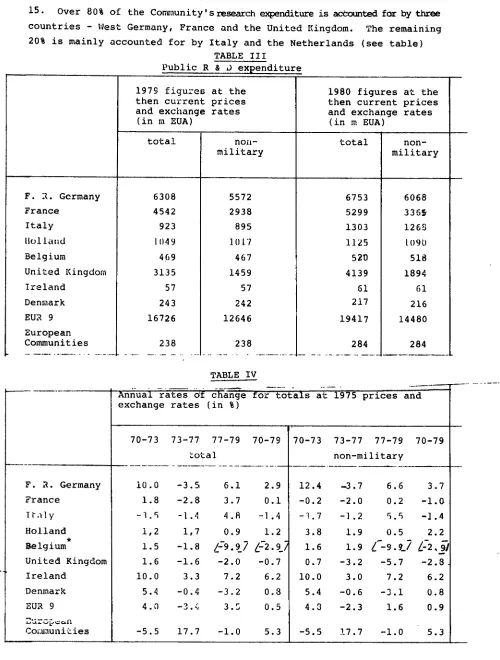
15' Over 80t of the Comrnunity'sr€search elpenditure is accounted for by three
countries - I'Iest Germany, France and the United l(ingdom. The remaining 20t is mainry accountecl for b11 rtaly and the Netherlands (see tabre)
TABLE III
PublicR&Jexpenditure
TABLE IV ual ra c c
exchange rates (in t)
F. R. Germany
france
T l,r'l y
Holland
*
Belgium
United Kingdom
Ireland
Denmark
EUR 9
D J! viJgqll
Coi'.ununi'ties
The figures in brackets tal<e account of the methodological adjusi.ments nacie in 1978
1979 figules at the
then current prices
and excirange rates
(in n EUA)
1980 figures at the
then current prices
and exchange rates
(in m EUA)
total
noit-military totaL military
non-F. :t. Germany
France
It.aIy
llol larrd
Belgium
United l(ingdorn
I reland
Denrnark
EUR 9
European
:"y::'-':"
_6 308
4542 923
I ()4 9
4!r9
313 5
57 243 L6726 1',: 5572 2938 89s
I 017
467 1459 57 242 L2646 ?,? 67 53 5299 13 03 Il25 520
413 9
61 2I7 L94t7
,l:_
6068 335S L2e,8I 09U
518 I894 61 2L6 14480
_::'
70-73 73-77 77-79 70-79
lota1 10.0 1.8 -1.5 Lr2 1.5 1.5 10.0 5.4 4.0 -5.5
-3
.5
5.I
2.9-2.8
3.7
0.1-1.4
4.8
-1.41,7
0.9
L.2-I.8
1:s .s-7 l:z.g--1.6 -2.0 -0.73.3 7.2 6.2 -0.4 -3 .2 0.8 -3.r, 3.5 0.5
17 .7 -1.0 5. 3
70-73 73-77 77-79 70-79
non-mi 1 itary
L2.4 -0.2 -1 .7 3.8 1.6 0.7 10.0 5.4 4.3 -5. 5
-3.7
6.6
3.7-2.0
0.2
-1.O-l .2
rr.5
-1 .41.9
0.5
2.2r.
e
l'-g .c-7[z.il
-3
.2 -5.7
-2.93.0
7.2
6.2-0.6 -3.I
0.8-2.3
1.6
0.9t_7.7 -1.0
5.3 [image:15.564.27.527.96.756.2]16. I4ilitary research accounts for approxi$ately a quarter of, total req€flrch spending. In the United l(ingdom it accounts for over ha1f.
TABLE V
Defence expenditureE6-T of total research expend,iture
Country 19701 1975 L979 1980
United l(ingdon France
A. R. Germany EUR 9
41.0
35 .9
L7 .7
25.9
46.4
29.8
11.0
22.2
53 .5
35.3
11. 7
24.4
54.2
36.5
10 .1
25.4 estinated
Even if research in the defence sector has spin-offs in other ar€flsr it is nonetheless true that the community of Nine is neglecting non-military research to the benefit of military research. It is particularly importqnt
to consider whether military research is like1y to be pursued even more int.ensively in future given the general deterioration in relations between
the major Powers. In the rapporteurs view any growth in the level of military research is to be deplored.
17. rf wc comparc thc community wit.h the united stateg and,rapan, the following picture emerges:
iqtal non-military public non-military
research spenaing research spending
Comrrrunity
us...
J.rparr
divideC by cDp
t.7
L.7
).()
divided by cDp
0.7 0.5
0.E
Thus Japan for exanple invests 10 to 15t more in non-military regearch
than the Comrrunity (relative to its GDp).
18. The breakdown of, research spending by the t{ember States of the Nlne according to objectives is as follows:
(see table on next page)
This sirows that expenditure on energy research in the comrnunity reprgse4ts apprcxima{:ely 40t of the expenditure on research into defence.
[image:16.564.65.381.137.281.2].TABLE VI
I
Breqldmtn by oFjeccirrcs - 197.0^ to 1980
(irt t)
I P
{
I iu td *J A (, N){
f ?hot]ndrng l.9 ard tlle qri3sic.t of a gnall nu&r of nolpclassifiable :.iscelbrErs itEhs nlai, rEan that tr€ p!6pctic.rs .b not total loot D
1970 I 1980
F
1970 1 1980
I
1970 I 1980
NL
1970 r 1980
B IJK
1970 I 1990
IRL
l.
1970 1980
DK ET,'R 9
l SbdY ad rrti'li+irn
of na:ural environrEnt
2 OrganLzaLion of htnan environr€nt
3 Protection and irprotre' nEnt of hurnan health
4 Production, distribu-tion and rational use
of energy
5 furricultural produc-tivity and technology
6 Industrial productivi-ty and technology 7 Problerns of saial ce
o<is'-ence
8 Space research and
oploitation
9 Defence
10 Ceneral prcnotion of research t.rl I 2.4 1r.3 2.L 6.6 2.7 5.3
L7 .7
49.2 2.8 3.5 6.1 L4.4 1.9 10.0 3.8 4.3 10.1 43.L 2.5 3.9 4.2 8.3 3.0 L5.2 1.8 6.3 31.8 22.7 3.0 4.L 5.5 7.5 3.9 9.3 1.3 6.2 36.5 22.2
,.tl
,tl
2L-7,,.rl
,r.rl
i;,1
,.rl
I 4r.61 2.1 L.2 5.4 22.9 4.1 r7.4 2.2 6.2 2.7 35.7 1.3 3.9 6.7 6.2 8.7 6.4 4.2 3.r 4.954 .0
0.9 5.7 6.2 4.4 8.4 6.2 5.5 3.2 3.1 55.8 3 t-2, I 6-sl 13.0, : 4.21 I i 9. el I I I 5-ol I I 3.el o.4l I I I sl.41 3.7 3.4 15.9 8.7 4.8 L4.9 u.r 5.6 0.3 31.8 0.3 2.6 1.8 7.2 2.5 16.0 0.6 r.9 41.0 25.6 0.9 L.7 2.5 6.7 4.1 6.2 1.1 2.L 54.2 20.5 1.5 6.6 5.3 o.2 55.4 r8.1 3.8 0.0 0.0 9.1 0.9 7.3 r0.5 r.0 25.7 6.1 10.2 0.9 0.0 37.3 t.7 2.6 6.7 2.6 11.9 8.1 3.9 2.3 0.3 59.8 3.r 3 13 7.7 8.8
r3. 6
7.9 3.6 0.3 39r-.I 1.6 2.7 2.9 2.3 3.3 5.5
10.3 10.6
3.1 3.7
rr.3
9 .41.9 2.8
4.3 4.4 25.9 25.4
36.2, 32-0
IUTAL EXPE.IDITI'RE 100.0 .00.0 100.0 100.0 100.0 t00.0 t:0.0 t00.0 100.0 100.0 100.0 100.0 100.0 100.0 100.0 0 100.0 100.0
of wtrich rrcn-military
R & D erpenditure 82.3 89.9 68.2 63.5 96.1 97 .3 96.8 99.6 9.7 59.0 45.8 100.0 100.0 99.7 eeJ 74.L'14.6
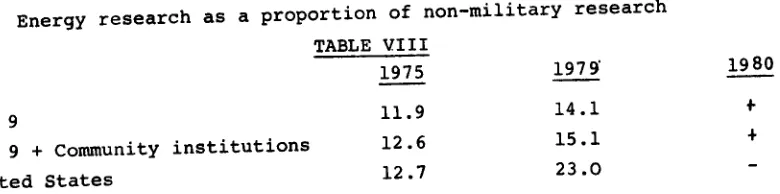
Id. Closer inspection of, for example'
distribution and rational use of energy)
public energy research (production' reveals the following:
Energy research as ProPortion of total research (military
TABLE VII
and non-militarY,)
I9 80
19 80
+ +
further
the CommunitY:
L979
3.9 8.8 74.4 2.6 o.8 9.5
100.
EUR 9
EUR 9 + CornnunitY institutions
united states
ConsiderationofenergyresearchasaProPortionofnon-militaryresearch
alone shows:
Energy research as a proportion of non-military research
TABLE VIII
L975
9.3 9.9 6.2
1979'
10.7 r1.4 1r.7
+ +
EUR 9
EUR 9 + CommunitY institutions
United States
General research
Non-nuclear primary energy products
Fue1s and nuclear transformation
Other sources of energY
EnergY=saving
Iliscellaneous TotaI
1975
tr.9
L2.6
t2.7
197
I
14 .1
15.1
23.O
20. proportionally, therefore more suPPort is given to energy research in
the United States than in the Community'
The distribution of resources to individual sectors is a interesting aspect of energy research in all t'lember States of
TABLE IX
L975
L.2 3.5
82 .3
o.4 o.3
12.3 100.
This shows that the nuclear sector oontinues to enjoy priority over other sectors. If one lvere to consider the major countries (west Germany' FrancertheunitedKingdomandltaly)andBelgiuminisolation'the
nuclear bias in energy reeearch would be even more Pronounced'
[image:18.562.77.467.301.398.2]2L.
tt is
perhaps usefulto
compare these figures with thosefor
the USA:-:
TABTE X
Nuclear energy FossiI energy
Solar energy and geothermBl Gnergy
Energy-saving
tliscellaneous Total
L975 50. 1
26.5 ?.o 4.4
12.O
IOO.
L979
38 .2
22.L
16 .4
13 .3
IO. O
100.
of energy the USA
Many will no doubt be surprised that non-nucLear sources and energy-saving measures are promoted to a greater extent in
than in the Community. (Statist,ics for changes under the Reagan
adrninistration are not yet available.) Nevertheless it is irnportant to
note that despite differences in emphasis and level of resources, research expenditure in j.pun, the USA and the Comnunity does not by
and large vary a great dqal. Closer inspection, however, shows that,
as described above, there are major differences between Member States
in the Community.
Four far more important reasons for the difference between the usA
and Japan on the one hand and the comrnunity on the other are, however,
as follows: in Europe
- there is no common language and cuLture
- there is no common education policy
- there are differences in the aid given to research
- there is a lack of mobility among researchers, i.e. there are barely any
European researeh teams.
22' The Community's research resources amount to a mere I.5t of total public R & D expenditure in the communityl. while there waE a
clear increase on average each year between 197,3 and 19gO, the figure
dropped in 1980-1981. It will rise again in 1982, but only ae a result of t-he exoenditure on fusion research.
TABLE XI P.ym.rrt
-uppropri.tiorr" fo. R .a d-lrrTh-" co**rrr,ity brrdg.t f.om . 1973
to L9822
197 3
I97 4
L975
L97 6
L977
197 I
r979 I980 198I
198e
75M EUA
84m EUA
L
lOIm EUA
135m EUA
183m EUA
195m EUA
196m 3UA
zttm EUA
249m EUA
338M, EUA
I
:CO!{ (81) 574 final
[image:19.564.77.494.75.200.2]I
partty due riidrrec't
" The &rop
in
rgSl tfrd expenditure probtemsin
generar aieto
the deraysiir
decieion-making by tfie couhcil of i{inisters.eAtteirt ih
pl+tlduta? havi ue6.ir tt€I& ,qp.23.
The maitr irr6ffs h'ffectectt{
u}ie decliiiein totar
ieseaLcrr e*,pet'ritlitnrcin
the'fierflrer liratosrro,
as ghritn j.n the t&t.e dh.pey6l7;
[*a 'g6blg orinctistrial
productl-vity and uecft't'rbioEy ana |eneral proinotiohof
iesebrch.ifhe most mark**& iitct'eases on
thi
oth€" rrandile in
the dibdsoi
protection ahdl iilprovement of huffdn hearth, ''oiglanizatl'ornof
the huheH cnviu6rrhent and the Btudy and uS€ of, faw matErials.2i.
on avetdge8t of
nationat pubi*'a resdaLch ftrids ar,e ui6afbl
internatidfie'l c6q#r{tton. The
tothls viry
betds€n s a'ridlot
iccotdfng to fifernberstate-
ltrE.larE€r couhtttesin
the CohrilRthlty tEhA t6 pt{ctebbilateral,agre"effit8 Sereas the 6hali ltrenber States pref€h
*tittLeterat
cooperarion.
oi$rte
.qnerihar hEariir adrrrinislrarive.oets;i€tai
factors operat6
ifi
favourof
multirete;er cooperation, inciudirir!:-
widcr distrilltrt iion of*.it:qrrirt.tl kuilwlr.dtler-
improved financia'I strtcturing owirr{to
consoridatioriot
bridgelary appropri,.atiotrs,-
best possihle useof
avai l.rblo resoarelr I)()tFntial .Four are*i
dt
r$ta*lch arso erlJoyprioriry in
irnultiiitEralcdolbratloni dlefefrce' e'pae6' ctrdbtar ptomotion
of
reBearctr,and lndristridl tEbhnology.
25
' Alt
ttres6 $teulsti'c6cdh only $erve as a generar guide
to
stdte effortsin
the indivl'dtusi gsdlurs bbcause thE dEmar."tionbbtween the individual
'types
of
resdlr"li trrti'"nait,,revari.s
somewrrat l'rom ccluntryt(, (.o..t ry. This presentf,tloh
of
research expenditureis,
however, dISo dlstortedbecause
it
only Sltbtysstite activities.
Thus,
for
example,in
WeetGermany a maJor $eLL
of
non-nucredr researchis
cohducted by indirstry whereasln
Ftanc4 eh;d'tne uhtteartngdbitr
ir is
flnanced from pribltc funds.But
if
the major Ht6pdftronoi
e,rioperii research 15bonducted by rhdusrry
(over two-thrrds rh
fregt cErfirany), thbn t,e dre briLitrea
to
ask hor$ [hi.s rcsearcrr capeciby cdrt b€ harii6ssedto
the godrs.ot comtiunitypolrby.
,tt.
26'
Nev€tth€res. these ?rgtrresdo show trie
srrilte-in
ttrepttort*E&
andpolicies objectfiigg
oi
the lirdivrdua,
,or.ini;.
therei=
as ydt no 'Europbdiii resbdtcii i:ollcyjrist
a" therels
no,Euibpedn,
in.iuetfl{r
poliey.lil:T::l::i
:::.j:-:i:tff::.
or
indivlduar ndtir,tarporiciei
do€E rridrcatup"ri.X.t
:. il:tjlti"rllj":'::'::""alrv
an instrumentor
nationar *ructurar techncirosical,/scientjric chanqos]tf"::":r:";:].r"ars
a6 a result oithe followlng phases can be
identified:
-secoirtl tloild ttif, p&trod,until the middle of the 5os
from 1955 to 1965
wholesale expansion in the soiences and higher education policy
great expansion of private
innovation to remain competitive. Creation of major research
institutes.
In some cases creation of research ministries
elimination of technological lacunae vis-i-vis the United States by
backing up conventional support
areas (nuclear research, space travel, military research) with data-processing and'new technologies'.
Introduction of indirect aid on a, larger sca1e.
structural policy approach to
overcome increasing signs of economic crisis
increasing financial constraints on
public budgets. Concentration of
R&D activities on modernization of economy and reducing dependence on energy imports.
Greater pressure towards i.nternational cooperation.
from the middle of the 5Os
since the beginning of the 7Os
at the beginning of the 8Os
27. This development reflects, as mentioned above, the social parameters and political objectives. Research policy has become a siqnificant instrument of nat,ional economic an4 industrial policy. Loqically, therefore, European
research policy should blcome an inst.rument of future European economic and industrial policy but this has still not happened.
In the past, the governments of the Member States were extremely reluctant
to have anything to do with a common tresearch and innovation policy. The
larger Member States in particular showed tittle interest in releasing their national hold on research policy. The smaller countries on the other hand are more inclined to favour the extension of Community research since it
enables them to increase their own potential.
28. It is also striking in the analysis of individual projects that the
proPoftion of nuClear research in Community research is between 70 and 8Ot, i.e. extraordinarily high. This proportion is no doubt historicalry
deternrined by the Euraton Treaty but it is impossibre to rid onescrf
entirely of the inpression that the Mendmr states tranefer to the European level Project,s which attrait little pubtic interest at any given ti65 in ordcr to be able to prorcte other proJeots at national revel tq, iu&rcrs the
national electorat€. Equally astonishing is the fact that agilculturll research is the lroor relation of community research, and witl clearly
renain so, the CffiiuaityrB Cormon Agricultural policy notwithstanding.
The guestion nor aris€a as to whttlrer factors hcve emerged which
would justify a netd approach to a Europcan- researeh policy. The shortage of funds and the econonic, technologtcai. and cultural challengGs faeing
Europe should have made it clear that it is absolutely essentiel to reorganize Europern research and innovation policy.
The chronolo,grical su*raries above shows that regcarch policy ic well able to adapt to shifte in the basic par|rn€ters. Sfe must therefqre alh ourselves whether there arc new factors which, notwithstanding the ne* financial constraints, Hould justify extending Community reea.arch polloy
so that we cantadd6.the coffmon problem8 on a united baeis.
Iv. Leqal bases for a Conmon Research policy
29 - The Treaties establishing the European Communitiee contain very few
provisions relating to research policy. Article 55 of the ECSC Treaty provides
for European research in the field of coal and steel, the Euratom Treaty contains comprehensive provi.sions on nuelear research in Europe. For example, Article 8 of the EAEC Treaty is the Iegal basis for the rJoint
Nuclear Rescarch Centrer. This was redesignated the rJoint Resoareh Centrer
some time ago because it had extended its area of research to the
non-nuclear sphere. And finally the EEC Treaty contains only one reference to research in Article {1 reliting to agriculture. No explicit provlsion was
made in the Treaties for further research activitles.
6ince 1966 th€ Europcan Parliament has been calllrrg in ever more urgent terms for the creation of othet rcdearch progranfiEs. It ras f,lrst assumed that the best solution for creating a legal tasis would bc ts
apply the procedure for amendlng the Trertiea pursuant to Articlc 23G of
the EEC Treaty. Article 335 vas only to be applled ln as a last fGaort.
30. There have been signs of a certain willingneag on the part of the
Council since 1967 and algo among the Heads of strte of Government cince
the surnruit meetings in rlr qt4E {n 1969 to,.ecad rt.a.rrh etiuitis .t, fryqrrr rerrcI.
'l"ltese political dcvel()pment"s need to be seen in the context of the threat to the continued exiatence of the JRC. The curvival of, thia
institution was in no ema1l heasure due to the conataht pressure from the
European Parliament throughout that period.
31. Even as latc as Lg72 it was apparent that the Council was seeking to avoid the application of Article 235 of the EEC Treaty as a legal basis for
a general research poricy. rndeed it went so far as to adopt, through the
permanent representatives acting as tthe representatives of the Member
states meeting in the Council I , a resolution on the implementation of action
in the non-nucrear fierd. This thus represented a resolution under
international law and not a Community decision. This resolution called for the conclusion of a treaty between the governments in the Member States and the JRC to allow non-nuclear research. Parliament strongly criticised this
procedure at the.time.
At the Paris 1972 Summit, there vras once again a declaration of the intention to encourage the development of a courmon policy in the field of
science and,technology. This statement was reaffirmed at the r973
Copenhagen Summit. The next step by the Council in 1974 was the adoption of
four resolutions relating to resqarch which all cite the Community fteaties as a
legal basis without referring to any specific article. The final break-through i.hen came in the same year, L974, r.rith the adoption of Ar:ticle 235
of the EEC Treaty as a legal,basLs for the adoption of the implementing
regulations to the abovementioned four resolutions. A major amount of the credil for this breakthrough is hue to the Commissioner responsible at the
time, Mr Dahrendorf, who received full backing from Parliament. Since then it has become standard practice to invoke Article 235 of the EEC Treaty
when introducing new research programmes. This represents an instittitional problem which ultitnately affects the European Parliamentts.terms of reference:
32' The Community's Treaties may be regarded as the Community's const,itution. But the Community constituon is subject to certain changes, above and beyoqd the procedures for amending the Treaties, in the sphere of Communlty case law. The latter contfibutes to the substantive. Commrrnity constituiion. This particularrv appries in cases in which the
basic communitv law does not contain substantive provisions but
specif,ically accords powers to the iommunity institutions. The cxercise of these Powers automatically modifies the relationship between the Comrnunity
and the Member States. To give a concrete example, if the Community makes usc of its general powers under Article 23s of. the EEC Treaty to assign
hitherto undefined responsibilities, this transfers policy or other regulatory decisions to the community. By virtue of the priority of community 1aw,
this in fact imposes obligations which prevent the Member States from
enacting regulations which deviate from Community law or from reaffirming thcse even at national level. As a result the substantive Community constitution is modified.
33. The European Parliament also endorsed the creation of research policy on the basis of Article 235 of the EEC Treaty
because it was convinced of the necessity for such a policy. The applieation
of Article 235 of the EEC Tr:eaty as a legal hasis however, also raisee A mlfm
from the parliamentary point of view: amendnents to the Treaties,purs$Fnt
to Article 236 of the EEc Treaty require ratification by the Member stateF pursuant to their constitutional regulatiogs, ,which includes approval by
national parliaments. On the other hand, lrhen Article 235 of the EEC Tfeety is applied, which after all represents a substantive constitutionel qmen{pp.nt,
the only parriamentary element is the consultation of the Europeap
parliqn6nt-consequently, whereas under the procedure pursuant to Article 235 of the
EEC Treaty one or more national parliaments have an opportunity to object to
the policy proposed and to prevent it being impremented by withhording
ratification of the amendment to the Treatyr when Article 235 of the s6pe {Treaty is applied, the European parliament can express its disa,pps6yar ,but
is unabre to prevent the policy being introduced by the corunirnity's regis-''lative body, the councit. The joint research poricy is an e4aapre of hqw
European policy largely esc,apes parliamentary scrutiny (Doth national
and European), and action is'Ieft tO the Commission and the Council.
The effect of these institutional problems on the rcsearch sector is that the European Parliament nust not only consider the s,.rbstance of research policy but must also insist either that t,he proc.edure for
amending the Treaties pursuant to Article 236 of the EEC Treaty be apptied
to introduce a research policy, qr. that it should be allowed to
exercise parliamentary control similar to that of the national parlianients under the procedure for amending the Treaties.
u.
34. There are th,o elements which justify a
research policy:
- the continuing shortage of br:dget resources at national revel
- the common internal and elternal challenges.
The budget situation is forcj,ng national governrnents to reduce or limit expenditure on research. This is at any rate under discussion in the capitals of the Member states. There is therefore the purely economic guestion of whether greaqe,r cooperation and coordination can enable
economies to be -rnade withoqt leading to any real loss. This could tal<e the
form of cooperation between states or research at Conmuni,ty level.
Joint
projects in basic research are feas-ibre inasmuch as they rerate to major projects (particle research, nuclear technology, lasers, marine.technclogy,, space research, Antarctic ,reqearch etc). As an exampre we may cite various
major projects which are cgurring up for decision in west Gefinany:
- further financing of fast b,qeeder and high_temperature reactors (estirnated additional finance requirqment,: one to tr^ro thousand mirtion EUA)
new approach to Community
the spallation neut.:on source, i.e. a neutron source fluxes (costing approx. 2oO miII. E[JA)
a relativistic heavy ion acee-lerator (costing approx. the Gesellschaft fiir Schwerionenforschung (Heavy Ion
Darms^uadt
with high peak
90 mill. EUA) for Research Company)
a proton-eleetron storagc ring (HF:RA) for DESy, Hamburg (e<>sts estimnte<l
at 25o mill. EUA)
Also the European science Foundation (ESF) has trecommended that a European synchrotron radiation source be built, which with premises and equipment is likely 'Lo cos'L IOO mill. EUA.
35- ?he community shourd use its own instruments
of legitimation - arbeit
they remain to be perfected - both in relation to the Member states
and to other international organizations such as the OECD, ESA,
CERN, Eir,lBL, EsO,
etc' in order gradually to assume the role of coordinator in such matters. Major installations courd be buitt and used jointly. This would read
to the formation of European teams which in turn wourd have repercussions on the European industrial and research scene.
The electron synr:hrotrott Proposod by thc IISF will serve as on trxilnrlrlr..
rts scientific necessity can be taken as assured, given the ESF,s
recommendation' The most economicar solution courd be found at community level or by following the example of CERN. costs would be reduced
and experience gained if the new electron synchrotron were connected to the
existing German erectron synchgotron prant (DEsy) in HAmburg. This
could provide both the necessary infrastructure and experience in
dealing with synchrotron radiation, sj.nce the research teams there
have already conducted research into synchrotron radiation in their
or^rn storage rings.
35' The second reason for: a common research policy is to
be found in the new
char'l'onges facing us' rnternarly
we face problems resulting from a new
wave
cr= technology (risk assessment, social acceptabirity of
technorogyr e'viro-mental and safety problems, improvements to the work
environm,ent, new
assessment of the concept of work).
Externalry we must safeguard our inter_
national cupetitirreness , use our energy and raw materiars economicalry ancl
cope with a range of problems relationg to
technol0gy transfer.
These problenrs rr6cd to be tackle6jointly bdeaude they affect us elr. rf this ie accepted as the criteria for European resoarch poriey, th6fi +lcatly the present Policy ahd vie$rs of the councir of Ministera are far
rettroved from this goar' Neithcr the seare nor type df ctrnertt reseeeh progrr1grurs trpregefttg a1
ade<1uate response to these charlenges. on the contrary, there is a danger of being overtarten by the Japanese or Americans not onr.y in the fierd of
microelectronics, but arso biotechnoLogy, narine technology
ete. Thie wourd confirn the vague fears of those who are already predicting that the base
of new technologies witr shift from the Buropean-Atlantic area to the
Japanese,/
American Pacific area. Thiswouldhave unforeseeabre conseguences
for Europe. 37. If we are to combat effectively the strategy of, gur major indtrstrial
competitoEsr- we need new measures to offset their advant&ges (large domgstic
market' uniform education system, conunon objectives, etc.). Eurae
m.rt cbrrclcp a
uniform strategy in matters of industrial competiti6n.
This 61st inctuae
not only more rnoney for research but also better, i.e. more rational, uge of
existing resources .
A11 this is very much in line with the arguments put forward by the
commission in recent years. However we wish Europeian research to be subject
to direct supervision by the European Parliament. we also want more to be done
^'o stimulate the key technologies of the future
and we want parlianrent to have a major say in all matters relating to nuclear, biorogical and chemicar
safety.