Theses
Thesis/Dissertation Collections
5-1-1980
The limiting effect of the human visual system on
image processing
Timothy J. Wilson
Follow this and additional works at:
http://scholarworks.rit.edu/theses
This Thesis is brought to you for free and open access by the Thesis/Dissertation Collections at RIT Scholar Works. It has been accepted for inclusion
in Theses by an authorized administrator of RIT Scholar Works. For more information, please contact
Recommended Citation
by
Timothy
J. Wilson
A thesis submitted in partial fulfillment
of the requirements for the degree of
Bachelor of Science in the School of
Photographic Arts and Sciences in the
College of Graphic Arts and Photography
of the Rochester Institute of Technology
May, 1980
Signiture of the Author
.
P~tographic
Science
and Instrumentation
Certified by ...•..•...•...•...•...
Thesis Advisor
Accepted by
.
by
Timothy
J. WilsonSubmitted to the
Photographic Science and Instrumentation Division in partial fulfillment of the requirements
for the Bachelor of Science degree at the Rochester Institute of
Technology
ABSTRACT
With the application of linear systems analysis, Fourier theory,
and signal processing
theory
to vision science, the properties of the visual system arebeing
defined in terms of such things as the modulation transfer functionCMTF)
. Earlier experimentationby
other researchers has calculated the visual MTF using simple sine-wave targets. This experiment demonstrates the correlation between the visual MTF and thefrequency
content of simple images. The effect of image contrast is also shown to have an effect on the subjective evaluation of image sharpness. Thisexperiment shows the need to consider the characteristics of the human
The author would like to express special thanks to Dr. Douglas
C.
Sargent, Chairperson,
and Ms. CarolynSymonds,
SystemsProgrammer,
of the Communication Support
Department,
CommunicationDivision,
ofthe National Technical Institute for the
Deaf,
for their assistanceand the use of the Data General ECLIPSE S230 minicomputer and the
Tektronix Terminal equipment in the Department.
The author would also like to thank Dr. Edward Granger for his
assistance in understanding the theoretical background of this
experiment.
The author acknowledges the assistance of the Central Intelligence
Agency
through it's grant to the Photographic Science and InstrumentationDepartment at the Rochester Institute of Technology.
LIST OF TABLES . ,,,,,,, ,,M..av
LIST OF FIGURES,..,.,,, , . , ,,,,,,t .. t ,..,..,,.,, ,v
INTRODUCTION....,...,.,...,,.,.,,,,,,...,,,, , , .
, , , , ,,,..,,,,,,,,,.1
EXPERIMENTAL ..,....,,,,.. ,,, ,..-^.^..-..,,,7
RESULTS OF EXPERIMENT. ...,.,,.,...,,.,,.,,...,,.,..,,..%U
INTERPRETATION OF RESULTS..,...,.,.,.,..,.,...,.. t ..,.,.,., . , . , ,2Q
CONCLUSIONS .,..,.,.,,.,,.,,.,,,,..,,..,,...,,, . , ,22
BIBLIOGRAPHY. . ,,,.,.,,.,..._,.,,,,,,..,,,..,,,.,,,,.23
General References.,....,...,...,,.,,,,,,..,,...,,,,,...,,.25
APPENDIX A - Computer
Programs Developed for this Experiment. , , . . , -, ,26
APPENDIX B
-A Comparison of Hybrid
Frequency
Filters and theEquivalent Ideal
CRectangle),
Filter,,,,.,,, ,,,,,,,.,,, ,36APPENDIX C
-A Comparison of One Data Record for
Frequency
Filter Effects. ... t .,,..,,,,...,.., , , ,,.,.,,,.
, . . ,47
APPENDIX D
-Experimental Images, , , , ( n . . nt . ..M.52
APPENDIX E - Tabular Results
of Pair Comparisons , , , . t ,,,,.,.,65
Table 1 Scene Luminance and
Resulting
Pupil Size.. ... .2Table El
-Ranking
of Images with.Varying
Levels of Gray. .,,,,.,.,..66Table E2
-Ranking
of High Contrast Images.,.,,...,.... ,,,...,,,67Figure 1
-Modulation Transfer Function of the Eye, ,.,,,,., ,3
Figure 2
-Reproduction of Test Image
CMade
with Output RoutineDescribed in
Text)
... r*t#**^qFigure 3
-Rectangle
Frequency
Filter and Spatial DomainFunction,
Figure 4 - Hybrid
Frequency
Filter and Spatial Domain Function..,.Figure 5
-Block Diagram of Data
Processing
Scheme,,.,,,,,,,,,,.,..,Figure 6 - Rank
Ordering
of Images wlth_Varying
Levels of Gray,..,Figure 7 - Rank
Ordering
of High Contrast Images,,..,.,....,,,,,,,,11
,.12
,,15
,.18
..19
Figure Bl - Hybrid
Frequency
Filter for 5 c/mm andSpatial Domain Function, ,.,,,,,,.,,,,.,,,.,,,,,,,,,,,,,.,37
Figure B2
-Ideal
Frequency
Filter for 5 c/mm andSpatial Domain Function. ..,...,.,,..,.,.,,..,,,...,..,38
Figure B3 - Hybrid
Frequency
Filter for 4 c/mm andSpatial Domain Function.,..,,,.,,..,,, ,,.,,,,,,.,...
39-Figure B.4 - Ideal
Frequency
Filter for 4 c/mm andSpatial Domain Function. ,,.,,,,.,,..,,,,..,,,,,,,.,,,,.,,4Q
Figure B5
-Hybrid
Frequency
Filter for 3 c/mm andSpatial Domain Function..,,..,.,..,.,....,,,,.,.,,..,,,..41
Figure B6 - Ideal
Frequency
Filter for 3 c/mm andSpatial Domain Function 42
Figure B7 - Hybrid
Frequency
Filter for 2 c/mm andSpatial Domain Function 43
Figure R8 - Ideal
Frequency
Filter for 2 c/mm andFigure B1Q - Ideal
Frequency
Filterfor
1 c/mm andSpatial Domain Function, , . , . , 46
Figure CI
-Original Data (No
frequency filtering
oredge tapering).. .,,...,..., ,.,,,., ,.,,,,.,48
Figure C2 - Data
with 5 c/mm
Frequency
Filtering., , , 49Figure C3
-Data with 3 c/mm
Frequency
Filtering, ..,.,.,.,,,,,...,,,.50Figure C4 - Data
with 1 c/mm
Frequency
Filtering...,,...,., , ., . ,51
Figure Dl
-Original Data , .,,.,,..,.,....,.,.... 53
Figure D2
-Data with 5 c/mm
Frequency
Filter Applied, .,...,.,.,.,.. .54Figure D3
-Data with 4 c/mm
Frequency
Filter Applied,. , . ,55Figure D4 - Data
with 3 c/mm
Frequency
FilterApplied,
,,.,.. ,56Figure D5 Data with 2 c/mm
Frequency
Filter Applied..,.,,,.,,,...,, .57Figure D6
-Data with 1 c/mm
Frequency
Filter Applied. ,...,.,,.,,,,, .58Figure D7 - Original Data (High. Contrast Imagel,
....,..,....,, 59 Figure. D8 Data with 5 c/mm
Frequency
Filter Applied(High. Contrast
Imagel,
.,,.,,,,,,,,..,.,.,,,.,,..,,.,.,,,,,6QFigure D9 - Data
with 4 c/mm
Frequency
Filter Applied(high.
ContrastImage)
.,,.,,,*, ,,.,....,.,,,..,.,,,.. , ...61Figure Did Data with 3 c/mm
Frequency
Filter Applied(High Contrast Imagel- ,,,,,,,.,,, .62
Figure Dll
-Data with. 2 c/mm
Frequency
Filter Applied(High Contrast Imagel, ..,,,.,,,.,.,... , . . . , 63
Figure D12
-Data with 1 c/mm
Frequency
Filter Applied(High. Contrast Imagel.. ,....,,,,,.,.,...,,,.., . 64
[image:8.539.57.490.88.678.2]The human eye, it's optics and photoreceptors, and the nervous
system which transmits signals to the visual cortex, are the main comp
onents of the human visual system. The complete function of this system
are not
fully
understood due to the complex functions of the brain init's interpretations of visual signals.
However,
the consideration thatthe eye behaves as a linear system have led to the application of linear
systems analysis, Fourier analysis, and signal processing
theory
tovision science. The modulation transfer function
(MTF)
is a measure ofhow
frequency
information will be degraded as it passes through a system.Since this is a sinewave response
characteristic, many experimenters
have classified thevisual modulation transfer function
by
measuring the7
2
34
5
eye's response to purely sinusiodal information. ' ' ' '
Since the
eye's optical system changes with object/scene luminance changes, the
visual MTF
(VTF)
must be a function of these changes. As the scene6
luminance changes, the pupil diameter of the eye changes. Shade relates
field luminance and pupil diameter. Table 1 tabulates some of these
values. Figure 1 shows the variation of the visual MTF as the pupil size
changes. There is some question as to the exact shape of the visual MTF
at very low frequencies (less than one cycle per millimeter) but this
experiment is not working in the region so the information in Figure 1
can be assumed to be valid for the region of study.
relat-it is hoped to demonstrate the relationship between the VTF and the
frequency
content of the image. It is felt that complex images are amore valid criterion for the basis of VTF functions rather than simple
sinusoidal images. This information is deemed valuable when images are
7
digitally
processed in the context of the visual system.Table 1
Scene Luminance and
Resulting
Pupil Size
Scene Luminance Pupil Diameter
(in
foot-lamberts)
(.in mm)4 x
-4
6.5
4 x
-3
5.9
0.04 5.3
0.4 4.7
1.0 4.4
4.0 3.9
10 3.6
40 3.0
100 2.8
400
1000
2.3
1.00 80 u 01 m w a cfl U H C O H 3 13 O QJ en C o en a) Pi 0) .60 -,40 -,20 + -2.0 mm -Performance of Ideal System
40 80 120 160
Spatial
Frequency
(c/mm-on retina)
200
Figure 1 - Modulation Transfer
Function
theory
9
be given here but a more complete discussion can be found in
Papoulis,
Bracewell,
andBrigham,
among others.The Fourier transform is generally be stated to be:
F(l/)=
/f(x)
exp(-/27Txu) dx.This transform also exhibits the properties of reversibility such that
a function defined in the
frequency
domain can also be defined in thespatial domain by:
f(x)=
I
F(V)
expC+i27Txu) dv.
Becuase an image is defined in two spatial
dimensions,
the Fouriertransform pair can also be defined in two dimensions:
F(tt,
V)=J_J
f(x>y)
exp(-/27rCux + v/y)) dxdy
f
(x,y)=/
r~F(u,v/)
exp(+/2tf-(ux + Vy)) du. du.Very
often, complex signals cannot be readily defined ascontinuous functions but are taken to be a sequence of discrete points.
The discrete Fourier transform
(DFT)
pair is the transform of a sequenceof N samples taken ax units apart. In one
dimension,
the discreteFourier transform pair is:
N-l
F(V)=^X1
f(x)
exp(-/2-Vx/N) x=0N-l
f(x)=
^
Yl
F(U)
exp(+/2?n;x/N)F(u,l>)= -~
S
2
f(x,y)
expC-i'2^Cax/M + Uy/N))
x=0 y=0M-l N-l
fCx,y)=
m^ a^
^
F(a,u)
exp(+/2^(ax/M+ Vy/N))
F((X,U)
orF(U)
, are often The modulus of thesefunctions,
called the Fourier spectra of the images or signals. These spectra show
the amplitude of the various sine-cosine pairs at the frequencies
contained in the signals.
When the Fourier transform is used to related the spatial-space
and the
frequency
domain,
one must always consider the effects thatoperations in one domain will have on the other domain. As an example,
multiplication operations in one domain are convolution operations in
the other domain. These interrelated effects must be taken into consid
eration when
designing
filters to be used in one domain. Considerationsfor the filters designed in this experiment are descussed in the
EXPERIMENTAL section and in APPENDIX B.
When a signal is sampled over finite
limits,
it is said to betruncated at those limits. This is because there is no information
about the signal outside of those limits. The act of sampling a signal
in one domainn causes the transform of that signal in the other domain to
become an
infinitely
periodic function. This means that the discreteFourier transform gives the results for a truncated original signal as
though this signal were
infinitely
periodic, with one periodbeing
thein the
frequency
domain. This error introduced into the- transform iscalled
"wraparound".
In order tokeep
this effect to a minimum, it isU
necessary to taper the original function down to zero at the edges.This causes some loss of information at the edges of the function but
eliminates the false
frequency
characteristics causedby
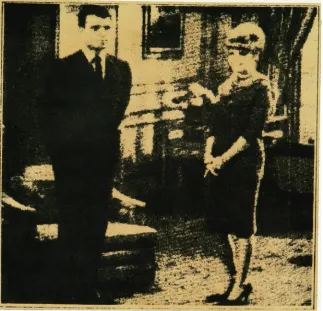
the wraparoundThe test image used for the experiment is an Indoor scene.
The
digitized
data for this scene was suppliedby
the thesis advisor.The image is one of a set that has wide use in
industry
for image experimentation. This scene was selected because it contains adequate detail
for this experiment. The test image is represented
by
a two-dimensionalarray, 256 x
256,
with each pointhaving
a brightness value between 1 and256. Figure 2 is a representation of the test image.
A Fast Fourier transform was used to compute the
frequency
spectrum of the test image. The image is composed of an array of 64,000
words of data. To allow this to be processed using a two-dimensional
Fast Fourier transform
(FFT)
, all of the image data would have to beresident in the working core of the host computer. In this experiment,
all FFT calculations were done on the RIT Honeywell-Xerox Sigma 9
computer system.
However,
the maximum allowable core use for one user atone time is 32,000 words. This necessitated the design of an FFT program
which processed less than the full picture at one time. It is generally
assumed that the information in one dimension of the image can be
oper-13
ated upon seperatly from information in the other
dimension,
so it canbe shown that the two-dimensional discrete transform discussed in the
introduction can be applied one dimension at a time.
Using
this as abasic premise, a program was written that applies a one-dimensional FFT
edges of the image to zero. The filter consisted of a raised cosine
function that goes from a value of one to a value of zero in 25 points
U
along each edge.
The actual FFT routine used in this experiment is a FORTRAN
subroutine called
FOURG,
which was developedby
Mr. Norman Brenner of14
the MIT Lincoln Laboratory. This routine is generally available in the
industry
today. It was developed to accept any number of data points, Nrather than 2 points as in most FFT routines. Although the experiment
Q
only uses 256
(2
)
points in the FFT at a time, this subroutine was used so that the number of data points processed could be completelyflexible.
The program written for this experiment that applies the
tapering
filter and takes the minus-J transform of the orignal image data is
called MINTRANS. It is listed in APPENDIX A along with other programs
written for this experiment. This program executed in approximately
9 minutes of computation
(CPU)
time on the RIT Sigma.The filters used in the
frequency
domain in this experimentwere designed with two major considerations. The first was that
they
should be as sharp cutting as possible. This suggested a rectangle
function should be used.
However,
the other consideration was the effectof the filter in the spatial space after the image was reconstructed.
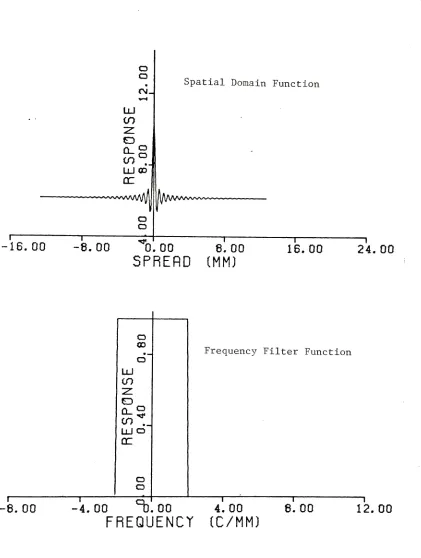
Since the Fourier transform of the rectangle function is the sine
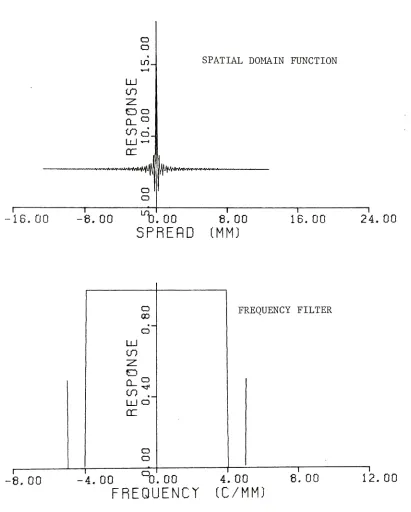
Figure 3 shows an ideal rectangle filter which cuts at 2 cycles per
millimeter
(c/mm)
in thefrequency
domain and the resulting sine functionin the spatial domain. In this case, the spread of the sine function is
over 16 millimeters
(mm)
in the reconstructed image. The visual effectin the reconstructed image due to the ripples in the sine function is
known as
"ringing".
A filter should be developed that keeps ringing toa minimum.
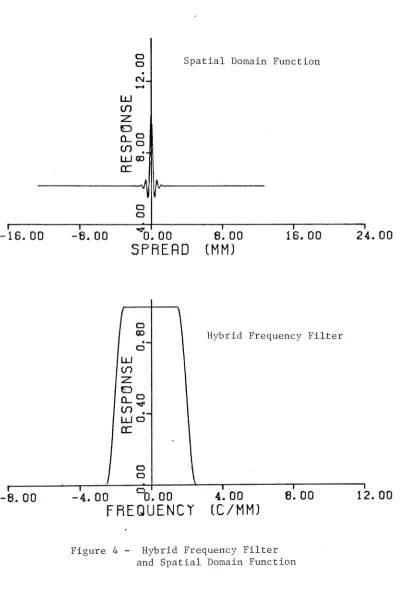
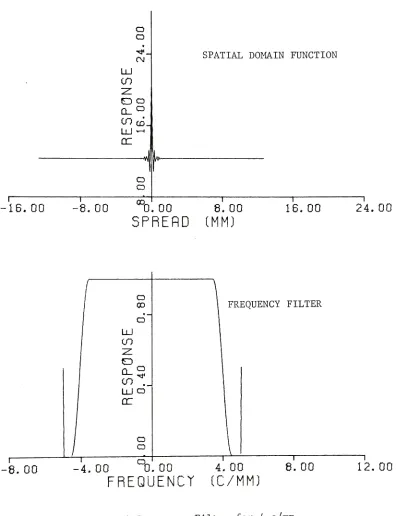
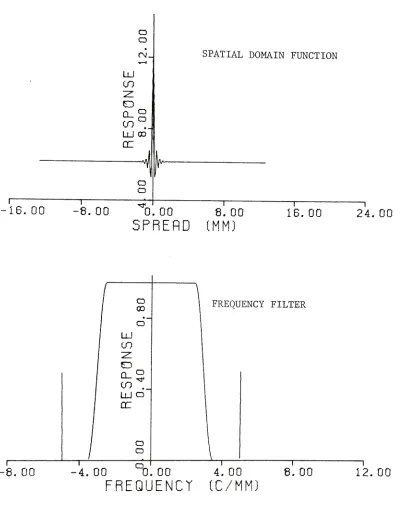
A hybrid
frequency filter,
combining the characteristics of boththe rectangle filter and a raised cosine
function,
was used in thisexperiment. One half of the cosine cycle was scaled to modulate from
100% to 0% in 25 points of the array. Figure 4 shows a hybrid
frequency
filter which is at 50% at 2 c/mm. The 50% point of the filters used
in this experiment was defined to be the cutoff
frequency
of the filter.The resultant function in the spatial domain is also shown in Figure 4.
The hybrid filter greatly reduces the spread in the spatial domain
caused
by
the convolution of the filter's transform with the image points.Using
the program MINTRANS as abasis,
a program was developed asa plus-J transform to back-transform the filtered
frequency
domain data.This program also applied the
frequency
filters that were developed. Itis listed in APPENDIX A as the program PLUSTRANS.
The sampled
frequency
domain of a signal is related to itsJ5
spatial space
by
the Nyquist Equation:NAfAX=1,
where N is the number of samples, Af is the
frequency
interval,
and axo o LU en -z. o
-en . LUOO DC -^-^n^aa/vVVAAAA/1 o o -16.00 -8.00Spatial Domain Function
0.00
SPRERD
8.00
(MM)
16.00
24.00
o 00Frequency
Filter FunctionLU en -z. d tn ._ LU O QC
1 1 1 i i
-8.00 4.00
^.00
4.00
FREQUENCY
(C/MM)
8.00
12.00
Figure 3
-Rectangle
Frequency
Filter [image:19.539.52.473.37.595.2]o o
LU cn
o
^
in.
LUCO CC
o
-16.00 -8.00
Spatial Domain Function
^|^~
0.00
SPREAD
8.00
(MM)
16.00
24.00
-8.00
Hybrid
Frequency
Filter4.
00
~0.
00
4.
00
FREQUENCY
(C/MM)
8.00
12.00
Figure 4 - Hybrid
Frequency
Filter [image:20.539.55.459.57.649.2]signal given by:
max 2ax
In this experiment, only 256 samples are available along one dimension.
Once the size of the final image is
defined,
it's maximumfrequency
andfrequency
sampling interval are defined. The published data on visual MTFgiven in the INTRODUCTION shows that the area of the
frequency
responseunder test is from one to ten cycles per millimeter on the image. This
criterion will define the visual angle necessary to be subtended
by
theprints to give the
frequency
range required.The
frequency
filters used in this experiment were designed tocut off at frequencies of 1 c/mm, 2 c/mm, 3 c/mm, 4 c/mm and 5 c/mm on
the prints. APPENDIX B shows these filters along with their respective
spatial domain pairs. Also in this appendix are the equivelant "ideal"
rectangle filters and their spatial domain pairs for comparison.
An output scheme was developed for this experiment when no
suitable established routine could be located through local
industry
that was accessable to the author. Because of the limited number of
alternative methods, an output routine was written for a Tektronix 4014
Graphisc CRT terminal (with the Extended Graphics
Option),
and a Tektronix4631 Hard
Copy
Unit,
which was available through the thesis advisor.The output method uses a scheme of
halftoning
to produce thedesired desities.
However,
due to the terminals screen resolution,each halftone pixel was capable of produceing only sixty-four levels of
be turned on or off. The size of the points making up each pixel is the
smallest available on the terminal. The pixels are created from the
center of the array outward such that the pixel appears to be a growing
dot as the
density
value at the point increases. Since the output schemeoutputs only sixty-four levels while 256 levels are
input,
the programalso rescales the data.
Many
of the factors in an output system of this type have not beenthroughly
investigated since the purpose of this experiment hasnot been to design an output system. The effects of beam size, screen
noise, and the reproduction characteristics of the hard copy unit have
not been studied here. All of these factors were
initially
adjusted togive a print acceptable for the experiment and then held constant
throughout the remainder of the output process.
The FORTRAN program OUTPUT is listed in APPENDIX A. This is the
program used to produce the images used in this experiment. The
output-ing
was done using the terminal equipment described above and a Data General ECLIPSE S230 minicomputer. Images were output at a rate ofabout one image every two and a half hours of user time. This mini
computer was used because the system had certain intrinsic characteristics
that allowed faster output than either the RIT Sigma system or the Xerox
Sigma system. These characteristics allowed for a more efficient program
and a higher avaialble output baud rate.
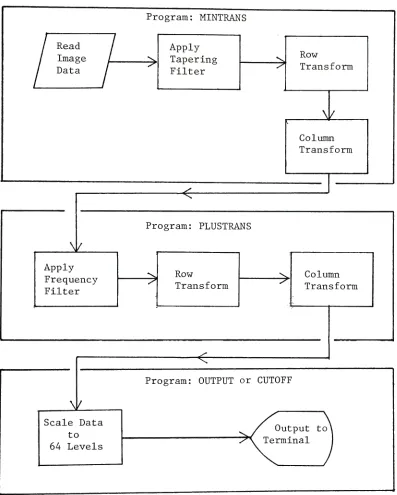
Figure 5 is an overall block diagram
describing
the dataprocessing and output scheme used in this experiment. It shows the
Read Image Data
^L
Apply
Frequency
Filterit
Scale Data to 64 Levels Program: MINTRANS ">Apply
Tapering
Filter "> Row TransformAk
Column Transform < Program: PLUSTRANS "> Row Transform "> Column Transform <Program: OUTPUT or CUTOFF
Output to'
"/\
TerminalFigure 5 - Block Diagram of Data
[image:23.539.61.458.107.602.2]Another method of outputing the data to the Tektronix terminal
was a threshold level program called CUTOFF. This program prints a
completely black pixel of the brightness level of the data was below
a selected value. If the data was above that
level,
the area was leftblank
(white).
This produced a set of test images of high contrast.The resulting images from the hard copy unit used in this experiment
contained a ripple effect along the x-direction. This effect was constant
in all of the test images.
The two sets of images produced from the data were set up such
that the illumination level and viewing angle would allow for
comparison of the results of this experiment with the earlier experiments
presented in the introduction. The illumination level was set to 72
foot-lamberts. The images were placed such that
they
subtended a visualangle of 3.8 to the observer. Under these conditions, the images were
viewed two at a time for pair comparison analysis. The results of this
pair comparison has been evaluated using the
"Rickmers-Todd
Method For16
Analysis of Subjective Judgements1.1
The observers were asked to rate
the images
by
sharpness for both sets of data. The observers wereasked to discount the ripple effect in the high contrast set of images
and attempt to judge sharpness of the images with the various gray levels
RESULTS OF EXPERIMENT
The two sets of images are shown in APPENDIX D. The tabular results
of the pair comparisons are shown in APPENDIX E. The Rickmers - Todd
method places the images on a scale ranking their relative
position.*
Figures 6 and 7 show the resulting ranks of the two sets of images.
Both figures show the average of the results of the observers that were judged to be consistant and the average of the results of all of the
observers. For both sets of
images,
the consistant observers were foundto significantly agree in their evaluation
(using
0.05 level ofsignificance). For the prints with varying levels of gray, the
coefficient of concordance for the consistant observers was 0,95.
The coefficient of concordance for the consistant observers of the
high contrast prints was 0.9.1,
This scale is not a true interval scale but Interpretations as to the
relative similarity or difference of prints can be made
by
noting theby
2&4 3 l
1
,
,
1
4 2 3 6 5
Ranks
by
All ObserversFigure 6 - Rank
Ordering
of Images withVarying
Levels2 3 4&5
1
1
h
2 3 4 5
Ranks
by
All ObserversFigure 7 - Rank
INTERPRETATION OF RESULTS
The results shown in Figures 6 and 7 are in overall agreement
with, earlier experimental results, J'/->i>^'-}
The image with varying levels of gray that had a
frequency
cutoffof 4 c/mm Is ranked equal with the image have 2 c/mm cutoff. This is
felt to be due to the fact that the 4 c/mm image had a slightly
higher overall brightness in comparison with the rest of the prints.
The reason for this is perhaps some
inconsistancy
in the hard copy unitof the Tektronix terminal at the time of output. Since sharpness (or
J7
acutance) is related to
density
differences,
differences in the overalldensity
levels of the images are contributing factors in the subjectiveevaluation of sharpness. When the high contast images of the same data
were ranked, all of the images were ranked in the order predicted
by
previous experiments.
The reversal of the order of the images with 5 c/mm cutoff and
6 c/mm cutoff in the ranking of the images with varying levels of gray
might also be attributed to the above effect. Since theory predicts
that the eye's
frequency
response to these images is approximately thesame, the proximity of these two images in the ranking indicates very
little difference judged between these images. In the case of the high
contrast
images,
all of the upperfrequency
cutoffs are grouped together.This shows a similarity in there judgement as predicted
by
theory.this type, certain changes might be made in the experiment.
First,
abetter,
more consistant output system needs to be used. A more throughunderstanding of the effects of the variables of the output system are
necessary. Controls on the output system to produce prints which vary
only in their sharpness due to the
frequency
cutoff of the data is alsonecessary.
Secondly,
enough data must be used such, that higher frequenciesoutside of the visual MTF range are available. This will allow for more
through
testing
of the visual effects offrequency
manipulationCONCLUSIONS
D
The modulation transfer function of the human visual system
developed through simple sine-wave targets has been demonstrated to
work for complex images.
2)
The effect of image contrast has been shown to be. signaficant on
BIBLIOGRAPHY
McCann,
J.J.,
R.L.Savoy,
and J. A.Hall,
Jr."Visibility
of LowFrequency
Sine-Wave Targets: Dependence on the Number of Cyclesand Surround
Parameters",
VisionResearch,
1978,
18.2
Watanabe,
A.,
T.Mori,
S.Nagata,
and K. Hiwatashi."Spatial
Sine-WaveResponse of the Human Visual
System",
VisionResearch,
1968,
18.3
Carlson,
C.R.,
R.W.Cohen,
and I. Gorog."Visual
Processing
of SimpleTwo-Dimensional Sine-Wave Luminance
Gratings",
VisionResearch,
1977,
17.4
Wilson,
H,R. and S.C. Giese."Threshold
Visibility
ofFrequency
GradientPatterns",
VisionResearch,
1977,
17.Campbell,
F.W. and J.G. Robson."Application
of Fourier Analysis to theVisibility
ofGratings",
J.Physiol.,
1968,
197.6
Shade,
O.H."Optical
and PhotoelectricAnolog
of theEye",
J. Opt. Soc.Am. ,
1956,
46.7
Stockham, T.G.,
Jr."Image
Processing
in the Context of a VisualModel",
Proceedings of the
IEEE,
July 1972,
60(7).g
Campbell,
F.W, and R.W.Gubisch,
"Optical
Quality
of the HumanEye",
J.
Physiol.,
1966, 186,
pg. 570,9
Papoulis,
A. The Fourier Integral and Its Applications. New York:McGraw
-Hill,
1962.Bracewell,
R.N. The Fourier Transform and ItsApplications,
2nd ed..New York: McGraw
-Hill,
1978.Brigham,
E.O. The Fast Fourier Transform. EnglewoodCliffs,
NJ;Prentice
-Hall,
1974.13
Gonzalez,
R.C. and P. Wintz. Digital Image Processing.Reading,
Mass.: Addison-Wesley,
1977,
pg. 50-52.14
Brenner,
N. Various Program Listings andDescriptions,
Suppliedby
Thesis Advisor.Gonzalez and Wintz. Digital Image Processing, pg. 70-75.
16
Rickmers,
A."Rickmers
-Todd Method For Analysis of Subjective
Judgements",
Handout from Author.11
James, T.H.,
ed. TheTheory
of the PhotographicProcess,
4th ed. . New York:Macmillian,
1977,
pg. 602-603.1 S
Hamming,
R.W. Digital Filters. EnglewoodCliffs,
NJ: Prentice-Hall,
1977,
pg. 178-179.19
General References
Andrews,
H.C. and B.R. Hunt. Digital Image Restoration. EnglewoodCliffs,
NJ: Prentice-Hall,
1977.Bracewll,
R.N. The Fourier Transform and ItsApplications,
2nd ed..New York:
McGraw-Hill,
1978.Brigham,
E.O. The Fast Fourier Transform. EnglewoodCliffs,
NJ: Prentice-Hall,
1974.Chavez,
Noel."The
Modification of Simple Imagesby
Fourier Transform Manipulation". RIT Bachelor of ScienceThesis,
June 1979.Cooley,
J.W. and J.W.Tukey,
"An
Algorithm for the Machine Calculation ofComplex Fourier
Series",
Math.Computation,
April1965,
19.Gaskill,
J.D. LinearSystems,
FourierTransforms,
and Optics. New York: JohnWiley,
1978." ' "
Gonzalez,
R.C. and P. Wintz. Digital Image Processing.Reading,
Mass.: Addison-Wesley,
1977.Pratt,
W.K. Digital Image Processing. New York: JohnWiley,
1978.APPENDIX A
Computer Programs Developed
for this Experiment
This appendix contains computer programs that where written for
this experiment
by
the author. The programs MINTRANS and PLUSTRANS arewritten to use XEROX EXTENDED FORTRAN IV but should be compatable with
most other FORTRAN compilers. The program OUTPUT was written using the
Data General FORTRAN V compiler, as was the program CUTOFF.
Both MINTRANS and PLUSTRANS use the subroutine FOURG. This sub
routine is the Fast Fourier Transform used in this project. Other
FFT routines could be substituted for FOURG. FOURG is not listed in this
appendix because it is generally available and other FFT routines can be
CCC FILENAME: MINTRANS
CCC THIS PROGRAM TAKES THE MINUS I TRANSFORM OF A 256 X 256 ARRAY
CCC USING A SERIES OF ONE-DIMENSIONAL FFT'S TO REDUCE WORKING CORE
CCC MEMORY SPACE.
CCC
C DIMENSION ARRAYS
C
REAL
INREAL(256)
,INIMAG(256),OUTREAL(256),*OUTIMAG(256)
,TRANSFORM(2,256) ,WORK(256),*FILTER(256)
INTEGER IN!
(256)
C
C CREAT TAPERING FILTER
C
DATA FILTER/256*
1.0/
FACTOR = 3.141593/26.0
DO 50 1=1,26
FILTER(27-I)=(COS(FLOAT (I)*FACTOR)+1.0)/2.0
50 FILTER(240+I)=(COS (FLOAT(I)*FACTOR)+1.0)/2.0
C
C READ IN AND TRANSFORM ROW DATA AND OUTPUT TO A TEMPORARY FILE
C
DO 300 1=1,256
CALL BUFFIN(1,1,IN1,256)
DO 100 J=l,256
TRANSFORM(l,J)=FLOAT(INl(J))*FILTER(I)*FILTER(J)
100 TRANSFORM
(2,
J)
=0,0CALL FOURG(TRANSFORM,
256,-1, WORK)
DO 200 K=l,256
OUTREAL
(K)
=TRANSFORM(
1,K)
200 OUTIMAG(K)=TRANSFORM(2,K)
CALL BUFFOUT
(2,1,
OUTREAL,
256)
300 CALL BUFFOUT(3,l,OUTIMAG,256)
REWIND 2
REWIND 3
C
C READ IN DATA FROM TRANSFORM TEPORARY FILES AND TRANSFORM COLUMNS AND
C OUTPUT TO FILES FOR DISC STORAGE
C
DO 600 M=l,256
DO 400 N=l,256
CALL BUFFIN(2,1,INREAL,M)
CALL BUFFIN
(3,1,
INIMAG,M)TRANSFORM( 1,N)=INREAL
(M)
400 TRANSFORMS,N)=INIMAG(M)
CALL FOURG
(TRANSFORM, 256,-1, WORK)
DO 500 1=1,256
OUTREAL
(I)
=TRANSFORM(1,I)
CCC FILENAME:MINTRANS
(CONTINUED)
C
CALL
BUFFOUT(4,l,OUTREAL,256)
CALL
BUFFOUT(5,l,OUTIMAG,256)
REWIND 2600 REWIND 3 STOP
CCC FILENAME: PLUSTRANS
CCC THIS PROGRAM TAKES THE PLUS I TRANSFORM OF A 256 X 256 ARRAY USING
CCC A SERIES OF ONE-DIMENSIOAL FFT'S TO REDUCE WORKING CORE MEMORY
CCC SPACE.
CCC THIS PROGRAM ALSO APPLIES THE SELECTED FREQUENCY FILTER TO THE INPUT
CCC DATA.
CCC
C DIMENSION AND INITIALIZE ARRAYS
C
REAL
INREAL(256)
,INIMAG(256) ,OUTREAL(256),OUTIMAG(256),*TRANSFORM(2,256),WORK(2,256),INl(256),IN2C256),FILTER(256)
INTEGER
IOUTREAL(256)
DATA FILTER/256*0.0/
FACTOR=3.141593/26.0
C
C SELECT FILTER TO BE USED ON INPUT DATA
C
READ
100,
IFIL100 FORMAT
(II)
IF(IFIL.EQ.5)
GOTO 10IF(IFIL.EQ.
4)
GOTO 20IF(IFIL.EQ.
3)
GOTO 30IF(IFIL.EQ.
2)
GOTO 40IF(IFIL.EQ.l)
GOTO 50C
C CREAT THE NECESSARY FILTER C
10 DO 1100 1=1,14
FILTER(I+115)=(.COS(FLOAT(I)*FACTOR)+1.0)/2.0
1100 FILTER(141-I)=(COS(FLOAT(I)*FACTOR)+1.0)/2.0
GOTO 200
20 DO 1150 1=1,70
1150 FILTER(1+9
3)
=0.0DO 1200 1=1,26
FILTER(I+89)=(COS(FLOAT(I)*FACTOR)+1.0)/2.0
1200 FILTER(167-I)=(COS(FLOAT(I)*FACTOR)+1.0)/2.0
GOTO 200
30 DO 1250 1=1,129
1250 FILTER(I+63)=0.0
DO 1300 1=1,26
FILTER(I+63)=(COS(FLOAT(I)*FACTOR)+1.0)/2.0
1300 FILTER(193-I)=(COS(FLOAT(I)*FACTOR)+1.0)/2.0 GOTO 200
40 DO 1350 1=1,179
1350 FILTER
(1+38)
=0.0 DO 1400 1=1,26FILTER(I+38)=(COS(FLOAT(I)*FACTOR)+1.0)/2.0
1400 FILTER(218-I)=(COS(FLOAT(I)*FACTOR)+1.0)/2.0
GOTO 200
CCC FILENAME: PLUSTRANS
(
CONTINUED)
CDO 1500 1=1,26
FILTER
(1+1
3)=(COS (FLOAT
(I)
*FACTOR)+l
.0) /2
.01500 FILTER(243-1)=
(COS (FLOAT
(I)
*FACTOR)+1.0)/2.0
CC READ
IN, FILTER,
AND TRANSFORM ROW DATAC
200 DO 300 1=1,256
CALL
BUFFIN(1,1,IN1,256)
CALLBUFFIN(10,1,IN1,256)
DO 110 J=l,256TRANSFORMQ
,J)
=IN1(
J)
*FILTER(I)
*FILTER(
J)
110
TRANSFORMS,
J)=IN2(J) *FILTER(I)*FILTER(J)
CALL FOURG(TRANSFORM,
256,
+1,
WORK)
C
C SCALE DATA AND OUTPUT TO TEMPORARY FILES
C
DO 210 K=l,256
OUTREAL
(K)=TRANSFORM(l,K)/256.
210 OUTIMAG(K)=TRANSFORM(2,K)/256,
CALL BUFFOUT
(2,1,
OUTREAL,256)300 CALL
BUFFOUT(3,l,OUTIMAG,256)
REWIND 2
REWIND 3
C
C READ IN DATA FROM TEMPORARY FILES AND TRANSFORM COLUMNS
C
DO 600 M=1,256
DO 400 N=l,256
CALL BUFFIN
(2,1,
INREAL,M)
CALL BUFFIN
(3,1,
INIMAG,M)
TRANSFORM
(1,N)=INREAL(M)
400 TRANSFORM(2,N)=INIMAG(M)
CALL FOURG
(TRANSFORM,
256,
+1, WORK)
CC SCALE AND OUTPUT DATA TO DISC STORAGE
C
DO 500 1=1,256
The
following
program,PACK1,
is used to pack the data producedby
PLUSTRANS such that there are 4 data values per word of memory
(32 bits)
on the Sigma 9. This is equivalent to packing one value per byte
(8 bits)
rather than per word. This facilitates data storage
by
cutting requiredspace
by
a factor of four and allows ease of data transfer between theSigma 9 and the Eclipse S230 used to output the images. The program
OUTPUT unpacks the data for use.
CCC FILENAME: PACK1
CCC THIS FILE PACKS DATA TO FOUR VALUES PER WORD
(
ONE VALUE PERCCC BYTE
)
USING A FORTRAN CONTROL PROGRAM AND A META-SYMBOLCCC PACKING SUBROUTINE.
CCC
C CONTROL PROGRAM - READS IN DATA AT ONE VALUE PER
WORD,
CALLS C PACKINGSUBROUTINE,
AND OUTPUTS PACKED DATA.C
INTEGER
IN1(256), 0UT1(64)
DO 200 1=1,256CALL
BUFFIN(1,1,IN1,256)
IF(ICHECK(1).EQ.3)
GOTO 300CALL
PACK(IN1,0UT1,64)
200 CALL
BUFFOUT(2,l,OUTl,64)
300 STOP
END
C
C META-SYMBOL PACKING SUBROUTINE C
SUBROUTINE PACK(IN,OUT,IWORDS)
IMPLICIT INTEGER
(A-Z)
BYTES=4*IW0RDS-1
S
LI,
4 0S10 LW,9 *IN,4
S
AND,
9 =X'FF' SSTB,
9 *0UT,4S AI,4 1
S CW,4 BYTES
S BLE 10S
CCC FILENAME: OUTPUT
CCC THIS PROGRAM READS IN THE PACKED IMAGE DATA AND PRODUCES A HALFTONE
CCC IMAGE ON A TEKTRONIX 4014 GRAPHICS TERMINAL FOR COPYING TO A HARD CCC COPY UNIT. THIS PROGRAM RUNS ON A DATA GENERAL ECLIPSE S230
CCC MINICOMPUTER UNDER THE FORTRAN V COMPILER.
CCC
C INITIALIZE ARRAYS
C
IMPLICIT INTEGER
(A-Z)
INTEGER
IN1(256),IN2(128),FNAME(16)
CC OPEN DATA FILE OF
INTEREST,
INITIALIZE SCREEN POSITION CREAD(11,2)FNAME
2 FORMAT
(16S2)
DO 10 1=2,3210
IF(BYTE(FNAME,I).EQ.040K)
BYTE(FNAME,I)=0 OPEN 3,FNAME,LEN=256LODEN=l
TYPE ' FOR NEGATIVE ON
SCREEN,
TYPE "-"' READ(11,
50)
INEGTYPE ' INPUT UPPER CORNER COORDNINATES (X THEN
Y)
'READ
(11,
30)
IIXREAD(11,30)
IY30 FORMAT
(14)
50 FORMAT
(Al)
CC INITIALIZE TERMINAL
MODE,
DRAW BORDER AROUND IMAGEAREA,
SET C BEAM SPOT SIZE TO MINIMUMC
CALL
INITT(O)
CALL TERM(3,4096)
CALL NEWPAG
CALL BORDER
(IIX,
IY)
CALL
TOUTPT(27)
CALL
TOUTPT(28)
CALL
TOUTPT(64)
C
C READ IN AND UNPACK DATA
C
DO 400 J=l,256
READ(3,100,END=999)(IN2(K),K=1.128)
100 FORMAT
(128A2)
K=l
DO 200 L=l,256 IN1(L)=BYTE(IN2,K)
K=K+1
C SCALE DATA TO 64 LEVELS AND CALL PIXEL ROUTINE TO PRODUCE
C HALFTONE PATTERN
C
IX=IIX
DO 300 1=1,256
IF(INEG.EQ.2H-)IN1(I)=110-IN1(I)
IF(IN1(I).LT,0)
IN1(I)=0DEN=IFIX(FLOAT(IN1(I))/4.0)
IF
(DEN.
GT,64)
DEN=64CALL
PIXEL(IX,IY,DEN,LODEN)
300 IX=IX+8
400 IY=IY-8
C
C MAKE A HARD COPY OF THE FINISHED IMAGE AND END C
CALL HDCOPY CALL
FINTT(0,0)
GOTO 500999 TYPE
'END
OF FILE-ERROR ON READ'
500 STOP
END C
C PIXEL SUBROUTINE - ROUTINE
WHICH PRODUCES HALFTONE "DOTS" C
SUBROUTINE PIXEL
(IX,
IY,DEN,LODEN)
IMPLICIT INTEGER(A-Z)
INTEGER
XMOV(64),YMOV(64)
DATA XMOV?*0, 1,-1, 1,-1, 1,-2, 1,-2, 3,
-2,1,-2, 3,
-3,3, 0,-3, 1,1, 2,
5,
*3,
-1,3,-5,5,
-5,4,
-3,0,3, 1,-5, 6,
-7,3, 1,0,
-1,4,-7,*6,
-5,5,
-5,4,
-3,5,
-7,7,
-7,2, 3,
-5,7,
-6,5,
-5,5,
1,-7, 0,7,
0,-7/
*YMOV/
*0,
1,0,
-1,2,-3,1,1,
-2,3,
-1,-1,2,
-3,3,
-3,4,
-5,3,-1,
*3,
-5,2, 1,-2, 3, 1,-5, 5,
-5,4,
-3,2,
-1,4,-7,7,
-7,3,1,
*2,
-5,0,5,
-6,7,
-2, -3,0,3,
-5,7,
-6,5, 1,-7, 0,7,
-6,5,
-6,7,
-7,7/
IF(DEN.EQ.
LODEN)
RETURNCALL
MOVABS(IX,IY)
DO 100 IVAL=1,DEN
CALL PNTREL
(XMOV(IVAL)
,YMOV(IVAL)
)
100 CONTINUE RETURN END C
C BORDER SUBROUTINE - DRAWS BORDER AROUND IMAGE AREA
C BORDER SUBROUTINE
(_
CONTINUED)
C
CALL
DRWABSClX+2064,IY-2064)
CALL
DRWABS(IX,IY-2064)
CALL
DRWABS(IX,IY)
RETURN
CCC BELOW THIS THRESHOLD CAUSES A FULL BLACK PIXEL TO BE PRODUCED.
CCC ALL DATA ABOVE THE THRESHOLD IS NOT PRINTED.
CCC THIS PROGRAM RUNS ON A DATA GENERAL ECLIPSE S230
CCC MINICOMPUTER UNDER THE FORTRAN V COMPILER.
CCC
C INITIALIZE ARRAYS
C
IMPLICIT INTEGER
(A-Z)
INTEGER INI(2 5 6
)
,IN2(
1 2 8)
,FNAME(1
6)
C
C OPEN DATA FILE OF INTEREST
C
TYPE " DATA FILE NAME? "
READ
(11,
2)
FNAME2 FORMAT
(16S2)
DO 10 1=2,32
10 IF(BYTE(FNAME,I),EQ.040K) BYTE
(FNAME,
I)
=0OPEN 3,FNAME,LEN=256
C
C SET THRESHOLD LEVEL
C
55 TYPE " CUTOFF LEVEL?
(1-256),
"READ(.11,60)IVAL
60 FORMAT
(13)
IFCIVAL.EQ.999) GO TO 500 C
C INITIALIZE TERMINAL
MODE,
THEN READ AND UNPACK DATAC
CALL
INITT(O)
CALL NEWPAG
DO 400 1=518,263,-1
READ(.3,1,END=999) (IN2
(K)
,K=1 ,128)
1 FORMAT
(1
28A2)
DO 200 L=l,256
200 IN1(L)=BYTE(IN2,L)
C
C OUTPUT PIXELS WHEN DATA IS LESS THAN THRESHOLD
C
DO 400 K=384,639
IF(IN1(K-383).LT.IVAL) CALL PNTABSC2*K-5
12,
2*1-390)
400 CONTINUE
CALL FLNTT(0,0)
C
C LOOP BACK TO SET DIFFERENT THRESHOLD
C OR END
GO TO 55
999 TYPE
"END
OF FILE"APPENDIX B
A Comparison of Hybrid
Frequency
Filtersand the Equivalent Ideal
(Rectangle)
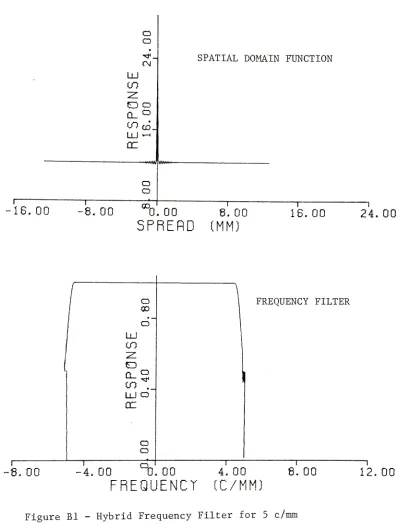
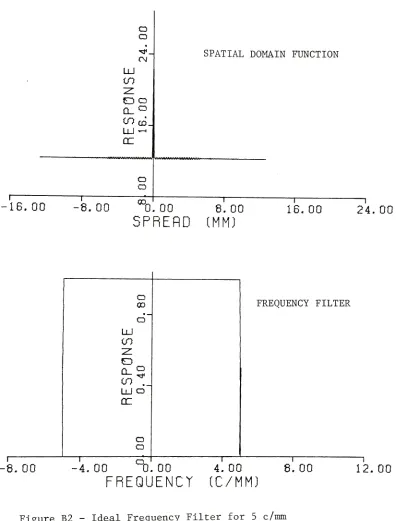
FilterThis appendix contains figures showing the hybrid
frequency
filters used in this experiment. These are shown along one axis of the
two-dimensional filter actually used. The spatial domain function assoc
iated with each filter is shown with the filter. On the
following
page,the equivalent ideal
(rectangle)
filter and it's spatial domain functionare shown for comparison.
The two vertical lines on each of the
frequency
domain figuresare the limits of the
frequency
content in the image (from the Nyquisto o
UJ in z
Oa
t-n&A
LU -< DC-16.
00
-8.00o
o
oa.
SPATIAL DOMAIN FUNCTION
0.00
SPREAD
8.00
(MM)
16.00
"24.00
FREQUENCY FILTER
-8.
00
-400
0.
00
FREQUENCY
4.00
(C/MM)
8.00
12.
00
Figure Bl - Hybrid
Frequency
Filter for 5 c/mm [image:45.539.58.456.81.605.2]o o
"*_
CM
LU in z.
cnoj- LU-QZ
-16.00 -8.00
o o
co
SPATIAL DOMAIN FUNCTION
0.00
SPREAD
8.00
(MM)
16.00
24. 00
FREQUENCY FILTER
-8.00 4.
00
0. 00
FREQUENCY
4.00
(C/MM)
8.00
12.00
Figure B2 - Ideal
Frequency
Filter for 5 c/mm [image:46.539.60.456.80.601.2]o o CM LU in z Oo 0_ CO CD LU-o o -16.00 -8.00 OCL
SPATIAL DOMAIN FUNCTION
0.00
SPREAD
8.00
(MM)
16.
00
24.00
o CO LU CO z o CO . LUO CC o o -8.00 Q_ FREQUENCY FILTER
4.
00
~0.
00
4.
00
FREQUENCY
(C/MM)
[image:47.539.60.456.81.597.2]8.00
12.00
Figure B3 - Hybrid
Frequency
Filter for 4 c/mmo
o
LOJ
LU CO
W*^Mi^M
-16.
00
-8.00SPATIAL DOMAIN FUNCTION
^^V^ft^WwY-V^V-V^V-*.**
^.00
SPREAD
8.00
(MM)
16.00
24.00
FREQUENCY FILTER
-8.
00
-400
0.00
FREQUENCY
4.00
(C/MM)
8.
00
12.00
Figure B4 - Ideal
Frequency
Filter for 4 c/mm [image:48.539.59.470.72.584.2]o o CM_ LU CO z LUCO CC
16. 00
-8.00
-l
o o
'*_
SPATIAL
DOMAIN FUNCTION0.00
SPREAD
8.00
(MM)
16.00
24.00
CO LU CO Z CO .. LUO CC o o FREQUENCY FILTER-8.00 4.
00
^1).
00
4. 00
FREQUENCY
(C/MM)
8.00
12.00
Figure B5 - Hybrid
Frequency
Filter for 3 c/mm [image:49.539.55.459.82.588.2]16.
00
o
o
CM_
LU CO z
in.
LUCO
CC
o
SPATIAL DOMAIN FUNCTION
~*n*>#*r**i\ffMm BJWVWlA'Vwvvuvv.^v-v.
-8.00
0.00
8.00
SPREAD
(MM)
16.00
24.00
-8.
00
-4FREQUENCY FILTER
00
0.00
FREQUENCY
4.00
(C/MM)
8.00
12.00
Figure B6 - Ideal
Frequency
Filter for 3 c/mm [image:50.539.61.456.77.592.2]-16.
00
o o
CM.
LU CO z
LUCO DC
~ir
o oSPATIAL
DOMAIN FUNCTION-8.00
0.00
8.00
SPREAD
(MM)
16.00
24.00
-8.
00
FREQUENCY FILTER
-4.00
0.00
4.00
FREQUENCY
(C/MM)
[image:51.539.63.460.59.618.2]8.00
12.00
Figure B7 - Hybrid
o o
CMJ
LU CO z
o
0_a
a
CO .
LU00
CC
SPATIAL
DOMAIN FUNCTION^^wwvvVwl A/\/vwwvwv~
16.
00
-8.00a o
^-0.00
SPREAD
8.00
(MM)
16.
00
~24.00
-8.
00
FREQUENCY FILTER
-4.00
0.00
4.00
FREQUENCY
(C/MM)
8.00
12.00
Figure B8 - Ideal
Frequency
Filter for 2 c/mmCO
CC
SPATIAL DOMAIN FUNCTION
-16.00 -8.00
^.00
8.00
SPREAD
(MM)
16.00
24.00
-8.00
FREQUENCY FILTER
4.00
"0.00
4.00
FREQUENCY
(C/MM)
[image:53.539.55.456.60.648.2]8.00
12.00
Figure B9 - Hybrid
Frequency
Filter for 1 c/mm16.00
-8.00o a
to
LU CO
SPATIAL DOMAIN FUNCTION
^.00
SPREAD
8.00
(MM)
16.00
24.00
LU CO
z
a o_ CO LU CC
a
FREQUENCY FILTER
-8.00 -4.00
CO
0.00
4.00
8.
00
12.00
FREQUENCY
(C/MM)
Figure B10 - Ideal
Frequency
Filter for 1 c/mm [image:54.539.58.452.81.619.2]APPENDIX C
A Comparison of One Data Record
for
Frequency
Filter EffectsThis appendix shows the effects of
frequency filtering
on thebri
ghtness values of one particular record. The record
(#128)
is taken fromthe original data file and the files filtered at 5 c/mm, 3 c/mm, and
1 c/mm. The data record was picked arbitraraly,
This comparison shows the smoothing effect of removing the high
300
1350
-w
200
H H CO
1
150
100
-50
-ORIGINAL DATA
RECORD
t
128
1
-256 SCALING
50
150
ARRAY VALUE
250
Figure CI - Original Data (No
frequency filtering
[image:56.539.53.482.62.525.2]300
n250
-200
>
H H
en
150
100
-50
-0
0
DATA UITH 5
C/NH
FILTERING
RECORD
*
128
1
-256 SCALING
100
50
150
ARRAY VALUE
200
300
250
Figure C2 - Data with 5 c/mm
300
i250
-200
>0
DATA UITH
3 C/flM
FILTERINlfc
RECORD
*
128
1
-256 SCALING
100
200
50
300
150
ARRAY VALUE
250
Figur C3 - Data with 3 c/mm
[image:58.539.52.484.79.499.2]300
-250
-3
200
><
H H
CO
I
150
100
-50
-0
+0
DATA UITH
1
C/MM FILTERING
RECORD
t
128
1
-256SCALING
100
200
50
150
ARRAY VALUE
300
250
Figure C4 - Data with. 1 c/mm
[image:59.539.53.482.68.513.2]APPENDIX D
Experimental Images
This appendix contains copies of the Images used in this experiment.
The first six images are those produced using the program OUTPUT, The
last six images are those high contrast images produced
by
the programFigure D3 - Data with.4 c/mm
Frequency
FilterFigure D4 - Data with 3 c/mm
Figure D6 - Data with.1 c/mm
Figure D8 - Data with 5 c/mm Frequency Filter Applied
[image:68.539.85.401.130.436.2]Figure DlQ - Data with. 3 c/mm
Frequency
Filter AppliedFigure Dll - Data with 2 c/mm
Frequency
Filter AppliedFigure D12 - Data with. 1 c/mm
Frequency
Filter Applied [image:72.539.89.411.128.448.2]APPENDIX E
Tabular Results of Pair Comparisons
This appendix contians the results of the pair comparisons
by
each of the observers. It shows how each, observer ranked both sets of
images. Table El shows the results for the images with varying levels
Table El
Ranking
of Images withVarying
Levels ofGray
Frequency
Cutoff(c/mm)
Observer en
u
fU JJJ
> u a> AC en
1 2 4 3 6 5
1 2 4 3 6 5
O EB 1 3 4 2 6 5
4-1
C LB 1 3 4 2 5 6
VAF 1 2 4 3 6 5
en
g
DDS 1 3 4 2 5 6CJ
MDF 1 3 5 2 5 5
LV 1 3 4 3 4 6
RG 1 3 3 3 5 6
GLK 1 5 5 4 4 2
JG 1 3 3 4 5 5
Average of
Consistant 1 2.5 4 2.5 5.7 5.3
Observers
Average of
All Observers
Table E2
Ranking
of High Contrast ImagesObserver JJJ AC
t
EBI
LB VAFg
DDS$
MDF COg
LV aFrequency
Cutoff(c/mm)
2 3 4 5 Original Data
1 1 1 1 1 1 1 1 3 3 3 3 3 3 3 3 6 4 4 5 4 5 6 4 5 5 5 4 5 4 5 5 4 6 6 6 6 6 4 6 RG GLK JG 1 1 1 2 3 2 4 3 4 4 3 5 5 5 5 6 4 5 Average of Consistant Observers
4.75 4.75 5.5
Average of
[image:75.539.96.442.179.532.2]