Rochester Institute of Technology
RIT Scholar Works
Theses
Thesis/Dissertation Collections
5-1-2009
A graph-based factor screening method for
synchronous data flow simulation models
Gregory Tauer
Follow this and additional works at:
http://scholarworks.rit.edu/theses
This Thesis is brought to you for free and open access by the Thesis/Dissertation Collections at RIT Scholar Works. It has been accepted for inclusion in Theses by an authorized administrator of RIT Scholar Works. For more information, please [email protected].
Recommended Citation
R
OCHESTER
I
NSTITUTE OF
T
ECHNOLOGY
A GRAPH-BASED FACTOR SCREENING METHOD FOR
SYNCHRONOUS DATA FLOW SIMULATION MODELS
A Thesis
Submitted in partial fulfillment of the
requirements for the degree of
Master of Science in Industrial Engineering
in the
Department of Industrial and Systems Engineering
Kate Gleason College of Engineering
by
Gregory W. Tauer
B.S., Industrial Engineering, Rochester Institute of Technology, 2009
D
EPARTMENT OFI
NDUSTRIAL ANDS
YSTEMSE
NGINEERINGK
ATEG
LEASONC
OLLEGE OFE
NGINEERINGR
OCHESTERI
NSTITUTE OFT
ECHNOLOGYR
OCHESTER, N
EWY
ORKC
ERTIFICATE OFA
PPROVALM.S. D
EGREET
HESISThe M.S. Degree Thesis of Gregory W. Tauer
has been examined and approved by the
thesis committee as satisfactory for the
thesis requirement for the
Master of Science degree
Approved by:
Dr. Michael E. Kuhl, Thesis Advisor
Abstract
This thesis develops a method for identifying important input factors in large system
dynam-ics models from an analysis based on those models’ underlying structures. The identification
of important input factors is commonly called factor screening and is a key step in the
analy-sis of simulation models with many input parameters. Models under investigation are system
dynamics models implemented as synchronous data flow programs, a model of computation
that requires encoding the model components’ dependencies in a graph format. The
devel-oped method views this graph as a stochastic process and attempts to rank the importance of
inputs, or source nodes, with respect to an output, or non-source node. This ranking is
accom-plished primarily through the use of weighted random-walks through the graph. A comparison
is made against other factor screening techniques, including fractional factorial experiments.
The presented structure-based method is found to be comparably accurate to statistical factor
screen experiments at magnitude order ranking. Run time of the developed method compared
against a resolution III fractional factorial design is found to be similar for small models, and
Contents
1 Introduction 1
2 Problem Statement 4
3 Literature Review 6
3.1 Review of Statistical Factor Screening Techniques . . . 6
3.2 Data Flow Programming . . . 11
3.2.1 General Data Flow . . . 11
3.2.2 Petri Nets . . . 15
3.2.3 Synchronous Data Flow . . . 16
3.3 Review of Literature on Graph Structure Analysis . . . 20
3.3.1 Linear Signal Flow Graphs . . . 20
3.3.2 Path Importance . . . 22
3.3.3 Node Importance . . . 23
3.4 Discussion . . . 28
4 Methodology 31 4.1 Scope of Work . . . 32
4.1.1 Simulation Models . . . 33
4.1.2 Data Flow Program Implementation Language . . . 33
4.1.3 Model Inputs and Outputs . . . 33
4.1.4 Elicitation of Graph Structure . . . 35
4.1.5 Defining Importance . . . 36
4.2 Shortest Path for Importance Estimation . . . 36
4.3 Random Walks for Importance Estimation . . . 39
4.3.1 Uniform Random Walks for Importance Estimation . . . 43
4.3.2 Weighted Random Walks for Importance Estimation . . . 45
4.4 Implementation of Weighted Random Walks Algorithm . . . 66
5 Experimental Methods 68 5.1 Evaluating Factor Screen Methods . . . 69
5.1.1 Accuracy Metric . . . 69
5.1.2 Run Time Metric . . . 71
5.2 Experimental Setup . . . 71
5.3 Experimental Models . . . 72
5.3.1 Tree and Big Tree Models . . . 74
5.3.2 Digraph Model . . . 74
5.3.3 Serial Queue and Queue Network Models . . . 75
6 Investigation of Method Behavior 82 6.1 Experimental Procedure . . . 83 6.2 Results . . . 84 6.3 Discussion . . . 87
7 Comparison to Alternative Factor Screen Techniques 92 7.1 Experimental Procedure . . . 94 7.2 Results . . . 96 7.3 Discussion . . . 99
8 Conclusions and Future Work 101
8.1 Conclusions . . . 101 8.2 Future Work . . . 101
Bibliography 104
A Full Results for Application Specific Model Behavior Experiments 108
List of Figures
3.1 A source node producing tokens containing a value of 3. . . 12
3.2 A simple addition actor. . . 12
3.3 A simple data flow program. . . 13
3.4 A partially enabled node, fully enabled node, and firing node. . . 14
3.5 Two example dynamic data flow actors. . . 16
3.6 An example SDF model with a directed cycle. . . 18
3.7 A SDF model with one self loop. . . 18
3.8 Addition rule for signal flow graphs. . . 21
3.9 Transmission rule for signal flow graphs. . . 21
3.10 Example linear signal flow graph. . . 21
3.11 Reduction of example linear signal flow graph. . . 21
3.12 Example Markov chain expressed as one-step transition probability matrix and initial probability vector. . . 26
3.13 Example Markov chain expressed as a graph. . . 26
3.14 Various m-step transition probability matrices. . . 27
4.1 Example Ptolemy II model. . . 34
4.2 Graph structure elicited from example Ptolemy II model. . . 36
4.3 Example data flow models demonstrating influence of distance. . . 38
4.4 Example data flow graph. . . 41
4.5 Example one-step transition probability matrix for data flow graph. . . 41
4.6 Example one-step transition probability matrix for data flow graph. . . 41
4.7 General representation of an unknown data flow actor. . . 43
4.8 One-step transition probability matrix for example data flow graph, generated using uniform assumption. . . 44
4.9 Example linear expression actor. . . 46
4.10 Example non-linear expression actor including (min, max) input ranges. . . 48
4.11 Actor with multiple outputs. . . 50
4.12 Actor with multiple outputs expressed as multiple nodes in graph elicitation. . . 51
4.13 Example model with a tree structure. . . 56
4.14 Markov chain structure for example model with a tree structure. . . 57
4.15 Example model with a tree structure including arc ranges. . . 58
4.16 Example model with a tree structure including arc main effects and transition probabilities. . . 60
4.17 One step transition probability matrix for example model with tree structure. . . 61
4.18 Plotted results for example model with tree structure. . . 62
5.1 Cumulative plots for example list demonstrating accuracy metric. . . 70
5.2 Digraph experimental model. . . 75
5.3 Queuing system represented by Serial Queue model. . . 77
5.4 Data flow graph of the Serial Queue model. . . 77
5.5 Queuing system represented by Queue Network model. . . 78
5.6 Data flow graph of the Queueing Network model. . . 78
5.7 Data flow graph of the Predator and Prey model. . . 80
List of Tables
4.1 Results for example model with tree structure. . . 61
5.1 Test computer specifications. . . 72
5.2 Summary of important categorical properties of the experimental models. . . . 73
5.3 Summary of important properties of the experimental models. . . 73
5.4 High and low factor values for the Serial Queue model. . . 79
5.5 High and low factor values for the Queuing Network model. . . 80
5.6 High and low factor values for the Predator and Prey model. . . 81
6.1 Parameters and factor levels for experiment to investigate WRW performances. 84 6.2 Weighted Random Walks method run time (ms) for each tested model by num-ber of randomly sampled input configurations. . . 85
6.3 Weighted Random Walks method accuracy for each tested model by number of randomly sampled input configurations for the Range Percentiles factor setting, (0, 100). . . 86
6.4 Weighted Random Walks method accuracy for each tested model by number of randomly sampled input configurations for the Range Percentiles factor setting, (1, 99). . . 86
6.5 Breakdown of runtime by method stage forBig Treemodel. . . 87
6.6 Method run time and accuracy by weighting experiment type; Full Factorial (FF) or Resolution III (III). Serial Queue1row is for Cumulative System Exits output, Serial Queue2for Average in Q3 output. . . . 87
6.7 Examination of effect on accuracy from proportion iterations recorded for Se-rial Queue model. . . 88
7.1 Model label and referenced output for models with multiple outputs under study. 96 7.2 Accuracy scores expected if order is determined randomly, and the actual WRW accuracy scores obtained from application to relevant experimental models. . . 96
7.3 Comparison of Weighted Random Walks method for factor screening versus Resolution III fractional factorial design for experimental models. . . 97
7.4 Comparison of speed advantage of Weighted Random Walks method versus Resolution III fractional factorial design for experimental models. . . 97
7.5 Comparison of Weighted Random Walks method for factor screening versus random balance design for factor screening on experimental models. . . 98
A.2 Weighted Random Walks method run time and 95% confidence interval half width by number of randomly sampled input configurations (N Samples) for Big Treeexperimental model. . . 109 A.3 Weighted Random Walks method run time and 95% confidence interval half
width by number of randomly sampled input configurations (N Samples) for Digraphexperimental model. . . 109 A.4 Weighted Random Walks method run time and 95% confidence interval half
width by number of randomly sampled input configurations (N Samples) for Serial Queueexperimental model. . . 110 A.5 Weighted Random Walks method accuracy by number of randomly sampled
input configurations (N Samples) for theTreeexperimental model. . . 110 A.6 Weighted Random Walks method accuracy by number of randomly sampled
input configurations (N Samples) for theBig Treeexperimental model. . . 111 A.7 Weighted Random Walks method accuracy by number of randomly sampled
input configurations (N Samples) for theDigraphexperimental model. . . 111 A.8 Weighted Random Walks method accuracy by number of randomly sampled
input configurations (NSamples) for theSerial Queueexperimental model and theCumulative System Exitsoutput. . . 112 A.9 Weighted Random Walks method accuracy by number of randomly sampled
input configurations (NSamples) for theSerial Queueexperimental model and theAverage Waiting in Queue 3output. . . 112
B.1 Full comparison of selected factor screen methods applied toTreemodel. . . . 114 B.2 Full comparison of selected factor screen methods applied toTreemodel. . . . 114 B.3 Full comparison of selected factor screen methods applied toBig Treemodel. . 114 B.4 Full comparison of selected factor screen methods applied toDigraphmodel. . 114 B.5 Full comparison of selected factor screen methods applied to Serial Queue1
model. . . 115 B.6 Full comparison of selected factor screen methods applied to Serial Queue2
model. . . 115 B.7 Full comparison of selected factor screen methods applied toQueue Network1
model. . . 115 B.8 Full comparison of selected factor screen methods applied toQueue Network2
model. . . 116 B.9 Full comparison of selected factor screen methods applied toQueue Network3
model. . . 116 B.10 Full comparison of selected factor screen methods applied toPred / Prey1model.116
Acknowledgements
During my work on this thesis, I received advice and help from a number of individuals. I
thank everyone who assisted me in this work. I especially thank the two members of my thesis
committee: my advisor, Dr. Michael Kuhl, for his advice and Dr. Moises Sudit for his insight.
I also thank Kevin Costantini for his assistance in developing the software used for the
representation and manipulation of graphs, and Pat Ciambrone for his help in developing the
Chapter 1
Introduction
Simulation is a widely used tool for the modeling and analysis of complex systems.
Unfortu-nately, complex systems often require large and complex simulation models to represent their
behavior. Since large simulation models can be time consuming to evaluate, there exists an
incentive to decrease the number of simulation replications required by any experimentation or
optimization to be performed on such models.
Simulation is often used as a tool to answer questions about the result of making changes to
a system. A simulation model can be viewed as a function where a set of input factors, which
may or may not be controllable in the real system, are controlled in the simulation to obtain a set
of output values. Although the number of input variables in a simulation may be very large, not
all input variables are likely to have equal effects on the output variables (Montgomery, 1979).
Factor screening is the process of identifying which input variables have a meaningful effect
on a set of output variables without necessarily determining the exact nature of those effects
(Watson, 1961). This knowledge allows for the asking of more efficient “what-if” questions by
allowing analysts to narrow their focus.
Although interesting alone, the results of factor screening are especially valuable when used
to improve the efficiency of optimization or further experimentation on a model. As the number
of considered input variables is reduced, the execution time of many simulation optimization
algorithms quickly increases, and the number of required replicates in a factorial experiment
Factor screening is often carried out as a designed experiment on a simulation model. When
carried out in this way, factor screening requires a number of dedicated simulation replications.
Although tasked with decreasing the cost of additional study, a designed statistical screening
experiment may itself be impractically expensive if the simulation model under investigation
is large. It would be advantageous to either replace, or improve the efficiency of, a screening
experiment with a factor screening method that does not require as many lengthy and expensive
simulation executions.
A specific class of system dynamic simulation models, implemented as synchronous data
flow programs, will be examined. These programs are used in a variety of applications. For
one, they can conveniently represent models described by a system of difference equations.
Difference equations are widely used tools to describe discrete dynamic systems, or the manner
in which certain systems develop over time (Elaydi, 1996). Systems of such equations are
widely used in both the social sciences and engineering, with some more specific examples
being their application to control theory problems, econometric models, queuing problems, and
behavior learning (Goldberg, 1958). This thesis will focus on synchronous data flow programs
that are simulation models, including systems of difference equations.
Besides their ability to concisely represent a system of difference equations, data flow
pro-gramming languages themselves are popular as general purpose propro-gramming tools. One of the
more notable examples of data flow programming’s popularity is G, a data flow programming
language at the core of National Instrument’s LabVIEW program (Bishop, 2007). Ptolemy
II, produced by the Ptolemy Project at University of California, Berkeley, is another widely
available program that supports data flow programming, as well as multiple other models of
computation (Brooks, Lee, Liu, Neuendorffer, Zhao, and Zheng, 2008).
The act of modeling a system requires representing theoretical knowledge about the system
under study in the structure of its model (Banks, 1998). This thesis proposes a method of
utilizing the structural information encoded in a synchronous data flow simulation program to
improve the efficiency of factor screening on that program.
Specifically, the developed method operates on the natural graph structures of data flow
relative node importance on a data flow graph in an attempt to make conclusions about which
nodes representing inputs are most important to a node representing an output. This algorithm,
named the “Weighted Random Walks” method, makes heavy use of random walks on a data
flow program’s underlying graph with arcs weighted by studying sub-components of the model.
The utility of data flow programming, as well as their popularity, make this class of program
an important topic for research. As with all simulation models, identifying the set of important
input factors thereby reducing the number of considered input combinations in a data flow
simulation is an important step in analysis. The ability to quickly estimate the importance of
factors in data flow models has the potential to greatly speed up the analysis of this class of
Chapter 2
Problem Statement
A common challenge of simulation modeling is that analysis of a given model can be very
time consuming. Many frequently studied real world systems can be modeled to an arbitrary
level of detail and the number of possible input combinations to these complex systems can
be overwhelming from the standpoint of analysis (Banks, 1998). Formally, the problem of
factor screening in simulation is the search through all of a model’s potentially important input
factors,k, for the most important subset of those factors,g, whereg << k(Montgomery, 1979, Bettonvil and Kleijnen, 1996).
The goal of this thesis is to develop an efficient method for identifying important input
fac-tors in large synchronous data flow simulation models. To be of practical usefulness, the
devel-oped method should have a run time smaller than that of alternative statistical factor screening
experiments for models with many inputs.
The inherently graph based structure of data flow programs makes them well-suited to
anal-ysis based on their structure. The methods developed in this thesis explore using the graph
structures of these data flow programs to suggest which input factors are more important than
other input factors. The main hypotheses which will be examined are:
1. A graph-based measure of an input node’s relative importance with respect to an output
node on a synchronous data flow program’s actor graph can be used to help identify
which input factors have the greatest effect in the modeled system, and that
based analysis compared to strictly statistical factor screening techniques of comparable
accuracy.
These hypotheses will be explored through the main objectives of this thesis, which are to:
1. Modify as appropriate, and then apply tools from the domain of graph theory to the
estimation of an input factor’s importance to a given output in a simulation model
imple-mented as a synchronous data flow simulation,
2. Assess the accuracy of the resulting methods, with comparisons to other factor screening
techniques, and finally to
3. Assess the practical usefulness of the resulting methods with respect to run time and
accuracy versus other factor screening techniques.
Reasonable inaccuracy, as proposed by the first hypothesis, is acceptable to the goals of
this thesis since even less than perfect identification of important factors in a simulation are
valuable. For example, many comprehensive statistical factor screening algorithms benefit
from prior knowledge about the factors’ expected importance (Kleijnen, 1998). The stated goal
of the developed algorithms is to guide, and improve the efficiency of, further experimentation
and optimization - not replace it. Successful completion this thesis’ goal of efficient factor
screening would be beneficial, as synchronous data flow programs are useful tools in a variety
Chapter 3
Literature Review
3.1
Review of Statistical Factor Screening Techniques
To help demonstrate the benefits of a model-structure based factor screening technique,
statis-tical factor screening techniques are reviewed. The general mechanics of these factor screening
techniques are also important, as they provide insight into how the structure, or substructures, of
a simulation model may provide clues about important factors in a given model. Furthermore,
an understanding of statistical factor screening reveals how prior knowledge about important
factors, even if not exact or complete, can be useful for increasing the efficiency of the designed
factor screening experiments reviewed in this section.
Factor screening has a long history in the literature of statistics and designed experiments.
Recently, many historically standard factor screening techniques have been adapted to account
for the unique characteristics of simulation. Although it is easy to control an arbitrarily large
number of inputs in a simulation model, the same is not true when experimenting on a real
system. Due to the difficulty of controlling many factors in real world systems, factor screening
techniques developed outside the domain of simulation tend to focus on relatively few factors
(Kleijnen, 1998). The high cost of experimentation on physical systems has also shaped the
focus of factor screening to estimate as many effects from as few experimental runs as possible;
a constraint which may not be as important in simulation experiments (Shen and Wan, 2005).
models is the special care that must be exercised when certain techniques are used, an example
being the use of analysis of variance techniques to simulation output data if variance reduction
techniques have been used (Montgomery, 1979).
Research into simulation factor screening has tended to focus on effects to a single response
of a model, contrary to the tendency of an analyst to be interested in multiple outputs from
the simulation (Cook, 1992). At least two ways of considering multiple outputs are proposed
by Cook. The outputs from a model can each be considered independently, or they can be
combined into a response function. Combining outputs has the advantage of a single response
to analyze at the cost of less detailed information about individual outputs.
Typically, statistical factor screening experiments fall into categories including random
bal-ance sampling, full or fractional factorial experiments, and group screening. Some of these
general factor screening techniques have been adapted into more specialized factor screening
techniques, such as sequential bifurcation (Bettonvil and Kleijnen, 1996), controlled
sequen-tial factorial designs (Shen and Wan, 2005), and a hybrid controlled sequensequen-tial bifurcation and
controlled sequential factorial design (Shen and Hong, 2006).
Montgomery (1979) points out that full factorial designs, when appropriate, have the
ad-vantage of providing information about all input factor’s main and interaction effects. Of full
factorial designs for simulation, 2k designs tend to be most efficient, although care must be
taken to select appropriate factor levels. Although highly informative, due to the quick rate
at which required simulation replications increase with an increase in considered factors, full
factorial designs work poorly when a large number of factors must be considered. This makes
these designs impractical for factor screening with thousands of potential input factors; a2kfull
factorial experiment with 1000 factors would require testing1.07×10301input combinations. Factorial designs more practically applied to factor screening are2k−ppartial factorial
ex-periments. If an assumption is made that higher order interaction effects can be considered
negligible, some of these effects can be aliased with each other or the main effects
(Mont-gomery, 2005). Partial factorial designs result in experiments that require fewer input
combi-nations than their full factorial relatives. For instance, a fully saturated, commonly referred to
more run than the number of factors to investigate. Unfortunately, since resolution III designs
require aliasing main effects with two way interaction effects, they may not be appropriate for
factor screening when meaningful two-way (or higher order) interaction effects exist. Another
popular resolution of two-level fractional factorial designs for factor screening are resolution
IV designs, capable of estimating all main effects in a minimum number of runs equal to two
times the number of factors. The benefit of a resolution IV design over a resolution III design
is that in the resolution IV design, factor main effects are not aliased with two way interaction
effects (although two way interaction effects are aliased with each other and higher order
inter-action effects). This characteristic makes resolution IV designs very popular factor screening
experiments.
Random balance sampling, like two level factorial designs, requires varying input factors
between two levels; high and low. The largest difference from factorial designs is, in random
balance sampling, which inputs are set high and low in any given replication is determined
randomly. The “balance” in the name of this method comes from the constraint that each factor
must be set high in exactly half of the experimental replications. More formally, givenkfactors, initially set to their low value, andN total replicates, for each factor ink, randomly select a set of replications of sizeN/2fromN for which the current factor should be set to its high value (Mauro and Smith, 1984).
The main advantage of this design is the ability of an analyst to set the magnitude ofN independently of the size ofk. This is to say, regardless of how many factors one wishes to examine, the number of replicates may be set to any even number greater than zero (Mauro and
Smith, 1984). Analysis in this way will lead to aliasing of effects, as also occurs in fractional
factorial designs. The main disadvantage of random balance sampling compared to partial
fac-torial designs is that in random balance sampling, aliasing occurs to a random degree (Mauro
and Smith, 1984), while in fractional factorial designs the alias structure is specified
(Mont-gomery, 2005). Random balance sampling is best suited for detecting a few large main effects
with a small number of replications, which are qualities that make it well suited to use in factor
screening.
of factors is considered a single “group factor” and the entire group’s values are set high or low
together (Kleijnen and Van Groenendaal, 1992). After grouping, experimentation can continue
as it would without groups, by assigning group factors as an experiment would treat any
indi-vidual factor. If a group factor is found not to be significant, it can be assumed that none of that
group’s members are important. On the other hand, if a group factor is found to be significant,
at least one of that group’s individual members is likely significant. All of a significant group’s
members could be marked for inclusion in further study, or additional factor screening could
be carried out to determine which specific factors in a group are important.
Group based factor screening requires assumptions about the possible effects in a system.
Of particular concern is the possibility of multiple main or interaction effects within a group
to cancel the total effect to zero (Watson, 1961). Although potentially disastrous to a group
screening method’s ability to detect significance, this problem does not usually show up in
practice, especially if an effort is made to code factor directions to correspond to a common
direction of change in the output (Kleijnen and Van Groenendaal, 1992).
Sequential bifurcation is a specialized form of group screening that relies heavily on the
aggregation of inputs. More specifically, sequential bifurcation is a sequential search technique
that involves testing groups of factors simultaneously then splitting the initial group factors
found to have a significant effect into smaller groups (Bettonvil and Kleijnen, 1996). When
a group of factors is found to collectively have an effect, that group is split into two equally
sized sub-groups which are tested in the same way. Search by splitting groups in two makes
sequential bifurcation a type of binary search.
For sequential bifurcation,
maxn= 1 +g
log2
2
K g
(3.1)
Shows the relationship between the worst case number of simulation runs, maxn, given the total number of factors to search throughk, andg, the number of all factors actually important (Bettonvil and Kleijnen, 1996). As expected, this relationship is very similar to the number of
iterations required for any binary search algorithm. At its worst, sequential bifurcation may
factors for the few important ones. Sequential bifurcation is more efficient at screening for a
small number of important factors in a large number of total factors. Given256input factors
of which 2 are actually important, sequential bifurcation will take less than or equal to 17
runs to find those two factors, while a completely saturated fractional factorial design would
take257runs. This efficiency over a saturated fractional factorial design can be attributed in
part to sequential bifurcation’s specialization in factor screening. A factorial design aspires to
determine detailed information about effects, sequential bifurcation does not.
An important disadvantage of sequential bifurcation is its ability to work on only one output
at a time. Unless multiple outputs could be grouped into a single response function, as described
above, sequential bifurcation may not provide any computational benefit to factor screening in
models with many important outputs.
Prior knowledge about the importance of a simulation model’s factors can greatly improve
the efficiency of statistical group screening experiments. With group screening in general, if
unimportant factors are grouped together, they can be eliminated together in efficiently large
groups. One specific example is the sequential bifurcation method described by Bettonvil and
Kleijnen (1996), which is most efficient if the input factors can be ordered by expected
impor-tance. Ordering the input factors by expected likelihood of importance increases the chance
that unimportant factors will be grouped, and thereby eliminated, together during
implementa-tion of this algorithm. While better ordering increases the efficiency of sequential bifurcaimplementa-tion,
poor ordering will not decrease the procedure’s effectiveness; it will only cause the number of
required replications to rise closer to the maximum described by Equation (3.1).
One of the disadvantages of the cited statistical factor screening techniques is their
re-liance on model evaluation. These designed experiments all require manipulating a simulation
model’s input factors, then evaluating the model to obtain an exact output value. Although
clearly valuable tools, it may prove too costly to perform a full factor screening experiment
on a model with many input factors and a long run time. It would be beneficial if some input
factors could be identified as unlikely to be important and discarded prior to the execution of
3.2
Data Flow Programming
Data flow programming is the model of computation used by the simulation models that will
be examined. What follows is a brief, high level overview of data flow programming with an
emphasis on the specific subtype of data flow that will be analyzed; synchronous data flow
programs. Special attention is given to analysis of the graph structure of such programs, in
addition to concepts such as time and recurrence which are useful for the implementation of
simulation models in data flow languages.
3.2.1
General Data Flow
In the data flow model of computation, modules react only to the presence of data at their inputs.
This is different from other models of computation such as “imperative”, where modules are
executed sequentially, or “discrete event”, where modules react to events that occur at a specific
time (Chang, Ha, and Lee, 1997, Lee and Sangiovanni-Vincentelli, 1998).
A data flow program consists of a directed graph containing a set of processing nodes
called “actors” connected by message passing arcs called “relations” (Dennis, 1980). Data
flow program execution is controlled by the flow of value holding tokens between nodes along
relations on this “data flow graph”. In the context of data flow programming, a token should
be thought of as a vehicle for the transportation of values around the data flow graph. In this
context, the values carried by tokens are usually the results of intermediate calculations.
A node on a data flow graph may be categorized by its degree as one of three main types. In
this work, a node with no input arcs is referred to as a source node, a node with no output arcs
referred to as a sink node, and a node with at least one input arc and at least one output arc is
called an intermediate node. A source node represents an actor that has no incoming arcs and
must, therefore, operate without input from any of the other nodes on the actor graph. Source
actors create tokens following some predefined rule. For example, the source actor pictured in
Figure 3.1 may be designated to produce one token of value3at the beginning of the program
execution. This token would then be passed to the successor of this source node on the actor
Figure 3.1: A source node producing tokens containing a value of 3.
Intermediate nodes receive tokens from either source nodes or other intermediate nodes and
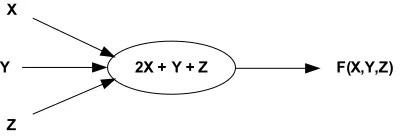
produce new tokens as a function of any received tokens. The addition actor shown in Figure
3.2, for example, will take a token from each input arcsAandB, and produce a new token with
a value equal to the sum of the received tokens’ values. The produced token will then be passed
along the addition actor’s output arc, C. The arcs in this example have been labeled only so
they may be referred to in the narrative; arcs on a data flow graph are not typically labeled, nor
do they perform any function besides describing paths that tokens may flow across. Although
often representative of simple arithmetic, as is the case with the addition actor shown in Figure
3.2, intermediate nodes may perform operations of any complexity.
Figure 3.2: A simple addition actor.
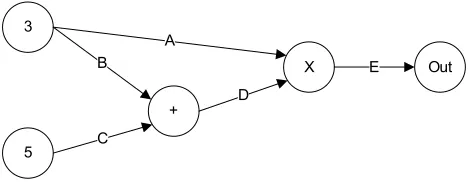
Figure 3.3 illustrates a simple, but complete, data flow program consisting of two source
nodes, two intermediate nodes, and one sink node. In this example, assume the sink node
simply records the value of any tokens it receives for later review. Further assume the two
source nodes in this example are set to produce and send one token on each of their output
arcs. The produced tokens will contain a value equal to the label of their producing node. For
this example, arcsAandB will each carry one token of value3from the source actor labeled
“3”, and arcC will carry one token of value5. The two intermediate nodes “+” and “×” will
perform the operation described by their label, addition and multiplication respectively. During
execution, arcDwill carry one token of value8, produced by applying the addition operator to
tokens with values3from arcBplus5from arcC. Finally, the output of this program, carried
[image:24.612.189.424.69.160.2]
Figure 3.3: A simple data flow program.
andOut=E.
The order of node execution in Figure 3.3 is easy and straightforward to determine. After
an actor’s data dependencies are met, that actor performs its assigned computation and the
result is propagated forward through the program. In data flow programs, a node’s execution is
completely controlled by the availability of data, as carried by tokens, at its inputs. Therefore
such programs are referred to as “data-driven”.
Any token received at a node is stored by that node in an internal queue representing which
arc the token is received on. Once an intermediate node has received the required number of
tokens on each of its required input arcs, that node is considered “enabled”. Figure 3.4 (a)
shows a partially enabled node that has received a token on one of its two input arcs. Figure 3.4
(b) shows a node in its fully enabled state. After becoming fully enabled, an intermediate node
will autonomously “fire”. When an actor fires, it removes some tokens from its input queues,
performs some operation using the values of tokens it has received, and then produces one or
more tokens that are sent along the data flow graph to the intermediate node’s successors, as
shown by 3.4 (c). Note that the token placed on the output arc is not the same as any of the
tokens consumed to produce it, although its value may be related (in this example a relation
by addition exists). The generalized data flow model does not constrain the number of tokens
consumed or produced by an actor each time it fires to be one, or even constant; a generalized
data flow actor may produce or consume a varying number of tokens.
The above described process of actor firing and token passing continues until some
termi-nation condition is met. During program execution an actor may receive and fire many tokens.
A description of this model of computation has been formalized by Lee and
Figure 3.4: A partially enabled node (a), fully enabled node (b), and firing node (c). A node is considered fully enabled if there is at least one token at each input arcs it requires to fire.
tag pair, and a signal is defined as set of such events. Using this definition, the output of a data
flow program can be described from part, or all, of one or many of the signals generated during
the program execution.
Because data flow programs allow an actor to fire any time that input data is available, it is
possible for more than one actor to be ready for firing at the same time. This offers the potential
for a high level of concurrency, often cited as a main advantage of data flow programming
(Dennis, 1980, Lee and Messerschmitt, 1987). Unfortunately, because the data flow model
lacks the concept of control flow, program overhead must be spent to determine which actor
to fire next when data flow programs are run on computers lacking the appropriate hardware
architecture (Dennis, 1980).
Also important to the efficiency of a data flow program is the granularity of that program’s
nodes. Complex operations can be built from a large number of simple units, or one complex
unit. The granularity of the model is considered course if the representative operations are
implemented as single, highly complex, actors or fine granularity if the same operations are
represented as a collection of many, individually less complex actors. In a data flow program,
larger granularity result in less overhead (Greening, 1988, Lee and Messerschmitt, 1987)
how-ever, due to their more abstract representation, models with courser granularity also contain
less structural information in their actor graphs.
Although not ideal from the standpoint of structural analysis, the reality that data flow nodes
operate as independent processing units of any complexity greatly adds to the expressive power
of data flow languages from the perspective of simulation modeling. Actors are not constrained
to implement only simple arithmetic operators, or even single expressions of many arithmetic
the authors show how it is possible to mix dataflow models with discrete-event models. One
example given by Chang et al. (1997) shows how a data flow actor may itself implement a
dis-crete event simulation as its operation; instead of evaluating an expression of some parameters,
a data flow actor could call a discrete event simulation and pass the result to other actors.
It should also be noted that actors may have internal state. An actor is allowed to remember
the values of any tokens it received, or any states derived from these tokens, since the start
of program execution. If the exact mechanics of a historically sensitive actor is known, it is
possible to convert it to an actor without state through adding a self-loop to communicate prior
state to itself between program iterations (Buck, 1993).
3.2.2
Petri Nets
Petri nets are a type of data flow program commonly used for a variety of applications,
espe-cially the modeling of concurrent systems (Tadao, 1988). One specific example is the
applica-tion of Petri nets to manufacturing systems (Proth and Xie, 1996).
A Petri net is a directed bipartite graph containing nodes called places connected to nodes
called transitions (Proth and Xie, 1996). Transition nodes in a Petri net behave like actors, as
described above. Place nodes in a Petri net behave like relations as described above or, more
specifically, as a queue of tokens at an actor’s input.
Besides the differences mentioned above, Petri nets behave exactly as a simple form of
data flow. Transitions are considered enabled when their dependencies are met (Proth and Xie,
1996). They then fire or remove some tokens from their input places and put some tokens at
their output places. In basic Petri nets, these tokens are unlabeled. An important extension
to the Petri net model are colored Petri nets. Colored Petri nets use tokens having different
colors, or labels. They generally allow a more compact representation of a system, but are
disadvantageous in that many of the more useful analytical properties of elementary Petri nets
are not easily applied to colored Petri nets.
It is in the study of Petri Nets that many techniques for the study of synchronous data flow
program structures originate. A review of such techniques, including examples which
tutorial of Petri nets’ usage in modeling, can be found in Tadao (1988).
3.2.3
Synchronous Data Flow
Synchronous data flow (SDF) programming is a special case of data flow programming where,
at least in its pure state, the number of tokens consumed and produced by an actor each time
it fires is independent of the token values (Lee and Messerschmitt, 1987). This allows a static
order of execution for actors in a SDF program to be computed during the program’s
initializa-tion phase, greatly reducing some of the overhead associated with data flow program execuinitializa-tion
(Lee and Messerschmitt, 1987). Furthermore, this assumption makes synchronous data flow a
subclass of Petri Nets (Buck, 1993).
In reality, the synchronous data flow language described by Lee and Messerschmitt (1987),
and which will be used to implement simulation models, differs from the above stated ideal.
The most notable difference is the inclusion of dynamic actors, two popular ones being the
switch and select actors shown in Figure 3.5, capable of producing or consuming a varying
number of tokens on each of their arcs (Buck, 1993). This extension of SDF can be made
with little impact to the scheduling and efficiency of the resulting programs, although some
scheduling decisions will need to be made at run time (Lee and Messerschmitt, 1987).
Figure 3.5: Two example dynamic data flow actors.
The addition of dynamic actors to extend synchronous data flow greatly improves the power
of such models. While basic Petri net models are not Turing-equivalent, dynamic data flow
programs usually are (Buck, 1993).
An important property of the synchronous data flow model of computation is that it contains
SDF model progresses globally to the model in discrete quantities referred to as “ticks” or
“iterations”, unlike discrete event and continuous time programs where time is modeled by the
application of a time-stamp to events.
Time is an important concept if a SDF program is to be used for certain simulation purposes.
One consequence of time dependent models is that an input factor may have an effect on a
model’s output instantly and to a constant extent over time, or that input’s effect may vary over
time- such an effect may be meaningless in the first iterations but grow to be a dominate effect
after many. Such accumulations of effect may happen when state data is stored in an SDF
model between iterations, as happens when such a model contains a directed cycle.
Figure 3.6 shows two actor graphs with a directed cycle between nodesAandB. The model
shown in Figure 3.6 (a) is impossible to start. NodeAdepends on both the value ofX and the
value ofBto fire. NodeBdepends on nodeY and nodeA. Since nodeAdepends on nodeBand
nodeB depends on nodeA, a cyclic dependency exists which effectively prevents the model
from starting up. One way this cyclic dependency can be handled in SDF is to introduce a
delay on one of the arcs in the cycle (Lee and Messerschmitt, 1987). A delay holds any token
it encounters for some fixed number of iterations before releasing it. Figure 3.6 (b) shows the
same model as (a) but with a single iteration delay on the directed arc fromAtoB. Since, by the
definition of synchronous data flow, it must pass a token in every iteration, a delay must hold
an initial token at the beginning of execution for passage in the first iteration. Curly brackets
are used here to show the initial token values contained by the delay, in this example one token
of value0. In the first iteration of the SDF model from 3.6 (b), nodeB will take data from
Y and the delay, initially 0, to produce its output. In the Nth iteration, nodeB will take data
fromY and the delayed output of A, or the value sent by A in iteration(N −1)to perform its operation. In a SDF model, it is required that all cycles be broken by a delay; failure to
do so is a structural fault that results in an unusable model (Lee and Messerschmitt, 1987).
Depending on the implementation language, delays may exist as attributes of the arc as shown
in this example or as specialized actor nodes on the network.
Cycles and delays in SDF can result in varying importance of an input over time, such as
[image:29.612.234.378.518.601.2]
Figure 3.6: An example SDF model with a directed cycle.
a state between iterations (although this can also be done internally by the actor). In the new
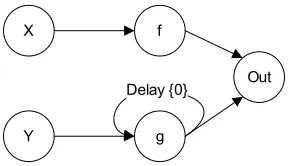
example of Figure 3.7, for example, assume the initial output of nodef isf(X) and nodeg’s output isg(Y,0). Note that nodeghas two input arcs, one of which is a self loop. Assuming X and Y remain constant, the values output in the second iteration forf and g aref(X) and g(Y, g(Y)), respectively. IfY were not constant, callY0andY1the initial and second iteration values ofY respectively, the value of g at the second iteration could be more thoroughly
de-scribed as g(Y2, g(Y1)). In general, the cycle around g in this example will cause g’s output on any given iteration to be partially dependent upon its output from the previous iteration,
which is itself partially dependent on nodeg’s output from the iteration before that. This
de-pendency continues recursively back to the first iteration, with the result being that node g’s
output is dependent upon all historical values ofY. This recursive dependency is one definition
of a difference equation;x(n+ 1) =f(x(n))(Elaydi, 1996).
Figure 3.7: A SDF model with one self loop.
In this way, SDF programs may be used to simulate systems of difference equations; the
behavior of which can lead to highly dynamic behavior. There exist methods for finding exact
these solution methods to SDF programs would be extremely difficult in practice, due in part
to the varying levels of granularity and transparency in SDF models. Although an actor may
contain a process to implement some functionf to map a set of inputsX to a set of responses
Y, no guarantee is made thatf itself is retrievable from the program. Any or all actors in a data
flow program may be implemented as a “black-box“.
As with Petri Nets, since their structures are strongly graph based, synchronous data flow
programs lend themselves well to graph theoretic based analysis. One simple example of this is
presented by Lee and Messerschmitt (1987) to verify the consistency of token production and
consumption.
Feng (2008) develops a model transformation approach to aid in the design of large
struc-turally configurable models. This is accomplished through the application of graph
transfor-mation algorithms. Principally concerned with the transfortransfor-mation of a model to speed up
con-struction and configuration, Feng’s work is an example of how the graph structure of a data
flow program can be examined and manipulated for productive purposes.
Of specific interest to analysis of a SDF simulation model is the ability to determine which
source actors, or inputs, have a causal impact on other actors in the model. A further question
is, given a set of source actors that have an effect on a given node, which of those effects are of
most importance.
The first question, which inputs have an effect on which outputs, can be addressed using
“causality interfaces” (Zhou and Lee, 2008). A causality interface, as defined by Zhou and
Lee (2008) states the dependency that an actor’s output signal has on input signals. It is also
shown that if the causality interfaces are known for all actors in an actor graph, it is possible
to determine the causality interface for the entire network, or composition of actors. Causality
interfaces are described by Zhou and Lee (2008) primarily as a means for deadlock analysis in
data flow, or as a tool for discovering structural faults in a model.
Just having a causal effect does not necessarily indicate that effect has a meaningful
mag-nitude. Given a set of inputs that are known to contribute to an output’s value, the individual
effect of some inputs may be overwhelmed by the effect of others. The solution to this problem
even more difficult with the existence of cycles, as was shown by example in 3.7. To date, there
does not appear to be any literature on ranking or identifying important effects using an actor
graph’s structure alone.
3.3
Review of Literature on Graph Structure Analysis
Considerable work has been done in developing methods to determine useful information from
structured data. Where graph based information exists there can often be found research into
how best to analyze that information. Some specifically interesting questions to the scope of
this thesis are:
• What makes a path of flow through the graph important?
• What makes an individual node important, both globally and relative to another node?
This section contains a review of literature relevant to answering these questions, framed
by application to analysis of a data flow program’s actor graph. Background information,
particularly on Markov chains, will be included as required.
3.3.1
Linear Signal Flow Graphs
Linear signal flow graphs are a well established tool for studying and reducing complex
feed-back systems. They consist of a graph with nodes representing linear functions and arcs
rep-resenting the dependency of data between nodes. In this way, linear signal flow graphs are
closely related to the data flow programs described in Section 3.2.
The behavior of a linear signal flow graph can be described concisely by two rules. The
first rule, shown by Figure 3.8 and described by Xi = nj=1AijXj, shows how values for individual nodes are computed (DeStefano, 1990).
The second rule, shown by Figure 3.9 andXi =AikXk, constraints values transmitted from a common source to be related by the value of the node which is their source (DeStefano, 1990).
Linear signal flow graphs can provide a convenient graphical representation of linear
[image:32.612.253.359.64.191.2]
Figure 3.8: Addition rule for signal flow graphs.
[image:32.612.253.362.229.357.2]
Figure 3.9: Transmission rule for signal flow graphs.
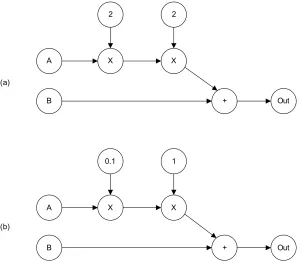
a structural reduction is given by Figure 3.10 and its reduction, Figure 3.11.
Figure 3.10: Example linear signal flow graph.
Figure 3.11: Reduction of example linear signal flow graph.
This example shows how entire variables, and the nodes representing them, can be removed
by applying properties of multiplication. More complex examples of reduction, including
re-duction techniques that can simplify feedback loops, are given in DeStefano (1990).
Linear signal flow graphs can be implemented as special types of data flow programs,
how-ever the restriction that they contain only linear equations makes them, and methods for their
3.3.2
Path Importance
Paths on an actor graph represent channels over which information can flow. In the context of
a data flow actor graph, an important path may be considered one that is likely to have great
influence on an output of interest. This is to say, if information enters the head of an important
path, that information could be expected to prove very significant to the information resulting
at the tail of that path.
A collection of paths connecting two nodes is a subgraph. In general, a subgraph is useful to
describe the relationship between two nodes when relationships between those nodes are
mul-tifaceted; often times representing a relationship using a single path is ineffective (Faloutsos,
Mccurley, and Tompkins, 2004). For an example in a social context, modified from an example
given by Faloutsos et al. (2004), imagine that your brother is married to your favorite author.
The shortest path between you and your sister in law on a social network would be that she is
your favorite author. It is, however, likely that your most important relation to her is through
her marriage to your brother. Multiple relationships like this exist in data flow graphs. The
most important path between actors may not be the shortest, and many less important paths
may contribute to one most important effect. It is important to consider all paths between an
input and output of interest.
The concept of important paths are used heavily by the work of Mojtahedzadeh, Anderson,
and Richardson (2004), which discusses a method of analyzing a system dynamics model’s
structure called the “Pathway Participation Method” (PPM). The PPM starts with a single
vari-able (output) of interest, then works backward to determine the most important structure in the
model. This is accomplished by studying individual components to identify which path into
that component most influences the output. The PPM then recursively examines the
compo-nent upstream along the just identified path until the method converges on the most important
structure of the model.
Faloutsos et al. (2004) propose a method for discovery of important subgraphs connecting
two nodes. Their procedure treats the search for a subgraph as a maximum flow problem. The
result is a collection of the important components comprising the potentially complex relation
3.3.3
Node Importance
The definition of node importance, as with the importance of a path, is ambiguous and domain
dependent. In literature, the interpretation of a node’s importance usually depends on the means
used to compute it.
It is easy to see how a measure for a node’s importance is useful in a variety of graph
structures. Considering the World Wide Web, one may be interested in the most important
website on the Internet. In social networks, the most important person in an organization may
be of interest. Analysis of a transportation system may be interested in the most important
bridge or intersection. In the actor graph of a data flow program, it may be useful to determine
which actor is most important, the answer to which is synonymous with the most important
calculation. Although the meaning of an important node is interpreted differently in these four
examples (the Internet, social networks, transportation networks, and actor graphs), in each case
a node is considered important because it is somehow related to other nodes in a meaningful
way.
The importance of a node also depends on perspective. In a social network of a large
organization, the most important person on the whole graph is arguably the company’s leader.
Less globally, the most important person from the perspective of an individual in a company
is likely that individual’s immediate boss. A node’s absolute importance is defined as the
importance of that node considering all other nodes in the graph. The relative importance of a
node can only be found specific to a subset of nodes.
Much work has been done on developing methods for discovering important nodes. Of
these methods there appear to be at least two main classes:
1. Methods that rank nodes based on graph theoretic notions (distance, node degree, etc.).
2. Methods that rank nodes by considering the graph to be a stochastic process.
3.3.3.1 Methods of Graph Theoretic Notions
Many methods from the first class rely on measures of a node’s centrality in a graph.
transportation network, the highest degree node would represent the intersection with the most
roads entering it. In a data flow actor graph, the highest degree node will represent the function
with the most input factors.
Global closeness is a method developed by Freeman (1979) to rank the centrality of a
node on a graph. Freeman defines a given node’s closeness centrality to be the sum of the
distance from that node to all other nodes on the graph. While closeness centrality is a useful
measure when distances on a graph hold important meaning, its power is limited when distances
themselves are not necessarily meaningful (Borgatti, 2005). Freeman (1979) also proposed
another measure of centrality called “betweenness”. Callgijthe total number of geodesic paths from nodeitojandgij(k)the number of those geodesic (shortest) paths passing through node k. The computation for betweenness centrality is then given by Freeman (1979) to be
i
j
gij(k)
gij ,∀i=j=k. (3.2) Essentially, betweenness centrality is a measure of how many geodesic paths pass through
nodek(Borgatti, 2005). As with global closeness, betweenness centrality is most relevant when
distance has meaning in a graph. Even so, measures of centrality in an actor graph may be
helpful in determining which nodes have the most widespread effect. If an actor on a data flow
actor graph has a large influence on information passing through it, the larger that influential
node’s centrality measure, the more other nodes its influence is likely to effect.
3.3.3.2 Stochastic Process Methods
A second main class of methods for importance ranking is a class of methods which view a
given graph as a stochastic process. More specifically, assume a graph to be a representation
of a first order Markov chain. A Markov chain is a discrete-time probabilistic model that is
useful for studying a system of states and transitions between those states. The study of a
Markov chain is facilitated by an application of the Markov assumption that the probability of
transitioning to any given state depends only on the current state of the system (Beichelt, 2006).
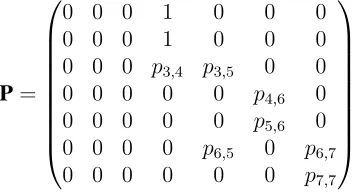
Under this assumption, a Markov chain can be completely described by a matrix of one-step
is in stateiat timen, it will transition to statejat timen+ 1with a probability ofpij. The system does not necessarily have to transition to a different state; it will remain in its current
state with probability pii. Being composed of transition probabilities, certain key properties must hold for the elements ofP:
0≤pij ≤1,∀i,∀jand j
pij = 1,∀i. (3.3)
For representation as a Markov chain, the individual nodes of a graph should be considered
different states and arcs indicate transition probabilities between those states that may be
non-zero. Under this assumption, imagine a single token on the graph. If the token is at nodeiat
timen,Pfor this system is made up of some fixed probabilitiespijthat the token will transition to nodej. The token will only be allowed to transition between nodes if they are connected in
the graph;pij = 0if nodeiis not connected to nodej,1≥pij ≥0ifiis connected toj. If this single token is allowed to randomly transverse the graph (take a random walk), the long-term
fraction of time that this token is expected to be at any given node can then be thought of as an
estimate for that node’s importance (White and Smyth, 2003).
Further background in discrete-time Markov chains is required to fully understand the
me-chanics behind computing the long-term fraction of time a token is expected to reside at a
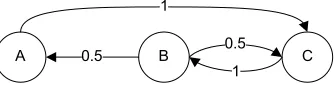
given state. Take for example the Markov chain described by Figure 3.12 which was built as
described above from the graph of Figure 3.13, assuming an equal probability of transition
along any outgoing arcs from a node. Because Node Bhas two out arcs, each arc has a0.5 probability of transition. IfNode Bhad three out arcs, each arc would be associated with a0.33 probability. The first column and row ofPin Equation 3.4 refers toState A, the second column
and row to State B, and the third to State C. The 1 in the first row and third column ofP in
Equation 3.4 refers to the 100% probability of transition fromState AtoState C. In this wayP
is closely related to the incident matrix of the graph from Figure 3.13.
IfPdenotes the single-step probabilities in a Markov chain,P2gives the two-step transition
probabilities, andPm is a matrix of them-step transition probabilities (Beichelt, 2006).
Ex-amples of the two-step, three-step, and hundred-step transition probabilities for the model of
P=
⎛
⎝00.5 0 00 1.5
0 1 0
⎞
[image:37.612.224.391.188.234.2]⎠;p0 = (1,0,0)
Figure 3.12: Example Markov chain expressed as one-step transition probability matrix and initial probability vector.
Figure 3.13: Example Markov chain expressed as a graph.
What the individual matrices in Figure 3.14 describe are the probability of transition from
stateito state jin the number of steps indicated by the degree of P. The first row of P3, for
example, shows that if starting inState 1, given three steps there is a0.5probability the system will end up back inState 1, and a0.5probability the system will end up inState 3.
The matrixP100seems to indicate that, regardless of the starting state, after100steps there is
a0.2probability of being inState 1, a0.4probability of being inState 2, and a0.4probability of being inState 3. In reality, the apparent indifference to starting state observed inP100of Figure
3.14 is due to rounding. If enough decimal places were displayed, it would be shown that,
given a start fromState 2, there is actually a slightly less than0.4probability of ending back inState 2after100steps. Even so,P100does suggest that the elements of the rows from these
m-step transition probability matrices are converging to some values asmapproaches infinity, specificallyπ = (0.2,0.4,0.4). If a probability distribution vector that describes the long-term behavior regardless of the starting distribution vectorp0for the system under study exists, it is
called the stationary state probability vector and is referred to as the vectorπ(Beichelt, 2006). More formally, to be considered a system’s stationary state probability vector, the elements of
πmust satisfy a system of linear equations described by
πj = i
πipij;∀j. (3.4)
P2 =
⎛
⎝ 00 01.5 00.5 0.5 0 0.5
⎞ ⎠
P3=
⎛
⎝00..25 05 0.5 00..255 0 0.5 0.5
⎞ ⎠
P100 =
⎛
⎝00..2 02 0..4 04 0..44 0.2 0.4 0.4
[image:38.612.246.362.76.251.2]⎞ ⎠
Figure 3.14: Various m-step transition probability matrices.
3.4 andP0.
From this definition, the interpretation of π is synonymous with the long-term fraction of time that a randomly-walking token is expected to reside at any given node, one of the
importance metrics presented by White and Smyth (2003).
Variations on random walks for importance evaluation have been successfully applied to
a variety of applications. One successful example is the PageRank algorithm of Page, Brin,
Rajeev, and Terry (1999) used by the Google Internet search engine. The PageRank algorithm
has a strong foundation in random walks on graphs. A simplistic explanation of PageRank is
that a website is ranked highly if an individual randomly following links on a graph of the Web
is likely to spend a large percentage of his time at that given website.
Similar to the long-run proportion of time a random walker is expected to be at any given
node, measures of the token’s expected first-passage time and commute time between nodes are
often cited measure of relative importance between nodes. The average first-passage time of a
randomly walking token between two nodes is the expected number of steps that a
randomly-walking token, leaving the first node, will take to reach the second (Fouss, Pirotte, Renders, and
Saerens, 2007). Expected commute time for two nodes is the expected number of steps required
for a round trip from the first node to the second node and back to the first. These metrics
can all be computed for a Markov chain, in a similar fashion to how the long-term residence
methods based on considering a graph to be a Markov chain work well when compared to other
standard scoring algorithms for a case study of a movie database; although they point out these
techniques are not likely to scale efficiently to very large systems. Even so, these methods that
view a graph as a stochastic process have the potential to be highly useful to analysis of a data
flow graph, as they rely on the connection structure of a graph - not distances between nodes.
3.4
Discussion
Two hypotheses were proposed in the problem definition of Chapter 2. The first stated
hypoth-esis, about the existence of information in a data flow graph, has roots in prior work as detailed
in the review section on data flow programming in Section 3.2 and the review of literature on
graph structure analysis in Section 3.3. Three specific examples on the analysis of a data flow
program from that program’s structure were noted; one related to the use of model
transforma-tion to the constructransforma-tion of structurally configurable models, another related to consistency of
token production and consumption rates, and the third to deadlock, or liveliness, analysis.
More applicable to the goals of this thesis is the work of Mojtahedzadeh et al. (2004). In this
work, an analysis of a graph-based model is performed, called Pathway Participation Method
(PPM), to identify the most important paths through a simulation with respect to an output. The
PPM method, however, only considers the most important effect on individual components; it
does not account for instances where many paths in a model combine to result in large effects.
Furthermore, the PPM method focuses on identifying important model structures to aid in
model understanding, with less emphasis placed on the search for important input factors.
Taylor, Ford, and Ford (2007) proposes a method to utilizing the results from statistical
factor screening for the identification of important model structures. After factors of high
im-portance have been identified, the model can be examined to see which model sub-structures
the most influential parameters are connected to; essentially the opposite of this thesis’s goal
of using important structures to identify important input factors. While of benefit for model