Rochester Institute of Technology
RIT Scholar Works
Theses
Thesis/Dissertation Collections
8-1992
Evaluation of digital image compression algorithms
for use on lap top computers
Bernard V. Brower
Follow this and additional works at:
http://scholarworks.rit.edu/theses
This Thesis is brought to you for free and open access by the Thesis/Dissertation Collections at RIT Scholar Works. It has been accepted for inclusion in Theses by an authorized administrator of RIT Scholar Works. For more information, please [email protected].
Recommended Citation
Evaluation
ofDigital
Image
Compression
Algorithms
for
Use
onLap Top
computersby
Bernard V. Brower
Submitted to the Center for
Imaging
Science in partial fulfillment of the requirements forthe Master of Science degree at the Rochester Institute of
Technology
ABSTRACT
A technique for the evaluation of image compression algorithms was
developed. This technique was then applied in the evaluation of six
image compression algorithms
(ARIDPCM,
ISO/JPEGDCT,
zonalDCT,
proprietary wavelet, proprietary sub-band coding and the proprietary DCT). Of the six algorithms evaluated, the Wavelet algorithm performed the best on average in image quality at all bit rates. The
JPEG DCT was concluded to be the most useful algorithm because of
its performance and the advantages that come with
being
anACKNOWLEDGEMENTS
The author would like to thank Dr. John R. Schott for his support, guidance and patience in this effort. The author would also like to express his appreciation for the technical advice given
by
his thesis committee: Dr. RogerEaston,
Dr. BobGray
and Dr Majid Rabbani.The author would like to thank for their technical support Mr. Chris
Honsinger,
Mr.Sterling
Mason and Mr. Bhavan Gandhi and the Eastman KodakCompany
forfinancial,
equipment, and materials support.The author would like to acknowledge the
following
people and organizations who aided this studyby
submitting and supporting proprietary image compression algorithms;Howard Resnikoff and John Huffman of Aware Incorporated.
Bahaa Fam from the Image
Processing
ResearchLaboratory
of the MITRE Corporation.Dedication
This thesis is dedicated to my parents, Ralph and
Monica,
whose moral andTable of Contents
Table of Contents vi i
List of Figures xi
ListofTables xiii
1.0 Introduction 1
1.1
History
of study 11 .2 Digital Images 2
1.3 Motivation for Compression 2
1.3.1 Storage of Digital Images 3
1.3.2 Transmission of Digital Images 3
1 .4 Digital Image Compression 4
1 .4.1 Lossless Digital Image Compression 5
1.4.2
Lossy
Digital Image Compression 51.5 Evaluation of Compression Algorithms 5
1.6
Summary
62.0 Experimental Approach 8
2.1 Test Image Selection 8
2.2 BWC Algorithm Selection 9
2.3 Bit Rate 1 0
2.4 Algorithm Performance 1 0
2.4.1 Bit Rate
Accuracy
1 02.4.2 Image
Quality
Evaluation 112.4.2.1 Numerical Performance 1 1
2.4.2.2 Visual Performance 1 3
2.4.2.2.1 Test Image Set Selection 14
2.4.2.2.2 Evaluation Layout and Media 14
2.4.2.2.3 Evaluation Instructions 15
2.4.2.2.4
Rating
Scale 152.4.2.2.5
Rating
Sheet 162.4.2.2.6 Background Questionnaire 1 6
2.4.2.2.7 Evaluation Procedure 1 6
2.4.3
Complexity
and Speed of the Algorithm 1 72.4.4
Susceptibility
to Error 1 73.0 Compression Algorithm Description 1 8
3.1 ARIDPCM 1 8
3.1.1 Compression 1 9
3.1.1.1 Prediction and Error 19
Table of Contents
(cont.)
3.1.1.3
Coding
223.1.2 Decompression 22
3.2 ISO/JPEG Baseline Discrete Cosine Transform
(DCT)
243.2.1 Compression 24
3.2.1.1 Transform 26
3.2.1.2 Quantization 26
3.2.1.3
Coding
273.2.2 Decompression 28
3.3 Zonal DCT 29
3.3.1 Compression 29
3.3.1.1 Transform 29
3.3.1.2 Quantization 29
3.3.1.3
Coding
313.3.2 Decompression 31
3.4
Proprietary
DCT 3 13.4.1 Compression 3 1
3.4.1.1 Transform 32
4.4.1.2 Quantization 3 2
3.4. 1.3
Coding
3 23.4.2 Decompression 3 3
3.5
Proprietary
Quadrature Mirror Filter Pyramid Compression ...333.5.1 Compression 33
3.5.1.1 Transform 34
3.5.1.2 Quantization 35
3.5.1.3
Coding
363.5.2 Decompression 36
3.6
Proprietary
Wavelets Compression 373.6. 1 Compression 3 7
3.6.1.1 Transform 37
3.6.1.2 Quantization 39
3.6.1.3
Coding
393.6.2 Decompression 40
4.0 Results and Discussion 41
4.1 General Results 41
4.1.1 Bit Rate 41
4.1.2 Speedand
Complexity
424.1.3 Tolerance to Channel Error 42
4.1.4 Numerical Performance 43
4.1.5 Subjective Performance 45
4.2 Algorithm Results 47
Table of Contents
(cont.)
4.2.1.1 Bit Rate Control 47
4.2.1.2 Speed and
Complexity
484.2.1.3 Tolerance to Channel Error 48
4.2.1 .4 Objective Performance 48
4.2.1 .5 Subjective Performance 49
4.2.2 ISO/JPEG DCT 49
4.2.2.1 Bit Rate Control 49
4.2.2.2 Speed and
Complexity
504.2.2.3 Tolerance to Channel Error 50
4.2.2.4 Objective Performance 51
4.2.2.5 Subjective Performance 5 1
4.2.3 Zonal DCT
(HVS)
524.2.3.1 Bit Rate Control 52
4.2.3.2 Speed and
Complexity
524.2.3.3 Tolerance to Channel Error 52
4.2.3.4 Objective Performance 53
4.2.3.5 Subjective Performance 53
4.2.4
Proprietary
DCT 5 34.2.4.1 Bit Rate Control 53
4.2.4.2 Speed and
Complexity
544.2.4.3 Tolerance to Channel Error 54
4.2.4.4 Objective Performance 54
4.2.4.5 Subjective Performance 5 5
4.2.5
Proprietary
QMF Pyramid Compression 554.2.5.1 Bit Rate Control 55
4.2.5.2 Speed and
Complexity
554.2.5.3 Tolerance to Channel Error 55
4.2.5.4 Objective Performance 56
4.2.5.5 Subjective Performance 56
4.2.6
Proprietary
Wavelets Pyramid Compression 564.2.6.1 Bit Rate Control 56
4.2.6.2 Speed and
Complexity
574.2.6.3 Tolerance to Channel Error 57
4.2.6.4 Objective Performance 57
4.2.6.5 Subjective Performance 5 8
4.3 Subjective Performance 5 8
4.3.1 Algorithm Performance Observations 58
4.3.2 Image
Quality
Observations 59Table of Contents
(cont.)
References 68
Acronyms 70
Appendix A Evaluation Images A-1
Appendix B Image Results Tables B-1
Appendix C Description of Evaluation Code C-1
Appendix D Description of SAS command Files for evaluation D-1
Appendix E Test Evaluation Packet E-1
Appendix F Example of
Rating
Sheet F-1Appendix G Example of Exploitation Questions for the Images G-1
List of Figures
Figure Title Page
1 Rate Distortion Curve for ARIDPCM on Test Image 4
2 Test
Transparency
Format 1 53
Rating
Scale 164 The levelsoftheARIDPCM 8-by-8 block 1 9
5 DCT Basis
Functions;
N =8;
C = Coefficient Order 256 The
Zig-Zag
Format 2 87 Contrast
Sensitivity
Function 308 QMF Sub-band Generation for
Coding
349 Two Level pyramid Decomposition 35
1 0 QMF Reconstruction Process 36
1 1 Daubechies Filter 3 8
1 2 Wavelet Sub-band Decomposition 38
13 Six level Pyramid Decomposition 39
1 4 Wavelet Reconstruction Process 40
15 Compression and Decompression Speed 42
16 Average RMS Error Performance vs. Bit Rate 43
1 7 Average SNR Performance vs. Bit Rate 44
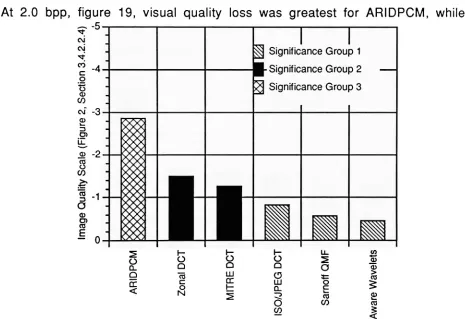
1 8 Average Maximum Error Performance vs. Bit Rate 44 1 9 Visual Image
Quality
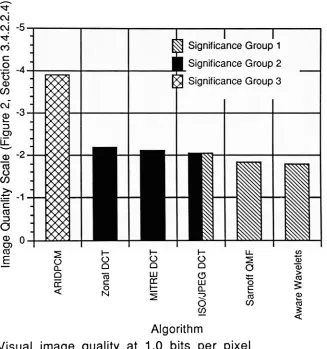
at 2.0 bits per pixel 45 20 Visual ImageQuality
at 1.0 bits per pixel 46 21 Visual ImageQuality
at 0.5 bits per pixel 4722 RMS Error Performance vs. Bit Rate for the ARIDPCM Algorithm 49
23 Normalization Factor Effect on Bit Rate 50
24 Average RMS Error Performance vs. Bit Rate for ISO/JPEG DCT 51 25 RMS Error Performance vs. Bit Rate for Zonal DCT 53 26 RMS Error Performance vs. Bit Rate for MITRE DCT 54 27 RMS Error Performance vs. Bit Rate for Sarnoff QMF 56 28 RMS Error Performance vs. Bit Rate for Aware Wavelets 58 29 RMS Error Performance vs. Bit Rate for Test Image 1 B-2 30 Max Error Performance vs. Bit Rate for Test Image 1 B-2 31 Signal to Noise Ratio vs. Bit Rate for Test Image 1 B-2 32 RMS Error Performance vs. Bit Rate for Test Image 2 B-4 33 Max Error Performance vs. Bit Rate for Test Image 2 B-4 34 Signal to Noise Ratio vs. Bit Rate for Test Image 2 B-4 35 RMS Error Performance vs. Bit Rate for Test Image 3 B-6 36 Max Error Performance vs. Bit Rate for Test Image 3 B-6 37 Signal to Noise Ratio vs. Bit Rate for Test Image 3 B-6 3 8 RMS Error Performance vs. Bit Rate for Test Image 4 B-8 39 Max Error Performance vs. Bit Rate for Test Image 4 B-8
List of Figures
(cont.)
Figure Title Page
41 RMS Error Performance vs. Bit Rate for Test Image 5 B-10
42 Max Error Performance vs. Bit Rate for Test Image 5 B-10
43 Signal to Noise Ratio vs. Bit Rate for Test Image 5 B-10
44 RMS Error Performance vs. Bit Rate for Test Image 6 B-12
45 Max Error Performance vs. Bit Rate for Test Image 6 B-12
46 Signal to Noise Ratio vs. Bit Rate for Test Image 6 B-12
47 RMS Error Performance vs. Bit Rate for Test Image 7 B-14
48 Max Error Performance vs. Bit Rate for Test Image 7 B-14
49 Signal to Noise Ratio vs. Bit Rate for Test Image 7 B-14
50 RMS Error Performance vs. Bit Rate for Test Image 8 B-16
51 Max Error Performance vs. Bit Rate for Test Image 8 B-16
52 Signal to Noise Ratio vs. Bit Rate for Test Image 8 B-16
53 RMS Error Performance vs. Bit Rate for Test Image 9 B-18
54 Max Error Performance vs. Bit Rate for Test Image 9 B-18
55 Signal to Noise Ratio vs. Bit Rate for Test Image 9 B-18
56 RMS Error Performance vs. Bit Rate for Test Image 10 B-20
57 Max Error Performance vs. Bit Rate for Test Image 10 B-20
58 Signal to Noise Ratio vs. Bit Rate for Test Image 10 B-20
59 RMS Error Performance vs. Bit Rate for Test Image 11 B-22
60 Max Error Performance vs. Bit Rate for Test Image 11 B-22
61 Signal to Noise Ratio vs. Bit Rate for Test Image 11 B-22
62 RMS Error Performance vs. Bit Rate for Test Image 12 B-24
63 Max Error Performance vs. Bit Rate for Test Image 12 B-24
64 Signal to Noise Ratio vs. Bit Rate for Test Image 12 B-24
65 RMS Error Performance vs. Bit Rate for Test Image 13 B-26
66 Max Error Performance vs. Bit Rate for Test Image 13 B-26
67 Signal to Noise Ratio vs. Bit Rate for Test Image 13 B-26
68 RMS Error Performance vs. Bit Rate for Test Image 14 B-28
69 Max Error Performance vs. Bit Rate for Test Image 14 B-28
70 Signal to Noise Ratio vs. Bit Rate for Test Image 14 B-28
71 RMS Error Performance vs. Bit Rate for Test Image 15 B-30
72 Max Error Performance vs. Bit Rate for Test Image 15 B-30
73 Signal to Noise Ratio vs. Bit Rate for Test Image 15 B-30
74 RMS Error Performance vs. Bit Rate for Test Image 16 B-32
75 Max Error Performance vs. Bit Rate for Test Image 16 B-32
76 Signal to Noise Ratio vs. Bit Rate for Test Image 16 B-32
77 RMS Error Performance vs. Bit Rate for Test Image 17 B-34
78 Max Error Performance vs. Bit Rate for Test Image 17 B-34
List of Tables
Title Page
BWC Test Images 9
Test Images Included in the
Engineering
Evaluation 1 4ice Evaluation
Summary
4 1Table
1 BWC T 2 Test In
3 Perforn 4 Numeri 5 Numeri 6 Numeri 7 Numeri 8 Numeri 9 Numer 10 Numeri 11 Numeri 12 Numer 13 Numer 14 Numer 15 Numer 16 Numer 17 Numer 18 Numer 19 Numer 20 Numer 21 Numer 22 Numer 23 Numer 24 Numer 25 Numeri 26 Numeri 27 Numer 28 Numeri 29 Numeri 30 Numer 31 Numer 32 Numer 33 Numeri 34 Numer 35 Numer 36 Numeri 37 Numer 38 Numer 39 Numeri ca ca ca ca ca ca ca ca ca ca ca ca ca ca ca ca ca ca ca ca ca ca ca ca ca ca ca ca ca ca ca ca ca ca ca ca Resu Resu Resu Resu Resu Resu Resu Resu Resu Resu Resu Resu Resu Resu Resu Resu Resu Resu Resu Resu Resu Resu Resu Resu Resu Resu Resu Resu Resu Resu Resu Resu Resu Resu Resu Resu Its fo Its fo Its fo Its fo Its fo Its fo Its fo Its fo Its fo Its fo Its fo Its fo Its fo Its fo Its fo Its fo Its fo Its fo Its fo Its fo Its fo Its fo Its fo Its fo Its fo Its fo Its fo Its fo Its fo Its fo Its fo Its fo Its fo Its fo Its fo Its fo
NITFS Test Image 1 at 0.5
bpp
B-3NITFS Test Image 1 at 1.0
bpp
B-3NITFS Test Image 1 at 2.0
bpp
B-3NITFS Test Image 2 at 0.5
bpp
B-5 NITFS Test Image 2 at 1.0bpp
B-5 NITFS Test Image 2 at 2.0bpp
B-5 NITFS Test Image 3 at 0.5bpp
B-7 NITFS Test Image 3 at 1.0bpp
B-7NITFS Test Image 3 at 2.0
bpp
B-7 NITFS Test Image 4 at 0.5bpp
B-9 NITFS Test Image 4 at 1.0bpp
B-9 NITFS Test Image 4 at 2.0bpp
B-9 NITFS Test Image 5 at 0.5bpp
B-11 NITFS Test Image 5 at 1.0bpp
B-1 1NITFS Test Image 5 at 2.0
bpp
B-11 NITFS Test Image 6 at 0.5bpp
B-1 3 NITFS Test Image 6 at 1.0bpp
B-1 3 NITFS Test Image 6 at 2.0bpp
B-1 3 NITFS Test Image 7 at 0.5bpp
B-1 5 NITFS Test Image 7 at 1.0bpp
B-1 5 NITFS Test Image 7 at 2.0bpp
B-1 5 NITFS Test Image 8 at 0.5bpp
B-1 7 NITFS Test Image 8 at 1.0bpp
B-1 7 NITFS Test Image 8 at 2.0bpp
B-1 7 NITFS Test Image 9 at 0.5bpp
B-1 9 NITFS Test Image 9 at 1.0bpp
B-1 9 NITFS Test Image 9 at 2.0bpp
B-1 9 NITFS Test Image 10 at 0.5bpp
B-21 NITFS Test Image 10 at 1.0bpp
B-21 NITFS Test Image 10 at 2.0bpp
B-21 NITFS Test Image 11 at 0.5bpp
B-23NITFS Test Image 11 at 1.0
bpp
B-23 NITFS Test Image 11 at 2.0bpp
B-23NITFS Test Image 12 at 0.5
bpp
B-25NITFS Test Image 12 at 1.0
bpp
B-25List of Tables
(cont)
Table Title Page
40 Numerical Results for NITFS Test Image 13 at 0.5
bpp
B-2741 Numerical Results for NITFS Test Image 13 at 1.0
bpp
B-2742 Numerical Results for NITFS Test Image 13 at 2.0
bpp
B-27 43 Numerical Results for NITFS Test Image 14 at 0.5bpp
B-2944 Numerical Results for NITFS Test Image 14 at 1.0
bpp
B-2945 Numerical Results for NITFS Test Image 14 at 2.0
bpp
B-2946 Numerical Results for NITFS Test Image 15 at 0.5
bpp
B-3147 Numerical Results for NITFS Test Image 15 at 1.0
bpp
B-3148 Numerical Results for NITFS Test Image 15 at 2.0
bpp
B-3149 Numerical Results for NITFS Test Image 16 at 0.5
bpp
B-3 350 Numerical Results for NITFS Test Image 16 at 1.0
bpp
B-33 51 Numerical Results for NITFS Test Image 16 at 2.0bpp
B-3352 Numerical Results for NITFS Test Image 17 at 0.5
bpp
B-3553 Numerical Results for NITFS Test Image 17 at 1.0
bpp
B-351.0 Introduction.
It was once said that a picture is worth a thousand words. If this is taken
literally
then both sources of information should be the same size in bitsfor digital computers.
Assuming
an average length of a word to be 4.5 letters and a half space on each end of a word (5.5letters)
and assuming an ASCII character (eight bits per character), then 1000 words willrequire 44,000 bits. This results in a
binary
image of about 210 pixelsby
210 lines which does not even equal the spatial
(approximately
640 pixelsby
460lines)
or radiometric (8 bits per pixel) resolution of television.This exercise proves one of two things: either a picture is worth more
than a thousand words or images can be reduced in size with no loss of
information. In
truth,
both statements are correct. This thesis isintended to evaluate the capability of several digital image compression
algorithms for use on a personal computer. It also provides a consistent method for evaluating compression algorithms.
1.1
History
ofStudy
The National Image Transmission Format Standards
(NITFS)
is a group ofMilitary
Standards that ensureinteroperability
between secondaryimagery
users(Army,
Navy,
AirForce,
CoastGuard,
Federal Bureau ofInvestigation are some of the government agencies that are involved in the standards). The secondary
imagery
user is one that uses images in thefield (i.e. at diverse and often remote locations and usually with little additional support resources) and is most
likely
equipped with an AT-class Personal Computer (PC). Thisfamily
of standards was developedbecause different agencies within the Government could not easily share
information in the form of images. Under the
funding
of the federalgovernment and the guidance of the NITFS Technical Board
(NTB)
this study was completed tohelp
the NTB select the next standard BandwidthCompression
(BWC)
algorithm for the NITFS. The original NITF BWCstandard was the Adaptive Recursive Interpolative Differential Pulse Code Modulation (ARIDPCM).(6) This algorithm produced acceptable image
quality at 2.0 bits per pixel
(bpp)
with a reasonable amount of CPU time.With the improvement of personal computers and BWC algorithms since
1984,
it was believed that there was an algorithm that could significantly1.2 Digital Images
Images will always be part of society and
they
are ever evolving in theirform. Original images started with drawings and paintings; the development of photographic film increased the capability to record events
"exactly",
without artistic interpretation. Now digital images arebeing
used everywhere from medical diagnosis to graphic arts to mass media.Many
of the classical film-based systems(X-rays,
hand heldcameras, . .
.) are converting to digital images because of the advantages
of digital images and of the associated equipment (e.g. speed,
flexibility,
range, . . . ). But along with the advantages of digital images come some drawbacks. One of the main problems is the quantity of data associated with the digital images. For example, only one 512-by-512 24-bit colorimage can be stored on a 1.44 megabyte 3.5 inch floppy. There is a need for compression of these images to maximize the efficiency of storage and
transmission in real systems.
1.3 Motivation for Compression
Digital images have two main sources. The first type are direct digital sources which include some medical applications (e.g. CAT
Scan,
MRI anddigital
X-Rays),
digital cameras (e.g. Kodak's Hawkeye II and the Canon'sdigital camera), computer-generated synthetic
images,
and remotesensing satellites (e.g. SPOT and LANDSAT). The second source type is digitized analog data (e.g.
film,
video). These images can be monochrome,single band (for most application of medical
images),
color (threebands)
as in television and color photography, and multiple bands as in LANDSAT
(7
bands)
and MRI (3 Bands). Digital images come in many sizes.Low-resolution images are most common in personal computer graphics
(
640 pixels per line and 480 lines per image with about 8 bits per pixel per band). Medium-resolution is used in many photographic applications(1024-by-1024,
8 bits per pixel per band). High-resolution images areusually at least 2048
by
2048,
12 bits per pixel and are used for somemedical applications.
As digital images became popular, the increase in resolution resulted in larger files. A simple monochrome low-resolution image of 512 pixels
1.3.1 Storage of Digital Images
Storage of digital images is now commonly used for medical records,
criminal records (both fingerprint and mug-shots), and with new digital
consumer products it will become more common to store personal
photographs
digitally
(Kodak Photo-CD). Another large database of imagesis tax assessments of property for the government. A small image
(512-by-512,
eight-bit resolution), which is minimalby
most standards, willuse about one-fifth of a double-sided
high-density
(1.44 megabyte)floppy
disk. A 40 megabyte hard drive will only hold about 150 suchimages,
which is not sufficient for storing images of all the buildings in a small
town or all the X-rays generated
by
a small hospital in a week.By
compressing the images
8:1,
a 40 megabyte hard drive could store up to1,200 images.
1.3.2 Transmission of Digital Images
Transmission of digital images is
increasingly
useful, e.g. for news/mediaevents. Newspaper images begin as lithographs of photographic images.
Then the lithographed image is transformed into a digital product which
can then be transmitted over a phone line. The best solution is the
transmission of the original digital images so that the local press can be
optimized for the original image. The transmission of a simple image
(512-by-512,
8-bpp)
over a common phone line at 2400 baud will takeapproximately 11 minutes. With a compression rate of 2:1 this time is cut
in half and higher compression rates can decrease the transmission time
proportionally. The transmission of images is commonly used in the
newspaper
industry
over phone lines and in the medicalindustry
onanything from phone lines to local area networks (e.g. ethernet ).
Another possibility is the use of radio transmission which is usually of
lower quality
(noisier)
and has slower baud rates.In these new scenarios a newspaper photographer could take the images
digitally,
review the images with the camera and find the nearest phone tocall the office to transmit the selected image.
By
eliminating thephysical transportation, photographic development and lithographic
processing the time it takes to get the picture back to the office is significantly reduced. A newspaper reporter can have the final shot of a
basketball game back to the main office before the fans have all left the
1.4 Digital Image Compression Basics
Most pictures, exhibit a large amount of data redundancy. For example, the sky in most images is quite uniform which means that any given sky pixel
is very similar to an adjacent sky pixel. These pixels are
highly
correlated or have redundant information (similar
information)
in them.Thus most digital images have high correlation between neighboring
pixels. The average correlation of digital images is approximately 90% for adjacent pixels.which translates to redundant information.
Compression algorithms
try
to reduce the redundant information in any ofseveral ways. Digital image compression may be lossless (i.e. image is
perfectly recoverable) or lossy. Lossless image compression will reduce
the redundant information with no loss of fidelity. In contrast,
lossy
digital image compression techniques always introduce some numerical loss of information. With a lossless image compression algorithm only the algorithm itself has to be evaluated since the resulting images havenot changed from the original. In
lossy
digital image compression the reconstructed image quality becomes a major issue.Many
of thealgorithms use the fact that the human vision system is less sensitive to certain spatial frequencies and certain noise patterns. This allows
greater compression of the digital images with no appearance of visual loss in the image. Lossless techniques are
typically
limited tocompression of about 2:1 to 3:1
depending
on the image and thealgorithm*4-5'8). The compression ratio for
lossy
techniques is limitedby
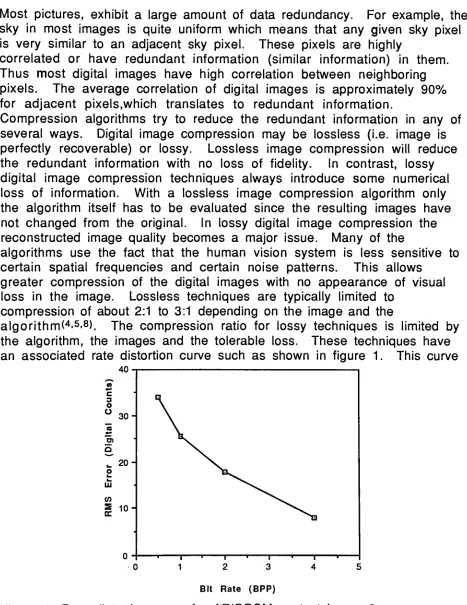
the algorithm, the images and the tolerable loss. These techniques havean associated rate distortion curve such as shown in figure 1. This curve
40
0 1 2 3 4 5
[image:19.551.42.509.67.672.2]Bit Rate (BPP)
only accounts for numerical
distortion,
not visual distortion.1.4.1 Lossless Compression
Lossless algorithms take advantage of local area correlation between
pixels and/or image statistics for compression. The most common
algorithm is Differential Pulse Code Modulation
(DPCM)
which uses aweighted average of previous pixels (in either one-dimensional or
two)
topredict the gray value of the next pixel. The resulting difference between
the actual and predicted pixel value is coded with a statistical coder (e.g.
Huffman encoder*4'5-8) or arithmetic coder*9-10)). Evaluation of lossless
algorithms is limited to speed of the algorithm, memory requirements, and susceptibility to channel error because image quality is unchanged.
1.4.2
Lossy
CompressionLossy
digital image compression techniques also use local correlation andredundancy to reduce the number of bits necessary to represent the image.
Ideally,
the resulting image is visually identical (i.e. for a given viewingcondition), but can be visually lossy. Most of the
lossy
algorithms cancompress the data
by
about 4:1 without significant visual loss. Increaseof the compression ratio results in more visual error. It is important to
understand how much error occurs with each algorithm and for what type
of image. Some algorithms perform better on a given type of image for a
variety of reasons:
1
)
some may work better becausethey
are tuned to a given image type;2)
others may work best because their innate artifacts are relativelyundamaging to that data type.
1.5 Evaluation of Compression Algorithms
The performance of
lossy
algorithms are evaluated in four general areas.First (and probably most
important),
is the image quality at a given bitrate. This provides one data point on a rate distortion curve shown in
figure 1. Other aspects (e.g. speed, susceptibility to channel errors, rate
control) of the compression techniques may be overlooked if the image
quality is superior for comparable bit rate. Most algorithms are compared
using this criteria alone but this is not sufficient for system design
which includes digital image compression as a component. In most
studies, the evaluation consists of comparison of rate distortion curves of
the given algorithm versus a general standard technique.*1-5-15'18) Other
compression technique in the context of the target system for which it is
being
developed. There are three main areas of compression use:1)
storage of
data, 2)
transmission ofdata,
and3)
source system. Thestorage of data is usually internal storage either for long-term/archival storage or short-term storage. The main concern in these scenarios is the compression speed, decompression speed, and the rate-distortion curve. The person operating the system will not want to wait five minutes to decompress one image for display. In the transmission of the data another
obstacle is the noise in the transmission line. What are the artifacts caused
by
a bit error in the transmission line(susceptibility
to channel errors). This is not a large concern in most scenarios because simpleerror detection and correction
(EDAC)
codes can reduce the odds of a biterror affecting the image. The most concern is when noisy channels are
used; the most common of these are radio
(UHF,
VHF)
communications channels. In source systems (e.g. hand-held digital camera) data-ratecontrol is important so that real-time allocation to fixed storage space is
possible. The source system type is common in digital cameras and
remote sensing systems where power, size and weight are a concern for the system design and packaging. Source systems algorithms will not be
specifically considered in this paper because of their
dependency
onknowledge of associated hardware design. Another concern in selecting a
compression algorithm is the
inter-operability
and public acceptance ofthe algorithm (I.e. an algorithm which has wide acceptance will be more
functional to communicate with more people). The final concern in any
applications is the cost of the product. Although this will not be
specified in this report it is important to many consumers.
1.6
Summary
One of the most important factors governing the usage of digital images in
the world is digital image compression. People will always want better
quality (higher resolution)
images,
so as communication channels becomewider and storage memory becomes cheaper people will want more data
(resolution). With this in mind there will always be a need for the
compression of the data. This is reflected in the commercial world
by
thenumber of companies that are involved with digital image compression
(e.g.
IBM,
EastmanKodak, Aware, Optivision, C-Cube,
. . .). For some ofthem, digital image compression products are the main source of income. This is also shown
by
the number of companies that are represented in theAmerican National Standards Institute
(ANSI)
and InternationalWith the importance of compression there is a need to evaluate different
compression techniques for a given type of system. This thesis will
address one way of evaluating compression techniques. It will also evaluate six compression techniques on a variety of images at multiple
2.0 Experimental Approach
With digital image compression
being
so common in theliterature,
there are many established methods for evaluating the performance of an image compression algorithm.*3'4'5-8)Many
evaluations consideronly the
compression rate and the image quality at that given rate. Other factors may be important to properly design an
imaging
system. For example, an algorithm will not be used regardless of compression rate if theprocessing time is excessive on a given computer system.
The
following
study was developed for the purpose of evaluatinglossy
compression algorithms for use in the NationImagery
TransmissionFormat Standards (NITFS). These military standards define the
format,
communication protocols, compression techniques and other needs for the
interoperability
of digital image dissemination. This standard was defined for use withSecondary
Image Dissemination Systems(SIDS)
which are mostly based on personal computers. The study plan was developed to meet the needs of this standard. A wide variety of images were selected for this study and were compressed over a range of bitrates
by
multiple image compression techniques. Then thesereconstructed images were evaluated with respect to numerical and visual accuracy and the algorithms were rated in speed/complexity, bit-rate accuracy and susceptibility to channel error.
None of the algorithms were allowed to train on the test
images,
therewas a second set of images supplied for training.
The
following
subsections describe the methodology andhistory
of thisstudy. This description should allow the results to be replicated, at least in numerical performance.
2.1 Test Image Collection
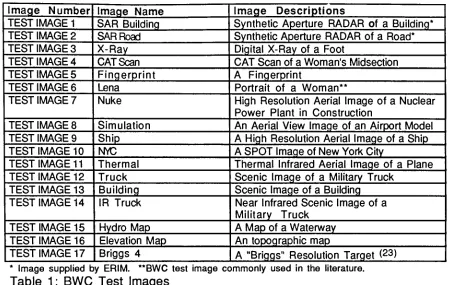
Seventeen test images were selected to represent the types of images
that might be exploited for information extraction
by
the users of NITFS. These monochromeimages,
each 512 pixelsby
512 linesby
8 bits perpixel, include high-resolution aerial
images,
medicalimages,
digitizedmaps, hand-held
images,
graphics, and images applicable to lawImage Number Image Name Image Descriptions
TEST IMAGE1 SAR Building Synthetic Aperture RADAR of a Buildinq*
TEST IMAGE2 SARRoad Synthetic Aperture RADAR of a Road*
TEST IMAGE 3 X-Ray Digital X-Ray of a Foot
TESTIMAGE4 CAT Scan CAT Scanof aWoman's Midsection i TEST IMAGE 5 Fingerprint A Fingerprint
TEST IMAGE 6 Lena Portrait of a Woman**
TESTIMAGE7 Nuke High Resolution Aerial Image of a Nuclear Power Plant in Construction
TEST IMAGE 8 Simulation An Aerial View Image of an Airport Model TESTIMAGE9 Ship A High Resolution Aerial Image of aShip
TEST IMAGE10 NYC ASPOT ImaqeofNew YorkCity
TEST IMAGE 11 Thermal Thermal Infrared Aerial Image of a Plane TEST IMAGE12 Truck Scenic Image of a Military Truck
TESTIMAGE13 Building Scenic Imageof a Building
TEST IMAGE14 IR Truck Near Infrared Scenic Imageof a
Military Truck TEST IMAGE 15 Hydro Map AMapof aWaterway TEST IMAGE16 Elevation Map Antopographic map TEST IMAGE17 Briggs 4 A "Briggs"
Resolution Target *23)
*
Image supplied by ERIM. "BWC test image commonly used in the literature.
Table 1 : BWC Test Images
2.2 Candidate Bandwidth Compression Algorithm Selection
The classical
lossy
image compression technique is a form of DPCM. Acompression algorithm in this class is the ARIDPCM. The simplicity of
this algorithm has enabled its use on personal computers for years. But
the performance improvements of small computers, their compilers, and in the compression algorithms themselves have permitted the
consideration of hitherto complex algorithms. For example, the relatively
recent development of the integer-based Discrete Cosine Transform
(DCT)
(as opposed tofloating-point)
has enabled the DCT to become practical onIBM AT-class machines.
DCT is well known for producing excellent image quality and is included in
the test matrix in three forms. The best known is the proposed ISO/JPEG DCT standard. The second of the DCT algorithms evaluated is the "generic"
zonal DCT algorithm. This algorithm is more complex than the ISO/JPEG algorithm, but has advantages in bit-rate control and in resistance to
channel error. The third DCT algorithm is a proprietary algorithm submitted
by
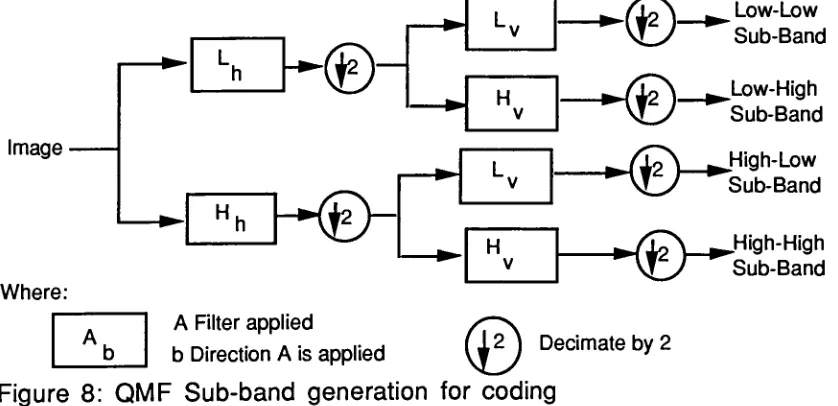
the MITRE Corporation. This evaluation also included two proprietary forms of sub-band coding compressiontechnology,
oneby
Aware Inc. and anotherby
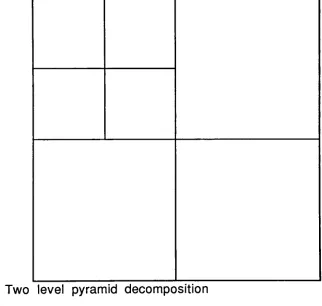
David Sarnoff Research Center. The sub-band [image:24.551.38.488.44.329.2]2.3 Compression and Reconstruction
The test images were compressed to rates of
0.5, 1.0,
2.0 and 4.0bpp
and then reconstructed. The three non-proprietary algorithms were runinternally by
the author on a VAX-8700 and the images using the three proprietary algorithms were processedby
their respective companies. These bit rates were chosen to compensate for theinherently
exponentialrate distortion curves over the bit rates of interest.
Sampling
in such a fashion minimizes interpolation errors for a fixed number of bit rates. Anexample of a rate-distortion curve is shown in Figure 1. This study concentrated in the range of 2.0
bpp
to 0.5bpp
because at 4.0bpp
most algorithms were visually lossless. The study did not pursue highercompression ratios because prior experience many images are not useful
when compressed below 0.5
bpp
for these algorithms.2.4 Algorithm Evaluation
The
following
sections outline the methodology used in evaluating the testalgorithms for: bit-rate accuracy, image quality, susceptibility to channel error, speed, and complexity.
Only
software implementation techniques using "standard" practices on serial computers were evaluated because of the cost of hardwareimplementations. If hardware implementation had been considered then
additional evaluation techniques for complexity would have been
necessary, such as physical size, power consumption and absolute speed of calculations. Hardware implementations of interest would
include,
for example, small portable systems (hand held digital cameras) and remotesensing systems.
2.4.1 Bit-Rate
Accuracy
Reliable control over the number of bits transmitted is important in
scenarios where transmission time or receiver storage is limited. To assess the performance of the algorithms in this area, the algorithms are
first divided into two classes, driven and non-driven. A driven algorithm
produces a desired bit rate independent of the
image,
while a non-driven algorithm produces a bit rate that is dependent on both the image and the algorithm. The driven algorithms are then evaluated on the ease ofand the relative ease with which a non-driven algorithm can produce a
desired bit rate are reviewed.
2.4.2 Image
Quality
EvaluationThe most important part of the overall evaluation of a BWC algorithm is image quality. Bit-rate accuracy, speed, complexity and tolerance to
channel errors are often compromised for higher image quality.
Image quality loss is generally divided into two classes, subjective and
objective. Subjective image quality ratings rank the visual information loss of an image. Objective image quality ratings yield information on the loss of the radiometric
(numerical)
information. Subjective observationscan differ from person to person
depending
on a variety of factors such as the experience and age of the observer and viewing conditions. Objectiveratings are unchanged from evaluation to evaluation. The problem with numerical performance is that it is not
directly
related to subjective image quality. This means that an algorithm may have a larger numericalerror but appear to be better in visual image quality. This can happen if one algorithms exhibits greater error in areas or frequencies to which the
eye is relatively insensitive.
2.4.2.1 Numerical Performance
The numerical performance values include root-mean-squared error
(RMSE),
signal-to-noise ratio(SNR),
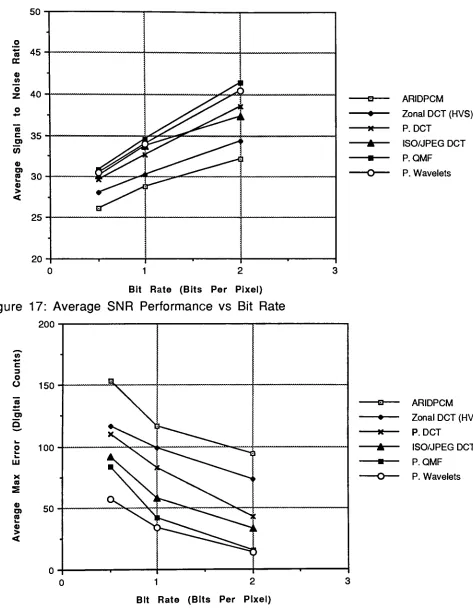
maximum error, global image gray level mean before and after compression, standard deviation before andafter compression, and the entropy of the original image and of the error images. These measurements were performed on each image at each bit
rate and for all the algorithms. It is important to note that
numerical performance values may not be
directly
proportionalto subjective image quality.
RMSE is one of the most common objective quality measurements used in
N
RMS Error =
\
^
=VMSE
(1)
X(X'i-Xi)2
Where
Xj
is an original image value,X'j
is the reconstructed image and N isthe total number of pixels.
SNR is another common metric for evaluating BWC algorithms. SNR is
defined here as the ratio of the original image variance
(signal)
to themean squared error
(MSE)
of the compressed image (noise). The SNR is calculatedby implementing
Equation 2.SNR =
10*Log10
Original Image Variance
MSE
(2)
An algorithm may exhibit relatively small global MSE while still
exhibiting objectionable error in isolated regions.
Generally,
acomputation of the maximum error will
flag
this effect. The Max error isthe maximum absolute value of the difference between the original and
the reconstructed image (Equation 3).
Max Error = MAX
(
ABS(
X'
-X) )
(3)
Where X is the original image value and
X'
is the reconstructed image.
The overall statistics of the original and reconstructed images are
important if an automatic tone transfer curve
(TTC)
is used for display. A TTC remaps a given image to produce the "best" tonal viewing conditions for a given image and monitor. A change in image statistics may change the resultingTTC,
which will in turn change the appearance of the image.In addition, a decrease in standard deviation may also indicate increased
smoothing
by
the algorithm; conversely, an increase in standard deviation may indicate a noise increase. The mean and standard deviation of the images are calculated using Equations 4 and5,
respectively.N
iXi
Mean
(X)
=N
X(Xj-
X)2_
, i=1 Standard Deviation
(s)
=\
rpj
(5)
where
Xj
is the value of the image at pixeli,
X is the mean of thatimage,
and N is the total number of pixels.
The final statistics to be calculated are the entropy values of the original image and the error image. The entropy of the original image
approximates the busyness of the original scene. The entropy of the error image is intended to show the approximate bits per pixel additionally
required to reproduce the original image without loss. The entropy of an
image is calculated
from;
K
ENTROPY= /Pi *
Log
i=1
1
P
(6)
where
Pj
is the probability of any given gray value(i)
in the image and K isthe number of possible gray values (i).
2.4.2.2 Visual Performance
High-quality
images of the original and reconstructed images werepresented to a group of people for evaluation. The evaluation images were 9 inches
by
9 inches photographic transparency. The production of theseimages was optimized to produce the best images quality. Examples of
the original and reconstructed images are shown in Appendix A in smaller
and reflection print format. There were 34 evaluators ranging in
experience from professional image analysts to engineers to military
personnel. This evaluation was to determine the relative losses in visual utility due to the bandwidth compression
(BWC)
algorithms evaluated. Some areas of concern and points of interest of the images are presentedin section 5.4. This should enhance the readers'
ability to visually
2.4.2.2.1 Test Image Set Selection
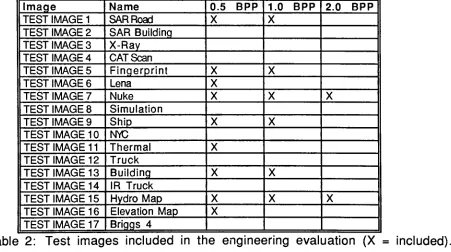
A subset of the 17 test images were chosen for visual evaluation (See Table 2). It was deemed unreasonable to evaluate all images at all bit
rates because of the amount of images to be viewed. The subset image set was chosen on the basis of image applicability combined with
compressibility. For example, Briggs targets and medical images were
eliminated; both of these image sets compressed well, while the benefit
is questionable in comparison to aerial,
hand-held,
or map images. At 4.0 bits per pixel most images decompressed with the candidate BWCalgorithms produced visually lossless results.
Therefore,
these images were eliminated from the test set. For the otherimages,
preference was given to lower bit-rates. Decompressed images with negligible visual loss were eliminated from the test set.Image Name 0.5 BPP 1.0 BPP 2.0 BPP
TEST IMAGE1 SARRoad X X
TEST IMAGE2 SAR Building
TEST IMAGE 3 X-Ray TEST IMAGE 4 CAT Scan
TESTIMAGE 5 Fingerprint X X
TEST IMAGE6 Lena X
TEST IMAGE7 Nuke X X X
TEST IMAGE8 Simulation
TEST IMAGE 9 Ship X X
TEST IMAGE10 NNC
TESTIMAGE 11 Thermal X
TESTIMAGE12 Truck
TEST IMAGE13 Building X X
TEST IMAGE 14 IR Truck
TESTIMAGE15 Hydro Map X X X
TEST IMAGE16 Elevation Map X
[image:29.551.56.507.286.538.2]TEST IMAGE 17 Briggs 4
Table 2: Test images included in the engineering evaluation (X = included).
2.4.2.2.2 Evaluation Layout and Media
The six algorithms with the original data were rendered on positive nine-by-nine inch film transparencies. Transparencies present a wider dynamic
range and higher level of consistency than can be rendered on prints. A light table was therefore required at each evaluation site. Figure 2
illustrates the format of a given test transparency. Each image within the
layout is 512 lines
by
512 pixels. The 1024-by-1024 images werelaser writer. These original negatives were contact printed to produce
multiple copies. Each copy was checked for consistency. The upper left
image is the standard "original" against which all others were evaluated.
The remaining renditions for a given
image,
each corresponding to a specific compression algorithm and a bit rate, were randomly placed inthe remaining three spots among the transparencies.
Standard
Image
Algorithml
Rendition
Algorithm 2
Rendition
Algorithm
3
Rendition
Figure 2: Test
transparency
format2.4.2.2.3 Evaluation Instructions
A set of instructions for performing the rating was supplied with each
test set. The instructions, shown in Appendix
E,
are a step-by-step guidethrough the test procedure. Because of the
diversity
of personnel anddiffering
environmental conditions at each site, the instructions are veryspecific. While we assume the instructions were
followed,
theevaluations were unsupervised. A set of instructions was sent with each
image set.
2.4.2.2.4
Rating
ScaleThe evaluators were to rate each image on a quality scale of +1 to -5 in
comparison to the original image (Standard). This scale could be
interpolated
by
the evaluator to an arbitrary precision. Images wereevaluated in terms of exploitation loss of the compressed image as
compared to the original uncompressed image. Each algorithm was
evaluated in comparison only to the original image standard; no scoring
should have been based on comparison between two or more algorithms.
+1
-3
-5
Slight improvement compared to the standard No noticeable difference from the standard
Slight change in the imagecompared to standardbut no loss in utility Slight loss in utility compared to standard, but adequate to perform exploitation
Significant loss in utility compared to standard (adequate to perform exploitation but may seriously affect accuracy of exploitation)
Excessive utility loss compared to standard (unusable for exploitation but usable for briefings and orientation)
Excessive utility loss compared to standard (unusable for any purpose)
Figure 3:
Rating
scale2.4.2.2.5
Rating
SheetA rating sheet example is shown in Appendix F. Possible exploitation
questions/tasks, based on the image at
hand,
were provided for each image. Appendix G shows sample questions for test image7,
an aerial view of the construction site for a nuclear power plant.2.4.2.2.6 Background Questionnaire
A personal data sheet, shown in Appendix
H,
was completedby
each evaluator and was intended to categorize the image exploitationexperience of each evaluator if statistical weighting would have been required.
2.4.2.2.7 Evaluation Procedure
The data were screened for outliers
by
using standard statistical techniques. Flagged outliers would have been considered for removal according to such factors as individual experience with the given data type. No outliers were discovered.An analysis of variance
(ANOVA)
table was used to interpret the results. The ANOVA table allowstesting
forbiases,
which might be due to theexpertise of the evaluator on an image type, the image data or the bit-rate. Each bit-rate was considered separately because
they
are discrete points on the rate-distortion curve. The ANOVA table produces, in thiscase, a mean visual rating, the variance of the rating and a prediction of
same significance group. A single algorithm can be placed in two
different significance groups which implies that group one is
significantly different from group two but that the algorithm is not
significantly different from either of the groups.
2.4.3 Algorithm
Complexity
and SpeedThe complexity and speed of a BWC algorithm are important to small
computer users. For this study each algorithm was evaluated on the basis
of the number and type of operations
(multiplies,
divides, look-ups,
etc.)performed per pixel. These numbers translate to approximate running
time for a computer platform benchmarked for the speed of each operation
assuming a serial implementation of the algorithm.
Relative running times for each algorithm on a given machine are
presented for both compression and decompression. While the relative
algorithm performance is accurate for the configurations presented, the
actual times will vary
depending
on specific implementations. A generalgoal of the NITFS is to compress and decompress a 512-by-512 sample
image in less than two minutes each direction.
2.4.4
Susceptibility
to ErrorChannel bit-error effects are important for evaluating BWC algorithms
used in transmission. Some algorithms will suffer localized information
loss from a bit error, while others may experience total image
destruction.*4) This indicates certain algorithms may have different error
detection and correction requirements. Error detection algorithms reduce
the loss of information in an image but also increase the overhead, which
in turn increases the total bit rate. The effects of bit errors
during
3.0 Compression Algorithm Description
Spatial compression can be performed on images only if neighboring pixels
are correlated. In general, the higher the correlation between neighboring
pixels the more compression that can be achieved. Most
lossy
spatialcompression algorithms work in three phases: prediction, quantization and
coding. The first is the transform or prediction or "representation" or
"model"
phase, which takes advantage of the correlation between pixels.
This phase, which is usually
lossless,
decorrelates the databy
eithertransform or prediction methods. The intent of the transform or
prediction is to minimize the redundant information in the image.
The second phase of the compression process is the quantization of the
data. Losses in image
fidelity
aredirectly
attributable to this step.However,
the amount of loss is a function of both the transform/prediction method and the quantization strategy employed. Examples of
common quantization strategies are Lloyd-Max quantization and Pulse
Code Modulation (PCM).*4)
The quantized values are coded in the third and last phase. The two coding
methods discussed in this study are a fixed-length
binary
code and avariable-length coder. Constant-length
binary
codes with n bits per pixelcan store 2n values. These values are representative of integer values
between 0 and
2n-1,
or of values that are hard-coded in alook-up
table.In variable-length coders, the length of the code is a function of the
probability of occurrence of a given data point. An entropy coder is the
most common variable-length coder. Other examples of coding strategies
are the Mel-coder and the Lempel-Ziv*4) technique.
In sections
3.4,
3.5 and3.6,
only a limited discussion of the algorithmscan be presented due to their proprietary nature. More information can be
obtained from the references given and the companies that have submitted
the algorithms.
3.1 ARIDPCM(3.6)
The ARIDPCM algorithm consist of partitioning the original image into
8-by-8 pixel neighborhoods, generating hierarchical prediction matrices for
those neighborhoods, and then quantizing the difference images (original
-predicted) at each level of the hierarchy. As outlined in the NITFS
mode.
Only
the driven mode will be discussed since it ensures a fixed compression rate.3.1.1 Compression
The driven mode is a two-pass algorithm. The first pass generates the prediction matrices, finds the difference images and then classifies each difference neighborhood in terms of its activity. The second pass
quantizes the delta pixel values (from the difference
image)
in each neighborhood according to its activity classification. As inDPCM,
compression is achieved through quantizing the difference image with fewer bits.3.1.1.1 Prediction and Error
Each image is subdivided into 8-by-8 pixel neighborhoods
beginning
at the upper left corner of the image. All of the prediction are made with the original values. Each neighborhood is comprised oflevels;
one Level-1 pixel(L1),
three Level-2 pixels(L2),
twelve Level-3 pixels(L3),
and forty-eight Level-4 pixels(L4)
(see figure 4 for Level map).EI
L3 L3 L4 L4 L4 L4 L4 L4 L4Inn*
L3 L4 L3 L4 L3 L4 L3 L4 L3 msasm L4 L4 L4 L4 L4 L4 L4 L4 L2 mimai L4 L3 L4 L4 L4 L3 L4 L4 L4 L4 L4 L4 L4 L4 L3 L4 L3 L4 L3 L4 !L3 L4 L3 L1 L4 L4 L4 L4 L4 L4 L4 L4 L3 L4 L4 L3 L4 L4lL1
The notation used to describe the neighborhood matrices is
Di.j
=Uj
-pij;
difference matrix.Li.j
= Actual pixel value at Pixel i,j.Pi.j
= Predicted pixel value at Pixel i,j.The sub-image blocks are referenced in the bottom right corner (i =
j
=0),
with
i,
j increasing
from right-to-left andbottom-to-top
respectively.A prediction matrix is computed for each neighborhood
by
using anadditional column to the left and an additional row to the
top
of theneighborhood. In total, a 9-by-9 sub-image block encompassing the
neighborhood of interest is required to create its prediction matrix. If the
neighborhood of interest borders the
top
or left edge of theimage,
anartificial 9th row and/or column is created
by
copying the first row orcolumn in the neighborhood respectively, and
Ls,8
is assigned Lrj,0- Thefollowing
linear and bilinear interpolation scheme is used to compute the prediction matrix for each neighborhood.Level 2 pixels:
Po,4
=(
L0,o
+Lo,8
)
/ 2(7)
P4,o
= (L0,o+ L8>0)/2(8)
P4,4
=(
L0,o
+L0,8
+1-8,0
+L8i8
)
/ 4(9)
Level 3 pixels:
Pij
=(
LU-2
+Lu+2 )
/ 2 for i-0,
4 and j.2,
6(10)
Pij
-(
Lj.2ij
+Li+2ij
)
/ 2 for i.2,
6 and j-0,
4(11)
Pi.j
=(
Lj-2,j-2
+U-2.J+2
+Li+2,j-2+
Li+2>j+2)
/ 4 for i=2,
6 and j=2,
6(12)
Level 4 pixels:
Pij
=(
Li.j.1
+Li>j+i
)
/ 2 for i=0, 2, 4,
6 and j-1, 3, 5,
7(13)
Pij
=(
Lj.-ij
+Li+i,j
)
/ 2 for i=1, 3, 5,
7 and j=0, 2, 4,
6(14)
Pij
=(
U-ij-i
+Li-i,j+i
+Li+i,j-i
+Li+1fj+i)
/ 4 for i=1, 3, 5,
7 and j=1, 3, 5,
7(15)
The difference matrix or error map is computed
by
set:DiJ
=U.j
-Pij.
This, however,
does not include the corner point which is a Level-1 pixel.Do,o
=L00.
(17)
The level-1 delta pixels are assigned their original pixel values.
3.1.1.2 Quantization
Each difference neighborhood is classified in terms of its activity. A
measure of activity is
"Busyness",
which is defined as the maximumdifference of the Level-4 delta pixels.
Busyness =
Max(D4)
-Min(D4)
(18)
Each difference neighborhood is classified as either an
A,
B, C,
or DBusyness;
Dbeing
the busiest.In the driven mode of operation, the first pass computes the activity of a
neighborhood. Thresholds for each busyness class are then computed such
that a fixed percentage of the neighborhoods falls into each classification.
This guarantees data compression at a specified fixed rate. Table 8 in
NITFS document Version 1.1 shows the percent Busyness classification for
a selected bit rate.
The quantization of the difference pixel is done with the use of
hard-coded
look-up
quantization tables that are dependent on the busynessclass, level of the pixel and the difference value of that pixel. The
Level-1 pixels are always quantized to their full image resolution (8 bits).
Standard quantization tables were derived
by
using Level-4 deltas fromsample images. The population distribution of the Level-4 deltas was
determined and divided into N continuous regions of equal population (N =
2",
were n represents the number of bits allocated for a given level in theBAMs). The hard-coded Bit Allocation Matrices
(BAM)
and quantization3.1.1.3
Coding
The quantized levels are coded with a constant-length
binary
look-up
table code. The number of bits in the
BAM,
the compression rate, and thequantized value are used as indices to the
look-up
table.3.1.2 Decompression
The image decompression process is the reverse process of the
compression scheme. The received data is used to reconstruct the
predicted matrix, which in turn allows reconstruction of the image. The
notation used to describe this process is:
E[
Djj
]
= Estimated value ofDjj
after dequantization.Ri,j
=E[Dij]
+P|j.
Rjj
= Reconstructed value at pixel i,j.Pij
= Predicted value at pixel i,j.Ljj
= Actual value at pixel i,j.The
(R0,o. Ro,8, Rs.o,
Rs.s)
pixels are equal to(L0,o> L0,8, U.o,
L8>8)
pixelssince Level 1 pixels are transmitted in full 8-bit resolution. The
remaining image values are reconstructed
by
consecutively computing the predicted values and their corresponding reconstructed values.Level-2 pixels:
The predicted values for level-2 pixels are
Po,4
=(
Ro.o
+Ro,8
)/2(19)
P4,o
=(
Ro.o
+Rs.o
)/2(20)
P4.4
=(
Ro.o
+Ro.s
+Rs.o
+Rs.s
)/4. (21)
The corresponding level-2 pixel values are reconstructed using
R0,4
=E[
D0)4
]+Po,4
(22)
R4,o
= E[D4,o]+P4,o
(23)
R4l4
=E[
D4,4
]
+P4.4.
Level-3 pixels:
From these reconstructed values already derived and using the
reconstructed values for
(
R4.8,
Rs,4 ),
P4.8
=(
Ro,8
+R8,8
)/2P8,4
= (R8>0+ R8,8)/2(25)
R4,8
=E[
D4,8
]+P0,4
(26)
R8,4
=E[
D8i4
]+P8>4
(27)
the
following
Level-3 predictions can be made.=
( Ri,j-2
+Ri,j+2
)/2 for i=0, 4,
8 and j=2,
6(28)
=(
Ri-2,j
+Ri+2,j
)/2 for i=2,
6 and j=0, 4,
8(29)
=
( Ri-2,j-2
+Ri-2,j+2
+Ri+2,j-2
+Ri+2,j+2
)/4. for i=2,
6 and j=2,
6(30)
The corresponding reconstructed values are then computed using
Ri.j=
E[
DU
]
+Pij.
(31)
Level-4 pixels:
The level-4 predicted values are made using the above reconstructed
values.
Pij
=( Rjj.1
+Ri,j+1
)/2 for i=0, 2, 4,
6 and j=1, 3, 5,
7(32)
Pij
=(
Ri'ij
+Rmj
)/2 for i=1, 3, 5,
7 and j=0,
2, 4,
6(33)
Pij
=(
Ri-ij-i
+Ri-ij+i
+Ri+ij-i
+Ri+i,j+i
)/4 for i=1,
3, 5,
7 and j=1, 3, 5,
7(34)
The remaining reconstructed values are computed
by
usingRlj
=E[
Dy
]
+Pij.
(35)
This completes the reconstruction process for all pixel values within an 8-by-8 neighborhood. This process is repeated until all neighborhoods are
3.2 ISO/JPEG Baseline Discrete Cosine TransformC,3,4,5,6,7,8)
The ISO/JPEG baseline DCT is a sequential 8-bit DCT with Huffman
encoding. This DCT is a one-pass algorithm comprised of a 2-D 8-by-8 DCT transform followed
by
separate Huffman encoding of the set of DCcoefficients; the AC coefficients are encoded with Huffman codes and run
lengths. The improvement in quality compared to the standard Chen-Pratt
(threshold)
DCTO) is in the quantization of the DCT coefficients. TheISO/JPEG DCT has been implemented in a
fast, integer-based,
transformwhich increases the speed of the transform with minimal quantization
errors. This implementation of the DCT has made its use in a PC-based
system more amenable.
3.2.1 Compression
The correlation structure for most realistic gray-scale images is
approximately Markov in character. When the equations governing the
Karhunen-Loeve
(KL)
transform are applied to a first-order Markov processwith high spatial correlation, the resulting transform looks very much
like the transform of a DCT. The DCT is thus assumed to be nearly
optimum for a block transform of a given size, as a variance-compacting
decorrelator with respect to imagery.
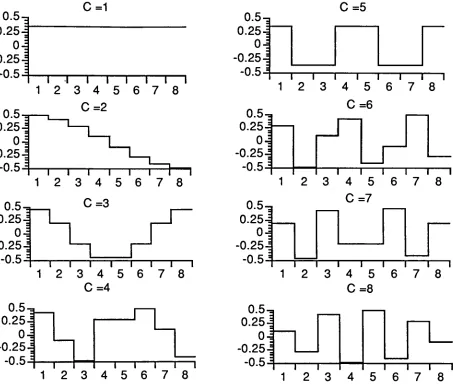
The DCT is significantly faster than a spatial KL transform. Figure 5
shows the DCT basis functions for a block size of 8. The transform
coefficients corresponding to each of the basis functions measures the
similarity of the pixels in the block and the corresponding basis functions.
The sign of the coefficients indicates negative or positive correlation
with the basis function.
The 1-D basis function are represented in two dimensions
by
equation 36.The 1-D functions can be applyed in the lines direction and then the
samples direction because of their separability. This can increase both
0.5-g
0.25-j 04
-0.254
-0.5-i
C=1
0.5-=
~l 1 I I I I I I
12 3 4 5 6 7 8
C=2
0.5, C=3
1 I 1 T I 1 1 1
12 3 4 5 6 7 8
C=4
0.5-=, 0.254
04
-0.25-1
-0.5^
n
i i i i i
1 2 3 4 5 6 7 8
0.5-= 0.254 0-j
-0.25-j
-0.5-:
C=5
0.5-g
0.25404
-0.254
-0.5-S
I I I l I I I
12 3 4 5 6 7 8
C=6
0.5-a 0.254
0-1
-0.254
-0.5-^
\ 1 1 1 1 1
1 2 3 4 5 6 7 8
C=7
I I 1 1 1 1 1 1
12 3 4 5 6 7 8
C=8
O.5-3
0.254
04
-0.254
-0.5i
1_
I 1 1 I 1 1 1 1
[image:40.551.53.506.50.435.2]1 2 3 4 5 6 7 8
3.2.1.1 Transform
The ISO/JPEG DCT process first divides the image into 8-by-8 blocks. The
8-by-8 DCT of each block is computed. The transform equation is:
(4C(u)C(v))n-1n-1 (2j + 1)up (2k + 1)vp F(u,v) = A
'2K ''
1
f(J.k)cos(* 2/ P)cos(A ^T^(36)
n j=o k=0
where
F(u,v)
is the DCT value for the point u, v in the 8-by-8block,
f(j,k)
is the original image value for the pixelj,
k of the 8-by-8block,
and
C(w)
= . for w = 0and
C(w)
=1 for w =1,2,3,
. . . , N-1.For most images the energy is concentrated in the low spatial frequencies
(upper left corner). The extreme upper left value is the DC value
(i.e.,
zerofrequency)
which is proportional to the mean of that block. The othervalues increase in
frequency
and generally decrease in energy from theupper left to the lower right.
3.2.1.2 Quantization
The ISO/JPEG DCT quantization tables have been adapted to reflect the
sensitivity of the human visual system (HVS).*8'21) This HVS quantization
is optimized to reduce information without sacrificing perceived image
context. The benefits of HVS quantization can be thought in two ways:
1. The same visual quality can be obtained with less data (i.e. more
compression).
2. Improved image quality can be obtained with the same quantity of
data.
Quantization is performed
by
dividing
the transform databy
a factor forthat
frequency
and quantizing to a nearest integer. Compression isincreased
by
multiplying the quantization table below (annex of the JPEG16
(DC)
1 1 10 16 24 40 51 6112 12 14 19 26 58 60 55
14 13 16 24 40 57 69 56
14 17 22 29 51 87 80 62
18 22 37 56 68 109 103 77
24 35 55 64 81 104 113 92
49 64 78 87 103 121 120 101
72 92 95 98 112 100 103 99
The error associated with compression occurs at this step. This is an
example, and may not be suitable for normal viewing conditions because of the lack of symmetry.
3.2.1.3
Coding
The DC coefficient is extracted from the 8-by-8 block and coded
separately. The DC coefficient of the adjacent block is used as a predictor
and the difference is Huffman encoded. The remaining 2-D array of
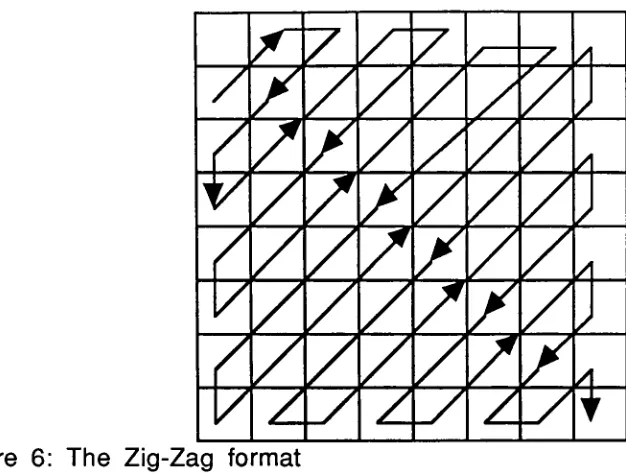
quantized AC coefficients are placed in a 1-D array
by
zig-zag ordering, shown in Figure 6. This reformats the transform coefficients intoapproximately
decreasing
order of expected energy and allows them to be run length encoded. The AC coefficients are Huffman encoded withadditions to the code for runs of zero coefficient and end-of-block
(EOB)
data. The EOB is used at the last non-zero AC coefficient. This reducesthe number of coefficients to be coded since most of the high
frequency
values tend to be zero, especially after the HVS quantization. The Huffman and quantization
(normalization)
tables can be optimized for aFigure 6: The
Zig-Zag
format3.2.2 Decompression
The ISO/JPEG DCT decompression process is a mirror image of the
compression process. The decompression process consists of four stages:
1.
decoding
the Huffman code2. recreate the 2-D block
3. dequantization
4. inverse DCT.
The transform from discrete cosine domain to image domain is executed
using Equation 37:
(4C(u)C(v)) n-1 n-1
(2j
+ 1)up (2k + 1)vp,v f(j,k) = [
4
I F(u,v)cos(^ ' >os(j ^Ji)(37)
n u=o v=0
2n
where
F(u,v)
is the DCT value for the point u, v in the 8-by-8 blockf(j,k)
is the reconstructed image value for the pixelj,
k of the 8-by-8block,
andC(w)
=
-?=-for w = 0 and
C(w)
= 1 for w = 1,2,3 N-1.V
2Again,
equation 37 is the definition of thefloating
point inverse DCT