RESEARCH
Stochastic lattice-based modelling
of malaria dynamics
Phong V. V. Le
1,2, Praveen Kumar
1,3*and Marilyn O. Ruiz
4Abstract
Background: The transmission of malaria is highly variable and depends on a range of climatic and anthropogenic
factors. In addition, the dispersal of Anopheles mosquitoes is a key determinant that affects the persistence and dynamics of malaria. Simple, lumped-population models of malaria prevalence have been insufficient for predicting the complex responses of malaria to environmental changes.
Methods and results: A stochastic lattice-based model that couples a mosquito dispersal and a
susceptible-exposed-infected-recovered epidemics model was developed for predicting the dynamics of malaria in heterogene-ous environments. The Itoˆ approximation of stochastic integrals with respect to Brownian motion was used to derive a
model of stochastic differential equations. The results show that stochastic equations that capture uncertainties in the life cycle of mosquitoes and interactions among vectors, parasites, and hosts provide a mechanism for the disruptions of malaria. Finally, model simulations for a case study in the rural area of Kilifi county, Kenya are presented.
Conclusions: A stochastic lattice-based integrated malaria model has been developed. The applicability of the
model for capturing the climate-driven hydrologic factors and demographic variability on malaria transmission has been demonstrated.
Keywords: Malaria, Climate change, Metapopulation, Stochastic, Ecohydrology
© The Author(s) 2018. This article is distributed under the terms of the Creative Commons Attribution 4.0 International License (http://creat iveco mmons .org/licen ses/by/4.0/), which permits unrestricted use, distribution, and reproduction in any medium, provided you give appropriate credit to the original author(s) and the source, provide a link to the Creative Commons license, and indicate if changes were made. The Creative Commons Public Domain Dedication waiver (http://creat iveco mmons .org/ publi cdoma in/zero/1.0/) applies to the data made available in this article, unless otherwise stated.
Background
Malaria is a vector-borne disease with complex nonlinear dynamics [1, 2]. The disease, caused by protozoan para-sites of the genus Plasmodium, is transmitted between humans by female Anopheles mosquitoes. Many fac-tors are determinants for the transmission of malaria, including climate suitability, life cycles of pathogens and vectors, and the local capacity to control the mosquito population [3–6]. The fundamental basis for malaria risk prediction and early warning lies in the ability to estimate the effects of weather, to identify vector habitat, and to model the population dynamics of Anopheles mosqui-toes and the transmission of the pathogens in the human population.
Mathematical models have been used to provide an explicit framework for understanding malaria
transmission dynamics for over 100 years, starting with the pioneering work of Ross [7]. In a simple form, he used a few ordinary differential equations (ODEs) to describe quantitative changes in densities of infected human and mosquitoes. Since then, more sophisticated models have been developed that include factors such as latent peri-ods [4, 8], vector density and human age structure [4], varying human population size and migration [9, 10], socio-economic developments [11], temporary immu-nity [12], and weather effects [13]. In addition, agent-based and meta-population agent-based models have been used to allow simulations of heterogeneous communi-ties subject to realistic transmission scenarios [14–18]. Over the last 60 years, much scientific research was undertaken and progress made in understanding the biology of malaria vectors and host-parasite-vector inter-actions. Systematic reviews of mathematical modelling of malaria [19] and other mosquito-borne diseases [20, 21] indicate the need for models to address the complexities is the host-vector-parasite interactions and to incorpo-rate heterogeneous environments.
Open Access
*Correspondence: [email protected]
1 Department of Civil and Environmental Engineering, University of Illinois, Urbana, IL 61801, USA
Deterministic models with susceptible-exposed-infected-recovered (SEIRS) patterns, often based on nonlinear ODEs, are among the standard approaches for estimating the transmission potential for a wide range of infectious diseases, including malaria [22]. These models are use-ful in understanding the temporal dynamics of infection cycles and in coping with different epidemiological situa-tions including both epidemicity and endemicity. However, SEIRS models ignore the aquatic stage of the mosquito life cycle and the spatial dynamics of mosquitoes when habi-tats are heterogeneously available, thus limiting the ability to couple and accurately predict the link between the life cycle of Anopheles mosquitoes and malaria transmission. Furthermore, deterministic models cannot capture fluc-tuations dominated by the random nature of population events, environmental conditions, and variability in the controlling parameters, which inevitably occur in a real system [23]. To that end, stochastic models have proved valuable in estimating asymptotic expressions for the prob-ability of occurrence of major outbreaks as well as sto-chastic extinctions [24, 25]. Nevertheless, there still exists a lack of complete predictive capability which may allow a mechanism to efficiently capture uncertainty in the tempo-ral and spatial dynamics of malaria. This shortcoming has been attributed to the differences in stochastic modelling approaches, as agent-based models [15, 17, 18] are inef-ficient for large-scale simulations with very large number of vector individuals involved, while lumped-population models [26, 27] bypass the spatial dynamics of the diseases.
In this paper, a stochastic lattice-based integrated malaria (SLIM) model for investigating the dynamics of mosquitoes and transmission of malaria in time and space is developed. More precisely, an entomological mosquito dispersal formulation is coupled with a clas-sic SEIRS-type model to capture the interaction between malaria dynamics and the life cycle of Anopheles vec-tors. The model is linked to a sophisticated ecohydro-logic model to incorporate climate-driven hydroecohydro-logic and ecologic processes as factors that determine mosquito population and malaria transmission dynamics. A meta-population approach is incorporated to describe the movements of vectors among discrete geographic sub-domains. The Itˆo approximation of stochastic integrals is used to derive governing stochastic differential equations (SDEs) of the model. Then, the derived SDEs are rep-licated across lattice grid cells in the domain to capture temporal and spatial dynamics of malaria.
The rest of this paper is organized as follows. In the next section, the mathematical formulations of the sto-chastic malaria model is described. Then, numerical sim-ulations of this model using topographic and reanalysis data for a case study in Kenya are presented. Finally, the paper closes with discussion of the key points.
Methods: model description
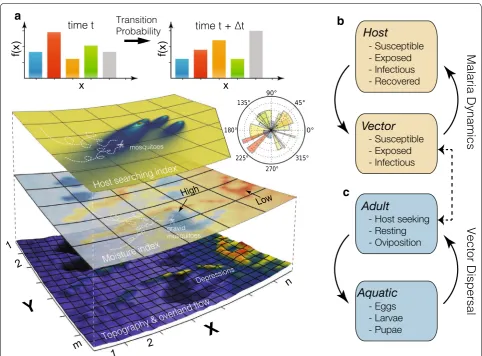
SLIM consists of two stochastic time-continuous, space-discrete models: one for vector dispersal that represents the entomological life cycles of female Anopheles, and a second for SEIRS malaria dynamics that simulates the circulation of the pathogen between host and vec-tor populations (see Fig. 1). The model is driven by the distribution of human population (density, locations), atmospheric forcing (air temperature, precipitation), and hydrological conditions (soil moisture distribution and ponding persistence in topographic depressions). The spread of malaria in time and space is modelled as fol-lows. Let D be a bounded domain in R2 and let m,n≥1 be integers. D is partitioned into uniform and rectangu-lar lattice grid indexed as {ζ :=(i,j)∈Z2+:i≤n,j≤m} . In each grid cell ζ , a vector dispersal model for mosquito population dynamics is coupled with a SEIRS formula-tion for malaria transmission. It is assumed that mosqui-toes in aquatic stages are immobile, but adult mosquimosqui-toes can move between adjacent grid cells, spreading the pathogen.
Vector dispersal model
The deterministic vector dispersal model of Lutambi et al. [28] that serves as the basis for constructing the stochastic formulation is described first. The life cycle of the female mosquito has six distinct phases, includ-ing three aquatic stages: egg (E), larval (L), pupal (P); and three adult stages: host-seeking ( Ah ), resting (Ar ), and
oviposition site searching ( Ao ). Each phase of this model, hereafter referred to as ELPAs, is subject to fluctuations due to recruitment, mortality, and progression of survi-vors into the next states. Ah and Ao are further affected by the movement of mosquitoes in space. For t>t0 and ∀ζ ∈D , ELPAs is given as a set of dynamical equations as described below. The summary of key parameters pre-sented in ELPAs and their ranges of values are given in Table 1.
• The rate of change in egg population ( Eζ ) as a
func-tion of oviposifunc-tion, egg mortality and hatching:
where b is the average number of eggs laid during an oviposition with 1:1 sex ratio; ρAo is the rate at which eggs are oviposited by gravid mosquitoes; µE is egg mortality rate; and ρE is the hatching rate into larvae. The term ψζW on the right hand side represents water
availability in a particular cell ζ and is discussed later. (1a)
dEζ
dt =bψ
W
• The rate of change in larvae population ( Lζ ) as a
function of egg population, larval mortality and maturation into pupae:
where ρL is the progression rate from larvae to pupae; µL1 and µL2 represent natural and density-dependent
death rates of larvae, respectively.
• The rate of change in pupae population ( Pζ ) as a
function of larval maturation, pupal mortality, and emergence into adults:
(1b)
dLζ
dt =ρEEζ−
µL1+µL2Lζ+ρL
Lζ
(1c) dPζ
dt =ρLLζ−(µP+ρP)Pζ
where µP is the mortality rate of pupae, and ρP rep-resent the rate of emergence from pupae into adults.
• The rate of change in population of host-seeking adults ( Ah,ζ ) as a function of pupal emergence,
ovi-position, mortality, and blood feeding rates:
where µAh is the death rate of host-seeking adults; and ρAh is the rate at which they enter a resting state after blood feeding. Host-seeking adults can spread to adjacent cells for searching human host in which ωζH1:ζ2 represents their movement rate from cell ζ1
(1d)
dAh,ζ
dt =ρPPζ+ψζWρAoAoζ −
µAh+ψζHρAh
Ah,ζ
+
ζ′∈N ωζH′:ζ
Ah,ζ′−
ζ′∈N
ωHζ:ζ′×Ah,ζ
a
b
c
Fig. 1 Schematic of the SLIM model that couples a vector dispersal model with a malaria dynamics formulation. a Ponding and moisture index
obtained from an ecohydrologic model (Dhara) provide the habitat for gravid female Anopheles to deposit eggs. The dispersal of host-seeking
mosquitoes is based on a host searching index calculated as a function of human density in each grid cell. The rates of movement of mosquitoes among adjacent grid cells are diffusive. In each cell, the changes of sub-populations (x-axes) in vector dispersal and malaria dynamics models
over time period t are described by transition probabilities. b Sub-population of compartmental malaria dynamics model in each grid cell. c
[image:3.595.57.540.86.442.2]to ζ2 modelled as a decreasing exponential function
of human population and average area of cell ζ1 and ζ2 (see [28]); N denotes the neighbors of the cell
under consideration. The last two terms in (1d) rep-resent the movements of vectors from all neighbors ζ′ into cell ζ and vice versa, respectively. After laying eggs, gravid mosquitoes return to the host-seeking state for subsequent blood feeding.
• The rate of change in population of resting adults ( Ar,ζ ) as a function of blood feeding, mortality, and
protein digestion rates:
where µAr is the death rate of resting adults; and ρAr is the progression rate at which the survivors enter the oviposition site searching phase. In the rest-ing state, female mosquitoes are usually dormant to digest protein.
• The rate of change in population of oviposition site searching adults ( Ao,ζ ) as a function of emergence,
oviposition, mortality, and digestion rates:
where µAo is the death rate of gravid female mosqui-toes. Vectors in ovipositing state also spread in space
(1e) dAr,ζ
dt =ψ
H
ζρAhAh,ζ−
µAr +ρAr Ar,ζ
(1f) dAo,ζ
dt =ρrAr,ζ−(µAo+ψζWρAo)Ao,ζ
+
�
ζ′∈N ωζW′:ζ
Ao,ζ′ −
�
ζ′∈N
ωWζ:ζ′×Ao,ζ
to find water for oviposition in which ωWζ1:ζ2 repre-sents their movement rate from cell ζ1 to ζ2 modelled
as a decreasing exponential function of surface soil moisture and average area of cell ζ1 and ζ2 [28].
The above model (1) is well-posed in a positively invari-ant domain:
Unlike the original model [28], environmental vari-ability is further incorporated to the developmen-tal rates of aquatic mosquitoes using the temperature relationships [29]:
for k= {E,L,P} , where Ta is the mean air temperature (K) over the time interval t ; and rk(Ta):R�→R is the
development rate per unit time at Ta . Details for the tem-perature dependencies of egg, larval, and pupal popula-tions are presented in Depinay et al. [29].
Although the ELPAs model offers a simple approach to incorporate the effects of vector mobility on spatial popu-lation dynamics of vectors in heterogeneous environments, it does not account for fluctuations dominated by random-ness in population events and environmental conditions. In some cases, such fluctuations may result in critical state transitions of vector population dynamics. This fact high-lights the need to develop stochastic tools to address the complexities arising from vector population dynamics.
A continuous SDE model for the dynamical system (1) is developed in the following way (see Chapter 5, ref [30] �= {Eζ,Lζ,Pζ,Ah,ζ,Ar,ζ,Ao,ζ} ⊆R≥6×0m×n, ζ ∈D
(2)
ρk=rk(Ta)�t Table 1 Description and values of parameters of the ELPAs model. Modified from [28]
Name Description Unit Range
b Integer number of female eggs laid per oviposition − 50–300
ψζW 50% of the eggs are assumed to hatch into female mosquitoes parameter
repre-sent water availability in cell ζ
− 0.0–1.0
ψζH Binary parameter represent human presence in cell ζ − 0–1
ρE Egg hatching rate into larvae day−1 0.33–1.0
ρL Rate at which larvae develop into pupae day−1 0.08–0.17
ρP Rate at which pupae develop into adult/emergence rate day−1 0.33–1.0
µE Egg mortality rate day−1 0.32–0.80
µL1 Natural mortality rate of larvae day−1 0.30–0.58
µL2 Density-dependent mortality rate of larvae day−1mosq−1 0.0–1.0
µP Pupae mortality rate day−1 0.22–0.52
ρAh Rate at which host-seeking mosquitoes enter the resting state day−1 0.322–0.598
ρAr Rate at which resting mosquitoes enter oviposition searching state day−1 0.30–0.56
ρAo Oviposition rate day−1 3.0–4.0
µAh Mortality rate of mosquitoes of searching for hosts day−1 0.125–0.233
µAr Mortality rate of resting mosquitoes day−1 0.0034–0.01
[image:4.595.62.540.98.339.2]for more details about the approach to stochastic mod-elling applied herein). First, it is assumed that there is demographic variability due to births, deaths, and transitions between the states in (1). Second, a discrete (Markov chain) stochastic model for (1) is constructed. For small interval t , we then identify all possible changes and their corresponding transition probabili-ties for the discrete stochastic processes. Third, the expected changes and the covariance matrix of changes of these processes are determined. Finally, the continu-ous SDE model for (1), hereafter referred to as S-ELPAs, is inferred by similarities in the forward Kolmogorov equations between the discrete and continuous stochas-tic processes [30, 31]. Note that solutions of the discrete Markov chain and continuous S-ELPAs models approxi-mately have the same probability distribution.
Let Eζ(t) , Lζ(t) , Pζ(t) , Ah,ζ(t) , Ar,ζ(t) , Ao,ζ(t)∈R≥0 denote continuous random variables for the density of eggs, larvae, pupae, host-seeking adults, resting adults,
and oviposition site searching adults in a grid cell ζ , respectively (see Fig. 2). The S-ELPAs model depends on the state variables:
where Xk(t)= {Xk,ζ(t)∈R:ζ ∈D} ⊆Rm≥×0n for k=1,. . ., 6 in which Xk(t) has an associated probability density function pk(x,t):
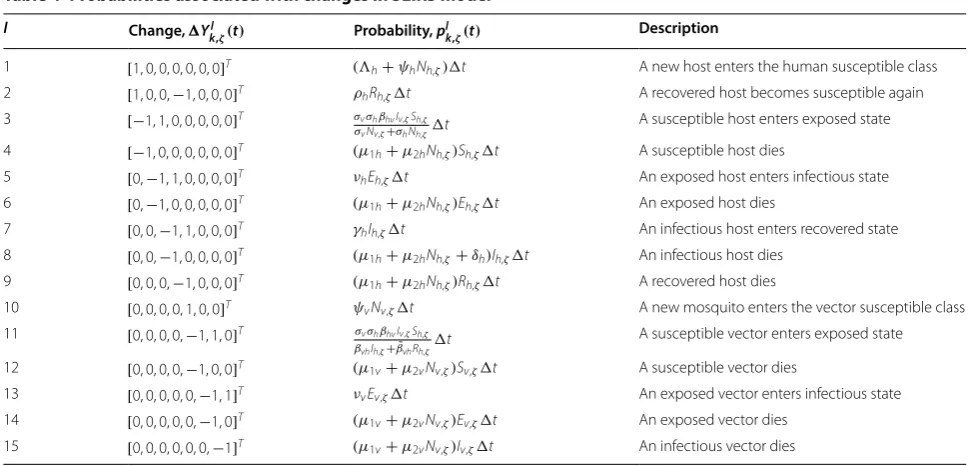
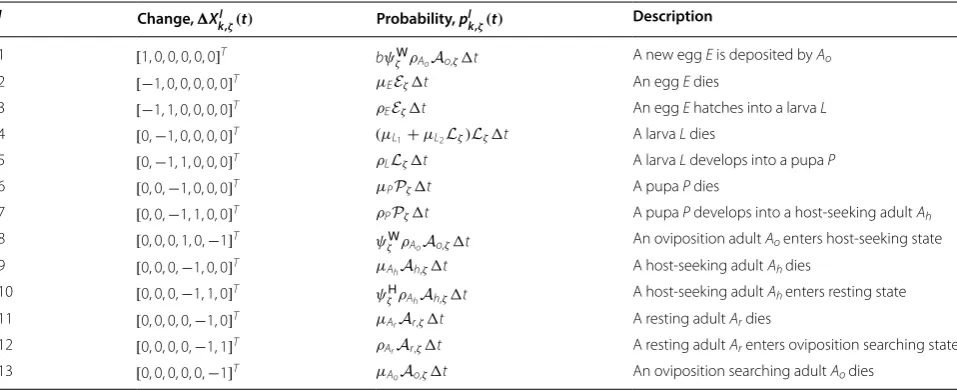
Let �X(t)=X(t+�t)−X(t) . For small t , there are 13 possible unit changes in �Xk,ζ(t) of the discrete stochas-tic model associated with different probabilities in each cell ζ (see Table 2). The Itˆo stochastic differential equa-tions for the S-ELPAs model are given as follow [30]:
(3) X(t)=E
(t),L(t),P(t),Ah(t),Ar(t),Ao(t)T ⊆R6≥×0m×n,
(4) P{a≤Xk(t)≤b} =
b
a
pk(x,t)dx,
Fig. 2 Schematic representation of Anopheles life and feeding cycles. The first three stages are aquatic. The last three stages are adult, which are
able to carry the pathogens (Modified from Lutambi et al. [28])
Table 2 Probabilities associated with changes in ELPAs model
l Change, �Xk,lζ(t) Probability, plk,ζ(t) Description
1 [1, 0, 0, 0, 0, 0]T
bψζWρAoAo,ζ�t A new egg E is deposited by Ao
2 [−1, 0, 0, 0, 0, 0]T µ
EEζ�t An egg E dies
3 [−1, 1, 0, 0, 0, 0]T ρEE
ζ�t An egg E hatches into a larva L
4 [0,−1, 0, 0, 0, 0]T (µL1+µL2Lζ)Lζ�t A larva L dies
5 [0,−1, 1, 0, 0, 0]T ρLL
ζ�t A larva L develops into a pupa P
6 [0, 0,−1, 0, 0, 0]T µ
PPζ�t A pupa P dies
7 [0, 0,−1, 1, 0, 0]T ρPPζ�t A pupa P develops into a host-seeking adult Ah 8 [0, 0, 0, 1, 0,−1]T
ψζWρAoAo,ζ�t An oviposition adult Ao enters host-seeking state
9 [0, 0, 0,−1, 0, 0]T µ
AhAh,ζ�t A host-seeking adult Ah dies
10 [0, 0, 0,−1, 1, 0]T
ψζHρAhAh,ζ�t A host-seeking adult Ah enters resting state
11 [0, 0, 0, 0,−1, 0]T µ
ArAr,ζ�t A resting adult Ar dies
12 [0, 0, 0, 0,−1, 1]T ρArAr,ζ�t A resting adult Ar enters oviposition searching state
13 [0, 0, 0, 0, 0,−1]T µ
[image:5.595.55.540.330.464.2] [image:5.595.58.537.531.726.2]where Fx:R6×m×n→R6×m×n ; Gx:R6×13×m×n →R6×13×m×n ; W(t)⊂R13×m×n is the matrix of inde-pendent Wiener processes; and px⊆Rm×n is the matrix of parameters that are functions of time t and climatic, anthropogenic, and entomological factors Cx(t)⊆Rm×n.
The drift term Fx in (5), to order t , is the expectation of all possible changes in the discrete stochastic model computed as:
(5) dX(t)=Fxt,
X(t),px(t,Cx(t))dt
+Gxt,X(t),px(t,Cx(t))·dW(t)
(6) Fx= ��X(t)� ≡
13
�
l=1
pk,l,ζ(t)�Xk,l,ζ(t)
=
bψWρAoAo−(µE+ρE)E ρEE−(µL1+µL2L+ρL)L
ρLL−(µP+ρP)P
ρPP+ψWρAoAo−(µAh+ψHρAh)Ah
ψHρAhAh−(µAr +ρAr)Ar ρrAr,−(µAo+ψWρAo)Ao
�t
for k=1,. . ., 6 and ∀ζ ∈D.
Additional Wiener processes are included into the stochastic systems to simplify the derivation of the dif-fusion term Gx [30, 31], written as follows:
in which the covariance matrix associated with the tran-sition probabilities to form the diffusion term is com-puted as:
The diffusion term Gxζ in the S-ELPAs model is obtained
as:
(7)
Gx= {Gxk,l,ζ :ζ ∈D, 1≤k≤6, 1≤l≤13}
(8) Gxk,l,ζ =�Xk,l,ζ(t)
pk,l,ζ(t), ∀ζ ∈D
(9) Gx,T ζ = �
bψζWρAoAo,ζ�t
�
µEEζ�t �
ρEEζ�t �
(µL1+µL2Lζ)Lζ�t �
ρLLζ�t �
µPPζ�t �
ρPPζ�t �
ψζWρAoAo,ζ�t �
µAhAh,ζ�t �
ψζHρAhAh,ζ�t �
µArAr,ζ�t �
ρArAr,ζ�t �
µAoAo,ζ�t
×I13×
1 0 0 0 0 0
−1 0 0 0 0 0
−1 1 0 0 0 0
0 −1 0 0 0 0 0 −1 1 0 0 0 0 0 −1 0 0 0 0 0 −1 1 0 0 0 0 0 1 0 −1 0 0 0 −1 0 0 0 0 0 −1 1 0 0 0 0 0 −1 0 0 0 0 0 −1 1 0 0 0 0 0 −1
= �
bψWρAoAo,ζ 0 0 0 0 0
−�
µEEζ 0 0 0 0 0
−�
ρEEζ �ρEEζ 0 0 0 0
0 −
�
µL1Lζ+µL2L 2
ζ 0 0 0 0
0 −�
ρLLζ �ρLLζ 0 0 0
0 0 −�
µPPζ 0 0 0
0 0 −�
ρPPζ �
ρPPζ 0 0
0 0 0
�
ψWρAoAo,ζ 0 −
�
ψWρAoAo,ζ
0 0 0 −�
µAhAh,ζ 0 0
0 0 0 −
�
ψHρAhAh,ζ �
ψHρAhAh,ζ 0
0 0 0 0 −�
µArAr,ζ 0
0 0 0 0 −�
ρArAr,ζ �
ρArAr,ζ
0 0 0 0 0 −�
where I13 is the 13 ×13 identity.
The S-ELPAs model provides the basis to capture spa-tial variation of mosquito population dynamics. It incor-porates random processes and heterogeneity in both densities of human hosts and breeding sites for the feed-ing and life cycles of the vectors. S-ELPAs is coupled with a stochastic SEIRS formulation presented below for malaria transmission dynamics.
Malaria transmission model
The S-ELPAs model described above extends the deter-ministic ELPAs model to incorporate stochastic vari-ability associated with population and spatial dynamics of the mosquitoes. Similarly, a stochastic version of SEIRS formulations is developed to capture the vari-ability associated with the circulations of malaria par-asites between human and vector populations. The aim is then to combine and link them to an ecohydro-logical model that explicitly considers climate-driven hydrologic factors for simulating mosquito population dynamics and malaria transmission.
The lumped, deterministic SEIRS formulations [9, 10] shown below is extended to develop a stochastic malaria model. The human host population is divided into four distinct classes: susceptible ( Sh ), exposed ( Eh ), infectious ( Ih ), and recovered ( Rh ). The adult vec-tor population is divided into three classes: susceptible ( Sv ), exposed ( Ev ), and infectious ( Iv ). Here, the aquatic stages of vectors are not considered in SEIRS models. For t>t0 and ∀ζ ∈D , the deterministic SEIRS model is given by another set of ODEs that characterize:
• The rate of change in susceptible host ( Sh,ζ ) as a
function of immigration, birth, human infection, recovery from infection, and human mortality:
where h is immigration rate; and ψh is per cap-ita birth rate of humans; ρh is per capita rate of losing acquired temporary immunity. Acquired temporary immunity represents the enhance-ment of the defense mechanism of the human host as a result of a previous encounter with the pathogen [32]. Nh,ζ =Sh,ζ +Eh,ζ+Ih,ζ+Rh,ζ
is total population size for humans in each cell ζ ; fh(Nh,ζ)=µ1h+µ2hNh,ζ is the human per capita death rate; and h,ζ is the infection rate from mosqui-toes to humans defined as:
(10a) dSh,ζ
dt =�h+ψhNh,ζ +ρhRh,ζ
−h,ζ(t)Sh,ζ−fh(Nh,ζ)Sh,ζ
in which Nv,ζ =Sv,ζ +Ev,ζ+Iv,ζ is total population
of mosquitoes in cell ζ ; σv represents the number of
times one mosquito attempt to bite humans per unit time; σh is the maximum number of mosquito bites a human can have per unit time; and βhv is the
prob-ability of infection transmission from an infectious mosquito to a susceptible human, given that a con-tact between the two occurs.
• The rate of change in exposed host ( Eh,ζ ) as a
func-tion of new host infecfunc-tions, latent period, and human mortality:
where νh is per capita rate of progression of humans from exposed to infectious state.
• The rate of change in infected host ( Ih,ζ ) as a
func-tion of latent period, recovery and human mortality rates:
where γh represents per capita recovery rate for humans from infectious to recovered states; and δh represents per capita disease-induced death rate for humans.
• The rate of change in recovered host ( Rh,ζ ) as a
function of recovery, immunity loss, and human mortality:
• The rate of change in susceptible vector ( Sv,ζ ) as a
function of reproduction, vector infection, and vec-tor mortality:
where ψv represents per capita birth rate of the vec-tors; fv(Nv,ζ)=µ1v+µ2vNv,ζ is the per capita death rate for vectors in each cell ζ ; and v,ζ is the infection rate from humans to mosquitoes defined as:
h,ζ = σvσh
σvNv,ζ +σhNh,ζ ×
βhvIv,ζ
(10b) dEh,ζ
dt =h,ζ(t)Sh,ζ−νhEh,ζ −fh(Nh,ζ)Eh,ζ
(10c) dIh,ζ
dt =νhEh,ζ −γhIh,ζ−fh(Nh,ζ)Ih,ζ−δhIh,ζ
(10d) dRh,ζ
dt =γhIh,ζ −ρhRh,ζ −fh(Nh,ζ)Rh,ζ
(10e) dSv,ζ
dt =ψvNv,ζ−v,ζ(t)Sv,ζ−fv(Nv,ζ)Sv,ζ
v,ζ = σvσh
σvNv,ζ+σhNh,ζ ×
βvhIh,ζ+ ˜βvhRh,ζ
where βvh and β˜hv represent the transmission prob-ability of infection from an infectious and a recovered human, respectively, to a susceptible mosquito, given that a contact between them occurs.
• The rate of change in exposed vector ( Ev,ζ ) as a
function of new vector infection, vector latent period, and vector mortality:
where νv is per capita rate of progression of
mosqui-toes from the exposed state to the infectious state.
• The rate of change in infected vector ( Iv,ζ ) as a
function of latent period and mortality:
A summary of parameters associated with (10) are shown in Table 3. All parameters described are strictly positive with the exception of the disease-induced death (10f) dEv,ζ
dt =v,ζ(t)Sv,ζ−νvEv,ζ−fv(Nv,ζ)Ev,ζ
(10g) dIv,ζ
dt =νvEv,ζ −fv(Nv,ζ)Iv,ζ
rate, δh , which is non-negative [10]. The model is well-posed in a positively invariant domain:
The development rate of Plasmodium parasites within humans νh , or the intrinsic incubation period, is assumed to be temperature independent.
However, the development rate of Plasmodium within mosquitoes νv , or extrinsic incubation period, is highly dependent on air temperature. Unlike the original mod-els [9, 10], the fitted temperature-development function for the development rate of parasites within the vec-tor [33–35] is also incorporated to the extended model:
where νv(Ta):R�→R is the progression rate of mosqui-toes from exposed to infectious state and Ta≤35.
Next, the SDE model from the ODE systems described above is derived to incorporate random fluctuations of malaria transmission. It is again assumed that there is variability described by random noise in the transitions between states in (10). Similarly, a discrete (Markov
�= {Sh,ζ,Eh,ζ,Ih,ζ,Rh,ζ,Sv,ζ,Ev,ζ,Iv,ζ} ⊆R≥7×0m×n, ζ∈D
(11) νv(Ta)=0.000112×Ta×(Ta−15.384)
35−Ta
Table 3 The parameters for SEIRS malaria model. From [10]
a In the Unit, H represents humans, M represents mosquitoes, and T represents time
Name Description Unita
h Immigration rate of humans H × T −1
ψh Per capita birth rate of humans T−1
ψv Per capita birth rate of mosquitoes T−1
σv Number of times one mosquito would want to bite humans per unit time, if humans were freely available. This is a function of the
mosquito’s gonotrophic cycle (the amount of time a mosquito requires to produce eggs) and its anthropophilic rate (its preference for human blood)
T−1
σh The maximum number of mosquito bites a human can have per unit time. This is a function of the human’s exposed surface area T−1
βhv Probability of transmission of infection from an infectious mosquito to a susceptible human, given that a contact between the two
occurs −
βvh Probability of transmission of infection from an infectious human to a susceptible mosquito, given that a contact between the two
occurs −
˜
βhv Probability of transmission of infection from a recovered (asymptomatic carrier) human to a susceptible mosquito, given that a
con-tact between the two occurs −
νh Per capita rate of progression of humans from the exposed state to the infectious state. 1/νh is the average duration of the latent
period T
−1
νv Per capita rate of progression of mosquitoes from the exposed state to the infectious state. 1/νv is the average duration of the latent
period T
−1
γh Per capita recovery rate for humans from the infectious state to the recovered state. 1/γh is the average duration of the infectious
period T
−1
δh Per capita disease-induced death rate for humans T−1
ρh Per capita rate of loss of acquired temporary immunity for humans. 1/ρh is the average duration of the immune period T−1
µ1h Density-independent part of the death (and emigration) rate for humans T−1
µ2h Density-dependent part of the death (and emigration) rate for humans H × T −1
µ1h Density-independent part of the death (and emigration) rate for mosquitoes T−1
[image:8.595.63.544.404.714.2]chain) stochastic model is first developed and the expected changes and covariance matrix of changes of the discrete stochastic processes are identified. Then, the continuous stochastic SEIRS model, hereafter referred to as S-SEIRS, is derived. Solutions of the discrete Markov chain and continuous S-SEIRS models approximately have the same probability distribution as well.
Let Si,ζ(t) , Ei,ζ(t) , Ii,ζ(t) , and Rh,ζ(t) denote con-tinuous random variables for the density of susceptible, exposed, infectious for human ( i=h ) and vector ( i=v ), and recovered human, respectively (Fig. 3). The S-SEIRS model depends on the state variables:
(12) Y(t)= {Sh(t),Eh(t),Ih(t),Rh(t),Sv(t),Ev(t),Iv(t)}
⊆R7≥×0m×n,
where Yk(t)= {Yk,ζ(t)∈R:ζ ∈D} ⊆Rm≥0×n for k=1,. . ., 7 in which Yk(t) has an associated probability density function pk(y,t):
Let �Y(t)=Y(t+�t)−Y(t) . For small t , there are 15 possible unit changes in �Yk,ζ(t) of the discrete sto-chastic processes associated with different probabilities in each grid cell ζ (Table 4). The Itˆo stochastic differential equations for the S-SEIRS model are given as:
in which Fy:R7×m×n→R7×m×n , Gy:R7×15×m×n→
R7×15×m×n , W(t)⊂R15×m×n is matrix of independ-ent Wiener processes, and py⊆Rm×n is the matrix of parameters which are functions of time t and climatic and socio-economic factors Cy(t)⊆Rm×n . The drift term Fy is calculated as:
(13) P{a≤Yk(t)≤b} =
b
a
pk(y,t)dy,
(14) dY(t)= Fyt,Y(t),py(t,Cy(t))dt
+Gy
t,Y(t),py(t,Cy(t)) dW(t)
(15) Fy=��Y(t)� ≡
15
�
l=1
pk,l,ζ(t)×�Yk,l,ζ(t)
=
�h+ψhNh+ρhRh−(h+µ1h+µ2hNh)Sh
hSh−(νh+µ1h+µ2hNh)Eh
νhEh−(γh+µ1h+µ2hNh+δh)Ih
γhIh−(ρh+µ1h+µ2hNh)Rh
ψvNv−(v+µ1v+µ2vNv)Sv
vSv−(νv+µ1v+µ2vNv)Ev
νvEv−(µ1v+µ2vNv)Iv
�t Fig. 3 Schematic representation of malaria transmission. The
model divides the human population into four classes: susceptible,
Sh ; exposed, Eh ; infectious, Ih ; and recovered (immune), Rh . Vector
population is divided into three classes: susceptible, Sv ; exposed, Ev ;
and infectious, Iv . Both species follow a logistic population model,
with humans having additional immigration and disease-induced death. Birth, death, and migration into and out of the population are
not shown in the figure (Adapted from Chitnis et al. [10])
Table 4 Probabilities associated with changes in SEIRS model
l Change, �Yl
k,ζ(t) Probability, p
l
k,ζ(t) Description
1 [1, 0, 0, 0, 0, 0, 0]T (�h+ψhNh,ζ)�t A new host enters the human susceptible class
2 [1, 0, 0,−1, 0, 0, 0]T ρ
hRh,ζ�t A recovered host becomes susceptible again
3 [−1, 1, 0, 0, 0, 0, 0]T σvσhβhvIv,ζSh,ζ σvNv,ζ+σhNh,ζ�t
A susceptible host enters exposed state
4 [−1, 0, 0, 0, 0, 0, 0]T (µ1h+µ2hNh,ζ)Sh,ζ�t A susceptible host dies
5 [0,−1, 1, 0, 0, 0, 0]T ν
hEh,ζ�t An exposed host enters infectious state
6 [0,−1, 0, 0, 0, 0, 0]T (µ1h+µ2hNh,ζ)Eh,ζ�t An exposed host dies
7 [0, 0,−1, 1, 0, 0, 0]T γ
hIh,ζ�t An infectious host enters recovered state
8 [0, 0,−1, 0, 0, 0, 0]T (µ1
h+µ2hNh,ζ+δh)Ih,ζ�t An infectious host dies
9 [0, 0, 0,−1, 0, 0, 0]T (µ1h+µ2hNh,ζ)Rh,ζ�t A recovered host dies
10 [0, 0, 0, 0, 1, 0, 0]T ψ
vNv,ζ�t A new mosquito enters the vector susceptible class
11 [0, 0, 0, 0,−1, 1, 0]T σvσhβhvIv,ζSh,ζ βvhIh,ζ+ ˜βvhRh,ζ�
t A susceptible vector enters exposed state
12 [0, 0, 0, 0,−1, 0, 0]T (µ
1v+µ2vNv,ζ)Sv,ζ�t A susceptible vector dies
13 [0, 0, 0, 0, 0,−1, 1]T ν
vEv,ζ�t An exposed vector enters infectious state
14 [0, 0, 0, 0, 0,−1, 0]T (µ1v+µ2vNv,ζ)Ev,ζ�t An exposed vector dies
15 [0, 0, 0, 0, 0, 0,−1]T (µ
[image:9.595.59.294.88.173.2] [image:9.595.55.540.492.725.2]for k=1,. . ., 7 and ζ ∈D . Using a similar approach for derivation of the diffusion term in S-ELPAs model, the form of diffusion term Gy in S-SEIRS is written as:
in which:
Thus, the diffusion term in the S-SEIRS model is obtained as follows:
(16)
Gy= {Gky,l,ζ :ζ ∈D, 1≤k≤7, 1≤l≤15}
(17) Gyk,l,ζ =�Yk,l,ζ(t)
pk,l,ζ(t)
where I15 is the 15 ×15 identity.
The S-SEIRS model incorporates environmental per-turbation and stochastic interactions among sub-popu-lations of human hosts and vectors in different states. It provides a stochastic framework to study uncertainty and dynamics of malaria transmission as well as other mos-quito-borne diseases.
Model couplings
S-SEIRS model is coupled with the S-ELPAs formulation through the equality constraint of adult vector popu-lation. In essence, S-SEIRS represents different states (i.e. susceptible, exposed, infected) of adult vectors in S-ELPAs. Therefore, the total populations of adult mos-quitoes in the two model are the same. The equality con-straints are given as:
(18)
Gyζ,T = �
(�h+ψhNh,ζ)�t �
ρhRh,ζ�t �
σvσhβhvIv,ζSh,ζ σvNv,ζ+σhNh,ζ�t
�
(µ1h+µ2hNh,ζ)Sh,ζ�t �
νhEh,ζ�t �
(µ1h+µ2hNh,ζ)Eh,ζ�t
�
γhIh,ζ�t
�
(µ1h+µ2hNh,ζ+δh)Ih,ζ�t �
(µ1h+µ2hNh,ζ)Rh,ζ�t �
ψvNv,ζ�t �
σvσhβhvIv,ζSh,ζ
βvhIh,ζ+ ˜βvhRh,ζ�t
�
(µ1v+µ2vNv,ζ)Sv,ζ�t �
νvEv,ζ�t
�
(µ1v+µ2vNv,ζ)Ev,ζ�t �
(µ1v+µ2vNv,ζ)Iv,ζ�t
×I15×
1 0 0 0 0 0 0
1 0 0 −1 0 0 0
−1 1 0 0 0 0 0
−1 0 0 0 0 0 0
0 −1 1 0 0 0 0
0 −1 0 0 0 0 0
0 0 −1 1 0 0 0
0 0 −1 0 0 0 0
0 0 0 −1 0 0 0
0 0 0 0 1 0 0
0 0 0 0 −1 1 0
0 0 0 0 −1 0 0
0 0 0 0 0 −1 1
0 0 0 0 0 −1 0
0 0 0 0 0 0 −1
= �
�h+ψhNh,ζ 0 0 0 0 0 0
�
ρhRh,ζ 0 0 −�
ρhRh,ζ 0 0 0
−�
h,ζSh,ζ �h,ζSh,ζ 0 0 0 0 0 −�
fhNh,ζSh,ζ 0 0 0 0 0 0
0 −�
νhEh,ζ �νhEh,ζ 0 0 0 0
0 −�fhEh,ζ 0 0 0 0 0
0 0 −�
γhIh,ζ �
γhIh,ζ 0 0 0
0 0 −�
(fh+δh)Ih,ζ 0 0 0 0
0 0 0 −�
fhRh,ζ 0 0 0
0 0 0 0 �ψvNv,ζ 0 0
0 0 0 0 −�
v,ζSv,ζ �v,ζSv,ζ 0
0 0 0 0 −�
fvSv,ζ 0 0
0 0 0 0 0 −�
νvEv,ζ �νvEv,ζ
0 0 0 0 0 −�fvEv,ζ 0
0 0 0 0 0 0 −�fvIv,ζ
∀ζ ∈D and t>t0 . For spatial movement of adult vectors among adjacent cells, it is assumed that vector popula-tions are well-mixed or the fraction of malaria classes in the adult vector population remain unchanged during movements:
where tb and ta represent time before and after vector movement in every modelled time step t , respectively. Furthermore, birth and mortality rates of vectors in the S-SEIRS model are excluded as these processes are already represented in S-ELPAs model. The proposed coupling approach between S-ELPAs and S-SEIRS mod-els presented allows to simulate stochastically the spatial dynamics of both vector population and malaria trans-mission over time. Finally, the coupled stochastic lattice-based vector dispersal and malaria model (SLIM) can be written as:
in which X(t) and Y(t) are random variables described in (3) and (12). Solutions for equations (21) are obtained numerically.
Estimating moisture index
The moisture index ψζW shown in (1a) represents water availability in a particular cell ζ and is estimated using a sophisticated ecohydrologic modelling framework (Dhara, see [36]). The Dhara framework includes a collec-tion of canopy process models (MLCan, see [37–39]) and a physically-based surface-subsurface flow model cou-pler (GCS-flow, see [40]) designed for capturing moisture transport on the land surface and in the below-ground (19a) Ah,ζ(t)+Ar,ζ(t)+Ao,ζ(t)=Nv,ζ(t)
(19b) Sv,ζ(t)+Ev,ζ(t)+Iv,ζ(t)=Nv,ζ(t)
(20a) Sv,ζ(tb)
Nv,ζ(tb) ≈
Sv,ζ(ta)
Nv,ζ(ta)
(20b)
Ev,ζ(tb)
Nv,ζ(tb) ≈ Ev,ζ(ta)
Nv,ζ(ta)
(21a) dX(t)=Fxt,X(t),px(t,Cx(t)dt
+Gx
t,X(t),px(t,Cx(t) dW(t)
(21b)
dY(t)=Fy
t,Y(t),py(t,Cy(t)
dt
+Gyt,Y(t),py(t,Cy(t)dW(t)
(21c) 6
k=4
Xk,ζ(t)= 7
k=5
Yk,ζ(t), ζ ∈D
systems. It incorporates vegetation acclimation to ele-vated CO2 and the retention of moisture flow dynamics
associated with topographic variability. This integration provides predictive capability to capture the impacts of environmental changes on the formation and persistence of breeding habitat. The SLIM (coupled S-ELPAs and S-SEIRS) model is linked with Dhara for incorporating climate-driven hydrologic factors to vector population and malaria transmission dynamics.
Female mosquitoes deposit eggs in breeding habitat of various sizes. However, a large fraction of the breed-ing habitat is at scales that are not detectable by currently available topographic data. As a result, there is always a probability that ponding exists in small-scale topographic depressions inside a particular non-saturated cell ζ that hydrologic modelling cannot capture. To address this scale mismatch issue, we incorporate the fractal struc-ture found in topographic depressions to the estimation of ψζW . Specifically, the hypothesis is that topographic depressions exist at all sizes on the landscape following the power scaling law [41]. Available topographic data is used to find the scaling relationship of topographic depressions in bounded domain D and assume that this relationship remains unchanged at smaller scales for esti-mation of ψζW as below:
in which �ζ ∈ [�min, 1] is the degree of saturation of the soil surface in cell ζ obtained from the Dhara model,
min is the minimum degree of saturation that is a func-tion of soil properties, and α is the negative slope of the power-law scaling relationship for the exceedance proba-bility of the area of topographic depressions found in the domain under consideration. In this work, α is identified
separately using a topographic depression identification (TDI) algorithm [41].
Model performance
In order to evaluate the performance of SLIM, each of its components (S-ELPAs and S-SEIRS) is first analysed independently. Then simulations of the fully coupled SLIM model using observed meteorological and topo-graphic data for a case study in the rural area in Kilifi county, Kenya are presented.
S‑ELPAs model
S-ELPAs model simulations are implemented using similar parameter sets shown in a previous study [28] (Table 2). The model is tested in a simple rectangu-lar domain D1 partitioned into uniform and lattice grid
{ζ :=(i,j)∈Z+2 :i≤5,j≤5} . The size of each grid
cell is 100m×100m . In addition, periodic boundary conditions are applied. The model is run with four dif-ferent initial conditions and sizes of vector population uniformly distributed over D1 to analyse the effects of
random processes on mosquito population dynamics. As S-ELPAs is run independently, homogeneous mois-ture index and human distribution in D1 are assumed
for simplicity. In addition, to isolate the effects of sto-chastic noise on the dynamics of vector population, all
a
b
Fig. 4 The dynamics of S-ELPAs and S-SEIRS models with white noise. a Simulation of total adult mosquitoes at different sizes of initial population. The graph shows how the oscillatory behavior becomes disrupted by noise in smaller populations, whereas large populations conform close to
the equilibria. b Comparison of the malaria infected cases in humans between deterministic and stochastic simulations. The red curve shows the
[image:12.595.59.539.90.558.2]parameters in S-ELPAs are assumed to be constants over time. In other words, model parameters’ dependences on hydro-climatic factors are excluded in the simulations. S-ELPAs simulations are conducted in 800 days using daily time step.
Figure 4a shows the variations in log-scale of adult mos-quito density averaged over D1 under the effects of
ran-dom processes. It can be seen that S-ELPAs simulations with larger populations are affected slightly by stochas-tic noises, and the dynamics tend to be close to equilib-ria predicted by the deterministic systems. In contrast, smaller population sizes experience proportionally more noise and their behaviors tend to be further from the deterministic systems, highlighting the different dynam-ics of vector population at different sizes. The variations of small vector population can also be disrupted signifi-cantly by sudden changes induced by stochastic noises in the system. Linking these similarities and differences between stochastic and deterministic systems in meta-population and lattice-based models is thus important to study the dynamics of vector density in large areas, where populations at various sizes are interconnected.
S‑SEIRS model
A large number ( ∼100) of independent S-SEIRS simula-tions are conducted and compared with the determinis-tic SEIRS model to investigate the modelled dynamics of malaria transmission in noise-dominated systems. All the stochastic and deterministic simulations have the same initial conditions chosen randomly. Moreover, periodic
boundary conditions are applied for all simulations. Parameters for the two models are the same and selected from a previous published study [10]. Further, to separate the effects of stochastic noise on the dynamics of malaria, the dependences of parameters on hydro-climatic factors are also excluded in both S-SEIRS and SEIRS simulations. As the spatial movement of mosquitoes is not considered in S-SEIRS model, only simulations for a single grid cell are implemented. These simulations are conducted in 800 days with daily time step as well.
The variation of infected human malaria cases ( Ih ) obtained from stochastic S-SEIRS (shaded area) and deterministic SEIRS (blue solid line) models are shown in Fig. 4b. Unlike the deterministic approach, S-SEIRS simulations provide a range of possibilities for malaria transmission given the same initial conditions and model parameters. S-SEIRS simulations shown in Fig. 4b high-light the random nature of malaria transmission that inevitably occur in real systems. Although the mean val-ues of stochastic simulations (red solid line) are found to be close to those in the deterministic simulation, variability obtained from S-SEIRS implies that there are probabilities that (i) local outbreaks can be disrupted by random noises or stochastic extinctions may occur and (ii) the intensity of the outbreaks can be larger than the theoretical endemic equilibrium point shown in deter-ministic models. Note that periodic boundary condi-tions applied in the simulacondi-tions imply isolated systems. This may allow shorter persistence time to extinction of malaria than in non-isolated systems. In our simple tests,
Topographic Depressions
a
b
[image:13.595.61.539.477.698.2]the extinction of malaria in a specific region (i.e. entire domain) is defined as events in which the number of infected human population in this region is smaller than 0.5. Moreover, the probability of resurgence of the dis-eases in isolated systems is low. Capturing the range of variability and possible stochastic extinctions plays a fun-damental role in understanding and breaking the circu-lation of the pathogen. This information, usually ignored in deterministic approaches, is important for preparing malaria control in reality.
Case study
Next, the applicability of the SLIM model for large-scale simulations of malaria is demonstrated in a rural area in Kilifi county, Kenya. This region has high levels of malnu-trition as well as a high incidence rate of Plasmodium fal-ciparum parasites for which the Anopheles gambiae is the main vector [42]. Indeed, the intensity of malaria parasite transmission in Kilifi county is complex, subject to long- and short-term cycles of variation driven by climate, changes in human land use and the efficacy and coverage of interventions that target the parasite and vector [43]. Previous studies showed a decline in malaria transmis-sion during the 1998–2009 period. However, there was a steady and marked increase of malaria transmission from 2009 to 2014 [43, 44]. Here, the primary objective is to present the capabilities and advantages of SLIM model for capturing the spatial and temporal variations of fac-tors that drive malaria transmission. Therefore, the model is not validated for the case study. Model validation using observed malaria prevalence data and the impacts of cli-mate change on malaria in coastal Kenya is presented in another work [45].
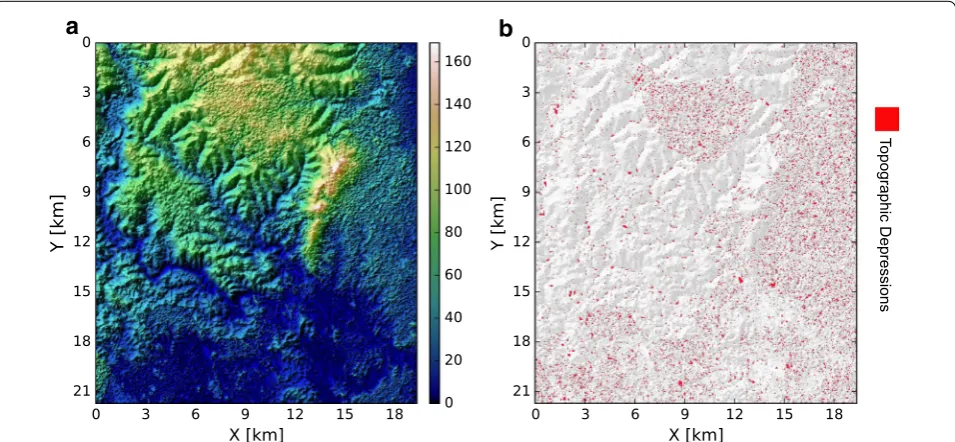
The domain of simulation is approximately 440 km2 (22 km north to south and 20 km east to west) with medium to high percentage cover of vegetation (Fig. 5). It is assumed that natural water on the ground surface is the main habitat of Anopheles mosquitoes. Topo-graphic data at 30 m × 30 m resolution from Advanced
Spaceborne Thermal Emission and Reflection radiom-eter (ASTER) global digital elevation model is used for modelling surface runoff and belowground soil moisture dynamics (Fig. 5a). Global reanalysis mete-orological data at 3 h interval by European Centre for Medium-range Weather Forecasts (ECMWF) from 2005 to 2014 is used to drive both Dhara and SLIM models. Human population census data at 100 m spa-tial resolution is obtained from the population maps for low income nations [46]. Topographic depressions in the study area are found using TDI algorithm for estimating a moisture index as presented in " Estimat-ing moisture index" (see [41]). The distributions of
topographic depressions in the study domain are shown in Fig. 5b. The spatial heterogeneities of vector habi-tat and human hosts are the main drivers for mosqui-toes movement and spread of malaria parasites. Model parameter sets similar to those used in previous stud-ies [10, 28] are used for model simulations.
Figure 6a–d presents the variation of total aquatic and adult phases of mosquito populations obtained from the S-ELPA component in SLIM. The results reveal that the variation of the mosquito population in both aquatic and adult stages are highly dependent on cli-matic factors. Specifically, positive correlations are found between monthly averaged mosquito populations mod-elled in S-ELPAs with observed monthly air tempera-ture ( R2=0.75−0.86 ) and rainfall ( R2=0.69−0.77 ), respectively. The largest and smallest total mosquito population during the years are found correspondingly with the highest and lowest air temperature and rainy seasons with several days of time lag (10 and 18 days, respectively). In aquatic stages, the sensitivity of lar-vae development to air temperature change is found to be much lower than of eggs and pupae which was also shown in previous studies [29]. The population of adult Anopheles mosquitoes is also sensitive to climatic condi-tions (see Fig. 6d). The result shows that the fraction of host-seeking mosquitoes ( Ah ) in adult stage is high, con-sisting of ∼70−80% of the total adult population. The
sub-population of oviposition site searching mosquitoes ( Ao ) are usually 2−3 times larger than the resting mos-quitoes ( Ar ). The high number of egg deposited by female Anopheles during reproduction is likely a key factor that explains the high density of vectors in aquatic environ-ment, thus mosquito population. The total number of adult mosquitoes is equal to the number of adults in the SEIRS model and plays a key role in malaria transmission.
The dynamics of malaria in human hosts and mosquito populations in the study area are presented in Fig. 6e–f. Positive correlations are also found between the monthly average malaria incidence ( Eh , Ih ) with air tempera-ture ( R2=0.58−0.69 ) and rainfall ( R2=0.53−0.67 ), respectively. The results show that, similarly to the vector population, the variation of malaria incidences, including both exposed and infected cases, in the region is sensi-tive to climatic factors as it is directly dependent on vec-tor density. The largest values of exposed human cases ( Eh ) are usually found after the rainy seasons start and air
temperature was high. The peaks of Eh are also followed
S-ELPAs: Aquatic Populations
S-ELPAs: Adult Populations
S-SEIR: Host Populations
S-SEIR: Aquatic Populations
e
d
f
c
a
b
Fig. 6 Illustration of variation of mosquitoes in different phases of their life cycle and malaria as predicted by SLIM model in response to
meteorological driver for the study domain shown in Fig. 5. a Daily precipitation. b Mean daily air temperature. c Population dynamics of
mosquitoes in aquatic phase; E represents egg population, L represents larvae population, and P represents pupae population, respectively. d
Population dynamics of mosquitoes in adult phase; Ah represents host-seeking mosquitoes, Ar represents resting mosquitoes, and Ao represents
oviposition searching mosquitoes, respectively. e Dynamics of malaria within human hosts; Eh represents exposed cases and Ih represents infected
cases, respectively. f Dynamics of malaria within human hosts; Sv is susceptible vector, and Ev represents exposed vector, Iv is infected vector, and Nv
[image:15.595.61.542.86.628.2]Conclusions
In summary, we have presented a stochastic lattice-based integrated malaria (SLIM) model that consists of a vector dispersal (S-ELPAs) and a malaria dynamics (S-SEIRS) component. SLIM is developed to predict mosquito pop-ulation dynamics and malaria transmission in response to heterogeneity and variability in the environment. It is well known that climatic and hydrological conditions strongly control Anopheles mosquito populations and thus influence malaria incidence, and indeed the asso-ciations have been demonstrated repeatedly. The details of malaria-environment interactions are highly nonlin-ear and uncertain both in time and space, thus the opti-mal predictive ability arises from complex models that involve processes from hydroclimatology, ecology, and entomology.
The stochastic coupled model is constructed based on deterministic systems [9, 10, 28]. The model is also link with a an ecohydrologic model (Dhara) used to capture soil moisture dynamics on the ground. This integration provides the capability to incorporate climate-driven hydrologic and ecologic processes with the dynamics of vector population and malaria transmission. In this man-ner, the presented SLIM model augments existing models by explicitly simulating all of the aforementioned com-plexities and incorporating a range of possible outcomes to the dynamics of vector population and transmission. Authors’ contributions
PVVL, PK designed research. PVVL, PK, MOR carried out the modelling. PVVL analysed data. PVVL, PK, MOR wrote the paper. All authors read and approved the final manuscript.
Author details
1 Department of Civil and Environmental Engineering, University of Illinois, Urbana, IL 61801, USA. 2 Faculty of Hydrology, Meteorology and Oceanogra-phy, Hanoi University of Science, Vietnam National University, Hanoi, Vietnam. 3 Department of Atmospheric Sciences, University of Illinois, Urbana, IL 61801, USA. 4 Department of Pathobiology, University of Illinois, Urbana, IL 61802, USA.
Acknowledgements
We would like to thank people in Kumar research group at Ven Te Chow Hydrosystem Laboratory for their help andsupport with this study. The work also used the ROGER supercomputer, which is supported by NSF grant num-berACI 1429699.
Competing interests
The authors declare that they have no competing interests.
Availability of data and materials
The SLIM model is publicly available at https ://githu b.com/Hydro Compl exity .
Consent for publication Not applicable.
Ethics approval and consent to participate Not applicable.
Funding
PVVL received support from Computational Science and Engineering (CSE) fellowship. PK received support fromNSF (CBET1209402, ACI 1261582, EAR 1331906, EAR 1417444).
Publisher’s Note
Springer Nature remains neutral with regard to jurisdictional claims in pub-lished maps and institutional affiliations.
Received: 25 January 2018 Accepted: 22 June 2018
References
1. Miller LH, Baruch DI, Marsh K, Doumbo OK. The pathogenic basis of malaria. Nature. 2002;415:673–9.
2. Smith DL, McKenzie EF. Statics and dynamics of malaria infection in Anopheles mosquitoes. Malar J. 2004;3:1–14.
3. Anderson RM. The population dynamics of infectious diseases: theory and applications. Population and community biology series. London: Chapman & Hall Ltd.; 1982.
4. Anderson RM, May RM. Infectious diseases of humans: dynamics and control. Dynamics and control. Oxford: Oxford University Press; 1992. 5. Paaijmans KP, Thomas MB. Health: wealth versus warming. Nat Clim
Change. 2011;1:349–50.
6. Caminade C, Kovats S, Rocklov J, Tompkins AM, Morse AP, Colón-González FJ, et al. Impact of climate change on global malaria distribution. Proc Natl Acad Sci USA. 2014;111:3286–91.
7. Ross R. The prevention of malaria. 2nd ed. Dutton; 1910.
8. MacDonald G. The Epidemiology and Control of Malaria. Oxford Medical Publications. Oxford, UK: Oxford University Press; 1957.
9. Ngwa GA, Shu WS. A mathematical model for endemic malaria with variable human and mosquito populations. Math Comput Model. 2000;32:747–63.
10. Chitnis N, Cushing J, Hyman J. Bifurcation analysis of a mathematical model for malaria transmission. SIAM J Appl Math. 2006;67:24–45. 11. Yang HM. Malaria transmission model for different levels of acquired
immunity and temperature-dependent parameters (vector). Rev Saude Publica. 2000;34:223–31.
12. Filipe JAN, Riley EM, Drakeley CJ, Sutherland CJ, Ghani AC. Determination of the processes driving the acquisition of immunity to malaria using a mathematical transmission model. PLoS Comput Biol. 2007;3:e255. 13. Parham PE, Michael E. Modeling the effects of weather and
cli-mate change on malaria transmission. Environ Health Perspect. 2010;118:620–6.
14. Ariey F, Duchemin JB, Robert V. Metapopulation concepts applied to falciparum malaria and their impacts on the emergence and spread of chloroquine resistance. Infect Genet Evol. 2003;2:185–92.
15. Bomblies A, Duchemin JB, Eltahir EAB. Hydrology of malaria: model development and application to a Sahelian village. Water Resour Res. 2008;44:W12445.
16. Gu W, Novak RJ. Agent-based modelling of mosquito foraging behaviour for malaria control. Trans R Soc Trop Med Hyg. 2009;103:1105–12. 17. Arifin SN, Zhou Y, Davis GJ, Gentile JE, Madey GR, Collins FH. An
agent-based model of the population dynamics of Anopheles gambiae. Malar J. 2014;13:1–20.
18. Pizzitutti F, Pan W, Barbieri A, Miranda JJ, Feingold B, Guedes GR, et al. A validated agent-based model to study the spatial and temporal het-erogeneities of malaria incidence in the rainforest environment. Malar J. 2015;14:1–19.
19. Mandal S, Sarkar R, Sinha S. Mathematical models of malaria—a review. Malar J. 2011;10:202.
20. Reiner RC, Perkins TA, Barker CM, et al. A systematic review of mathemati-cal models of mosquito-borne pathogen transmission: 1970–2010. J R Soc Interface. 2013;10:20120921.
•fast, convenient online submission •
thorough peer review by experienced researchers in your field • rapid publication on acceptance
• support for research data, including large and complex data types •
gold Open Access which fosters wider collaboration and increased citations maximum visibility for your research: over 100M website views per year •
At BMC, research is always in progress.
Learn more biomedcentral.com/submissions
Ready to submit your research? Choose BMC and benefit from: 22. Keeling MJ, Rohani P. Modeling infectious diseases in humans and
ani-mals. Princeton: Princeton University Press; 2008.
23. Azaele S, Maritan A, Bertuzzo E, Rodriguez-Iturbe I, Rinaldo A. Stochastic dynamics of cholera epidemics. Phys Rev E. 2010;81:051901.
24. Herwaarden OA, Grasman J. Stochastic epidemics: major outbreaks and the duration of the endemic period. J Math Biol. 1995;33:581–601. 25. van Herwaarden AO. Stochastic epidemics: the probability of
extinc-tion of an infectious disease at the end of a major outbreak. J Math Biol. 1997;35:793–813.
26. Britton T. Stochastic epidemic models: a survey. Math Biosci. 2010;225:24–35.
27. Krstic M. The effect of stochastic perturbation on a nonlinear delay malaria epidemic model. Math Comput Simul. 2011;82:558–69. 28. Lutambi AM, Penny MA, Smith T, Chitnis N. Mathematical modelling
of mosquito dispersal in a heterogeneous environment. Math Biosci. 2013;241:198–216.
29. Depinay JM, Mbogo C, Killeen G, Knols B, Beier J, Carlson J, et al. A simula-tion model of African Anopheles ecology and populasimula-tion dynamics for the analysis of malaria transmission. Malar J. 2004;3:29.
30. Allen E. Modeling with Itô Stochastic differential equations. Mathematical modelling: theory and applications. Heidelberg, Germany: Springer Berlin Heidelberg; 2007.
31. Allen LJS. An introduction to stochastic processes with applications to biology. 2nd ed. Florida: CRC Press; 2010.
32. Doolan DL, Dobaño C, Baird JK. Acquired immunity to malaria. Clin Micro-biol Rev. 2009;22:13–36.
33. Detinova TS. Age-grouping methods in Diptera of medical importance with special reference to some vectors of malaria. WHO Monograph series. 1962;47:13–191.
34. Briere JF, Pracros P, Le Roux AY, Pierre JS. A novel rate model of tem-perature-dependent development for arthropods. Environ Entomol. 1999;28:22–9.
35. Paaijmans KP, Read AF, Thomas MB. Understanding the link between malaria risk and climate. Proc Natl Acad Sci USA. 2009;106:13844–9.
36. Le PVV, Kumar P. Interaction between ecohydrologic dynamics and microtopographic variability under climate change. Water Resour Res. 2017;53:8383–403.
37. Drewry DT, Kumar P, Long S, Bernacchi C, Liang XZ, Sivapalan M. Eco-hydrological responses of dense canopies to environmental variability: 1. Interplay between vertical structure and photosynthetic pathway. J Geophys Res. 2010;115:G04022.
38. Le PVV, Kumar P, Drewry DT, Quijano JC. A graphical user interface for numerical modeling of acclimation responses of vegetation to climate change. Comput Geosci. 2012;49:91–101.
39. Le PVV, Kumar P, Drewry DT. Implications for the hydrologic cycle under climate change due to the expansion of bioenergy crops in the Midwest-ern United States. Proc Natl Acad Sci USA. 2011;108:15085–90. 40. Le PVV, Kumar P, Valocchi AJ, Dang HV. GPU-based high-performance
computing for integrated surface-sub-surface flow modeling. Environ Modell Softw. 2015;73:1–13.
41. Le PVV, Kumar P. Power law scaling of topographic depressions and their hydrologic connectivity. Geophys Res Lett. 2014;41:1553–9.
42. Nyakeriga AM, Troye-Blomberg M, Chemtai AK, Marsh K, Williams TN. Malaria and nutritional status in children living on the coast of Kenya. Am J Clin Nutr. 2004;80:1604–10.
43. Snow RW, Kibuchi E, Karuri SW, Sang G, Gitonga CW, Mwandawiro C, et al. Changing malaria prevalence on the Kenyan Coast since 1974: climate, drugs and vector control. PLoS ONE. 2015;10:1–14.
44. Mogeni P, Williams TN, Fegan G, Nyundo C, Bauni E, Mwai K, et al. Age, spatial, and temporal variations in hospital admissions with malaria in Kilifi County, Kenya: a 25-year longitudinal observational study. PLoS Med. 2016;13:1–17.
45. Le PVV, Kumar P, Ruiz MO, Mbogo C, Muturi JE. Predicting the direct and indirect impacts of climate change on malaria in coastal Kenya. PLOS (under review). 2018.
![Table 1 Description and values of parameters of the ELPAs model. Modified from [28]](https://thumb-us.123doks.com/thumbv2/123dok_us/8314802.294370/4.595.62.540.98.339/table-description-values-parameters-elpas-model-modified.webp)
![Table 3 The parameters for SEIRS malaria model. From [10]](https://thumb-us.123doks.com/thumbv2/123dok_us/8314802.294370/8.595.63.544.404.714/table-the-parameters-for-seirs-malaria-model-from.webp)