
Rochester Institute of Technology
RIT Scholar Works
Theses
Thesis/Dissertation Collections
8-1-2008
Modeling and synthesis of the HD photo
compression algorithm
Seth Groder
Follow this and additional works at:
http://scholarworks.rit.edu/theses
This Thesis is brought to you for free and open access by the Thesis/Dissertation Collections at RIT Scholar Works. It has been accepted for inclusion
in Theses by an authorized administrator of RIT Scholar Works. For more information, please contact
.
Recommended Citation
Modeling and Synthesis of the HD Photo Compression Algorithm
by
Seth Groder
A Thesis Submitted
in
Partial Fulfillment of the
Requirements for the Degree of
MASTERS OF SCIENCE
in
Computer Engineering
Approved by:
Principal Advisor
________________________________________________
Dr. Kenneth Hsu, RIT Department of Computer Engineering
Committee Member
_____________________________________________
Dr. Muhammad Shaaban, RIT Department of Computer Engineering
Committee Member
_____________________________________________
Mr. Francis Tse, Xerox Corporation
Department of Computer Engineering
College of Engineering
Rochester Institute of Technology
Rochester, New York
RELEASE PERMISSION FORM
Rochester Institute of Technology
Modeling and Synthesis of the HD Photo Compression Algorithm
I, Seth
Groder, hereby grant permission to the Wallace Library and the Department of Computer
Engineering at the Rochester Institute of Technology to reproduce my thesis in whole or in part.
Any reproduction in these accounts will not be for commercial use or profit.
____________________________________________
Seth Groder
i
Abstract
The primary goal of this thesis is to implement the HD Photo encoding algorithm using Verilog
HDL in hardware. The HD Photo algorithm is relatively new and offers several advantages over
other digital still continuous tone image compression algorithms and is currently under review by
the JPEG committee to become the next JPEG standard, JPEG XR.
HD Photo was chosen to become the next JPEG standard because it has a computationally light
domain change transform, achieves high compression ratios, and offers several other
improvements like its ability to supports a wide variety of pixel formats. HD Photo’s
compression algorithm has similar image path to that of the baseline JPEG but differs in a few
key areas. Instead of a discrete cosine transform HD Photo leverages a lapped biorthogonal
transform. HD Photo also has adaptive coefficient prediction and scanning stages to help furnish
high compression ratios at lower implementation costs.
In this thesis, the HD Photo compression algorithm is implemented in Verilog HDL, and three
key stages are further synthesized with Altera’s Quartus II design suite with a target device of a
Stratix III FPGA. Several images are used for testing for quality and speed comparisons between
HD Photo and the current JPEG standard using the HD Photo plug-in for Adobe’s Photoshop
CS3. The compression ratio when compared to the current baseline JPEG standard is about 2x so
the same quality image can be stored in half the space. Performance metrics are derived from the
Quartus II synthesis results. These are approximately 108,866 / 270,400 ALUTs (40%), a 10 ns
ii
Acknowledgements
The author would like to acknowledge all of the direction, guidance, and assistance he has
received from his thesis committee, Dr Ken Hsu, Dr. Muhammad Shaaban, and Mr. Francis Tse,
whom without which this thesis would not have come together. The author would also like to
express his gratitude and appreciation for the support he has received from his friends and family
iii
Table of Contents
List of Figures... vi
List of Tables ... vii
Glossary... viii
Introduction ...1
1
Theory ...3
1.1
Common Image Compression Techniques ... 3
1.1.1
Domain Transference... 3
1.1.2
Quantization... 4
1.1.3
Encoding ... 4
1.2
Current Digital Still Image Codecs... 5
1.2.1
JPEG ... 5
1.2.2
JPEG 2000 ... 6
1.3
HD Photo... 7
1.3.1
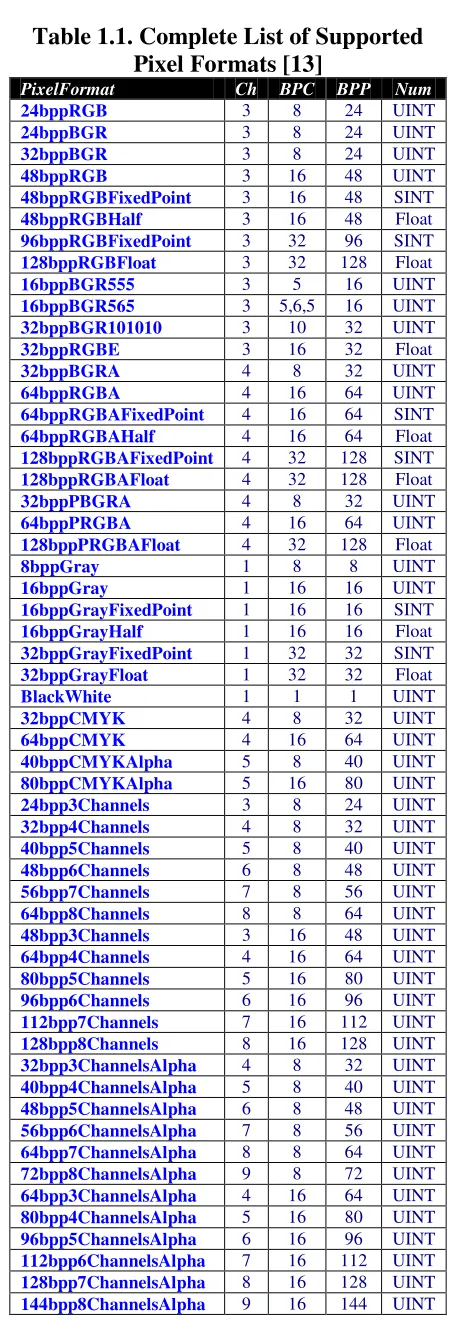
Supported Pixel Formats... 8
1.3.2
Data Hierarchy ... 10
1.3.3
Frequency Hierarchy... 11
1.3.4
Bitstream Structure ... 12
1.3.5
Supported Features... 13
2
Design... 14
2.1
Constraints ... 14
2.2
Image Setup ... 15
2.3
Color Transform... 15
2.4
Lapped Biorthogonal Transform... 16
2.4.1
Photo Core Transform... 19
2.4.2
Photo Overlap Transform ... 23
iv
2.6
Adaptive Coefficient Prediction ... 27
2.7
Adaptive Coefficient Scanning ... 29
2.8
Adaptive Entropy Encoding ... 31
2.9
Adaptive Coefficient Normalization ... 33
3
Implementation ... 34
3.1
Lapped Biorthogonal Transform... 34
3.1.1
General Transform Information... 34
3.1.2
Photo Core Transform... 35
3.1.3
Photo Overlap Transform ... 38
3.1.4
16x16 Lapped Biorthogonal Transform... 40
3.2
Quantization ... 43
3.2.1
Quant Map ... 43
3.2.2
4x4 Quantizer... 44
3.3
Adaptive Coefficient Prediction ... 45
3.4
Adaptive Coefficient Scanning ... 47
3.5
Adaptive Entropy Encoding ... 48
3.5.1
DC Encoder... 48
3.5.2
LP Encoder... 49
3.5.3
HP Encoder ... 50
4
Verification ... 52
4.1
Verilog Testbench... 52
4.2
Software Models... 54
5
Results ... 55
5.1
Layout Analysis ... 55
5.2
Performance Analysis ... 55
5.3
Power Analysis... 57
5.4
Compression Analysis ... 58
6
Conclusion and Future Work... 60
6.1
Project Benefits ... 60
v
6.3
Possible Enhancements ... 62
References ... 64
Appendix A. Images... 66
thumbnail.bmp... 66
tree.tiff ... 66
lenna.tiff... 67
shea.bmp... 68
Appendix B. VHDL Code... 69
lbt_16x16.v ... 69
predict_16x16.v ... 85
scanner_16x16.v... 95
Appendix C. Perl Script ... 100
bmp_to_hex.pl ... 100
Appendix D. Quartus II Synthesis Reports ... 101
LBT Fitting:... 101
LBT Timing: ... 101
LBT Power: ... 101
Prediction Fitting:... 102
Prediction Timing: ... 102
Prediction Power: ... 103
Scanning Fitting:... 103
Scanning Timing: ... 103
vi
List of Figures
Figure 1.1. JPEG and HD Photo Compression Steps [17]... 7
Figure 1.2. Spatial Layout of Macroblock Aligned Image [13,18] ... 11
Figure 1.3. Process of Developing Frequency Hierarchy ... 12
Figure 1.4. HD Photo Bitstream Structure [13,15] ... 13
Figure 2.1. PCT and POT Operation Boundaries [14]... 17
Figure 2.2. Various LBT Implementation Techniques ... 18
Figure 2.3. Pseudo-code for 2x2 Hadamard Transform [13]... 20
Figure 2.4. Pseudo-code for 2x2 Odd Transform [13]... 21
Figure 2.5. Pseudo-code for 2x2 Odd-Odd Transform [13] ... 22
Figure 2.6. Pseudo-code for 4x4 PCT [13] ... 23
Figure 2.7. Pseudo-code for 2-Point Rotation Transform [13]... 24
Figure 2.8. Pseudo-code for 2-Point Scaling Transform [13]... 24
Figure 2.9. Pseudo-code for 4-Point POT [13] ... 25
Figure 2.10. Pseudo-code for 4x4 POT [13]... 26
Figure 2.11. DC Prediction Layout [15] ... 28
Figure 2.12. LP Coefficient Prediction [15] ... 28
Figure 2.13. HP Left Prediction Scheme [14,15]... 29
Figure 2.14. Initial Scan Patterns (a) LP and HP Horizontal (b) HP Vertical [15] ... 30
Figure 2.15. Example of Adaptive Coefficient Scanning [15] ... 31
Figure 2.16. Example 3½D - 2½D Coded Stream [15] ... 31
Figure 2.17. VLC Coding Tables used by HD Photo [13,14,15]... 32
Figure 2.18. Coefficient Normalization Process [13,15] ... 33
Figure 3.1. Structural Overview of 2x2 Hadamard Transform... 35
Figure 3.2. Structural Overview of 2x2 Odd Transform ... 36
Figure 3.3. Structural Overview of 2x2 Odd-Odd Transform ... 36
Figure 3.4. Structural Overview of 4x4 PCT... 37
Figure 3.5. Structural Overview of 2-Point Rotation... 38
Figure 3.6. Structural Overview of 2-Point Scaling ... 38
Figure 3.7. Structural Overview of 4-Point POT... 39
Figure 3.8. Structural Overview of 4x4 POT... 40
Figure 3.9.Structural Overview of LBT... 42
Figure 3.10. Structural Overview of Quant Map ... 44
Figure 3.11. Structural Overview of 4x4 Quantizer ... 45
Figure 3.12. Structural Overview of Adaptive Coefficient Prediction ... 46
Figure 3.13. Structural Overview of Adaptive Coefficient Scanner... 47
Figure 3.14. Structural Overview of DC Encoder ... 49
Figure 3.15. Structural Overview of Run-Length Encoder with Flexbit Support ... 50
Figure 3.16. Structural Overview of HP Encoder... 51
Figure 4.1. Testbench Simulation Environment ... 53
Figure 5.1. Chart of Compression Time vs. Amount of Pixels in the Image... 57
vii
List of Tables
Table 1.1. Complete List of Supported Pixel Formats [13]... 9
Table 1.2. Illustration of Combination of Rotate and Flips [15] ... 13
Table 5.1. Layout Results of Design Modules... 55
Table 5.2. Performance Analysis of Design Modules ... 56
Table 5.3. Sample Image Completion Times... 57
Table 5.4. Power Analysis of Design Modules... 58
viii
Glossary
ASIC:
Application Specific Integrated Circuit – An integrated circuit that was
developed for a specific purpose that could not be achieved within an
off-the-shelf part.
Bit stream:
Term used to describe a series of bits that are produced as a result of the
encoding process.
BGR:
Blue Green Red – A pixel format describing the order of three color planes.
Block:
A 4x4 matrix of coefficient data co-located across all color channels
BMP:
File extension used to denote a bitmap file format.
CBP:
Coded Block Pattern – Encoded series of bits that detail on which portion of the
image contains meaningful data.
Codec:
A combination of both an encoder and decoder
DCT:
Discrete Cosine Transform – 8x8 block transform utilized by the baseline JPEG
standard
DWT:
Discrete Wavelet Transform – Wavelet transform utilized by the JPEG 2000
standard
FPGA:
Field Programmable Gate Array – Chip which usually contains numerous LUT’s
and memory.
HDL:
Hardware Description Language – Description of a computer language that is
commonly used to design and test analog, digital, and mixed-signal circuits.
HDP:
HD Photo – Image codec and file format standard developed by Microsoft. Also
may be used as the file extension.
HDR:
High Dynamic Range – Term used to describe pixel formats that can represent a
significantly amount of colors by using more bits per pixel.
HEX:
File extension used for files containing a series of hexadecimal number values.
ISO:
International Organization for Standardization – Non-governmental organization
that sets international standards for a wide range of applications.
ix
produced by the group.
LBT:
Lapped Biorthogonal Transform – Main 2 stage reversible transform leveraged
in the HD Photo compression algorithm to change domains.
LUT:
Lookup Table – A data structure that replaces a runtime operation with a simpler
indexing operation.
Macroblock:
A 4x4 matrix of blocks, which subsequently makes a 16x16 matrix of coefficient
data co-located across all color channels
MFP:
Multifunction Printer – Device usually capable of more than just printing,
including such features as scanning, copying, and faxing.
PCT:
Photo Core Transform – 4x4 block transform utilized within the two stages of
the LBT
POT:
Photo Overlap Transform – 4x4 block transform that may occur within the LBT
across block boundaries to reduce blocking artifacts within the compressed
image.
QP:
Quantization Parameter – Describes a single or set of values used in the
quantization stage of the algorithm
RGB:
Red Green Blue – A pixel format describing the order of three color planes.
ROI:
Region of Interest – Refers to the ability to access specific pixels from within a
compressed bitstream.
VLC:
Variable Length Code – Term used to describe an encoding pattern that replaces
fixed length elements with elements that vary in bit depth with the intention of
reducing the total bits.
YUV:
Color space using three channels, one
luma
, y, and two
chroma
, u & v.
YUV420:
YUV colorspace where a sample of the
luma
channel is a 4x4 matrix of pixel
data and the
chroma
channels are sub sampled with only 2x2 matrices of pixel
data.
YUV422:
YUV colorspace where a sample of the
luma
channel is a 4x4 matrix of pixel
data and the
chroma
channels are sub sampled with only 4x2 matrices of pixel
data.
1
Introduction
As technology improves and the demand for image quality increases the topic of efficient image
compression is as relevant as ever. Many image compression algorithms are ill equipped to
handle new high dynamic range (HDR) and wide gamut formats because their algorithms were
developed with a generic three color channel eight bits of pixel data per channel model. New
color formats may use 16 or even 32 bits per color channel and in some cases there are more than
three color channels. This new image compression paradigm provides motivation to create a
versatile compression algorithm that is capable of accommodating the majority of the color
format spectrum while still remaining computationally efficient and portable.
The JPEG committee has been responsible for overseeing and developing new digital image
compression algorithms for almost two decades. The committee was formed in 1986 and had its
original lossy JPEG standard that is still widely used today, ISO 10918-1
,
was under
development in 1990 accepted in 1994 [4,8,18]. Since then there have been modified versions
that standard that have allowed lossless encoding and 12-bits of data per color channel. In an
effort to improve compression ratios add niceties such as ROI and progressive decoding a new
standard was developed and released in the year 2000 called JPEG 2000, ISO 15444-1:2000 [8].
Currently Microsoft’s HD Photo is in the review process of becoming the newest JPEG standard
and is tentatively referred to as JPEG XR.
HD Photo offers many of the enhancements to an image compression algorithm that the JPEG
committee is looking for. Some of the advantages include its ability to support a wide variety
2
daunting task to implement in hardware. Because of hardware’s rigid nature it is possible to
constrain the design to implement only the necessary components of the algorithm while still
delivering a solution that is faster than software.
The Quartus II design suite was developed by Altera. It is a comprehensive tool that is used to
simulate, synthesize, and analyze HDL code target Altera’s various FPGA products. This tool
was used to verify the correctness of the data stream, as well as synthesize the components of the
design to obtain timing, power, and gate count information.
The first chapter covers general encoding practices and how they compare and are applied within
the HD Photo algorithm. Chapter two discusses how the various parts implemented for the
encoder are designed and work. The third chapter elaborates on how each component was
designed and implemented for a hardware solution. Chapter four summarizes how the design
was verified for functionality and operation. The fifth chapter presents the results achieved by
this design and the encoding algorithm itself. Finally the sixth chapter provides some closing
remarks about this thesis and where its future lies.
Images used for testing and simulations are in Appendix A. The Verilog Code for the three
synthesized modules of the encoder can be found in Appendix B. The Perl script used to convert
the BMP into a HEX file is located in Appendix C. Finally the synthesis reports generated by
3
1
Theory
1.1
Common Image Compression Techniques
There are several techniques used to reduce the overall storage imprint of an image. For most
applications lossy compression is suitable but some need to be lossless. Lossless codecs need to
perfectly reconstruct the original sample, constraining the areas in which to achieve a bit savings.
On the other hand lossy image codecs take advantage of the fact that some visual data is
irrelevant or unperceivable and maybe removed from the image without degrading the quality.
Some of the techniques used in common image compression standards include a domain
transference, quantization, and encoding.
1.1.1
Domain Transference
Finding a suitable domain in which to operate can greatly increase the ability to reduce the
sample size. For instance taking pixel coefficients into a domain that can exploit the samples’
luminance and chrominance is advantageous because the human eye is more sensitive to
luminance. By doing so the chrominance channels of the image may be sub-sampled reducing
the pixel data on these channels by half or more.
Transferring pixel coefficient data into the frequency domain is another useful technique because
4
image compression the data that falls into the invisible or barely visible spatial frequencies may
be discarded or with negligible effects on the quality of the sample.
1.1.2
Quantization
Quantization is a technique that can only be taken advantage of by lossy codecs. Essentially it
removes some of the least significant bits of the pixel coefficient data by dividing them by some
factor in an attempt to remap the displayable color space. Using a smaller color space allows
each pixel to be represented by fewer bits, but the quantization factor used can have a great
impact on the sample quality. For if the quantization parameters are too high, a significant
amount of pixel data may be discarded such that the integrity of the sample quality cannot be
maintained.
1.1.3
Encoding
There are numerous different types of encoding algorithms that exist today, but in terms of image
compression there are a handful of techniques to reduce the bitstream that can be leveraged by
both lossy and lossless codecs. Simplistically there is redundant data within an image that can be
coded to reduce the bitstream. A popular encoding algorithm, Huffman Encoding, uses variable
length codes assigning shorter codes and longer codes for those events predetermined based on
their possibility of the event occurring. By assigning shorter codes to the high probability events
5
events requiring a longer code than their original fixed length. Another popular technique is run
length encoding when dealing with sparse data sets. Knowing that there are predominately trivial
zeros within a stream of data allows for symbols to be created that contain information on
non-zero data and the string of non-zeros adjacent. These generated symbols are smaller in quantity than
the original amount of data coefficients and are another avenue to achieve a lesser bitstream.
1.2
Current Digital Still Image Codecs
1.2.1
JPEG
The baseline implementation of the JPEG standard uses three color channels, 8-bits of data per
channel, and is lossy. There exist other versions of JPEG that are capable of supporting lossless
encoding and up to 12-bits of data per color channel [18]. The baseline implementation has
become ubiquitous within the digital continuous tone still image field. JPEG sees use in a wide
variety of applications including but not limited to digital cameras, printing devices, and over the
internet. JPEG is so popular because it offers a scalable compression ratio that has a reasonable
tradeoff between compressed image size and image quality. Under normal circumstances a
compression ratio of 10:1 can be used with minimal image degradation.
The despite the widespread support of JPEG there are several limitations. Newer pixel formats,
especially HDR and wide gamut formats, have too many bits per pixel to be compressed using
6
more of the original data is lost and artifacts within the image can increase. The compressed
image bitstream is created in such a manner that ROI decoding is unavailable, meaning the
compressed image file cannot produce its own thumbnail or be progressively decoded.
1.2.2
JPEG 2000
In an effort to achieve higher compression ratios and support for random bitstream access the
JPEG 2000 standard was developed as a replacement. JPEG 2000 overhauled the compression
algorithm by substituting JPEG’s Discrete Cosine Transform (DCT) with a Discrete Wavelet
Transform (DWT) and adding support for tiling. Tiling decouples regions of image so they may
be independently decoded. Independent data groupings provide the ability to randomly access
data within the bitstream. The DWT and enhanced entropy encoding enable higher compression
ratios over the original JPEG standard, but it comes at a price. The compression algorithm is
quite mathematically intensive, requires the use of floating point arithmetic, and has a greater
memory footprint. These drawbacks make JPEG 2000 rather costly to implement and it never
gained widespread support from web browsers and embedded applications like digital cameras.
JPEG 2000 never fully replaced the original JPEG standard as intended. It survives on in niche
7
1.3
HD Photo
The first and foremost objective of HD Photo was to provide an expansive end-to end codec that
can provide excellent compression ratios while still maintaining superior image quality. As seen
in Figure 1.1 at a high level HD Photo is quite similar to the JPEG standard but there is quite a
bit that occurs underneath that separate these two codecs.
Figure 1.1. JPEG and HD Photo Compression Steps [17]
The JPEG process is fairly rigid with a set transform, scanning pattern, and encoding scheme.
The only real mechanism that can alter the compression ratios is adjusting the quantization
factor. HD photo on the other hand has three settings for the transformation stage that can be
tailored for performance, quality, or somewhere in between. The quantization stage can use
different quantization parameters (QP) based on spatial locality, frequency band, and color
channel. Coefficient prediction and scanning is used to reorder the data stream to obtain a more
desirable input into the encoding stage. These two stages adapt on the fly based on current data
8
keeps a statistical measure for which variable length coding (VLC) table is used and switches to
a different code if it is probable to provide a reduction in the average code per element size.
1.3.1
Supported Pixel Formats
As mentioned previously part of what makes HD Photo such an attractive candidate to become a
standard is its offering of an extensive variety of supported pixel and data formats. Acceptable
data can differ in numerical format, number of color channels, organization of color channels,
and even bit depth.
HD Photo has support for unsigned integer, signed integer, fixed point and floating point data.
These number formats can also vary on bit depth as well up to 32 bits per data element.
However when using any data format above 26 bits lossless image compression is no longer an
option due to clipping that will occur somewhere within the algorithm.
The proposed standard also can handle up to eight channels of data along with an optional alpha
channel used for transparency making a total of nine possible channels. While most instances
will only use three or four channels the added functionality provides value for the future of codec
to support unrealized formats that may take advantage of them.
A complete list of currently accepted formats can be seen in Table 1.1 describing the entire list of
different configurations. To synopsize there is support for RGB, Gray, CMYK, black & white,
9
Table 1.1. Complete List of Supported
Pixel Formats [13]
PixelFormat
Ch
BPC
BPP
Num
24bppRGB
3
8
24
UINT
24bppBGR
3
8
24
UINT
32bppBGR
3
8
24
UINT
48bppRGB
3
16
48
UINT
48bppRGBFixedPoint
3
16
48
SINT
48bppRGBHalf
3
16
48
Float
96bppRGBFixedPoint
3
32
96
SINT
128bppRGBFloat
3
32
128
Float
16bppBGR555
3
5
16
UINT
16bppBGR565
3
5,6,5
16
UINT
32bppBGR101010
3
10
32
UINT
32bppRGBE
3
16
32
Float
32bppBGRA
4
8
32
UINT
64bppRGBA
4
16
64
UINT
64bppRGBAFixedPoint
4
16
64
SINT
64bppRGBAHalf
4
16
64
Float
128bppRGBAFixedPoint
4
32
128
SINT
128bppRGBAFloat
4
32
128
Float
32bppPBGRA
4
8
32
UINT
64bppPRGBA
4
16
64
UINT
128bppPRGBAFloat
4
32
128
Float
8bppGray
1
8
8
UINT
16bppGray
1
16
16
UINT
16bppGrayFixedPoint
1
16
16
SINT
16bppGrayHalf
1
16
16
Float
32bppGrayFixedPoint
1
32
32
SINT
32bppGrayFloat
1
32
32
Float
BlackWhite
1
1
1
UINT
32bppCMYK
4
8
32
UINT
64bppCMYK
4
16
64
UINT
40bppCMYKAlpha
5
8
40
UINT
80bppCMYKAlpha
5
16
80
UINT
24bpp3Channels
3
8
24
UINT
32bpp4Channels
4
8
32
UINT
40bpp5Channels
5
8
40
UINT
48bpp6Channels
6
8
48
UINT
56bpp7Channels
7
8
56
UINT
64bpp8Channels
8
8
64
UINT
48bpp3Channels
3
16
48
UINT
64bpp4Channels
4
16
64
UINT
80bpp5Channels
5
16
80
UINT
96bpp6Channels
6
16
96
UINT
112bpp7Channels
7
16
112
UINT
128bpp8Channels
8
16
128
UINT
32bpp3ChannelsAlpha
4
8
32
UINT
40bpp4ChannelsAlpha
5
8
40
UINT
48bpp5ChannelsAlpha
6
8
48
UINT
56bpp6ChannelsAlpha
7
8
56
UINT
64bpp7ChannelsAlpha
8
8
64
UINT
72bpp8ChannelsAlpha
9
8
72
UINT
64bpp3ChannelsAlpha
4
16
64
UINT
80bpp4ChannelsAlpha
5
16
80
UINT
96bpp5ChannelsAlpha
6
16
96
UINT
112bpp6ChannelsAlpha
7
16
112
UINT
128bpp7ChannelsAlpha
8
16
128
UINT
10
1.3.2
Data Hierarchy
Within the HD Photo codec pixel data is grouped into various levels of granularity that are
leveraged throughout. The smallest piece of data is a single pixel coefficient. These coefficients
are then grouped into 4x4 matrix of adjacent values and are referred to as a blocks. Blocks are in
turn regrouped into a 4x4 matrix called a macroblock. The next largest groupings are tiles which
are arbitrary sets of the subdivided image. Tiles can vary in width and height but all tiles in the
same row must have the same height and likewise all tiles in the same column must have the
same width. The largest grouping is the image itself which is extended to fall on macroblock
boundaries. The extension is performed in order to reduce the design logic that would be needed
to handle incomplete macroblocks. An illustration of the spatial hierarchy can viewed in Figure
11
Figure 1.2. Spatial Layout of Macroblock Aligned Image [13,18]
1.3.3
Frequency Hierarchy
Within the spatial layout the data is orthogonally represented in the frequency domain as well.
As a result of the transform stage the coefficients are grouped into three groups, DC, lowpass
(LP), and highpass (HP). A flow of this process is illustrated in Figure 1.3 and depicts how in
two separate stages one macroblock contains one DC, 15 LP, and 240 HP coefficients. Even
though it might appear that these pixels are then grouped separately, they are in fact still within
12
Figure 1.3. Process of Developing Frequency Hierarchy
The first stage of the LBT produces one DC coefficient in the top left corner of each block and
the other 15 AC coefficients in the block become the HP band. The second stage of the LBT
operates on the 16 DC coefficients in the macroblock created in the first stage and are operated
on as a block of their own. The DC of the DC coefficients becomes the DC band, 15 AC of DC
coefficients become the LP band, and the rest remain HP coefficients.
1.3.4
Bitstream Structure
A HDP file is arranged so that the beginning set of bytes is dedicated to metadata describing the
rest of the file. This information is followed by an index table that marks where each tile is
located in the bitstream. However each tile may be laid out according to its spatial or frequency
hierarchy, the choice between the two has no real impact on image quality or compression
ability. The only difference is that the frequency hierarchy separates out the data produced as a
result of coefficient normalization that generally has limited information relevant to the quality
13
Figure 1.4. HD Photo Bitstream Structure [13,15]
1.3.5
Supported Features
One of the benefits of HD Photo is that it can provide both lossy and lossless image compression
using the same algorithm. This is achieved by using a quantization factor of one, which
inherently does not alter the transform data. Other benefits include the use of tiling like that of
JPEG 2000, that enable progressive and ROI decoding. Similarly because of how the
compressed bitstream is structured the encoded image contains its own thumbnail image. HD
Photo also offers support for lossless transcoding operations like flips and rotations on the
compressed image through reordering the macroblocks. A list of the eight supported operations
can be found in Table 1.2.
Table 1.2. Illustration of Combination of Rotate and Flips [15]
Original
Flip
horizontal
Flip
vertical
Flip
horizontal
& vertical
Rotate
90
oCW
Rotate
90
oCW
& flip
horizontal
Rotate
90
oCW
& flip
vertical
14
2
Design
2.1
Constraints
It is important to note that in an embedded system the image input source is fixed so the
incoming data format is predetermined. For this implementation the pixel format is presumed to
use Blue Green Red (BGR), 8-bit, unsigned integer data. The image size is limited to 11” x 14”
at 600 DPI which is approximately a maximum of 56 megapixels. Reducing the amount of
ambiguity in the design allows for a tighter coupled solution that can improve performance,
shrink the number of logic elements, decrease the amount of test cases, and minimize possible
errors introduced by an elaborate design.
Data streams into the compression algorithm as a series of pixels in raster scan order. The scan
order progresses left to right then top to bottom forming the macroblock aligned image.
Internally all pixel formats are converted so that each image is concurrently represented by a set
of up to 16 color channels, its spatial layout, and its frequency layout. Storing the image like this
provides improved computational flexibility with minimal overhead since the image data size
remains unchanged.
With respect to the color channel representation of the image the first channel is known as the
luma or luminance channel and the rest are chroma or chrominance channels. The number of
chroma channels may vary depending on the color format that is used. In this implementation
15
responsible for luminance and resembles the monochrome representation of the image. The
chroma channels, U and V, are accountable for the colors in the image. The optional alpha
channel was not applied to add a dimension of transparency to the image.
Each color channel has its own spatial hierarchy and usually has the same resolution but there are
some exceptions. The human eye is more sensitive to the luminance so it is possible to down
sample the chroma channels in lossy modes and reduce the memory footprint while still
maintaining a quality image. For a 4x4 2-D block of pixels on the Y channel, the corresponding
chroma channels may be fully sampled, YUV444, half sampled in the horizontal direction,
YUV422, or half sampled in both the horizontal and vertical direction, YUV420. The YUV444
color space is used in order to keep the data flow and transform components identical for all of
the channels reducing the complexity of the design but requires more logic.
2.2
Image Setup
To simulate an image path data from a BMP bitmap image file must be converted so that it
usable by the rest of the encoder. The data coefficients are read using a Perl script and rewritten
as a series of hex values. The hex values and then able to be read by the testbench at runtime.
16
The color transform module takes stream of pixel values in BGR sequencing and creates a
macroblock aligned image across the YUV444 color space. As the hex data arrives it must be
immediately converted using Equations 2.1-3. [15]
Color Conversion:
Eqn. 2.1
Eqn. 2.2
Eqn. 2.3
2.4
Lapped Biorthogonal Transform
There are two essential operators used within the LBT, the Photo Core Transform (PCT) and
Photo Overlap Transform (POT). The PCT is comparable to the DCT from the original JPEG
standard in that it exploits spatial locality and has similar drawbacks. However instead of using
an 8x8 matrix of data HD Photo uses a 4x4 matrix. Block transforms are ill-suited for taking
advantage of redundancy across block boundaries resulting in possible blocking artifacts in the
compressed image. The POT was designed to help mitigate this drawback by operating on data
17
optional. The POT has three different configurations, on for both, off for both, or on for only the
first stage. The quality and performance requirements can dictate how the POT needs to
supported, possibly reducing the size and complexity. For this design the POT will be on for
both stages to achieve the best image quality.
Figure 2.1. PCT and POT Operation Boundaries [14]
One of the main implementation issues of the compression algorithm is the tradeoff between
maintaining a small memory footprint and a fully pipelined design. Images can be of significant
size and increasing the image buffers within design can be proportionally related to the size and
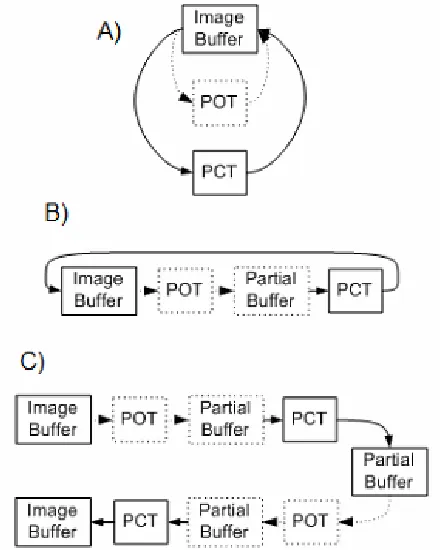
throughput of the design. Figure 2.2 presents three different approaches for implementing the
18
Figure 2.2. Various LBT Implementation Techniques
Figure 2.2A demonstrates how one image buffer can drive and store data to and from the
appropriate transform(s). This approach uses the least amount of memory, but requires either
each transform to complete one at a time or a fairly sophisticated image buffer to continually
load and store sets of data. Figure 2.2B uses an intermediary partial image buffer that allows the
coefficients to enter the PCT directly from the POT. The advantage to using the partial buffer is
an improved pipeline architecture that does not require the space of a second full image buffer.
If no POT is applied at either stage then the two implementations are identical. This design
however implements an approach that resembles Figure 2.2C which is a fully pipelined and will
yield the highest throughput and largest memory footprint. Like Figure 2.2B, partial buffers are
used in between the transform gaps. Once all the data is loaded into the first transform the
19
2.4.1
Photo Core Transform
The PCT itself is comprised of several smaller transforms because a separable 2-D transform can
be implemented by performing 1-D transforms on the rows of data in conjunction with a 1-D
transforms on the columns of data.
2.4.1.1
2x2 Hadamard Transform
The Hadamard transform is a 2-point operator that can mathematically be described by equation
2.4. The 2x2 Hadamard transform is developed by taking the Kronecker product of the 2-point
Hadamard with itself as seen in equation 2.5 [13].
Eqn. 2.4
Eqn. 2.5
The math is then reduced to a series of trivial lifting steps described in pseudo-code in Figure
20
2x2T_h (a,b,c,d, R) {
int t1, t2
a += d
b –= c
t1 = ((a – b + R) >> 1)
t2 = c
c = t1 – d
d = t1 – t2
a –= d
b += c
[image:32.612.231.381.68.235.2]}
Figure 2.3. Pseudo-code for 2x2 Hadamard Transform [13]
2.4.1.2
2x2 Odd Transform
The odd transform was developed by taking the Kronecker product of a 2-point rotation operator
described in equation 2.6 and the 2-point Hadamard operator [13].
Eqn. 2.6
The transform can be reduced to a set of equations including four that are non-trivial as described
by the pseudo-code found in
21
T_odd (a,b,c,d) {
b –= c;
a += d;
c += ((b + 1) >> 1);
d = ((a + 1) >> 1) – d;
b –= ((3*a + 4) >> 3);
a += ((3*b + 4) >> 3);
d –= ((3*c + 4) >> 3);
c += ((3*d + 4) >> 3);
d += (b >> 1);
c –= ((a + 1) >> 1);
b –= d;
[image:33.612.220.394.67.295.2]a += c;
}
Figure 2.4. Pseudo-code for 2x2 Odd Transform [13]
2.4.1.3
2x2 Odd-Odd Transform
The odd-odd transform was developed by taking the Kronecker product of a 2-point rotation
operator with itself. The transform can be reduced to a set of equations including three that are
22
T_odd_odd (a,b,c,d) {
int t1, t2;
b = –b;
c = –c;
d += a;
c –= b;
a –= (t1 = d >> 1);
b += (t2 = c >> 1);
a += ((b * 3 + 4) >> 3);
b –= ((a * 3 + 3) >> 2);
a += ((b * 3 + 3) >> 3);
[image:34.612.213.401.66.337.2]b –= t2;
a += t1;
c += b;
d –= a;
}
Figure 2.5. Pseudo-code for 2x2 Odd-Odd Transform [13]
2.4.1.4
4x4 Photo Core Transform
The PCT itself is a series of Hadamard, odd, and odd-odd transforms. The order and data flow
can be found in the pseudo code of Figure 2.6. In total each PCT contains 15 non-trivial
operations. The set of transforms used can logically be broken up to occur in two separate stages
23
4x4PCT (Coeff[0], …, Coeff[15]) {
// First stage
2x2T_h(Coeff[0], Coeff[3], Coeff[12], Coeff[15], 0)
2x2T_h(Coeff[5], Coeff[6], Coeff[9], Coeff[10] , 0)
2x2T_h(Coeff[1], Coeff[2], Coeff[13], Coeff[14] , 0)
2x2T_h(Coeff[4], Coeff[7], Coeff[8], Coeff[11] , 0)
// Second stage
2x2T_h(Coeff[0], Coeff[1], Coeff[4], Coeff[5], 1)
T_odd(Coeff[2], Coeff[3], Coeff[6], Coeff[7])
T_odd(Coeff[8], Coeff[12], Coeff[9], Coeff[13])
T_odd_odd(Coeff[10], Coeff[11], Coeff[14], Coeff[15])
// Permute the coefficients
FwdPermute(Coeff[0], Coeff[1], …, Coeff[15])
}
Figure 2.6. Pseudo-code for 4x4 PCT [13]
2.4.2
Photo Overlap Transform
The POT uses some of the same transforms as the PCT but includes another two. These two are
the 2-point rotation and the 2-point scaling operations. Since the POT operates across
macroblock boundaries edge cases are created that require the use of a 4-point transform along
with a 4x4 transform.
2.4.2.1
2-Point Rotation
The rotate transform can be found in equation 2.6 and is demonstrated in pseudo-code with three
24
fwdRotate (a,b) {
a += ((b * 3 + 8) >> 4);
b –= ((a * 3 + 4) >> 3);
a += ((b * 3 + 8) >> 4);
[image:36.612.232.380.69.145.2]}
Figure 2.7. Pseudo-code for 2-Point Rotation Transform [13]
2.4.2.2
2-Point Scaling
The scaling function is a result of the matrix that can be found in equation 2.7 [13]. It can be
remapped as the pseudo-code with three non-trivial functions found in Figure 2.8.
Eqn. 2.7
fwdScale (a,b) {
b += a;
a –= ((b + 1) >> 1);
b –= ((a * 3 + 4) >> 3);
a –= ((b * 3 + 8) >> 4);
b –= ((a * 3 + 0) >> 3);
a += ((b + 1) >> 1);
b –= a;
}
[image:36.612.234.376.349.617.2]25
2.4.2.3
4-Point Overlap Transform
At both stages there is a ring of coefficients two thick that the 4x4 POT cannot be applied to.
The 2x2 matrix of coefficients formed at each corner are passed through while the rest of the
border is grouped into 2x4 blocks and fed through two of the 4-point POT. The pseudo-code
describing the 4-point POT containing nine non-trivial operations can be found in Figure 2.9.
4PreFilter (a,b,c,d) {
a –= ((d * 3 + 16) >> 5);
b –= ((c * 3 + 16) >> 5);
d –= ((a * 3 + 8) >> 4);
c –= ((b * 3 + 8) >> 4);
a += d – ((d * 3 + 16) >> 5);
b += c – ((c * 3 + 16) >> 5);
d –= ((a + 1) >> 1);
c –= ((b + 1) >> 1);
fwdRotate(c, d);
d += ((a + 1) >> 1);
c += ((b + 1) >> 1);
a –= d;
b –= c;
[image:37.612.218.397.269.528.2]}
Figure 2.9. Pseudo-code for 4-Point POT [13]
2.4.2.4
4x4 Photo Overlap Transform
The POT like the PCT is a series of smaller transforms with 27 non-trivial operations. Logically
the flow of transforms can be separated into four different pipelined stages. The pseudo code
26
4x4PreFilter (a,b,...,p) {
2x2T_h(a, d, m, p, 0);
2x2T_h (b, c, n, o, 0);
2x2T_h (e, h, i, l, 0);
2x2T_h (f, g, j, k, 0);
fwdScale (a, p);
fwdScale (b, l);
fwdScale (e, o);
fwdScale (f, k);
fwdRotate (n, m);
fwdRotate (j, i);
fwdRotate (h, d);
fwdRotate (g, c);
T_odd_odd (k, l, o, p);
2x2T_h (a, m, d, p, 0);
2x2T_h (b, n, c, o, 0);
2x2T_h (e, i, h, l, 0);
2x2T_h (f, j, g, k, 0);
[image:38.612.228.384.64.402.2]}
Figure 2.10. Pseudo-code for 4x4 POT [13]
2.5
Quantization
Quantization is one of the key stages in terms of compressing the image. The QP can be varied
over the three orthogonal representations of the image. Each color plane may have the same QP,
the luma and chroma channels may have separate QP, or each channel may have an individual
QP. In the spatial domain every tile may have the same QP, each tile may have a unique QP, or
there can be 16 different QP for macroblocks within a tile. In the frequency domain each band
may use the same QP, the LP and HP can use separate QP from the DC band, the DC and LP can
27
harmonic quant values which are applied to divide down the image coefficients reducing their bit
sizes. In lossless encoding a quant value of one is used.
If lossless compression is required then quantization may be left out of the design all together.
However for this design a set of registers are implemented to track the QP values and settings,
and parallel dividers are used for each color channel.
2.6
Adaptive Coefficient Prediction
The coefficient prediction stage is designed to remove inter-block redundancy in the quantized
transform coefficients while minimizing the storage requirements. The prediction scheme
however is only used when the inter-block correlation has a strong and dominant orientation
[15]. DC and LP prediction occurs across macroblock boundaries, but HP prediction happens
within a macroblock. Prediction uses adjacent pixel coefficients with the same QP to determine
if there is a dominant prediction direction that determines which if any coefficients should be
updated. The DC band uses its top, left, and top left DC neighbors as illustrated in Figure 2.11,
where D represents the top-left coefficient (diagonal), T is the top, L is left, and X is the
28
X
T
L
D
XT L D
X T L D
luminance
[image:40.612.248.366.474.596.2]chrominance
Figure 2.11. DC Prediction Layout [15]
The LP band determines its prediction direction based off of the DC prediction direction. And
the HP band uses the LP coefficients to determine its prediction direction. Predicted values are
derived from the same band coefficients that are adjacent row above or column to the left of the
current macroblock or block in the HP band’s case. Eventually the predicted values are added to
the current macroblock coefficients based on the direction predictor. The LP coefficients either
use three coefficients from the top row of a macroblock or three coefficients from the leftmost
column as highlighted in Figure 2.12.
Figure 2.12. LP Coefficient Prediction [15]
The HP predicted values used are similar to the LP prediction scheme in the top row or left
column is used to predict. A visual depiction of left prediction can be found in Figure 2.13, but
29
Figure 2.13. HP Left Prediction Scheme [14,15]
Because the HP direction is based off of the LP coefficient and the LP direction is determined by
the DC direction there are dependencies between the three bands so they must occur in a specific
order. This design predicts for one block at a time so each DC and six of the LP coefficient
values must be stored for prediction of future blocks as data flows through the pipeline. Since
HP prediction does not cross macroblock boundaries 36 coefficients need to be stored but can be
dumped at the next macroblock.
30
Scanning is the process of converting the 2-D matrix of coefficients into a 1-D array so that it
may be encoded. The DC coefficients are ordered in raster scan order while the LP and HP
coefficients must be ordered in some manner. In JPEG traditionally known as zigzag scanning,
HD Photo uses two different scan orders depending on the prediction direction and a statistical
[image:42.612.226.385.236.319.2]average can modify those orders. The initial orders are displayed in Figure 2.14.
Figure 2.14. Initial Scan Patterns (a) LP and HP Horizontal (b) HP Vertical [15]
As values are scanned a tally of the non-zero coefficients are kept in order to predict future
clusters of zero coefficients. By adjusting the scan order to a more favorable bit stream the
overall number of bits in the compressed image can be decreased by an average of 3%. The scan
order can be determined independent from neighboring macroblocks and therefore directly
pipelined with the prediction stage as blocks of coefficients become available. An example of an
adjustment to the scan order is illustrated in Figure 2.15. Figure 2.15a shows that box 5 has
more non-zero coefficients than box 8, so in Figure 2.15b the two boxes are switched in the
31
Figure 2.15. Example of Adaptive Coefficient Scanning [15]
2.8
Adaptive Entropy Encoding
The HD Photo compression algorithm uses a 3½D - 2½D coding approach that in contrast to 2D
or 3D coding tracks the number of zeros trailing a non-zero coefficient in the bit stream. The
first non-zero coefficient must signal both the run of zeros preceding and trailing in the bit
stream for this encoding to work. An example stream with five symbols is found in Figure 2.16.
Figure 2.16. Example 3½D - 2½D Coded Stream [15]
For all of the symbols the trailing run can be zero, non-zero, or the last coefficient and the level
can be one or greater. Therefore to encode the basic 2 ½D symbol the language is limited to a
32
language required to encode these symbols is twice as large meaning a code of 12. The
coefficient levels and signs are encoded according to their frequency band and use the VLC
tables to translate the resulting bitstream. There are seven adaptable predefined VLC tables used
to translate the bitstream as shown in Figure 2.17.
Figure 2.17. VLC Coding Tables used by HD Photo [13,14,15]
Each table is designed for a closed language with a different number of symbols per table. Some
tables describe more than one translation code per language. A set of weighted estimations are
monitored so the encoding algorithms can switch to a more desirable code within a table at run
time. The use of small predefined VLC tables helps maintain a small memory footprint and the
estimation algorithm is computationally light. Since encoding is macroblock independent
33
2.9
Adaptive Coefficient Normalization
In order to produce better suited coefficients for the 3½D - 2½D encoding procedure only the 12
MSB of each LP coefficient and eight MSB for the HP coefficients are used to determine the
level. The four LSB of the LP and eight LSB of the HP are left unaltered and grouped into what
are referred to as flexbits including a sign indication. The nature of the LP and HP bands makes
this data of limited importance and may be discarded in lossy compression if so desired. A
simple picture of how this process takes place is captured in Figure 2.18
34
3
Implementation
3.1
Lapped Biorthogonal Transform
3.1.1
General Transform Information
Within all the transforms the non-trivial steps are multiplies in the form of
n2
3
with some
rounding correction. Luckily all of these non-trivial operations can be reduced to a simpler set of
additions and shifting without the use of a multiplier or divider. This can be done by dividing
the calculation into smaller pieces and then pipelining the results together. First to obtain a
multiply by three, feed an adder the same number on both input ports, with one input left shifted
by one bit. The left shift has the same effect as a multiply of two without the added LUTs or
dedicated DSP blocks inside the FPGA. The rounding correction is usually half the value of the
denominator, and is added on so that when division occurs the result is not always rounded
down. Lastly and most importantly since all the divisions are 2
n,
they can be achieved through a
right shift. There is only some small Boolean check to make sure the sign of the value remains
intact. Because this solution is implemented on a FPGA that uses LUTs instead of normal gates
it tends to be more efficient to use the default macros included in the Quartus II MegaWizard for
35
3.1.2
Photo Core Transform
3.1.2.1
2x2 Hadamard Transform
The implementation of the Hadamard transform can be seen in Figure 3.1 and contains only
trivial operations of which are divided into six pipelined stages. In total there are eight instances
[image:47.612.107.508.322.531.2]of addition / subtraction.
Figure 3.1. Structural Overview of 2x2 Hadamard Transform
36
The implementation of the Odd transform can be seen in Figure 3.2 and contains only trivial
operations of which are divided into 16 pipelined stages. In total there are 24 instances of
addition / subtraction.
Figure 3.2. Structural Overview of 2x2 Odd Transform
3.1.2.3
2x2 Odd-Odd Transform
The implementation of the Odd-Odd transform can be seen in Figure 3.3 and contains only trivial
operations of which are divided into 18 pipelined stages. In total there are 19 instances of
addition / subtraction.
37
3.1.2.4
4x4 Photo Core Transform
The implementation of the PCT transform can be seen in Figure 3.4 and contains only trivial
operations of which are divided into 24 pipelined stages. In total there are 107 instances of
addition / subtraction. In order to produce results concurrently extra registers needed to be added
into the pipeline before the second set of transforms.
Hadamard
A_in
B_in
C_in
D_in
E_in
F_in
G_in
H_in
I_in
J_in
K_in
L_in
M_in
N_in
O_in
P_in
Hadamard
Hadamard
Hadamard
Hadamard
Odd
Odd
Odd Odd
REG 12x
REG 12x REG 12x REG 12x
REG 2x
REG 2x REG 2x REG 2x
REG 2x
REG 2x REG 2x REG 2x
A_out
B_out
C_out
D_out
E_out
F_out
G_out
H_out
I_out
J_out
K_out
L_out
M_out
N_out
O_out
[image:49.612.123.493.270.671.2]P_out
38
3.1.3
Photo Overlap Transform
3.1.3.1
2-Point Rotation
The implementation of the rotation transform can be seen in Figure 3.5 and contains only trivial
operations of which are divided into 12 pipelined stages. In total there are nine instances of
addition / subtraction.
Figure 3.5. Structural Overview of 2-Point Rotation
3.1.3.2
2-Point Scaling
The implementation of the scaling transform can be seen in Figure 3.6 and contains only trivial
operations of which are divided into 19 pipelined stages. In total there are 14 instances of
addition / subtraction.
39
3.1.3.3
4-Point Overlap Transform
The implementation of the 4-point POT transform can be seen in Figure 3.7 and contains only
trivial operations of which are divided into 31 pipelined stages and 17 buffer registers at the
output to align with the 4x4 POT. In total there are 39 instances of addition / subtraction.
[image:51.612.73.524.259.492.2]A_in B_in C_in D_in REG REG REG REG REG REG REG REG REG REG REG REG REG REG REG REG REG
+
>>
4 REG REG REG REG+
<<1 REG REG REG REG REG REG REG+
>>
5 REG REG REG REG+
REG>>
5>>
5 <<1–
REG REG–
<<1 REG REG REG REG REG REG REG REG+
>>
1 REG+
<<1+
REG REG REG REG+
16'h10+
–
+
16'h8>>
4+
<<1 REG–
–
+
16'h10>>
5+
<<1+
+
–
+
16'h1>>
1 REG–
–
REG REG REG REG REG REG REG REG+
16'h8>>
4 REG REG REG REG+
<<1 REG REG REG+
REG REG REG REG REG REG REG REG+
16'h4>>
3 REG REG REG REG+
<<1 REG REG REG–
REG REG REG REG REG REG REG REG+
16'h8>>
4 REG REG REG REG+
<<1 REG REG REG+
REG REG REG REG REG REG REG REG+
>>
1+
16'h1>>
1 REG REG+
+
REG REG–
–
REG x 17 REG x 17 REG x 17 REG x 17 A_out B_out C_out D_outFigure 3.7. Structural Overview of 4-Point POT
3.1.3.4
4x4 Photo Overlap Transform
The implementation of the 4x4 POT can be seen in Figure 3.8 and contains only trivial
operations of which are divided into 49 pipelined stages. In total there are 135 instances of
addition / subtraction. The design is grouped into four stages in which buffers needed to be
40
Hadamard A_in
B_in
C_in D_in
E_in
F_in
G_in H_in
I_in
J_in
K_in L_in M_in
N_in
O_in P_in
Hadamard
Hadamard
Hadamard
Hadamard
A_out
M_out
B_out
N_out D_out
P_out
C_out
O_out
E_out
I_out
F_out
J_out H_out
L_out
G_out
K_out
Odd Odd
Hadamard
Hadamard
Hadamard REG 18x
REG 18x REG 18x REG 18x
REG 18x
REG 18x REG 18x REG 18x
REG 18x
REG 18x REG 18x REG 18x Scale
Scale
Scale
Scale
Rotate
Rotate
Rotate
Rotate REG 8x
REG 8x
REG 8x REG 8x
REG 8x
REG 8x
[image:52.612.87.527.87.401.2]REG 8x REG 8x
Figure 3.8. Structural Overview of 4x4 POT
3.1.4
16x16 Lapped Biorthogonal Transform
The implementation of the LBT can be seen in Figure 3.9 and contains only trivial operations of
which are divided into 111 pipelined stages. In total there are 640 instances of addition /
subtraction. In order to fully exploit the parallelism that exists within the design two 4-point
POT are used in parallel with one 4x4 POT and a pass through buffer for the corner coefficients.
In order to start producing complete blocks of coefficients at a time without buffering
41
a single pass though it were a 5x5 block. The data that pertains to other blocks will be
recalculated later when it is the turn for that block to undergo the POT. The results from the first
stage POT transforms are input into 16 orthogonal 16-bit 6,608 column by 4 row RAM structures
one for each position in the macroblock so data can be entered and retrieved in parallel while
making sure that all calculated data is preserved until it is no longer needed. Once enough of the
POT values have been calculated the first stage PCT is signaled it can start. As data comes out of
the PCT transform there are 15 HP coefficients per block generated that are stored into 15
orthogonal 16-bit 6,608 column by 4 row RAM structures and wait for the DC and LP values to
finish being calculated. The DC/LP coefficients are fed into a separate set of 16-bit 413 column
by 4 row RAM structures that are used to supply the second stage POT with data. Following a
similar process at a different granularity level the second stage POT and PCT produce the DC
and LP coefficients which are then realigned with their corresponding block of HP coefficients
42
43
3.2
Quantization
The quantization stage is fairly straightforward and is composed of two components, a 4x4
quantizer and a quant map. Together the two components store the quantization settings
including all of the different QP associated with the setting and a ten clock divider to apply the
quant values.
3.2.1
Quant Map
The quant map takes in the user specified QP and stores them according to the quantization
settings selected by the user. As requests for specific blocks come in the QP are sent out to the
44
Figure 3.10. Structural Overview of Quant Map
3.2.2
4x4 Quantizer
The 4x4 quantizer is signaled by the LBT that the data stream is ready, at which point the control
logic starts to iterate over the block data, requesting specific QP. When the QP are retrieved from
the map they are converted into their quant values and then applied using a 10 clock cycle
45
Figure 3.11. Structural Overview of 4x4 Quantizer
3.3
Adaptive Coefficient Prediction
An overview of how the adaptive prediction stage was designed can be found in Figure 3.12.
The macroblock flows in block by block in raster scan order. The zeroth block contains the DC
values so they are used along with the stored DC top-left, top, and left neighbors to determine the
DC and LP predict direction. Knowing the DC direction its value can immediately be predicted
and wait until it is needed at the output. The LP prediction direction might be left so the LP
46
in. At this point the LP Direction can dictate how to predict the LP values and the HP predict
direction can be calculated. The HP values must be buffered up until the fifteenth and final block
arrives at which point the HP values can be predicted. At the output some control logic realigns
the frequency bands and sends the valid data out block by block.
y_0
y_4
y_8
y_1
u_1
u_8
u_12
u_2
u_3
v_0
v_1
u_4
y_2
y_12
u_0
y_3
y_out
u_out
v_out
v_8
v_12
v_2
v_3
v_4
data_in_valid
mblock_height
mblock_width
Control
Logic
y_in
u_in
v_in
DC Predict
Direction
LP Buffer
HP Buffer
DC Predict
DC
Storage
LP Predict
LP Storage
HP Predict
HP Predict
Direction
Control
Logic
[image:58.612.85.527.217.676.2]hp_vertical_scan
data_out_valid
![Figure 1.2. Spatial Layout of Macroblock Aligned Image [13,18]](https://thumb-us.123doks.com/thumbv2/123dok_us/116267.11231/23.612.194.417.71.327/figure-spatial-layout-macroblock-aligned-image.webp)
![Figure 2.3. Pseudo-code for 2x2 Hadamard Transform [13]](https://thumb-us.123doks.com/thumbv2/123dok_us/116267.11231/32.612.231.381.68.235/figure-pseudo-code-for-x-hadamard-transform.webp)
![Figure 2.4. Pseudo-code for 2x2 Odd Transform [13]](https://thumb-us.123doks.com/thumbv2/123dok_us/116267.11231/33.612.220.394.67.295/figure-pseudo-code-for-x-odd-transform.webp)
![Figure 2.5. Pseudo-code for 2x2 Odd-Odd Transform [13]](https://thumb-us.123doks.com/thumbv2/123dok_us/116267.11231/34.612.213.401.66.337/figure-pseudo-code-for-x-odd-odd-transform.webp)
![Figure 2.7. Pseudo-code for 2-Point Rotation Transform [13]](https://thumb-us.123doks.com/thumbv2/123dok_us/116267.11231/36.612.234.376.349.617/figure-pseudo-code-point-rotation-transform.webp)
![Figure 2.9. Pseudo-code for 4-Point POT [13]](https://thumb-us.123doks.com/thumbv2/123dok_us/116267.11231/37.612.218.397.269.528/figure-pseudo-code-for-point-pot.webp)
![Figure 2.10. Pseudo-code for 4x4 POT [13]](https://thumb-us.123doks.com/thumbv2/123dok_us/116267.11231/38.612.228.384.64.402/figure-pseudo-code-for-x-pot.webp)
![Figure 2.11. DC Prediction Layout [15]](https://thumb-us.123doks.com/thumbv2/123dok_us/116267.11231/40.612.248.366.474.596/figure-dc-prediction-layout.webp)