Muhammad Firmansyah Kasim,1 Luke Ceurvorst,2 Naren Ratan,2James Sadler,2 Nicholas Chen,2 Alexander S¨avert,3, 4 Raoul Trines,5 Robert Bingham,5 Philip N. Burrows,1 Malte C. Kaluza,3, 4 and Peter Norreys2, 5
1John Adams Institute, Denys Wilkinson Building, Keble Road, Oxford OX1 3RH, United Kingdom 2
Clarendon Laboratory, Department of Physics, University of Oxford, Oxford OX1 3PU, United Kingdom 3Institut f¨ur Optik und Quantenelektronik, Abbe-Center of Photonics,
Friedrich-Schiller-Universit¨at, 07743 Jena, Germany 4
Helmholtz-Institut Jena, Friedrich-Schiller-Universit¨at, 07743 Jena, Germany 5STFC Rutherford Appleton Laboratory, Chilton, Didcot OX11 0QX, United Kingdom
(Dated: February 8, 2017)
Shadowgraphy is a technique widely used to diagnose objects or systems in various fields in physics and engineering. In shadowgraphy, an optical beam is deflected by the object and then the intensity modulation is captured on a screen placed some distance away. However, retrieving quantitative information from the shadowgrams themselves is a challenging task because of the non-linear nature of the process. Here, a novel method to retrieve quantitative information from shadowgrams, based on computational geometry, is presented for the first time. This process can also be applied to proton radiography for electric and magnetic field diagnosis in high-energy-density plasmas and has been benchmarked using a toroidal magnetic field as the object, among others. It is shown that the method can accurately retrieve quantitative parameters with error bars less than 10%, even when caustics are present. The method is also shown to be robust enough to process real experimental results with simple pre- and post-processing techniques. This adds a powerful new tool for research in various fields in engineering and physics for both techniques.
I. INTRODUCTION
Shadowgraphy is a technique to visualise modulations in discrete objects [1, 2] and is used extensively in our daily life. For example, when sun rays propagate through a transparent object with non-flat surface, one can read-ily observe the modulation of the light intensity behind the object on a screen placed a suitable distance away. This occurs because when light rays propagate, different refractive indices in the object cause the rays’ paths to be deflected, resulting in the intensity modulation. With its simplicity, the shadowgraphy technique has become a widely used diagnostic tool in many different fields in physics and engineering. Examples are diagnosing plasma wakefields [3], measuring temperatures in com-bustion processes [4], and characterization of optical sys-tems [5]. A similar technique, that of proton radiogra-phy, is also widely employed to diagnose the structure in laser-plasma experiments [6–11]. In proton radiography, instead of using light rays, a proton beam is fired into the plasma. The electric and magnetic fields inside the plasma deflect the protons’ trajectories. Proton beams are both highly laminar and have discrete divergence an-gles that allow magnification of the object, provided that the screen is placed far enough away from the object. By looking at the intensity modulation of the proton beam on the screen, one can see the structure inside the plasma with ∼ µm resolution. Among the applications of pro-ton radiography are studies of experimental magnetic re-connection phenomena [6, 7], observing solitons [8], laser channeling in plasmas [9, 10], and observing the Weibel instability [11].
One emphasises here that both the shadowgraphy and
proton radiography techniques share the same underly-ing principle. Thus, one can refer to proton radiography as shadowgraphy and vice-versa, without losing general-ities. We will do this throughout this paper. By doing so, we show that this new approach provides a powerful new quantitative diagnostic tool for high-energy-density plasma science.
Although shadowgraphy is widely used in plasma sci-ence, in many cases it is used as a qualitative analysis tool [9, 10]. There have been many efforts in the past to retrieve the quantitative information from shadowgrams, but it has only been possible, so far, in limited cases where the intensity modulations are small. This is done mainly by employing Poisson’s equation solver [1, 13–15] or by using the diffusion equation [16] for specific cases [5, 17]. The equation for small intensity modulation of shadowgraphy was also obtained by Pogany, et al. [13] using phase contrast approach and Fresnel diffraction. The non-linear nature of shadowgraphy makes it a chal-lenging task for large modulation cases. Some experi-ments also make use of a grid to estimate the deflection of the beam [7, 12]. However, the technique depends on the grid resolution and it becomes harder to estimate when the feature to be observed is about the same size as the grid resolution or smaller [9, 10].
In this paper a method to retrieve quantitative infor-mation from shadowgraphic images for large intensity modulations, without using a grid, is presented. A co-herent beam for optical shadowgraphy is also assumed throughout. By retrieving the quantitative information one can interpret phenomena in much greater detail, and thus provide a greater understanding of the diagnosed system. Section II provides equations underlying the
II. THEORY
A. Deflectometry
If beams of light or charged particles are fired into deflecting objects along thez0-axis, they will be deflected by an amount of
a(x0, y0) =−∇Φ(x0, y0), (1)
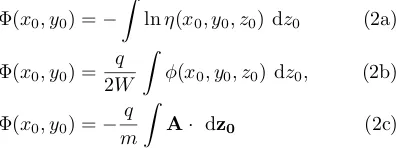
where Φ(x0, y0) is the deflection potential. The deflection potentials for optical shadowgraphy and proton radiog-raphy cases, respectively, are [14, 15]
Φ(x0, y0) =− Z
lnη(x0, y0, z0) dz0 (2a)
Φ(x0, y0) =
q
2W
Z
φ(x0, y0, z0) dz0, (2b)
Φ(x0, y0) =−
q m
Z
A· dz0 (2c)
whereηis the refractive index of the object in light shad-owgraphy cases,φandArespectively are the electric and magnetic potential,q, W, andmare the charge, energy, and mass of the particle in the beam, respectively. It is assumed that the beam propagates in straight lines during the interaction with the object.
With each deflection, beams at position (x0, y0) on the object plane are mapped to position (x, y) on the screen according the equations below,
x=x0+a·ˆxL
y=y0+a·ˆyL,
(3)
where L is the distance between the object and the screen. These equations assume the beams are collimated before the interaction with the objects. For diverging beams using the paraxial approximation, one can simply replacex0→x0(1 +L/l) andy0→y0(1 +L/l), wherel is the distance from the beam source to the object.
From the mapping equations, one can obtain the in-tensity of the beam on the screen as [15]
I(x, y) = I0(x, y)
∂(x,y)
∂(x0,y0)
, (4)
where I0(x, y) is the beam intensity on the screen with-out deflections. The term|∂(x, y)/∂(x0, y0)|is the deter-minant of the Jacobian matrix of (x, y) with respect to
the beam, so the total flux on the screen without the object (source profile) is the same as the total flux on the screen with the object (target profile). With this assumption, the problem can be restated as the Monge transport problem [18]: how are the particles transported from the source profile to the target profile such that the total distance for all particles is minimised? This can be solved using a combination of Lloyd’s algorithm [19], Voronoi and power diagram [20], and optimization [21].
B. Voronoi and power diagram
Consider a 2D plane with several sites located on the plane. For every point on the plane, there is a site which is closest to the corresponding point. As an example, Figure 1(a) shows a plane with 3 sites and point A. Com-pared to the other sites, site 1 is the closest to the point A. Therefore point A belongs to site 1.
In the construction of a Voronoi diagram [20], the plane is divided by some regions. All points in a region belong to the site in the same region. Figure 1(b) is an example of a Voronoi diagram. Mathematically, the i-th site at
r0i = (x0i, y0i) occupies a region or cell on the source
plane,r0= (x0, y0), where for allj,
||r0−r0i||2≤ ||r0−r0j||2. (5)
The equation above applies only for a case where all sites have the same weights. However, in some cases, this does not apply. A site with a larger weight tends to have a larger region compared to sites with smaller weights. A diagram resulting from weighted sites is called as weighted Voronoi diagram or power diagram. A region in power diagram is called as apower cell. In the power diagram with weights w, the i-th site at ri = (xi, yi)
occupies a region or power cell on planer= (x, y) where ||r−ri||2−wi≤ ||r−rj||2−wj (6)
for allj. Figure 1(c) shows an example of a power dia-gram with more weight on site 1. In a power diadia-gram, it is possible for a site to not be located inside its region or even have no region. Setting all weights to be uniform or zero produces the Voronoi diagram.
C. Lloyd’s algorithm
[image:2.612.100.298.318.392.2]FIG. 1. (a) An example of a case with 3 sites and a point A which is closest to the site 1. (b) A Voronoi diagram where the plane is divided into several regions based on which site is the closest one. (c) A power diagram with the same position of the sites as (b), but with more weight assigned to site 1. (d)-(g) Illustration of Lloyd’s algorithm where the centroids of the regions are denoted by a plus (+) sign.
area. The algorithm starts by deploying randomly a num-ber of sites on a bounded plane. Then a Voronoi diagram is constructed to divide the plane into several regions. For every region, the algorithm calculates its centroid po-sition. The sites are then moved to the centroid position of its region, and constructing the Voronoi diagram for the new positions. The process is then repeated until any stopping conditions are reached, e.g. maximum number of iterations, minimum displacement, etc. An illustration of the algorithm can be found on Figure 1(d)-(g).
There are some cases where the plane is not uniform. If this is the case, then there are several improvements that can be made. First, the site can be deployed randomly using a simple rejection method [22]. Positions on the plane with lower values tend to reject a site with higher probabilities. The rejected sites are deployed to other positions until they are accepted. Second, the centroid can be calculated by adjusting the values on the plane. It is similar to calculating the centre of mass of a 2D object with a non-uniform density.
III. METHOD
In order to retrieve quantitative information of the ob-ject from the screen, one needs the beam profiles both with and without the object in position. We refer to the beam profile without the object as the source profile,I0, and the profile with the object as the target profile,I.
Initially, a number of sites are deployed randomly on the source plane profile with a simple rejection method mentioned above. Then, Lloyd’s algorithm is applied on the source plane profile to distribute the sites so that each site has approximately the same flux. This produces a Voronoi diagram, or a power diagram with weights
w = 0. Once the Lloyd’s algorithm finishes, then the algorithm performs optimization on the weights.
Denote Vi as thei-th region on the source plane and
Pw
i as thei-th region on the target plane as a function
of all sites’ assigned weights, w. Note that P0
i = Vi.
Also denote S(Vi) and T(Piw) as the flux of thei-th
re-gion on the source and target planes, respectively. The objective of the algorithm is to find the weights, such that transporting the flux from the source plane with
in-tensity profile I0 to the target plane produces the same intensity profile as the target profile,I, and the total dis-tance travelled by all regions from the source plane to the target plane is minimised. Aurenhammer [21] found that the weights can be found in the minimum of a convex function,
f(w) =−X
i
"
wiS(Vi) +
Z
Pw
i
||r−r0i||2−wi
I(r)dr
#
,
(7) where r0i and wi are the i-th site position and the
as-signed weight, respectively. It is noted thatR
Pw
i
I(r)dr=
T(Pw
i ). The gradient of the function is given by
∂f(w)
∂wi
=T(Piw)−S(Vi), (8)
so any gradient based optimization methods can be em-ployed. Note that in the optimization process, the sites positions do not change. It is only the assigned weights that are changed. These equations have been employed to design surfaces of transparent objects that produce caustic designs [23].
Once the minimum of equation 7 is reached, the cen-troid position of each power cell in the power diagram,
[image:3.612.64.557.53.142.2]1: Input: a shadowgram or a proton radiogram image 2: Output: Φ, the 2D deflection potential of the object 3:
4: %Initialisation
5: Deploy sites randomly on the source plane,xandy 6: repeat
7: Construct the Voronoi diagram with sites atxandy on the source plane
8: Calculate the centroid of each region,xcandyc
9: x←xc;y←yc
10: untilany stopping conditions reached
11: Construct the Voronoi diagram with sites at xandy on the source plane
12: CalculateS(V) 13:
14: %Gradient-based optimization
15: w←0 16: repeat
17: Construct the power diagram withx,y, andwon the target plane
18: CalculateT(Pw) for each site 19: Calculatef(w) and ∆w=∇wf(w)
20: Updatew←w−α∆w
21: untilany stopping conditions reached 22:
23: %Finalisation
24: Construct the power diagram with x, y, and w on the target plane
25: Obtain the centroid positions, xP andyP
26: Assign the displacement,xP−xandyP−y, to each site
27: Move 4 sites closest to the corners to the corners 28: Get the displacement of each pixel using natural
neigh-bour interpolation
29: Integrate the displacement inxoryaxis to obtain Φ
A. Implementation
There are a lot of basic computational geometry algo-rithms employed in the implementation of this method. First, to obtain the power diagram of sites, algorithms that use convex hull and transformation to dual space are employed [24]. Voronoi diagram can be obtained by the same algorithm by setting all weights to zero. Bounded Voronoi and power diagrams inside a rectangle are obtained by clipping the diagram with the rectan-gle using the Sutherland-Hodgman algorithm [25]. The Sutherland-Hodgman algorithm is employed for all poly-gon clippings in the implementation, since all polypoly-gons are convex in this case.
To calculate the function in equation 7, one needs to compute the weighted area (i.e. S(Vi) and T(Piw)),
sity within a pixel, computing the parameters for each polygon, and merging the parameters to give the param-eters for the given cell [29]. The area, centroid position, and moment of inertia with respect to the origin of a 2D convex polygon withN vertices can be shown to be
A=1 2
N−1 X
i=0
(xi+1yi−xiyi+1) (9a)
xc =
1 6A
N−1 X
i=0
(xi+xi+1)(xi+1yi−xiyi+1) (9b)
yc =
1 6A
N−1 X
i=0
(yi+yi+1)(xi+1yi−xiyi+1) (9c)
Iz=
1 12
N−1 X
i=0
[(x2i +xixi+1+x2i+1)+ (9d)
(yi2+yiyi+1+yi2+1)](xi+1yi−xiyi+1) where (xi, yi) is the vertex position of each polygon and
they are ordered in the clockwise direction. Note that (xN, yN) = (x0, y0). The cells’ centroids for Lloyd’s al-gorithm are also computed by this method.
To obtain faster convergence to the global minimum of the function in equation 7, one can use a quasi-Newton gradient descent algorithm [26]. However, using a quasi-Newton algorithm requiresO(Ns2) memory, whereNs is
the number of sites, and it can be very large computation-ally. Thus, using the limited memory BFGS (L-BFGS) method [27, 28] can save memory while still achieving fast convergence. One can also use a multi-stage approach to minimise equation 7 faster [29]. The complete implemen-tation code of the algorithm on this paper can be found at https://github.com/mfkasim91/invert-shadowgraphy.
IV. BENCHMARK WITH SIMULATIONS
A. Magnetic field proton radiography
The first test for this method considers the case of a proton beam with energy ofW = 14.7 MeV propagating in the positivez-direction and going through a toroidal magnetic field. The toroidal magnetic field around the centre gives a line-integrated magnetic field on the object plane of
− Z
B×dz=Dmexp
−||r||
2
2σ2 + 1 2
1
σr (10)
whereDmis the maximum value of line-integrated value
FIG. 2. Illustration of the algorithm with 100 sites. Figure (b) shows the deployed sites in line 5 in Algorithm 1. The results of Lloyd’s algorithm from line 6 to 10 is shown in Figure (c). The same sites positions are then redeployed on the target plane, as shown in Figure (e). Figures (f) and (g) are the results of line 17 of the algorithm on the 3rdand 26thiterations, respectively. Figure (h) and (i) are the results of lines 25 and 26, respectively. The interpolated displacement in line 28 is shown in Figure (j) and (k). Last, the integration of the displacement yields the deflection potential (l). The distortion at the corners in (l) is caused from moving 4 sites to the corner as in line 27 in the algorithm.
been found in laser-plasma experiments, such as in mag-netic reconnection experiments [6, 7]. Even though only magnetic field cases are considered here, it can be ex-panded into light shadowgraphy and electric field cases using equations 2.
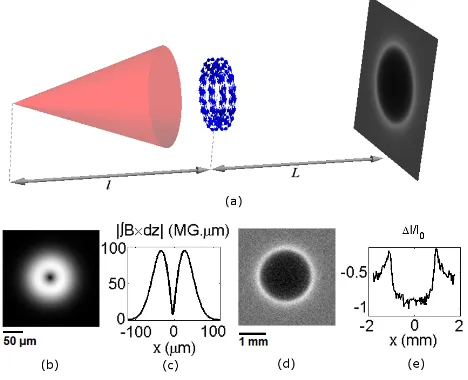
The transverse size of the toroidal magnetic field is assumed to be σ = 30 µm. The beam is deflected by the magnetic field and captured on the screenL= 2 cm away. The distance from the source to the magnetic field is l = 1.3 mm, thus giving magnification of 15. It is assumed that the magnetic field extent in thez-direction is very small compared tol andL. Visualisation of the test case can be seen in Fig. 3.
The beam’s deflected velocity isvt =−e/mR B×dz where e/m is the charge-to-mass ratio of the proton beam. Thus, the deflected angle isa=−e/√2mWR
B×
dz. This gives the deflection potential as in equation 2, givenB=∇ ×A.
The value of Dm is varied from 10 MGµm to
340 MGµm. These values cover the cases from small intensity modulation to the cases where caustics are formed. Caustics start to appear on the screen atDm=
190 MGµm. The beam’s intensity modulation is shown in Fig 4. Gaussian noise is added to each image with variance about 10% of the average intensity.
From each image of the intensity modulation, the de-flection potentials are retrieved using the method ex-plained in this paper. Then one calculates the magnitude of the line integrated magnetic field,||R
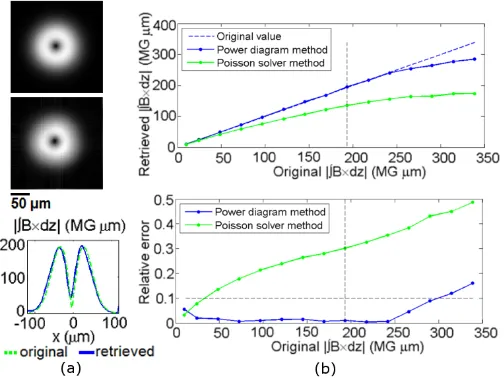
B×dz||, from the deflection potential. The retrieved value is then com-pared with the original value to benchmark the method. The images of the retrieved line-integrated magnetic field are shown in Fig 5(a). Comparison between the peaks of the retrieved values of line-integrated magnetic
FIG. 3. Illustration of the test case system. In figure (a), the proton beam is fired through a toroidal magnetic field and the intensity modulation is captured on the screen. Fig-ure (b) shows the magnitude of the line-integrated magnetic field,−R
|B×dz|with maximum value, Dm = 97 MGµm, and its horizontal 1D-cross-section in figure (c). The inten-sity modulation on the screen is shown in figure (d) with its 1D-cross-section on figure (e). The intensity on the screen is augmented by Gaussian noise with variance 10% of the aver-age intensity value to test robustness of the method.
[image:5.612.328.562.340.530.2]FIG. 4. The beam’s intensity modulation on the screen and its horizontal 1D-cross-section at the middle position for (a) small intensity modulation, (b) large intensity modulation, (c) a case where caustics have formed, and (d) where the caustics already branched. The value ofDmfor cases (a)-(d) is (24,97,194,290) MGµm, respectively.
solver and compared. Note that no noise has been added to the intensity images for the Poisson’s equation solver case. These comparison results are shown in Fig 5(b).
It can be seen that the retrieved line integrated mag-netic field gives very good agreement with the original profile, even when caustics are formed. The error on the retrieved value increases just when the branches of the caustics are relatively distinguishable. This is because in regions between the caustics branches, the beams are coming from more than one different position on the ob-ject plane, while this method assumes that each region on the target plane is formed from one region on the ob-ject plane only. However, one can still infer magnitude of the deflection potential in this case within some error.
A slightly higher relative error at small values of||R
B×
dz||is caused by the noise. The intensity modulation at that point is comparable to the noise. As the intensity modulation gets larger, the effect of noise seems to be weaker.
It is observed that this method amplifies low-frequency components of the image and reduces the high-frequency components. It makes the power diagram method some-what less robust to low frequency noise, but robust to high frequency noise. This can be solved by applying a high frequency filter to the image before it is processed using the power diagram method.
On the other hand, the retrieved value using the Pois-son’s equation solver deviates significantly from the orig-inal value. The Poisson’s equation solver gives rela-tive error of 10% when Dm & 30 MGµm while the
power diagram method gives the same relative error when
Dm&300 MGµm. If one wants an accuracy of less than
10%, the power diagram method gives 10 times larger working range than the Poisson’s equation solver’s work-ing range.
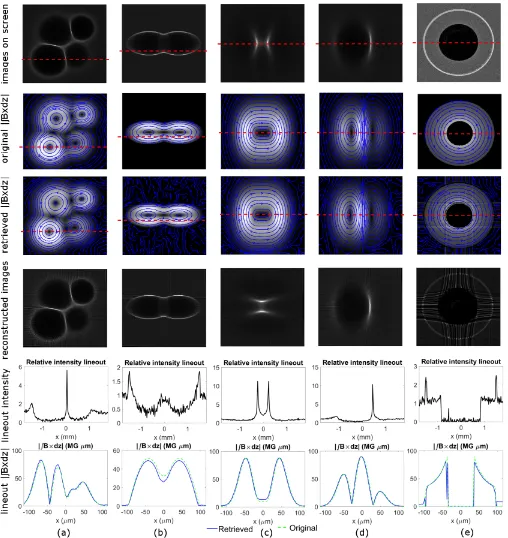
As an additional benchmark to the case described above, we also tried retrieving quantitative information for arbitrary magnetic field structures. Fig 6 shows the retrieval results of the magnetic field with various
struc-FIG. 5. Comparison of the magnitude of the line-integrated magnetic field between (a,top) the original profile and (a,middle) the retrieved profile. The 1D-cross-section at the centre position of the original and the retrieved profile is given in (a,bottom). The dashed green line shows the 1D-cross-section of the original profile while the solid blue line shows the retrieved profile. The picture in (a) is taken for the case with Dm = 194 MGµm, where caustics are just formed. The quantitative comparison for the maximum value of the line-integrated magnetic field is given in figure (b). The top picture (b,top) shows the maximum retrieved value of ||R
B×dz|| using the power diagram method (blue/dark grey) and the Poisson’s equation solver method (green/light grey) compared with the original values. The relative error between the retrieved and original values is given in figure (b,bottom). The dashed vertical lines in figures (b) show the value when caustics are present. The dashed horizontal line shows the relative error of 10%.
tures with the same setup as the previous case. Each image has a size of 200×200 pixels with depth of 16 bits. The code was run on a highly parallel computer cluster using 32 cores. It takes around 2-3 hours to process one image.
In Fig 6, one can see that the retrieved magnetic field structures agree very well with the original magnetic field. It is also apparent that the retrieved magnetic field can be different from what it seems in the proton radio-graphy image. Moreover, the size of the structure can also be different, as shown in Fig 6(e) where the struc-ture’s size is actually smaller than it seems in the proton radiography image.
V. TESTS WITH EXPERIMENTAL RESULTS
[image:6.612.319.571.56.245.2]index modulation in the plasma caused the probe’s path to bend so that some parts of the probe were brighter than others at the detector. The refractive index of a plasma with density profilen(x0, y0, z0) is
η(x0, y0, z0) = s
1−n(x0, y0, z0)e 2
m0ω2
, (11)
where 0 is the vacuum permittivity constant, e and m are the electron’s charge and mass, respectively, and ω
is the frequency of the light. Using equations 2 and 11 with approximationω2p=n0e2/m0ω2, the deflection potential for light in a plasma is
Φ(x0, y0)≈
e2
m0ω2 Z
n(x0, y0, z0) dz. (12)
Thus, the information that can be retrieved from shad-owgrams using the power diagram method isR
ndz. One of the main challenges in inverting the shadow-grams for real experimental data is the non-uniformity of the probe’s unmodulated intensity, i.e. the intensity profile without deflection from objects. This can be a big problem because the inversion processes from shad-owgrams to deflection potentials amplify low frequency components. Even though this can be solved by taking the intensity profile without the object, the data is not usually available or reliable because of shot-to-shot vari-ations. Therefore, a straightforward solution is to apply a high-pass filter to either the shadowgrams and/or the resulting deflection potentials.
The pulse that drives the wakefield has a wavelength of 810 nm, duration of 35 fs, and peak intensity IL =
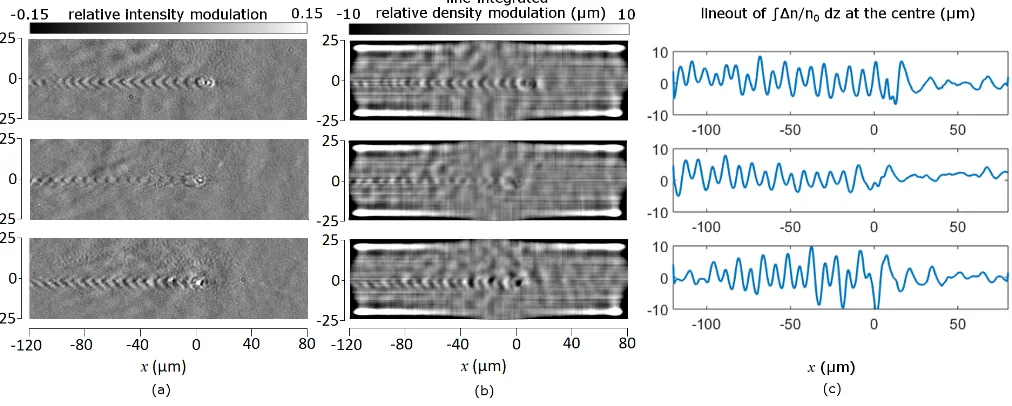
6×10¹⁸ W cm−2. The probe pulse has the same wave-length, but with shorter duration, 5.9 fs. The shadow-grams for a plasma with density n0= 1.65×1019cm−3 are shown in Fig. 7(a). Using the power diagram method and equation 12, it is possible to infer the line-integrated relative electron density modulation, R
∆n/n0 dz from the shadowgrams. The inverted results from the shad-owgrams are shown in Fig. 7(b), where the grey scale shows the value of the line-integrated relative electron density modulation, R∆n/n0 dz, as well as their 1D-cross-sections at the centre of the wakefield in Fig. 7(c). The figures still show the wakefield features with addi-tional information ofR
∆n/n0 dz. It is shown from Fig. 7 that the power diagram method in this paper is ro-bust enough to analyse real experimental results with additional preprocessing and post-processing. It should be noted that we have neglected relativistic effects in the plasma, e.g. the plasma electrons mass increase,
We have presented a new method to retrieve quan-titative data from shadowgraphic images. In the cases considered in this paper, a beam propagates through an object, gets deflected by it, and is then captured on a screen. The intensity modulation on the screen acts as the input and the deflection potential of the object is regarded as the output of this method. It assumes the beam propagates in straight lines while interacting with the object. Besides shadowgraphy, the method in this paper can also be applied to proton radiography cases.
The method has been benchmarked for a toroidal mag-netic field case, which has been found in some laser plasma experiments, and a plasma wakefield shadowg-raphy case. In some test cases, the method successfully retrieved the deflection potential profiles with relative er-ror less than 10% for large intensity modulation, even for cases where caustics are present. It is also tested using arbitrary structures of the diagnosed objects and gives very good results in retrieving structures with their quantitative parameters. Moreover, it has been shown that the method is also robust to noise, especially high-frequency noise. This extends the working range of the Poisson’s solver equation by an order of magnitude. It is also shown that the method can be applied to real exper-imental results, with some additional pre-processing and post-processing. By applying this method, one can in-fer quantitative information from shadowgraphy images with high accuracy. This opens up a new dimension of re-search in a wide range of areas in engineering and physics.
ACKNOWLEDGMENTS
FIG. 7. (a) Original shadowgrams of plasma wakefield from S¨avert,et al.. Images reproduced with permission. (b) The retrieved line-integrated relative electron density modulation,R
∆n/n0 dz from the shadowgrams with their 1D-cross-sections
at the centre of the wakefields in (c). High pass filter is applied in preprocessing and post-processing of the images. The very bright and very dark on the images are features obtained from applying high pass filter, as well as horizontal fringes on the left and right edges.
[1] G. S. Settles,Schlieren and Shadowgraph Techniques: Vi-sualizing Phenomena in Transparent Media (Heidelberg: Springer, 2001).
[2] P. K. Panigrahi and K. Muralidhar,Schlieren and Shad-owgraph Methods in Heat and Mass Transfer(New York: Springer, 2012).
[3] A. S¨avert, S. P. D. Mangles, M. Schnell, E. Siminos, J. M. Cole, M. Leier, M. Reuter, M. B. Schwab, M. Mller, K. Poder, O. J¨ackel,et al., Phys. Rev. Lett.115, 055002 (2015).
[4] R. W. Lewis, R. E. Teets, J. A. Sell, and T. A. Seder, Applied Optics Vol. 26, Issue 17, pp. 3695-3704 (1987). [5] H. Canabal, J. Alonso, and E. Bernabeu, Opt. Eng.40
(11) pp. 2517-2523 (2011).
[6] P. M. Nilson, L. Willingale, M. C. Kaluza, C. Kam-peridis, S. Minardi, M. S. Wei, P. Fernandes, M. Notley, S. Bandyopadhyay, M. Sherlock,et al., Phys. Rev. Lett. 97, 255001 (2006).
[7] C. K. Li, F. H. S´eguin, J. A. Frenje, J. R. Rygg, R. D. Petrasso, R. P. J. Town, O. L. Landen, J. P. Knauer, and V. A. Smalyuk, Phys. Rev. Lett.99, 055001 (2007). [8] M. Borghesi, S. Bulanov, D. H. Campbell, R. J. Clarke,
T. Zh. Esirkepov, M. Galimberti, L. A. Gizzi, A. J. MacKinnon, N. M. Naumova, F. Pegoraro, et al., Phys. Rev. Lett. 88, 135002 (2002).
[9] L. Romagnani, A. Bigongiari, S. Kar, S. V. Bulanov, C. A. Cecchetti, T. Zh. Esirkepov, M. Galimberti, R. Jung, T. V. Liseykina, A. Macchi,et al., Phys. Rev. Lett.105, 175002 (2010).
[10] L. Willingale, P. M. Nilson, A. G. R. Thomas, J. Cobble, R. S. Craxton, A. Maksimchuk, P. A. Norreys, T. C. Sangster, R. H. H. Scott, C. Stoeckl, et al., Phys. Rev. Lett.106, 105002 (2011).
[11] C. M. Huntington, F. Fiuza, J. S. Ross, A. B. Zylstra, R. P. Drake, D. H. Froula, G. Gregori, N. L. Kugland, C. C. Kuranz, M. C. Levy,et al., Nat. Phys.11, 173176 (2015).
[12] L. Willingale, A. G. R. Thomas, P. M. Nilson, M. C. Kaluza, S. Bandyopadhyay, A. E. Dangor, R. G. Evans, P. Fernandes, M. G. Haines, C. Kamperidis,et al., Phys. Rev. Lett.105, 095001 (2010).
[13] A. Pogany, D. Gao, and S. W. Wilkins, Rev. Sci. Instrum. 68(7) (1997).
[14] G. Izarra and C. Izarra, Eur. J. Phys.33, pp. 18211842 (2012).
[15] N. L. Kugland, D. D. Ryutov, C. Plechaty, J. S. Ross, and H.-S. Park,et al., Rev. Sci. Instrum.83, 101301 (2012). [16] C. Graziani, P. Tzeferacos, D. Q. Lamb, and C. Li,
arXiv:1603.08617 [physics.plasm-ph] (2016).
[17] A. Bon´e, N. Lemos, G. Figueira, and J. M. Dias, J. Phys. D: Appl. Phys.49, 155204 (2016).
[18] G. Monge,Histoire de l’Acad´emie Royale des Sciences de Paris, avec les M´emoires de Math´ematique et de Physique pour la mˆeme ann´ee, pp. 666-704 (1781).
[19] M. McCool and E. Fiume, Proc. of the Graphics Inter-face, pp. 94-105 (1992).
[20] F. Aurenhammer, ACM Computing Surveys, Vol. 23, No. 3 (1991).
[21] F. Aurenhammer, F. Hoffmann, and B. Aronov, Algo-rithmica, Vol. 20, Issue 1, pp. 61-76 (1998).
[22] G. Casella, C. P. Robert, and M. T. Wells, Lecture Notes - Monograph Series, Vol. 45, pp. 342-347 (2004). [23] Y. Schwartzburg, R. Testuz, A. Tagliasacchi, and M.
Pauly, ACM Trans. Graph. 33,4, Article 74 (2014). [24] A. Nocaj and U. Brandes, Computer Graphics Forum,