City, University of London Institutional Repository
Citation
:
D'Amato, V., Haberman, S., Piscopo, G., Russolillo, M. and Trapani, L. (2014).Detecting Common Longevity Trends by a Multiple Population Approach. North American Actuarial Journal, 18(1), pp. 139-149. doi: 10.1080/10920277.2013.875884
This is the accepted version of the paper.
This version of the publication may differ from the final published
version.
Permanent repository link:
http://openaccess.city.ac.uk/13967/Link to published version
:
http://dx.doi.org/10.1080/10920277.2013.875884Copyright and reuse:
City Research Online aims to make research
outputs of City, University of London available to a wider audience.
Copyright and Moral Rights remain with the author(s) and/or copyright
holders. URLs from City Research Online may be freely distributed and
linked to.
City Research Online: http://openaccess.city.ac.uk/ [email protected]
Detecting longevity common trends by a multiple population approach
Valeria D’Amato1, Steven Haberman2,Gabriella Piscopo3, Maria Russolillo1, Lorenzo Trapani4
1 Department of Economics and Statistics, University of Salerno, via Ponte Don Melillo, Campus
Universitario, 84084 Fisciano (Salerno), Italy
e-mail: [email protected], [email protected]
2 Faculty of Actuarial Science and Insurance, Cass Business School, City University, Bunhill Row
London, UK, e-mail: [email protected],
3 Department of Economics, University of Genoa, Via Vivaldi, 16126 Genoa, Italy - e-mail:
4 Faculty of Finance, Cass Business School, City University, Bunhill Row London, UK, e-mail:
Abstract. Recently the interest in the development of country and age-based longevity risk models (Njienga and Sherris. 2011) has been growing. The investigation of long-run equilibrium relationships could provide valuable information about the factors driving changes in mortality, in particular across ages and across countries.
In order to investigate cross-country longevity common trends, tools to quantify, compare and model the strength of dependence become essential. On one hand it is necessary to take into account either the dependence for adjacent age groups, or the dependence structure across time in a single population setting: a sort of intra-dependence structure (D’Amato et al. 2012b). On the other hand, the dependence across multiple populations, which we describe as inter-dependence, can be explored for capturing common long run relationships between countries. In particular, the objective of our work is to produce longevity projections by taking into account the presence of various forms of cross-sectional and temporal dependencies in the error processes of multiple populations, considering mortality data from different countries. The algorithm that we propose combines model-based predictions in the Lee Carter framework (1992) with a bootstrap procedure for dependent data, and so both the historical parametric structure and the intra-group error correlation structure are preserved. We modify the model presented by D’Amato et al. (2012b), which applies a sieve bootstrap to the residuals of the Lee Carter model. According to this scheme, they are able to reproduce in the sampling the dependence structure of the data under consideration. In this paper, the algorithm we build is performed on a pool of populations by using ides from panel data; we refer to this new algorithm as the Multiple Lee Carter Panel Sieve (MLCPS). By considering a group of associated populations that have similar socioeconomic conditions, we are interested in estimating the relationships between them, and identifying the common features in the group. The empirical results show that the MLCPS approach works well in the presence of dependence.
Keywords: Serial and Cross-sectional Correlation, Factor Models, Vector
AutoRegression, Sieve Bootstrap, Lee Carter model
1. Introduction
In the actuarial literature and practice, the interest in the development of country and age-based longevity risk models is increasing (Njienga and Sherris. 2011). Attention is focused on investigating long-run equilibrium relationships and collecting valuable information about the factors driving the changes in mortality, in particular across ages and countries. The importance of considering a synoptic approach has been highlighted by Li and Lee (2005). They show improvement of the mortality projections for individual countries by taking into account the
patterns in a larger group. Thus, Tuljapurkar et al (2000)identify a ‘universal pattern’ of mortality
model, Russolillo et al. (2011)provide an aggregate estimate for a set of countries. The underlying idea is to produce projected life tables for the set of countries under consideration.
Lazar and Denuit (2009) extract and forecast the common stochastic trends shared by the time series of log-death rates, where the common factors can be modelled as a multivariate random walk with drift. To hedge against the basis risk, Li and Hardy (2011) connect the longevity improvements of two different populations by the Augmented Common Factor Model in the Lee Carter setting. They show that using two independent Lee-Carter models is likely to result in an increasing divergence in life expectancy in the long run. This is counter to a global convergence in mortality
levels, as documented in White (2002), Wilson (2001), and United Nations (1998).
In order to investigate cross-country longevity common trends, we adopt a multiple population
approach. For the purposes under consideration, the dependence structure has to be taken into
account, to avoid an underestimation of the actual mortality risk. Indeed, the pressing need of the correct representation of the longevity phenomenon is also more relevant in light of the new regulatory guidelines prescribed by Solvency II. In order to produce accurate longevity projections, it is essential to include the so-called dependency risk, which is a significant source of risk as
explained in D’Amato et al. (2011). On one hand it is necessary to take into account either the
dependence for adjacent age groups, or the dependence structure across time for a single population: which is a type of intra-dependence. On the other hand, the dependence across the multiple populations under consideration has to be explored: here we describe this as inter-dependence.
The existence of dependence in mortality data involves the interactions between age and time. In
particular, the mortality experience of countries in the industrialized world over the course of the twentieth century would suggest a substantial age-time interaction: two dominant trends have
affected different age groups at different times. Booth et al. (2002)show that the interaction exists,
in the application of the Lee-Carter (henceforth LC) model to Australian data. Furthermore, they
acknowledge that the main methodological problem in the LC model is the assumption of invariance in the age component. To overcome the problem they propose an extension of the
original nature of the model. According to other authors, like Stevens (2011), the assumption that
bx component in LC is time-independent is violated. In fact, empirical evidence shows that this
assumption is violated. In particular, Stevens proposes a different variant to the traditional Lee Carter model, as a time-dependent-age factor. Others have introduced switching regimes (Hainut, 2012) or multiple factor models for mortality using an affine model for all ages simultaneously (Gaille et al. 2011). In particular, a multiple Lee Carter model is developed to capture the stochastic trends in mortality improvements at different ages and across time as well as a multivariate dependence structure across ages.
In this paper, we consider a different approach to the issue of cross-sectional and time dependence. We retain the parametric structure of the LC model, but we extend the basic framework to include some cross dependence in the error term. As far as time dependence is concerned, we allow for all idiosyncratic components (both in the common stochastic trend and in the error term) to follow a linear process, thus considering a highly flexible specification for the serial dependence structure of our data. We also relax the assumption of normality, which is typical of early studies on mortality (Lee and Carter, 1991) and on factor models (see e.g. the textbook by Anderson, 1984). Whilst the technical details are in Section 4, we point out that our model nests the standard LC framework, thereby having the same properties and also being more general.
method) may be flawed in small samples; moreover, limiting distributions of estimated parameters depend upon several nuisance parameters whose estimation can be fraught with difficulties. Thus, the bootstrap can be, in this context, a valid alternative. By virtue of our assumption on the time dependence structure, we apply a sieve bootstrap algorithm (Bulhmann, 1997) to the Vector AutoRegression (VAR henceforth) model containing the estimated common factors (both stationary and nonstationary). However, in our context we cannot apply a standard sieve bootstrap algorithm, since, when resampling the estimated common factors, a generated regressors problem arises. Trapani (2012) develops the full blown theory to apply sieve bootstrap to the context of nonstationary panel factor series, developing selection rules for the order of the VAR and showing the superior performance of sieve bootstrap compared to first-order asymptotics. Our paper is therefore the first application of the bootstrap theory for nonstationary panel factor series.
Based on this methodology, we produce longevity projections by taking into account the presence of various forms of cross-sectional and temporal dependencies in the error processes in related to a multiple population dataset, composed of mortality data from different countries. The benefit of the
aforementioned framework is twofold. It “replicates” the mortality of the small population by
mixing appropriately the mortality data from neighbouring countries, as suggested in Olivieri (2011). Some recent contributions reveal the importance of this aspect. Thus, Cairns et al (2011) represent the joint development over time of mortality rates in a pair of related populations. Jarner and Kryger (2009) introduce a proposal for robust forecasting based on the existence of a larger reference population.
Furthermore, our approach is intended to avoid a problem leading to inconsistent estimates due to misleading inference and even inconsistent estimators.
The remainder of the paper is organised as follows. Section 2 introduces the LC model. In section 3, we present the setting of multiple population on which we develop the algorithm. Section 4 is devoted to the Multiple Lee Carter Panel Sieve that we propose. Section 5 shows the numerical applications. Finally, section 6 concludes.
2. Demographic scenario: the Lee Carter model
Lee and Carter (1992) suggested a log-bilinear form for the force of mortality:
)
exp( x x t xt
xt k u
m
1xt t x x xt
xt m k u
y ln( )
2describing the log of a time series of age-specific death rates mxt as the sum of an age-specific
parameter independent of time xand a component given by the product of a time-varying
parameter kt, reflecting the general level of mortality and the parameter x, representing how
rapidly or slowly mortality at each age varies when the general level of mortality changes.
We refer to Lee and Carter (1992) for a fuller discussion of the model.
In this research we analyse mortality datasets related to five populations experiencing common
longevity improvements, in order to compare the survival evolution in different countries in the
light of cross-country common trends. Working with different populations, the dependence structure analyzed in previous works for a single dataset (D’Amato et al. 2012a) becomes very complex and has to be taken into account under a multidimensional approach. In fact, the cross sectional dependence for adjacent age groups, across countries and serial/time dependence have to
be considered. In this case, the classical VAR sieve bootstrap framework appears infeasible and
cannot be applied to our three-dimensional dataset, because the number of cross-sectional units is too large. Thus, we present an original contribution to overcome the problem of analyzing dependence in the case of multiple populations.
Our research starts from the idea that the common trends between countries are captured by the
parameters kt of the Lee Carter model. For this reason, we fit separately the Lee Carter on some
mortality dataset of M different populations, composed by the same ages xa a, 1, ,aN and
years tb b, 1, ,b T , where a represents the first age and b the first time, respectively. Once
we have obtained the kt’s for each country, we arrange the M time series of kt in a matrix,
generating a panel data in which the single units are represented by the different populations and are collected in rows. As it is clear, the approach is completely different from the previous one: in the case of one population, each single unit is represented by a different age; the variable observed is
the central mortality death rate and the observations are NT , consisting of time series of length T,
on N parallel units-ages. Instead, in the case of multiple populations, each single unit is
represented by a different population; the variable observed is the parameter kt of that particular
population, which is able to explain the mortality trend; thus the observation are MT, consisting of
M time series of length T, one for each population. On this reduced dataset, it is possible to
implement the VAR sieve scheme.
4. Algorithm: Multiple Lee Carter Panel Sieve
This section discusses the methodology to generate the bootstrap sample. Consider (2), and define
, 1
k t t
t k e
k
where ekt is a stationary process. Detailed assumptions on the form of serial dependence in kt and uxt
are in Trapani (2012).
Prior to explaining the actual bootstrap algorithm, there in (2) it is necessary to estimate kt and its
loading βx. The estimation theory is in Bai (2004), and here we summarize the main points. Let
Y=[y₁,...,yN], where we define yx=[yxt,...,yxT}]′ for x=1,...,N; thus, Y is an T×N matrix, and (2) can
be written as
,
u KB
where K=[k₁′,...,kT′]′, B=[β₁K,..., βNK], and u is defined analogously to Y. The estimation of K is
based on the applying the Principal Components estimator (PC henceforth) to the T×T matrix YY′.
In particular, after extracting the eigenvalues and eigenvectors of YY′, sort the
eigenvalue/eigenvector couple based on the magnitude of the eigenvalue in descending order. Then kt is estimated by the first eigenvector of YY′ multiplied by T. Of course, as is well known this
technique does not estimate kt, which can only be identified up to its sign. Having determined the
estimated kt, say kˆ , the t βxs are estimated applying OLS to (4), i.e.
. ˆ 1 ˆ
' ˆ ˆ ˆ
1 1
1
1
T
t lt t T
t lt t T
t t t K
x k y
T y k k
k
Hence, we can apply the bootstrap algorithm; this is described in Trapani (2012), and reported here for convenience. The algorithm is a classical sieve bootstrap, with the only difference that it is applied to generated regressors.
In particular, the algorithm is based on fitting two autoregressions. We assume that the DGPs of the
common factors kt and of the error term ult in (3) can be approximated as
. ,
, 1
,
, 1
,
u q lt qu
j
j lt j q l lt
K q t qK
j
j t j q t
e u u
e k A k
(5)
As Trapani (2012) points out, the choice of the truncation lags qK and qu plays a pivotal role in
ensuring the consistency of the bootstrap procedure. Based on Trapani (2012), we propose qK and
qu →∞ with
. ln , min
, ln , min
T T N O
qu
T T N O
qK
(6)
Hence the bootstrapping algorithm is as follows:
Step 1. (PC estimation)
(1.2) Generate the residuals uˆxt yxt ˆxK'kˆt and define xt
kˆt',uˆxt
'.Step 2. (estimation)
(2.1) Estimate Aq,j and γq,jx by applying OLS to (5) – after replacing uxt and Δkt with their
estimated counterparts.
(2.2) Compute the residuals
qK
j
j t j q t
k q
t k A k
e
1 ,
, ˆ ˆ ˆ
ˆ and
qu
j
j xt x j q xt
q
xt u u
e
1 ,
, ˆ ˆ ˆ
ˆ , and
define ˆ ,
ˆ, ',ˆxt,q
'k q t q
xt e e
e , and center the residuals around their mean, defining them ext,q.
Step 3. (bootstrap) for b=1,...,ℶ iterations
(3.1) (resampling)
(3.1.a) Draw (with replacement) T values from
Tt q xt
e
1
, to obtain the bootstrap
sample
ext,b Tt1, where we define ext,b
et,bk',ext,bu
' .(3.2) (generation of the bootstrap sample)
(3.2.a) Generate recursively the pseudo sample xt,b
kt,b',uxt,b
' ask b t qK
j
b j t j q b
t A k e
k ,
1
, ,
, ˆ
and xtbu
qu
j
b j xt x j q b
xt u e
u ,
1
, ,
,
ˆ
, using as initialisation
xq,b,...,x1,b
xq,...,x1
.(3.2.b) Generate kt,b as
t
j b j b
b
t k k
k
1 , ,
0
, , with initialisation k0,b=k₀.
(3.2.c) Generate the pseudo sample
yxt,b Tt1 as yxt,b ˆx'kt,b uxt,b. Thus, theoutput of the bootstrap algorithm (for every iteration b) is the pseudo-sample yxt,b. As far as
implementation details are concerned (e.g., the number of bootstrap replications ℶ), these are
discussed in Section 5.3.
5. Numerical Application
In the present section, we provide an assessment of longevity risk and trends of the historical
longevity data across ages for several countries expected to have experienced common longevity
improvements, on the basis of similar socio-economic features. In particular, the analysis considers
the following countries: United Kingdom (henceforth UK), France, Italy, Spain, Belgium. The study is performed for each country on total population (composed by male and female) ranging
from 1950 to 2006, for ages from 0 up to 110 years, considered by single calendar year and by
single year of age, where the class of age above 100 years is collected in an open age group 100+. The numerical application is performed according to three phases:
1) Fitting the LC model,
3) Projecting mortality.
5.1 Fitting the LC model
In the first phase of the numerical applications, we fit the Lee Carter model on the datasets of the five selected countries and then we identify the structure of the residuals through the traditional
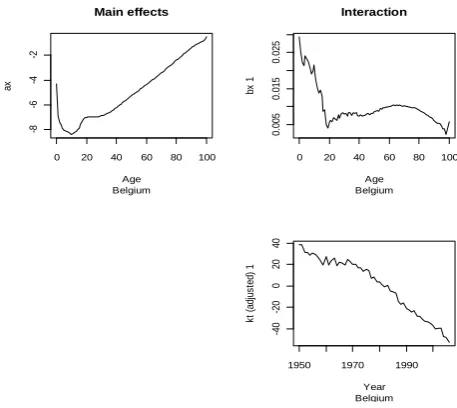
measures. In Figure 1, we show the estimates of the model parameters obtained by the fitting of the
LC model for the five considered countries:
0 20 40 60 80 100
-8
-6
-4
-2
Main effects
UK Age
ax
0 20 40 60 80 100
0
.0
0
5
0
.0
1
5
UK Age
b
x
1
Interaction
UK Year
k
t
(a
d
ju
s
te
d
)
1
1950 1970 1990
-4
0
-2
0
0
20
40
0 20 40 60 80 100
-8
-6
-4
-2
Main effects
France Age
ax
0 20 40 60 80 100
0
.0
0
5
0
.0
1
5
0
.0
2
5
France Age
b
x
1
Interaction
France Year
k
t
(a
d
ju
s
te
d
)
1
1950 1970 1990
-6
0
-2
0
0
20
40
0 20 40 60 80 100
-8
-6
-4
-2
Main effects
Italy Age
ax
0 20 40 60 80 100
0
.0
0
5
0
.0
1
5
0
.0
2
5
Italy Age
b
x
1
Interaction
Italy Year
k
t
(a
d
ju
s
te
d
)
1
1950 1970 1990
-6
0
-2
0
20
0 20 40 60 80 100
-8
-6
-4
-2
Main effects
Spain Age
ax
0 20 40 60 80 100
0
.0
0
0
0
.0
1
5
0
.0
3
0
Spain Age
b
x
1
Interaction
Spain Year
k
t
(a
d
ju
s
te
d
)
1
1950 1970 1990
-6
0
-2
0
20
0 20 40 60 80 100
-8
-6
-4
-2
Main effects
Belgium Age
ax
0 20 40 60 80 100
0.
00
5
0.
01
5
0.
02
5
Belgium Age
bx
1
Interaction
Belgium Year
kt
(
ad
ju
st
ed
)
1
1950 1970 1990
-4
0
-2
0
0
20
[image:9.595.58.287.77.281.2]40
Figure 1- ax, bx, kt adjusted, basic Lee Carter model – UK, France, Italy, Spain, Belgium, total population, age: from 0 to 110
Observing Figure 1, we note that the fitting of the parameter x is quite similar for each country:
the average of the mortality rate calculated during the years for a given age does not show significant differences across countries. Moreover, we can notice on the basis of the fitting of the
parameter kt that all countries have experienced a decreasing mortality trend during the years, with
a small difference in the rate of reduction. For example, Italy shows a lower rate of mortality reduction until 1980 and afterwards its acceleration. Instead, greater differences are recognized in
the fitting of the parameter x, which represents how different ages react to the reduction in
mortality. It presents a greater variability between age 30 to 100 in the Spanish dataset and between age 0 to 20 in the Belgian dataset. This feature has impact on the percentage of the variation explained in fitting the model, that is respectively: 93.3% for UK, 93.7% for France, 94.7% for Italy, 92% for Spain and 88.6% for Belgium. Furthermore, for each country, we compute the error measures on mortality rates. In Table 1 are shown the error measure findings with various indexes of the fitting accuracy averaged across years (ME=mean error, MSE=mean squared error, MPE=mean percentage error and MAPE=mean absolute percentage error), and also whose integrated across ages (IE=integrated error, ISE=integrated squared error, IPE=integrated percentage error and IAPE=integrated absolute percentage error):
Averages across ages:
ME MSE MPE MAPE
UK -0.00001 0.00005 0.00527 0.05513
France 0.00005 0.00009 0.00741 0.05645
Italy 0.00008 0.00008 0.0111 0 0.07269
Spain -0.00010 0.00008 0.00994 0.09113
Belgium -0.00021 0.00038 0.00926 0.07280
Averages across years:
IE ISE IPE IAPE
UK -0.00034 0.00395 0.52529 5.41629
France 0.00601 0.00612 0.73746 5.52106
Italy 0.00833 0.00573 1.11463 7.16246
Spain -0.00944 0.00693 0.99988 8.97029
Belgium -0.01393 0.02343 0.90969 6.92477
[image:9.595.72.544.562.763.2]5.2 Measuring Dependence Structures
In the second stage of the numerical application, we measure either the dependence within each
single population, either the dependence between different populations: respectively the
intra-dependence and the inter-dependence. In that respect by focusing on the intra-dependence, we
include graphical analysis on autocorrelation functions by age and time, formal statistical tests as the Ljung-Box test based on the autocorrelation plot and Pearson test of independence. Regarding
the inter-dependence, we investigate the long-run relationships between countries by VAR scheme.
Thus, as regard the intra-dependence, broadly speaking the empirical evidences confirm a
dependence structure for each country. Going more deep into details, we make use of the correlogram, a graphical tool to examine the strength of association between observations, in order to investigate the correlation in the residuals. In the Appendix, we show the correlogram for each country, constructed by considering the correlation between ages for each year of the dataset. Throughout the correlograms, we can notice the persistence of correlation for UK, Italy and Spain almost always during the years. In other words, calculating the correlation means there is a dependence structure between ages in the same year and this appears for each year separately
considered: given t, we observe correlation between the residuals of age x0,1, 2, ,p, where p
is the maximum lag considered. In a different way, for France and Belgium the dependence outcome seems to be not so quite marked.
Furthermore in the Appendix, we show the correlogram by considering the correlation between years for each age. In this case, for each age, we are dealing with a time series generated from a stochastic process and verify the autocorrelation during the time. In other word, by considering the
dependence for a fixed t, we verify a temporal dependence for each age during the years. It is
possible to note that Italy and Spain prove a strong dependence structure for almost all ages, in particular for younger ones, which tends to decrease for adult ages. The case of UK shows a low correlation for younger ages, different from Italy, while it increases from 24-25 years up to 70
years. Also for France the correlation is stronger for the central ages instead of the extremes (lower
or higher ages). Belgium seems to have less marked dependence structure.
The graphical analysis is supported also by the results of Liung-Box test, implemented for each age and for each country separately.
On the basis of the calculations performed for each countries we can conclude that most for any age and for each country, the null hypothesis of independence is rejected. If we look at the p-value, i.e. the probability to make an error if we reject the null hypothesis when this is true, the value is very small for every age. In other words, we can confirm the randomness of the residuals, already observed in the graphical analysis.
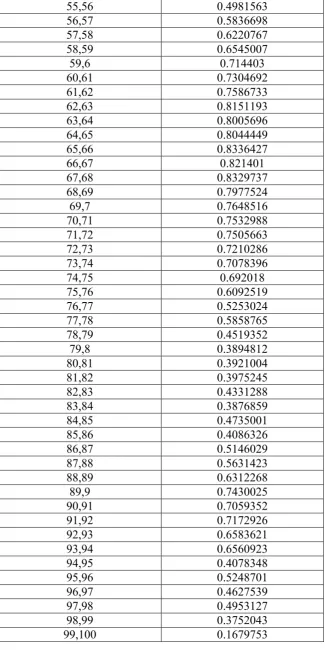
Finally, we compute the Pearson’s correlation coefficient, which assumes normality in the residuals distribution, and it confirms a strong positive dependence for almost all countries, except Spain and Belgium which present few negative values for some ages. For instance, table 2 illustrates the case of Italy.
Pearson’s correlation coefficient
x=age Value
0,1 0.9249975
1,2 0.9593225
2,3 0.9616913
3,4 0.91959
5,6 0.8806236
6,7 0.7955352
7,8 0.7433184
8,9 0.6569047
9,10 0.6516526
11,12 0.6837091
12,13 0.6134128
13,14 0.7446103
14,15 0.6364435
15,16 0.5834051
16,17 0.161985
17,18 0.6298621
18,19 0.3826222
19,20 0.6161803
20,21 0.537574
21,22 0.7511346
22,23 0.6995258
23,24 0.7612173
24,25 0.82023
25,26 0.8967373
26,27 0.9136936
27,28 0.8928995
28,29 0.8973545
29,3 0.9353529
30,31 0.9362392
31,32 0.9336044
32,33 0.940451
33,34 0.9311992
34,35 0.9343669
35,36 0.9261032
36,37 0.8973486
37,38 0.880285
38,39 0.8352225
39,40 0.8086334
40,41 0.853257
41,42 0.6992298
42,43 0.6305726
43,44 0.6976953
44,45 0.6622836
45,46 0.5847089
46,47 0.5756761
47,48 0.564031
48,49 0.4790489
49,50 0.5914199
50,51 0.4351083
51,52 0.5762156
52,53 0.608357
53,54 0.6347328
55,56 0.4981563
56,57 0.5836698
57,58 0.6220767
58,59 0.6545007
59,6 0.714403
60,61 0.7304692
61,62 0.7586733
62,63 0.8151193
63,64 0.8005696
64,65 0.8044449
65,66 0.8336427
66,67 0.821401
67,68 0.8329737
68,69 0.7977524
69,7 0.7648516
70,71 0.7532988
71,72 0.7505663
72,73 0.7210286
73,74 0.7078396
74,75 0.692018
75,76 0.6092519
76,77 0.5253024
77,78 0.5858765
78,79 0.4519352
79,8 0.3894812
80,81 0.3921004
81,82 0.3975245
82,83 0.4331288
83,84 0.3876859
84,85 0.4735001
85,86 0.4086326
86,87 0.5146029
87,88 0.5631423
88,89 0.6312268
89,9 0.7430025
90,91 0.7059352
91,92 0.7172926
92,93 0.6583621
93,94 0.6560923
94,95 0.4078348
95,96 0.5248701
96,97 0.4627539
97,98 0.4953127
98,99 0.3752043
[image:12.595.136.462.72.723.2]99,100 0.1679753
Table 3 - Pearson Coefficient, Italy
At this last stage, after having assessed the dependence structures, we apply the Multiple Lee Carter Panel Sieve algorithm, described in Section 4, considering the datasets of UK, France, Italy, Spain and Belgium. Figure 2 plots estimates of kt simultaneously, for the total population of the five
countries considered. As shown, kt declines roughly linearly from 1950 to 2006, especially for
France and Italy.
[image:13.595.64.485.184.361.2]
Figure 2-, kt trends– UK, France, Italy, Spain, Belgium, Total population, years: from 1950 to 2006
We fit the VAR on the kt of each country and calculate the residuals. Figures 3-7 display, for each
country, a diagram of fit, a residual plot, the auto-correlation and partial auto-correlation function of the residuals. For each country, we can observe that the autocorrelation and partial autocorrelation functions are consistent with the hypothesis of stationary series.
[image:13.595.89.477.478.654.2]-40
-20
0
20
Diagram of fit and residuals for bel
0 10 20 30 40 50
-1
0
1
2
0 2 4 6 8 10 12
-0.
2
0.6
Lag ACF Re sidua ls
2 4 6 8 10 12
-0.
3
0.1
[image:14.595.88.479.87.266.2]Lag PACF Re sidua ls
Figure 4- Diagram of fit, residuals, ACF and PACF of residuals for Belgium
[image:14.595.88.474.323.505.2]Figure 6- Diagram of fit, residuals, ACF and PACF of residuals for France
Figure 7- Diagram of fit, residuals, ACF and PACF of residuals for Italy
Finally, we simulate for each period the kt medium, by implementing a bootstrap on the basis of
the algorithm indicated in Section 4. Then, we project them by using ARIMA models and calculate
confidence intervals. Figures 8 displays the mean of the simulated kt and the projections with
[image:15.595.86.477.344.521.2]Figure 8- mean kt for UK, Belgium, Spain, France and Italy
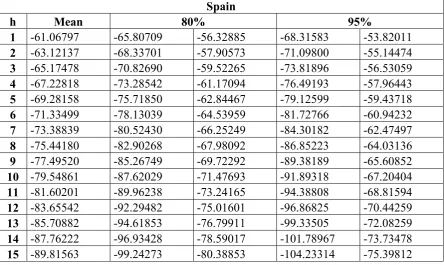
Table 3-7 illustrate the mean of projection of kt for h1, ,15 periods ahead, calculated running a
[image:16.595.96.545.503.769.2]number of simulations equal to 1000. Moreover, the 80% and 95% confidence intervals values are shown in the same tables for each countries.
Table 3- Confidence Intervals for kt, 80% and 95%, UK
UK
h Mean 80% 95%
1 -50.87365 -55.18137 -46.56592 -57.46174 -44.28555
2 -55.19162 -59.84698 -50.53625 -62.31138 -48.07185
3 -55.13368 -60.82036 -49.44701 -63.83070 -46.43666
4 -57.65851 -63.82319 -51.49382 -67.08658 -48.23044
5 -58.65893 -65.47290 -51.84496 -69.08000 -48.23786
6 -60.55909 -67.85024 -53.26794 -71.70995 -49.40823
7 -61.92820 -69.73011 -54.12630 -73.86019 -49.99622
8 -63.61075 -71.85655 -55.36495 -76.22161 -50.99989
9 -65.10830 -73.79504 -56.42157 -78.39352 -51.82309
10 -66.71505 -75.81023 -57.61987 -80.62492 -52.80517
11 -68.25734 -77.74970 -58.76498 -82.77465 -53.74003
12 -69.83767 -79.70766 -59.96769 -84.93252 -54.74283
13 -71.39556 -81.63129 -61.15983 -87.04976 -55.74136
14 -72.96669 -83.55438 -62.37901 -89.15916 -56.77422
Table 4- Confidence Intervals for kt, 80% and 95%, Belgium
Table 5- Confidence Intervals for kt, 80% and 95%, Spain
Belgium
h Mean 80% 95%
1 -50.16977 -54.76127 -45.57827 -57.19186 -43.14768
2 -51.71650 -56.83237 -46.60064 -59.54054 -43.89247
3 -53.26324 -58.85450 -47.67197 -61.81434 -44.71213
4 -54.80997 -60.83927 -48.78067 -64.03098 -45.58895
5 -56.35670 -62.79430 -49.91911 -66.20215 -46.51125
6 -57.90343 -64.72493 -51.08194 -68.33601 -47.47086
7 -59.45017 -66.63508 -52.26525 -70.43854 -48.46179
8 -60.99690 -68.52772 -53.46608 -72.51429 -49.47951
9 -62.54363 -70.40514 -54.68212 -74.56678 -50.52049
10 -64.09037 -72.26921 -55.91152 -76.59883 -51.58190
11 -65.63710 -74.12142 -57.15277 -78.61275 -52.66145
12 -67.18383 -75.96301 -58.40466 -80.61042 -53.75724
13 -68.73056 -77.79501 -59.66612 -82.59343 -54.86770
14 -70.27730 -79.61830 -60.93630 -84.56313 -55.99147
15 -71.82403 -81.43363 -62.21443 -86.52065 -57.12741
Spain
h Mean 80% 95%
1 -61.06797 -65.80709 -56.32885 -68.31583 -53.82011
2 -63.12137 -68.33701 -57.90573 -71.09800 -55.14474
3 -65.17478 -70.82690 -59.52265 -73.81896 -56.53059
4 -67.22818 -73.28542 -61.17094 -76.49193 -57.96443
5 -69.28158 -75.71850 -62.84467 -79.12599 -59.43718
6 -71.33499 -78.13039 -64.53959 -81.72766 -60.94232
7 -73.38839 -80.52430 -66.25249 -84.30182 -62.47497
8 -75.44180 -82.90268 -67.98092 -86.85223 -64.03136
9 -77.49520 -85.26749 -69.72292 -89.38189 -65.60852
10 -79.54861 -87.62029 -71.47693 -91.89318 -67.20404
11 -81.60201 -89.96238 -73.24165 -94.38808 -68.81594
12 -83.65542 -92.29482 -75.01601 -96.86825 -70.44259
13 -85.70882 -94.61853 -76.79911 -99.33505 -72.08259
14 -87.76222 -96.93428 -78.59017 -101.78967 -73.73478
15 -89.81563 -99.24273 -80.38853 -104.23314 -75.39812
Table 6- Confidence Intervals for kt, 80% and 95%, France
Table 7- Confidence Intervals for kt, 80% and 95%, Italy
h Mean 80% 95%
1 -54.40954 -59.09458 -49.72451 -61.57469 -47.24440
2 -57.53012 -62.21537 -52.84486 -64.69560 -50.36463
3 -60.27504 -65.02405 -55.52603 -67.53802 -53.01205
4 -62.75654 -67.67673 -57.83634 -70.28133 -55.23175
5 -65.05331 -70.24118 -59.86544 -72.98747 -57.11915
6 -67.22054 -72.74407 -61.69700 -75.66805 -58.77302
7 -69.29692 -75.19643 -63.39741 -78.31944 -60.27440
8 -71.30960 -77.60455 -65.01465 -80.93690 -61.68231
9 -73.27761 -79.97363 -66.58159 -83.51829 -63.03693
10 -75.21429 -82.30852 -68.12006 -86.06397 -64.36461
11 -77.12900 -84.61372 -69.64429 -88.57589 -65.68212
12 -79.02831 -86.89325 -71.16336 -91.05670 -66.99991
13 -80.91681 -89.15061 -72.68301 -93.50932 -68.32430
14 -82.79774 -91.38874 -74.20673 -95.93655 -69.65893
15 -84.67335 -93.61013 -75.73658 -98.34097 -71.00573
Italy
h Mean 80% 95%
1 -73.52702 -79.08849 -67.96555 -82.03255 -65.02148
2 -75.76981 -81.99289 -69.54672 -85.28720 -66.25242
3 -78.01260 -84.83342 -71.19178 -88.44415 -67.58105
4 -80.25539 -87.62563 -72.88515 -91.52720 -68.98358
5 -82.49818 -90.37963 -74.61673 -94.55182 -70.44454
6 -84.74097 -93.10243 -76.37950 -97.52872 -71.95321
7 -86.98376 -95.79914 -78.16838 -100.46572 -73.50180
8 -89.22655 -98.47359 -79.97951 -103.36867 -75.08442
9 -91.46934 -101.12877 -81.80991 -106.24216 -76.69651
10 -93.71213 -103.76705 -83.65721 -109.08980 -78.33445
11 -95.95492 -106.39035 -85.51948 -111.91453 -79.99530
12 -98.19771 -109.00025 -87.39516 -114.71878 -81.67663
13 -100.44050 -111.59809 -89.28290 -117.50456 -83.37643
14 -102.68329 -114.18497 -91.18160 -120.27359 -85.09298
6 Concluding Remarks
Several models have been developed for representing future mortality trends. In particular, the extrapolative methods allow for obtaining the most reliable approach in terms of forecast accuracy. Among the class of models under consideration, we base our work round the Lee-Carter one,
because its desirable features (Tuljapurkar et al. 2000). Therefore, in this paper we try to develop a
more accurate algorithm in terms of prediction intervals. To do this, an improved predictor should take into account not only the dependence across age and time (D’Amato et al. 2012b), but also the dependence structure across different populations characterized by similar feature, so that potentially affected by common factors.
We present an algorithm that preserve the parametric structure in Lee Carter setting, as well as improve the goodness of the predictor in its genetic construction, because it is in the context of the appropriate tools for bootstrap simulation of dependent data. Other interesting research questions are worth exploring. Whilst the presence of cross sectional dependence is considered in our framework, the standard LC model can be extended to accommodate for the presence of several common stochastic trends (as opposed to only one) and to include the presence of stationary common factors in the error term. The latter extension, in particular, could prove useful in order to take into account the presence of strong cross sectional dependence across units (i.e. across countries and age groups). This is a very important topic, since the bootstrap algorithm proposed here, per se, is a “one cross sectional unit at a time” algorithm, which ensures consistency only in presence of weak cross dependence. Trapani (2013) discusses some extensions of the bootstrap theory to the case of multiple, stationary and nonstationary common trends. The application of such theory to the context of the LC model is currently under investigation by the authors.
Next issues related to the topic will focus on the proof of accuracy of the proposed method.
References
Anderson, T. W., 1984, An Introduction to Multivariate Statistical Analysis, 2nd Edition, New
York: Wiley
Bai, J., 2004, Estimating cross-section common stochastic trends in nonstationary panel data,
Journal of Econometrics, 122, 137-183
Booth, H., Maindonald J., Smith, L., 2002, Age-time interactions in mortality projections: applying Lee-Carter to Australia. Working Papers in Demography n. 85
Bühlmann, P., 1997, Sieve bootstrap for time series, Bernoulli, 3, 123-148
Cairns, A.J.G., D. Blake, K. Dowd, G.D. Coughlan, M. Khalaf-Allah, 2011, Bayesian Stochastic
Mortality Modelling for Two Populations. ASTIN Bulletin, 41(1), 29–59.
D’Amato V., Haberman S., Russolillo M., 2012a, The Stratified Sampling Bootstrap: an algorithm for measuring the uncertainty in forecast mortality rates in the Poisson Lee-Carter setting.
Methodology and Computing in Applied Probability, 14(1), 135-148.
D’Amato V., Di Lorenzo E., Haberman S., Russolillo M., Sibillo M., 2011, The Poisson
log-bilinear Lee Carter model: Applications of efficient bootstrap methods to annuity analyses. North
http://www.soa.org/library/journals/north-american-actuarial-journal/2011/no-2/naaj-2011-vol15-no2.aspx
D’Amato V., Haberman S., Piscopo G., Russolillo M., 2012b, Modelling dependent data for
longevity projections. Insurance Mathematics and Economics 51, 694-701, DOI information:
10.1016/j.insmatheco.2012.09.008
Fiig Jarner, S., E. Masotty Kryger, 2009, Modelling adult mortality in small populations: the Saint
model. Pensions Institute DiscussionPaper PI-0902.
Gaille S., Sherris M., 2011, Modelling Mortality with Common Stochastic Long-Run Trends. The
Geneva Papers on Risk and Insurance - Issues and Practice, 36(4), 595-621.
Hainut D., 2012, Multidimensional Lee–Carter model with switching mortality processes.
Insurance Mathematics and Economics, 50(2), 236-246.
Lazar, D., Denuit, M., 2009, A multivariate time series approach to projected life tables. Applied
Stochastic Models in Business and Industry,25, 806–823.
Lee, R.D., L. R. Carter, 1992, Modelling and Forecasting U.S. Mortality. Journal of the American
Statistical Association, 87, 659-671.
Li, N., R. Lee, 2005, Coherent mortality forecasts for a group of populations: An extension of the
Lee-Carter method. Demography, 42(3), 575–594.
Li, J. S. H., Hardy, M. R., 2011, Measuring Basis Risk Involved in Longevity Hedges. North
American Actuarial Journal, 15(2), 177–200.
Olivieri A., 2011, Forecasting mortality by mixing mortality experiences, Demography and Longevity Workshop, CEPAR Sydney
Russolillo, M., Giordano, G., Haberman, S., 2011, Extending the Lee-Carter model: a three-way
decomposition. Scandinavian Actuarial Journal, 2, 96-117.
Stevens, R., 2011, A time-dependent age-factor extension to the Lee- Carter model, Longevity 7, Frankfurt
Trapani, L., 2012, On bootstrapping panel factor series - Extended version. Available at SSRN:
http://ssrn.com/abstract=2062183
Trapani, L., 2013, On bootstrapping panel factor series. Journal of Econometrics, 172, 127-141.
Tuljapurkar, S, Li, N and Boe, C, 2000, A universal pattern of mortality decline in the G7 countries.
Nature, 405, 789-792.
United Nations, 1998, World Populations Prospects: The 1996 Revision. New York: Population Division, United Nations.
White, K. M., 2002, Longevity Advances in High-income Countries, 1955–96. Population and
Wilson, C, 2001, On the Scale of Global Demographic Convergence 1950–2000. Population and Development Review, 24, 593–600.
Appendix
UK, correlograms between ages for each year, where t=1 corresponds to 1950 up to t=56 which represents 2006 calendar year.
0 5 10 20
-0 .2 0. 2 0. 6 1. 0 Lag AC F t=1
0 5 10 20
-0 .2 0. 4 1. 0 Lag AC F t=2
0 5 10 20
-0 .2 0. 2 0. 6 1. 0 Lag AC F t=3
0 5 10 20
-0 .2 0. 2 0. 6 1. 0 Lag AC F t=4
0 5 10 20
-0 .2 0. 4 0. 8 Lag AC F t=5
0 5 10 20
-0 .2 0. 2 0. 6 1. 0 Lag AC F t=6
0 5 10 20
-0 .2 0. 4 0. 8 Lag AC F t=7
0 5 10 20
-0 .2 0. 2 0. 6 1. 0 Lag AC F t=8
0 5 10 20
-0 .2 0. 2 0. 6 1. 0 Lag AC F t=9
0 5 10 20
-0 .2 0. 2 0. 6 1. 0 Lag AC F t=10
0 5 10 20
-0 .2 0. 2 0. 6 1. 0 Lag AC F t=11
0 510 20
-0 .2 0. 2 0. 6 1. 0 Lag AC F t=12
0 5 10 20
-0 .2 0. 2 0. 6 1. 0 Lag AC F t=13
0 5 10 20
-0 .2 0. 2 0. 6 1. 0 Lag AC F t=14
0 510 20
-0 .2 0. 2 0. 6 1. 0 Lag AC F t=15
0 5 10 20
-0 .2 0. 4 0. 8 Lag AC F t=16
0 5 10 20
-0 .2 0. 4 0. 8 Lag AC F t=17
0 510 20
-0 .2 0. 4 0. 8 Lag AC F t=18
0 510 20
-0 .2 0. 4 1. 0 Lag AC F t=19
0 5 10 20
-0 .2 0. 2 0. 6 1. 0 Lag AC F t=20
0 5 10 20
-0 .2 0. 4 0. 8 Lag AC F t=21
0 510 20
-0 .5 0. 0 0. 5 1. 0 Lag AC F t=22
0 5 10 20
-0 .2 0. 4 0. 8 Lag AC F t=23
0 5 10 20
-0 .2 0. 4 0. 8 Lag AC F t=24
0 510 20
-0 .2 0. 2 0. 6 1. 0 Lag AC F t=25
0 5 10 20
-0 .2 0. 4 0. 8 Lag AC F t=26
0 5 10 20
-0 .2 0. 2 0. 6 1. 0 Lag AC F t=27
0 5 10 20
-0 .2 0. 2 0. 6 1. 0 Lag AC F t=28
0 510 20
-0 .2 0. 4 0. 8 Lag AC F t=29
0 510 20
-0 .2 0. 2 0. 6 1. 0 Lag AC F t=30
0 5 10 20
-0 .2 0. 2 0. 6 1. 0 Lag AC F t=31
0 510 20
-0 .2 0. 2 0. 6 1. 0 Lag AC F t=32
0 510 20
-0 .2 0. 2 0. 6 1. 0 Lag AC F t=33
0 5 10 20
-0 .2 0. 2 0. 6 1. 0 Lag AC F t=34
0 510 20
-0 .2 0. 4 0. 8 Lag AC F t=35
0 510 20
-0 .2 0. 2 0. 6 1. 0 Lag AC F t=36
0 510 20
-0 .2 0. 2 0. 6 1. 0 Lag A C F t=37
0 5 10 20
-0 .2 0. 2 0. 6 1. 0 Lag A C F t=38
0 510 20
-0 .2 0. 2 0. 6 1. 0 Lag A C F t=39
0 510 20
-0 .2 0. 2 0. 6 1. 0 Lag A C F t=40
0 5 10 20
-0 .2 0. 4 1. 0 Lag A C F t=41
0 510 20
-0 .2 0. 4 0. 8 Lag A C F t=42
0 510 20
-0 .2 0. 4 1. 0 Lag A C F t=43
0 5 10 20
-0 .2 0. 2 0. 6 1. 0 Lag A C F t=44
0 510 20
France, correlograms between ages for each year, where t=1 corresponds to 1950 up to t=56 which represents 2006 calendar year.
0 5 10 20
-0 .2 0. 2 0. 6 1. 0 Lag A C F t=1
0 5 10 20
-0 .2 0. 2 0. 6 1. 0 Lag A C F t=2
0 5 10 20
-0 .2 0. 2 0. 6 1. 0 Lag A C F t=3
0 5 10 20
-0 .2 0. 2 0. 6 1. 0 Lag A C F t=4
0 5 10 20
-0 .2 0. 4 0. 8 Lag A C F t=5
0 5 10 20
-0 .2 0. 4 0. 8 Lag A C F t=6
0 5 10 20
-0 .2 0. 2 0. 6 1. 0 Lag A C F t=7
0 5 10 20
-0 .2 0. 4 0. 8 Lag A C F t=8
0 5 10 20
-0 .2 0. 4 0. 8 Lag A C F t=9
0 5 10 20
-0 .2 0 .4 0 .8 Lag A C F t=10
0 5 10 20
-0 .2 0 .2 0 .6 1 .0 Lag A C F t=11
0 5 10 20
-0 .2 0 .4 0 .8 Lag A C F t=12
0 5 10 20
-0 .2 0 .2 0 .6 1 .0 Lag A C F t=13
0 5 10 20
-0 .2 0 .2 0 .6 1 .0 Lag A C F t=14
0 5 10 20
-0 .2 0 .2 0 .6 1 .0 Lag A C F t=15
0 5 10 20
-0 .2 0 .2 0 .6 1 .0 Lag A C F t=16
0 5 10 20
-0 .2 0 .2 0 .6 1 .0 Lag A C F t=17
0 5 10 20
-0 .2 0 .2 0 .6 1 .0 Lag A C F t=18
0 5 10 20
-0 .2 0 .4 1 .0 Lag A C F t=19
0 5 10 20
-0 .2 0 .4 1 .0 Lag A C F t=20
0 5 10 20
-0 .4 0 .2 0 .8 Lag A C F t=21
0 5 10 20
-0 .4 0 .2 0 .8 Lag A C F t=22
0 5 10 20
-0 .2 0 .4 0 .8 Lag A C F t=23
0 5 10 20
-0 .4 0 .2 0 .8 Lag A C F t=24
0 5 10 20
-0 .4 0 .2 0 .8 Lag A C F t=25
0 5 10 20
-0 .5 0 .0 0 .5 1 .0 Lag A C F t=26
0 5 10 20
-0 .5 0 .5 1 .0 Lag A C F t=27
0 5 10 20
-0 .4 0. 2 0. 8 Lag A C F t=28
0 5 10 20
0. 0 0. 5 1. 0 Lag A C F t=29
0 5 10 20
-0 .4 0. 2 0. 8 Lag A C F t=30
0 5 10 20
-0 .2 0. 4 1. 0 Lag A C F t=31
0 5 10 20
-0 .4 0. 2 0. 8 Lag A C F t=32
0 5 10 20
-0 .2 0. 4 1. 0 Lag A C F t=33
0 5 10 20
-0 .2 0. 4 1. 0 Lag A C F t=34
0 5 10 20
-0 .2 0. 4 0. 8 Lag A C F t=35
0 5 10 20
0 5 10 20 -0 .2 0 .4 0 .8 Lag A C F t=37
0 5 10 20
-0 .2 0 .2 0 .6 1 .0 Lag A C F t=38
0 5 10 20
-0 .2 0 .2 0 .6 1 .0 Lag A C F t=39
0 5 10 20
-0 .2 0 .2 0 .6 1 .0 Lag A C F t=40
0 5 10 20
-0 .2 0 .2 0 .6 1 .0 Lag A C F t=41
0 5 10 20
-0 .2 0 .2 0 .6 1 .0 Lag A C F t=42
0 5 10 20
-0 .2 0 .2 0 .6 1 .0 Lag A C F t=43
0 5 10 20
-0 .2 0 .2 0 .6 1 .0 Lag A C F t=44
0 5 10 20
-0 .2 0 .2 0 .6 1 .0 Lag A C F t=45 0 15 -0 .2 1. 0 Lag A C F t=46 0 15 -0 .2 1. 0 Lag A C F t=47 0 15 -0 .2 1. 0 Lag A C F t=48 0 15 -0 .2 1. 0 Lag A C F t=49 0 15 -0 .2 1. 0 Lag A C F t=50 0 15 -0 .2 1. 0 Lag A C F t=51 0 15 -0 .2 1. 0 Lag A C F t=52 0 15 -0 .2 1. 0 Lag A C F t=53 0 15 -0 .2 1. 0 Lag A C F t=54 0 15 -0 .2 1. 0 Lag A C F t=55 0 15 -0 .2 1. 0 Lag A C F t=56
Italy, correlograms between ages for each year, where t=1 corresponds to 1950 up to t=56 which represents 2006 calendar year.
0 5 10 20
-0 .2 0. 2 0. 6 1. 0 Lag A C F t=1
0 5 10 20
-0 .2 0. 2 0. 6 1. 0 Lag A C F t=2
0 5 10 20
-0 .2 0. 2 0. 6 1. 0 Lag A C F t=3
0 5 10 20
-0 .2 0. 2 0. 6 1. 0 Lag A C F t=4
0 5 10 20
-0 .2 0. 2 0. 6 1. 0 Lag A C F t=5
0 5 10 20
-0 .2 0. 2 0. 6 1. 0 Lag A C F t=6
0 5 10 20
-0 .2 0. 2 0. 6 1. 0 Lag A C F t=7
0 5 10 20
-0 .2 0. 2 0. 6 1. 0 Lag A C F t=8
0 5 10 20
-0 .2 0. 2 0. 6 1. 0 Lag A C F t=9
0 5 10 20
-0 .2 0 .2 0 .6 1 .0 Lag A C F t=10
0 5 10 20
-0 .2 0 .4 0 .8 Lag A C F t=11
0 510 20
-0 .2 0 .2 0 .6 1 .0 Lag A C F t=12
0 5 10 20
-0 .2 0 .4 0 .8 Lag A C F t=13
0 5 10 20
-0 .2 0 .4 0 .8 Lag A C F t=14
0 510 20
-0 .2 0 .2 0 .6 1 .0 Lag A C F t=15
0 5 10 20
-0 .2 0 .2 0 .6 1 .0 Lag A C F t=16
0 5 10 20
-0 .2 0 .2 0 .6 1 .0 Lag A C F t=17
0 510 20
-0 .2 0 .2 0 .6 1 .0 Lag A C F t=18
0 5 10 20
-0 .2 0. 2 0. 6 1. 0 Lag AC F t=19
0 5 10 20
-0 .2 0. 2 0. 6 1. 0 Lag AC F t=20
0 5 10 20
-0 .2 0. 2 0. 6 1. 0 Lag AC F t=21
0 5 10 20
-0 .2 0. 2 0. 6 1. 0 Lag AC F t=22
0 5 10 20
-0 .2 0. 4 0. 8 Lag AC F t=23
0 5 10 20
-0 .2 0. 2 0. 6 1. 0 Lag AC F t=24
0 5 10 20
-0 .2 0. 2 0. 6 1. 0 Lag AC F t=25
0 5 10 20
-0 .2 0. 2 0. 6 1. 0 Lag AC F t=26
0 5 10 20
-0 .2 0. 2 0. 6 1. 0 Lag AC F t=27
0 510 20
-0 .2 0 .2 0 .6 1 .0 Lag A C F t=28
0 510 20
-0 .2 0 .2 0 .6 1 .0 Lag A C F t=29
0 510 20
-0 .2 0 .2 0 .6 1 .0 Lag A C F t=30
0 510 20
-0 .2 0 .2 0 .6 1 .0 Lag A C F t=31
0 510 20
-0 .2 0 .2 0 .6 1 .0 Lag A C F t=32
0 510 20
-0 .2 0 .2 0 .6 1 .0 Lag A C F t=33
0 510 20
-0 .2 0 .2 0 .6 1 .0 Lag A C F t=34
0 510 20
-0 .2 0 .2 0 .6 1 .0 Lag A C F t=35
0 510 20
0 5 10 20 -0 .2 0. 2 0. 6 1. 0 Lag A C F t=37
0 5 10 20
-0 .2 0. 2 0. 6 1. 0 Lag A C F t=38
0 5 10 20
-0 .2 0. 2 0. 6 1. 0 Lag A C F t=39
0 5 10 20
-0 .4 0. 2 0. 8 Lag A C F t=40
0 5 10 20
-0 .4 0. 2 0. 8 Lag A C F t=41
0 5 10 20
-0 .4 0. 2 0. 8 Lag A C F t=42
0 5 10 20
-0 .2 0. 2 0. 6 1. 0 Lag A C F t=43
0 5 10 20
-0 .2 0. 2 0. 6 1. 0 Lag A C F t=44
0 5 10 20
-0 .2 0. 2 0. 6 1. 0 Lag A C F t=45 0 15 -0 .2 1. 0 Lag A C F t=46 0 15 -0 .2 1. 0 Lag A C F t=47 0 15 -0 .2 1. 0 Lag A C F t=48 0 15 -0 .2 1. 0 Lag A C F t=49 0 15 -0 .2 1. 0 Lag A C F t=50 0 15 -0 .2 1. 0 Lag A C F t=51 0 15 -0 .2 1. 0 Lag A C F t=52 0 15 -0 .2 1. 0 Lag A C F t=53 0 15 -0 .2 1. 0 Lag A C F t=54 0 15 -0 .2 1. 0 Lag A C F t=55 0 15 -0 .2 1. 0 Lag A C F t=56
Spain, correlograms between ages for each year, where t=1 corresponds to 1950 up to t=56 which represents 2006 calendar year.
0 5 10 20
-0 .2 0. 2 0. 6 1. 0 Lag A C F t=1
0 5 10 20
-0 .2 0. 2 0. 6 1. 0 Lag A C F t=2
0 5 10 20
-0 .2 0. 2 0. 6 1. 0 Lag A C F t=3
0 5 10 20
-0 .2 0. 2 0. 6 1. 0 Lag A C F t=4
0 5 10 20
-0 .2 0. 2 0. 6 1. 0 Lag A C F t=5
0 5 10 20
-0 .2 0. 2 0. 6 1. 0 Lag A C F t=6
0 5 10 20
-0 .2 0. 2 0. 6 1. 0 Lag A C F t=7
0 5 10 20
-0 .2 0. 2 0. 6 1. 0 Lag A C F t=8
0 5 10 20
-0 .2 0. 4 0. 8 Lag A C F t=9
0 5 10 20
-0 .2 0. 4 0. 8 Lag A C F t=10
0 5 10 20
-0 .2 0. 2 0. 6 1. 0 Lag A C F t=11
0 5 10 20
-0 .2 0. 2 0. 6 1. 0 Lag A C F t=12
0 5 10 20
-0 .2 0. 2 0. 6 1. 0 Lag A C F t=13
0 5 10 20
-0 .2 0. 2 0. 6 1. 0 Lag A C F t=14
0 5 10 20
-0 .2 0. 2 0. 6 1. 0 Lag A C F t=15
0 5 10 20
-0 .2 0. 2 0. 6 1. 0 Lag A C F t=16
0 5 10 20
-0 .2 0. 2 0. 6 1. 0 Lag A C F t=17
0 5 10 20
-0 .2 0. 2 0. 6 1. 0 Lag A C F t=18
0 510 20
-0 .2 0. 2 0. 6 1. 0 Lag AC F t=19
0 5 10 20
-0 .2 0. 2 0. 6 1. 0 Lag AC F t=20
0 510 20
-0 .2 0. 2 0. 6 1. 0 Lag AC F t=21
0 510 20
-0 .2 0. 2 0. 6 1. 0 Lag AC F t=22
0 5 10 20
-0 .2 0. 2 0. 6 1. 0 Lag AC F t=23
0 510 20
-0 .2 0. 2 0. 6 1. 0 Lag AC F t=24
0 510 20
-0 .2 0. 2 0. 6 1. 0 Lag AC F t=25
0 5 10 20
-0 .2 0. 2 0. 6 1. 0 Lag AC F t=26
0 510 20
-0 .2 0. 2 0. 6 1. 0 Lag AC F t=27
0 5 10 20
-0 .2 0. 2 0. 6 1. 0 Lag AC F t=28
0 5 10 20
-0 .2 0. 2 0. 6 1. 0 Lag AC F t=29
0 5 10 20
-0 .2 0. 4 0. 8 Lag AC F t=30
0 5 10 20
-0 .2 0. 2 0. 6 1. 0 Lag AC F t=31
0 5 10 20
-0 .2 0. 2 0. 6 1. 0 Lag AC F t=32
0 5 10 20
-0 .2 0. 4 0. 8 Lag AC F t=33
0 5 10 20
-0 .2 0. 2 0. 6 1. 0 Lag AC F t=34
0 5 10 20
-0 .2 0. 4 0. 8 Lag AC F t=35
0 5 10 20
0 510 20 -0 .2 0 .4 0 .8 Lag A C F t=37
0 5 10 20
-0 .2 0 .4 0 .8 Lag A C F t=38
0 510 20
-0 .2 0 .4 0 .8 Lag A C F t=39
0 510 20
-0 .2 0 .2 0 .6 1 .0 Lag A C F t=40
0 5 10 20
-0 .2 0 .2 0 .6 1 .0 Lag A C F t=41
0 510 20
-0 .2 0 .2 0 .6 1 .0 Lag A C F t=42
0 510 20
-0 .2 0 .2 0 .6 1 .0 Lag A C F t=43
0 5 10 20
-0 .2 0 .2 0 .6 1 .0 Lag A C F t=44
0 510 20
-0 .2 0 .2 0 .6 1 .0 Lag A C F t=45 0 15 -0 .2 1 .0 Lag A C F t=46 0 15 -0 .2 1 .0 Lag A C F t=47 0 15 -0 .2 1 .0 Lag A C F t=48 0 15 -0 .2 1 .0 Lag A C F t=49 0 15 -0 .2 1 .0 Lag A C F t=50 0 15 -0 .2 1 .0 Lag A C F t=51 0 15 -0 .2 1 .0 Lag A C F t=52 0 15 -0 .2 1 .0 Lag A C F t=53 0 15 -0 .2 1 .0 Lag A C F t=54 0 15 -0 .2 1 .0 Lag A C F t=55 0 15 -0 .2 1 .0 Lag A C F t=56
Belgium, correlograms between ages for each year, where t=1 corresponds to 1950 up to t=56 which represents 2006 calendar year.
0 5 10 20
-0 .2 0. 2 0. 6 1. 0 Lag AC F t=1
0 5 10 20
-0 .2 0. 2 0. 6 1. 0 Lag AC F t=2
0 5 10 20
-0 .2 0. 2 0. 6 1. 0 Lag AC F t=3
0 5 10 20
-0 .2 0. 4 0. 8 Lag AC F t=4
0 5 10 20
-0 .4 0. 2 0. 8 Lag AC F t=5
0 5 10 20
-0 .2 0. 4 1. 0 Lag AC F t=6
0 5 10 20
-0 .2 0. 4 0. 8 Lag AC F t=7
0 5 10 20
-0 .2 0. 2 0. 6 1. 0 Lag AC F t=8
0 5 10 20
-0 .2 0. 2 0. 6 1. 0 Lag AC F t=9
0 510 20
-0 .2 0. 2 0. 6 1. 0 Lag A C F t=10
0 510 20
-0 .2 0. 2 0. 6 1. 0 Lag A C F t=11
0 510 20
-0 .2 0. 2 0. 6 1. 0 Lag A C F t=12
0 510 20
-0 .2 0. 2 0. 6 1. 0 Lag A C F t=13
0 510 20
-0 .2 0. 2 0. 6 1. 0 Lag A C F t=14
0 510 20
-0 .2 0. 2 0. 6 1. 0 Lag A C F t=15
0 510 20
-0 .2 0. 2 0. 6 1. 0 Lag A C F t=16
0 510 20
-0 .2 0. 2 0. 6 1. 0 Lag A C F t=17
0 510 20
-0 .2 0. 2 0. 6 1. 0 Lag A C F t=18
0 5 10 20
-0 .2 0. 2 0. 6 1. 0 Lag AC F t=19
0 5 10 20
-0 .2 0. 2 0. 6 1. 0 Lag AC F t=20
0 5 10 20
-0 .2 0. 2 0. 6 1. 0 Lag AC F t=21
0 5 10 20
-0 .2 0. 4 0. 8 Lag AC F t=22
0 5 10 20
-0 .2 0. 4 0. 8 Lag AC F t=23
0 5 10 20
-0 .2 0. 2 0. 6 1. 0 Lag AC F t=24
0 5 10 20
-0 .2 0. 4 0. 8 Lag AC F t=25
0 5 10 20
-0 .2 0. 2 0. 6 1. 0 Lag AC F t=26
0 5 10 20
-0 .2 0. 2 0. 6 1. 0 Lag AC F t=27
0 5 10 20
-0 .2 0. 4 0. 8 Lag A C F t=28
0 5 10 20
-0 .2 0. 4 1. 0 Lag A C F t=29
0 5 10 20
-0 .2 0. 2 0. 6 1. 0 Lag A C F t=30
0 5 10 20
-0 .2 0. 2 0. 6 1. 0 Lag A C F t=31
0 5 10 20
-0 .2 0. 2 0. 6 1. 0 Lag A C F t=32
0 5 10 20
-0 .2 0. 4 0. 8 Lag A C F t=33
0 5 10 20
-0 .2 0. 2 0. 6 1. 0 Lag A C F t=34
0 5 10 20
-0 .2 0. 2 0. 6 1. 0 Lag A C F t=35
0 5 10 20
0 510 20 -0 .2 0. 4 0. 8 Lag AC F t=37
0 5 10 20
-0 .2 0. 2 0. 6 1. 0 Lag AC F t=38
0 510 20
-0 .2 0. 2 0. 6 1. 0 Lag AC F t=39
0 510 20
-0 .2 0. 2 0. 6 1. 0 Lag AC F t=40
0 5 10 20
-0 .2 0. 2 0. 6 1. 0 Lag AC F t=41
0 510 20
-0 .2 0. 2 0. 6 1. 0 Lag AC F t=42
0 510 20
-0 .2 0. 2 0. 6 1. 0 Lag AC F t=43
0 5 10 20
-0 .2 0. 4 0. 8 Lag AC F t=44
0 510 20
-0 .2 0. 2 0. 6 1. 0 Lag AC F t=45 0 15 -0 .2 1. 0 Lag AC F t=46 0 15 -0 .2 1. 0 Lag AC F t=47 0 15 -0 .2 1. 0 Lag AC F t=48 0 15 -0 .2 1. 0 Lag AC F t=49 0 15 -0 .2 1. 0 Lag AC F t=50 0 15 -0 .2 1. 0 Lag AC F t=51 0 15 -0 .2 1. 0 Lag AC F t=52 0 15 -0 .2 1. 0 Lag AC F t=53 0 15 -0 .2 1. 0 Lag AC F t=54 0 15 -0 .2 1. 0 Lag AC F t=55 0 15 -0 .2 1. 0 Lag AC F t=56
UK, correlograms between calendar years for each age.
0 5 10 15
-0 .2 0. 4 0. 8 Lag A C F x=1
0 5 10 15
-0 .2 0. 4 0. 8 Lag A C F x=2
0 5 10 15
-0 .2 0. 4 0. 8 Lag A C F x=3
0 5 10 15
-0 .2 0. 4 0. 8 Lag A C F x=4
0 5 10 15
-0 .2 0. 4 0. 8 Lag A C F x=5
0 5 10 15
-0 .2 0. 4 0. 8 Lag A C F x=6
0 5 10 15
-0 .2 0. 4 0. 8 Lag A C F x=7
0 5 10 15
-0 .2 0. 4 0. 8 Lag A C F x=8
0 5 1015
-0 .2 0. 4 0. 8 Lag A C F x=9
0 5 10 15
-0 .2 0. 4 1. 0 Lag A C F x=10
0 5 1015
-0 .2 0. 4 0. 8 Lag A C F x=11
0 5 1015
-0 .2 0. 4 0. 8 Lag A C F x=12
0 5 10 15
-0 .2 0. 4 0. 8 Lag A C F x=13
0 5 1015
-0 .2 0. 4 0. 8 Lag A C F x=14
0 5 1015
-0 .2 0. 4 0. 8 Lag A C F x=15
0 5 10 15
-0 .2 0. 4 0. 8 Lag A C F x=16
0 5 1015
-0 .2 0. 4 1. 0 Lag A C F x=17
0 5 10 15
-0 .2 0. 4 0. 8 Lag A C F x=18
0 5 10 15
-0 .2 0. 4 0. 8 Lag A C F x=19
0 5 10 15
-0 .2 0. 4 0. 8 Lag A C F x=20
0 5 10 15
-0 .2 0. 4 0. 8 Lag A C F x=21
0 5 10 15
-0 .2 0. 4 0. 8 Lag A C F x=22
0 5 10 15
-0 .2 0. 4 0. 8 Lag A C F x=23
0 5 10 15
-0 .2 0. 4 0. 8 Lag A C F x=24
0 5 10 15
-0 .2 0. 4 0. 8 Lag A C F x=25
0 5 10 15
-0 .2 0. 4 0. 8 Lag A C F x=26
0 5 10 15
-0 .2 0. 4 0. 8 Lag AC F x=27
0 5 10 15
-0 .2 0. 4 0. 8 Lag AC F x=28
0 5 10 15
-0 .2 0. 4 0. 8 Lag AC F x=29
0 5 10 15
-0 .2 0. 4 0. 8 Lag AC F x=30
0 5 10 15
-0 .2 0. 4 0. 8 Lag AC F x=31
0 5 10 15
-0 .2 0. 4 0. 8 Lag AC F x=32
0 5 10 15
-0 .2 0. 4 0. 8 Lag AC F x=33
0 5 10 15
-0 .2 0. 4 0. 8 Lag AC F x=34
0 5 10 15
0 5 10 15 -0 .2 0. 4 0. 8 Lag A C F x=36
0 5 10 15
-0 .2 0. 4 0. 8 Lag A C F x=37
0 5 10 15
-0 .2 0. 4 0. 8 Lag A C F x=38
0 5 10 15
-0 .2 0. 4 0. 8 Lag A C F x=39
0 5 10 15
-0 .2 0. 4 0. 8 Lag A C F x=40
0 5 10 15
-0 .2 0. 4 0. 8 Lag A C F x=41
0 5 10 15
-0 .2 0. 4 0. 8 Lag A C F x=42
0 5 10 15
-0 .4 0. 2 0. 8 Lag A C F x=43
0 5 10 15
-0 .4 0. 2 0. 8 Lag A C F x=44
0 5 10 15
-0 .4 0. 2 0. 8 Lag AC F x=45
0 5 10 15
-0 .4 0. 2 0. 8 Lag AC F x=46
0 5 10 15
-0 .4 0. 2 0. 8 Lag AC F x=47
0 5 10 15
0. 0 0. 5 1. 0 Lag AC F x=48
0 5 10 15
-0 .4 0. 2 0. 8 Lag AC F x=49
0 5 10 15
-0 .5 0. 5 1. 0 Lag AC F x=50
0 5 10 15
-0 .5 0. 0 0. 5 1. 0 Lag AC F x=51
0 5 10 15
-0 .5 0. 0 0. 5 1. 0 Lag AC F x=52
0 5 10 15
-0 .5 0. 5 1. 0 Lag AC F x=53
0 5 10 15
-0 .4 0 .2 0 .8 Lag A C F x=54
0 5 10 15
-0 .4 0 .2 0 .8 Lag A C F x=55
0 5 10 15
-0 .4 0 .2 0 .8 Lag A C F x=56
0 5 10 15
-0 .2 0 .4 1 .0 Lag A C F x=57
0 5 10 15
-0 .2 0 .4 0 .8 Lag A C F x=58
0 5 10 15
-0 .2 0 .4 0 .8 Lag A C F x=59
0 5 10 15
-0 .2 0 .4 0 .8 Lag A C F x=60
0 5 10 15
-0 .2 0 .4 0 .8 Lag A C F x=61
0 5 10 15
-0 .2 0 .4 0 .8 Lag A C F x=62
0 5 10 15
-0 .2 0 .4 0 .8 Lag A C F x=63
0 5 10 15
-0 .2 0 .4 1 .0 Lag A C F x=64
0 5 10 15
-0 .2 0 .4 1 .0 Lag A C F x=65
0 5 10 15
-0 .2 0 .4 1 .0 Lag A C F x=66
0 5 10 15
-0 .2 0 .4 0 .8 Lag A C F x=67
0 5 10 15
-0 .2 0 .4 0 .8 Lag A C F x=68
0 5 10 15
-0 .2 0 .4 0 .8 Lag A C F x=69
0 5 10 15
-0 .2 0 .4 0 .8 Lag A C F x=70
0 5 10 15
-0 .2 0 .4 0 .8 Lag A C F x=71
0 5 10 15
-0 .2 0. 4 0. 8 Lag A C F x=72
0 5 10 15
-0 .2 0. 4 0. 8 Lag A C F x=73
0 5 10 15
-0 .2 0. 4 0. 8 Lag A C F x=74
0 5 10 15
-0 .2 0. 4 0. 8 Lag A C F x=75
0 5 10 15
-0 .2 0. 4 0. 8 Lag A C F x=76
0 5 10 15
-0 .2 0. 4 0. 8 Lag A C F x=77
0 5 10 15
-0 .2 0. 4 0. 8 Lag A C F x=78
0 5 10 15
-0 .2 0. 4 0. 8 Lag A C F x=79
0 5 10 15
-0 .2 0. 4 0. 8 Lag A C F x=80
0 5 1015
-0 .2 0. 4 0. 8 Lag A C F x=81
0 5 10 15
-0 .2 0. 4 0. 8 Lag A C F x=82
0 5 1015
-0 .2 0. 4 0. 8 Lag A C F x=83
0 5 1015
-0 .2 0. 4 0. 8 Lag A C F x=84
0 5 10 15
-0 .2 0. 4 0. 8 Lag A C F x=85
0 5 1015
-0 .2 0. 4 0. 8 Lag A C F x=86
0 5 1015
-0 .2 0. 4 0. 8 Lag A C F x=87
0 5 10 15
-0 .2 0. 4 0. 8 Lag A C F x=88
0 5 1015