City, University of London Institutional Repository
Citation
: Shah, P., Bird, G. and Cook, R. (2016). Face processing in autism: Reduced
integration of cross-feature dynamics. Cortex, 75, pp. 113-119. doi:10.1016/j.cortex.2015.11.019
This is the accepted version of the paper.
This version of the publication may differ from the final published
version.
Permanent repository link:
http://openaccess.city.ac.uk/13099/Link to published version
: http://dx.doi.org/10.1016/j.cortex.2015.11.019
Copyright and reuse:
City Research Online aims to make research
outputs of City, University of London available to a wider audience.
Copyright and Moral Rights remain with the author(s) and/or copyright
holders. URLs from City Research Online may be freely distributed and
linked to.
City Research Online: http://openaccess.city.ac.uk/ [email protected]
In press at: Cortex
Format: Note
Word count: 2922
Running head: Reduced integration of feature dynamics in Autism
Face processing in autism: Reduced integration of cross-feature dynamics
Punit Shaha, Geoffrey Birda,b, Richard Cookc,*
b
MRC Social, Genetic and Developmental Psychiatry Centre, Institute of Psychiatry, Psychology, and Neuroscience, King’s College London, University of London, London,
U.K.
b
Institute of Cognitive Neuroscience,
University College London, University of London, London, U.K.
c
Department of Psychology, City University London, London, U.K.
*Corresponding author: [email protected]
Department of Psychology, City University London,
Whiskin Street London, EC1R 0JD
2
Highlights
Individuals with and without autism completed a dynamic face processing task
Asynchronous mouth movements typically induce illusory slowing of eye transitions
Individuals with autism show no susceptibility to this illusion
3
Abstract
Characteristic problems with social interaction have prompted considerable interest in the face processing of individuals with Autism Spectrum Disorder (ASD). Studies suggest that reduced integration of information from disparate facial regions likely contributes to difficulties recognizing static faces in this population. Recent work also indicates that observers with ASD have problems using patterns of facial motion to judge identity and gender, and may be less able to derive global motion percepts. These findings raise the possibility that feature integration deficits also impact the perception of moving faces. To test this hypothesis, we examined whether observers with ASD exhibit susceptibility to a new dynamic face illusion, thought to index integration of moving facial features. When typical observers view eye-opening and -closing in the presence of asynchronous mouth-opening and -closing, the concurrent mouth movements induce a strong illusory slowing of the eye transitions. However, we find that observers with ASD are not susceptible to this illusion, suggestive of weaker integration of cross-feature dynamics. Nevertheless, observers with ASD and typical controls were equally able to detect the physical differences between comparison eye transitions. Importantly, this confirms that observers with ASD were able to fixate the eye-region, indicating that the striking group difference has a perceptual, not attentional origin. The clarity of the present results contrasts starkly with the modest effect sizes and equivocal findings seen throughout the literature on static face perception in ASD. We speculate that differences in the perception of facial motion may be a more reliable feature of this condition.
4
1. Introduction
Autism Spectrum Disorder (ASD) is a neurodevelopmental condition characterized by social-communicative atypicalities, and a restrictive and rigid repertoire of behaviors (American Psychiatric Association, 2013). Characteristic problems with social interaction have prompted considerable interest in the face processing of individuals with ASD. Where observed, deficits of face perception may hamper social interaction, contributing to the emergence of wider socio-cognitive features of ASD (Klin, Schultz, & Jones, 2015; Schultz, 2005). Although the literature is somewhat mixed, many studies have found evidence of atypical processing of facial identity or expression in this population (Harms, Martin, & Wallace, 2010; Jemel, Mottron, & Dawson, 2006; Morin et al., 2015; Weigelt, Koldewyn, & Kanwisher, 2012). Most recently, it has been reported that observers with ASD are less able to recognize faces from their characteristic patterns of motion (O'Brien, Spencer, Girges, Johnston, & Hill, 2014). Previous work suggests that a failure to integrate information from different facial regions may contribute to static face recognition difficulties experienced by observers with ASD (Behrmann, Thomas, & Humphreys, 2006; Gauthier, Klaiman, & Schultz, 2009; Teunisse & de Gelder, 2003). The present study is, to our knowledge, the first to examine whether reduced integration of information from dynamic features underlies the poor recognition and interpretation of facial motion in this population.
1.1Feature integration – static faces
5
Sensitivity to orientation inversion is widely regarded as a hallmark of holistic representation, i.e., the feature integration processes recruited by static faces (Maurer et al., 2002; Tanaka & Farah, 1993). For example, composite interference is greatly reduced when stimulus arrangements are shown upside-down (Abbas & Duchaine, 2008; Calder et al., 2000; Susilo, Rezlescu, & Duchaine, 2013; Young et al., 1987). Disrupted holistic processing forms the rationale for a popular account of the well-known face inversion effect, whereby the recognition of faces is disproportionately impaired by orientation inversion compared to other objects (Yin, 1969). Whereas the perception of upright faces may benefit from the efficient, accurate analysis afforded by holistic representation, inverted faces may be subject to a slower, effortful, piecemeal analysis (e.g., Maurer et al., 2002; Piepers & Robbins, 2013).
Diminished integration of static features may contribute to difficulties recognizing faces from photographic images experienced by some individuals with ASD (Simmons et al., 2009; Weigelt et al., 2012). Observers with ASD often focus on local features and may therefore experience problems forming integrated global representations (Behrmann et al., 2006; Happe & Frith, 2006). Moreover, it has been argued that extensive visual experience of a stimulus class is necessary to acquire holistic representation (Diamond & Carey, 1986; Richler, Mack, Palmeri, & Gauthier, 2011). Should individuals with ASD attend less to social stimuli (Chevallier, Kohls, Troiani, Brodkin, & Schultz, 2012; Riby & Hancock, 2008; Swettenham et al., 1998), members of this population may exhibit problems acquiring holistic face representation. Although findings have been mixed (Nishimura, Rutherford, & Maurer, 2008; Watson, 2013), some observers with ASD do appear to show reduced susceptibility to the composite-face illusion (Gauthier et al., 2009; Teunisse & de Gelder, 2003), indicative of weaker integration of static facial features.
1.2 Feature integration – dynamic faces
6
Motion cues may be particularly valuable when we encounter faces under impoverished viewing conditions, such as those created by negation (Knight & Johnston, 1997), or pixilation and blurring (Lander, Bruce, & Hill, 2001) and have been shown to aid face recognition in individuals who exhibit poor face perception (Bennetts, Butcher, Lander, Udale, & Bate, 2015; Longmore & Tree, 2013). Moreover, responding appropriately during social interactions, often challenging for individuals with ASD, depends on the accurate perception of correlated feature changes over time (Jack, Garrod, & Schyns, 2014).
The ability of typical observers to recognize identity and gender from facial motion cues is sensitive to orientation (Cook et al., 2012; Hill & Johnston, 2001; O’Brien et al., 2014), a finding that suggests that moving faces also recruit feature integration processes (see also, Favelle, Tobin, Piepers, Burke, & Robbins, 2015). Recently, this possibility was confirmed by a novel dynamic face illusion reported by Cook and colleagues (Cook, Aichelburg, & Johnston, 2015). Adopting a similar logic to the composite face paradigm, observers were asked to judge the speed of eye-opening and -closing, whilst ignoring asynchronous mouth-opening and -closing. The presence of the concurrent mouth movements altered how observers perceived the eye-opening and -closing. The motion of the eyelids was subject to illusory slowing; transitions (from eyes-open to eyes-closed and vice versa) with a physical duration of 140 ms, were judged to take ~180ms. Interestingly, illusory feature slowing was observed only when stimulus arrangements were shown upright, suggesting that dynamic and static feature-integration processes behave in similar ways. Feature slowing may reflect the adjustment of feature dynamics, whereby transitions are delayed to match the preferred phase of internal models of global facial change (Cook et al., 2015).
7
to the feature slowing illusion, thought to depend on dynamic feature integration over time (Cook et al., 2015).
2. Method
2.1 Participants and Diagnostic Procedures
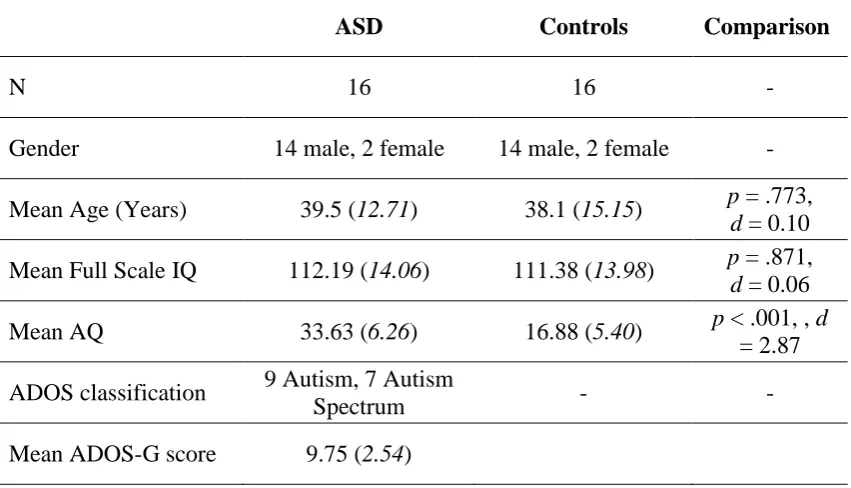
Thirty-two right-handed adults with (n = 16) and without (n = 16) ASD participated in the Experiment. All participants had normal or corrected-to-normal vision. All had received a diagnosis of ASD from a clinical practitioner in the United Kingdom. All participants also met the criteria for autism or ASD on the Autism Diagnostic Observation Schedule – Generic (ADOS-G; Lord et al., 2000). All participants completed a measure of autistic traits, the Autism-Spectrum Quotient (AQ: Baron-Cohen, Wheelwright, Skinner, Martin, & Clubley, 2001), on which the ASD group scored significantly higher than the control group (Table 1). Sample size was determined a priori based on power analysis assuming a large effect size (Cohen, 1988). Ethical clearance was granted by the local ethics committee and the study was conducted in line with the ethical guidelines laid down in the 6th (2008) Declaration of Helsinki. All participants gave informed consent.
Table-1
2.2 Stimuli and materials
Stimulus frames (see Figure 1a) were created by posing the eyes and mouth of an avatar face in Poser 7 (e frontier America, Inc.). Frames were saved as bitmaps and compiled into uncompressed audio-visual interleave (.avi) files using Matlab (The MathWorks, Inc.). Each movie comprised 40 frames saved and presented at 50 frames per second (fps). Irrespective of transition duration, one stimulus cycle always lasted .80 secs. During the experiment, stimuli completed 8 cycles and were therefore visible for 6.4 secs. Each avatar stimulus subtended 8° vertically when viewed at 60 cm. Experimental programs were written in Matlab with Psychtoolbox (Brainard, 1997; Pelli, 1997) and presented on a high-speed Samsung SyncMaster 2233RZ LCD monitor (refresh rate of 120 Hz).
2.3 Procedure
8
the eye transitions were faster for the standard or comparison. Responses were recorded using a keypad. Participants were free to fixate each face in turn. Concurrent mouthopening and -closing movements were presented on the standard, also at 1.25 Hz. The eye transitions, open-to-closed and vice versa, exhibited by the standard stimulus always lasted 140 ms. The mouth on the comparison stimulus remained closed throughout. Comparison eye transitions varied in duration from 20 ms (rapid transition) to 260 ms (slow transition) in steps of 40 ms (see Figure 1c). Orientation was manipulated by presenting the standard upright or inverted; the comparison stimulus was always presented upright. Whether the standard appeared on the right or left was counter-balanced. Trial type was interleaved within mini-blocks of 70 trials. Participants always completed 280 trials (7 comparison durations × 2 orientations × 20 presentations). The procedure was completed in a dimly lit and sound-proofed room.
Figure-1
3. Results
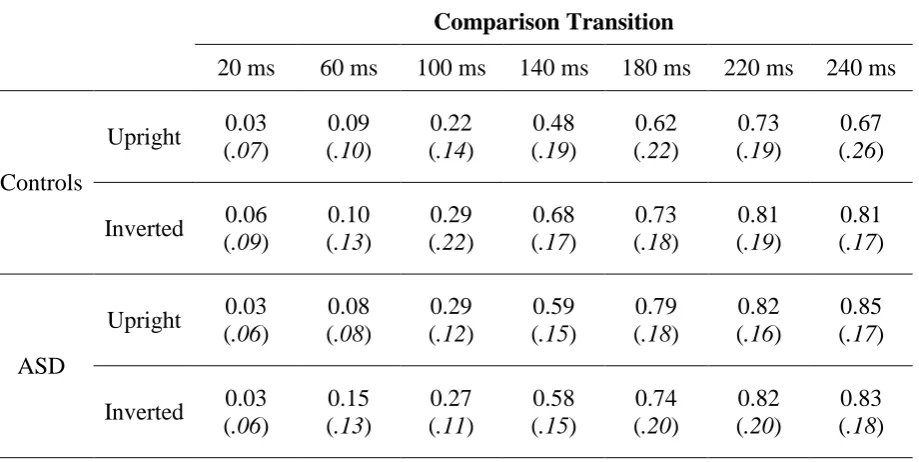
Separate psychometric functions (each modelling the probability the comparison eye-transition was judged slower than the standard eye-eye-transition as a function of the comparison duration; Table 2) were estimated for the upright and inverted conditions by fitting cumulative Gaussian functions in Matlab using the Palamedes toolbox (Prins & Kingdom, 2009). The perceived duration of the standard eye transition was inferred from the point of subjective equality (PSE) on each psychometric function; an estimate of the comparison transition duration necessary for the comparison and standard to be judged equivalent. In addition to the transition durations, we also estimated participants’ sensitivity to the physical differences between the different levels of eye transition, inferred from the slope of the psychometric function (Figure 2). Sensitivity estimates represent the standard deviation of the symmetric Gaussian distribution underlying the modelled cumulative Gaussian function, subjected to a log transform to attenuate positive skewing. The mean transition durations and sensitivities estimated for the ASD and control group are shown in Table 3.
Table-2 / Table-3
3.1 Perceived transition duration
9
a significant main effect of Orientation [F(1,30) = 6.957, p = .013, ηp2 = 0.19] and crucially, a
Group × Orientation interaction [F(1,30) = 12.431, p = .001, ηp2 = 0.29]. The transition
durations estimated for the control group were greater in the upright condition than in the inverted condition [t(15) = 3.728, p = .002, d = 0.72]. The upright transition durations estimated for the control group also exceeded the veridical duration of 140 ms [t(15) = 3.716.
p = .002, d = 0.94] as well as the transition durations estimated for the ASD group in the upright condition [t(25.970) = 2.570, p = .016, d = 0.91]. In contrast, the transition durations on inverted trials were not significantly different from the veridical duration [t(15) = 0.583, p
= .57, d = 0.15]. The transition durations estimated for the observers with ASD did not vary as a function of stimulus orientation [t(15) = .789, p = .442, d = 0.20]. Neither their upright [t(15) = .966, p = .349, d = 0.24] nor inverted duration estimates [t(15) = 1.026, p = .321, d = 0.26] exceeded the veridical duration of 140 ms. Acrorss the two groups the difference in perceived duration between the upright and inverted conditions was negatively correlated with autistic traits (r = - 0.37, p = .038).
Figure-2
3.2 Sensitivity to comparison transitions
The data were analyzed using ANOVA with Orientation (upright, inverted) as a within-subjects factor and Group (control, ASD) as a between-within-subjects factor. The analysis revealed a significant Group × Orientation interaction [F(1,30) = 8.118, p = .008, ηp2 = 0.21]. Whereas
the controls exhibited a trend towards less sensitivity in the upright condition [t(15) = 1.993,
p = .065, d = 0.49], likely a product of the illusion, the ASD group displayed less sensitivity in the inverted condition [t(15) = 2.286, p = .037, d = 0.56]. Importantly, the sensitivity of the two groups did not differ significantly in either the upright [t(30) = 1.608, p = .118, d = 0.57] or inverted [t(30) = .048, p = .962, d = 0.02] conditions. We note, however, that the non-significant trend observed in the upright condition was for superior sensitivity to changes in the comparison eye transitions in the ASD group.
4. Discussion
10
dynamic feature changes by comparing the susceptibility of observers with ASD and matched neurotypical controls to illusory feature slowing (Cook et al., 2015). The difference in the groups’ susceptibility to the illusion was striking: When neurotypical observers viewed eye-opening and -closing, the presence of asynchronous mouth movements induced illusory slowing thought to index the integration of feature dynamics. Consistent with the original description of the illusion (Cook et al., 2015), feature slowing was observed only in the upright orientation. The observers with ASD, however, showed little evidence of illusory slowing in either orientation, suggestive of reduced cross-feature integration. Free from the interference induced by feature integration processes, the estimated transition durations of the ASD observers were in fact more accurate, closer to the veridical duration of 140 ms, than the typical observers, when the avatar was viewed upright.
Observers with ASD experience difficulties recognizing facial motion signatures (i.e., the idiosyncratic changes associated with different genders and identities) and unlike typical observers, derive little benefit from upright presentation (O'Brien et al., 2014). The present results suggest that difficulties interpreting upright patterns of facial motion reflect problems integrating feature transitions into coordinated representations, possibly reflecting aberrant internal models of global facial change. Many segments of facial motion, including displays of facial emotion, yawning, sneezing and laughter, are defined by closely correlated eye and mouth transitions. In many cases, the timing of one feature change relative to the onset or offset of another, can drastically alter the communicative or affective message conveyed (Jack et al., 2014). Internal models of global facial change are thought to mediate efficient, accurate coding of this dynamic variation (Cook et al., 2015). While the lack of feature integration seen in ASD may enhance performance on contrived lab-based tasks requiring observers to judge one feature whilst disregarding another, it likely hinders face perception outside of the lab, where fast, accurate interpretation of facial motion is necessary to respond appropriately in social interactions.
11
they would have been less able to detect the physical differences when comparing eye transitions. Importantly, however, the two groups of observers showed comparable sensitivity to the physical differences between stimuli; indeed, the observers with ASD showed a trend towards greater sensitivity than controls when the avatar faces were upright. This is not what one would expect if the ASD group were simply looking away from the eyes and indicates that the striking group difference observed has a perceptual, not attentional, origin.
12 Acknowledgements
The research described in this article was supported by a Future Research Leaders grant
13 References
Abbas, Z. A., & Duchaine, B. (2008). The role of holistic processing in judgments of facial attractiveness. Perception, 37(8), 1187-1196.
American Psychiatric Association. (2013). Diagnostic and Statistical Manual of Mental Disorders (Fifth Edition ed.). Washington, DC: American Psychiatric Association.
Atkinson, A. P. (2009). Impaired recognition of emotions from body movements is associated with elevated motion coherence thresholds in autism spectrum disorders.
Neuropsychologia, 47, 3023-3029.
Baron-Cohen, S., Wheelwright, S., Skinner, R., Martin, J., & Clubley, E. (2001). The autism-spectrum quotient (AQ): evidence from Asperger syndrome/high-functioning autism, males and females, scientists and mathematicians. Journal of Autism and
Developmental Disorders, 31(1), 5-17.
Behrmann, M., Thomas, C., & Humphreys, K. (2006). Seeing it differently: visual processing in autism. Trends in Cognitive Sciences, 10(6), 258-264.
Bennetts, R. J., Butcher, N., Lander, K., Udale, R., & Bate, S. (2015). Movement Cues Aid Face Recognition in Developmental Prosopagnosia. Neuropsychology.
Brainard, D. H. (1997). The psychophysics toolbox. Spatial Vision, 10(4), 433-436.
Calder, A. J., Young, A. W., Keane, J., & Dean, M. (2000). Configural information in facial expression perception. Journal of Experimental Psychology: Human Perception Performance, 26(2), 527-551.
Chevallier, C., Kohls, G., Troiani, V., Brodkin, E. S., & Schultz, R. T. (2012). The social motivation theory of autism. Trends in Cognitive Sciences, 16(4), 231-239.
14
Cook, R., Johnston, A., & Heyes, C. (2012). Self-recognition of avatar motion: How do I know it's me? Proceedings of the Royal Society B: Biological Sciences, 279(1729), 669-674.
Cohen, J. (1988). Statistical Power Analysis for the Behavioral Sciences (Second Edition). Hillsdale, NJ: Lawrence Erlbaum Associates.
Diamond, R., & Carey, S. (1986). Why faces are and are not special: an effect of expertise.
Journal of Experimental Psychology: General, 115(2), 107-117.
Favelle, S., Tobin, A., Piepers, D., Burke, D., & Robbins, R. A. (2015). Dynamic composite faces are processed holistically. Vision Research, 112, 26-32.
Gauthier, I., Klaiman, C., & Schultz, R. T. (2009). Face composite effects reveal abnormal face processing in Autism spectrum disorders. Vision Research, 49(4), 470-478.
Happe, F., & Frith, U. (2006). The weak coherence account: detail-focused cognitive style in autism spectrum disorders. Journal of Autism and Developmental Disorders, 36(1), 5-25.
Harms, M. B., Martin, A., & Wallace, G. L. (2010). Facial emotion recognition in autism spectrum disorders: a review of behavioral and neuroimaging studies.
Neuropsychological Review, 20(3), 290–322.
Hill, H., & Johnston, A. (2001). Categorizing sex and identity from the biological motion of faces. Current Biology, 11(11), 880-885.
Jack, R. E., Garrod, O. G. B., & Schyns, P. G. (2014). Dynamic facial expressions of emotion transmit an evolving hierarchy of signals over time. Current Biology, 24(2), 187-192.
15
Klin, A., Schultz, S., & Jones, W. (2015). Social visual engagement in infants and toddlers with autism: Early developmental transitions and a model of pathogenesis.
Neuroscience and Biobehavioral Reviews, 50,189-203.
Knappmeyer, B., Thornton, I. M., & Bulthoff, H. H. (2003). The use of facial motion and facial form during the processing of identity Vision Research, 43, 1921-1936.
Knight, B., & Johnston, A. (1997). The role of movement in face recognition. Visual Cognition, 4(3), 265-273.
Lander, K., Bruce, V., & Hill, H. (2001). Evaluating the effectiveness of pixelation and blurring on masking the identity of familiar faces. Applied Cognitive Psychology, 15, 101-116.
Longmore, C. A., & Tree, J. J. (2013). Motion as a cue to face recognition: evidence from congenital prosopagnosia. Neuropsychologia, 51(5), 864-875.
Lord, C., Risi, S., Lambrecht, L., Cook, E. H., Jr., Leventhal, B. L., DiLavore, P. C., et al. (2000). The autism diagnostic observation schedule-generic: a standard measure of social and communication deficits associated with the spectrum of autism. Journal of Autism and Developmental Disorders, 30(3), 205-223.
Maurer, D., Le Grand, R., & Mondloch, C. J. (2002). The many faces of configural processing. Trends in Cognitive Sciences, 6(6), 255-260.
Morin, K., Guy, J., Habak, C., Wilson, H. R., Pagani, L., Mottron, L., et al. (2015). Atypical Face Perception in Autism: A Point of View? Autism Research.
Nishimura, M., Rutherford, M. D., & Maurer, D. (2008). Converging evidence of configural processing of faces in high-functioning adults with autism spectrum disorders. Visual Cognition, 16, 859–891.
16
O'Toole, A. J., Roark, D. A., & Abdi, H. (2002). Recognizing moving faces: a psychological and neural synthesis. Trends in Cognitive Sciences, 6(6), 261-266.
Pelli, D. G. (1997). The VideoToolbox software for visual psychophysics: transforming numbers into movies. Spatial Vision, 10(4), 437-442.
Pellicano, E., Gibson, L., Maybery, M., Durkin, K., & Badcock, D. R. (2005). Abnormal global processing along the dorsal visual pathway in autism: a possible mechanism for weak visuospatial coherence? Neuropsychologia, 43(7), 1044-1053.
Piepers, D. W., & Robbins, R. A. (2013). A Review and Clarification of the Terms "holistic," "configural," and "relational" in the Face Perception Literature. Frontiers in
Psychology, 3(559), 1-11.
Prins, N., & Kingdom, F. A. A. (2009). Palamedes: Matlab routines for analyzing psychophysical data. . http://www.palamedestoolbox.org.
Riby, D. M., & Hancock, P. J. (2008). Viewing it differently: social scene perception in Williams syndrome and autism. Neuropsychologia, 46(11), 2855-2860.
Richler, J. J., Mack, M. L., Palmeri, T. J., & Gauthier, I. (2011). Inverted faces are (eventually) processed holistically. Vision Research, 51(3), 333-342.
Schiltz, C., Dricot, L., Goebel, R., & Rossion, B. (2010). Holistic perception of individual faces in the right middle fusiform gyrus as evidenced by the composite face illusion.
Journal of Vision, 10(2), 25.
Schultz, R. T. (2005). Developmental deficits in social perception in autism: the role of the amygdala and fusiform face area. International Journal of Developmental
Neuroscience, 23(2-3), 125-141.
17
Simmons, D. R., Robertson, A. E., McKay, L. S., Toal, E., McAleer, P., & Pollick, F. E. (2009). Vision in autism spectrum disorders. Vision Research, 49(22), 2705-2739.
Susilo, T., Rezlescu, C., & Duchaine, B. (2013). The composite effect for inverted faces is reliable at large sample sizes and requires the basic face configuration. Journal of Vision, 13(13), 14.
Swettenham, J., Baron-Cohen, S., Charman, T., Cox, A., Baird, G., Drew, A., et al. (1998). The frequency and distribution of spontaneous attention shifts between social and nonsocial stimuli in autistic, typically developing, and nonautistic developmentally delayed infants. Journal of Child Psychology and Psychiatry, 39(5), 747-753.
Tanaka, J. W., & Farah, M. J. (1993). Parts and wholes in face recognition. Quarterly Journal of Experimental Psychology, 46(2), 225-245.
Teunisse, J. P., & de Gelder, B. (2003). Face processing in adolescents with autistic disorder: the inversion and composite effects. Brain Cogn, 52(3), 285-294.
Watson, T. L. (2013). Implications of holistic face processing in autism and schizophrenia.
Frontiers in Psychology, 4, 414.
Weigelt, S., Koldewyn, K., & Kanwisher, N. (2012). Face identity recognition in autism spectrum disorders: A review of behavioral studies. Neuroscience and Biobehavioral Reviews, 36(3), 1060–1084.
Yin, R. K. (1969). Looking at upside-down faces. Journal of experimental psychology, 81(1), 141-145.
18
Figure 1
19
Figure 2
20
Table 1: Mean age, Gender, Autism-Spectrum Quotient (AQ) and IQ scores for the ASD group and the matched neurotypical controls. Autism Diagnostic Schedule (ADOS) score and classification for the ASD group. Standard deviations are shown in italics inside parentheses.
ASD Controls Comparison
N 16 16 -
Gender 14 male, 2 female 14 male, 2 female - Mean Age (Years) 39.5 (12.71) 38.1 (15.15) p = .773,
d = 0.10 Mean Full Scale IQ 112.19 (14.06) 111.38 (13.98) p = .871,
d = 0.06 Mean AQ 33.63 (6.26) 16.88 (5.40) p < .001, , d
= 2.87 ADOS classification 9 Autism, 7 Autism
Spectrum - -
Mean ADOS-G score 9.75 (2.54)
[image:21.595.86.512.128.372.2]21
Table 2: The mean response probabilities for each Condition by Group.
Comparison Transition
20 ms 60 ms 100 ms 140 ms 180 ms 220 ms 240 ms
Controls
Upright 0.03 (.07)
0.09 (.10)
0.22 (.14)
0.48 (.19)
0.62 (.22)
0.73 (.19)
0.67 (.26)
Inverted 0.06 (.09)
0.10 (.13)
0.29 (.22)
0.68 (.17)
0.73 (.18)
0.81 (.19)
0.81 (.17)
ASD
Upright 0.03 (.06)
0.08 (.08)
0.29 (.12)
0.59 (.15)
0.79 (.18)
0.82 (.16)
0.85 (.17)
Inverted 0.03 (.06)
0.15 (.13)
0.27 (.11)
0.58 (.15)
0.74 (.20)
0.82 (.20)
0.83 (.18)
22
Table 3: The mean duration estimates for the two groups (left). The mean sensitivity estimates for the two groups (right). Standard deviations are shown in italics inside parentheses
Duration estimates Sensitivity estimates
Upright Inverted Upright Inverted
Controls 184.6 (48.0) 145.7 (39.4) 1.875 (.283) 1.974 (.280) ASD 147.7 (31.7) 153.3 (51.7) 1.880 (.300) 1.818 (.268)
[image:23.595.79.513.144.219.2]