INTERNATIONAL DESIGN CONFERENCE - DESIGN 2016
Dubrovnik - Croatia, May 16 - 19, 2016.THE INFULENCE OF PRODUCT COMPLEXITY ON
TEAM PERFORMANCE WITHIN NPD
[Authors: this will be inserted automatically]
Keywords: [this will be inserted automatically]
1. Introduction
The purpose of this paper is to explore the influence of product complexity on team performance within product development projects. Emerging trends within the product development and business environments have forced companies to explore and develop more complex products to satisfy the increasingly competitive and diverse market place. One of the key changes brought about these trends within product development processes have been cross-functional virtual teams and modular product development. It is however unclear how these changes impact the team dynamics, especially in relation to the complexity of the projects.
This paper explores these influences within a project-based learning environment. Through a longitudinal study of several European Global Product Realisation projects we explore the perceptions virtual teams have in relation to the outcomes of their projects. We explore two projects where several teams collaborated on delivering components of one product and two projects where the teams worked on the full product individually. Although in an education setting, the discussed projects provide valuable insight into the influence project complexity has on team performance.
2. Theoretical underpinnings
New product development (NPD) is a demanding and complex activity as it is, and its level of difficulty is additionally increased by the ever-changing business environment, primarily by functional association of geographically dispersed multicultural human resources [Žavbi and Tavčar 2005, Ball et al. 2012, Jansen 2004, Dayan and Di Benedetto 2010, Žavbi and Vukašinović 2015].
A virtual team is an organisational unit potentially capable to perform NPD within actual business environment. A virtual team is a group of geographically dispersed people who interact through interdependent tasks guided by a common purpose with the support of information and communication technology [Boudreau et al. 1998]. These teams are supposed to provide many advantages over traditional teams, including the ability to bridge time and space (e.g. ‘‘follow-the-sun’’ product development), better utilization of distributed human resources without physical relocation of employees, ability to hire the best people regardless of their location, and organizational flexibility [Biggs 2000, Lipnack and Stamps 2000, Paul et al. 2004].
Due to the virtual nature of development teams, most of the work process requires various means of electronic communication [e.g. Benedičič et al. 2015]. Communication tools can be categorized along four dimensions [Nemiro 2004]: time and place, social presence, and information richness. The time dimension refers to the synchronicity of communication. Synchronous communication occurs at the same time, while asynchronous occurs at different times. The dimension of place refers to the location of communication. Co-located communication occurs at the same place, while dispersed communication occurs at different places. Furthermore, the dimension of social presence refers to the level at which a specific communication tool facilitates sensitivity and a personal connection to others, while information richness is defined as “the potential information-carrying capacity of data” [Nemiro 2004, Daft, Lengel 1984]. Table 1 classifies some of the ICT tools according to the above-mentioned four dimensions. The asynchronous type of communication is characterised by a delay in feedback, which may lead to misunderstandings and miscommunication. Face-to-face interaction is considered the richest form of communication, but for virtual teams limited richness of communications may lead to further misunderstandings. Furthermore, synchronous types of communication offer a higher degree of social presence than asynchronous ones. Social presence is important because it facilitates the feeling of involvement and a sense of interpersonal dialogue [Nemiro 2004]. Improvements in processing capabilities and the availability of high speed internet have greatly facilitated the use of synchronous types of communication, especially via videoconferencing.
The communication methods and information contents to be shared within the teams were in a strong correlation with the phase of the NPD process, and each of the tasks required appropriate ICT infrastructure [Christophersen et al. 1994]. However, the results of some research studies have shown that the mere availability of ICTs does not necessary lead to their use. Therefore, it is essential to establish some standards for availability and acknowledgement of communication to define when dispersed teammembers should be available for collaboration and how quickly they should respond to the messages [Montoya et al. 2009].
Dimensions Types of
communication (tool)
Time Space Social presence Information
richness Face-to-face Same
(synchronous)
Same (co-located)
Highest Richest
Videoconferencing (e.g. Skype--audio-video, etc.) Same (synchronous) Different (dispersed)
High High
Audioconferencing (e.g. Skype--audio, conference phone calls, etc.) Same (synchronous) Different (dispersed)
Moderate Moderate
Instant messaging (e.g. Skype chat, Windows Live Messenger, Yahoo Messenger, etc.) Same (synchronous) Different (dispersed)
Moderate Low
Video recorded standup meeting [Giuffrida, Dittrich 2014] Different (asynchronous) Different (dispersed)
Moderate High
Shared workspace (e.g. BSCW)
Different (asynchronous)
Different (dispersed)
Low Moderate
E-mail Different
(asynchronous)
Different (dispersed)
Low Low
Voice mail Different (asynchronous)
Different (dispersed)
Low Moderate
The markets demand new products and services and put a lot of pressure on NPD teams to achieve high level of performance. Performance can be seen as process performance and product performance. Process performance refers to quality of the process performed by the team and is evaluated by metrics such as on-time and on-budget completion of the development process [Espinosa et al. 2012], knowledge transfer, acquisition of new and strengthening of existing competencies, trust building and satisfaction of virtual team members. Product performance refers to quality of the product developed within the process and is evaluated by metrics such as level of fulfilment of product specifications and level of user satisfaction.
Sivasubramaniam et al. found that internal communication, external communication, group cohesiveness and goal clarity (as team process variables) are paramount for the success of NPD team. Internal communication refers to frequency and openness of information exchange among team members, while external communication refers to the degree of information exchange with people outside the team and taking advantage of external resources. Group cohesiveness refers to level of interpersonal bonds. Group cohesiveness is more influential in case of intense and interconnected activities, as is the case of NPD. Goal clarity refers to the goal consensus within NPD team. It has been shown that specific and challenging goals are superior to ambiguous and easy goals [Sivasubramaniam et al. 2012].
Product complexity is characterized by [Novak, Eppinger 2001]:
the number of components; adding more parts to a product means more coordination;
the extent of interactions to manage between these components; the more interconnected are the parts, the more difficult is to coordinate the development;
the degree of novelty; application of new working principles/new architectures introduces new not well understood interconnections between components. Identification and understanding these interconnections increase difficulty of coordination.
Greater product complexity therefore increases coordination efforts during development process and affects communication and team performance. It is even more challenging to coordinate work in virtual setting.
3. The context
The basis for this research has been an international design and engineering student course called European Global Product Realisation (EGPR), which runs continuously since 2001. The course connects students from four European countries, four different universities which provide students with knowledge and experience in various disciplines. In the observed period of time, i.e. between 2012 and 2015, University of Ljubljana, Faculty of Mechanical Engineering; University of Zagreb, Faculty of Mechanical Engineering and Naval Architecture; London City University; and Budapest University of Technology and Economics participated in the class. The projects included students from different educational, cultural, knowledge, professional and language backgrounds. The teams are always formed internationally and multidisciplinary, to foster their communication and creativity. Prior to the prototype phase all communication and engagement is done through the use of IT tools and services.
This approach gives a special unique note to a course each year. The lectures, project management, course calendar, milestones and teams are carefully considered each year, to achieve optimal results. While the lectures, course calendar and milestones are routinely managed, the project complexity needs careful foreseeing, which can be optimally done only by experienced staff and industrial partners who have a good awareness of capabilities and knowledge of all involved partners. In the past, the EGPR course engaged with industrial projects that allowed each student team to deliver the product independently in its entirety; however in the last four years EGPR engaged with two larger projects, which needed special attention. The projects in 2013 and 2015 were too demanding to be realised only by one team in the time frame of one semester. Since the staff and company representatives anticipated this complexity, they restructured the course, so different international, multidisciplinary teams worked on the development of one product, where each team focused on a different module or element of the complex product. This approach reveals the necessity of cross-team collaboration, which has never been crucial in smaller projects where each team worked on their individual product. It immediately became clear, this communication needed to be formalised to be effective. Therefore two major steps have been foretaken: it was necessary to dedicate persons from each team, who were responsible for cross-team communication and decision making; and it was necessary to formalise the communication tools and channels so the communication would be clear, structured, uninterrupted and all crucial information would immediately be available for all project partners, not only cross-team communication representatives.
3.1 Brief description of the projects
2012
In 2012 the project was organised in collaboration with Suman d.o.o. company, located in Zagreb, Croatia and manufacturing facilities in Bosnia and Herzegovina. The task was to develop new, innovative ideas for professional commercial parasols, intended for use in cafés, bars and shopping centres. The low complexity of project allowed 5 international, multidisciplinary teams to work on their own 5 different products, all realised to the full scale working prototypes as shown in Figure 1.
[image:4.595.81.512.439.601.2]
Figure 1: two of five 2012 project prototypes - adaptive parasol systems
2013
more than one team. The final result was partially functional prototype of an airplane as seen on figure 2, demonstrating some crucial capabilities and features which ensure usability of the aircraft for wheelchair users, e.g. entering and leaving the airplane on a wheelchair, locking wheelchair in aircraft operating position and basic ergonomics of controls when piloting the aircraft in a wheelchair.
Figure 2: common 2013 project prototype - ultra light aircraft for wheelchair users
2014
The project in 2014 was done in collaboration with Bosch-Siemens company, department for small household appliances from Nazarje, Slovenia. The additional financial support was obtained by ERASMUS funds for organising the final workshop. The project task was to develop kitchen machines of the future. The company wanted to get fresh ideas about the future of autonomous meal preparation and kitchen device interaction with IT tools and technologies. To get several different ideas, the project supported 5 teams working on 5 different prototypes. Two of them are shown in Figure 3.
2015
Figure 3: two of five 2014 project prototypes - advanced kitchen meal preparators
[image:6.595.128.469.406.662.2]4. Methodological approach
This study employed a quantitative approach to explore the influence of product complexity on team performance within NPD projects. The participants of the study were Master students of engineering that were engaged in EGPR in years 2012, 2013, 2014 and 2015. All of student teams had to engage with a real company in providing a solution to the problem and at the end of the modules presented their findings and recommendations to the client. The students in 2013 and 2015 worked on developing a single product all together. Each student team was responsible for developing a component of a product and at the end of the project, all student teams had to build one working prototype for the client. The students in 2012 and 2014 on the other hand worked on individual projects separately, thus the client received several working prototypes at the end of the module. The survey was completed by 25 students in 2012, 12 students in 2013, 32 students in 2014 and 34 students in 2015.
The questionnaire used to explore the perceptions of the chosen students in relation to the product complexity and its influence on team performance was developed based on previous studies (for details see [Musa et al 2012] and [Okudan, Rzasa 2006]) and contained 15 items. The questionnaire focused on measuring the students' perception of how successful their project outcomes were and how the cultural, team member and information sharing differences affected the performance of the team. Students were also asked about their perception of the teaching approach and final results of the module. The questionnaire employed a 1-5 Likert type scale with 1 being “strongly disagree” and 5 being “strongly agree”. The students were also asked to comment on the overall satisfaction with the modules in an open-ended question. Some of their comments will be elaborated upon in support of the survey findings.
5. Results
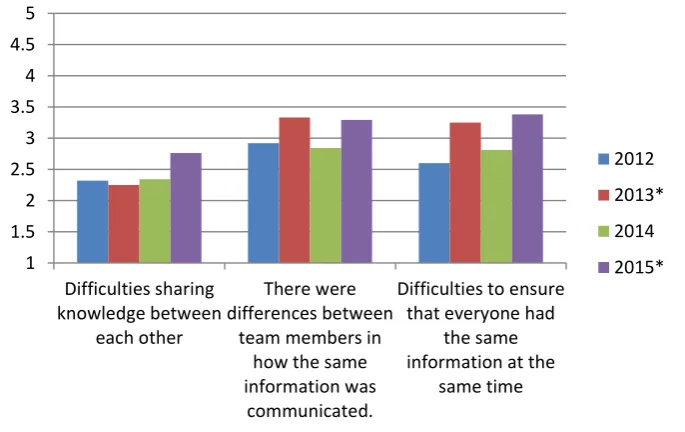
[image:7.595.127.470.502.718.2]The first set of questions was related to information sharing and knowledge exchange between the team members. The students were asked to evaluate the difficulties related to sharing knowledge with one another, differences between team members on communicating the same information and the availability of the same information to everyone. The results in figure 5 show that students working on different modules of the same product encountered more problems related to sharing and interpreting information than the students that worked on products independently. Although mitigation was provided from the start by the establishment of a cross-team to share information, the complexity of the product seemed to have influenced the perception of attained information.
Figure 5: Information and knowledge sharing among team members 1
1.5 2 2.5 3 3.5 4 4.5 5
Difficulties sharing knowledge between
each other
There were differences between
team members in how the same information was
communicated.
Difficulties to ensure that everyone had
the same information at the
same time
2012
2013*
2014
The need to have a greater amount of information to successfully manage and integrate different modules of one product is necessary for a successful outcome [Tavčar et al. 2005; Nemiro, 2004]. The results from the study supports this, as the students working on a common product across teams felt the need for further communication and resolution of information issues.
[image:8.595.89.500.283.536.2]The students were further asked to evaluate how the differences in culture between team members and the different levels of softer skills such as leadership, communication and interpersonal skills affected the development process and the overall performance of the team. The results in figure 6 indicate that culture was not considered a relevant factor, as students from all years disagreed with the statement that culture affected their process. There are however differences in the perception of how different skills affected the team performance. Especially in 2015, the students seem to be more inclined towards acknowledging an effect of these skills on team performance. The students of the course come from different educational backgrounds and disciplines, thus the differences in skills were expected. It seems however, the students were able to mitigate these differences effectively.
Figure 6: Influences of differences between team members
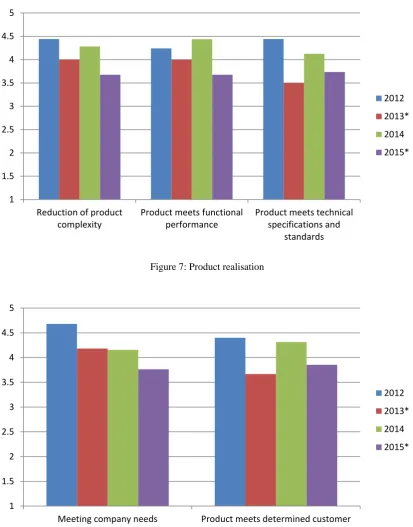
In the next section, the students were asked to evaluate how successfully they managed to reduce product complexity, whether the product met functional performance and the technical specifications. Overall, the student responses seemed to have been positive (figure 7). There is however evident difference in how satisfied the students were with regard to the reduction of product complexity. In both of the years where students worked on one project and different modules of the same product (2013 and 2015), the perception was that the reduction of product complexity was satisfactory, rather than excellent, whereas the students in 2012 and 2014 were extremely positive about the outcomes. Similarly, the technical specifications were met better in the projects, where students needed to develop the full product themselves. This would indicate that product complexity does have an influence on the overall outcome of the project, as perceived by the students.
1 1.5 2 2.5 3 3.5 4 4.5 5
The diffeneces between team members with regard to culture had a negative
effect on our development process.
The differences between team members with regard to written material, communication and leadership effected
our team's performance.
2012
2013*
2014
Figure 7: Product realisation
Figure 8: Meeting project requirements
Next, the students were asked to evaluate the final outcomes, in terms of satisfying company and customer needs (figure 8). The students that developed the least complex product (parasols in 2012) seemed to be the most satisfied with their outcome, whereas the students that worked on the two complex projects (2013 and 2015) were less satisfied with their market needs fulfilment. This can be attributed to the fact that low project complexity enabled the students to build a fully functioning product, thus giving them the chance to see how the company and customer needs were satisfied in practice, whereas the complex projects only delivered partially working prototypes and thus it was not completely clear how the product would work for the client.
1 1.5 2 2.5 3 3.5 4 4.5 5
Reduction of product complexity
Product meets functional performance
Product meets technical specifications and
standards
2012
2013*
2014
2015*
1 1.5 2 2.5 3 3.5 4 4.5 5
Meeting company needs Product meets determined customer needs
2012
2013*
2014
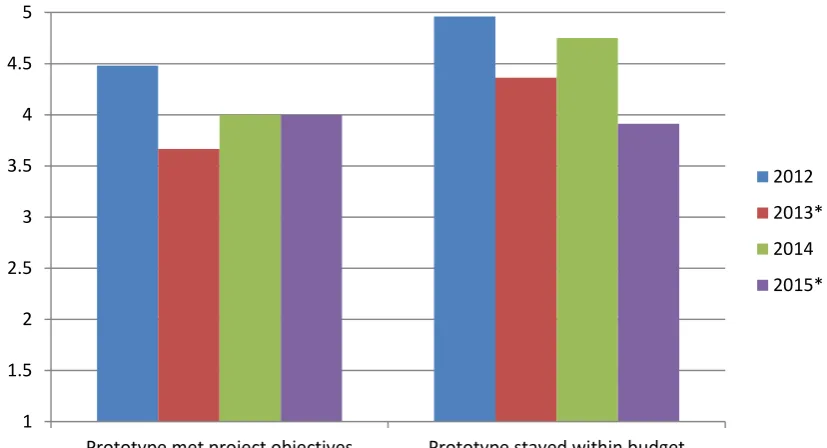
Finally, the students were asked to evaluate the prototype on the basis of how it met the project objectives and its relation to the budget (figure 9) . The students working on the complex projects were more critical on both occasions, as they were less satisfied with the prototype meeting the project objectives and (especially in 2015) their prototype was less in line with the budget.
Figure 9: Prototype success
6. Conclusions
This paper presents the results of surveys performed on four consecutive EGPR projects. The projects differed in project assignment and its complexity. The focus of these surveys was on the influence of project complexity on virtual team performance. The performance has been monitored from various aspects: information and knowledge sharing among participants; influences of differences between team members; product realisation; meeting project requirements; and prototype success. The four year time span gave us the opportunity to gain larger survey population and identify trends independent of specifics of various projects. In four years we had the opportunity to observe two project assignments, where 5 different virtual teams worked on 5 individual concepts and prototypes, and two more complex project assignments where 5 different teams had to work on different modules of a single complex product. More specific, the individual concepts required only communication within one virtual team while teams working on specific module of a complex product have to coordinate and communicate, not only within the virtual team itself, but also across all project virtual teams. Thus, cross team communication brings additional constraints to the project, therefore it would be recommended to ease and facilitate team performance by formalising cross team communication protocols and ICT tools. Increase in product complexity causes increase of coordination and communication efforts. In absence of face-to-face meetings, as it is in virtual NPD, the second richest ICT tool (i.e. multipoint video conference) is needed.
Academic virtual teams as used in EGPR are intentionally structured as virtual teams also in the case of development of individual modules of complex products. This fact artificially adds to increased coordination and communication needs. This approach is selected on purpose, because primary aim of EGPR is to face students with virtual NPD, while technical sophistication of solutions is of secondary purpose. In such a way all the students were exposed to work in international virtual environment and exclusion of individual students from international experience is prevented.
1 1.5 2 2.5 3 3.5 4 4.5 5
Prototype met project objectives Prototype stayed within budget
2012
2013*
2014
However, real industrial projects usually engage geographically dispersed teams of professionals, who work locally (i.e. in co-located environment) on a specific problem (i.e. development of particular module or component), but integration of product development runs globally in virtual environment. Such real industrial approach would reduce the efforts in coordination and communication in virtual collaboration.
The results indicate that realisation of complex products increases the demand for coordination and communication, which finally resulted in less satisfactory solutions. On the opposite, the survey showed that individual (i.e. less complex projects) gained more positive response in almost all question categories. However, we believe that all students who successfully completed these projects, regardless to the project assignment and product complexity, gained sufficient professional competences in virtual NPD process to face real industrial challenges in virtual environment.
Acknowledgement
The project in 2014was a part of Erasmus Lifelong Learning programme and has been funded with support from the European Commission. The project in 2015 was a part of Erasmus+ Strategic Partnership programme and has been funded with support from the European Commission. This communication reflects the views of the authors, and the Commission cannot be held responsible for any use which may be made of the information contained therein.
References
Ball, A.G.,Zaugg, H., Davies, R., Tateishi, I., Parkinson, A.R., Jensen, C.G., Magleby S.P. “Identification and Validation of a Set of Global Competencies for Engineering Students”, International Journal of Engineering Education, Vol. 28, No. 1, 2012, pp. 156-168.
Benedičič, J., Krek, J., Leben, V., Velez Vöröš, G., Beravs, T., Potočnik, S., Žavbi, R., Development of an automatic marketplace using virtual collaboration, Technical Gazette, Vol. 22, No. 2,2015, pp. 431-441.
Biggs, M., “Assessing risks today will leave corporate leaders well-prepared for the future of work”, InfoWorld, September 25, 2000, pp.100-100.
Christophersen, E., Coupe, P. S., Lenschow, R. J., Townson, J., “Evaluation of Civil and Construction Engineering Education in Denmark”, Centre for Quality Assurance and Evaluation of Higher Education in Denmark, Copenhagen, 1994.
Daft, R.L., Lengel, R.H. Information richness: A new approach to managerial behaviour and organization design, Research in Organizational Behavior, Staw, B.M., Cummings, L.L. (Eds.), JAI Press Greenwich Connecticut, 1984, pp.191-233.
Dayan, M., Di Benedetto, C.A., “The impact of structural and contextual factors on trust formation in product development teams”, Industrial Marketing Management, Vol. 39, No. 4, 2010, pp. 691-703.
Jansen, D.E., “Developing the intercultural competence of engineering students: a proposal for the method and contents of a seminar”, World Transactions on Engineering and Technology Education, Vol. 3, No. 1, 2004, pp. 23-28.
Lipnack, J., Stamps, J. “Virtual teams: People working across boundaries with technology”, 2nd ed., Wiley New York, 2000.
Montoya, M.M., Massey, A.P., Caisy Hung, Y-T., Crisp, C.B., “Can you hear me now? Communication in Virtual Product development teams, The Journal of product innovation management, Vol. 26, No. 2, 2009, pp. 139-155. Nemiro, J.E., “Creativity in Virtual Teams”, Pfeiffer San Francisco, 2004.
Paul, S., Seetharaman, P., Samarah, I., & Mykytyna, P. P., “Impact of heterogeneity and collaborative conflict management style on the performance of synchronous global virtual teams”, Information and Management, Vol. 41, No. 3, pp. 303–321
Tavčar, J., Žavbi, R., Verlinden, J. Duhovnik, J., “Skills for effective communication and work in global product development teams”, Journal of Engineering Design, Vol. 16, No. 6, 2005, pp. 557-576.