Rochester Institute of Technology
RIT Scholar Works
Theses Thesis/Dissertation Collections
2012
Metamorphosis
Jin Hee Park
Follow this and additional works at:http://scholarworks.rit.edu/theses
This Thesis is brought to you for free and open access by the Thesis/Dissertation Collections at RIT Scholar Works. It has been accepted for inclusion in Theses by an authorized administrator of RIT Scholar Works. For more information, please [email protected].
Recommended Citation
Rochester Institute of Technology
A thesis submitted to the faculty of
The College of Imaging Arts and Sciences
In candidacy for the degree of
Master of Fine Arts in Metals
Department of the School for American Crafts
Metamorphosis
by
JIN HEE PARK
Approvals
Chief Advisor: Leonard Urso
Date: / /
Associate Advisor: Juan Carlos Caballero-Perez
Date: / /
Associate Advisor: Eileen Bushnell
Date: / /
School for American Crafts Chairperson:
Robin Cass
Date: / /
I, Jinhee park, hereby grant permission to the Wallace Memorial Library of the Rochester Institute of Technology to reproduce my thesis, Metamorphosis in whole or in part. Any reproduction will not be for commercial use or profit.
Table of Contents
Approvals
……….2Abstract
……….5Introduction – Concept
……….6Influences and Inspirations
………..8The Body of Works
………...……….……...17Sculptural Work ……….………17
Jewelry Work ………..……...22
Conclusion
……….……….27Figures
……….29Sculptural Work ……….………30
Jewelry Work ………..……...43
List of Figures
Fig. 1 Metamorphosis I – Sensibility ……….30
Fig. 2 Metamorphosis I – Intelligence ……….32
Fig. 3 Metamorphosis I – Gift ……….34
Fig. 4 Cocoon I ……….38
Fig. 5 Cocoon II ……….40
Fig. 6 Pride I ……….44
Fig. 7 Pride II ……….45
Fig. 8 Blossom I ……….46
Fig. 9 Blossom II ……….48
Fig. 10 Blossom III ……….50
Fig. 11 Boundary ……….51
Fig. 12 Cage ……….53
Fig. 13 Buhwa I ……….54
Fig. 14 Buhwa II ……….55
Abstract
The purpose of this art is to present women’s transformed lives in society
through my life experiences. As a woman from South Korea, a country that
concretely separates women from men in a traditional way, I have expressed the
continuous changes in my life brought about by changes in the society where I
belong. I created various forms of cocoons that, like wombs, have protected me
from negative effects. I have also presented the variety of transformed women’s
lives in two types of art, sculpture and jewelry. The main concern for my thesis is to
develop line work in the various methods possible in textile techniques, which bring
pattern, rhythm, space, boundaries, scale, symmetry, and asymmetry. Through
these works, I have captured the images that represent women’s characteristics,
Introduction – Concept
Metamorphosis means any complete change in the substance, shape, or
form that redefines the characteristic of a thing. The lifecycle of a butterfly is a
typical example of metamorphosis. Like butterflies, human beings also change
through time, both physically and psychologically. Unlike the butterfly, however, we
cannot always predict a human’s future manifestation because these
transformations are often blocked and distorted by the culture in which they take
place.
For my thesis, I have chosen to present the metamorphosis of my life as a
woman in society in South Korea and from a culture that is traditionally
androcentrist. Many countries have had a similar historical structure, and while the
situation is improving in some respects, restrictions for women still exist. In the
1980s and 1990s, many barriers for women still existed in my culture, making it
and forced me into a sort of social cocoon. As I have grown older, the situation has
eased, and this change has triggered my own metamorphosis.
I am now a grown woman living in another country that has more
opportunities for women than my traditional Korean society did. This experience
has given me a different perspective on the role of women in society. Like the
caterpillar, I am preparing to break my boundaries for my next metamorphosis. To
share in the experiences of life, I have built cocoons, hidden myself in them, and
Influences and Inspirations
Because I am a female artist from South Korea, traditional Korean women’s
characteristics are primarily mine, too, and my characteristics have changed along
with changes in the environment.
The traditionally androcentric Korean society has had many barriers for
women, like ignorance, rejection, and degradation. For example, it was usually
males who were promoted in society. Females could not compete against males
even if they were talented. However, as society has become more modern, the
stigma in terms of more prominent positions for women has decreased as society
hasaccepted women. Despite the current changes, traditional barriers still exist for
women. Some believe that women are weak and so should be protected, thus
believing that they cannot stand in the same position as men in society. This
perception of women has affected them negatively and has played a significant
role in changing them. Living with society’s prejudices, women have created their
for improving themselves.
Historically, society has been slow to accept women in terms of granting
them equality with men. The prevalence of this situation led to the rise of
feminism,1 which is a collection of movements aimed at establishing and defining
equal political, economic, and social rights in order to provide equal opportunities
for women.
In the 2000s, people’s perception of women changed definitively. Because
women have been accepted in some sense into men’s roles, the discrimination
against women has been less visible. I was treated almost the same as a man
when I worked at a company, for example. Chores like ordering coffee or cleaning
desks were no longer considered to be only for women.
However, there are still some distorted situations for women in unexpected
places. First of all, the family structure, the basic unit of society, has remained
largely in the past and has, as a consequence, interfered with the development of
women. For example, in the case of my family, my parents did not allow me to
1
study abroad because they thought our world was too dangerous for women to
endure its perils. However, they easily allowed my brother to do it because he was
a male candidate who deserved it. This situation is very common.
In another case, a female friend had been well on the way toward her career
goals, but recently she traded her role in society as a career woman for that of
marriage and family. The most astonishing part was that no one asked her to quit
her job; it was her own decision to give herself to the care of her family. Her
decision was understandable, however, because in Korean households, men’s and
women’s chores are still visibly divided. That is, women would mostly carry out the
household duties. My mother’s generation—that is, women over fifty—think this
custom is normal because they have grown up with the custom and they have
raised their children in a similar way. Society is going through change; however, the
fundamental change is not easy. These roles are too deeply rooted to eradicate. A
radical approach to such women’s issues often causes women to retreat into what,
for myself and others, I have termed as “cocoons” or, to use another metaphor,
Before I decided to study abroad, I took a six-month trip to the United States.
It was my first overseas trip, and it triggered changes my life. The world I belonged
to was safe, but it also had many limitations, such as age or field restrictions for
women. Through my trip, I realized that I had been in small world, like a babe in the
woods. At that time, I was in my mid-twenties, which is not considered to be that
young in Korea. After quitting work, I tried to start learning a new field, which was
very different from what I had learned. However, I was too afraid to start over at
what I considered to be a not-very-young age. While I was in the United States,
however, I joined a few artistic social clubs, like dancing, drawing, and making
pottery, and met many women from other countries. They were learning something
new for starting a new life. I was even younger than many of the women in those
groups. The new environment of a new culture—Western culture—gave me new
perspectives on women and helped me break out of self consciousness about my
age. My experiences gave me courage and triggered my “metamorphosis.” In
some ways, the other women’s view of themselves was comparable to that of
have as significant roles in society as men.
As they age, human beings encounter mental and physical changes. The
physical changes are more evident in women than in men. Different epochs have
different standards of beauty for women’s bodies. Similarly, the changes in
women’s bodies in themselves hold many stories. Throughout time, artists have
used the human form as a topic of their art. The works of French American artist
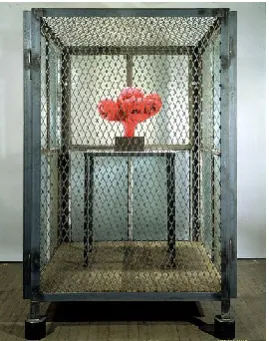
and sculptor Louise Bourgeouis2 are about women’s transformation stories, and
the shape of her works is relevant to my topic. Her works are wholly
autobiographical, inspired by her childhood trauma. The ways she created her
works have been a major influence for me in developing my body of work for my
thesis. Several of Louise Bourgeouis’s works show the restrictions and
degradations to which, from her perspective, women have been subjected.
2 Louise Bourgeouis (December 25, 1911–May 31, 2010): French-American artist, sculptor with
[image:14.612.340.459.471.645.2]
Fig. A Louise Bourgeouis, Temper Tantrum, 2000 Fig. B Louise Bourgeouis, Untitled, 2002
Fig. C Louise Bourgeouis, Femme Maison, 1992
[image:14.612.154.289.472.643.2]As an artist researching women’s lives, I came across and was drawn to a
new art technique, the textile technique, which uses lines to express artistic notions.
It is a historically acceptable feminine artistic medium, which has been typically
associated with soft materials, such as fabric, felt, or yarn. However, I wanted to
transfer the technique to a new material like metal to express ideas about women
in a new way. Thus, I have attempted to incorporate metal wires of different
thicknesses in my work in order to use many different textile techniques. For
example, the thinner the metal wire, the more malleable and softer it is, thus
becoming an expression of vulnerability and delicacy. Thin layers can be put
together for greater strength. I have used this idea to represent female
characteristics; a female has different forms—those of a girl, a woman, and a
mother—over the course of time. There is a saying, “Women are weak, but
mothers are strong.” That is, as time goes on, females become stronger, acquiring
layers in terms of depth of mind, like the results of the textile technique.
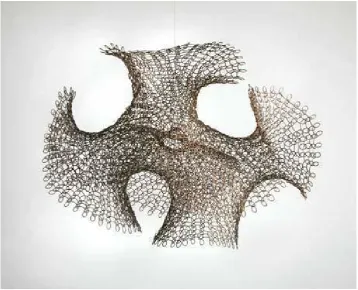
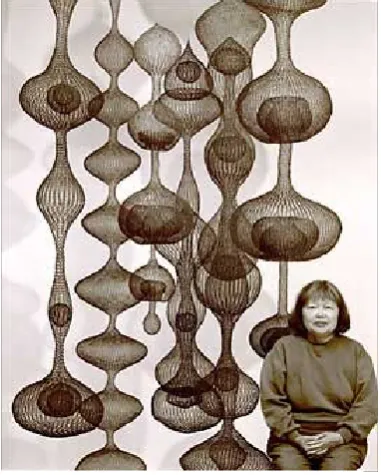
Many artists use this technique, and one is Ruth Asawa,3 a
3
American artist, who uses weaving techniques to create abstract works. Her
sculptures using crochet have served as an inspiration for my works, as she has
experimented with using commonplace materials in new and original ways. She
considers her woven sculptures made from iron, copper, brass, and many other
types of wire as three-dimensional drawings. These following figures are her
[image:16.612.127.486.341.631.2]representative art works that show her perspective.
Fig. I Roth Asawa, Seriese of Form within Form
[image:17.612.109.271.100.370.2] [image:17.612.211.402.413.651.2]The Body of Works
Sculpture Work
For sculptures, I tried to capture images of women prior to their
metamorphosis stage, building on such concepts as traumas or hidden emotions.
Based on my experiences, I used the form of the female body in various poses
because specific poses are able to express a variety of meanings under different
situations, unlike language, which many people may regard as having more fixed
ideas and meanings. With the effects I create, I hope that audiences will be able to
communicate with the works based on their own experiences.
I used thin wires with textile techniques, crocheting and knitting, to create a
visual effect by which the works look empty and light. This is symbolic of the
emptiness that people can feel when looking back at their own past. Dark colors
were used to express discolored memories of the past. Moreover, different scales
for the body structures allow the audience to look at the works from different
perspectives. I wanted to show the double-sided meaning of the sculpture works.
Cocoons, for example, can be viewed either as protections from the outside world
Metamorphosis I
- Sensibility (Figure 1)
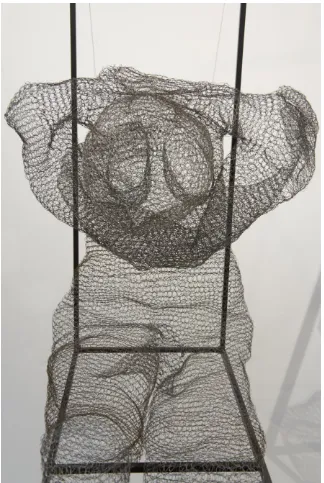
The Sensibility of Metamorphosis I presents changes in women’s emotions
as they face distinctive changes in their bodies. It is crocheted with steel wire and
placed in a cell made by steel rods. It shows mental immaturity in a woman who is
not able to understand and cope with the changes in her body because of mental
ignorance. The distinctive changes in the outline of the female chest embarrassed
me, and I wanted to conceal them and to shut myself up in a cell. To express this
particular thought, I constructed breasts on this piece and showed the figure trying
to hide the parts.
The figure is empty and rusted. This aspect expresses that time has passed
and that the soul has moved on from the past. The emptiness symbolizes the
soul’s ability to pass beyond the stage of mental ignorance. The reason I could
break out of that stage stemmed from the mental growth that came with physically
maturing as a woman. In addition, I realized that the parts are essential for not only
women’s lives, but also women’s beauty. This piece represents the start of my
- Intelligence (Figure 2)
Intelligence presents the stereotype of women that causes them to create
inner shelters to protect themselves and to put limitations on the outside world. It is
made of crocheted steel wire and is meant to represent one’s desire to escape
from within one’s cell. The interesting part of the piece is that it has an opening in
the head that is connected to the cell. It demonstrates the stereotypes stemming
from the conventional wisdom that affected me, represented by the cell, which I
had embedded into my own mind.
- Gift (Figure 3)
The Gift was also created by crocheted steel wire, but the index finger was
made differently. It was crocheted of fine silver wire and was connected to a spool
of fine silver wire outside of the cell in which the figure is placed. The pointing index
finger represents the direction in which I wish to go. The reason the finger is left
unfinished is that it represents hope, which is infinite, like a gift that instructs me of
my next step. Moreover, it will not be complete until the metamorphosis comes to
an end. The Gift expresses that my metamorphosis will not come to an end but will
Cocoon I (Figure 4)
I made the Cocoon Ⅰ of two different textile techniques, weaving and crocheting.
In the cell, which is made of copper rod, there is a pupa shaped like a cocoon
containing two legs. The legs represent a female. The cocoon visually shows
women having been in a cage. They have built it to protect themselves from all
other positive or negative surroundings. Moreover, although the shelter expressed
by the cage looks transparent and delicate, it is made with layers of woven wire,
which makes it more durable. This expresses women’s dual nature—that is, they
seem and can be soft and weak, but they are also strong in many ways.
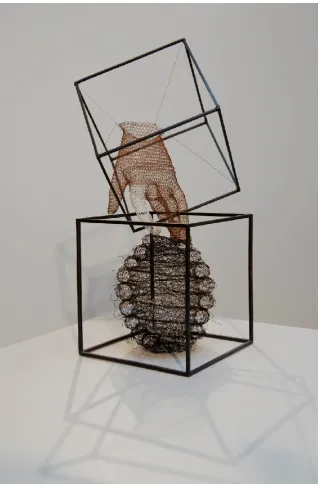
Cocoon II (Figure 5)
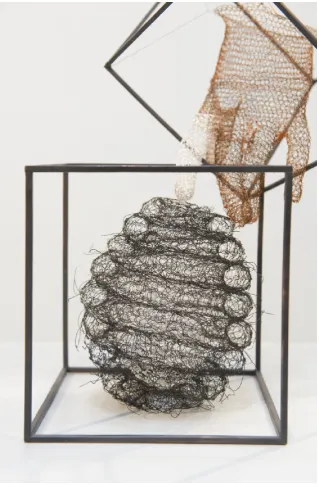
Cocoon Ⅱ was also built by weaving and crocheting techniques. It was made of
combining two different cells made of copper rod. One cell includes the pupa made
of crocheted silver wire that indicates one’s inner self, and the other cell includes a
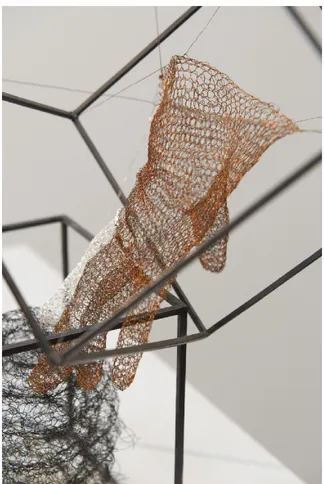
hand that is woven of copper and silver wires. This cell, created in the image of a
cocoon, is like the safe and cozy bosom of a mother. The cocoon represents not
the limitation that had impeded my growth. The hand from the first cell is touching
the cocoon in the other cell. The purpose of the hand is for deriving meaning from
its gestures, which are a significant medium for expressing one’s intention in
addition to using language. The index finger of the hand is touching the cocoon,
indicating the direction of desire. Silver wire was used to make the index finger so
Jewelry work
Jewelry is used by humans for many purposes: adorning the body, indicating
a relationship, or indicating one’s status. That is, jewelry decorates the body and
protects from another’s attention like a protective film, thus playing the role of a
boundary.
For example, larvae make pupae to endure the metamorphosis of becoming
a butterfly. The pupae are comfort zones, like the boundaries expressed through
sculpture, as well as a restraints on one’s freedom. However, the boundary
expressed through the jewelry indicates protection, like the glamorous patterns on
butterfly wings that protect it from predators. Women need protection when,
metaphorically speaking, they are bare skinned through the stages of
metamorphosis. That is, the jewelry functions as protection, like a butterfly’s wings.
Many different textile techniques and a variety of warm, bright colors,
representing gratitude and plenitude, were used to create the jewelry. I also made
an effort to use a variety of materials, such as mulberry paper, paper cord,
Pride I & II (Figure 6 & 7)
The Pride series express a woman’s pride in herself. Pride I was woven of fine
silver wire, and the end of each wire was made into a ball. Pride II was made with
mulberry paper, cut into thin sheets, coated with adhesive, and woven into a bundle
for weaving. Pride II was decorated with sterling silver charms on cords, attached
by woven silk thread. The idea for the title came from the way they are worn.
Chokers not only adorn the body, but also make a woman keep her head up. Thus,
they are an expression of overcoming insecurities and gaining confidence. The two
pieces were made with very thin silver wire and paper thread. The characteristics
of the materials create a delicate effect, which defines women.
Blossom I, II & III (Figure 8, 9 & 10)
The Blossom series is composed of a necklace, a bracelet, and rings. They
are in the form of forged sterling silver, combined with the basket shape of cup-like
flowers. The rings and the necklace were decorated with crocheted, colored copper
be spread to other places. Women are often referred to as flowers because of the
life cycle of flowers. The flowers start from seeds and buds, after which they
blossom, finally withering and falling off to scatter the seeds. This process is similar
to women’s lives. The Blossom series represents the changes of women’s lives.
Boundary (Figure 11)
The Boundary was created with knitted stainless steel wire wrapped around
a cord of woven paper with a long sterling silver pin. It can be either a hairpiece or
a brooch. It expresses freedom within the boundaries of society. We can never
really escape all boundaries because we will constantly face different ones
throughout our lives. Enjoying freedom within those boundaries is true freedom.
The use of contrasting colors, like white and red, and of different materials helps to
break the monotony of the repeated pattern from the weaving technique. This
Cage (Figure 12)
The Cage is jewelry shaped like a tool for knitting. The design is from the
weaving tool, which is the main technique used for my thesis work. To me, the tool
is the medium that creates a cage, and the cage could be either a shelter or a cell
depending on its use.
The top part of the ring is detachable. Depending on the number of bars on the
top part, the forms of the woven shapes change. The Cage shows the idea of
freedom within limitations.
Buhwa I & II (Figure 13 & 14)
“Buhwa” is a Korean word indicating the hatching of an egg. As you can infer
from the title, the forms of these two pieces are like a cracked egg. These works
abstractly express the hatching out of one world into a new world. The self that
hatched out of the old world points in one direction—that of desire. Wanting to
follow a strong desire for a particular road induces me to go through another stage
of metamorphosis. Buhwa Ⅰ & Ⅱ show the strong desire for a change that triggered
Metamorphosis II (Figure 15)
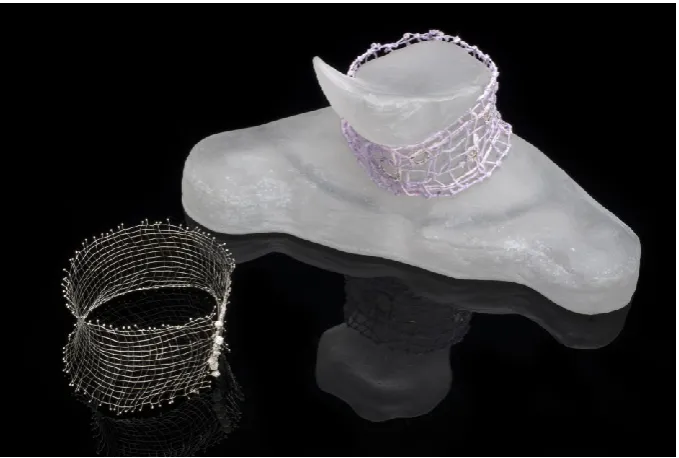
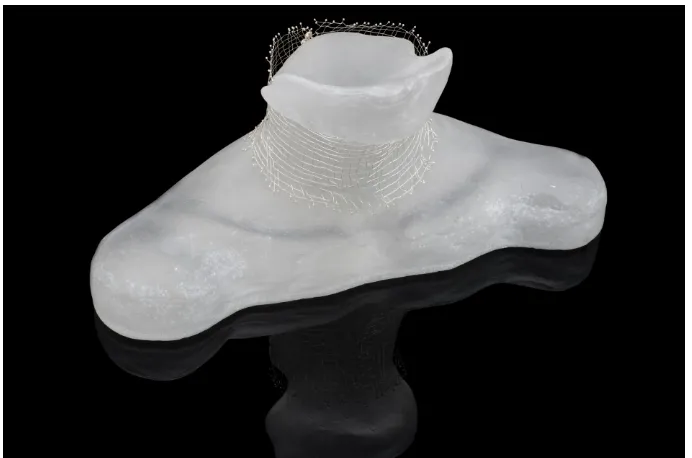
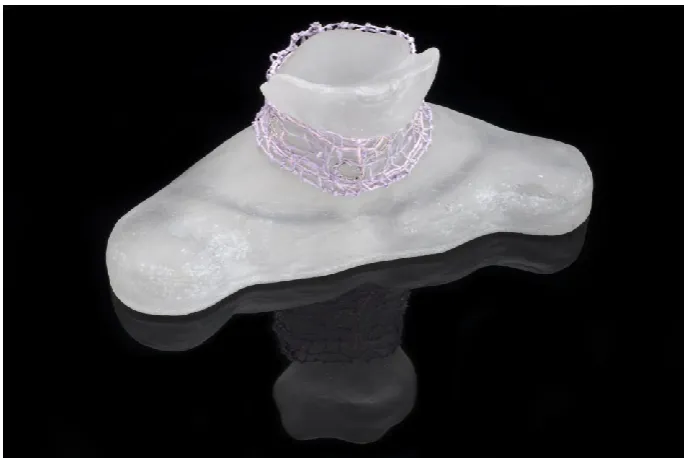
The last piece of the jewelry section, Metamorphosis II, is comprised of
different colors—blue, white, and purple—to express a change. Colors have their
own meaning in themselves. White was used in the interior part of this piece to
represent the purity of the inner self. Blue was used on the exterior to express
youth, as well as hope or happiness. In between is the purple that wraps the inner
self, signifying hurt feelings and sorrow. The purple expresses the internal scars
that the inner self is holding. Although three different colors are used, they were all
chosen to exude a calming quality to avoid having the piece appear too complex.
Metamorphosis II also breaks the monotony from the regular pattern used in the
Conclusion
For my thesis, I wanted to reveal women’s psychological transformation
through my experienced perspective. This work would reflect feminism because the
artist who built these works is a woman, and the contents of the works are
women’s stories. However, I would like to draw not just feminism, by which women
assert their right for gender equality, but the unalloyed process of women’s
metamorphosis.
Thus, I tried to understand myself first so that I could draw upon the process.
I thought I could help the understanding of others by creating art after
understanding life in situations peculiar to women, and with the creature formed
from my own comprehension, I could win the understanding of audiences. Also, the
fruit of my experiences could take on worth as art.
I formed these processes of metamorphosis in sculpture and jewelry with
linear textile techniques that are historically acceptable female artistic applications.
The sculptures reflect the fixed boundary in which women exist, and they show that
women in boundaries are static. On the other hand, the jewelry presents both
Expressing comparable characteristics in jewelry is possible through such
characteristics of textile techniques as solid and transparent, or darkness and light.
I tried to use these techniques to bridge these opposing qualities and also to
portray women’s dual nature through those characteristics.
Hermann Hesse states, “The bird fights its way out of the egg. The egg is
the world. Who would be born must first destroy a world.” As Hesse implies, I have
had growing pains since I destroyed the cocoons that had protected me and in
which I had shut myself. Although it was not easy to escape from them, I could feel
that I was developing, even though I was in pain. However, I was almost the same
as naked when I emerged from the world in which I had been living. Thus, I needed
to create another boundary to protect myself, as the butterfly flaps its wings as
soon as it emerges from the pupa.
Throughout the preparation and completion of this thesis, I was able to
reflect on myself. I have not only metamorphosed in the changing situations and
developed, but have also learned wisdom to prepare for the next metamorphosis.
Moreover, the conceptual world of my art is a significant vehicle for me as a
Figure
Title Size Material
Fig.1
Fig.2
Fig.3
Metamorphosis I
Sensibility 3.5’H x 3.5’W x 1’D Steel
Intelligence 3.5’H x 4’W x 1’D Steel
Gift 3.5’H x 3’W x 1’D Steel
Fig.4 Cocoon I 1.5’H x 1’W x 1’D Copper wire, Steel
Fig.5 Cocoon II 0.5’H x 0.5’W x 0.5’D
0.5’H x 0.5’W x 0.5’D
Copper wire,
Fine Silver wire
Fig.6 Pride I 3”H x 4”W x 4”D Fine Silver Wire
Fig.7 Pride II 3”H x 4”W x 4”D Fine Silver Wire, Silk,
Mulberry Paper, Sterling Silver
Fig.8 Blossom I 8”H x 4”W x 3/4”D Sterling Silver,
Colored Copper Wire,
Gold Filled Wire,
Stretched Nylon Cord
Fig.9 Blossom II 2”H x 2”W x 2”D Sterling Silver,
Stretched Nylon Cord
Fig.10 Blossom III 1”H x 3/4”W x 3/4”D Sterling Silver,
Colored Copper Wire,
Gold Filled Wire,
Stretched Nylon Cord
Fig.11 Boundary 3”H x 4”W x 2.5”D
1’(pin)
Paper Cord,
Stainless Steel Wire,
Sterling Silver
Fig.12 Cage 1”H x 3/4”W x 3/4”D Sterling Silver,
Pearl
Fig.13 Buhwa I 3”H x 2”W x 2”D Sterling Silver,
Stretched Nylon Cord
Fig.14 Buhwa II 3”H x 2”W x 2”D Sterling Silver,
Fine Silver
Fig.15 Metamorphosis II 2’H x 4”W x 3/4”D Fine Silver Wire,
Sculpture
Jewelry
Figure 6 – Pride I - Front
`
Figure 7 – Pride II – Front
Figure 10 – Blossom III
Figure 11 – Boundary - Detail
Bibliography
Franz Kafka, [Metamorphosis], The Limited Edition Club, U.S.A., 1984
Jonathan Ames, [Sexual Metamorphosis], Vintage, U.S.A., 2005
Caroline Walker Bynum, [Metamorphosis and Identity], Zone Books, U.S.A., 2001
John Monroe Macgregor, [Metamorphosis], Creative Growth Art Center, U.S.A., 1999
Claudia Gian Ferrary, [Metamorphosis], Charta, Italy, 1997
Linda Holtzschue, [Understanding Color], U.S.A., 2001
Tim McCroight & Nicole Bsullak, [Color on Metal], Guild Publishing, U.S.A., 2001
Daniell Cornell. [The Sculpture of Ruth Asawa], University of California Press, 2006
Heribert Kuhn, [Hermann Hesse, Demian], Suhrkamp, Germany, 2000
Ajay Jindal, [Textile raw Materials], Pbhishek publication, India, 2007